1. Introduction
Mafic microgranular enclaves (MMEs) are common in granitic or dioritic rocks. Through the study of host rocks and MMEs, information about the composition of deep crustal materials, interaction between the crust and mantle and exchange of energy can be revealed, which potentially provides new constraints for the genesis, mineralization and tectonic setting of rocks (Perugini et al. Reference Perugini, Poli, Christofides and Eleftheriadis2003; Zhao et al. Reference Zhao, Guo, Fan, Li, Qin and Li2010; Liu et al. Reference Liu, Mao, Yao, Wang, Jia and Yang2017; Wang et al. Reference Wang, Qiu, Yu and Zhao2017; Plail et al. Reference Plail, Edmonds, Woods, Barclay, Humphreys, Herd and Christopher2018; Kazemi et al. Reference Kazemi, Kananian, Xiao and Sarjoughian2019). Therefore, the study of host rocks and MMEs has attracted extensive attention from geologists. MMEs usually have a typical fine-grained or porphyritic igneous rock structure, and so a genetic model of magma mingling has been recognized by most scholars. MMEs are considered effective evidence for the involvement of basic magma in the evolution of acidic magma in the model of magma mingling (Castro et al. Reference Castro, Moreno-Ventas and Rosa1990; Barbarin & Didier, Reference Barbarin and Didier1992; Waight et al. Reference Waight, Maas and Nicholls2001; Barbarin Reference Barbarin2005; Słaby & Martin, Reference Słaby and Martin2007; Liu et al. Reference Liu, Qiu and Li2013; Yang & Jiang, Reference Yang and Jiang2013). The Sr–Nd–Hf isotope compositions of MMEs are usually different from those of host rocks and show obvious heterogeneous characteristics. For some MMEs, however, the mineral assemblages and chemical and isotopic compositions are very similar to those of the host rocks. There are two main viewpoints on the causes and material sources of MMEs in this situation. The most common viewpoint is that the parent magma of MMEs should be sourced from the mantle, while the multiple similarities between MMEs and host rocks are caused by magma mingling between basic magma and granitic magma (Reid et al. Reference Reid, Evans and Fates1983; Vernon, Reference Vernon1984; Barbarin & Didier, Reference Barbarin and Didier1992; Barbarin, Reference Barbarin2005; XH Zhang et al. Reference Zhang, Mao, Zhang, Zhai, Yang and Hu2011; Yang et al. Reference Yang, Ge and Zhao2015; JJ Zhang et al. Reference Zhang, Wang, Castro, Zhang, Shi, Tong, Zhang, Guo, Yang and Maria Iaccheri2016). Another relatively rare viewpoint is that MMEs should have the same magmatic source as the host rocks and represent remnants of melting resistance in the source area of the host rocks (Chappell et al. Reference Chappell, White and Wyborn1987; Donaire et al. Reference Donaire, Pascual, Pin and Duthou2005; Shellnutt et al. Reference Shellnutt, Jahn and Dostal2010).
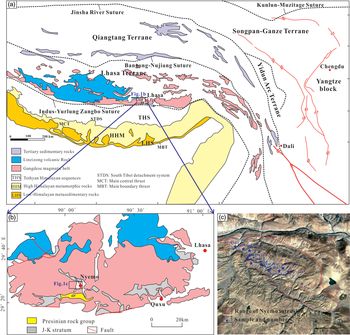
In response to the Indo-Asian continental collision (~65 Ma; Dong et al. Reference Dong, Mo, Zhao, Zhu, Wang, Chen and Li2006), the Gangdese magmatic belt formed across the southern Tibetan Plateau and is juxtaposed with the Indus–Yurlung Zangbo suture zone (IYS) (Mo et al. Reference Mo, Dong, Zhao, Guo, Wang and Chen2005; Dong et al. Reference Dong, Mo, Zhao, Zhu, Song and Wang2008). This Gangdese magmatic belt is c. 2000 km long and 100 km wide from east to west, with an exposed area of 110,000 km2 (Fig. 1a; Tu et al. Reference Tu, Zhang, Zhao and Wang1981; Gui et al. Reference Gui, Cheng and Wang1982; Jin, Reference Jin1986). Many dark enclaves are exposed in the southern Gangdese belt, forming a basic rock belt that corresponds to a clear aeromagnetic anomaly zone (Dong et al. Reference Dong, Mo, Zhao, Zhu, Wang, Chen and Li2006). The basic rocks and granites are closely associated in space, and their crystallization ages are concentrated in the Eocene (53–40 Ma). Previous studies have shown that magma mixing is the most important mechanism for the formation of the Gangdese magmatic belt, which records information on crust–mantle interactions and their tectonic significance (Sisson et al. Reference Sisson, Grove and Coleman1996; Dong et al. Reference Dong, Mo, Zhao, Zhu, Wang, Chen and Li2006, Reference Dong, Mo, Zhao, Zhu, Song and Wang2008; Renna et al. Reference Renna, Tribuzio and Tiepolo2007; Zhang et al. Reference Zhang, Zhao, Kroˇner, Liu, Xie and Chen2009; Li et al. Reference Li, Qiu and Xu2012; Qiu et al. Reference Qiu, Wang, Zhao and Yu2015).
Geological maps of (a) the Tibetan Orogenic Belt (modified from Hou & Wang, Reference Hou and Wang2008), (b) Quxu–Nyemo area, southern Tibet, (modified from Ma et al. Reference Ma, Xu and Meert2016) and (c) Google Earth image showing the sample locations.

The Nyemo intrusion is located in the middle part of the Gangdese magmatic belt, and is mainly composed of host diorites and MMEs. Compared with other parts of the Gangdese magmatic belt, the host diorite in the Nyemo intrusion has a mineralogy similar to that of the MMEs, which represent the least evolved magma in the Gangdese magmatic belt and therefore are most likely to provide information about the mantle components of the source. Such information can provide a better understanding of the time and mode of the growth of the Gangdese continental crust since the Indo-Asian collision. Differences are also observed in the chemical contents between host diorites and MMEs in the Nyemo intrusion. Thus, the question is whether the MMEs were formed by the accumulation of host magma or represent a different end-member from the host magma. Furthermore, the deep processes and evolution mechanism underlying the Gangdese magmatic belt must be determined. Based on these questions, the Nyemo intrusion in the southern Gangdese is selected as the research object. Here, we report zircon U–Pb geochronological and whole-rock geochemical data for host diorites and MMEs, and electron probe data for hornblendes in the diorites and MMEs, and combine mineralogy, petrology, petrogeochemistry and isotope geochemistry analyses to discuss (1) the genetic type of MMEs in the Nyemo intrusion; (2) the source and original physicochemical conditions of the host magma and MME magma; and (3) the deep geodynamic processes in the Gangdese magmatic belt. This study provides a basis for exploring the deep crust–mantle processes involved in the Indo-Asian continental collision.
2. Geological setting and sample
2.a. Geological setting
The ‘roof of the Earth’ or the Tibetan Plateau was formed by the successive accretion of diverse exotic terranes above a thickened block of continental crust (Tapponnier et al. Reference Tapponnier, Xu, Roger, Meyer, Arnaud, Wittlinger and Yang2001; Yin et al. Reference Yin, Dubey, Kelty, Webb, Harrison, Chou and Célérier2010 a, b; Zhang et al. Reference Zhang, Dong, Liu, Lin, Yan and Santosh2012; Cai et al. Reference Cai, Ding, Laskowski, Kapp, Wang, Xu and Zhang2016; Xu et al. Reference Xu, Hou, Zheng, Wang, He, Zhou, Wang, He, Zhou and Yang2017). The collisional orogenic belt of the Tibetan Plateau is divided into the Songpan–Ganze terrane, Qiangtang terrane, Lhasa terrane and Himalayan terrane from north to south, which are bounded by the Jinsha River suture zone (JS), the Bangong–Nujiang suture zone (BNS) and the IYS from north to south (Fig. 1a; Yin & Harrison, Reference Yin and Harrison2000). The Lhasa terrane has a mid-Proterozoic and early Cambrian basement covered by a sequence of Palaeozoic–Mesozoic sedimentary rocks that are dominated by Ordovician–Triassic shallow-marine clastic rocks (Burg & Chen, Reference Burg and Chen1984; Kind et al. Reference Kind, Ni, Zhao, Wu, Yuan, Zhao, Sandvol, Reese, Nabelek and Hearn1996).
Located in the southern margin of the Lhasa terrane, the 2000 km long and 100 km wide Gangdese magmatic belt was intruded parallel to the IYS and crops out over an area of 110 000 km2. Detailed chronological studies of the Gangdese magmatic belt over the past ten years show that magmatic activity in this area can be divided into four stages: 205–152 Ma, 109–80 Ma, 65–41 Ma and 33–13 Ma (Fig. 1b; Ji et al. Reference Ji, Wu, Chung, Li and Liu2009 a, b; Zhu et al. Reference Zhu, Zhao, Pan, Lee, Kang, Liao, Wang, Li, Dong and Liu2009; Lee et al. Reference Lee, Luffi, Chin, Bouchet, Dasguptam, Morton, Roux, Yin and Jin2012; Kang et al. Reference Kang, Xu, Wilde, Feng, Chen, Wang, Fu and Pan2014; Ma et al. Reference Ma, Xu and Meert2016). The magmatic rocks from 65 to 41 Ma are the products of the main collision stage of the Indian and Asian terranes, and are the most widely distributed (Mo et al. Reference Mo, Dong, Zhao, Guo, Wang and Chen2005; Wen et al. Reference Wen, Liu, Chung, Chu, Ji, Zhang, Song, Lee, Yeh and Lo2008; Guo et al. Reference Guo, Liu, Liu, Liang, Wang and Chen2011), especially the volcanic rocks of the Linzizong Formation around the Linzhou Basin. Previous studies on its chronology and petrogenesis show that the Linzizong Formation is divided into the Dianzhong (65–60 Ma; Zhou et al. Reference Zhou, Mo, Dong, Zhao, Qiu, Wang and Guo2004), Nianbo (56.4–54.1 Ma; Zhou et al. Reference Zhou, Mo, Dong, Zhao, Qiu, Wang and Guo2004; Li et al. Reference Li, Chung, Wang, Zhu, Yang, Song, Liu and Wu2007), and Pana (54–44 Ma; Zhou et al. Reference Zhou, Mo, Dong, Zhao, Qiu, Wang and Guo2004) groups, which are dominated by andesitic, dacitic and rhyolitic volcanics, respectively (Mo et al. Reference Mo, Zhao, Deng, Dong, Zhou, Guo, Zhang and Wang2003). Linzizong volcanism is associated with a change in tectonic regime from Neo-Tethyan subduction to Indo-Asian collision (Mo et al. Reference Mo, Zhao, Deng, Dong, Zhou, Guo, Zhang and Wang2003, Reference Mo, Hou, Niu, Dong, Qu, Zhao and Yang2007). The collisional intrusive rocks corresponding to the Linzizong Formation can also be divided into three magmatic assemblages: a crust-derived granite assemblage (66–50 Ma), a crust/mantle mixed granite–gabbro assemblage (52–47 Ma) and a mantle-derived basaltic subvolcanic–diabase dike assemblage (42 Ma) (Dong et al. Reference Dong, Mo, Zhao, Zhu, Wang, Chen and Li2006; Guo et al. Reference Guo, Liu, Liu, Liang, Wang and Chen2011). Among these rocks, the crust/mantle mixed granite–gabbro assemblage is represented by the Quxu batholith with various rock types ranging from basic to acidic and mainly consisting of granodiorite, quartz diorite, quartz monzonite and monzonitic granite, which are also rich in MMEs (Hou et al. Reference Hou, Gao, Qu, Rui and Mo2004; Hou & Wang, Reference Hou and Wang2008; Meng et al. Reference Meng, Xu, Santosh, Ma, Chen, Guo and Liu2016). The MMEs in the ~50 Ma host rocks are all formed in ~50 Ma (Dong et al. Reference Dong, Mo, Zhao, Zhu, Wang, Chen and Li2006; Ma et al. Reference Ma, Meert, Xu and Zhao2017). The Nyemo intrusion is located in the west of the Quxu batholith and in the middle part of the Gangdese magmatic belt (Fig. 1b). The Quxu batholith and the Nyemo intrusion share a similar crystallization age (52~47 Ma) and petrographic composition, and abundant MMEs have been recognized in both of them (Dong et al. Reference Dong, Mo, Zhao, Zhu, Wang, Chen and Li2006, Reference Dong, Mo, Zhao, Zhu, Song and Wang2008; Ma et al. Reference Ma, Xu and Meert2016).
2.b. Sample characteristics
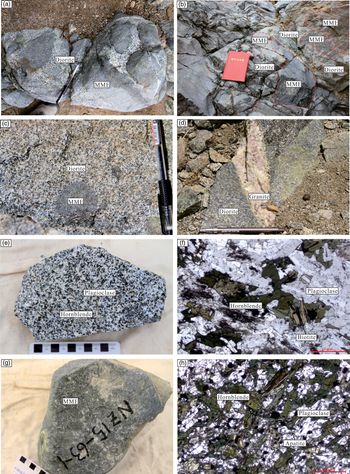
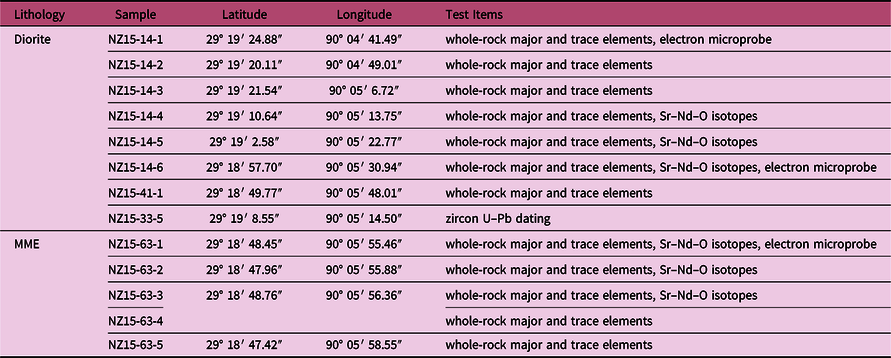
The Neymo intrusion is an elliptical intrusive body with an area of c. 50 km2 and is mainly composed of diorite (Fig. 2a–c). MMEs are unevenly distributed in the intrusion in round or irregular shape. When present, the MMEs can represent 60–70 % of the outcrop area at most, and only <1 % in other parts. The boundary between the MMEs and host diorite is either sharp or displays a transitional zone with gradually lighter colour from the interior outward, and sometimes reverse veins of host rocks can be seen in the MMEs (Fig. 2a). In addition, plastic flow occurs between the diorites and MMEs (Fig. 2b). Our study focuses on outcrops along a mountain valley which is closely associated with the fault movement. Samples of host diorites and MMEs have been collected from the Nyemo intrusion along the valley (Fig. 1c; Table 1). The diorite in the Nyemo intrusion is nearly homogeneous, has a grey-green colour and is medium- to coarse-grained. The main minerals are hornblende (30–35 %) and plagioclase (40–55 %), with small amounts of potassium feldspar, quartz and biotite (Fig. 2e, f). The accessory minerals are mainly zircon and short columnar apatite. The sizes of the MMEs vary greatly, present diameters ranging from 2 cm to 1 m, and show a grey-black colour in general. The MMEs exhibit a fine-grained texture and contain plagioclase (20–25 %), hornblende (50–75 %) and small amounts of biotite and quartz (Fig. 2g, h). MMEs contain many apatite grains, which are long and columnar and have length/width ratios between 10:1 and 20:1, thus showing the characteristics of quenched crystallization. The xenocrysts in the MMEs are mainly quartz grains, and their sizes and shapes are similar to those of quartz in the host diorite. It is speculated that these phenocrysts in MMEs originated from the host magma. Vein-like K-feldspar granite cutting across the diorite can be seen only in part of the intrusion with a sharp, linear contact line (Fig. 2d). They are rare and present a very small percentage (<1 %) of the outcrop area. The granite vein has a width from 2 cm to 8 cm, and medium- to coarse-grained texture and is mainly composed of potassium feldspar (50–60 %) and quartz (40–50 %). In both the diorite and MME of the Nyemo intrusion, some of the hornblendes are altered into biotite or chlorite, and only fresh samples were selected for the whole-rock geochemical, isotopic and electron probe analyses after they were identified under the microscope.
Petrologic characteristics of rocks from the Nyemo intrusion. (a–c) Diorite and MME in Nyemo intrusion; (d) Diorite is cross-cut by K-feldspar granite; (e–f) hand specimen and microphotograph of diorite; (g–h) hand specimen and microphotograph of MME.

Samples locations, characteristics and test items in the Nyemo intrusion

3. Analytical methods
3.a. Whole-rock major and trace elements
The whole-rock major and trace elements compositions of the samples analysed in this study were determined by X-ray fluorescence (XRF) and inductively coupled plasma mass spectrometry (ICP-MS), respectively, at the National Geological Analytical Center, Chinese Academy of Geological Science (CAGS), China. All the samples tested here were fresh and not significantly affected by alteration. In the test of these samples by ICP-MS, GBW07111 (Granodiorite) and GBW07105 (Basalt) were used as the standard samples and the error ranges were within 5 %.
3.b. Zircon geochronology and Hf isotopes
Zircon U–Pb dating was completed at Nanjing Hongchuang Geological Exploration Technology Service Co., Ltd. An Australian Scientific Instruments RESOlution LR laser ablation system (Canberra, Australia) and Agilent Technologies 7700x quadrupole ICP mass spectrometer (Hachioji, Tokyo, Japan) were combined for the experiments. The 193 nm ArF excimer laser, which is homogenized by a set of beam delivery systems, was focused on a zircon surface with a fluence of 3.5 J cm−2. The ablation protocol adopted a spot diameter of 30 μm at a 5 Hz repetition rate for 40 s (equating to 200 pulses). Helium was applied as a carrier gas to efficiently transport aerosols to the ICP-MS instrument. The Isoplot 4.15 software was used to calibrate the test data, calculate the weighted average age and draw the U–Pb age concordia diagram. Zircon 91500 was used as an external standard to correct for instrumental mass discrimination and elemental fractionation during the ablation. Zircon GJ-1 was treated as quality control for the geochronology. The lead abundance of zircon was externally calibrated against NIST SRM 610 with Si as an internal standard, while Zr was used as an internal standard for other trace elements (Liu et al. Reference Liu, Hu, Zong, Gao, Gao, Xu and Chen2010 a; Hu et al. Reference Hu, Liu, Chen, Zhou, Li, Zong, Zhu and Gao2011). Raw data reduction was performed off-line with the ICPMSDataCal software (Liu et al. Reference Liu, Hu, Zong, Gao, Gao, Xu and Chen2010 a, b).
In situ zircon Hf isotope analyses were performed using a GeoLas Pro laser ablation system coupled to a Neptune multiple collector ICP-MS instrument at the Key Laboratory for the Study of Focused Magmatism and Giant Ore Deposits, MLR, Xi’an Center of Geological Survey, China Geological Survey. Details of the instrumental conditions and data acquisition procedures are similar to those described by Hou et al. (Reference Hou, Li, Zou, Qu, Shi and Xie2007) and Meng et al. (Reference Meng, Liu, Liu, Liu, Yang, Wang, Shi and Cai2014). A stationary laser ablation spot with a beam diameter of 50 μm was used for the analyses. The ablated aerosol was carried by helium and then combined with argon in a mixing chamber before being introduced to the ICP-MS plasma. All Hf analyses were performed on the same spots as U–Pb laser ablation. Zircon GJ-1 was used as the reference standard and yielded a weighted mean 176Hf/177Hf ratio of 0.282030 ± 40 (2 SE) during this study.
3.c. Sr–Nd–Pb–O isotopes
The test samples for the Sr–Nd–Pb–O isotopes are whole-rock samples. Rb–Sr, Sm–Nd and Pb–Pb isotope analyses were completed at the Radiogenic Isotope Geochemistry Laboratory of China University of Science and Technology. The powdered sample of c. 100 mg was accurately weighed in a Teflon container, mixed into eight to ten drops of purified HClO4 acid and shaken, and then 2–3 ml of purified HF acid was added. The sample was heated in a closed chamber for approximately one week to fully dissolve the sample. Separation and purification of the Rb–Sr isotopes were completed in a quartz exchange column with 5 ml AG50W-X12 exchange resin (200–400 mesh), and the separation and purification of Sm–Nd isotopes were completed in a quartz exchange column with 1.7 ml Teflon powder. The separation and purification of Pb isotopes were completed in AG1-X8 anion exchange resin (200–400 mesh). The isotope ratios were measured using a MAT-262 thermal ionization mass spectrometer from Finnigan Company in Germany. The Rb–Sr isotope ratios were measured with a Ta metal band and Ta emitter; the Sm–Nd isotope ratios were measured with a Re metal band; and the Pb isotope ratios were measured with a single Re metal band and silica gel as the emitter. The measured isotope ratios were calibrated by mass fractionation using 86Sr/88Sr = 0.1194 and 146Nd/144Nd = 0.7219. The long-term measurement result of standard NBS987 was 87Sr/86Sr = 0.710249 ± 0.000012 (n = 38), and that of the standard solution La Jolla was 143Nd/144Nd = 0.511869 ± 0.000006 (n = 25). The measurement result of the NBS981 standard for Pb isotopes was used for mass fractionation correction of the Pb isotopes. Several measurements showed that the fractionation coefficient of Pb isotope was 0.1 % per atomic mass unit (p.a.m.u.) at 1300 °C. The accuracies of the Sr and Nd isotope ratios were better than 0.003 %, and that of the Pb isotope ratio was better than 0.01 %. The backgrounds for the Sr, Nd and Pb isotope analyses were <200 pg, <100 pg and <200 pg, respectively. Detailed isotope analysis procedures can be found in Chen et al. (Reference Chen, Hegner and Todt2000, Reference Chen, Siebel, Satir, Terzioglu and Saka2002, Reference Chen, Li, Wang, Li and Siebel2007).
For the oxygen isotope analysis of silicates, O2 was prepared by the BrF5 method and then converted into CO2 by reacting with a graphite rod at 700 °C. CO2 was measured using a Finnigan MAT 253 mass spectrometer at the Key Laboratory on Isotope Geology, Institute of Mineral Resources, Chinese Academy of Geological Sciences. The analytical reproducibility in this study was ±0.2 per ml for O isotopes.
3.d. Electron probe
Carbon injection and sample testing of the probe were completed at the Electron Probe Laboratory of the Institute of Mineral Resources, Chinese Academy of Geological Sciences. A JXA-8230 electron probe analyser produced by the JEOL company of Japan was used to analyse the chemical composition of the minerals in the experiment. The acceleration voltage was 15 kV, the beam current was 2.0 × 10⁻⁸ A and the beam spot size was 5 µm. The detection limits for major elements were c. 0.01 %. The standard minerals were jadeite (Na, Al and Si), forsterite (Mg), topaz (F), potassium feldspar (K), wollastonite (Ca), hematite (Fe), rutile (Ti) and apatite (P).
4. Results
4.a. Whole-rock major and trace elements
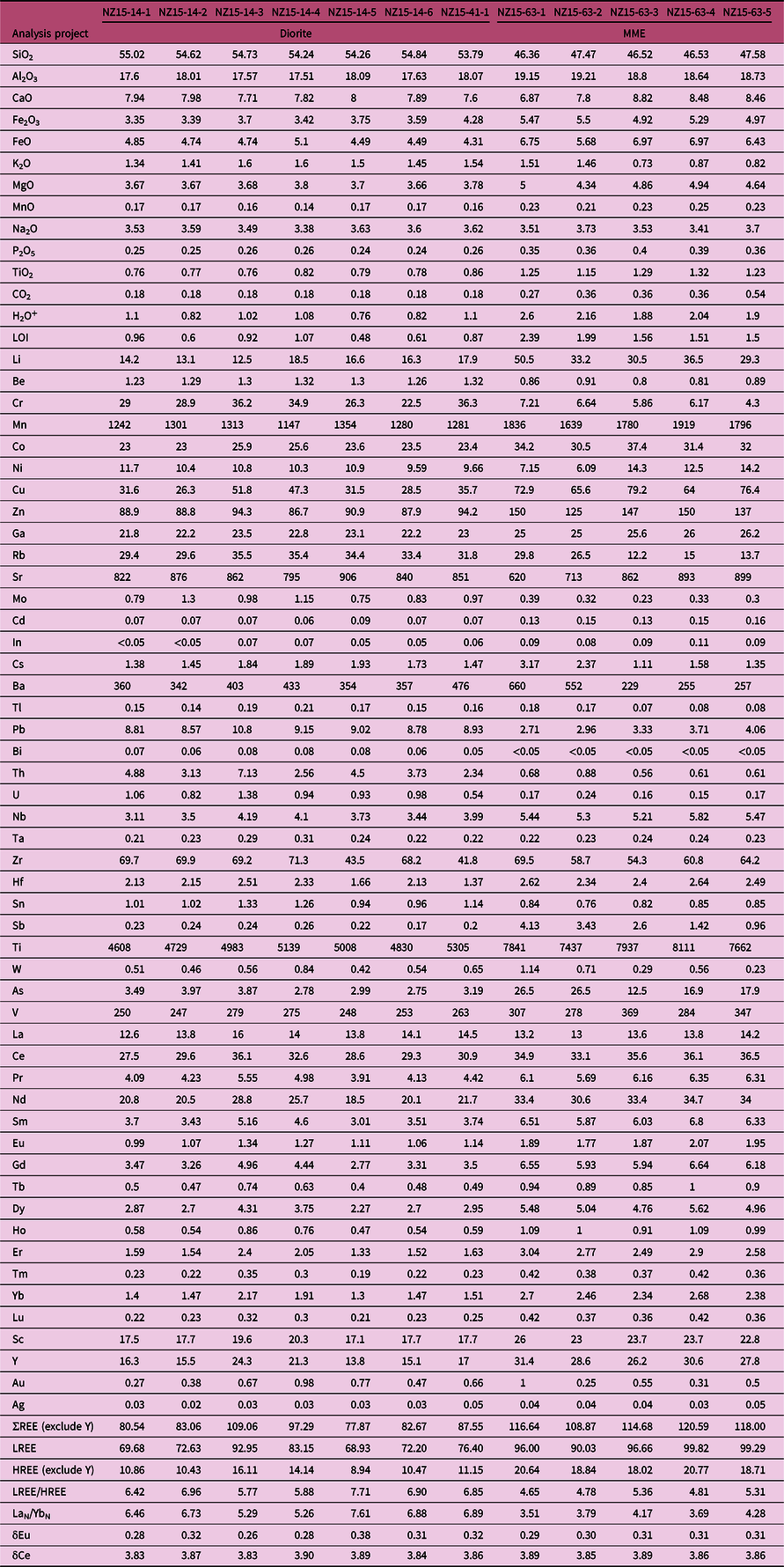
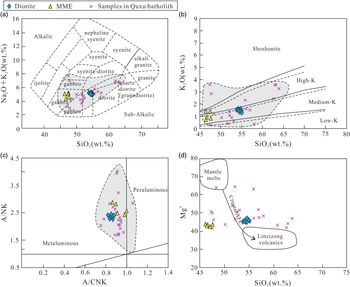
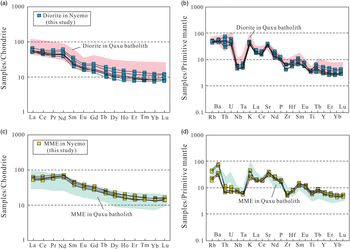
The diorites have SiO2 contents of 53.79–55.02 wt % (average of 54.50 wt %), Al2O3 contents of 17.51–18.01 wt % (average of 17.78 wt %), K2O + Na2O contents of 4.87–5.16 wt % (average of 5.04 wt %) and K2O/Na2O ratios of 0.38–0.47 (average of 0.42), indicating that they belong to a medium-K calc-alkaline series (Table 2; Fig. 3a, b). The diorites have an average aluminium saturation index [A/CNK: Al2O3/(CaO + Na2O + K2O)] of 0.86, thus showing metaluminous properties (Fig. 3c). The diorites have relatively high MgO (3.66–3.80 wt %) and TiO2 (0.76–0.86 wt %), and low rare earth element (REE) contents varying between 78 and 109 ppm, with an average of 88 ppm. The light rare earth elements (LREEs) and heavy rare earth elements (HREEs) are significantly fractionated, with LREE/HREE values of 5.77–7.71 and an average (La/Yb)N value of 6.64 (Fig. 4a). Moreover, the Eu/Eu* values are 0.26–0.38, which indicates weakly negative Eu anomalies. The diorites are enriched in Rb, Th and U but depleted in Nb, Ta and P (Fig. 4b).
Major (wt %) and trace element (10−6) compositions of diorite and MME samples from the Nyemo intrusion

SiO2 – Na2O+K2O diagram (a), SiO2–K2O diagram (b), A/CNK–A/NK diagram (c) and SiO2–Mg# diagram (d) of diorite and MME in Nyemo intrusion. The diagrams are adapted from Irvine & Baragar (Reference Irvine and Baragar1971), Cox et al. (Reference Cox, Bell and Pankhurst1979) and Defant & Drummond (Reference Defant and Drummond1990), and data for Quxu (including both host rocks and MMEs) are from Chen (Reference Chen2006), Dong et al. (Reference Dong, Mo, Zhao, Zhu, Song and Wang2008) and Huang et al. (Reference Huang, Zhao, Zhang, Zhu, Dong and Mo2010).

Chondrite-normalized REEs (a) and primitive mantle-normalized trace elements (b) variation diagrams for diorite and REE in Nyemo intrusion. Chondrite and primitive mantle values are from Sun & McDonough (Reference Sun, McDonough and Norry1989), and data for Quxu are from Chen (Reference Chen2006), Dong et al. (Reference Dong, Mo, Zhao, Zhu, Song and Wang2008) and Huang et al. (Reference Huang, Zhao, Zhang, Zhu, Dong and Mo2010).

The MMEs have a limited range of SiO2 contents (46.36–47.58 wt %) (Table 1; Fig. 3a) and relatively high contents of MgO (4.34–5.00 wt %), with Mg# (Mg2+/Mg2+ + Fe2+) values of 42.36–43.53 (Fig. 3d). They show low contents of TiO2 (0.79–1.14 wt %) and K2O + Na2O (average 3.50 wt %), low A/CNK value (average 0.91) (Fig. 3b, c), and flat REE patterns (Fig. 4a) with low (La/Yb)N values (3.51–4.28), indicating that they are calc-alkaline mafic rocks with metaluminous affinity. The contents of REEs vary between 108.87 and 120.59 ppm and exhibit obvious Eu anomalies, with Eu/Eu* values of 0.29–0.31. The MMEs are enriched in Sr and Ba but depleted in Th and U (Fig. 4b) and show obvious Nb–Ta negative anomalies, which is similar to arc tholeiitic to calc-alkaline basalts. In the Harker diagrams (Fig. 5), K2O and Na2O increase while TiO2, Al2O3, MgO, CaO, FeOT, MnO and P2O5 decrease with the SiO2 content, which is similar to the Quxu batholith. In the La–Yb (Fig. 6a) and Sr–Y diagrams (Fig. 6b), MMEs have the characteristics of arc magmatic rocks, while diorites show a trend of mixing between arc magmatic rocks and adakitic rocks.
Harker diagrams from the diorite and MME in Nyemo intrusion. Data for the samples in Quxu batholith are from Chen (Reference Chen2006), Dong et al. (Reference Dong, Mo, Zhao, Zhu, Song and Wang2008) and Huang et al. (Reference Huang, Zhao, Zhang, Zhu, Dong and Mo2010).

(a) YbN–LaN/YbN and (b) Y–Sr/Y diagrams for diorite and MME samples from Nyemo intrusion. The diagrams are adapted from Hou et al. (Reference Hou, Gao, Qu, Rui and Mo2004), and data for the samples in Quxu batholith are from Chen (Reference Chen2006), Dong et al. (Reference Dong, Mo, Zhao, Zhu, Song and Wang2008) and Huang et al. (Reference Huang, Zhao, Zhang, Zhu, Dong and Mo2010).

4.b. Zircon geochronology and Hf isotopes
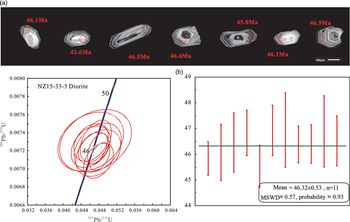
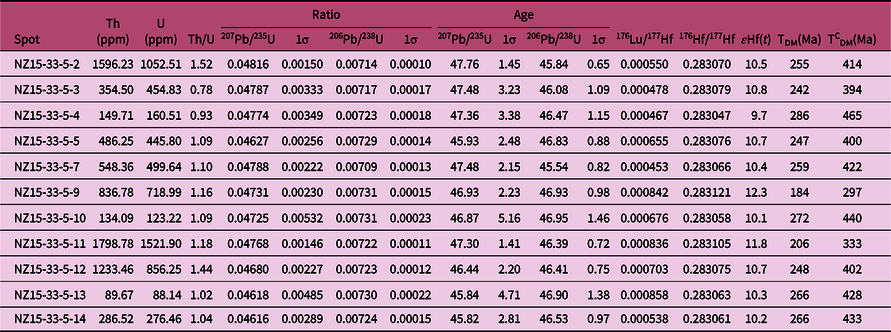
The zircons from the diorites analysed in this study are generally regular in shape, with aspect ratios of 1:1–2:1 and sizes of 100–160 µm. They are white to light grey and xenomorphic and have oscillatory zones (Fig. 7a). A total of 14 analyses were undertaken, 11 of which are discussed here (Table 3), and the other 3 are inherited zircons with U–Pb ages of 150 Ma, 1014 Ma and 2438 Ma respectively. These 11 zircons have U contents of 88.14–1521.90 ppm, with an average of 563.48 ppm, and Th contents of 89.67–1596.23 ppm, with an average of 683.12 ppm, thus yielding Th/U ratios between 0.78 and 1.52, which are indicative of magmatic zircons (Belousova et al. Reference Belousova, Griffin, O’Reilly and Fisher2002; Wu & Zheng, Reference Wu and Zheng2004). The 11 analyses cluster in a small area and yield a weighted mean 206Pb/238U age of 46.32 ± 0.53 Ma (MSWD = 0.57, n = 11) (Fig. 7b) as defined using Isoplot v. 3.0 (Ludwig, Reference Ludwig2003).
Cathodoluminescence images (a) and U–Pb concordia plots (b) of zircons for diorite.

Zircon U–Pb ages and Hf isotopic compositions of the diorite

A total of 11 zircons with U–Pb data were chosen for the Lu–Hf isotope analyses (Table 3). All 11 analyses yielded 176Lu/177Hf ratios of <0.002, indicating little accumulation of radiogenic Hf after zircon formation (Amelin et al. Reference Amelin, Lee, Halliday and Pidgeon1999). These zircons have 176Hf/177Hf values of 0.283047~0.283121, with an average of 0.283070, and ε Hf(t) values of 9.7–12.3 (Fig. 8), with an average of 10.70. These zircons have average single-stage Hf model ages (T DM) and two-stage Hf model ages (T DM C) of 248 and 402 Ma, respectively.
Zircon Hf isotope compositions of diorite from Neymo intrusion. The diagram is adapted from Yang et al. (Reference Yang, Hou, Jiang, Zhang and Song2011). For comparison, the zircon Hf isotope compositions of part Gangdese magmatic belt are also shown; data are after Lin et al. (Reference Lin, Qiu, Wang, Hong and Xu2018).

4.c. Sr–Nd–Pb–O isotopes
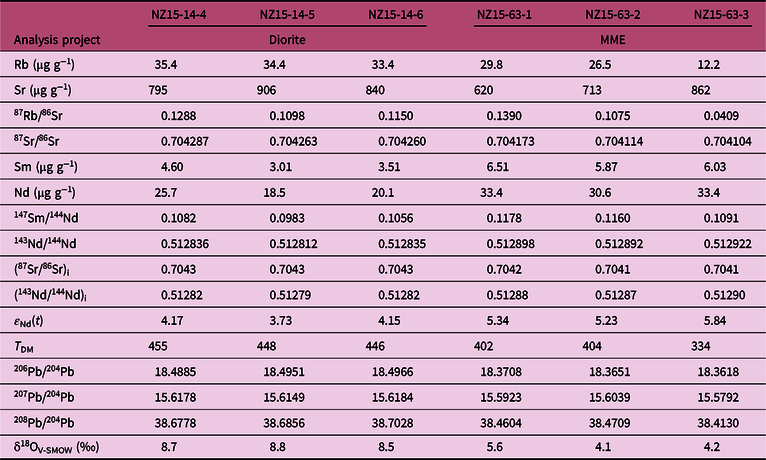
The (87Sr/86Sr)i values of diorites vary from 0.704260 to 0.704287 (Table 4), thus showing a small variation range. The ε Nd(t) values are from 3.73 to 4.17. The Nd isotope depleted mantle model ages are concentrated between 446 and 448 Ma. On the 87Sr/86Sr–143Nd/144Nd diagram (Fig. 9a), all test points are located on the evolution line from DM to EM II. The 206Pb/204Pb, 207Pb/204Pb and 208Pb/204Pb values of diorite range from 18.486 to 18.497, 15.615 to 15.619, and 38.678 to 38.703, respectively, and are distributed between MORB and EM II (Fig. 9b). The δ18OV-SMOW values are 8.5‰, 8.7‰ and 8.8‰, respectively. The Sr–Nd–Pb values of the MMEs are similar to those of the diorites (Table 4). The (87Sr/86Sr)i values range from 0.704680 to 0.704704, while the ε Nd(t) values vary from 0.35 to 3.74 (Fig. 9a). The Nd isotope depleted mantle model ages are concentrated between 492 and 660 Ma. The 206Pb/204Pb, 207Pb/204Pb and 208Pb/204Pb of the MMEs range from 18.498 to 18.519, 15.603 to 15.611, and 38.678 to 38.719, respectively (Fig. 9b), and the δ18OV-SMOW values are 4.1‰, 4.2‰ and 5.6‰.
Results of the Sr–Nd–Pb–O isotopes of diorite and MME samples

The 87Sr/86Sr–143Nd/144Nd (a) and 206Pb/204Pb–207Pb/204Pb (b) diagrams of the diorite and MME in Nyemo intrusion. The diagrams are adapted from Hou et al. (Reference Hou, Gao, Qu, Rui and Mo2004); data for Quxu are from Chen (Reference Chen2006), Dong et al. (Reference Dong, Mo, Zhao, Zhu, Song and Wang2008) and Huang et al. (Reference Huang, Zhao, Zhang, Zhu, Dong and Mo2010).

4.d. Electron probe
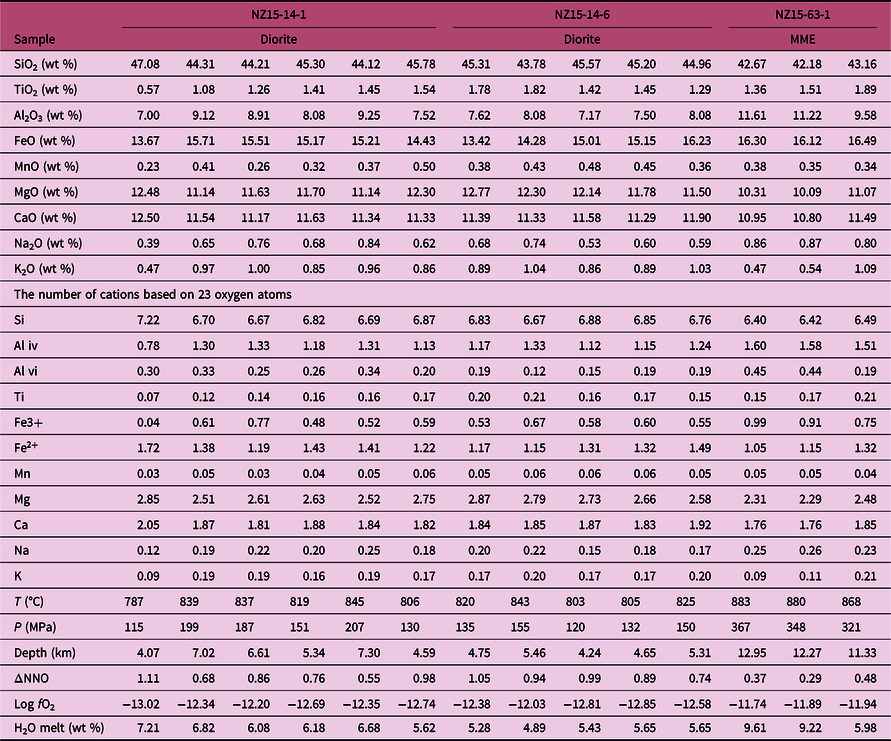
The electron probe chemical composition and the related calculation results for the two kinds of hornblendes in the diorites and MMEs are shown in Table 5. Among them, the cation number of hornblende was calculated with 23 oxygen atoms as the standard, and the value of Fe3+ was calculated by the method of electric price difference (Zheng, Reference Zheng1983). The cation characteristics of hornblende are CaB = 1.76~2.05 and (Na + K)A = 0.10~0.29. According to the nomenclature principles proposed by the Amphibole Professional Committee of the International Mineralogical Association, hornblendes in the Nyemo diorites and MMEs are calcium hornblendes (CaB ≥ 1.50). The calcium hornblende in the diorite also has Si = 6.67–7.22, Mg/(Mg + Fe2+) =0.62–0.71 and falls within the scope of pargasite in the Si – Mg/(Mg + Fe2+) diagram, while the hornblende in the MMEs has Si = 6.40–6.49, Mg/(Mg + Fe2+) = 0.65–0.69 and falls within the range of tschermakite (Fig. 10a; Leake et al. Reference Leake, Wooley, Arps, Birch and Gilbert1997). The chemical composition of the hornblendes in the Nyemo diorites shows the following characteristics: MgO = 14.07–11.13 %, CaO = 11.17–12.50 %, K2O = 0.50–1.04 %, Na2O = 0.40–0.84 %, TiO2 = 0.57–1.78 % and Al2O3 = 6.06–9.25 % (Table 5), while the values of the hornblendes in the MMEs are MgO = 10.09–11.07 %, CaO = 10.80–11.49 %, K2O = 0.47–1.09 %, Na2O = 0.80–0.87 %, TiO2 = 1.36–1.89 %, and Al2O3 = 9.58–11.60 %. In the w(TiO2)–w(Al2O3) diagram (Fig. 10b), the hornblendes in the diorites are mainly derived from crust–mantle mixtures, while the hornblendes in the MMEs are derived from the mantle source.
Composition of the hornblendes from Nyemo diorite and MME (wt %)

(a) Classification of hornblendes (Leake et al. Reference Leake, Wooley, Arps, Birch and Gilbert1997) and (b) w(TiO2)–w(Al2O3) diagram (Giret et al. Reference Giret, Bonin and Léger1980) of hornblendes from diorite and MME in Nyemo intrusion.

5. Discussion
5.a. Physicochemical conditions of mineral crystallization in the Nyemo intrusion
5.a.1. Hornblende thermobarometer
Despite the influence of the host magma composition, the chemical composition of hornblende is largely related to the crystallization conditions of the magma (temperature, pressure, oxygen fugacity and water content) (Ridolfi et al. Reference Ridolfi, Puerini, Renzulli, Menna and Toulkeridis2008, Reference Ridolfi, Renzulli and Puerini2010). Through experimental simulation, Ridolfi et al. (Reference Ridolfi, Puerini, Renzulli, Menna and Toulkeridis2008) developed a formula for calculating the crystallization temperature of hornblende based on its molecular formula and then corrected the formula (Ridolfi et al. Reference Ridolfi, Renzulli and Puerini2010):
 $$\eqalign{ T = - 151.487{Si^*} + 2041 \cr {Si^*} = Si + {{^{[4]}Al} \over {15}} - {2^{[4]}}Ti - {{^{[6]}A1} \over 2} - {{^6Ti} \over {1.8}} + {{F{e^{3 + }}} \over {3.3}} \cr \quad\quad + {{Mg} \over {26}} + {{^BCa} \over 5} + {{^BNa} \over {1.3}} - {{^ANa} \over {15}} + {{^AK} \over {2.3}}. \cr} $$
Based on this formula and the chemical composition of the hornblendes, the crystallization temperatures of the hornblendes from the diorites are calculated to be 787–845 °C (Table 5), with an average of 820 °C. The crystallization temperatures obtained from data on three hornblendes in the MMEs are 883 °C, 880 °C and 868 °C.
Experimental petrology has shown that the total aluminium content of hornblende is proportional to the pressure at the time of crystallization (Johnson & Rutherford, Reference Johnson and Rutherford1989). This feature provides an effective method of determining the consolidation pressure of rock containing hornblende. The precondition for a hornblende aluminium manometer to effectively limit the crystallization pressure of a rock is the mineral symbiotic combination of plagioclase and hornblende in the rock. Petrographic observations of the Nyemo intrusion show that plagioclase and hornblende crystallized at the same time and were in equilibrium (Fig. 2f, h), and these conditions meet the application conditions for the hornblende aluminium manometer. At present, six kinds of hornblende aluminium manometers have been proposed by Hammarstrom & Zen (Reference Hammarstrom and Zen1986), Hollister et al. (Reference Hollister, Grissom, Peters, Stowell and Sisson1987), Johnson & Rutherford (Reference Johnson and Rutherford1989), Schmidt (Reference Schmidt1992), Anderson & Smith (Reference Anderson and Smith1995) and Ridolfi et al. (Reference Ridolfi, Puerini, Renzulli, Menna and Toulkeridis2008) to estimate the crystallization pressure of hornblende. Lei et al. (Reference Lei, Wu, Gao, Guo, Liu, Guo, Gao, Chen and Qin2010) described and compared the first five hornblende aluminium manometers in detail. The oxygen fugacity (fO2) is the common limiting factor of various manometers, which makes the calculated pressure values inaccurate. Based on previous studies, Ridolfi et al. (Reference Ridolfi, Puerini, Renzulli, Menna and Toulkeridis2008) simulated and corrected the formula of the hornblende aluminium pressure gauge (Ridolfi et al. Reference Ridolfi, Renzulli and Puerini2010) through experimental petrology. Therefore, in this paper, the following formula of the hornblende aluminium manometer corrected by Ridolfi et al. (Reference Ridolfi, Renzulli and Puerini2010) is used:
 $$P( \times 100 \;MPa) = 19.209{e^{(1.438A{l_T})}}({R^2} = 0.99).$$
The calculated consolidation pressures of diorites in the Nyemo intrusion are 115–207 MPa, with an average of 153 MPa, while those of the MMEs are 367 MPa, 348 MPa and 321 MPa (Table 5). The pressure obtained by the hornblende aluminium manometer is close to the solid-phase pressure; therefore, the formation depth corresponding to the hornblende manometer should be the emplacement depth of the rock. According to the 100 MPa = 3.3 km calculation, the emplacement depths of the diorites were 4.07–7.30 km, with an average of 5.39 km, while the emplacement depths of the MMEs were 12.95 km, 12.27 km and 11.33 km, with an average of 12.18 km.
5.a.2. Oxygen fugacity and water content
In addition to physical and chemical conditions, such as temperature and pressure, the fO2 and water content of the magma are key factors affecting magma evolution (Candela & Holland, Reference Candela and Holland1984; Richards, Reference Richards2003). Hornblende contains the variable valency element Fe, and its ratio of Fe3+/Fe2+ is very sensitive to changes in fO2. Ridolfi et al. (Reference Ridolfi, Puerini, Renzulli, Menna and Toulkeridis2008) proposed a formula for calculating the fO2 during hornblende crystallization based on the molecular formula of hornblende and then corrected the formula (Ridolfi et al. Reference Ridolfi, Renzulli and Puerini2010):
 $$\eqalign{ {\rm\Delta} NNO = 1.644{Mg^*} - 4.01. \cr {Mg^*} = Mg + {{Si} \over {47}} - {{^{[6]}Al} \over 9} - {1.3^{[6]}}Ti \cr\quad\quad\quad+ {{F{e^{3 + }}} \over {3.7}} + {{F{e^{2 + }}} \over {5.2}} - {{^BCa} \over {20}} - {{^ANa} \over {2.8}} + {{^AK} \over {9.5}}. \cr} $$
According to the above formulas, the range of fO2 during hornblende crystallization in the Nyemo diorites was between ΔNNO + 0.55 and ΔNNO + 1.11 (Table 5), with an average of ΔNNO + 0.88, while the fO2 in the MMEs was ΔNNO + 0.37, ΔNNO + 0.29 and ΔNNO + 0.48 (Table 5).
In addition, Ridolfi et al. (Reference Ridolfi, Puerini, Renzulli, Menna and Toulkeridis2008) proposed a formula for calculating the water content of magma during crystallization based on the hornblende molecular formula and corrected the formula (Ridolfi et al. Reference Ridolfi, Renzulli and Puerini2010):
 $$\eqalign{ {H_2}{O_{{\rm{melt}}}} = 5.215{Al^*} + 12.28 \cr {Al^*}{ = ^{[6]}}Al + {{^{[4]}Al} \over {13.9}} - {{Si{ + ^{[6]}}Ti} \over 5} - {{^CF{e^{2 + }}} \over 3} \cr\quad\quad\,- {{Mg} \over {1.7}} + {{^BCa{ + ^A}K} \over {1.2}} + {{^ANa} \over {2.7}} - 1.56K - {{Fe\# } \over {1.6}}. \cr} $$
Using the above formulas, the variation range of the magmatic water contents of the diorites in the Nyemo intrusion was 4.89–7.21 %, with an average value of 5.95 %, while the magmatic water contents of the MMEs were 9.61 %, 9.22 % and 5.98 % (Table 5), with an average value of 8.27 %.
5.b. Petrogenesis and source of the Nyemo intrusion
5.b.1. Genetic type of MMEs
To date, several hypotheses have been proposed for the genesis of MMEs in granitic rocks: (1) A remnant source may include recrystallized refractory metamorphic rock fragments or refractory residues in the source area of granite magma (Chen et al. Reference Chen, Price and White1989; Chappell & White, Reference Chappell and White1992; Chappell, Reference Chappell1996). (2) A cognate magmatic origin, by either accumulation or liquid immiscibility. The concept of accumulation suggests that the MMEs consist of mafic minerals accumulated from the early crystalline phases of magma due to gravity differentiation, and were crushed and formed in the process of magma ascent (Dodge & Kistler, Reference Dodge and Kistler1990; Donaire et al. Reference Donaire, Pascual, Pin and Duthou2005; Shellnutt et al. Reference Shellnutt, Jahn and Dostal2010), while the origin of liquid immiscibility implies that the MMEs formed when the magma was immiscible under liquid conditions or at a low degree of miscibility. The MMEs share similar temperatures and pressures with the host rocks and are the result of diffusion or dissociation of different components in intermediate-acid magma (Watson, Reference Watson1976; Zhu, Reference Zhu1995). (3) In the magma-mingling origin, MMEs are considered to be the products of incomplete mixing of mantle-derived magma and crust-derived magma (Barbarin & Didier, Reference Barbarin and Didier1992; Griffin et al. Reference Griffin, Wang, Jackson, Pearson, O’Reilly, Xu and Zhao2002; Perugini et al. Reference Perugini, Poli, Christofides and Eleftheriadis2003; Yang et al. Reference Yang, Wu, Wilde, Xie, Yang and Liu2007; Zhao et al. Reference Zhao, Guo, Fan, Li, Qin and Li2010; Kocak et al. Reference Kocak, Zedef and Kansun2011; Temizel et al. Reference Temizel, Arslan and Abdiogˇlu2014; Weidendorfer et al. Reference Weidendorfer, Mattsson and Ulmer2014; Yu et al. Reference Yu, Qiu and Wang2016).
Regarding dioritic MMEs in the Nyemo intrusion, we have not yet obtained their exact crystallization age. The Nyemo intrusion is located in the west of the Quxu batholith and in the middle part of the Gangdese magmatic belt, and the U–Pb ages of the MMEs in the ~50 Ma host rocks of the Gangdese magmatic belt (including Quxu batholith) are all ~50 Ma (Dong et al. Reference Dong, Mo, Zhao, Zhu, Wang, Chen and Li2006; Ma et al. Reference Ma, Meert, Xu and Zhao2017); therefore, we believe the MMEs in the Nyemo intrusion present equivalent ages that are consistent with the host diorite age within the error range. Moreover, no sedimentary structures or metamorphic minerals are found in the MMEs; therefore, the possibility of wall rock or refractory remnants in the host diorite source area is excluded. As shown in Figure 4, the abundances of trace elements in the MMEs are higher than those in the diorites, and the Eu anomalies are not obvious. This result suggests that the host diorites cannot be derived from the MMEs through fractional crystallization because large ion lithophile elements (LILEs) and REEs tend to be enriched in the late stage of evolution (Jung et al. Reference Jung, Hoernes and Mezger2000).
The MMEs in the Nyemo intrusion are formed by magma mingling on the basis of the following reasons: (1) MMEs are mostly oval, spindle or lenticular in shape; a clear boundary occasionally occurs between an MME and the host rock, but more commonly the boundary appears as a transitional zone with a lighter colour from the interior outward. Reversed veins and plastic flow can be seen locally (Fig. 2a), thus reflecting the plastic coexistence between MME magma and host magma. (2) The MMEs contain biotite, and the magmatic water content of the MMEs is 8.27 %. The high water content of the MMEs indicates that the magma has strong plastic flow ability which is favourable for the mingling between the MME magma and the host magma (Grasset & Albarede, Reference Grasset and Albarede1994). (3) Acicular apatite (Fig. 2h) is the product of quenched crystallization of high-temperature basic magma injected into a low-temperature acidic magma chamber. Such apatite is an important signal of magma mingling during genesis (Baxter & Feely, Reference Baxter and Feely2002; Barbarin, Reference Barbarin2005). (4) The Harker diagrams (Fig. 5) show that K2O and Na2O increase while TiO2, Al2O3, MgO, CaO, FeOT, MnO and P2O5 decrease with the SiO2 content, which is characteristic of magma mingling. In the La–Yb (Fig. 6a) and Sr–Y diagrams (Fig. 6b), the MMEs have the characteristics of arc magmatic rocks, while the diorites show a trend of mixing between arc magmatic rocks and adakitic rocks. In Figure 11, the samples also show a trend of magma mixing. (5) When the MME magma mixes with the host magma, the isotopes can quickly reach chemical equilibrium with the host magma in the initial stage of basic magma entry, which leads to similar Sr–Nd isotope geochemical characteristics between the MME magma and the host rock (Xiong et al. Reference Xiong, Ma, Chen, Liu and Wang2010; Liu et al. Reference Liu, Qiu and Li2013). Therefore, the above petrographic and geochemical data suggest that the MMEs in the Nyemo intrusion are formed by magma mingling between MME and host magmas.
(a) MgO–FeOt and (b) Rb/Sr–Ti/Zr diagrams for diorite and MME samples from Nyemo intrusion. The diagrams are adapted from Zorpi et al. (Reference Zorpi, Coulon and Orsini1991) and de Hollanda et al. (Reference de Hollanda, Pimentel and Sá2003), and data for the samples in Quxu batholith are from Chen (Reference Chen2006), Dong et al. (Reference Dong, Mo, Zhao, Zhu, Song and Wang2008) and Huang et al. (Reference Huang, Zhao, Zhang, Zhu, Dong and Mo2010).

5.b.2. Magma sources
5.b.2.1. Host diorite
The diorites in the Nyemo intrusion have SiO2 contents of 53.79–55.02 wt %, showing metaluminous (Fig. 3c; A/CNK = 0.86), medium-K calc-alkaline (Fig. 3a, b; K2O/Na2O = 0.42), and amphibole-rich properties, which are indicative of typical I-type granite. Chappell & White (Reference Chappell and White1974) studied the genesis of I-type granite and indicated that it is formed by partial melting of igneous rocks without surface weathering. At present, however, mantle material is considered to contribute greatly to the formation of I-type granite, which is a product of mixing between crustal magma and mantle-derived magma (Griffin et al. Reference Griffin, Wang, Jackson, Pearson, O’Reilly, Xu and Zhao2002; Kemp et al. Reference Kemp, Hawkesworth, Foster, Paterson, Woodhead, Hergt, Gray and Whitehouse2007; He et al. Reference He, Xu and Niu2010). The diorites of the Nyemo intrusion are rich in the LILEs Rb, Ba and Sr and strongly depleted in the high field strength elements (HFSEs) Nb and Ta, which are obvious characteristics of arc magmatic rocks. Th and U anomalies in the diorites are not obvious, indicating an affinity with crustal components.
The Nyemo diorites have positive zircon ε Hf(t) values (8.3–12.3) and very young two-stage model ages (TDM C = 297–465 Ma). In the t–ε Hf(t) diagram (Fig. 8), the sample points are all above the chondrite evolution line, which is consistent with the zircon Hf isotope compositions of the granite in Gangdese magmatic belt of the same period. It is impossible to obtain significant amounts of granitic magma due to the partial melting of the mantle (Leake, Reference Leake1990); therefore, granites with positive ε Hf(t) values are generally considered as the products of partial melting of juvenile crust with the addition of mantle components (Taylor & McLennan, Reference Taylor and McLennan1985; Wu et al. Reference Wu, Ji, Liu and Chung2010). O isotopes can also effectively distinguish the magma sources from the crust to the mantle. For lithospheric or asthenospheric mantle, the oxygen isotope values are less than 6 ‰, whereas for the crust they are greater than 6 ‰ (Mattey et al. Reference Mattey, Lowry and Macpherson1994). The oxygen isotope values of diorites are 8.7 ‰, 8.6 ‰ and 8.5 ‰, showing that crustal components are important to the formation of diorites. In the Sr–Nd isotope diagram (Fig. 9a), the diorites generally plot along the mantle evolution trend from homogeneous primitive mantle (BSE) to depleted mantle (DM), which is similar to the Quxu batholith, indicating that depleted mantle plays an important role in the formation of both the Nyemo and Quxu rocks. In the Pb isotope diagram (Fig. 9b), the diorites also show the characteristics of a mixture between the depleted mantle and the crust. All the Sr–Nd–Pb–Hf–O isotopes indicate that the diorite originated from partial melting of the juvenile crust with the addition of the mantle components. The Nyemo diorite was formed in the most intense period of Gangdese magmatism (65~41 Ma; Ji et al. Reference Ji, Wu, Liu and Chung2009 b) after the subduction and break-off of the Neo-Tethyan oceanic slab on the southern margin of Lhasa terrane, which is currently considered to have occurred at ~52 Ma (Zhu et al. Reference Zhu, Zhao, Niu, Mo, Chung, Hou, Wang and Wu2011, Reference Zhu, Wang, Zhao, Chung, Cawood, Niu, Liu, Wu and Mo2015; Hou et al. Reference Hou, Duan, Lv, Zheng, Zhu, Yang, Yang, Wang, Pei, Zhao and McCuaig2015). The heat generated by the upwelling asthenosphere induced by the break-off of the subducted Neo-Tethyan oceanic slab caused the partial melting of the juvenile crust, thus producing the initial magmas of the diverse granitic rocks.
5.b.2.2. MMEs
MMEs can be formed by partial melting or magmatic differentiation. The REE patterns of MMEs show a right-inclined and gentle pattern with no obvious difference between LREEs and HREEs and Eu anomalies, indicating that there was no obvious differentiation during the magmatic process and that the MMEs are the products of equilibrium partial melting. The contents of SiO2 and Mg# in the MMEs are close to those of basaltic primary magma. The total amounts of REEs are relatively low, and the average value of LaN/YbN is 3.89. Trace elements are strongly depleted in Th, U, Nb and Ta and enriched in Ba, K and Sr, thus showing characteristics of arc magmatic rocks. In the YbN – LaN/YbN (Fig. 6a) and Y – Sr/Y (Fig. 6b) diagrams, the MMEs plot in the range of arc magmatic rocks. The contents of Cr (4.30–7.21 ppm) and Ni (6.09–14.30 ppm) are low compared with those of mantle-derived basaltic magmas (Ni = 300 to 400 ppm, Cr = 300 to 500 ppm; Chen & Frey (Reference Chen and Frey1985) indicate that the MMEs represent evolved basaltic melts derived from an arc-like mantle source. The oxygen isotope values of the MMEs are 4.1‰, 4.2‰ and 5.6‰, which also show that the source area of MMEs is the mantle. Because the total distribution coefficients of Nb, Zr and Y among the mantle-basalt melts are close to 1 and these elements are inactive, they are not affected by metasomatism, alteration or weathering; therefore, they can basically represent the composition of the mantle in the source area. In the Nb–Zr–Y (Fig. 12a, b) diagram, the Nyemo MMEs are located in the depleted mantle field, showing the source area characteristics of the depleted asthenospheric mantle. The positive Nd anomaly (Fig. 4a) in the Nyemo intrusion could represent accumulation of a mineral such as apatite in the samples. The isotopic data suggest both the MMEs and diorites show evidence of a mixed source, with evidence for some crustal contamination of an originally mantle-derived magma.
Nb–Zr–Y diagram showing variations in MMEs from Nyemo intrusion, all of which plot in the depleted mantle field. Diagram adapted from Zhao (Reference Zhao1997).

5.c. Trigger for compositionally diverse magmatism at c. 50 Ma
Through the study of the thermal evolution history of Gangdese in southern Tibet, geologists have determined that Gangdese was uplifted rapidly from 65 to 45 Ma (Li et al. Reference Li, Kohn, Sandiford, Xu and Wei2015, Reference Li, Kohn, Sandiford, Xu, Tian and Seiler2016), which was closely related to the collision of the Indian and Asian continents since 65 Ma. At the same time, intense magmatic activity developed in the Gangdese belt, which provides a true record of the geological evolution of the collision. The age data obtained in recent years indicate that the magmatic activity in the southern margin of the Gangdese magmatic belt began at c. 120 Ma but reached a peak at 50–45 Ma (Chu et al. Reference Chu, Chung, Song, Liu, O’Reilly, Pearson, Ji and Wen2006; Li et al. Reference Li, Chung, Wang, Zhu, Yang, Song, Liu and Wu2007), which shows that magma underplating and mixing occurred during the northward subduction of the Neo-Tethyan Ocean and the Indo-Asian collision (Dong et al. Reference Dong, Mo, Zhao, Zhu, Wang, Chen and Li2006). During the collision process, the Tethyan oceanic crust broke off, and a tectonic window was formed due to the weak stress, which caused upwelling of the asthenosphere (Fig. 13).
The geodynamic model of Gangdese magmatic belt (a) and Nyemo intrusion (b) in southern Tibet.

At the same time, the dehydrated Tethyan oceanic crust subducted into the upper mantle, which resulted in the partial melting of the overlying mantle and the formation of a magma reservoir (Fig. 13a). A large amount of water from the subduction zone entered the primary basaltic magma system, promoting formation of hornblende over pyroxene (Beard, Reference Beard1986; Sisson et al. Reference Sisson, Grove and Coleman1996). The upwelling basaltic magma intruded into the thickened lower crust of the Lhasa terrane to form basaltic magma chambers (Anderson, Reference Anderson1976). Meanwhile, magma accumulation was accompanied by high temperatures, which contributed to the partial melting of the juvenile lower crust with added mantle components and formed a felsic magma chamber at c. 12 km at 880 °C. When the two kinds of magma came into direct contact, such a large temperature difference led to intense heat exchange, and the high-temperature basaltic magma cooled rapidly to form hornblendes, while the low-temperature felsic magma warmed. When the mixed magma carrying early crystallized hornblendes continued to move upward to the shallow crust (5.5 km, 820 °C), the hornblende in the host magma began to crystallize (Fig. 13b). Diorites formed in areas with strong crust–mantle interactions, while the widely distributed granites in Gangdese magmatic belt formed in areas with relatively weak crust–mantle interactions.
6. Conclusions
-
(1) The crystallization temperature of hornblende in diorite is 820 °C with a formation depth of 5.39 km, the oxygen fugacity is ΔNNO + 0.88 and the water content is 5.95 %. The crystallization temperature of hornblende in MMEs is 880 °C with a formation depth of 12.18 km, the oxygen fugacity is ΔNNO + 0.38 and the water content is 8.27 %.
-
(2) The Nyemo MMEs were formed by magma mingling. The MME magma originated from partial melting of the depleted mantle, while the host diorite originated from partial melting of the juvenile crust with the addition of mantle material.
-
(3) The formation of the Gangdese magmatic belt was related to the Indo-Asian continental collision. The break-off of the subducted Neo-Tethyan oceanic crust triggered partial melting of the asthenosphere, which resulted in the underplating and accumulation of basaltic magma and then caused the partial melting of the juvenile lower crust with the addition of mantle material, resulting in the diversification of granitic rocks and the very large Gangdese magmatic belt.
Acknowledgements
We thank Peiyan Xu, Changda Wu and Jingtao Mao for assistance with the field work. This work was funded by the National Key Research and Development Project of China (2016YFC0600307), National Natural Science Foundation Project (4170020919, 41773042, 41403043) and Fundamental Research Funds for the Chinese Academy of Geological Sciences (KK1709).