

Scholarship on interest groups in the American states is growing rapidly in the twenty-first century. Not only are more and more studies being published in high quality peer-reviewed journals, but they reflect a determination on the part of many scholars to engage in the hard work of data gathering in order to build on, and then go beyond, the advances scholars had made by the end of the twentieth century. Researchers are asking new questions about how interest groups interact with political parties, shape public opinion, recruit lobbyists, and change their issue focuses in order to grow and survive. They are also using the latest in computational technologies to build large new data sets impossible to produce in the past, making the states not just policy laboratories, but labs for pioneering new methodological approaches.
In this review article, we broadly chart the scope of state interest group research. We start by describing where matters stood at the end of the last century, especially with Virginia Gray and David Lowery’s work on interest group mobilization. Then, we begin our exploration of the first quarter of the twenty-first century by showing how scholars have learned to build large population-spanning datasets of state groups, as well as on lobbying and campaign finance behavior. We then show how interest group lobbying and campaign spending shape state policy in the climate, healthcare, and education policy fields. These advances give us confidence that the study of interest groups will continue to grow and innovate, helping us better understand the crucial role they play in state politics and policymaking. Furthermore, the methodological approaches being developed today will produce tools that can be applied to the study of interest groups around the world (Garlick, Junk, and Brown Reference Garlick, Junk and Brown2025; Lowery, Halpin, and Gray Reference Lowery, Halpin and Gray2015).Footnote 1
What has gone before
The mid-twentieth century saw interest groups take a significant, even dominant, place in the discipline of political science. For scholars like David Truman (Reference Truman1951), the American political system was little more than networks of organized groups representing different mobilized sectors of society and the economy, all competing to shape public policy. Prominent features of this theory of interest group pluralism include the idea that new groups mobilized for political advocacy when distinct factions of society perceived their interests (or what they were told were their interests) as threatened by already mobilized groups, thus expanding the number and ideological range of mobilized interests. Public policies were therefore the outcomes of political struggle between these groups, reflecting balances of power between competing factions of society (see Garson Reference Garson1978). Truman’s influence was so profound that scholarship over the next couple of decades was largely about refining the theory of group pluralism and trying to identify the most powerful interests influencing various government policies (see Dahl Reference Dahl1961; Latham Reference Latham1952; Polsby Reference Polsby1962). Some, like Robert Dahl (Reference Dahl1956), even argued that group competition was an acceptable, even desirable, way to make policy in a democracy of heterogeneous interests.
Pluralism eventually came under attack from a variety of directions, such as criticism that it underestimated the ability of some groups, or even a few powerful elites, to keep certain issues out of public view to prevent countermobilization (Bachrach and Baratz Reference Bachrach and Baratz1962; Mills Reference Mills1956). More famously, Mancur Olson (Reference Olson1965) argued that perceptions of threat were simply not enough to mobilize people to form an interest group; economic incentives were also needed except in the case of very small groups. There was also an important empirical objection. Gray and Lowery (Reference Gray and Lowery1996) argued that there were simply not enough valid and reliable data on groups in Washington, D.C., to really test the assumptions of pluralism, and in any case, it was only one case of a single institutionalized governing structure. Fortunately, Gray and Lowery noted that there was a really good alternative – interest group in the American states where there was plenty of variation in economies, political cultures, and institutional structures. And a research agenda was born.
Not that Gray and Lowery were the first to study state interest groups and how they lobbied. As early as 1954, Belle Zeller was exploring the crucial role groups played in state politics, though, lacking any consistent and comparable data on which to draw, she had to rely on the expert assessments of scholars in each state to form conclusions regarding their relative influence on state policies. A few decades later, Zeigler and van Dalen (Reference Zeigler, Hendrik, Virgina, Herbert and Kenneth1976) were still doing the same thing due to the lack of available data, and Morehouse (Reference Morehouse1981) had to rely on journalistic accounts along with scholarly articles for her assessment of state interest group influence. Even the highly detailed volumes by Thomas and Hrebenar (Reference Thomas and Hrebenar1992, for a summary) on groups in every state relied on the assessments of others.
While many states did start making lists of interest groups registered to lobby their governments available, the data were often hard to get, forcing many scholars to collect it from just a few states, like Wiggins, Hamm, and Bell (Reference Wiggins, Hamm and Bell1992) and Hamm (Reference Hamm1986), or rely on data not representative of state interest group populations, like Maitland’s (Reference Maitland1985) reliance on Political Action Committee (PAC) contributions. Most continued to rely on surveys and elite interviews from group leaders and lobbyists in just a few states (e.g., Nownes and Freeman Reference Nownes and Freeman1998; Rosenthal Reference Rosenthal1993; Zeigler and Baer Reference Zeigler and Baer1968). Only Hunter, Wilson, and Brunk (Reference Hunter, Wilson and Brunk1991) were able to obtain data from nearly every state, but for only one year. It was never enough to test theories of interest group mobilization and influence or draw generalizable conclusions.
It was in the last decade of the twentieth century that Gray and Lowery put state interest group scholarship on a firm theoretical foundation. While their initial work (Gray and Lowery Reference Gray and Lowery1988) focused on the number of state interest groups as an explanation for variation in economic growth, driven by Olson’s (Reference Olson1982) argument that more policy demands by more groups slowly grind economic expansion to a halt (they found little evidence of this), Gray and Lowery then flipped the question around and studied the influence of economic growth on the number and variety of state interest groups. Here, they found that increases in gross state product provided more of the resources needed for people to take on the expense of forming and maintaining political organizations, at least up to a point (Lowery and Gray Reference Lowery and Gray1993). This, they argued, was a better explanation for group mobilization than the pluralist argument regarding perceived political threats. Their subsequent work (compiled in Gray and Lowery Reference Gray and Lowery1996) went on to provide a solid basis for understanding interest mobilization by adapting the population ecology approach from evolutionary biology, leading to the energy–stability–area (ESA) model of group formation and survival. Drawing on data they doggedly collected from all 50 states for several (nonconsecutive) years, they not only provided a theory of group formation but for the first time studied empirically the whole population of American states. Their work was so influential that their ESA model was subsequently applied to the study of groups in other nations (see Lowery, Halpin, and Gray Reference Lowery, Halpin and Gray2015).
Advances in methods and data
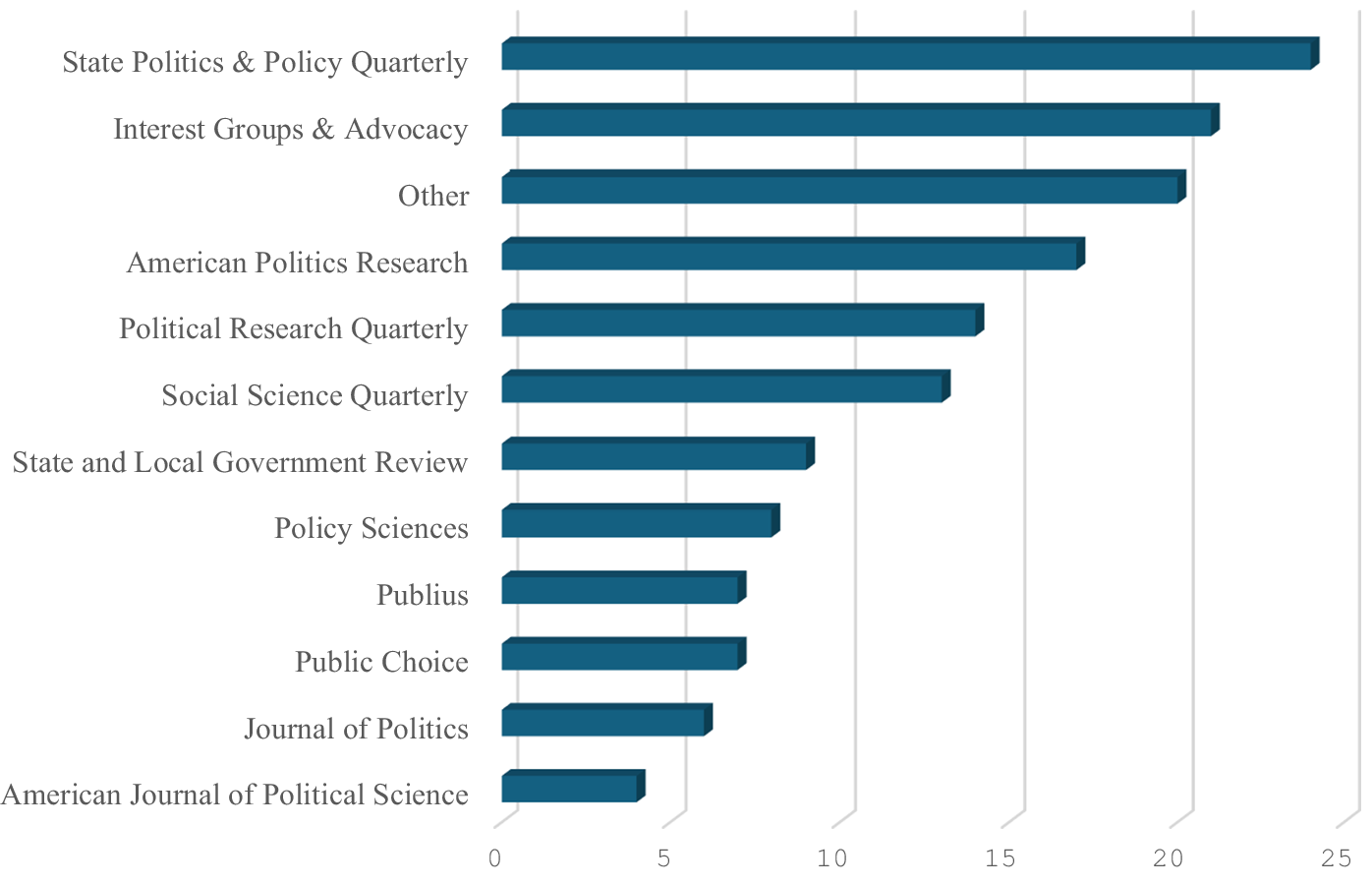
Largely inspired by Gray and Lowery’s work, the twenty-first century has seen a burst of research on interest groups in the American states. So much so that we argue a renaissance is underway as scholars employ both traditional and new innovative data-gathering techniques to amass big datasets and produce a large number of significant studies. We can get a sense of this by simply looking at the number of peer-reviewed articles published between 2000 and mid-2025. In Figure 1, we show the number of papers published on state interest groups and associated keywords in the general political science and public administration journals along with journals specializing in these topics. In total, 150 papers were published.Footnote 2 Readers of this journal may be pleased to know that State Politics & Policy Quarterly was the leader with 24 articles, edging out Interest Groups & Advocacy, the official journal of the Political Organizations and Parties section of the American Political Science Association (which published 21, though it has only existed since 2012).
Number of articles published in political science and public policy journals on state interest groups from 2000 to mid-2025.

Figure 1. Long description
The X-axis ranges from 0 to 25 in increments of 5. The Y-axis lists journals in descending order of article count.
* State Politics and Policy Quarterly: approximately 24 articles.
* Interest Groups and Advocacy: approximately 21 articles.
* Other: approximately 20 articles.
* American Politics Research: approximately 17 articles.
* Political Research Quarterly: approximately 14 articles.
* Social Science Quarterly: approximately 13 articles.
* State and Local Government Review: approximately 9 articles.
* Policy Sciences: approximately 8 articles.
* Publius: approximately 7 articles.
* Public Choice: approximately 7 articles.
* Journal of Politics: approximately 6 articles.
* American Journal of Political Science: approximately 4 articles.
Arguably, the biggest advances have come in data availability, fueling multiyear research agendas. So while a few scholars have still gone deep by studying interest groups and lobbying in single states, such as Fisher (Reference Fisher2015) with California and Heaney (Reference Heaney2004) with Wisconsin, many have attempted to either gather data on the universe of interest groups and/or lobbyists in all 50 states or at least have strong samples from all or select states (chosen to control for a variety of factors). In the following sections, we show how such advances have fueled this renaissance by describing these studies of group mobilization and then explore how they lobby and how many contribute to campaigns, to influence public policy.
Interest group mobilization
Interest groups often organize to “promote new legislative agendas and social values” (Walker Reference Walker1983, 404), and the twenty-first century began with Gray and Lowery continuing to push forward the study of interest group mobilization by applying their ESA model to questions of advocacy by organizations without members (Gray and Lowery Reference Gray and Lowery2001), state healthcare policy (Gray, Lowery, and Benz Reference Gray, Lowery and Benz2013), and even replicating their early, foundational work on mobilization (Lowery, Gray, and Cluverius Reference Lowery, Gray and Cluverius2015).
Getting relatively complete data on all interest groups in a state was never easy. Gray and Lowery contacted each state’s agency responsible for registering political groups to obtain lists of organizations, and some scholars still pursue this approach (e.g., Strickland Reference Strickland2021). For those wanting to study state interest groups even further back in time, digital archives have become the destination of choice. Scraped historical records from the Internet show the growth of group populations, especially voluntary associations popular in the late nineteenth century. Initially, Chamberlain, Yanus, and Pyeatt (Reference Chamberlain, Yanus and Pyeatt2019) used digital archive data to see if Gray and Lowery’s ESA model explained group mobilization in the late nineteenth and early twentieth centuries, but their subsequent work showed how changing economic and social contexts shaped the growth of many organizations during those years (Chamberlain and Yanus Reference Chamberlain and Yanus2022), finding that group development lagged in the southern states (Chamberlain, Yanus, and Pyeatt Reference Chamberlain, Yanus and Pyeatt2020).
Scholars wanting to study twenty-first-century group populations, however, benefited from the establishment of the National Institute for Money in Politics (NIMP) that collected and made publicly available group data directly from state registers.Footnote 3 Although NIMP’s original data required extensive rechecking and were poorly coded by economic sector, Holyoke (Reference Holyoke2019) cleaned it for general use, making available complete data panels of all interest groups and other lobbying organizations in the states from 2006 to 2024.Footnote 4 These data have subsequently been used to replicate and extend some of Gray and Lowery’s work (Holyoke Reference Holyoke2021), suggest new methodological approaches to studying interest groups in hierarchical systems (Holyoke Reference Holyoke2017), and pursue research questions such as the influence of interest groups on state legislative spending and debt (Holyoke and Cummins Reference Holyoke and Cummins2020) and the influence of state legislative ideology and spending on group population sizes (Holyoke Reference Holyoke2025).
However, perhaps what is most exciting is that advances in computing power now allow scholars to build state interest group datasets and measures without the tedious searching and coding procedures of a previous age. In one novel effort, Garlick and Cluverius (Reference Garlick and Cluverius2020) used a machine learning model to estimate the economic sectors of approximately 143,000 interest groups in the NIMP’s data, suggesting ways in which data science techniques could be used to validate and extend that data as well as data from other sources. More recently, Hall et al. (Reference Hall, Basseches, Bromley-Trujillo and Culhane2024) collected hearing testimony and lobbying registrations to observe 13 million positions taken by tens of thousands of interest groups in 17 states and thus estimate which groups shared policy positions with other groups on legislation.
Lobbying
Armed with new data, whether from NIMP or from more traditional methods such as surveys and interviews, scholars in the twenty-first century have made considerable advances in understanding how interest groups lobby in the states to influence public policy. Zeller did this as far back as Reference Zeller1954 and was followed by many important studies (e.g., Rosenthal Reference Rosenthal1993; Zeigler and Baer Reference Zeigler and Baer1968), but recent work has revealed some of the ways lobbying has changed in the last few decades, such as the greater importance now on lobbying state governors’ offices and the crucial role personal relationships with lawmakers now play in state politics (Nownes and DeAlejandro Reference Nownes and DeAlejandro2009). Lobbying by exchanging information crucial to lawmakers for access, as well as working in lobbying coalitions, has also become as important in state politics as in Washington, D.C. (Dwidaar Reference Dwidaar2025; Newmark and Nownes Reference Newmark and Nownes2019; Nownes and Newmark Reference Nownes and Newmark2016).
Lobbying effectiveness in pushing or stopping legislation has always been one of the most important topics in the subfield, and fortunately, California, Iowa, Nebraska, and Ohio have helped scholars by going beyond basic disclosure of who hires lobbyists to now require them to report which bills are of interest to their clients (making available data at the bill level).Footnote 5 Of particular note, Colorado and Wisconsin also require lobbyists to report if their clients oppose, support, or have other interests in a bill. These data are more revelatory than any other of their kind globally (Garlick, Junk, and Brown Reference Garlick, Junk and Brown2025), and scholars have now used them to show where lobbying is effective. For instance, when more organizations lobby in support of a bill, it is more likely to pass, and more opposition leads to bill failure (Butler and Miller Reference Butler and Miller2021; Garlick Reference Garlick2025; Grasse and Heidbreder Reference Grasse and Heidbreder2011; Lewis Reference Lewis2013). Connecting these data on the lobbying of bills to other publicly available data, it has also been possible to identify the conditions that make lobbying even more likely to be effective, such as when lobbyists are working on less salient bills (Grasse and Heidbreder Reference Grasse and Heidbreder2011) or when groups are unopposed or working to maintain a policy status quo (Butler and Miller Reference Butler and Miller2021).
Research on lobbying effectiveness has also been enhanced by a growing interest in using field experiments, taking advantage of the relative accessibility of state legislators and their staff. Using such methods, Grose et al. (Reference Grose, Lopez, Sadhwani and Yoshinaka2022) reveal the importance of social lobbying, finding that lobbying done over dinner with state legislators was often more effective than lobbying in that lawmaker’s office. Zelizer (Reference Zelizer2018) shows that state legislators were willing to cosponsor more bills on veterans’ affairs after a veteran’s group randomly selected legislators to receive information regarding the needs of this influential constituency, though, oddly they would not take public positions on social media promoting their bills (Camp, Schwam-Baird, and Zelizer Reference Camp, Schwam-Baird and Zelizer2024). Experiments have even revealed tactics that do not work, like sending mass emails to state legislators (Cluverius Reference Cluverius2017).
We have known for a long time that some legislatures are more professionalized than others (Squire Reference Squire1992), and now, Hertel-Fernandez (Reference Hertel-Fernandez2014) has found that legislatures with the least policymaking capacity at members’ disposal, meaning these are citizen (nonprofessional) legislatures without any institutional informational resources, have members more likely to rely on multistate advocacy organizations like the American Legislative Exchange Council (ALEC) for “model bills” they could introduce on a wide range of topics. The same is true of newly elected lawmakers lacking experience. Moreover, Garlick, Kroeger, and Pellaton (Reference Garlick, Kroeger and Pellaton2025) exploited a 1990 California ballot initiative that cut the funding for staff of the state’s assembly to show that bills sponsored by interest groups became more likely to pass into law when those lawmakers had less capacity and, consequently, relied more on lobbyists for information.
Finally, scholars have also continued studying how the profession of lobbying has evolved in the states, building on the work of Rosenthal (Reference Rosenthal1993). In addition to finding a growing gender diversity among state lobbyists (Strickland and Stauffer Reference Strickland and Stauffer2022), Strickland (Reference Strickland2019) documents an increase in numbers of lobbyists since the 1980s but also finds a surprising decline in the value of “revolving door” lobbyists (those who moved from government employment into lobbying). He surmises that as larger numbers of new legislators enter state politics, the value of older lawmakers to potential clients declines simply because the latter do not know the former particularly well (Strickland Reference Strickland2020). The variation in institutional design of state governments providing scholars with leverage over so many questions (Anzia Reference Anzia2019) helps shed even more light on questions of revolving door lobbying. Strickland and Crosson (Reference Strickland and Crosson2023), for instance, find that state legislatures experience more turnover in members when they have term limits, leading to fewer multiclient lobbyists, who are also generally the ones going through the revolving door, even as more professionalized legislatures stimulate more interest group formation (Berkman Reference Berkman2001; Kattelman Reference Kattelman2015).
Campaign contributions
Many interest groups also try to gain influence by contributing money in elections, and this has certainly attracted the attention of state interest group scholars. In the first volume of this journal, Gross and Goidel (Reference Gross and Goidel2001) found that the contribution limits of the day had little effect on campaign spending. More recently, Bonica (Reference Bonica2014) used contributions from interest groups to estimate the ideology of both interest groups and state legislators. Scholars have also measured the influence that spending supposedly brings, using the states as a prime venue to observe such influence. The US Supreme Court’s famed 2010 decision in Citizens United v. Federal Election Commission, which banned limits on independent expenditures by corporations or unions, only had an immediate effect on 23 states with such bans. Gilens, Patterson, and Haines (Reference Gilens, Patterson and Haines2021) found that in these states there was movement in favor of corporations on policies where they had clear preferences; for example, their tax rate fell between 4% and 8%, but there was no discernible change in most social policies.
The contribution behavior of interest groups also appears to have a different relationship with policy capacity than lobbying. Powell (Reference Powell2012), for instance, found that professionalized legislatures (with more staff and other resources) are more susceptible to influence from interest group contributions because career-driven lawmakers are more dependent on such donations. Fouirnaies and Hall (Reference Fouirnaies and Hall2018) also found that donor groups in states with more professionalized legislatures target the members of committees making assignments to other committees, thus seeking to indirectly shape the ideological composition of those committees. Finally, Fouirnaies (Reference Fouirnaies2018) found them funneling more contributions toward legislative agenda setters, such as party leaders and committee chairs who control the ultimate fates of most bills, especially bills regulating economic sectors where states have significant authority like health care and insurance (also see Fouirnaies and Fowler Reference Fouirnaies and Fowler2022). Interestingly, though, states with strict laws on campaign contributions also tend to spend more on public welfare programs (Flavin Reference Flavin2015).
Drawing disparate behaviors together
While the previous sections summarized research on the primary behaviors of interest groups, one of the advantages of the field is that scholars are not siloed as they try to answer important research questions. Consider the many ways scholars have studied the role groups play in partisan polarization in the states, which has been increasing in the twenty-first century (Shor and McCarty Reference Shor and McCarty2022). While researchers studying national politics have suggested that interest groups might moderate partisan legislative behavior (e.g., Grossmann and Dominguez Reference Grossmann and Dominguez2009), by taking advantage of variation in state political polarization (often using the ideology scores of Shor and McCarty Reference Shor and McCarty2011), state politics scholars have found that interest group mobilization might actually be influenced by the partisan leanings of legislatures. While Gray et al. (Reference Gray, Cluverius, Harden, Shor and Lowery2015) found no clear connection between legislative polarization and group numbers in a state, Holyoke (Reference Holyoke2025) found that states with more liberal legislatures tend to have more left-leaning advocacy groups.
Yet it may go the other way too. Using bill-level data from three states, Garlick (Reference Garlick2022) showed how bills lobbied by citizen-advocacy organizations (though not businesses) lead to more party polarization on roll-call votes. Furthermore, Thieme (Reference Thieme2020) found that the lobbying positions taken by businesses in Iowa, Nebraska, and Wisconsin are more extreme than their contribution history would suggest. Finally, Grumbach (Reference Grumbach2020) showed that state legislators who accept more campaign finance donations from these groups exhibit more extreme partisan behavior. While it may still be an open question as to whether partisanship affects interest groups or vice versa, there is little evidence of any moderating effect across these different venues of study.
Studying policy outcomes
Again, our period of study has coincided with a high degree of partisan polarization and the nationalization of many issues (Hopkins Reference Hopkins2018), with many states governed by a single party. This formula has created divergent policy landscapes, perhaps most clearly seen in the case of ending national protections for abortion, which was engineered, celebrated, and then capitalized on by antiabortion rights groups. When he signed the Gestational Age Act, originally written by the Alliance Defending Freedom to provoke a court challenge, Mississippi Governor Phil Bryant said: “We’ll probably be sued here in about a half hour, and that’ll be fine with me. It is worth fighting over” (Gathright Reference Gathright2018). With the subsequent 2021 Dobbs v. Jackson ruling by the US Supreme Court ending the constitutional right to an abortion, it incited a rapid contraction or expansion of abortion rights in both right-leaning and left-leaning states with some surprising policy outcomes, such as in Kansas, a conservative-leaning state where pro-choice interest groups nonetheless preserved abortion access. In the following sections, we explore the way interest groups in three major policy fields – climate, health care, and education – have pursued their goals within the context of polarization and nationalization, sometimes creating change and sometimes preserving the status quo.
Climate
Climate policy fits the pattern of national polarization leading to gridlock and state polarization. A 2009 national effort to tax emissions through a “cap and trade” system faced strident opposition from the petroleum industry before failing in the US Senate. But the states have been a different matter. Those controlled by Republicans have been rolling back climate policies passed in the 1990s to encourage renewable energy (Stokes Reference Stokes2020), while 10 northeastern states controlled by Democrats established the Regional Greenhouse Gas Initiative (Raymond Reference Raymond2016) that uses the very blueprint for “cap and trade” that Congress rejected.
The interaction of nationalization and polarization has made partisan control a significant predictor of the climate policies adopted, but there is still counterintuitive variation that interest group scholarship can help explain. Zacher (Reference Zacher2023), for instance, shows how the adoption of policies friendly to low-emission vehicles (LEVs) and renewable energy is related to the relative strength of the energy industry by exploiting the uneven distribution of shale underfoot in many US states allowing for lucrative “fracking” operations. The energy industry became stronger in fracking states, suppressing policies encouraging LEVs even though LEVs offer no threat to their operations. Similarly, Trachtman (Reference Trachtman2023) shows how climate policy could be affected by policy feedback dynamics as rooftop solar installers, an ascendant industry, used their growth in some states to expand their business and political operations in others. In both cases, group lobbying pushed an expansion of conflict in this policy area to achieve their goals (Layman et al. Reference Layman, Carsey, Green, Herrera and Cooperman2010).
Climate policy has also demonstrated how groups work across a variety of state-level institutions to achieve their goals. Interest groups are known to venue shop by involving a legislature, agency, or the courts in their issues, hoping new venues will advantage them (Holyoke, Brown, and Henig Reference Holyoke, Brown and Henig2012). Describing how Republican-controlled states like Texas unwound renewable energy policies passed in the 1990s, Stokes describes the “fog of enactment” or the ability of specialized interest groups, defeated in the legislature, to turn to bureaucratic agencies to nullify policies before they are implemented. Public utility commissions also hold important policymaking power, but Stokes documents how Arizona Public Service spent tens of millions of dollars to elect commissioners who retrenched solar-friendly laws. Basseches (Reference Basseches2024) shows how the structure of a state’s energy sector, and specifically the presence of “investor owned utilities” like Arizona Public Service, helps explain variation in state clean and renewable energy policies. Finally, Jourdain, Hug, and Varone (Reference Jourdain, Hug and Varone2017) find that lobbyists for public energy utilities in California were able to influence the decisions of several policymaking bodies regarding consumer energy rates, which can advantage consumer advocates if direct democracy tools are available.
Health care
The US healthcare system was reshaped by the 2010 Affordable Care Act (ACA). The goal of the Act was to provide universal health insurance, and its design leaned heavily on joint federal-state action through insurance exchanges, Medicaid expansion, and state-led innovation within Medicaid (Rocco, Kelly, and Keller Reference Rocco, Kelly and Keller2018). The US Supreme Court’s 2012 National Federation of Independent Business v. Sebelius decision further devolved authority for Medicaid expansion to the states, making it optional. For several years, Medicaid was expanded above the poverty line quickly in states controlled by Democrats but was the subject of intense debate in Republican states. Hertel-Fernandez, Skocpol, and Lynch (Reference Hertel-Fernandez, Skocpol and Lynch2016) studied the complicated battle lines over Medicaid expansion in these red states as ideologically motivated organizations, like the Heritage Foundation, opposed the matter as a part of their nationalized policy agenda, while local business interests, especially hospitals, supported it. Despite subsequent efforts from national Democrats to reify, or Republicans to dismantle, these efforts at universal health care, the state dynamics continue to be driven by groups and advocates closer to the grassroots (Michener Reference Michener2025).
Healthcare policymaking has shifted over the last 25 years, but whether this is due to interest group influence has been debated. By studying the size of healthcare group populations and state policies on care availability and prescription assistance in the years before the ACA, Gray, Lowery, and Benz (Reference Gray, Lowery and Benz2013) concluded that they did not, in fact, drive policy change. But when both voters and elected officials of all political stripes consider the rising cost of health care to be a problem, protecting the status quo can only really be explained by the strength of the healthcare industry’s lobbying efforts (Garlick Reference Garlick2025).
A major source of health industry influence that may hide their involvement is their “structural power,” or perception among policymakers that what is good for a major firm is good for the larger economy (Witko et al. Reference Witko, Morgan, Kelly and Enns2021), which can pressure policymakers into supporting the positions of those firms. Kelly (Reference Kelly2023), for instance, notes that the design of American social programs with private firms at their core, like health insurance companies embedded within state-operated Medicaid programs, gives those firms leverage when lobbying against reforms. Garlick (Reference Garlick2025) demonstrated structural power at play on the conference committee of a 2012 Massachusetts cost control bill, when the state’s lower chamber wanted to aggressively legislate the pricing practices of Mass General Brigham (MGB) as it was harming local hospitals. The state’s upper chamber, however, was sympathetic to MGB’s structural power argument about the well-being of the state’s economy. A staffer summed up the dispute: “In the House, it was all about my community hospital” (p. 79). The provisions that concerned the MGB’s lobbyist were stripped out.
Education
Kindergarten through twelfth-grade public education remains an area of policymaking still dominated by state (and local) governments. Consequently, numerous aspects of state education policy are heavily fought over by interest groups, often by religious groups (Hightower Reference Hightower2021), thus attracting scholarly attention. Much of this focuses on the local level, especially in large urban centers (e.g., Ansell, Reckhow, and Kelly Reference Ansell, Reckhow and Kelly2009; Reckhow et al. Reference Reckhow, Henig, Jacobsen and Litt2017), with whole coalitions of groups lobbying against each other, though this has also been found at the state level with education-oriented ballot initiatives in Georgia (Welsh and Graham Reference Welsh and Graham2021). While some like Finger and Reckhow (Reference Finger and Reckhow2022) study partisan divisions among education groups and parties (most traditional education groups and unions leaning Democratic with most reformists on the other side), most research has focused on the influence of teachers’ unions in both state and local politics.
Nearly 90% of contributions made in state political races connected to education come from teachers’ unions (Toma, Berhane, and Curl Reference Toma, Berhane and Curl2006). While much of the concern over the influence of unions on education policy, for good or for ill, focuses on local government and school board elections (see Anzia Reference Anzia2011; Anzia and Moe Reference Anzia and Moe2016; Hartney Reference Hartney2022), some does focus on unions blocking reform policies at the state level. Most notably, Hartney and Flavin (Reference Hartney and Flavin2011) find that advocacy by teachers’ unions exerts a particularly high influence over state policy, often by keeping proposed reforms in K-12 education, including greater parental choice in education, off legislative agendas.
Reforms to any long-standing policy with vested interests tend to spark interest group conflict, and few have done so in education to quite the extent that school choice has. One strain of this, the charter school movement, has received considerable attention for being a fiercely fought reform (Bulkley Reference Bulkley2005; Henig Reference Henig2008). Interest groups have been the dominant players in this policy fight in many states (Holyoke et al. Reference Holyoke, Henig, Brown and Lacireno-Paquet2007). Pro-school choice groups frame charter schooling as a way to improve K-12 education by injecting market-like competition into it, while the side defending the status quo (including teachers’ unions) claims such reforms would destroy it (Brown Reference Brown2020). Consequently, some of the policy frameworks they have enacted make it easy to open charter schools, while others are quite restrictive (Holyoke et al. Reference Holyoke, Henig, Brown and Lacireno-Paquet2009).
The struggle over school choice also sheds light on another important question – how might interest groups affect policies in the years after their enactment? While opponents of charter schooling have largely failed to keep the new policy from being enacted, they have managed in many cases to press state lawmakers into subsequently shedding more of the policy’s radical, market-oriented elements in the years after enactment. They often achieve this by convincing risk-averse state lawmakers through policy performance feedback mechanisms that it was not achieving its purported goals (Holyoke and Brown Reference Holyoke and Brown2018). Indeed, although in many states pro-charter school interest groups were able to make the policies relatively path-dependent and thus highly resistant to subsequent change, in others teachers’ unions have been able to push back against the path and shift the policy in less radical directions (Holyoke Reference Holyoke2022).
Going forward
This renaissance of interest group studies in the American states has been built off two key features, which will continue to drive the field. The first is data accessibility. US states have some of the most transparent and rigorous reporting regimes for lobbyists, such as California identifying group sponsors of legislation (Kroeger Reference Kroeger2022) or Wisconsin requiring groups to report their positions on in-progress legislation (Butler and Miller Reference Butler and Miller2021; Grasse and Heidbreder Reference Grasse and Heidbreder2011). Their disclosure requirements are not only better than those for Washington, D.C., but also for most other democracies as well (see Chari et al. Reference Chari, Hogan, Murphy and Crepaz2019). Scholars should continue to mine such innovative measures, like measuring state group resources using tax disclosures (Glasgow et al. Reference Glasgow, Rai, Zhao, Taylor and Haider-Markel2025). Not all work has to be focused on contemporary politics either, as historical party platforms can help explain how interest groups contributed to the development of the American “culture war” (Gamm et al. Reference Gamm, Phillips, Carr and Auslen2024).
Second, the variation in institutional design across the 50 states has provided scholars with comparative leverage to better detect interest group influence (Anzia Reference Anzia2019) and contribute to national conversations about potential reforms to address the influence of interest groups. For example, citizens often call for term limits on legislators, but Garlick, Kroeger, and Pellaton (Reference Garlick, Kroeger and Pellaton2025) found that term-limited legislators had little impact on bills introduced by interest groups in California. However, term limits increase legislative turnover, which Strickland and Crosson (Reference Strickland and Crosson2023) find reduces multiclient lobbying, which they argue aids smaller groups. In terms of money in politics, reformers have called for public financing of elections to reduce polarization, but evidence from Maine and Arizona doubts its efficacy (Masket and Miller, Reference Masket and Miller2014).
Finally, there are topics yet to be studied. Scholars, for instance, have yet to say much about interest groups and state courts. There is a burgeoning literature on how groups try to influence the US Supreme Court and federal courts in general, both in the nomination and confirmation of justices (Cameron and Kastellec Reference Cameron and Kastellec2023) and amicus curiae briefs on cases in progress (Box-Steffensmeier, Christenson, and Hitt Reference Box-Steffensmeier, Christenson and Hitt2013). Do these results translate to the states? With state judges elected or appointed through the merit system, but without lifetime appointments as federal judges enjoy, state judicial systems may be more sensitive to interest group influence. Finding out would require significant data collection efforts, but as digital collection and analysis tools improve, the observation of group activity in 50 separate judicial systems may become feasible (see Bonica and Woodruff Reference Bonica and Woodruff2015). Even a study of just a few state court systems would be informative. The same can be said for state executive branches, which are heavily targeted by interest groups but whose rulemaking procedures are also notoriously difficult to observe from state to state (Nownes and DeAlejandro Reference Nownes and DeAlejandro2009; Yackee Reference Yackee2015).
National political concerns have motivated many state legislatures to litigate citizenship and immigration policies (Grumbach Reference Grumbach2022), while states are also increasingly eager to engage in foreign policy (Musgrave Reference Musgrave2025), yet there is scant literature on how interest groups affect these policy areas. Are state lobbying communities becoming similar over time, perhaps because of the emergence of more multistate lobbying firms or because national issues are resonating more in state politics? Wolak et al. (Reference Wolak, Newmark, McNoldy, Lowery and Gray2002) looked at the question with 1997 data, but little has been done since. There are other overlooked types of lobbying, such as intergovernmental advocacy. How do states lobby in Washington, D.C.? How do municipalities lobby state governments? There is little research here beyond that of Payson (Reference Payson2020). On a similar note, the mobilization and advocacy of philanthropic nonprofits is increasing and could also use more scholarly attention (Lowry Reference Lowry2005; Willse Reference Willse2025).
Overall, we know much more about state interest group behavior than we did at the turn of the century, such as where and when they mobilize and how their financial resources do and do not win policy change. We also know more about how the lobbying profession is evolving in the states, including the profiles of lobbyists themselves. We have seen the application of new machine learning algorithms and other innovative software to quickly gather information from digital archives to create datasets that would have been almost unimaginable in the twentieth century. We know so much more about the influence interest groups have on state policy, both overall and in numerous domains of policymaking, and we have learned so much about the connections between group advocacy and the growing partisanship of state politics. It puts us in a strong position for the next 25 years. Time to get to work!
Data availability statement
Replication materials are available on SPPQ Dataverse: https://dataverse.harvard.edu/dataset.xhtml?persistentId=doi:10.7910/DVN/ABNPV8 (Garlick Holyoke Reference Garlick and Holyoke2026).
Acknowledgements
The authors are grateful for comments from the SPPQ editorial team and anonymous reviewers.
Funding statement
The authors have received no financial support for the research, authorship, and/or publication of this article.
Competing interests
The authors declare no potential conflicts of interest with respect to the research, authorship, and/or publication of this article.
Author biographies
Alex Garlick is Assistant Professor of Political Science at the University of Vermont. He researches interest groups and American legislatures. He is the author of Pre-Existing Conditions: How Lobbying Makes American Health Care More Expensive (Oxford University Press, 2025).
Thomas T. Holyoke is Professor of Political Science at California State University, Fresno, where he specializes in research on interest groups and lobbying as well as education policy and western water policy. He has published 50 articles and book chapters on these topics along with four books, including Water Politics: The Fragmentation of Western Water Policy (Routledge, 2023).