




No CrossRef data available.
The Tomb of James, Brother of Jesus, as Locus Memoriae
Published online by Cambridge University Press: 08 March 2004
Extract
La mémoire s'accroche à des lieux comme l'histoire à des événements.“Memory fastens upon sites, whereas history fastens upon events.” Pierre Nora, “Entre mémoire et histoire: La problématique des lieux,” in Les lieux de mémoire (ed. Pierre Nora; 3 vols.; Paris: Gallimard, 1984) 1.xxxix; published in English as Realms of Memory (trans. Lawrence D. Kritzman; 3 vols.; New York: Columbia University Press, 1996) 1.18.
Information
- Type
- Research Article
- Information
- Copyright
- © 2004 Cambridge University Press
In his monumental work Les lieux de mémoire, the French historian Pierre Nora establishes the leading role of physical places in the creation of collective memory. The English translation of Nora's work bears the title Realms of Memory, which fails, however, to catch the full sense of the French title. For although Nora assigns to the phrase “places of memory,” the loci memoriae, a much broader significance than that of particular confined spaces, he nevertheless devotes much of his discussion to untangling the convoluted interaction between inanimate sites and the conscious recollections of people and communities about their past. Physical features of a landscape—whether monuments, architectural structures, or well-demarcated areas—serve as magnets that attract some abstract reminiscences and repel others, thus organizing and classifying those traditions; and those physical features become the spine or binding whereby disparate details are stitched together as cultural textures.2
Nora, “Entre mémoire,” xvii–xlii.
Reading this model backward, one may use memorable places and the traditions configured around them as a kind of porthole that allows a glance at the dynamics that shaped groups and societies. The following paper attempts such a reading in relation to the tomb of James, the Temple Mount in Jerusalem, and the various groups associated with the figure of James in early Christianity. After establishing the centrality of Jerusalem and the temple to the groups associated with James, I will investigate the shifting perceptions regarding the tomb as well as the dynamic textual history of a central element that became associated with it, an architectural feature known as the pterygion. The conclusions of these two separate, but closely related, studies will enable the reconstruction of a rather forgotten locus memoriae in the realm of early Christianity
Introduction: James, Jerusalem, and the Temple
Despite considerable scholarly effort, the figure of James, the brother of Jesus, remains largely obscure.3
For a comprehensive survey and updated bibliography of research on this figure and the sources dealing with him, see Wilhelm Pratscher, Der Herrenbruder Jakobus und die Jakobustradition (FRLANT 139; Göttingen: Vandenhoeck and Ruprecht, 1987); and Roy B. Ward, “James of Jerusalem in the First Two Centuries,” ANRW II 26.1 (1992) 779–812. For James's place in Christian thought in the Byzantine and medieval periods see the discussion below, as well as n. 42, below.
The origin of this dispute goes back to the 1840s, to the publications of Ferdinand Baur and the Tübingen school; its most recent manifestation is the debate about the theories of the Franciscans Testa and Bagatti. I do not intend to discuss here such a ramified research literature. For a fairly comprehensive bibliography, see Frédéric Manns, Bibliographie du Judéo-Christianisme (SBF 13; Jerusalem: Franciscan Printing Press, 1979); and idem, “A Survey of Recent Studies on Early Christianity,” in Early Christianity in Context: Monuments and Documents (ed. Frédéric Manns and Eugenio Alliata; SBF 38; Jerusalem: Franciscan Printing Press, 1993) 17–25. See also the papers collected in Everett Ferguson et al., eds., Early Christianity and Judaism (Studies in Early Christianity 6; New York: Garland, 1993).
As articulated by Kenneth L. Carrol, “The Place of James in the Early Church,” BJRL 44 (1961–1962) 49–67.
A variety of documents related to James and his group share a common trait: they emphasize the centrality of Jerusalem and the temple. These two elements figure prominently in the collective recollections of this early Jewish Christian community, to be known later as “the church of the circumcised in Jerusalem” or even “the mother of the churches.” Before the destruction of the temple, however, the Jerusalem community was merely one group of Jews among many others.
6For some reason this point has been blurred in studies of the theology of the various Christian groups in those days; see, e.g., Hans J. Schoeps, Theologie und Geschichte des Judenchristentums (Tübingen: Mohr, 1949); Jean Daniélou, Théologie du Judéo-Christianisme (Paris: Desclée, 1958); Hans Conzelmann, Geschichte des Urchristentums (GNT 5–6; Göttingen: Vandenhoeck and Ruprecht, 1969); and Emmanuele Testa, The Faith of the Mother Church (trans. Paul Rotondi; SBF 32; Jerusalem: Franciscan Printing Press, 1992). Perhaps these scholars considered the emphasis on Jerusalem to be self-evident, since it was, after all, the site where the group lived, but it seems to me that the following discussion will demonstrate that the role of the city and the temple exceeded the technical sense of residence. In contrast, the studies of Pratscher and Irshai highlight this aspect, giving it the place it deserves; see Pratscher, Der Herrenbruder 110–14; and Oded Irshai, “Historical Aspects of the Christian-Jewish Polemic Concerning the Church of Jerusalem in the Fourth Century” (in Hebrew) (Ph.D. diss.; 2 vols.; Hebrew University of Jerusalem, 1993) 1:4–34. See also Richard Bauckham, “James and the Jerusalem Church,” in The Book of Acts in Its Palestinian Setting (ed. Richard Bauckham; Grand Rapids, Mich.: Eerdmans, 1995) 417–27; and the studies mentioned in n. 76, below.
Acts 1:4, 12–22; 2:5–47 (prophesying during Pentecost); 3:1; and more. Compare 1 Apoc. Jas. 25:15–18 (ed. Charles W. Hedrick, in Nag Hammadi Codices V, 2–5 and VI [ed. Douglas M. Parrott; NHS 21; Leiden: Brill, 1979] 70), where, on the contrary, Jesus orders James to leave Jerusalem. For various explanations of the commands in the (First) Apocalypse of James, see William R. Schoedel, “A Gnostic Interpretation of the Fall of Jerusalem: The First Apocalypse of James,” NT 33 (1991) 161–62, and see also the following note. Obviously the status of Jerusalem in Acts can be seen as part of Luke's theology, and the verse is indeed explained in this way by most commentators; see, e.g., Hans Conzelmann, Acts of the Apostles (trans. James Limburg et al.; Philadelphia: Fortress, 1987) 6. But the comparative material about the site presented here shows that, apart from the literary and theological uses of Jesus's instruction made by the author of Acts, these verses also reflect a certain authentic position held by some members of the community.
But compare Ps.-Clem. Rec. 1.71.2 (ed. Bernard Rehm, Die Pseudoklementinen [2 vols.; GCS 48; Berlin: Akademie-Verlag, 1953–1965] 2:48), which hints that the supporters of James had some sort of center in Jericho and that he was brought there after he was injured at the temple, although the same sentence also says that his home was in Jerusalem; see also Prot. Jas. 49 (ed. Émile de Strycker, Protoevangelium Jacobi [Subsidia hagiographica 33; Brussels: Société des Bollandistes, 1961] 188), which explicitly states that James the “Jerusalemite” left the city for a while and went to live in the desert. On this passage see Ward, “James of Jerusalem,” 800.
Ap. Jas. 16:9–10 (ed. Francis E. Williams, in Nag Hammadi Codex I (The Jung Codex) [ed. Harold W. Attridge; 2 vols.; NHS 22–23; Leiden: Brill, 1985] 1:52).
1 Apoc. Jas. 25:15–18 (ed. Parrott, 70); 36:16–18 (ed. Parrott, 90–92). Compare Schoedel, “A Gnostic Interpretation,” 174–78.
2 Apoc. Jas. 44:15 (ed. Parrott, 110); 45:24–25 (ed. Parrott, 112); 60:14–22 (ed. Parrott, 140); 61:21–23 (ed. Parrott, 142).

), to be the natural setting for James's activities.
12Ps.-Clem. Rec.1:55:2 (ed. Rehm, 40; ed. Wilhelm Frankenberg, Die Syrischen Clementinen mit griechischem Paralleltext [TUGAL 48.3; Leipzig: J. C. Hinrichs, 1937] 60 line 28); 70:6–8 (ed. Rehm, 48; ed. Frankenberg, 74).
But the tradition that most clearly affiliates James with the temple is transmitted by the second-century C.E. writer Hegesippus in a well-known fragment preserved by the fourth-century C.E. church historian Eusebius.13
Eusebius, Hist. Eccl. 2.23.4–18 (ed. Eduard Schwartz, Eusebius Werke: Die Kirchengeschichte, books 1–5 [ed. Eduard Schwartz and Theodor Mommsen; GCS 9.1; Leipzig: J. C. Hinrichs, 1909] 166–70). I am not delving here into the complex, and mostly unresolved, issue of Hegesippus's identity and sources. See, for example, Berndt Gustafsson, “Hegesippus' Sources and His Reli-ability,” in Papers Presented to the Third International Conference on Patrisitic Studies (ed. F. L. Cross; 4 vols.; StPatr 3=TU 78–81; Berlin: Akademie-Verlag, 1961) 1:227–32.
See also Bauckham, “James,” 448–50.
This story bears a striking resemblance to the (Second) Apocalypse, described above, and other literary representations of James convey similar trends. For example, the tradition transmitted by the church father Epiphanius, in the generation following Eusebius—the second half of the fourth century C.E.—depicts James as a “priest in accordance with the ancient priesthood.”15
Epiphanius, Pan. 29.4.2 (ed. Karl Holl, rev. Jürgen Dummer, Epiphanius [2d ed.; GCS; Berlin: Akademie-Verlag, 1980] 1:324 line 19); see also idem, 78.13.5–78.14.2 (ed. Holl and Dummer, 2:464–65). Views differ on the source of Epiphanius's data; some scholars believe that his information was based on another version of Hegesippus, independent of Eusebius, while others claim that Epiphanius developed and expanded the very same version. On all this see Hugh J. Lawlor, Eusebiana (Oxford: Clarendon, 1912) 10–56.
Ps.-Clem. Rec. 1.70.6–8 (ed. Rehm, 48; ed. Frankenberg, 74 line 25).
Eusebius, Hist. Eccl. 2.23.18 (ed. Schwartz, 170 lines 23–24). For the tradition in Josephus (A.J. 20.200) and the enormous research literature about it, see Louis H. Feldman, Josephus and Modern Scholarship 1937–1980 (Berlin: de Gruyter, 1984) 704–7. An interesting parallel to such a view can be found in the legend about the fall of Bethar, the final refuge of Bar Kokhva (y. Ta

anit 4, 68c, and parallels). This legend too links the killing of R. Eleazar ha-Moda

i, who sat and prayed every day, and the capture of the town by Hadrian. A similar conception is expressed by the midrash in R. Yohanan ben Zakkai's answer to Vespasian concerning R. Tsadok, “If there is one like him in a city, you would not be able to conquer it forever.” See Lam. Rab. 1:5 (ed. Buber, 34b). The same line of thought is offered by that story's version in b. Giṭ., 56a, which states, “R. Tsadok sat in fasting for forty years so that Jerusalem shall not fall.” In a nutshell, the idea that the presence of a pious man safeguards the city appears already in the biblical sequence about Sodom (Gen 18:23–32), and from there it was adopted by some Second Temple apocryphal writers; see 2 Bar. 2:1–2 (ed. S. Dedering, in The Old Testament in Syriac according to the Peshiṭṭ a Version, pt. 4, fasc. 3 [Leiden: Brill, 1973] 1); 4 Bar. 1:2 (ed. Robert A. Kraft and Ann-Elizabeth Purintun, Paraleipomena Jeremiou [SBLTT 1; Missoula, Mont.: Society of Biblical Literature, 1972] 12). The above rabbinic portions continue this same notion; see also Pesiq. R. Kah. 13:13 (ed. Mandelbaum, 238 lines 2–4); Pesiq. R. 26 (ed. Friedmann, 131a). All of these sources confirm the Jewish origins of Hegesippus's tradition about James.
I Apoc. Jas. 36:16–18 (ed. Parrott, 90–92). Brown's claim that this association can also be found in the (Second) Apocalypse of James is rather doubtful; see Kent Brown, “Jewish and Gnostic Elements in the Second Apocalypse of James (CG V,4),” NovT 17 (1975) 228. The passage only asserts that Jerusalem would be destroyed, as Jesus had said; it does not establish any connection with James's death.
Origen, Comm. Matt. 10:17 (ed. Klostermann, Origenes Werke, vol. 12, pt. 3 [GCS; Berlin: Akademie-Verlag, 1959] 22); idem, Cels. 1.47 (ed. Marcel Borret, Contra Celsum [5 vols.; SC; Paris: Éditions du Cerf, 1967–1976] 1:198–200); 2.13 (ed. Borret, 1:324); Eusebius, Hist. Eccl. 2.23.20 (ed. Schwartz, 172). A discussion of the source of the passages and a bibliography can be found in Pratscher, Der Herrenbruder, 119–20; and Zvi Baras, “The Testimonium Flavianum and the Martyrdom of James,” in Josephus, Judaism, and Christianity (ed. Louis Feldman and Gohei Hata; Detroit: Wayne State University, 1987) 338–48. This fragment should not be confused with Josephus's famous passage about James (see n. 17, above). Most of the scholarly attention has been devoted to the latter, while the one discussed here has gone mostly unnoticed.
Identifying the Tomb of James: Scholarly Views and Some Objections
I do not intend to discuss the tangled history of the traditions about James's martyrdom, neither that of Josephus nor those formulated in various early Christian settings. Nor do I intend to deal with the ways in which the figure of James was shaped in those settings.20
On these matters see Pratscher, Der Herrenbruder, 229–60; Feldman, Josephus, 704–7; Ward, “James of Jerusalem”; Irshai, “Historical Aspects,” 5–13; Alexander Böhlig, “Zum Martyrium des Jakobus,” NovT 5 (1962) 207–13; and Karlmann Beyschlag, “Das Jakobusmartyrium und seine Verwandten in der frühchristlichen Literatur,” ZNW 56 (1965) 149–78. A more recent source-critical examination of the various traditions, which exhaustively discusses the vast scholarly opinions that were offered on this topic, may be found in F. Stanley Jones, “The Martyrdom of James in Hegesippus, Clement of Alexandria, and Christian Apocrypha, Including Nag Hammadi: A Study of the Textual Relations,” SBLSP 29 (1990) 322–35. Not all sources about James emphasize those aspects of his life pertaining to Jerusalem and the priesthood; on the contrary, some of them seem to be deliberately ignoring these features and highlighting opposing ones. See, e.g., the fragment from the Gospel of the Hebrews adduced by Jerome, which is cited in Ward, “James of Jerusalem,” 793. Even though the theological picture stemming from these early traditions of the Jesus movement is very complex, it is hard to ignore the fact that the fragmentary details mentioned here belong to one fairly well-grounded facet of their discourse.
The account of James's martyrdom in the fragment from Hegesippus situates his killing in the pterygion (

) of the temple (

). Pterygion is literally a diminutive of a noun meaning “wing,” and its closest English translation in this architectural context is “pinnacle” or “turret.”
21Eusebius, Hist. Eccl. 2.23.11 (ed. Schwartz, 168 line 18). A bit later in the passage (line 22) some textual witnesses read ναóζ, which usually denoted the inner shrine of the temple (fig. 1.A), instead of

. I discuss this variant in n. 60, below.
2 Apoc. Jas. 61:20–23 (ed. Parrott, 142). The relation between these two texts will be addressed on p. 51, below.
Eusebius, Hist. Eccl. 2.23.18 (ed. Schwartz, 170 lines 21–22).
Two questions may be asked about this account: 1) What was the pterygion of the temple and where was it located, if it existed at all? 2) Where were the tomb and the monument, and what can this tell us about the community that established them and preserved their memory?
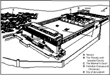
Much has been written about the first question, and in the past century almost every possible spot in the temple area has been proposed as that place: from the roof of the temple to the roof of the royal basilica on the south of the Temple Mount (see fig. 1), through the various entrance structures to the area, to locations on the city walls—both those surrounding the temple and its inner courts (fig. 1.A–C) and those encircling the whole compound (fig. 1.D).
24For a summary of the various proposals, see Joachim Jeremias, “Die ‘Zinne’ des Tempels (Mt. 4,5; Lk 4,9),” ZDPV 59 (1936) 195–205; and Exegetical Dictionary of the New Testament (ed. Horst Balz and Gerhard Schneider; 3 vols.; Grand Rapids: Eerdmans, 1990) 3.191–92, s.v.

.
Matt 4:5–7; Luke 4:9–12.
On this unique textual tradition, see James A. Montgomery, A Critical and Exegetical Commentary on the Book of Daniel (ICC; New York: Scribner, 1927) 386–88. The date of this translation is commonly fixed in the second half of the second century; see John J. Collins, Daniel (Minneapolis: Fortress, 1993) 10–11.

; not

as in most other sources) as an architectural feature of Solomon's temple.
27T. Sol. 22:8 (ed. Chester Charlton McCown, The Testament of Solomon [Leipzig: J. C. Hinrichs, 1922] 66 line 11).
To the best of my knowledge, no one has yet collected the various mentions of this site from the literature of the pilgrims and other writings of the Byzantine period and discussed them critically. Partial references may be found in Jeremias, “Die ‘Zinne,’” 201–5.

The numerous propositions for the location of the pterygion all emanate from the lack of any detailed description of it in the various sources. Some scholars cling to one particular piece of information and insist that it is the ultimate clue for solving the mystery. Jeremias, for example, favored the Testament of Solomon as the most reliable independent source to mention the pterygion, thus deducing that it represented the lintel of the temple gate and probably referred to the entrance of the so-called women's court (fig. 1.C).
29Jeremias, “Die ‘Zinne,’” 205–6 and his summary on p. 208. For more on this conjecture see n. 32, below.
Josephus, A.J. 15.412. For scholars who hold this position, see Balz and Schneider, eds., Exegetical Dictionary, 3.191–92.

(“doorway”) of the Temple Mount mentioned in the Palestinian Talmud.
31y. Pesaḥ 7.11, 35b. For this proposal see the extensive discussion in Jeremias, “Die ‘Zinne,’” 201–5.
The speculative nature of these conjectures is clear. It is hard to trust the Testament of Solomon, a magical text of the second century C.E. that makes purely literary use of a motif evidently well known to its readers. Likewise, it is unreasonable to attempt to identify the site solely on the basis of the information that it was high enough that a fall from the pterygion would be deadly; this criterion could describe several locations on the Temple Mount.32
Indeed, sharp criticism of the various suggestions has been expressed time and again in scholarly literature; ironically, however, the various critics have suggested hypotheses that are no less astonishing than the ones they condemned. Jeremias, for example, argues extensively against the positions that were prevalent in the literature before him, yet he himself bases his interpretation on the Testament of Solomon. And Hyldahl, who disapproves of Jeremias's thesis (and also repeats the criticism against all the earlier scholars), presents an equally ill-founded view in which the pterygion is presented as the official execution site of Jerusalem. See Niels Hyldahl, “Die Versuchung auf der Zinne des Tempels,” ST 15 (1961) 113–27.
It is thus preferable to shift the inquiry from the geographic identity of the site, which apparently leads to a dead end, and to focus instead on the conceptual framework in which the pterygion operates. I claim not only that such a framework is traceable but that the (relatively) recent discovery of the (Second) Apocalypse of James, unavailable to previous generations of scholars toiling to identify the geographical location of the pterygion, permits us to delineate the formative stages that shaped the collective understanding of this element. Even if we will never know exactly where the pterygion was geographically, it is entirely within our reach to determine its “conceptual geography,” that is, the place it occupied in the consciousness of the people who used it. Two topics—the image of the pterygion, and its cultural and religious contexts—are the focus of the following discussion.
Conceptual Frameworks and Their Changing Landscapes
Importantly, all of the early traditions cited above consider the pterygion an integral component of the temple. This cannot be deduced simply from the literal definition of the word, which embraces “wing,” “top,” “edge,” “corner,” “point,” and “pinnacle,” as well as sometimes a projection of a building or even a tower or turret. Indeed, in the Septuagint, for example, the word occasionally bears these meanings without any relation to the temple.33
Enumerated in Edwin Hatch and Henry A. Redpath, A Concordance to the Septuagint (Oxford: Clarendon, 1897) 1238, s.v.

.
The nature of the pterygion in Theodotion's translation of Daniel and the Testament of Solomon—as an organic constituent of the temple—resembles its character in the traditions about James's death. Hegesippus explains that the pterygion was chosen as the venue for James's speech because it was “clearly visible on high,” and thus the speaker's words would be “audible to all the people” who attended the temple on the holiday of Passover.
34
; Eusebius, Hist. Eccl. 2.23.11 (ed. Schwartz, 168 lines 18–19); trans. Kirsopp Lake, Eusebius: The Ecclesiastical History (LCL; 2 vols.; Cambridge: Harvard University Press, 1926) 1:173.

)” (fig. 1.A).
35Eusebius, Hist. Eccl. 2.23.18 (ed. Schwartz, 170 lines 21–22). Lake translates ναóζ as “temple” and thus obscures the writer's differentiation between

and ναóζ.
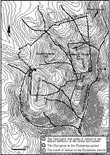
Scholars felt uneasy with such a positioning because it appears to contradict Jewish law. Strict halakhic rules forbid any sort of impurity in the temple area, making a grave at the site of the temple highly unlikely; indeed, a human corpse is considered the most potent source of impurity. Yet proposals that would resolve these difficulties by relocating the tomb elsewhere—for instance, to the ravine east of the city known as the Valley of Jehoshaphat (see fig. 2.3)36
So claim, for example, Hugues Vincent and Félix Marie Abel, Jérusalem nouvelle (Paris: J. Gabalda, 1922) 842; Arthur C. McGiffert, The Church History of Eusebius (NPNFGrand Rapids, Mich.: Eerdmans, 1986) 1:127 n. 30; and Jeremias, “Die ‘Zinne,’” 201 n. 1. See also n. 39, below.
Other accounts of James's death, whether literarily dependent on Hegesippus or not (a matter that is heatedly debated among scholars; see n. 20, above), contain details that support this conclusion. The description of the events in the (Second) Apocalypse of James is practically identical. The only site mentioned in that narrative is the temple; it is there that James was captured, and since the author does not state that he was taken away, he apparently believes that James was killed (and buried) in the same place.37
2 Apoc. Jas. 61:20 (ed. Parrott, 142–44). The pericope that might be considered to hint at a burial is 62:8–11 (ed. Parrott, 144), and one author who understood it that way was Brown, “Jewish and Gnostic Elements,” 228 n. 10. In contrast, Brown's suggestion (ibid., 230) that the statement that James was dragged along the ground after he was thrown off (62:2; ed. Parrott, 144) implies that the body was taken out of the temple area is doubtful, if only because there is no hint of it in the text. On this whole issue see also Wolf P. Funk, Die zweite Apokalypse des Jakobus aus Nag-Hammadi-Codex V (TU 119; Berlin: Akademie-Verlag, 1976) 176–80.
Ps.-Clem. Rec. 1.70.6–8 (ed. Rehm, 48; ed. Frankenberg, 74).
These segments and others are gathered in Félix Marie Abel, “La Sépulture de saint Jacques le Mineur,” RB 28 (1919) 482–83. Abel, like the scholars discussed above (n. 36), assumed that the tomb could not have been located on the “sacred Mount,” as he calls it, and so was compelled to suggest other readings of these passages. Concerning later versions of James's martyrdom, see Wilhelm Schneemelcher, New Testament Apocrypha (trans. Robert McL. Wilson; 2 vols.; Cambridge: James Clarke, 1992) 2:478–79.
This assortment of diverse sources indicates the vital role of the temple among the cluster of tropes that shaped early Christian traditions about James's death. Established as the central location of the course of events that led to James's martyrdom, the image of the temple was channeled into the consciousness of his followers and engraved in their shared memory. This obviously comports with the status of the temple in other stories about James, as discussed at the beginning of this paper. The same spatial organization structured the memories about his life and death.
The exact location of the tomb, if there ever was one, remains unknown. As a result of the marginality of James, one of the great losers among the protagonists of pre-Constantinian Christianity, traditions about the location of sites associated with him declined or perished. For more than two hundred years, from the days of Hegesippus and the other authors of the second-century C.E. texts discussed above down to the late fourth century C.E., the sources remain silent about any special locus related to James within the emerging religious topography of Jerusalem. Pilgrims to Palestine from the fourth century C.E. onward were no longer aware of the traditions about James's martyrdom; the anonymous Bordeaux pilgrim, for example, comes across the “corner of a highly elevated tower” in the ruined temple compound but knows of it only as the locus of the temptation of Jesus.40
Itinerarium Burdigalense 589.12–590.2 (ed. Paul Geyer and Otto Cunz, in Itineraria et alia geographica, [2 vols.; CCSL 175–176; Turnhout: Brepols, 1965] 1:15). See also Breviarius de Hierosolyma 6 (ed. R. Weber, in Itineraria et alia geographica, 1:112). Many have missed this point; see, for example, Pierre Maraval, Lieux saints et pèlerinages d'Orient: Histoire et géographie des origines à la conquête arabe (Paris: Cerf, 1985) 261. Maraval lists the references to the pterygion in the pilgrimage literature, adding incidentally that this is also the place from which James was thrown (“ce pinacle est aussi l'endroit d'où fut précipité Jacques, frère du Seigneur”), but this is precisely the detail that is not mentioned at all by any of the pilgrims!
See John Wilkinson, Egeria's Travels (rev. 2d ed.; London: Aris and Phillips, 1981) 183. Wilkinson suggests that parts of the description of Jerusalem in the writing of the so-called Peter the Deacon of the twelfth century are taken from lost fragments of Egeria's writings. But the information about James in the passage that Wilkinson cites is far too similar to the fragment of Hegesippus, and it seems much more likely that Peter, a librarian in the Monte Casino monastery, took them from Eusebius (through Rufinus's translation or Jerome's citations of the passage in Vir. ill. 2). For more on this see Abel, “La Sépulture,” 499.
Only in the second half of the fourth century—most likely in tandem with the revitalization of the Jerusalem church and its intense political activity—did the figure of James regain its place of honor. For the first time in almost three hundred years, legendary accounts surfaced, reporting the miraculous recovery of his tomb, which the new accounts located in the Valley of Jehoshaphat (see fig. 2.3).42
Abel collected the various sources describing this site and its functions during the Middle Ages and discussed them at length; see Abel, “La Sépulture,” 480–99; and a somewhat shorter version in Vincent and Abel, Jérusalem, 845–50. For a more recent discussion of this site, see Stéphane Verhelst, “L'Apocalypse de Zacharie, Siméon et Jacques,” RB 105 (1998) 81–104. Other famous Christian figures received similar attention in Byzantine Jerusalem; see, e.g., Ora Limor, “Christian Sacred Space and the Jew,” in From Witness to Witchcraft: Jews and Judaism in Medieval Christian Thought (ed. Jeremy Cohen; Wolfenbütteler Mittelalter-Studien 11; Wiesbaden: Harrassowitz, 1996) 63–65.
To the literature enumerated in the previous note add John Wilkinson et al., eds., Jerusalem Pilgrimage 1099–1185 (London: Hakluyt Society, 1988) 44.
The colorfulness and diversity embodied in this new phase of Christian experience fit well with a report by Jerome that, in his day, some believed that James's tomb was to be found on the Mount of Olives, as well as with traditions current a century and a half later that located the “cornerstone” (discussed below) on Mount Zion.44
Jerome, Vir. ill. 2 (ed. Ernest Cushing Richardson, Hieronymus liber De viris inlustribus [TU 14.1; Leipzig: J. C. Hinrichs, 1896] 8 lines 26–27). See also Theodosius, De situ Terrae sanctae 9 (ed. Geyer, in Itineraria et alia geographica, 1:119 lines 10–12), and another tradition from the same period in Gregory of Tours, De gloria beatorum martyrum 27 (ed. Theodore Ruinart, PG 71:727–28). Cf. Edgar D. Hunt, Holy Land Pilgrimage in the Later Roman Empire, AD 312–460 (Oxford: Clarendon, 1982) 155 n. 1. Hunt's interpretation of the first two texts presented here as evidence that James's tomb was located in the Kidron Valley has no foundation. Jerome and Theodosius both clearly say “the Mount of Olives” (in monte Oliveti); moreover, Theodosius distinguishes explicitly between the site on the Mount of Olives (par. 9), where he locates James's tomb, and the site in the Valley of Jehoshaphat. See also Abel, “La Sépulture,” 491. Concerning the “cornerstone” on Mount Zion, see the second version of the so-called Antoninus of Piacenza 22 (ed. Geyer, in Itineraria et alia geographica, 165). For Gregory of Tours's sources see the detailed discussion in Yitzhak Hen, “Gregory of Tours and the Holy Land,” OCP 61 (1995) 47–64.
Armenian lectionary, readings for 25 December (ed. Charles Renoux, Le lectionnaire de Jérusalem en Arménie [Turnhout: Brepols, 1989–] 367). Note Renoux's comment (ibid.) that the original version referred to the biblical patriarch Jacob and not to James, the brother of Jesus. On these ceremonies, see Ora Limor, “The Origins of a Tradition: King David's Tomb on Mount Zion,” Traditio 44 (1988) 457–62. It is worth noticing that this particular feast was still unknown to Egeria in the late fourth century. For additional, later “holy days” that were devoted to James in the various Palestinian liturgies, see Abel, “La Sépulture,” 494 with n. 3.
It is in this later period, in the generations following the establishment of Christian hegemony in Jerusalem, that the location of the pterygion was disengaged from its original temple context (fig. 2.1) and shifted to the southeastern corner of the Temple Mount enclosure (fig. 2.2). The establishment of the tomb in the Valley of Jehoshaphat (fig. 2.3) and its rapid growth made this a natural choice. From the vantage point of anyone standing at the foot of the mountain, on the banks of the Kidron, gazing up at the remnants of the mighty fortifications of the compound, the top of that wall appears at the southeast corner as a platform from which one who leapt or was thrown would land on the spot of the new tomb. As evident, for example, from the famous lithograph of the tomb of the sons of Hezir, which later Christians claimed to be James's tomb, the southeast corner of the Temple Mount is the only topographical feature that dominates the panoramic view available from the tomb.46
Reproduced in George Williams, The Holy City: Historical, Topographical, and Antiquarian Notices of Jerusalem (2 vols.; 2d ed.; London: J. W. Parker, 1849) plate 1, following p. 196.
Abel, “La Sépulture,” 499: “La vénération de la mémoire du premier évêque de Jérusalem ne s'éloignait pas beaucoup du lieu de son martyre.”
But an enormous difference separates the location of the tomb suggested by the earliest sources, especially Hegesippus, from the location proposed by the Byzantine traditions (accepted at face value by modern scholars) whose goal was to reconcile ancient traditions (whether the stories about the pterygion in the New Testament or the accounts about James's martyrdom) with the remains of the Temple Mount still visible in the fourth century C.E.. It is a difference of perspective—the direction of viewing was completely inverted, reversed by one hundred and eighty degrees. The Byzantines stood in the Kidron Valley and looked north, thus seeing the wall of the temple precinct from the outside. But the viewpoint, both physical and spiritual, of the early community of James's followers was completely centered within the temple precinct itself (figs. 1.A and 2.1). Standing inside the compound, they focused on the temple and its immediate vicinity (fig. 2.1). As I have shown, the events and the various sites associated with James by his early followers—the pterygion, the tomb, and the gravestone (as well as the great stone to be discussed below)—were all attached, even if only in their minds, to the structure of the temple itself and its immediate vicinity (fig. 2.1). The early sources presume an interior, rather than an exterior, perspective of the Temple Mount. Scholars were prone to project the Byzantine perspective onto the early sources, and to read the Byzantine physical circumstances into the early texts. It was thus natural for scholars to situate the pterygion in the southeast corner of the Temple Mount and the tomb of James in the Valley of Jehoshaphat, and to regard these identifications as incontrovertible facts.48
Abel's attempt (ibid., 485) to explain this difference between the early and Byzantine sources by arguing that at a certain point James's body was moved from one grave to another is nothing but a harmonizing effort lacking any evidential basis. Clear examples of this process of “reading backward” are Jeremias, “Die ‘Zinne,’” 201 with n. 1; Hunt, Holy Land Pilgrimages, 155 n. 1; and Herbert Donner, “Der Felsen und der Tempel,” ZDPV 93 (1977) 1–11. The same process is reflected in the remarks of John Wilkinson on the Byzantine pilgrims; see, e.g., his comments on the description of the Temple Mount in the writings of the Bordeaux pilgrim, in Jerusalem Pilgrims before the Crusades (Warminster: Aris and Phillips, 1977) 173, s.v. “Temple”; and in “Christian Pilgrims in Jerusalem during the Byzantine Period,” PEQ 108 (1976) 86. From here it is but a short step to a “new reality” in the guides and introductory books; see, e.g., Clemens Kopp, The Holy Places of the Gospels (New York: Herder and Herder, 1963) 287 (map); and Maraval, Lieux, 33, 264. In the same vein, the publishers of the recently (re)discovered James ossuary locate his tomb “beneath the Temple,” obviously referring to the Valley of Jehoshaphat; see Lemaire, “Burial Box of James,” 32.
The problem with these reconstructions is that the earliest traditions about James, from the late first and early second centuries C.E., lack even the slightest allusion to the southeast corner of the temple platform as the location of the pterygion. Even more so, the early sources contain no hint that James's tomb was ever believed to be outside the temple area. Quite to the contrary, the early traditions cited above indicate that the pterygion and the tomb of James were both located at the top of the mount, immediately next to the temple ruins (i.e., somewhere in the vicinity of fig. 1.A–C or fig. 2.1). It is hard to determine what led the Byzantine establishers of the new location of the tomb of James to “turn their back” on the Temple Mount. Perhaps intentional ideological motives caused this shift; perhaps it occurred simply because the Temple Mount was not an integral part of Jerusalem at that time; or perhaps it was merely circumstantial. Our inability to discern the motives behind this act, however, should not blur its innovative aspects.
Finally, to close the historical circle, during the Crusader era, with the renewal of intense Christian activity on the Temple Mount, various spots associated with James began to be “identified” once more within the temple compound itself.49
See Abel, “La Sépulture,” 495–99; Wilkinson, Jerusalem Pilgrimage 1099–1185, 44; and Sylvia Schein, “Between Mount Moriah and the Holy Sepulchre: The Changing Traditions of the Temple Mount in the Central Middle Ages,” Traditio 40 (1984) 175–95.
Evolving Traditions about the Pterygion
Among the array of images and physical details incorporated into the later sources that mention the “pterygion of the temple,” one that stands out had not been present from the start—“the great cornerstone.” A later source illustrates this point. When the Bordeaux pilgrim recounts his visit to the temple ruins in the fourth decade of the fourth century C.E., he reports two adjoining objects: an impressive corner of a tower and a “huge cornerstone (lapis angularis magnus).” He recognizes the former as the site of the temptation of Jesus, which various New Testament authors identified as the pterygion of the temple. To be sure, the term used by the traveler to indicate the turret of this towering structure—the Latin pinna—serves as the equivalent of the Greek pterygion. As for the latter feature, the great cornerstone, the traveler cites Ps 118:22 as a prooftext referring to this particular stone: “The stone which the builders rejected has become the head of the corner.”50
Itinerarium Burdigalense 589.11–590.4 (ed. Geyer and Cuntz, 1:15).
Surprisingly, both the cornerstone and the pterygion, as well as the associated verse from the psalm, also appear in the Testament of Solomon, a legendary tale written approximately one hundred and fifty years earlier about the construction of the first temple by King Solomon. According to that story, Solomon's building enterprise concluded with the hoisting of a huge cornerstone (

) onto the “pterygion of the shrine (

).” Beyond human capacity, this final task hindered the completion of the project until an Arab demon named Epiphas arrived to help. King Solomon in turn, in his great joy at the completion of the project, cited the above-mentioned verse from Psalm 118—“The stone which the builders rejected has become the head of the corner”—and applied it to this stone.
51T. Sol. 22:7–8 (ed. McCown, 66); 23 (ed. McCown, pp. 69–70). For another, later, version of this legend, see Dennis C. Duling, “Testament of Solomon,” in The Old Testament Pseudepigrapha (ed. James H. Charlesworth; 2 vols.; New York: Doubleday, 1983) 1:985, verse 24, n. a.
Scholars did not pay much attention to this parallel. Yet, although the source for the cornerstone image in the writings of the Bordeaux pilgrim remains unknown, the very fact that both the pilgrim and the Testament of Solomon know of a corner-stone in the temple and associate that stone with the same biblical text cries out for interpretation. Although the verse from the psalm was very popular among early Christian writers, insofar as Jesus is recorded not only to have expounded it but also to have likened himself to that rejected stone,52
For some of the more popular examples, see ibid., verse 23, n. b; and R. J. McKelvey, “Christ the Cornerstone,” NTS 8 (1961–1962) 352–59. An additional interesting parallel is Barn. 6.3–4 (ed. Kirsopp Lake, The Apostolic Fathers [2 vols.; LCL; Cambridge: Harvard University Press, 1912] 1:358), which alludes to this verse in the context of its criticism of those people who interpret it literally and put their trust in an actual stone. This may echo the identification of a particular stone in Jerusalem, as indicated by the Bordeaux pilgrim. See also the Coptic Apocryphon of Jeremiah 28 (ed. K. H. Kuhn, “A Coptic Jeremiah Apocryphon,” Mus 83 [1970] 95–135, 291–350, at 302–3), a late (fourth-fifth century C.E.) text that conveys a fully developed legend about the cornerstone of the temple with no connection to the other features discussed here (I owe this reference to Kirstie Copland, and I am also grateful for her help and advice on the Coptic material throughout this paper). Concerning the motif of the stone in biblical imagery, which undoubtedly affected the religious thinking of whoever shaped the traditions about Jesus and James, see Ithamar Gruenwald, “God the ‘Stone/Rock’: Myth, Idolatry, and Cultic Fetishism in Ancient Israel,” JR 76 (1996) 428–49. Gruenwald's study complements my presentation here: It examines the motif from the abstract aspect of ideas, while my own remarks reflect the way these ideas encountered the real world (I thank Prof. Gruenwald for referring me to his study).
New light on this issue, which elucidates the stages in the formation of this cornerstone tradition, may be shed by the martyrdom passage in the (Second) Apocalypse of James. In his account of James's capture by his opponents, the author of the apocalypse enumerates two spots where James stood. The first, regardless of the uncertain meaning of the relevant Coptic word, undoubtedly represents the author's attempt to render the Greek pterygion.53
Apoc. Jas. 61:21–22 (ed. Parrott, 142). For the various alternative translations from Coptic, see Walter E. Crum, A Coptic Dictionary (Oxford: Clarendon, 1939) 421. See also the editor's hesitation in the notes of Parrott, 142–43.
Yet, despite all the unknowns, the traits common to these three disparate sources—the story of James's martyrdom as it appears in the (Second) Apocalypse of James, the legend about the building of the temple in the Testament of Solomon, and the tradition featured by the Bordeaux pilgrim—reflect the same conceptual setting. Their geographic backdrop centers on the temple (note that both the Bordeaux pilgrim and the Testament of Solomon present it as Solomon's temple), and within this landscape they highlight two adjacent constituents—the pterygion and the “great cornerstone.” At some point, not in the (Second) Apocalypse but in the two other texts, the verse from Psalm 118 was linked to the cornerstone and continued to serve as its prooftext for centuries.54
Scholars who did not recognize the realistic dimension of these documents have missed this point entirely; Funk (Die zweite Apokalypse des Jakobus, 175 n. 1), although noticing that all three texts share the “great stone,” nevertheless returns to Jeremias's view (see nn. 31–32, above, and n. 55, below). But at the time when Jeremias produced his study, the (Second) Apocalypse of James was still buried in the ground at Nag Hammadi, and Funk did not consider the possibility that this new discovery could highlight aspects unrecognized by Jeremias. Funk's claim that Hegesippus's story was shaped by the verse about the “cornerstone” in Ps 118:22 (LXX Ps 117:22) compounds the error since the two major features—the great stone and the verse from the psalm—are precisely what is missing from Hegesippus, surfacing only in the Testament of Solomon and the (Second) Apocalypse of James. This point was also missed by Brown, “Jewish and Gnostic Elements,” 227.
What prompted the shared texture of these traditions? The common mention of the pterygion would seem to suggest that they should all be associated with the New Testament account of the temptation of Jesus, and that this account should in fact be identified as the source of inspiration for all the others.55
So Jeremias, “Die ‘Zinne,’” 200, and many others.
Matt 4:5–7//Luke 4:9–12.
The author of Mark does not include such a pericope in his temptation sequence at all; see Mark 1:12–13.
This interpretation, however, presupposes the superiority of the New Testament passages about the temptation in the worldview of those who produced the other traditions. Such a perspective focuses on the temptation of Jesus and, while taking its details for granted, seeks an appropriate way to construe its meaning. This situation, however, may not have been the case in the first few centuries of the Common Era—prior to the consolidation of the New Testament into a homogeneous and prominent document—when the above-mentioned traditions, such as those found in the (Second) Apocalypse of James, were formulated.
A different set of challenges confronts those attempting to reconstruct the physical context and ideological tendencies embodied in the passages in their formative stage and their function in the life of the communities that produced them. In this setting the nature of the pterygion assumes greater importance. Did the author of the passage in Matthew and Luke create the name of the place out of whole cloth? If so, what was he trying to achieve? Readers who focus on the events that transpired there—Satan's attempts to entice the future Messiah—and their New Testament legacy are liable to impose the events on the geography and arrive at peculiar conclusions, like that of Hyldahl, who claimed that the pterygion was the official execution site of the Sanhedrin, the Jewish high court, in the Second Temple period.58
Hyldahl, “Die Versuchung.”
Indeed, the tradition handed down by Matthew and Luke does not endow the pterygion with any real substance. This site is not mentioned anywhere else in the documents incorporated into the New Testament, nor is it involved in any other event. Such omissions indicate that the name of the place was already registered in the mind of the audience targeted by the authors who recorded the temptation story. Rather than making the first use of the pterygion image, the New Testament passage seems to be relying on its established reputation.
Comparing the pericope about the temptation of Jesus in Matthew and Luke with the account in Hegesippus about the martyrdom of James reveals striking similarities in both the name of the site, the pterygion, and the events that unfolded there—namely, a deadly fall. Furthermore, both narratives represent analogous, though opposite, tendencies in the world of the Jesus movement. Both contemplate the combination of death and the dissemination of the belief in Jesus the Messiah, but the passage about James articulates a rather positive view of such a “martyrdom,” whereas the temptation story remains reserved about it (after all, Jesus turned down Satan's proposal). Within these contrasting narratives, the pterygion serves an identical function: it is high enough that a fall from it would be fatal; it is centrally located so that it could be observed by the multitudes; and most importantly, it is incorporated in the structure of the temple, the heart of Jewish life at the time. This analysis suggests that the pterygion, or the idea of such a place, already held a certain significance for the authors and their readers. The prestige of the pterygion led authors and readers alike to associate it with major events of their shared ethos and to formulate around it various traditions, until it was finally memorialized as a pilgrimage site for Byzantine Christians.
Over the years, the figure of the pterygion and its associations continued to change, and some of these developments may still be discerned. While in the New Testament stories of Jesus and in Hegesippus's account about James, only the pterygion appears, a second, closely related entity—the “great cornerstone”—surfaces along with it in other traditions, which therefore should probably be dated to a later stage. Two second-century C.E. sources—the Testament of Solomon and the (Second) Apocalypse of James—link the “great cornerstone” with the pterygion, and remnants of this coupling were preserved until the time of the Bordeaux pilgrim. Such an analysis reveals a two-stage process in the crystallization of the pterygion image. First came traditions in the lore of the early Christian communities about significant events, either historical or legendary, that took place at the pterygion. The sources expressing this phase include the passages about the temptation of Jesus in Matthew and Luke and the passage about James preserved by Hegesip-pus. In the second phase the tradition was enhanced by the addition of the “great cornerstone.” This stage also features the development of folkloristic legends about the pterygion, such as the one in the Testament of Solomon, and the configuration of a biblical prooftext as an allusion to the site. The two sources conveying the events about James's martyrdom—Hegesippus and the (Second) Apocalypse of James—delineate the axis along which the representation of the site matured: the great cornerstone is absent from the former but does appear in the latter.
The literary proliferation of traditions involving the pterygion reached its zenith in the second stage. It was then followed by a third phase, in which the traditions faded. This third chapter in the story of the pterygion is clearly demonstrated by the writings of the Bordeaux pilgrim. While his itinerary still includes the pterygion and the great cornerstone and indicates some knowledge of their associated lore, namely the story about the temptation of Jesus and the application of the psalm verse to the cornerstone, other components of the site's legacy have already begun to dissolve. The figure of James and the sites associated with him, all dominant factors in the earlier portrayal of the pterygion, have been “eliminated” from the picture. It would not be long before the ancient depiction of this feature would be forgotten altogether.
But this does not mean that the cluster of images and details associated with James were doomed to vanish completely. Traditions tend to fluctuate, and when they no longer retain their old shape, they are reinvented in a new one. In the case under discussion, this reinvention occurred in the Byzantine era. Christian inhabitants of Jerusalem at that time were no longer familiar with the anonymous Jewish authors among the Jesus movement or within the community of James in the late first and early second centuries. Undoubtedly they were also far removed from first-century moral, ideological, and religious views. Yet when they encountered the traditions preserved in writing, such as the fragment from Hegesippus in Eusebius and the segments in the Pseudo-Clementines, they revived them, while shifting their geographical arena from the temple to the lower Kidron Valley (see fig. 2).

The Temple Mount as a Sacred Cemetery
What endowed the pterygion of the temple with such importance for the early followers of Jesus and James? Hegesippus concludes the story of James's burial next to the temple by adding that “his gravestone still remains by the shrine [of the temple] (

).”
59Eusebius, Hist. Eccl. 2.23.18 (ed. Schwartz, 170 lines 21–22). Contra Dennis E. Groh (“The Onomasticon of Eusebius and the Rise of Christian Palestine,” in Papers of the Ninth International Conference in Patristic Studies, Oxford, 1983 [ed. Elizabeth A. Livingstone; 4 vols.; StPatr 18; Kalamazoo, Mich.: Cistercian Publications, 1985] 1:27), who ascribes the remark “his gravestone still remains by the shrine” to Eusebius and compares it with that writer's habit in his Onomasticon of concluding a geographical account with the statement that the situation at a particular site continues “until this very day.” Groh's reading of the passage stumbles on both linguistic and literary grounds. Eusebius consistently uses the expanded, biblically rooted, and therefore almost formal formula

(“until this very day”), not the ingenuous temporal adverb

(“still”). See also Robert L. Wilken, The Land Called Holy: Palestine in Christian History and Thought (New Haven: Yale University Press, 1992) 100. Furthermore, in the absence of distinguishing punctuation such as colons and quotation marks, competent writers like Eusebius utilized literary techniques to distinguish a quotation from their own words. This could not be clearer than in the current passage, where Eusebius brings Hegesippus's segment to a close with the statement, “This account is given at length by Hegesippus” (2.23.19).
Noting this, Schwartz (p. 170) concluded that the two endings of the story cannot function together: “zwei Schlüsse der Erzählung, die neben einander nicht stehen können”; i.e., they cannot come from the same author. On the other hand, his assertion in the critical apparatus that the phrase locating the site

is a scribal error due to homoioteleuton (the same phrase

appears once before in the same context, which could signal that the eyes of a scribe skipped from one to another) does not seem persuasive. This version is witnessed by all the Greek manuscripts as well as by the Syriac translation (ed. William Wright and Norman McLean, The Ecclesiastical History of Eusebius, in Syriac [Cambridge: University Press, 1898] 104 line 8), which shows that it already existed in the fifth century. The entire pericope about the tombstone was omitted from Rufinus's text, perhaps because of his inaccurate translation, which Mommsen called an “arbitrary and strongly abbreviating treatment of the original (willkürliche und stark verkürzende Behandlung der Urschrift)”; see Theodor Mommsen, “Einleitung zu Rufin,” in Eusebius Werke: Die Kirchengeschichte (ed. Eduard Schwartz and Theodor Mommsen; GCS 9.3; Leipzig: J. C. Hinrichs, 1909) ccli. But compare Francis X. Murphy, Rufinus of Aquileia (345–411): His Life and Works (Washington: Catholic University of America, 1945) 164ff. An alternative reason might be that the monument was no longer known in the fifth century.
In general, tombs of publicly acclaimed figures do not just endure fortuitously for decades; someone has to retain the memory of the deceased and ensure at least some minimal maintenance of the grave. Written at around the same time as Hegesippus, the Martyrdom of Polycarp provides a glimpse into the activities that commemorated such places: “Thus we, at last, took up his bones, more precious than precious stones, and finer than gold, and put them where it was appropriate. There the Lord will permit us to come together according to our power in gladness and joy and celebrate the day of his martyrdom.”61
Mart. Pol. 18.2–3 (ed. Lake, Apostolic Fathers, 2:336; trans. ibid., 2:337).
The most detailed discussions of the early traditions about this tomb are still those of Vincent and Abel, Jérusalem, 89–104; Joachim Jeremias, “Wo lag Golgotha und das Heilige Grab?,” Angelos 1 (1925) 141–73; idem, “Golgotha und der heilige Felsen,” Angelos 2 (1926) 74–128 (these two papers were published together as a short monograph, Golgotha [Leipzig: E. Pfeiffer, 1926]). I do not want to delve here into the debate about what exactly the early Christians remembered or what transformations and developments these memories underwent. But it is hard to accept extreme positions such as that of André Parrot, Golgotha and the Church of the Holy Sepulchre (trans. Edwin Hudson; New York: Philosophical Library, 1957) 49–59. There is still some basis for the claim that the early members of the Jesus movement preserved some memory whose early layers are reflected in the various gospel accounts of the resurrection (Matt 27:59–28:20//Luke 23:52–24:53). For a more moderate view, see Charles Coüasnon, The Church of the Holy Sepulchre in Jerusalem (London: British Academy, 1974) 6–14. On the entire issue, see the balanced, persuasive discussion of Peter W. L. Walker, Holy City, Holy Places? (Oxford: Clarendon, 1990) 241–47, which includes an up-to-date bibliography.
André Grabar, Martyrium: Recherches sur le culte des reliques et l'art chrétien antique (3 vols.; Paris: Collège de France, 1946), esp. 1:27–44; and Peter Brown, The Cult of the Saints: Its Rise and Function in Latin Christianity (Haskell Lectures on History of Religions n.s. 2; Chicago: University of Chicago Press, 1981). Even though most of Grabar's and Brown's discussions are devoted to later periods than the one at issue here, they too assert that the beginning of these processes was very early. For a discussion concentrating on Palestine, see also John Wilkinson, “Jewish Holy Places and the Origins of Christian Pilgrimage,” in The Blessings of Pilgrimage (ed. Robert G. Ousterhout; Urbana: University of Illinois, 1990) 41–53, as well as n. 70, below.
The mutual relations between sites and saints were extensively discussed in Hippolyte Delehaye, Les légendes hagiographiques (2d ed.; Brussels: Bureaux de la Société des Bollandistes, 1906) 45–51, 190–201; see also 253–56.
The area of the ruined Jewish temple functions as the stage, and later as the pilgrimage site, for another renowned figure in early Christian legacy, namely Zechariah, whose tale is retold many times in both Jewish and Christian settings. The sources about the martyrdom of this character were gathered carefully, and his persona, blending together more than one person, has been extensively studied, so that there is no need to repeat the details here.65
See, e.g., Schneemelcher, New Testament Apocrypha 1:396; John Chapman, “Zacharias Slain between the Temple and the Altar,” JTS 13 (1911–1912) 398–410; Sheldon H. Blank, “The Death of Zechariah in Rabbinic Literature,” HUCA 12–13 (1937–1938) 327–46; and Jean-Daniel Dubois, “La mort de Zacharie: mémoire juive et mémoire chrétienne,” REAug 40 (1994) 23–38. The similarities between Zechariah and James are discussed in detail in Irshai, “Historical Aspects,” 8–12. There is not yet a complete summary of the tradition and the site in the writings of the pilgrims and later authors; in the meantime, see Wilkinson, Jerusalem, 173, who for some reason did not include Itinerarium Burdigalense 591.2 (ed. Geyer and Cuntz, 1:15), and now Verhelst, “L'Apocalypse.”
E.g., the martyrdom of Tabitha in Apoc. El. (C) 6 (ed. Georg Steindorff, Die Apokalypse des Elias [Leipzig: J. C. Hinrichs, 1899] 120–25; ch. 4 in Charlesworth's numeration).
Lam. Rab. 4:14 (Buber, 149). Other sources on Zechariah are listed in n. 65, above.
Another tradition that fits well with the image of the Temple Mount as the locus of sacred tombs is witnessed by the myth about Adam's burial under the foundation stone. Only vague recollections of this notion are preserved here and there. Isaiah Gafni, who collected and studied the material, convincingly argues that the belief about Adam's interment at Golgotha echoes an early conviction that located the site at the Jewish temple. As with many other pieces of Jewish lore, later Christian authors transferred this tradition to the Holy Sepulcher.68
Isaiah M. Gafni, “Pre-Histories of Jerusalem in Hellenistic, Jewish and Christian Literature,” JSP 1 (1987) 12–16.
m.

Ed. 8.5; y. Pesaḥ 9.1, 36c; Abot R. Nat. version a 26 (ed. Schechter, 41b). See Samuel Krauss, Qadmoniot ha-Talmud (in Hebrew) (2 vols.; Berlin: Benjamin Harz, 1924) 1:1.109–11, who deduces from these sources that burial was indeed practiced on the Temple Mount (or in the numerous tunnels underneath its surface).
Generally speaking, many studies demonstrate that tombs of important figures, mostly with roots in the biblical past, occupied the cultural landscape and daily experience of Second Temple Jews.70
Recently a bibliography and a review of research on this topic were presented in David Satran, Biblical Prophets in Byzantine Palestine (SVTP 11; Leiden: Brill, 1995) 22–25.
Ibid., 118–20. For a view opposing these inclinations, see, e.g., Matt 23:29.
The most significant analogy to the traditions about James's burial place on the Temple Mount pertains to the Holy Sepulcher, the site of Jesus's tomb at Golgotha. Even a superficial glance at the wide array of sources that attest the emergence of this locality reveals patent similarities to the story of James. Both individuals, central figures in their circles, died in tragic circumstances, each struggling to defend the rightness of his chosen path. In both cases, the threat felt by others lest the teachings of this individual be disseminated served as the main incentive for killing him. Both were buried in the immediate vicinity of the place where they were killed, and their tombs acquired a sacred status. Seeing the situation this way and knowing (in hindsight) the whereabouts of Golgotha only strengthen the conclusion that the Temple Mount is indeed the appropriate place to locate James's tomb.
Conclusions
When did the awareness of holy burial sites on the Temple Mount take shape, and what induced the authors among the disciples of Jesus and the followers of James to mold these geographical designations the way they did? It is hard to answer these questions. As mentioned at the beginning of this paper, various sources hint that the temple ranked high among some early Christian groups. For example, traditions that locate the major events of Jesus's childhood in this institution, as well as the assertion that Mary too grew up in the temple among the priests, tally with Hegesippus's portrayal of James.72
Eg., Luke 2:22–29, 41–50; 4:9–13; Matt 4:5–11; Prot. Jas. 1–10 (ed. de Strycker, 64–86).
Heb 2:17; 3:1; 5:1–10; 6:19; 7:11–18; see Harold W. Attridge, The Epistle to the Hebrews (Philadelphia: Fortress, 1989) 97–103. Oddly, even when Attridge cites parallel Christian sources outside of the New Testament (ibid., 102 n. 263), he does not mention those pertaining to James.
Martha Himmelfarb, Ascent to Heaven in Jewish and Christian Apocalypses (New York: Oxford University Press, 1993) 30–31.
Heb 7:27; Epiphanius, Pan. 30.16.7 (ed. Holl and Dummer, 1:354–55).
Noticed by Gustafsson, “Hegesippus's Sources,” 229–32. See also Pratscher, Der Herrenbruder, 110–14; and Frederick F. Bruce, Peter, Stephen, James and John: Studies in Early Non-Pauline Christianity (Grand Rapids, Mich.: Eerdmans, 1979) 116–17.
Likewise, due to the paucity of sources, the actual events that led to and followed James's death remain unknown. For example, the passage in Josephus describes a more moderate version of the proceedings that set James's killing in motion, in which the temple and the Temple Mount do not appear at all (see n. 19, above). Was James really buried on the Temple Mount? The numerous cavities underneath the platform provide potential sites aplenty. One cannot know for sure, and for the purpose of the present study it does not really matter. Even though it appears implausible that temple authorities in the Second Temple period would allow a corpse to be entombed there, someone no later than the middle of the second century C.E. had patterned the tradition in Hegesippus according to that very mode. The land-scape envisioned in that spatial organization spread in the popular imagination until different forms of it were embedded in the apocalyptic writings unearthed at Nag Hammadi and in the legends retold in the Testament of Solomon. Reverberations of the same paradigm, however faint, could still be heard at the time of the Bordeaux pilgrim. The people who designed these configurations clearly considered the space near the temple to be a place of religious value—not the temple itself but rather, in the words of Hegesippus, the area “near the shrine.” The fragmentary traditions reflecting this line of thought display the seeds of a new spatial order and the consolidation of a new holy site: not the temple itself, but the area in which it was located. Likewise, the temple worship with its associated laws of purity and its classic symbols—the altar and the holy of holies—were supplanted by other concerns and new objects: the pterygion, the great cornerstone, James's tomb, and the monument of his gravestone. All in all, this study of the evolving traditions about the death and burial of James contributes to our knowledge of the history of the Temple Mount, and illuminates as well a relatively obscure chapter in the story of early Christianity.
Footnotes
Unless otherwise noted, all translations in this paper are mine. The current study does not directly refer to the recent debate regarding the authenticity of the ossuary associated with James, brother of Jesus, that has infuriated both the scholarly community and the general public in the last few months; see André Lemaire, “Burial Box of James the Brother of Jesus,” BAR 28, no. 6 (2002) 24–33, 70. Naturally, the publishers of this artifact, as well as those who have disputed their findings, have channeled their efforts toward evaluating its inscription, which asserts that the bones of James were entombed in that stone box. No one involved in the current controversy has paid any serious attention to the question of where James was buried, repeating only the traditional nineteenth- and early-twentieth-century opinions on this issue (see nn. 36 and 48, below). The present study (which originated years before the topic of James's death became so popular) aspires to fill this gap. Many thanks to Martha Himmelfarb, who read a few early versions of this article and provided invaluable comments.
 You have
Access
- 1
- Cited by