In 2017, transgender woman Danica Roem stunned political observers in Virginia by unseating a long-time anti-LGBTQ legislator from a conservative district in the Virginia House of Delegates.Footnote 1 She was the first openly transgender person elected and seated to a state legislature. Delegate Roem’s election was historic in LGBTQ political representation, but it also occurred in a period when backlash against the LGBTQ community seemed to be growing (Taylor, Lewis, and Haider-Markel Reference Taylor, Lewis and Haider-Markel2018). These two threads led us to ask: How are LGBTQ candidates achieving historic successes even as forces seem mobilized against them?
How are LGBTQ candidates achieving historic successes even as forces seem mobilized against them?
This article examines the 2018 state legislative elections to assess whether sexual orientation and gender identity played a role in candidate electoral success.
Existing research on the role of sexual orientation in elections suggests that it is, at worst, a non-issue in most elections (Haider-Markel Reference Haider-Markel2010; Magni and Reynolds Reference Magni and Reynolds2018; Reynolds Reference Reynolds2018) and perhaps even a benefit to many candidates (Haider-Markel Reference Haider-Markel2010). These findings are consistent with research on women candidates, which indicates that gender and gender stereotypes do not have significant negative electoral consequences for women (Brooks Reference Brooks2013). However, the perception that there are electoral barriers inhibits some women from running for office (Brooks Reference Brooks2013; Lawless and Fox Reference Lawless and Fox2010); the same is true for LGBTQ potential candidates (Haider-Markel Reference Haider-Markel2010).
For gay and lesbian candidates, the lack of negative electoral consequences is due at least partly to the fact that these candidates, perceiving electoral barriers, have been strategic about when and where they run for office. They often run after they have acquired considerable party and/or political experience and run in jurisdictions the demographics of which would suggest less opposition to a gay candidate (Haider-Markel Reference Haider-Markel2010). In addition, most gay candidates run as Democrats, thereby avoiding the fact that the strongest opponents to gay candidates are unlikely to vote for any Democratic candidate (Haider-Markel Reference Haider-Markel2010; Loepp and Redman Reference Loepp and Redman2020). We know less about potential opposition to bisexual candidates but, given that voters are likely to consider their sexual orientation about the same as they would for gay candidates, we expect the profile of opponents to be similar.
The literature on transgender candidates is sparse (Casey and Reynolds Reference Casey and Reynolds2015)—much of it based on survey responses to hypothetical candidates—but does suggest that transgender candidates face greater opposition than gay and lesbian candidates (Haider-Markel et al. Reference Haider-Markel, Miller, Flores, Lewis, Tadlock and Taylor2017; Jones et al. Reference Jones, Brewer, Young, Lambe and Hoffman2018; Taylor, Lewis, and Haider-Markel Reference Taylor, Lewis and Haider-Markel2018). However, the profile of a voter more likely to support a transgender candidate is similar to that of a voter likely to support a gay candidate—that is, female, younger, college educated, less religious, and leaning Democratic and liberal (Haider-Markel et al. Reference Haider-Markel, Miller, Flores, Lewis, Tadlock and Taylor2017).
A RAINBOW WAVE?
The advent of the Trump administration mobilized many women and people from marginalized communities to participate more actively in politics, including attending protests and voting in elections. Indeed, Chenoweth and Pressman (Reference Chenoweth and Pressman2017) tracked protests since the 2016 election and suggested that 2017 witnessed an exceptional number of protests, with perhaps more than 4 million protesting in the Women’s March in January.Footnote 2 The mobilization of marginalized groups has been enhanced by recent movements including #BlackLivesMatter March for Our Lives and the #MeToo movement. During off-year state elections in states such as Virginia and special elections in states such as Alabama, voter participation—especially among women and people of color—was especially high. As the 2018 midterm election approached, the number of nontraditional candidates running for office at every level of government broke previous records. In Congress alone, a record number of women, people of color, and LGBTQ status were elected to serve: 117 women and 10 LGBTQ members, including Native American lesbian Sharice Davids (D-Kansas) (Zhou Reference Zhou2019). In total, more than a record 150 LGBTQ candidates were elected to office in 2018 (Caron Reference Caron2018).
One 2018 race that illustrates the surge of candidates from underrepresented groups was District 115, part of Dallas County, in the Texas House of Representatives. The race also illustrates how sexual orientation often is a non-issue in elections. In that race, lesbian Julie Johnson was a first-time candidate for office running against two-term incumbent Republican Matt Rinaldi (Holter and Perez Reference Holter and Perez2019). Although the district is racially diverse and well educated, it was historically Republican. Rinaldi, part of the conservative Texas Freedom Caucus in the legislature, had been elected to the seat in 2014 (Ballotpedia 2019). In 2015, he was voted the most conservative member of the Texas House (Hooks Reference Hooks2018). Democrats had fielded candidates in the district in recent election cycles, but most were often “sacrificial lambs” rather than competitive challengers (Holter and Perez Reference Holter and Perez2019). Nevertheless, in 2016, the district voted for Clinton (52%) and the Democratic legislative candidate had been competitive against Rinaldi, coming within one percentage point of defeating the incumbent, thereby trending the district toward blue (Dallas Morning News Editorial 2018).
Involved in local Democratic politics and raising money for an LGBTQ national advocacy group but never before herself a candidate, Johnson was a practicing attorney in Dallas running her own law firm (Hooks Reference Hooks2018). She was part of a wave of LGBTQ candidates in Texas during 2018. In all, 35 LGBTQ candidates ran for offices in Texas in 2018; 14 were successful (Wiley Reference Wiley2018). In 2017, Johnson was encouraged to run for the legislature by party operatives (Hooks Reference Hooks2018), but her decision was motivated in part by a so-called bathroom bill that was introduced in the legislature in 2017 (Holter and Perez Reference Holter and Perez2019). Modeled after similar 2016 legislation in North Carolina, the bill (SB 6) would have overridden local laws, discriminating against transgender people by limiting access to bathrooms in government buildings, universities, and public schools based on biological sex (Ura and Murphy Reference Ura and Murphy2017). The measure ultimately failed, but Johnson viewed the measure as an attack on a minority group and not one that was positive for Texans (Holter and Perez Reference Holter and Perez2019). Johnson was open throughout the campaign about her sexual orientation and her same-gender wife, but she viewed her sexual orientation as simply part of who she was rather than a central feature of her candidacy (Holter and Perez Reference Holter and Perez2019). Moreover, we could not locate any public evidence that Rinaldi’s campaign attempted to make an issue of Johnson’s sexual orientation.
Although partly motivated by attacks against the LGBTQ community and the divisive behavior and words of the Republican incumbent, Johnson focused her campaign on improving public education and access to health care (Holter and Perez Reference Holter and Perez2019). Her focus on education—and Rinaldi’s firebrand reputation—convinced Rinaldi’s former Republican opponent, former State Representative Bennett Ratliff, to endorse Johnson (Hooks Reference Hooks2018). Her education focus also led to the endorsement of the Dallas Morning News (Dallas Morning News Editorial 2018) and President Obama (Jeffers Reference Jeffers2018).
Fundraising during the race was remarkably competitive. Johnson was able to raise more than $950,000 for her campaign, mostly through individual donations (FollowTheMoney.org 2019a), whereas Rinaldi raised slightly less than that amount, mostly from single-issue/ideology-group donations (FollowTheMoney.org 2019b). Based on data from FollowTheMoney.org, the amounts raised and spent by the campaigns were four times higher than in previous races and were in the top 10 of all candidates for the Texas House. Strong financing helped Johnson secure almost 57% of the vote in November. Given her overall margin of victory, it would be difficult to claim that her sexual orientation had a negative impact on her electoral fortune.
Candidate Johnson clearly represented the rainbow, pink, and blue waves of the 2018 election. Her candidacy also provides additional evidence that LGBTQ candidates running for office as Democrats are unlikely to face significant hurdles in their elections.
Candidate Johnson clearly represented the rainbow, pink, and blue waves of the 2018 election. Her candidacy also provides additional evidence that LGBTQ candidates running for office as Democrats are unlikely to face significant hurdles in their elections.
This is because LGBTQ candidates—perceiving hurdles—typically need to be encouraged to run, to have more political experience than other candidates, and to be strategic about when and where they run (i.e., avoiding deep-red conservative districts and drifting toward diverse districts that are trending blue) (Haider-Markel Reference Haider-Markel2010).
Indeed, like Texas, the country witnessed a record wave of LGBTQ candidates running for local, state, and national office in 2018. Most election cycles since the late 1990s have witnessed a near-linear increase in the number of LGBTQ candidates (Haider-Markel Reference Haider-Markel2010; Haider-Markel and Gauding Reference Haider-Markel, Gauding, Hernandez and Navarro2019), as well as women candidates and candidates of color (Dittmar Reference Dittmar2019; Ocampo and Ray Reference Ocampo and Ray2019; Reingold Reference Reingold2019). However, even the political action committee that exists to support LGBTQ candidates (i.e., the Victory Fund) dramatically exceeded its historical number of candidate endorsements in 2018 (Stack Reference Stack2018).
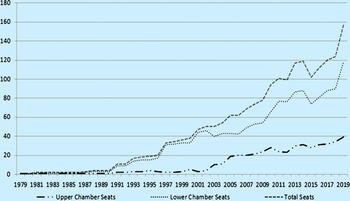
A complete historical record of all openly LGBTQ candidates for state legislative seats is not available, but there are data on LGBTQ state legislators who have served. Figure 1 displays the annual count of LGBTQ state legislators since 1979.Footnote 3 The representation trend generally is upward, especially in recent years. LGBTQ legislators are more common in the West, Upper Midwest, and Northeast, but a majority of states experienced at least one LGBTQ legislator. Even some conservative Republican states (e.g., Utah) have had several LGBTQ state legislators.
Publicly Open LGBTQ State Legislators 1979–2019

By the general election in November 2018, there were at least 283 LGBTQ candidates running in general elections for state legislative seats.Footnote 4 Of those candidates, 47% identified as female, 33% were incumbent legislators, and 80% were running for seats in the lower chamber of the legislature. As was the case historically, most candidates ran in states on the coasts and in the Upper Midwest, but states such as Kansas and Indiana had LGBTQ candidates run successfully for the legislature for the first time.
RESEARCH DESIGN AND DATA
Central to the focus of this article is whether state legislative candidates’ LGBTQ status influences their likelihood of being elected or the percentage of the two-party vote received. Therefore, we follow Klarner’s example, and our unit of analysis is a contest for state legislative seats in the 45 states holding legislative elections in 2018.Footnote 5 For our analysis, we followed examples provided by Klarner (Reference Klarner2010; Reference Klarner2018), examining state and candidate characteristics in a multivariate model predicting the percentage of the two-party vote won by the Democratic candidate. We examined a second model assessing the likelihood of a Democratic candidate winning—that is, receiving more than 50% of the two-party vote.Footnote 6
LGBTQ legislators were identified through public sources including the Victory Fund, newspapers, candidate websites, and online news sources. Only candidates who self-identified as LGBTQ in these public sources were counted as such. We tracked 283 LGBTQ candidates; however, eliminating non-major-party candidates and nonpartisan elections reduced the number of candidates in our analysis.Footnote 7 We note that more than 92% of LGBTQ candidates ran as Democrats.Footnote 8 To capture the 21 Republican LGBTQ candidates in the first model, predicting percentage of the vote going to the Democrat, we coded the LGBTQ candidate as 1 for LGBTQ Democratic candidate, 0 for neither/both candidates LGBTQ, and -1 for Republican LGBTQ candidates. In our dataset, only five Republican LGBTQ candidates won their race.Footnote 9 We included a lagged version of the LGBT candidate variable if the 2018 candidate ran in the district in 2016 or 2014. This variable controlled for the district’s electoral attractiveness for LGBT candidates.
We also included a variable coded 1 if there was a Democratic incumbent in the race, -1 if there was a Republican incumbent in the race, and 0 if there were no incumbents running; research clearly suggests that incumbents are reelected at high rates (Hogan Reference Hogan2008; Klarner Reference Klarner2010; Reference Klarner2018).Footnote 10 Likewise, we included a lagged incumbency variable. We also controlled for candidate gender and whether candidates held a seat in the other legislative chamber in the state.Footnote 11
Our model also accounted for district characteristics: median household income (in $1,000 increments), percentage of college-educated adults, percentage of African American population, percentage of Hispanic population, percentage of Protestant Fundamentalist population,Footnote 12 proportion of same-sex-partner households, percentage of the two-party vote for the Democratic candidate in the last election, percentage of urban population, and a dummy variable coded 1 for upper-chamber district.Footnote 13 We expected that the Protestant Fundamentalist population would decrease the likelihood that a Democratic candidate would win the race,Footnote 14 whereas the proportion of same-sex-partner households would increase the likelihood that the Democratic candidate would win.Footnote 15 We did not have rigorous expectations for the other district characteristics measured. Additional district and candidate characteristics were accounted for in the models following guidelines from this symposium’s editor, Carl Klarner, and the State Legislative Elections project, as well as his related work (Klarner Reference Klarner2010; Reference Klarner2018).Footnote 16
RESULTS
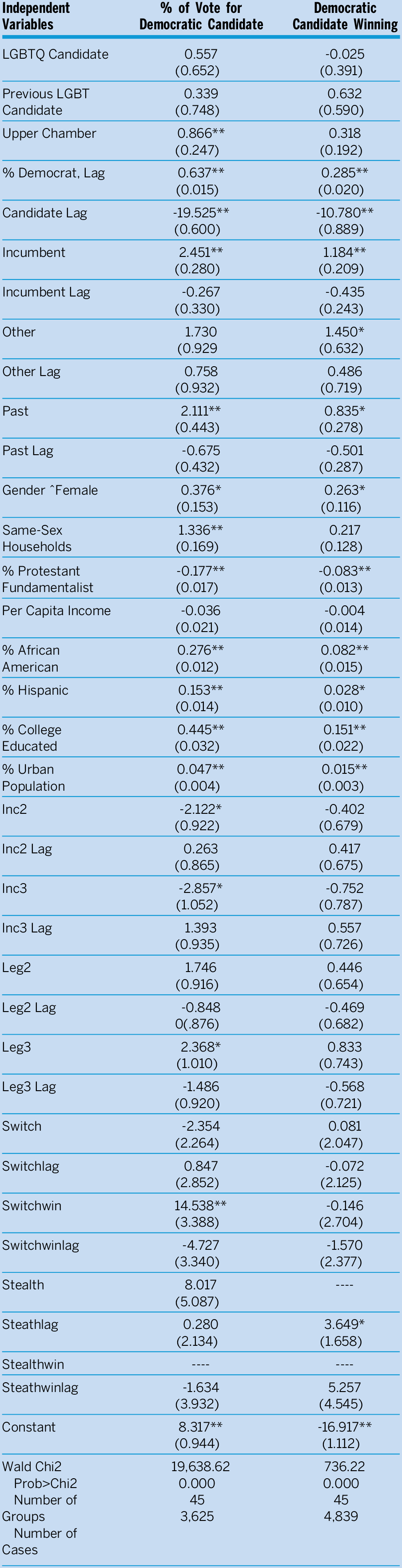
The results in table 1, column 1, display coefficients for a multilevel mixed-effects linear regression (which accounts for fixed and random effects) using the Democratic percentage of the two-party vote as the dependent variable. Column 2 displays the results of a logistic regression with random effects for each state, with the dependent variable coded 1 if the Democrat won the election and 0 otherwise.
Predicting General-Election Support for 2018 State Legislative Candidates

Notes: Data include 2018 partisan elections in 45 states. Coefficients in column 1 are estimates from a multilevel mixed-effects linear regression (which accounts for fixed and random effects), using the Democratic percentage of the two-party vote as the dependent variable. Coefficients in column 2 are estimates from a logistic regression with random effects for each state. Democratic candidate winning dependent variable coded as 1=Democratic candidate won, otherwise 0. “----” indicates variable dropped in model due to collinearity. Significance levels: **<0.01, *<0.05.
In predicting the Democratic percentage of the two-party vote, our LGBTQ-candidate variable is positive but not statistically significant at traditional levels, even while accounting for other candidate and district characteristics, which suggests that the presence of LGBTQ candidates was not associated with an increase or decrease in the percentage of the vote for Democrats. This result suggests that the presence of an LGBTQ candidate does not substantively impact support for the Democratic candidate in a race.
The model also suggests that the Democratic share of the vote was higher in districts where a female candidate was running and in districts with more education, more urbanization, a larger LGBTQ population, a more diverse population, and fewer Protestant Fundamentalists. In additional analysis (not displayed), we interacted LGBTQ candidates with Protestant Fundamentalists as well as with same-sex-partner households. Neither interaction was statistically significant, which suggests that neither factor is driving the presence or success of LGBTQ candidates in state legislative districts.
We conducted several robustness checks to assess whether our results for the first model were shaped by our model-specification decisions (see the online supplemental appendix for results). These checks included excluding the lagged LGBTQ variable, restricting the analysis to one-seat contests, excluding the variables that tracked how long an incumbent or other legislator has served, and excluding the variables that tracked party switchers or non-major-party candidates who previously ran as major-party candidates. In another check, we simultaneously excluded both of the last two sets of variables referenced. None of these checks produced substantively different results, leading us to conclude that the lack of statistical significance for the LGBTQ variable is not due to model-specification decisions.
When we modeled a Democrat winning the election (see table 1, column 2), the results indicated that the presence of an LGBTQ candidate did not make a discernable difference in the outcome of the race—and neither did the proportion of same-sex-partner households in the district. Given the results from the first and second models, it seems logical to conclude that LGBTQ status is not a significant factor in elections. Factors that did increase the chances for a Democratic win included the presence of a female candidate, a higher college-educated population, a greater percentage of African Americans and Hispanics, and a lower proportion of Protestant Fundamentalists.
Given the special nature of open-seat elections in potentially attracting LGBTQ candidates to run, the online supplemental appendix includes separate models estimated for races with and without incumbents. The results of these models do not differ substantively from the results shown in table 1.
FINAL THOUGHTS AND CONCLUSION
Our evidence suggests that the 2018 election cycle indeed represented a rainbow wave in American politics with more LGBTQ candidates elected to office than ever before. Ironically, this wave appeared as backlash toward the LGBTQ rights movement increased—anti-LGBTQ forces appeared to have more power in Washington and many states than they had during the previous 10 years. We examined this wave election in greater detail to determine whether candidate LGBTQ status influenced electoral outcomes.
Our analysis of 2018 partisan state legislative elections from 45 American states allowed us to draw several important conclusions. First, in an election cycle in which many nontraditional candidates threw their hat into the ring, LGBTQ candidates followed this wave: more ran for office in higher numbers—many successfully—than they had in past elections. This increase in candidates fits a continuing pattern of LGBTQ candidates running for office since the 1990s, but it also is consistent with increases in women and candidates of color running (Dittmar Reference Dittmar2019; Ocampo and Ray Reference Ocampo and Ray2019; Reingold Reference Reingold2019). The election of Trump in 2016 appears to have accelerated this process, but other trends—such as the #MeToo movement and #BlackLivesMatter—also have contributed.
Second, candidate LGBTQ status did not influence election-result outcomes, at least after accounting for various district characteristics. In addition, there is no observed relationship between the presence of an LGBTQ candidate in a race and the proportion of the two-party vote received by Democrats. Overall,
Overall, the evidence clearly suggests that even in a period of anti-LGBTQ backlash, LGBTQ candidates are not facing new or significant electoral hurdles when they run for state legislative seats.
the evidence clearly suggests that even in a period of anti-LGBTQ backlash, LGBTQ candidates are not facing new or significant electoral hurdles when they run for state legislative seats.
Third, the combination of results and findings of previous research suggests that candidate LGBTQ status does not hinder candidates’ electoral chances in part because they are strategic in choosing how, where, and when to run for the state legislature. On average, LGBTQ candidates are running as Democrats in districts the demographics of which at least somewhat favor Democrats, greatly improving their chances of success. Therefore, our findings are consistent with previous research (Haider-Markel Reference Haider-Markel2010) and do not suggest that the Trump Era has changed the dynamic for LGBTQ candidates. These findings are consistent with research on women legislative candidates, which indicates that electoral hurdles based on sex and gender are more perception than reality in the current era (Brooks Reference Brooks2013).
Fourth, the strengthening trend of LGBTQ candidates running successfully as Democrats points to the incorporation of the LGBTQ community within the Democratic base. However, the lack of successful LGBTQ Republican candidates also suggests future issues for the Republican Party. As the Republican base—white, conservative, men—ages out of the voting population, the Party’s non-inclusion of LGBTQ people likely will make Republican candidates less attractive to a growing voting cohort of younger, less-white, and more-educated voters. The Republican Party already has this problem in regard to candidates of color and, to a lesser extent, with women candidates (Ocampo and Ray Reference Ocampo and Ray2019; Reingold Reference Reingold2019). Failing to make inroads with the LGBTQ community points to potential future peril for the Republican Party. It can alleviate this issue if it works to recruit more LGBTQ candidates to run for office in less-conservative districts.
Finally, our conclusions come with a caveat. Our modeling strategy does not allow us to fully account for where and when LGBTQ potential candidates choose to run. Some potential candidates might choose to run only in liberal-leaning districts that are less religious, which would likely increase their probability of success. This pattern has been observed with women state legislative candidates (Pyeatt and Yanus Reference Pyeatt and Yanus2020). However, other potential candidates running as Democrats might choose to run in Republican-leaning districts simply because no other Democrats are willing to serve as “sacrificial lambs” in a race they are destined to lose. We cannot be sure. To fully address these strategic choices, future research should account for an LGBTQ candidate’s previous candidacies and incumbency.
Supplementary Materials
To view supplementary material for this article, please visit http://dx.doi.org/10.1017/S1049096520000372.