Implications
Fertility after artificial insemination in dairy goats may be a limiting factor for extended use of the technique. Dissemination of genetic merit is not optimal resulting in an economical loss to the farmer and IA centre. Identifying the main factors affecting fertility is the first step to improve insemination results and avoid the issues observed in dairy cattle such as the decrease in fertility over the years (Cutullic et al., Reference Cutullic, Delaby, Gallard and Disenhaus2012). Although, female heritability of success of artificial insemination is low implying slow genetic gain, the gain achieved year on year would be positive and cumulative.
Introduction
Artificial insemination (AI) is mostly used in conjunction with progeny testing, as a main tool for genetic improvement of dairy goats and to limit sanitary problems. The main French breeds (Alpine and Saanen) are seasonal breeders, sexually active in autumn and beginning of winter. In order to satisfy year-round cheese market demands, treatments to control the timing of reproduction are needed. This control is mainly based on hormonal treatment (Leboeuf et al., Reference Leboeuf, Manfredi, Boue, Piacère, Brice, Baril, Brocqua, Humblot and Terqui1998) and, with less efficiency, on light treatment and male effect (Fatet et al., Reference Fatet, Pellicer, Palhière, Bouix, Lagriffoul, Piacère, Martin, Boué, Leboeuf and Bodin2009). Goat AI centres use only frozen semen in France, mainly as a mean to dissociate the time of production from the time of use. Breeding values for dairy and udder morphology traits (Leboeuf et al., Reference Leboeuf, Delgadillo, Manfredi, Piacère, Clément, Martin, Pellicer, Boué and De Cremoux2008) are evaluated using an animal model and BLUP methodology. Since 1992, a national working group on goat reproduction was constituted including all stakeholders in the dairy goat industry. This has led to the improvement of the reliability of data from the milk recording national database. However only about 10% of the French goat population are inseminated while this proportion is about 90% for dairy cows and 40% for dairy sheep (Leboeuf et al., Reference Leboeuf, Boué and Jenot2012). Thus development efforts are still necessary to improve diffusion from the nucleus to the base population. Identifying the genetic and non genetic factors influencing AI success is the preliminary step for this. The purpose of this study was to estimate genetic and environmental factors affecting this trait in combining all available information from male and female (David et al., Reference David, Robert-Granié, Manfredi, Lagriffoul and Bodin2008).
Material and methods
Buck and semen management
All the semen used for AI was cryopreserved. Collection, dilution of sperm and freezing of semen were performed using the method proposed by Corteel, Reference Corteel1981. Before 1997, bucks were collected only during the 6-month of the breeding season (autumn and winter). Since 1997, the use of artificial photoperiodic cycles allows semen collection year-round (Leboeuf et al., Reference Leboeuf, Restall and Salamon2000). Most of the semen supply is built up within the first 2 years of life of the animal, counting about 3000 straws per buck. At the beginning of AI season in March, the straws are allocated to the field inseminators. When the season is over, the remaining straws are grouped and stored at the production centre waiting for the next season. Most bucks are slaughtered when they are about 2 years old; however some genetically interesting males are retained and further collected at four or 7 years old. There was no information in the database which permitted to distinguish, for these very particular bucks, the straws collected before 2 years old from the straws collected later. Thus for few observations in the data sets, the fixed effect taking into account the number of years of semen storage was wrong.
Data
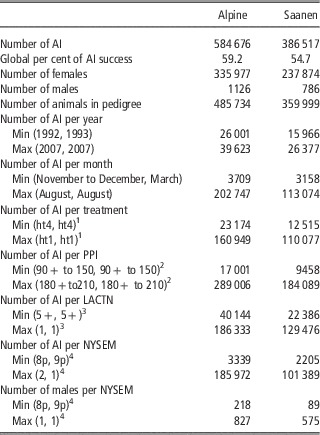
Data came from the national goat database (CTIG, Centre de Traitement de l’Information Génétique, INRA, Jouy-en-Josas, France). Data used in this study were the recorded results of 584 676 AI in Alpine breed and 386 517 in Saanen, performed between 1992 and 2009. The average number of AI per female over the whole career of the female was 1.74 and 1.62 for Alpine and Saanen breed, respectively. AI result was a success (Y=1) if kidding occurred within the range of 140 to 160 days after insemination, otherwise it was a failure (Y=0). Only one attempt of AI was made per campaign for a given female. The environmental effects tested in the analysis were: flock within year of AI; period within year of AI, which was established by dividing each year into unequal periods of time with the constraint of minimizing the fertility variation within period, maximizing the variation between the periods and getting sufficient observations in each cell, to make the results easier to read, modalities of this factor were labelled with the year and the name of the month corresponding better to the period; month of AI with nine levels (all records from January and February, representing 0.2% of the whole data set and totally confounded with very few flocks, were removed; November and December were grouped), this factor was tested only combined with all other factors where enough data were available, this was done to test if the effect of a factor change between months; year of AI, again this factor was tested only combined with all other factors with enough available data, for the same reason as month of AI; treatment for induction and synchronization of oestrus (TREAT), with seven levels: no treatment (no), light treatment (light), light and melatonin implant (ligme), hormonal treatment (ht1, ht2, ht3, ht4 for the first, second, third and fourth occurrence, respectively); lactation number (LACTN) with five levels: 1, 2, 3, 4 and 5+; quartile of milk 250-day yield (QMY) with four levels defined as quartiles within flock×year (QMY1, QMY2, QMY3, QMY4 From smallest to largest quartile); quartile of fat 250-day yield (QFY); quartile of protein 250-day yield (QPY); class of time interval between previous kidding and AI (PPI) with five levels coded as follows: <150, 150+ to 180, 180+ to 210, 210+ to 240, >240 days, records corresponding to PPI below 90 and beyond 600 were removed from the analysis; number of years of semen storage (NYSEM) coded from 1 to 8+ or 1 to 9+ for Alpine and Saanen breed, respectively. The age of female was not included in the model because of its strong correlation with LACTN. All records concerning nulliparous female, representing 3% of the data, were discarded because of interaction between physiological characteristics of young does and AI success (Houdeau et al., Reference Houdeau, Furstoss, Forgerit, Bonné and Leboeuf2008). The number of animals in the pedigree files was 485 734 for Alpine and 359 999 for Saanen breed. A summary of the data is given in Table 1.
Description and summary of recorded data

PPI=postpartum interval with AI; LACTN=number of lactation; NYSEM=duration of conservation of semen in year.
For Min and Max values, the label given in brackets refers to the levels of factors for Alpine and Saanen dairy goat breeds, respectively.
1 ht1, ht4 the first and the fourth hormonal treatment.
2 The number indicates the range of the interval of PPI in day.
3 5+=strictly more than four lactations, 1=the first lactation.
4 8p, 9p=more than 8 and 9 years for the conservation of semen, 1=one year of conservation.
Data analysis and model
There were very few flocks that had both breeds in the database, this led to confounding between breeds and flock within years random effects. Moreover our main objective was to estimate genetic parameters, therefore we conducted separate analysis on each breed. A linear repeatability animal model was used to estimate variance components and fixed effects parameters. Due to the binary nature of the AI success trait, we should have used a threshold model but several studies have compared both models and have reported no clear advantage of the univariate threshold model over the univariate linear model (Ramirez-Valverde et al., Reference Ramirez-Valverde, Misztal and Bertrand2001; David et al., Reference David, Bodin, Lagriffoul, Leymarie, Manfredi and Robert-Granié2007). Thus we used a linear model to make the interpretation of results easier. The equation of the model for each breed was:
 $$Y=X\beta {\plus}Kf{\plus}Z_{m} a_{m} {\plus}Z_{f} a_{f} {\plus}W_{m} p_{m} {\plus}W_{f} p_{f} {\plus}{\varepsilon}$$
where Y is the vector of observations of AI success, β the vector of fixed environmental effects, f the random vector of flock within year effect, a
m
, a
f
are vectors of genetic additive random effect for male and female respectively, p
m
, p
f
are vectors of male and female permanent environmental random effect, ε the random vector of independent residuals. X, K, Z
m
, Z
f
, W
m
, W
f
are the corresponding known incidence matrices. All random effect are distributed as a centred normal distribution with variance covariance matrix equal to
 $A\sigma _{m}^{2} $
and
 $A\sigma _{f}^{2} $
for the genetic male and female effect respectively, and
 $I_{i} \sigma _{i}^{2} $
for the other random effects (i=f, p
m
, p
f
, ε) where A is the known numerator relationship matrix and I
i
are identity matrices of appropriate size. All random effects are assumed to be independent from one another. Fixed effects were preliminarily selected step by step using likelihood ratio tests with a maximum likelihood estimation of parameters (procedure MIXED, SAS Institute Inc., 1999). This test is asymptotically equivalent to the F test (Engle, Reference Engle1984). The full model included all of the main fixed effects described above and we added all the two-way interactions that had a biological meaning and sufficient data in cells. The specification of the full fixed effect model was:
 $$\eqalignno{{\rm period}&{\times}{\rm year}{\plus}{\rm TREAT}{\plus}{\rm PPI}{\plus}{\rm LACTN}{\plus}{\rm QMY}{\plus}{\rm QFY}{\plus}{\rm QPY}\cr&{\plus}{\rm NYSEM{\plus}year}{\times}{\rm TREAT}{\plus}{\rm year}{\times}{\rm PPI}{\plus}{\rm year}{\times} {\rm LACTN}\cr&{\plus}{\rm year}{\times}{\rm QMY}{\plus}{\rm year}{\times}{\rm QFY}{\plus}{\rm year}{\times}{\rm QPY}{\plus}{\rm month}\cr&{\times}{\rm TREAT}{\plus}{\rm month}{\times}{\rm PPI}{\plus}{\rm month}{\times}{\rm LACTIN}{\plus}{\rm month}\cr&{\times} {\rm QMY}{\plus}{\rm month}{\times}{\rm QFY}{\plus}{\rm month}{\times}{\rm QPY}{\plus}{\rm TREAT}{\times}{\rm PPI}\cr&{\plus}{\rm TREAT}{\times}{\rm LACTIN}{\plus}{\rm TREAT}{\times}{\rm QMY}{\plus}{\rm TREAT}{\times}{\rm QFY}\cr&{\plus} {\rm TREAT}{\times}{\rm QPY}{\plus}{\rm PPI}{\times}{\rm LACTIN}{\plus}{\rm PPI}{\times}{\rm QMI}{\plus}{\rm PPI}{\times}{\rm QFY}\cr&{\plus}{\rm PPI}{\times}{\rm QPY}{\plus}{\rm PPI}{\times}{\rm QPY}{\plus}{\rm LACTIN}{\times}{\rm QMY}{\plus} {\rm LACTIN}\cr&{\times}{\rm QFY}{\plus}{\rm LACTIN}{\times}{\rm QPY}{\plus}{\rm QMY}{\times}{\rm QFY}{\plus}{\rm QMY}{\times}{\rm QPY}\cr&{\plus}{\rm QFY}{\times}{\rm QPY}. $$
After selection of fixed effects, variance and covariance components were estimated using Restricted Maximum Likelihood, implemented in ASReml software (Gilmour et al., Reference Gilmour, Gogel, Cullis and Thompson2006).
Heritability was estimated by
 $\sigma \,_{{a_{m} }}^{2} /\sigma \,_{t}^{2} $
and
 $\sigma \,_{{a_{f} }}^{2} /\sigma \,_{t}^{2} $
for male and female fertility respectively, repeatability was estimated by
 $(\sigma \,_{{a_{m} }}^{2} {\plus} \sigma \,_{{p_{m} }}^{2} )/\sigma \,_{t}^{2} $
and
 $(\sigma \,_{{a_{f} }}^{2} {\plus} \sigma \,_{{p_{f} }}^{2} )/\sigma \,_{t}^{2} $
for male and female fertility, respectively, with
 $\sigma \,_{t}^{2} =\sigma \,_{{a_{m} }}^{2} {\plus} \sigma \,_{{p_{m} }}^{2} {\plus}\sigma \,_{{a_{f} }}^{2} {\plus} \sigma \,_{{p_{f} }}^{2} {\plus}\sigma \,_{{\varepsilon}}^{2} $
.
Estimated means were calculated by forming linear function of a subset of fixed effect coefficients weighted by the number of observations included in each cell of the subset. This was done to obtain more realistic estimated means.
Results
Analysis of fixed effects
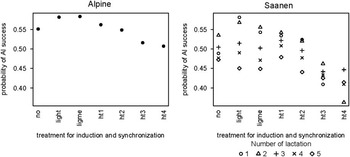
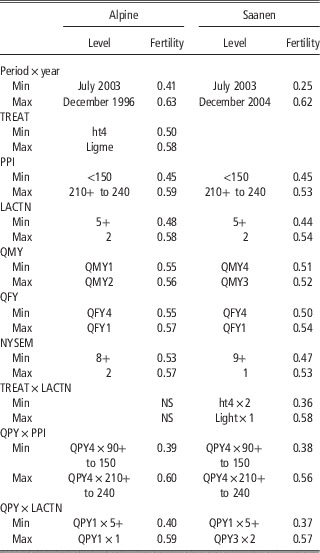
The global percentage of AI success was 59.2 and 54.7 for Alpine and Saanen breed, respectively. The fixed effects retained in the final model were very similar between the two breeds. The common fixed effects retained for both breeds were period within year, TREAT, PPI, LACTN, QMY, QFY, NYSEM, interaction between QPY and PPI, interaction between QPY and LACTN. The interaction between TREAT and LACTN was retained for Saanen breed only. All those fixed effects were very highly significant (P<0.001) except QPY for Alpine breed (P<0.01). The range of variation between levels of estimated means for each of those factors is presented in Table 2. The period within year effect was the main effect affecting AI success. For many years we have observed a decline in fertility during the middle of summer, often in July, in both breeds (data not shown). The very low fertility observed in July 2003 (Table 2) was due to the heatwave observed in Europe during that summer. The estimated values of period within year were averaged within year to investigate a possible trend over the years. The regression line was estimated by discarding outlier points which corresponded to the years 1996 and 2003 in Alpine breed and 1998 and 2003 in Saanen breed. The result is illustrated on Figure 1 and exhibit a significant negative trend (P<0.01) for Alpine breed. The decline in fertility is about one point in percentage of fertility per 10 years in this breed. In Saanen, even if not significant (P=0.08) we observed an increase in fertility over the years. The TREAT effect in Alpine breed showed that the best results in fertility were obtained with light treatment (Figure 2), while in Saanen breed it depended on the number of lactation. Indeed in young Saanen females (LACTN=1 or 2), the best results were obtained with light treatment, but for older females the best results were obtained with the first hormonal treatment (Figure 2).
Estimated values of probability of AI success in relation to years. The coefficient for the regression lines was estimated without year 2003 for both dairy goat breeds and without year 1996 and 1998 for Alpine and Saanen breeds, respectively.

Estimated values of probability of AI success in relation to treatment for induction and synchronization of oestrus for Alpine dairy goat breed on left panel, and in interaction with number of lacation for Saanen dairy goat breed on right panel. no=no treatment; light=light treatment; ligme=light and melatonin implant; ht1, ht2, ht3, ht4 for first, second, third and fourth hormonal treatment.

Minimum and maximum of estimated means of the fixed effect for probability of AI success in each dairy goat breed

TREAT=treatment for induction of oestrus, light=light treatment, ligme= light and melatonin implant, ht4=fourth hormonal treatment; PPI=postpartum interval to AI, numbers in the label of level give the range of the interval in days; LACTN=number of lactations, 5+=more than five lactations; QMY,QPY,QFY=quartile within flock×year of milk, protein and fat 250-day yield, the number in the label of the level give the increasing order of the quartile; NYSEM=number of years of semen storage, 8+ and 9+=more than 8 or 9 years of conservation.
Period×year interaction, levels of this factor were labelled with the year and month corresponding better to the period.
We observed a decline in fertility in both breeds with the number of hormonal treatment received per female; the decrease was about five points in percentage of fertility between the first and the fourth hormonal treatment for Alpine breed, while in Saanen breed, due to the interaction between number of hormonal treatment and number of lactation, the highest decrease in fertility (19 points) between the first and the fourth hormonal treatment was observed for females in second lactation.
The influence of milk yield was very low, only 1 point in percent of AI success between the first and fourth quartile of milk 250-day yield within flock×years. For fat yield the influence was just a bit more important and exhibited a slight decrease, two and four points for Alpine and Saanen respectively, between the first and fourth quartile. There was no main effect of protein yield on AI success but the influence of this factor showed an interaction with PPI and LACTN illustrated on Figure 3. We observed a positive trend between fertility and protein yield for females with a lactation number over 1 and for 180+ to 210, 210+ to 240 levels of PPI which are the most common modalities and are recommended when selecting females for AI protocol.
Estimated values of probability of AI success for Alpine and Saanen dairy goat breeds in relation to quartile of 250-day protein yield by levels of postpartum interval to AI (bottom panel) and by levels of number of lactation (top panel). Each subpanel is labelled with the levels of the factor, units are day for range of interval.

The negative effect of the duration of conservation of semen, NYSEM, was not very important, four and five points in percent of AI success for Alpine and Saanen breed respectively. It is illustrated in Figure 4 and show an increase in fertility for the fourth year for Saanen breed and for the seventh year for Alpine breed.
Estimated values of probability of AI success for Alpine and Saanen dairy goat breeds in relation to the number of years of conservation of semen.

Variance components and genetic parameters
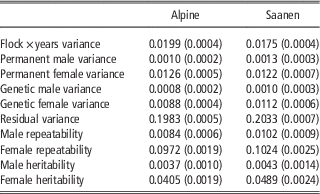
All variance components (Table 3) were very low compared to residual variance which represented 82% of the total variance for both breeds. The largest variance components were those of flock within year effect that accounted for about 8% and 7% of the total variance for Alpine and Saanen breeds respectively. The female repeatability was about 10% and 10 times higher than male repeatability. All heritabilities were significant but very low: lower than 0.5%, for males and about 5% for females.
Variance components and genetic parameter estimates of AI success for Alpine and Saanen dairy goat breeds, standard error in brackets

Discussion
The choice of a linear model instead of a threshold model makes it necessary to verify the condition that the incidence of the binary response is between 25% and 75% among cells of fixed effects (David et al., Reference David, Bodin, Lagriffoul, Leymarie, Manfredi and Robert-Granié2007). This was the case in our data set.
Fixed effects
After correction of the other identified factors of variation, the fertility declined with years for Alpine breed. Actually, the increase of the raw fertility with years was due to the modification of the AI protocol (i.e. introduction of light treatment and increase of the time interval between kidding and AI), this was taken into account in the model. This phenomenon was not observed in Saanen breed and the trend over the years (Figure 1) seems to be positive but the raw average within year exhibit a strong increase in fertility along years, so the statistical model has the same effect in both breeds, for example to correct downward the observed increase in fertility.
To study the relationship between milk production traits and AI success we used quartile of 250-day yield within flock×years. This choice was made after model comparison between three transformations: none, quartile within years and quartile within flock×years. The latter was the best for each variable: milk, fat and protein yield. We observed a very low negative effect of milk yield expressed as quartile within flock×years on fertility, this result is consistent with that observed in dairy sheep (David et al., Reference David, Robert-Granié, Manfredi, Lagriffoul and Bodin2008) and in dairy cattle for which this effect was largely studied and where its intensity depends on breed and on herd environment (Windig et al., Reference Windig, Calus and Veerkamp2005). To our knowledge there are only few recent references concerning the influence of the fat and protein yield on fertility. Hoekstra et al., Reference Hoekstra, Van der Lugt, van der Werf and Ouweltjes1994 found a low negative phenotypic correlation between fertility and fat and protein yield for first parity cows. Our study demonstrated a negative effect of fat yield on fertility but a strong positive effect of protein yield on fertility for female with lactation rank higher than 1. This trend was more important in Saanen breed (about 11 points of variation in percent of AI success for female in third lactation), than in Alpine breed (about nine points of variation for the same type of females). For females on first lactation the relationship between protein yield and fertility was clearly negative (Figure 3). The interpretation of this result is not evident. The relation between protein yield and fertility for very short PPI (Figure 3) was also clearly negative. So both observations could suggest that QPY could be related to pre-partum body condition score which is known to affect fertility (Walsh et al., Reference Walsh, Williams and Evans2011). This relation could be positive for multiparous female and negative for younger females because of differences in energy balance, as demonstrated on cows by Friggens et al., Reference Friggens, Berg, Theilgaard, Korsgaard, Ingvarsten, lovendahl and Jensen2007.
The effect of modalities of treatment for induction and synchronization of oestrus was important despite the difficulties to gather reliable information and the imperfection of the database structure that did not allow the declaration of simultaneous treatments (such as the combination of light and hormonal treatment which is known to be practised on farm). In both breeds, the TREAT effect clearly demonstrated the well-known decrease in fertility with repeated treatment due to anti-body production (Drion et al., Reference Drion, Furstoss, Baril, Manfredi, Bouvier, Pougnard, Bernelas, Caugon, McNamara, Remy, Sulon, Beckers, Bodin and Leboeuf2001). The levels of immune reaction between ht1 and ht4 seemed to be stronger in Saanen breed for female in first and second lactation while for Alpine breed no such effect was evidenced. Differences in immune reaction on different sheep breeds were also observed by David et al., Reference David, Robert-Granié, Manfredi, Lagriffoul and Bodin2008. The best AI success results were obtained with light treatment associated or not with a melatonin implant (Figure 2) in Alpine breed. The same results were obtained in Saanen breed but for young females only (number of lactation lower than 3). We know that the procedure of light treatment is often not implemented very thoroughly on farm, and even less when it is associated with hormonal treatment (communication of AI operators). To explain these results an investigation among farmers practicing this treatment would be needed, and also the information stored in the database should be made more accurate.
The effect of post partum interval was in interaction with QPY but the levels 180+ to 210 or 210+ to 240 were always the best at any level of the QPY factor. Then those levels should be strongly recommended when selecting animals for AI. Similarly the levels <150 or >240 were the worst, animals with such levels should be set aside from AI procedure. The effect of number of lactation was in interaction with QPY for both breeds and with TREAT for Saanen breed. Nevertheless we observed an important decrease in fertility when number of lactations (>2) increase for all levels of QPY and TREAT except for ht3 and ht4.
The evolution of buck management (i.e. collection during breeding season changing to year-round collection with photoperiodic treatment) induced no loss of fertility (Delgadillo et al., Reference Delgadillo, Leboeuf and Chemineau1992). The effect of long semen storage period, over 5 years, on the probability of conception was not expected but was already observed on bull (Haugan et al., Reference Haugan, Grohn, Kommisrud, Ropstad and Reksen2007). Some hypothesis for this effect are genetic damage, for example DNA integrity, (Karlsson and Toner, Reference Karlsson and Toner1996), reduction in sperm membrane fluidity (Chatterjee and Gagnon, Reference Chatterjee and Gagnon2001) and physical cryoevolution of sperm surface proteins (Lessard et al., Reference Lessard, Parent, Leclerc, Bailey and Sulivan2000). The effect of NYSEM on the fertility could support this hypothesis but the effect of handling of the straws during storage was also evidenced on non-return rate in bovine (Janett et al., Reference Janett, Schilter, Weber, Witschi and Thun2008). The latter could also be suspected to partly explain the observed decrease in fertility because the repetitive manipulations of the storage canisters without sufficient care could result in a rise in straw temperature which could affect semen quality. This argument is consistent with the fact that fertility is partially restored with occurrence of new semen collection for very few bucks in the fourth and seventh year of age. This fact led to confusion between the fourth and seventh modalities of the NYSEM fixed effect and the first year modality. This confusion conducted to a false estimated value for those levels. On the whole data set the effect of repetitive manipulations seemed to be limited because it was averaged, but we observed on some subset of data (not shown) an important decrease in fertility, particularly between the beginning and the end of intensive activity periods of the AI season.
Data analysis was made separately between the two breeds, so a strict comparison should not be allowed, however some comments could be made on the difference between Alpine and Saanen breeds. There was a main difference of about 4.5% in AI success in favour of Alpine breed and estimated means provided by our models exhibit systematically the superiority of this breed. A slight difference between our two models involved the effect of repetitive hormonal treatments which was very important for young females in Saanen breeds. Baril et al., Reference Baril, Remy, Leboeuf, Beckers and Saumande1996 have not found differences between breeds for eCG binding and onset of oestrus but data was not shown so we could not confirm there were no differences at all. Drion et al. (Reference Drion, Furstoss, Baril, Manfredi, Bouvier, Pougnard, Bernelas, Caugon, McNamara, Remy, Sulon, Beckers, Bodin and Leboeuf2001) have tested only Alpine breed, so specific studies focusing on breed comparison seem to be needed. Another slight difference between breeds was observed in Figure 3 regarding the effect of the QPY×PPI interaction: less productive Saanen female seemed to be much less fertile especially for short and very long PPI. Was this related to a physiological status that was less favourable for AI success in Saanen breed?
Variance components and genetic parameters
In our models, genetic correlation between male and female fertility was supposed to be null as demonstrated in sheep by David et al. (Reference David, Bodin, Lagriffoul, Leymarie, Manfredi and Robert-Granié2007).
The very low values of genetic components of male fertility were expected because of similar results in other species (Ranberg et al., Reference Ranberg, Herinstad, Klemetsdal, Svendsen and Steine2003 in cattle, David et al., Reference David, Robert-Granié, Manfredi, Lagriffoul and Bodin2008 in sheep). However the range of variation between breeding values of males was 7 and 8 points in percentage of AI success for Alpine and Saanen, respectively. That means that the choice of the male has an importance in the final results. Moreover it has been demonstrated (Furstoss et al., Reference Furstoss, Borderes, Forgerit, Guillouet and Leboeuf2010) that the difference in fertility between different ejaculates of the same buck could be commonly over 40%, therefore our model should have taken into account semen characteristics of each ejaculate used for AI in a recursive model (Gianola et Sorensen, Reference Gianola and Sorensen2004). However the information related to the ejaculate (collection date, initial volume and concentration, in vitro quality…) used for AI is not yet available in the database. These shall be recorded in the database in the future for us to adjust a more precise model.
The range of variation between extreme female breeding values was 47% and 53% for Alpine and Saanen breeds, respectively. Genetic improvement of AI success could therefore be useful. Similarly the range of variation of estimated value of flock×years random effect was 70% and 65% in Alpine and Saanen breeds, which means an effort to advise the farmers could also be very useful.
Conclusion
Our study highlighted the key points that could improve AI success before starting selection for this trait which has low heritability. The postpartum interval should be between 180 and 240 days, particularly for females with high protein yield. Particular attention should be drawn to primiparous females with high levels of protein yield, through the estimation of body condition score for example. Females should not receive more than two hormonal treatments during their reproductive life. Further investigation is needed to explain why AI results are superior for farmers using light treatment for induction and synchronization of oestrus. Recommendations regarding the handling of semen in transport vessels should be made to AI operators.
The next step in using those data should be the estimation of genetic correlation between AI success and milk production traits as these could possibly explain the decrease in the estimated fertility between years.
Acknowledgements
The authors would like to thank Yvonnick Forgerit and Jean-Luc Bonné for their fruitful comments about goat zootechny.