Ever since Peter Borsay published his seminal work on the English Urban Renaissance, we have had a useful paradigm for understanding the cultural role of the towns and cities of early modern England from c. 1660 onwards.Footnote 1 Some more recent literature, mostly emanating from the scholarly interest in consumer behaviour, has explored the cultural life of particular English towns and cities in that era and from well before. But those explorations have favoured some cultural activities, and some urban places, more than others. An earlier issue of Urban History at least opened the question of urban music in this era to wider attention.Footnote 2 The Records of Early English Drama project has now published the dramatic records of most of the larger provincial urban centres up to 1640, with the volumes devoted to the London scene now beginning to roll off the line.
But no other urban cultural genre has fared nearly as well, some having garnered but negligible attention. Amongst the latter, the practice of painting, whether figurative or decorative, comes quickly to mind. Only very recently have early modern English towns and cities in general been noted and described as centres of painting activity. Attention to individual examples has been paid only more or less in passing in larger works,Footnote 3 remain unpublishedFootnote 4 or have appeared in publications unlikely to come to the attention of most historians.Footnote 5
Some of this neglect must be laid at the feet of English urban historians who, when attending to painting at all, have tended to neglect the early modern era.Footnote 6 Labouring under the authority of the traditional canon of prominent painters of the day (or, more recently, the all-embracing pall of critical theory), an earlier generation of the art historical community must also bear its share of responsibility. Its time-honoured canon held little space for any besides the mostly foreign-born, London or court-based figures, working in the more sophisticated styles and fashions of continental painting, and invariably based in London. The role of the native English craftsman-painter, unschooled in the naturalistic, three-dimensional imagery required by royal and aristocratic patrons and produced by the courtly painters, has largely been overlooked; neglect of the local scene, or denial that there might have been one, continues apace.Footnote 7
This article argues for the vitality of painting activity in provincial urban centres by focusing on the City of Chester, whose archives especially for the period c. 1590 to 1650 allow the fullest view of painting activity of any provincial urban centre of the late Tudor/early Stuart era.Footnote 8 As it happens, this same era marked a critical point in the development of secular, figurative painting in England: a time at which the crude, vernacular forms of the craft workshop met with and tried to assimilate the newer, continentally derived ideas about perspective, colouration, verisimilitude and visual theory in general. This was also a critical time for the formation of a viable ‘public’ for portraiture: a public which extended socially well beyond the crown, court and senior aristocracy, and geographically well beyond the London metropolis.Footnote 9
No doubt a study of Chester as a centre for painting in this era has a lot to tell us about the development of English painting itself. But urban historians will be more interested to observe how this urban centre worked to facilitate the interests of local painters and their patrons, what its example might tell us about the cultural relations between urban centres and their hinterlands (and between urban centres and the London metropolis) and what Chester might reveal about cultural activity itself in an early modern provincial hub.
This article explores several related themes. First, it suggests how a cultural activity like painting in places like Chester (and, by implication, similar provincial centres) could come to be shaped by local social, economic and even geographic circumstances. Second, it describes Chester painters themselves as a group, noting the ways in which the craft had come to be organized in this provincial centre, and how it perpetuated its activity from one generation to the next. Then it examines that handful of particular painters who played key roles in sustaining the craft in these years. Their careers allow us, inter alia, to explore how local portrait painters at least in the Chester area connected with their patrons, and what sort of patrons (socially and geographically speaking) they connected with. A final theme concerns questions of Chester's typicality or uniqueness as a local centre for painting and, by implication, other cultural forms as well.
The Chester context
Let us begin by considering the City of Chester itself. As affirmed in John Speed's map of 1611 (Figure 1). Chester was not a big place in these years, and remained physically compact. Its population probably topped out at about 5,500 in 1600, reaching something like 6,500 by 1640.Footnote 10 But Chester's relatively modest size belies its considerable importance and influence as the focal point for all sorts of activity and authority over a wide area.
John Speed's map of Chester, 1611.

Economically, Chester remained the centre of a substantial hinterland (extending to southern Lancashire, most of Cheshire, northern Shropshire and North Wales) for the marketing of agricultural goods; trade, principally with Ireland, Scotland and some of the west coast ports of England; leather production; and the commerce derived from those who came to engage with its sundry administrative bodies. Those institutions included the offices of the Palatinate (especially its exchequer and other courts), the quarter sessions, assizes and courts and administration of the City itself.
Finally, of course, the 1541 conversion of the Abbey of St Werburghe into a cathedral made Chester a diocesan centre. That event added status to the institution, but that transition, and the tides of change which brought it about, also marked the peak of the sort of decorative requirements and ceremonial upon which Chester's painters had long depended for some of their livelihood. Though some ceremonial, and consequent artistic patronage, persisted to the end of our period of interest, it would never be as much as it had been.Footnote 11 Yet, at the same time, the patronage for portraiture both civicFootnote 12 and personal,Footnote 13 or for decorative painting in the country houses of the regionFootnote 14 or for heraldic painting demanded by regional gentryFootnote 15 all seem steadily to have grown. Local painters may therefore have had somewhat to adjust to new and more secular subject matter, but their work remained in considerable demand, and their occupation generally well supported throughout the subsequent era and beyond.
Other factors also played a role in shaping such local cultural activity as painting. Chester's geographic position, fairly remote from London and facing west rather than east toward the Continent, impeded the influence of London or of continentally based sophistication, allowing Chester's painters to retain traditional methods and styles longer than their peers in some other parts of the realm. In addition, from the time of early settlement the heavy, acid clay of much of the surrounding region had favoured pastoral rather than arable agriculture. Though a balance between the two agricultural forms had come to be achieved by 1600, the patterns of dispersed settlement typical of pastoral areas still pertained, and the relatively poor and unproductive agricultural lands kept regional landowners widely dispersed and relatively unprosperous.Footnote 16 Save for the Stanley earls of Derby, who dominated the Palatinate administration as its chamberlains (though they were hardly constant residents) from 1588,Footnote 17 the area had long failed either to attract or to spawn the sort of landed elites whose great houses – the Longleats, Hatfields or Knoles of the day – could serve as significant cultural centres of their own. These factors made for a regional gentry which remained heavily dependent on the resources of the region rather than what might be obtained in frequent trips to London. It also enhanced Chester's importance as a central place of meeting and exchange within that region: not only in an economic sense, but socially and culturally as well.
The painters’ occupation
Perhaps because there were no other substantial urban centres in a very wide surrounding area where fathers could apprentice their sons to the painters’ trade, where painters could find employment or where regional patrons could satisfy their needs for portraiture or decorative painting, Chester painters were surprisingly numerous. Between about 1570 and 1640 no fewer than 48 people came to be master-painters in the City's amalgamated Company of Painters, Glaziers, Embroiderers and Stationers.Footnote 18 From well back into the fifteenth century the Painters had had their own guild, but they joined with the Glaziers, Embroiderers and Stationers in the year 1535 so as to share the costs of the City's lavish ceremonial of the day.Footnote 19 Most Chester painters probably took on whatever work they could get, and so worked in various media and on various sorts of projects. But some also specialized in one aspect of the trade or another, as, for example, portrait painters, decorative painters, glass painters, herald painters and what we would call house painters.
The guild's main function was to regulate the activity of its members so as to uphold the standards and reputation of the whole. It ensured that wages and prices remained fair to both the worker and the consumer. In addition, the guild received complaints about shoddy work, which it then inspected and rectified,Footnote 20 and it took responsibility for extending aid to indigent members.Footnote 21 Finally, guild members played an active, if not legally obligatory, role in governing the City. Though it was not one of the most influential guilds in this regard, eminent members like Randle Holme I and II came prominently to serve in high local office.Footnote 22
The guild met annually on St Luke's Day (18 October), he being the patron saint of painters, and at several other times during the year. Its usual place of meeting was in a room referred to as ‘the Tower’ – probably the Charles Tower of that walled town – which it let on an annual basis from the Barbers’ Company.Footnote 23 But it also met at an inn known as the Golden Phoenix and, during the Civil Wars, in the houses of one or two leading members of the group.Footnote 24
Much of the guild's periodic meetings were devoted to dinners and ceremonies, but other business consisted, inter alia, of registering new apprentices as they became bound to their masters, and admitting those who had successfully completed their apprenticeships to full guild membership, and therefore as freemen of Chester, so that they could legally carry on their trade. The guild registered the annual hiring of journeymen painters by masters who presumably required further help around the shop. From 1580, 23 journeymen are recorded (prior to which such hirings were not recorded) by only 10 masters, with almost never more than a single journeyman at a time in each workshop.Footnote 25
The guild structure not only perpetuated the painters’ trade within the community, but it also allowed the occupation to succeed from one generation to the next within particular families. Master painters often apprenticed their sons to fellow painters, and sometimes to themselves. But in an era where the life expectancy was still in the upper forties for men, it was not uncommon for a father to pass on before his son completed his training. That is where the women came into the picture.
A painter's wife will have played an active role in her husband's shop. She probably kept the books, she will have looked after the contractual responsibility to provide room and board for apprentices, and – because many painters’ shops were simply an extension of the residence itself – she would never have been far removed from its activity. A master's widow also inherited a deceased husband's status as a freeman of the City and member of the guild. In that capacity, she could take over the shop until a son completed an apprenticeship, gained his own admission to the guild and picked up where his father had left off. Seven masters’ widows in the period at hand did exactly that. Thus, they preserved the business for the next generationFootnote 26 and even took on journeymen to help them on the shop floor.Footnote 27 Those actions succeeded in establishing several family dynasties of painters – the Hallewoods, Dewsburys, Leeches, Handcocks, Pulfords, Thorpes and Welches – to the second and even the third generation.Footnote 28 Though it is difficult to tell if those Chester widows also retained apprentices on their own – it was not uncommon for painters to be fined for failing to enrol their apprenticesFootnote 29 – the practice was common elsewhere, and cannot be ruled out for Chester.Footnote 30
As in other towns and cities of the time, surprisingly few apprentices actually served their apprenticeships to full term. A drop out rate of 50–70 per cent seems to have been standard at this time,Footnote 31 and, though such failed apprentices were not regularly recorded in the Chester Company records, some 16 of 68 apprentices are listed as ‘failed’. Of those who did complete their apprenticeships, some will have left the profession altogether. Some became journeymen, presumably hoping to save up enough to establish their own shop. Others, like Thomas Leigh the elder and the younger, became itinerant.Footnote 32 In Chester itself, 18 eventually became master painters.Footnote 33
In contrast to the great workshops of the high-end and usually foreign-born painters in London, Chester shops remained small. Most masters never needed to take on a journeyman; many shied away from taking an apprentice. Even the largest shops run, for example, by William Handcock, William Poole, Randle Holme I and II, or by John Souch, rarely had more than a single journeyman or apprentice at any one time.
Painters, influences and patrons
The names of Randle Holme I (1570/71–1655) and his son Randle Holme II (1601–59), and of John Souch (1593–1645), lead us to consider Chester's leading painters, and to describe their roles and influence. Surely the most prominent member of the guild in these years, and one of the most prominent Cestrians in every respect, was Randle Holme I.Footnote 34 Holme's importance lay in four areas. His prominent role as city and county official elevated the influence of his company along with his own. His work as a deputy herald, and the close ties this afforded him with the arms-bearing families of the entire region, placed him at the hub of circles both of gentry patrons and fellow painters. His tutelage of several apprentices fostered the leaders of the next generation of Chester painters. Finally, the fascinating collection of sophisticated, continental prints and drawings which he and his son, Randle II, began to collect somewhere around the 1620s helped open a local window on contemporary imagery and techniques practised elsewhere in England and in Europe.
A blacksmith's son with family links to lesser gentry in and around the Shire, Holme got his start when his father apprenticed him to the prominent herald and genealogist Thomas Chaloner (d. 1598) from about 1591. By the time of his master's death, Holme had completed his apprenticeship, gaining admission to the Painters’ Company in June of that same year. In very short order thereafter, he married his late master's wife, the widowed Elizabeth Chaloner, adopted her son Jacob as his own and took a long-term lease on a house for his new family.Footnote 35 It may still be seen, adjacent to Ye Olde King's Head in Lower Bridge Street at the north-west corner of Castle Lane.
By 1600, Norroy king of arms appointed Holme deputy herald for Cheshire, Lancashire and North Wales, an appointment which was confirmed or re-defined several times thereafter. Holmes took the post seriously, worked hard at it for most of the rest of his life and thereby sustained a close familiarity and relationship with the region's gentry over several decades. His election as city alderman in 1604 inaugurated a long career in the City's administration which would extend to stints as sheriff (1628/29) and mayor (1633/34).Footnote 36
Holme's heraldic obligations regarding the shire gentry brings us to the subject of portraiture, and to the close relations between heralds on the one hand and that particular social group most likely to require the painters’ services on the other. The herald's office required a constant and close familiarity with the arms-bearing families of his assigned region, recording their births, deaths and marriages, weighing claims to arms-bearing status, signing death and marriage certificates, arranging heraldic funerals and generally keeping track of family events.Footnote 37 These were precisely those passages of life which invited a portrait record. Whether for portraiture itself or decorative work on their houses, it is these gentry families of the Chester hinterland, along with some city officials and benefactors, which provided the most demand for Chester's painters.Footnote 38 In addition, Holme's heraldic role provided an important and active link between the urban centre and its rural hinterland, between townsmen and landed gentry.
Local records conventionally refer to Holme as a painter as well as a deputy herald. He will have painted a great many armorial hatchments and associated regalia: some for armigerous families, some for local churches and some for civic institutions. Whether or not he did actual portraits remains unclear, though the possibility certainly exists. What we do know is that he took on as apprentices several other people, including his own son and namesake, Randle the younger, taught them well and assisted them thereafter in getting their careers off the ground. This, he seems to have done by sponsoring their membership in the fellowship of the guild, and thus in the Freemanry of the City of Chester, and by recommending their services as painters to the very same gentry families with whom his heraldic responsibilities kept him in close touch.
Despite his prominence and relative affluence, Holme's shop remained small compared to many of those in the London metropolis. Only five apprentices are recorded in a career spanning more than half a century. But aside from his son William, who appears to have died an early death, all of them remained active in Chester and came to distinguish themselves in either heraldry or portraiture. They were Holme's step-son Jacob Chaloner (1585–1631), his own son and namesake, Randle Holme the younger, John Souch and Edward Bellin (1609–50).
Jacob Chaloner remained a herald painter and served as deputy herald for much of the same region as his father Thomas Chaloner and then his step-father Holme. Many volumes of his heraldic notes and sketches of armorial bearings have survived in the Harleian MSS of the British Library to the present day, and he will have been extremely well known throughout the region.Footnote 39
So far as is recorded, Holme II took on only one apprentice: Daniel King (1616–61), son of a Chester baker. King became one of the foremost English engravers of the mid-seventeenth century, working with such luminaries as the Warwick antiquary Thomas Dugdale and the internationally known engraver Wenceslaus Hollar. If we take the entries in the new Oxford Dictionary of National Biography as something of an honour roll of important historic figures, Daniel King – along with Souch and the Holmes – deservedly makes the cut.
Holme II the younger followed the career path of his father so closely that it is often very difficult to attribute a reference to one rather than the other. The younger Holme became an active member and officer of the Painters’ Guild, deputy herald for Lancashire in 1627, city treasurer in 1633, and pro-royalist mayor between 1643 and 1645. When his efforts to defend the City from parliamentary siege failed in that latter year, he was removed from office, but he avoided prosecution thereafter and lived on until 1659.Footnote 40
Both Holmes were very diligent in their heraldic responsibilities: their heraldic drawings and notes on regional armigerous families fill some 260 (!) manuscript volumes in the British Library.Footnote 41 Like his father, there is no firm evidence that Holme junior painted portraits. But his heraldic painting remains a splendid and highly prized body of work. As surviving samples of his work suggests, that reputation was well earned.Footnote 42
If we cannot confidently credit either of the Randle Holmes with producing actual portraits, we do have abundant and very striking evidence of how serious an interest they took in contemporary painting and engraving, and especially in forms and styles which were continental in origin and much more current than anything likely to be produced in most of provincial England.
The portraiture produced in much of provincial England at this time remained crudely vernacular by contemporary continental standards. It lacked much of an understanding of naturalistic figurative representation, three-dimensionality, subtlety of brushwork, shading or blending of colours.Footnote 43 But the Holmes aspired to a much more sophisticated grasp of visual imagery than was yet common in provincial circles. From about the 1620s, the elder Holme and then his son began to gather the fascinating and unique collection of prints, engravings and drawings now known as the ‘Holme Album’, and which came to be deposited in the British Museum in the late eighteenth century.Footnote 44 This collection tells us a lot: not only about its collectors and compilers, but also about provincial painters and their outlook on the wider world of visual culture, and about where Chester (and many other provincial centres) stood in their understanding of that same wider world at this time.
The Album contains over 150 prints and drawings, covering a range of styles and subjects, pasted or drawn on 72 sheets of paper. Each engraving, though none of the drawings, has been labelled either ‘rh i’ or ‘rh ii’, marks which we can only presume to have indicated which of the Holmes collected which print. Most of the prints are engravings rather than woodcuts, a few of them have been cut from published books; others have been acquired as individual sheets. The compilers themselves made no effort to identify any of them, but Dr Anne Thackray has been able to identity virtually all of them from modern research sources.Footnote 45
Most of the prints, and the originals from which drawings have been made, are continental in origin, the work of some of the most famous engravers of the day amongst them. Some English prints are included as well, including one by the contemporary engraver William Rogers: the second known copy of the particular portrait of ‘Queen Elizabeth I Standing in a Room with a Latticed Window’.Footnote 46 Not all the images by any means are portraits, but amongst those are quite a few with finely modelled drapery or clothing, and some which model the human figure. Figure studies would not have been part of the traditional apprenticeship training in an English, much less provincial English, workshop at that time. Yet here we have copies of, or studies from, such eminent European artists as Maarten van Heemskerck, Hendrick Goltzius and Cornelius Cort.Footnote 47
We naturally want to know how these images came to Chester, why they did so and what they might have meant to the local community of painters. Comparatively crude woodcuts had long been in English circulation, but finer engravings like these were only coming to be more widely circulated by the time the Holmes set to work. John Sudbury and George Humble established the first dedicated print shop in England in 1603, and their wares will steadily have found their way from their London shop to collectors throughout the realm thereafter. In addition, those Album engravings clipped from books might have been provided by stationers even in Chester itself: though we know little about individual Chester Stationers, they were members of the same amalgamated guild as the Painters.
The underlying objective of such collection seems most likely to have been to satisfy a serious curiosity about continental styles and subject matter which were still uncommon in England, and especially uncommon so far away from London. The Album's sundry examples of such works, with their naturally depicted flesh and the natural fall of drapery – even of figures shown at full length when most local portraits usually showed a person at best from the chest up – presented local painters lots to think about, and to imitate. Some of the techniques involved in making these prints and drawings will also have been relatively unfamiliar. The illusions of shadow, of proportion and of three-dimensional space will all have served as objects of interest and study. We may assume that the Holmes will have wanted these models for their apprentices to learn from, just as technical training of a later generation consisted of figure drawings from classical imagery. For all we know, the young Daniel King may well have studied them en route to his career as an engraver. Even more likely, the elder Holme's apprentice John Souch, who became the most prominent regional portrait painter of his time, may have done so as well.
Souch was an Ormskirk man whose father, a draper, sent him down to Chester at the age of 13 in 1607 to begin an apprenticeship with Randle Holme I. Thus began a long and close relationship which endured to Souch's death in 1645. Souch served a ten- rather than seven-year apprenticeship, becoming a member of the Chester Painters’ Guild, and thus a freeman of the City, in 1617. That extra time under Holme's tutelage allowed him both an introduction to the kind of imagery which the Holmes had begun to collect in their prints, and also an equally valuable introduction to the potential patrons amongst Holme's heraldic clientele who would eventually turn to him for their portraits.Footnote 48
Amongst these eventual patrons were many of the royalist and Anglo-Catholic gentry of the day who dwelt in that wide geographic circle of which Chester formed the hub. They included families like the Traffords of Trafford Bridge, the Astons of Aston and the Leghs (or Leighs) of Lyme and of Adlington, all in Cheshire; the Corbets of Albright Hussey in Shropshire; the Pullestons of Emral and Davies of Gwysanay, in Flintshire; and the Trevors of Trevellyan, Denbighshire. In their capacity as deputy heralds, one or the other of the Holmes will have known them all, arranged the marriage ceremonies and signed the death certificates of many of them.Footnote 49
In general, Souch's portraits are ornately and sumptuously worked, suggesting his sitters’ sensitivity to contemporary fashion and style and his own willingness and ability to bring that sensitivity to the canvas. Several of them also reflect a substantial influence of heraldry and heraldic elements: features which played well to his sitters’ concern to utilize the portrait medium as a form of personal legitimation at a time of rapid social mobility. We not only find a frequent appearance of arms, but the very subject matter records what is most important to the heraldic office: the marriages, family ties and genealogical successions of armigerous families. Souch will also have become sensitized to those concerns at his master's knee, as the whole function of heraldry by that time was to monitor and co-ordinate an intricate system for recognizing and affirming a much coveted social status. The fact that so many of his clients prove to have been Catholics or Anglo-Catholics must also figure into the mix, as these families were anxious to indicate their active role in the county society of their day and their loyalty to its values, while – at least in these cases – keeping their religious views to themselves and off the canvas.
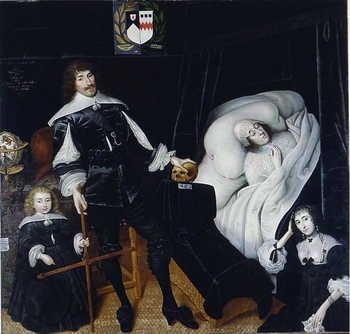
The best known of these works must surely be Sir Thomas Aston at the Deathbed of his Wife, painted and signed by Souch in c. 1635, and now in the Manchester City Gallery (Figure 2). This may not be Souch's best work or even a very good work by the standards which would have applied, for example, in London at about this time. But it is the most familiar of Souch's known work. It is usually interpreted as a complexly symbolic fantasy in which the well-known Cheshire gentleman Sir Thomas Aston (1600–45) stands at the deathbed of his first wife while his child and second wife contemplate the scene. The whole shows a number of memento mori images, indicating the fleeting nature of life and implying the importance of right living in the time remaining. All three living figures dress in black mourning clothes; a watch marking the passage of time hangs at Aston's chest; his left hand rests on a skull. Less visible are the two inscriptions which, translated from the Latin, read ‘My Garland dries up’, and ‘Virtue flourishes after Death’.
John Souch, Sir Thomas Aston at the Deathbed of his Wife (c. 1635). Manchester City Art Gallery.

Both the image and the context in which it was commissioned reflect several elements of the elder Holme's influence. Holme had presided over the heraldic funeral held for the deceased Lady Aston, just as (also in his heraldic capacity) he had signed the death certificate of Aston's own father.Footnote 50 The painting includes a coat of arms, but it also records the intricate genealogy of this generation of the Aston family by including both wives and the child, and by presenting in visual terms the succession from one to the other wife and the child produced by the first marriage.
There is another point to make about this painting, and one which lies central to our theme. As an aesthetic creation, it demonstrates a level of skill which lies midway between the run of the mill of contemporary English vernacular and the sort of sophisticated continental imagery which the Holmes collected and which Souch must often have seen. Souch's ‘Thomas Aston’ depicts real drapery, and indicates at least some conscious effort to depict the natural play of shadow, skilfully blended colours and so forth. But Souch has obviously not mastered the art of perspective or of naturalistic posing of his figures. The result can no longer be termed entirely ‘naive’ or ‘primitive’, but it does remind one a little bit of the distorted mirrors in the amusement park fun-house. The distance between his paintings and the characteristic vernacular nevertheless marks a giant step in the mastery of visual techniques by Chester painters of the early Stuart era.
Several other Chester painters of this era deserve at least a brief mention, and they are all part of what we may think of as the Holme circle. They include Edward Bellin (c. 1612–50), Thomas Pulford (c. 1615–46) and the two Thomas Leighs, father and son, who were active from the early to mid-seventeenth century).
The fact that we know of Edward Bellin at all rests chiefly on the survival of a signed portrait called An Unknown Man of the Family of Edwards of Rhual, done in 1636.Footnote 51 Bellin was also apprenticed to Randle Holme I for 10 years before being admitted to the Chester Company of Painters in 1633 or 1634. Bellin's introduction to Holme's heraldic clientele is evident in his co-signature of a funeral certificate taken by the senior Holme during his apprenticeship in 1631. Like his mentor, Bellin became an active member of the guild, frequently held office and still maintained an active enough workshop to take on five journeymen for a single year each during his 16-year active career.Footnote 52
Two of those five were portrait painters themselves, Thomas Leigh the elder (b. pre-1595 – post-1642) and his son Thomas the younger (b. pre-1620 – post-1666), suggesting that Bellin's workshop specialized in portraits. Neither of the Leighs stayed on for any length of time in Chester, but both were of Cheshire origin: the Leighs were one of the most extensive and influential clans in the region with some eight distinct family branches resident in the shire. Both of these Thomases enjoyed substantial careers painting portraits in London and elsewhere.Footnote 53 Insofar as we can reconstruct their careers, they suggest the ability of provincially born and probably trained painters even from relatively remote areas like Cheshire to travel widely and succeed, sometimes as itinerants, sometimes as more settled painters, in London and elsewhere. Daniel King's career makes the same point.Footnote 54 The reasonable thought that all three may have had access to, and been influenced by, the classical imagery collected by the Holmes suggests a reverse flow of cultural influence: from a provincial centre to rather than from London and elsewhere.
The last figure of interest is Thomas Pulford, who apprenticed not with Randle Holme, but with Souch.Footnote 55 Pulford also seems to have been an industrious and successful painter. Though none of his works seem to have survived, we do know of some which have not survived. It seems that in 1637, when Pulford had been a master painter for only a year, the much punished Puritan zealot William Prynne was brought to Chester on his way to banishment in Ireland. Chester and its surrounding area certainly had a strong contingent of Anglo-Catholic sympathizers as we have seen, but it also had its Puritans, and they greeted Prynne's coming as devotees to a martyr. They celebrated him in a number of ways, and some of them commissioned Pulford to record the moment of Prynne's Chester sojourn by producing on very short order several portraits of their hero. These they intended to record his stay, and his sufferings, for posterity. Pulford completed the task, but he did so only to have the paintings confiscated by local officials, taken out of their frames and publicly burned in the marketplace.Footnote 56
The whole episode was reported to Richard Neile, archbishop of York, and a vociferous opponent of the Puritan movement. Neile immediately ordered the portraits to be burned. When he was informed that they had already been taken out of their frames and burned without his knowledge, he flew into a rage and ordered that the frames be burned as well, which they then were.Footnote 57 This is perhaps not the sort of legacy by which a portrait painter wishes to remain known, but it shows portraiture in the service of religion and politics in early modern Chester nonetheless.
Uniqueness and typicality
Finally, we turn to the question of Chester's uniqueness or typicality as a centre for painting and, by implication, other cultural forms as well. Those particular painters and patrons noted above were specific to Chester and, it seems safe to assume, their experiences will have been replicated in other provincial centres. At the same time, however, we should not ignore the ways in which Chester remained unique. By the opening of the seventeenth century, different regions of the realm seem to have developed (or perhaps still retained) distinctly different traditions of painting. Such distinctions appear to have been forged by factors of social structure, geographic location and even economic conditions. Comparison with the painting activities of two other provincial centres of the day, each with their respective hinterlands, helps makes the point. These areas are much of East Anglia as anchored by the City of Norwich, and most of Gloucestershire as anchored by the City of Gloucester.
Of the two, Norwich's wide hinterland – agriculturally rich, affluent, eastwards-facing and with long-standing and close ties with Dutch and Flemish culture afforded by that geographic situation – presents the sharpest contrast. A substantial number of court figures throughout the period came from and maintained residences in the region. The reverse was also true: a great many East Anglian gentry retained close ties to the court circle, and many of them will have kept abreast of the latest styles and fashions to be found there. London painters not infrequently took commissions from such people, but many portraits produced in the Norwich hinterland were carried out either by immigrant painters who had settled there, or by native English painters who had been quick to learn from them.Footnote 58
Evidence for the ties with Dutch and Flemish painters, who came and went with great and casual frequency from well before the Reformation, may be found in all sorts of decorative painting, and in myriad ecclesiastical and residential settings, throughout the region. By the mid-sixteenth century, the subject matter may have changed to secular painting including portraiture. But the Reformation itself, and the Protestant diaspora which it created throughout the Low Countries, sharply increased the flow of immigrants into East Anglia. Though it is the textile trades which were most affected and which have drawn most scholarly observation, painters and other such craftsmen came as well. They brought with them techniques, styles and skills which were similarly innovative and current. In continued touch with their homelands, they also found it much easier to obtain the superior and more extensive materials required to produce the highest-quality work. These included a full range of pigments which were easily obtainable from abroad, the best panels of Baltic rather than English oak, prepared especially in the workshops of Antwerp before being brought to England, and so forth.Footnote 59 In consequence of all these factors, Norwich-centred painting, and especially portraiture, was consequently much more sophisticated, and at an earlier time, than anything which could be found in Chester or similarly remote locales.
The hinterland surrounding Gloucester had far fewer of Norwich's advantages: less proximate contact with London or the court, or with continental sources of either styles or materials. It, too, enjoyed some rich agricultural lands, and some of its neighbouring gentry were considerably affluent. In contrast to the Cheshire area, the western two-thirds of Gloucestershire had numerous and denser settlement. Yet its distance from London meant that most of the middling sort of patrons will still have had to rely on local painters. Unfortunately, the archival records of the area have not survived to anywhere near the extent that they have for Chester or Norwich, but we do have a greater survival of its locally produced portraits.
These survivals are sufficient to suggest a characteristic Gloucester style, and a characteristic range of pigments. A series of 12 portraits of mayors and civic benefactors, known as the ‘Twelve Worthies’, out of an original 18 and all done between 1610 and 1620, have survived: 11 of them may be seen in the City Folk Museum; one in the City Art Gallery. Produced by a total of five distinct hands, we may confidently take them to typify the local work of that time.Footnote 60 Nearly all of them bear characteristics which have not been found in combination elsewhere in the realm: large, prominently outlined eyes set off by high arching brows, shortened limbs, and other disproportionate features and very clumsy handling of fingers. They also reflect a very similar range of colours, and there is good reason for this. Far enough removed from easy access to some of the more expensive, important, pigments, local Gloucester painters had often to rely on locally obtainable sources which could be refined locally and cheaply. In Gloucester, this meant a reliance on local deposits of ochre in a range of earthy colours: browns, yellows, oranges and so forth.Footnote 61 It is these colours which predominate in the palettes of the ‘Twelve Worthies’.
We may take these other provincial examples as evidence of regional distinctions in English portraiture of the late sixteenth and early seventeenth centuries. They also allow us to place Chester's own portrait tradition in an appropriate and wider context. Chester enjoyed few of the geographic advantages of Norwich, or either the cultural sophistication or economic opportunity which such elements might encourage. It had little in the way of local mineral or dye deposits which could readily be refined for painting, nor was it well placed to secure some of the less common pigments and other materials available in Norwich. Then, too, it lacked the great families of the realm such as proliferated in Norfolk, a particularly affluent regional gentry, or the myriad prosperous market towns of Gloucestershire.
But it did have a landowning clientele anxious to assert and record their social status by use of portraiture, and a very strong tradition, not of foreign influence, but of native English heraldic display. And in the large community of painters on hand in Chester, particularly those associated with the Holmes and their acolytes, they had a well-trained occupational resource to satisfy those very requirements.
Conclusion
In sum, the Chester example suggests a number of observations about the activity of painting in provincial urban centres from which we may draw more general conclusions. The most obvious point, of course, is that such activities did go on, and to a very considerable extent, in provincial centres as well as the London metropolis. Provincial patrons undeniably did look to London for their inspirations, for their materials and for specialists in both portraiture and decorative work. But they could and often did also satisfy their need for both kinds of painting by craftsmen closer to hand. Local traditions of painting were often regionally distinct, and this is probably more the case in areas, like Chester, which were more remote from London and the Continent than those, like Norwich, which were closer. In the more sparsely settled areas like the Chester hinterland, potential gentry patrons who were not frequent travellers to London will often have found their painters closer to home through the influence or advice of regionally assigned heralds: an occupation which embraced expertise in both genealogy and visual imagery.
In their efforts to keep up with current styles and techniques, provincial painters no doubt benefited from exposure to the London scene however they could manage it. But the flow of ideas cannot be considered entirely uni-directional. Rich as they may be, the records of the Chester painters yield virtually no evidence of London-trained painters coming to work in Chester. Instead, Chester perpetuated the craft by training its own. In fact, the examples of the two Thomas Leighs, and of Daniel King, suggest that even a relatively remote urban centre like Chester could train and contribute skilled painters and engravers to the national scene.
None of this is meant to suggest that Borsay's ‘English Urban Renaissance’ was fully formed and active in places like Chester prior to the Civil Wars. But it does become clear that cultural activities like painting were as well rooted in provincial centres as the better-known cultural genres of, for example, music or dramatic activity, and at a much earlier time than has generally been recognized. Painting in Chester extends well back to pre-Reformation times, and only its subject matter and its techniques changed in the interim.