Research studies to date in the field of reading development have underlined the multicomponential nature of reading, with word reading and reading comprehension being two distinct aspects of developing literacy. Furthermore, multiple oral language and print-related skills are considered to play a crucial role in literacy development. Existing literature has supported three oral language skills, namely, phonological awareness, vocabulary, and morphological awareness, being involved in reading development (Kuo & Anderson, Reference Kuo and Anderson2006; Protopapas, Sideridis, Mouzaki, & Simos, Reference Protopapas, Sideridis, Mouzaki and Simos2007; Ricketts, Nation, & Bishop, Reference Ricketts, Nation and Bishop2007; Ziegler & Goswami, Reference Ziegler and Goswami2005).
Several studies in shallow and deep orthographies have repeatedly demonstrated the importance of phonological awareness for reading development (e.g., de Jong & van der Leij, Reference de Jong and van der Leij2002; Manis, Doi, & Bhadha, Reference Manis, Doi and Bhadha2000). Phonological processing skills appear to have a universal role in reading development across the alphabetic languages (Caravolas, Lervag, Defior, Malkova, & Hulme, Reference Caravolas, Lervag, Defior, Malkova and Hulme2013), although their contribution to prediction of reading in transparent orthographies may be significant mostly during the first 2 years of reading instruction (Georgiou, Torppa, Manolitsis, Lyytinen, & Parrila, Reference Georgiou, Torppa, Manolitsis, Lyytinen and Parrila2012). There is also evidence that phonological awareness contributes to early word reading that is independent from other language and cognitive skills, namely, verbal and nonverbal IQ, memory, and morphological and orthographic processing skills (Deacon, Reference Deacon2011).
Oral vocabulary skills also play a significant role in the distinct reading skills of decoding, visual word recognition, and reading comprehension (Ouellette, Reference Ouellette2006). It is suggested that both vocabulary size and quality of semantic representations are associated in a unique way with word reading accuracy and reading comprehension. Correlational and longitudinal studies have supported the influence of oral vocabulary on decoding and reading comprehension throughout the elementary school period (e.g., Verhoeven & van Leeuwe, Reference Verhoeven and van Leeuwe2008; Verhoeven, van Leeuwe, & Vermeer, Reference Verhoeven, van Leeuwe and Vermeer2011). According to the simple view of reading (Hoover & Gough, Reference Hoover and Gough1990), reading comprehension, the ultimate goal of the reading process, is the product of the interaction of two components: decoding and listening comprehension. These two components have an independent significant contribution to reading comprehension, in both deep and shallow orthographic systems (Megherbi, Seigneuric & Ehrlich, Reference Megherbi, Seigneuric and Ehrlich2006; Protopapas et al., Reference Protopapas, Sideridis, Mouzaki and Simos2007). Successful reading comprehension is a result of a balanced development of these two components with the relative contribution of each component to reading comprehension changing depending on reading competence and age (Hoover & Gough, Reference Hoover and Gough1990). In particular, in the early years of reading instruction (Grades 1–2), decoding predicts more variance in reading comprehension than listening comprehension does. On the contrary, in later stages of reading development, when word reading becomes more automatic, the contribution of listening comprehension increases. However, research studies have revealed that the relative contribution of each component to reading comprehension may also vary depending on the type of the orthographic system (Florit & Cain, Reference Florit and Cain2011; Megherbi et al., Reference Megherbi, Seigneuric and Ehrlich2006). As Florit and Cain (Reference Florit and Cain2011) demonstrated in an exploratory meta-analysis, in transparent alphabetic languages, listening comprehension was a more significant predictor of first- and second-grade reading comprehension than was decoding accuracy. Vocabulary is one of the constructs that contributes to language comprehension (Muter, Hulme, Snowling, & Stevenson, Reference Muter, Hulme, Snowling and Stevenson2004), and decoding is dependent on both phonological skills and vocabulary (Oullette, Reference Ouellette2006).
Finally, a substantial body of research in both alphabetic and nonalphabetic languages indicates that morphological awareness may also contribute to reading outcomes (e.g., Casalis & Luis-Alexandre, Reference Casalis and Luis-Alexandre2000; Kirby et al., Reference Kirby, Deacon, Bowers, Izenberg, Wade-Woolley and Parrila2011; Kuo & Anderson, Reference Kuo and Anderson2006; Roman, Kirby, Parrila, Wade-Woolley, & Deacon, Reference Roman, Kirby, Parrila, Wade-Woolley and Deacon2009; Wang, Ko, & Choi, Reference Wang, Ko and Choi2009). Moreover, its contribution to reading outcomes appears to be independent from the contribution of phonological awareness or other related skills (e.g., Carlisle & Nomanbhoy, Reference Carlisle and Nomanbhoy1993; Deacon, Reference Deacon2011; Mahony, Singson, & Mann, Reference Mahony, Singson and Mann2000; Roman et al., Reference Roman, Kirby, Parrila, Wade-Woolley and Deacon2009). Morphological awareness is expected to have an impact on word reading skills, because the mental lexicon is morphologically organized (Kuo & Anderson, Reference Kuo and Anderson2006). The contribution of morphological awareness to decoding skills increases with age and consequently is more important in later reading development (Casalis & Luis-Alexandre, Reference Casalis and Luis-Alexandre2000; Mahony et al, Reference Mahony, Singson and Mann2000). Further, morphological awareness skills have been found to influence reading comprehension (Casalis & Luis-Alexandre, Reference Casalis and Luis-Alexandre2000; Kuo & Anderson, Reference Kuo and Anderson2006), and this contribution becomes stronger with age (Kuo & Anderson, Reference Kuo and Anderson2006). As children age, they are exposed to more complex texts, which include an increasing number of unknown morphologically complex words. Morphological awareness helps these readers to analyze words into constituents and thus to infer their meaning, which in turn makes comprehension of the texts an easier task.
INFLECTIONAL MORPHOLOGICAL AWARENESS AND READING
Morphological awareness is defined as the ability to “reflect on and manipulate” the morphemic structure of words (Carlisle, Reference Carlisle and Feldman1995). Words are made up of morphemes, the smallest units of meaning in language. Two or more morphemes are combined to produce a new word or a different form of the same word. The Greek language has a shallow orthography with morphophonemic structure (Porpodas, Reference Porpodas, Joshi and Aaron2006). It has a rich morphology system, including derivational morphology, inflections, as well as compounds (Ralli, Reference Ralli2005). Morphemes are classified into free morphemes and two types of bound morphemes: the stems and the affixes. An affix can be a prefix or a suffix. The suffixes are typically more common than the prefixes. A prefix is always placed before the stem and produces a new derived word. A suffix is placed after the stem, and it can be a derived or an inflectional suffix. Adding a derivational suffix to a stem is constrained by phonological, semantic, and pragmatic factors (Ralli, Reference Ralli2005). According to Ralli (Reference Ralli2005), one example of a phonological constraint is that the derivational suffix –μα (–ma) is added in disyllabic verbal stems (e.g., άνοιγ-μα [anig-ma], opening), whereas the suffix –σιμο (–simo) is added in monosyllabic verbal stems (e.g., λύ-σιμο [li-simo], solution/looseness). As far as semantic constraints, Ralli (Reference Ralli2005) provided the following example: the suffix –τη(ς) (–ti[s]), which means the agent cannot be combined with a verb of statement (like sleep), but only with verbs of agency (like dance; e.g., χορευ-της [choref-tis], dancer). Finally, an example of a pragmatic limitation is that the augmentative suffix cannot be added to a stem that indicates an abstract concept (e.g., sadness). For instance, the word πορτ-αρα (port-ara, the bigger door) is grammatical and results from adding the augmentative suffix –αρα (–ara) to the stem πoρτ- (port-; πορτα, door). However, the word λυπ-αρα (lip-ara, the great sadness) is ungrammatical bcause there is not such a pragmatical concept (Ralli, Reference Ralli2005). Thus, a derivational morpheme cannot be attached to all base words, as an inflectional morpheme can be.
Inflectional morphology refers to the formation of variant forms of the same word by adding an inflectional suffix to a stem. For example, in English, the regular past tense in verbs is formed by adding the inflectional morpheme –ed in the verb stem (I play–I played). Research in alphabetic languages has shown that the acquisition of awareness of inflectional morphology begins early (Kuo & Anderson, Reference Kuo and Anderson2006), with children recognizing and manipulating the inflectional morphemes by the early elementary years (Casalis & Luis-Alexandre, Reference Casalis and Luis-Alexandre2000; Kuo & Anderson, Reference Kuo and Anderson2006).
Inflectional morphological awareness is considered to play an important role in reading competence (e.g., Casalis & Luis-Alexandre, Reference Casalis and Luis-Alexandre2000; Deacon, Reference Deacon2011), and it contributes to distinct reading outcomes and in different age groups. Moreover, its impact on reading skills is evident in various languages, such as English (Deacon, Reference Deacon2011; Deacon & Kirby, Reference Deacon and Kirby2004), French (Casalis & Luis-Alexandre, Reference Casalis and Luis-Alexandre2000), Finnish (Müller & Brady, Reference Müller and Brady2001), and Dutch (Rispens, McBride-Chang, & Reitsma, Reference Rispens, McBride-Chang and Reitsma2008). It is more important that these languages vary in terms of the complexity of their inflectional system and their orthographic depth as well. Alphabetic writing systems vary in terms of grapheme-to-phoneme correspondences, and they are placed in a continuum from transparent to opaque. The degree of consistency between phonemes and graphemes affects word reading accuracy. In transparent languages, such as Greek or Finnish, decoding real words and pseudowords is usually dependent on grapheme–phoneme correspondence rules, whereas in opaque languages like English, where a grapheme can have multiple pronunciations, accurate reading cannot be based solely on these rules (Seymour, Aro, & Erskine, Reference Seymour, Aro and Erskine2003). Therefore, in an opaque language, readers can benefit from the use of morphemes, because recognizing and manipulating familiar morphemes in unfamiliar words facilitates not only word recognition but also understanding of word meaning (Roman et al., Reference Roman, Kirby, Parrila, Wade-Woolley and Deacon2009). It is more important that inflectional morphemes may contribute to understanding of a sentence, because they mark the syntactic relations between the words in the sentence (e.g., in English the suffix –s marks plural of nouns, and the third person of present is always represented by the suffix –s). However, in various alphabetic scripts, inflectional morphology varies in terms of complexity (e.g., in Greek, the gender is marked in inflectional suffixes, whereas in English, the gender is not marked in this way). Furthermore, in some languages, adding an inflectional suffix may result in phonological shifts, while in other languages this does not occur. In Greek, the plural form of a noun can be phonologically different from the singular form (e.g., το κερ-ί [to ker-I], the candle, singular; τα κερ-ιά [ta ker-ia], the candles, plural). Provided that languages vary in orthographic depth and in inflectional morphology, it would be expected to find differences in the nature of the relationship between inflections and distinct reading outcomes across various alphabetic writing systems.
The relationship between awareness of inflections and reading was investigated by Brittain (1970), as cited in Kuo and Anderson (Reference Kuo and Anderson2006). Brittain's study was conducted in English and documented that in Grades 1 and 2, inflectional morphology was correlated with reading even after controlling for intelligence. Inflectional morphology was measured in this study with a sentence-completion task assessing the plural, the verb tense, and the possessive of pseudowords. However, in Brittain's study, reading was defined as the combination of decoding and reading comprehension. According to Kuo and Anderson (Reference Kuo and Anderson2006), many cross-sectional and longitudinal studies in different languages have repeatedly provided evidence for the influence of inflectional morphology on various aspects of reading. For example, Casalis and Luis-Alexandre (Reference Casalis and Luis-Alexandre2000), in a longitudinal study with French-speaking children, from kindergarten to Grade 2, revealed a strong relationship between inflections and reading skills. The inflectional test used assessed the ability to add an inflectional suffix in real words and pseudowords without the help of context. Two types of inflections were included in the task: feminine in nouns/adjectives (e.g., un boulanger/une boulangere, a baker) and verb tenses. The researchers found that Grade 1 decoding was explained significantly by the kindergarten performance on the inflectional morphology task. Furthermore, kindergarten measures of inflections predicted reading comprehension in Grade 2. It is important that in both grades none of the inflectional skills measured at these grades explained decoding and reading comprehension, despite the reported developmental differences in the inflectional morphology across these grades. However, it is necessary to note that in Casalis and Luis-Alexandre's (Reference Casalis and Luis-Alexandre2000) study, the role of inflections in reading outcomes was assessed simultaneously in the same regression model with the role of derived morphology. It is interesting that neither inflections nor derivations assessed in first grade predicted reading skills at this grade, while in second grade, comprehension was predicted by derived morphology measured at the same grade. On the contrary, Kirby et al.'s (Reference Kirby, Deacon, Bowers, Izenberg, Wade-Woolley and Parrila2011) longitudinal study from Grades 1 to 3, focusing only on inflection, showed that inflectional morphological awareness measured in Grade 3 was a more significant predictor of Grade 3 reading ability than was morphological awareness measured at Grades 1 and 2.
In a longitudinal study conducted in English (Grades 2–5), Deacon and Kirby (Reference Deacon and Kirby2004) showed that verb inflection morphology (past tenses) assessed in Grade 2 was a significant predictor of reading comprehension and reading real words and pseudowords across Grades 3 to 5, after controlling for the influence of phonological and verbal skills. Deacon and Kirby (Reference Deacon and Kirby2004) further demonstrated that the contribution of inflectional morphological awareness to reading outcomes was consistent across grades, without any increase. Similarly, Deacon (Reference Deacon2011), in a cross-sectional study with English-speaking children in Grades 1 and 3, found an independent and consistent contribution of morphological awareness to word reading. Deacon (Reference Deacon2011) assessed the independent contribution of verb inflections, phonological awareness, and orthographic processing skills to real word and to pseudoword reading, including a measure of receptive vocabulary. Deacon's (Reference Deacon2011) study showed that in both grades, the ability to change the verb tense in a sentence analogy test had a significant independent contribution (1%–2%) to decoding skills, which however was smaller than that of phonological and orthographic processing skills. Interpreting these results, Deacon (Reference Deacon2011) suggested that “It is perhaps more likely that the small size of contribution was (at least in part) due to the relatively large number of control variables included in the regression equation, particularly with the unique contribution of orthographic processing” (p. 12). However, in the study conducted by Roman et al. (Reference Roman, Kirby, Parrila, Wade-Woolley and Deacon2009) in English, including the same number of predictor variables, it was indicated that morphological awareness explained almost 4% of variance in decoding. Deacon's (Reference Deacon2011) study explored the contribution of verb morphology in early stages of reading development, whereas Roman et al. (Reference Roman, Kirby, Parrila, Wade-Woolley and Deacon2009) and Mahony et al. (Reference Mahony, Singson and Mann2000) studied morphology in later elementary children and they did not assess purely inflections. Nevertheless, Deacon (Reference Deacon2011) demonstrated that verb morphology was an important predictor of early word reading skills in English, a language having a deep orthography and a less complex inflectional system than the Greek language. On the contrary, related research in other languages (e.g., Casalis & Luis-Alexandre, Reference Casalis and Luis-Alexandre2000; Müller & Brady, Reference Müller and Brady2001) raised questions in regard to the predictive role of inflections for early word reading.
Müller and Brady's (Reference Müller and Brady2001) study with first-grade Finnish-speaking children also supported the contribution of inflectional morphology to early reading skills. Compared to English, the Finnish language has a more complex inflectional system (Kuo & Anderson, Reference Kuo and Anderson2006) and is consistent in reading and spelling (Georgiou et al., Reference Georgiou, Torppa, Manolitsis, Lyytinen and Parrila2012). Their study showed that awareness of inflectional morphology was an important predictor of reading comprehension and decoding speed, after taking into account the effect of vocabulary. However, when phonological awareness skills were entered into the regression equation, morphological awareness did not predict word-reading skills. Nevertheless, it is necessary to note that in Müller and Brady's (Reference Müller and Brady2001) study, the morphological awareness task did not measure purely the verb inflections, because it also contained comparative–superlative items. Finally, Rispens et al. (Reference Rispens, McBride-Chang and Reitsma2008) demonstrated that noun inflection contributed in a unique way to word reading in first-grade Dutch-speaking children, after controlling for the effect of phonological processing skills. Specifically, the contribution of noun inflection to word recognition was 4%, while the performance on the verb inflection task (change of verb tense) was not a predictor of first-grade reading words. The noun inflection and the verb inflection tasks consisted of pseudonouns and pseudoverbs, respectively, whereas the noun inflection task also included diminutive forms. The Dutch language has a transparent orthographic system like the Greek one, and the above research provides an initial foundation for studies in Greek.
In the Greek language, inflectional morphology is a complex and more productive process than is the derivational morphology. Inflectional suffixes are attached to a stem, and they form different aspects of the same word. For example, in the case of verbal inflectional morphology, the persons are marked by adding the related suffix to the verbal stem. In the verb τρέχ-ω (trech-o; run), the verb stem is τρέχ- (trech-). The first singular person of simple present is τρέχ-ω (trech-o), the second singular person is τρέχ-εις (trech-is), and the third singular person is τρέχ-ει (trech-i). The inflectional word belongs to the same grammatical category with the base word, while inflections change the grammatical function of a word but not the grammatical category. Furthermore, adding an inflectional morpheme does not alter the meaning of the base word. It simply adds some properties, which however are predictable (Ralli, Reference Ralli2005). For example, in the verb παίζ-ω (pezo; play), the verbal inflectional suffix –ω always represents first-person simple present.
Nouns, adjectives, and articles are inflected for gender, number, and case. For instance, ο μεγάλ-ος κήπ-ος (o megal-os kip-os; the big garden) is a singular nominative case, whereas the plural nominative case is οι μεγάλ-οι κήπ-οι (i megal-i kip-i; the big gardens). Verbs are marked for person and number (e.g., εγώ τρέχ-ω [ego trech-o; I run]: first singular person; εμείς τρέχ-ουμε [emis trech-oume; we run]: first plural person). There are four cases and three genders: masculine, feminine, and neuter. The nominative and the accusative cases have the same suffixes. Inflectional suffixes have semantic and syntactic properties, and they appear to play a role in the syntax of a sentence. Further, in a sentence, the article–adjective–noun should agree in terms of tense, case, and gender. Finally, in the case of nouns and adjectives, and in terms of cases and plural, adding an inflectional suffix makes phonological changes to the base word, and the position of the stress can be altered (Ralli, Reference Ralli2005; e.g., singular nominative: το παιδί [to pedi]; plural nominative: τα παιδιά [ta pedia]; singular nominative: το μαγαζί [to magazi]; singular genitive: του μαγαζιού [tou magaziou]).
In the Greek language, during the last few years, there has been an increasing interest in the role of morphological awareness skills in early literacy, namely, decoding and reading comprehension (Manolitsis & Kandilidou, Reference Manolitsis and Kandilidou2011; Padeliadu, Rothou, & Sideridis, in press; Rothou & Padeliadu, Reference Rothou and Padeliadu2011). Research with Greek-speaking children has also focused on the use of morphemic rules for spelling (Chliounaki & Bryant, Reference Chliounaki and Bryant2002, Reference Chliounaki and Bryant2007) as well as on the role of morphological awareness in spelling (Tsesmeli, Reference Tsesmeli2007, Reference Tsesmeli2009). Rothou and Padeliadu (Reference Rothou and Padeliadu2011), in a cross-sectional study with Greek-speaking children in Grades 1 to 3, investigated the unique contribution of segmentation and formation of coordinative compounds, phonological awareness, and oral vocabulary skills to decoding and reading comprehension. Their study revealed a significant contribution of morphological awareness to both reading skills in Grade 3 and to reading comprehension in Grade 1. However, in Grade 2, there was not an impact of morphological skills on reading performance. Rothou and Padeliadu (Reference Rothou and Padeliadu2011) study suggested that in a transparent language, morphological awareness, namely, compounds, played a significant role in word reading at later stages of reading development. This is in line with results reported in a review by Kuo and Anderson (Reference Kuo and Anderson2006), with different languages showing that the contribution of morphological awareness to word-reading skills increases with age. However, Rothou and Padeliadu found that the morphological skills had an impact on reading comprehension in nonsequential grades. In their study, reading comprehension in Grades 1–2 was assessed with the same texts, but the children in second grade were better than first graders at both decoding and vocabulary knowledge. Padeliadu, Rothou, et al. (in press) also explored the contribution of derivational morphological awareness (diminutive nouns and derived adjectives from nouns), phonological awareness, and oral vocabulary to the prediction of beginning reading (Grades 1 and 2). Their cross-sectional data revealed that morphological awareness contributed significantly to both decoding and reading comprehension, only in first grade, pointing again to a nonsignificant role of morphological awareness in second-grade reading.
In sum, it appears that in alphabetic languages varying in the depth of the orthographic system and in the richness of morphology, awareness of inflectional morphology can be an important predictor of early reading skills. Furthermore, given the existing research in Greek, it is revealed that in the first year of reading instruction, derived morphology and compounds are associated with different reading outcomes. It is also indicated that even in an orthographically transparent language, morphological awareness, when measured as compounding, plays a significant role only in later decoding skills, whereas derivational morphological awareness is a significant predictor of decoding in first grade. However, both of the above aspects of morphological awareness do not contribute to literacy outcomes in Grade 2, when the children begin to read in a more automatic way and develop richer vocabulary. Thus, an interesting question concerns the nature of the relationship between inflectional morphology and distinct literacy outcomes across the first 3 years of reading instruction.
The purpose in this cross-sectional study was to investigate the role of two aspects of inflectional morphology in word reading and reading comprehension, in Greek language-speaking children in Grades 1, 2, and 3. At these grades, children acquire the mechanism of reading they start to read in a more automatic way.
Our main research question was whether and to what extent awareness of noun–adjective inflections and awareness of verb inflections can contribute to early reading skills. We further examined their unique contribution to word reading and reading comprehension, after controlling for the effects of two important reading-related skills: phonological awareness and vocabulary knowledge. Finally, we wanted to provide some preliminary data on the development of awareness of noun–adjective inflections and awareness of verb inflections in the Greek language.
METHOD
Participants
Participants came from 19 primary schools located in the area of Attica, which represented urban, rural, and semiurban areas. The schools were selected randomly from a group of 68 primary schools for which we had permission from the Pedagogic Institute and the Ministry of Education to conduct this research. The sample consisted of 369 children: 120 in Grade 1, 123 in Grade 2, and 126 in Grade 3. The mean (standard deviations) ages in months for the children in Grades 1 and 2 were 80.07 (3.435) and 92.16 (3.907), respectively, and 103.71 (3.173) for the children in Grade 3. The numbers of male and female participants represent approximately half of the sample in each grade. All participants were native speakers of Greek, and none received special educational services or had documented reading difficulties. They were selected randomly from each class and were included in the study, providing we had acquired a signed parental consent form.
Testing took place from mid-January to April 2010. Each child received a battery of four oral language tasks and two reading tasks. All tests were administered individually to each child in a quiet room in the school and in two sessions of approximately 30 min each, by one of the writers.
Materials
Phonological awareness
Phonological awareness was assessed with the phoneme deletion and phoneme segmentation subtests of a standardized screening test of reading difficulties for Grades A–B (Grades A and B refer to Grades 1 and 2, respectively; Porpodas, Reference Porpodas2007). In the phoneme deletion task, children were asked to repeat a pseudoword without a specified phoneme. The task was discontinued when children gave three consecutive incorrect answers. There were four practice items. The score was the total number of correct answers. In the phoneme segmentation task, children segmented a pseudoword in phonemes. There were four practice items, and the total number of correct responses was the score. In Grades 1 and 2, the task was stopped after three consecutive incorrect answers, while in third grade, both subtests of the task were given without stopping after three consecutive incorrect responses. For all grades, a combined score for phonological awareness was calculated by summing up the scores of the two tasks. According to the test manual, for Grades A–B, the alpha reliability for the phoneme deletion subtest is 0.93 and for the phoneme segmentation subtest it is 0.92. For the children in third grade, the alpha reliability was 0.82 for the phoneme deletion and 0.96 for the phoneme segmentation. A ceiling rule for Grades 1–2, but not 3, on the phoneme segmentation task was considered acceptable, because less than 15% of children scored the best possible score and because alpha reliability across all grades was adequate (>0.80).
Inflectional morphological awareness
Two aspects of inflectional morphology were assessed: noun–adjective inflections and verb inflections. Separate oral experimental tasks were used for their measurment. Both tasks were based on the concept of the morphological generation task (Muter et al., Reference Muter, Hulme, Snowling and Stevenson2004).
The noun–adjective inflection task assessed the ability of children to produce the plural of articles, adjectives, and nouns in the context of a sentence. The test had 10 sentences that included the structure article–adjective–noun (AAN) in the singular form and 4 sentences with the structure article–noun article–noun (AN AN) in the singular form, while the remainder of each sentence was in plural. The children were asked to produce the plural form for these structures specifically in two cases: general and accusative.
One example for the structure AAN is the following:
-
Singular form: Αγοράσαμε γλυκά του μικρού παιδιού /Agorasame glika tou mikrou pediou / We bought cakes for the small child.
-
Plural form: Αγοράσαμε γλυκά των μικρών παιδιών/ Agorasame glika ton mikron pedion / We bought cakes for the small children.
For the structure AN AN, an example is the following:
-
Singular form: Είδαμε το φίλο του παιδιού/ Idame to filo tou pediou / We saw the friend of the child.
-
Plural form: Είδαμε τους φίλους των παιδιών/ Idame tous filous ton pedion / We saw the friends of the children.
The correct case was scored with 1. Therefore, the maximum correct score for each AAN structure was 3, and for each AN AN structure the maximum correct score was 4. The total maximum score was 46 (=[3 × 10] + [4 × 4]).
The alpha reliability for each grade was very good (Grade 1: α = 0.85, Grade 2: α = 0.90, and Grade 3: α = 0.75). Furthermore, the validity of the task was checked with the confirmatory factor analysis using the statistical program EQS 6.1 (Bentler, Reference Bentler2006). The validity for each grade was proved adequate, Grade 1: χ2 (74) = 109.770, p < .05, χ2/df = 1.48, comparative fit index (CFI) = 0.903, root mean square error of approximation (RMSEA), 90% confidence interval (CI) = 0.064 (0.036–0.087); Grade 2: χ2 (74) = 91.598, p > .05, χ2/df = 1.23, CFI = 0.957, RMSEA (90% CI) = 0.044 (0.000–0.071); and Grade 3: χ2 (74) = 100.116, p < .05, χ2/df = 1.35, CFI = 0.703, RMSEA (90% CI) = 0.053 (0.021–0.078)
The verb inflection task used asked children to change the tense of the verb in a sentence. A temporal adverb in the beginning of the sentence defined the alteration of the verb tense. The children were read a pair of sentences that differed in the temporal adverbs. The second sentence began with an adverb that reflected the change of the verb tense. The remaining of the sentence was similar to the first sentence. For example,
-
First sentence: Τώρα εσύ πλένεις τα πιάτα/ Tora esi plenis ta piata / Now you are washing the dishes.
-
Second sentence (verb tense change): Xθές μια φορά εσύ έπλυνες τα πιάτα / Chthes mia fora esi eplines ta piata / Yesterday (in a specific time) you washed the dishes.
The task contained 12 verbal inflections: 3 present, 3 past, 2 perfect, and 4 future. The correct verb tense change was scored with 1. The maximum correct score was 12.
The alpha reliability for each grade was adequate (Grade 1: α = 0.54, Grade 2: α = 0.55, and Grade 3: α = 0.69). Furthermore, the validity of the task was checked with the confirmatory factor analysis using the statistical program EQS 6.1 (Bentler, Reference Bentler2006). The validity of the task was proved adequate for all grades, Grade 1: χ2 (47) = 21.258, p > .05, χ2/df = 0.45, CFI = 1, RMSEA (90% CI) = 0.000; Grade 2: χ2 (48) = 66.485, p < .05, χ2/df = 1.38, CFI = 0.810, RMSEA (90% CI) = 0.056 (0.013–0.086); and Grade 3: χ2 (48) = 70.239, p > .05, χ2/df = 1.46, CFI = 0.875, RMSEA (90% CI) = 0.061 (0.025–0.090).
Vocabulary
Receptive and expressive vocabulary skills were assessed separately with two standardized tests. Specifically, receptive vocabulary was measured using the Greek standardization of the Peabody Picture Vocabulary Test (Simos, Sideridis, Protopapas, & Mouzaki, Reference Simos, Sideridis, Protopapas and Mouzaki2011; Protopapas, Simos, Sideridis & Mouzaki, Reference Protopapas, Simos, Sideridis and Mouzaki2012). Children were asked to identify one picture out of four that best represented the orally given word. There were 173 items of increasing difficulty. Test administration was stopped when the child gave 8 incorrect answers within 10 consecutive questions. The total number of correct responses was the score for receptive vocabulary.
The vocabulary subtest of the Greek standardization of the third edition of the Wechsler Intelligence Scale for Children (Georgas, Paraskevopoulos, Bezevegis, & Giannitsas, Reference Georgas, Paraskevopoulos, Bezevegis and Giannitsas1997) was used as a measure of expressive vocabulary. The children were asked to give definitions of words of increasing difficulty. The test was discontinued after four consecutive zero-scoring responses. The score for expressive vocabulary skills was the total number of correct definitions. According to the manual, the internal consistency of the vocabulary subtest of the Wechsler Intelligence Scale for Children (Cronbach α) ranges from 0.62 to 0.81 for ages from 6 to 8 years (Grades 1 to 3).
Reading ability
Word reading and reading comprehension were measured with the relevant subtests of Greek standardized tests, which assessed four aspects of reading: decoding, fluency, morphology–syntax, and comprehension. Specifically, in Grades 1 and 2 word reading (decoding) was assessed with the decoding subtest of the NewTELA reading test (Padeliadu, Antoniou, & Sideridis, in press), and in Grade 3, with the decoding subtest of the TestA (Padeliadu & Antoniou, Reference Padeliadu and Antoniou2007). The decoding subtest of the TestA included three tasks asking children: (a) to read a list of 24 pseudowords of increasing difficulty, (b) to read a list of 53 real words of increasing difficulty, and (c) to distinguish between real words and pseudowords (totally 36 real words and pseudowords). The correct response was scored with 1. The word reading (decoding) score in Grade 3 was calculated by adding up the scores on these three tasks (maximum correct score = 113). According to the manual of the TestA, the internal consistency (Cronbach α) for the decoding subtest is 0.770.
The decoding subtest of the NewTELA (Grades 1 and 2) included four tasks asking children: (a) to read a list of 40 pseudowords of increasing difficulty, (b) to read a list of 57 real words of increasing difficulty, (c) to distinguish real words and pseudowords from a mix of 33 real words and pseudowords, and (d) to identify the word out of three options (real words and pseudowords) that best represented a given picture (26 words were tested totally). Reading words (decoding) score in Grades 1–2 was calculated by adding up the scores on these four tasks (maximum correct score = 156). The correct response was scored with 1. The internal consistencies (Cronbach α) for pseudoword reading, real word reading, word distinction, and word identification are 0.929, 0.964, 0.872, and 0.847, respectively (Padeliadu, Antoniou, et al., in press).
Reading comprehension in Grades 1 and 2 was measured with the reading comprehension subtest of the NewTELA (Padeliadu, Antoniou, et al., in press), and in Grade 3, with the reading comprehension subtest of the TestA (Padeliadu & Antoniou, Reference Padeliadu and Antoniou2007). The comprehension subtest in both the NewTELA and TestA contained two tasks assessing the same skills: identification of two equivalent semantically sentences from four options (for all grades the maximum correct score was 4), and understanding of texts with seven multiple choice questions (Grades 1–2: six texts, maximum correct score = 42; and Grade 3: three texts, maximum correct score = 21). For each grade, a combined score for reading comprehension resulted from adding up the scores on the two tasks of reading comprehension (Grades 1–2: maximum correct score = 46 and Grade 3: maximum correct score = 25). Generally, the correct response was scored with 1. The internal consistency (Cronbach α) for the reading comprehension subtest of TestA is 0.816 (Padeliadu & Antoniou, Reference Padeliadu and Antoniou2007). For the NewTELA (Padeliadu, Antoniou, et al., in press), the internal consistency (Cronbach α) for the task of identification of two equivalent semantically sentences is 0.670, whereas for each of the six texts the Cronbach α ranges from 0.816 to 0.899. Specifically, for Text 1 and Text 3, α = 0.853; for Text 2, α = 0.865; for Text 4, α = 0.899; for Text 5, α = 0.870; and for Text 6, α = 0.816.
RESULTS
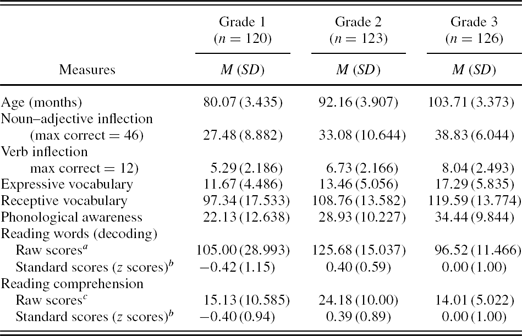
All analyses were conducted within grade using raw scores for all variables and adopting a level of significance at .05. Provided that reading skills in third grade were measured with different tests than in Grades 1–2, we also calculated the standard scores for these. Standard scores allow us to compare raw scores that come from different metrics. Descriptive statistics for all measures are presented in Table 1, according to grade. Performance on both morphological awareness tasks appeared to increase by grade level (Kruskal–Wallis tests, p < .001), indicating developmental differences across all three grades. However, scores on the noun–adjective inflection task and the verb inflection task did not reach maximum performance even in Grade 3, pointing to important lack of mastery. Within all grades, there were statistically significant differences between the two inflectional tasks (Wilcoxon tests, p < .001 across the three grades), with verb inflection being a more difficult task than the noun–adjective inflection.
Means (standard deviations) for noun–adjective inflection, verb inflection, phonological awareness, vocabulary skills, decoding, reading comprehension, and ages for participants in Grades 1–3

a Combined raw score from decoding subtests of NewTELA Reading test (Padeliadu, et al., in press) for Grades 1 and 2 (maximum correct = 156) and combined raw score from decoding subtests of TestA Reading test (Padeliadu & Antoniou, Reference Padeliadu and Antoniou2007) for Grade 3 (maximum correct = 113).
b Standard scores (z scores; M = 0, SD = 1) for making comparisons of raw scores that come from different reading tests.
c Combined raw score from reading comprehension subtests of NewTELA Reading test (Padeliadu, et al., in press) for Grades 1 and 2 (maximum correct = 46) and combined raw score from reading comprehension subtests of TestA Reading test (Padeliadu & Antoniou, Reference Padeliadu and Antoniou2007) for Grade 3 (maximum correct = 25).
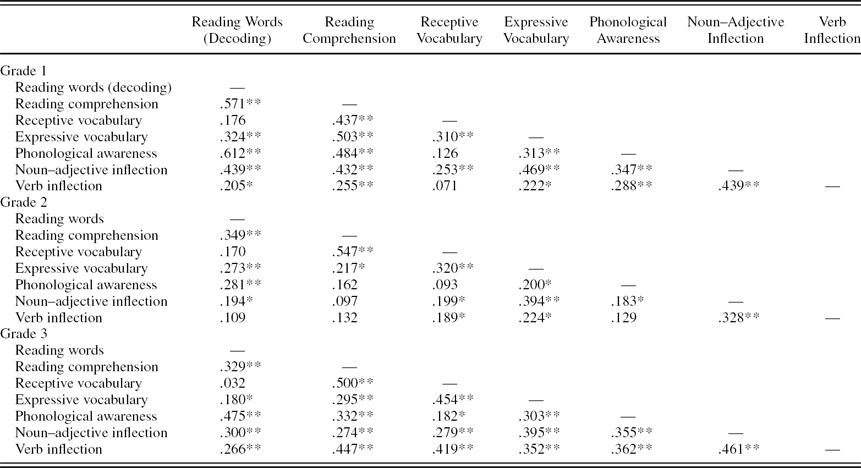
Correlations between reading skills and oral language skills are reported separately for each grade in Table 2. Noun–adjective inflection was significantly and moderately correlated with decoding skills in all grades. On the contrary, verb inflection correlated significantly with both reading skills only in first and third grades. It is interesting that the correlations between noun–adjective inflection and reading skills decreased by grade, while the correlations between verb inflection and reading increased. Phonological awareness correlated with decoding skills across all three grades and with reading comprehension in Grades 1 and 3. The analysis of the data also showed that receptive vocabulary correlated only with reading comprehension in all grades, whereas expressive vocabulary skills correlated with both decoding and reading comprehension in Grades 1 and 3. Finally, it is interesting to note that phonological awareness was significantly related to both noun inflection and verb inflection only in Grades 1 and 3. In Grade 2, phonological awareness was correlated only with noun–adjective inflection, and this correlation was smaller than those found in the other two grades.
Simple correlations between reading skills and predictor variables

*p < .05. **p < .01.
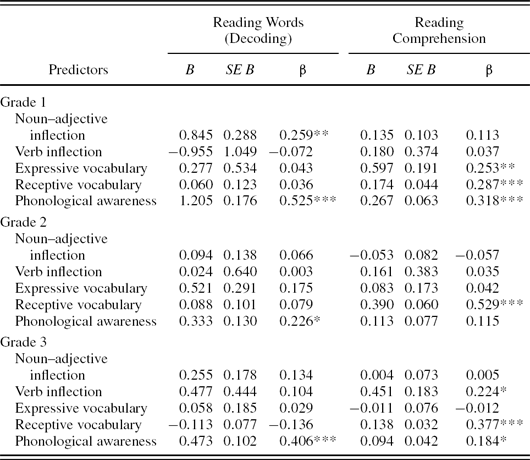
Separate standard multiple regression analyses within each grade were used to explore the predictive value of each aspect of inflectional morphological awareness. Phonological awareness, receptive vocabulary, expressive vocabulary, noun–adjective inflection, and verb inflection were entered into the equation at the same time. The results of these analyses (Table 3) indicated how well these oral language skills can predict the two distinct reading outcomes. Furthermore, they allowed us to assess the unique contribution of each of them to reading skills.
Regression analyses with noun–adjective inflection, verb inflection, phonological awareness, and vocabulary skills as predictors

*p < .05. **p < .01. ***p < .001.
The analysis showed that only in first grade did noun–adjective inflection make a statistically significant contribution to reading words (β = 0.259), which however was smaller than the contribution of phonological awareness (β = 0.525). Phonological awareness was the unique predictor of word reading in Grades 2 and 3, and the most important in Grade 1. The combination of all the predictor variables accounted for a greater amount of variance in word reading in Grades 1 and 3 than in Grade 2, Grade 1: R 2 = .441, F (5, 114) = 17.965, p < .001; Grade 2: R 2 = .138, F (5, 117) = 3.753, p < .01; and Grade 3: R 2 = .262, F (5, 120) = 8.501, p < .001.
As for reading comprehension, inflectional morphological awareness was found to be a significant predictor only in Grade 3. Specifically, verb inflection made a significant contribution to reading comprehension (β = 0.224) followed by phonological awareness, while receptive vocabulary was the most important predictor. The model of all the predictor variables explained a greater amount of variance in reading comprehension in Grades 1 and 3 than in Grade 2, Grade 1: R 2 = .466, F (5, 114) = 19.865, p < .001; Grade 2: R 2 = .317, F (5, 116) = 10.751, p < .001; and Grade 3: R 2 = .348, F (5, 120) = 12.788, p < .001. Phonological skills contributed to reading comprehension in Grade 1 as well. In all grades, the receptive vocabulary was the most important predictor of reading comprehension and it was the unique one in Grade 2. It is interesting that in Grade 1 both vocabulary skills contributed to this reading skill.
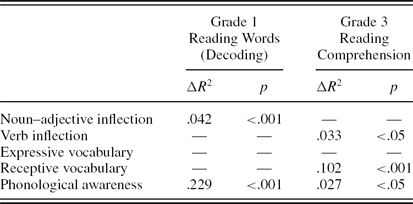
We further investigated the independent contribution of noun–adjective inflection and verb inflection to first-grade word reading and to third-grade reading comprehension, respectively, after controlling for the effect of the other predictor variables. Hierarchical multiple regression analyses were conducted for word reading in Grade 1 and for reading comprehension in Grade 3. The results of these analyses are reported in Table 4, with each line representing the amount of variance explained by each variable, after controlling for the effect of the remaining variables.
Hierarchical regression analyses for reading words in Grade 1 and for reading comprehension in Grade 3, after controlling for the other variables

It was revealed that in Grade 1 noun–adjective inflection explained an additional 4.2% of the variance in word reading after controlling for the effects of phonological awareness, F change (1, 114) = 8.648, p < .001. The contribution of inflectional morphology was smaller than the contribution of phonological awareness. As far as verb inflection is concerned, the hierarchical multiple regression analysis indicated that in Grade 3 it accounted for an additional 3.3% of the reading comprehension, F change (1, 120) = 6.094, p < .05.
DISCUSSION
In the current study, we investigated the contribution of two aspects of inflectional morphology to word reading and reading comprehension in Greek-speaking children (Grades 1–3). We found that noun–adjective inflection awareness contributed uniquely only to word reading in Grade 1, while verb inflection awareness predicted only Grade 3 reading comprehension. We also aimed at providing some preliminary data for the development of noun–adjective and verb inflection awareness in the Greek language.
Our findings indicated significant developmental differences in the acquisition of these inflectional morphological awareness skills through the first 3 years of schooling. The increase in the performance on the two inflectional tasks was expected on the basis of previous research in inflectional morphology, though these were documented in languages with deep orthography and a less complex inflectional system (e.g., Berko 1958, as cited in Kuo & Anderson, Reference Kuo and Anderson2006; Casalis & Luis-Alexandre, Reference Casalis and Luis-Alexandre2000). Our study suggested that in the beginning of formal literacy instruction, Greek-speaking children have some knowledge of inflectional morphology, and they are able to manipulate the inflectional morphemes. This finding is consistent with the results reported in Berko (1958), as cited in Kuo and Anderson's (2006) and Casalis and Luis-Alexandre's (Reference Casalis and Luis-Alexandre2000) studies, which were conducted from kindergarten to Grade 2. These studies in English and French languages demonstrated an improvement in the performance on inflectional tasks throughout the first years of schooling. However, contrary to Casalis and Luis-Alexandre (Reference Casalis and Luis-Alexandre2000), our study showed that the performance on noun–adjective inflection and verb inflection tasks did not reach the maximum levels in Grade 2, or even in Grade 3. In the study by Casalis and Luis-Alexandre (Reference Casalis and Luis-Alexandre2000), children scored higher on inflectional tasks that included real verbs and real nouns–adjectives than on tasks containing pseudowords, and their scores were approximately at ceiling levels. The complex inflectional morphological system of the Greek language and the fact that target inflections were assessed within a sentence, whereas in Casalis and Luis-Alexandre (Reference Casalis and Luis-Alexandre2000) the inflectional suffixes were assessed out of context, could account for the difference between our results and the French study. The development of morphological awareness in the Greek language during the first 3 years of schooling has been also presented by Padeliadu and Rothou (Reference Padeliadu and Rothou2011), who explored the derived and compound awareness in Grades 1–3. The researchers administered oral morphological awareness tasks to typically developing children, and they revealed developmental differences and, of more importance, a moderate performance for third graders.
Our study also suggested that in each grade, Greek-speaking children faced greater difficulty with verb inflections than with noun–adjective inflections. Similarly, in English, Berko (1958; cited in Kuo & Anderson, Reference Kuo and Anderson2006) found that for both kindergarteners and first graders, the plural of nouns was easier than the formation of verb tenses. However, Casalis and Luis-Alexandre (Reference Casalis and Luis-Alexandre2000) did not demonstrate an effect of type of inflection on the performance of children when they were given tests with real words. The difficulty of Greek-speaking children in morphological awareness tasks could be due to the content and the structure of these tasks. However, both noun–adjective and verb inflection tasks contained real words of high frequency in the oral and written vocabulary of these grades, and the target inflections were included in sentences with simple structure. Furthermore, the concept of two measures has been used in research studies with children at this age (e.g., Deacon, Reference Deacon2011; Muter et al., Reference Muter, Hulme, Snowling and Stevenson2004). Therefore, the reported difficulty of the children in our study is more likely to be due to the morphologically demanding system of the Greek language. In Greek, inflections in verbs and articles–nouns–adjectives are many more in number and more complicated than in other alphabetic languages, such as English or French. In conclusion, our results demonstrated developmental differences in the mastery of inflectional morphology and suggest that morphological awareness may develop later in more complex languages, although the latter finding needs further investigation with longitudinal studies.
Our main research question was whether and to what extent noun–adjective inflection and verb-inflection awareness can contribute to early reading skills. The results documented that inflectional morphological awareness can be an important predictor of reading in a language with shallow orthography and rich morphology. It is interesting that in second grade none of the two aspects of inflectional morphology contributed to reading skills, while in Grades 1 and 3, awareness of inflectional morphology had different effects on reading. Nevertheless, the use of different reading tasks in Grade 3 may have confounded these results, and this raises the possibility of these results being an artifact of the reading tasks used.
The finding that inflectional morphology did not contribute to reading outcomes in second grade agrees with Casalis and Luis-Alexandre's (Reference Casalis and Luis-Alexandre2000) study. In the French langauge, Casalis and Luis-Alexandre (Reference Casalis and Luis-Alexandre2000) demonstrated that first- and second-grade performance on inflectional tasks did not predict the reading skills in first and second grades, respectively. However, our study in Greek found that only noun–adjective inflection was predictive of word-reading skills in first grade. Similarly, Rispens et al.'s (Reference Rispens, McBride-Chang and Reitsma2008) study with first-grade Dutch-speaking children documented that noun inflection was a significant predictor of word reading. It is more interesting that, in Greek, the independent contribution of noun–adjective inflection to word-reading skills was at the same level (4.2%) with that found in the Dutch language (4%).
However, in contrast to previous research studies (e.g., Deacon, Reference Deacon2011; Müller & Brady, Reference Müller and Brady2001), our study did not support the predictive role of verb inflection for first-grade reading outcomes. Greek-speaking children appear not to use verb inflections until later, in third-grade reading comprehension. By the end of their first year of schooling, children have acquired some preliminary knowledge of verb inflections, but they have not yet mastered it. Thus, in Grades 1–2 students may not be capable of applying this knowledge when they read, because they have not developed it yet.
It is interesting that, in Greek, the independent contribution of verb inflection to reading comprehension (3.3%) was larger than the reported contribution to decoding skills in Deacon's (Reference Deacon2011) study, wherein the respective contribution was 1%–2%. Both Müller and Brady (Reference Müller and Brady2001) and Deacon (Reference Deacon2011) revealed a significant contribution of verb inflections to first-grade reading comprehension and first-grade word reading, respectively, without taking into account the impact of noun inflection. It is important to note that in our study the impact of verb inflection on reading outcomes was assessed simultaneously with the impact of noun–adjective inflection. In order to test whether our results for first-grade children might have been different if we had not entered into the same regression equation both aspects of inflectional morphology, we proceeded in an analysis taking out noun inflections. Again, verb inflection did not have an impact on first-grade reading skills. Furthermore, we need to underline that in the present study, the verb inflection task measured fully the knowledge of verb inflections and did not assess only past tense transformations as Müller and Brady (Reference Müller and Brady2001) and Deacon (Reference Deacon2011) did.
The finding that inflectional morphological awareness was not a predictor of either word reading or reading comprehension in second grade is consistent with the results reported in two other studies in the Greek language (Padeliadu, Rothou, et al., in press; Rothou et al., Reference Rothou and Padeliadu2011), which assessed derivational and compound awareness. The present study showed that in Grade 2, children's phonological awareness skills were developed in higher levels than in first grade. Taking into consideration the transparency of the Greek orthographic system, it can be suggested that Grade 2 readers, who have become phonologically strong, did not need to use morphological awareness as much as the phonologically weaker, first graders did. Similarly, in Grade 3, Greek-speaking children decoded words using only phonological processing knowledge. It is further interesting to note that none of the inflectional tasks were associated with reading comprehension in Grades 1 and 2. It can be hypothesized that for beginning readers, even though they had acquired inflectional morphology, they were not yet able to apply it for facilitating the text understanding, as the older children did.
Overall, the data in this study and in previous ones lead us to hypothesize that in a morphologically demanding language, children appear to use morphological skills either in the beginning or in the consolidated phase of reading development. That is, they use it when they actually possess it and when they need it. In second grade, Greek-speaking children are more competent in morphological processing than in first grade, whereas in third grade, they deal with more complex morphological structures and reading material as well. In the third year of schooling, Greek children are taught explicitly both the use of advanced tenses (e.g., present perfect and future) in syntactic parsing of the sentences and the applying rules as well. On the contrary, during the first two grades, tenses are usually taught implicitly, via experience and within specific contexts, and thus children in these grades might not yet be able to generalize this knowledge. Nevertheless, we acknowledge that longitudinal and intervention studies could provide evidence for or against this hypothesis.
The present study has some limitations, which however can be used as a basis for future research in the field of reading. One limitation is that the inflectional morphological awareness tasks did not contain pseudowords but only real words. The inclusion of pseudowords in morphology tasks could ensure that children's performance on these tasks was not mediated by their vocabulary skills. Furthermore, it is noteworthy that our study did not explore separately the contribution of morphological awareness to real and pseudoword reading. Perhaps the predictive role of morphological processing skills for these types of reading accuracy could differentiate through the first three grades, and especially in first and second grades, when the children learn the rules of decoding and they usually rely on phonological awareness to read. Finally, our study was a cross-sectional one, and therefore it does not allow us to support causal relations between the variables. A longitudinal study or a training study could disentangle these relations. Furthermore, a longitudinal study would provide more definite data on the development of inflectional morphological awareness.
In conclusion, the present study demonstrated that in a language with shallow orthography and a complex inflectional morphological system, inflectional morphological awareness may develop later on and can be a significant predictor of early reading skills of Greek-speaking children. Specifically, it suggests that in the Greek language, verbal inflectional morphology may have an important effect on the development of later reading comprehension, whereas noun–adjective inflectional morphology influences only Grade 1 decoding. It appears that in Greek, decoding in Grade 1 relies on both phonological and morphological processing skills, despite the transparency of writing system. On the basis of the present data, it would be useful to explore the contribution of inflectional morphology to reading fluency, given that Greek-speaking children become accurate readers at the end of the first year of formal reading instruction.