

World War I was a pivotal event for U.S. political and economic development, particularly in the realm of public finance. For it was during the war that the federal government ended its traditional reliance on regressive import duties and excise taxes as principal sources of revenue and began a modern era of fiscal governance, one based primarily on the direct and progressive taxation of personal and corporate income. The wartime tax regime, as the historian David M. Kennedy has observed, “occasioned a fiscal revolution in the United States.”Footnote 1
Like other aspects of war mobilization, the fiscal revolution required an enormous infusion of national administrative resources. Nowhere was this more evident than within the corridors of the U.S. Treasury Department—the executive agency responsible for creating, managing, and defending wartime fiscal policies. Managing a global war, and a tax system that included such novel and difficult to decipher provisions as an “excess-profits” levy, demanded an unprecedented amount of bureaucratic capacity.Footnote 2
The dramatic changes in tax laws and policies ushered in by the global conflict were not inevitable or preordained. The war emergency, to be sure, provided the principal context for the fiscal transformation, but there was vociferous and consequential disagreement among social groups, lawmakers, and policy analysts about the specific path of U.S. public finance before, after, and especially during the war. The political malleability created by the crisis provided state actors with a unique opportunity to determine the future contours of U.S. tax policy. In this sense, the wartime fiscal revolution was not merely a functional response to the need for revenue, nor was it an abrupt end to wholesale progressive tax reform, as some scholars have suggested.Footnote 3 The wartime tax system embodied, instead, a complex continuation of the conceptual shift in public finance advanced by prewar progressive intellectuals and political leaders, and a constraint on the social-democratic ambitions of some populist tax reformers. Although the wartime tax regime may not have gone as far as some activists had hoped, the unprecedented turn toward a system of steeply graduated taxes fundamentally altered the distribution of economic obligations and the meaning of fiscal citizenship.
Among the Treasury officials who took part in creating the new tax system, a group of elite lawyers was central to the project of building the administrative capacity of the new fiscal state.Footnote 4 These lawyers played a vital role in constructing, administering, and defending the wartime fiscal polity. They deployed their social and professional networks, their technical legal skills, and their practical experiences as social and economic intermediaries to shape the administrative foundation of the rising modern American fiscal state.Footnote 5 By focusing on the state-building efforts and achievements of these government lawyers, this article contributes to the recent scholarly interest in uncovering the constitutive role of law and the legal profession in developing the legitimacy of the modern liberal polity.Footnote 6 Rather than emphasizing how lawyers as litigators defended negative liberties against the state, however, this article explores how transactional lawyers-turned-government administrators helped constitute the positive rights associated with American new liberalism; how they helped build not just a civil society separate from the moderate state, but rather a robust, fiscal polity intertwined with U.S. public life.Footnote 7
The Treasury lawyers contributed to the emergence of a new fiscal polity in several ways. First, as leading members of the bar, they used their particular social and professional networks—developed through attendance at elite law schools, employment at leading corporate law firms, and service to the nation's largest businesses and wealthiest individuals—to staff and train their offices with like-minded legal professionals committed to the department's core institutional mission of building public trust. They cultivated such confidence by imposing a sense of rationality onto war financing without challenging the dominant structure of U.S. corporate capitalism. Second, they used their concrete legal skills to help consolidate Treasury's administrative authority. Their legal expertise was necessary to guard the department's jurisdictional control, to delimit the reach of other government entities, and to manage the daily details of financing a global war. Melding their claims to professionalism with their expertise and desire to wield state power, the Treasury lawyers were active participants in the creation of a distinctively legal administrative state.Footnote 8
Third, as intellectual stewards, the lawyers helped formulate broad policies regarding the mix of war financing options.Footnote 9 They used their contacts, skills, and experience to search for legally viable alternative sources of revenue, to channel Treasury efforts in constitutionally permissible directions, and to remind key policymakers that the choice between taxation and government borrowing implicated the dynamics of patriotism, wartime sacrifice, and fiscal citizenship.Footnote 10 Fourth, and perhaps most important, the World War I Treasury lawyers were moderators of social forces and ideological tensions. Operating as classic, Tocquevillian arbitrators of conflicting societal interests, they sought to mediate between populist leaders who wanted to use the war crisis to radically reconstruct American political economy and more conservative forces that wanted to retain or extend the regressive prewar system of tariffs and consumption taxes.Footnote 11
In carrying out these tasks, the lawyers were not always altruistic guardians of the public purse. In their patriotic zeal to build public trust, they did not lose sight of their own professional and personal self-interest, particularly when they considered their postwar opportunities. In their attempts to create an Americanized version of an ideal-typical Weberian bureaucracy, they maintained their allegiance to a highly marketable profession and not a rigid civil service system.Footnote 12 Though they helped create “soak-the-rich” tax policies that expressed egalitarian aspects of fiscal citizenship, they simultaneously advanced contradictory policies and unwittingly unleashed broader economic forces that undermined the state's claims of exacting shared wartime sacrifices. And, finally, in trying to mediate between social interests, they nonetheless retained an unyielding and self-serving faith in corporate capitalism as the engine of economic growth and prosperity.
Despite being the “counterpoise to the democratic element,” the Treasury lawyers set the administrative foundations of the new fiscal polity.Footnote 13 By helping to weave direct and progressive taxation into the fabric of American ideas, institutions, and legal culture, they ironically set in motion patterns of public financing that would usher in a new fiscal order and fundamentally transform American life—well beyond what these government lawyers could have anticipated. Many of them likely looked back on their wartime efforts with an ambivalent mix of satisfaction and chagrin. Although they did their part to make the world “safe for democracy,” in the process they also helped establish a new fiscal regime that tremendously expanded the potential powers of the activist liberal state. The retrenchment of the postwar decade and the economic shocks of the Great Depression arrested the development of certain aspects of the new fiscal polity. And it would take a second total war to institutionalize the mass income tax and provide greater legitimacy for the positive state. But the crucible of World War I solidified the foundations of the new fiscal state. The transformation that began with the late nineteenth-century conceptual revolution in public finance was by the early 1920s nearly complete.Footnote 14
After briefly summarizing the profound fiscal and administrative changes wrought by the Great War, this article focuses on the government attorneys who operated just below the main line of hierarchical authority and well above the quotidian task of clerical staff. Among these lawyers, some, like Daniel C. Roper, the Commissioner of Internal Revenue, and Thomas B. Love, an Assistant Treasury Secretary, were longtime southern Democrats and Woodrow Wilson supporters who fit easily into the wartime administration.Footnote 15 Others seemed more out of place. The Wall Street Republicans Russell C. Leffingwell and Arthur A. Ballantine were early Treasury department consultants who quickly rose to more prominent positions. They were more emblematic of the elite corporate attorneys who viewed the rise of the wartime fiscal state and their role in its emergence with a combination of pride and consternation. This article chronicles how lawyers like Leffingwell, Roper, Ballantine, and Love helped build the wartime fiscal regime—a regime that did as much to meet the revenue needs of the war as it did to reorient the meaning of progressive tax reform.
Wartime Statism, Fiscal Revolution, and the Infusion of Administrative Resources
As part of the war mobilization effort, the federal government significantly expanded its powers and reach over U.S. society. Overall federal spending, for instance, skyrocketed from a paltry 0.2 percent of GDP in 1914 to about 3.2 percent by 1919.Footnote 16 Within months of U.S. entry into the war, several new federal agencies were created, including the Food Administration to regulate the price, production, and distribution of foodstuffs; the National War Labor Board to manage industrial relations; and most notably the War Industries Board, which under the leadership of the financier Bernard Baruch attempted to coordinate and streamline the military-industrial procurement process. In what was perhaps the most intense form of government intervention in the economy, the Wilson administration also took control of the railroads, pooling the various lines to create an integrated, national system of transportation. By the eve of the war, a form of U.S. corporatism was firmly in place, as “the federal government, the industrial community, and the military services had developed complex, modern, and professionalized structures, each dependent upon the others.”Footnote 17 Brokering agreements between organized interests became a defining aspect of the administration's broader mode of progressive governance, and thus the role of Treasury lawyers as mediators between competing interests fit naturally with the methods of wartime statecraft.Footnote 18
To underwrite the unprecedented institutional interdependence between state and society, the national tax system underwent its own transformation. Federal taxation expanded during the early twentieth century with the corporate excise tax of 1909, the ratification of the Sixteenth Amendment in 1913, and the enactment of a national income tax in that same year. But it was not until the war that the federal government began to exercise assiduously its new taxing powers.Footnote 19 With high exemption levels and moderately graduated rates, the early prewar versions of the federal income tax affected only a small fraction of U.S. citizens and added little to the national fisc. In fiscal year 1914, as the tariff and excise taxes continued to dominate federal revenues, only about 2 percent of the labor force paid income taxes, and income tax receipts, accordingly, made up fewer than 10 percent of total federal revenues.Footnote 20
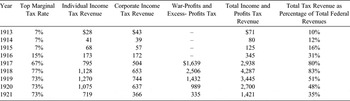
By the end of the war, however, levies on income and profits had eclipsed all other forms of taxation. Marginal individual income tax rates soared to a top figure of 77 percent, the percentage of the labor force filing income taxes climbed to nearly 17 percent, and monies generated by income and profits taxes accounted for roughly half of all federal revenues in fiscal year 1919 (see Table 1). Although exemption levels decreased substantially, the wartime tax system had a distinctive “soak-the-rich” characteristic. In fact, the effective tax rate of the nation's wealthiest 1 percent of households soared from roughly 3 percent in 1916 to 15 percent within two years.Footnote 21
Maximum Marginal Tax Rates and Tax Revenues By Source, Fiscal Years 1913–1921 (nominal dollar amounts in millions).

Sources: Historical Statistics of the United States; Annual Reports of the Treasury Department, 1914–1921; Roy G. Blakey and Gladys C. Blakey, The Federal Income Tax (New York: Longmans, Green, 1940), 512, Table 20.
Taxes were not the only source of funding for the robust wartime state—government borrowing and the use of newly created monetary powers were also critical. Government bonds, artfully dubbed “Liberty Loans,” provided significant revenue. As a result, total public debt as a percentage of GDP increased from 0.2 percent in 1914 to roughly 4.3 percent by 1919.Footnote 22 Lenient monetary policy also provided a convenient, if unacknowledged, source of financing. From June 1916 to June 1919, the money supply increased by over $11 billion, and consumer prices shot up nearly 66 percent. Although budget surpluses and a more stable money supply resurfaced after the war, debt financing and rampant inflation proved to be key components in the wartime mix of funding sources. In fact, economic historians have estimated that the U.S. war effort was financed with roughly 20 percent of taxes, 20 percent of money creation, and the remaining 60 percent from public borrowing. Wartime government officials, especially the Treasury lawyers, agonized over the distributional implications of these various funding sources.Footnote 23
From a historical and comparative perspective, the economic impact of U.S. war financing was mixed. On the one hand, the wartime fiscal policies provided the American Expeditionary Forces and the Allies with sufficient resources to win the war, and the World War I mix of financing sources was an improvement from the Civil War when the North resorted mainly to debt financing and the printing of new money. Yet, if one measures the economic success of wartime financing by focusing on the state's ability to extract tax revenue from a broad base of citizen/taxpayers while limiting the costs of inflation, the U.S. financing of World War I was not nearly as successful as World War II. During the latter conflict taxes constituted a significantly larger percentage of financing, and inflation was much lower mainly because of greater productivity and stable rates of savings.
Comparatively, U.S. financing of the Great War was superior to nearly all other major participants in the conflict. Only Great Britain, which followed a similar path of relying on current taxation, was able to fund roughly one-fifth of its war expenditures with taxes, though it suffered from an increasing price level that exceeded U.S. inflation. France, Russia, and Italy, by contrast, raised little from taxes and were forced to rely on tremendous amounts of public borrowing and inflation-inducing money creation, which greatly undermined their postwar credit and economies. This comparative success, in part, explains why World War I was vital to the early development of U.S. geopolitical power.Footnote 24
During the early stages of mobilization, lawmakers seemed intent on financing the war evenly with current taxes and debt financing. Even before the United States officially entered the conflict, the 1916 Revenue Act demonstrated the federal government's resolve. It provided sharply higher income tax rates, a tax on the business profits of munitions manufacturers, and a graduated federal inheritance tax. Supported by progressive groups like the American Committee on War Finance and the Association for an Equitable Federal Income Tax, the new law had broad appeal, especially since it came on the heels of the U.S. Supreme Court's validation of the 1913 income tax—a decision that emboldened lawmakers to forcefully use their new found fiscal powers.Footnote 25
As the war progressed, lawmakers sought to continue to minimize borrowing to restrain inflation and spread the war costs fairly across generations and between socioeconomic classes. In his war message to Congress in 1917, President Wilson stated, “so far as practicable the burden of the war should be borne by taxation of the present generation rather than by loans.” Treasury secretary McAdoo reiterated that “fifty percent of the war costs should be financed by” taxation, contending that “one of the most fatal mistakes that governments have made in all countries has been the failure to impose fearlessly and promptly upon the existing generation a fair burden of the cost of war.”Footnote 26 The desire to balance the war costs with an eye towards intergenerational equity illustrates how the Wilson administration was mindful of its social and ethical obligations to monitor the distributional effects of war financing. Leffingwell and his legal colleagues echoed this initial message of seeking distributional equity, especially when other Treasury department officials began to veer from this initial commitment.
Although the 1916 law solidified the taxing powers of the national government, the most radical departures—and certainly the most controversial—came after the United States officially entered the war in April 1917. Initially, McAdoo anticipated that of the $3.5 billion needed for the war new taxation could provide $1.8 billion. These optimistic projections were soon dashed, however. By the summer of 1917, war costs were expected to be closer to $15 billion, with taxation making up less than $2 billion. “With each fresh calculation,” McAdoo later disparagingly recalled, “the sum had grown larger, and the figures were appalling. There were so many uncertain factors in the problem that a definite conclusion was not possible.”Footnote 27
As Treasury confronted the mounting war costs, and U.S. troops began sailing overseas, the calls for confiscatory taxes on income, profits, and wealth became more vociferous. Demands for the “conscription of wealth” to match the conscription of men began to fill the editorial pages of the country's leading publications. While Congress debated a new tax bill, newspapers like the Los Angeles Times rhetorically queried whether the minor financial sacrifices made by the Rockefellers and the Fords could compare “with that of the man who bares his breast to the bullets or the bayonets of the foe and risks his life for his country. What are the sacrifices of capitalists compared with the sacrifices of those whom the solider leaves behind?”Footnote 28
The 1917 Revenue Act thus dramatically raised the stakes. It increased the top individual marginal tax rates to unprecedented heights, enacted several nominal excise taxes, and adopted a new controversial levy on excess profits. Whereas the earlier munitions-profits tax levied a flat 12.5 percent tax on the profits of all armament producers, the newly created excess-profits tax applied to profits “over a reasonable return on invested capital,” and affected all businesses, not just those in the munitions industry.Footnote 29
Other nations used excess-profits taxes as a funding source, but the unprecedented turn to this levy by the United States signaled the Wilson administration's desire to alter the concept and meaning of business profits, at least during the war. Profits were no longer simply the gains earned by private effort. As the language of the levy indicated, the notion of taxing “excess” profits suggested that the broader public, through the powers of the state, had a stake in the surplus of “unreasonable” or “abnormal” business earnings created by war—those windfall gains that exceeded a legitimate amount of financial profit. At a time when ordinary Americans were sacrificing life and limb, the enactment of an excess-profits tax expressed a growing indignation with war profiteering and a demand for shared sacrifice that was at the center of the Treasury department's egalitarian sense of fiscal citizenship. The new valence of profits did not escape the notice of populist leaders and progressive lawmakers who strongly supported the new levy, nor those conservatives who opposed it.Footnote 30
The 1917 law also significantly raised taxes on alcohol, tobacco, and wealth transfers, in addition to enacting a variety of excise taxes on luxury items, sporting goods, and even chewing gum and movie tickets—all in the hopes of symbolically, if not substantively, spreading the burden of wartime fiscal sacrifice. Even before the 1917 tax law was enacted, the New York lawyer Amos Pinchot boldly and presciently proclaimed: “If we ever get a big income tax on in war time, some if it—a lot of it—is going to stick.”Footnote 31
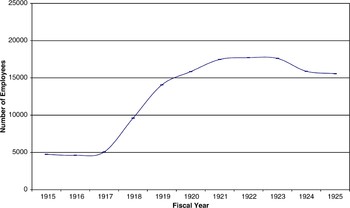
To help make this new tax stick, the Treasury department itself underwent a major reorganization. Several new assistant secretary positions were created and the number of rank-and-file personnel expanded significantly. Leffingwell occupied one of the new positions, and he and Roper helped monitor the recruitment and training of Treasury personnel. The Bureau of Internal Revenue (BIR), the unit responsible for interpreting, assessing, and collecting taxes, including the excess-profits levy, grew enormously under Roper's leadership. Between 1913 and 1920, the number of BIR personnel increased by nearly four-fold, rising from roughly 4,000 employees to nearly 16,000. Though that figure declined after the war, the new plateau remained multiples above the prewar amount, thus giving credence to the notion that the war had a ratchet effect on the BIR's administrative capacity (see Fig. 1).Footnote 32
Growth of Bureau of Internal Revenue, 1915–1925. Source: Blakey and Blakey, Federal Income Tax, 540, Table 32; Annual Reports of the Treasury Department, 1914–1926.

Treasury department spending during and after the war mirrored the increase in employment. Not only did the department's overall budget, in real terms (constant 1913 dollars), more than double, increasing from $86 million in 1915 to $187 million by 1919, such spending remained relatively consistent after the war. During the same period, the BIR's specific budget (in real terms) increased at an even greater pace, with spending rising from just under $7 million to over $19 million, nearly a three-fold increase. These figures illustrate the financial commitments to administrative power required by the war.Footnote 33
In sum, World War I triggered a sea change in the historical development of a powerful U.S. nation-state. Unparalleled interconnections among economy, society, and polity were undergirded by fundamental transformations in public finance and federal bureaucratic capacity. After the war, the steeply progressive tax rates were scaled back, just as tariff revenues increased in response to the revival of international trade. But the national tax system did not return to either its prewar levels or even its prewar trajectory—the war was thus the pivot upon which the early twentieth-century fiscal revolution turned. Nonetheless, these profound changes were not inexorable or predetermined. The years surrounding the war were a highly charged period of contestation and contingency regarding state authority. Not only did the possibility of U.S. participation in the war divide the nation, once the United States became directly involved, the exigencies and pragmatic demands of the conflict frequently overwhelmed the initial desires and intentions of lawmakers and administrative bureaucrats like the Treasury lawyers.
The Treasury Lawyers
It was amid the dramatic wartime changes in state power that the Treasury lawyers made their mark. McAdoo, who himself had been a practicing lawyer before turning to other pursuits, filled key Treasury posts with leading members of the bar, often ones he knew personally. Roper and Love, for example, were longtime southern Democrats. A former South Carolina lawyer and state legislator, Roper had been a staff member at numerous government commissions and agencies, and he was among the first group of modern state officials to assemble the revolving door between the public and private sector.Footnote 34 Love, a former Texas legislator and insurance lawyer, was appointed to his Treasury post mainly because of his role as the head of Wilson's Texas reelection campaign. Throughout his career, including during his tenure in Treasury, Love seemed more interested in the partisanship of Democratic politics than the intricacies of insurance law or government service.Footnote 35
If Roper and Love revealed the southern Democratic roots of the Wilson administration, Leffingwell and Ballantine were the epitome of Yankee aristocracy. Leffingwell was undoubtedly the central node in this network of government attorneys. A graduate of Yale College and Columbia Law School, and a former partner in the prestigious New York firm of Cravath & Henderson, he was the de facto undersecretary of the Treasury during most of the war.Footnote 36 As a legal adviser for many of New York's leading banks, Leffingwell had supervised numerous complex corporate reorganizations before the war, and he had navigated the issuance of some of the most challenging corporate and municipal securities offerings.Footnote 37 Paul Cravath, his senior law partner, referred to Leffingwell as “one of the best lawyers at our Bar, with no superior as a contract lawyer.”Footnote 38
Like Leffingwell, Ballantine emerged from the ranks of the northeastern legal elite. Educated at Harvard College and Law School, he became a leading Boston corporate lawyer, specializing in bankruptcy reorganizations and corporate finance. At the start of the war, he was a temporary consultant on the BIR's “committee of lawyers,” but he soon became solicitor of Internal Revenue, the Bureau's chief lawyer, where he played a central role in organizing the tax collection process and defending the constitutionality of the excess-profits tax.Footnote 39
These Treasury lawyers generally entered government service in predictable ways. While Love and Roper, as longtime Wilson supporters, were rewarded with their high-level positions because of years of loyal service to the party, Leffingwell and Ballantine were appointed because of their practical expertise and experience. Despite their similar backgrounds, Leffingwell and Ballantine became “dollar-a-year” men through different means. The Leffingwell family had social ties to the McAdoos, but it was Paul Cravath who brought Leffingwell to McAdoo's attention.Footnote 40 By contrast, Ballantine entered the wartime corporatist state through a more conventional route. He likely came to the attention of administration officials because of his progressive stance on the use of insurance, rather than traditional tort suits, to compensate victims of railway injuries.Footnote 41
Leffingwell and his colleagues wielded significant private and public power at a time when the U.S. legal profession itself was undergoing dramatic change. The Great War began during the tail end of the transition from what the legal historian Robert W. Gordon has dubbed “liberal legal science” to “progressive legal science.” By the start of the war, elite lawyers were less concerned about policing the boundaries between public and private power than they were about using their professional contacts and technical expertise to develop efficient solutions to social conflicts. As the elite practice of law expanded beyond common-law courts and into the boardrooms and corridors of large corporations, lawyers became more than just zealous trial advocates of their clients' interests; they also became pivotal mediators and negotiators seeking to broker big deals and execute complex transactions that affected a variety of interests.Footnote 42
The structure of law firms at this time was also undergoing an organizational transformation. Since the turn of the century, leading lawyers had been assisting large industrial clients in vertically integrating their businesses and consolidating their hold over particular industries, just as lawyers themselves hastened their professional project of controlling the market for legal services.Footnote 43 As part of the corporate reconstruction of U.S. capitalism, law firms abandoned the model of small general partnerships independent of their clients' hierarchical management. They embraced, instead, the model of a large, multispecialist law office pioneered by the New York Cravath firm. Only such large, compartmentalized firms could service the enormous and complex bankruptcy reorganizations, corporate mergers and acquisitions, and securities issuances that became critical components in the broader structural transformation of the U.S. economy.Footnote 44
The Treasury lawyers embodied the new vision of the highly skilled transactional attorney as essential intermediary. In this sense, this history of the World War I Treasury lawyers is less a story about the power and personalities of individual policymakers—though their personalities undoubtedly played a part in shaping their decisions and actions—than it is a tale about how a group of early twentieth-century U.S. lawyers and their particular professional perspective shaped the emerging institutional contours of a new fiscal order; how their networks, skills, and experience, in other words, reflected a historically specific professional mind-set about the broad role of lawyers in building a modern, liberal polity. As Leffingwell observed toward the end of his career, the main role of his generation of lawyers was not to be merely a specialist in any one area of legal practice, but to be, as he put it, the “doctor who knew when to call in the specialist.”Footnote 45
In their role as legal doctors to the Treasury Department, Leffingwell and his colleagues deployed a type of general analysis and problem-solving ability to provide systematic, forward-looking, long-term solutions. They used a broad and holistic perspective to build the department's organizational capacity, to formulate fiscal policy options, to search for alternative sources of revenue, and to evaluate the distributional impact of the new tax laws and policies. To accomplish these tasks, these legal professionals understood that they needed to create a core institutional culture committed to gaining the public trust. Given the department's historical lack of administrative capacity and inability to build public faith in its earlier use of monetary policy, World War I tax policy afforded the department a new opportunity to gain the confidence and support of the populace.Footnote 46
The Treasury lawyers seized this opportunity. They used the skills of cooperation and negotiation, developed as part of their prewar transactional practices, in their government service. As Roper recounted in his memoirs, his main goal in running the BIR was to cultivate a collaborative relationship between the BIR and taxpayers. “With the Government in partnership with business, it was increasingly important that the partners co-operate for their common good and not antagonize each other,” he recalled. The exigencies of the war emergency, of course, forced U.S. citizens to relax, at least temporarily, their long-held skepticism of centralized power, thus limiting antagonisms. But Roper and his colleagues were well aware that they could not squander the tolerance afforded by the crisis. Winning the war and making the world safe for democracy meant creating confidence and legitimacy in the fairness and effectiveness of wartime fiscal policies.Footnote 47
Recruiting, Training, and a Common Commitment to Building Public Trust
For the Treasury lawyers, one way to build public trust was by recruiting and hiring like-minded colleagues who embraced the department's core mission of cooperating with citizens and taxpayers in raising revenue. Developing a homogeneous cadre of officials and staff was a challenge, especially given the initial social divisions over the war, Treasury's growing size, and the allure of a prosperous wartime economy. Nonetheless, administrators like Leffingwell and Roper tapped their social and professional contacts to hire assistants who shared their vision of—and their professional biases toward—corporatist state building. Leffingwell naturally turned to the Cravath firm. He not only recruited several of his key lieutenants from the firm, including Hugh Satterlee and S. Parker Gilbert, a well-regarded corporate attorney who succeeded Leffingwell as undersecretary, but he also “turned the tables” on Paul Cravath, volunteering the services of his senior partner to assist the U.S. representatives to the Inter-Allied Conference in Europe.Footnote 48
Likewise, Roper assembled his “cabinet” of assistants by hiring friends and associates from his days in the Post Office Department, the Tariff Commission, and the Ways and Means Committee. With his experience shuttling between government and private service, Roper also anticipated the future benefits that could inure to those who were willing to help usher in a new fiscal order. As the leading tax lawyers E. Barrett Prettyman Sr. and Albert L. Hopkins later recalled, Roper recruited young, struggling attorneys, and some of Washington's first “lady lawyers,” with appeals to patriotism and remarks about how “this tax business is likely to develop into quite a thing for lawyers.”Footnote 49
With their vast professional and social network reaching the worlds of law, banking, insurance, and accounting, the lawyers-turned-administrators quickly became pivotal intermediaries between the burgeoning fiscal state and the business community. Indeed, because they were central nodes in an elite network, the lawyers could consult with a variety of interests and recruit like-minded legal professionals, with similar contacts and commitments to building public trust. Other professionals within the Treasury Department may have been able to staff and train officials, but only lawyers could reach out to those who had experience interacting with, and building confidence among, a variety of financial and regulatory actors. Leffingwell regularly consulted former colleagues and clients to test ideas about fiscal policy, to gauge private perceptions of government actions, and to develop a dialogue about the ongoing relationship among taxpayers, bond investors, and the Treasury Department. Some of these contacts, in turn, did not hesitate in soliciting Leffingwell's influence in their own personal tax matters with the BIR.Footnote 50
Meanwhile, Roper developed his own cooperative methods. At the start of the war, he created several advisory boards and a “committee of attorneys,” which initially included Ballantine, to “review from time to time the decisions of the legal forces of the Bureau” and to “arouse a public consciousness of the partnership relation” formed by the new wartime tax laws. This “public consciousness” was necessary, Roper concluded, “if we were to achieve cooperation between the Government and the taxpayers in administering the law with justice and equity.”Footnote 51
Professional loyalty, the promise of future riches, and patriotic appeals helped the Treasury lawyers recruit close confidants, but the staffing of clerical personnel posed other challenges. Although the total number of personnel hired by the Treasury Department increased sharply throughout the war, conscription and increasing private-sector demands reduced the pool of available staff members and tarnished the image of government work. Maintaining the continuity of personnel and bolstering staff morale were critical for public confidence. When there was talk in the summer of 1918 that the draft age would be lowered, Leffingwell feared that the department's personnel would be decimated. Revealing perhaps his own anxieties about the decision not to enlist in the military, Leffingwell warned McAdoo that “the efficiency of this Department and the Liberty Loan organization is in danger of being undermined as a result of the proposed extension of the draft age.” Since Leffingwell himself “was on the way to being a soldier when [McAdoo] drafted him into the Treasury,” he could empathize with those staffers who longed for more active participation in the war. “These men would gladly enough be fighting instead of figuring,” wrote Leffingwell. “We are only keeping them on their present jobs because they feel they are doing the work they are best fitted for to help win the war.”Footnote 52
Roper went further in using patriotism to link figuring and fighting. “While our soldiers and sailors pay the full price,” he told his BIR field agents, “you will be giving your vigilant, unselfish and indefatigable service with quick understanding and keen enthusiasm to keeping open the life stream of revenue that finances the nation in both peace and war. And let no man lack the knowledge of just how the paying of his tax is a part of the winning of the war.”Footnote 53
As the war progressed, the training of new department hires became increasingly important to the mission of building a coherent and cohesive institutional culture. To be sure, the Treasury lawyers underwent their own learning by fire. Roper and Ballantine struggled to create a rational collection process that could make sense of the new profits taxes. Love, working closely with Leffingwell, learned firsthand about the exacting demands of the “Cravath system,” as he became the junior partner in Leffingwell's own public finance practice, frequently enduring the stern rebukes of his professional superior.Footnote 54
But developing the core commitment of building public trust also meant retaining and inculcating a group of highly trained staffers. No sooner had new assistants and clerks been hired and trained, than the private sector frequently lured many away. “The complex character” of the new tax laws, Roper explained, unexpectedly led to a “drain upon our best men,” with businesses “continually skimming the cream of our trained men from our organization” in order to comply with the new laws and regulations. “As man after man left to accept financial beguilement, the condition gave cause for alarm.” In response to this “exodus of trained personnel,” Roper, ever the pragmatic institutional entrepreneur, consulted with his “Little Cabinet” to develop a “training school” for BIR personnel on the fundamentals of tax law and accounting. Homer S. Pace, a well-known New York accountant, became the night school's supervisor, and the heads of the different BIR divisions became his “professors.”Footnote 55
The recruitment, retention, and training of highly skilled professionals appeared to pay dividends. Some wealthy individuals and businesses protested the reach of the new tax laws, but these complaints were often muffled by the patriotic pressures of the war and by the Treasury department's image of effective and fair administration. Roper, for instance, nostalgically, and perhaps exaggeratedly, recounted how the BIR's advisory groups and committees had convinced disgruntled taxpayers of the accuracy and effectiveness of the tax assessment process. The focus on building public trust flowed throughout the Treasury. “The problem of statesmanship,” McAdoo once explained, “is to establish a just relation between necessary taxation and the earning power of the Nation.”Footnote 56 Leffingwell admired how McAdoo had “managed to make himself an advocate of huge taxes without antagonizing” citizens, and how he had “on the contrary gained the confidence of the taxpayers,” especially business interests. McAdoo accomplished all this, Leffingwell concluded, because the Treasury Department was careful to distance itself “from the ignorant or malicious corporation-baiting” that other federal agencies “habitually practiced.”Footnote 57
Administrative Capacity and the Image of a Rational Executive Agency
Developing a cooperative, corporatist relationship between state and society was crucial to the Treasury Department's institutional mission of building public trust. So too was the creation of administrative capacity. If “figuring” rather than “fighting” was what Treasury personnel could do to help win the war, the lawyers wanted to make sure that the department had all the administrative power that it needed. Treasury therefore, first, needed to establish and guard its jurisdictional prerogatives, especially since war mobilization created numerous government organizations that frequently blurred the institutional lines of control. In the process, the department needed to project the image, if not the reality, of an agency that was imposing rationality onto the uncertainty of war financing.
To do this, Treasury lawyers used their professional contacts and legal skills to protect the scope of their administrative powers. They defended their authority over fiscal policy by rebuking other, often newly created, federal entities such as the Capital Issues Committee (CIC)—the organization created as part of the War Finance Corporation (WFC) to filter and supervise the flow of capital to private businesses. When the CIC attempted to regulate bank loans, Treasury lawyers relied on their skills of statutory interpretation to quash what they saw as an encroachment onto their powers. “I think it would be bad organization and contrary to the spirit, if not the letter of the Act under which the Capital Issues Committee was formed, for it to interfere in any way with bank loans,” Leffingwell notified McAdoo.Footnote 58 Similarly, when some states attempted creatively to tax the interest on federal government securities—contrary to the law—the Treasury department unleashed its powers and those of the Justice Department and the Federal Reserve System to remind state tax officials to adhere to the details of federal law. Treasury's legal staff also drafted legislation, coaxed lawmakers, and considered new rules that would contain the autonomous powers of state governments within the structures of U.S. federalism. In curbing the powers of other war agencies and state governments, Treasury consolidated its own powers by clearly delimiting the authority of competing organizations.Footnote 59
The different bureaus within the Treasury themselves frequently clashed over the exercise of administrative power, particularly when it came to communicating with the taxpaying public. A correspondence between Ballantine and Leffingwell revealed concerns over who had proper jurisdiction to issue Treasury regulations related to tax collection. Leffingwell contended that it was Treasury secretary McAdoo and not his subordinate, the Commissioner of Internal Revenue Roper, who was ultimately responsible for accepting Treasury certificates as payment for income and profits taxes. He sternly informed Ballantine that “the public debt and public monies are matters which do not concern the Commissioner; and investors . . . will be reassured by reading that the regulations are to be prescribed by the same authority which issues them.” In his typically self-assured style, Leffingwell even provided Ballantine with detailed legislative language illustrating his point.Footnote 60
Maintaining jurisdictional control was not only an issue of power, however. It was also a matter of establishing the perceived legal transparency, stability, and predictability that were critical to broadcasting the impression of an organized and coherent executive agency. At times, this meant that the Treasury lawyers were willing to use their legal and financial expertise to help taxpayers execute unique and complex commercial transactions, such as when Henry Ford bought out the minority shareholders of the Ford Motor Company in 1919. This transaction, as Roper later recalled, proved to be “an exceptional opportunity” for the BIR to provide the tax guidance that effectuated the buyouts, yielded substantial tax revenue, and garnered the trust of the business community.Footnote 61
Besides such special cases, the Treasury lawyers understood that to impose rationality onto the uncertainty of war financing they needed to control the flow of public information. Information, as the lawyers knew, was vital to the effective functioning of capital markets and the overall revenue-raising process. In reality, controlling information to project a judicious image was frequently less about increased transparency than it was about carefully cultivating public perceptions. To this end, Leffingwell kept an incredibly tight personal grip over public access to government information. He was quick to admonish his bureau chiefs for press leaks. He often edited the official press releases issued by the department. And he regularly read the New York and Washington papers to review how they were covering war financing, and to gauge how editors were responding to new policies.Footnote 62
The Treasury lawyers also shaped public perceptions in other ways. Thomas Love, at McAdoo's behest, tapped his Texas contacts and used his skills as a political operative to campaign for Liberty Loans. Roper, as we have seen, used the BIR's advisory boards and ad hoc committees to convince taxpayers of the effectiveness and fairness of tax assessments. In a rare moment of self-congratulation, even Leffingwell acknowledged how Treasury's proficient administration of war financing had enhanced public confidence in the department. After learning, in the fall of 1918, that the press and investors had favorably received the fourth and largest Liberty Loan distribution, he wrote to McAdoo that we “have undertaken stupendous tasks and imposed heavy burdens but heretofore without arousing antagonism or controversy. Now more than ever we need to make the people feel that the great machine is running smoothly.”Footnote 63
In some ways, controlling the flow of public information did not appear to be a task that required the skills of professional corporate lawyers. After all, George Creel's Committee on Public Information was already carefully managing U.S. public opinion, often with propaganda evoking chilling and dangerous images of foreign invaders.Footnote 64 But unlike the Americanization campaigns and loyalty drives that emerged from public relations professionals, the complex financing information generated and controlled by the Treasury had a particular meaning and resonance among the elite network of investors, wealthy taxpayers, business leaders, financial advisers, and lawyers with whom Leffingwell and his colleagues had regular contact. Thus, even when it came to directing public information, the lawyers provided a distinctive contribution to the wartime state-building project.
If maintaining jurisdictional powers and controlling public information were indispensable to developing Treasury's claims of professional proficiency, managing revenue collections and coordinating them with the timing of debt payments stretched the limits of such organizational capacity. The extent of the department's capacities was tested in spring 1918 when the Treasury Department contemplated allowing taxpayers to defer the payment of their federal income and profits taxes. Initially, the Treasury lawyers acquiesced to the plan, but upon further reflection they agreed that any deferment past the June 15, 1918 deadline for paying the income and profits taxes would upset the delicate timing of certificate and loan payments. As early as December 1917, Leffingwell warned McAdoo that “we could not safely” issue a new series of certificates “if deferred payments of taxes were permitted.”Footnote 65
Although the Treasury Department opposed the idea of deferment, it also realized that forcing taxpayers to pay all their income and profits taxes at once could cause a dramatic shock to the economy. Bankers feared that tax payments by their large corporate clients could trigger a panic run on their reserves at a time when other clients would need to borrow to pay their taxes; hence many in the business and financial communities urged lawmakers to allow for deferred installment payments of federal taxes. The Treasury lawyers carefully monitored revenue estimates, as they considered alternatives to tax deferment.Footnote 66
Treasury proposed several recommendations. In a widely circulated letter to lawmakers, bankers, and leading members of the business community, Leffingwell synthesized the work of his legal staff to illustrate how existing laws and department decisions provided several possible solutions, including the opportunity for “the partial payment, in advance, of income and profits taxes,” and the use of short-term certificates in lieu of cash to pay taxes. The recently enacted Liberty Bond Act, Leffingwell reminded his readers, also permitted the Treasury to deposit the proceeds of tax payments into U.S. banks, thereby mitigating any potential short-term turnover in bank deposits. The law, moreover, provided an appropriately timed coupon payment that would help taxpayers meet their tax liabilities. With these and other safeguards in place, Leffingwell confidently persuaded McAdoo and other officials that there was no need to concede to the demands for tax deferment.Footnote 67
As the June tax deadline approached, Leffingwell and Love anxiously monitored the increasing news coverage of expected tax payments.Footnote 68 In the end, the federal government collected nearly $2.8 billion in profits and income taxes by the deadline, and an additional $855 million in other internal revenues.Footnote 69 More important, the BIR was able to perform the collection process without any difficulties to money markets or the economy as a whole. “The tax payments were made without a ruffle,” one banker explained with surprise. “The immense financial transaction was consummated almost without being noticed. The transaction was put through with perfect balance and without the least disturbance to business or banking.” McAdoo sent along his personal congratulations to Leffingwell for guiding the successful collection process.Footnote 70
In administering wartime tax laws and policies, Treasury developed the bureaucratic capacity that undergirded the legal legitimacy of the wartime fiscal state. Even though at times they may have limited the transparency of their actions, Leffingwell and his colleagues attempted to build public trust by projecting the image of a rational executive agency. Gaining and maintaining the faith of taxpayers and citizens was only one of the early and ongoing challenges. When it came to formulating the broad principles of fiscal policy, Treasury officials faced an equally daunting task of assuring the public that the costs and sacrifices of underwriting a global conflict were being shared equitably.
Formulating Policy and the State Obligations of Fiscal Citizenship
Among the principal policy issues confronting Treasury officials, none was more salient than analyzing the war financing options. Although nearly everyone agreed that a balance between taxes and public borrowing was necessary, economic experts, social commentators, and lawmakers vastly disagreed on the appropriate mix. Underpinning these policy debates was the fundamental issue of how one defined the relationship between patriotism, wartime sacrifice, and fiscal citizenship. What rights and obligations, in other words, did citizens and the state have toward each other during a war emergency?
For many social critics and policymakers, the answer was obvious. Fiscal citizenship meant that members of the political community—as taxpayers, creditors, and consumers—had a moral and patriotic duty to make the necessary wartime sacrifices to support the state. “A new sense of the obligations of citizenship will transform the spirit of the nation,” the progressive journalist Fredrick Lewis Allen predicted at the start of the war. Progressive tax reformers had for decades been promoting direct and graduated taxation as a way to forge a new ethos of social solidarity and civic obligation. Graduated taxes were based on the notion that each citizen owed a debt to society in proportion to his or her ability to pay. By weaving direct and graduated taxes into the fabric of U.S. legal institutions and culture, the Great War became a historic moment to further the progressive commitment to shared social responsibility.Footnote 71
Throughout the conflict, many political leaders emphasized the need to use tax policy to spread wartime sacrifices evenly across class and region. On the eve of the war, Claude Kitchin (D-NC), the House majority leader and powerful chair of the Ways and Means Committee, did not hide his sectional bias. When wealthy New York citizens, he wrote “are thoroughly convinced that the income tax will have to pay for the increase in the army and navy, they will not be one-half so frightened over the future invasion of Germany and preparedness will not be so popular with them as it now is.” Others went further in criticizing the moneyed classes. “The stock brokers would not, of course, go to war, because the very object they have in bringing on war is profit,” declared the progressive Sen. George W. Norris (R-NE). “They will be concealing in their palatial offices on Wall Street, sitting behind mahogany desks, covered with clipped coupons—coupons soiled with the sweat of mothers' tears, coupons dyed in the lifeblood of their fellow man.”Footnote 72
Several of the Treasury lawyers agreed that the national crisis and nascent federal taxing powers provided a unique opportunity to promote a new type of civic identity. Roper frequently instructed his BIR staff to emphasize appeals to patriotism. He also enlisted the influence of the American clergy and the publicity powers of popular and business periodicals to spread the word about “The Glory of Paying the Income Tax.” And when opportunistic individuals sought to profit from turning in tax evaders, Roper personally rebuked such attempts at personal gain with nationalistic zeal. “Certainly no good citizen,” he instructed one potential informant, “would think of profiting on the understated taxes of his neighbors—people unfamiliar with the intricacies of this complicated tax law, not if he were a good citizen and had the right attitude toward his own people—and the right attitude toward defending his country in this war.”Footnote 73
In the process of formulating broad fiscal policy, however, Treasury lawyers stretched the meaning of fiscal citizenship beyond the conventional, singular focus on the obligations and duties of citizens. Like the earlier tax theorists and political activists who supported progressive taxation, the wartime Treasury lawyers believed that fiscal citizenship meant that the state had a reciprocal social obligation and democratic responsibility to its citizens, a duty not only to protect them during war but to ensure that the obligations of wartime fiscal sacrifice were equitably distributed among community members. In this way, fiscal citizenship was not solely a unidirectional force, requiring the allegiance only of individual citizens to the activist state. Fiscal citizenship, instead, entailed a set of mutual egalitarian responsibilities on state actors to spread more evenly the costs and sacrifices of underwriting a modern global war. Because the new tax laws had made the “government a partner with business,” as Roper had explained, the scale and scope of the new fiscal policies made it “increasingly important that the partners co-operate for their common good.”Footnote 74
The dynamics of patriotism, wartime sacrifice, and fiscal citizenship were perhaps best expressed in the policy debates over the proper mix of wartime funding sources. On one side, there was a fragile congressional coalition led by populist and progressive lawmakers like Kitchin and Robert M. La Follette Sr. (R-WI) who wanted to use the newly created taxing powers and the war emergency to redistribute wealth in a more equitable manner. Aligned against this coalition was a business community that favored consumption taxes and a more general use of income taxes aimed at all classes of society. Led by members of the northeastern commercial elite, this group was cognizant of the regional ramifications of shifting from a system of indirect consumption taxes to a regime of direct and graduated levies.Footnote 75 The business community, of course, did not speak with one voice. Many companies understood that the war required economic sacrifice, and more than a few firms did their part to hold the line on prices and profits as part of their patriotic service. But when it came to taxes, especially the new profits levies, U.S. companies used a variety of maneuvers to ensure that wartime profits were not always returned to the Treasury.Footnote 76
If the disagreements between southern and western populists and northeastern business elites echoed the tensions of the past, professional economic experts did little to placate such opposition. Economists, in fact, were equally divided over the issue of war financing. Some, like O. M. W. Sprague of Harvard and Irving Fisher of Yale, favored a “pay-as-you-go” method, using progressive income taxes and widespread consumption taxes to curb inflation and finance the war.Footnote 77 Other leading experts such as Edwin R. A. Seligman of Columbia and Charles J. Bullock of Harvard feared that a resort to excessive taxation would blunt the incentives for economic productivity. Although the latter group conceded that taxes ought to be an important part of war financing, they contended that increased borrowing would soon become necessary, especially if the conflict became protracted.Footnote 78 In their role as moderators, Treasury lawyers had to confront the controversy among the economic experts and between populist politicians and the conservative business community.
In doing so, Leffingwell and his colleagues underscored how fiscal citizenship entailed a reciprocal social and democratic obligation on the state to distribute fairly the burdens of wartime sacrifices. As policymakers were considering a third round of Liberty Loans in the spring and summer of 1918, Leffingwell the “Wall Street Republican” argued for the importance of taxation. “The sound rule to stick to,” Leffingwell reminded McAdoo, “is that taxes should be as heavy as they can safely be levied.”Footnote 79 Although McAdoo had initially agreed, he soon became enamored with the ease of issuing low-interest, tax-favored government debt.Footnote 80 In his attempt to capitalize patriotism, McAdoo embarked on a nationwide speaking tour and enlisted the services of several of his Treasury lawyers, including Thomas Love, and some of the country's leading artists and celebrities to publicize the sale of government bonds.Footnote 81
Leffingwell agreed that “there is no substitute for the appeal to patriotism,” but he held a broader understanding of patriotism, sacrifice, and fiscal citizenship. Patriotism for McAdoo meant that the state could rely on the obligations and responsibilities of its citizens to participate directly in funding the war through loans and taxes. For Leffingwell and his legal colleagues, an unreflective resort to more borrowing without a greater reliance on taxation was an abdication of the state's civic responsibility to its citizens. To be sure, the Treasury lawyers did not agree with Sprague and the political activists who wanted to rely mainly on taxes; nor did they agree with those who were issuing dire warnings about excessive taxation.
Rather, as arbiters of social forces, the lawyers sought to pave a more moderate path. Leffingwell reminded McAdoo that reliance on a variety of taxes could raise revenue, curtail consumption, and equitably spread the costs of the war. With their experiences in the capital markets, the lawyers understood that the trade-off between taxes and bonds was fundamentally about timing—whether current or future taxpayers were responsible for the war costs. A war financing policy that “forced people to take bonds” was, in Leffingwell's estimation, a double penalty against future taxpayers who would have to contend with paying back the war loans and financing the postwar recovery. A resort to more borrowing posed other problems as well. Flooding the credit market with government loans was, Leffingwell assured McAdoo, a sure step towards financial ruin—it “simply means an enormous amount of undigested securities choking the market, depreciation in bond prices and ruin to the credit of the United States and inflation of the currency.” As the war progressed, Leffingwell seemed to forget the significance of his comments, but his remarks concerning inflation would prove to be quite prophetic.Footnote 82
Besides analyzing the mix of financing options, the Treasury lawyers also used their networks, skills, and experience in other more mundane, though equally important, policymaking functions. Leffingwell and his legal staff drew on their specific legal and business knowledge to channel Treasury efforts in particular directions and to act as gatekeepers on the use of state power. When McAdoo, for instance, wanted to explore the “federal taxation of real estate,” it was the Treasury lawyers working with the attorney general's office who reminded the secretary that a national property tax required “a Constitutional amendment to permit the United States to levy direct taxes without apportionment.”Footnote 83
In monitoring state power, however, Treasury lawyers did not act only as constraints. Just as all good gatekeepers are aware of alternative routes, Treasury lawyers often used their technical knowledge, access, and expertise to navigate around legal challenges to policy proposals. In the fall of 1918, with German troops in retreat, the Wilson administration was contemplating the creation of a War Trade Export Corporation, another wartime corporatist entity that could be used specifically to tax exports. Leffingwell and his legal staff not only reminded McAdoo that such a levy was also “prohibited by express provision of the Constitution,” they went on to make a plausible alternative recommendation.Footnote 84
The recommendation illustrated how the Treasury lawyers used their professional network and legal skills to craft long-run, forward-looking, corporatist solutions. After consulting with members of the War Trade Board—the existing agency supervising all import and export activity—and his former Cravath partner, E. C. Henderson, whom Leffingwell described as “the best lawyer I know, bar none,” Leffingwell suggested that the administration forsake the short-term—and constitutionally futile—aim of trying to tax exports and focus instead on how the government could use the waning months of the war to establish the country's postwar trade position and long-term geopolitical power. To that end, he suggested that a new corporatist agency be established along the lines of the War Industries Board to organize and license exporters. This plan, Leffingwell continued, “would have the great advantage . . . of tending to bring the export houses in a position where they would be able after the war to develop our foreign trade, instead of practically putting them out of business during the period of the war and leaving them disorganized and disheartened to deal with after-the-war problems.” To assuage the administration's desire to tax the growing profits of exporters, Leffingwell assured McAdoo that the robust wartime profits tax “can be trusted to take into the Treasury excessive profits which may result from the adoption of this plan.”Footnote 85 The imminent end of the war less than a month later precluded McAdoo from pursuing an export tax or creating a new export licensing agency, but the suggestion vividly illustrated how Treasury lawyers had become attracted to the corporatist model of state-building.
The search for new sources of tax revenues and the appeals to patriotism and fiscal citizenship were examples of how the Treasury department attempted to spread the costs of the war across a broad swath of socioeconomic classes, regions, and even generations. But, ultimately, the war financing policies had complex and often contradictory consequences. McAdoo seemed to be aware of how the interest rate on bonds could have far reaching implications. In deliberately setting an initially low rate of interest, McAdoo contended that “we should be reducing the cost of war, not only today for ourselves, but, in the future for ourselves and for our brave men who are fighting in France and will have little or no opportunity to accumulate and invest in Liberty Bonds though they must upon their return join the army of taxpayers who must pay this interest.”Footnote 86
McAdoo's rhetoric about helping the quotidian “army of taxpayers” did not match his actions, or wartime reality. The so-called army of ordinary taxpayers was rather slim. Though the sundry consumption taxes affected a broad swath of citizens, and generated some colorful protests, the vast bulk of federal tax revenue came from the income and profits taxes on wealthy individuals and prosperous businesses. Preoccupied with assuaging the social concerns over war profiteering, policymakers seemed to give little consideration to taxing the mass of middle-class wage earners—an option that would be effectively exercised in World War II.Footnote 87
The initially low, tax-exempt interest rates set on government debt, furthermore, did not extract the type of wartime financial sacrifice that the Treasury department claimed. The tax exemption disproportionately benefited wealthy individuals not only because they were the primary investors in the largest bond offerings but also because they were the ones subject to the highest progressive marginal rates.Footnote 88 Though the consistent oversubscription of Liberty Loans was a clear political victory, the bonds did not have the economic impact that Treasury envisioned. With their knowledge of the interactions of taxes and market forces, the Treasury lawyers were undoubtedly aware of these contradictory actions, but they seemed ineffective in altering policy.Footnote 89
Another way in which financing policies undermined economic goals was the inadvertent increase in the price level. In its zeal to issue debt, Treasury fostered a “borrow and buy” mentality among bond investors that, rather than redirecting moneys away from current consumption, in fact, created new money and fueled inflation. In theory, bond sales to the nonbanking public could restrain inflation by absorbing consumer spending, while transferring real economic resources from private consumption to war production. But because the Treasury department encouraged individual investors to use borrowed funds to purchase government debt, and because much of the below-market, short-term debt issued by the Treasury was bought directly by banks, the massive wartime borrowing, in the end, fueled rather than contained inflation.Footnote 90
Changes to the nascent Federal Reserve System exacerbated inflationary pressures. Legal modifications to reserve requirements, the centralization of reserves in district banks, and the expansion of banks eligible to be federal depositories were just some of the subtle changes to monetary policy that led to an incredibly elastic money supply. Indeed, the combination of increased bank borrowing and permissive monetary policies led to an explosive growth in the money supply and a concomitant mushrooming of the price level.Footnote 91 Although he claimed to have learned from the errors of the past, McAdoo's resort to easy money, in the end, had a striking resemblance to the Civil War printing of greenbacks.
The Treasury lawyers unwittingly contributed to the increased bank borrowing and the resulting inflation. From his perch as undersecretary, Leffingwell endorsed McAdoo's contradictory ideas and actions. Despite his earlier warnings about the adverse impact of excessive borrowing, Leffingwell seemed to suspend his financial judgment. Not only did Leffingwell encourage financial institutions, including Federal Reserve member banks, to accept U.S. bonds as collateral for loansFootnote 92; he also supported McAdoo's attempts to use moral suasion and appeals to patriotism, rather than legal restrictions, to prevent investors from selling their bonds for further spending. Leffingwell believed, like McAdoo, that a liberal democracy, even during wartime—perhaps especially during wartime—could not restrict the economic decisions of its citizens by prohibiting them from selling their financial assets. “It is of course important to avoid making people think that if they subscribe they will not be permitted to sell,” Leffingwell remarked in an April 1918 telegram to McAdoo. “We realize that subscribers might have to sell their bonds and should be protected as far as possible against losses.”Footnote 93
Like McAdoo, Leffingwell preferred to contain inflation with appeals to patriotism and the fiscal responsibilities of investors, rather than more forceful actions. “It should be the object of the Secretary of the Treasury, and of all public men,” Leffingwell sternly informed lawmakers, “not to encourage people to lend their money to the Government one day and to take it back the next, nor to make it easy for them to do so, but to teach the people to save and lend their money to the Government for a period of years. Liberty loans are an investment—the best on earth. They are not currency and are not meant to be.”Footnote 94 Leffingwell went even further in relying on civic virtue to restrain private spending. He reminded the secretary with words from McAdoo's own annual report that wealthy Americans had additional wartime financial and civic responsibilities: “The men and women of large and moderate means owe a greater duty, because they have a larger margin of income, to cut off self-indulgences, to deny themselves useless and needless luxuries, to make sacrifices of comforts, pleasures, and conveniences that will effect genuine economies and set an example to the Nation.”Footnote 95
The fiscal sacrifices of citizens at home were inextricably linked to the physical sacrifices made by soldiers at the frontlines. As Leffingwell reminded McAdoo, quoting again from the secretary's annual report: “It is a sacred duty of every citizen and it should be regarded as a glorious privilege of every patriot to uphold the Government's credit with the same kind of self sacrifice and nobility of soul that our gallant sons exhibit when they die for us on the battle fields of Europe. It is as imperative to sustain the Government's credit as it is to sustain our armies because our armies cannot be sustained unless the Government's credit is always above reproach.”Footnote 96 Not all citizens, of course, embraced this “sacred duty” or “glorious privilege,” and some lawmakers may have viewed Treasury's words as hollow rhetoric. But Leffingwell and McAdoo certainly believed they could mobilize patriotism to their advantage, even though their actions were, in the end, obfuscating the true costs of the war.Footnote 97
Although the dynamics of the war frequently overwhelmed policymakers' intentions, the Treasury lawyers did moderate the formation of broad fiscal policies. Leffingwell's admonishments in spring 1918 to balance taxes and borrowing expressed a broader social desire to spread equally the costs of wartime sacrifices. The subsequent legislation, which was not enacted until the winter of 1919, after the armistice and after Republicans took control of Congress, was not nearly as progressive as some populist lawmakers had anticipated; nor was it as reactionary as some business leaders and conservative legislators had hoped. Instead, the new tax law revealed that the Wilson administration was not willing to renounce the social and ethical obligations of fiscal citizenship.
In their role as policymakers, the Treasury lawyers were not simply passive scientific engineers; they were also policy and political entrepreneurs, seeking to convince lawmakers of the legitimacy and usefulness of their expertise and knowledge. They were not simply builders of organizational capacity; they occasionally used their increased power to exercise a new found bureaucratic autonomy.Footnote 98 Simply put, they were not just interest takers, but interest makers who engaged the legislative process with their insights about the consequences of the laws and policies they were asked to implement. Thus, in advancing administrative governance, the Treasury lawyers both effectively executed the democratic will of Congress and at times challenged lawmakers when the implications of new statutes seemed to become unhinged from the original aims. One of the most forceful challenges of existing law came in the spring and summer of 1918 when Treasury questioned the efficacy of the excess-profits tax.
Between Justice and Revenue: Evaluating and Defending the Excess-Profits Tax
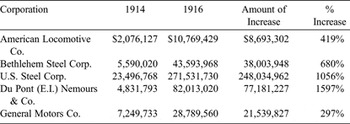
From the start, the initial profits tax on munitions makers and the subsequent excess-profits tax on all businesses were rooted in social concerns over war profiteering. As early as 1917, the popular journal The Outlook documented “the extraordinary increase in profits” among the leading industrial concerns. Comparing the profits of over one hundred companies from 1914 to 1916, the editors calculated that the aggregate “profits of these one hundred and four corporations exceed the profits of the year in which the war began by over a billion dollars.” (See Table 2). With these soaring profits came bloated dividends and rising returns on equity, at a time when the stock market as a whole was witnessing substantial drops in real value. From this statistical evidence, The Outlook joined other leading popular periodicals in supporting an excess-profits tax to make “the war-brides pay up.”Footnote 99
Increase in Corporate Profits of Select U.S. Corporations, 1914–1916 (nominal dollar amounts).
Source: “Helping the War Pay For Itself,” The Outlook, June 27, 1917, 319–20. A similar table was printed in the Congressional Record as part of the House discussion of the excess-profits tax. Congressional Record, May 18, 1917, 65th Cong., 1st Sess., 2541.
The social protest against war profiteering led to the adoption of the 1917 excess-profits tax. But many economic and legal experts questioned the efficiency, administrability, and even constitutionality of a tax on all profits beyond a “normal level.” The main point of contention seemed to rest with the idea of using “invested capital” as a baseline from which excess profits could be determined. Seligman seemed to sum up the hostility towards the notion of “invested capital” when he wrote that “what constitutes capital is so elusive as to be virtually impossible of precise calculation.”Footnote 100 Members of the business and legal communities echoed Seligman's concerns. The Commercial and Financial Chronicle—that bastion of orthodox business thinking—attacked the “Excessive Taxation of ‘Excess’ Profits” as “governmental confiscation of wealth.” Favoring the British version of a war-profits tax, the editors of The Wall Street Journal similarly disparaged the excess-profits tax as “hasty and ill-advised legislation . . . rushed through Washington by politicians desiring political favor with the many by taxing the capital of the few.” Lawyers representing financial interests added their voice. Harping on the alleged unconstitutionality of the excess-profits tax, Robert R. Reed, the counsel for the Investment Bankers' Association, assailed the law as a “confiscatory tax on businesses.”Footnote 101
Soon after it was enacted, opponents of the excess-profits tax commissioned a group of economists to conduct a comparative investigation of U.S. and British war financing. Under the supervision of Thomas S. Adams, the BIR's chief economist, Treasury organized its own team of economists, accountants, and lawyers to examine the consequences of the existing excess-profits tax. Adams's study supported what many in the financial and academic communities had predicted from the start, namely, that the excess-profits tax appeared to have unintended consequences. The existing levy, with its use of “invested capital” as the baseline for determining “excess profits,” was adversely affecting small businesses more than the large corporations it was designed to attack. Larger corporations were able to manipulate the law to reduce their tax liability. By increasing their invested capital, either by issuing more equity or by increasing their investments in intangible assets or through other accounting maneuvers, they could inflate the base from which their rates of return and profits were calculated, thereby placing their net profits in a lower tax bracket. By contrast, smaller enterprises, especially those that relied mainly on personal services such as family businesses, did not have high levels of capital to begin with, nor did they have the slack to adjust their capital levels or annual investments. Thus, they were hardest hit by the excess-profits tax.Footnote 102
Even before the Treasury completed its study, McAdoo was encouraging lawmakers to consider supplementing the existing excess-profits tax with a new British-style profits tax that levied a high flat rate on all profits above prewar average earnings. Since Kitchin remained the key congressional supporter of the excess-profits tax, McAdoo took his recommendation directly to the powerful southern congressman. In a carefully drafted letter, McAdoo explained how “the existing excess profits tax does not always reach war profits.” McAdoo argued that “a flat rate of 80% on all war profits,” those measured against a prewar average of profits, was a better method for getting at war profiteering.Footnote 103 Kitchin remained unconvinced. From the beginning, populists like Kitchin and progressives like La Follette wanted to make the excess-profits tax a permanent part of the national tax system. Enacting a tax that relied on prewar earnings as its baseline would mean conceding that the levy was a temporary measure—one that could be discarded easily at the end of the conflict.Footnote 104
Treasury completed its initial investigation of the excess-profits tax in the summer of 1918, just as the Ways and Means Committee was drafting its version of a new tax bill. The Treasury lawyers eagerly used the department's study to build the necessary support for the war profits tax. Because Leffingwell had long suspected the inequities of using invested capital as a measure of excess profits, he enthusiastically marshaled the resources of the department to lobby Kitchin.Footnote 105 The study, together with numerous petitions from small businesses, confirmed Leffingwell's suspicions that the excess-profits tax did not accurately capture the profits created by the war, and that it was permitting the growth of corporate capitalism rather than curbing or taming it.Footnote 106
Leffingwell's understanding of the study seemed to be in some tension, however, with its actual conclusions. Whereas the investigation focused mainly on the rate structure of the excess-profits tax, Leffingwell highlighted instead the problems of using “invested capital” as a base to measure excess profits.Footnote 107 As corporate lawyers, Leffingwell and Ballantine, who also had some reservations, may have been uneasy about using newly created state capacity to regulate corporate profits. Other Treasury officials, including Roper, were concerned about moving to a war-profits tax based on prewar earnings, but Leffingwell was confident that a war-profits tax was the fair and just method because it balanced the need for revenue with concerns about economic productivity.Footnote 108
In a confidential memo to the president's secretary, George Tumulty, Leffingwell identified what he thought were the fundamental differences between the war profits and the excess profits taxes:
A war profits tax finds its sanction in the conviction of all patriotic men of whatever economic school, that no one should profit largely by the war. The excess profits tax must rest upon the wholly indefensible notion that it is a function of taxation to bring all profits down to one level with relation to the amount of capital invested, and to deprive industry, foresight and sagacity of their fruits. The excess profits tax exempts capital and burdens brains, ability and energy.Footnote 109
The department's study did not explicitly criticize the excess-profits tax in such sharp terms. Indeed, some economic experts believed that the existing levy might not be excessive, nor that it would hinder economic productivity. But, for Leffingwell, the excess profits tax was “wholly indefensible” because it fundamentally challenged the precepts of modern American capitalism. The former corporate lawyer was willing to attack war profiteering, but he was not interested in undermining the long-term incentives that he believed were the driving force of the nation's economic growth and productivity.
In his private memo, Leffingwell went even further in criticizing the general theory of taxing corporations at progressive rates: “Any graduated tax upon corporations is indefensible in theory for corporations are only aggregations of individuals and by such a tax the numerous small stockholders of a great corporation may be taxed at a higher rate than the very wealthy large stockholders of a relatively smaller corporation.” In echoing this common critique, Leffingwell emphasized the report's conclusion about the unintended consequences of the existing excess-profits tax. “The object of a graduated tax should be to make taxes fall upon the rich who are best able to pay them,” Leffingwell explained. “The graduated excess profits tax disregards this, and often produces the reverse result.”Footnote 110 In criticizing progressive corporate tax rates, Leffingwell was seeking indirectly to support the move to a higher flat rate on all war—as opposed to excess—profits.
Leffingwell's memo appeared to achieve its intended objective. “The course of the Administration is plain,” Tumulty responded the following day. “We must stand for the War Profits Tax to the end.” He hastened to add that “the ‘staging’ of the whole business” of presenting the administration's position to Congress and the public was “most important.” Bureaucratic autonomy rested heavily on how the ideas of unelected administrators were framed for democratically accountable lawmakers. That same day President Wilson wrote Kitchin to inform him of the importance of “a war profits tax as distinguished from a mere excess profits tax.” The former, the president claimed, was “manifestly equitable.” Acknowledging the difficulty of enacting a tax increase during an election year, Wilson optimistically assured Kitchin that a new profits tax would be well received by the business community. “I do not believe that the manufacturers of the country who are now making profits directly from war work would object” to the new tax, wrote Wilson. “On the contrary, I think that they would feel a certain pride in sharing the burdens of the war directly with the men who are giving their lives for the safety of America and the freedom of the world.”Footnote 111
Unsurprisingly, the existing excess-profits levy still had its supporters. In addition to Kitchin, there were others who maintained that the excess-profits tax, even with its flaws, was, as one agrarian group described it, a potent symbol of “justice over revenue.” In a letter to McAdoo, the Farmers' National Committee contended that not enough of the war was being financed through taxation. Its members proposed a “Liberty Tax Bill” as a corollary to the Liberty Loan drives. Speaking on behalf of numerous farmer and labor groups, the Farmers' National Committee called for a fiscal policy in which “one-half of the cost of the war shall be raised by current taxation upon excess and war profits, upon incomes, and upon the unearned increment of land values.” McAdoo passed along this correspondence to Leffingwell, who responded with a letter of his own optimistically stating how taxation had made up “almost one-third of our total expenditures in the fiscal year 1918.”Footnote 112
To reinforce its support for a war-profits tax, Treasury commissioned its economist T. S. Adams to conduct another systematic comparison of profits taxes. Before taking responsibility for a new wartime tax measure—during an election year no less—Treasury officials wanted to be certain that the war-profits tax could promote distributional ideals without harming revenue. Adams's second report confirmed that an 80 percent flat tax on profits above a prewar average would extract more revenue from big businesses as compared to smaller enterprises, with only a small decline in revenue. The second study, however, explicitly recommended maintaining the excess-profits tax, as a supplement to a new war-profits tax. An excess-profits levy would reach those corporations, such as the Ford Motor Company, “which earned an unusually high rate of profits in the prewar period . . . but would pay no war-profits tax.” Although the report's emphasis on the virtues of the excess-profits tax may have disappointed Leffingwell, he nonetheless set aside his personal views and redoubled his efforts to support the department's position to maintain the excess-profits tax.Footnote 113
Eventually, Treasury officials were able to persuade Congress to accept the proposal of levying both a war-profits and excess-profits tax. By September 1918, the House drafted and passed a comprehensive revenue bill that included a dizzyingly complex corporate levy containing both an excess-profits and war-profits tax.Footnote 114 The mobilization of the department's economic and legal expertise helped broker a compromise that convinced Kitchin and other lawmakers that a hybrid or dual-profits tax was the appropriate solution to war profiteering. Consequently, the Treasury lawyers were able to reframe the new profits tax as a temporary measure, one that was linked to prewar average profits and that, therefore, could be easily dismantled after the conflict. Leffingwell and his colleagues thus were able to reorient the demands of activist social groups like the Farmers' National Committee and populist lawmakers like Kitchin. Although the bill was not enacted until the following year, the proposed tax increase, coming just before the armistice and midterm elections, had significant political ramifications, helping to deliver resounding congressional victories for the Republican Party.Footnote 115
As lawmakers and Treasury officials were evaluating the merits of the excess-profits tax, lawyers at the BIR were considering the constitutionality of the levy. The BIR lawyers knew early on that one of the greatest challenges in administering the excess-profits tax was “clarifying what invested capital means.” In tackling this task, Ballantine, as the lead BIR lawyer, acknowledged that the excess-profits levy might face some constitutional challenges. Opponents of the law, such as Robert Reed, the legal representative of investment banking interests, had been suggesting in no uncertain terms that the vagueness of invested capital made the excess- profits tax an unconstitutional form of government confiscation. With these comments in mind, Ballantine used his technical legal skills to lay out a detailed doctrinal defense of the excess-profits tax in a 1919 article in the Yale Law Journal.Footnote 116
There were primarily two parts of the excess-profits tax law that Ballantine believed might pose some constitutional issues. The first was, as Reed suggested, a Fifth Amendment due process challenge to the use of “invested capital” as the tax base for measuring excess profits. The second potential issue was whether the “relief clauses” of the law, which allowed the BIR to use comparative statistics to impute invested capital for those businesses that did not have any invested capital, were an unconstitutional delegation of congressional authority. On both counts, Ballantine concluded, “the decided cases appear to disclose little probability that the statute will be upset on either ground.”Footnote 117
Ballantine agreed that the due process clause of the Fifth Amendment could be a legitimate restraint theoretically on the arbitrary exercise of Congress's taxing powers. But in his analysis of the case law, a tax based on the ratio of profits to invested capital was wholly permissible and well within Congress's taxing powers. “As to a method of taxation, like any ‘classification,’ the question is whether there is any reasonable ground for it or whether it is simply arbitrary,” wrote Ballantine. Analyzing a litany of cases, Ballantine contended that any judicial challenge to the congressional taxing power on the grounds of due process was likely to fail. “So vigorous has been the Court in its support of federal taxing power,” Ballantine reasoned, “that all the attacks upon taxing statutes under the Fifth Amendment, upon the ground of their unequal operation, have so far failed.”Footnote 118
The second aspect of the excess profits tax that Ballantine addressed was the constitutionality of the “relief sections” that gave the BIR discretion in imputing invested capital to a business. In determining whether these provisions were an unconstitutional delegation of legislative authority, Ballantine contended that providing “relief” through these provisions was simply a function of administering the law, and was not therefore an exercise in legislative authority. “So long as it can be said that all that is left by Congress to administrative officers is the determination of how a taxing provision applies to a particular state of facts,” Ballantine reasoned, “no delegation is involved.”Footnote 119
Ballantine bolstered his defense by appealing to historical context. He admitted that in an earlier age one could claim that legislatures should maintain the responsibility of creating and administering revenue laws. But in a modern, industrial society where a complex array of laws and regulations were increasingly needed to provide the stability and consistency of an ordered society, effective administration of these new laws and regulations required the creation of new government agencies and organizations. “Recognizing the increasing variety of the subject matter upon which statutes operate, and the increasing complexity of the result sought to be achieved by statutes,” Ballantine wrote, “the courts have gone much farther than under the simpler conditions of an earlier period in supporting the extensive use by the legislative arm of the more flexible executive instrumentality.”Footnote 120 Ballantine's legal defense of the excess-profits tax was not just an academic exercise. His views provided some stability for an uncertain legal environment, and in time his legal analysis was vindicated when the Court upheld the excess profits tax soon after the war.Footnote 121
Lest one confuse Ballantine's constitutional defense of the excess-profits tax as an unequivocal endorsement, the former corporate lawyer judiciously balanced his support of the levy with some biting criticism of it on nonlegal grounds. Like many others, Ballantine thought the tax had several significant drawbacks. It did not curb inflation; it angered taxpayers with its inquisitorial requirements; and it could promote a great deal of uncertainty and delay in generating revenue. Together, these concerns could—and would—ultimately lead to the repeal of the excess-profits tax, but as far as its legal foundations were concerned, Ballantine was convinced that “there is little likelihood that the court will conclude that the discrimination involved in the excess profits tax is hostile or arbitrary.” If business owners and taxpayers in general believed that the excess-profits tax was unwise, there were other methods to address the problem beyond judicial challenges. Ballantine, ever the moderate, concluded, “It is to Congress rather than to the courts that the taxpayer must look for a fairer and wiser distribution of the revenue burden.”Footnote 122 Ballantine's words were prescient. Soon after the war, it was to Congress that opponents of the excess-profits tax successfully turned in repealing the measure—to the immense disappointment of populist fiscal reformers and social groups who had hoped to make the excess-profits tax a permanent part of the U.S. tax system.
Postwar Visions of a New Fiscal Order
After the war ended in November 1918, many of the Treasury lawyers actively returned to the private sector. Roper led many of his BIR colleagues into a burgeoning Washington, D.C. consulting and tax law practice, only to return to public life as Franklin D. Roosevelt's secretary of commerce.Footnote 123 Love was equally eager to return to the private sector and Texas politics, as he leveraged his Washington, D.C. contacts to develop a lucrative postwar legal practice.Footnote 124 Ballantine also returned to private practice after the war, eventually joining the New York law firm that would become Dewey, Ballantine. Throughout the 1920s, he led the firm's tax practice and became a leading voice of the evolving tax bar. In 1931, he returned to Washington to serve as his Harvard classmate Ogden Mills's Treasury undersecretary.Footnote 125
Leffingwell, by contrast, remained at Treasury to ensure a smooth postwar transition. He served McAdoo and his immediate successor Carter Glass admirably, gaining the respect of both men.Footnote 126 Leffingwell relished his role as a government official, and he did not hide his disappointment when President Wilson selected David F. Houston, the secretary of agriculture, as Glass's successor ahead of Leffingwell. He rejoined the Cravath firm in 1920 but soon left to take a senior position at the investment house of J. P. Morgan.Footnote 127
It did not take long for the lawyers to realize the historical significance of their government service. In a series of correspondence in the fall of 1919, Roper and Leffingwell assessed their contributions and shared their respective visions of a postwar fiscal order. The seasoned administrators reflected on how the past three years had dramatically changed the everyday operations of the federal fiscal system. Building upon their experiences, Roper and Leffingwell discussed how they could make the tax collection process even more effective after the war. Roper made two principal policy proposals. First, he recommended the creation of a “Court of Internal Revenue Tax Appeals” to adjudicate appeals directly from the district courts. Second, and perhaps more important, he suggested that the Treasury consider fundamentally restructuring the tax system to focus on “revenue sources” that might be collected “with the least inconvenience to taxpayers.”Footnote 128
Roper's recommendations elicited a mixed response from Leffingwell. Leffingwell was “quite taken with the idea of a Court of Internal Revenue Tax Appeals.”Footnote 129 Both Roper and Leffingwell understood how the complexity of wartime tax laws raised numerous legal questions and burdened the judicial system. It was essential, Roper observed, revealing his unquestioned faith in expertise, to have these complex legal issues “considered by men especially trained in Internal Revenue Taxation,” so that “a sound basis of internal revenue court decisions may be assured for both the benefit of the Government and the taxpayer.”Footnote 130 Leffingwell agreed. Providing taxpayers with a stable and predictable set of tax laws had been one of the hallmarks of the wartime Treasury. And having a quasi-independent judiciary of professionally trained tax experts was certainly one way to institutionalize the consistent resolution of tax controversies, and thus provide the type of formal rationality that state-builders craved. Such a court could also carve out an autonomous institutional sphere for the nascent tax bar. Although Leffingwell did not elaborate on this self-serving possibility, a specialized court of tax appeals could protect the profession's monopoly on the provision of scarce legal services and thereby enhance the collective power of lawyers within the new polity. It could also further the stratification of the bar, setting tax law experts apart from other corporate and business lawyers.Footnote 131
If Leffingwell supported the idea of a specialized tax appeals court, he was less enthusiastic about Roper's suggestion to alter revenue sources. Similar calls to return to a more “convenient” system of broad-based tariffs and excise taxes were being made by Sen. Reed Smoot (R-UT) and other congressional opponents of progressive income and wealth-transfer taxes. To Leffingwell, this recommendation seemed to hearken back to the prewar regime of regressive indirect taxation—a system that Leffingwell believed was rendered obsolete by the successful administration of the wartime tax policies. Leffingwell informed Roper that his suggestion “if pressed to the limit . . . would mean that we should have nothing but indirect taxes such as the protective tariff, the excess profits tax, and the consumption tax.”Footnote 132 A return to the old fiscal regime meant a return to a regressive, opaque, and ultimately undemocratic system of public finance. “In the case of indirect taxes the whole community pays through increased cost of living, and there is a minimum of inconvenience to the taxpayers,” Leffingwell conceded. “Indeed, most of them know nothing about it.” This invisible form of taxation violated the principles of democracy and modern economics by favoring convenience of collections over the transparency of direct taxation. “I take it that it is good democratic doctrine—certainly it is good economics” wrote Leffingwell, “that a direct tax, such as the income tax, which inevitably involves a certain amount of inconvenience to the taxpayer, is to be preferred to the indirect tax which involves none at all.”Footnote 133
Although Leffingwell did not elaborate on what he meant by “good democratic doctrine,” his ideas and actions during his tenure in the Treasury Department suggest that he had in mind the inextricable link that existed between direct taxes, democracy, and fiscal citizenship. Since the late nineteenth century, tax reformers and political economists had been claiming that the “inconvenience” of direct levies on income, profits, and inheritances made citizens more attuned to the workings of the state, that paying taxes directly to the federal government gave citizens a greater stake in how public funds were raised and used, and that direct taxation ultimately helped forge a renewed sense of civic identity.Footnote 134
Leffingwell and the other Treasury lawyers endorsed these views with their actions, if not their words. In the process of building Treasury's administrative capacity during the war, they sought to assure taxpayers that revenues were collected in a consistent and equitable manner. By clarifying the operations of complex new rules and by evaluating and reevaluating the income and profits taxes, the lawyers helped build the trust between citizens and their government that was essential to the success of a liberal democracy engaged in global war. But they also did much more. Their vision for a postwar fiscal order, reflected in Leffingwell's remarks to Roper, went beyond simply using direct taxes to imbue citizens as stakeholders with a sense of belonging to a new national community. The Treasury lawyers knew all too well that even the robust wartime tax laws affected only a small fraction of U.S. citizens. In rebuking Roper's suggestion to alter revenue sources, Leffingwell focused, once again, on the state's fiscal obligations to its citizens, on the responsibility of government officials to distribute equitably and effectively the fiscal burdens of financing a modern industrial democracy. This was one way of striking the balance between justice and revenue.
Conclusion
The Great War fundamentally transformed nearly every aspect of American society, including the national system of public finance. The conceptual transformation underpinning the rise of a new fiscal order had its roots in the economic, legal, and social turmoil of the late nineteenth and early twentieth centuries. But it was the war that fortified the federal government's use of direct and progressive taxes. It was the war that triggered the unprecedented interdependence of state and society, and the attendant explosive growth in federal spending and administrative capacity. And it was the war that ushered in a new fiscal state and all that the new polity stood for.
Although the global conflict provided the historical conditions for a fiscal and administrative revolution, it was state actors who seized this opportunity to shape the emerging fiscal polity into their particular vision of a robust and just legal Leviathan. Their vision did not always correspond with the public interest. The legal professionals who worked in the Wilson administration's Treasury Department were by no means purely valiant tribunes of the people. In helping to formulate policy, they privileged their administrative expertise over the popular will of social groups and elected lawmakers. In recruiting and staffing their offices, they assisted personal friends and former colleagues, while they developed the potential for a lucrative area of postwar practice.
Indeed, the Treasury lawyers were among the post–World War I government officials who helped grease the revolving door between the public and private sectors and thus set the mold for future generations of “Washington Lawyers.” Despite their allegiance to the wartime state, these elite lawyers could not divorce themselves from their intractable professional faith in corporate capitalism as the source of economic growth and productivity. Even when they intended to spread the war costs more evenly across regions, classes, and generations, the unpredictable dynamics of war often overwhelmed their intentions and aims.
Still, the Treasury lawyers used their networks, skills, and experience to navigate the wartime fiscal system between the extremes of radical change and conservative inertia. From creating an executive agency committed to building public trust and enhancing its own administrative capacity, to formulating broad policies that spotlighted the reciprocal rights and obligations of fiscal citizenship, to evaluating and defending the novel excess profits tax, to developing the parameters of the postwar fiscal order, the Treasury lawyers helped not only to underwrite the Allied victories in Europe, but also to strengthen the revenue-generating powers of the burgeoning modern American liberal state.
The fiscal regime forged during the Great War did not simply wither away after the conflict. Although some opponents of direct and progressive taxation attempted to return the U.S. system of public finance to the regressive prewar regime of tariffs and excise taxes, the new fiscal polity proved remarkably resilient. The war-related budget deficits, to be sure, provided a structural floor on the ability of lawmakers to eviscerate the new and robust taxing powers, even as the scale and scope of federal taxing powers were retrenched. But the durability of the new fiscal system owed just as much to the patterns of financing established by the wartime Treasury Department. The modern American fiscal polity, in sum, went through a formative period of administrative development during the Great War. For it was during this period of national emergency that the Treasury lawyers exercised their new found taxing powers to build the administrative foundations of a new fiscal order.