Introduction
The study of ideas in foreign policy has seen a rise in popularity during the last few years, drawing on social constructivism as well as reflectivist and discourse-oriented avenues. Foreign policy analysis (FPA), traditionally rather nebulous on epistemological issues, has seen a sharpened focus on ideas coupled with debates on whether (either) social constructivism or reflectivism may be of service to FPA.Footnote 1 The present article extends contributions from a constructivist perspective by elaborating the concept of guiding principles, defined here as core ideas derived from tradition and essential to forge a national foreign policy consensus. Guiding principles can be sought out through historical analysis and may, as will be shown in this article, be analytically useful to gauge the cognitive basis of foreign policy making. In order to measure the significance of such ideas, speeches and debates offer key empirical data. By allowing for individual agency within collective cognitive frames, this approach also avoids the loss of agency to which ideational analysis is sometimes disposed.Footnote 2
In the foreign policy domain, collective ideas are allowed immediate leverage on the formulation and justification of policy. Defining a nation against the external world has a particular symbolic significance: in Europe, it has been argued, despite enhanced integration, the legitimacy of foreign policy remains embedded in national identity and self-ascribed roles.Footnote 3 Identity is strongly geared towards established tradition, making innovation in foreign policy a daunting and rarely accomplished task.Footnote 4 Studying foreign policy debates is hence a venture that may shed light not only on idea structures among policy-makers but on the political culture itself and the principles and ideas underpinning it. Guiding principles, according to this perspective, set the terms for foreign policy debates by defining a political space which actors leave only in exceptional circumstances, and typically at considerable cost. Strategic and material interests affect these debates, but they are often overridden by the element of historical continuity. Thus, studies of foreign policy debates and of policymaking should acknowledge the importance of collective ideas, rooted in identity politics and the traditional role to which a nation sees itself suited.Footnote 5
To exemplify this ideational approach to FPA, the present article provides a comparative study of speeches by the British prime minister, Tony Blair and the French President, Jacques Chirac, preceding the invasion of Iraq in March 2003. The theoretical basis, discussed in the first section of the article, draws on social constructivism to account for how ideas impact on political identity and decision making by defining the legitimate freedom of manoeuvre. As background to the empirical analysis, section two gives a brief historical overview of post-war French and British foreign policy, from which a set of contrasting guiding principles are extracted. The resulting dichotomies are applied in section three in the empirical analysis, which examines the extent to which traditional guiding principles were prevalent in Blair and Chirac's speeches on Iraq. In the final section I return to the theoretical implications of the analysis, with particular focus on the balance between collective ideas and individual agency.
Theorising the causal impact of ideas
The significance of ideas to FPA remains contested, despite a number of empirical studies applying ideational frameworks.Footnote 6 The present article argues that conventional social constructivism offers a promising avenue to the study of foreign policy debates. Essential to such research is a refined understanding of both agency and ideas in the causal chain of policymaking. The theoretical argument presented here is that collective ideas defined by tradition shape the political space for contemporary debates and effect the foreign policy decisions of policy makers. Guiding principles of foreign policy are conceived as a stable body of ideas which set the terms for conceptualising, discussing and deciding foreign policy. Elitism and socialisation in parliament help maintain this stability around traditional concerns.Footnote 7 My empirical focus in this article is on the causal link between traditional guiding principles and ideas present in foreign policy debates. Before elaborating the theoretical framework, I will give a brief review of competing analytical approaches to ideas.
Concepts such as narratives, idea sets or policy paradigms are relevant to the full range of political analysis and have, for example, become prevalent in studies of the British domestic agenda.Footnote 8 The result has been new understandings of how structural, ideational and strategic variables impact on policy output. Empirical studies of ideas in foreign policy have been less systematic, inspired by diverse epistemological positions and united by genre (historical or case-based) rather than theoretical position. Applying social constructivism to the field has yet to resolve this confusion: in particular, the constructivist belief in causality differs from reflectivist epistemologies.Footnote 9
Broadening the scope from FPA to international relations, some of the same unresolved tensions arise. The study of ideas has suffered from poor conceptualisation and little agreement over what analytical role they should be assigned – resulting in unrefined methodology and little scope for generalisation.Footnote 10 There has also been a lack of consensus on concepts; ‘ideas’ or ‘ideology’ have confusingly referred to variables at the personal as well as the social and national levels. The absence of a consensus has been the more flagrant in attempts to theorise ideas in causal relationships. With questions of causality, the structure/agency conflict is immediate: ideas could be conceived as, on the one hand, fundamental structural movers or, on the other hand, flexible devices applied by political actors to win support. In the realist paradigm ideas are typically seen in the latter perspective of manipulation and interests in disguise; others perceive ideology as endogenous, but relevant only to certain types of regimes. What appears a more fruitful framework for ideational analysis is the literature where ideas are considered as guides and constraints to all forms of political agency. Carlsnaes represents this tradition when referring to foreign policy as the ‘extension of [national] values into the international arena’; Hunt, equally, refers to ideology as ‘sets of beliefs and values […] that make international relations intelligible and decision making possible’.Footnote 11 The challenge, according to both these contributions, is to seek out the specific ideas underpinning decisions.
In order to accomplish the task of defining ideas behind policy, we should look towards the conventional constructivism initially propagated by Alexander Wendt.Footnote 12 Constructivism does not refute the material facts of international relations; however, it modifies the rationalist conception of objective interests.Footnote 13 Of particular significance is the inclusion of collective ideas and identity which are considered analytically prior to interests. This widening of analytical scope is based on the view that interests follow broadly from collective beliefs. Constructivism thus represents a synthesis of materialist and idealist assumptions of foreign policy. In a broader sense, foreign policy becomes ‘the way in which a country expresses its individual heritage and character to the outside world’.Footnote 14 The ideational heritage is subject to continuous reinterpretation and is sufficiently flexible to accommodate a broad range of interests around its core beliefs.Footnote 15 When a performance crisis occurs, it may cause a reorientation of the guiding principles, which will then be redefined.Footnote 16 To what extent ideational revision results in profound change is dependent on political entrepreneurship and the alternatives available at the time of crisis.
Ideational path dependence is a useful analytical concept to describe this process, echoing the conception of institutional path dependence that is seen to limit the scope for functionally driven change.Footnote 17 More generally, our understanding of the role of ideas in FPA can be further enriched by the literature on new institutionalism.Footnote 18 Here, to conceptualise institutional change the role of both ideas and political agency are brought into the analysis.Footnote 19 Agents who take on the role as reformers of collectively held beliefs could be theorised as norm entrepreneurs. Where ideational change occurs, and debates enter new territory (thus opening a space for policy change), agency can be traced back to such entrepreneurs. Significantly, however, they must benefit from windows of opportunity where a change in collectively held beliefs is conceivable. The emphasis on agency maintains that guiding principles ‘do not appear out of thin air; they are actively built by agents having strong notions about appropriate or desirable behavior’.Footnote 20 Combining the impact of collective ideas with windows of opportunity and norm entrepreneurs could thus help resolve some of the tensions in FPA between structure and agency oriented analyses. I now turn to the foreign policy traditions of Britain and France to define a set of collective ideas constituting the backdrop for debates on Iraq, where the rhetoric of Blair and Chirac will be analysed from a constructivist perspective.
Guiding principles in the British foreign policy traditionFootnote 21
This brief review of British foreign policy attempts to define a set of guiding principles that have been consistent throughout the period since 1945. Among the principles seen to pervade policymaking are a privilege for Anglo-American relations, with NATO as corollary; insular reserve towards the European continent; a maintained global presence with special preference for the Commonwealth; a policy based on pragmatism rather than principle; and, finally, a liberal belief in international trade.
British post-war foreign policy could perhaps be summarised by the term continuity alongside decline. In this view, there is an essential conservatism in British foreign policy. Combined with a predominantly pragmatic outlook, this has made decision-makers evoke a mixture of historical precedence and common sense rather than great principles through policy developments since 1945.Footnote 22 A preference for unstated pragmatism has also been accompanied by the absence of explicitly stated aims and principles in foreign policy. Only in recent years has this changed: the formulation of a set of international priorities, first presented in a White Paper in 2003 and succeeded by a similar document three years later marks a clear departure from the British tradition of implicitness.Footnote 23 This tradition may also explain why, as late as by the end of the Cold War one could claim that no reformulation of national priorities had been stated since Churchill's vision of ‘the three circles’ (Europe, US and Commonwealth) with which post-war Britain was to engage.Footnote 24
In the first decade of that post-war era, British policy-makers were determined to keep American interests committed to Europe, from an economic and strategic point of view just as much as from a perception of kinship.Footnote 25 Anglo-American partnership rapidly acquired a fixed status on the British side. With support from its Atlantic ally, Britain reduced the danger of overstretching while opting for the maintenance of influence based on a strong historical role. The three circles doctrine served as a corollary to this commitment to American power. A ‘masterly ideological mystification’, it served to legitimise British hesitation over priorities and direction during the following decades.Footnote 26 While relying on the special relationship for strategic support, Britain's balancing of the three circles became increasingly precarious in the post-war decades – often ritualised rather than given actual content.Footnote 27 Let down by the US over the Suez crisis in 1956 and opting for withdrawal in the late 1960s from its remaining Asian strongholds: Britain had indeed, in Dean Acheson's phrase ‘lost an empire and not yet found a role’.Footnote 28
In its relations with Europe, the insular view of Britain as offshore and self-reliant has served as a rationale for disentanglement. Historically, the predominant British view was of the salient military threat being ‘the achievement by a single state of domination on the European continent’.Footnote 29 Meanwhile, the political and cultural divide constituted by the Channel has meant that Britain has been a consistent laggard in the process of European integration. With the exception of Edward Heath's premiership (1970–74), every British government since the first strides towards membership has held strong qualms over Europe. European debates in Britain have been easily caught by historical representations of the continent as violent, unstable and opposed to fundamental British traditions of parliamentary sovereignty, common law and ancient liberties.Footnote 30 Differing political cultures and, above all, differing conceptions of what integration is meant to obtain (closer unity and social protection vs. functional cooperation, common market) have remained.Footnote 31
Reflecting this cultural divide, in the global empire that Britain administered until the mid-twentieth century, ‘profitable trade and cheap diplomacy’ were predominant ideas, well-founded on self-interest, yet ‘happily in conformity with moral dictates’.Footnote 32 Entrepreneurship and liberalism at home were echoed abroad in the notion of free trade imperialism, according to which the Empire was fundamentally a framework for commerce.Footnote 33 Liberalism was coupled with individualism, a belief in the virtue of personal liberty from governmental interference, in the material as well as the spiritual domain.Footnote 34 By protecting that liberty, Parliament would play a pivotal role, the remains of which we witness today in the symbolic importance of parliamentary sovereignty against the supra-nationalism of the EU. The question of ideational impact on British politics may be a fallacy, as precedence and common sense seem more often evoked than ideas. History influences politics rather through the ‘notion of enduring, timeless interests’, summed up in keywords as Britain's global extension, its basis in commerce and consequent reliance on open seas.Footnote 35 This entanglement of material interest and ideas goes to illustrate how core ideas in Britain have acquired their position through proved utility and profit.Footnote 36
To what extent has this ideational material changed over time? Conservative rule under Margaret Thatcher was perceived as revolutionary in many areas of domestic policy. In the foreign policy domain, however, Thatcherism implied no radical departure, aiming explicitly for the re-establishment of British influence abroad, in part through affirmative military strength. With regards to European integration, the prime minister championed a further development of the common market, yet remained staunchly nationalist in questions outside the economic domain. Ideally, the Europe supported by Britain would broaden its area of free trade rather than deepen integration into social or foreign/military policy. All in all, Thatcher's international approach was conservative, its emphasis put on liberating the forces of international capitalism while maintaining a military balance in Europe.Footnote 37
Whereas John Major's seven years as prime minister only moderated the most controversial Thatcherite stances on Europe, the return of a Labour government in 1997 was expected to bring more fundamental change. Labour did indeed bring a new language to the domain of British foreign policy; what followed in substance, however, is more debated.Footnote 38 In the early years of the Labour government, much was made of the supposedly ethical dimension to foreign policy, supported by debt relief and peace-building efforts, a suggested clamp-down on weapons exports to rogue states and, in Kosovo (1999) and Sierra Leone (2000) by humanitarian intervention. In a much-quoted speech to the Economic Club in Chicago on 22 April 1999, the British Prime Minister, Tony Blair, gave the ideological rationale for such intervention.Footnote 39 As manifested by events thereafter, the concept of humanitarian intervention implies a difficult terrain both in terms of ethics and international law. Both the Kosovo campaign (1999) and the Iraq invasion (2003) lacked endorsement by the United Nations (UN) Security Council due to disagreement among the veto powers – yet, the two cases received sharply contrasting judgements from the international community.Footnote 40 It may be analytically useful to draw a line between the early years of Blair's premiership, characterised by caution and humanitarian reasoning, and his later embrace of bold intervention on security grounds, accentuated by the events of 11 September 2001. Whether a departure from traditional guiding principles is detectable in Blair's speeches on Iraq is an underlying question in this article.
Guiding principles in the French foreign policy tradition
Arguably, a summary of post-war French foreign policy could emanate in a set of broadly shared ideas despite great political transformation underway. The essential guiding principles extracted in the review below are: belief in a strong Europe under French guidance; a preference for multilateralism, with the EU and UN as dominant vehicles, partly operating as counterweight to American power; parallel significance of French independent influence on the international scene, supported by strong presidential power; an esteemed civilising mission based on French republican legacy; a foreign policy based on principle more than on pragmatism; and, finally, a perceived importance of global reach with former colonial relations as bedrock.
In contrast with Britain, French foreign policy in the post-war period gives a primary impression of rupture just as much as continuity. In a longer perspective, French political history shows numerous cases of regime change.Footnote 41 However, while institutional – and even constitutional – design has been subject to tumultuous changes, continuity is what characterises many of the ideological elements of French politics. Arguably, the natural starting point for a post-war evaluation of French foreign policy is 1958 rather than 1945. Signified by the rise to presidency of Charles de Gaulle and the Constitution establishing the Fifth Republic, there is ample reason to suggest a new era began in 1958. According to de Gaulle, the new Constitution washed away the symptoms of weakness and division to return to the ancient, grander vision of France. Undoubtedly, the Fifth Republic marked a resolute break with executive impotence. Foreign policy set an example for the strong presidential role by becoming part of his domaine séparé. The immediate implication was firm, thought contested leadership in a tumultuous period of colonial war in Algeria. In a longer perspective, however, de Gaulle applied foreign policy as part of his project to forge a new political consensus.
Prior to 1958, French political history had wavered between parliamentary dominance on one hand and charismatic-plebiscitary rule on the other. In the Fourth Republic (1946–58), much like the Third (1871–1940), the balance had tilted towards the National Assembly, where a broad range of political parties battled for power and prestige. The 1958 constitution made a resolute break with this tradition by introducing a semi-parliamentary polity with presidential predominance. Nevertheless, de Gaulle was less of a break with French political tradition than what has often been claimed.Footnote 42 The emphasised view of the Gaullists was that France was in need of strong leadership to re-establish republican ideals, in a nation ‘historically divided, politically weak, and yet culturally strong, […] and potentially “great”’.Footnote 43 International prestige was perceived as indispensable in this process – suggesting that a more affirmative role would be assigned to French foreign policy.
Thus, a set of explicit guiding principles were to permeate French foreign policy, strongly reflected in the rhetoric of successive presidents. One central tenet was the emphasis on French exceptionalism, largely drawing on France's revolutionary legacy and its perceived historical role as spearhead of human rights. According to this perspective, applauded by de Gaulle, France was committed to a vigorous presence abroad. In the foreign policy domain this further implied an emphasis on autonomy and a French civilising mission. De Gaulle's was a vision of nation-states as the building blocs, organised in a clear-cut hierarchy with France in a prominent role, as reflected in the composition of the UN Security Council.Footnote 44 Independence, however, was also conducive to the support of a multipolar world, opposing the logic of two dominant blocs imposed by the Cold War. French withdrawal from the integrated military structure of NATO (1966) and development of an independent nuclear deterrent exemplifies this idea. In few domains has French post-war autonomy been more clearly evoked than in military affairs, where it has always been invested with large symbolic significance.Footnote 45
De Gaulle gave his contribution to what ‘may have been the most unified French nation since before the Great Revolution’.Footnote 46 Among the few distinct adjustments pursued by his successors, Pompidou (1969–74) and Giscard d'Estaing (1974–81), was a more cooperative approach to Europe, based on the understanding that France alone could only play a limited role on the world scene. In foreign policy continuity and Europe are keywords even of the presidencies of François Mitterrand (1981–95) and Jacques Chirac (1995–2007).Footnote 47 Closer European integration represents a compromise of the nationalist twist to French foreign policy, yet is more in line with de Gaulle's vision of the world than often conceived. This is particularly clear in the French pursuit of global influence through Europe. Aspirations for continental leadership have long roots in French political thought. One could here observe a tension in the French political mind between de Gaulle's national-republican and Monnet's federationalist approach to Europe.Footnote 48 The latter had been given ascendancy with the emerging European integration. De Gaulle on his side promoted the national interest yet gave his whole-hearted support to integrationist measures that could promote French interests abroad, reflected, inter alia, in the French-German tandem sealed by the Elysée Treaty (1963).
To Aldrich and Connell, ‘France is the only country that wants to express its foreign policy in universal, logic terms [while aspiring] to a global role’.Footnote 49 There is no perceived contradiction between promoting French interests and universal ideas, harking back to revolutionary history and the French guise as ‘homeland of human rights’.Footnote 50 Promotion of human rights and democracy remains central to French foreign policy, accompanied by support for multilateral institutions, a distinct presence overseas and command of la francophonie, the global French-speaking community. In addition to the EU's remit, the UN may be regarded as the primary vehicle of French multilateralism on a global scale. According to Tardy, the UN provides the double virtue of being a forum to promote the French universal message and an institution in which French prestige is maintained.Footnote 51 France may here pursue a position of power while simultaneously promoting progressive (and seemingly disinterested) causes.
In light of post-Cold War changes, and the relative decline of French economic and military power, certain of these principles have been accentuated whereas others have been left in decline. Multilateralism today has a clear anti-American bias, seeking to balance American dominance, primarily through the EU and secondarily through international law maintained by the UN.Footnote 52 French attitudes to Europe have proven increasingly sceptical since the marginal acceptance of the Maastricht Treaty in 1992, culminating with the refusal of the draft constitution in 2005. Meanwhile, globalisation has emerged as a pivotal issue marked by strong internal opposition towards the exposure to international market forces. In this context, national protectionism and aspirations for a strong EU go hand in hand. The difficult preference is for an EU in concord with French ideas, something which is far more difficult to achieve in a union of 27 member states than in de Gaulle's era of a core Europe of six.
Method and data
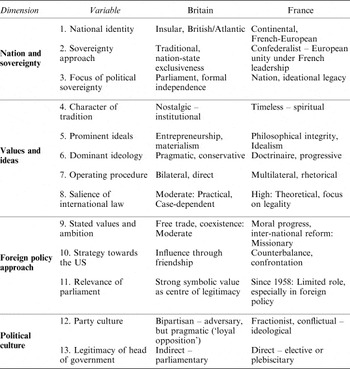
The brief ideational reviews of post-war British and French foreign policy may be summarised in an analytically useful matrix form. Table 1 draws together some essential guiding principles, based on dichotomies where the two countries represent opposite poles. Guiding principles of British and French foreign policy can thus be seen as a series of dichotomous variables. For heuristic purposes, the variables are organised in four dimensions covering essential characteristics of foreign policy ideas.Footnote 53
British- French contrasts in guiding principles affecting the conduct of foreign policy

Case studies investigating the role of ideas typically utilise texts such as policy documents or speeches as data. Contributions to this field have already addressed how Tony Blair's ideas or personality are reflected in his case for invasion in Iraq.Footnote 54 The present article contributes to this frontier by relating Blair and Chirac's speeches to a historical set of guiding principles, thus opening a broader scope for comparison.
Within the school of qualitative content analysis, the design may be referred to as ideational, where the aim is to trace the appearance of ideas in textual material through manual coding. Here, the significance of a text rests on it being part of a genre where similar ideas predominate.Footnote 55 Ideational analysis relates logically to the question of ‘[w]hat motives, values, beliefs, and attitudes are revealed in a person's writing or speech’.Footnote 56 Whichever method applied for coding ideas will require an element of interpretation. The analysis applied for this article follows a middle road between quantitative content analysis on the one hand and discourse-oriented analysis on the other. While content analysis is often constrained to counting words and concepts, discourse analysis yields a deeper scope for interpretation but is often difficult to validate.Footnote 57 Ideational analysis attempts to balance the virtues of counting and interpreting while avoiding the pitfalls of both.
Researchers who analyse texts by combining counting and interpretation have been criticised for ‘being unsystematic in their uses of texts and impressionistic in their interpretations’.Footnote 58 Reliability remains an obvious challenge: to make the analysis as transparent as possible, qualitative content analysis should be used with a defined body of texts and with a coding scheme providing for a relatively straightforward coding of data. For the purpose of registering ideas in Blair's and Chirac's speeches, a coding scheme was made on the basis of the guiding principles presented in table 1. To operationalise the British and French guiding principles, I constructed a range of standardised statements – such as ‘Europe must find a common voice..’ as they were expected to appear in political debates. These statements were given as contrasting pairs; hence, a reference to a traditional British principle would normally imply opposition to its traditional French adversary. Operationalising the guiding principles required some preliminary knowledge of the data, which was obtained through a short explorative study of speeches on Iraq. The dichotomies of French vs. British principles turned out to be analytically fruitful, with the majority of ideas falling along either the French or the British foreign policy tradition.Footnote 59 To exemplify how coding was conducted, an excerpt is given here from a declaration by the French President at the dawn of the invasion:
France, faithful to her principles […], will continue to act for the just and peaceful resolution of crises; by collective action, through the UN, the only legitimate forum for peace in Iraq…Footnote 60
Three ideas were registered for this segment, based on the coding scheme:
2.02 We have a vision of the world, a set of ideas, to help resolve the Iraq issue. [Values and ideas: France]
3.01 Legitimacy of military action requires endorsement by the UN Security Council. [Foreign policy approach: France]
3.02 Any intervention in Iraq must be in accordance with international law. [Foreign policy approach: France]
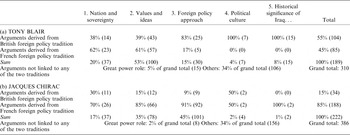
In other parts of the texts specific ideas or principles could be rare, or references could be irrelevant to the principles I had conceived. However, speeches as well as debates were generally of a high comparative quality, which meant that the two leaders could be analysed along the intended dimensions with high validity.Footnote 61 The only ideational dimension that was added through acquaintance with data was the historical significance of Iraq, which occurred repeatedly in speeches by Blair but not by Chirac (see table 2). With regard to the choice of data, the analysed texts are of a rather heterogeneous genre. In particular, the different contexts of speeches, interviews and press conferences were expected to cause some analytical problems, along with the time dimension which covers the period from September 2002 to late March 2003. Different contexts meant that the statements were not uniquely centred on the issue of Iraq. The majority of them, however, gave essential information on the line of argument presented to the public on the issue of a possible Iraq invasion. Moreover, while differing in form and audience, the material nevertheless showed a surprising degree of internal consistency for both Blair and Chirac. In addition to the contrast between the two leaders, the time dimension opened the opportunity for observing changes over time, which in the case of Blair gave the basis for an interesting observation. I will return to this point below.
Occurrence of arguments from separate political traditions in speeches on Iraq; numbers given in per cent (frequency counts within brackets)

Empirical analysis: analysing speeches on Iraq
The issue of how to respond to the potential threat from Iraq took centre stage of public debate in many European countries in 2002–03. This was to a particular extent the case in Britain and France, due to their pivotal role in establishing a coalition whereby consensus in the UN Security Council could be reached. Both countries also share a historical legacy in the Middle East which made positioning on the Iraq issue indispensable.Footnote 62
In the following analysis of debates preceding the invasion of March 2003, focus is directed towards the heads of government rather than the broader popular currents. What would be the expected finding was a reflection of traditional guiding principles in the rhetoric of both Tony Blair and Jacques Chirac. With regard to government policy, the two nations diverged consistently, with France as a leader of a European anti-war bloc and Tony Blair's government lining up closely with the US. Parliamentary opinion, however, was more diverse in both nations. British debates were characterised by relatively strong opposition in Parliament all the way to the centre of government.Footnote 63 French parliamentarians were more united behind government policy, but disputes arose over the strategic merits of open opposition to the US.Footnote 64 In my analytical framework, these policy divergences may affect which ideas will be the most conducive for decision makers to evoke. Still, conformity with traditional guiding principles will be the obvious working hypothesis for both heads of government, not the least because invasion in itself could be supported by each of the two diverging traditions.Footnote 65
Blair: ‘This is not the time to falter…’Footnote 66
Iraq presented Tony Blair with an international mission, as a manifestation of his post-9/11 global engagements. According to the Prime Minister, the Iraqi regime tied together the predominant threats of the twenty-first century: a rogue state with possible terrorist links and potentially equipped with weapons of mass destruction.Footnote 67 Iraq, furthermore, had been a consistent theme in British and American politics throughout the 1990s, as Saddam Hussein's regime had been the cause of rising concern. The challenge would be to unite an international coalition responding to Blair's pretension of leadership. Did his attempt to foster such a coalition over Iraq also imply an attempted role as norm entrepreneur at home? If so, we would expect to see Blair breaking new pathways in his rhetoric rather than leaning on ideas from the British foreign policy tradition. Was this the case in his speeches on Iraq?
The analysis certainly revealed a strongly activist character in Blair's speeches. A disproportionate number of the ideas evoked by the prime minister were on the dimension of Values and ideas, and here he drew heavily on what I defined as the French foreign policy tradition, seeking the moral high ground rather than pragmatic self-interest:
This is not a time for British caution or even British reserve, still less for a retreat into isolation […] This is a time for us to be out in front; engaged; open; creative; willing to take bold decisions […] Now is the moment to make our future as exciting in impact, if different in character, as our history.Footnote 68
Blair frequently argued for affirmative and pre-emptive action on moral grounds, clearly at odds with the prudence associated with British foreign policy. Significantly, this uncompromising approach was coupled with a strongly instrumentalist and efficiency-oriented view of the UN which was far more in line with what the British tradition. The combination of moralism and required efficiency gave a special urgency to Blair's arguments. Speaking in September 2002 the prime minister proclaimed:
If the challenge to us is to work with the UN, we will respond to it. But if we do so, then the challenge to all in the UN is this: the UN must be the way to resolve the threat from Saddam not avoid it.Footnote 69
Blair's speeches were thus characterised by a bold and moral approach to Iraq derived from the French tradition rather than a ‘British’ penchant towards prudent self-interest. A similar observation can be made on the dimension of Nation and sovereignty, where Blair's rhetoric was permeated with references to promotion of international solidarity, especially in the early phase of the debates.Footnote 70 Principles of the British foreign policy tradition, such as the importance of the Atlantic alliance and national interest were present, but less numerous than the international solidarity argument.
On the third analytical dimension, Foreign policy approach, Blair however chose a more traditional British approach. Only rare occurrences were made to UN legitimacy and international law. Furthermore, Blair did not once raise the French-derived ideal of a multipolar world. On the contrary he maintained the importance of working with the US rather than balancing it and the need for enforcement rather than lengthy deliberation. Similar leanings towards British tradition were seen on the two last dimensions, Political culture and Historical significance of the Iraq question, which were prevalent in his parliamentary speeches. The latter dealt with the view of Iraq as a case of (successful) containment vs. (potentially disastrous) appeasement. Blair's use of historical reference exemplifies the social construction of pivotal events in the past from which present decision-makers are to learn: Versailles and Munich are the two quintessential European examples, both of relevance to Britain.Footnote 71 Blair's speeches revealed a strong presence of the British-derived appeasement argument:
[I]f the international community having made the call for his disarmament, now, […] at the point of decision, shrugs its shoulders and walks away, [Saddam] will draw the conclusion dictators faced with a weakening will, always draw. That the international community will talk but not act; will use diplomacy but not force; and we know, again from our history, that diplomacy, not backed by the threat of force, has never worked with dictators and never will […]Footnote 72
The analysis of ideas in Blair's speeches strongly supports the perception of an aspiring norm entrepreneur. In his speeches, Blair would present a hybrid version of the British and French foreign policy traditions. The most striking example is found in his combination of the idealist and moralist verve of the French tradition with enforcement and efficiency in a British traditional vein. The result of this contradictory course is a hybrid version of what I defined initially as French and British foreign-policy traditions. A final observation should be added with regard to developments over time. From the September 2002 to January 2003 period to February/March 2003 Blair appears to have made a considerable shift of emphasis from the French-side international solidarity argument towards the importance of the Atlantic alliance and national interest in the weeks leading up to the invasion. On Values and ideas, however, Blair's movement is from ‘British’ to ‘French’ ideas, increasingly embracing the principle of acting boldly rather than prudently and perceiving Iraq as a case for moral principle rather than pragmatic consideration. Lastly, the idea of Britain having a national vision was evermore present in Blair's speeches. Table 2 gives a summary account of speeches and statements on Iraq.
Chirac: ‘Au nom de la primauté du droit’Footnote 73
Contrary to the British prime minister, Jacques Chirac did not take international idealism to mean a proactive stance against Iraq. French resilience towards military action caused much bitterness among British and American officials and was central to the lack of Security Council endorsement. The fact that the French position pushed the UN towards the sidelines on Iraq is paradoxical, as championing the UN as source of legitimacy through international law was a recurring theme in Chirac's speeches. The presidential statements between September 2002 and March 2003 reveal a consistent emphasis on UN legitimacy and legality, ideas strongly emphasised by the French foreign policy tradition. This was coupled with an emphasis on Europe, as implementer of UN law as well as an actor in its own right.
The dimension of Values and ideas was relatively less emphasised by Chirac than by Blair. Meanwhile, where Chirac argued along this dimension, he almost exclusively drew upon ideas from the French foreign policy tradition. Thus, the principles of a vision of the world and war is the worst of all solutions were strongly supported by Chirac; so was the view that French identity is embedded in timeless ideas rather than institutions. However, on the two (equally French-derived) principles quintessential to Blair – Iraq as a case for moral progress and – in particular – that policy should be bold and intervene against evil, Chirac's references were rare. On the British side of traditional ideas, Chirac surprisingly matched Blair in his reference to efficiency. Rather than supporting military action, however, this idea was evoked in relation to the weapons inspections regime. Tellingly, Chirac was far behind Blair in accepting the necessity of military enforcement where diplomacy fails.
On the first dimension of the analytical scheme, Nation and sovereignty, Chirac – as Blair – arrived with a majority of ideas derived from the French tradition. Among the nuances between the two, where Blair referred singularly to international solidarity, Chirac in his speeches split evenly between solidarity and the desirability of Europe finding a common voice. In fact, the latter accounts for the larger share in Chirac's arguments along this dimension.Footnote 74 The European flavour of Chirac's rhetoric, meanwhile, often consisted in seeing the EU follow the leading voice of France:
Europe will not exist in the multipolar world unless she acquires a common security and defence policy […] This does not pose a threat to France; French interests are deeply integrated with those of Europe. Whether we discuss Iraq […], development or globalisation, I am confident that the French position is supported by a majority in Europe.Footnote 75
The dimension of Foreign policy approach was where Chirac put the overwhelming thrust of his argument. Two principles derived from the French tradition appeared to be of unrivalled importance, namely the key role of the UN Security Council in justifying military action and the belief that action must follow international law:
We have the ambition of a more just and peaceful world, regulated by law under the UN, which incarnates international democracy; of a world where peace and war cannot be decided but in this nodal point of the international community.Footnote 76
Here, Chirac drew heavily on what I defined as the French foreign policy tradition, with the UN and the EU as twin sources of legitimacy. An interesting contrast with Blair is found in Chirac's promotion of a multipolar world; while Blair repeatedly warned against this idea – ‘th[e] concept of rival poles of power’ as ‘a profoundly dangerous concept’Footnote 77 – the French President consistently referred to the need for an independent Europe, in ‘a multipolar world where it is evident that Europe will have a place’.Footnote 78 Chirac also maintained that ‘dialogue between cultures, between civilisations based on mutual respect is a better way of resolving our problems’, hence legitimacy requires lengthy deliberation.Footnote 79 The two last dimensions of the analytical scheme, Political culture and Historical significance of the Iraq question were hardly seen in speeches and statements by Chirac; thus, there were no references to appeasement, for example, a concept which in France has nothing near the historical resonance that it has on the British side. Finally, no change over time comparable to that of Blair's rhetoric was found in the speeches of Chirac.
Blair vs. Chirac: agency under the weight of tradition
The analysis of Chirac's speeches reveals a leader drawing selectively on what I defined as guiding principles of French foreign policy. His single significant move towards the British tradition was found in a few strategic references to the Atlantic alliance. Significantly, Chirac's arguments to support non-intervention drew almost exclusively on guiding principles from the French tradition, which – irrespective of his stance towards Iraq – facilitated his communication with a domestic audience. In this perspective, Blair's great difficulties with gaining home support for invasion should not be seen as only the result of an unpopular policy. His limited correspondence with the British foreign policy tradition may have contributed to his difficulties in persuading the national public.
Based on the above, there are clear theoretical lessons to be drawn from the comparative study of Blair and Chirac. Agency is reflected in an ability to change the political weather by redefining the core principles from which decisions are drawn. Where Blair aspired to the role of entrepreneur, he did not succeed in expanding the political space to import French ideas to the British foreign policy tradition.Footnote 80 While this explanation obviously simplifies a lengthy political debate, it appears a fruitful approach for enhanced understanding of ideational structures and entrepreneurship. Significantly, it was not a shortage of arguments that caused Blair's limited success in convincing the British public. His mix of idealism and realpolitik would justify invasion in light of: Saddam's regime as a threat to the Western world; the moral-humanitarian cause of Iraq's submerged population; the need to take action against cruelty; the dangerous precedence of appeasement; the desire to maintain privileged relations with the US. Nevertheless the Prime Minister failed to persuade the British public or forge a parliamentary consensus around his own argument, leaving him as an aspiring, yet ultimately unsuccessful norm entrepreneur.Footnote 81 Chirac meanwhile positioned himself close to the ideational tradition of French foreign policy, which was conducive to a general consensus in Parliament as well as in the French public. Less entrepreneurship and more conformism is the summary judgement of Chirac.
In a comparison between the two leaders, then, it is Blair who stands out as the greatest analytical challenge. According to the theoretical perspective applied here, traditional guiding principles are embedded in the individual decision maker. There is however a remaining scope for deviation from collective ideas. Blair may have embodied a belief in the ability to transform the world which breaks with core principles of the British tradition.Footnote 82 An alternative reading, given less emphasis here, is that Blair in his evaluation of guiding principles came down with such an emphasis on the American alliance that other priorities became secondary or instrumental. What is certain is that Blair challenged some of the core assumptions of British foreign policy. Further empirical studies are needed in order to develop hypotheses on when entrepreneurship is attempted, and when it may succeed. The institutionalist concept of critical juncture, presupposing an external crisis for fundamental change to occur, would be a useful starting point for this debate. Thus, one may hypothesise that revision of guiding principles occurs at critical moments where the nation's external identity is put to the test. From these scope conditions, the aspiring entrepreneur will offer a re-interpretation of parts of the nation's history and, most importantly, of its preferred international role. The preconditions for successful entrepreneurship have been less theorised in this article, but must include the speaker's credibility and the amenability within the audience to consider fundamental reform.Footnote 83
Finally, analysing Blair and Chirac with the British and French traditions as reference points is not exhaustive. Let us briefly mention a different source of the ideas promoted by Blair. Reference could be drawn to the interwar Labour of James Ramsay MacDonald and Keir Hardie, whose internationalism was permeated with a vision of moral progress. The context was different, the challenges they had to face of a whole different nature than Iraq. However, the insistence on activism and international justice was equally persistent. A departure from dominant elements in the British foreign policy tradition, Blair may have felt more at home with his early Labour predecessor MacDonald, who on the threshold of Labour's first government stated:
[T]here is not a capital city in Europe today but contains somewhere embers which, with a fresh blowing wind, will scatter themselves over the inflammable material of Europe […] My colleagues and myself want to go to office with a broad foot and a big heel and to stamp […] upon every one of those embers […]Footnote 84
Conclusion
Ideas, while significant to decision making, have for too long been under-conceptualised in political analysis. This is a particularly valid in the FPA literature, where ideas are often admitted some impact, yet the precise nature of their influence remains undefined. When this is the case, it is also because ideas are intrinsically difficult to grasp, ‘mediated through the preferences and capacities of each government’.Footnote 85 However, foreign policy cannot be fully understood without its historical basis, guided as it is by collective ideas, tradition and precedence. This article has presented a framework where a set of historically derived ideas define the political space in which foreign policy debates occur. The subsequent empirical study of speeches by Tony Blair and Jacques Chirac on the issue of Iraq lends itself to substantial as well as theoretical observations.
While a number of traditional British-French distinctions would hold sway in speeches by Blair and Chirac on the Iraq issue, Blair departed from this perspective by combining selective ideas from the French tradition (such as bold and moral action to defend ideas abroad) with traditional British principles of swift action and efficiency. More specifically, while Chirac's speeches drew largely on French principles of UN legitimacy, legality and a common EU voice, Blair's speeches combined French-inspired moralism with claims for efficiency derived from the British tradition.Footnote 86 This attempted entrepreneurship was ultimately unsuccessful as Blair did not find resonance, neither in public or Parliament, for his attempts to expand and transform the guiding principles of British foreign policy.
One may discuss whether the analysis of Blair and Chirac's speeches on Iraq says more about the rationale for going to war than it does about foreign policy. An assumption in the present study is that debates on war and invasion bring forward the guiding principles of foreign policy with particular clarity. Speeches related to the Iraq invasion are therefore considered useful data for a case study, in which both the collective tradition and individual entrepreneurship are displayed. In order to establish to what extent Iraq is particular, comparative analyses of other cases of invasion, such as Kosovo, would be useful, as well as period studies such as pre- vs. post-9/11.Footnote 87
Perhaps the most significant argument of this article is that while tradition weighs heavily on foreign policy, entrepreneurship allows for revising dominant collective ideas. A successful entrepreneur can thus effect paradigmatic change, with ‘[t]he construction of cognitive frames’ an essential strategy to do so.Footnote 88 However, such entrepreneurship is critically dependent on benevolent circumstances, typically conceptualised as windows of opportunity. Success is also dependent on the quality of the entrepreneurship itself. Blair may have failed on both these variables. The analytical framework presented in this article is particularly powerful in foreign policy where continuity and tradition normally prevail. Individual agency should not be forgotten when discussing ideas in FPA. Yet it is traditional ideas that define the normative frames within which agency operates. If we accept these basic propositions, the analytical relevance of ideas to FPA should take prominence in future research.