Candidates win elections by establishing reputations popular with voters. These reputations can be based either on actions and characteristics unique to a particular candidate or on actions shared by a group, such as a party. We explore how electoral rules affect the kind of reputation legislators build. With which other legislators should candidates collaborate in order to construct the most effective shared reputation? The extent to which legislators are encouraged to work together, and with whom they are encouraged to collaborate, has implications for how representative democracy functions. For example, if legislators are encouraged to distinguish themselves from their copartisans, shared party labels are less informative for voters. If electoral rules encourage legislators to gravitate toward a single ideological position, proposals for major policy shifts are unlikely. If electoral rules discourage legislators from working with members of opposition groups, compromise may be impossible. While the propensity of legislators to support policies near to or far from one another is fundamental to the practice of representative democracy, explaining variation in position taking across institutional settings and ideological contexts of varying dimensions is actually quite complex. Although much of the previous research relies on spatial models of ideology, we develop an alternate means of conceptualizing theoretically, modeling formally, and measuring empirically ideology and position taking. We use our innovations to explain patterns of cooperation and conflict among legislators that could not be predicted from the perspective of a traditional spatial model, and as a result, we facilitate research on ideology and representation in contexts where analyzing the spatial model may be intractable.
Spatial models of electoral systems have shown that some rules can lead parties or candidates to select positions in the middle of the ideological spectrum—centripetal incentives—while incentives in other systems lead parties or candidates to select positions at the relative extremes of that spectrum—centrifugal incentives (Cox 1990, 903). Conceptualizing ideology in terms of points on a spatial map has been a mainstay of thinking about position taking since Black (1958), Downs (1957), and Hotelling (1929). Indeed, this approach has been so successful that researchers rarely think about ideology in any other way. Spatial analyses, formal and empirical, have advanced our understanding of the specific features of electoral systems responsible for position taking incentives, their implications for voters' behavior, and their impact on the strategies candidates adopt.
However, the prevalence of spatial stories of ideology—especially unidimensional stories—often leads us to confound limitations of the spatial model with limitations to studying ideological position taking itself. For example, when more than one dimension of ideological positioning is assumed, cycling and instability prevail (McKelvey 1976, 1979). In addition, models of multicandidate electoral systems often fail to reveal equilibrium outcomes and, therefore, predictions about legislator or candidate behavior. Works that fruitfully combine formal models and systematic empirical work are often limited to systems, like the United States, where the assumption that ideology is unidimensional is generally justifiable (Poole and Rosenthal 1991) and where equilibrium strategies emerge from the institutional rules of the game.
We conceive of ideological positions not as points on a spatial map, but as currencies legislators may use to purchase voters' support in a future election. Currencies vary in their purchasing power, and the consumer with the most to spend in real terms fares best. By analogy, candidates associated with the policy positions or ideological reputations most popular in their individual districts will fare best.
To that end, we model elections as auctions in which candidates use currencies of varying purchasing power to buy the support of voters. Electoral rules determine with which other bidders/candidates a particular candidate is in competition and how many votes are required to win election. Voters express their preferences by their behavior at voting booths, and legislators take these revealed preferences along with the institutional incentives of the electoral system itself into account when determining how to behave within the legislature to most enhance their prospects for reelection. This pattern extends beyond casting roll call votes to other behaviors such as selecting fellow legislators with whom to cosponsor legislation.
Thus, our second innovation is to measure position taking using, not binary roll call vote choices, but choices over with whom to cosponsor legislation. Cosponsorship data are available for all legislatures, including those where roll call procedures are not utilized.1
Further, the pool of potential issues for bill introduction is unlimited, whereas measures based on voting behavior rely on only those issues that come to the floor, a potential source of bias.
We would expect cosponsorship data and roll call results to complement one another, but we hope to illustrate the usefulness of a more widely available but less commonly used indicator.
2 Bill sponsorship is one of many activities that reveal a legislator's intentions. Cosponsorship is an action that signals willingness to share a policy position and the reward (or punishment) that position elicits from voters. While it is the one concrete indicator of legislator behavior we observe here, we take it as a sign of a more general willingness to work together or cooperate. In future work, we hope to employ multiple indicators including at least cosponsorship and roll call voting.
In sum, we focus on incumbent legislators' interaction with one another through bill cosponsorship as an indicator of position taking and reputation building and use our models to explain legislator behavior in a system with multimember (binomial) districts, seemingly centrifugal electoral incentives, and a multidimensional policy space.
As Kessler and Krehbiel (l995, 555) summarize, “Electoral connection theories of legislative politics view bill cosponsorship as low-cost position taking by rational legislators who communicate with target audiences (e.g. constituents) external to the legislature.” The costs of passing bills are high while the costs of cosponsoring bills are low. Thus, “…a legislator seeking reelection could not hope for a more efficient way to strengthen his or her electoral connection than to cosponsor constituency-prized legislative initiatives” (555). What is overlooked is that constituents gain information about the legislator's position not only from the content of the bill but also from the legislator(s) with whom it is cosponsored.3
Consider, for example, in the U.S. case, Republican Senator John McCain's choice to cosponsor campaign finance legislation with Democrat Russ Feingold, thus signaling both men's reputations as ideological moderates.
Signaling theories of legislatures explain how cosponsorship patterns act as messages to other members of the legislature, but we provide evidence that prospective constituents can heed these signals as well, or at least that legislators act as if they do.
4 In some systems, including Chile, on which we focus here, the president has strong legislative powers, including the exclusive right to introduce bills that require appropriations. What is more, many bills proposed by legislators do not actually become law. Still, which bills one initiates and with whom allow legislators to take positions popular with the voters in their districts and thus more likely to lead to their reelection. We have no direct indicators that voters are heeding these signals, as others have no indicator that voters pay attention to roll call vote results in committees or on the floor. What we can, and do, show is that incumbent legislators behave as if voters are paying attention.
Under the relatively common types of electoral institutions that we specify here, legislators have incentives to cosponsor bills with their toughest competitors—members of parties and coalitions popular in their districts—even when cooperating with those competitors may help them earn the votes to emerge victorious at the cosponsoring legislator's expense.
5 Like studies that use roll call votes as an indicator of position taking and reputation building, our indicator, cosponsorship, is available only for incumbents. Our logic regarding reputation building holds for challengers as well, but we have no systematic measure of their position-taking, reputation-building efforts. Where most legislators run for reelection and most of those running win, we learn a great deal about candidates—not just legislators. At the same time, our model is unaffected by dimensionality assumptions. Because we take as our unit of measurement the decision to cosponsor rather than the choice of a policy position, our model is equally tractable in legislatures with several policy dimensions as it is in legislatures with only one.
CENTRIFUGAL ELECTORAL INCENTIVES
Whether politics is centrist or extremist is an important feature of representation. Centrist position taking on the part of politicians by definition favors the representation of median opinions and a relatively more narrow vision of political options. Relatively more extreme position taking is associated with ideological dispersion and minority representation. Extremist position taking can even influence the durability of democratic regimes. Polarization and divisiveness are frequently used by authoritarian actors as a justification for limiting competition and participation. In the case of Chile, in particular, fragmentation of the party system and the representation of extremist positions in the early 1970s have been blamed for the breakdown of democratic rule, making way for the imposition of a harsh 17-year dictatorship (Valenzuela 1978). The degree of extremism is undoubtedly a function of many conditions, including societal cleavages based on income, ethnicity, or religion, but institutional incentives embodied in electoral rules can influence whether politicians gravitate to the middle of a political spectrum or disperse to its extremes.
Cox (1990; Valenzuela 1978) has shown that what constitutes centripetal or centrifugal electoral incentives varies depending on whether votes cast for one member of a list can pool to other members of the same list. Where votes are noncumulative (do not pool), increasing votes per voter, outlawing partial abstention, and decreasing district magnitude all increase centripetal incentives or the motivation to cluster in the center of a unidimensional policy space. On the other hand, where votes can cumulate, single member districts create centripetal incentives, while centrifugal incentives dominate where the magnitude is greater than one. Dow (1998) and Magar, Rosenblum, and Samuels (1998) have shown formally that despite the fear of extremism based on interpretations of events in the 1970s, the current, postauthoritarian Chilean electoral system is still characterized by a lack of centripetal incentives.
The 120 members of the Chamber of Deputies are elected to four-year terms in two-seat districts, and the seats are allocated using the d'Hondt formula—the two seats are divided among the top two lists unless the first-place list garners more than twice the number of votes as the second-place one. Thus, the low district magnitude and seat allocation formula combine to encourage parties to coalesce into pre-electoral coalitions.6
A comment on terminology is in order. As we detail below, Chilean politics is dominated by two major “coalitions”—Concertación and Unión por Chile. These coalitions present open “lists” of two members in each district—meaning voters can disturb the order of the candidates. Typically, listmates or “slatemates” come from different parties within the coalition. When referring to electoral dynamics in a particular district, we refer to “lists” and listmates or slatemates. These terms would apply in any multimember electoral system. When referring to Chilean politics more generally, we may use the broader term “coalition.” In other contexts, electoral lists, open or closed, may be formed by single parties rather than pre-electoral coalitions of parties.
As a result, formerly disparate parties have merged into two pre-electoral lists, and these lists have been exceedingly stable in their membership (Siavelis
2000). In addition, the electoral rules assure that a plurality of votes cannot be turned into a majority of seats because in most instances it requires an overwhelming majority for a single list in any one district to capture both seats. The new electoral formula favors the representation of the second largest coalition, correctly assumed by the authoritarian framers to be the center-right. By using open-list proportional representation rules, the Chilean electoral formula creates a situation in which competition can be defined along not only interlist competition but also intralist rivalries. Because lists are open, if a given list garners only one seat, the individual legislator on that list receiving the greatest percentage of votes gets that seat (if one list doubles the number of votes of the other list, regardless of the number of votes any individual candidate on either list may have gotten, both candidates on that list get seats while the other list gets no seats).
In the elections of 1989, 1993, and 1997, only three candidates from lists other than those registered by the two major coalitions won a seat in the Chamber of Deputies.7
Given questions about whether some parties would be legalized by the outgoing authoritarian regime, several candidates ran as independents (on major coalition slates) or under party banners they knew to be legal in 1989. The seat totals reflect the parties of which they later declared themselves to be members. The Socialist Party, in particular, was of questionable legality at the end of the Pinochet regime. Its members frequently ran under the Party for Democracy label.
, the center-left list, and
Unión por Chile,
8 The center-right coalition has also used the label Democracia y Progreso and Unión por el Progreso.
the center-right list, together averaged more than 88% of the vote nationally in Chamber of Deputy races (Siavelis
2000, 46–49). Consistency and predictability for lists, parties, and candidates have been the norm.
Concertación—made up primarily of the Christian Democratic Party (PDC), Party for Democracy (PPD), and Socialist Party (PS)—consistently held approximately 60% of the seats, while the center-right—primarily the Independent Democratic Union (UDI) and National Renewal (RN)—maintained about 40% of the seats. In addition to this interlist stability, there was considerable stability within lists. National Renovation, of the center-right, had the greatest variation in the percentage of seats held, with a high of 26.7% and a low of 19.2%. Seat and vote totals for other parties were even more stable. In the three elections considered here, in only about 15% of the 180 elections (60 two-member districts×3 elections) did one coalition list win both seats in a district. On average, the top vote-getting coalition got 56% of the vote and the second-place coalition got 34% of the vote. In 1993 and 1997 about 75% of incumbents were renominated and about 60% won reelection (Carey
2002, 234).
The combination of a two-member district with d'Hondt seat allocation formula encourages coalescence into two lists and movement of those lists away from the median voter. Open-list competition should encourage members of the same list to occupy an identical point in the policy space but to be circumspect about cultivating a common reputation. However, this “noncentral pairing result” does not define predictions about position taking by legislators on the same (open) coalition list who, by definition, are in competition with one another from such a conceptualization. At best, we can predict that at least some candidates will take positions distant from the median voter (Dow 1998, 455–56). Dow (1998) uses survey results in four districts to spatially position parties and finds that across districts voters consistently disperse parties on a left–right continuum, with Concertación candidates clustered on the center-left (with the PDC at its right/centrist edge) and the Unión por Chile9
During the 1989 elections studied by Dow (1998), the center-right coalition used the label Democracia y Progreso.
parties clustered to the right. Respondents place individual candidates close to their parties, and voters' self-placement predicts for which pre-electoral list they will vote. What evidence is there regarding how these incentives influence the behavior of legislators?
Magar, Rosenblum, and Samuels (1998, 727–29) conclude that electoral incentives like those in Chile are noncentrist, with candidates positioning themselves at a given distance on either side of the median voter, but they are uncertain regarding the extent to which lists formed in the pre-electoral stage will hold in the postelection, governing stage. Several scholars have argued that any tendency to position oneself away from the median voter will be tempered by forces external to electoral incentives—namely, lessons drawn from historical experience with fragmentation. Scully (1995) argues that the former political left, center, and right have learned their lessons and have behaved in a much more conciliatory fashion in the post-Pinochet era. Morgenstern (2004) has used roll call vote data to test the cohesiveness of electoral lists and the parties that form them. With data from Argentina, Brazil, the United States, and Uruguay serving as comparative yardsticks, Morgenstern (2004) concludes that the list unity scores in Chile are sufficiently low to indicate that there is indeed “an important number of policy coalitions that form across the alliance boundaries” (163). He also concludes that “while the divisions among the electoral alliances are quite evident, there is also a substantial degree of cooperation among House agents on different sides of the electoral alliance lines” (166). “[L]egislators from the two main coalitions in Chile tend to vote with each other and…the coalitions also tend to vote against one another” (Carey 2002, 250), but there is more “defection” to join with the other pre-electoral list than ideological position, pre-electoral list membership, or participation in the governing coalition might lead us to suspect. We provide a formal rationale to explain when legislators are most likely to collaborate with members of their own list—measured as cosponsorship of legislation—and when they are most likely to collaborate with members of the opposition list.
We use the Chilean system to show that institutionalizing electoral competition both within and between coalitions is not necessarily synonymous with efforts to distance oneself from most others or dysfunctional legislative politics. In fact, quite the opposite can be true. Our nonspatial formal model of electoral incentives produces hypotheses about which legislators are most likely to sponsor bills with copartisans, members of their pre-electoral coalition, and members of the opposition coalition. We consider position taking to be a reputation-building activity, and reputations, we show, can be more complex than placement on a left–right spectrum. Apparent ideological agreement among listmates on the unidimensional policy space translates into working together to implement policies only under certain conditions. Likewise, apparent ideological disagreement between lists discourages cross-list cooperation only under conditions that frequently do not hold. Incentives in the Chilean electoral system prompt a legislator to work with whichever list is most successful within his or her own district, be that one's own list or that of the opposition. Thus, somewhat paradoxically, legislators in Chile are drawn toward the electoral opponents who are most likely to beat them in the next election. Our intuition indicates that legislators will attempt to “cash in” on the reputations of popular groups in their districts. Given that the electoral rules make it unlikely that either list will win both seats, legislators will cosponsor bills with the opposition list the more popular it becomes, and they will cosponsor with listmates the more threatening they become.
THE MODEL
As noted earlier, in unidimensional spatial terms, the Chilean electoral system produces incentives that make it difficult to deduce predictions about with which, if any, electoral grouping legislators will endeavor to associate themselves (Dow 1998; Magar, Rosenblum, and Samuels 1998). What is more, Londregan (2000) shows that Chilean politics is not, in fact, unidimensional. Using roll call votes results from three Senate committees, Londregan shows that there are “at least two dimensions to Chilean politics, one of which deals with labor relations, income redistrubution, and human rights, and another which deals with social issues such as drug abuse and divorce…” (118). Roll call vote outcomes from the chamber floor show evidence of party unity, list unity, and cross-list inclusiveness (Carey 2002, Morgenstern 2004). We consider the structural incentives that affect legislators' separate decisions to work within or outside their party and within or outside their list when attempting to build a reputation that will win them reelection. In the empirical section that follows, we use bill cosponsorship as an indicator of collaboration and shared reputations. In our formal model, we show that purely election-seeking candidates have some incentives to work with other members of their party but have no more incentive to work with members of their coalition than they do to work with members of opposing coalitions.
We argue that the Chilean electoral system is strategically equivalent to a second-price multiunit auction like that described in Vickrey (1961).10
A Vickrey auction is simply a second-price auction, modified for auctions with several units for sale. In such an auction, bidders submit a bid vector, made up of their bids on a specified number of units. Bidders can select different amounts for bids on different units. Therefore, each bidder selects the number of units on which he or she would like to place a bid and the amount for which he or she bids for each unit. The bidder with the highest bid wins the first unit but pays the amount of the second-highest bid exactly like a second-price auction for a single unit. Then the bidder with the second-highest bid wins the second unit but pays the amount of the third-highest bid. This process continues until all units have been sold. We use a Vickrey auction because one of its characteristics is that bidders submit bid vectors that accurately reflect how much they value the items (Krishna 2003, 181–82).
The analogy rests on the notion of campaigns as marketplaces, where incumbents (since our empirical models speak only to incumbent behavior) attempt to amass enough goodwill among voters to win reelection. Incumbents want votes and will expend some level of effort to gain each vote, but wish to expend no more effort than is absolutely necessary on any particular vote, because any surplus effort is better applied to garnering more votes. The second-price feature is useful because candidates do not have to expend all of their available efforts to win each vote or group of votes they seek. Instead, they must merely expend more effort than the other candidates to gain that vote. Below, we outline other assumptions we make in our model.
First, we assume that there is some quantity of voters in the district, ω, a value that is known to both incumbents and challengers. ω is divided into j groups of voters. Members of a group make identical voting decisions, and candidates, then, attempt to secure the votes of groups of voters within a district.11
Voters in each district are divided into groups for the purposes of mobilization, following the group theory of voting. In these models, group leaders can provide selective incentives that make voter turnout for a particular candidate rational (Morton 1991; Uhlaner 1989), despite the fact that voting as individuals is generally not considered to be rational (e.g., Riker and Ordeshook 1968, 1973). Further, candidate attempts to court such groups can affect the provision of public goods (Morton 1987). Legislators in our model, then, make efforts within the legislature to encourage particular groups within their constituency to vote for them. In this sense, candidates do not need to know the “price” of each individual vote they buy, but need only to know the cost associated with all the votes in a group. For example, candidates know they can “buy” the votes of all the members of a union for a particular price.
We further assume that voters vote for the candidate who expends the most “currency” courting them. “Currency” could be defined as anything from programmatic policy promises to pork barrel projects to personal favors. Thus, when we talk about “buying votes,” it is a reference to the auction context where candidates are attempting to impress voters, not necessarily the corrupt practices associated with the pejorative use of the term. Activities that win over groups of voters associate incumbents with a personal reputation or a collective reputation—in Chile, party, coalition (electoral list), or opposition. In the empirical section, cosponsorship patterns measure which currency a legislator is using to gain electoral support.
We also assume that candidates are single-minded seekers of reelection and that their ability to expend effort is constrained by some budget, γij, which is a variable from some known distribution with a different mean for each candidate (i) and group (j). By allowing means to vary, we allow candidates to vary both on quality and on ideological attractiveness for each group of voters in each district. Higher-quality and more attractive candidates draw their budget constraint from a distribution with a higher mean. Each candidate knows his or her own value for γij, as well as that of the other candidates. We further assume that γ can be expended only for buying votes. Therefore, candidates have no incentive to withhold a portion of their budgets.12
This assumption explicitly assumes away candidate entry decisions. But since we are interested only in those who have decided to run, we are comfortable doing so.
Also note that we are explicitly modeling only incumbent behavior in office, because our model describes behavior while in office. Surely, challengers engage in similar behavior, using currencies necessarily collected outside the legislature, but we leave that question for future research.
Incumbents can expend effort alone or they can expend effort in conjunction with one of three organizations in the legislature: their party, their coalition (pre-electoral list), or their opposition. Any effort expended in collaboration with one of the organizations competing in one's district yields votes that must be shared with that organization. In other words, if the legislator expends effort with her opposition, she receives one half of the votes bought with that effort and the opposition candidates receive the other half, shared equally between them.
If a candidate can work with others to curry favor with constituents, it may be the case that such a candidate would win an election by working with others, despite the fact that this candidate would have lost the election had he or she depended solely on his or her personal reputation. We model this reality through the use of a “multiplier” coefficient, μ. As the name suggests, we multiply μ by the budget constraint γ to determine a true value for the purchasing power behind a legislator's budget. Further, any legislator will face four values for μ for each group j: self (μsj), party (μpj), coalition (μcj), and opposition (μoj).13
We assume that parties and coalitions cannot constrain legislators' choices over which multiplier they can select. Indeed, this is the case in Chile.
In this sense, then, legislators in the same coalition (and therefore the same values for μ
c for each group) may face different values for the other μ
ij. This is the case for two reasons. First, legislators may differ on their own or their party's efficacy. And second, voters in a legislators district will be comprised of different groups. We assume that each legislator knows all values of μ, both for him- or herself and for any other candidates in the district. Differing values of μ also account for the reality that individual candidates, parties, and lists have different levels of vote-buying ability. If we consider bill cosponsorship to be an act of position taking, then it follows that taking positions alongside more popular or powerful organizations will yield more electoral benefits. On the other hand, we can conceive of bill cosponsorship to be the first step in an attempt to claim credit for adoption of a law. Similarly, then, legislators are,
ceteris paribus, better off cosponsoring with relatively powerful and popular organizations. Presumably, joining forces with such an organization increases the likelihood that the bill will indeed become law, thus providing credit to claim.
We assume that μ ranges from zero to two, thereby allowing us to capture the idea that some choices for collaborators are better than others. Weak parties, for example, may be associated with a μp with some value less than one, capturing the notion that working with an ineffectual party creates a “drag” on the legislator's ability to secure votes. On the other hand, powerful parties are associated with a μp with a value greater than one. In this case, multiplying μp by the budget constraint γ results in a value greater than that of γ alone. In this sense, working with the party allows the legislator the ability to “afford” more votes. In other words, it is more valuable, ceteris paribus, to expend effort seeking votes with a popular and efficacious group than with a less popular and less efficacious group, in the same way that it is more efficient to buy goods and services with the currency of a country whose exchange rate is higher.14
We do not explicitly model the activity of actually finding an individual cosponsor. But much as gasoline may cost different amounts in different places, the value for groups' multipliers will differ in different districts. For example, Legislator A's coalition may be weak within his or her district, thus making him or her want to work with someone from the opposition. Legislator B, from another district, may find working with Legislator A's coalition to be more beneficial. In this sense, both legislators are weak in their own districts but strong in the district of their cosponsors.
We also incorporate into the model the electoral rules of Chile: The first winning candidate/bidder is the one who garners the most votes on the list that garners the most votes. The second winning candidate/bidder is either the second candidate on the first winner's list, provided that list garnered more than two-thirds of the vote, or the candidate who garnered the most votes on the list with the second-most number of votes. Also, we assume that each election takes place among two coalitions,15
Although more than two coalitions appear on ballots in Chile, one of the two major coalitions has won virtually every seat in the Chamber of Deputies. In the empirical tests that follow, we relax the assumption that there are only two coalitions in each district and account for the presence of other vote-getting groupings.
with two candidates each.
16 We do not explicitly model the candidate nomination process, but we are modeling only incumbent behavior, and incumbents virtually always secure renomination. To our knowledge, candidate selection procedures are a constant across the major coalitions in Chile. If centralized nomination procedures increase incentives for intracoalition cohesiveness, we show that electoral incentives that vary across time and space still lead to cross-coalition cooperation and a lack of intracoalition cooperation.
At the same time, securing votes with others implies sharing the fruits of that labor. We therefore further assume that legislators receive only one-half of the votes they secure using the multipliers of others, provided that a member of that other group is running in the legislator's district. For example, if a legislator secures votes using purchasing power from a coalition (or, in terms of the model, the coalition's multiplier) and the coalition runs two candidates, the listmate receives one-half of the votes the legislator secured. If a reelection-seeking legislator cosponsors with the opposition, the candidate receives one-half of the votes earned and the two members of the opposition list split the remaining one-half of the vote. On the other hand, if the legislator earned votes with the currency of his or her party and the coalition slatemate was a member of another party, the votes earned would not have to be shared with either one's slatemate or the opposition candidates.
These assumptions lead us to the following proposition.
Proposition
Incentives in the Chilean electoral system imply that reelection-seeking legislators are no more likely to cooperate with fellow coalition list members than with opposition list members, when doing so provides no difference in vote-purchasing power. The likelihood of doing either is a function of the extent to which doing so associates the sponsor with a higher valued currency/reputation.
proof
See Appendix.
A careful examination of the Chilean electoral system, then, depicts a somewhat counterintuitive set of incentives. Although coalitions are durable from election to election and are often thought to be strong voting blocs (Carey 2002; Morgenstern 2004), we see that the system itself provides no real incentives for coalition listmates to work together. Indeed, the only real incentive is for legislators to work with members of their own party, but only because they rarely face an electoral threat from copartisans. Instead, working with one's party in the Chilean system is the structural equivalent of working alone.17
Legislators may also decide to work alone, in cases in which their own multiplier is larger than that of their party or of any coalition. In most cases, this is rare, but it may be the case, for example, on issue dimensions in which no party or coalition can effectively work, such as new issues for which the parties have yet to formulate a position.
Thus, rational Chilean legislators will be quite willing to work with fellow party members, providing that doing so increases purchasing power. Indeed, it seems likely that this would virtually always be the case. We would expect that working within a party would make passage of legislation more likely than working in isolation. Therefore, Chilean legislators will be willing to work with their parties in all situations, save for the unlikely event that parties actually create a “drag” on their efforts to be reelected. Furthermore, given that candidates have a choice of parties, it follows that such drag-inducing parties would quickly cease to exist due to lack of members. Key to this finding is the assumption that Chilean candidates do not have to run against fellow partisans, and, indeed, it is rare in Chile that listmates are also copartisans. Yet the same cannot be said for coalition or listmates. The structure of the Chilean electoral system makes it a certainty that candidates will face electoral opposition from members of their own pre-electoral coalition.
More important, the proof points to incentives in the Chilean electoral system that lead purely reelection-seeking legislators to be indifferent between the listmates' success and the success of opposition candidates. Candidates must run two campaigns at once. First, they must run against the opposition. Their own coalition must garner at least 33% of the vote to secure one seat and 67% to secure both. In this sense, candidates want their coalitions to fare well electorally. But in the very likely event that the coalition cannot secure both seats, the candidates run a second, concurrent campaign, against their own listmates. Therefore, incumbents are not likely to work (cosponsor) with legislators from parties likely to appear on the open list. The rules of the Chilean electoral system create a stronger threat from one's own listmate than from any opposition candidate. Only the informal norm of composing a coalition's slate in any given district with members of two different parties prevents this divisiveness from infiltrating intraparty relations.18
It may seem like a gross oversimplification to assume that legislators are concerned about their own reelection and unconcerned about whether their coalition obtains majority status. However, in any given election, one coalition wins both the seats in a very limited number of districts (only about 15% of the time). One might predict that incumbents from lopsided districts would focus on “doubling up” or winning both seats, assuming the collective action problems in getting them to be less than self-interested could be overcome (see Carey and Siavelis 2003 on the use of appointed posts by the majority coalition to reward losers who tried hard). The observable implication would be that where a legislator's coalition doubled or nearly doubled the nearest opponent in the last election, the legislator would focus on enhancing the coalition's reputation. We predict the same outcome, but based on the rationale that where the coalition is very popular, legislators will seek to be associated with its reputation to get themselves reelected. What is more, our rationale applies to legislators from all districts, not just those where doubling up is a possibility. In addition, it applies to the value of other reputations, not just the reputation of the incumbent's coalition.
EMPIRICAL TEST
The formal model is driven by the “multiplier,” a measure of the effect on purchasing power of working with a particular group—the initiator's party, coalition, or opposition. The multiplier term in the model acts as an indicator of the electoral benefit the legislator derives from being associated with the reputation of a particular group.19
In both our formal model and our empirical tests we assume that all sitting legislators plan to seek reelection. In actuality, we know that 75% of incumbents are renominated (Carey 2002, 234) and there may be additional incumbents who sought reelection but did not obtain it. The cosponsorship patterns of legislators not bound by the reelection imperative should not be responsive to the electoral incentives tested here. We did not control for the reelection imperative because (1) so many sitting legislators are renominated, (2) we have no information on which legislators sought renomination but did not obtain it, and (3) we do not know at what point in an incumbent's term the decision to not seek reelection was made.
To that end, we incorporate the multiplier notion into the empirical model by considering the effect of a group's popularity within a legislator's district on the relative propensity of that legislator to collaborate with a member of that group. We measure popularity based on electoral returns in the last election in the district. As previous electoral returns of a group within a district rise, so should the propensity of bill initiation with members of that group. It is to this issue that we turn here.
In Chile, when sponsoring legislation, legislators have eight mutually exclusive options for cultivating a personal, party, or coalition reputation.
- Sponsor alone
- Sponsor with copartisans only
- Sponsor with members of other parties in one's coalition only
- Sponsor with copartisans and members of other parties in one's coalition
- Sponsor with members of parties in the opposition coalition only
- Sponsor with copartisans and members of parties in the opposition coalition
- Sponsor with members of other parties in one's coalition and with members of parties in the opposition coalition
- Sponsor as part of a grand coalition that includes copartisan, coalition members, and opposition members
Sponsoring alone is a means to heighten one's personal reputation (pattern 1). Sponsoring only with copartisans is a signal of one's interest in boosting and capitalizing on the party's reputation (pattern 2). Given that a legislator is typically the only member of his or her party on the ballot in any given district, it is difficult to know for sure that one is building a personal reputation to the exclusion of a party reputation, and vice versa. Sponsoring with the party has the benefit of being part of a larger entity with a popularity of its own and a mass that may be critical to seeing the bill through to law. However, as our formal model makes clear, these patterns share an important feature—like sponsoring alone, sponsoring only with one's copartisans means that the votes “bought” do not, in virtually all cases, have to be shared with other candidates in one's district. For this reason, we group working with the party and working alone for the purposes of the empirical analysis. It is important to note, however, that as the model predicts, cosponsoring with one's party is significantly more likely than sponsoring legislation alone.
Given that a candidate will be competing against members of other parties in one's coalition, any pattern of cosponsorship that includes members of other parties in one's coalition (but excludes the opposition) is buying votes with a currency that enhances a reputation that must be shared with one's slatemate (patterns 3 and 4). However, as the formal model indicates, bill initiation attempts of this sort assure that the votes earned are divided among slatemates and not shared with members of parties in the opposition coalition. Patterns that exclude members of other parties in one's coalition, but include the opposition, raise the possibility of the heretofore counterintuitive “opposition vote seeking” (patterns 5 and 6). Again, buying votes with this currency may have the advantage of being part of a popular and large group but the disadvantage that the proceeds, votes, must be shared with a competitor in one's district—in this case the opposition coalition. Thus, cosponsorship patterns 3 through 6 distinguish the author from some competitors in his or her district but not all competitors (as do patterns 1 and 2).
Finally, sponsoring bills as part of a grand coalition or even along with members of one's own coalition and the opposition coalitions (patterns 7 and 8) do not help us discern vote-seeking strategies. In a sense, they buy support for incumbents generally or the democratic regime as a whole, but such efforts do not distinguish among competitors in a district. Such bills may stand a better chance of actually becoming law because they would supposedly receive the support of more partisan delegations not only in the Chamber of Deputies but also in the generally more conservative Senate.
Our model leads to concrete hypotheses that at first glance may seem counterintuitive. First, ceteris paribus, cooperating, including cosponsoring, with members of the opposition's list should be equally likely as cooperating with one's coalition—members of parties likely to appear on one's own list. As our model shows, they are equally valuable, and equally dangerous, means of building a reputation for reelection. In both instances one must share the votes with another competitor in one's district. Cosponsoring with members of the parties on the opposition's list becomes more attractive as the opposition list grows popular in one's district because it will be easier to garner votes in one's district by working with groups that are already popular there—a notion that was stylized in the formal model as the “multiplier.” Recall from our abstraction assuming only two coalitions that the goal is to buy enough votes to assure victory. No matter with what currency these votes are purchased, a candidate is guaranteed a seat regardless of the opposition's vote or the slatemate's vote. Thus a popular opposition is an attractive partner with which to enhance one's own reelection prospects.
H1: The probability of cosponsoring bills with the opposition increases as the opposition's popularity in one's district increases.
Initiating with one's party is always attractive from a purely electoral perspective. As our model shows, votes purchased with the party's reputation do not have to be shared with other candidates in one's district. This is especially true if one's party controls a large number of seats and, therefore, is more likely to get bills passed or at least be able to force the issue onto the legislative agenda. On the other hand, belonging to a popular coalition list or facing a popular opposition list would discourage one from cosponsoring solely with copartisans, a clear implication of the formal model. When the multiplier of one's coalition list (μc) or the opposition list (μo) is more than twice as great as that of the party (μp), cosponsoring with groups other than the party yields more votes. Also remember that the formal model shows that one can never buy enough votes to win an election either for one's own slatemate or for the opposing coalition. Contrary to a unidimensional spatial understanding, then, these actors are not viewed so much as competitors, but as members of a group that has a currency capable of buying more votes in one's district.
H2: The probability of cosponsoring bills with copartisans decreases as one's coalition and opposition grow in popularity.
Finally, one's listmate's vote is irrelevant to whether one campaigns based on the coalition list's reputation. A popular coalition list is an attractive means by which to increase one's reelection prospects, and legislators merely calculate the combination of currencies and effort that will yield enough votes to assure victory. Part of that recipe may be votes bought with a currency that have a five-tenths chance of going to one's slatemate. As the formal model emphasizes, candidates are indifferent to their slatemate's vote as long as their half of the shared credit they receive contributes sufficiently to the vote total they need to win their own seat.
H3: The probability of cosponsoring bills with one's coalition increases with one's coalition's popularity in one's district, regardless of the threat presented by one's slatemate.
These seemingly counterintuitive hypotheses revolve around the revelation that one can “buy” votes with different currencies or reputations—personal/party, coalition, and opposition—and that the value of those reputations is simply a function of their popularity in the legislator's district. In addition, some currencies yield votes that must be shared with others, while other reputations—personal/party—buy votes that accrue solely to the sponsor. Once these multipliers are accounted for, a legislator is indifferent about working with copartisans, coalition listmates, or opposition list members.
We collected bill initiation data for the three complete congresses elected under these rules. This covers 13 years of democratic rule, from 1990 through 2002. Each bill initiation attempt was classified as one of the eight mutually exclusive cosponsorship patterns defined above. Thus a bill appears in our data set once for each of its cosponsors, and each legislator appears as often as he or she sponsored or cosponsored a bill in a given term. We are interested in legislators' efforts to enhance and capitalize on various reputations. The decisions legislators make about which reputation to utilize, or which currency has the most purchasing power, is in part the decision with whom to sponsor bills. Therefore, we use the most direct measure of that decision as our dependent variable.
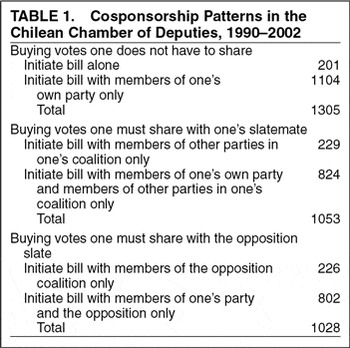
As frequencies reported in Table 1 make clear, legislators favor their copartisans over their coalition partners, and they are relatively indifferent between their coalition and the opposition.20
We omit “grand coalition” attempts that do not distinguish among competitors within a district.
A plurality of attempts entails working alone or solely with one's copartisans. The numbers of times a cosponsorship pattern involves members of other parties appearing on one's coalition list or members of parties in the opposition coalition list are nearly identical.
While these frequencies are indicative of the reputation-building incentives institutionalized in Chilean electoral laws, true tests of the hypotheses generated by our auction model require a multivariate analysis. We constructed a dependent variable to reflect the panels of “currencies” one can use to “buy” votes (Table 1). We then use information on seats and votes to test our hypotheses, as depicted in the previous literature. Thus, we have a dependent variable capturing the currencies or reputations summarized in Table 1.21
1 = buying votes one does not have to share; 2 = buying votes one must share with one's slatemate; 3 = buying votes one must share with the opposition slate.
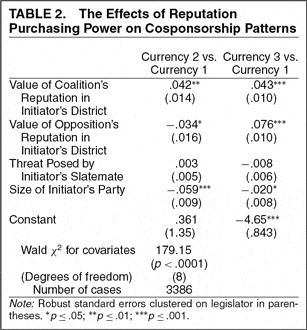
We use a multinomial logit model to test our three hypotheses because our dependent variable comprises more than two, unordered nominal categories. To allow for any lack of independence across observations, we use robust standard errors clustered on a term-specific deputy identification number, thus accounting for the fact that a legislator will appear multiple times—once for each bill he or she sponsored or cosponsored that term. The comparison group is currency 1—sponsoring or cosponsoring bills alone or with the party, so as to buy votes one does not have to share. The coefficients for the covariates then indicate their effect on the likelihood of using currency 2—buying votes one must share with one's listmate—as opposed to currency 1 and the likelihood of using currency 3—buying votes one must share with the opposition list—as opposed to currency 1.
The independent variables are the reputations that can be used to win votes. The information that legislators have available to them on values of personal/party, coalition, and opposition reputations is the votes cast for these units in the previous election. Thus Value of Coalition's Reputation in Initiator's District is the percentage of the vote received by the initiator's list in the previous election. Value of Opposition's Reputation in Initiator's District is the percentage of the vote won by (both members of) the highest vote-getting coalition other than that of the initiator.22
If the same two, and only these two, coalitions appeared on the ballot in every district in every election, coalition reputation and opposition reputation would be inverses of one another. However, there are several parties and coalitions in addition to Concertación and Unión por Chile, and the electoral strength of these actors varies dramatically across districts and over successive elections.
is the percentage of the intracoalition vote received by the initiator's coalition listmate. As we discuss in detail below, our hypotheses about the impact of reputation values on the likelihood that an initiator will make use of them are overwhelmingly supported (see
Table 2).
We measure the value of the opposition's reputation in the district of the initiator with the percentage of the vote it received in the last election. As the coefficient for value of opposition's reputation in the third column in Table 2 confirms, the likelihood of initiating a bill with at least one member of the opposition coalition list and with no member of another party in the initiator's coalition list increases with the opposition list's reputation. The coefficients must be interpreted as the covariate's effect on the likelihood of a cosponsorship pattern relative to the comparison group—in this case initiating a bill alone or with copartisans only. The positive and statistically significant coefficients for value of the opposition's reputation in initiator's district support our hypothesis that incumbent candidates will use a reputation/currency as its vote-purchasing power in their districts increases—regardless of the supposed ideological proximity.23
Rather than seeing coalitions as relatively homogeneous internally and distinct from one another, several scholars argue that the PDC is relatively centrist compared to other members of Concertación, and, to a lesser extent, the RN is relatively centrist within Unión por Chile. In addition, they are the two largest parties. To test whether our results are simply a function of PDC/RN cooperation, we dropped the observations based on bills sponsored by only the PDC and the RN. Observations from all other bills reflect on reputations not dependent on the relationship between the two major parties. In other words, we kept observations based on bills where members of the PDC or RN sponsored alone, cosponsored only with other members of their own coalitions, or cosponsored with members of the opposition coalition including parties other than the major (relatively most centrist) party. Our findings did not change. The signs on all coefficients remained the same, and the magnitude of the coefficients varied only slightly. The variables that were statistically significant and those that were not did not change either. Given that the relative value of reputations held in the full model and the model excluding observations from PDC/RN bills, the relationship between the two largest parties is not driving our results.
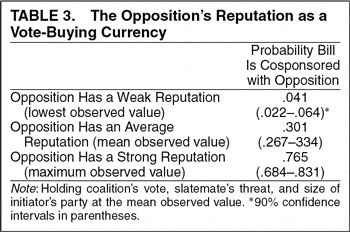
To give a more intuitive substantive interpretation of these coefficients, we present simulated probabilities of sponsorship patterns where one factor of interest is allowed to vary while all other independent variables are held constant. This simulation-based approach conveys numerically precise estimates of the quantity of greatest substantive interest (in this case, the value of the opposition's reputation) and a reasonable measure of uncertainty (a 90% confidence interval) about those estimates (King, Tomz, and Wittenberg 2000).24
We use the statistical simulation program CLARIFY (Tomz, Wittenberg, and King 1999) in conjunction with the statistical software package STATA to calculate the probability of a particular cosponsorship pattern that we can expect when statistically significant independent variables in turn take on a variety of observed values, while holding all other variables constant at a chosen value.
As the simulated probabilities presented in
Table 3 make clear, the popularity of the opposition list in one's district has a large substantive impact on the probability of cosponsoring with the opposition to take advantage of its vote buying potential. When the opposition list is at its weakest, and therefore, the vote-buying potential of its reputation in the district at its lowest, it is highly unlikely that a legislator will try to cash in on its devalued currency—probability of cosponsoring with the opposition, .041. However, where the opposition list is very popular, legislators will ignore any possible ideological distance in an effort to use its vote-buying potential. The simulated probability of initiating with the opposition reaches a high of .765.
25 The positive and statistically significant coefficient for the vote received by the initiator's coalition as reported in column 2 in Table 1 indicates that an initiator is relatively less likely to work alone or with his or her party and relatively more likely to work with the opposition as the strength of his or her coalition grows. This may be an indication that coalition strength is synonymous with one guaranteed seat–the opposition list is unlikely to win both seats in the district. Cooperating with the opposition would distinguish the initiator from his or her slatemate in their pursuit of the one seat the initiator's coalition is likely to win. The negative and statistically coefficient for size of the initiator's party simply indicates that members of the opposition are a less likely cosponsor when the initiator's party is large. This may merely be a matter of opportunity or an indication that members of large parties find their party's size to be a strong currency.
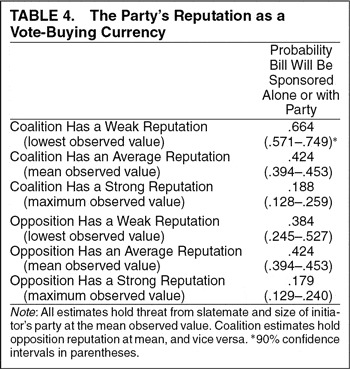
A large party has the predicted impact of increasing the likelihood of cosponsoring with copartisans, but other cosponsors are also attractive depending on the purchasing power of their reputations in one's district. As the negative and statistically significant coefficients for coalition's currency and opposition's currency indicate, initiators are willing to ignore copartisans as the value of other currencies or reputations in their districts increase. As the simulated probabilities in Table 4 illustrate, initiating alone or solely with copartisans is particularly likely when an initiator's competitors are weak but becomes increasingly unlikely as the strength of other actors—the initiator's coalition or the opposition coalition—increases. The increasing purchasing power of one's coalition makes it especially easy to cooperate with it because it is a popular group. The probability of initiating alone or with copartisans drops from .664 when the initiator's coalition is at its weakest to .188 when it is at its strongest. The opposition can also encourage initiators to abandon their parties but not at a similar magnitude. First, the overall lower probabilities in the bottom portion of Table 4 are a result of the coalition's popularity having its mean score. The large confidence interval around the simulated probability of using the party's reputation as a currency when the opposition's reputation is at its weakest means that we cannot be confident that this situation is discernible from instances when the opposition received the average observed vote. However, when the opposition is particularly strong, it discourages initiators from relying on the reputations of their parties.
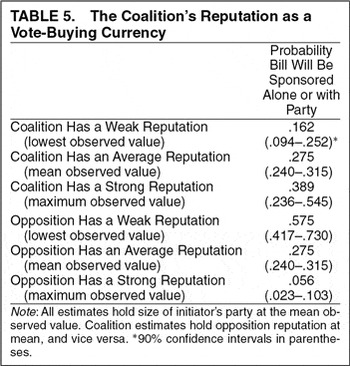
Finally, we examine hypothesis 3 regarding the possibility that the reputation of one's coalition has purchasing power even when one's slatemate is a threat to win more votes than the initiator (Table 5). The hypotheses to be derived from the extant literature are unclear or contradictory on this matter. On the one hand, the existing literature concurs that members of the same coalition should be ideologically proximate, making them likely cosponsors. On the other hand, it also implies that seats are likely to be split between the two coalitions, opening up the possibility of intracoalition competition as a legislator's greatest concern. Conceiving of the Chilean electoral system as an auction makes clear that a legislator is interested in combining any and all currencies/reputations in the most efficient manner to purchase 33%+1 votes in a two-coalition district (the logic remains regardless of the number of coalitions, but the math simply depends on the likely vote of the minor lists and independents). Thus, we hypothesized that legislators are unconcerned with the threat posed by their slatemates, but they are interested in purchasing votes with the reputation of a popular coalition.
When an initiator belongs to a large party, other cosponsors are less appealing. Again, the threat posed by a listmate is not a statistically significant predictor of cosponsorship patterns or reputation building— even when initiating with the coalition has the effect of buying votes for this tough competitor. However, the popularity of the initiator's coalition in his or her district is positively associated with cosponsorship to enhance and capitalize on the coalition's reputation. The simulated probability of an initiator focusing on his or her coalition's reputation increases as the coalition's reputation moves from low to average values.26
The large confidence interval around the simulated probability for when the coalition's reputation is at its highest means we must be somewhat circumspect regarding the predicted effect on the probability of cashing in on the coalition's reputation.
Legislators from districts where their coalitions are unpopular have a .162 probability of cosponsoring bills with their coalitions to the exclusion of the opposition. On the other hand, initiators belonging to a coalition of just average popularity have a .275 probability of cosponsoring bills the credit for which is shared with their listmates in upcoming elections. Holding the support for the initiator's coalition constant at its mean value, changes in the value of the opposition's reputation have a dramatic impact on the apparent purchasing power of the reputation of the initiator's coalition. When the opposition is particularly weak, there is a .575 probability that an initiator will choose to work with his or her coalition, but that probability drops to a low of .056 when the opposition's reputation is particularly valuable.
In sum, incumbent legislators wish to earn the support of prospective constituents in their district. Our auction depiction of the Chilean electoral system makes clear the logic that legislators have a variety of currencies, or reputations, with which they can earn votes. We reasoned that the value of those currencies is not a function of their ideological proximity to the initiator or the extent to which competitors—from the opposition coalition or the initiator's own coalition list—pose a threat. Instead, as our multinomial logit model and the simulations based on its results support, a popular reputation, no matter its supposed position in a unidimensional ideological space, is a valuable currency.
CONCLUSION
The outgoing authoritarian regime in Chile wanted to protect the political Right and to assure that a formerly fragmented and polarized party system coalesced into something approaching a two-party, centrist system. However, a unidimensional spatial model of an electoral system characterized by open-list proportional representation, d'Hondt seat allocation rules, and binomial districts does not reveal predictions of centripetal behavior. Preexisting parties have reason to coalesce into two major coalitions, but binomial districts should discourage the coalitions from converging on the median voter. What is more, open lists should discourage coalition partners from working together, even if they have reason to want to occupy the same ideological position. Yet post-Pinochet Chilean politics has not been characterized by debilitating stalemate or destabilizing levels of political conflict.
Our formal model and empirical tests show that under certain electoral rules the values of partisan, coalition, and even opposition reputations are dependent on the electoral profile of a legislator's district. Using a traditional, unidimensional spatial model, no equilibria predictions are revealed—it is difficult to define the system itself as embodying centrifugal or centripetal forces. With which reputation an incumbent seeking reelection should endeavor to be associated through cosponsorship or other means (roll call voting, etc.) is not clear. We have shown that legislators “bid” on votes by capitalizing on the currencies with the most purchasing power in each of their districts. If this entails ignoring one's coalition or even working with the opposition coalition, so be it. By encouraging legislators to work with all others who have strong reputations, the electoral system avoids polarization and fragmentation. Virtually an identical number of bill initiation attempts by legislators involves members of the opposition list to the exclusion of members of other parties in the initiator's own coalition (30.37%) as involves members of other parties in the initiator's own coalition to the exclusion of members of the opposition list (31.08%).27
This discussion omits “grand coalition” attempts detailed in Table 1 and discussed earlier.
With which group (reputation) legislators cosponsor is a function of that group's strength in the initiator's district.
How generalizable are our findings? We suspect that candidates will respond to the variation in the electoral value or purchasing power of ideological reputations across districts in some common institutional settings. Formal models of the purchasing power of ideological reputations under other electoral rules are in order, but the distinguishing feature of the Chilean electoral system appears to be the combination of interparty competition, intraparty competition, and relatively small districts. Intraparty competition is by definition a feature of democratic systems. Interparty (or, in the Chilean case, intralist or intracoalition) competition is a feature of systems that use participatory candidate selection procedures such as primaries or that use open lists or subparty lists at the general election stage. Relatively small districts make proportionality difficult and thus drive home the need of every member of the list to contemplate both inter- and intraparty competitors. More importantly, greater district magnitude requires assuming that legislators can make Herculean calculations regarding how many votes to buy and with whom to buy them. As magnitude increases the numbers of interlist and intralist competitors increase, and the number of winning electoral strategies (equilibria) multiplies dramatically. Predicting which of many potential strategies a reelection seeking incumbent would choose becomes impossible.
For comparison, systems like that in the United States for electing members of Congress approximate in many ways the key features of the Chilean electoral system for electing Deputies. Intraparty and interparty competition occurs in two stages in the United States,28
Splitting intra- and interparty competition into two distinct stages, may afford candidates a brief opportunity to reposition themselves between races (see, e.g., Kalt and Zupan 1984, 1990), but short general election cycles make it difficult for incumbents to create wholly new cosponsorship or roll call patterns.
at the candidate selection (primary election) and general election stages, respectively. Magnitude is low and disproportionality is higher than even under Chilean binomial districts.
29 Rather than competing for
votes, candidates must seek (in two-candidate races)
votes.
Clearly, the plurality system has centripetal characteristics, but legislators are not entirely homogeneous (see, for example, the Bullock & Brady [
1983] “two constituencies” argument with respect to the U.S. Senate). How might the incentives we have identified manifest themselves in the United States, where, as in Chile, legislators face challenges from both within and outside their own parties? We suspect that legislators' willingness to cross party lines may be a function of the purchasing power of reputations in their districts. Our general lesson is that under the electoral rules noted above, legislators gravitate toward the reputation or positions from which they receive the stiffest challenge. If this holds in the United States, then a legislator who faced a stiff challenge in his or her party's primary should be more prone to cultivate the reputation of his or her strongest challenger. In other words, if the strongest primary challenger was from the liberal wing of the party, the reelection seeking incumbent should cultivate a liberal reputation. On the other hand, a legislator who faced a stiff challenge in the general election should be most willing to collaborate with members of the opposition. An incumbent who won both stages handily may feel free to work without cosponsors, while a legislator who was challenged at both stages may feel compelled to use a mixed strategy—cosponsoring frequently with copartisans and opposition. Note that we are arguing not merely that legislators seek to take policy positions popular in their districts but that in their quest to achieve a plurality of the votes they will actually work to win votes they must share with their toughest competitors.
Ideological position, we argue, is limited to neither spatial conceptions nor roll call manifestations, despite the tremendous advancements these innovations have made possible. Modeling elections as auctions, conceiving of ideological reputations as currencies with varying purchasing power, and using cosponsorship as an indicator of position taking and reputation seeking are not limited to unidimensional policy spaces or institutional rules that define clear equilibrium strategies. Conceiving of ideological position taking as “currency” for buying votes in an electoral “auction” may allow both for new ways of thinking about ideology in situations where the spatial model may be incomplete or intractable and for derivation of novel hypotheses where it seems to work well. Empirically, there is a growing literature that considers patterns of bill cosponsorship in the United States (Kessler and Krehbiel 1995; Koger 2003; Krehbiel 1995; Wilson and Young 1997). Further, this measure of ideology could have wide applications in legislatures where floor roll call votes either are a rarity (as in much of Latin America) or yield relatively little information about individual legislators (as in systems like Great Britain's, where party alignment virtually perfectly determines floor votes). What is more, legislators can select among all possible issues when deciding on bills to sponsor, rather than selecting among only those issues that leader preferences and institutional barriers allow to advance to the stage of roll call votes. Thus, as we have shown, ideology is more than a question of with whom one wants to vote. More broadly, it is a question of the shared policy reputation with which one prefers to be identified.
APPENDIX
Proof
We label the two pre-electoral lists A and B and call the two sitting legislators in each district Candidate 1 and each challenger Candidate 2, assuming that the lists split the seats in the previous election (as is the case in a vast majority of districts). Therefore, there are four candidates per district, two incumbents, C1A and C1B, and two challengers, C2A and C2B. To better differentiate, we refer to incumbent C1A as the coalition incumbent using feminine pronouns, while the opposition incumbent C1B is referred to with masculine pronouns. The proof refers to C1A as the coalition list incumbent and C1B as the opposition list incumbent, but the proof holds for both incumbents by symmetry. The fact that rational legislators prefer to work with candidates that provide the most purchasing power30
“Purchasing power”: The value μi is a measure of a party's or list's vote-purchasing power or “multiplier.” A list's reputation has purchasing power to the extent that it is associated with ideas, positions, and actions popular with the district's voters. Therefore, if μA>μB, then party or list A has greater purchasing power than party or list B.
is straightforward. Further, candidates prefer to buy as few votes as possible because this allows them to maximize the amount they can bid for each vote given their budget constraint. The only reason the proposition would not be true, then, is if a legislator could buy votes to make another candidate a winner, when that candidate would otherwise lose. The proof rests on showing that this is not the case.
Proving this for coalition listmates is straightforward. We assume that legislators share equally the number of votes the legislator buys with the coalition reputation's purchasing power. Therefore, C1A's choice to cooperate with31
“Cooperating with”: A legislator is assumed to be cooperating with another candidate when the legislator buys votes with that candidate's multiplier, μi. This could entail any number of activities including advocating the same policy position through cosponsorship, casting identical votes in a roll call situation, or making a campaign appearance together.
multiplier μ
A (the multiplier associated with her own coalition) has no effect on the differences between the votes incumbent
C1A receives and the votes the challenger/listmate
C2A receives. Therefore, buying votes for coalition listmates will never result in the listmate winning a seat when the incumbent loses a seat. If the incumbent has more votes prior to the purchase, the incumbent will obviously continue to have more votes. If not, the incumbent may lose (provided the purchase does not provide the list with both seats), but that had been the case prior to the purchase, anyway.
Proof for opposition list members relies on the rule in Chilean electoral system that the opposition must receive more than two-thirds of the votes cast
to win both of the district's seats.32
This assumes only two lists. Regardless of the number of lists competing, the first-place list must win more than twice as many seats as the second-place list to obtain both seats. Therefore, our logic applies in all circumstances but is easiest to explain making the simplifying assumption of two lists.
prefers to buy only enough votes to assure victory, since doing so allows her to pay the highest price for each group of votes,
33 Remember that the votes go to the highest bidder.
done most efficiently with the reputation (μ
i) with the most purchasing power. Further, this value is
,34
Note that the model requires only that the legislator be able to pay the highest value for
of the votes. The legislator may not have to do so, if his or her slatemate purchases some votes.
since at that value, the opposition list (here assumed to be list B) cannot buy enough votes to win both seats for list B. What is more, incumbent
C1A's listmate
C2A cannot win more votes than
C1A, thereby winning the election, without assuring that
both of list A's candidates win seats.
If an opposition candidate does not buy
votes, list A wins both seats. Now suppose opposition incumbent C1B successfully buys
votes.35
If opposition incumbent C1B does not do so, coalition list A assures winning both seats.
There are then two possible cases. Either the opposition list multiplier μ
B is greater for all groups of voters summing to
or there is some group of voters summing to
using a multiplier other than the opposition's
. If the latter is the case, the coalition incumbent C1A buys votes using the other multipliers μi. In this case, coalition incumbent C1A can buy only the remaining
votes. Therefore, the incumbent cannot, in this case, buy enough votes to make another candidate the winner, thus proving the proposition in this case.
Now suppose the former is the case: C1B successfully buys at most
votes, but the opposition list B offers the most purchasing power for all groups of voters summing to
. In this case, the coalition incumbent C1A is forced to buy votes with the opposition list's multiplier only (μB). As before, there is only a maximum of
votes left to buy. But again, the opposition incumbent buys
votes, keeping one-third of the votes for herself. In this case, coalition list A has one-third of the votes, and opposition list B has a total of two-thirds of the votes. Therefore, opposition list B does not exceed the two-thirds threshold for winning both seats, and coalition incumbent C1A retains the remaining seat. This proves the proposition in this case.
A previous version of this paper was presented at the 2003 Annual Meeting of the Public Choice Society. The authors thank Scott W. Desposato, Bradford S. Jones, and three anonymous reviewers for comments on early drafts.






Comments
No Comments have been published for this article.