INTRODUCTION
Ethnographic studies of urban food-and-livelihood security in Sub-Saharan Africa show that the urban poor are a resourceful, adaptive, resilient category whose ways of dealing with hardship deserve research and policy attention (e.g. Iyenda Reference Iyenda2001; Lourenço-Lindell Reference Lourenço-Lindell2002; Mandel Reference Mandel2004; Tollens Reference Tollens and Trefon2004; Gallaher et al. Reference Gallaher, Kerr, Njenga, Karanja and WinklerPrins2013; Simiyu & Foeken Reference Simiyu and Foeken2013). Ethnographers generally appreciate that multifaceted, grassroots initiatives keep cities ‘working’ and food secure. Such ethnographic research is indebted to Jane Guyer's landmark volume on urban food markets, Feeding African Cities (Guyer Reference Guyer1987), which showed how the supply of urban foodstuffs had become reliable and affordable thanks to institutional linkages that span the urban and the rural. While much research on urban food supplies is now focused on the potential for urban agriculture, the legacy of Guyer's volume persists in research on social dynamics – gendered constraints and opportunities in particular – with regard to food processing and marketing; urban livestock keeping; long-distance trade; and food policies aiming to protect the vulnerable (see e.g. Overå Reference Overå2007; Hovorka et al. Reference Hovorka, de Zeeuw and Njenga2009; Pottier Reference Pottier, Domingos, Sobral and West2014). At the core of these interests lies a belief in people's capabilities. As Sandra Wallman demonstrated in her study of medical treatment seeking in a Kampala neighbourhood in the early 1990s, ‘in even the most dire circumstances … every setting, every person … has capabilities, however limited’ (Wallman Reference Wallman1996: 231).
Between early July and mid-October 2012, I carried out qualitative, ethnographic research in two densely populated wards of Kampala – one peri-urban, the other situated on the urban/peri-urban cusp – in order to gain a broad understanding of how food (in)security was locally understood. I concentrated on how the urban poor (a diverse category) perceived their food (in)security; what their food intake was like; how food intake might relate to seasonality; and what strategies were deployed to stay food secure. These themes mirrored interests I had pursued in Lilongwe townships, Malawi, in 2011 (Pottier Reference Pottier, Domingos, Sobral and West2014). In common with other food-focused anthropologists, I aimed to develop the kind of ‘interpretive reach, texture and nuance which just isn't accessible to survey-based, statistics-driven approaches’ (Roopnaraine Reference Roopnaraine2012: 51). In the Uganda context, the need for qualitative information has been stressed by Dr Hebe Welbourn, a pioneer of targeted nutrition intervention, who spoke of the value such information adds to numerical evidence (Welbourn Reference Welbourn1963: 14).
In conducting survey interviews, administered in 118 households, I quickly learned that the English term ‘food’ is difficult to translate in Luganda. As culturally understood, a meal consists of staple food (emere) and relish (eriani). Emere can be a stiff porridge made from maize or millet flour, or may be a dish of boiled potatoes, cassava, rice or steamed plantains (Whyte & Kyaddondo Reference Whyte and Kyaddondo2006: 174). Starch foods can be combined. In Kampala, meals are essentially of the ‘classic’ Buganda variety with steamed plantains (matoke) featuring as the preferred staple, but, as will be seen, with posho (stiff maize porridge) becoming popular when matoke turns scarce and expensive. The relish (eriani), a kind of sauce, is commonly made with groundnut flour, onions and tomatoes, a leafy green vegetable and/or beans, and, when affordable, some meat or fish.
My study did not aim to ‘measure’ food insecurity the way it is conventionally done in large surveys from which household ‘food consumption scores’ are calculated (see World Food Programme/WFP 2009), nor did it measure the extent and intensity of short-term coping mechanisms by working out ‘cumulative food security scores’ (see Maxwell Reference Maxwell1996). I did use a questionnaire to generate basic insights and some statistical information, but took every opportunity to engage respondents in open-ended conversation. Besides collecting brief personal data, the questionnaire covered: household composition and length of residence in Kampala; meal frequency and dietary diversity; food shopping practices; periodic adjustments in response to food shortages and high prices; livelihood diversity; income and expenditure, including for healthcare; urban-rural interactions; and urban agriculture.
As I was also keen to learn about household composition in a context where HIV/AIDS had claimed a heavy toll, I started off making brief notes on who resided in each household. Later on, after learning how some households relied quite heavily on non-residents for their survival, I collected more comprehensive, more reliable information. In the final week of research, I revisited a dozen households, mostly complex ones, to fine-tune the genealogies. The idea behind this fine-tuning was to probe how the burden of care was spread within the extended family, for instance via food gifts and the payment of school fees.
Finally, for reasons of protocol and personal safety, I was introduced to potential respondents by zone-level administrators who knew the people well. Their presence, always low key, proved helpful; never did I face interference or obviously skewed responses. As a rule, I aimed for a mixture of large and small households. Beyond this, it was a question of who was available and willing to be interviewed (see also Welbourn Reference Welbourn1963: 20). The only possible bias in this random sampling exercise occurred towards the end of the research, when my curiosity about large three-generational households (some were very complex indeed) made me want to meet more of them. As a result, the percentage of large households in my sample may have been on the high side.
WIDER SETTING AND FOOD FLOWS
Following consultation with colleagues at Makerere University and with the Mayor of Kawempe Division (1·2 million people), I researched in Bwaise-2 and Kawempe-1. In part a congested slum, Bwaise-2 ward has over 17,000 residents and is subject to periodic flooding; agriculture is hardly practised. Here I researched in Jambula zone, where ‘real slum’ conditions exist, and in Lufula, which is popularly said to have ‘more decency’ and a mixture of fortunes. Kawempe Division also has wards that do practise agriculture, as in Kawempe-1, whose population is double that of Bwaise-2. Urban agriculture in Kampala has a long history (see below), but its appeal gained momentum during the 1980s liberation war, when ‘the purchasing power of formal wages … was less than one tenth what it had been in 1972!’ (Maxwell & Zziwa Reference Maxwell and Zziwa1992: 10).
Historically, Kawempe Division, initially termed Kawempe Township, was outside Kampala's municipal boundary but within Greater Kampala (Southall and Gutkind Reference Southall and Gutkind1957: 12). Gazetted in 1955, the township ‘sprung out in chaotic spontaneity’, experiencing conditions similar to those found in other suburban pockets: among them, dense settlement, a lack of infrastructure and poor sanitation (1957: 17). Lying outside the colonial capital's boundary, the dominant form of tenure in the township was privately owned mailo land (Fortt Reference Fortt, Richards, Sturrock and Fortt1973: 68–9).
Following land reform and a succession of new laws early on in the 20th century, land in Buganda ceased to be controlled from the political centre; some estates remained in royal and chiefly hands, but vast amounts became available as mailo land to the Baganda population. This gave Baganda women ‘the legal capacity to inherit, purchase and own freehold land in their own right’. Baganda women now had a choice not shared by other women in the region: ‘they could either do what their families would expect of them and get married, or they could remain single and become economically independent land-owners’ (Ogden Reference Ogden, Werbner and Ranger1996: 172). The number of mailo owners, just under 4,000 in 1902, rose to 100,000 by 1965 (1966: 26). The trend slowed down, however, with the rising value of land in the 1960s (Richards Reference Richards1966: 26). Fathers now began to use their ‘testamentary freedom’ to leave their mailo land to whoever they pleased (1966: 25), thus turning siblings into potential co-heirs and rivals. Today, exploiting a family plot (kibanja) at home, which many Kampala residents do, indicates they have either inherited the plot or expect to do so.
Importantly too, where mailo land is subdivided and let, tenants have significant rights, and cannot easily be evicted. Historically, this has caused frustration among mailo landowners, especially in densely populated areas (Fortt Reference Fortt, Richards, Sturrock and Fortt1973: 83). This reality lives on in the 1998 land law, which stipulates that the mailo landowner must leave the tenant undisturbed unless s/he defaults on the rent (Hanson Reference Hanson2003: 239). The upshot in suburban Kampala, where mailo land has acquired high economic value, is that tenancy holders may be cashing in (e.g. through building shops or lodging houses for rent) whereas owners are unable to capitalise on the land. Southall & Gutkind (Reference Southall and Gutkind1957: 35) noted the anomaly already in the mid-1950s. The contemporary situation is complex. Where my respondents stated that they own the land they live on, which was the case in 58·5% of household heads interviewed, they may either hold the land title in their name or hold it in the form of a kibanja, which means that the long-term use rights have been purchased from the person holding the title (see also Maxwell & Zziwa 1999: 36).Footnote 1
At the turn of the last century, suburban Kampala wards (previously called parishes) were known to have grown
in an unplanned, headlong fashion with the net result that there [were] virtually no public services or facilities (i.e. drainage, sanitation, public health units, etc.). Most residents earn[ed] a living as market traders, shopkeepers, hawkers, wheelbarrow pushers, food vendors, brewers and sellers of local beer and gin, drivers, factory workers, domestic servants or low-paid office workers. (Bantebya Reference Bantebya, Jones and Nelson1999: 116, referring to Kamyoka II parish)
When Kampala first attracted large numbers of migrants, their objectives and conditions were not conducive to setting up large families. Men mostly wanted to make some capital to invest on returning home (Elkan Reference Elkan1960: 42–3); women also aspired to making their own money, but many arrived as single women hoping to achieve independence and settle in town. They escaped ‘not only … from tribal sanctions, kinship obligations and male dominance, but in many cases from marriage itself’ (Southall Reference Southall and Southall1961: 224). In Namuwongo-Wabigalo ward, Christine Obbo learned that
single women fell into five categories: (1) women who had never married; (2) women, including divorcees and widows, who were irrevocably tired of marriage as an institution …; (3) women who belonged to the first two categories but lacked the resources to be self-supporting; (4) women who … hoped to marry urban men or rich rural men who frequented the city …; (5) women who were caught up in the scramble for non-existent or underpaid jobs and often resorted to ‘the skill that comes naturally’ – sex. (Obbo Reference Obbo1980: 88)
Even when they had husbands, women who worked as petty traders normally worked on their own (Bantebya & McIntosh Reference Bantebya and McIntosh2006: 178). Invariably, however, urban women faced gender-related problems in their families and at work, leading to high divorce rates (Richards Reference Richards1966: 21).
For the wards I researched in, the 2002 Uganda Population and Housing CensusFootnote 2 provides the statistics shown in Table I.
Ward-level statistics

The food traders I conversed with, mostly in the markets of Kalerwe and Kawempe-1, told me that the city's food supply has undergone dramatic changes. Kampala used to get much of its food from the country's Central Region, which nowadays is said to suffer soil exhaustion. Today, produce comes from the Central, Eastern and Western regions, with the exception of matoke (plantain), which grows in abundance in districts west of the capital city: Mbarara, Rukungira, Masaka and others.
Matoke, rice, maize, beans, sweet potatoes and cassava are commonly consumed. Central to the Kampala diet, matoke is abundant from mid-January until the end of June, after which the availability goes down and the price increases steadily until it doubles by the end of the year. The period of scarcity occurs when local rice is unavailable (May–August) and more expensive rice is imported from Vietnam, Pakistan and Tanzania. The third key staple, maize, usually sold as flour, is sourced from all over Uganda. There is good availability from July until late February. For beans, the popular pulse, Buganda is the main provider from October until late April. The market price then rises until September, when bean mixtures (called mawanga magate, literally ‘mixed tribes’) are sourced from outside the district. Large-scale traders also create shortages and price hikes by hoarding local beans (called nabaale beans). Sweet potato, another important food, has a more complex cycle of abundance and scarcity, with July–August and January–February being times of low availability and high prices. Finally, cassava has a fairly regular supply, knows no significant price hikes, and is often eaten cooked and prepared as a stew (katogo of cassava). Fried cassava is a popular breakfast.
The Government of Uganda does not regulate food prices, but addresses ‘micronutrient malnutrition by conducting iron and Vitamin A supplementation for children 6–59 months and for women’ (Harvest Plus 2012: 1). Food diversification through nutrition education is also promoted. Food prices, however, are determined by the market in response to supply fluctuations. Low supplies are caused by seasonality, erratic weather conditions and the ever-rising cost of fuel for transportation. Recent years have seen heavy inflation in the price of food, with the exception of 2010 when there were bumper harvests for maize and rice (EPRC 2012).
When periods of scarcity – and thus high prices – are put next to each other, it becomes clear that July–August is a time when hardship sets in for the urban poor (see Figure 1).
Food price fluctuations, Kampala 2012

Price fluctuations also reflect regional factors. Of importance here is Uganda's role as a key contributor to food security in East Africa. Vast quantities of beans and maize are exported to Kenya, Tanzania, Rwanda, the DRC and South Sudan. Maize exports can be informal or formal; in the latter case, a significant amount is funnelled through the WFP programme, which ‘puts direct upward pressure on maize prices inside Uganda’ (Gautam & Zorya Reference Gautam and Zorya2008: 6). This upward pressure may be good news for large-scale farmers, but not for vulnerable consumer groups like the urban poor (2008: 10). In September 2010, WFP staff informed me that 25% of Uganda's grain export was organised through their programme (staff 2010 int.).
Seasonal difficulties in food procurement also relate to the school calendar. In Kalerwe market, a dry-food trader made the following connection:
Market prices for posho [maize flour] and beans tend to rise every time the children return to school after vacation. Because schools must have a guaranteed supply, they are willing to pay more. With posho, which schools and small traders like myself buy wholesale from grain milling companies in Kasenyi [in Kampala], I find myself in competition with schools. I have no option but to accept to pay the higher prices, which I must then pass on to customers. (2.10.2012 int.)
Consumers, too, linked the school calendar to procurement difficulties, though from a different angle. As Rose (pseudonym) told me,
The termly payment of school fees is financially stressful, and usually means that for a while only posho and beans can be afforded. Even when there is plenty of matoke around! Seasons in terms of the weather do not affect us very much, but whenever school fees must be paid, and the money supply goes down, the diet drops to posho and beans – and we have just one meal a day. (17.9.2012 int.)Footnote 3
Rose's mother, who was divorced and lived in, met the household's school fees: for her daughter's three sons (aged 18, 15 and 7), one nephew (aged 14) and one classificatory grandchild (aged 6). The fathers of these children, I was told, contributed very little.
HUNGER, SEASONALITY AND MEALS
I take people's perception of their food intake and its quality as my point of departure because this approach complements the work on metric measurements and nutritional value by health specialists. Also, global definitions of food security underscore the institutional and political aspects of an adequate diet; variables that cannot be quantified. Of the key dimensions to food security (availability, access and adequacy), matters of accessibility cannot be grasped when power relations and cultural expectations are left out (FAO 1996: 3). Targeted interventions, for example through nutrition education, may fail when local experiences of vulnerability are left unaddressed (Wheeler Reference Wheeler and Wood1985). As will be seen for the research area, coping with vulnerability meant achieving two meals a day and some diversity of ‘food’ and relish during the week.
At the onset of my research, in July 2012, matoke was still relatively abundant and affordable, except in the poorest households. Two months later – matoke now scarcer and growing in cost – more households had reduced their matoke intake; many were already pegging down to a late breakfast and just one meal a day. Hunger was said to have set in. That July marks a turning point for poor households was made explicit when an informant told me: ‘July is difficult because matoke, rice and sweet potatoes all become expensive. From July onwards, we eat one meal a day’ (26.7.2012 int.).
The period of research (July to mid-October) was marked by a gradual change in food availability, cost and intake. The interviews gave me a sense of what this change entailed, and when and why it came about. Unlike in Lilongwe, Malawi, where the perception of seasonal dietary change revolved around the low availability of (exceedingly expensive) maize meal towards the end of the calendar year, seasonal change in Kampala had to do with the availability and cost of matoke, which, when expensive, is initially replaced with imported rice (if rice can be afforded) and ultimately with a stiff porridge made from maize meal (posho). When rice can no longer be afforded, poor households switch to posho with beans in a groundnut sauce, and eat just once a day. The arrival of cheap(er) local beans in October is then eagerly awaited. In times of food stress, the relish should still contain some onions and tomatoes, and a leafy green. Popular greens are cabbage, spinach and kale; less common are indigenous greens like nakati (Solanum ethiopicum), ddodo (amaranth), and buga (Amaranthus dubious). Kale is locally known as ‘sukuma weekly’, meaning: eat once and it will push you for a week. Poor families do not eat vegetables daily.Footnote 4
For the urban poor the year has two halvesFootnote 5:
February-June/July = breakfastFootnote 5 and two meals (matoke-based) a day;
July/August-January=late breakfast and one late lunch (increasingly posho-based).
When matoke is abundant and cheap, low-income households may manage a meat or fish stew at the weekend. Silver fish (mukene) is particularly popular, as is offal when ‘meat proper’ cannot be afforded.
As already noted, the seasonal shift in staple food is gradual. When I interviewed her in September, Josephine, who did not consider her household to be food-insecure, reflected:
It is getting difficult to eat matoke every day. I can no longer buy a whole bunch, so I buy loose plantains and combine the [steamed] matoke we eat with posho or rice. Last week I bought matoke for 3,000USh only. One day [in the week before interview] we had matoke and posho with fresh silver fish, another day we had matoke and rice with a groundnut sauce. The remaining days of the week we had rice and beans; rice with a groundnut sauce; rice with dried fish; and a cassava stew (katogo of cassava) with beans. When the price of matoke rises sharply, as it does between September and December, we have katogo of matoke just once a week. (12.9.2012 int.)Footnote 6
Mixing reduced amounts of matoke with rice was common. Ultimately, though, the poorer a household the more quickly it switched to posho with a simple groundnut sauce, and lived on one meal a day. Beans would be added to the relish as soon as cheap local beans became available (see Figure 1). The one meal a day turned into a late lunch taken around 4 pm – ‘Uganda time’! This late lunch was had when day-school children came home. If the parents or carers could afford to pay for school lunches, the children would already have had the standard posho-and-beans school lunch. In theory, the relish for the late lunch is not affected by seasonal change. But, as the hardship deepens, it will no longer contain fish or meat, and may have fewer tomatoes and onions.
The observed strategies of cutting down on food portion size, switching to less preferred foods, and – in the case of acute poverty – settling for just one meal a day, were short-term coping measures that were also recorded in the early 1990s (Maxwell Reference Maxwell1996). Respondents borrowed food and cash, as an interim measure before deciding that the actual number of meals needed cutting. Men in their early twenties said they often got ‘cash credits’ from a friend, perhaps two or three times a month, and that the amounts borrowed needed to be repaid quickly. Older informants, on the other hand, would first contact their grown-up children for assistance or approach a friend, or would obtain food on credit from a helpful shopkeeper or market vendor. In its assessment of how Ugandans coped with high food prices in 2008, the World Food Programme reported similar findings (WFP 2009: 79).
PERCEIVED INSECURITY, HOUSEHOLD STRUCTURE AND COPING MECHANISMS
In terms of nutritional value, the shift from matoke- to posho-based meals does not mean that the diet worsens. After all, as is well established, the mainly carbohydrate preferred diet of poor Baganda lacks protein, becomes unbalanced when children are weaned, and may lead to kwashiorkor and stunting (Welbourn Reference Welbourn1955a: 170). Also noting that plantains are deficient in protein, Elkan qualified the standard Ganda diet as ‘a diet which satisfies hunger’; it compared unfavourably with diets structured around millet varieties and root crops (Elkan Reference Elkan1960: 12–13). The diet of Kampala Luo, for instance, which was more cereal-based and varied, was found to be nutritionally far superior, as was that of middle class Baganda (Welbourn Reference Welbourn1955b: 294; Rutishauer Reference Rutishauer1965: 567). While shifting to a posho-based diet is not in itself detrimental to their health, what mattered to my informants was that the shift was virtually synonymous with pegging down to a single meal a day, without any improvement in the amount or quality of the relish they consumed.
Out of my sample of 118 households, 24 respondents mentioned having had just one meal on the day before the interview. They indicated that this one-meal-a-day had become the norm. Of those 24, 16 were grandparents who cared for grandchildren and sometimes nieces/nephews. The other eight food-insecure households involved adults whose income derived from poorly paid informal activity, such as peddling small non-food items, beer brewing, the sale of liquor, sex work, doing laundry, repairing shoes and selling street foods. Despite their reliance on poorly paid activities, the heads of poor households often cared for children other than their biological offspring. Quite a number of these children were orphaned, mostly because the parents had died of AIDS. However, it was often the sheer number of dependents, who frequently included unemployed ‘own children’, which plunged households into food insecurity.
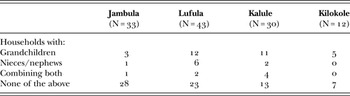
The high number of grandchildren who were looked after by grandparents, mostly single grandmothers (26/38), was a key feature of the research scene. A small majority of these grandparents (22/38) thought their households stayed food secure throughout the year. For each of the four research zones, Table II lists the number of households in which grandchildren and/or nieces and nephews were being cared for.
Caring for grandchildren and nieces/nephews

Roughly 40% (47/118) of the households surveyed had grandchildren and/or nieces and nephews in residence. This stands in marked contrast to the era around Uganda's independence when Kampala households had remained small. As Southall & Gutkind (Reference Southall and Gutkind1957) observed in Mulago, where ‘the family unit’ seemed the norm, its most striking feature was ‘the relative scarcity of children under five’ (only 9% of the population), a fact linked to ‘the custom of [parents] having their young children looked after by relatives who do not necessarily live in town’ (1957: 132). While it was true that the prospect of an advanced education was a magnet that brought rural children to Kampala, as Richards showed for peri-urban Kisozi (Richards Reference Richards1966: 66), the movement of children was by no means unidirectional.
How did the urban poor get by? Here is the telling case of Mary, a widowed grandmother who just about managed to keep her complex household food secure. At the time of our interview, she still managed to serve up two meals a day, with some diversity.
Mary's story
Mary, aged 56, was still a child when she left her home village in Wakiso district to be educated in Kampala. She married in her mid-twenties and had lived in Bwaise-2 ever since.
Of her five children, the second son, unemployed, lived with her. The other two sons lived and cultivated in her natal village; one of these sons had a family of his own. The kibanja plot the sons cultivated used to be owned by their mother's father. Recently, however, a dispute over land access had broken out. It was a battle the sons appeared to be losing. In addition to the son who lived with her, Mary looked after 11 grandchildren (six boys, five girls), young teenagers mostly. Six belonged to her twin daughters, who lived elsewhere and whose marriages had failed; two were the offspring of the son who lived in; one issued from Mary's first son; two were by her youngest son (they had different mothers).
For food, Mary got whatever she could get from the family farm in Wakiso, but this was not enough; money was needed for food purchases. Most days, Mary spent about 5,000USh on staple food and relish, which, for such a large household, was still insufficient. However, since she owned her house, Mary made money from selling piped water, enough to cover the cost of the daily meals. Her customers were charged half of what people paid at regulated standpipes, i.e. 100USh for a 20-litre jerry can instead of 200USh. But some customers paid the full amount. Other income came from a resident granddaughter who earned 1,500USh a day as a shop assistant, and from the two non-resident sons, who together contributed 3,000USh a day on average. Only the two grandchildren from her youngest son (who lived in Wakiso) attended school; their father paid the tuition fees. (based on 19.7.2012 int.)
Mary's story is of interest not only because it is representative in that she pursued a combination of coping strategies, but also because of the implications for household analysis. Indeed, Mary's situation, and that of many other grandparent-headed households, raises questions about how the ‘urban household’ should be conceptualised. While my informants were often responsible for large numbers of dependents, who lived together and shared meals, the support networks that made living-in-town possible clearly straddled the urban-rural divide.
But Mary's story does not end here. Mary also cared for a sick, widowed, elderly neighbour, roughly of her own age, whose AIDS-related condition prevented her from cooking meals. This neighbour, whom I call Brenda, dropped in for lunch on a daily basis and would be brought food on days she did not appear. Brenda was also helped by a small group of neighbours who would see to it that she received firewood for free when her income – from letting part of the house – proved inadequate. Other friends, and relatives from Brenda's home village, would also leave small amounts of money whenever they visited.
The friendship between Mary and Brenda resonates with research in Kampala in the early 1990s, which documented the role of ad hoc community networks ‘based on diverse interests such as work, religious inclinations, residential proximity and compatibility’ (Obbo Reference Obbo, Jones and Nelson1999: 149). Support by such networks reflected the moral concern that ‘one should care for others if one hopes to get a decent funeral, which everyone deserves’ (1999: 149). Obbo recalled how older people expressed their ‘fear of dying without being mourned if they [were] not friendly to their neighbours, generous with close and distant relatives, or if they [were] unco-operative at the work place’ (1999: 151–2; emphasis added). Acts of kindness involved the regular sharing of food, even with newcomers who appeared isolated.
In addition to the role grandparents played in running urban households and trying to keep them food secure, contributions by another type of carer – the senga – must also be acknowledged. Historically, the senga (father's sister) institution is known as the Buganda channel of communication about sexual behaviour for adolescent girls, even though boys too may have a senga.Footnote 7 Today, senga practices are in crisis, in both rural and urban settings, yet some medical practitioners believe that the institution can still be harnessed ‘to develop more culturally appropriate forms of sex education for girls, particularly out of school girls and adolescent mothers’ (Muyinda et al. Reference Muyinda, Kengeya, Pool and Whitworth2001: 353). The Kabaka (king of Buganda) is also working to revive the institutional role of the paternal aunt. When I discussed matters of education with Lydia, a research participant I met regularly, she too asserted that the senga still had a role to play. Lydia and her husband, whom she described as ‘a farmer and a businessman’, had lived in Bwaise-2 since marrying in the 1980s. Among the young relatives they cared for were several grandchildren as well as a daughter of Lydia's divorced brother. Of this niece, Lydia said she felt duty-bound by her role as senga. Looking after the young niece made Lydia relive what she herself had experienced when coming to Kampala as a child. She, too, had stayed with her paternal aunt to have the opportunity of a good education (12.9.2012 int.).
That older people may take charge both of grandchildren and of nieces/nephews they are senga to, was borne out in the life-history of another respondent, Julia, who lived with two girls who called her jaja (grandma) and two boys who called her senga (19.9.2012 int.). The boys’ parents, their father being Julia's son, were deceased. She said that some years earlier another young niece she is senga to had also lived with her in Kampala. Julia had raised and educated the niece until she gained a professional qualification. I came across several other households in which a senga cared for nieces or nephews whose parents had died or divorced. In most cases, as with Julia herself, the senga was simultaneously a grandma to others in her care.
Sometimes, a senga offered financial assistance without taking the children in. Catherine, for example, a 64-year-old widow who looked after four orphaned grandchildren on a shoestring budget, received money from two daughters who were senga to these grandchildren (10.9.2012 int.). Likewise, a senga might assist a niece/nephew materially later on in life. Thus Florence, whose migrant husband sent money only sporadically, was helped by her senga when she aspired to open a restaurant. After Florence had saved 60,000USh as start-up capital, her senga gave 20,000USh to help secure the rent agreement (10.9.2012 int.).
Let me add a note on rentals. In Kawempe-1 ward, nearly all food-secure households headed by grandparents (8/10) made money from rentals. The practice seemed widespread throughout the ward. Older, long-term residents had often bought their homes, or a mailo plot to build on, when urban land was still plentiful and cheap. Until the early to mid-1990s, land around the house had been used for farming, but when Kampala's population boomed and serious profits could be made from lets, home owners started to build rentals on this land. There is a strong parallel here with the situation in 1990s Lilongwe (Pottier Reference Pottier, Domingos, Sobral and West2014). Income from rentals meant that school (and even university) fees could be met without too much sacrifice. (In contrast, Bwaise-2 respondents owned fewer rentals.)
Grandparents who maintained the ideal of two meals a day and some diversity of ‘food’ and relish when food prices peaked, did so because of one or more of the following strengths. First, the adults in residence had regular incomes from employment or rentals. Gainful employment came from formal and/or informal sector work. Second, the grandparent(s) received direct contributions – produce or money – from rural family farms to which they had access. These farms were often a good size and might permit lucrative trading. Third, the grandparent(s) received financial assistance to meet the expense of school fees and food for some of the grandchildren (or nieces and nephews) they had in their care. This kind of assistance was more difficult to secure in the case of orphans. In addition, grandparents might have an adult son or daughter living nearby who helped out with food provisioning.
The above assets – regular income (employment, rentals), access to rural family land, and assistance with cash/foodstuffs for certain dependents – were the same assets that two-generation households also needed to maintain or improve their food security.
A NEW DISCOURSE ON CHILD FOSTERING
Child fostering among Baganda has a long history. According to Ainsworth (Reference Ainsworth1967), the practice of mother-child separation was traditionally sanctioned at the time of weaning, which frequently coincided with the birth of a new baby. The weaning child would normally be sent to a ‘grandmother, either maternal or paternal, who was chosen by the parents’ (1967: 417, emphasis added). A second reason for fostering – in the ‘old days’ – related to the recruitment of children to be brought up at the Kabaka's court. As a strategy for escaping such recruitment, it became ‘desirable to send [the] child to live with the maternal grandmother or another of the mother's relatives’ (1967: 417, emphasis added). A stay with maternal relatives, who were not of the child's own clan, provided safety when the recruitment officer called.
With relevance to the situation in Kampala today, Ainsworth added:
If neither grandmother wanted the child, another female relative might be selected as the foster mother, preferably either the father's sister or the mother's sister. If no one seemed really to want the child, and the parents were nevertheless set on the separation, they might take him surreptitiously to the home of the grandmother and leave him without seeking her consent. Under these circumstances the grandmother was obliged to accept the child. (Ainsworth Reference Ainsworth1967: 417)
When Welbourn researched the possible benefits of fostering to Baganda children of weaning age, she argued that conditions of malnutrition might clear as a result of the fostering, but this was by no means a common outcome (Welbourn Reference Welbourn1963: 20). Ainsworth, for example, noted that it was ‘more frequently [observed that] the separation from the mother made matters worse rather than better. Too often the child was moved to a household where he belonged to no one in particular’ (Ainsworth Reference Ainsworth1967: 427). In actual fact, children fostered in rural areas might be reclaimed by their urban mothers precisely because they had developed kwashiorkor (Welbourn Reference Welbourn1963: 20). Given these mixed results, it was perhaps inevitable that child-mother separation for Kampala children had declined by the early 1960s (1963: 16).
Today there are signs that HIV/AIDS has rekindled the practice of child fostering, albeit with a thoroughly altered discourse. Looking after orphans has resulted in large three-generational households in which the middle generation is mostly missing. In my sample of 118 households, the average of size for households where grandchildren were fostered was 7·9 members, but about a quarter of them had 10 members or more. The explanation for such large households is that the AIDS pandemic makes ‘women, especially those with cash resources, commonly assume responsibility for orphans’ (Bantebya & McIntosh Reference Bantebya and McIntosh2006: 256). To this must be added the already noted ‘tradition’ that grandmothers cannot refuse to take in grandchildren (Ainsworth Reference Ainsworth1967: 417) – a practice which also appears to be growing.
The high incidence of grandparents who manage large, complex households has given rise to a discourse on ‘real grandchildren’. Several times in my research, grandmothers reflected on which grandchildren they would ‘ideally’ look after. Visiting Ruth, I asked her if it was true – as I had heard – that maternal grandparents were nowadays more likely to take care of grandchildren. She gave a thoughtful response: ‘When a daughter-in-law misbehaves towards the husband's side, the husband's parents may end up not loving her children. They will question whether their son really is the father of those grandchildren whose mother is misbehaving’ (4 October 2012 int.).
I took this up with another grandmother, Prudence, whose husband ran a successful small business. The couple's four children all had children of their own: one daughter was unmarried; one daughter had left her first husband; the two sons were divorced. The sons' children were staying with their biological mothers or mothers' mothers; the children of the daughters (aged 10 and under) were staying with Prudence and her husband. As I felt at home with this family, I put my question to Prudence.
Self: Is it true that maternal grandparents love their grandchildren more than paternal grandparents do?
Prudence (reflective): The grandchild from your daughter is the real one because the one from your son can be taken away from you and given to another. [Luganda: Omuzukulu wo mwana omuwala mwana wa ddala kubange owo mulenzi basobola okumukujaico oba mugaba eri omusajja omulala.]
Self (frowning): Can you help me understand this better?
Prudence: As we say, a grandchild for a daughter is a real grandchild. It is different for sons, because paternity is never clear. (4.10.2012 int.)
Another informant endorsed this, adding that maternal grandparents care more ‘even when paternity is not in doubt’. She injected nuance: ‘Grandparents on the paternal side do not care much; they do not treat the grandchildren the way maternal grandparents do. The latter treat the children well; they truly care about them. But on the paternal side, grandparents only care if the father, that is their own son, is still alive’ (4.10.2012 int.).
The underlying logic is that when grandchildren are taken in, it is ‘better’ (more satisfying, less trouble) to look after a daughter's offspring. My kinship diagrams confirm this: children living with grandparents frequently belonged to daughters who had gone through a divorce and were starting new relationships. Sarah, another informant, was explicit on this point (28.9.2012 int.). Her household consisted of herself and the children who issued from the failed, first marriages of three of her daughters. Each daughter had seen her children rejected by the man with whom a new relationship was begun. So the children ended up staying with their maternal grandmother.
The growing ‘preference’ for looking after maternal grandchildren departs from practices recorded in the 1990s, but reconnects with the much earlier practice whereby maternal grandmothers fostered children lest they be recruited by the Kabaka (above). For Kampala in the early 1990s, Obbo (Reference Obbo, Jones and Nelson1999) showed that it was ‘tradition’ to call on paternal grandparents should grandchildren need to be taken care of. One particularly striking example she discussed was that of Mika, a young man who died of AIDS after fathering seven children with different girlfriends. On his death, and with the irate former girlfriends fearing for their own lives, all ‘seven children were “brought home to their father as custom demanded”’ (1999: 156). Describing the situation in Luwero, Guest wrote likewise: ‘Children belong to the father's family, according to customary law, so usually go to them after his death. Mothers are expected to go away and start a new family’ (Reference Guest2001: 98). In the 1990s it was commonly said that ‘when a woman does not produce, her husband's clan cannot grow’ (Ogden Reference Ogden, Werbner and Ranger1996: 177). In Kampala's poorer neighbourhoods today, the perception that a woman produces for her husband's clan, has lost much of its prominence – even though, in the absence of formal ceremonies, the birth of children continues to validate urban marriage (1996: 178).
ROLE OF RURAL FAMILY FARMS IN URBAN FOOD SECURITY
Farming ‘at home’ matters to the Kampala residents. Many women and men I interviewed, in fact nearly half of my respondents, had access to a kibanja under the mailo system. This greatly enhanced their food security. But there was a complicating factor: since kibanja is not formally divided, siblings must negotiate the terms on which the inherited land is to be allocated and used, especially when the deceased owner has left no will. As negotiations often fail to satisfy every party, informants may give vent to their frustration. Unhappy because she was not getting any produce from the family farm that her brother and sister cultivated, one disgruntled interviewee said of the hunger she knew in the city: ‘Food shortage starts at the village’ (bula lyemere litandi kira ku kyalo) (12.7.2012 int.). Farming or not farming a piece of rural family land made a big difference in the quest for urban food security.
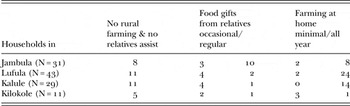
I collected systematic information on the rural connections that respondents maintained with their areas of origin. I was interested to know whether respondents cultivated land at home and, if not farming, whether relatives provided them with food gifts, either occasionally or through the year. The results are shown in Table III.
Rural contributions to urban food supply (114 households)Footnote 12

Households that actively farmed at home constituted almost half of my entire survey (54/114); with just three exceptions, all thought of themselves as reasonably food secure. Of the food-insecure households, half (12/24) did not farm in the areas of origin, nor did they receive assistance from rural kin. The remaining 12 were scattered across the other categories: five received occasional food gifts; three received food gifts more regularly; one farmed a plot ‘too small to yield anything’; and three both farmed and received produce year-round, but it was not enough. These last three were large, complex households.
The finding that rural farming makes an important contribution to urban food security in Kampala, at least in the wards where I researched, is particularly significant since so much of the literature on urban food security in East Africa focuses on the benefits of urban agriculture, leaving rural farming out of the equation. This can be deduced from a recent review by Diana Lee-Smith (Reference Lee-Smith2010). For Kampala, Lee-Smith looks back to
[a] rigorous study of farming and non-farming households in Kampala in 2003 [which] found that the main factors affecting household food security were wealth, land size, the keeping of livestock, gender and education (Sebastian et al. Reference Sebastian, Lubowa, Yeudall, Cole, Ibrahim, Cole, Lee-Smith and Nasinyama2008). Thus, a relationship was clearly established between urban agriculture and household food security, something already asserted in earlier studies in Nairobi, Kampala and Nakuru. (Lee-Smith Reference Lee-Smith2010: 487)
Because of its focus on examining the relevance of urban agriculture for urban food security, the study by Sebastian and colleagues ‘over-sampled’ farming households (Sebastian et al. Reference Sebastian, Lubowa, Yeudall, Cole, Ibrahim, Cole, Lee-Smith and Nasinyama2008: 71) and omitted to ask respondents about their interests in rural farming.Footnote 8 While this bias is understandable given the focus of enquiry, findings inevitably obscured how respondents may have simultaneously maintained a kibanja plot ‘back home’.
In my research, women regularly underscored the importance of having access to ancestral land. When caregiver Ruth (above), who headed a particularly complex household, told me about her coping strategies, she mentioned that a stepson, a son of her (deceased) husband's first marriage, was now the main source of financial support. He worked as a shop assistant in central Kampala. Other significant support came from Ruth's two brothers, who regularly sent staple food – matoke and cassava – from the 10-acre family farm in the area of origin. She said she was fortunate to have brothers who honoured her share of the family land (21.9.2012, int.).
URBAN AGRICULTURE IN KAMPALA
From early on, the mailo system has boosted urban agriculture in Kampala. Describing Kisozi in the 1950s as ‘typical of the peri-urban communities of Buganda’, Audrey Richards found the house-site plots ‘were small, averaging 3 acres, a figure well below that for Buganda as a whole, but not for the densely populated areas round Kampala’ (Richards Reference Richards1966: 67). Peri-urban agriculture also yielded food cash crops, as Obbo (Reference Obbo1980) learned during fieldwork in Namuwongo-Wabigalo. Whether they had been born in the area (as daughters of migrants) or had arrived there to settle, several women in her study supported themselves by earning money from cultivating land they had inherited or purchased (1980: 71–2). As a general rule, mailo holdings remained sizable and productive the farther removed they were from the city centre (Elkan Reference Elkan1960: 46).Footnote 9
Kampala is often praised for being at the forefront of the urban farming campaign. It has long been appreciated that ‘Kampala City Council is … unusual, not only in having a Department of Agriculture but also in having developed both by-laws governing urban agriculture and a system of classifying types of urban agriculture zones’ (Lee-Smith Reference Lee-Smith2010: 486). This unusually positive situation has galvanised urban and peri-urban agriculture. However, and this chimes with my own observations, Lee-Smith argues for Kampala and other African cities that ‘better-off households are currently benefiting more from urban agriculture than the majority of poor households' (2010: 483).
In the two wards where I researched, agricultural practices differed markedly. In crowded Bwaise-2, no one cultivated around the house (lack of space) or on rented plots (risk of flooding), and there was only limited interest in raising small livestock. In contrast, the enthusiasm for urban agriculture in Kawempe-1 ward was robust. In the ward's Kalule zone (30 households surveyed), 10 had sizeable gardens which produced both crops and fruits, for home consumption and sale. Tall fruit trees and extensive matoke groves were a common sight. Besides matoke, the selection of crops included maize, beans, cassava and sugar cane. Entrepreneurial farmers, who enjoyed relative wealth, might also specialise in marketing a range of vegetables, including mushrooms. Some of their businesses generated local employment. In Kalule, 7/30 respondents raised between 150 and 300 chickens each, while one extended household ran a chicken farm with over 2,000 birds. A further two households raised 20 chicks each. Some households kept goats (half a dozen on average); one raised two heads of cattle; another kept healthy looking pigs. Among the households that did not cultivate around the homestead, three rented a plot elsewhere in Kawempe-1, where they raised crops and kept small livestock. This gave a total of 13/30 households which actively practised urban cultivation, and a total of 9/30 who raised poultry. The scenario in Kalule, which seemed replicated in Kilokole zone (where I surveyed only 12 households), confirmed the strong interest in urban agriculture reported for other parts of the city (see Sebastian et al. Reference Sebastian, Lubowa, Yeudall, Cole, Ibrahim, Cole, Lee-Smith and Nasinyama2008). But there was a caveat. Although Kawempe-1 undoubtedly exemplified the potential for urban agriculture, there was continuing pressure on households to convert ‘farmland’ into building plots for rentals. If one had the land, constructing rentals was the easier route to generating some regular income.Footnote 10
The information I gathered in Kawempe-1 ward conforms with recent observations from Eldoret, Kenya, where urban residents have taken up ‘livestock keeping mostly as a means of earning additional income but also for additional food’ (Simiyu & Foeken Reference Simiyu and Foeken2013: 598). Significantly, despite Eldoret's stringent legal and policy restrictions, livestock keeping had become common practice: ‘of the 160 urban households surveyed, 73% kept livestock – 60% kept livestock in addition to cultivating crops, while 13% kept livestock only’ (2013: 584). For Kampala, moreover, the literature suggests that agriculture's dual purpose – as a source of additional income and food – has been in evidence since well before Uganda's independence.
CONCLUSIONS
Using a local (Buganda) perspective on food insecurity – hunger being the time of year which permits just one meal a day, with virtually no variation in relish from one day to the next – this study has found that 24 out of the 118 households interviewed (or just over 20%) experienced hunger during the survey period. Given the timing of the research, which ended before the ‘season of difficulty’ closed, this statistic must be treated as a conservative estimate.
Food-insecure households dropped, or significantly decreased, their consumption of matoke, the plantain staple, fairly soon after its availability went down and the market price started to rise. As the hardship deepened, they shifted to a diet of stiff maize porridge (posho) and a groundnut-based relish – eventually eating just one meal a day. This patterned response resembled what had been observed in another part of the city two decades ago (Maxwell Reference Maxwell1996). For most respondents, however, the shift was gradual, with rice and sweet potatoes also playing their part, but was speeded up in vulnerable households. The latter shifted to the one-meal-a-day pattern as soon as the ‘season of difficulty’ kicked in.
Adults living in food-insecure households tended to engage in poorly remunerated, informal sector activities. Many such households were headed by grandparents, single grandmothers especially, even though the widespread existence of three-generational households was not in itself a sign of insecurity. In fact, the majority of grandparents who headed households from which the middle generation was (mostly) missing, considered themselves to be food-secure, either because they had regular income from paid work or rentals, or because they received direct contributions – produce or money – from rural family farms which they owned as a mailo or had user-rights in, as well as through assistance from within the extended family towards the cost of food and school fees for younger children in their care.
For the full set of respondents, who came from one Kampala ward where the prospect for urban agriculture was good and one where it was virtually non-existent, access to rural family land (kibanja) stood out as critical for achieving year-round, urban food security. Of the households on which reliable data was collected, just under half farmed ‘at home’ in the area of origin. With few exceptions, all maintained a diet the household head considered acceptable, though it was not preferred. Land access negotiations were not straightforward, however, and, as observed also in Lilongwe, Malawi, could only succeed if regular contact and good relationships were upheld (Pottier Reference Pottier, Domingos, Sobral and West2014). Despite their legal entitlement to an equal share of inherited family land, access could be difficult for Ugandan women (see also LEMU 2009). The finding that rural farming matters to urban food security is significant, since so much of the literature on urban food security is nowadays focused on the benefits of urban agriculture.Footnote 11
Finally, the high incidence of urban grandparents who face excessive demands on their already stretched resources is giving rise to a discourse in which the paternity of a son's children is open to questioning, especially when the daughter-in-law fails to show respect towards her in-laws. The consensus is growing that, as the saying goes, only ‘a grandchild for a daughter is a real grandchild’.