INTRODUCTION
Nutrient availability is of critical importance for the physiognomy, functioning and structure of dystrophic habitats. The availability of nutrients is limited in many tropical ecosystems, varying with locality and with regional factors such as climate, species composition and succession. In these habitats, the activity of soil fauna is of primary importance for soil nutrient availability (Lobry de Bruyn & Conacher Reference LOBRY DE BRUYN and CONACHER1990, van de Vijver et al. Reference VAN DE VIJVER, POOT and PRINS1999, Wood & Sands Reference WOOD, SANDS and Brian1978). Through nest activities, several species of ant and termite promote local concentrations of organic matter in their nests, creating nutrient-rich patches.
An important group of soil fauna in Neotropical ecosystems are leaf-cutting ants of the genus Atta and Acromyrmex (Hymenoptera: Formicidae) (Araújo et al. Reference ARAÚJO, DELLA LUCIA and MAYHÉ-NUNES1997, Cherrett Reference CHERRETT, Lieth and Werger1989). These ants have a large impact on the vegetation, both as herbivores and as soil modifiers (Cherrett Reference CHERRETT, Lieth and Werger1989, Lobry de Bruyn & Conacher Reference LOBRY DE BRUYN and CONACHER1990). For example, ant nests play an important role in the formation of local patterns of vegetation by facilitating seed recruitment and plant establishment, and increasing root biomass (Farji-Brener & Medina Reference FARJI-BRENER and MEDINA2000, Garrettson et al. Reference GARRETTSON, STETZEL, HALPERN, HEARN, LUCEY and MCKONE1998). Ants change the soil through (1) inversion of soil layers through nest excavation and (2) mineralization and release of nutrients from the organic matter dumped in nest chambers containing fungus gardens and through partial mineralization of the refuse dumped inside or outside the nests, thus creating high-nutrient patches (Cherrett Reference CHERRETT, Lieth and Werger1989, Farji-Brener & Illes Reference FARJI-BRENER and ILLES2000, Haines Reference HAINES1978, Moutinho et al. Reference MOUTINHO, NEPSTAD and DAVIDSON2003). Recent studies show that plants surrounding leaf-cutting ant nests directly use accumulated nutrients from these patches (Sousa-Souto et al. Reference SOUSA-SOUTO, SCHOEREDER and SCHAEFER2007, Sternberg et al. Reference STERNBERG, PINZON, MOREIRA, MOUTINHO, ROJAS and HERRE2007).
Savanna-type habitats, collectively known as cerrado, occupy an area of about 1 800 000 km2 in Central Brazil and represent the second largest biome formation in the country after tropical rain forests. The Brazilian cerrado comprises a complex vegetation mosaic of savannas, grasslands and dry forests. Although these physiognomies have been classified into five groups according mainly to their tree densities (Coutinho Reference COUTINHO1978), they often occur intermingled in the same area, and several factors are responsible for the determination of the local vegetation, such as soil moisture, soil nutritional status and the effects of fire and leaf-cutting ants (Coutinho Reference COUTINHO1978, Reference COUTINHO1984).
Burning is a common and widespread disturbance factor, occurring every 1–5 y (Coutinho Reference COUTINHO1978, Eiten Reference EITEN1972). On the one hand, frequent fires create vegetation gaps and may facilitate the establishment of leaf-cutting ants, which prefer open areas, so that recently disturbed areas invariably have high nest densities (Rao Reference RAO2000, Schoereder & Coutinho Reference SCHOEREDER and COUTINHO1990, Vasconcelos & Cherrett Reference VASCONCELOS and CHERRETT1995). On the other hand, burning has a negative impact on plant diversity and composition (Moreira Reference MOREIRA2000) and can affect foraging activity of leaf-cutting ants (Araújo et al. Reference ARAÚJO, DELLA LUCIA and PICANÇO2004). In the long term, reduced plant diversity could limit the range of species harvested by leaf-cutting ants and could consequently decrease the amount of organic matter accumulated within nests as well as its mineralization. In this case, the negative effect of herbivory by leaf-cutting ants, which may cause an energetic loss to the plant community (Cherrett Reference CHERRETT, Lieth and Werger1989, Lugo et al. Reference LUGO, FARNWORTH, POOL, JEREZ and KAUFMAN1973), could surpass the positive effect of nests as high-nutrient patches (Farji-Brener & Illes Reference FARJI-BRENER and ILLES2000, Moutinho et al. Reference MOUTINHO, NEPSTAD and DAVIDSON2003).
We tested the hypothesis that the occurrence of fire has a negative effect on nutrient availability in soils from nests of the leaf-cutting ant Atta laevigata (F. Smith, 1858). In addition, we measured the vertical density of roots (diameter >2 mm) inside ant nests and in non-nest areas to verify if plants close to ant nests could access the available nutrients in the soil beneath the nests.
METHODS
Study site
The study was conducted at the Ecological Reserve of the Brazilian Institute of Geography and Statistics (RECOR-IBGE) in Brasília, DF, Brazil (15°51′41″S, 47°51′02″W) within the experimental area of a large fire project. This reserve covers 1375 ha within a slightly hilly landscape (1130–1160 m asl). The mean annual rainfall is 1478 mm with a well-defined dry season from May to September and a mean annual temperature of around 21 °C. The native vegetation is characterized as cerrado, with physiognomic forms ranging from grasslands to savanna woodland and low forest ‘cerradão’ (Coutinho Reference COUTINHO1978). The dominant soil type is a deep well-drained red latosol (oxisol), with high clay content, mostly kaolinite, a low cation exchange capacity and moderate acidity (pH range: 4.5–6.2), derived from Tertiary lateritic deposits (Embrapa 1999). The fire project consists of 30 plots of 4–10 ha, distributed over several savanna physiognomies (from grasslands to cerradão woodland) and subjected to different fire disturbance. The prescribed burns in the fire project were similar in regime and intensity to natural burns in the region of study (Miranda et al. Reference MIRANDA, MIRANDA, DIAS and DIAS1993).
The effect of fires on soil nutrient concentrations of A. laevigata nests was tested using a 10-ha burned and a 10-ha unburned plot in a cerrado denso vegetation type. Cerrado denso is a dense savanna where trees predominate; the woody cover varies between 50–70% and the average tree height is between 5 and 8 m (Coutinho Reference COUTINHO1978, Eiten Reference EITEN1972). The burned plot had been subjected to burning every 2 y since 1992, and was burnt 30 d before this study. The unburned plot was protected from fire since 1974 (Miranda et al. Reference MIRANDA, MIRANDA, DIAS and DIAS1993).
The plots were chosen because they had relatively large ant colonies, covered with some woody plants, thus allowing us to access root density at several depths either inside ant nests or non-nest areas. The plots were surveyed for mature A. laevigata nests (covering >4 m2) from March to April 2004, both at the margin of the plot and inside it. The nests were classified as either active or abandoned. We limited our study to active nests only, which were characterized by the presence of ants (most cases), recently cut leaves dropped on the nest-mound, well-maintained foraging trails, or recent signs of soil disturbance.
Soil samples and chemical analyses
Shafts (1 × 1 × 2 m deep) were manually excavated in July 2004 (during the dry season) at the highest point of three nest mounds and at a minimum distance of 25 m from the edge of each nest mound (control soil), in both burned and unburned plots (methods adapted from Moutinho et al. Reference MOUTINHO, NEPSTAD and DAVIDSON2003). The three largest ant colonies found in the unburned plot and in the burned plot were chosen for excavation. Such large nests should have a more detectable effect on the soil properties than smaller nests because they have chambers at deeper soil levels. In each of 12 excavated shafts (six replicates for nests and six for non-nest soils), soil samples were taken at several depths (0–40, 40–80, 80–120, 120–160 and at 200 and 350 cm). The soil sample at 350 cm depth was collected using an 8-cm-diameter core auger (extension 1.5 m). In the nest shafts, samples were taken avoiding fungus and refuse chambers. Soil samples were air-dried at 50 °C for 48 h. The concentrations of the macronutrients K, Ca Mg and P were determined. In addition, we measured the pH, organic carbon (OC) and cation exchange capacity (CEC), following Embrapa (1997). Chemical analyses included soil pH in water in a 1:2.5 soil mass:solution volume ratio, total exchangeable K, Ca and Mg were determined after extraction with 1 M NH4Cl (Embrapa 1997), P was measured with a Mehlich I extractant and the organic carbon (OC) was determined following the Walkley-Black method (OM = OC × 1.724) (Embrapa 1997). The cation exchange capacity (CEC) was measured in 5 g of soil with ammonium acetate at pH 7 (Embrapa 1997). High CEC values indicate elevated soil fertility. Total soil nitrogen was not determined due to possible losses during handling and high variability due to low amounts in these soils, with a range of concentration typically between 0.03 and 0.30% (Embrapa 1999). In our study site, nitrogen is not a limiting nutrient for plants (Sousa-Souto et al. Reference SOUSA-SOUTO, SCHOEREDER and SCHAEFER2007). Moreover, recent studies have found that leaf-cutting ant nests did not alter total N, net N mineralization rates or net N nitrification at depth in a well-drained red latosol (oxisol) (Moutinho et al. Reference MOUTINHO, NEPSTAD and DAVIDSON2003, Verchot et al. Reference VERCHOT, MOUTINHO and DAVIDSON2003).
Vertical density of roots
We measured the vertical density of coarse roots (diameter >2 mm) in the 12 excavated shafts using a rectangular transect (50 × 40 cm) with 80 subdivisions of 5 cm. The rectangular transect was used in the shaft walls and the proportion of subdivisions occupied with roots was measured at depth intervals of 0–40, 40–80, 80–120, 120–160 and 160–200 cm, excluding the nest mound. As the sampled plots comprise a dense savanna where trees predominate, the distance of ant nests to surrounding plants was negligible.
Statistical analysis
All analyses were done using R (R Development Core Team., R Foundation for Statistical Computing, Vienna, Austria. http://www.R-project.org), using linear mixed-effects models (lme) with binomial error, followed by analysis of residuals to check for the suitability of error distribution and for model adjustment. Minimum adequate models (MAM) were obtained by deleting non-significant terms (P < 0.05) from the full model consisting of all variables and their interactions. Soil depth was added as the random factor in all complete models (Crawley Reference CRAWLEY2002).
The proportion of small squares occupied by roots across soil depth was compared using the proportion of roots as the response variable, with shaft location (ant nest; non-nest; ant nest from burned area; non-nest from burned area), soil depth, and the interaction shaft location × soil depth as factors, with binomial error distribution.
We compared concentrations of Ca, Mg, K, P, pH, organic matter (OM) or CEC with the same factors as mentioned above, with soil depth as a random factor with a normal error distribution.
The full models used in hypothesis tests were therefore: (1) Proportion of roots = shaft location + soil depth + shaft location: soil depth; and (2) Soil concentration (Ca, Mg, K, P, pH, OM or CEC) = shaft location + soil depth + shaft location: soil depth.
In the models, a plus sign (+) denotes the addition of a variable to the model whereas a colon(:) means a statistical interaction between variables. Error distribution was Binomial and Normal for models (1) and (2), respectively.
RESULTS
The density of nests in our study area was 0.9 ha−1 in the unburned plot and 0.6 ha−1 in the burned plot, comprising a total area covered by nest mounds of 1.3% and 1.1% respectively. The mean size of the nests sampled was similar in the unburned and the burned plot (64 ± 13 and 56 ± 23 m2 respectively). All three nests in the unburned plot were active whereas the nests in the burned plot had low activity, although nest activity was not directly measured.
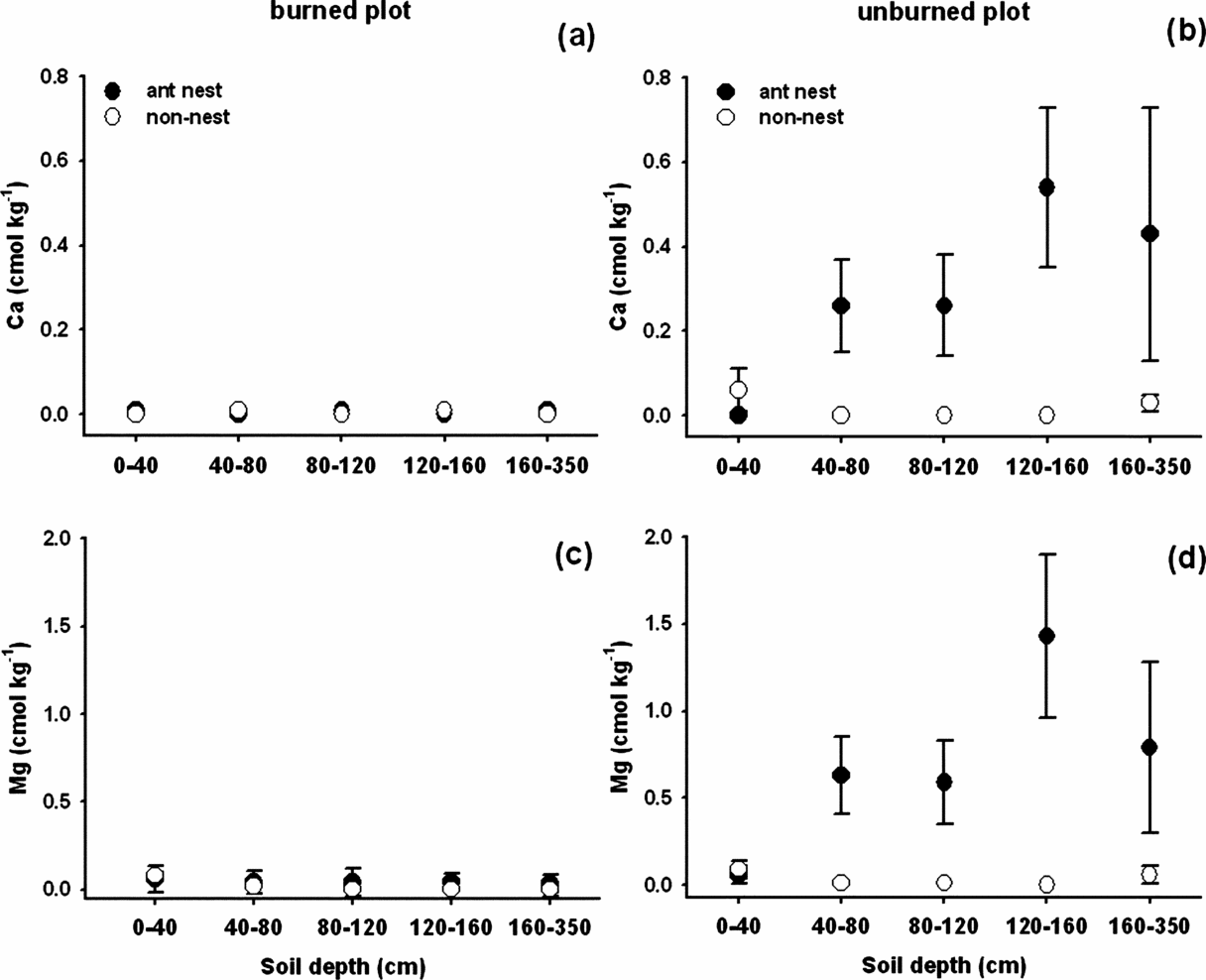
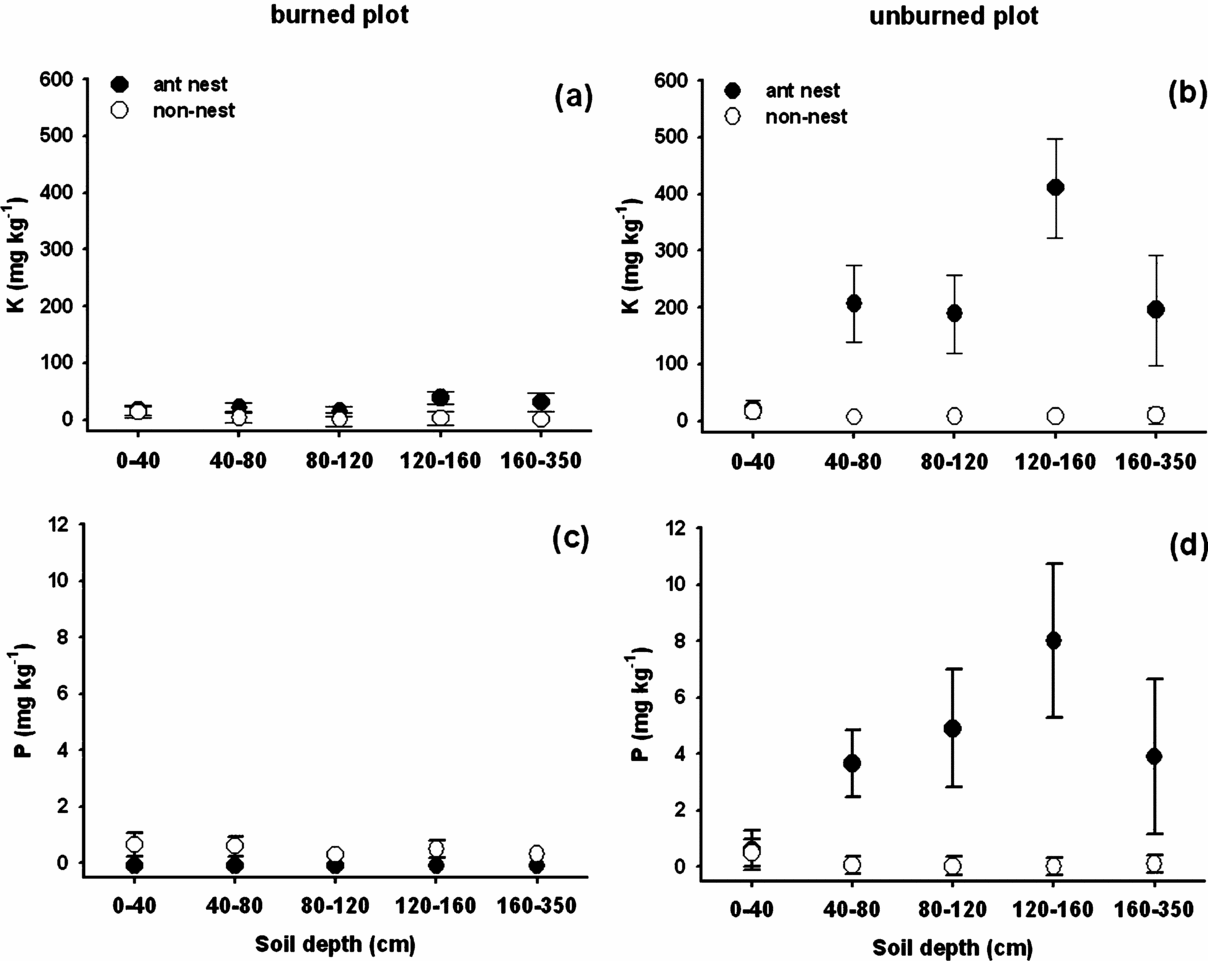
Frequent burning over long periods (every 2 y for 12 y in this case) was negatively related to concentrations of soil nutrients in ant nests. Concentrations of Ca and P in soil from ant nests in the burned plot were below our detection limit and the concentrations of Mg and K were low compared with ant nests in the unburned plot (Figures 1a, 1c and 2a, 2c). There was no significant difference in nutrient concentrations, organic matter or pH in non-nest soils between the burned and non-burned plot.
Soil availability of exchangeable cations Ca and Mg (mean ± SE) at several depths in ant nests and non-nests areas in plots that were successively burned every 2 y for over 12 y (a and c); or protected of burning since 1974 (b and c). Open symbols are non-nest soil (control) and black symbols are nest soil.

Soil availability (mean ± SE) of K and P at several depths in ant nests and non-nests areas in plots that were successively burned (a and c) or protected from burning (b and d). Open symbols are non-nest soil (control) and black symbols are nest soil.

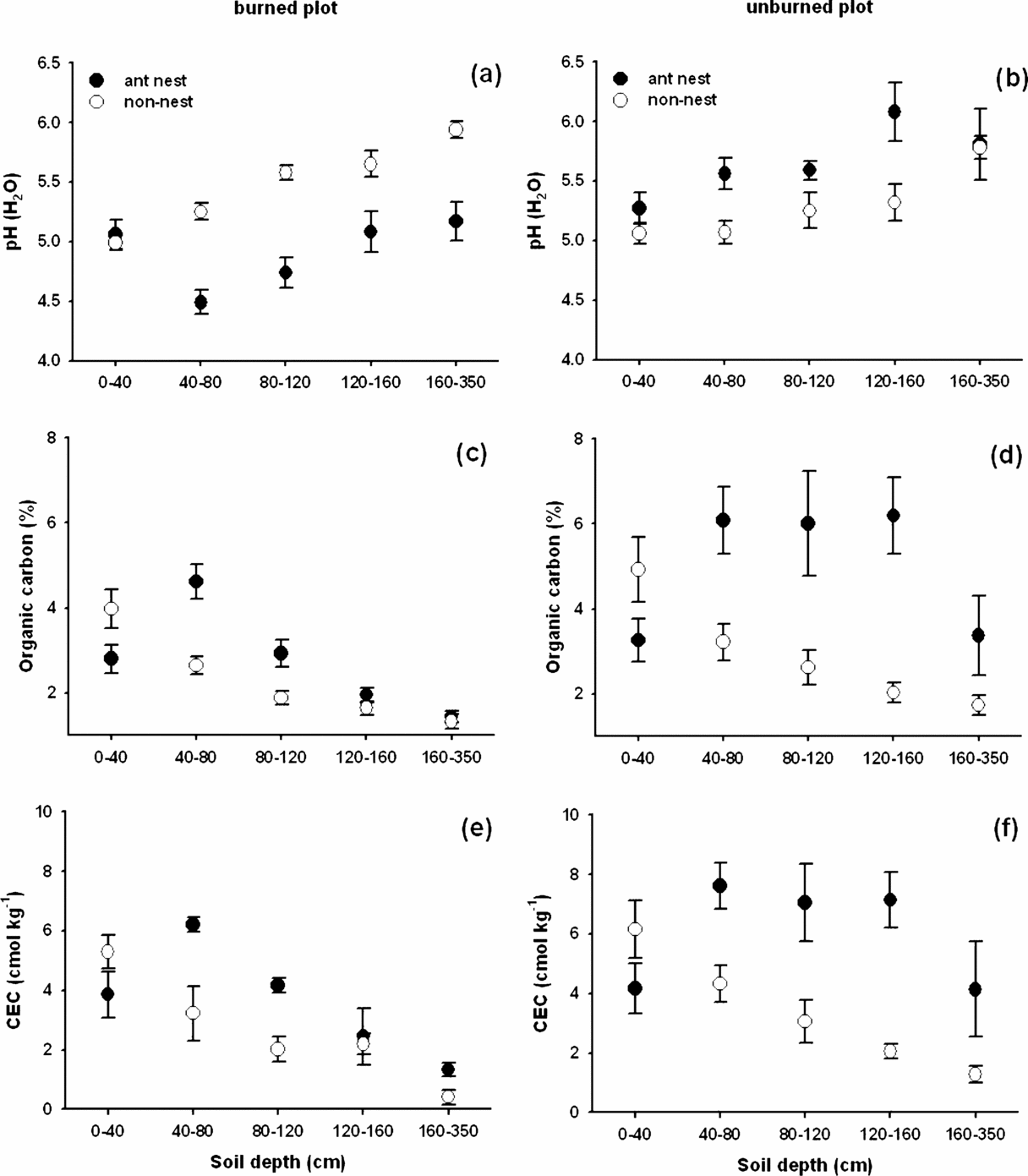
In contrast, ant nests from the unburned plot were associated with strong modifications of soil nutrient concentrations compared with non-nest soil or ant nests in the burned plot (Figure 1b, 1d and 2b, 2d). The interaction between shaft location and soil depth was significant for Ca, Mg, P, K, pH, organic matter and CEC (P ≤ 0.01). With exception of the top 40 cm, the values of Ca (Figure 1b), and Mg (Figure 1d) were significantly higher in these ant nests than anywhere else (F3,127 = 16.4, P < 0.001 and F3,127 = 19.8, P < 0.001, respectively). Similar results were found for K (F3,127 = 38.6, P < 0.001) and P (F3,127 = 18.6, P < 0.001, Figure 2b and 2d). There was a 6–50-fold increase in the concentrations of these nutrients at several depths. Soil pH was significantly different among ant nests (F3,6 = 53.1, P < 0.001), all values were within the range of the latosol studied (Figure 3a–b). There was significant soil organic matter (SOM) accumulation in soils from ant nests compared with non-nest soils at depths below 40 cm in both plots (F3,6 = 17.5, P < 0.001) (Figure 3c–d). However, SOM concentrations in nests from the burned plot were lower than in nests from the unburned plot. Similar results were found for cation exchange capacity (CEC) (F3,6 = 13.1, P < 0.001) (Figure 3e–f).
Soil pH, organic matter and cation exchange capacity (CEC) (mean ± SE) at several depths in ant nests and control areas which were successively burned every 2 y for over 12 y (a, c and e) or protected of burning since 1974 (b, d and f). Open symbols are non-nest soil (control) and black symbols are nest soil.

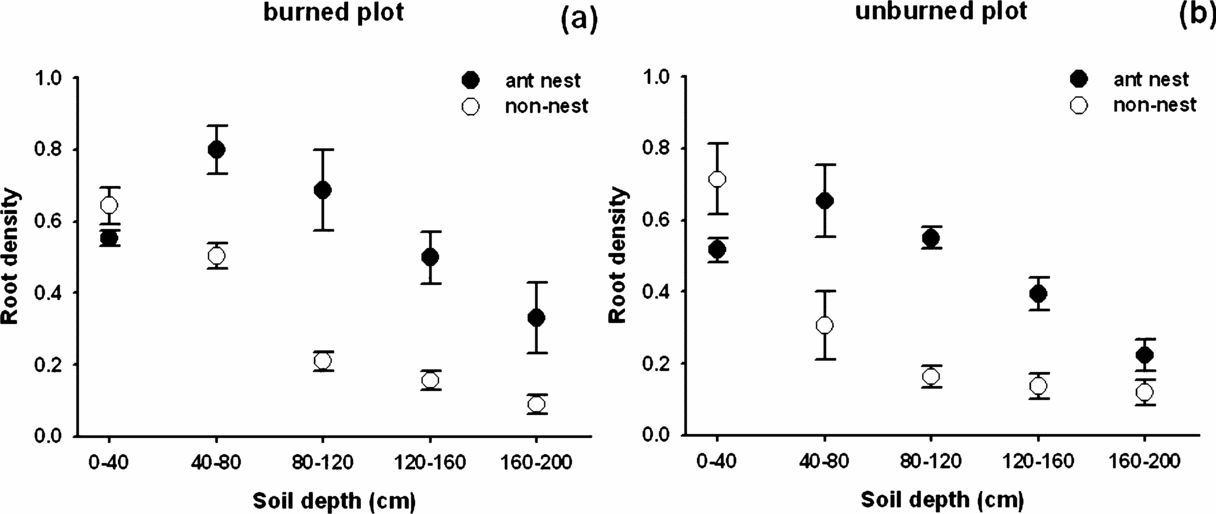
Transects from shafts of ant nests were occupied with more roots than non-nest shafts at depths below 40 cm (F3,43 = 63.2, P < 0.001). At these depths, roots of woody plants were predominant. There was no significant difference in root density between the burned and unburned plot (F3,6 = 0.13, P > 0.05), indicating that nests of both plots had the same effect on root density (Figure 4a–b). In general, transects in shafts of ant nests had 60% of its squares occupied with roots whereas transects from non-nest shafts had only 30% of roots in the squares.
Vertical root density (the proportion of a shaft wall covered with roots) inside nest and non-nest shafts (mean ± SE) which were successively burned every 2 y for over 12 y (a) or protected of burning since 1974 (b). Open symbols are non-nest shafts (control) and black symbols are ant nest shafts.

DISCUSSION
Leaf-cutting ants create high-nutrient patches in the cerrado by increasing soil fertility in areas protected from fire. In areas subjected to frequent fires, however, the effect of ant nests on nutrient accumulation was practically annulled through depletion of the concentrations of soil nutrients, cation exchange capacity and organic matter.
The increased root density inside ant nests in both burned and unburned plots indicates that ant nests are favourable patches for root growth and woody-plant establishment. As root density was similar within all ant nests, it is likely that nests from burned areas have been suitable patches for nutrient acquisition by surrounding plants. An alternative explanation for increased root density and changes in soil is colony founding after plant establishment or in areas of higher soil fertility. Several studies, however, suggest that differences between soils of ant nest and surrounding soils result from the activity of ant workers rather than a combination of initial conditions and subsequent worker modification (Dostál et al. Reference DOSTÁL, BREZNOVÁ, KOZLICKOVÁ, HERBEN and KOVÁR2005, Wagner et al. Reference WAGNER, JONES and GORDON2004). Besides, the success of colony establishment is higher in vegetation gaps and disturbed areas than protected ones (Vasconcelos & Cherret Reference VASCONCELOS and CHERRETT1995, Wirth et al. Reference WIRTH, MEYER, ALMEIDA, ARAUJO, BARBOSA and LEAL2007), suggesting that plant colonization occurs commonly after the establishment of leaf-cutting ant nests. Thus, the differences in root density and soil nutrient concentrations between nest soil and non-nest soil in our study probably results, at least in part, from ant activity.
Although the negative effect of fire was confirmed, it is not clear, from our results, why soil macronutrient availability in ant nests from the burned plot was negatively affected. There are at least three possible explanations: first, as we found a high density of coarse roots (and probably the density of fine roots is also high) in ant nests from the burned plot, the soil nutrients in these sites could be reduced due to a likely high assimilation of nutrients by plants during successive post-fire recover (Batmanian & Haridasan Reference BATMANIAN and HARIDASAN1985, van de Vijver et al. Reference VAN DE VIJVER, POOT and PRINS1999). If it is true, this could lead to a depletion of soil nutrients in these nests, overcoming the mineralization rate through organic matter deposition. In the long term, nutrient concentrations could be reduced to values similar to the control soil. Moutinho et al. (Reference MOUTINHO, NEPSTAD and DAVIDSON2003) found increases of up to 50-fold in fine-root biomass in Atta nests compared with non-nest soil and suggested that proliferation of fine roots in nest soil was in response to lower resistance to penetration and increased nutrient availability. Second, the low concentrations of SOM and nutrients inside ant nests in the burned plot suggest reduced foraging activity of the ants. Burning has negative effects on the vegetation, such as tree mortality and reduced species diversity (Eiten Reference EITEN1972, Moreira Reference MOREIRA2000), which could decrease the range of species harvested by leaf-cutting ants, affecting the development of nests located in burned areas (Araújo et al. Reference ARAÚJO, DELLA LUCIA and PICANÇO2004). Species diversity and abundance of woody plants in our study site were similar in the burned and unburned plot (Moreira Reference MOREIRA2000) thus the range of plant species consumed by ants in both plots may not differ.
Finally, the possibility that nest maintenance (i.e. gallery excavation, soil inversion) was affected in the burned nests cannot be excluded. Therefore, soil material from chambers could lose nutrients through leaching in nests with low activity. Hence, if nests in the burned plot are somewhat inactive and ants did not replenish the nutrients at the same rates as in the unburned plot, it is likely that root density is due to changes in soil texture more than nutrient availability. Active nests of Lasius flavus, for example, had higher soil nutrient concentrations than abandoned nests or surrounding soil in grasslands (Dostál et al. Reference DOSTÁL, BREZNOVÁ, KOZLICKOVÁ, HERBEN and KOVÁR2005).
In contrast, the increased nutrient concentrations in ant nests in the unburned plot suggest an important role of Atta colonies in generating high-nutrient patches in cerrado habitats when fire disturbance is low or absent. Brazilian latosols are naturally deficient in many limiting nutrients such as Ca, however, P is most limiting because of immobilization through adsorption to soil clay particles (Andrade et al. Reference ANDRADE, MENDONÇA, ALVAREZ and NOVAIS2003). We found that leaf-cutting ant nests act as biological sources of P and Ca in latosols covered by cerrado vegetation. Availability of P and Ca through ant nests was reported in recent studies that consistently indicated direct nutrient uptake by plants surrounding ant nests (Sousa-Souto et al. Reference SOUSA-SOUTO, SCHOEREDER and SCHAEFER2007, Sternberg et al. Reference STERNBERG, PINZON, MOREIRA, MOUTINHO, ROJAS and HERRE2007). High concentrations of Mg, Ca and OM in the topsoil were previously reported for other systems (Farji-Brener & Silva Reference FARJI-BRENER and SILVA1995, Haines Reference HAINES1978, Moutinho et al. Reference MOUTINHO, NEPSTAD and DAVIDSON2003). As root biomass is commonly higher inside than outside ant nests, it is likely that ant nests in burned areas should lead to post-fire colonization by pioneer plants through facilitation of root establishment. Facilitated succession of plants by leaf-cutting ants was indeed found in a Venezuelan savanna (Farji-Brener & Silva Reference FARJI-BRENER and SILVA1995).
In this study nests of the leaf-cutting ant A. laevigata have evidently changed soil chemical properties and the changes have enhanced root density. Although we found a lower concentration of soil nutrients in nests from the burned area, we believe that there was a causal relationship between root density and nutrient enrichment through nest activities. Hence, we think that these findings are not caused by preferences of ants for areas with high root density or high nutrient concentrations. Despite the low density of ant nests in our study site, compared with other areas (Araújo et al. Reference ARAÚJO, DELLA LUCIA and MAYHÉ-NUNES1997, Moutinho et al. Reference MOUTINHO, NEPSTAD and DAVIDSON2003, Wirth et al. Reference WIRTH, MEYER, ALMEIDA, ARAUJO, BARBOSA and LEAL2007), the importance of A. laevigata for cerrado vegetation seems high if we consider the large colony size of this species and that their influence may extend well beyond the area that is covered by nest mounds. For example, trees within a radius of 11 m from the nest mounds are affected by the nest through nutrient assimilation (Sternberg et al. Reference STERNBERG, PINZON, MOREIRA, MOUTINHO, ROJAS and HERRE2007). Thus, the negative effect of leaf-cutting ants on plant biomass through herbivory (Lugo et al. Reference LUGO, FARNWORTH, POOL, JEREZ and KAUFMAN1973) would, at least in part, be diminished by nutrient availability for plants close to A. laevigata nests. In the presence of fire, however, the cumulative effect of persistent losses of nutrients through burning and herbivory by leaf-cutting ants may decrease site productivity in the long term.
ACKNOWLEDGEMENTS
The authors wish to thank to Danival Souza, Túlio Gomes, Thyago Silva, Felipe Suci and Ricardo Solar for field assistance, Maria Iracema Gonzales and Heloisa Miranda for allowing us to perform this research in the experimental area, Eraldo Lima, Arne Janssen (Visiting Teacher [PVE] from CAPES, Brazil) for helpful suggestions and English revision. The Nature Conservancy (project 024/2003) and Conselho Nacional de Desenvolvimento Científico e Tecnológico (CNPq) are thanked for financial support.