Sepiolite is a trioctahedral hydrated magnesium silicate with a chain structure, fibrous morphology and theoretical unit cell formula of Mg8[Si12O30](OH)4(H2O)4.nH2O (n = 6–8) (Galán, Reference Galán1996; Murray, Reference Murray2007; Suarez & Garcia-Romero, Reference Suarez, Garcia-Romero, Galán and Singer2011). The structure of sepiolite consists of ribbons with a 2:1 phyllosilicate structure. These ribbons run parallel to the x-axis and have an average width along the y-axis of three linked pyroxene-like single chains. They contain continuous tetrahedral sheets that are inverted via basal oxygens, thus forming a discontinuous octahedral sheet (Jones & Galán, Reference Jones, Galán and Bailey1988; Galán, Reference Galán1996; Murray, Reference Murray2007; Brigatti et al., Reference Brigatti, Galán, Theng, Bergaya, Theng and Lagaly2006). These inverted tetrahedra occur regularly, forming channels (3.7 Å × 10.6 Å) (Galán, Reference Galán1996). In addition to the exchangeable cations, these channels may also contain water that is coordinated to the octahedral cations and zeolitic water, which is loosely bonded in the channels (Galán Reference Galán1996). The palygorskite–sepiolite group of clay minerals has a wide range of industrial applications because the fibrous crystal structure, large specific surface area and active silanol groups provide excellent adsorption properties. The cation-exchange capacity (CEC) of sepiolite (and palygorskite) ranges from 4 to 40 cmol(+) kg–1, which may increase depending on impurities (Gal án, Reference Galán1996).
Mild acid treatment is used widely to increase the specific surface area and to improve the purity and the adsorption capacity of sepiolite for gases and heavy metal ions. In this process, a certain proportion of the structural Mg2+ ions and metal exchange cations are removed and mineralogical impurities such as calcite and dolomite are eliminated. Thus, a partially dissolved material with increased specific surface area, porosity and surface acidity forms (Komadel, Reference Komadel2003). With more intense acid treatment the octahedral sheets dissolve, yielding free amorphous silica gel. The silica gel has variable textural characteristics depending on the nature of the raw material, the acid concentration, the reaction time and the reaction temperature (Rodriguez-Reinoso et al., Reference Rodriguez-Reinoso, Ramirez-Saenz, Lopez-Gonzalez, Valenzuela-Calahorro and Zurita-Herrera1981; Vicente Rodriguez et al., Reference Vicente Rodriguez, Lopez Gonzalez and Banares Munoz1994; Myriam et al., Reference Myriam, Suarez and Martin-Pozas1998; Komadel & Madejová, Reference Komadel, Madejová, Bergaya, Theng and Lagaly2006).
Ethylene is a natural plant-growth regulator and it is highly effective in the development of leaves, flowers and fruits (Reid, Reference Reid and Davis1995; Youngjan, Reference Youngjan2012; Iqbal et al., Reference Iqbal, Khan, Ferrante, Trivellini, Francini and Khan2017). Accumulation of ethylene may be detrimental to fruit quality (Youngjan, Reference Youngjan2012; Iqbal et al., Reference Iqbal, Khan, Ferrante, Trivellini, Francini and Khan2017). Therefore, the ethylene concentration must be controlled and excess ethylene must be removed from storage environments in order to prolong the storability and shelf-life of harvests. Despite its widespread use in ethylene retention, commercial KMnO4 is an expensive contaminant material.
In addition to the abundance of sepiolite reserves in the Sivrihisar region, the large specific surface area of this sepiolite due to its molecular-sized channels is the main reason for choosing this low-cost material for this study. Previous studies of ethylene adsorption by clay-based materials (Choundary et al., Reference Choundary, Kumar, Bhat, Cho, Han and Kim2002; Park et al., Reference Park, Lee, Han, Kim and Cho2002, Reference Park, Han, Kim and Cho2004; Cho et al., Reference Cho, Park, Han and Kim2005; Lee et al., Reference Lee, Park, Han, Kim, Cho and Lee2005; Saini et al., Reference Saini, Pinto and Pires2011; Youngjan, Reference Youngjan2012; Gwak et al., Reference Gwak, Kim, Oh, Lee, Kwon and Han2017; Alvarez-Hernandez et al., Reference Alvarez-Hernandez, Artes-Hernandez, Avalos-Belmontes, Castillo-Campohermoso, Contreras-Esquivel, Ventura-Sobrevilla and Martinez-Hernandez2018; Srithammaraj et al., Reference Srithammaraj, Magaraphan and Manuspiya2018; Gaikwad et al., Reference Gaikwad, Singh and Negi2019), acid-treated sepiolite, kaolinite and bentonite (Erdoğan Alver & Sakızcı, Reference Erdoğan Alver and Sakızcı2012; Erdoğan Alver et al., Reference Erdoğan Alver, Alver, Günal and Dikmen2016) and Ag+-, K+-, Li+-, Mg2+-, Cu2+- and Fe3+-exchanged bentonites (Erdoğan Alver & Günal, Reference Erdoğan Alver and Günal2016; Erdoğan Alver, Reference Erdoğan Alver2017) did not examine ethylene adsorption on various cation-exchanged forms of sepiolite. The novelty of this study is in its comparison of the ethylene adsorption properties of sepiolite samples after both cation exchange and acid activation and in its determination of the most suitable type of sepiolite for optimum adsorption. Hence, the objective of this study is to investigate the possible application of this non-toxic, readily available and low-cost material as an adsorbent for removing ethylene and thus extending the shelf-life of vegetables and fruits.
Materials and methods
The clay used as an adsorbent is a natural sepiolite from Sivrihisar, southwest Eskişehir, Turkey, supplied by Element Mineral, Inc. There are two types of sepiolite formations in the Sivrihisar region: the meerschaum type and the layered type. Meerschaum sepiolites have been used for many years in the manufacture of pipes and ornaments due to their ease of cutting and shaping. Such formations occur as fragments of Miocene-aged conglomerates. Layered sepiolites are in Miocene–Pliocene-aged volcaniclastics in the Sivrihisar region. They are economically important mineable deposits and have important applications due to their physicochemical properties.
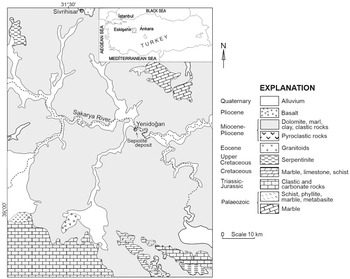
In the Sivrihisar region, the 200–500 m-thick Miocene–Pliocene volcaniclastic succession unconformably overlies the Palaeozoic metamorphic basement rocks, Mesozoic clastic rocks, carbonates, serpentinites and Eocene granitoids (Fig. 1) (Yeniyol, Reference Yeniyol1992, Reference Yeniyol2012; Ece & Çoban, Reference Ece and Çoban1994; Karakaş & Varol, Reference Karakaş and Varol1994; Kadir et al., Reference Kadir, Erkoyun, Eren, Huggett and Önalgil2016). The Miocene–Pliocene succession consists of conglomerate, limestone, dolomite, clayey dolomite, sepiolite, gypsum, magnesite and pyroclastics. Three different types of sepiolite beds were recognized in central parts of the Sivrihisar basin: (1) organic matter-rich black sepiolite; (2) organic matter-poor brown sepiolite, which contains ~5% dolomite; and (3) white-, cream- or yellow-coloured dolomitic sepiolite containing 20–40% dolomite (Ece & Çoban, Reference Ece and Çoban1994). The layered sepiolite sample with beige–pale brown colour used in this study was obtained from the Yenidoğan area (Fig. 1).
Geological map of the southern Sivrihisar area and location of the Yenidoğan sepiolite deposit (revised from MTA, 2002; Yeniyol, Reference Yeniyol2014).

The sepiolite was ground to obtain the <45 μm fraction. Cation-exchanged and acid-activated sepiolites were prepared using LiNO3, KNO3, NaNO3, Ca(NO3)2, Mg(NO3)2, HNO3 and H2SO4 under the following conditions: concentration: 1.0 M; heating temperature: 90°C; reaction time: 4 h; and sample/solution ratio: 5% m/v. The samples were then filtered, washed several times with hot deionized water, dried first at room temperature and then at 100°C for 20 h and kept in a desiccator. The natural sepiolite sample is denoted as S while the Na-S, K-S, Li-S, Mg-S, Ca-S, HN-S and HS-S formulations refer to the samples obtained by cation exchange and acid treatment of the S sample. All of the chemicals were supplied by Merck (Germany).
X-ray diffraction (XRD) analyses were performed using a Bruker (D8 Advance) apparatus with Cu-Kα radiation (λ = 1.54 Å) in the 2θ range from 5° to 40° with a 0.02° scanning step. The samples were analysed chemically for major oxides using X-ray fluorescence (XRF) spectroscopy with a Rigaku ZSX Primus XRF spectrometer. The CEC values of the sepiolite samples were determined using the sodium acetate method (Chapman, Reference Chapman and Black1965). Nitrogen adsorption isotherms were measured at 77 K using an Autosorb 1 instrument (Quantachrome, USA). Ethylene adsorption isotherms of the sepiolites were obtained at 273 K using the same instrument. Gas adsorption measurements were made after degassing under vacuum at 125°C for 12 h.
Results and discussion
XRD analysis
The XRD traces of sepiolite and that of the modified forms are displayed in Fig. 2. The sample S consists mainly of sepiolite with minor dolomite (Fig. 2a). A sharp, intense and symmetrical (110) peak at 11.7 Å indicates a relatively well-ordered sepiolite. The full width at half maximum (FWHM) of this peak displays a non-linear relationship with crystallinity. The FWHM of the (110) peak is 0.69°2θ, which is lower than that of the well-ordered sepiolite (Yeniyol, Reference Yeniyol2014) and higher than that of most of the sepiolites given by Sanchez Del Rio et al. (Reference Sanchez Del Rio, García-Romero, Suarez, Da Silva, Fuentes-Montero and Martínez-Criado2011).
XRD traces of the (a) raw S, (b) Mg-S, (c) Li-S, (d) Ca-S, (e) K-S, (F) Na-S, (g) HN-S and (h) HS-S samples. D = dolomite; Sp = sepiolite.

The XRD traces of S and the cation-exchanged forms (Na-S, K-S, Li-S, Mg-S and Ca-S) are similar, as expected, indicating that no structural changes occurred during the modification of sepiolite with exchange solutions. The intensity, sharpness and FWHM values of the (110) peak did not differ significantly for the cation-exchanged sepiolites. However, the crystal order was highest in the Mg-exchanged sepiolite and lowest in the Ca-exchanged sepiolite, although the differences were small (Mg > Na > Li > K > Ca). By contrast, the intensities of the main sepiolite peaks of the acid-activated samples significantly decreased due to the partial destruction of the structure (Fig. 2g,h). The decomposition of sepiolite is more pronounced after H2SO4 activation than after HNO3 activation. Sepiolite decomposes faster than palygorskite as its octahedral sheet is richer in Mg2+ and its structural micro-channels are larger (Myriam et al., Reference Myriam, Suarez and Martin-Pozas1998). The disappearance of the dolomite peaks after acid treatment is due to dissolution.
Although the intensities of the sepiolite and dolomite peaks decrease or vanish, there is a broad hump between 20 and 30°2θ on the XRD traces of the acid-activated samples (Fig. 2g,h), which is in accordance with previous works (Myriam et al., Reference Myriam, Suarez and Martin-Pozas1998; Gonzales-Pradas et al., Reference Gonzalez-Pradas, Socias-Viciana, Urena-Amate, Cantos-Molina and Villafranca-Sanchez2005; Esteban-Cubillo et al., Reference Esteban-Cubillo, Pina-Zapardiel, Moya, Barba and Pecharroman2008). This hump is related to the presence of the amorphous phase, probably opal-A. Additionally, the presence of sharp but low-intensity peaks on this hump is indicative of quartz and feldspar. These amorphous and crystalline phases were probably present in trace amounts below the XRD detection limit in natural sepiolite (S). They appeared on the XRD traces of the samples shown in Fig. 2g,h after acid treatment due to the partial dissolution of sepiolite and dolomite.
Chemical analysis and CEC
The chemical compositions of the sepiolite samples are listed in Table 1. As the natural sample (S) contains sepiolite and dolomite, the CaO (3.31%) is due to dolomite only and the SiO2 (52.36%) resides only in sepiolite. Thus, the S sample contains 89% sepiolite and 11% dolomite. However, due to the presence of trace quartz, feldspar and amorphous phases as shown by the XRD results, it may be suggested that the S sample contains ~80% sepiolite.
Chemical compositions (%) of the natural, cation-exchanged and acid-activated sepiolites.

LOI = loss on ignition.
Portions of the MgO, Al2O3, Na2O, K2O and Fe2O3 come from sepiolite. The Si4+ is substituted by AI3+ and Fe3+ in the tetrahedral sheet, and Al3+, Fe3+ and Fe2+ are the main cations substituting for Mg2+ in the octahedral sheet of the sepiolite structure; therefore, certain amounts of Al2O3 and Fe2O3 occur in most sepiolites, and other oxides, such as TiO2, K2O and Na2O, are generally present at a very low level or entirely absent (Suarez & Garcia-Romero, Reference Suarez, Garcia-Romero, Galán and Singer2011). The remaining MgO originates from dolomite. The loss on ignition of the samples is due to the dehydration and dehydroxylation of sepiolite and the decomposition of dolomite (Table 1). The observed changes in chemical compositions considerably varied according to the salt and acid solutions. As a result of acid treatment, the exchangeable cations were removed, the octahedral cations (Mg2+, Al3+ and Fe3+) were dissolved and amorphous SiO2 formed, which is insoluble in the acid solution (Myriam et al., Reference Myriam, Suarez and Martin-Pozas1998; Gonzalez-Pradas et al., Reference Gonzalez-Pradas, Socias-Viciana, Urena-Amate, Cantos-Molina and Villafranca-Sanchez2005; Lazarevic et al., Reference Lazarevic, Jankovic-Castvan, Jovanovic, Milonjic, Janackovic and Petrovic2007).
The CEC values of the sepiolite samples are listed in Table 2. The CEC of the raw sepiolite was 23.72 cmol(+) kg–1. This CEC value is within the range 9.5–60.0 cmol(+) kg–1 reported in previous studies (Velde, Reference Velde1992; Brigatti et al., Reference Brigatti, Lugli and Poppi2000; Alkan et al., Reference Alkan, Çelikçapa, Demirbaş and Doğan2005; Sun et al., Reference Sun, Li and Wang2014). The CEC values of the acid-activated forms were greater than those of the raw sepiolite and its cation-exchanged forms. The CEC values followed the order Na > natural sepiolite (S) > K > Mg > Li > Ca, although the differences were small. The acid-treated samples showed CEC values which were approximately twice as large, probably because acid treatment removed impurities from the sepiolite channels, especially their external parts.
CEC and nitrogen adsorption data of the natural, cation-exchanged and acid-activated sepiolites.

Nitrogen adsorption
The specific surface areas and micropore volumes calculated using the Brunauer–Emmett–Teller (BET) method and t-plot method, respectively, are summarized in Table 2. The ion-exchange modification did not increase the specific surface area. The BET surface areas of the Na-, K-, Mg- and Ca-exchanged sepiolite samples are in the range of 125.2–234.5 m2 g–1, which is lower than that of natural sepiolite (248.4 m2 g–1). This can be explained by the partial blockage of the channels due to cation exchange, preventing the penetration of N2 molecules. The treatment with 1.0 M HNO3 and H2SO4 solutions increased considerably the specific surface area (from 248.4 m2 g–1 for S to 507.9 m2 g–1 for HN-S and 506.9 m2 g–1 for HS-S), the micropore surface area (from 68.8 m2 g–1 for S to 207.7 m2 g–1 for HN-S and 222.3 m2 g–1 for HS-S) and the micropore volume (from 2.845 × 10⁻² cm3 g–1 for S to 11.380 × 10⁻² cm3 g–1 for HN-S and to 9.389 × 10⁻² cm3 g–1 for HS-S) (Table 2), which is in accordance with previous work (Myriam et al., Reference Myriam, Suarez and Martin-Pozas1998; Dekany et al., Reference Dekany, Turi, Fonseca and Nagy1999; Gonzales-Pradas et al., Reference Gonzalez-Pradas, Socias-Viciana, Urena-Amate, Cantos-Molina and Villafranca-Sanchez2005; Lazarevic et al., Reference Lazarevic, Jankovic-Castvan, Jovanovic, Milonjic, Janackovic and Petrovic2007). The increase in the specific surface area may be explained by the dissolution of the brucite layer, the elimination of soluble impurities and the increase in the number of the micropores.
Adsorption of ethylene
The ethylene adsorption isotherms obtained at 273 K and up to 100 kPa are shown in Figs 3 & 4. As the kinetic diameter of the ethylene molecule is 3.9 Å, it can easily enter into the channels of sepiolite. The ethylene adsorption capacities of sepiolite and those of modified forms were compared with those reported in the literature (Table 3). In samples prepared using cation exchange, ethylene adsorption capacities are comparable, and the order of these capacities is K-S > Li-S > Na-S > Mg-S > Ca-S. Although the specific surface area of the K-S sample was moderate (225.7 m2 g–1), it displayed the greatest adsorption selectivity due to the stronger cation–π interactions of K+ with ethylene molecules than the Na+, Mg2+, Li+ and Ca2+ cations. The C2H4 adsorption capacity of Li-S (0.812 mmol g–1) was greater than those of Na-S (0.749 mmol g–1), Mg-S (0.727 mmol g–1) and Ca-S (0.376 mmol g–1). For sepiolite exchanged with large cations such as Na+ and Ca2+, the contribution of cation–π interactions is considerable, the large ions may also block the adsorption sites and reduce the ethylene adsorption capacity. The lowest affinity of Ca-S for ethylene may be ascribed to both its lowest specific surface area and the blockages of the adsorption sites, which arise from large populations of large Ca2+ ions on the sepiolite surface.
Ethylene adsorption isotherms of the S, Ca-S, Mg-S and HS-S samples at 273 K.

Ethylene adsorption isotherms of the HN-S, K-S, Li-S and Na-S samples at 273 K.

Comparison of the ethylene adsorption capacities of the present work with literature data.

The HN-S and HS-S samples were better adsorbents for the retention of C2H4 compared to the cation-exchanged forms (Table 3). This was probably due to an increase in the cross-section of the intercrystalline channels caused by the exchange of large cations, such as K+, Na+ and Ca2+, with small H+ cations, as well as being due to the obvious increase in the microporosity and specific surface area of sepiolite, leading to an increase in the rate of diffusion of ethylene molecules into the channels of sepiolite. In addition, the dissolution of octahedral cations (e.g. Mg2+) as a result of the acid treatment yielded fresh silanol groups. Due to their double bonds, high polarizability and quadrupole moment, ethylene molecules interact with the surface of HN-S more strongly than with the other modified forms. The HN-S sample had a greater ethylene adsorption capacity than pillared bentonite (PILC-6; 0.570 mmol g–1 at 273 K) (Youngjan, Reference Youngjan2012), bentonite (0.292 mmol g–1) and its K+-exchanged (0.335 mmol g–1), Li+-exchanged (0.240 mmol g–1), Mg2+-exchanged (0.201 mmol g–1) forms (Erdoğan Alver, Reference Erdoğan Alver2017), Cu2+-exchanged (0.239 mmol g–1) and Fe3+-exchanged (0.167 mmol g–1) bentonites at 273 K (Erdoğan Alver & Günal, Reference Erdoğan Alver and Günal2016) and bentonite treated with 5.0 M HCl for 3 and 6 h (BH3-5 = 0.627 and BH6-5 = 0.719 mmol g–1) (Erdoğan Alver et al., Reference Erdoğan Alver, Alver, Günal and Dikmen2016) (Table 3). This can be explained by the presence of channels in the sepiolite structure, unlike in bentonite. The gas adsorption characteristics of the clay minerals are largely dependent on the porosity, the specific surface area and the active sorption sites (especially silanol groups) of the adsorbent and the polarity and size of the adsorbate molecules (Galán, Reference Galán1996). By contrast, bentonite treated with 4.8 mL solution of 0.5 M cetyltrimethylammonium bromide solution displayed a greater capacity for the adsorption of ethylene than the HN-S sample due to its textural and structural differences (1.436 mmol g–1) (Youngjan, Reference Youngjan2012). All of these samples are different from the sample in the present study and different conditions were implemented during treatment. In conclusion, the sepiolite treated with 1.0 M HNO3 solution is the most effective adsorbent (1.308 mmol g–1) for the removal of ethylene from storage environments.
Summary and conclusions
The C2H4 adsorption experiments with the sepiolite sample from the Sivrihisar region, Turkey, were carried out to determine the usability of this low-cost mineral and that of the cation-exchanged (Na-S, K-S, Li-S, Mg-S and Ca-S) and acid-activated (HN-S and HS-S) forms for the removal of ethylene. The acid treatment caused significant structural changes to sepiolite. The acid-treated forms of sepiolite are more effective for the adsorption of ethylene than the cation-exchanged forms. This can be attributed to the blocking of the channels of sepiolite as a result of the cation exchange, which prevents ethylene adsorption. Among the sepiolite samples studied, the maximum ethylene adsorption capacity was determined for sepiolite activated with 1.0 M HNO3 solution (HN-S). In summary, HN-S can be used as an efficient and low-cost adsorbent to control ethylene in storage environments, and therefore it may extend the shelf-life of fruits and vegetables.