The Turbulent Tenth Century
Tenth-century Europe witnessed profound cultural, ideological, and political transformations that ultimately led to the creation of early states. Among the characteristic features of zones subjected to the monopolistic rule of elites were the introduction of normative regulations, social differentiation, and the division of society into the governing and the governed. Centralized apparatuses of power began to emerge at around the same time in the European territories controlled by the Piasts, the Přemyslids, the Arpads, and the Jelling dynasty (see Randsborg, Reference Randsborg1980; Dobat, Reference Dobat2009; Révész, Reference Révész2014; Urbańczyk, Reference Urbańczyk2015; Moździoch, Reference Moździoch and Trzeciecki2016 with references). Using their authority and superior military force, prospective rulers developed the means to maintain law and order and devised new ways to manifest their position in both local and supra-local arenas. They were able to achieve their long-term political goals by relying on expertly-trained, well-armed, and mobile groups of warriors who had the capacity to prevent attempts at separatism and anarchy and to maintain the state's integrity in the face of external threats.
This article concerns the ways in which Western Slavic elites expressed their identity during the turbulent period of the formation of the Piast state. The geographical focus is on the territory located between the rivers Oder in the west and Vistula in the east, an area which in the Viking Age (c. ad 750–1050) coincided with the western parts of present-day Poland. There are strong and multiple indications that in this part of Europe the process of state formation did not follow an evolutionary course, as some scholars have argued, and it is now widely accepted that it was not preceded by a preliminary period of gradual development of proto- or early state structures known as ‘tribal states’ or ‘territorial-tribal states’ (for an overview of these debates, see Banaszkiewicz et al., Reference Banaszkiewicz, Kara and Mamzer2013; Kara, Reference Kara, Banaszkiewicz, Kara and Mamzer2013). The Piast state did not emerge from external conquest, nor was it caused by foreign geopolitical factors. Instead, textual and archaeological sources suggest that state formation resulted from a dramatic cultural breakthrough, in the course of which the Piasts appropriated the old centres of worship and power and effectively implemented the ‘regnum model’, i.e. an early state model (Kara, Reference Kara, Banaszkiewicz, Kara and Mamzer2013; Mamzer, Reference Mamzer, Banaszkiewicz, Kara and Mamzer2013 with references). However, there are also strong reasons to believe that ‘the first historical ruler of Poland’, duke Mieszko I of the Piast dynasty (d. ad 992), did not consider the state as an abstract political and territorial entity, as it is commonly understood today, but rather as his private property (Urbańczyk, Reference Urbańczyk2017: 67).
As the social and economic position of Mieszko and the closest circle of his family grew, the emerging Western Slavic elites began to develop new ways of manifesting their identity through distinctive social practices and characteristic ‘material markers’ (see Price, Reference Price, Amirell and Müller2014; Raffield et al., Reference Raffield, Greenlow, Price and Collard2016: 40–41 for Viking Age Scandinavia) or group-specific material culture such as clothing, jewellery, weapons, and equestrian equipment. These items were largely recovered in graves, hoards, strongholds, and other settlements. They are made of costly material (silver, copper-alloy, gold) and often display extraordinary craftsmanship, suggesting that they were commissioned by and for the highest echelons of society. Many have been variously interpreted and often wrongly associated with non-Slavic cultural milieus, predominantly with Viking Age Scandinavians or the Kievan Rus (e.g. Nadolski et al., Reference Nadolski, Abramowicz and Poklewski1959; Kara, Reference Kara and Leciejewicz1991, Reference Kara, Dickinson and James1992a, Reference Kara1992b, Reference Kara2001; Wachowski, Reference Wachowski2001, Reference Wachowski2006; Wołoszyn, Reference Wołoszyn, Salamon and Strzelczyk2010). While the misleading views on some of these finds are now being revised (Gardeła, Reference Gardeła, Eriksen, Pedersen, Rundberget, Axelsen and Berg2015, Reference Gardeła2017, Reference Gardeła2018, Reference Gardeła, Bogacki, Janowski and Kaczmarek2019a, Reference Gardeła, Birkett and Dale2019c; Ratajczyk et al., Reference Ratajczyk, Gardeła, Kajkowski, Gardeła and Kajkowski2017; Gardeła et al., Reference Gardeła, Kajkowski and Ratajczyk2019a, Reference Gardeła, Staecker and Toplak2019b), the fact that numerous high-status Western Slavic ‘material markers’ are decorated with snake motifs has so far largely been overlooked. By collating archaeological, textual, and folkloristic sources and weaving them into a theoretical framework, we attempt to decipher the deeper meanings of these motifs and the reasons why Western Slavic elites used them so eagerly, especially to adorn their military equipment.
The themes explored here are inspired by a recent article by Raffield and colleagues (Reference Raffield, Greenlow, Price and Collard2016), concerning ingroup identification and identity fusion in Viking Age warbands. Referring to the work of psychologists, sociologists, and anthropologists specializing in aspects of group dynamics (e.g. Tajfel et al., Reference Tajfel, Billig, Bundy and Flament1971; Korostelina, Reference Korostelina2007), they give the following definition of an ingroup: ‘a social group that is distinguished by a trait or set of traits. An ingroup is defined in opposition to an outgroup, which comprises the people who do not share the ingroup's defining traits. The traits that distinguish an ingroup can be genetically inherited or socially learned, and can include dialect, clothing, diet, skin colour, music, values, beliefs, and attitudes’ (Raffield et al., Reference Raffield, Greenlow, Price and Collard2016: 37).
Answering the call encouraging ‘archaeologists dealing with all periods and regions, not just those focusing on Viking Age Scandinavia, [to] give consideration to the anthropological and psychological literature on ingroup identification and identity fusion’ (Raffield et al., Reference Raffield, Greenlow, Price and Collard2016: 44), we attempt here to investigate the issue of (in)group identity in central Europe. We argue that high-status Western Slavic objects from the area of the Piast state served not only as emblems of a prominent group of people, but that they also mediated profound symbolic meanings referring to the pre-Christian worldviews and warrior ideologies of their users, thereby strengthening a sense of shared identity and reinforcing group cohesion.
‘Material Markers’ of Western Slavic Elite Identity in Strongholds and Graves
In order to manifest their growing social and economic position in the emerging Piast state, and to communicate their group affiliation and distinct ideology, Western Slavic elites began to introduce social practices and characteristic types of high-status objects in the mid-tenth century. Such artefacts, we argue, soon became their ‘material markers’. Although occasionally found in hoards and as stray finds, these objects are mostly associated with prominent strongholds and high-status graves. A brief introduction to Western Slavic defensive architecture and mortuary practice is, therefore, appropriate.
Strongholds
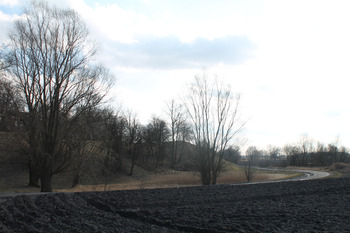
Given the abundance of forests in the central European Plain, the Western Slavs became expert at exploiting timber for a variety of purposes. The massive strongholds built of wood, stone, and clay, many of which still dot the central European landscape, were one of their most remarkable achievements (Buko, Reference Buko2008; Chrzan et al., Reference Chrzan, Czapla and Moździoch2014; Urbańczyk, Reference Urbańczyk2015: 143–68). These strongholds played multiple roles, serving as visual statements of power as well as administrative, trade, and religious centres (Figure 1). In the turbulent time of state formation, many strongholds formerly belonging to local chieftains were seized by the Piasts and either destroyed or rebuilt with the intention to adapt them to the needs of the developing state. Greater Poland, drained by the rivers Warta and Noteć, which served as natural defences but also as important routes of communication, was where the Piasts made some of their most significant investments, with strongholds at Giecz, Gniezno, Grzybowo, Ostrów Lednicki, and Poznań in the heart of their domain (Krysztofiak, Reference Krysztofiak, Kara, Krysztofiak and Wyrwa2016; Kurnatowska & Wyrwa, Reference Kurnatowska and Wyrwa2016). Although the remains of these defensive structures have never been fully excavated, it is on these sites that the jewellery, weapons, and equestrian equipment taken to be the distinctive markers of Western Slavic elite identity have been recovered. Similar objects have also been found in settlements and cemeteries.
Early medieval stronghold at Giecz in Greater Poland, one of the oldest and most important seats of power in the Piast state.

The treatment of the dead
Before the conversion to Christianity, a process initiated in the tenth century during the rule of Mieszko I, cremation was the dominant burial rite in the Western Slavic area, in the basin of the rivers Oder and Vistula (Kostrzewski, Reference Kostrzewski1960; Zoll-Adamikowa, Reference Zoll-Adamikowa1975–1979). The bodies were burnt on pyres together with various organic and non-organic goods, but occasionally also with animals and other humans, perhaps ritually killed to accompany the deceased on their journey to the otherworld (Gardeła & Kajkowski, Reference Gardeła, Kajkowski, Kurasiński and Skóra2014). Cremated bones were gathered and placed in ceramic or organic containers and later buried or set up on free-standing posts within cemeteries. On some occasions, human remains, and the objects that accompanied the dead on the pyre, were also thrown into lakes and rivers (Moździoch, Reference Moździoch and Trzeciecki2016: 162).
From the late tenth century onwards, inhumation became the dominant burial rite (Rajewski, Reference Rajewski1937; Zoll-Adamikowa, Reference Zoll-Adamikowa1966–1971; Miśkiewicz, Reference Miśkiewicz1969; for recent overviews, see Kajkowski, Reference Kajkowski2015; Gardeła, Reference Gardeła2017). Inhumation burials took many forms, depending on the region, the availability of resources (stones, wood, etc.), the wealth and status of the deceased and mourners, as well as other social, economic, and religious factors. Unlike Scandinavian burials, most graves were flat and lacked prominent external structures, such as mounds or cairns. The graves could be lined with stones or wood, and the dead could be buried on biers, in coffins, and occasionally in boats (Kajkowski, Reference Kajkowski, Franz, Kościelniak and Pilarczyk2016). People were usually interred in a supine position, but examples of prone and other ‘deviant burials’ are also known (Gardeła, Reference Gardeła2017). Western Slavic graves were generally rather modestly furnished, with iron knives the most common grave goods (Wrzesiński, Reference Wrzesiński2000). Richly furnished inhumations occurred relatively rarely and are typically interpreted as belonging to the elites (Nadolski et al., Reference Nadolski, Abramowicz and Poklewski1959; Buko, Reference Buko2015; Wadyl, Reference Wadyl2019). They included weapons (swords, axes, spears), riding equipment, drinking vessels made of clay or wood, and various small utensils. Jewellery (temple rings, finger rings, kaptorgas, see below) is usually found in female graves, although it occasionally also appears in male graves (Kajkowski, Reference Kajkowski, Franz and Pilarczyk2018).
Chamber graves are some of the most remarkable burials, and those most frequently containing the ‘material markers’ mentioned above. In the area governed by the Piasts, their greatest concentration is noted in Greater Poland (e.g. Dziekanowice, Sowinki) and along the river Vistula (Bodzia, Ciepłe, Czersk, Kałdus, Pień) (Janowski, Reference Janowski2015; Błaszczyk, Reference Błaszczyk2017). They appear in the late tenth century, based on radiocarbon, dendrochronological, and typological analyses.
Recent analysis of the distribution of Western Slavic chamber graves in the Piast state has shown that they are predominantly located close to major strongholds and supra-local centres of political, administrative, and religious power (Błaszczyk, Reference Błaszczyk, Błaszczyk and Stępniewska2016: 38). Their chronology is also significant for the present discussion, as they emerge in the tenth–eleventh centuries and continue to be built in the coastal areas of Pomerania until the eleventh–twelfth centuries (Biermann, Reference Biermann2008), which fits what we know from textual sources about the social and political transformations and the process of state formation in these areas. In view of their chronology, distribution, and wealth (see below), there are strong reasons to identify chamber graves with the final resting places of elites.
Various motivations may have incited people to construct chamber graves. While some scholars see this form of funerary architecture as characteristic of ‘barbaric’ societies at the time of state formation and conversion (Rębkowski, Reference Rębkowski2007: 159; Błaszczyk, Reference Błaszczyk, Błaszczyk and Stępniewska2016: 42), others argue that it reflects the ideological struggle associated with the decline of pagan ideologies (Biermann, Reference Biermann2008). Still others point out that the emergence of chamber graves may be the result of several processes that are difficult to resolve (Janowski, Reference Janowski2015: 91–92).
In addition to debates surrounding the reasons for building chamber graves, the identity of their occupants, whether indigenous or foreigners from Scandinavia or Rus, has been a matter of discussion (for a critical summary, see Gardeła, Reference Gardeła, Błaszczyk and Stępniewska2016, Reference Gardeła, Bogacki, Janowski and Kaczmarek2019a). Recent aDNA and isotope studies (Błaszczyk, Reference Błaszczyk2017, Reference Błaszczyk2018), however, show conclusively that most of the people buried in chamber graves were local to the area of the Piast state. This conclusion also dovetails with the contents of the graves which, we argue, served as ‘material markers’ and proclaimed the high status of the deceased and those who buried them.
In the following, we concentrate on the jewellery, knives, weapons, and equestrian equipment discovered in inhumation graves within the Piast domain, as well as similar items found in strongholds (for further details, see the Online Supplementary Material).
Jewellery
In the tenth and eleventh centuries, jewellery was predominantly worn by women, although in some instances men also wore such items (for overviews of Western Slavic jewellery, see Musianowicz, Reference Musianowicz1948–1949; Kóčka-Krenz, Reference Kóčka-Krenz1993). In addition to representing status and wealth, some jewellery probably conveyed profound religious meanings and served as ‘material markers’. This is likely to have been the case of certain variants of temple rings, finger rings of the Orszymowice type, and kaptorgas.
Temple rings
Temple rings (Polish kabłączki skroniowe) are characteristic Slavic items of adornment made of wire or rolled strips of sheet metal formed into a ring with open ends. The term ‘temple rings’ refers to the rings’ position on the body: they were meant to be worn at the head's temples, attached to an organic headband. The metals used include copper-alloys, tin, lead, silver, and occasionally gold.
Temple rings are the most popular type of jewellery worn by the early medieval female population in the Western Slavic world. In the area of the Piast state, they are predominantly found in female graves and occasionally appear as stray finds in strongholds and other settlements. In some instances, temple rings, either whole or fragmented, also occur in hoards (e.g. Musianowicz, Reference Musianowicz1948–1949; Kóčka-Krenz, Reference Kóčka-Krenz1993).
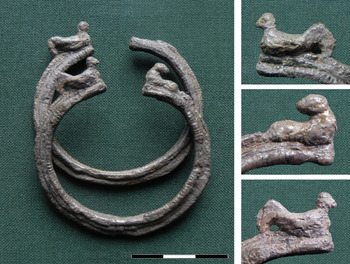
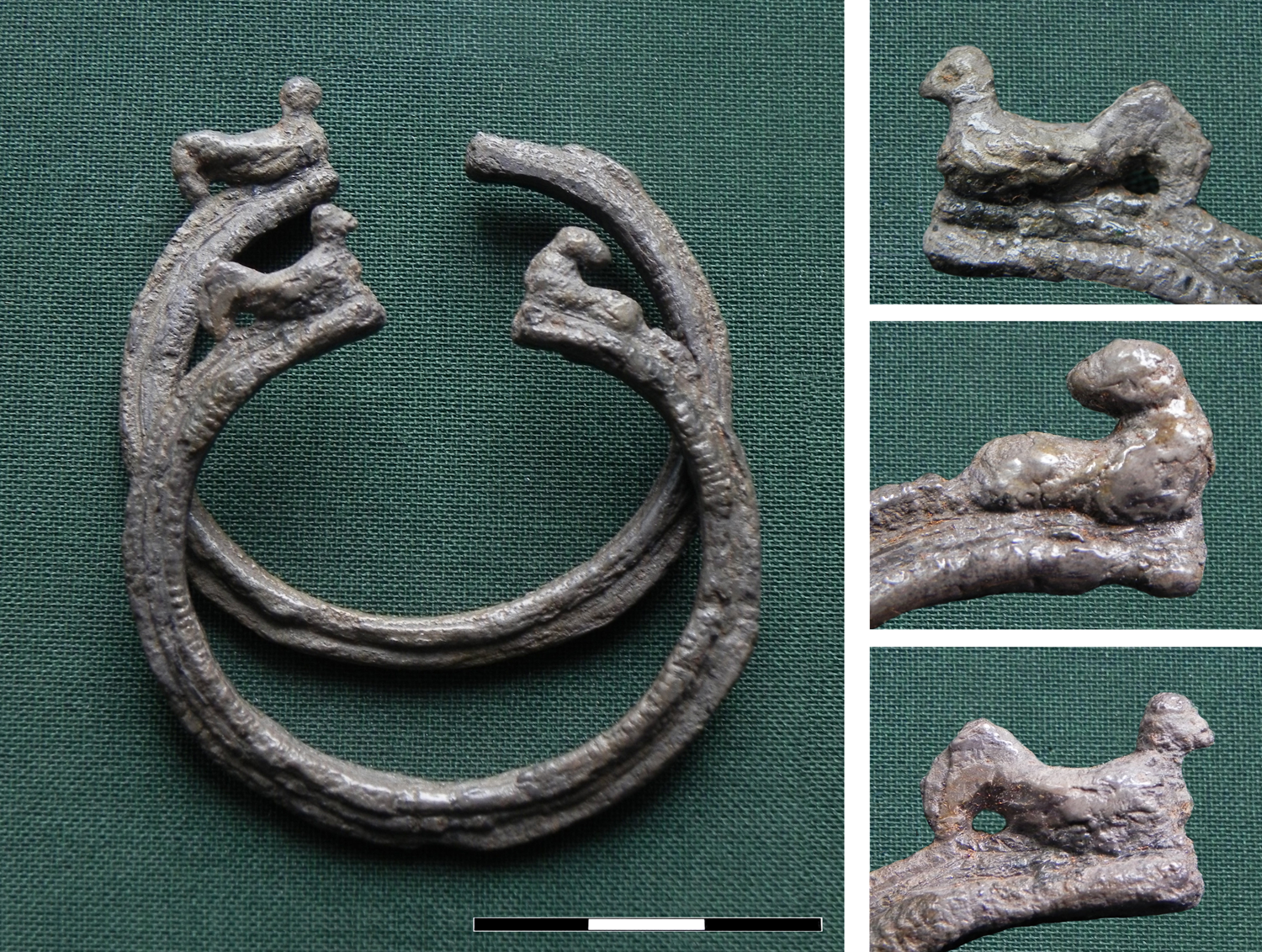
Temple rings no doubt had a special meaning (e.g. Hensel, Reference Hensel1969; Chudziak, Reference Chudziak2006: 86–87), particularly those whose ends resemble the head of a snake, known from a wide area from Pomerania in the north to Bohemia in the south (Hensel, Reference Hensel1969). Some examples are additionally adorned with representations of other creatures, such as quadrupeds (horses?) and birds (Figure 2; Supplementary Material: Table S8). Although these animal decorations have been linked to Christian concepts (e.g. Pawlak & Pawlak, Reference Pawlak and Pawlak2015), the chronology and context of the objects featuring these motifs suggests that they relate to pre-Christian ideas (Posselt & Szczepanik, Reference Posselt, Szczepanik, Biermann, Kersting and Klammt2017). As we shall demonstrate, the iconographic programme depicted on some temple ring variants is very close to the imagery shown on other high-status Western Slavic objects, suggesting that they formed a semantically cohesive corpus.
Copper-alloy temple rings from grave 170 from the cemetery in Poznań-Śródka in Greater Poland (after Pawlak & Pawlak, Reference Pawlak and Pawlak2015: 76). Reproduced by permission of Paweł Pawlak.
Finger rings of the Orszymowice type
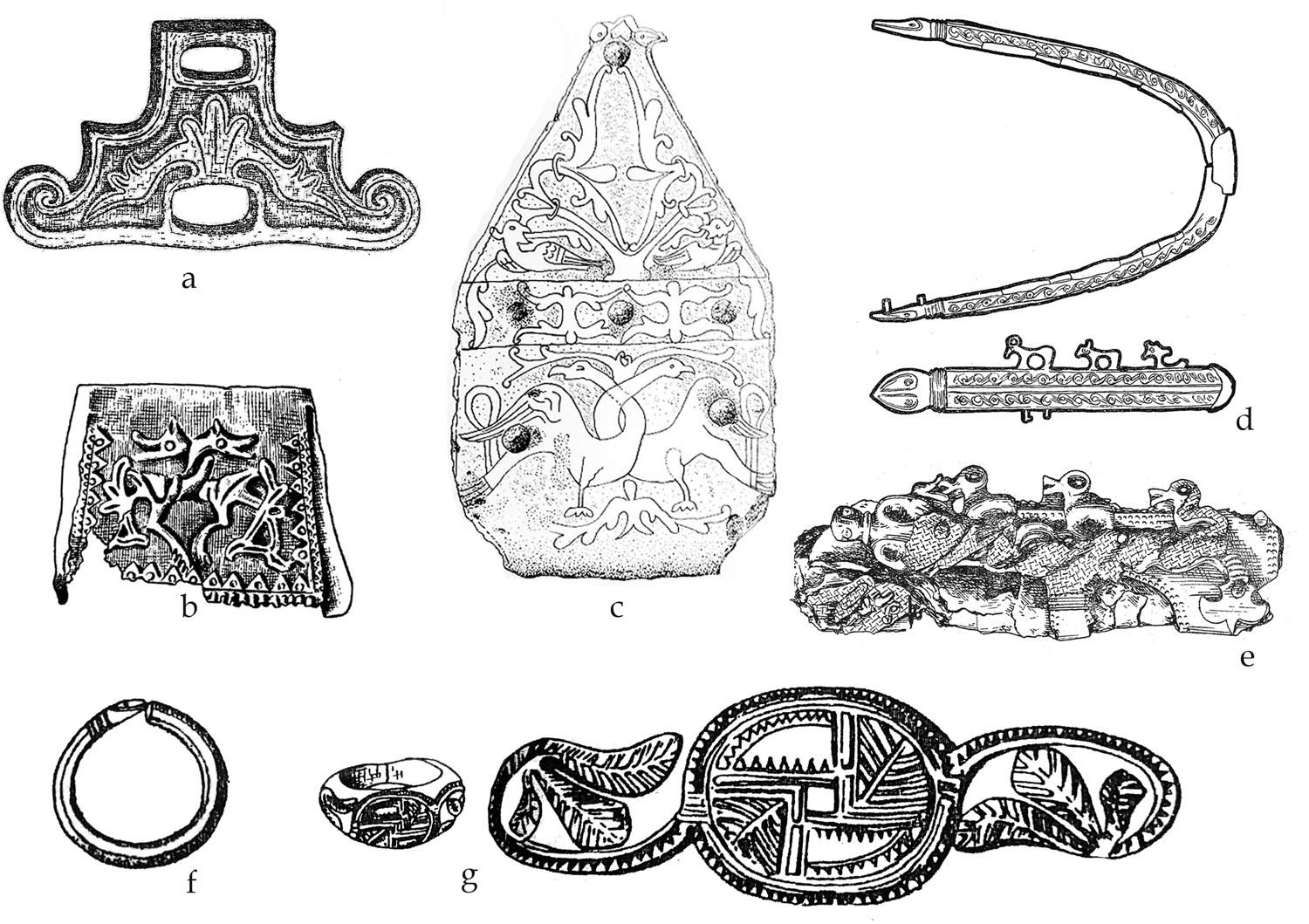
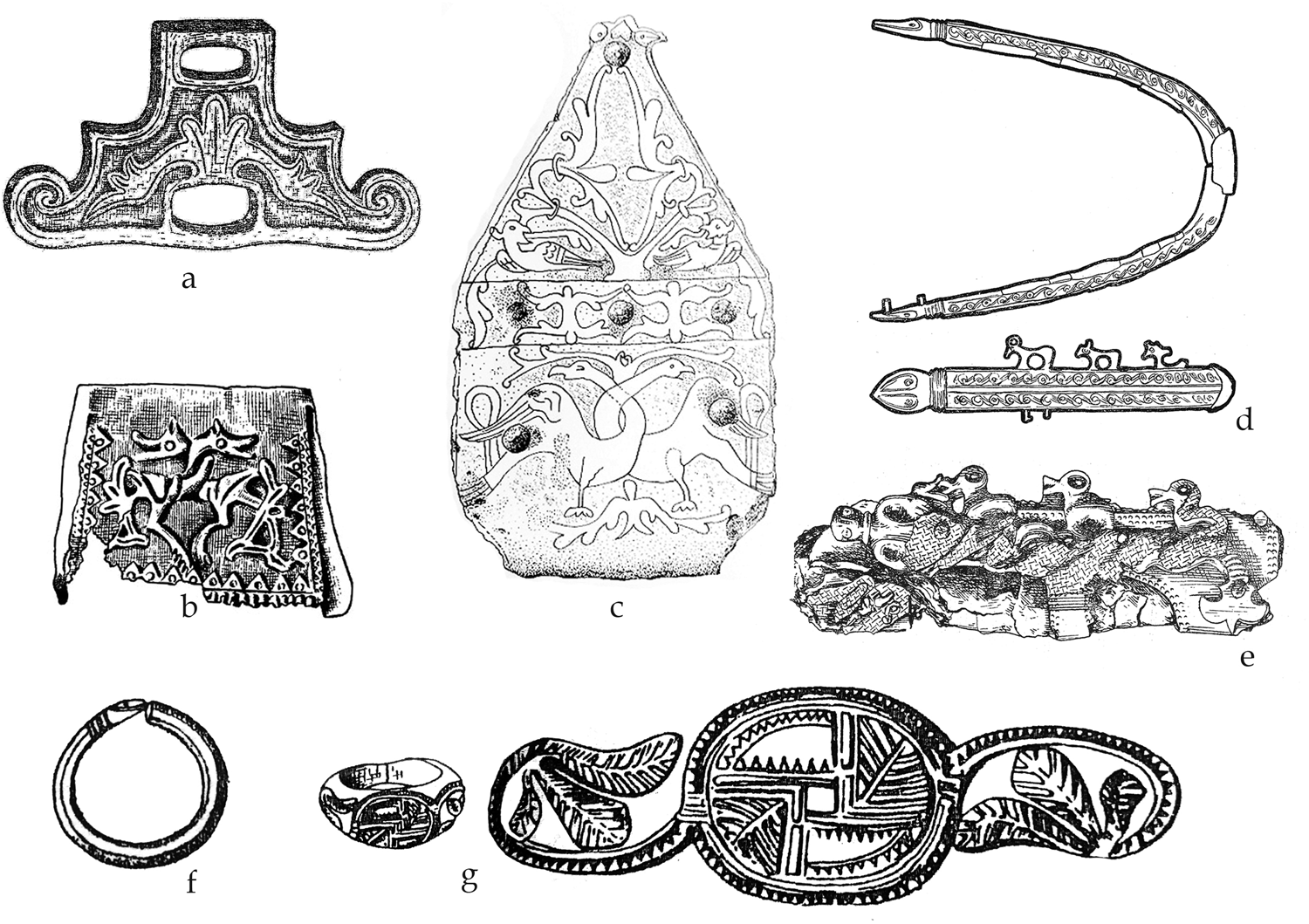
Rings of the Orszymowice type, dated from the end of the tenth to the twelfth centuries, are a type of Western Slavic silver and copper-alloy rings typically found in high-status female graves and Piast strongholds (Kóčka-Krenz, Reference Kóčka-Krenz and Wesse1998; Wrzesiński, Reference Wrzesiński, Bogacki, Franz and Pilarczyk2005; Drozd-Lipińska, Reference Drozd-Lipińska2011). Although they all share some formal and stylistic traits, each ring is different, implying that they were not mass-produced but designed for a particular individual or group of people, probably serving as symbols of elevated social status. At first glance, the rich decoration of the rings’ bands evokes Romanesque floral motifs. In some instances (e.g. the rings from Brześć Kujawski, Dziekanowice, and Grzybowo), the rings also have a central motif resembling an equal-armed cross or a stylized swastika (Figure 3g; Supplementary Material: Table S5). On closer inspection, however, an alternative reading of these decorative features suggests two snakes surrounding or flanking the central motif. In our view, this decoration may refer to Western Slavic pre-Christian cosmological principles, as discussed below.
Slavic objects with snake motifs: a) cheek-piece from Lutomiersk, Poland (after Jażdżewski, Reference Jażdżewski1951: 111); b) kaptorga from Biskupin, Poland (after Hensel, Reference Hensel1960: 108); c) stirrup from Velds, Denmark (after Pedersen, Reference Pedersen2014: Plate 34); d) zoomorphic spur from Lutomiersk, Poland (after Nadolski et al., Reference Nadolski, Abramowicz and Poklewski1959: Plate XLIV); e) knife sheath from Brześć Kujawski, Poland; f) ring from Brześć Kujawski, Poland; g) ring with equal-armed cross or stylized swastika from Brześć Kujawski, Poland (e, f and g after Kaszewscy, Reference Kaszewscy1971: 376–377). All redrawn and edited by Karolina Michałowska.
Kaptorgas
Kaptorgas (also known as ‘amulet boxes’) are small, rectangular or trapezoidal pendants usually made of silver. They are found in Western Slavic settlement sites, hoards, and graves where they typically accompany women (Sztyber, Reference Sztyber2008, Reference Sztyber, Kucypera and Wadyl2010; Wrzesiński & Wyrwa, Reference Wrzesiński and Wyrwa2011). Kaptorgas were worn around the neck, suspended from a string made of organic material or a silver chain. The context of their discovery and their decorative features suggest a date from the mid-tenth to the twelfth centuries (Kóčka-Krenz, Reference Kóčka-Krenz1993: 85).
Like the rings of the Orszymowice type, every kaptorga is different, which again suggests that they were designed by and for specific individuals. A closer study of their various ornamental motifs (which use an array of techniques including pressing, casting, filigree, and granulation) nevertheless shows that they have some common semantic traits. Several exemplars with winged creatures, either singly or in pairs, are relevant to the themes developed here. When shown in pairs, these creatures are usually in an antithetic pose but with their necks intertwined (e.g. Biskupin; Figure 3b; Supplementary Material: Table S6). At first glance and to an untrained eye they resemble birds, but closer examination reveals snake-like features. They might, therefore, represent mythological hybrid animals.
The academic literature is replete with discussions of the function of the kaptorgas in Western Slavic societies (e.g. Sztyber, Reference Sztyber, Kucypera and Wadyl2010; Wrzesiński & Wyrwa, Reference Wrzesiński and Wyrwa2011 with references). In early studies, scholars thought they were reliquaries, arguing that they derived from and/or were inspired by western European Romanesque art or imitated reliquaries of the Orthodox Church. Such interpretations, linking the kaptorgas with Christian ideology, were dismissed by Helena Zoll-Adamikowa (Reference Zoll-Adamikowa1966–1971); and, today, the prevailing opinion is that the kaptorgas are pagan objects, serving as containers for things that had magic and/or sentimental value (Sztyber, Reference Sztyber, Kucypera and Wadyl2010: 48). Regrettably, the contents of the kaptorgas rarely survive, preventing a more detailed interpretation. Interestingly, some kaptorgas contained hallucinogenic substances (cannabis) and animal remains (e.g. Profantová & Šilhová, Reference Profantová and Šilhová2010; Sztyber, Reference Sztyber, Kucypera and Wadyl2010).
Knives and Knife Sheaths
Knives are among the most common objects found in Western Slavic inhumation graves. While most are unremarkable, some knives have sheaths decorated with copper-alloy figural motifs. The details of their ornamentation vary but, again, feature a number of recurrent themes (Figure 3e; Supplementary Material: Table S4). Variants of knife sheaths with a riveted copper-alloy bar which terminates in an animal head, probably a snake, as attested at, for example, Bodzia, Giecz, Kałdus, Tomice, Ostrów Lednicki, and Sowinki, are of particular interest. In some instances, the bar has additional details, such as standing quadrupeds resembling horses or cattle (e.g. at Brześć Kujawski, Giecz, Ostrów Lednicki). Remarkably, several sheaths of this type have a bar with one end shaped like a snake while the other bears a representation of an anthropomorphic figure (e.g. at Brześć Kujawski, Gościejewo, Ostrów Lednicki). We shall not discuss the meaning of this imagery in detail here, but note that several scholars (e.g. Biermann, Reference Biermann2014; Szczepanik, Reference Szczepanik, Biermann, Kersting and Klammt2017) have recently argued that the scene can be interpreted as a world-model or axis mundi. This consists of a representation of the three tiers of the Slavic cosmos, with the snake being a hypostasis of the supreme god of the underworld (known as Weles or Triglav), the anthropomorphic figure on the opposite side of the bar the sky god (known as Perun or Sventovit), and the different animals along the bar the mediators between the worlds or human souls in zoomorphic form. While such copper-alloy sheaths do not always have the same ornamental features, the animal that is always depicted on them is the snake, implying that this particular creature was of key importance for the people who designed and used these objects.
Military and Equestrian Equipment
The Western Slavic rulers of the Piast dynasty, Mieszko and his successor Bolesław the Brave, relied heavily on well-armed and trained warriors in the process of state formation (Bogacki, Reference Bogacki2007), as can be seen elsewhere in Europe (e.g. Braathen, Reference Braathen1989; Dobat, Reference Dobat2009; Pedersen, Reference Pedersen2014; Révész, Reference Révész2014). Warriors became catalysts of change, their authority, experience, and superior force enabling them to maintain control over society in times of profound political transformation.
In Viking Age Europe, material traces of warriors are usually found in funerary contexts. In contrast to Scandinavia, where weapon graves occur relatively frequently (especially in Norway, e.g. Petersen, Reference Petersen1919), military equipment in the Piast state was, however, rarely buried with the dead. The reasons for the relatively small number of weapons in Western Slavic funerary contexts are not clear, and this situation compels us to approach the phenomenon of weapon burial in this part of Europe with caution. Echoing the foundational works of Heinrich Härke (Reference Härke2014) and Howard Williams (Reference Williams2006) concerning the meaning of grave goods, it seems that not every person who took active part in war and conflict in the Piast state was buried with weapons, and conversely not everyone buried with military equipment used it in life (Sikora, Reference Sikora, Dzieduszycki and Wrzesiński2014).
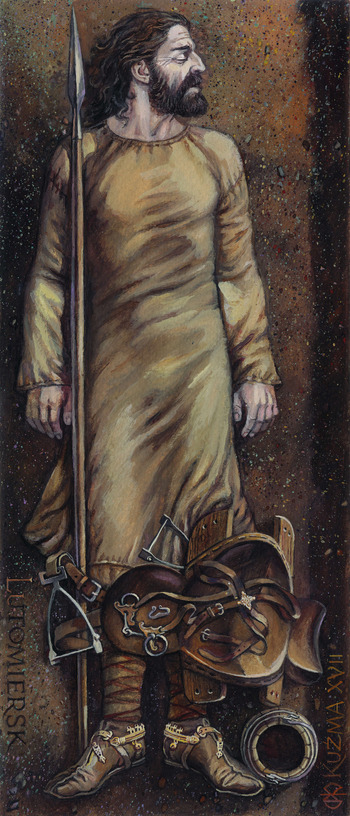
While we agree that graves are not ‘mirrors of life’ (Williams & Sayer, Reference Williams, Sayer, Sayer and Williams2009), we believe that there are good reasons to regard at least some weapon graves from the Piast state as belonging to actual warriors. The most evocative examples have been found in the tenth–eleventh century cemeteries of Ciepłe in eastern Pomerania and Lutomiersk in central Poland (Figures 4–6) (Nadolski et al., Reference Nadolski, Abramowicz and Poklewski1959; Ratajczyk, Reference Ratajczyk, Moździoch, Stanislawski and Wiszewski2013a, Reference Ratajczyk2013b; Gardeła, Reference Gardeła2018, Reference Gardeła, Bogacki, Janowski and Kaczmarek2019a; Gardeła et al., Reference Gardeła, Kajkowski and Ratajczyk2019a). The idea that these graves belonged to elite warriors rests on their rich furnishings, including elaborately decorated weapons (e.g. silver- and copper-inlaid swords and spears), equestrian equipment (spurs, stirrups, bridles) (Figure 7; Supplementary Material: Tables S1-S3), and other high-status goods (e.g. drinking vessels, utensils, etc.). They could have belonged to militarized equestrian elites who, like their counterparts in the Danish kingdom of Harald Bluetooth (Dobat, Reference Dobat2009; Pedersen, Reference Pedersen2014), were closely tied to the ruler, probably serving as members of his retinue. In the Slavic world, this aristocratic or royal retinue is commonly known as drużyna and in medieval Latin sources as acies curialis or loricati (Bogacki, Reference Bogacki2007).
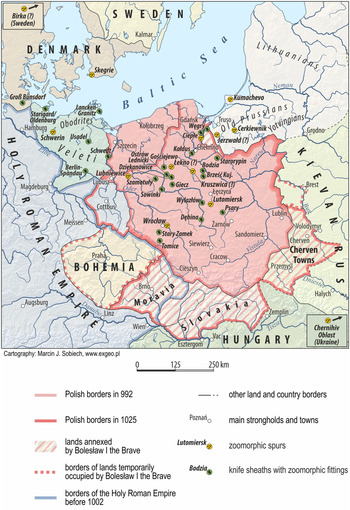
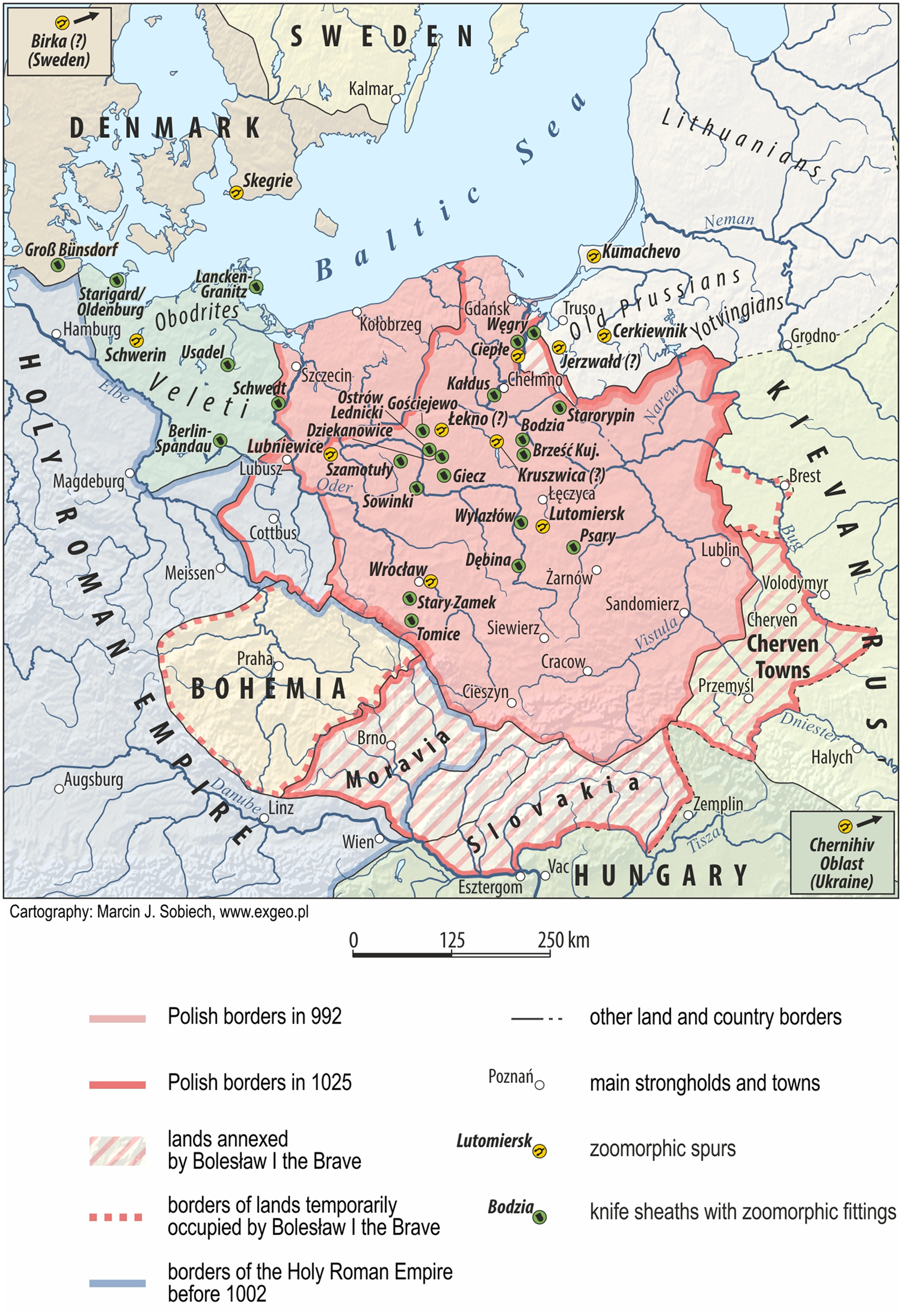
Distribution of Western Slavic ‘material markers’: knife sheaths with zoomorphic motifs (selected examples) and zoomorphic spurs. Reproduced by permission of Marcin J. Sobiech.
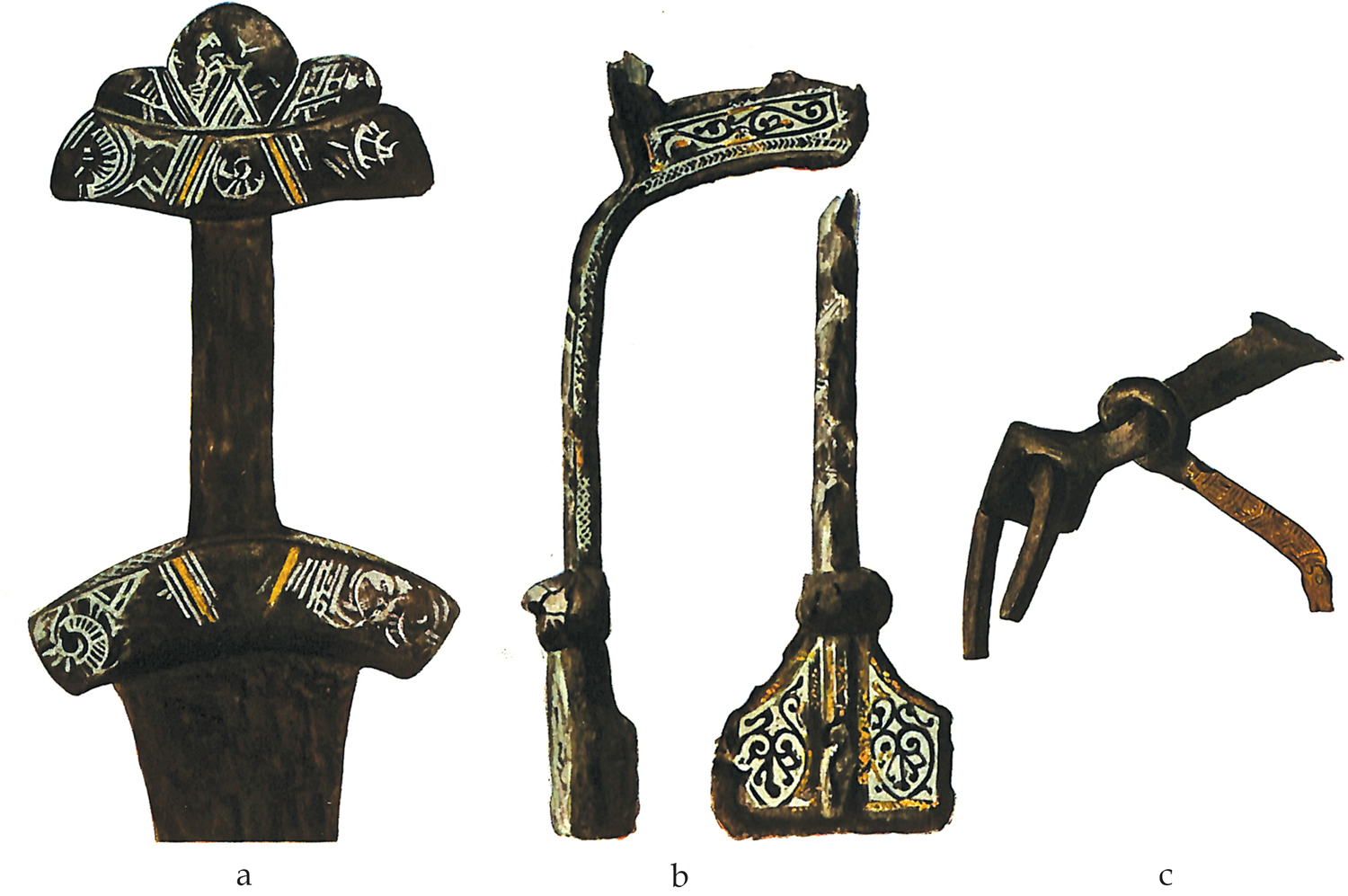
Western Slavic military equipment with zoomorphic, snake-like decoration from grave V at Ciepłe, Poland: a) sword; b) stirrup; c) cheek-piece (after La Baume, Reference Baume La1926). Redrawn by Karolina Michałowska.

Reconstruction of grave 10 from Lutomiersk, Poland (after Gardeła, Reference Gardeła2017: 63). Reproduced by permission of Mirosław Kuźma.

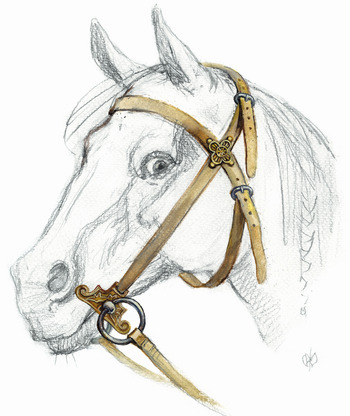
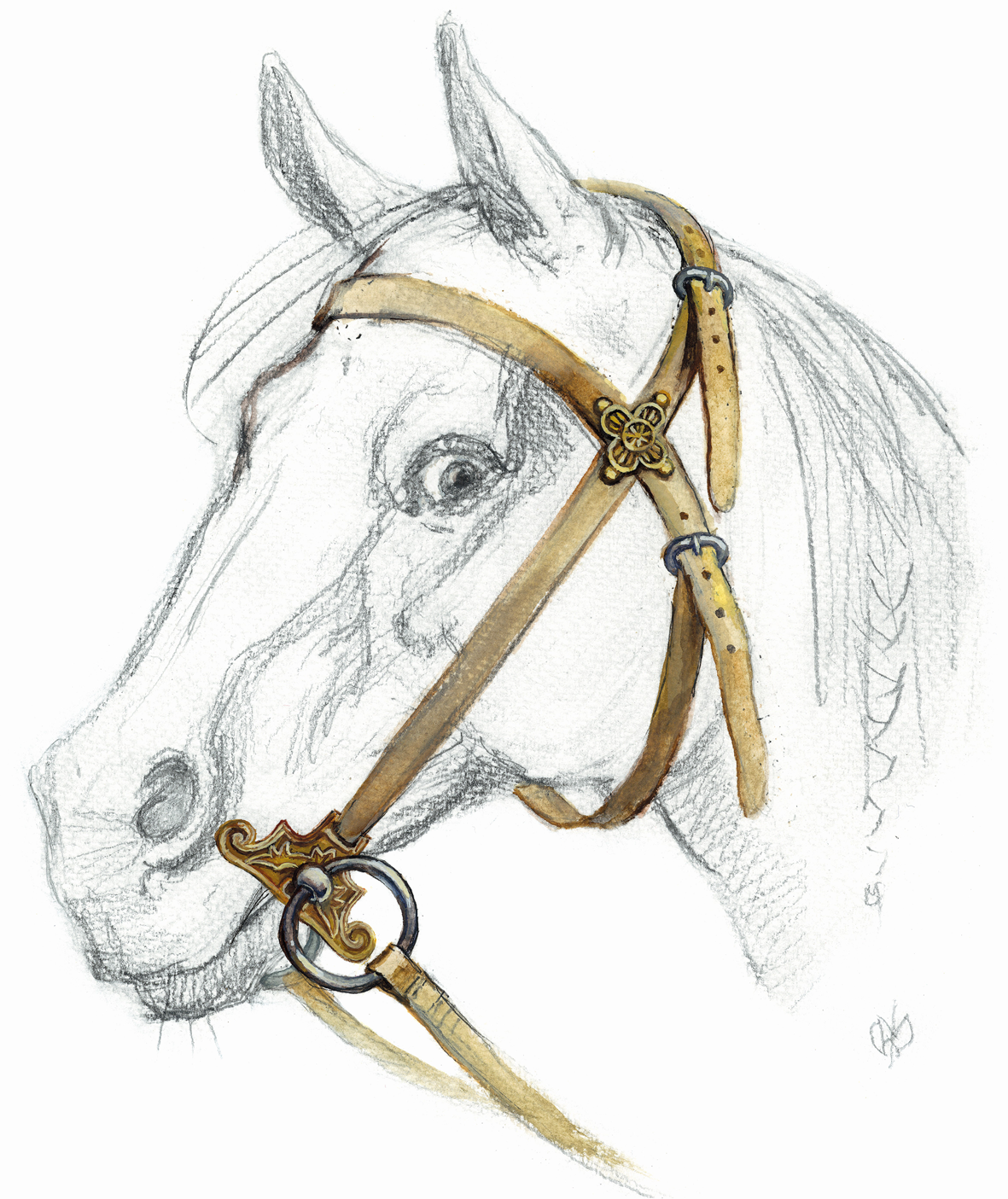
Reconstruction of the horse bridle from grave 10 at Lutomiersk, Poland. Reproduced by permission of Mirosław Kuźma.
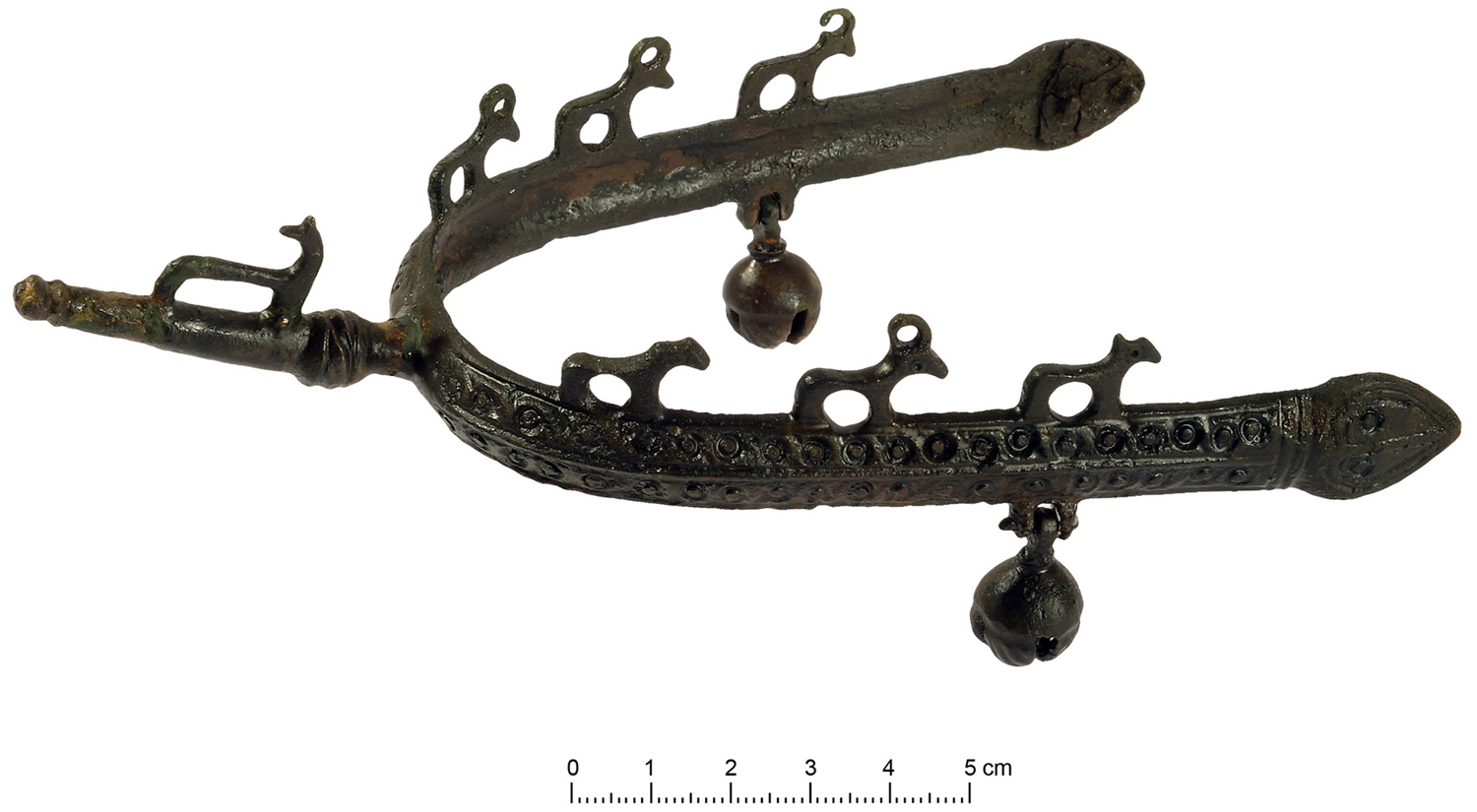
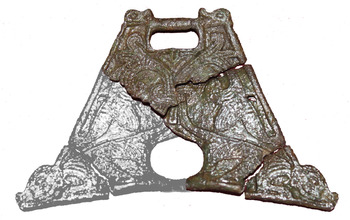
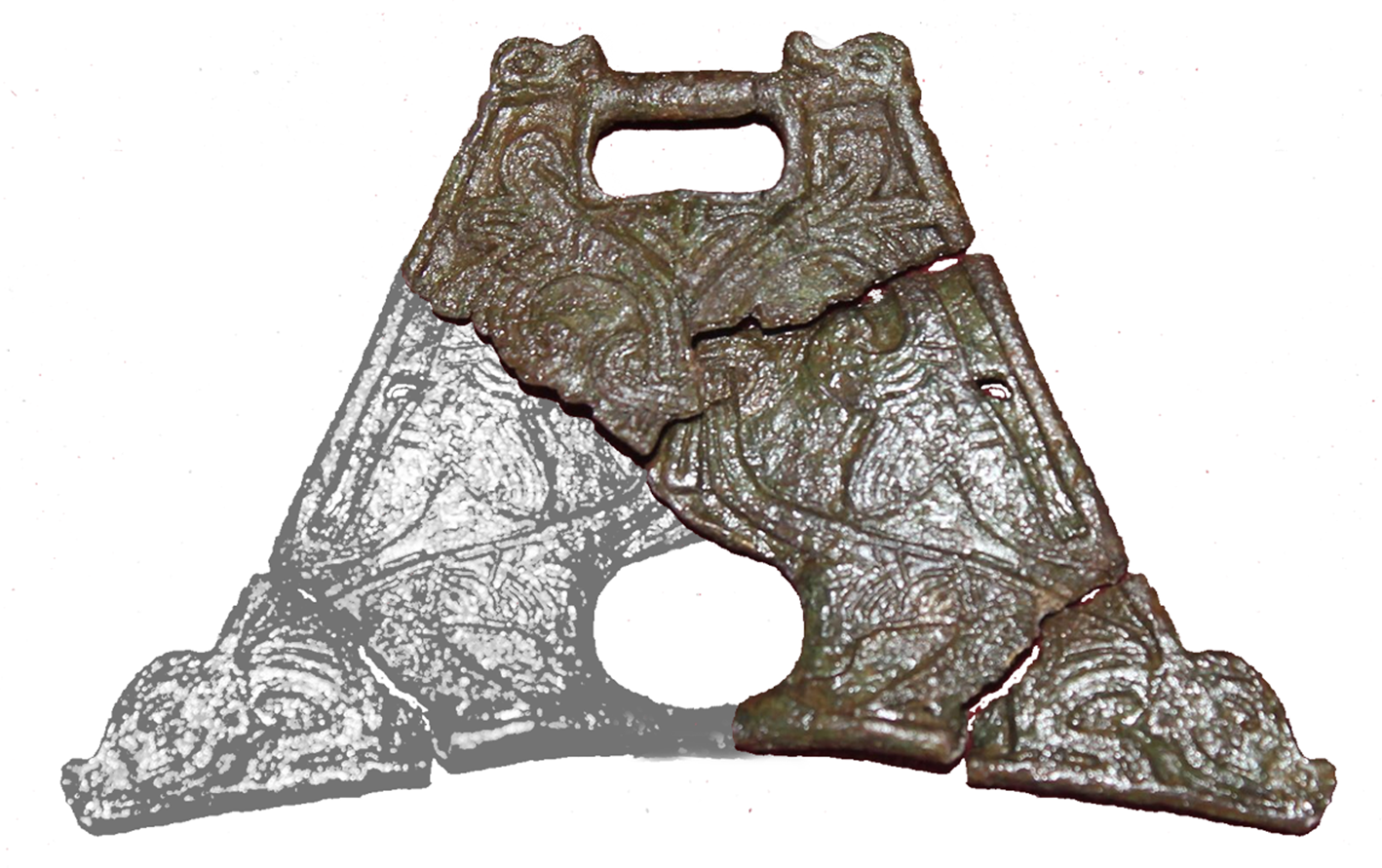
Several such high-status individuals were buried with items decorated with snake motifs. For instance, in the cemeteries of Ciepłe (grave 42/2009) and Lutomiersk (graves 5 and 10, a cremation and an inhumation respectively), the deceased had lavishly decorated copper-alloy spurs with snake head terminals (Figure 8). Additional winged snakes were attached to the spurs’ straps, serving as ‘hooks’ for the tongue-less buckle (also decorated with two snakes facing one another). In a series of recent studies, we have argued that spurs of this type, also known as the ‘Lutomiersk type spurs’ or ‘zoomorphic spurs’, served as models of the Slavic cosmos, depicting its different tiers and animals with sacral and/or mediatory characteristics (Ratajczyk et al., Reference Ratajczyk, Gardeła, Kajkowski, Gardeła and Kajkowski2017; Gardeła et al., Reference Gardeła, Kajkowski and Ratajczyk2019a, Reference Gardeła, Staecker and Toplak2019b). At Lutomiersk, opposed winged snakes with what looks like a tree (a tree of life?) between them are also schematically shown on the copper-alloy cheek-pieces from grave 10 (Figure 3a).
Copper-alloy zoomorphic spur from grave 42/2009 from Ciepłe, Poland (after Ratajczyk, Reference Ratajczyk2013b: 296). Reproduced by permission of Zdzisława Ratajczyk, Archaeological Museum of Gdańsk.

In addition to their occurrence on high-status weaponry and equestrian equipment at Ciepłe and Lutomiersk, snakes (sometimes with wings) adorn other Western Slavic objects associated with warfare, such as the decorative copper-alloy cheek-pieces from Giecz (Figure 9), Kałdus, Kruszwica, Ostrów Lednicki, and Santok and a stirrup from Ostrów Lednicki (Banaszak & Tabaka, Reference Banaszak and Tabaka2017; Gardeła et al., Reference Gardeła, Kajkowski, Ratajczyk, Wadyl and Wadyl2019c). Given that most such items come from within the borders of the Piast state, there are strong reasons to believe that this is where they were produced, possibly even that they were commissioned by Mieszko or by his son Bolesław the Brave.
Copper-alloy cheek-piece from Giecz, Poland. Photo by Leszek Gardeła, edited by Kamil Kajkowski. Reproduced by permission of The Museum of the First Piasts in Lednica and Teresa Krysztofiak.
High-status Western Slavic military and equestrian equipment and other artefacts with zoomorphic decoration have also occasionally been found outside the Piast realm (Figure 3c), especially in Polabia (located roughly between the rivers Trave and Elbe), Denmark and southern Sweden. It is thought that they belonged to Slavic equestrian warriors and/or migrants who were interacting in some manner with external elements (Dobat, Reference Dobat2009; Gardeła et al., Reference Gardeła, Kajkowski and Söderberg2019b; Gardeła, Reference Gardeła, Staecker and Toplak2019b; see also Roslund, Reference Roslund2007). The location of these finds, close to the fortresses erected by the Danish king Harald Bluetooth, is of particular interest. Together with the results of isotopic analyses of the individuals buried at Trelleborg in Zealand, which suggest that a significant proportion of the population originated from the Slavic area (Price et al., Reference Price, Frei, Dobat, Lynnerup and Bennike2011), the presence of high-status Western Slavic objects within Harald's kingdom implies that the contacts between the Piasts and the Jelling dynasty were far more sophisticated than previously acknowledged.
The Earth Diver and the Flying Serpent
As argued, detailed analyses of the iconographic motifs adorning high-status objects from the Piast state area allow us to link them to Slavic pre-Christian beliefs. Unravelling their deeper meaning is, however, challenging, because the early medieval Western Slavs did not leave any written records of their pagan worldviews; all we know about their gods and other supernatural beings relies on the accounts of external observers, i.e. heavily biased Christian clergy and Arab travellers. This has always been a serious obstacle in studies of Slavic pre-Christian beliefs, but one that can be alleviated by critically employing other categories of sources from archaeology, linguistics, and folklore.
Considerable caution is obviously necessary when using nineteenth- and twentieth-century folklore to interpret archaeological evidence from the tenth and eleventh centuries. Folkloristic sources cannot be taken at face value and require verification of their credibility, repeated occurrence, and origin. This kind of comparative and interdisciplinary study has long been part of Polish scholarship (e.g. Tomicki, Reference Tomicki1976; Mianecki, Reference Mianecki2010) but similar approaches are now being followed elsewhere, for example in studies of Viking Age Scandinavia (Heide & Bek-Pedersen, Reference Heide and Bek-Pedersen2014). We are aware that late folklore cannot provide answers to all our questions, but believe it is capable of informing our understanding of at least some aspects of traditional beliefs and their reflections in material culture. In our case, we believe that the so-called ‘Slavic cosmogonic myth’ can provide valuable insights into the meanings of the complex imagery depicted on elite objects from the Western Slavic world, specifically the Piast state.
The Slavic myth of the world's creation is preserved in over fifty variants in nineteenth- and twentieth-century folkloristic accounts recorded in Poland, Belarus, Ukraine, and Russia. Such a broad spread attests to its significance and ancient origin. In the 1970s, the basic form of this myth was reconstructed by Ryszard Tomicki (Reference Tomicki1974, Reference Tomicki1976, Reference Tomicki1979; see also Tomiccy, Reference Tomiccy1975) and extensively discussed in a series of publications, forming the cornerstone of any investigation into Slavic pre-Christian religion (e.g. Szyjewski, Reference Szyjewski2003; Szczepanik, Reference Szczepanik2018; Kajkowski, Reference Kajkowski2019). These studies reveal that the Slavic cosmogonic myth closely parallels the well-known myth of the ‘earth diver’ (Dundes, Reference Dundes1962), widespread around the world, especially among Indo-European societies.
In the most common variants of the Slavic cosmogonic myth, two antagonists known as God and Devil (probably serving as Christian substitutes for the Slavic gods Perun and Weles) engage in the act of the world's creation. The Devil, intrinsically associated with water and the underworld, is compelled by the representative of the celestial world to bring soil from the abyss. After several unsuccessful attempts, a small grain is finally brought to the surface. The sky god casts it onto the water, thus creating an island. Then, the two opponents step onto the island and the sky god falls asleep. While he is sleeping, the trickster god tries to push him into the water, hoping to become the sole ruler of the universe. He fails, the sky god awakens and, enraged, strikes the Devil with lightning and casts him back into the abyss.
Tomicki (Reference Tomicki1974) is of the opinion that, in some of the most archaic forms of the cosmogonic myth, the two antagonists had the form of animals or that they created animals that served as their hypostases/avatars or supernatural helpers. Surviving folkloristic evidence permits us to hypothesize that the sky god created a flying serpent known as Żmij, a hybrid creature with the features of a snake and a bird (a crane, gander or eagle), effectively a flying serpent (Tomicki, Reference Tomicki1974). The god of the underworld also created snakes that lived in the water and had the capacity to absorb it, causing drought and famine. The overarching idea behind this myth is that the basis for the world's creation and its continued existence is a conflict of opposites—such as water and fire, light and darkness—embodied by the gods and their hypostases or avatars. In practical terms, the Slavs would have witnessed this cosmic struggle by observing the natural world and the ever-changing seasons, where winter symbolized the time when everything fell asleep or died and darkness ruled over the world, and where the first thunder and rain in the spring heralded rebirth. But how can this story relate to the elite material culture discussed here?
The Piasts and the Flying Serpent
The aggressive and expansionist politics of the first Piast rulers were the cause of numerous armed conflicts. The outcomes of their ambitions and aspirations are clearly visible in archaeology, indicating the destruction and depopulation of old settlements and strongholds, their annexation, and the construction of new ones (Buko, Reference Buko2008; Urbańczyk, Reference Urbańczyk2015 with references). But after incorporating the acquired lands into the organizational structures of the expanding regnum, the Piasts took care of their new possessions. Their rule, in some regions at least, was associated with a degree of socio-economic stabilization. At a symbolic level, this situation might have found some parallels in the world of the mythical and cosmological ideas outlined above. That is why, we argue, the symbol of the flying serpent Żmij, a fierce protector and bringer of prosperity, would have been the most appropriate embodiment of the political agenda pursued by the Piasts and a suitable emblem for the victors.
Our hypothesis that the snake served as an emblem of the Piasts finds considerable support in the distribution of artefacts associated with the Western Slavic elites in the basin of the rivers Oder and Vistula (see Supplementary Material). Similar ideological mechanisms are found elsewhere, for example in Viking Age Scandinavia, where certain types of objects (e.g. high-status items decorated in the Jellinge and Hiddensee styles) are associated with the ruling elites or with specific warbands, serving as material markers of identity and emphasizing group cohesion (e.g. Armbruster & Eilbracht, Reference Armbruster and Eilbracht2010; Price, Reference Price, Amirell and Müller2014). Following Charlotte Hedenstierna-Jonson (Reference Hedenstierna-Jonson, Klevnäs and Hedenstierna-Jonson2015: 81–82), ‘to mark an object or even to produce an object that in its design is uniquely linked to a patron or organization of power is to declare ownership and belonging’. There are good reasons to believe that snakes served this purpose among the Western Slavic elites in the Piast state as symbols of superior (or even supernatural) power, ownership, and belonging.
Leaving aside the question of the personal retinues of the ninth-century semi-legendary Piasts (Bogacki, Reference Bogacki2007: 103), we can say with confidence that the first historical ruler of the Piast dynasty, Mieszko I, had his own group of dedicated warriors, as attested in the tenth-century account of Ibrāhīm ibn Yacqūb. This merchant and traveller, and possibly a spy from Tortosa in the Caliphate of Córdoba, reports that Mieszko had three thousand heavily-armed warriors divided into separate troops and that he gave these men ‘clothing, horses, weapons and everything they needed’ (Bogacki, Reference Bogacki2007). According to ibn Yacqūb, not only did Mieszko offer precious goods to his male subjects, but he also cared for women by financing their weddings and providing dowries.
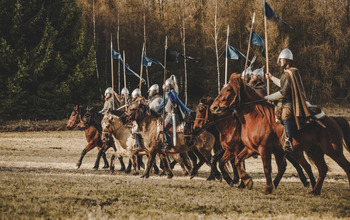
It is clear from ibn Yacqūb's account that armed riders formed a substantial part of Mieszko's retinue (Figure 10). Referring to other areas of Viking Age Europe (e.g. Braathen, Reference Braathen1989; Pedersen, Reference Pedersen2014), we can surmise that this group of warriors was an elite unit closest to Mieszko, accompanying him in battle and serving as enforcers of his ordinances. In addition to being purely military assets (with appropriate weaponry and training), this group of people had to command respect (one function of their elaborate clothing and equipment), since equestrian warriors also influenced the perception of the ruler within his monarchy, reflecting his superior power and wealth. Extant medieval texts emphasize that the retinue of Mieszko's son and successor, Bolesław the Brave, also stood out in terms of military skills, behaviour, and overall appearance (Kajkowski, Reference Kajkowski and Rębkowskiin press).
Western Slavic equestrian warriors from Drużyna Konna Pancerna X. Reproduced by permission of Kaja Szewczyk, Jōra Photo Tales.

The archaeological and textual evidence strongly suggests that the Piast rulers were personally responsible for equipping their retinues. The equipment of elite warriors (as recovered at Ciepłe and Lutomiersk) was of exceptional quality and value, substantiating and enhancing not only their fighting qualities but also the position of their superiors. In practical and/or symbolic terms, the equipment was probably the property of the rulers and it was designed in such a way that an observer would have no doubts about their identity. Elaborately decorated weapons, riding gear, and jewellery thus all became ‘material markers’, defining and emphasizing the relations between the leader, individual warriors (as well as their wives and families), and the retinue or drużyna. This created a cultural habitus, following Bourdieu (Reference Bourdieu2005), understood as the basis for social differentiation and judgment grounded in specific forms of behaviour and material culture. Studies of ideological and psychological determinants in social group formation, including warbands, also support our arguments, demonstrating the active and fundamental role of these conditions in creating a sense of group cohesion (Korostelina, Reference Korostelina2007; Price, Reference Price, Amirell and Müller2014; Raffield et al., Reference Raffield, Greenlow, Price and Collard2016 with references).
Unsurprisingly, medieval authors were deeply convinced of the superiority of spiritual or religious bonds over other factors related to creating a sense of identity (Pieniądz, Reference Pieniądz2014: 69). The ability of religion to saturate all social structures, together with its capacity to integrate diverse social goals and legitimize authority by invoking divine power, all played a decisive role in strengthening intra-group relations.
It seems that in pagan societies, among which Mieszko I operated, the legitimization of the monarch's actions had to rely on arguments deeply rooted in the traditional sphere of images and values, understood and shared by a circle wider than that of the elite around the ruler's court. Mythical events underpinning the prosperity and existence of Western Slavic societies (i.e. the cosmogonic myth and/or the prominent role of the snake Żmij) could have been such a device. It is not inconceivable that Mieszko himself initially (i.e. before his conversion) referred to the pre-Christian past of his regnum and derived the origins of his people directly from the mythical story of the world's creation before he finally transformed the former tribal organization into an early state, a programme that his son Bolesław the Brave successfully pursued.
Supplementary Material
To view supplementary material for this article, please visit https://doi.org/10.1017/eaa.2020.36.
Acknowledgements
This paper is dedicated to the memory of our colleague Zdzisława Ratajczyk (1954–2018), the discoverer of the zoomorphic spurs from Ciepłe.
The authors are grateful to Sławomir Cichecki, Tomasz Czyszczoń, Charlotte Hedenstierna-Jonson, Klaudia Karpińska, Mirosław Kuźma, Bartosz Ligocki, Simon Nygaard, Ewa and Paweł Pawlak, Neil Price, Ben Raffield, Zdzisława Ratajczyk, Keith Ruiter, Rudolf Simek, Kaja Szewczyk, Matthias Toplak, Kurt Villads Jensen, and Sæbjørg Walaker Nordeide for valuable discussions and help during various stages of the research presented here. Special thanks are also due to the three anonymous reviewers and to Catherine Frieman for her excellent editorial assistance.