In the past decade, there has been a growing interest in health technology disinvestment, because of the scarcity of resources in health care and the consequent need to identify, assess, and remove health technologies considered obsolete. A health technology is defined to be obsolete if it is in use for one or more indications and if its clinical benefit, safety, or cost-effectiveness has been significantly superseded by other available alternatives (Reference Ruano Ravina, Velasco Gonzalez, Varela Lema, Cerda Mota, Ibargoyen Roteta and Gutierrez Ibarluzea1). Disinvestment is the “process of (partially or completely) withdrawing health resources from any existing healthcare practices, procedures, technologies, or pharmaceuticals that are deemed to deliver little or no health gain for their cost and thus are not efficient health resource allocation” (Reference Elshaug, Hiller, Tunis and Moss2).
A disinvestment process concerns a health technology when it is in the last stage of its life cycle and has been superseded by other technologies or demonstrated to be ineffective or harmful. However, at the same time, a technology may be investigational for certain indications, established for others, and obsolete, being outmoded or abandoned, for others. Many technologies undergo multiple incremental innovations after their initial acceptance into general practice (Reference Gelijns and Rosenberg3;Reference Reiser4). A technology that was once considered obsolete may return to established use for a better-defined or entirely different clinical purpose (Reference Goodman5).
Therefore, a structured disinvestment process involving all relevant stakeholders (health professionals, Health Authorities, patients’ organizations, industry, etc.) is crucial to identify and deliver the most effective, safe, and cost-effective healthcare interventions.
Several reviews have systematically assessed the specific patterns of disinvestment adopted worldwide (Reference Gallego, Haas, Hall and Viney6–Reference Polisena, Clifford, Elshaug, Mitton, Russell and Skidmore10). The present work is aimed at updating the overview of disinvestment programs worldwide and at investigating, for the first time, potential barriers and facilitators, among socio-economic characteristics or the existence of HTA agencies, to the implementation of disinvestment activities.
OBJECTIVES
The objectives of this study were to describe the state of the art of the health technology disinvestment programs worldwide and to identify socio-economic (i.e., Human Development Index [HDI], Gross Domestic Product [GDP] per capita, etc.) parameters and the existence of HTA agency/ies in each country that could be associated with the presence of disinvestment programs or structured experience implemented at the local, regional or national levels. Based on our a priori research hypothesis, we considered these factors as potentially relevant to the development of disinvestment programs.
METHODS
A systematic review of the literature according to PRISMA reporting guidelines was performed from database inception to November 18, 2014, together with the collection of original data on socio-economic indicators and the existence of HTA agency/ies from countries belonging to the Organization for Economic Co-operation and Development (OECD), as well as BRICS countries (Brazil, Russia, India, China, and South Africa) and Indonesia (Supplementary Table 1).
Specific Characteristics of Disinvestment Programs

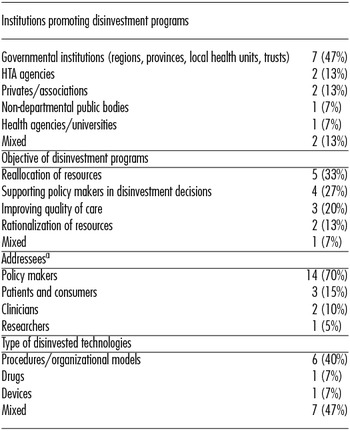
a The total number exceeds 15 as a divestment program can have more than one addressee.
Literature Search
The following electronic databases were searched: MEDLINE, EMBASE, Cochrane Library, CRD Databases, and Web of Science. Details of the search strategy are described in Supplementary Table 2. In addition, the gray literature was taken into account by consulting websites of all the HTA agencies included in the HTAi Vortal, the Web sites of Italian Regional Health Authorities and Google Scholar. To ensure a standardized and comprehensive gray literature search, we followed the Grey Matters online resource developed by The Canadian Agency for Drugs and Technologies in Health (11). The keywords searched were “health technology disinvestment” and “obsolete technology”. Reference lists of selected papers and of existing reviews on disinvestment were screened to find additional articles of interest.
Criteria of Disinvestment Programs

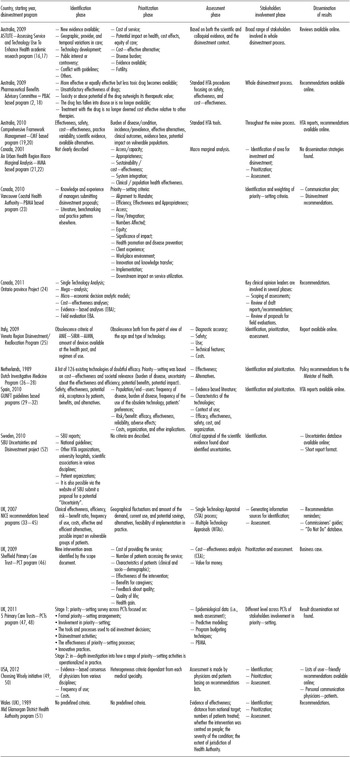
HTA, health technology assessment; PBMA, Program Budgeting and Marginal Analysis; ANIE, Federazione Nazionale Imprese Elettrotecniche ed Elettroniche (Italian National Federation of Electrotechnical and Electronics); SIRM, Società Italiana di Radiologia Medica (Italian Society of Medical Radiology); AIMN, Associazione Italiana di Medicina Nucleare e Imaging Molecolare (Italian Association of Nuclear Medicine and Molecular Imaging); GUNFT, Guideline for Not Funding existing health Technologies in health care systems; SBU, The Swedish Council on Health Technology Assessment; UK, United Kingdom; NICE, National Institute for Health and Care Excellence; USA, United States of America.
Study Selection Process
Two authors (M.O. and A.M.) independently screened for inclusion titles and abstracts of all the records identified. Subsequently, full-text study reports or publications were independently screened by two authors (M.O. and A.M.) for inclusion. Reasons for exclusion were identified and recorded. We resolved any disagreement through discussion or, if required, we consulted a third author (I.A.).
Inclusion Criteria
To be included, a study had to be a primary study describing an implemented disinvestment program or a structured experience encompassing methods used to identify, prioritize, and assess obsolete technologies and disseminate the results (Reference Ruano Ravina, Velasco Gonzalez, Varela Lema, Cerda Mota, Ibargoyen Roteta and Gutierrez Ibarluzea1;Reference Goodman5). Disinvestment was considered as “the process of (partially or completely) withdrawing health resources from any existing healthcare practices, procedures, technologies, or pharmaceuticals that are deemed to deliver little or no health gain for their cost and thus are not efficient health resource allocation” (Reference Elshaug, Hiller, Tunis and Moss2). In addition, we also included disinvestment programs focused on resource reallocation and appropriate use of technologies. Furthermore, only articles written in English or Italian were taken into account.
Exclusion Criteria
The following types of articles were excluded: systematic reviews, narrative reviews, overviews; letters, editorials, poster presentations; qualitative studies, model studies.
Data Extraction
Characteristics of the disinvestment programs/experiences described in included articles were recorded in pretested tables for data extraction (see Table 1, Table 2, Table 3, and Supplementary Tables 3–5). In particular, for each identified disinvestment program/experience the following data were extracted: background information; disinvested technologies, objectives, and addressees; identification phase criteria; prioritization phase criteria; assessment phase criteria; stakeholder involvement; and dissemination of results.
Disinvestment Criteria Used

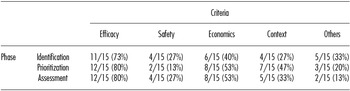
Note. Data presented as numbers, with row percentages in parentheses. Context: epidemiology of the disease; health technology frequency of use; geographic, provider, and temporal variations in care; geographical fluctuations and amount of the demand; characteristics of patients; practice variability; etc. Others: patients’ preferences, potential impact on vulnerable populations, equity of care, input from patient organisations, etc. For each phase, the disinvestment programs can consider more than one criteria.
The criteria used in the identification, prioritization and assessment phases of the disinvestment programs were categorized into broader areas: efficacy, safety, economics, context, and others. Some programs described the priority-setting process used for disinvestment decisions. To describe the criteria considered in that process, we decided to merge, depending on the specific case, the identification, prioritization, and assessment phases, considering priority-setting as a multi-step process comprising more than one phase.
Data Collection of Socio-economic Indicators and the Existence of HTA Agency/ies
Databases used for collecting socio-economic indicators were OECD Statistics (12) and BRICS Joint Statistical Publications (13). With regard to the existence of HTA agency/ies, Web sites of HTA agencies for each country were consulted, in addition to the HTAi Vortal Web site. Indicators were collected from 2006 onward, because a significant increase in research activities and related disinvestment literature dated from this time. Data were collected for each country and each year up to 2013.
The socio-economic indicators considered were as follows (see Table 4): Human Development Index (HDI), defined as “a summary measure of average achievement in key dimensions of human development: a long and healthy life, being knowledgeable, and having a decent standard of living” (14); gross domestic product (GDP) per capita (12); general government debt (12); public expenditure on health (12); public social expenditure (12); gross domestic expenditure on research and development (12); total tax revenue (12); employment rate (12); life expectancy at birth (12); infant mortality (12); educational level (12); types of healthcare system: Beveridge healthcare system, Bismarck healthcare system, private health insurance, transition model, mixed (Reference Or, Cases, Lisac, Vrangbaek, Winblad and Bevan15); free access to the best available scientific evidence (i.e., The Cochrane Library), especially relevant in the identification phase of obsolete health technologies (http://www.thecochranelibrary.com/ [accessed 18 November 2014]); income distribution and poverty (computed using the Gini Index, defined as an index that “measures the extent to which the distribution of income—or, in some cases, consumption expenditure—among individuals or households within an economy deviates from a perfectly equal distribution”) (12); perceived levels of corruption (Corruption Perceptions Index) (http://www.transparency.org/ [accessed 18 November 2014]).
Characteristics of the Countries with and without Disinvestment Programs

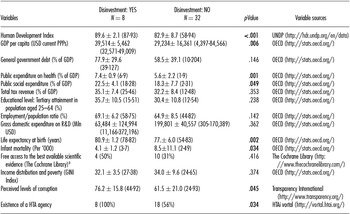
Note. Data presented as means ± SDs, with ranges in parentheses. Boldface type indicates a significant value.
a The Cochrane Library provides, to some countries, free online access through a provision or a special scheme.
UNDP, United Nations Development Programme; GDP, gross domestic product; USD, United States dollar; PPPs, purchasing power parities; OECD, Organisation for Economic Cooperation and Development; R&D, Research and Development; Mln, million; HTA, health technology assessment; HTAi, Health Technology Assessment international.
Statistical Analysis
For each country, we calculated the mean of each continuous indicator. Continuous variables were presented as means, standard deviations, and ranges, while categorical variables were reported as counts and percentages. Univariate tests were used to investigate the association between socio-economic indicators or the existence of HTA agency/ies and the presence/absence of one or more disinvestment programs/experiences. The student's t-test was used to compare continuous indicators and the Chi-square test was performed to compare categorical variables.
Correlations between several continuous indicators of interest were calculated using Pearson correlation coefficients. The significance level was fixed at p = .05. Stata/SE 13 was used for all statistical analyses (StataCorp. 2013.Release 13. College Station).
RESULTS
Literature Search Results
Overall, 1,456 records were initially retrieved: 1,199 from the electronic database search, while 257 records were identified through other sources: (118 were collected by consulting the Web sites of the HTA agencies, 100 from Google Scholar, and 39 from Web sites of the Italian Regional Health Authorities). After removal of duplicates and the initial screening of titles and abstracts, 172 records remained. Finally, after full text analysis, thirty-eight papers describing fifteen disinvestment programs/experiences in eight countries were included (see Supplementary Figure 1 for the study screening process).
Disinvestment Programs Worldwide
We have identified fifteen disinvestment programs worldwide (Reference Elshaug, Hiller, Tunis and Moss2;Reference Watt, Hiller and Braunack-Mayer16–Reference Jonsson52). Their basic characteristics and country of origin are displayed in Supplementary Table 3.
Study Characteristics
Four disinvestment programs were conducted in the United Kingdom (UK) (Reference Hollingworth and Chamberlain33–Reference Robinson, Williams, Dickinson, Freeman and Rumbold48;Reference Cohen51), three in Australia (Reference Elshaug, Hiller, Tunis and Moss2;Reference Watt, Hiller and Braunack-Mayer16–20), three in Canada (Reference Mitton, Patten and Donaldson21–Reference Levin24), and one each in Italy (25), the Netherlands (Reference Oortwijn, Banta, Vondeling and Bouter26–Reference Boer28), Spain (Reference Garcia-Armesto, Campillo-Artero and Bernal-Delgado29–Reference Ibargoyen-Roteta, Gutierrez-Ibarluzea and Asua32), Sweden (Reference Jonsson52), and the United States of America (49;Reference Cassel and Guest50). Twelve programs (Reference Elshaug, Hiller, Tunis and Moss2;Reference Watt, Hiller and Braunack-Mayer16–20;Reference Mitton, Dionne, Damji, Campbell and Bryan23–25;Reference Garcia-Armesto, Campillo-Artero and Bernal-Delgado29–Reference Cassel and Guest50;Reference Jonsson52) began after 2006 and are still ongoing, while three programs (Reference Mitton, Patten and Donaldson21;Reference Mitton, Patten, Waldner and Donaldson22;Reference Oortwijn, Banta, Vondeling and Bouter26–Reference Boer28;Reference Cohen51) began before 2006 and are no longer in existence.
In Table 1, the following characteristics of disinvestment programs are shown: the promoting institutions, the main objectives, the addressees, and the type of disinvested technology. The promoting institutions were governmental in seven programs (Reference Elshaug, Hiller, Tunis and Moss2;Reference Elshaug, Hiller and Moss18–25;Reference Airoldi46), HTA agencies in two (Reference Garcia-Armesto, Campillo-Artero and Bernal-Delgado29–Reference Ibargoyen-Roteta, Gutierrez-Ibarluzea and Asua32;Reference Jonsson52), private entities/associations in another two (Reference Oortwijn, Banta, Vondeling and Bouter26–Reference Boer28;49;Reference Cassel and Guest50), non-departmental public bodies (Reference Hollingworth and Chamberlain33–Reference Garner, Docherty and Somner45) and health agencies/universities (Reference Cohen51) in one each, and mixed type in two (Reference Watt, Hiller and Braunack-Mayer16;Reference Elshaug, Moss, Littlejohns, Karnon, Merlin and Hiller17;Reference Robinson, Dickinson, Freeman, Rumbold and Williams47;Reference Robinson, Williams, Dickinson, Freeman and Rumbold48). The objectives of disinvestment programs were reallocation of resources in five programs (Reference Watt, Hiller and Braunack-Mayer16;Reference Elshaug, Moss, Littlejohns, Karnon, Merlin and Hiller17;Reference Mitton, Patten and Donaldson21;Reference Mitton, Patten, Waldner and Donaldson22;25;Reference Hollingworth and Chamberlain33–Reference Airoldi46), supporting policy makers in disinvestment decisions in four (Reference Elshaug, Hiller, Tunis and Moss2;Reference Elshaug, Hiller and Moss18;Reference Levin24;Reference Oortwijn, Banta, Vondeling and Bouter26–Reference Boer28;Reference Jonsson52), improving quality of care in three (Reference Elshaug, Watt, Mundy and Willis19;20;Reference Garcia-Armesto, Campillo-Artero and Bernal-Delgado29–Reference Ibargoyen-Roteta, Gutierrez-Ibarluzea and Asua32;49;Reference Cassel and Guest50), rationalization of resources in two (Reference Mitton, Dionne, Damji, Campbell and Bryan23;Reference Cohen51) and mixed in one (Reference Robinson, Dickinson, Freeman, Rumbold and Williams47;Reference Robinson, Williams, Dickinson, Freeman and Rumbold48). The addressees were policy makers in fourteen programs (Reference Elshaug, Hiller, Tunis and Moss2;Reference Watt, Hiller and Braunack-Mayer16–Reference Robinson, Williams, Dickinson, Freeman and Rumbold48;Reference Cohen51;Reference Jonsson52), patients and consumers in three (Reference Garcia-Armesto, Campillo-Artero and Bernal-Delgado29–Reference Garner, Docherty and Somner45;49;Reference Cassel and Guest50), clinicians in two (Reference Elshaug, Watt, Mundy and Willis19;20;49;Reference Cassel and Guest50), and researchers in one (Reference Mitton, Dionne, Damji, Campbell and Bryan23) (the total number exceeds fifteen because a divestment program can have more than one addressee).
Disinvested technologies were procedures/organizational models in six programs (Reference Elshaug, Watt, Mundy and Willis19–Reference Mitton, Patten, Waldner and Donaldson22;Reference Garcia-Armesto, Campillo-Artero and Bernal-Delgado29–Reference Ibargoyen-Roteta, Gutierrez-Ibarluzea and Asua32;Reference Airoldi46–Reference Robinson, Williams, Dickinson, Freeman and Rumbold48;Reference Cohen51), drugs (Reference Elshaug, Hiller, Tunis and Moss2;Reference Elshaug, Hiller and Moss18) or devices (25) in one case each, and mixed technologies in seven cases (Reference Watt, Hiller and Braunack-Mayer16;Reference Elshaug, Moss, Littlejohns, Karnon, Merlin and Hiller17;Reference Mitton, Dionne, Damji, Campbell and Bryan23;Reference Levin24;Reference Oortwijn, Banta, Vondeling and Bouter26–Reference Boer28;Reference Hollingworth and Chamberlain33–Reference Garner, Docherty and Somner45;49;Reference Cassel and Guest50;Reference Jonsson52). This review has identified few disinvestment programs specifically focused on drugs, probably due to publication bias of government and payer disinvestment initiatives, as suggested by Parkinson et al. (Reference Parkinson, Sermet and Clement53).
Disinvestment Criteria
Criteria used for the identification, prioritization, and assessment phases are summarized in Table 2 and Table 3. For each phase, the disinvestment programs considered more than one criteria. For the identification phase, 11/15 (73 percent) programs (Reference Elshaug, Hiller, Tunis and Moss2;Reference Elshaug, Hiller and Moss18–20;Reference Levin24–Reference Cassel and Guest50;Reference Jonsson52) considered efficacy, 6/15 (40 percent) (Reference Elshaug, Hiller, Tunis and Moss2;Reference Elshaug, Hiller and Moss18–20;Reference Levin24;Reference Oortwijn, Banta, Vondeling and Bouter26–Reference Boer28;Reference Hollingworth and Chamberlain33–Reference Garner, Docherty and Somner45;49;Reference Cassel and Guest50) economics, 4/15 (27 percent) (Reference Elshaug, Hiller, Tunis and Moss2;Reference Elshaug, Hiller and Moss18–20;Reference Garcia-Armesto, Campillo-Artero and Bernal-Delgado29–Reference Garner, Docherty and Somner45) safety, 4/15 (27 percent) (Reference Watt, Hiller and Braunack-Mayer16;Reference Elshaug, Moss, Littlejohns, Karnon, Merlin and Hiller17;Reference Elshaug, Watt, Mundy and Willis19;20;Reference Levin24;Reference Oortwijn, Banta, Vondeling and Bouter26–Reference Boer28) context, and 5/15 (33 percent) (Reference Elshaug, Hiller, Tunis and Moss2;Reference Watt, Hiller and Braunack-Mayer16–Reference Elshaug, Hiller and Moss18;Reference Oortwijn, Banta, Vondeling and Bouter26–Reference Ibargoyen-Roteta, Gutierrez-Ibarluzea and Asua32;Reference Jonsson52) others. For the prioritization phase, 12/15 (80 percent) programs (Reference Elshaug, Hiller, Tunis and Moss2;Reference Watt, Hiller and Braunack-Mayer16–Reference Mitton, Patten, Waldner and Donaldson22;Reference Levin24–Reference Robinson, Williams, Dickinson, Freeman and Rumbold48) considered efficacy, 8/15 (53 percent) (Reference Elshaug, Hiller, Tunis and Moss2;Reference Watt, Hiller and Braunack-Mayer16–Reference Elshaug, Hiller and Moss18;Reference Mitton, Patten and Donaldson21;Reference Mitton, Patten, Waldner and Donaldson22;Reference Levin24;Reference Oortwijn, Banta, Vondeling and Bouter26–Reference Airoldi46) economics, 7/15 (47 percent) (Reference Watt, Hiller and Braunack-Mayer16;Reference Elshaug, Moss, Littlejohns, Karnon, Merlin and Hiller17;Reference Elshaug, Watt, Mundy and Willis19–Reference Mitton, Patten, Waldner and Donaldson22;Reference Oortwijn, Banta, Vondeling and Bouter26–Reference Airoldi46) context, 2/15 (13 percent) (Reference Elshaug, Hiller, Tunis and Moss2;Reference Elshaug, Hiller and Moss18;Reference Garcia-Armesto, Campillo-Artero and Bernal-Delgado29–Reference Ibargoyen-Roteta, Gutierrez-Ibarluzea and Asua32) safety, and 3/15 (20 percent) (Reference Elshaug, Watt, Mundy and Willis19;20;Reference Mitton, Dionne, Damji, Campbell and Bryan23;25) others. For the assessment phase, 12/15 (80 percent) programs (Reference Elshaug, Hiller, Tunis and Moss2;Reference Watt, Hiller and Braunack-Mayer16–20;Reference Mitton, Dionne, Damji, Campbell and Bryan23–Reference Garner, Docherty and Somner45;49–Reference Jonsson52) considered efficacy, 8/15 (53 percent) (Reference Elshaug, Hiller, Tunis and Moss2;Reference Elshaug, Hiller and Moss18–Reference Mitton, Patten, Waldner and Donaldson22;Reference Levin24;25;Reference Garcia-Armesto, Campillo-Artero and Bernal-Delgado29–Reference Ibargoyen-Roteta, Gutierrez-Ibarluzea and Asua32;Reference Airoldi46–Reference Robinson, Williams, Dickinson, Freeman and Rumbold48) economics, 5/15 (33 percent) (Reference Watt, Hiller and Braunack-Mayer16;Reference Elshaug, Moss, Littlejohns, Karnon, Merlin and Hiller17;Reference Levin24;Reference Garcia-Armesto, Campillo-Artero and Bernal-Delgado29–Reference Ibargoyen-Roteta, Gutierrez-Ibarluzea and Asua32;Reference Robinson, Dickinson, Freeman, Rumbold and Williams47;Reference Robinson, Williams, Dickinson, Freeman and Rumbold48;Reference Cohen51) context, 4/15 (27 percent) (Reference Elshaug, Hiller, Tunis and Moss2;Reference Elshaug, Hiller and Moss18–20;25;Reference Garcia-Armesto, Campillo-Artero and Bernal-Delgado29–Reference Ibargoyen-Roteta, Gutierrez-Ibarluzea and Asua32) safety, and 2/15 (13 percent) (Reference Mitton, Dionne, Damji, Campbell and Bryan23;Reference Cohen51) others.
Context issues encompassed epidemiology of the disease, health technology frequency of use, geographic, provider, and temporal variations in care, geographical fluctuations and amount of demand, characteristics of patients, practice variability, etc. In the “others” category, we have included patients’ preferences, potential impact on vulnerable populations, equity of care, input from patient organizations, etc.
Stakeholder Involvement
The most common stakeholders involved in the disinvestment processes were physicians and other healthcare staff in 11/15 programs (73 percent) (Reference Elshaug, Hiller, Tunis and Moss2;Reference Watt, Hiller and Braunack-Mayer16–Reference Elshaug, Hiller and Moss18;Reference Mitton, Patten and Donaldson21;Reference Mitton, Patten, Waldner and Donaldson22;Reference Levin24–Reference Garner, Docherty and Somner45;49–Reference Jonsson52), clinical and political decision makers in 6/15 (40 percent) (Reference Mitton, Patten and Donaldson21–Reference Mitton, Dionne, Damji, Campbell and Bryan23;25;Reference Robinson, Dickinson, Freeman, Rumbold and Williams47;Reference Robinson, Williams, Dickinson, Freeman and Rumbold48;Reference Cohen51;Reference Jonsson52), patients and patient organizations in 6/15 (40 percent) (Reference Elshaug, Hiller, Tunis and Moss2;Reference Watt, Hiller and Braunack-Mayer16–Reference Elshaug, Hiller and Moss18;Reference Garcia-Armesto, Campillo-Artero and Bernal-Delgado29–Reference Ibargoyen-Roteta, Gutierrez-Ibarluzea and Asua32;Reference Airoldi46;49;Reference Cassel and Guest50;Reference Jonsson52), experts and researchers in 5/15 (33 percent) (Reference Elshaug, Watt, Mundy and Willis19–Reference Mitton, Patten, Waldner and Donaldson22;Reference Levin24;Reference Hollingworth and Chamberlain33–Reference Garner, Docherty and Somner45;Reference Cohen51), health economists in 4/15 (27 percent) (Reference Elshaug, Hiller, Tunis and Moss2;Reference Elshaug, Hiller and Moss18;25–Reference Boer28;Reference Robinson, Dickinson, Freeman, Rumbold and Williams47;Reference Robinson, Williams, Dickinson, Freeman and Rumbold48), and citizens in 4/15 (27 percent) (Reference Watt, Hiller and Braunack-Mayer16;Reference Elshaug, Moss, Littlejohns, Karnon, Merlin and Hiller17;Reference Elshaug, Watt, Mundy and Willis19;20;Reference Robinson, Dickinson, Freeman, Rumbold and Williams47;Reference Robinson, Williams, Dickinson, Freeman and Rumbold48;Reference Jonsson52). The phases in which stakeholders were involved were as follows: identification/prioritization/assessment in 8/15 programs (53 percent) (Reference Elshaug, Hiller, Tunis and Moss2;Reference Watt, Hiller and Braunack-Mayer16–Reference Mitton, Dionne, Damji, Campbell and Bryan23;25;49–Reference Cohen51), identification/prioritization in 3/15 (20 percent) (Reference Oortwijn, Banta, Vondeling and Bouter26–Reference Ibargoyen-Roteta, Gutierrez-Ibarluzea and Asua32;Reference Robinson, Dickinson, Freeman, Rumbold and Williams47;Reference Robinson, Williams, Dickinson, Freeman and Rumbold48), identification in 1/15 (7 percent) (Reference Jonsson52), identification/assessment in 1/15 (7 percent) (Reference Hollingworth and Chamberlain33–Reference Garner, Docherty and Somner45), prioritization/assessment in 1/15 (7 percent) (Reference Airoldi46), and assessment in 1/15 (7 percent) (Reference Levin24) (Supplementary Table 4).
Dissemination of Results
The most common means used to disseminate results were: printed or online recommendations (Reference Elshaug, Hiller, Tunis and Moss2;Reference Elshaug, Hiller and Moss18–20;Reference Mitton, Dionne, Damji, Campbell and Bryan23;Reference Levin24;Reference Oortwijn, Banta, Vondeling and Bouter26–Reference Boer28;49–Reference Cohen51); online HTA reports (Reference Elshaug, Watt, Mundy and Willis19;20;Reference Garcia-Armesto, Campillo-Artero and Bernal-Delgado29–Reference Ibargoyen-Roteta, Gutierrez-Ibarluzea and Asua32); printed or online recommendation reminders, online commissioners’ guides, and “Do Not Do” database (Reference Hollingworth and Chamberlain33–Reference Garner, Docherty and Somner45); online uncertainties databases and online short report format (Reference Jonsson52); online reviews (Reference Watt, Hiller and Braunack-Mayer16;Reference Elshaug, Moss, Littlejohns, Karnon, Merlin and Hiller17;25); others (Reference Mitton, Dionne, Damji, Campbell and Bryan23;Reference Airoldi46;49;Reference Cassel and Guest50) (Supplementary Table 5).
Socio-economic Indicators and Existence of HTA Agency/ies
Table 4 shows the results of univariate analysis investigating the association between indicators and the presence of a disinvestment program/experience. The Human Development Index was significantly higher in countries with disinvestment programs (p < .001). Countries with disinvestment programs also showed significantly higher levels of GDP per capita (p = .006), public expenditure on health care (p = .001), public expenditure on social services (p = .049), life expectancy at birth (p = .002), and a lower level of infant mortality rate (p = .034). Finally, countries with disinvestment programs had a significantly lower perceived level of corruption (p = .045). The existence of HTA agency/ies in the country was a strong predictor of the disinvestment programs (p = .034). In fact, all the countries with disinvestment programs had at least one HTA agency.
We also categorized the countries by the type of healthcare system: Beveridge: health care is characterized by universal coverage and is entirely financed by the government through taxation; Bismarck: is based on an insurance system financed jointly by employers and employees through payroll deduction; mixed: a healthcare system that has elements of both Beveridge and Bismarck systems; private insurance: the healthcare system is mainly covered by private insurance; transition model: healthcare systems in transition toward one of the abovementioned models (e.g., many post-communist countries).
The type of healthcare system did not correlate significantly with the presence of disinvestment (p = .22). Five of eight countries with disinvestment programs had a Beveridge system, two had private insurance, and one was based on the Bismarck model.
DISCUSSION
Summary of Findings
Our study led to the identification of disinvestment programs/experiences at the local, national, and regional levels. As expected, divestment programs were more common in developed countries, 63 percent of which had a Beveridge model healthcare system (Reference Or, Cases, Lisac, Vrangbaek, Winblad and Bevan15). Disinvested technologies were more frequently of the mixed type (drugs, devices, procedures) or related to procedures/organizational models.
In a majority of programs, a wide range of stakeholders was involved throughout the disinvestment process. The most common means used to disseminate the results were printed material, online recommendations, HTA reports, online databases, and reviews. Countries with disinvestment programs were found to have a higher level of HDI, GDP per capita, public expenditure on health care and social services, and life expectancy at birth. The existence of HTA agency/ies in the country was shown to be a strong predictor of the presence of a disinvestment program/experience.
According to our results, developed countries seem to pay more attention to the disinvestment issue. Probably, countries less developed have no sufficient resources and specific skills to focus on such virtuous initiatives as divestment programs. However, the scarcity of healthcare resources will force these countries to deal with disinvestment issue. To have room for developing disinvestment programs, system-oriented measures should be undertaken to improve overall socio-economic conditions and HTA agencies/organizations should be established.
Strengths and Limitations
The strength of this overview includes a comprehensive search strategy that encompassed several important databases, as well as a wide array of databases containing grey literature. The analysis of socio-economic determinants and the existence of HTA agency/ies in the countries, with or without disinvestment programs, is an innovative aspect of this study. However, we acknowledge some limitations in our investigation. It is possible that we failed to capture informal disinvestment initiatives that were unpublished; however, it would have required contacting disinvestment experts in all the considered countries. For the literature search, we decided to include only papers written in English or Italian, which could have introduced a language bias that weakened results of the statistical analysis. Our study has a limited sample size (40 countries); this hampers the feasibility of multivariate models to investigate the independent role of each socio-economic variable as predictor of disinvestment programs. The narrowness of the time frame could be considered a limit, but we think that it constitutes a minor issue, as almost all the disinvestment programs date from 2006.
Comparison with Previous Reviews
In recent years, some overviews or reviews on disinvestment have been published (Reference Gallego, Haas, Hall and Viney6–Reference Polisena, Clifford, Elshaug, Mitton, Russell and Skidmore10). A report issued by the Centre for Health Economics Research and Evaluation (Reference Gallego, Haas, Hall and Viney6) identified several case studies and pilot projects, but did not identify any formal structure, process, or mechanism to reduce the use of existing technologies, clinical interventions, or health programs with limited or no clinical effectiveness or cost-effectiveness. Gerdvilaite and Nachtnebel (Reference Gerdvilaite7) performed an overview of existing disinvestment approaches in four selected countries (England, Spain, Australia, and Canada) but no comprehensive national disinvestment framework was identified.
Leggett et al. (Reference Leggett, Noseworthy, Zarrabi, Lorenzetti, Sutherland and Clement8) performed a systematic review of the international Health Technology Reassessment (HTR) initiatives for nondrug technologies. They found eight countries engaged in HTR activities, but no comprehensive model for HTR was elaborated and implemented. Mayer and Nachtnebel (Reference Mayer and Nachtnebel9) systematically reviewed internationally implemented models to identify ineffective interventions and technologies and found eight implemented disinvestment models and two pilot projects. To achieve a comprehensive description of the identified models and strategies and to describe particular advantages, disadvantages, and barriers to implementation, international experts for each identified model were asked to fill in a semi-standardized questionnaire.
Based on the examples analyzed, a potential model for Austria was developed. Polisena et al. (Reference Polisena, Clifford, Elshaug, Mitton, Russell and Skidmore10) performed a systematic review to identify case studies on the application of frameworks and tools for disinvestment and resource allocation decisions and found fourteen case studies. Most of the studies described the application of program budgeting and marginal analysis (PBMA), while two reports used health technology assessment (HTA) methods for coverage decisions in a national fee-for-service structure. However, the scarcity of evidence and local health service usage precluded the development of evidence-based recommendations for disinvestment. Compared with these previous reviews, our study has identified new disinvestment programs (25–Reference Boer28;Reference Airoldi46–Reference Robinson, Williams, Dickinson, Freeman and Rumbold48;Reference Cohen51), and has sought to identify socio-economic characteristics or the existence of HTA agency/ies that could facilitate or hinder the implementation of disinvestment activities in the different countries.
CONCLUSION
The objectives of the disinvestment programs identified were reallocation of resources, supporting policy makers in disinvestment decisions, improving quality of care, and rationalization of resources. Disinvested technologies were procedures/organizational models, drugs or devices, and mixed technologies.
Results indicated that GDP per capita, Human Development Index, public expenditure on health, life expectancy at birth, and the existence of HTA agency/ies were strongly associated with the presence of a disinvestment program. These items could be related to the overall development stage of the country.
SUPPLEMENTARY MATERIAL
Supplementary Table 1: https://doi.org/10.1017/S0266462317000514
Supplementary Table 2: https://doi.org/10.1017/S0266462317000514
Supplementary Table 3: https://doi.org/10.1017/S0266462317000514
Supplementary Table 4: https://doi.org/10.1017/S0266462317000514
Supplementary Table 5: https://doi.org/10.1017/S0266462317000514
Supplementary Figure 1: https://doi.org/10.1017/S0266462317000514
CONFLICTS OF INTEREST
The authors have nothing to disclose.