The politics of law and order are regularly major issues of political debate. In the French presidential campaign 2012, the incumbent Nicolas Sarkozy tried to gain votes from the far right by portraying himself as the guardian of law and order in France.Footnote 1 And in Britain, Conservative Prime Minister David Cameron ditched many parts of Justice Secretary Kenneth Clarke's sentencing reform after criticism from the tabloids.Footnote 2 These examples show that the politics of law and order are highly politicized. However, and quite surprisingly, a systematic comparative study of law-and-order policies is still missing – at least from the political science literature.
Instead, the politics of law and order have been discussed at length among criminologists in recent years. The initial impetus for this debate has been David Garland's thesis about a ‘punitive turn’ in the societies of industrialized Western countries – in particular in Britain and United States.Footnote 3 In his influential book published in 2001, Garland argues that neo-liberal capitalism has led to a profound change in the culture of society: ‘If the watchwords of post-war social democracy had been economic control and social liberation, the new politics of the 1980s put in place a quite different framework of economic freedom and social control’.Footnote 4 Following Garland, criminologists offer different, mostly structural, explanations for this tendency to harsher law-and-order policies: Neo-liberalism, globalization, socio-economic change and welfare state retrenchmentFootnote 5 as well as increasing crime rates, reaching even the middle classes,Footnote 6 have been mentioned as important causes in the literature.
However, from a political science perspective, this state of the art is unsatisfying for several reasons. First, probably due to the criminological and sociological background of the scholars, explanations of law-and-order policies focusing on the policy-making process itself are largely missing from the debate. This is surprising, as law-and-order policies are by no means direct consequences of structural variables; however, they are decided and enacted by governments and legislatures (who might in turn react to some structural developments). Admittedly, some case studies on the United States and Britain have provided evidence on how partisan politics play a role.Footnote 7 But most of these studies are focused only on these two countries, neither provide a general theoretical underpinning of why partisan ideology might impact on law-and-order policies nor analyse this question in a comparative setting, and use a rough left-right scale instead of measuring the actual partisan position of governments on law and order. Secondly, the criminological literature does not have much to say about the variations between countries in terms of law-and-order policies. However, if we assume that nations differ in the extent to which the neo-liberal ideas – identified by Garland as the major cause for the punitive turn – have found their way into economic policy making, we would clearly expect such differences. Although recent comparative (and largely descriptive) studies of the emerging field of comparative criminologyFootnote 8 suggest that international variation and clusters of nations exist (following welfare state regimesFootnote 9 or varieties of capitalismFootnote 10 ) an encompassing explanation of the cross-national differences is still missing. Thirdly, in existing studies the measurement of the dependent variable is conceptually problematic. Most analyses either use historical narratives in order to make their point qualitatively (as Garland does), or analyse data on imprisonment ratesFootnote 11 or fear of crimeFootnote 12 quantitatively.Footnote 13 However, these outcome-variables are causally rather ‘far away’ from the policy-making arena (see below) which we expect to impact significantly on actual policy outputs.
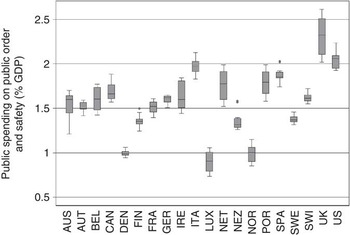
Addressing these three shortcomings of existing research is the main concern of the present contribution. Therefore, concerning the first point, we will discuss theoretically and investigate empirically how political parties in government and their ideological stances impact on law-and-order policies. We will do this, secondly, by analysing a sample of twenty OECD countries between 1995 and 2008Footnote 14 – thus addressing the dearth of comparative studies in the field. Thirdly, concerning the dependent variable, we analyse expenditure data because public spending is more closely related to the policy-making process than imprisonment rates and should, therefore, catch differences in law-and-order policies in a more straightforward way (see below).Footnote 15 In order to provide a brief overview of the cross-national and over-time variation in public spending on law and order, Figure 1 shows the variance in twenty countries over time. The explanation of this variance paying particular attention to the partisan ideology of governments is the main concern of this article.
Variation in law-and-order spending

The remainder of this contribution is structured as follows. In the next section, we lay out the theoretical and conceptual underpinnings of our study and relate it to the state of the art. Here, we will also explain why we expect the ideology of parties in government to influence national law-and-order policies. The following section focuses on data and methodological issues, while the results of the empirical analysis are presented and discussed in the penultimate section. The final section concludes.
STATE OF THE ART AND THEORETICAL UNDERPINNINGS
This section lays the theoretical groundwork for the empirical analysis of law-and-order policies in twenty Western democracies from 1995 to 2008. Our theoretical reasoning involves two steps. First, based on the state of the art of the criminological debate, we develop a theoretical model in order to explain differences in law-and-order policies. We show that the causal model which underlies many criminological studies on law-and-order policies is dominated by structural variables and omits a crucial factor – partisan politics. Building on this assessment, we then proceed to explain why (and in what ways) partisan ideology should matter.
How to Explain Law-and-Order Policies: A Brief Overview of the Fragmented State of the Art
Recent studies from comparative criminologists investigating law-and-order policies fall into two broad categories. On the one hand, some scholars focus on the temporal dimension and argue that all Western societies find themselves in a process of globalization, neo-liberalization and welfare state retrenchment and that these developments lead to harsher law- and-order policies and rising punitiveness (often measured via imprisonment rates).Footnote 16 On the other hand, a growing number of studies emphasize the cross-national dimension showing that major differences between industrialized countries persist, that the levels of punitiveness vary greatly, and that nation-states cluster in specific groups.Footnote 17
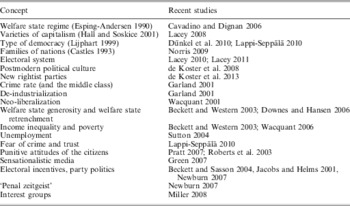
When it comes to the explanation of both findings, however, the literature lacks a general theoretical framework. Instead, studies from both strands of the literature identify a wide range of variables which might be influential (see Table 1 for an overview). Furthermore, the degree to which a real explanatory argument is presented varies considerably from study to study. Whereas Lacey or Wacquant establish clear causal relationships, the contribution of Cavadino and Dignan is largely descriptive. When scholars present causal explanations, the most dominant approaches are structuralistFootnote 18 in nature and focus on inequality, poverty, unemployment and the labour market as determinants of law-and-order policies. But media systems, partisan competition, interest groups, specific new rightist parties and welfare state generosity have been said to be influential, too. Furthermore, key concepts from comparative politics have been used to make sense of cross-national differences, such as Lijphart's distinction between consensus and majoritarian democracies, different welfare state regimes or the types of varieties of capitalism.
Explanations for Law-and-Order Policies according to the State of the Art in (Comparative) Criminology

Hence, in assessing today's state of the art, one is left with a plethora of possible variables that may account for variance in law-and-order policies and punitiveness, while an overall theoretical framework in which these variables could be embedded is still missing. Moreover, the fact that most studies are qualitative in nature makes an assessment of the explanatory power of these factors rather difficult. This leaves us with the unsatisfying impression that every single variable discussed in the literature might well be influential, as one could always find some qualitative evidence from some case study out there suggesting that this indeed is the case.
What complicates the picture even further is the ambiguity concerning the dependent variable. Most criminological studies focus on ‘punitiveness’ – a concept which remains ‘thin and under-theorized’ and ‘largely undifferentiated’.Footnote 19 Qualitative researchers analyse a wide range of developments which are all related to ‘punitiveness’: Newburn, for instance, analyses law-and-order legislation in England and Wales;Footnote 20 and Garland examines a variety of indicators – such as ‘harsher sentencing and increased use of imprisonment; “three strikes” and mandatory minimum sentencing laws’, and many others – in order to declare that a ‘punitive turn’ in the United States has taken place.Footnote 21 In contrast, quantitative studies usually rely on imprisonment rates to approximate punitivenessFootnote 22 as these data are readily available for several countries. Again, and as for the explaining variables, this multitude of possible dependent variables exacerbates an overall assessment of the causal relationships: Some of the above mentioned explanations might well impact on legislation, but do they matter for imprisonment rates? And how do the different dependent variables relate to each other? These questions are a direct product of the vagueness of the dependent variable.
Summing up the state of the art in comparative criminology, we come to the conclusion that even though there is a multitude of studies indicating that (1) overall, law-and-order policies have become harsher in recent decades and that (2) at the same time, cross-national differences are substantial, the lack of a common framework of analysis makes a valuable comparison of the various approaches difficult. In what follows, we therefore propose a general theoretical framework which draws on the existing work and guides our own research.
Explaining Law-and-Order Policies: A Theoretical Framework
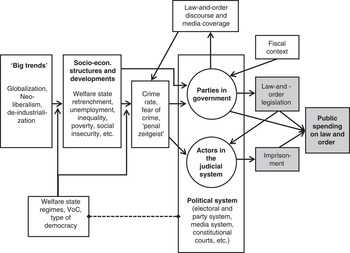
If one aims at integrating the relationships between the various independent and dependent variables indicated above in one overarching theoretical framework, thinking of causal orderFootnote 23 proves to be helpful. The first step in such an endeavour is to specify the explanandum – the dependent variable. In our case, several (again causally ordered) dependent variables have been discussed: one could, as Newburn does, take legislation, a measure which is very close to the political system. Alternatively, one could assess the toughness of judicial sentencingFootnote 24 or analyse imprisonment rates – a measure, which reflects legislative decisions as well as characteristics of the judicial system. Finally, we could analyse public spending as an overall measureFootnote 25 in which all legislative, bureaucratic and judicial decisions with budgetary repercussions should be involved. All these variables cover distinct aspects of law-and-order policies and can be analysed in principle. What is important, however, is to order them causally and to be clear about their relative position with respect to the explaining variables.
Figure 2 depicts what such a causal organization of the politics of law and order looks like. The three grey-shaded boxes symbolize possible dependent variables and their causal order is immediately clear from Figure 2: legislation is a direct policy output of the political system and impacts both on public spending (for example, a law introducing new surveillance instruments) and on the judicial system, where different actors such as public prosecutors or judges sentence on the basis of the laws enacted. Their decisions affect imprisonment rates which in turn influence public spending. In addition, it might be the case that governments decide upon spending per se, for instance by increasing the budget for hiring new police officers. However, as budgetary decisions are not made in a laboratory situation, the fiscal and economic context (such as high indebtedness or economic growth) should influence the leeway governments have to implement legislation with budgetary effects.Footnote 26
Overall theoretical framework

In terms of the independent variables, Figure 2 organizes the multitude of variables discussed in the criminological literature in terms of their causal order. Beginning from the right, the variables which are most closely related to the policy output (and outcomes) are the parties in government (deciding on legislation) and the actors in the judicial system (deciding on sentencing). Both actors – governments and sentencers – are embedded in the political system of the specific country and this institutional setting influences their actions.Footnote 27 Two examples: if significant actors in the judicial system (such as judges or prosecutors) are directly elected by the people (as in most American states), this will probably impact their behaviour in terms of sentencing.Footnote 28 And if the electoral system has a tendency to generate two-party-systems (such as the British first-past-the-post system), a ‘prisoner's dilemma’, where one party tries to outpace the other in terms of ‘being tough on crime’, may be more probable.Footnote 29 The same applies for strong constitutional courts, which may prevent governments from implementing harsher law-and-order legislation,Footnote 30 or for media systems which might act as an amplifier for calls for harsher measures (especially when the tabloids play a significant role).Footnote 31 What is important to note, however, is that these characteristics of the political systems impact only indirectly on policies. Tabloid newspapers and electoral systems neither implement legislation, nor sentence people nor decide on spending. However they might create institutional restrictions or incentives for the decision-making actors to behave in a certain way: interaction effects are, therefore, highly probable.
The government (and to a certain extent the actors in the judicial system depending on their responsiveness to public demands) react with their policies to certain societal problems. Following the criminological literature, the problems in the realm of law-and-order policies might be a rising crime rate (visible for the middle classes),Footnote 32 higher fear of crimeFootnote 33 or ‘tougher’ attitudes of the citizens,Footnote 34 as well as a certain ‘penal zeitgeist’Footnote 35 which is brought about in the public and media discourse (and again influenced by the actors in the political systems, and the government in particular). However, following the structuralist approach, these developments do not originate from nowhere. Instead, socio-economic developments (such as poverty, unemployment, welfare state retrenchment or inequality) might be the underlying causes. Feelings of insecurity and fear of crime can be the result of socio-economic developments such as unemployment or welfare state retrenchment. And rising crime rates may be just the outcome of an impoverished population of unemployed people.Footnote 36 Again, some observers hold that these developments could, in turn, be interpreted as the results of global trends such as globalization, deindustrialization and neo-liberalism.Footnote 37 These causal relationships are depicted on the left of Figure 2. However, the model also shows that the ‘big trends’ are quite distant from the policy output and influenced by many other factors, too. Hence, even if we adhere to the argument that globalization and neo-liberalism are overall developments affecting all Western societies, it is very probable that different nation-states react in their policy making quite differently to these general developments.Footnote 38 This is the reason why broad concepts which cluster countries in families of nations, welfare state regimes, varieties of capitalism or types of democracy should condition the impact that these global trends have on the respective nation-states (see box below in Figure 2; the dotted line symbolizes the close relationship of these concepts to the institutional arrangements of the political systems). This impact might manifest itself on various occasions throughout the causal process.
Comparing the causal model depicted in Figure 2 with the state of the art in the criminological literature yields three main conclusions. First, most of the criminological explanations of law-and-order policies limit their analysis to the impact of big trends, socio-economic structures, or variables such as crime rates or fear of crime. However, only rarely do they take into account the causal ordering of variables or test specific relationships explicitly. Secondly, to date, public spending on law and order has not been analysed comparatively in any significant way. This is surprising as public expenditure has been a major subject of analysis in the comparative public policy literature. Moreover, international statistical conventions, such as the ‘classification of functions of governments’, ensure a high degree of data comparability. That is why the remainder of this article focuses on the impact of the partisan ideology of governments on public spending. And thirdly, although some more recent studies from comparative criminologists analyse the impact of political institutions (such as electoral systems) or broad political science concepts (for example, welfare state regimes) on law-and-order policies, the main actors legislating such policies, namely governments and their partisan composition, have not been properly examined yet. This is a major gap in the literature, because all the causal paths leading from whatever explanatory variable to policies need to pass at least one of two bottlenecks: either they influence the government and its legislation or they impact on the judicial system and affect the sentencing (see Figure 2). However, as legislation sets the rules for sentencing, the role played by governments within the causal model is even more crucial. Therefore, this contribution pays particular attention to the role of the government and its partisan composition when it comes to law-and-order policies. In order to be more precise about what kind of partisan influence to expect, the following section will deduce two hypotheses concerning the partisan effects.
Parties, Voters, Institutions and Law-and-Order Politics
The former sections have shown that although general structural trends such as globalization affect all Western industrialized countries and may cause certain developments in law-and-order policies, national governments continue to be relevant actors when such policies are enacted. Therefore, causes for variation in law-and-order policies are very likely to be found at the level of governments. A key variable in this respect is the ideological position of the parties (or party) forming the government. This is not only the conclusion of decades of research in comparative public policy literature, but also the implication of several case studies by criminologists such as Lacey, Newburn, or Beckett and Sasson (see above). However, in order to say something about an impact of parties on law-and-order policies and abstracting from the case study evidence, we need to show that there are strong theoretical reasons for systematic partisan influences. To develop this argument is the aim of this section.
Using the main concepts of the partisan politics theory in public policy research,Footnote 39 we argue that the ideology of governing parties will influence law-and-order policies under the subsequent three conditions: (1) if governments exhibit different ideological stances towards law and order in different nation-states or over time; (2) if parties in power have an incentive to implement policies according to their ideology; and (3) if the institutional as well as fiscal environment allows them to translate their preferences into policies. The following sections elaborate on each of the three conditions.
Condition 1: Parties, ideologies and law and order
The prerequisite for a partisan impact is that different parties exhibit different ideological stances towards law and order. Studies on partisan effects on public policies mostly take this precondition for granted or relate it to party positions on a left-right scale – usually opposing social democrats, Christian democrats and secular conservatives.Footnote 40 However, the literature on partisan positions has convincingly shown that differences on economic issues on which the left-right axis is founded do not necessarily coincide with differences in other policy fields. Kitschelt argues for instance that partisan competition centres not only on economic but also on socio-political issues (libertarian v. authoritarian).Footnote 41 In the same vein, Warwick suggests that West European party systems share three common dimensionalities: left-right, post-materialism and social control.Footnote 42 Finally, the study by Laver and HuntFootnote 43 shows that at least the party systems in the Benelux countries (as well as in GermanyFootnote 44 ) have a distinct two-dimensional structure which includes an economic dimension and a dimension where parties compete in the policy fields of justice and societal policies. Hence, if we are interested in law-and-order policies, we have to take partisan differences into account more specifically.
If one calculates the partisan positions of governments in twenty Western industrialized countries between 1995 and 2008 using the data on partisan positions on law and order from the Manifesto Research Group,Footnote 45 it is evident that governments’ positions within a country vary considerably over time.Footnote 46 This variation is mainly caused by changes in the partisan composition of governments (such as the drop from a harsher position of the CDU-FDP government in Germany before 1998 to a more liberal position of the red-green coalition after that date), but also due to changes in the ideological stances of one and the same governing parties (for example, the Canadian Liberal government between 1995 and 2005). In addition, governments differ more or less sharply in their law-and-order position depending on the country we look at. For instance, the shift in power in Britain from a Tory to Blair's (New) Labour government in 1997 did not alter the law-and-order position of the government significantly as the positions of New Labour and the Tories converged (and moved to the more authoritarian pole – a finding which is very much in line with the arguments put forward by Lacey and Newburn). In stark contrast, however, the election of the centre-right government in Denmark in 2001 replacing a centre-left cabinet did alter the ideological stance of the government significantly as the positions on law and order of Danish parties are more highly differentiated than those of British parties. Finally, the data on partisan positions indicate that parties in some countries (like Britain) exhibit generally a tougher stance towards law and order than other nation-states (for example, Sweden and Germany). Summing up these points, the first condition is clearly met: governments indeed exhibit different ideological stances towards law and order. This is true over time within a country but also between nation-states and might well explain differences in law-and-order policies.
Condition 2: Vote-seeking, policy-seeking and partisan differences
What are the chances that the said differences in the governmental ideological stances materialize in terms of diverging public policies? An answer to this question which lies at the heart of the ‘parties matter’ debate within public policy research is necessary, because there is no guarantee that parties elected do actually implement the policies they purport to represent once in office. Hence, we have to clarify theoretically whether and under what conditions governments have an incentive to implement different policies according to their ideological positions – a point which has recently been re-iterated by Häusermann et al.Footnote 47
Our starting point is the well-established claim, that ‘[P]oliticians face a trade-off between the policies that maximize their chances of reelection and those that are most preferred by the constituency supporting their party’.Footnote 48 If we assume that a party in government is mainly motivated by policy-seeking goals, the derivation of a partisan impact on public policies is rather straightforward as the implementation of the preferred policies – usually written down in a manifesto and approved by a party convention – is an end in itself: parties have fixed policy preferences which they implement when they are in office and voters choose between the policy proposals of different parties.Footnote 49
However, this position has been criticized for its macro-perspective which considers parties to be the main actors. The alternative view adopts a more dynamic micro-perspective, where parties are primarily vote-seekers and their positions are, therefore, closely connected to the positions of the constituencies: voters are movers, and parties follow. Subsequently, parties in office care less about their manifestos but much more about public opinion (and winning the next election).Footnote 50 This has important consequences for our analysis of partisan impacts on policies. If parties in government care primarily about their re-election, ideological positions of governments as laid out in manifestos are largely irrelevant for an explanation of public policy outcomes. Instead, the ideological position of the voters decides. Only under the condition that party positions correspond to the positions of the respective voters is an impact of the ideological position of governments on public policies probable. If this condition is met in the case of law-and-order policies, i.e. if partisan positions on law and order and the distribution of voter's preferences towards this issue relate to each other, has to be clarified empirically.
Empirical evidence on this relationship is available for a selection of countries.Footnote 51 Several points are worthy of note: on the one hand, very generally, partisan positions seem to reflect the positions of the constituencies rather well. Only eight out of the thirty-three parties that we analysed rank very differently in terms of their stance towards law and order from the positions of their constituencies (divergence of more than one position in the national party system). Moreover, the extreme positions are usually held by the same parties; slight differences occur mostly at the centre of the ideological scale where parties and voters are closer to each other. Hence, even from a vote-seeking perspective, parties seem to have an incentive to implement their preferred policies in order to please their constituencies who share these views. On the other hand, however, a few differences for specific parties stand out. This is especially true for regional parties – for instance, the NVA in the Flemish part of Belgium – but also for the positions of the German, the Belgian and the Swedish social democrats. Whereas the German SPD electorate seems to be much more in favour of a less rigid law-and-order policy, the party position is more authoritarian. In Sweden and Belgium the opposite is true. However, these changes do not compromise our general assessment that the positions of parties and their constituencies are quite similar. Therefore, it seems safe to say that even if one shares the view that parties in government primarily care about winning the next election, they have a strong incentive to implement law-and-order policies as laid out in their manifestos, because the preferences of their constituencies are generally in accordance. So, we formulate the following hypothesis:
HYPOTHESIS 1: If a government in a country (at a certain time) exhibits a harsher ideological stance towards law and order, law-and-order policies in this country (at this time) will be tougher.
Condition 3: Partisan effects and the impact of the institutional and fiscal environment
The last sections have shown that vote-seeking as well as policy-seeking politicians have an incentive to implement their ideologically favoured law-and-order policies when elected to office. In this section, we now turn to a third condition which relates to the argument that the political institutions of a country as well as the fiscal and economic context affects governmental policy discretion (see Figure 2). This insight is relevant for the investigation of partisan effects, because the extent to which a politician is able to implement her favoured policies depends on these external conditions: Many institutional constraints limit partisan effects, whereas low institutional barriers allow parties to implement the preferred policies without many changes. In fact, recent studies have convincingly shown that the influence of partisan ideologies on public policies is often moderated by the institutional framework in which governments operate.Footnote 52 Applied to our research question, we would therefore expect partisan effects to be generally stronger in Westminster-style systems where only few veto points exist than in political systems with many institutional constraints.
In the case of law-and-order policies, this general idea of institutional constraints can be specified more precisely, because one specific institution – constitutional courts – might play a prominent role. Even though constitutional courts seldom affect sentencing directly,Footnote 53 their decisions may impact on the law-making process and in turn influence law-and-order spending. Several cases illustrate how this influence takes place. In France, for instance, the French ‘Conseil Constitutionel’ turned down parts of a bill proposed by the Sarkozy government in 2012, which introduced a new electronic identity card coupled with a mega-database in which biometric information should be stored.Footnote 54 Another case in point is Belgium, where the Constitutional Court in 2007 (decision 105/2007) partly set aside an act which extended the application of certain special methods of investigation.Footnote 55 For Germany, many case studies have shown that the Federal Constitutional Court acted as a powerful force constraining the Federal government from implementing tougher law-and-order policies, too.Footnote 56 Kneip describes the role of the German Constitutional Court as follows:Footnote 57
In the last 10 years, Federal and state legislators have adopted a large number of new laws that significantly restricted civil rights and liberties. Many of these laws were submitted to the Constitutional Court by ordinary citizens … These laws had to be withdrawn only due to the interventions of the Federal Constitutional Court.
But even in Britain – probably the least likely case for an impact of constitutional courts on policies – Kavanagh argues that a ‘constitutional shift’ has taken place.Footnote 58 She presents a case study showing how the House of Lords, which (debatably) in this case might be considered as functionally equivalent to a constitutional court,Footnote 59 decided against the opinion of the Home Office that the detention of nine people without trial in the light of a public emergency in the Belmarsh prison was incompatible with the articles of the European Convention on Human Rights.Footnote 60 For Kavanagh, this decision of the Law Lords indicates the beginning of a new landscape in which, ‘the government has to justify counterterrorist policies as compatible with human rights’.Footnote 61 Clearly, this ‘constitutional shift’ should have a mid-term impact on the overall law-and-order stance in policy making and, finally, impact on public spending in this area, too.Footnote 62 Thus, overall, there seems to be a fair amount of evidence that constitutional courts (and especially strong ones, like the German or the Austrian) may constrain very tough law-and-order policies not only directly by setting aside law bills, but also indirectly by limiting the influence of parties: more authoritarian parties might not be able to implement their preferred policies because of the court's decision.
Finally, the fiscal room to manœuvre may have a similar moderating impact on the relationship between parties and policies. Scholars of welfare state retrenchment have convincingly argued that budgetary pressures limit the possibilities of governments to transform their political preferences into policies. The most far-reaching claim in this respect has been made by Paul Pierson,Footnote 63 who has argued that partisan differences vanish in times of austerity. Even though this claim does not seem to hold in general, the last decade of welfare state research has at least shown that partisan effects are much more limited if the budgetary room for manœuvre is restrained.Footnote 64 Drawing upon these arguments, we would expect that governing parties cannot (or at least to a lesser extent) implement their preferred law-and-order policies if the budget is under pressure. Summing up the three points made above leads to the following hypothesis:
HYPOTHESIS 2: (a) The impact of ideological differences of governing parties on law-and-order policies is conditioned by the institutional framework and especially the strength of constitutional courts as well as
(b) By the budgetary room to manœuvre.
DATA, METHOD, VARIABLES AND ESTIMATION STRATEGY
Data and Method
The principal goal of our analysis is to investigate how parties impact on law-and-order policies. We will examine this question by means of a quantitative analysis using data for twenty OECD countries.Footnote 65 The focus on the OECD countries is theoretically informed, as our hypothesis is connected to the literature on the punitive turn which deals with countries that belong to the group of ‘late modern societies’.
In the quantitative analysis, we use panel data that vary over time and countries. This is appropriate because our research interest and our theoretical arguments have a temporal and a cross-sectional dimension. Moreover, as Plümper and Troeger note, if we assume that most social processes are dynamic, pure cross-sectional analysis may be spurious if the time dimension is not taken into account.Footnote 66 Our dataset comprises 280 country-year observations (14 years (1995–2008) times 20 countries). In some rare instances (for example, the fear of crime variable), we had to interpolate data which were not available on a yearly basis.
Estimating regressions for pooled data creates some trouble – especially unit heterogeneity, serial correlation and heteroscedasticity.Footnote 67 We test for these problems and use econometric solutions, such as a lagged dependent variable in case of serial correlation and panel corrected standard errors (PCSE) in order to control for heteroscedasticity.Footnote 68 For the problem of unit heterogeneity, the econometric textbook solution would be to estimate fixed-effects regressions.Footnote 69 However, this comes with major disadvantages, as the de-meaning of variables changes the substantial interpretation of the coefficients: the differences in levels between units are reduced to differences from the respective means. As we are chiefly interested in cross-national differences this is a major drawback. Therefore, Plümper et al. advise us: ‘If a theory predicts level effects, one should not include unit dummies. In these cases, allowing for a mild bias resulting from omitted variables is less harmful than running a fixed effects specification’.Footnote 70 Hence, we analyse our rather homogeneous sample of Western industrialized countries without fixed effects and include many explanatory variables accounting for the idiosyncrasies of the selected countries.
Variables and Estimation Strategy
The main independent variable of this study, the ideological position of the government on law and order, is approximated by using the party positions based on the data of the Manifesto Research Group. We calculated the ideological centre of gravity of the government weighting the party position by the share of cabinet seats for the respective party.Footnote 71 The data for the dependent variable, public spending on law and order, is taken largely from the OECD. It has been extended using data from the IMF and national sources in cases when the OECD did not report data (such as Switzerland or Australia). As national statistical bureaux and the OECD use a similar systematization (the ‘classification of functions of government’), data comparability should be rather good.Footnote 72 The control variables in the regression equations stem from the criminological as well as the public policy literature and have been discussed in connection with the state of the art and the overall theoretical framework.Footnote 73
In addition, some short remarks on the controls and the estimation strategy are required. First, in the regression estimations, we will not include all control variables simultaneously as they (1) often relate to developments which are theoretically closely connected (see Figure 2) and (2) produce high levels of multi-collinearity. Secondly, we do not estimate regressions including both the ‘broad concepts’ of comparative politics (such as the type of democracy according to Lijphart) and specific institutional variables linked to political systems (such as the party system) because the former are an integral part of the latter (for example, consensus democracies usually employ proportional representation). Thirdly, we use some of the variables alternatively, for instance homicide rates and crime rates, in order to check the robustness of our findings.Footnote 74 Fourthly, as we deal with spending data measured as a percentage of gross domestic product (GDP), economic growth will be included in all regression estimations.
A brief comment on significance is warranted, too. As we do not deal with a random sample of countries, significance levels cannot be interpreted as is normally done when drawing inferences from a sample to a population. However, when interpreted cautiously, we believe that significance levels do give an indication of the trustworthiness of the results. Therefore, although we refer to significance levels in the interpretation of the results, we do not use them as definitive cut-off criteria for the exclusion or inclusion of variables in the models. Here, theoretical considerations guide the analysis.
EMPIRICAL ANALYSIS
The following empirical analysis tests the two main hypotheses derived above. In addition, it provides empirical evidence for the impact of the control variables on public law-and-order spending – a relationship which has not been tested yet. We proceed in two steps. First, we test our hypothesis on direct partisan effects (main effect models) running several regressions for different combinations of independent variables (distinguishing between models of ‘underlying’ variables (such as institutions) and ‘broad regime concepts’ (such as welfare states)). In a second step, we assess how institutions and the budgetary room for manœuvre condition the relationship between the ideological position of the government and public spending on law and order. In this case, the interpretation will be based mainly on graphics.Footnote 75
Main Effect Models
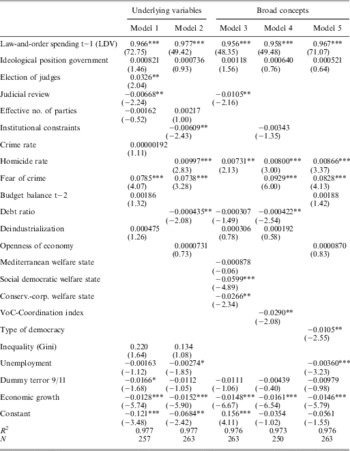
Table 2 summarizes the direct relationships between the independent variables and law-and-order spending in twenty OECD countries between 1995 and 2008. For the variable of prime interest – the ideological position of the government – the evidence is rather disappointing: Although the sign for the coefficient suggests that law-and-order spending is generally higher if the government exhibits an ideologically tough position towards this issue, the variable fails to reach conventional levels of significance. Our first hypothesis must, therefore, be rejected. However, apart from this result, the empirical findings tell an interesting story – a story of how institutions, fiscal pressures and a few structural determinants impact on law-and-order spending. First, regarding institutions, public expenditure on law and order tends to be higher if judges are directly elected, if judicial review is low, if there are few institutional constraints and if the media system follows the liberal model (United States, Britain, Canada or Ireland) compared to the democratic-corporatist model (of Western Europe, essentially), which is the reference category.Footnote 76 Interestingly, the electoral system (measured here via the effective number of parties) and corporatism do not affect spending significantly.Footnote 77 Secondly, the impact of fiscal pressures is straightforward and as hypothesized in Figure 2: higher debt ratios lead to lower spending on law and order, whereas a positive budget balance (a surplus) affects expenditures positively (but not always significantly). Thirdly, concerning the structural variables, homicide is positively associated with law-and-order spending (indicating that it is indeed a better measure than crime rates) and the same is true for fear of crime. Even more interesting are the missing effects: neither the deindustrialization nor the openness of the economy affects law-and-order spending significantly, which is a clear refutation of the ‘big trends’ thesis advocated by Garland. In addition, the coefficient for income inequality is not significant either, although the sign points in the expected direction and the 90 per cent confidence level is almost reached. Unemployment, in turn, is negatively associated with law-and-order spending. Although this finding contradicts the criminological expectations, it can be explained by budgetary mechanisms: higher unemployment leads to increasing social expenditure, which in turn crowds out public spending in other areas – such as law and order.Footnote 78 Finally, our control variables perform as expected: the lagged dependent variable is highly significant and economic growth is significantly and negatively related to spending (denominator effect). Only the dummy for the 9/11 terrorist attacks which takes the value of 1 after 2001, does not point in the expected direction which might be explained by overall budgetary constraints limiting spending after 2001.
If we introduce the ‘broad regime concepts’ in the equations, the results by and large confirm the evidence of comparative criminology (Models 3–5 in Table 2). Law-and-order spending is significantly lower in social-democratic and conservative-corporatist than in liberal welfare states (the reference category); more co-ordinated economies and consensus democracies spend significantly less than more liberal economies and majoritarian systems, respectively. Again, the ideological position of the government is positively (as expected), but not significantly, related to the extent of law-and-order spending, although significance on the 90 per cent level is almost reached in Model 3.
Main Effect Models

Note: t statistics in parentheses, *p < 0.1, **p < 0.05, ***p < 0.01.
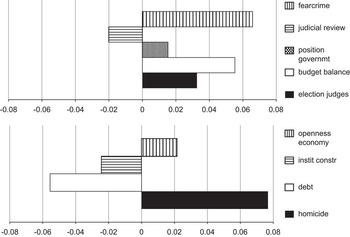
In order to assess the strength of the effects, we have plotted the change of the predicted values for a change of the different explanatory variables from the minimum to the maximum holding all other variables at their mean (Figure 3). Very clearly, homicide rates and fear of crime have the strongest impact on law-and-order spending. This finding underlines the importance of societal developments which serve as input to the political system and to which governments respond. In the second place follow the two variables for the fiscal environment in which spending decisions are taken. Regarding the two institutional variables, Figure 3 reveals that although judicial review and institutional constraints have a significant impact on spending, the effect is not very strong. For a change from a very weak to a very strong constitutional court, our model predicts a decrease in spending by around 0.02 per cent of GDP. Finally, and again, partisan ideology does play only a minor role, although the effect goes in the expected direction: if the Canadian liberal government of the year 2000 (the most ‘liberal’ according to our data) had been replaced immediately by the Canadian conservative government (in 2006), we would expect an increase in public spending on law and order of around 0.01 per cent of GDP according to our model. Hence, overall, although there undeniably is a certain pattern in line with Hypothesis 1 in the data, the results do not support our first hypothesis very convincingly.
Change of predicted values Note: The change of predicted values is calculated based on Models 1 (above) and 2 (below) in Table 2.

Conditional Effects
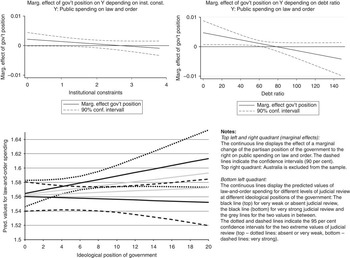
Recent studies on public policies have shown that partisan effects are often conditioned by other variables – namely, by institutions or the fiscal room for manœuvre. Hypothesis 2 expects that this is also true for law-and-order policies. In the following, we examine the moderating effect of (general) institutional constraints, judicial review and fiscal room for manœuvre by estimating interaction effects for these indicators with the partisan variable. As the coefficients are difficult to interpret directly,Footnote 79 we plot the effects for three interactions in Figure 4.Footnote 80
Plots of interaction effects

The first version of our second hypothesis expected institutional constraints to limit the impact of ideological preferences of governments. The first interaction effect (top left quadrant in Figure 4) tests how institutional constraints condition the impact of the position of government parties on law-and-order spending. The empirical evidence supports the argument put forward in Hypothesis 2, because the impact of the ideological position of the government reaches significance (90 per cent level) in countries with no or very few veto points, whereas the partisan effect remains clearly insignificant for high levels of institutional constraints. Thus, a marginal increase in the toughness of the ideological stance of a government leads to an increase in spending only if the political system does not have many institutional constraints.
If we reformulate the hypothesis for institutional constraints more specifically – namely for constitutional courts – the finding of the moderating impact of institutions is corroborated, although the substantial effect is not very strong (bottom left quadrant). As hypothesized, the impact of the ideology of the government on law-and-order policies does manifest itself in the expected direction only if there are no or weak constitutional courts. The slopes of the lines for strong or very strong constitutional courts are very flat indicating a very weak effect. In contrast, if constitutional courts are weak, an increase of the ideological position of the government from the theoretical minimum to its maximum (0–20) results in an estimated spending increase of 0.03 percentage points (black line at the top).
Turning to the budgetary room for manœuvre as moderating effect (Hypothesis 2b) the evidence presented in Figure 4 (top right quadrant) shows that while a move towards a tougher ideological stance increases expenditure in cases of low indebtedness, this is not the case if the governments are under high fiscal pressure. The interpretation is straightforward: even if a ‘tough-on-crime’ government wants to hire more police this might not be possible if the budget is under strong pressure. However, the effect is only significant if Australia is excluded from the sample, which might be explained by the fact that there is only very little variance in the partisan ideology of the governments over time. In sum, there is at least some support for Hypothesis 2b which posits that government ideology matters for law-and-order policies if governments have the budgetary leeway to increase spending.
Summing up the results of the statistical analysis with regard to our two main hypotheses, there is, overall, a fair amount of empirical evidence pointing to an impact of partisan ideology on law-and-order policies. However, the relationship does not seem to be direct, as hypothesized in Hypothesis 1: here, the regression results provide only weak evidence. Instead partisan effects materialize only if the conditions are favourable: Strong institutional constraints and constitutional courts as well as a delicate budgetary situation prevent governments from implementing their ideologically preferred policies. Hence, both varieties of Hypothesis 2 are supported by the data.
Turning to the main control variables, the analysis confirms the impact of most variables which have been discussed in the criminological literature: Social-democratic (and to a smaller extent conservative-corporatist) welfare states, highly co-ordinated economies and consensus democracies spend significantly less on law-and-order policies. In addition, high fear of crime and high homicide rates as well as a more liberal media system increase law-and-order spending. In this regard, our results add to the existing criminological literature showing that these associations hold even if we use a different dependent variable (public spending instead of the ‘standard’ criminological indicator, namely imprisonment rates).
Robustness of the Findings
In order to assess the robustness of the empirical findings, we have conducted a set of tests in order to evaluate the influence of individual countries.Footnote 81 Overall, for the main effect models reported in Table 2, the results remain rather robust. Although some variables lose their significance if specific countries are excluded – for example, the election of judges and the Gini index (Model 1) or the unemployment rate (Model 2) – the loss of significance is in no case massive and, most importantly, the signs of the coefficients always stay the same. This is also true for the variable on government ideology. The sign of the coefficient remains positive in any case and it reaches conventional levels of significance if Australia is excluded from the sample. Concerning the equations including the ‘broad concepts’, the same result holds: the impact of the welfare state regimes, the varieties of capitalism (VoC) and the type of democracy is quite robust, although the significance of the VoC variable drops rather substantially (to p = 0.353) if Germany is excluded from the sample. But, overall, the interpretations of the regressions are confirmed.
Concerning the interaction effects, the coefficients for the interaction terms are very robust to the exclusion of individual countries. The significance levels even increase in several cases when individual countries are excluded; in contrast, only in one case – when Italy is excluded in the estimation where the partisan variable is interacted with the debt ratio – does the interaction term lose significance. Thus, overall, the pattern which emerges from the analysis of interaction effects seems to be quite robust to changes in the analysed sample of countries.
CONCLUSION
The investigation of law-and-order policies has been a major subject in the criminological literature whereas political scientists have more or less ignored this policy during recent decades. This article has made a first attempt to bring political science into the analysis of law-and-order policies. In order to do so, we have introduced a theoretical framework, where the national policy-making process moves centre-stage. This is in contrast to criminology studies in which general developments and structural variables play a major role and the national policy-making process is considered to be less important. Our results show that although the structural variables clearly influence national policy-making, they do not completely determine the decisions of national governments. For globalization, Zohlnhoefer has argued recently that it ‘does not force politicians to do anything nor does it prohibit certain policies. Globalisation only changes the cost/benefit relations for certain policies’.Footnote 82 In our view, this claim is not only true for globalization but for many other structural variables, whose impact on policy outcomes is moderated by the national policy-making system.
The most prominent feature of national policy-making systems is the partisan composition of government and its ideological stance. We have argued theoretically that although background variables might well impact on national governments, the way in which these impacts are translated into national law-and-order policies is strongly influenced by this variable: policy-seeking as well as vote-seeking parties in government have major incentives to implement their ideologically preferred policy. However, the partisan effects should depend on the specific institutional and budgetary context. Under unfavourable conditions, governments may not be able to implement the policies they wish.
Our empirical analysis corroborates these expectations. We find a pattern of partisan effects – under the condition that judicial review and institutional constraints are weak and that there is money to spend. If this is not the case, however, the evidence for an impact of partisan ideology on law-and-order policies is weak although the underlying pattern is still clearly observable. This result points to the importance of moderating variables and is very much in line with findings from comparative public policy research in other policy areas.Footnote 83 To add a cautious note, however, we have to admit that the effects are not very strong compared to the impact of other structural variables such as fear of crime or the homicide rate.
Besides the new insights on partisan effects, our analysis adds to the emerging field of comparative criminological research showing that the most prominent ‘broad’ explanations for law-and-order policies such as the variety of capitalism, the welfare state regime or the type of democracy also hold, if public spending is used as dependent variable.
Of course, our results are mainly correlational in nature. We have not drawn a random sample of countries nor do we provide qualitative evidence or causal process observationsFootnote 84 that would explain the suggested relationships in more detail. However, as the theoretical arguments as well as the qualitative evidence from case studies are very much in line with our findings, there are good reasons to believe that the systematic patterns which we found in the data are linked to causal processes as described above.
Thus, our results are of prime importance not only for comparative criminologists but also for scholars of comparative public policy. They show that the comparative perspective on public policy change is of prime importance: Although macro-trends like globalization or the development of ‘late modern societies’Footnote 85 may set the overall tone, it is the political systems of different countries, the institutions, party systems, governments, ideologies and voters who decide how these general developments are translated in national public policies. What is true for social policies seems to be true for the policies of law and order, too. There is neither an overall race-to-the-bottom of the welfare state nor a general punitive turn, but there are different policy paths in different countries depending on their specific characteristics – and, not least, the ideological stance of the government parties.