


Does increasing the size of a legislature result in larger government? A common explanation for this hypothesized relationship is the geographic basis of expenditure in multiple-district legislatures (e.g., Shepsle and Weingast 1981; Weingast 1994). Although others had discussed this explanation for logrolling and pork-barrel projects (e.g., Buchanan and Tullock 1962), Weingast et al. (1981) theoretically formalized it as the “law of 1/n” or that “the degree of inefficiency in project scale is an increasing function of the number of districts” (654). The authors assume the norm of universalism, whereby each legislator has unilateral control over the size of projects within her own district. Projects benefit a particular geographical district, whereas the entire population shares project costs, creating a common pool problem. Therefore, an increase in districts (n) induces legislators to propose larger, more inefficient projects for their own districts, as they are responsible for a smaller portion of the overall tax burden.
Empirical research on unicameral legislatures has consistently confirmed the law of 1/n. Studies of city councils (Baqir 2002), county commissions (Bradbury and Stephenson 2003), and national legislatures (Bradbury and Crain 2001) have all found a positive relationship between legislative seats and spending. However, studies of bicameral U.S. state legislatures have produced a pattern of divergent results (e.g., Gilligan and Matsusaka 1995, 2001; Primo 2006). Although upper chamber size has a positive effect on spending, lower chamber size exhibits an either insignificant or negative relationship with spending, a result at odds with the law of 1/n.
This pattern, illustrated in Table 1, presents a puzzle and suggests a gap between empirics and theory. Why does the positive seats-to-spending relationship hold for unicameral bodies and for upper chambers (Senate) but not for the lower chambers (House) of bicameral legislatures? This inconsistency is substantively important because bicameral legislatures are present in most Organisation for Economic Co-operation and Development (OECD) countries and all but one American state. A potential resolution to this puzzle lies in the geographic embedding of House districts within Senate districts, a feature of most U.S. states. Each Senate district contains multiple House districts, an institutional setup that may dilute the relationship between legislative size and spending.

To address this puzzle, we extend the original Weingast et al. theory in two directions. First, we apply the law of 1/n logic to a model of bicameralism, with geographic overlap between Senate and House districts. Second, we relax Weingast et al.'s assumption of legislative universalism, under which the chamber defers to legislators to choose the size of projects in their own districts. Instead, we ground our model in a Baron–Ferejohn bargaining game, in which proposed bills must pass by majority vote in both chambers. Our model refines the original theory, as we preserve Weingast et al.'s logic of geographically targeted benefits and dispersed costs.
Although all models are simplifications of empirical reality, there are good reasons to believe that bicameralism is a substantively important institutional complexity. First, the empirical literature has revealed the pattern that the law of 1/n consistently holds in unicameral legislatures but not in bicameral bodies. Second, the Weingast et al. model relies on the geographic targetability of projects within districts to drive its main results. The fact that House districts are geographically embedded within Senate districts suggests that the strategic interaction of chambers may affect the relationship between districting and spending.
The equilibrium results of our model of distributive spending in bicameral legislatures produce a new set of comparative statics. As Senate size (n) increases, more districts share project costs, so legislators have a greater incentive to overspend. This result and its underlying mechanism are similar to the original law of 1/n. However, as the House-to-Senate seat ratio (k) increases, spending decreases in equilibrium. The basic intuition here is that dividing each Senate district into more House districts has the effect of shrinking each House member's constituency, ceteris paribus. Having a smaller constituency dilutes House members' payoffs from exploiting common pool resources to fund large pork barrel projects. We refer to these main comparative statics as the law of k/n, as spending increases in n but decreases in k. Empirically, we test these relationships using two data sets of spending in U.S. state legislatures from 1992 to 2004 and 1964 to 2004, and the results corroborate our theoretical predictions. Overall, our findings demonstrate the robustness of Weingast et al.'s (1981) law of 1/n logic across two theoretical extensions: introducing bicameralism and relaxing the assumption of universalism.
This article is organized as follows. The first section discusses the existing empirical and theoretical literature on the law of 1/n. The second section discusses three key components of our formal model of distributive spending in bicameral legislatures, and we outline how our main theoretical predictions arise. The third section presents our formal model and derives the law of k/n. The fourth section presents empirical tests of the model using data from the U.S. states. The final section concludes by discussing the findings and areas for future research.
EXISTING RESEARCH ON THE LAW OF 1/N
Empirical studies of the law of 1/n have abounded in recent years, and Table 1 summarizes this body of work. Scholars have found consistently positive results when examining unicameral bodies at all levels of government. Analyzing American city councils, Baqir (2002) finds that a 1% increase in council size is associated with 0.11–0.32% increases in per-capita expenditure. Bradbury and Stephenson (2003) study unicameral Georgia county commissions and find that a one-seat increase in commission size is associated with statically significant 4.2–8.5% increases in per-capita spending. Finally, Bradbury and Crain (2001) examine unicameral national legislatures in a comparative setting and also find support for the positive seats-to-spending relationship: a 1% increase in legislative size is associated with a 0.17% increase in government spending as a percentage of GDP.1
Bradbury and Crain (2001) also examine countries with bicameral legislatures and find that the size of the lower chamber has a positive effect on spending, but the size of the upper chamber is generally insignificant. The authors interpret these results as the consequence of power asymmetry between the chambers. In most national bicameral legislatures, the upper chamber is much weaker and does not have budgetary authority, so only the lower chamber exhibits the law of 1/n result.
However, empirical studies of bicameral legislatures in the U.S. states have produced a pattern of mixed findings. Such research has generally employed the empirical strategy of regressing spending onto Senate and House sizes, implicitly treating both chambers as independent legislatures governed by the law of 1/n. On reporting these findings, authors of these studies have repeatedly called for new theoretical research into the seats-spending relationship for bicameral legislatures. Gilligan and Matsusaka (1995) examine U.S. states from 1960 to 1990 and find that a one-seat increase in the Senate is associated with a $9.87–$10.91 increase in per-capita spending (1990 dollars). However, in most model specifications, the coefficient for House size is statistically insignificant and substantively small. Gilligan and Matsusaka are puzzled by this finding: “The inability to detect such effects in the lower House is a little troubling for this interpretation [the law of 1/n] … We did not anticipate this finding nor is there an obvious explanation for it. Further inquiry into the apparent pivotal nature of upper chambers would seem to be in order” (399–400).2
In a recent article, Gilligan and Matsusaka (2006) argue that the spending-seats relationship is driven by partisan gerrymandering, as bias in favor of prospending interests is increasing in the number of seats. Although this argument cannot explain the empirical anomalies described above, it does suggest that factors other than fiscal externalities may be complicating empirical testing.
Gilligan and Matsusaka (2001) perform a similar study on U.S. states from the first half of the 20th century, 1902–1942. The authors find the same pattern of positive coefficients for upper chamber size but insignificant coefficients for lower chamber size. Gilligan and Matsusaka note, “Unfortunately, we lack a compelling model that predicts this as the bargaining outcome. In the end, we view the cause of this apparently robust empirical relation as a challenge for future research” (79).
Primo (2006) also finds mixed results for bicameral chambers and echoes the need for theoretical modeling of the seats-to-spending relationship in bicameral legislatures. Examining U.S. states from 1969 to 2000, Primo finds that upper chamber size has a significant and positive relationship on spending, whereas lower chamber size exhibits a significant and negative effect. Primo suggests, “These opposing results demonstrate that more theoretical development of the impact of legislature size is needed” (298).
In this article, we respond to these appeals for a more precise theoretical model of the relationship between chamber size and spending in bicameral legislatures, building on recent theoretical work that has explored both the robustness and the limits of the law of 1/n. Primo and Snyder (2005) reexamine the original Weingast et al. model and demonstrate that the law of 1/n holds for excludable pork projects. However, altering legislators' payoff functions to account for cost sharing, pure public goods, or spillover of project benefits potentially eliminates the main result. The authors suggest yet another extension in the conclusion of their article: “A solid theoretical foundation for the impact of bicameralism on these ‘law of 1/n’ results is a logical next step” (13). Accordingly, our article extends this line of research by exploring the robustness of the law of 1/n in the context of a bicameral legislature with a Baron–Ferejohn bargaining game. Following Primo and Snyder, we analyze the consequences of project benefits spilling over across districts. Together, both this article and the Primo and Snyder model explore the limits of the Weingast et al. analysis but do so in different ways. Primo and Snyder examine alternative forms of spending and taxation, whereas we consider different institutional structures in the framework of a strategic game.
THEORETICAL ISSUES
In this section, we informally discuss and justify three key assumptions of our formal model that drive our law of k/n results, whereby expenditure is increasing on upper chamber size (n) and decreasing on the ratio of lower-to-upper chamber size (k).
Spending Divisibility
To formalize bicameralism, we need to select a plausible assumption about the geographical level at which legislatures can target spending projects. To do this, we confidentially interviewed the staffs of 26 lower chamber representatives in Missouri and Iowa, 13 in each state, in October 2006.3
We randomly called Missouri legislators' offices and were able to obtain 13 responses. We then randomly sampled Iowa legislators until we received 13 responses. In some cases, we were able to speak with the representatives themselves.We chose these two states because they differ significantly in upper and lower chamber sizes; whereas Missouri has a high ratio of 163 representatives to 34 senators, Iowa exhibits a much lower ratio of 100 representatives to 50 senators. However, the two states are similar across other covariates. Although Missouri's population is nearly twice as large as Iowa's, both states have similar per-capita gross state products ($35,740 for MO and $37,323 for IA) and per-capita revenues from the federal government ($1,257 for MO and $1,325 for IA). Further, Missouri's session length is 77 days compared to 71 for Iowa. Finally, both states border one another, indicating regional and historical similarities.
In both Iowa and Missouri, all interviewees told us that they frequently work with the senator in which their district is geographically embedded, regardless of that senator's party. One Missouri legislator commented, “That's a given … We need to coordinate for logistical purposes” (phone interview, 6 October 2006). Additionally, many interviewees also named other lower chamber members who are geographically embedded within the same Senate district. However, we were surprised to find that legislators tend not to work with geographically proximate representatives in different Senate districts, save for a few exceptions. These trends among our interviewees suggest that project benefits generally do not spill over across Senate district lines, as representatives usually do not work with their counterparts from outside, neighboring Senate districts. However, collaborating with other representatives within one's own Senate district appears to be quite important, suggesting that spending projects cannot be easily targeted at the House district level. In almost all states, House districts are substantially smaller than Senate districts, so it is plausible that projects are divisible at the Senate level but not at the House level.4
Our interview results also suggest that lower chamber representatives may aspire to occupy the seat of the senator in which their district is embedded, consistent with previous research on careerism in state legislatures (e.g., Squire 1988). House members may have incentives to build relationships with their associated senator, thereby leading to the provision of projects that are targetable at the level of the upper chamber district.
This assumption is important for the law of k/n comparative statics from our formal model. Lower chamber proposers cannot target large projects to their own districts, so an increase in House-to-Senate seat ratio implies that, ceteris paribus, a lower chamber proposer benefits from a smaller share of his Senate district's projects. This declining share of the benefits decreases the incentive of lower House proposers to pursue large pork bills. This intuition drives the “k” portion of our results, whereby an increase in House-to-Senate ratio induces a decrease in spending. If we had made the alternate assumption that spending is divisible at the House district level, then our model would have predicted a positive effect on spending for both upper chamber size (n) and lower-to-upper chamber ratio (k). However, our assumptions about project targeting are not unreasonably strict. As we explain in the presentation of the formal model, our results do not require that project benefits are perfectly confined within Senate districts. In other words, benefits may “spill over” across Senate district boundaries.
Utility Functions
Our model requires an assumption regarding how project sizes in each district translate to utility payoffs for citizens and legislators. Our goal in this article is to revise the “law of 1/n” to account for bicameralism. Therefore, when possible, we follow Weingast et al.'s (1981) utility function, which assumes that legislators' payoffs depend on the sizes of the projects within their respective districts, minus their shares of project costs and taxes. In other words, Weingast et al. treat spending projects as private goods, and constituency size has no effect on legislator payoffs. Project benefits are divided among the citizens residing in the district, and the legislator benefits from citizens' aggregate utility. We attempt to replicate this assumption in our more complex setting of a bicameral legislature. We assume that within each Senate district, project benefits are divided equally among constituents. Further, legislators' payoffs depend on constituents' aggregate utility.
Our payoff assumptions are important to our law of k/n results. A representative's payoff is negatively related to k because he must share the pork project with all other representatives located within his Senate district. Therefore, an increase in k would decrease his incentive to secure a pork project. Suppose we had made the alternate assumption that projects are pure, nonexcludable public goods, and citizens benefit from their district's entire project rather than a per capita share. Furthermore, suppose that legislator payoffs depend on average citizen payoffs rather than their aggregate. Under these two alternate assumptions, our law of k/n results would no longer hold. Instead, n and k would both affect spending positively.
Hence, we must qualify our theoretical results by noting that our law of k/n comparative statics depend on the assumption that spending projects are excludable, private goods. This assumption is consistent with previous treatments in the distributive politics literature, including Weingast et al. (1981). Our utility function simply requires that spending projects are reasonably rivalrous or excludable; that is, one citizen's enjoyment of the project decreases the benefits available to others. This quality is consistent with many state-funded projects. For example, public computers at a library can only be used by a limited number of patrons and depreciate with use. Business and agricultural grants are provided on a competitive basis, so only a limited number of commercial entities may receive them. Even projects traditionally considered local public goods, such as harbors, have limited space availability and benefit narrow constituencies. The alternative assumption of pure public goods, under which each citizen enjoys the full benefit of the good rather than a per capita share, is less reflective of typical appropriations projects.
Legislators' Cost of Proposing Bills
The third important component of our model is that for legislators, preparing a bill proposal incurs a nonzero personal cost. The substantive motivation for this assumption is that legislators have limited time and resources to devote to the passage of new bills. Cox (2006) notes that in legislatures, plenary time is a limited resource; a legislator who elects to propose one bill foregoes the opportunity to present other bills. Moreover, legislators may have to work extensively with committees before their proposals even reach a floor vote. Finally, the process of writing a bill and forming a majority coalition requires staff time and resources. Legislators could instead choose to expend their time and resources on other activities, such as campaigning, constituency service, or nonlegislative activities, particularly in less professionalized chambers. This assumption echoes Huber and Shipan's (2002) theoretical and empirical findings that legislation is expensive to produce, both in terms of legislator effort and resources as well as opportunity costs: “Even if the political environment indicates substantial benefits from writing detailed legislation, high costs will limit the ability of legislators to do so” (149). To model these costs, we assume that legislators incur an exogenous cost of λ when they choose to propose a bill and that λ is chosen from a random uniform distribution.5
Note that the cost of proposing does not depend on any of our main variables, such as population size. The intuition here is that the resources required for bill writing are generally fixed costs such as staff time, negotiating the committee process, and background legislative research tools. However, our main results remain intact even if we assume that payoff is scaled by population. To maintain parsimony, we exclude such complexities.
THE MODEL
Our formal model mimics the basic framework of Baron and Ferejohn's (1989) “divide-the-dollar” game with a closed rule and no time discounting. Our geographical setup of districts follows Ansolabehere et al. (2003), embedding multiple lower chamber districts within each upper chamber district. We follow several other models that have developed variations of the basic Baron and Ferejohn setup (e.g., Ansolabehere et al. 2003; Banks and Duggan 2000).
Players
We consider a state with population P, where P>0, governed by a majority-rule, bicameral legislature. The state is divided into n ≥ 2 equally populated upper chamber (hereafter: Senate) districts, where n is even,6
We solve the identical game for the case of an odd-sized Senate. The results are slightly changed but fundamentally similar. For example, the expected per capita spending in Proposition 1(d) becomes:

These results produces comparative statics identical to those presented in Proposition 4.
Recognition Rule
The game consists of a single proposal period. During the game, only one member from the entire legislature is recognized. With probability ρ, a Senator is recognized, and with probability 1 − ρ, a Representative is recognized. Within each chamber, individual members have equal recognition probabilities. Hence, each Senator's recognition probability is ρ/n, and each Representative's recognition probability is (1−ρ)/nk. On recognition, a legislator may either propose a bill (B) at cost λ or decline to propose a bill (NB), in which case the game ends with no new spending. A legislator who proposes incurs the cost regardless of whether her proposal successfully passes.
Proposer Strategies
A recognized legislator must first choose to either propose (B) or not propose (NB) a bill, A ∈{B, NB}. We denote Senators' strategy choices as As and Representatives' strategy choices as Ar. A legislator who chooses strategy B incurs the proposal cost and must offer a legislative proposal. Formally, a legislative proposal consists of a vector, X =(x1, …, xn), of nonnegative project benefits across the n Senate districts, where ∀i ∈{1, …, n}, xi is the size of the pork project allocated to Senate district i. During the game, one legislator is given the opportunity to propose a bill. If approved by both chambers, the proposal is enacted. Otherwise, the game ends with no new spending. We assume that two constitutional limitations govern all spending bills: (1) geographical divisibility: projects can be targeted to one Senate district, but benefits are divided equally among all citizens within the targeted district and (2) equal taxation: all costs are divided equally among all citizens, regardless of district.
We represent the cost function for each pork bill as:

We square the sum of all projects to model our assumption that projects have increasing marginal costs and diminishing marginal returns.
Sequence of Play
The sequence of play is as follows:
- 1. Nature randomly selects and publicly announces the cost of presenting a legislative proposal, λ, from the uniform distribution: λ ∼ U [0, 2].
- 2. One legislator is randomly recognized to make a proposal.
- 3(a). The recognized legislator chooses whether to propose a bill at the cost of λ.
- 3(b). The proposing legislator offers a project distribution, X =(x1, …, xn).
- 3(c). Legislators in both chambers simultaneously vote up or down on the proposal.
If the recognized legislator declines to propose, then the game ends with no new spending. We illustrate this sequence of play in Figure 1.

Sequence of Play
Majority Voting
We assume that with simple majority voting, a proposal requires strictly greater than n/2 Senate votes and nk/2 House votes to pass.
Spillovers
We incorporate variable spillover effects so that our model considers both targetable and nontargetable spending projects. By spillover effects, we mean that a spending project located in district i may indirectly benefit citizens residing outside of district i. In our model, every type of legislative spending is characterized by an exogenous parameter, α∈[0, 1], that indicates the degree of spillovers. For example, the case of α=0 represents a perfectly targetable good with zero spillovers, such as a local road. At the other extreme, the case of α=1 represents a pure public good with complete spillovers, implying that citizens in all districts benefit equally, regardless of where legislative projects are geographically located. To illustrate, suppose a spending project in Des Moines has a spillover parameter of α=0.05. Each resident of Cedar Rapids or Sioux City will enjoy only 1/20th as much utility from the project as each Des Moines resident enjoys.
Citizen Payoffs
Each citizen's utility payoff, denoted as uc(X), consists of two parts: project benefits and a tax burden. First, each citizen enjoys a per-capita share of her own Senate district's spending benefits, as well as spillover benefits from projects in all remaining districts. We denote the size of the spending project in c's Senate district as xc, so the sum of spending projects in all remaining districts is:

Therefore c's per-capita share of benefits from her own district and all other districts is:

where α is the spillover parameter and P/n is the population of each Senate district. Second, we assume complete cost sharing across districts, so each citizen pays an equal share of the total cost of all projects. The total cost is the square of the sum of all project sizes, so the per-capita tax burden is:

where xj represents the project size in one of the n Senate districts. Therefore, citizen c's overall payoff from a bill, X =(x1, …, xn), is:

where xc represents the size of the project in c's Senate district.
Legislator Payoffs
For both Senators and Representatives, utility payoffs are the sum of all citizens' payoffs within the legislator's constituency, minus the cost of proposing a bill, if applicable. Let Ci represent the set of citizens residing within legislator i's district. Then i's payoff from proposing a successfully passed bill, X, is:

where λ is the randomly chosen cost of proposing. If not the proposer, then i's payoff is simply:
Equilibrium Results
We confine our attention to subgame-perfect Nash equilibria (SPNE) and present necessary results to describe the expected sum of project spending authorized by the legislature.
Lemma A
The equilibrium voting behavior of both Senators and Representatives is as follows. Legislator i votes in favor of a spending proposal, X=(x1, …, xn), iff:

where xi is the size of the spending project in the Senate district within which legislator i resides. The term
represents the sum of the spending projects in all n districts.
Proof: Appendix A
Lemma A describes the equilibrium voting behavior of both Senators and Representatives after a proposal is offered. A legislator votes in favor of a bill only if the bill allocates a sufficiently large project to the Senate district within which the legislator resides. That is, project benefits for the legislator's constituency must be at least as large as the tax burden, as represented by Eq. 2.7
Note that in equilibrium, as represented by the weak inequality in Eq. (1), legislators resolve indifference in favor of voting for proposals. This indifference resolution behavior arises directly from our use of the SPNE solution concept. If legislators were to resolve indifference by voting against proposals, then proposers would have to design legislative bills to give each coalition partner an infinitesimally small but positive payoff, and this would not constitute an SPNE. In other words, proposers would be maximizing over an open interval. Hence, in SPNE, legislators must resolve indifference by voting in favor of proposals.
Note that our game assumes a closed rule legislature with no continuation. That is, a proposed bill is immediately put to an up-or-down vote in both chambers, and if the bill fails, the game ends immediately with no new spending. In SPNE, proposers will only offer bills that are guaranteed to secure majority support in both chambers. Defeating a proposal results in no new projects, so all nonproposing legislators have a continuation value of zero. Therefore, the proposer must guarantee her colleagues a nonnegative net payoff to secure their votes.
The SPNE results of the formal model depend on α, the level of spillovers in project benefits. Specifically, there are three cases to consider: low, moderate, and high spillovers. We present the equilibria results of these three cases in Propositions 1, 2, and 3, respectively. Within each of the three Propositions, parts (a) and (b) describe when a recognized legislator will choose to offer a spending proposal. Part (c) describes the precise allocation of spending projects offered by proposals in equilibrium. Part (d) presents comparative statics from these equilibrium results. In these Propositions, we show that our law of k/n predictions derive primarily from Case 1, or legislative spending on low-spillover projects. Nevertheless, we also show in Proposition 4 that the inclusion of moderate and high-spillover projects in a legislature's portfolio of spending bills does not negate our law of k/n comparative statics. The law of k/n holds weakly when examining total legislative expenditure constituting all spillover levels.
CASE 1: LOW SPILLOVERS
Proposition 1
characterizes the equilibria when spillovers are low}, α≤2/(n+4).
Proposition 1(a) (Senators' Decision to Propose)
A recognized Senator, s∈{1, …, n}, offers a legislative proposal in SPNE only when the proposal cost, λ, is sufficiently low:

Proposition 1(b) (Representatives' Decision to Propose)
A recognized Representative, r∈{1, …, (nk)}, offers a legislative proposal in SPNE only when the proposal cost, λ, is sufficiently low:

Proof: Appendix A
Proposition 1 states that a recognized legislator does not always offer a bill proposal. Nature randomly selects the cost of proposing a bill. If the cost is higher than the expected payoff from proposing, then the recognized legislator will decline to propose.8
Equations 3 and 4 in Proposition 1(a) are weak inequalities, meaning that recognized legislators resolve indifference in favor of offering a proposal. Note, however, that the alternate behavior of resolving indifference against offering a proposal can also be part of an SPNE strategy profile. The assumption about indifference behavior has no impact on our equilibrium results and comparative statics because there is a zero probability that the recognized legislator will be indifferent.
The intuition behind this result is that a new spending bill brings net benefits to the proposer's constituents. However, if these benefits are outweighed by the cost of preparing the bill, then proposing is not a worthwhile strategy. In Proposition 1(b), for example, a Representative expects to benefit n(2+nα)2/8k(n+2) from proposing a bill, so he or she proposes only when the cost, λ, is no greater than this amount. The formal proof is presented in Appendix A, but the intuitive logic is straightforward. Consistent with the original law of 1/n logic, the proposer's payoffs increase with n because the proposer's district pays a smaller proportion of the project costs. However, the proposer's payoff is decreasing in k, as project benefits are split among more Representatives.
Thus, with some probability, the recognized legislator will find the proposal cost too high and decline to propose. In this event, the game ends with no new legislative projects or taxes. When the proposal cost is sufficiently low, however, the recognized legislator will present a proposal that, in equilibrium, buys enough votes for a winning coalition in both chambers. Proposition 1(c) describes such equilibrium proposals, which are identical for Senate and House proposers.
Proposition 1(c) (Equilbirium Bill Proposals)
When α≤2/(n+4), equilibrium bill proposals will build a majority coalition. If the recognized legislator, whether a Senator or Representative, elects to propose a bill, the bill will satisfy three characteristics in equilibrium. Let
denote the equilibrium bill proposal, and let
denote the sum of all spending projects allocated to the n districts. First, the sum of all spending projects in equilibrium is:

where n is the number of Senate districts and α is the spillover parameter. Second, the proposer allocates projects of size:

to exactly n/2 other Senate districts. Finally, the proposer allocates a project of size:

to the Senate district within which he or she resides.
Proof: Appendix A
Proposition 1(c) describes the equilibrium allocation of spending projects when a recognized legislator, whether a Senator or Representative, decides to offer a proposal. The proposer allocates a large spending project of size
to the Senate district within which he or she resides. The proposer also offers a minimally sufficient project to each of n/2 other Senate districts to buy their votes. All remaining Senate districts receive no projects.
In Proposition 1(d), we consider the equilibrium results from Case 1, with low spillovers, and we present a closed-form expression for the legislature's expected per-capita expenditure during the game. We then derive four comparative statics from this result.
Proposition 1(d) (Comparative Statics)
When spill- overs are low, α≤2/(n+4), the expected per capita spending by the legislature over the entire game is:

Thus, when spillovers are low, the expected per-capita expenditure by the legislature is:
- (i) Strictly increasing on n, the size of the Senate;
- (ii) Strictly decreasing on k, the ratio of Representatives to Senators;
- (iii) Strictly decreasing on P, the population of the state.
Proof: Appendix A
Proposition 1(d) expresses the legislature's expected per-capita spending in terms of chamber sizes and population size. Appendix A presents a formal proof of this result, but we outline the basic intuition here. The recognized legislator proposes a bill only when λ, the cost of proposing, falls below the thresholds in Eqs. (3) and (4) of Propositions 1(a) and 1(b), respectively. Each λ is chosen from a random uniform distribution, λ∼U[0, 2], so we can write an expression for the probability that λ falls below the appropriate threshold. From Eq. (5) of Proposition 1(c), we have an expression for Ω*, the sum of spending projects in equilibrium when a bill is proposed. Multiplying the total cost of the spending projects by the probability of a proposal, we derive an expression for the expected total expenditure by the legislature. We then divide this amount by P, the population, to arrive at Eq. (8), the expected per capita expenditure during the game. We derive three comparative statics from this result by evaluating the first-order derivative of Eq. (8) with respect to each of three variables. Below, we explain the informal reasoning behind our first two results, which we label the “law of k/n.”
Proposition 1(d)(i) predicts a strictly positive relationship between Senate size (n) and per capita spending. The intuition behind this result is similar to the classical law of 1/n logic. As upper chamber size increases, a larger number of districts share in the costs of legislative projects, so each district pays a smaller fraction of the total costs. The proposer has a greater incentive to allocate a large project for her own district because her own constituency shoulders a smaller portion of the tax burden from new spending projects.
Proposition 1(d)(ii) predicts that an increase in House-to-Senate seat ratio (k) leads to a strict decrease in per capita spending. Intuitively, the logic driving this proposition is as follows. Projects are divisible at the Senate district level. When α is low, the legislature can target projects to particular Senate districts but may not discriminate among individuals within a Senate district. Our model assumes single-member districts, so an increase in House-to-Senate district ratio implies that each House district receives a smaller share of its Senate district's project benefits. Therefore, when k is higher, a recognized Representative enjoys a lower payoff from successfully proposing a large spending project for his own district. This lower payoff decreases the probability that a recognized Representative will find it worthwhile to propose a large spending project. Hence, recognized Representatives propose spending bills with a lower probability, explaining the negative relationship between k and spending.
We illustrate the intuition behind Proposition 1(d)(ii) with a simplified, hypothetical example. Suppose that Vermont and Wyoming are identical states in all respects with the following exception: Wyoming has 30 Senators and 60 Representatives, so k = 2, whereas Vermont has 30 Senators and 150 Representatives, so k = 5. A Wyoming Representative who secures a $10 pork project for his own Senate district has to share the benefits with one other House district, whereas the Vermont Representative would have to share with four other House districts. Hence, the Wyoming Representative's constituency would enjoy a total payoff of $5, whereas the Vermont Representative's constituency would enjoy only $2. If the cost of proposing a bill is $3, then the Wyoming Representative is willing to propose, whereas the Vermont Representative would decline to propose. Therefore, the Wyoming House is more likely than the Vermont House to produce spending bills.
We refer to Propositions 1(d)(i) and 1(d)(ii) as the law of k/n, because the number of upper chamber districts (n) and the ratio of upper to lower chamber districts (k) affect per capita spending in opposite directions. Here in Case 1, the law of k/n holds strictly. These theoretical results represent our refinement of the classical law of 1/n logic to fit a typical bicameral legislative structure.
Does the law of k/n hold when spending projects have higher spillover levels? Yes, but not strictly. Under the remaining two cases of moderate and high spillovers (Cases 2 and 3, respectively), we illustrate in Propositions 2 and 3 that the law of k/n holds only weakly in that legislative spending is monotonically decreasing on House-to-Senate ratio (k). The positive relationship between spending and Senate size (n) continues to hold strictly. Though Case 1 addresses the type of excludable pork projects originally considered by Weingast et al. (1981), we additionally derive the equilibria and comparative statics under Cases 2 and 3 for both theoretical and empirical reasons. Theoretically, it is helpful to illustrate that the law of k/n holds at least weakly for all types of spending, regardless of spillover level. Furthermore, our empirical tests examine total state expenditure, as we lack a precise measurement of each spending project's spillover level.
CASE 2: MODERATE SPILLOVERS
Proposition 2
characterizes equilibria when spillovers are moderate, 2/(n+4)<α≤1/2:
Proposition 2(a) (Senators' Decision to Propose)
A Senator, s∈{1, …, n}, offers a legislative proposal in SPNE only when the proposal cost is sufficiently low:

Proposition 2(b) (Representatives' Decision to Propose)
A Representative, r∈{1, …, (nk)}, offers a proposal in SPNE only when the proposal cost is sufficiently low:

Proposition 2(c) (Equilbirium Bill Proposals)
If the recognized legislator, whether a Senator or Representative, elects to propose a bill, then the equilibrium proposal must be as follows. The proposal allocates a project of size
to the proposer's own Senate district, and the proposal allocates no spending projects to all remaining districts.
Proof: Appendix A
Here in Case 2, with moderate spillovers, the proposer need not offer dispersed projects to build a minimum winning coalition. Spillover benefits are sufficiently high to induce other legislators' support; therefore, the proposer places a single, large project in her own district.
Proposition 2(d) (Comparative Statics)
When spillovers are moderate, 2/(n+4)<α≤1/2, the “law of k/n” holds weakly. The expected per capita expenditure by the legislature is:
- (i) Strictly increasing on n, the size of the Senate;
- (ii) Monotonically decreasing on k, the ratio of Representatives to Senators;
- (iii) Strictly decreasing on P, the population of the state.
Proof: Appendix A
The comparative statics in Proposition 2(d) represent a weak version of the law of k/n. The intuition behind these comparative statics is similar to the law of k/n from Case 1, with one exception. Under Case 2, proposers need not offer projects to other districts to build a winning coalition. Rather, a proposer can afford the luxury of allocating all legislative spending to her own Senate district. In some situations, the payoff from this luxury is so high that a recognized legislator never declines to propose, regardless of λ, the randomly chosen cost of proposing; that is, the inequalities in Eqs. (9) and (10) are always satisfied, so recognized legislators always propose. Consequently, the logic behind Proposition 1(d)(ii) does not always apply here, and legislatures with different high Senate-to-House ratios (k) are equally likely to produce spending bills. Hence, per capita expenditure is constant along k, so our comparative static on k holds weakly under Case 2.
Case 3, where spillovers are high, has similar results. The proposer needs not offer geographically dispersed projects to buy the votes of fellow legislators. Rather, a single, large project appears in the proposer's Senate district, and the comparative statics again form a weak law of k/n.
CASE 3: HIGH SPILLOVERS
Proposition 3
characterizes equilibria when spillovers are high, α>1/2:
Proposition 3(a) (Senators' Decision to Propose)
A Senator, s∈{1, …, n}, offers a legislative proposal in SPNE only when the proposal cost is sufficiently low:

Proposition 3(b) (Representatives' Decision to Propose)
For all proposal periods t∈{1, …, T}, a Representative, r∈{1, …, (nk)}, offers a legislative proposal in SPNE only when the proposal cost is sufficiently low:

Proposition 3(c) (Equilbirium Bill Proposals)
If the recognized legislator, whether a Senator or Representative, elects to propose a bill, then the equilibrium proposal is as follows. The proposal allocates a project of size
to the proposer's own Senate district, and the proposal allocates no spending projects to all remaining districts.
Proposition 3(d) (Comparative Statics)
When spillovers are high, α>1/2: the law of k/n holds weakly. The expected per capita expenditure by the legislature is:
- (i) Strictly increasing on n, the size of the Senate;
- (ii) Monotonically decreasing on k, the ratio of Representatives to Senators;
- (iii) Strictly decreasing on P, the population of the state.
Proof: Appendix A
Here in Case 3, the proposer never worries about building a majority coalition. Project spillovers are sufficiently high to guarantee unanimous support for any equilibrium proposal. As in Case 2, the relationship between spending and k is constant, so the law of k/n holds weakly.
We have shown that the law of k/n holds strictly for Case 1, with low spillovers, but weakly for Cases 2 and 3, with moderate and high spillovers, respectively. Empirically, however, it is not possible to isolate legislative projects that belong under Case 1 because we do not have precise measurements of the spillover level of each line-item approved by legislatures. Rather, any available measurements of legislative spending are bound to include projects that fall under any of the three categories—low, moderate, and high spillovers. Hence, in Proposition 4, we aggregate our comparative statics results from the three Cases to summarize the theoretical predictions to be tested in our empirical models.
Proposition 4
In legislatures that pass a mixture of low-, moderate-, and high-spillover projects, expected per-capita expenditure is:
- (i) Strictly increasing on n, the size of the Senate;
- (ii) Monotonically decreasing on k, the ratio of Representatives to Senators;
- (iii) Strictly decreasing on P, the population of the state.
Proposition 4(i) follows directly from Propositions 1(d)(i), 2(d)(i), and 3(d)(i). Under each of the three Cases, legislative spending is strictly increasing on Senate size (n), so any mixture of low-, moderate-, and high-spillover projects will also exhibit a positive relationship between spending and n. Similarly, Proposition 4(iii), the negative relationship between spending and population, follows from Propositions 1(d)(iii), 2(d)(iii), and 3(d)(iii).
Proposition 4(ii) aggregates the comparative statics results from Propositions 1(d)(ii), 2(d)(ii), and 3(d)(ii), Spending is strictly decreasing on House-to-Senate ratio (k) under Case 1 but weakly decreasing under Cases 2 and 3. Therefore, given a legislature that funds projects falling under all three Cases, our equilibrium results guarantee that spending will be monotonically decreasing on k.
Finally, we present a theoretically interesting result concerning the inefficiency of legislative spending:
Lemma B
Whenever the legislature passes a spending bill, the level of spending will be higher than the socially optimal level, provided that there are more than two Senators (n>2).
Proof: Appendix A
Lemma B is theoretically important for two reasons. First, Weingast et al. (1981) argue that the geographical division of legislatures into separate districts leads to inefficient overspending on pork barrel projects. Lemma B confirms that such overspending emerges in the equilibrium of our Baron–Ferejohn legislative game. Second, Weingast et al. (1981) suggest the law of 1/n as an observable implication of the inefficiency of pork barrel projects. Analogously, our model suggests the law of k/n as a manifestation of inefficient pork spending in the context of bicameral legislatures.
EMPIRICAL TESTING
Data/Model
We test the comparative statics results from our theoretical model by examining U.S. states annually from 1992 to 2004.9
There is nothing particularly special about the time period chosen. However, electronic data on the variables of interest are readily available from 1992 onwards, making it a convenient choice of time frame.
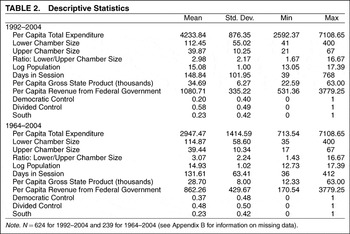
All dollar figures described below are adjusted for inflation and measured on a per capita basis. Appendix B discusses measurement details, sources of data, and technical details, including missing data and nonspherical errors. Table 2 presents descriptive statistics.

First, we regress per-capita total state expenditure (Eit), excluding local spending and including intergovernmental expenditure, onto the three variables from the comparative statics in Proposition 4. We also include a vector of control variables (xit) used in previous studies of state public finance (e.g., Gilligan and Matsusaka 1995, 2001; Owings and Borck 2000). The econometric model is:

where Uit represents the size of the Senate in state i in time period t, Rit represents the House-to-Senate seat ratio, Pit represents log of state population, χt represents year fixed effects that are invariant across states, and εit represents the error term. Our law of k/n comparative statics predict that per capita spending should increase with the size of the Senate and decrease with the House-to-Senate ratio. Moreover, per Proposition 4(iii), state population should be inversely related to per-capita expenditure, suggesting economies of scale in spending.
The control variables are per capita gross state product, per capita revenue from the federal government, days in session, partisan control of the state government, and an indicator variable for southern states. Although other empirical studies rationalize the inclusion of these variables in greater detail, we briefly summarize here. Wealthier states should produce more legislative spending because of greater tax revenues and a more relaxed budget constraint. Similarly, increased revenue from the federal government generates wealth effects that may allow more spending. Previous work has documented a positive relationship between legislative professionalism and government spending in the American states (e.g., Malhotra 2006; Owings and Borck 2000). Therefore, we include a variable for the length of the session in legislative days. We include dummy variables for Democratic-controlled and divided governments because we presume Republican governments, the baseline category, are more fiscally conservative. Finally, following many previous studies of state politics and policy, we include a dummy variable for southern states to account for the unique cultural and political history of the region, as well as supposed lower investment in public works.
There is not enough across-time variation in legislative size between 1992 and 2004 to test the predictions of the formal model with respect to within-state changes in n and k. Indeed, the correlation between lower chamber size in 1992 and 2004 is 0.997; the correlation for upper chamber size is 0.980. Consequently, we construct a new data set, collecting data from five historical cross sections: 1964, 1974, 1984, 1994, and 2004. In doing so, we leverage the massive redistricting that occurred in the aftermath of the Baker v. Carr and Reynolds v. Sims Supreme Court decisions in 1962 and 1964, respectively. We estimate a second model to include state fixed effects that are invariant across time (ωi):

Results
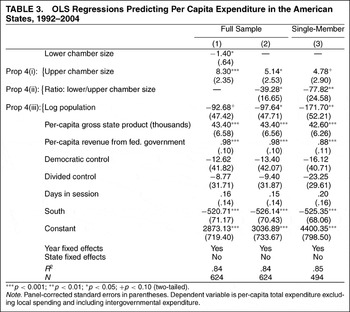
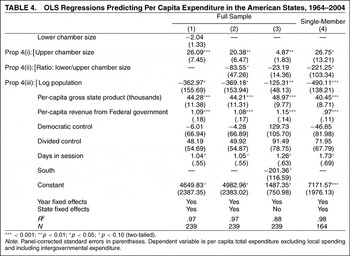
Table 3 presents regression results from the 1992–2004 data, and Table 4 presents results from the 1964–2004 data. Before discussing the main tests of our comparative statics, we first reproduce the divergent results found in previous empirical studies of state legislatures, that Senate and House sizes do not exhibit uniformly positive effects on spending (e.g., Gilligan and Matsusaka 1995, 2001; Primo 2006). In column 1 of Table 3 and column 1 of Table 4, we regress expenditure onto Senate and House sizes, following the empirical approach of previous research. We discover the same anomaly in our data as others have found. Although this approach is not an explicit test of our formal model, Senate size has a significantly positive relationship with spending, whereas House size exhibits a negative effect, which is significant in the 1992–2004 data.

We now test our model's three comparative statics in column 2 of Table 3, which estimates Eq. (13) using the 1992–2004 data. Per capita expenditure is increasing in the size of the Senate (n), confirming Proposition 4(i). A one-seat increase in upper chamber size is associated with a $5.14 per capita increase in spending. Conversely, a one-unit increase in the ratio of House to Senate seats (k) leads to a $39.28 decrease in per-capita expenditure, consistent with Proposition 4(ii). These results, which are both statistically significant at the p<0.05 level, corroborate our law of k/n predictions. Following the comparative statics of our formal model, we depart from the past practice of examining chamber sizes in isolation, and we instead use Senate size (n) and the ratio of House to Senate seats (k) to predict spending. Note that our formal model is agnostic about the approach of regressing spending onto chamber sizes in isolation, as in column 1 of Table 3. However, our formal model suggests that the optimal test of our law of k/n should consider Senate size (n) and House-to-Senate ratio (k) as regressors, and our empirical results in column 2 confirm the effectiveness of this approach. The data also confirm our model's other comparative static unrelated to legislative size. Consistent with Proposition 4(iii), log population is inversely related to per-capita spending, suggesting economies of scale in expenditure. In addition to exhibiting statistical significance, the observed effects are substantively large as well. Moving across the range of Senate sizes (n) is associated with an increase in the dependent variable of over one-quarter of a standard deviation. Moving across the range of House-to-Senate ratios (k) is associated with an increase in per-capita spending of about two-thirds of a standard deviation.
Furthermore, the estimated coefficients associated with the control variables are significant and in their expected directions. Wealthier states are likely to spend more per citizen, as are states that receive more aid from the federal government. The parameter estimates of the dummy variables representing divided and Democratic-controlled state governments generally do not come close to achieving statistical significance. These results confirm Gilligan and Matsusaka's (1995, 2001) and Primo's (2006) findings that partisan variables are not strong predictors of budgetary outcomes. Directionally, states with longer sessions spend more than their citizen counterparts, but the coefficient does not achieve conventional levels of statistical significance. Finally, as expected, southern states spend, on average, less than other states.
Finally, we test our comparative statics by isolating both between-state and within-state variation in the variables. Column 2 of Table 4 presents the estimates from Eq. (14) using the historical data, 1964–2004. Once again, the effects of legislative size are statistically significant and in their expected directions, but they are substantively larger. A one-seat increase in Senate size increases a state's per-capita spending by $20.38, nearly four times as much as the effect found when estimating Eq. (13). Similarly, a one-unit increase in House-to-Senate ratio decreases expenditure by $83.55 per capita, over twice as large as the parameter estimate from Eq. (13). Thus, legislative size changes over the past half-century have produced spending effects consistent with the law of k/n. Again, the coefficient on population is negative and statistically significant at conventional levels.

To ensure that these results are not simply an artifact of the larger time period being studied, we also use the 1964–2004 data to estimate Eq. (13), the regression model without state fixed effects. As seen in column 3 of Table 4, the parameter estimates are similar in size to those estimated using the 1992–2004 data. Hence, the substantively larger effects found when estimating Eq. (14) are the consequence of isolating within-state changes in legislative size and spending.
Finally, we reestimate both Eqs. (13) and (14) using the subset of states in which the majority of districts in both chambers are represented by single legislators. Our formal model presumes single-member districts, so this subset of our data is most consistent with our theory. As column 3 of Table 3 and column 4 of Table 4 illustrate, the effects of legislative size on spending are greater among single-member legislatures as compared to the full sample, both statistically and substantively. For the 1992–2004 data, the effect of the House-to-Senate ratio is nearly twice as large, whereas the effect of Senate size is about the same. The historical data produces similar patterns. The impact of Senate size is about 30% larger, and the effect of chamber ratio is over two-and-a-half times as large. Finally, population emerges as a significant and negative predictor in both data sets, consistent with Proposition 4(iii), and is substantively larger as compared to the full sample. Hence, the evidence supporting the law of k/n is even stronger when we isolate states with single-member districts, an important feature of our theoretical setup. The formal model does not explicitly predict relationships for multimember districts; the introduction of this complexity is left to future theoretical research.
DISCUSSION
Our findings help resolve the puzzle we presented at the outset: Why does the law of 1/n hold empirically for unicameral legislatures and upper chambers in bicameral legislatures but not for lower chambers? Our explanation is that lower chamber districts, at least in U.S. states, are unique because they are geographically embedded within Senate districts. Dividing a Senate district into more House districts dilutes the original law of 1/n result by reducing Representatives' incentives to exploit common pool resources for large spending projects. To illustrate the effect of this institutional complexity, we model distributive spending in a bicameral framework while preserving the original Weingast et al. (1981) focus on projects with concentrated benefits and dispersed costs. Our formal model's predictions show that Senate size (n) has a positive relationship with spending, whereas House-to-Senate ratio (k) exhibits a negative relationship. Using data from U.S. state legislatures, various empirical model specifications corroborate these predictions.
Hence, we have strengthened Weingast et al.'s (1981) model by exploring the impact of geographic districting across important modeling extensions. We find that the positive seats-spending relationship holds for upper chambers but must be revised to account for embedded lower chamber districts. These relationships are robust to relaxing the assumption of universalism, grounding the model instead in a Baron–Ferejohn bargaining game.
As discussed above, for purposes of simplicity, our model assumes that districts are represented by single representatives. However, there are notable examples of deviant legislative structures in the U.S. states, each with unique characteristics. For example, the Arizona House contains legislators from 30 districts, each occupied by 2 members. Conversely, the New Hampshire House consists of 400 members from 103 districts reconstituted after every census, represented by differing numbers of legislators. Until recently, the Arkansas General Assembly was composed of single-member districts save for 2 residual multimember districts that were remnants from a prior round of legislative reorganization. Modeling and testing these complexities is beyond the scope of this article but represents a fruitful area for further research.
Moreover, we have deliberately avoided cross-country analysis for the reasons stated above. Yet, a more fundamental problem with such studies is the precise definition of “bicameral.” The legislature of the United Kingdom technically has two chambers, but the upper chamber, the House of Lords, is essentially ceremonial and has little budget-making authority. A similar framework is present in Canada, in which the Upper House is entirely appointed by the executive branch. However, the Indian upper chamber, the Rajya Sabha, includes both executive appointees and members elected by state legislatures. Indeed, there exists not a single national legislature in which the two chambers are composed solely of single-member districts. The theoretical modeling and empirical testing of the law of k/n in the more complex and problematic cross-national setting is a promising domain for future study.
Finally, our research underscores the need for future empirical work that more precisely measures the geographic divisibility of spending projects. The current reporting of budgetary line items for state expenditure lacks sufficient detail, so we are unable, for example, to separate pure public goods from private pork barrel projects or accurately measure spillover. Recent advances in geographic information systems provide promising tools to help estimate the targetability of various spending projects to specific geographic districts, and therefore test our theory more carefully.
Building on recent efforts to model institutional interactions (e.g., Ansolabehere et al. 2003; Huber and McCarty 2004; Tsebelis 2002), our results show that institutions cannot be examined in isolation. In this case, bicameralism appears to complicate the seats-spending relationship, warranting an extension of the law of 1/n. By enhancing the original theory to account for a more complicated bicameral framework, our model generated comparative static results that account for the seemingly anomalous findings of previous empirical work.
APPENDIX A: PROOFS TO LEMMAS A AND B AND PROPOSITIONS 1–3
Proof of Lemma A
The proof of Lemma A is identical for both Senators and Representatives. Suppose that a proposal, X=(x1, …, xn), is offered. If the proposal is defeated, every nonproposing legislator receives a zero payoff because the game ends immediately. Thus, a legislator votes in favor of any proposal that brings her a nonnegative payoff. All citizens within a Senate district receive an identical payoff, so a legislator favors only proposals that give each of her constituents a nonnegative payoff. Citizen c's overall payoff from a bill, X=(x1, …, xn), is:

Let xi represent the size of the project allocated to the Senate district within which legislator i resides. Therefore, legislator i votes for proposal X if and only if each of her constituents receives a nonnegative payoff. This condition is:

Proof of Lemma B
The lemma states that legislatures with n>2 will spend more than the socially optimal level whenever a bill is passed. To prove this lemma, we calculate the socially optimal spending level and compare it to the equilibrium spending level in Cases 1, 2, and 3. The aggregate social benefit from a bill, X=(x1, …, xn), is:

The total cost of the bill is:

Hence, the socially optimal spending bill must satisfy:

The solution to this maximization problem is any bill that satisfies:

Hence, the cost of the socially optimal bill must be:

We now compare this socially optimal spending level to the equilibrium spending in each of the three Cases:
Case 1. α≤2/(n+4):
In equilibrium, a bill proposal allocates a total of Ω*=n(2+nα)/2(n+2) in spending projects. Hence, the total cost of this bill is:
which exceeds the socially optimal level whenever:

Case 2. 2/(n+4)<α≤1/2:
An equilibrium bill contains one project of size nα. The total cost of (nα)2 exceeds the socially optimal spending level whenever:

Case 3. α>1/2:
An equilibrium bill contains one project of size n/2. The total cost of (n/2)2 exceeds the socially optimal spending level whenever:

Via the three cases, it is clear that equilibrium spending exceeds the socially optimal level when n>2.
Note on Proofs of Propositions 1, 2, and 3
The proofs of Parts (a) and (b) of each Proposition require knowing the size of the spending project allocations in equilibrium, a result we do not prove until Part (c) of each Proposition. However, we present the proofs of Parts (a) and (b) first to follow the chronological sequence of play in the game.
Proof of Propositions 1(a), 2(a), and 3(a)
Let xs denote the size of the project allocated to Senator s's district, and let {1, …, n}\{s} denote the set of all other Senate districts. From Eq. 1, we know that each of Senator s's constituents receives a payoff of:

Therefore, the Senator's expected payoff from proposing a bill in equilibrium is the sum of his or her (P/n) constituents' payoffs, minus the cost of proposing the bill, or:

Applying Eq. (15) to each of the three {Cases} of low, moderate, and high spillovers, we have:
Proposition 1(a). When α≤2/(n+4):
An equilibrium bill would allocate
to the proposer's own district and
to each of n/2 coalition districts, where Ω*≡n(2+nα)/2(n+2),as stated in Proposition 1(c). Applying these equilibrium values to Eq. (15), we calculate the Senator's expected payoff from proposing to be n(2+nα)2/8(n+2)−λ.
Proposition 2(a). When 2/(n+4)<α≤1/2:
An equilibrium bill would allocate
to the Senator's own district. Applying Eq. (15), the Senator's expected payoff from proposing is: nα(1−α)−λ. \paragraph*{{\rm Proposition 3(a).}} When α>1/2:
An equilibrium bill would allocate
to the Senator's own district. Applying Eq. (15), the Senator's expected payoff from proposing is: n/4−λ.
If the recognized Senator elects not to offer a proposal, then everyone receives a payoff of zero. Therefore, Senator s offers a proposal, X*, in equilibrium only when his or her payoff from proposing, as described in the three above cases, will be non-negative. That is:

Proof of Propositions 1(b), 2(b), and 3(b)
This proof is similar to the proof for Propositions 1(a), 2(a), and 3(a). However, Eq. (15) is different for a Representative proposer. Let xr represent the project allocated to Representative r's Senate district. Each representative has P/nk constituents, so his expected payoff from proposing a bill in equilibrium is:

Like the proof for Part (a) of each Proposition, we apply the equilibrium project allocations to Eq. (16). Therefore, Representative r's expected payoff from proposing a bill, X*, in equilibrium is:

If the recognized Representative elects not to offer a proposal, then everyone receives a payoff of zero. Therefore, Representative r offers a proposal, X*, in equilibrium only when his payoff from an equilibrium proposal would be nonnegative. That is:

Proof of Propositions 1(c), 2(c), and 3(c)
If the recognized proposer is a Senator, a successful proposal must allocate spending projects to n/2+1 coalition Senate districts to secure a majority in both chambers. For notation, let y denote the size of the project allocated to the proposer's own Senate district, and let x1, …, xn/2 denote the projects allocated to the remaining n/2 coalition Senate districts. The proposer's utility payoff, stated in Eq. (17) below, depends on her district's total benefits from spending projects, y+α(x1+···+xn/2), minus her district's share of the tax burden, (y+x1+···+xn/2)2/n, minus the cost of preparing a proposal, λ. Hence, the proposer faces an optimization problem with two constraints, as follows:


The first constraint [Eq. (18)] is that all project sizes must be nonnegative. The second constraint [Eq. (19)] is that each Senate district's project must be large enough to satisfy Eq. (2) of Lemma A.
The solution to this optimization problem has three cases, depending on the value of α:
Case 1. α ≤2//(n+4):

Case 2. 2/(n + 4) <α≤1/2:

Case 3. α > 1/2:

When the recognized proposer is a Representative, the equilibrium spending allocations are identical to the above, so we do not reproduce the proofs for these results.
Proof of Proposition 1(d)
Let Ω*≡n(2+nα)/2(n+2), as defined in Eq. (5) of Proposition 1(c). The expected amount of legislative spending in equilibrium is:

The state consists of P citizens, so the legislature's expected per-capita expenditure is:

Three main comparative statistics arise from this result. Per-capita expenditure is:

Proof of Proposition 2(d)
There are three scenarios to consider:
Scenario 1::
}
Under this scenario, recognized Senators and Representatives both have a nonzero probability of declining to propose, depending on the announced value of λ. If a legislator decides to propose, the size of the project, from Proposition 2(c), is: Ω*=nα. Hence, in equilibrium, the expected amount of legislative spending is:


Hence, the legislature's per capita expenditure is:

which leads to the following first-order comparative statics. Per-capita expenditure is:

Scenario 2::
Under this scenario, recognized Senators will always propose a bill because the inequality in Eq. 9, λ≤nα(1−α), is always satisfied. Hence, in equilibrium, the expected amount of legislative spending is:

Hence, the legislature's per capita expenditure is:

which leads to the following first-order comparative statics. Per-capita expenditure is:

Scenario 3::
Under this scenario, recognized Senators and Representatives will always propose a bill because the inequalities in Eqs. (9) and (10) are always satisfied. Hence, in equilibrium, the expected amount of legislative spending is:

Hence, the legislature's per-capita expenditure is Ψ*=n2α2/P, which leads to the following first-order comparative statics. Per-capita expenditure is:

Note that in all three Scenarios, per-capita expenditure (Ψ*) is strictly increasing on n, thus proving Proposition 2(d)(i). Moreover, Ψ* is strictly decreasing on k in Scenarios 1 and 2 but constant on k in Scenario 3. Hence, we can characterize Ψ* as monotonically decreasing on k, proving Proposition 2(d)(ii). Finally, Ψ* is strictly decreasing on P in all three Scenarios, proving Proposition 2(d)(iii).
Proof of Proposition 3(d):
There are three scenarios to consider, depending on the value of n:
Scenario 1: n < 8.
Under this scenario, recognized Senators and Representatives both have a nonzero probability of declining to propose, depending on the announced value of λ. If a legislator decides to propose, the size of the project, from {Proposition 2(c)}, is Ω* = n/2 Hence, in equilibrium, the expected amount of legislative spending is:

Hence, the legislature's per-capita expenditure is:

which leads to the following first-order comparative statics. Per-capita expenditure is:

Scenario 2: 8≤n<8k
Under this scenario, recognized Senators will always propose a bill because the inequality in Eq. (11), λ ≤ n/4, is always satisfied. Hence, in equilibrium, the expected amount of legislative spending is:

Hence, the legislature's per-capita expenditure is:

which leads to the following first-order comparative statics. Per-capita expenditure is:

Scenario 3: n≥8k.
Under this scenario, recognized Senators and Representatives will always propose a bill because the inequalities in Eqs. 11 and 12 are always satisfied. Hence, in equilibrium, the expected amount of legislative spending is:

Hence, the legislature's per-capita expenditure is Ψ*=n2/4P, which leads to the following first-order comparative statics. Per-capita expenditure is:

Note that in all three {Scenarios}, per-capita expenditure (Ψ*) is strictly increasing on n, thus proving {Proposition 3(d)(i)}. Moreover, Ψ* is strictly decreasing on k in {Scenarios} 1 and 2 but constant on k in {Scenario 3}. Hence, we can characterize Ψ* as monotonically decreasing on k, proving {Proposition 3(d)(ii)}. Finally, Ψ* is strictly decreasing on P in all three Scenarios, proving Proposition 3(d)(iii).
APPENDIX B: MEASUREMENT OF VARIABLES, SOURCES OF DATA, AND TECHNICAL ISSUES
Measurement and Sources of Data
Per-capita total expenditure is the total amount of money budgeted at the state level (including intergovernmental, liquor store, and insurance trust expenditures), divided by state population. Upper chamber size is simply the size of the upper chamber in the legislature. The ratio Lower chamber size/Upper Chamber size was calculated by dividing the size of the lower chamber by the size of the upper chamber. Data for these variables (as well as for Log population) are from the Statistical Abstract of the United States (U.S. Census Bureau, various years). Days in session is the number of legislative days (seven calendar days converted to five legislative days) for the biennial session averaged across chamber and rounded to the nearest day. Both regular and special sessions are included. Data are from various editions of The Book of the States (Council of State Governments, various years). Per-capita gross state product is gross state product divided by state population (expressed in thousands of dollars) (Bureau of Economic Analysis). Per-capita revenue from the federal government is the amount received by each state from the federal government divided by state population. Data are from Government Finances (U.S. Census Bureau, various years). All variables measured in dollars were adjusted for inflation using the Consumer Price Index (CPI) and expressed in 2004 dollars. Democratic control is a dummy variable representing a state in which the governorship and both chambers of the legislature are controlled by Democrats.Divided control is a dummy variable representing a state in which no party controls the governorship and both chambers of the legislature. Data for the partisan control variables and the identification of single-member legislatures are from various editions of The Book of the States, supplemented with information from Niemi et al. (1985) and Hardy et al. (1981). Southern states are the 11 states of the Confederacy: AL, AR, GA, FL, LA, MS, NC, SC, TN, TX, and VA.
Missing Data
Following previous studies that have examined state spending (Gilligan and Matsusaka 1995, 2001; Owings and Borck 2000; Primo 2006), Alaska is excluded from the analysis because its immense oil and gas deposits make it an extreme outlier; it spends nearly twice as much per capita as the second highest-spending state. Nebraska is also excluded because its legislature is unicameral and nonpartisan. In the historical data, the 1963–1964 Minnesota session is excluded because it was nonpartisan.
Nonspherical Errors
We use panel data, so the possibility that the disturbances may be nonspherical is a concern. Heteroskedasticity and autocorrelation are detected with Breusch-Pagan (Breusch and Pagan 1979) and Wooldridge (Wooldridge 2002) tests, respectively. In both data sets, we find significant evidence of both heteroskedasticity across panels and autocorrelation across time. Panel-corrected standard errors (Beck and Katz 1995) are used to correct for nonconstant variance.




Comments
No Comments have been published for this article.