Introduction
It is well established that a congenital heart defect (CHD), particularly the severe type, can increase the risk of both behavioral and emotional problems in children (Latal et al. Reference Latal, Helfricht, Fischer, Bauersfeld and Landolt2009; Stene-Larsen et al. Reference Stene-Larsen, Brandlistuen, Holmstrom, Landolt, Eskedal, Engdahl and Vollrath2011) and psychological distress and mental disorders in their parents (Lawoko & Soares, Reference Lawoko and Soares2002, Reference Lawoko and Soares2006; Helfricht et al. Reference Helfricht, Latal, Fischer, Tomaske and Landolt2008; Menahem et al. Reference Menahem, Poulakis and Prior2008; Solberg et al. Reference Solberg, Dale, Holmstrom, Eskedal, Landolt and Vollrath2011, Reference Solberg, Gronning Dale, Holmstrom, Eskedal, Landolt and Vollrath2012). The associations between the child's and the parents' distress, however, have not been studied appropriately and are therefore still not well understood. Methods from twin research provide useful tools to model the associations of psychological symptoms in families exposed to stress by differentiating between individual child and parental factors, shared family factors, and mutual influences between the child and the parents (Neale & Maes, Reference Neale and Maes2004).
Individual factors pertain to the unique psychological experiences the same event elicits in different members of the family. In the case of CHD in a young child, only the parents will understand the diagnosis, therapeutic interventions and the implications of the defect for their child, and their reactions will probably include acute fear of losing their child. The young child, by contrast, has no way of understanding the disease but may react with prolonged distress because of pain and discomfort caused by the disease or treatment. This individual-specific mechanism caused by a jointly experienced event would explain more mental health problems in families with a child with CHD, but the problems would not be expected to covary between family members. In this case, individual psychological support would be necessary for the child and/or the parent.
Shared family factors pertain to experiences shared by both the child with CHD and their parents. For example, prolonged hospitalization is probably distressing for both the child and the parents, preventing the development of bonding between child and parents, and disrupting the development of family routines. Pre-existing family problems, such as a high level of conflict, may also constitute shared experiences by creating an atmosphere of high tension. Such a mechanism would indicate that we should consider psychological support that is aimed at both the child and the parents.
Mutual influences pertain to the child's and the parents' reactions to the presence and intensity of psychological distress in the respective other family member. This association is not accounted for by shared factors but is truly mutual. For example, mothers experiencing high levels of fear and distress may not be able to provide the comfort and sensitivity the child with CHD needs because they may be too absorbed in controlling their own feelings (Elgar et al. Reference Elgar, McGrath, Waschbusch, Stewawrt and Curtis2004; Cents et al. Reference Cents, Diamantopoulou, Hudziak, Jaddoe, Verhulst, Lambregtse-van den Berg and Tiemeier2013). This in turn may increase the child's distress and the risk of behavioral problems. Conversely, the child's psychological distress in reaction to the CHD may reinforce the mother's distress. If such mutual mechanisms are present, family therapy interventions that focus on aspects of mutual influences between family members should be considered.
All three mechanisms are likely to operate simultaneously. However, their relative importance has not previously been studied in families with a child with CHD or another life-threatening congenital condition. There are studies available on the negative influence of maternal mental health problems on the child with CHD (Gupta et al. Reference Gupta, Guiffre, Crawford and Waters1998; Visconti et al. Reference Visconti, Saudino, Rappaport, Newburger and Bellinger2002; McCusker et al. Reference McCusker, Doherty, Molloy, Casey, Rooney, Mulholland, Sands, Craig and Stewart2007; Spijkerboer et al. Reference Spijkerboer, De Koning, Duivenvoorden, Bogers, Verhulst, Helbing and Utens2010), but none of these studies examined the relative importance of individual experiences, shared experiences and mutual influences between the parents and the child. Moreover, there are no studies that address whether the covariation of psychological distress in families of children with CHD is specific for families with a sick child or reflects processes that can also be found in families with healthy children.
In sum, although there is sufficient knowledge about mental health problems in children with CHD and their parents, little is known about the pathways that cause these problems. It is unclear to what extent individual child and parent factors, shared factors within the family and/or effects of mutual influences between family members contribute to the increased rates of psychological problems in children with CHD and their parents. The analysis of these pathways calls for longitudinal studies that allow us to compare the mutual influence of child and maternal mental health over time in families with healthy children and in families with a child with CHD.
The aim of this study was twofold: first, we aimed to assess child internalizing behavior problems and maternal mental distress in a sample of children with CHD in the first 3 years after birth. Based on previous studies, we expected a significant proportion of children and mothers to show higher levels of problems. Second, based on models of twin and family studies, we wanted to investigate to what extent the increased levels of problems in families with a child with CHD could be attributed (a) to factors that are specific to the mother or the child, (b) to factors that are shared by the mother and the child, and (c) to mutual influences between the mothers' and the child's mental health across time. We expected that all three pathways would contribute to the mental health problems of the child and the child's mother. By using prospective population-based data from families in both the population of children with CHD and the normal population, we aimed to examine all these effects in the CHD population while taking normal development into account.
Method
Study design
To model the causal effects of a child's CHD on psychological problems in a family, we used two matched samples in a longitudinal case–cohort design. We identified all children with CHD within the Norwegian Mother and Child Cohort Study (MoBa; www.fhi.no/morogbarn) (n = 93 009). The MoBa has been following mothers and their children from early pregnancy with repeated questionnaire assessments. Pregnant women from more than 50 hospitals across Norway were invited to join the study when they received their first free ultrasound examination. The participation rate in the MoBa is 38.5%.
Response rates among women who agreed to participate in the study were 95, 92, 87, 77 and 62% respectively at gestational weeks 17 and 30, and at 6, 18 and 36 months postpartum (Magnus, Reference Magnus2007). In addition, we used information of the child's health status at birth from the nationwide Medical Birth Registry of Norway (MBRN) (Irgens et al. Reference Irgens, Bergsjø and Lie2000). The study was approved by the Regional Committee for Medical Research Ethics in South-Eastern Norway. Informed consent was obtained upon recruitment.
Clinical information on the diagnosis and treatment of children with CHD was available through the nationwide CHD registry at Oslo University Hospital, Norway, which serves as a national treatment center for these children (Eskedal et al. Reference Eskedal, Hagemo, Edkild, Aamodt, Seiler and Thaulow2005). Every examination, diagnosis and procedure is entered into the database with assigned dates. To ensure the quality of the registry, only certified pediatric cardiologists are entitled to enter data. Infants with CHD in the MoBa cohort were identified by matching the personal identification number in the two databases. This study was based on version 6 of the MoBa files.
Participants
A case match between the CHD registry and the MoBa identified 511 children with CHD, corresponding to 0.55% of the cohort. Among these, 103 children were lost to attrition. The proportion of severe CHD was higher among the children lost to attrition compared to children who continued to participate in the study (49% v. 35%, χ 2 = 5.81, p < 0.02). The remaining 408 children with CHD had a wide spectrum of diagnoses ranging from simple to severe defects. Most children had non-cyanotic CHD (71.1%), 16.4% had cyanotic CHD, and 12.5% had other types of CHD. Almost half of the children (42.9%) had undergone cardiac surgery, and 17% had received catheter interventions. The average Aristotle score (a complexity score ranging from 1.5 to 14) among operated cases was 8.0 ± 2.5, which is very similar to the average scores found in European and US treatment centers (Jacobs et al. Reference Jacobs, Lacour-Gayet, Jacobs, Clarke, Tchervenkov, Stellin, Gould, Dokholyan, Peterson, Elliott and Mavroudis2005; Kang et al. Reference Kang, Tsang, Elliott, De Leval and Cole2006).
Measures
Infant fussiness
Fussiness was assessed at child age 6 months by means of the Fussy/Difficult scale (seven items) from the Infant Characteristics Questionnaire (Bates et al. Reference Bates, Freeland and Lounsbury1979). Details on the item selection procedure have been reported previously (Japel et al. Reference Japel, Tremblay, McDuff and Boivin2000). Mothers rated their child's usual mood and temperament on a seven-point Likert scale ranging from 1 = totally disagree to 7 = totally agree. The reliability of the fussiness scale was α = 0.69.
Child internalizing problems
At 18 and 36 months, child internalizing problems were examined by means of 12 items from the Child Behavior Checklist (CBCL) for ages 1.5–5 years (Achenbach & Rescorla, Reference Achenbach and Rescorla2000). Internalizing problems encompass anxiety, depression, withdrawal and somatic symptoms. The items included were considered to represent the most clinically and theoretically relevant items of the internalizing scale, based on a consensus among four specialists in developmental psychology. Each item was checked on a three-point scale ranging from 1 = not true to 3 = very true. In this study, four items referring to somatic problems (e.g. eating, digestion) were excluded from the internalizing scale because they may be a direct consequence of the heart defect rather than a psychological reaction. The reliability of the final eight-item internalizing short scale was modest, with α values of 0.52 and 0.56 at 18 and 36 months respectively.
Maternal distress
Distress was measured at child ages 6, 18 and 36 months with eight items from the Hopkins Symptom Checklist (HSCL; Derogatis et al. Reference Derogatis, Lipman, Rickels, Uhlenhut and Covi1974). This SCL-8 questionnaire is designed to measure psychological distress with symptoms of anxiety and depression. These symptoms represent the same domain as child's internalizing problems. A regression analytic approach was used to select the items for the SCL-8 (Tambs, Reference Tambs, Sandanger, Sørgaard, Ingebrigtsen and Nygaard2004). Each item has four response categories ranging from 0 = not bothered to 3 = very bothered. The reliability of the SCL-8 achieved α values of 0.85, 0.85 and 0.87 at 6, 18 and 36 months respectively.
Statistical analyses
Descriptive analyses
For all descriptive analyses we standardized maternal SCL-8 scores based on the normal population cohort's standard deviation (s.d.) at 6 months. Child fussiness was standardized according to the normal cohort's s.d. at 6 months, and internalizing problems at 18 and 36 months were standardized according to the normal cohort's s.d. at 18 months. In addition, relative risks (RRs) for scoring above the 95th percentile of the mental health or behavior measures were estimated using Poisson regression.
Structural equation modeling
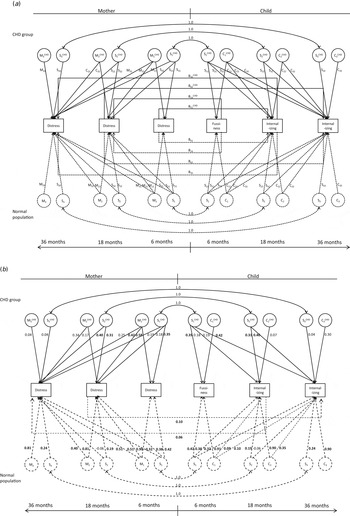
In the structural models used in this study, individual differences in maternal distress and child internalizing problems were broadly assumed to originate from two different sources that are mediated through three different pathways, as shown in Fig. 1 a: (1) individual-specific sources: mother-specific factors (M), comprising all factors for mental health in the mother not shared with the child; and child-specific factors (C), comprising all factors for mental health in the child not shared with the mother; (2) shared factors (S), comprising all factors for mental health influencing both the mother and the child. The S factors comprise all shared familial environmental variance. The effect of these two sources of variance (i.e. individual-specific and shared factors) can be mediated through an additional pathway: (3) mutual influences. This third pathway (B paths) constitutes the processes where the mental health problems of one family member directly influence the mental health problems of another family member. As M and C are the background factors for mental health, the effects of M and C work indirectly through the third paths of mutual influences. Given that mothers of children with CHD and mothers of children in the normal cohort did not differ in distress before birth (Solberg et al. Reference Solberg, Gronning Dale, Holmstrom, Eskedal, Landolt and Vollrath2012), we assume that the child's CHD causes distress in both mothers and children after birth. Such an additional cause creates additional variance. Hence, we modeled the additional variance unique to the CHD group separately for the children with CHD (Fig. 1 a, with superscript ‘CHD’) but not for the normal cohort. The variance in the CHD group was modeled with both the normal cohort and the CHD group variance components. All CHD group variance components had the same structure as the normal cohort variance components. To organize the longitudinal structure of the within-individual covariance, we applied the Cholesky decomposition (Neale & McArdle, Reference Neale and McArdle2000) on the within-individual covariance matrix (Fig. 1, factor subscripts 1–3).
(a) Conceptual model and (b) best-fit model for shared and individual-specific risk factors for maternal distress and child internalizing problems in families with a child with a congenital heart defect (CHD). (a) Boxes represent observed variables of maternal distress and child fussiness and internalizing problems at 6, 18 and 36 months postpartum. Circles represent latent factors comprising risk. M denotes risk factors for distress specific for the mother, C denotes risk factors for internalizing problems specific for the child, and S denotes risk factors for both maternal distress and child internalizing shared by mother and child. The shared risk factors (S) are fixed to correlate with 1.0 between mother and child (double-headed arrows). Single-headed arrows represent the effect going from one variable to another, such as the effect from risk factors to outcomes. Single-headed arrows going from mother to child and vice versa represent mutual influences, where the characteristic of the mother has a direct effect in the child, and vice versa. The lower area with broken lines represents risk factors and effects present in both the normal population and the CHD group. The upper area with solid lines represents risk factors and effects present only in the CHD group. (b) Parameter estimates from the best-fit model. The path coefficients are regression coefficients, so they must be squared to equal the amount of variance in the dependent (downstream) variable that is accounted for by the independent (upstream) variable.

We sought to simplify the full model (Fig. 1), first by reducing the number of mutual influence paths (B) and then by eliminating mother-specific, child-specific and shared factors across and within time (see online Supplementary Table S1). Corresponding to the principle of parsimony, we preferred models with fewer parameters if they did not result in a significant deterioration of fit. As an index for parsimony and fit, we used Akaike's (Reference Akaike1987) Information Criterion (AIC, Δχ 2–2Δdf). The model with the lowest AIC value has the best fit to the data. We used the Mx software package to fit the structural family model to the data (Neale & Maes, Reference Neale and Maes2004). To account for non-normality in the sampling distribution, we used bootstrapping resampling with 1000 sample draws on the final best-fitting model to calculate reliable 95% confidence intervals (CIs).
Results
Characteristics of the samples
The CHD group (n = 408) and the normal population cohort (n = 92 498) did not differ with regard to gender distribution (51.2% males in both groups, p = 0.98), maternal age in years (CHD group: mean = 30.57, s.d. = 4.75; normal cohort: mean = 30.23, s.d. = 4.53; p = 0.13) and mothers' years of education (CHD: mean = 14.73, s.d. = 2.55; normal cohort: mean = 14.74, s.d. = 2.54; p = 0.94). However, the children with CHD had a lower gestational age (gestational week CHD: mean = 38.67, s.d. = 2.51; normal cohort: mean = 39.41, s.d. = 1.90; p < 0.001) and a lower birthweight (CHD: mean = 3383 g, s.d. = 763; normal cohort: mean = 3572 g, s.d. = 582; p < 0.001). As shown previously, mothers of children with CHD were not different from mothers of the normal population cohort at week 30 of pregnancy in both level (p = 0.30) and variance (p = 0.60) of distress (Solberg et al. Reference Solberg, Gronning Dale, Holmstrom, Eskedal, Landolt and Vollrath2012).
Differences in mental health between the CHD group and the normal population cohort
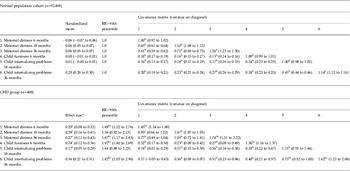
Table 1 gives an overview of standardized child and maternal mental health scores and RRs to score above the 95th percentile on these scores for the CHD group compared to the normal population at 6, 18 and 36 months postpartum. Most differences were statistically significant, with small between-group effect sizes. Notably, the variance in maternal and child distress was higher in the CHD group than in the normal cohort at 6 and 36 months. When dichotomizing the scores at the 95th percentile, group differences became clearer. Children with CHD had a considerable higher RR to score above the 95th percentile on fussiness at 6 months and on the CBCL internalizing problems scale at 18 and 36 months (Table 1). The same was true for maternal distress at 6, 18 and 36 months respectively. Taken together, the results show that CHD is a substantial risk factor for child behavior problems and maternal distress at all assessments.
Mean, variance, covariance, relative risks (RRs) and 95% confidence intervals (CIs) for measures on maternal distress and child internalizing problems in normal population and CHD group families between 6 and 36 months postpartum

CHD, Congenital heart defect.
95% CIs were calculated using bootstrapping with 1000 sample draws.
a Corresponds to the effect size measure Glass's Δ, which is similar to Cohen's d but only the standard deviation of the control group (i.e. normal population) is used.
b p < 0.05.
c Different from normal population, p < 0.05.
Model fitting
To simplify the structural model we first examined the mutual influence effects that were specific for the CHD population (see online Supplementary Table S1; step 1; BCHD in Fig. 1 a), finding them to be non-significant. Second, we removed mutual influences across time (B in Fig. 1 a). All mutual influences from 6 to 18 months could be removed (steps 2–3; B51 and B24 in Fig. 1). Two effects remained significant, that is mutual influences from 18 to 36 months (steps 2–4; B62 and B35 in Fig. 1). As a fifth step we were able to drop child-specific effects across time (C21, C31 and C32). Further improvements to the model were not possible (online Table S1; model 12; AIC = −8.8). The model with the second-best fit (model 16, online Table S1) also included child-specific effects across time but these effects were non-significant (χ 2 = 2.5, df = 3, p = 0.18). The superior fit of model 12 in terms of AIC indicates that it was the most parsimonious model, that is the model explaining the observed data with the least number of estimated parameters.
Mother-specific, child-specific and shared risk factors for mental distress unique to CHD had a substantial impact (Fig. 1 b). There were significant mutual influences between mother and child across time, but these influences were not different for the CHD group compared to the normal population cohort. This suggests that, although the total load of risk factors for mental health problems was greater in the families with CHD, the rules by which mutual influence between mental health problems in mothers and children operates were the same in the two groups.
Mother-specific factors for psychological distress in the CHD group
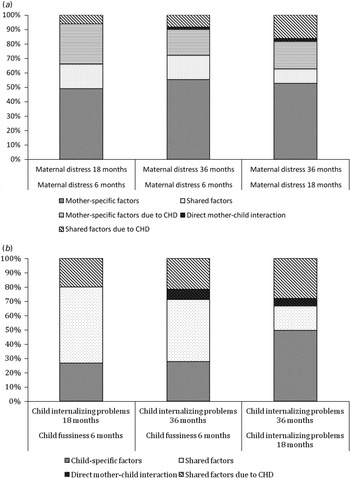
Table 2 shows the partitioning of variance and co-variance. Maternal distress due to CHD was explained to some extent by mother-specific CHD factors at all time points (Fig. 1 b, MCHD). Explained variance in maternal distress due to mother-specific CHD factors declined from 24% at 6 months to 15% at 36 months (Table 2). Mother-specific factors due to CHD (MCHD) also contributed to the stability in psychological distress (Fig. 2 a). Specifically, 28% of the covariance between mother's distress at 6 and 18 months could be explained by MCHD. The corresponding figures were 18% for 6 and 36 months and 19% for 18 and 36 months.
Percentage of covariance across time explained in (a) maternal distress and (b) child internalizing problems by individual-specific and shared factors.

Percentage of variance (and 95% CI) due to direct mother–child interaction, mother-specific factors, child-specific factors, and shared factors for maternal distress and child internalizing symptoms among 408 families with a child with CHD

CI, Confidence interval; CHD, congenital heart defect.
Figures are adjusted for measurement error by subtracting the error variance in the observed score according to Cronbach's α from the mother/child-specific variance in the normal population.
a 95% CI not available.
Values given as percentage or percentage (95% CI).
Child-specific factors for internalizing problems in CHD children
Child internalizing problems were influenced by child-specific CHD factors to varying degrees (Fig. 1 b, CCHD). Whereas 14% and 8% of the variance could be explained by CCHD at 6 and 36 months, only 2% of the variance could be explained by CCHD at 18 months. CCHD did not contribute significantly to stability in child internalizing problems (online Table S1; step 5; Fig. 1 b).
Shared factors for mental health problems in CHD families
Factors for mental health problems due to CHD shared by mother and child (SCHD) contributed substantially to mothers' distress and children's internalizing problems at all time points (Table 2). Furthermore, there was a tendency for the effect to increase over time. Variance explained at 6, 18 and 36 months was 9, 10 and 14% respectively for the mother and 10, 13 and 17% respectively for the child. This contrasted with the pattern in the normal population cohort, which showed slightly decreasing explained variance across time (Table 2).
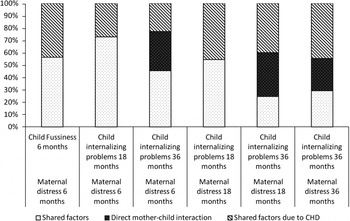
A sizeable share of the stability of both mothers' and children's mental health could be attributed to SCHD (Fig. 1 b). According to the path tracing in Fig. 1 b, SCHD contributed 6% to 16% of the stability in maternal distress and 20% to 28% of the stability in child internalizing problems. SCHD also contributed substantially to the covariance between mother and child mental health (Fig. 2); 44–45% of the covariance at the same time point was explained by SCHD in the CHD population, and 23–40% of the covariance between mother and child across time was explained by SCHD (Fig. 3).
Percentage of covariance between maternal distress and child internalizing problems explained by individual-specific and shared factors.

Effect of mutual influences between family members due to mental health problems
Whereas mutual influences between the child and the mother from 6 to 18 months were non-significant, there were two significant effects of mutual influences from 18 to 36 months: the effect of the mother's distress at 18 months on the child's internalizing problems was β = 0.10, and the direct effect from the child's internalizing problems to the mother's mental distress was β = 0.06 (Fig. 1 b).
Discussion
Mental health of children with CHD and their mothers
In line with our hypothesis and previous findings (Latal et al. Reference Latal, Helfricht, Fischer, Bauersfeld and Landolt2009), this study found increased levels of internalizing behavior problems in children with CHD at all three assessment points compared to the controls. Indeed, children with CHD had approximately twice the risk of scoring above the 95th percentile of the internalizing scale compared to the children in the normal population cohort.
Consistent with our hypothesis, we also found elevated levels of maternal distress in the CHD group at all three assessments. Similar to the findings in the children, mothers had considerable high RRs to score above the 95th percentile of the scale. This is in line with previous studies showing higher rates of anxiety, depression or post-traumatic stress disorder in mothers of children with CHD (Lawoko & Soares, Reference Lawoko and Soares2002, Reference Lawoko and Soares2006). As previous studies with samples from the MoBa have shown, mothers of children with severe CHD are most probably at the highest risk (Solberg et al. Reference Solberg, Dale, Holmstrom, Eskedal, Landolt and Vollrath2011, Reference Solberg, Gronning Dale, Holmstrom, Eskedal, Landolt and Vollrath2012). This suggests that a considerable share of mothers may need psychological support after giving birth to a child with CHD.
Contributions of individual and shared factors and mutual influences on child mental health
This study also examined to what extent internalizing behavior problems in children with CHD could be attributed to factors and experiences that were specific to the child, factors that were shared by child and mother, and mutual influences (cross-lagged effects) between the mother's and child's mental health across time. Analyses showed that the child's internalizing problems at 6, 18 and 36 months were influenced by child-specific CHD factors to varying degrees, explaining 14% and 8% of the variance at 6 and 36 months respectively in children with CHD but only 2% of the variance at 18 months. This suggests that child-specific CHD factors were moderate-sized risk factors at 6 and 36 months but not at 18 months. An explained variance of 14% and 8% at 6 and 36 months corresponds to correlations of 0.37 and 0.28 respectively. Considering epidemiological studies where familial factors were adjusted for by design (e.g. twin and family studies), this can be considered as a substantial effect of a single environmental exposure (Smith, Reference Smith2011). The lack of stability suggests that individual-specific factors associated with having CHD change substantially across time. This contrasts with findings from other studies where medical variables, such as type of CHD, were unrelated to proxy-reported child adjustment (DeMaso et al. Reference DeMaso, Campis, Wypij, Bertram, Lipshitz and Freed1991; Miatton et al. Reference Miattion, De Wolf, Francois, Thiery and Vingerhoets2007; Latal et al. Reference Latal, Helfricht, Fischer, Bauersfeld and Landolt2009; Spijkerboer et al. Reference Spijkerboer, De Koning, Duivenvoorden, Bogers, Verhulst, Helbing and Utens2010) and suggests that such influences can only be found in larger samples.
Factors shared by mother and child contributed substantially to children's internalizing problems at all time points, with an increasing effect over time. Shared factors due to CHD also contributed significantly to the stability of children's internalizing problems (20–28%). Finally, we found a significant effect from the mother's distress at 18 months to the child's internalizing problems at 36 months, but not vice versa. After shared factors were taken into account, maternal distress accounted for about 1% of the variance in child internalizing problems. It is noteworthy that this finding was present in both samples, hence not showing any specific mutual influence from mother to child in families with a child with CHD. Negative effects of maternal distress on child behavior have previously been shown in families of a child with CHD (Gupta et al. Reference Gupta, Guiffre, Crawford and Waters1998; Visconti et al. Reference Visconti, Saudino, Rappaport, Newburger and Bellinger2002; McCusker et al. Reference McCusker, Doherty, Molloy, Casey, Rooney, Mulholland, Sands, Craig and Stewart2007; Spijkerboer et al. Reference Spijkerboer, De Koning, Duivenvoorden, Bogers, Verhulst, Helbing and Utens2010) and also in families with healthy children (Elgar et al. Reference Elgar, McGrath, Waschbusch, Stewawrt and Curtis2004). A study among adolescents with depressive symptoms and antisocial behavior reported a corresponding effect of the same size (Pike et al. Reference Pike, McGuire, Hetherington, Reiss and Plomin1996). An explanation may be that a distressed mother may not able to adequately address her child's needs, which in turn may engender/reinforce behavioral problems in the child (Appleyard & Osofsky, Reference Appleyard and Osofsky2003).
Contributions of individual and shared factors and mutual influences to maternal mental health
In parallel to the analysis in children, we examined the extent to which the mother's distress could be attributed to factors that are specific to themselves, factors that are shared by child and mother, and mutual influences between the mother's and the child's mental health across time. Mother-specific CHD factors and factors shared by mother and child contributed substantially both to maternal distress at all assessments and to the stability of maternal distress over time. Of note, the effect of shared factors increased over time. In line with our hypothesis, we found significant effects of child behavior at 18 months on maternal mental health problems at 36 months. These effects, however, were not specific for the families with a child with CHD but were present in both samples (CHD and controls). Although such effects are known from studies in healthy children (Elgar et al. Reference Elgar, McGrath, Waschbusch, Stewawrt and Curtis2004), this study is the first to report a negative effect of child behavior problems on maternal distress in children with CHD. As children with CHD have an increased risk of internalizing problems compared to children from the normal population, the total effect on maternal distress will be stronger in the mothers of children with CHD.
Strengths and limitations
This study has several strengths, including a large population-based sample, a prospective design allowing for comparison of CHD families with norms and the application of advanced statistical procedures. However, there are some limitations that need to be considered. First, the participation rate in the MoBa is low (38.5%), which may have biased our sample. However, one study on negative pregnancy outcomes in the MoBa showed that, although prevalence rates were lower, the strengths of associations between known risk factors and pregnancy outcomes were the same as those in the normal population (Nilsen et al. Reference Nilsen, Vollset, Gjessing, Skjaerven, Melve, Schreuder, Alsaker, Haug, Daltveit and Magnus2009). Second, child internalizing problems in this study were rated by mothers. Some authors (e.g. Elgar et al. Reference Elgar, Curtis, McGrath, Waschbusch and Stewart2003) have argued that a distressed mother may have a tendency to exaggerate the severity of her child's adjustment problems (depression–distortion hypothesis). This may lead to an increased association of child and maternal problems. Findings in the literature on this issue are inconsistent. Nevertheless, most authors conclude that, although maternal reports on child behavior may to some extent be influenced by the mother's emotional state, they are still accurate and valid (Querido et al. Reference Querido, Eyberg and Boggs2001). In addition, clinical assessments of children are not viable in large epidemiological studies, and child self-report is not possible in young children. Third, we only examined internalizing behavior problems of the child. This was because exploratory analyses found that children with CHD showed no signs of externalizing problems. Fourth, our scales to assess mental health in mothers and children were shortened versions of established scales. In particular, the internalizing problems short scales had moderate internal consistencies. We cannot rule out the possibility that full-scale testing of mental health problems in children and mothers would have revealed stronger associations.
Conclusions
The findings of our study have several implications. First, our finding that children with CHD have an increased risk for internalizing behavior problems points to the need of early identification and individual support. Second, we found mothers of young children with CHD to be at a clear risk for severe long-lasting distress. This calls for close monitoring and individual psychological support of mothers, if clinical levels of distress are present. Third, we found mutual influences from the mother's distress to the child's internalizing problems that were similar to the healthy norm group. This suggests that family-based interventions that focus on mutual influences between family members must be considered in addition to the individual support of family members (Kazak et al. Reference Kazak, Kassam-Adams, Schneider, Zelikovsky, Alderfer and Rourke2006). Fourth, our findings call for replication in other groups of patients with CHD and other congenital disorders (e.g. Down syndrome) or chronic diseases (e.g. cystic fibrosis).
Supplementary material
For supplementary material accompanying this paper visit http://dx.doi.org/10.1017/S0033291713002894.
Acknowledgments
The MoBa is supported by the Norwegian Ministry of Health, the National Institutes of Health/National Institute of Environmental Health Sciences (NIH/NIEHS; grant no. N01-ES-85433), the NIH/National Institute of Neurological Disorders and Stroke (NIH/NINDS; grant no. 1 UO1 NS 047537-01), and the Norwegian Research Council/Functional Genomics in Norway (FUGE; grant no. 151918/S10). This project also received support from the Norwegian Research Council (grant no. 181862/V50).
Declaration of Interest
None.