Parents of children with CHD experience high psychological distress and coping difficulties.Reference Utens, Versluis-Den Bieman, Verhulst, Witsenburg, Bogers and Hess 1 Parental coping ability is important for psychological adaptation and adjustment related to stress, especially during the surgical or other interventions.Reference Davis, Brown, Bakeman and Campbell 2 , Reference Doherty, McCusker and Molloy 3 Importantly, it has been reported that parents of children with CHD have lower quality of life associated with distress and hopelessness.Reference Lawoko and Soares 4 These parents often experience parenting stress, characterised by difficulty with discipline of children with CHD.Reference Uzark and Jones 5 Cardiac catheterisation is an important diagnostic and therapeutic procedure for children with CHD and acquired heart disease. Cardiac catheterisation is an invasive procedure, however, and often requires anaesthesia in children. Due to its invasive nature and the implications of its findings, caregivers many times have heightened psychological stress when their children undergo cardiac catheterisation. There is a paucity of data on the anxiety level in the caregivers of children who are undergoing cardiac catheterisation and associated factors. These data are important for family-centred care and further clinical improvement programmes to reduce anxiety level in the caregivers during high-stakes procedures. Understanding factors associated with level of anxiety in the caregivers is a critical initial step in this process. We performed this cross-sectional survey with the aim to evaluate the level of and factors associated with anxiety in the parents of children who underwent cardiac catheterisation in a tertiary care hospital.
Materials and methods
This was a cross-sectional study using a survey questionnaire in the Children’s Hospital of Michigan. Inclusion criteria were parents of paediatric patients (<18 years of age) who had undergone cardiac catheterisation in our centre between January, 2015 and June, 2016. The survey was written in English. Therefore, parents who could not read English were excluded from the study. The survey consisted of two parts: questions about socio-demographic status and clinical history of child and stress level questionnaires – State-Trait Anxiety Inventory. Before catheterisation, parents were asked to fill in the survey questionnaire. Questions for parents included education level (high – college and graduate school versus low – high school or less), marital status (single, married or domestic partnership, and divorced), status of smoking and alcohol consumption, presence of other family members on the day of catheterisation, and multiple children.
The State-Trait Anxiety Inventory is a 40-item self-administered questionnaire validated to measure state and trait anxiety in adults. State anxiety is a temporary condition related to an acute event (cardiac catheterisation in this study), whereas trait anxiety is the overall tendency of an individual to be anxious. Each item has a four-point Likert scale. The state and trait anxiety scores are derived from 20 items of state anxiety and 20 items of trait anxiety. Higher scores indicate greater anxiety with scores ranging from 20 to 80. In our samples, Cronbach’s α value was 0.941 for state anxiety score, whereas the value was 0.895 for trait anxiety score. Significant anxiety was defined as scores ⩾2 standard deviation of the norm reference (score ⩾57 for state anxiety and score ⩾54 for trait anxiety).Reference Spielberger 6 Borderline anxiety was defined as score between 1 and <2 standard deviation (score 46–56 for state anxiety and score 44–53 for trait anxiety). No anxiety was defined as score <1 standard deviation (score⩽45 for state anxiety and score⩽43 for trait anxiety).
Data were expressed as mean±standard deviation and frequency (%) based on the variable types. A sample t-test was used to compare the date with normative data derived from 1838 working adults, who were employees of the Federal Aviation AdministrationReference Spielberger 6 . Pearson correlation coefficient was measured between state and trait anxiety scores. For univariate analysis, independent t-test or analysis of variance or the χ2 test was used to compare the data between groups. Multiple linear regression with backward selection model technique was used to assess the factors associated with state and trait anxiety. Significant coefficient β, its confidence interval, and standardised coefficient β were shown. Effect size estimates were expressed as R 2 or Cohen’s f2. The statistical analysis was performed using SPSS version 24 (IBM, Armonk, New York, United States of America).
Results
Demographics
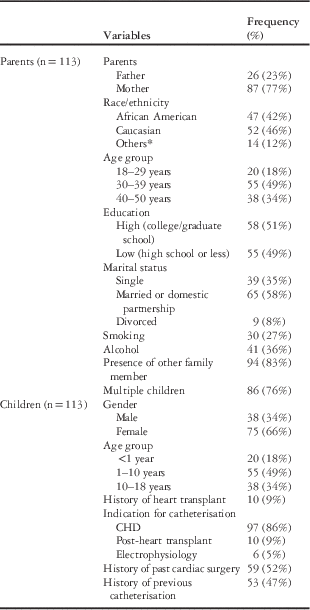
A total of 113 parents (87 mothers and 26 fathers) completed the survey (Table 1). The mean±standard deviation age of parents was 34.0±7.7 years. There were 47 (42%) African American and 52 (46%) Caucasian parents. Parents reported a high level of education in 51%, married or domestic partnership in 58%, smoking in 27%, and alcohol use in 36%. Most parents (83%) came to the catheterisation with other family members. There were other children at home for 76% of parents. Among children undergoing catheterisation, there was a female preponderance (66%). The mean age of children undergoing cardiac catheterisation was 6.7±5.7 years. There were 59 children who had a history of cardiac surgery, including 10 children with a history of heart transplant. About half the children (47%) had a history of previous catheterisation.
Demographic and socio-economic data of the study cohort.

* Others included Hispanic (6), Arabic (4), Moorish (1), no race/ethnicity (1)
Level of anxiety
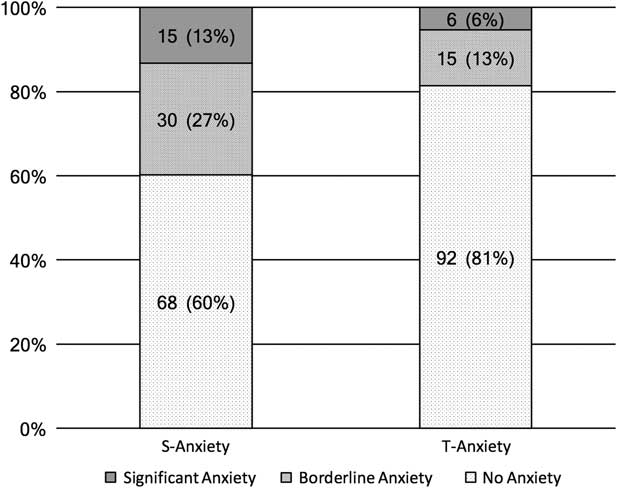
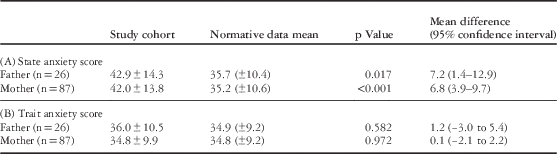
Based on state anxiety score, 45 parents (40%) had a current state of anxiety reported as significant (n=15) or borderline anxiety (n=30). Based on trait anxiety score, 21 parents (19%) had proneness to anxiety (significant in 6 and borderline anxiety in 15). Compared with the normative reference data, the mean state anxiety score was significantly higher in the parents despite no difference in trait anxiety scores (Table 2). There was no difference of state or trait anxiety scores between fathers and mothers. There was a significant positive correlation between state and trait anxiety scores (correlation coefficient=0.708, p<0.001) (Fig 1).
Level of anxiety of 113 parents based on state (S-anxiety) and trait anxiety (T-anxiety).

Comparison of (A) state anxiety score and (B) trait anxiety scores between the study cohort and normative data.

Factors associated with level of anxiety
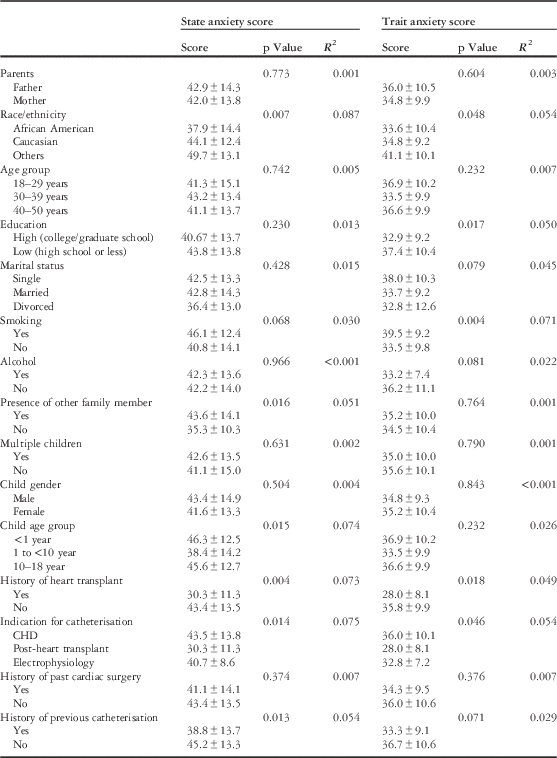
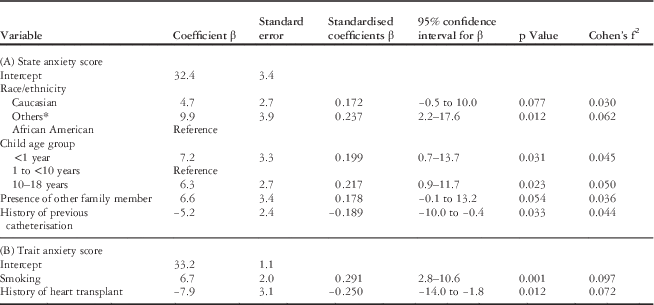
Univariate analysis (Table 3) showed that factors associated with state anxiety score was race/ethnicity, presence of other family member at the catheterisation, history of heart transplant, indications for catheterisation, and history of previous catheterisation. African American parents had lower state anxiety scores than did Caucasian and other parents. Those who had other family member present had higher state anxiety scores than those who did not have other family member present. Parents having children aged <1 years or 10–18 years had higher state anxiety scores than those having children aged 1 to <10 years. Parents who had transplant recipients had lower state anxiety score than those who did not have transplant recipients. Parents having children with history of previous catheterisation had lower state anxiety scores than those having children without history of previous catheterisation. Final multivariable model (Table 4a) using multiple linear regression consisted of 4 variables (R 2=0.220, p<0.001) and child age group and history of previous catheterisation remained statistically significant, adjusted by race/ethnicity and presence of other family member.
Univariate analysis of factors associated with state and trait anxiety scores

Multiple linear regression to assess the factors that associated with (A) state anxiety score and (B) trait anxiety score

* Others included Hispanic, Arabic, Moorish, and no race/ethnicity
Univariate analysis showed (Table 3) that factors associated with trait anxiety score were race/ethnicity, level of education, smoking, history of heart transplant, and indication for catheterisation. African American and Caucasian parents had a higher trait anxiety score than did those of other race/ethnicity, but there was no difference between African American and Caucasian parents. Parents with low education level had a higher trait anxiety score than did those with high education level. Parents who had transplant recipients had a lower trait anxiety score than did those who did not have transplant recipients. Final multivariable model (Table 4b) consisted of two variables (R 2=0.133, p<0.001) and smoking and history of heart transplant remained statistically significant.
Discussion
Parents of children who underwent cardiac catheterisation had a higher level of concurrent anxiety compared with the normative reference adult cohort. Parents may have coping difficulty with psychological distress because the cardiac catheterisation procedures were perceived as stressful and tense.Reference Utens, Versluis-Den Bieman, Witsenburg, Bogers, Hess and Verhulst 7 Many of these parents did not have a high level of intrinsic proneness to anxiety, indicating that our cohort had similar baseline psychological status to that of the normative reference population. These findings were consistent with previous reports.Reference Uzark and Jones 5 , Reference Utens, Versluis-Den Bieman, Witsenburg, Bogers, Hess and Verhulst 7 – Reference Fischer, Butz, Nicholson, Blankenship, Dyke and Cua 9 In our cohort, trait anxiety score positively correlated with state anxiety score, indicating parents with higher proneness to anxiety felt more acutely anxious about the cardiac catheterisation. Multiple factors were associated with higher anxiety scores in the univariate analysis. The final multivariate model indicated that parents felt more anxious when their child was an infant or adolescent and if their child had not had a previous catheterisation. Utens et al have reported the effect of child age on parental anxiety.Reference Utens, Versluis-Den Bieman, Verhulst, Witsenburg, Bogers and Hess 1 In the study of parents of 75 children aged 3 months to 6 years with CHD, mothers of younger children awaiting surgery showed higher levels of psychological distress.Reference Utens, Versluis-Den Bieman, Verhulst, Witsenburg, Bogers and Hess 1 Our result is consistent with this report by Utens et al. High level of concurrent anxiety in parents of adolescents has not been described well previously. We suspect that there would be different parental reactions to an illness treated/identified in infancy, young children, and adolescents. Further studies are needed to evaluate the possible reason for higher parental anxiety in the adolescent group. Lower level of parental anxiety with a history of previous catheterisations suggests that presence of knowledge and expectation for cardiac catheterisation may alleviate the psychological distress among parents.
Parents of children with CHD have high psychosocial morbidity.Reference Lawoko and Soares 10 In a study of 632 parents of children having CHD, many parents reported anxiety (16–18%).Reference Lawoko and Soares 10 Mothers reported more severe symptoms of anxiety. Psychosocial morbidity was associated with parental caregiving burden, dissatisfaction with care, social isolation, and financial instability. However, interestingly, the child’s clinical severity had less effect on the psychosocial morbidity. Other studies have also shown that objective measures of child disease severity are poor predictors of coping/adjustment and that child/parent perceptions of severity are more important.Reference Sloper 11 , Reference Bachanas, Kullgren, Schwartz, McDaniel, Smith and Nesheim 12 Parents have a higher psychological distress and anxiety when their children are awaiting invasive procedures such as cardiac surgery and catheterisation. Utens et al assessed psychological distress using the General Health Questionnaire in 75 parents of children awaiting cardiac surgery and 17 parents of children awaiting cardiac catheterisation.Reference Utens, Versluis-Den Bieman, Verhulst, Witsenburg, Bogers and Hess 1 Both surgery and catheterisation groups showed a higher psychological distress with anxiety, sleeplessness and social dys-functioning than the normal reference group consisting of random samples. Another study was conducted in Turkey to evaluate anxiety in 73 parents of children undergoing cardiac catheterisation.Reference Üzger, Başpınar, Bülbül, Yavuz and Kılınç 13 This study used a different measure of anxiety, Beck Anxiety Inventory, which showed 11% had severe, 14% had moderate, 16% had mild anxiety in the cohort. The 41% of anxiety level was similar to our data of 40% state anxiety. However, they reported that one of the important factors associated with a higher anxiety score was disease severity – cyanotic versus acyanotic condition of children.
The State-Trait Anxiety Inventory is a widely-used measure of trait and state anxiety and has been used in the studies of parents having children with CHD. Fischer et al in the United States evaluated the level of anxiety in 59 parents of neonates with CHD, just prior to initial hospital discharge.Reference Fischer, Butz, Nicholson, Blankenship, Dyke and Cua 9 Their cohort showed a high mean state anxiety score for 54 and trait anxiety score for 48. There was a positive correlation between state/trait anxiety score and education level. Vrijmoet-Wiersma et al reported State-Trait Anxiety Inventory scores in 114 mothers and 82 fathers of 131 children who underwent open-heart surgery in the Netherlands.Reference Vrijmoet-Wiersma, Ottenkamp, van Roozendaal, Grootenhuis and Koopman 8 Mothers had much higher mean state anxiety scores compared with fathers (score 53.9 versus 44.0). There was no difference in the mean trait anxiety score between mother (score 46.6) and father (score 44.1). Factors associated with anxiety were the number of surgical procedures, the time since the last surgery, and ethnicity. In contrast, our cohort showed lower scores in both state and trait anxiety scores, probably because we studied catheterisation rather than open-heart surgery, and no differences between mothers and fathers in the state anxiety score. We demonstrated the same trend that parents had higher anxiety in the concurrent state but not in the proneness to anxiety.
In the univariate analysis, several variables were associated with trait anxiety score. Lower education level had a higher trait anxiety score. Our finding of an association between trait anxiety score and smoking and a history of transplant are intriguing but plausible. Previous studies have shown that people with high anxiety are more likely to smoke,Reference Cuijpers, Smit, ten Have and de Graaf 14 and smoking is associated with the increased risk for developing anxiety.Reference Swendsen, Conway and Degenhardt 15 In our cohort, parents of heart transplant recipients experienced less anxiety. We speculate that those parents had less anxiety because of better understanding and expectations of the procedure. All the heart transplant recipients underwent annual surveillance cardiac catheterisation at least 2 years after their transplantation procedure. In contrast, most children with CHD and electrophysiology issue required cardiac catheterisation for their concurrent cardiac intervention. Utens et al reported the study assessing psychological distress in parents before and after their children underwent cardiac intervention.Reference Utens, Versluis-Den Bieman, Witsenburg, Bogers, Hess and Verhulst 7 The level of anxiety was higher before the intervention but significantly lower 18.7 months after the intervention compared with normative reference groups.Reference Utens, Versluis-Den Bieman, Witsenburg, Bogers, Hess and Verhulst 7 Two possible explanations of this favourable change were proposed by Utens et al. The first is “denial”, and the other is that parents may feel very relieved after they go through the stressful period of the cardiac procedure. Parents may feel stronger from the experience and improve their coping techniques including palliative reaction and passive reaction pattern. We suspect that parents with heart recipients felt stronger and less anxious with adjustment after going through a difficult peri-transplantation period. Our data showed parents with other family member present had more concurrent anxiety. Possible explanation for this is that parents with high anxiety may seek psychological support from others family members, thereby the presence of other family member reflecting high anxiety of parents.
How to alleviate parental anxiety before catheterisation has not been studied well. Most previous studies focused on patients themselves, not the caregivers. Uzark et al performed a randomised control study of a videotape that explained about the procedure in 54 children undergoing catheterisation.Reference Uzark, Klos, Davis and Rosenthal 16 The videotape group showed a better knowledge and sensation than controls, indicating that this pre-procedural videotape helped children to cope with the stress. There have been studies to show the effectiveness of non-pharmacological interventions to reduce anxiety levels in adult patients. Ferreira Nda et al in a review identified several strategies: music therapy, educational videos, nursing education, therapeutic massage, and palm therapy.Reference Ferreira Nda, Ramalho Eda and Lopes Jde 17 Other strategies such as cognitive-behavioural therapy,Reference Knibb 18 desensitisation,Reference Ultee, Griffioen and Schellekens 19 and relaxation therapyReference Klainin-Yobas, Oo, Suzanne Yew and Lau 20 have been shown to be effective in the treatment of anxiety, coping difficulties, and procedure-related psychological distress in general. These may be particularly helpful for individuals who have poor response to the educational interventions. McCusker et al reported the effective psychosocial intervention on parental coping/adjustment in families having children with CHD.Reference McCusker, Doherty and Molloy 21 , Reference McCusker, Doherty and Molloy 22 We think that some of these strategies can be applied to the caregivers of children undergoing catheterisation. Most importantly, we speculate that the primary driver of parental anxiety may be stress/fear related to lack of knowledge and expectation for cardiac catheterisation, especially when their children never have experienced catheterisation. In our cohort, when children had a history of previous catheterisations, parental anxiety level was significantly lower. As a future quality improvement project, we plan to create our introductory and explanatory videos of cardiac catheterisation and major interventional procedures. With the use of portable device such as iPad (Apple, Cupertino, California, United States of America), these videos will be shown to the caregivers before catheterisations. The impact of this strategy will be assessed by the State-Trait Anxiety Inventory.
This was a cross-sectional study with its inherent limitations. The sample size was not large. As the survey was written only in English, parents who did not read English were excluded from the study. This could have been a selection bias on race/ethnicity. To assess the State-Trait Anxiety Inventory scores in our study cohort, the normative data derived from working adults were used for comparison.Reference Spielberger 6 This working adults sample consisted of 1387 males and 451 females with heterogeneous educational levels and age groups. Furthermore, their parental status or presence of acute stressful event is unknown. Therefore, the differences in these two samples could introduce bias.
In conclusion, concurrent state anxiety level was high among parents of children undergoing cardiac catheterisation, whereas trait anxiety level (proneness to anxiety) was not. When children never had previous catheterisations and were infants or adolescents, parents felt more anxious about cardiac catheterisation. Familiarity with catheterisation in parents may possibly alleviate the level of anxiety. Further studies should be pursued to test the effectiveness of simple strategies to reduce parental anxiety level before catheterisation.
Acknowledgements
None.
Financial Support
This study was funded by the Children’s Hospital of Michigan Foundation (grant no. R1-2015-33).
Conflicts of Interest
None.
Ethical Standards
The authors assert that all procedures contributing to this work comply with the ethical standards of the relevant national guidelines on human experimentation and with the Helsinki Declaration of 1975, as revised in 2008, and has been approved by the Wayne State University Institutional Research Board. The study was qualified as the selected exemption category of “Research involving the use of survey procedures (no personal identifiers in the survey and data collection)”. Therefore, a waiver of written informed consent was approved.