Introduction
Representative legislatures were historically the instruments by which pre-democratic political systems were democratized in both North America and Europe. In colonial America, legislatures provided the settings in which colonists could address the British authorities and register grievances (Greene, Reference Greene1961). After the revolution, legislatures asserted lawmaking and appropriations power at both the state and national levels. These bodies provided one of the few avenues for citizens to participate in and exercise a measure of indirect influence over the political process. In Europe, in the 19th century, the expansion of the right to vote in parliamentary elections endowed parliaments with a legitimacy that enabled them gradually to limit the powers of monarchical governments. In both the first and second waves of democratization, the development of representative institutions preceded and legitimized the subsequent emergence of democratic regimes (Huntington, Reference Huntington1991: 16–17). This interpretation of the historical role of legislatures led to the theory that, by providing an institutional forum for the representation of societal diversity and the peaceful expression of political interests, legislatures contribute to the integration of society and the legitimating of democratic regimes (Loewenberg and Patterson, Reference Loewenberg and Patterson1979: 280–304; Mezey, Reference Mezey1985: 746–50). David Easton’s concept of ‘support’ posited that whether political systems ‘stand, fall, or change’ depends not on their ability to satisfy specific citizen policy demands but on their ability to attract a ‘generalized attachment to political objects … not conditioned upon specific returns at any moment’. Easton named that attachment ‘diffuse support’ and a considerable literature attributed a major role in generating it to democratically elected legislatures (Wahlke, Reference Wahlke1971).
During the third wave of democracy in the late 20th century, however, the development of legislatures and the transformation of regimes have proceeded very differently and in ways that call into question the applicability of theories about the legitimizing role of legislatures for new democracies. Contrary to the gradual and sequenced process typical of earlier democratic waves, representative legislatures and democratic regimes in many if not most third wave transformations were created abruptly and virtually simultaneously. In the former communist states of Eastern and Central Europe, for example, the process of democratization generally involved negotiations between the leaders of the previous one-party state and various opposition groups in an ad hoc process that mostly excluded existing parliaments. Communist legislatures had performed only symbolic roles, were not freely and fairly elected and, in any case, were not viewed by citizens as independent, representative, or legitimate. While the new regimes typically resulted in revitalized parliaments selected through competitive elections, the new legislatures had to overcome the legacy of single party rule and establish their own legitimacy in the eyes of citizens. Representative legislatures in Central and Eastern Europe are the products of democratic transitions rather than the instruments by which the new regimes were created and legitimized. This raises three questions: What is the process by which citizens developed attachments to the new political institutions? What role, if any, have post-Communist legislatures had in fostering citizen attachments to the emerging democratic regimes? And what factors determine the stability of that attachment?
Mishler and Rose (Reference Mishler and Rose1994) examined the relationship between public attitudes toward legislatures and regimes in six post-Communist regimes in 1992, very shortly after the new legislatures and regimes were established. They reported that citizens initially were somewhat skeptical of the new legislative institutions as they were of virtually all other political and social institutions including the church. At the same time, however, few citizens wanted to see the new legislatures or regimes abolished and most participated willingly in the formative elections. Initially, however, most citizens did not distinguish clearly among different political institutions or, specifically, between the new parliaments and the new regimes. Rather, citizens tended to perceive and evaluate the new regimes holistically on the basis of their performance and not as a composite of separate and distinct institutions, some performing better than others. Although there was some evidence that public approval of the new legislatures carried over to the new regimes, public attitudes about the new regimes were much more likely to condition public approval of the new legislatures than vice versa.
Although this snapshot of the relationship between popular attachments to parliaments and regimes at the start of the transition provides a useful starting point, that analysis was based on a small set of post-Communist regimes and a single point at the start of the transition before citizens had much opportunity to get to know the new institutions or regimes or to form considered opinions about their structure or functions. That snapshot could not illuminate the process by which citizens developed attachments to the new political institutions. In this article, we provide evidence to describe that process over the first 15 years of the post-Communist transition. We begin by reviewing competing theories on the development of public attachments to both legislatures and regimes. We proceed to discuss measurement problems and to chart changes in public attitudes toward legislatures and regimes over time in post-Communist East and Central Europe. We then use multi-level modeling procedures to assess the sources of support for legislatures and regimes and their reciprocal effects. The final section returns to the central questions of the process by which citizens develop attachments to new political institutions and the role of legislatures in that process.
Theory
An assessment of the process by which citizens develop attachments to new political institutions must consider existing theories of the individual-level and contextual sources of citizen support for political regimes. The earliest work on citizen attachment to political institutions and regimes emphasized the importance of social structural influences and early-life socialization on the cultivation of basic political orientations and values. According to this perspective, individuals are both formally and informally taught, virtually from birth, attitudes, values, and behaviors supportive of both the community and the regime (Easton and Hess, Reference Easton and Hess1962; Almond and Verba, Reference Almond and Verba1963; Easton, Reference Easton1965; Eckstein, Reference Eckstein1966; Inglehart, Reference Inglehart1997). Citizens are not only indoctrinated by the family, school, youth groups, and the public officials to accept the regime as legitimate, but also taught a series of even more basic values about their proper roles as citizens (or subjects).
This, of course, was particularly true of communist regimes in Eastern and Central Europe and the former Soviet Union, most of which invested considerable effort into socializing their youth to embrace authoritarian institutions and regimes. In fact, many observers were initially skeptical about the prospects for successful democratic transitions in the region because of the presumed success of this inculcation of authoritarian values. Nevertheless, while the ‘the power of the past’, as Bunce (Reference Bunce1999: xii) notes, may affect all members of the society, socialization theories emphasize that individual experiences with a communist past differ in ways conditioned by an individual’s age, education, gender, and position in the society (see, e.g. Almond and Verba, Reference Almond and Verba1963; Eckstein, Reference Eckstein1966; Inglehart, Reference Inglehart1990; Dalton and Weldon, Reference Dalton and Weldon2007).
More recent research on political support adopts an institutionalist perspective and treats the development of political attachments as substantially rational (Rogowski, Reference Rogowski1974; Evans and Whitefield, Reference Evans and Whitefield1995; Rose et al., Reference Rose, Mishler and Haerpfer1998; Anderson et al., Reference Anderson2005). Individuals are assumed to evaluate a regime and its institutions based on performance. Economic evaluations, both egocentric and sociotropic, presumably dominate this calculus (Kinder and Kiewiet, Reference Kinder and Kiewiet1981; Lewis-Beck, Reference Lewis-Beck1988; Mishler and Rose, Reference Mishler and Rose1994; Anderson, Reference Anderson1995). In addition, non-economic evaluations of the political performance of the regime are thought to influence regime support. These considerations include perceptions of the honesty, openness, and fairness of the new regime, as well as its commitment to protecting individual rights and liberties (Kornberg and Clarke, Reference Kornberg and Clarke1992; Anderson and Guillory, Reference Anderson and Guillory1997). The traditional conception of legislatures’ roles in legitimizing new democracies is an early expression of theory based on institutional performance.
While most research, both cultural and institutional, adopts a micro-level perspective focusing on citizen attitudes and their individual-level correlates, there is increasing evidence that macro-contextual factors matter as well. These include the structure and design of democratic institutions, which are thought to have important effects on how citizens perceive and evaluate regimes (Lijphart, Reference Lijphart1992; Norris, Reference Norris1999; Rose and Munro, Reference Rose and Munro2003). For example, there is increasing evidence that consensual political systems defined by multi-party coalition governments and multi-member districts with proportional representation generate significantly stronger popular attachments than majoritarian systems based on single-member district electoral rules and single-party governments (Lijphart, Reference Lijphart1999). This is presumably because consensual systems give more individuals a sense of representation and inclusion (Powell, Reference Powell2000: Ch. 9).
This discussion suggests that the development of public attachments to new regimes needs to be examined against the broader contributions of cultural and other institutional influences, both micro- and macro-political factors. To do so, we draw on survey data gathered in 10 Central and East European countries, Bulgaria, the Czech Republic, Hungary, Poland, Romania, Slovakia, Slovenia, Estonia, Latvia, and Lithuania, and in two post-Soviet countries, Russia and Ukraine, across the first 15 years of the post-Communist transition. All surveys were conducted face-to-face at different intervals between 1991 and 2005 by established national research institutes under the auspices of the Centre for the Study of Public Policy of the University of Aberdeen in Scotland. The data were weighted within countries based on age, sex, education, and region and then weighted across countries so that every country has the same effective number of cases each year (n = 1000). This produced a data set of 85,000 respondents distributed across a total of 12 countries and 85 country-years.Footnote 1
Measuring attachments to parliaments and regimes
Despite their reputations as legitimizing institutions, parliaments typically are not popular institutions even in established democracies. Trust in legislatures, even in long established democracies, is almost universally low both in absolute terms and relative to other governmental institutions. In many western democracies, moreover, trust has been declining sporadically for the past generation. Among the different public institutions, the army, the police, the courts, and the legal system generally attract the highest levels of trust worldwide (Rolef, Reference Rolef2006: 7–15). Trust in the administration of government also tends to be higher than trust in parliaments and parties, which are generally trusted least (CESifo DICE Report, 2/2007: 71).
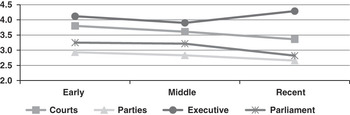
A very similar pattern holds for the post-Communist countries of Central and Eastern Europe. Figure 1 charts the levels of trust in four institutions across three time periods. Measuring trust on a 7-point scale, where 7 represents the highest trust, 1 reflects the greatest distrust, and 4 is the ‘skeptical’ midpoint, only political parties are trusted less than parliaments overall. The executive is the most trusted (i.e. least distrusted) institution, followed by the courts, although the differences in trust in absolute terms are small across the four institutions, and even the most trusted institutions barely reach the ‘skeptical’ midpoint of the scale. Trust in parliament, as in most other post-Communist institutions, has changed very little across the transition. To the extent it has changed, public confidence appears to have eroded slightly, but the changes are too small and inconsistent to call them a trend. Across the first 15 years of the transition, trust in three of the four institutions drops by an average of about 10% (although this is only 0.4 points on the 7-point scale in absolute terms). Only trust in the president increases across the period and even then only by a total of 0.2 points, virtually all of which is attributable to the substantial increase in Russian trust for the president following Putin’s election in 2000. Contrary to expectations, greater familiarity with new democratic institutions in post-Communist regimes has not increased the public trust in them.
Mean trust in political institutions (7-point scale) across post-Communist transition in 12 countries

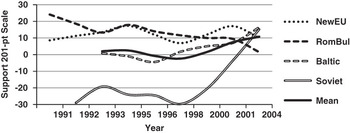
In contrast to the low but stable to gradually declining public trust in most post-Communist political institutions, popular attachments to most of the new democratizing regimes initially were a bit higher, although this varies widely by country. On a scale measuring public attachments to the new political systems where 100 was highest, −100 was lowest, and 0 was the neutral midpoint, the mean level of public support across the 12 countries initially was only 5.8, although this ranged from a low of less than minus 20 in Russia and the Ukraine to a high of almost plus 30 in the Czech Republic. As shown in Figure 2, which displays a truncated version of the original scale, average support declined somewhat in the middle years of this period before rebounding significantly to 7.5 points for the most recent years for which data are available. Although comparisons across the institutional trust and regime support scales are tricky, the clear implication of these data is that public attachments to the new regimes initially were higher than for most, if not all, of the political institutions examined, and support for the regimes has remained somewhat higher throughout the transition.
Popular attachment to post-Communist regimes

Trust, however, may not be an especially good measure of popular commitment to or support for an institution. Low levels of trust may simply reflect public disapproval of the recent performance of these institutions and a desire for reforms designed to strengthen their representative character and responsiveness. It is not at all clear that those expressing low levels of trust actually disapprove of the institution itself, or want to see it abolished or even fundamentally changed. Citizen trust in the US Congress was at record low levels recently, and yet virtually no American endorses its abolition; few even embrace fundamental reforms. Legislatures and parliaments are institutions that citizens love to blame. In a perverse way, they may serve as a safety valve for democracy, allowing citizens to vent their frustrations with the slow and messy ‘sausage making’ that defines democratic politics, while insulating the larger regime, at least partly, from similar criticism. The test of real commitment and attachment to a legislature or a parliament is not whether citizens like how it grinds the sausage, but whether they want to abolish the legislature or can imagine it being replaced by a system of strong leaders less hamstrung by democratic constraints.
In response to such concerns, Mishler and Rose (Reference Mishler and Rose1994) proposed an alternative measure of citizen attachment to parliament based on citizens’ willingness to see parliament abolished and their assessments of the likelihood that this could realistically happen. Following this strategy, our surveys asked respondents, first, how likely they thought it was that parliament in their country would be abolished and, second, whether they supported or opposed its abolition and the abolition of political parties. The rationale for asking about support for the abolition of the legislature is obvious; citizens hoping for its abolition are clearly non-supportive. Similarly, the logic for asking about the likelihood of the abolition of parliament and political parties is that citizens are unlikely to invest emotionally in institutions they do not expect to survive. The combined responses to these two questions produce a four-fold typology of attachment to parliament including confident supporters who think the suspension of parliament and political parties is unlikely and undesirable, anxious supporters who oppose suspension but fear it could happen, frustrated authoritarians who favor the suspension of parliament and political parties but think it unlikely, and hopeful authoritarians who favor suspension and expect it to occur (Mishler and Rose, Reference Mishler and Rose1994: 11–14). Confident supporters are clearly those with the strongest attachments to the new parliaments and to the political parties, which transformed parliaments from the one-party legislatures that were essentially window dressing for the communist regimes. Hopeful authoritarians are those whose attachments are weakest.
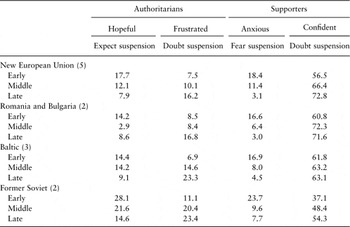
In using this typology to measure attachment to the new parliaments, we distinguished among four groups of countries because we hypothesized that they provide different contexts for the development of attachment to new institutions. The eight countries that had been admitted to the European Union in 2004 were most advanced economically, had met its requirements for the protection of minorities and civil rights most quickly, and had the relatively most stable party systems. Among these eight we treated the three Baltic States separately, because they had been member states of the Soviet Union and their citizens had been more continuously exposed to communist processes of political socialization. We wanted to see whether this experience had made them more skeptical of new institutions. The third group, the two southeastern European countries, Bulgaria and Romania, which were not admitted to the European Union until 2007, were not as advanced politically or economically as the first eight. Those in the fourth group, Russia and Ukraine, were differentiated by having been member states of the USSR.Footnote 2 As shown in Table 1, which summarizes the aggregate levels of attachment to parliament across our groups of countries over three time periods, popular attachment to the new parliaments was high almost everywhere in the early years of the transitions, except in the non-Baltic countries of the former Soviet Union – Russia and the Ukraine. Confident support of parliament began at a remarkably high level in all of the countries studied except the former Soviet states and has grown over time everywhere including in the former Soviet states. Most of this change, however, is due to declining anxiety about the survival of parliaments among its supporters and declining hope that it would be abolished among its authoritarian opponents. The percentage of frustrated authoritarians has increased across the transition in all of the countries. It is the proportion of hopeful authoritarians – hopeful of its suspension – and anxious supporters of parliament – anxious about its survival – that has declined. The expectation that the regime might yet change persisted somewhat more strongly in the former Soviet states, but even here confident supporters are the largest subgroup. Overall, it becomes clear that attachment to parliament with its multiple political parties is strongest and steadiest in the earliest group of countries to join the European Union, is less steady in the Baltic States, and is weakest in the former Soviet states.
Development of attitudes of attachment toward parliament in 12 central and east European countries, in 4 groups (in percent of respondents in each group)

Hypotheses and methods of data analysis
The evidence of the public’s attachment to parliament and to the regime is impressive, especially given the relatively short time since the transition from the communist regimes. Our aim is to identify the sources of these attachments, their consequences, and their durability. To what extent is this apparent support of the new multi-party parliaments and regimes the result of (or in spite of) early life socialization in an authoritarian society by an authoritarian regime, to what extent is it the consequences of citizens’ evaluations of the political and economic performance of the new regimes, and to what extent is it due to system-level characteristics including their actual political and economic performance, to their executive-legislative structures, and to their electoral systems? Finally, what is the relationship between attachment to parliament and attachment to the new regimes? Do the increasingly confident public attachments to the new parliaments carry over and help to legitimize the new regimes or is support for parliament simply a generalized manifestation of increasing support more broadly for the new regimes?
To answer these questions, we estimate an HLM (hierarchical linear model) of the potentially reciprocal effects of individual attachments to parliament and the regime. The model incorporates individual-level measures of cultural and institutional influences on attitudes toward parliament and the regime along with national-level measures of institutional structure and performance. This allows us to exploit the multi-level structure of the data in which national probability samples of individual citizens are aggregated across the 12 countries and 6–10 surveys, depending on the country, producing a total of 85 country-years.Footnote 3 The multi-level structure facilitates comparisons between the influences on individual-level attachments to the regime and constitutional and other system-level influences, including the influence of executive-legislative structures and electoral system types, levels of civil and political freedom, and national rates of post-Communist economic growth. The model allows us to measure both the direct effects of individual and contextual factors on citizen support of parliament and the regime and the indirect or conditioning effects that contextual factors have on individual-level relationships. For example, it allows us to assess whether the structure of parliament and the type of electoral system affects individual support of parliament and the regime.
In conducting our analysis, we first specified two separate but identical models of individual attachments to parliament and the regime. At the individual level, we used the model to test cultural theories, hypothesizing that early life socialization indicated by generational cohort, gender, education, relative income, and personal experience of communism influences political attachments to parliament and the regime. We also used the model to test institutional theories, hypothesizing that sociotropic and egocentric evaluations of the economic performance, the fairness and responsiveness of the new regime, the extent that it is perceived to protect civil and political freedoms, and the extent to which it provides political parties attracting citizen identification, influence political attachments to parliament and the regime. Since we wanted to test whether attachments to parliament and the regime are reciprocally related, each individual-level equation included in the model includes the endogenous variable from the other equation as a ‘right-hand side’ explanatory variable. To test for the existence of reciprocal influence, we incorporated a two-stage instrumental variable that we explain below.
At the aggregate level, institutional theory and considerable empirical research have shown that the design and performance of political institutions shape public attachments to both parliaments and regimes in important ways (Norris, Reference Norris1999, provides a good summary). Other things being equal, freer, more democratic regimes generate significantly greater popular support than do authoritarian regimes and regimes not committed to the rule of law (Norris, Reference Norris1999; Mishler and Rose, Reference Mishler and Rose2002). Numerous studies also show that public attachments to parliaments and regimes are significantly higher in parliamentary than in presidential systems, and in systems employing some form of proportional representation rather than a majoritarian system (Anderson and Guillory, Reference Anderson and Guillory1997; Anderson, Reference Anderson1998).
Given the multi-level nature of the model in which individual respondents are ‘nested’ within countries at multiple independent time points, our hierarchical linear model cannot be appropriately estimated using standard, ordinary least squares procedures. To do so would risk inflating the standard errors of the aggregate-level variables. It would also violate the assumption of causal heterogeneity (Western, Reference Western1998) since we hypothesize that the individual-level causal mechanisms underlying attachment to parliament and the regime are likely to vary across different contexts. The model must allow for the likelihood that these causal processes will be mediated by contextual factors that differ across countries and time.
The standard approach to the problems of multi-level models is to estimate a hierarchical linear model using restricted maximum likelihood estimators (RML) and robust standard errors (Steenbergen and Jones, Reference Steenbergen and Jones2002). This permits assessments of the independent effects of both individual- and aggregate-level influences on the attachment to parliament and the regime. It also facilitates tests of the conditioning effects (i.e. interaction) of aggregate-level variables on individual-level relationships. The usual approach is complicated, however, because of the inclusion of the other endogenous attachment variable – attachment to parliament in one model, attachment to the regime in the other – on the ‘right-hand side’ of each equation. We did this to specify the reciprocal effects of attachment to parliament and the regime. But this violates standard assumptions about uncorrelated error terms. Therefore, to estimate the pair of simultaneous individual-level equations within a hierarchical linear model, we proceeded in stages. We first used maximum likelihood procedures with robust standard errors to ‘instrumentalize’ the endogenous measures of attachment to parliament and the regime. We did so by estimating both attachment variables separately as a function of all exogenous variables in the analysis, including potential instrumental variables.Footnote 4 We then used these first stage results to generate predicted values for the two endogenous variables, attachment to regime (ŷ 1) and attachment to parliament, (ŷ 2), both of which are constructed so as to be uncorrelated with the error terms in the second stage equations.Footnote 5 Finally, we embedded the two second stage individual-level equations in separate but interrelated hierarchical linear models, which include hypothesized aggregate, contextual variables, and a small number of cross-level interaction terms.Footnote 6
Sources of attachment to parliament and the regime and their reciprocal effects
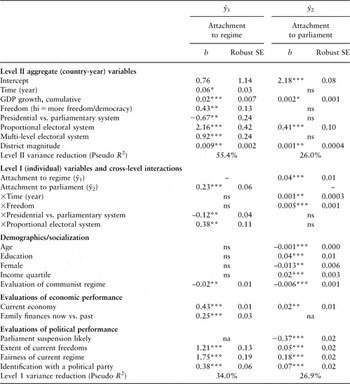
The second stage results for both equations are reported in Table 2. The coefficients in the table are RML estimates with robust standard errors. The coefficients measure the unit change in political attachments associated with a unit change in each independent variable. The goodness-of-fit (Pseudo R 2) statistics indicate that the models perform well, producing 27–34% reductions in the residual variance at the individual level (level I) and 26–55% reductions in the variance at the aggregate level (level II) across the two models.
Second stage multilevel model: restricted maximum likelihood estimates of reciprocal relationship between attachment to parliament and regime

ns = non-significant; na = instrumental variable omitted to identify equation; for level I variables n = 85,000; for level II variables n = 85.
***P ≤ 0.001; **P ≤ 0.01; *P ≤ 0.05.
At the aggregate level (level II), the analysis confirms institutional hypotheses that popular attachments to regimes are significantly influenced by institutional structure and performance. Aggregate levels of economic growth have significant effects on regime attachments as does the level or extent of democracy as measured by the Freedom House indices of civil and political liberties. These effects are independent of other influences on the model including individual-level assessments of current economic performance and current levels of civil and political liberties as discussed below. In addition, citizens living in parliamentary systems feel significantly more attached to the regime than do citizens in presidential systems. The same is true for citizens living in proportional representation electoral systems and systems with higher district magnitudes. Time also contributes to the support of new regimes net of all other influences. Citizen attachments to the new regimes grew slowly but steadily as the transition proceeded, even after controlling for other influences.
Popular attachments to parliament, however, are much less strongly linked to either institutional structure or performance. They are only modestly affected by economic growth and not at all by the level of democracy and protection of civil liberties. Popular attachments to parliament are significantly stronger in systems with proportional representation and high district magnitudes, although these effects are weaker than they are for regime attachments. Furthermore, the structure of the political system, whether presidential or parliamentary, has no effect on the strength of attachments to parliament. Finally, attachments to parliament also do not vary over time once other influences are controlled.
A similar pattern is evident at the individual level. Citizen evaluations of the economy, both sociotropic and egocentric, have big effects on regime attachments but only marginal effects on attachments to parliament.Footnote 7 Individual political assessments of the fairness of the government have significant effects on attachments to both parliaments and regimes as do evaluations of current political freedoms, although their effects on support for the regime are stronger than their effects on attachment to parliament. The same is true of political party identification; those who identify with a political party have stronger attachments to the regime and, to a lesser extent, to parliament than those who have no party identification.
Consistent with cultural theories, positive attitudes toward the former communist regime have significant negative effects on political attachments to the new regime and to parliament. These negative effects are particularly strong with respect to attachment to parliament. Not surprisingly, those thinking that the suspension of parliament is likely are much less attached to parliament than those who believe suspension is unlikely. Also consistent with cultural theories, attachments to parliament are substantially linked to individual positions within society. Women, the elderly, the relatively poor, and poorly educated all express significantly weaker attachments to the new parliament than do higher status individuals. Importantly, these effects are in addition to the lower evaluations of the economic and political performance of the new regimes given by lower status citizens generally. By comparison to the effect of social status characteristics on attachment to parliament, social status is not significantly related to attachments to the regime when other influences are taken into account. Overall, while individuals’ evaluations of political and economic performance affect political attachments both to parliament and the regime, their effects are much stronger with respect to regime attachments. By contrast, attachments to parliament are relatively less affected by institutional considerations and relatively more influenced by cultural and demographic influences.
Evidence of the legitimizing effect of elected legislatures on new democratic regimes is much weaker. While citizens’ attachments to the new parliaments do significantly affect their attachments to the new regimes, the reciprocal effects are much stronger: parliaments are more likely to be legitimated by the performance of the new regime than vice versa. Since attachment to parliament and attachment to the regime are measured on different scales, the relative strength of their coefficients as shown in Table 2 cannot be directly interpreted. Therefore, we standardized the values for the endogenous coefficients, ŷ 1 and ŷ 2, putting them on the same scale. When this is done, attachments to parliament are shown to have only about one-third of the initial direct effect on attachments to the regime (standardized coefficient = 0.04) as attachments to the regime have on support for parliament (standardized coefficient = 0.14). This is consistent with – albeit even stronger than – the asymmetric nature of this reciprocal relationship observed by Mishler and Rose (Reference Mishler and Rose1994) at the start of the transition in 1992. What was true early in the transition of six countries remains the case 15 years later when considering data on 12 regimes: public attachments to the new democratizing regimes contribute significantly more to legitimating their new parliaments than vice versa.
The cross-level interaction terms, shown under the level I variables in Table 2, indicate the extent to which contextual factors, including time and institutional structure, condition the reciprocal effects of attachment to parliament and the regime. These interaction terms measure the change in the individual-level RML estimators associated with a one unit change in the aggregate variables. The results show, for example, that the effects of attachment to parliaments on attachment to the regimes is significantly stronger, by 0.12 points, in parliamentary as compared to presidential systems.Footnote 8 The legitimating effects of attachment to parliament on attachment to the regimes are greater still in systems with proportional representation. While attachment to parliament contributes at least modestly to regime attachments everywhere, its effects are much greater in systems with more consensual political institutions, that is, in parliamentary systems of government employing proportional representation. This is an important finding to which we return in our conclusion. We also note that the effect of attachment to parliament on attachment to the regime is not affected either by the passage of time or by the level of freedom in a country. Neither of these interaction terms is statistically significant in the model of attachment to the regime. This is contrary to the expectation in the early analysis of Mishler and Rose (Reference Mishler and Rose1994) that attachment to parliament would play an increasing role in legitimating new regimes as citizens gained familiarity with the new institutions and could better distinguish their performance from that of other institutions.
By contrast, the cross-level interaction terms indicate that while the effect of attachment to the regime on attachment to parliament is not conditioned by the system of government or the electoral system of a country, it does grow over time and is affected by a country’s level of freedom. It seems that as citizens learn more about their new institutions and regimes, they increasingly evaluate the parliament based on their broader assessment of the regime as a whole. Overall, the findings indicated by the cross-level interaction terms reinforce the conclusion that citizens of new democracies are likely to assess the institutional parts of the regime based on the performance of the regime as a whole. Even 15 years into the transition, when the process of democratization was reasonably far advanced in the great majority of the 12 countries for which we have data, public attachment to the newly democratic parliaments made only minimal contributions to attachments to the new regimes. This suggests that the relationship between the development of legislatures and the development of democracy is fundamentally different in the transition from Communist to post-Communist regimes than it was in the transition from pre-democratic to democratic systems of government in America and in Europe in the 18th and 19th centuries.
Conclusion
We have investigated the development of public attachment to parliament and the regime in the newly democratic states of Central and Eastern Europe. In order to assess the stability of these regimes, we have investigated the sources of that attachment and the process of its development. We have been particularly interested in the reciprocal relationship between attachment to parliament and attachment to the regime, knowing that democratization in Central and Eastern Europe was not the product of the activity of parliaments but that democratic parliaments and democratic regimes in that part of the world were brought about simultaneously by exogenous forces, the collapse of communism. Research in the early 1990s on six countries undertaking the transition to democracy in Central and Eastern Europe had found that the level of attachment to parliaments was surprisingly high at the outset, and in fact similar to that observed in mature democracies. But that earlier research provided no understanding of the process by which this institutional attachment had developed, how widespread it was in other countries in the region, or how durable it would prove to be. Our examination of institutional attachment in a larger, more diverse group of post-Communist regimes over a much longer time period has enabled us to extend and elaborate on those initial findings.
Our analysis shows first of all that attachment to parliament is indeed widespread in the region and continues to be strong, at least in the sense that the public accepts the institution and increasingly expects it to persist. We were able to compare the sources of attachment to parliament with the sources of attachment to the regime, to assess the contextual factors that influence institutional attachment over time, and to investigate the interaction among contextual influences. From this comparison, we conclude that attachment to the regime is a function mostly of public evaluations of the economy, perceptions of the fairness of the regime, and perceptions of the success of the regime in protecting individual freedoms. Attachment to parliament, on the other hand, is a function of political socialization, measured by demographic factors, including age, education, income, and gender, and perceptions of the old regime and the fairness of the new order. These findings are consistent with previous research in other countries during the third wave of democratization.
But our analysis enabled us to further specify the factors influencing democratic attachment. We have shown that attachment to both parliament and the regime is weaker in presidential than in parliamentary systems. We have also presented evidence that proportional electoral systems contribute to attachment to the regime, probably because they permit multiple political parties to gain representation in these socially diverse societies.
As in the earlier findings, our analysis shows that attachment to the regime contributes more to the attachment to parliament than attachment to parliament does to attachment to the regime. But we have found that the differences between presidential and parliamentary systems condition the reciprocal effects of the attachment to parliaments and to regimes in important respects. Citizens in parliamentary systems exhibit stronger attachment to the institutions of the political system than do citizens in presidential systems. We have presented evidence that the effect of attachment to the regime on attachment to parliament grows over time and is affected by a country’s level of freedom. It seems that as citizens learn more about their new institutions and regimes, they increasingly evaluate the parliament based on their broader assessment of the regime as a whole. Overall, we have found that citizens of new democracies assess the institutional parts of the regime based on the performance of the regime as a whole.
Perhaps our most tantalizing finding is that parliamentary systems provide a stronger context for citizen attachment to the institutions of the regime than presidential systems do. In that respect, the evidence from Central and Eastern Europe in the period since the transition to democracy does echo the earlier experience with parliamentary institutions in Europe and North America. In Central and Eastern Europe, it may not be the institution of parliament but the context of the parliamentary system of government that contributes to attachment to the new regimes, independently of more changeable factors such as perceptions of their performance.
In the historical context in which Central and East European regimes were transformed after the collapse of communism, the institutions of democracy that had developed over two centuries in Western Europe and North America were the principal alternatives. Instead of evolving slowly, they were suddenly called into existence either by peaceful revolutions or through negotiations with existing regimes. As a result, public attachment to parliament began at a surprisingly high level. That attachment has not changed. With no clear alternative available to individuals living in these countries, opposition to parliaments has markedly declined. While attachment to parliament may be as much a product as a cause of attachment to the new regimes, we have found that it creates a context that contributes to citizens’ attachment to their new political institutions. In that respect, attitudes toward parliament in Central and Eastern Europe may be playing a role that is similar to the role that these attitudes played in an earlier stage of democratization in Europe and North America, the role of attaching citizens to new political institutions.
Appendix A Survey methodology
The NDB (New Democracies Barometer) surveys are conducted by established national survey institutes in the respective countries. The surveys are coordinated by the Paul Lazarsfeld Society in Vienna, which employs two survey networks with Central and East European affiliates, Fessel & GfK, and MITROPA. The New Russia Barometer is conducted by VCIOM, the Russian Centre for Public Opinion Research, in consultation with Dr Irina Boeva and Dr Viacheslav Shironin, economists in the former USSR Academy of Sciences. The resulting national files are merged into multi-national, multi-year files by the Centre for the Study of Public Policy at the University of Aberdeen, Scotland.
Samples for each country are drawn from the universe of the adult population aged 18 years and older. In each country, sampling conforms to ESOMAR standards using a multi-stage probability sample in which administrative units were stratified regionally and then within regions according to urban/rural divisions and town size. More than 100 primary sampling units (PSU) are selected per country. Within each PSU, individual respondents are chosen on the basis of standard random procedures, such as the Kish matrix or selecting the household member next having a birthday. All interviews are conducted face-to-face and about 10% of interviews are verified by post-interview back-checks conducted by survey institute supervisors. Response rates ranged between 55% and 80% and averaged over 65%.
National surveys are checked against census data for representativeness by gender, age, education, region and town size, and weighted accordingly. In no case do the weights produce significant changes in the sample composition or responses. After being internally weighted, national samples are then equally weighted cross-nationally in order that all country-years have 1000 cases and contribute equally to the pooled cross-sectional time-series database. For further information on sampling, questionnaire content, and the timing of surveys, see the Annex of Central and Eastern Eurobarometer (Brussels: European Commission DG X, No. 9, March 1996) and the following two websites: http://www.abdn.ac.uk/cspp/samplerepndb.shtml and http://www.abdn.ac.uk/cspp/NRBsamples.shtml.
Appendix B
Variable definitions, means, and standard deviations