Clostridium difficile is an opportunistic intestinal pathogen causing a range of clinical outcomes from asymptomatic colonization to infectious diarrhea, pseudomembranous colitis, or toxic megacolon.Reference Burke and Lamont 1 Clostridium difficile infection (CDI) is recognized as the most frequent etiologic agent of infectious healthcare-associated diarrhea associated with administration of antimicrobials. The main C. difficile virulence factors are toxin A and toxin B, primarily targeting colonic epithelial cells.Reference Carter, Chakravorty and Pham Nguyen 2 Detection of these toxins in fecal specimens is a common approach in CDI diagnostics.
Enzyme immunoassay (EIA) is highly specific for the detection of C. difficile toxins, although it is less sensitive than toxigenic culture or quantitative polymerase chain reaction (qPCR) assay.Reference Usacheva, Jin and Peterson 3 The EIA used to be the most frequently used CDI assay in clinical laboratories. Nucleic acid amplification assays offer improved sensitivity over EIA; however, concerns regarding the increased frequency of positive results due to colonization rather than infection have been raised.Reference Burnham and Carroll 4 – Reference Butler, Olson and Drekonja 6
Clostridium difficile toxins are generally considered to be very labile. 7 , Reference Stevens, Bryant and Carroll 8 However, a limited number of studies have investigated the toxin stability in fecal specimens. The duration of protein survival at these conditions has been poorly studied, and this information would be of interest for development of new diagnostics. Additionally, an increasing requirement for toxin testing and shipping of specimens to do the testing may raise the questions of toxin stability during delays due to shipping and best conditions for shipping specimens.
The purpose of this study was to investigate the stability of C. difficile toxin in clinical stool specimens and to evaluate the storage conditions for toxin detection using an immunological approach.
METHODS
Study Design
The testing was performed directly on prospectively collected patient stool specimens submitted for routine testing for CDI to the clinical microbiology laboratory at NorthShore University HealthSystem, a 4-hospital system located in the northern suburbs of Chicago. Remnant clinical stool specimens that were positive by Xpert C. difficile/Epi (Cepheid, Sunnyvale, CA) were utilized for the detection of toxin proteins by EIA. A transport medium was not used. Initial EIA testing was performed within 24–36 hours of specimen collection. During this time, the specimens were kept at room temperature for a short time before delivery to clinical microbiology laboratory, where the specimens were stored in a refrigerator.
Specimens
We collected 25 consecutive adult stool specimens between July and September 2016. Specimens positive for C. difficile by EIA were placed in storage for further testing throughout the next 4 months. The goal was to collect 5 toxin-positive diarrheal specimens. On days 0 (the initial testing), 14, 30, 60, 90, and 120 of storage, a single, separate 50-µL aliquot of each specimen was removed from each storage condition and was assayed for toxins. These aliquots were then discarded without thawing or refreezing.
Storage Conditions
Each specimen was divided into 2 parts. The first part was stored at a conventional refrigerated temperature (4–10°C) in bulk quantity in an airtight container. A few aliquots of each specimen were also transferred into individual tubes and stored at −30°C (ie, a non–frost-free freezer) and at −80°C. The second part of the specimen was mixed well in freshly prepared storage buffer (phosphate buffered saline [PBS], pH 7.4, 0.1% Tween20, 1 mM phenylmethane sulfonyl fluoride [PMSF], and 0.02% sodium azide [NaN3]) in a 1:1 ratio (volume/volume) and was then stored at −30°C and −80°C in 150-µL aliquots. Each aliquot was tested on a specific day. Diluted buffer samples on storage day 0 (the initial testing) were frozen at corresponding temperatures for 10 minutes and then thawed at room temperature before testing.
Toxin Detection
Clostridium difficile toxins were detected using TechLab C. difficile Tox A/B II kit (TechLab, Blacksburg, VA) according to the manufacturer’s instructions. The test utilizes immobilized affinity-purified polyclonal goat antibodies to C. difficile toxins A and B in ELISA format. Briefly, a container with specimen is vortexed for 10 seconds, then 50 µL stool is suspended in the diluent solution, and then a 100-µL diluted sample is transferred into ELISA wells filled with a conjugate and incubated at 36°C for 50 minutes. The toxins are detected in a microplate ELISA reader (SpectraMax M2, Molecular Device, Sunnyvale, CA) at 450 and 620 nm absorbance. Positives are defined as optical density (OD)≥0.080. Negative results are visually clear, with an OD <0.080. Each sample was tested in duplicate or triplicate.
RESULTS
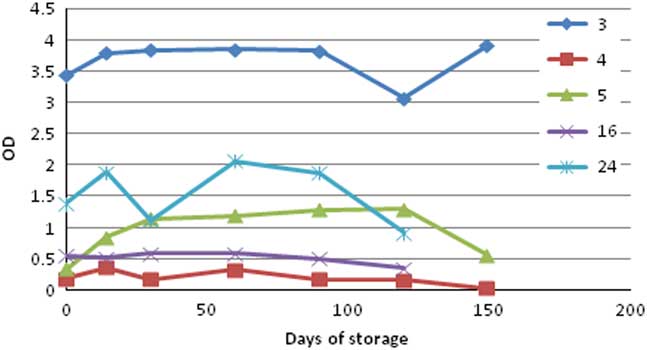
Of 25 prospectively collected consecutive fecal specimens reported (qualitatively) CDI positive by qPCR, only 5 stool samples were C. difficile toxin-positive by EIA. These samples demonstrated a wide range of toxin quantities, with OD readings ranging from 0.2 to 3.4 (Table 1). Despite the storage at aerobic refrigerated conditions with multiple exposures to room temperature during aliquot sampling, the toxins demonstrated immunological stability for at least 120 days regardless of the toxin level in the original specimens (Figure 1). Degradation of toxins was not observed during sample handling.
Detection of Clostridium difficile toxins in 5 clinical fecal specimens stored at refrigerated temperature. Optical densities (ODs) of aliquots of samples were measured on storage days 0, 14, 30 60, 90, 120, and 150. OD ≥0.080 indicates C. difficile toxin presence in specimens. Each specimen demonstrated a different quantity of toxin.

Characteristics of Enzyme Immunoassay (EIA)–Positive Stool Specimens

NOTE. qPCR, quantitative polymerase chain reaction; OD, optical density; CDI, Clostridium difficile infection; neg, NAP1 negative by Xpert C. difficile/Epi test; N/A, data not available.
a Optical density of toxin in the stool sample at the initial testing (time 0).
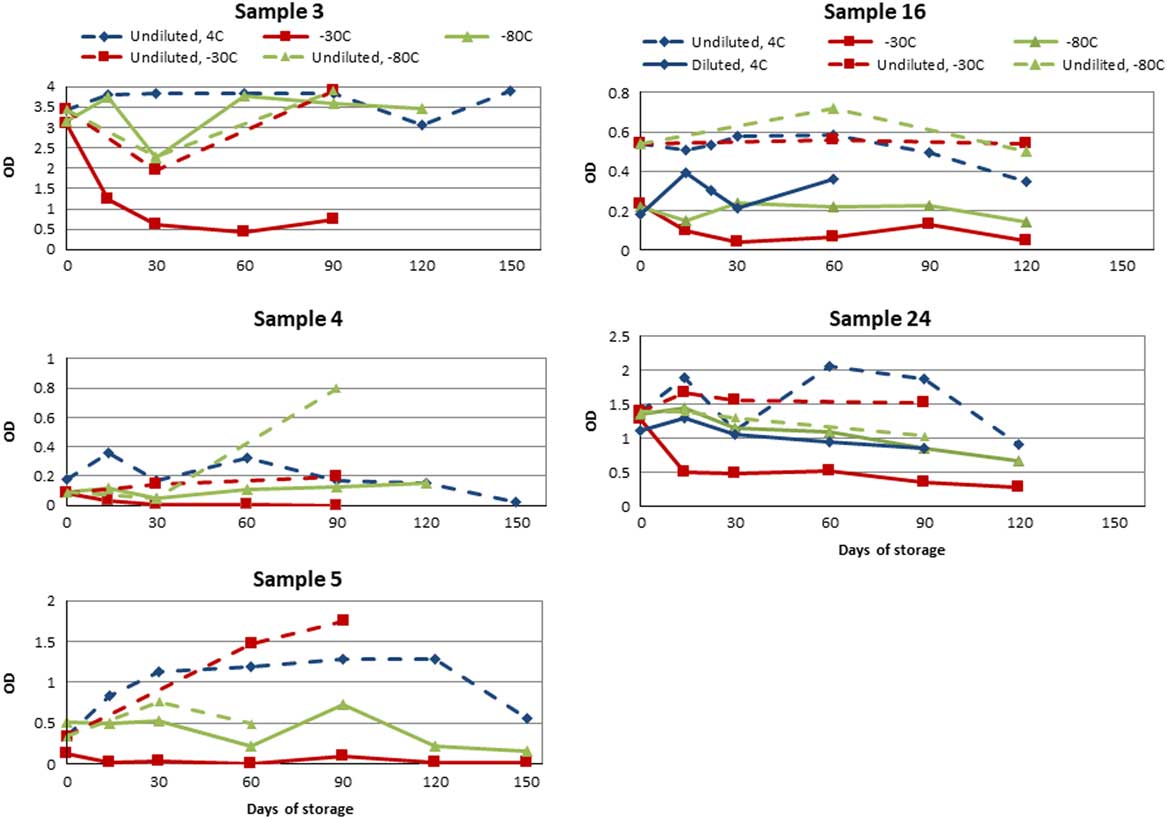
Aliquots of each specimen were also stored frozen at temperatures of −30°C and −80°C and were tested on storage days 4, 30, 60, 90, or 120 simultaneously with their refrigerated counterparts. The steady toxin detection up to 90 days was demonstrated at both freezing temperatures (Figure 2).
Effect of storage conditions on Clostridium difficile toxin stability and detection in individual stool samples. Refrigerated temperature denoted as 4°C. Solid lines denote specimens diluted before storage. Broken lines denote undiluted specimens. Blue diamond, red squares, and green triangles denote samples stored at 4°C, −30°C, and −80°C, respectively.

To preserve the toxins in feces for extended storage at refrigerated (4–10°C) and freezing (−30°C and −80°C) temperatures, the storage buffer was used for sample dilution in a ratio of 1:1 volume:volume. The toxins were detected in all samples at these conditions (Figure 2). However, by storage day 14 at −30°C, detrimental effects occurred, resulting in an OD reduction of nearly 50%. On subsequent testing days 30, 60, 90, and 120, toxins were undetected in those samples with the initial low (<1.0 OD) toxin level (Figure 2, samples 4, 5, and 16). In contrast, diluted stools stored at −80°C demonstrated longer toxin stability (up to 120 days) with OD results similar to initial levels. Similar results were observed in their refrigerated counterparts (Figure 2, samples 16 and 24).
To determine the dilution effect on toxin stability, 2 specimens were tested (Figure 2, samples 16 and 24). As expected, diluted samples stored at refrigerator temperature demonstrated lower ODs than the same samples without the storage buffer at the same temperature. However, unlike diluted specimens stored at −30°C, the ODs of diluted specimens stored at the refrigerated temperature (4–10°C) were fairly steady when tested on days 60 and 90 of storage.
DISCUSSION
Rapid nucleic acid amplification tests for CDI detection are popular in clinical settings owing to better sensitivity and robust signal, but they do not detect C. difficile toxin proteins. However, the complexity of CDI diagnostics may contribute to a renewed focus on the utility of toxin detection in stool specimens. Therefore, the toxin stability in clinical samples is of interest. Very few investigations have been devoted to this topic.
Clostridium difficile toxins have been considered labile in stool specimens. 7 , Reference Stevens, Bryant and Carroll 8 A few earlier studies reported that the toxins survived in spiked samples up to day 60 of storage under aerobic.Reference Freeman and Wilcox 9 – Reference Bowman and Riley 11 In our investigation, we focused on the immunological stability of C. difficile toxins in clinical stool specimens and their detection by EIA utilizing mix of toxin A- and B-specific antibodies in ELISA format.
In our study, clinical specimens demonstrated variable toxin quantities. Importantly, we verified that C. difficile toxins are stable in clinical stool specimens for at least 120 days of storage under refrigeration and the −80°C temperature condition, which is a novel observation. Similar results were reported by Weese et alReference Weese, Staempfli and Prescott 10 for C. difficile spiked equine feces stored at 4°C, −20°C, and −70°C for 60 days. Freeman and WilcoxReference Freeman and Wilcox 9 found that the toxin titer did not change by storage day 56 at 4°C. Freeman and Wilcox study used fecal emulsions spiked with 3 genotypically distinct strains of C. difficile (including 2 UK epidemic strains) diluted in PBS. Our EIA data correlate well with these studies, even though Freeman and WilcoxReference Freeman and Wilcox 9 employed a cell cytotoxicity assay to detect toxin activity. A recent investigation in a tropical setting reported that storage conditions only minimally affected the recovery of C. difficile and its toxins in stool culture.Reference Becker, Chatigre and Coulibaly 12 The toxins remained detectable for at least 28 days, regardless of storage conditions (aerobic storage at 4°C or 20°C). Furthermore, we detected the toxins (positive OD) after 150 days of storage, even in specimens with moderate quantities of toxin (data not shown). A slight increase in toxin level in the refrigerated specimens could be explained by the inaccuracy of measurements due to the complexity and inhomogeneity of the samples.
Our data suggest that refrigeration of stool specimens for EIA detection of C. difficile toxin is a safe storage mode. Immunologically detected toxins are stable up to 4 months of storage with slow gradual degradation. Our results do not support speculation that toxin stability is influenced by the presence of hypervirulent NAP1 strain noted for its large toxin production.Reference Freeman and Wilcox 9 , Reference Modi, DePasquale, Nguyen, Malinowski and Perez 13 In our study, 3 isolates confirmed as non-NAP1 (Table 1) produced toxins that were detectable for a few months, suggesting the absence of an association between the toxin stability and NAP1. Possibly, feces matrix supports toxin stability under aerobic conditions and prevents degradation by fecal proteases.Reference Valdes, Gueimonde and Ruas-Madiedo 16 This hypothesis is supported by the study of Modi et alReference Modi, DePasquale, Nguyen, Malinowski and Perez 13 who retrospectively reviewed medical records for CDI handling time.Reference Modi, DePasquale, Nguyen, Malinowski and Perez 13 They reported that the infection can be detected accurately for up to 13 hours in an unrefrigerated human fecal specimen using EIA. In contrast, purified C. difficile toxins A and B, available in lyophilized forms, demonstrated rapid decreased cytotoxic potency even at 4°C once they are dissolved into buffered solutions.Reference Lei and Bochner 15
Cytotoxin has been reported to degrade rapidly at −20°C.Reference Stevens, Bryant and Carroll 8 We demonstrated the considerable effect of storage conditions on the stability of C. difficile toxins in clinical specimens. The toxins in diluted stool degraded faster at −30°C than at −80°C. These results are in good agreement with the findings of Freeman and Wilcox,Reference Freeman and Wilcox 9 who reported similar effects at −20°C storage when samples were diluted in PBS. Valdes et alReference Valdes, Gueimonde and Ruas-Madiedo 16 also detected reduced activity of toxigenic culture supernatant at −20°C but not at −80°C.Reference Valdes, Gueimonde and Ruas-Madiedo 16 In contrast, we demonstrated that undiluted fecal specimens stored frozen at either −30°C or −80°C had a level of toxin detection similar to their counterparts stored at the refrigerated temperature. Therefore, a temperature range of −20°C to −30°C is not favorable for extended storage of diluted and, possibly, watery stool specimens.
Our study has several limitations. First, a limited number of stool specimens were tested for stability of C. difficile toxins. However, we did use clinical samples that were toxin positive by PCR and EIA, and the same samples were tested over a prolonged period. Second, only 1 immunoassay method was used for C. difficile toxin detection, and it had manufacturer-confirmed sensitivity ranging from 83.3% to 96% and 100% specificity. A cytotoxicity assay was not performed; therefore, we could not assess toxigenic activity during sample storage and compare it with immunologic stability. Third, we did not investigate in depth the impact of prior antibiotic use on detection of C. difficile toxins in clinical specimens.
In conclusion, clostridial toxins in fecal specimens can tolerate prolonged storage at refrigerated and freezing temperatures for at least 120 days, remaining immunologically stable when detected using specific antibodies. However, storage at −30°C had a detrimental effect on C. difficile toxin stability in diluted specimens.
ACKNOWLEDGMENTS
Financial support: This research was supported by the National Institute of Allergy and Infectious Diseases of the National Institutes of Health (grant no. R21AI116659).
Potential conflicts of interest: All authors report no conflicts of interest relevant to this article.