Bipolar disorder is often a severe, recurrent or unremitting disorder with significant impairment such as erratic work history, divorce, suicide, and substance abuse (Angst, Stassen, Clayton, & Angst, 2002; Goodwin & Jamison, 1990; Strakowski, DelBello, Fleck, & Arndt, 2000). Indeed, bipolar disorder was ranked as the sixth leading cause of disability among both physical and psychiatric disorders worldwide (Murray & Lopez, 1996). Bipolar disorder affects about 1.5% of the US population (Hyman, 2000) and between 0.5 and 3.5% of the world population (Kleinman et al., 2003). Within the bipolar category, a group of disorders appears to form a spectrum of severity from the milder subsyndromal cyclothymia, to bipolar II disorder, to full-blown bipolar I disorder (Akiskal, Djenderedjian, Rosenthal, & Khani, 1977; Akiskal, Khani, & Scott-Strauss, 1979; Cassano et al., 1999; Depue et al., 1981; Goodwin & Jamison, 1990; Klein, Depue, & Slater, 1985; Waters, 1979). Thus, we consider the full range of bipolar spectrum disorders in this article.
Bipolar disorder has been understudied compared to other mental health disorders (Hyman, 2000), especially from integrative psychological and biological perspectives. Little work has examined the joint influence of cognitive, psychosocial, and neurobiological factors in vulnerability to this disorder and its course and phenomenology, particularly in the context of an understanding of normative developmental processes. Thus, the overarching aim of this article is to present a cognitive vulnerability–stress perspective on the development and characteristics of bipolar spectrum disorders informed by research on normative adolescent brain, cognitive, and emotional development.
Consequently, we begin our article by presenting evidence for three clinical phenomena of bipolar disorder associated with adolescence (adolescent age of onset, gender differences, and specific symptom presentation) that require explanation. We present the cognitive vulnerability–transactional stress model of unipolar depression, evidence for this model, and its extension to bipolar spectrum disorders. Next, we review evidence that life events, cognitive vulnerability, the cognitive vulnerability–stress combination, and certain developmental experiences (poor parenting and maltreatment) featured in the cognitive vulnerability–stress model play a role in the onset and course of bipolar disorders. We then discuss how an application of the cognitive vulnerability–stress model can explain the adolescent age of onset, gender differences, and adolescent phenomenology of bipolar disorder. Finally, we further elaborate the cognitive vulnerability–stress model by embedding it in the contexts of normative adolescent cognitive (executive functioning) and brain development, and normative adolescent development of the stress-emotion system, and genetic predisposition. We suggest that increased brain maturation and accompanying increases in executive functioning along with augmented neural and behavioral stress sensitivity during adolescence combine with the cognitive vulnerability–stress model to explain the high-risk period for onset of bipolar disorder, gender differences, and unique features of symptom presentation during adolescence.
Age of Onset, Gender Differences, and Phenomenology in Bipolar Spectrum Disorders
Adolescence, a transitional developmental period between childhood and adulthood, is characterized by more biological, psychological, and social role changes than any other stage of life except infancy (Holmbeck & Kendall, 2002). Recent epidemiological and descriptive studies have revealed three clinical phenomena of bipolar spectrum disorders associated with adolescence that provide the point of departure for this article. First, although the median age of onset for bipolar I and II disorders ranges from 17 to 31, the first peak in rates of bipolar disorder is between ages 15 and 19 (Burke, Burke, Regier, & Rae, 1990; Kennedy et al., 2005; Kessler, Rubinow, Holmes, Abelson, & Zhao, 1997; Kupfer et al., 2002; Weissman et al., 1996). This 4-year period is what Weissman et al. (1996) refer to as the “hazard period” for bipolar disorder. Indeed, admixture analyses indicate that there are three high-risk periods in onset of bipolar disorder, with the earliest around midadolescence (Bellivier et al., 2003; Bellivier, Golmard, Henry, Leboyer, & Schurhoff, 2001). Moreover, adolescent onset bipolar disorder is associated with a worse course, greater comorbidity, and greater familial loading than adult onset bipolar disorder (Carter, Mundo, Parikh, & Kennedy, 2003; Ernst & Goldberg, 2004; Mick, Biederman, Faraone, Murray, & Wozniak, 2003; Schurhoff et al., 2000). Thus, the transition from adolescence to young adulthood is a critical developmental period constituting an “age of risk” during which bipolar conditions initially become manifest, “consolidate,” and often progress to a more severe course. We acknowledge that recent research (e.g., Biederman et al., 2000; Geller & Luby, 1997; Geller, Tillman, Craney, & Bolhofner, 2004; Wozniak et al., 1995) has demonstrated the existence of prepubertal/childhood onset bipolar disorder. However, it remains unknown whether bipolar disorder in children is a completely separate disorder or a developmental phase of adult bipolar disorder. Thus, the adolescent hazard period for onset of bipolar disorder will be the focus of this article.
The second clinical fact motivating this article is the findings of gender differences in the onset and phenomenology of bipolar spectrum disorders. Although the overall prevalence of bipolar spectrum disorders is similar in men and women, women's bipolar conditions are more likely to be characterized by primarily depressive episodes (e.g., bipolar II), whereas men's are more likely to be marked by hypomania/mania (Angst, 1978; Leibenluft, 1996; Rasgon et al., 2005; Robb, Young, Cooke, & Joffe, 1998; Roy-Byrne, Post, Uhde, Porcu, & Davis, 1985; Viguera, Baldessarini, & Tondo, 2001; but see also Hendrick et al., 2000; Winokur et al., 1994, for contradictory findings). This is very reminiscent of the robust gender difference in favor of women found for unipolar depression (Nolen-Hoeksema, 1990; Weissman & Klerman, 1977). In addition, men have an earlier onset of bipolar disorder than women, and men's first episode is more likely to be hypomanic/manic, whereas women's first episode is more likely to be depressed (Burke et al., 1990; Kawa et al., 2005; Kennedy et al., 2005; Robb et al., 1998; Viguera et al., 2001). Moreover, prepubertal onset cases of bipolar disorder are overwhelmingly male, whereas there is a more even gender distribution in adolescent onset bipolar disorder (Biederman et al., 2005; Geller et al., 1995; Hendrick, Altshuler, Gitlin, Delrahim, & Hammen, 2000). Thus, combined with the data on overall age of onset described above, it appears that adolescence is an age of risk for onset of bipolar spectrum disorders, especially for girls.
Third, the phenomenology of childhood and adolescent onset bipolar disorder is quite similar to each other, but different from adult cases. Compared to the more classic adult biphasic course of distinct depressive and manic episodes, both child and adolescent bipolar disorder are characterized by more mixed states, rapid cycling, greater dysphoria and irritability, and greater chronicity (Biederman et al., 2005; Geller et al., 1995, 2004; Leibenluft, Charney, & Pine, 2003; Mick et al., 2003; Strober et al., 1988). In addition, juvenile bipolar disorder is also associated with high comorbidity with attention-deficit/hyperactivity disorder (ADHD) that may continue into adolescence (Geller et al., 1998; Leibenluft et al., 2003; Wozniak et al., 1995), and symptoms of ADHD are often the first signs of psychopathology in offspring of bipolar parents (Chang, Steiner, & Ketter, 2000; DelBello & Geller, 2001). Thus, bipolar disorder in adolescence appears to be characterized by a mixed picture, with considerable depression, irritability, and attention problems.
Mechanisms for the Adolescent Onset and Gender Differences in Bipolar Spectrum Disorders
Why is adolescence an age of risk for onset of bipolar spectrum disorders, especially for females? The mechanisms underlying the adolescent emergence of bipolar disorder are not understood well. The goal of this article is to examine possible mechanisms underlying these developmental phenomena of bipolar disorder from the perspective of a cognitive vulnerability–transactional stress model, embedded within a normative adolescent brain, cognitive, and emotional development context. A cognitive vulnerability–transactional stress model may be plausible in explaining why many individuals with a bipolar diathesis have an onset of bipolar disorder during adolescence because some of the key etiological factors featured in the theory (e.g., cognitive vulnerability, stress, self-focused perseverative attention, future expectancies) have just become developmentally operative during this period due to normative brain maturation and cognitive (e.g., growth in executive functions) and emotional (e.g., increase in biological “stress sensitivity”) development.
Cognitive vulnerability–transactional stress model of depression
Over the past 2 decades, there has been growing interest in the role of cognition in bipolar disorders. This research has generally examined whether bipolar individuals exhibit dysfunctional cognitive styles similar to those observed among unipolar depressed individuals, and whether these cognitive patterns, alone or in combination with life events, predict the onset, expression, or course of bipolar disorder (Alloy, Abramson, Neeren, et al., 2006; Alloy, Abramson, Urosevic, et al., 2005; Alloy, Abramson, Walshaw, & Neenen, 2006; Alloy, Reilly-Harrington, Fresco, & Flannery-Schroeder, 2005). Studies of cognitive styles in bipolar disorder largely have been guided by logical extensions of the cognitive vulnerability–stress models of unipolar depression (Abramson, Metalsky, & Alloy, 1989; Beck, 1967, 1987). Thus, we begin with a brief description of the cognitive vulnerability–stress model of depression.
The cognitive vulnerability–transactional stress model (Hankin & Abramson, 2001) is a developmentally sensitive elaboration of the two highly successful cognitive theories of depression, Hopelessness theory (Abramson et al., 1989), and Beck's (1967, 1987) theory. Individuals with cognitive vulnerability are more likely to become depressed than nonvulnerable individuals when they confront negative events and make negative inferences about the causes, consequences, or self-implications of the events (negative cognitive style). An individual exhibiting cognitive vulnerability who gets fired might attribute this negative event to stable, global causes (e.g., incompetence) and infer that she never will get another job and is worthless. This model is a classic vulnerability–stress model because negative cognitive styles (the vulnerability) only contribute to depression in the presence, but not the absence, of negative events (the stress). In addition, negative cognitions such as hopelessness mediate the link between the Cognitive Vulnerability × Stress component and the onset of depression. The model also features a transactional process in which increases in depression or cognitive vulnerability itself can contribute to the creation of further dependent, negative events.
Recently, we (Abramson et al., 2002; MacCoon, Abramson, Mezulis, Hankin, & Alloy, 2006) elaborated the model to emphasize selective attention in the causal chain and connect the concepts of cognitive vulnerability and rumination, another cognitive factor important in depression onset (Just & Alloy, 1997; Nolen-Hoeksema, 2000; Spasojevic & Alloy, 2001) and course (Nolen-Hoeksema, 1991), as well as in gender differences in depression (Nolen-Hoeksema & Jackson, 2001). Self-regulation theorists (Carver & Scheier, 1998) emphasize that when faced with a negative event, it is adaptive to switch attention to the event, find a resolution, and then continue goal-directed behavior (the self-regulatory cycle). Selective attention remains focused on the negative event until it is resolved or reduced. We highlighted three ways to exit this self-regulatory cycle: generate a solution to the problem, decrease the event's importance, or distract attention away from the problem. Cognitively vulnerable individuals should have difficulty with all three exits due to their negative inferences. For example, if a cognitively vulnerable adolescent attributes not getting a date to “ugliness,” no solution is readily available. Instead, these individuals become “stuck” in the self-regulatory cycle with their attention focused on negative cognitive content because the inferences they generate in response to negative events only lead to further perceived problems (e.g., “no one will marry me because I am so ugly”) rather than to resolutions. Such self-regulatory perseveration (Pyszczynski & Greenberg, 1987) constitutes rumination because selective attention remains focused on negative content, which in turn, should result in the spiral into clinical depression. This self-regulatory perspective, then, highlights rumination as mediating the effects of cognitive vulnerability on depression.
Evidence for the cognitive vulnerability–transactional stress model of depression
The cognitive vulnerability–transactional stress perspective has garnered very considerable empirical support (see Abramson et al., 2002; Alloy, Abramson, Safford, & Gibb, 2005; Alloy, Abramson, Whitehouse, et al., 2006; Hankin & Abramson, 2001, for reviews). Much important evidence for the model comes from the Temple–Wisconsin Cognitive Vulnerability to Depression (CVD) Project (Alloy & Abramson, 1999; Alloy et al., 2000) and related studies. We highlight major findings from the CVD Project relevant to the current article here.
In the CVD Project, late adolescents (N = 349) at a major age of risk for depression and making the transition from late adolescence to early adulthood were followed for a total of 5.5 years. Ethnically diverse male and female university freshmen who were nondepressed and had no other Axis I psychiatric disorders at the outset of the study were selected to be at high risk (HR; N = 173) or low risk (LR; N = 176) for depression based on the presence versus absence of negative cognitive styles (negative inferential styles and dysfunctional attitudes).
More than half of CVD project participants entered college with no prior history of depression. These individuals potentially could experience their very first episode of depression during the follow-up. Consistent with the cognitive vulnerability hypothesis, Alloy et al. (Alloy, Abramson, et al., 1999; Alloy, Abramson, Whitehouse, et al., 2006) found that HR participants showed a greater likelihood than LR participants of a first onset of major depression (MD), minor depression (MiD), and hopelessness depression (HD; odds ratios = 5.6–11.7). These findings are especially important because they are based on a truly prospective test, uncontaminated by prior history of depression. HR participants also were more likely than LR participants to develop recurrences of MD, MiD, and HD (odds ratios = 3.1–4.1; Alloy, Abramson, et al., 1999; Alloy, Abramson, Whitehouse, et al., 2006). In addition, the HR group was more likely than the LR group to exhibit suicidal ideation and attempts during the follow-up, mediated by hopelessness (Abramson et al., 1998). These results indicate that negative cognitive styles indeed appear to confer vulnerability to clinically significant depression and suicidality.
In elaborating the cognitive vulnerability–transactional stress model to place it in a self-regulatory context, we highlighted rumination as a form of self-regulatory perseveration that mediates the effects of cognitive vulnerability on depression. Consistent with this elaboration, Spasojevic and Alloy (2001) found that a ruminative response style mediated between cognitive risk and the development of prospective onsets of MD. In addition, Robinson and Alloy (2003) extended the rumination hypothesis and suggested that cognitively HR individuals who tend to ruminate on their negative cognitions when stressful life events occur (stress-reactive rumination [SRR]), and thereby recursively activate their negative cognitions, would be more likely to become depressed. Consistent with this proposed extension, HR participants who were also high in SRR were more likely to have a past history and prospective onsets of MD and HD than were HR participants low in SRR or LR participants regardless of their SRR (Alloy et al., 2000; Robinson & Alloy, 2003). These findings indicate that rumination may act as both a mediator and moderator of cognitive vulnerability.
In the model, negative cognitive styles are hypothesized to confer vulnerability to depression when individuals confront negative life events and this Vulnerability × Sress interaction should be mediated by hopelessness. In studies of depressive symptoms and MD episodes among adolescents and young adults, we (Alloy & Clements, 1998; Alloy, Just, & Panzarella, 1997; Hankin, Abramson, Miller, & Haeffel, 2004; Hankin, Abramson, & Siler, 2001; Metalsky, Joiner, Hardin, & Abramson, 1993) found that negative cognitive styles interacted with negative life events to predict prospective increases in depressive symptoms and episodes, mediated by hopelessness (Alloy & Clements, 1998). In addition, we found that HR participants who experienced high stress were about 2.5 times more likely to have an onset of MD/MiD and HD than HR participants who experienced low stress or LR participants regardless of stress. Consistent with the transactional part (stress–generation hypothesis) of the cognitive vulnerability–transactional stress model, Safford, Alloy, Abramson, and Crossfield (in press) also found that, controlling for current and past depression, HR participants generated more events dependent on their behavior than LR participants, thereby increasing the likelihood that their vulnerability will be translated into depression. Thus, cognitively vulnerable individuals generate more negative events and then interpret them more negatively as well (i.e., a “two-hit” model).
Much evidence indicates that social support buffers against depression when people experience stress (Cohen & Wills, 1985). Panzarella, Alloy, and Whitehouse (2006) hypothesized that social support buffers against depression by preventing the development of hopelessness via the mechanism of others' positive or “adaptive” inferential feedback (IF) that promotes benign inferences about events, rather than depressogenic ones. In contrast, negative or maladaptive IF from others should promote depressogenic inferences. Consistent with prediction, Panzarella et al. found that high levels of adaptive IF prospectively predicted less negative inferences for actual events experienced and less negative inferential styles during the follow-up. Moreover, participants who were HR experienced many stressful events, and had more negative IF from others were more likely to become hopeless and develop MD episodes than participants with zero, one, or two of these vulnerability factors (Risk × Stress × IF Interaction). In addition, Dobkin, Panzarella, Nesbitt, and Alloy (2004) found that participants whose partners were taught to deliver positive IF showed reduced depressive inferences and symptoms following a laboratory failure compared to those whose partners provided general or no social support.
What are the developmental origins of cognitive vulnerability to depression? We highlight the developmental findings from the CVD Project most relevant to the current article here (but see Alloy et al., 2004, for a detailed review). Individuals may develop negative cognitive styles through a variety of familial socialization practices. For example, the IF parents provide to their children about causes and consequences of negative events in the child's life may contribute to the child's cognitive risk for depression, such that offspring's cognitive styles will be associated with their parents' IF styles. In addition, negative parenting practices, such as “affectionless control” (Parker, 1983), may also contribute to development of cognitive vulnerability to depression in offspring.
Alloy et al. (2001) examined the feedback and parenting hypotheses. Supporting the feedback hypothesis, according to both offspring and parent reports, both parents of HR participants provided more negative IF about causes and consequences of negative events that happened to their child than did parents of LR participants (see also Crossfield, Alloy, Abramson, & Gibb, 2002). Supporting the parenting hypothesis, according to both offspring and parent reports, fathers of HR participants showed less warmth than did fathers of LR participants (Alloy et al., 2001). Moreover, negative parental IF and fathers' low warmth predicted prospective onsets of depressive episodes in their offspring during the follow-up, mediated by the offspring's cognitive risk status (Alloy et al., 2001).
Rose and Abramson (1992) hypothesized that a developmental history of maltreatment may contribute to the origins of cognitive vulnerability to depression. In particular, emotional abuse should be especially likely to lead to development of negative cognitive styles because the depressive cognitions (e.g., “You're so stupid; you'll never amount to anything”) are directly supplied to the child by the abuser. Consistent with this hypothesis, Gibb et al. (2001a, 2001b) found that HR participants reported more emotional, but not physical or sexual, maltreatment than LR participants. In addition, controlling for initial depressive symptoms, a reported history of emotional maltreatment predicted onsets of MD, HD, and levels of suicidal ideation across the prospective follow-up, mediated by participants' cognitive vulnerability and hopelessness (Gibb et al., 2001a, 2001b). Moreover, controlling for parents' depression, cognitive styles, and abuse, peer victimization was also associated with HR status (Gibb, Abramson, & Alloy, 2004), suggesting that the association of emotional maltreatment with cognitive vulnerability is not entirely due to genetic effects or a negative family environment in general.
Extension of the cognitive vulnerability–stress perspective to bipolar spectrum disorders
Given the success of the cognitive vulnerability–transactional stress model in contributing to the understanding of the etiology, course, and treatment of unipolar depression, the logic of these theories has been extended to bipolar disorders (see Alloy, Abramson, Neeren, et al., 2006; Alloy, Abramson, Urosevic, et al., 2005; Alloy, Abramson, Walshaw, et al., 2006; Alloy, Reilly-Harrington, et al., 2005). In particular, when integrated with theorizing (Depue & Iacono, 1989; Depue, Krauss, & Spoont, 1987; Fowles, 1988, 1993; Johnson, Sandrow, et al., 2000; Urosevic, Abramson, Harmon-Jones, & Alloy, 2006) that bipolar individuals possess a hypersensitive behavioral approach system (BAS), a motivational system involved in goal seeking and attainment of reward, and recent evidence that bipolar individuals' cognitive styles are characterized by distinctive BAS-relevant features of autonomy, perfectionism, and goal striving (see Cognitive Styles and Bipolar Spectrum Disorders section), as well as indications that bipolar mood episodes are triggered by BAS-relevant life events (see Life Events and Bipolar Spectrum Disorders section), a cognitive vulnerability–transactional stress model may help explain bipolar mood episodes.
Cognitive processes that contribute vulnerability to unipolar depressive episodes may similarly also confer risk to the depressive episodes experienced by bipolar individuals following negative events. Specifically, BAS-relevant cognitive styles involving high self-standards, self-criticism, and perfectionism may combine with the occurrence of negative events that deactivate the BAS (e.g., irrevocable failures or losses) to increase the likelihood of bipolar depression. The effects of this cognitive vulnerability–stress combination on depressive symptoms should be mediated by rumination and hopelessness, with subsequent disengagement from goals. With respect to risk for manic/hypomanic episodes, these same perfectionistic, goal-striving BAS-relevant cognitive styles may combine with BAS-activating positive life events (e.g., goal attainments, rewards) or BAS-activating negative life events (e.g., goal obstacles that can be overcome, anger-inducing events) to increase the likelihood of hypomania/mania. Below (see Life Events and Bipolar Spectrum Disorders section), we will see that negative events also trigger manic as well as depressive episodes among bipolar individuals. Moreover, anger-inducing events, in particular, have been associated with BAS activation and hypomanic symptoms (Carver, 2004; Harmon-Jones & Allen, 1998; Harmon-Jones & Sigelman, 2001; Harmon-Jones et al., 2002; Harmon-Jones, Sigelman, Bohlig, & Harmon-Jones, 2003). From a cognitive vulnerability–stress perspective, bipolar individuals with a predominantly manic/hypomanic course are likely to be exposed to frequent BAS-activating positive and negative life events. Self-focused attentional processes such as “basking,” the positive counterpart to rumination (Segerstrom, Stanton, Alden, & Shortridge, 2003), and cognitions such as hope and self-efficacy that promote goal striving and attainment, should mediate the effect of the cognitive vulnerability–BAS activating events combination on the development of hypomanic/manic symptoms. Indeed, positive repetitive thought such as basking appears to promote positive affect (Segerstrom et al., 2003). Given that the same BAS-relevant cognitive styles may contribute risk to both depression and hypomania/mania in bipolar individuals, the experience of certain kinds of negative events (e.g., failures that can be remediated, goal obstacles) could trigger a mixture of depressive, hypomanic/manic, and irritable symptoms (i.e., mixed states) and daily variations in life events could lead to alternations between depression and hypomania/mania (i.e., rapid cycling). Indeed, from the cognitive perspective, the dysfunctional cognitive styles characterizing individuals at risk for bipolar disorder “… transforms the normally mild effects of events into periods of dysregulation. That is, the biobehavioral systems of bipolar-prone individuals will be more perturbed by stimuli of both positive and negative valence” (Depue et al., 1987, pp. 118–119).
Moreover, clinicians long have noted that bipolar individuals wreak havoc in their lives (i.e., generate life events such as loss), which in turn, worsen the course of their illness and recent evidence noted above (Safford et al., in press), suggesting that cognitive vulnerability itself, controlling for current and past depression, leads to stress generation and greater exposure to life events. Thus, the transactional part of the cognitive vulnerability–transactional stress perspective applied to bipolar disorders suggests a two-hit model in which individuals with maladaptive BAS-relevant cognitive styles not only react more strongly to relevant life events, but also are exposed to such events more frequently (via event generation or selection), which in turn, precipitates bipolar mood episodes.
Consistent with the potential relevance of negative cognitive styles to mania/hypomania, psychodynamic formulations suggest that the grandiosity of manic states is a “defense” or counterreaction to underlying depressive tendencies (e.g., Abraham, 1911/1927; Dooley, 1921; Freeman, 1971; Klein, 1994; Rado, 1928). In a cognitive reconceptualization of this “manic defense” hypothesis, Neale (1988) suggested that life events perceived as a threat to underlying fragile self-esteem lead to grandiose thoughts that function to prevent the underlying depressive cognitions from entering conscious awareness. Thus, mania is seen not as the polar opposite of depression, but rather akin to it cognitively. Inasmuch as depression and mania involve similar dysfunctional cognitive styles from this perspective, Neale (1988) postulates that which type of mood episode occurs is determined by life events and one's response to feelings of helplessness and threatened self-esteem. When the individual cannot handle the threat to self-esteem and ensuing helplessness with a cognitive defense mechanism, depression results. In contrast, mania results from a reactance to threatened self-esteem and helplessness with a last extreme effort to regain control and mastery. Tests of the manic defense hypothesis depend on a comparison of both explicit (i.e., direct) and implicit (i.e., indirect) assessments of cognitive styles. If this hypothesis is correct, bipolar individuals, particularly when in a manic state, should exhibit positive cognitions on explicit measures, but negative cognitions on implicit measures.
Evidence for the cognitive vulnerability–stress model of bipolar spectrum disorders
Do life events, cognitive styles, and their combination contribute risk for the onset, course, and expression of bipolar disorders, as suggested by the cognitive vulnerability–stress perspective? In the following subsections, we briefly review evidence for the role of life events, cognitive/personality styles, and their interaction in bipolar disorders. We also review the evidence for the role of negative parenting and maltreatment histories in bipolar disorders, developmental factors that have been found to contribute to cognitive vulnerability and unipolar depression.
Life events and bipolar spectrum disorders
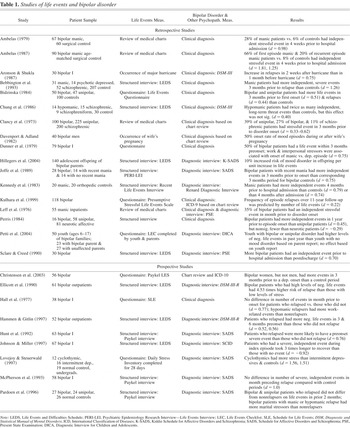
Table 1 summarizes studies on the association between life events and bipolar disorder.1
The results sections of Tables 1, 2, 3, and 4 include effect sizes when available. Some studies did not provide effect size information and did not contain sufficient information to calculate effect sizes.
Studies of life events and bipolar disorder

Before proceeding, however, several methodological limitations should be noted in this literature. First, many life event studies use retrospective designs, which might lead to “effort after meaning” bias (Brown & Harris, 1978) in recall by the bipolar individuals in providing information on the pre-episode environment. In addition, retrospective designs make it impossible to determine whether life events are causes or consequences of bipolar symptoms. Related to this, many studies have failed to differentiate among events that are independent of or dependent on people's behavior, a distinction of considerable importance given the chaotic lifestyles of individuals with bipolar disorders, and the possibility of stress generation. Second, most studies do not control for any reporting biases associated with bipolar individuals' mood state at the time they are reporting life events. Third, some studies rely on self-report measures of life events, which can lead to different subjective interpretations of what experiences count as an instance of a particular life event category. Further, use of self-reports compounds the potential problem of mood-based report biases. Thus, greater weight should be given to studies that employ interviewer assessments of events. Fourth, some studies do not include an appropriate control group to allow for a determination of whether bipolar individuals' environment differs from that of normal controls. Fifth, many of the studies do not distinguish between the depressive and manic/hypomanic episodes of bipolar individuals; thus, in these studies, it is unclear whether life events affect risk of mania as well as depression. Sixth, some studies use admission to the hospital or the start of a treatment regimen as the time of episode onset, which does not necessarily correspond well with the actual time of episode onset. Seventh, many studies use small samples with insufficient power to examine event: disorder relationships.
With these limitations in mind, overall, the retrospective studies report that bipolar individuals' first and subsequent episodes were preceded by the occurrence of stressful events, including stressful events rated as independent of their behavior (see Table 1, retrospective studies). Five retrospective studies employing life events interviews specifically examined the role of independent stressors in onsets of manic episodes. All (Bebbington et al., 1993; Chung, Langeluddecke, & Tennant, 1986; Joffe, MacDonald, & Kutcher, 1989; Kennedy, Thompson, Stancer, Roy, & Persad, 1983; Sclare & Creed, 1990) found that manic patients experienced more independent negative events during the period prior to onset than either controls or than the period after onset (although the effect was not statistically significant in Chung et al., 1986). Two retrospective studies specifically examined the life event–bipolar disorder association in adolescent offspring of bipolar parents (Hillegers et al., 2004; Petti et al., 2004), and both found that affected offspring (those with bipolar or unipolar mood disorders themselves) experienced significantly higher levels of negative life events than unaffected offspring.
The methodologically sounder prospective studies provide stronger, but not completely consistent, evidence for the role of stressful events as triggers of mood episodes in bipolar individuals (see Table 1, prospective studies). Although several prospective studies (Ellicott, Hammen, Gitlin, Brown, & Jamison, 1990; Hammen & Gitlin, 1997; Hunt, Bruce-Jones, & Silverstone, 1992; see also Lovejoy & Steuerwald, 1997) found that bipolar patients' relapse rate was significantly higher following a period of many negative life events than following periods with low stress, others either did not obtain this stress-relapse effect (McPherson, Herbison, & Romans, 1993) or only obtained the effect for women (Christensen et al., 2003) or particular types of stressful events (Hall, Dunner, Zeller, & Fieve, 1977; Pardoen et al., 1996). Specifically, bipolar patients who had a hypomanic/manic relapse had a greater number of work-related stressors (Hall et al., 1977) or marital stressors (Pardoen et al., 1996) prior to the relapse than did nonrelapsers. Finally, Johnson and Miller (1997) reported that bipolar inpatients who experienced a severe, independent event during the index episode took three times longer to recover than those who did not experience a severe, independent event.
Are there particular types of life events that are associated with occurrences of mood episodes among bipolar individuals? Of relevance to our integration of the cognitive vulnerability–stress model with a BAS perspective, two prospective studies found that life events involving goal attainment or goal striving are especially likely to trigger hypomanic/manic episodes among bipolar individuals. Johnson, Sandrow, et al. (2000) reported that goal attainment events predicted increases in manic, but not depressive, symptoms among bipolar I patients over a prospective follow-up, whereas general positive events did not. Similarly, Nusslock, Abramson, Harmon-Jones, Hogan, and Alloy (2006) found that individuals with bipolar spectrum disorders (bipolar II, cyclothymia) were especially likely to develop new onsets of hypomanic, but not depressive, episodes during a goal-striving period (final exams) compared to a prior control period. Moreover, as noted earlier, BAS-activating negative events such as anger-inducing events have also been associated with hypomanic symptoms (Carver, 2004; Harmon-Jones et al., 2002).
Are life events more likely to trigger early than later mood episodes among bipolar individuals? According to Post's (1992) “kindling” model, episodes become increasingly autonomous with each recurrence such that psychosocial stressors are hypothesized to be less likely to precipitate episodes that occur later in the course of disorder than early episodes. Five retrospective studies (Ehnvall & Agren, 2002; Glassner & Haldipur, 1983; Glassner, Haldipur, & Dessauersmith, 1979; Johnson, Andersson-Lundman, Aberg-Wistedt, & Mathe, 2000; Perris, 1984) obtained results consistent with the kindling hypothesis. In contrast, in another retrospective study of bipolar I patients assessed with interviews of life events, Hlastala et al. (2000) found that age, rather than the number of previous episodes, predicted stress level in preonset, but not control, periods. The probability of experiencing low stress increased as age increased. Hlastala et al. suggested that the aging process rather than illness progression might account for prior studies' apparent support for the kindling model. Finally, one prospective study also failed to support kindling. Hammen and Gitlin (1997) found that a greater proportion of bipolar patients with many than with few past episodes experienced a severe negative event prior to relapse. Consequently, there is some evidence from retrospective studies that life events play a larger role in triggering mood episodes earlier than later in the course of bipolar disorder or at an earlier age; however, the one prospective study to date fails to support the kindling model.
In summary, the evidence to date suggests that the occurrence of life events may contribute proximal risk to onsets and relapses/recurrences of mood episodes in individuals with bipolar spectrum disorders, with onsets early in the course of the disorder or at an earlier age perhaps being particularly responsive to life events. Given the extensive literature on the role of stress as a precipitant of episodes of unipolar depression, it is not surprising that negative events may trigger bipolar depressive episodes. However, negative events also appear to be relevant to precipitating hypomanic/manic episodes. Further research is needed to determine whether particular kinds of negative events that deactivate the BAS (e.g., definite failure or loss) precipitate depression, whereas it is BAS-activating negative events (e.g., goal obstacles, anger-evoking events) that trigger hypomania/mania, particularly in combination with BAS-relevant maladaptive cognitive styles. Moreover, few studies to date have investigated positive events and bipolar disorder. Preliminary evidence suggests that such positive events as achievements and upcoming goals could activate bipolar individuals' BAS-relevant cognitive styles and, in turn, lead to hypomanic/manic symptoms.
Cognitive styles and bipolar spectrum disorders
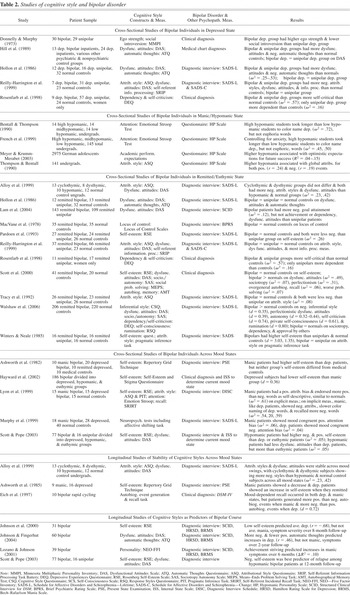
Table 2 summarizes studies on the association between cognitive styles and bipolar disorder. Recent reviews of this literature (Alloy, Abramson, Neeren, et al., 2006; Alloy, Abramson, Urosevic, et al., 2005; Alloy, Abramson, Walshaw, et al., 2006; Alloy, Reilly-Harrington, et al., 2005) have concluded that the observed cognitive styles of bipolar individuals depend to some degree on their current mood state and on whether the cognitive style assessment is based on explicit or implicit measures. Most studies indicate that bipolar individuals exhibit underlying cognitive patterns as negative as those of unipolar depressed persons, but with unique BAS-relevant features. However, they sometimes present themselves positively on explicit cognitive style measures. Moreover, there is some evidence that cognitive styles do predict prospectively the expression and course of bipolar disorder, particularly in combination with relevant life events.
Studies of cognitive style and bipolar disorder

A central methodological issue in this literature is the need to establish the nature of cognitive styles in bipolar individuals independent of mood states and symptoms of the disorder (Alloy, Abramson, Neeren, et al., 2006; Alloy, Abramson, Urosevic, et al., 2005; Alloy, Abramson, Walshaw, et al., 2006; Alloy, Reilly-Harrington, et al., 2005). Studies of cognition and bipolar disorder have addressed this issue in several different ways: by controlling statistically for concurrent mood and symptoms, by examining cognitions among remitted or euthymic bipolar individuals, by comparing bipolar individuals in depressive versus manic episodes, and by conducting within-subject longitudinal studies of the same bipolar individuals in different mood states. However, many studies in this area suffer from limitations that need to be addressed systematically in future studies, including small sample sizes, undiagnosed samples, failure to take medication status into account, absence of control groups, and unvalidated cognitive measures.
Cross-sectional studies of bipolar individuals in a current depressive episode (see Table 2, cross-sectional studies of bipolar individuals in a depressed state) find that their cognitive styles are as negative as those of unipolar depressed individuals and more negative than those of normal comparison groups (Hill, Oei, & Hill, 1989; Hollon, Kendall, & Lumry, 1986; Reilly-Harrington, Alloy, Fresco, & Whitehouse, 1999; Rosenfarb, Becker, Khan, & Mintz, 1998; but see Donnelly & Murphy, 1973, for an exception). Similarly, in cross-sectional studies of student samples assessed on a measure of hypomanic personality (see Table 2, cross-sectional studies of bipolar individuals in a manic/hypomanic state), although high hypomanic tendencies were associated with positive cognitive styles on explicit measures, they were related to underlying negative cognitive styles on implicit measures (Bentall & Thompson, 1990; French, Richards, & Scholfield, 1996; Meyer & Krumm-Merabet, 2003; but see Thompson & Bentall, 1990, for the exception).
Studies that examine cognitive styles of remitted or euthymic bipolar individuals (see Table 2, cross-sectional studies of bipolar individuals in a remitted/euthymic state) are important because they can establish the nature of cognitive styles independent of current mood or symptoms. The results of these studies are mixed. Five studies (Hollon et al., 1986; MacVane, Lange, Brown, & Zayat, 1978; Pardoen, Bauwens, Tracy, Martin, & Mendlewicz, 1993; Reilly-Harrington et al., 1999; Tracy, Bauwens, Martin, Pardoen, & Mendlewicz, 1992) using primarily explicit measures obtained little evidence of negative cognitions in the remitted state among bipolar participants compared to normal controls. In contrast, six other studies (Alloy, Reilly-Harrington, et al., 1999; Lam, Wright, & Smith, 2004; Rosenfarb et al., 1998; Scott, Stanton, Garland, & Ferrier, 2000; Walshaw et al., 2006; Winters & Neale, 1985), also employing mostly explicit measures of cognition, obtained support for negative cognitive styles among remitted bipolar individuals. Of particular relevance to our integration of the cognitive vulnerability–stress model with a BAS perspective, four of these studies (Lam et al., 2004; Rosenfarb et al., 1998; Scott et al., 2000; Walshaw et al., 2006) converged on the finding that euthymic bipolar individuals exhibit a unique profile of negative cognitive styles consistent with the high drive/incentive motivation associated with high BAS sensitivity, but not by maladaptive dependency and attachment attitudes typically observed among unipolar depressed individuals.
Five studies conducted cross-sectional comparisons of depressed bipolar to manic/hypomanic bipolar (and sometimes euthymic bipolar) participants (see Table 2, cross-sectional studies of bipolar individuals across mood state). Although three of these studies (Ashworth, Blackburn, & McPherson, 1982; Hayward, Wong, Bright, & Lam, 2002; Murphy et al., 1999) found that manic bipolar individuals exhibited more positive cognitive styles than depressed bipolar individuals, Scott and Pope (2003) obtained evidence of negative cognitive styles among hypomanic bipolar participants in comparison to remitted bipolar individuals. Lyon, Startup, and Bentall (1999) found that manic patients exhibited positive cognitive styles on explicit questionnaire measures, but showed underlying negative cognitive styles on implicit measures. Only three studies to date used longitudinal designs to investigate the stability of cognitive patterns across different mood states within the same bipolar individuals (see Table 2, longitudinal studies of stability of cognitive styles across mood states). Whereas Alloy, Reilly-Harrington, et al. (1999) found that attributional styles and dysfunctional attitudes were stable across participants' mood swings, Ashworth et al. (1985) observed that explicit self-esteem reverted to normal levels when previously depressed or manic bipolar patients recovered. Eich, Macaulay, and Lam (1997) observed that mood-dependent recall was common to both depressed and manic states, but patients generated more positive than negative autobiographical events when manic and more negative than positive events when depressed.
Four longitudinal studies examined various self-report measures of cognitive/personality styles as predictors of bipolar course, without considering the role of life events (see Table 2, longitudinal studies of cognitive styles as predictors of bipolar course). Whereas two studies found that negative automatic thoughts (Johnson & Fingerhut, 2004) and low self-esteem (Johnson, Meyer, Winett, & Small, 2000) predicted depressive, but not manic, symptoms over prospective follow-up periods, Scott and Pope (2003) found that negative self-esteem was the most robust predictor of relapse at 12-month follow-up among hypomanic bipolar patients. Moreover, Lozano and Johnson (2001) observed that the BAS-relevant trait of achievement-striving predicted increases in manic symptoms over 6 months.
Cognitive vulnerability–stress prediction of bipolar spectrum disorders
Perhaps most critical to a cognitive vulnerability–stress perspective on bipolar disorders is whether cognitive styles interact with life events to prospectively predict symptoms and episodes among bipolar individuals. To date, six studies, all using explicit measures of cognitive style, have examined the cognitive vulnerability–stress hypothesis for bipolar disorder. Four of these tested Beck's (1987) event congruence, vulnerability–stress hypothesis for sociotropic and autonomous cognitive styles in which the experience of stressful events congruent with one's style (interpersonal events for sociotropic individuals and achievement events for autonomous individuals) should lead to an onset or exacerbation of symptoms. Hammen et al. (Hammen, Ellicott, & Gitlin, 1992; Hammen, Ellicott, Gitlin, & Jamison, 1989) reported that symptom severity, but not symptom onset, was predicted by the interaction of sociotropy and negative interpersonal events (although only a nonsignificant trend in Hammen et al., 1989). The Autonomy × Negative Achievement Events interaction did not predict symptom severity. Francis-Raniere, Alloy, and Abramson (2006) found that among bipolar spectrum individuals, controlling for initial symptoms and the total events experienced, the interaction of a BAS-relevant self-critical, perfectionistic cognitive style with self-criticism-relevant negative or positive events, respectively, predicted prospective increases in depressive or hypomanic symptoms, respectively. Swendsen, Hammen, Heller, and Gitlin (1995) found that remitted bipolar patients who relapsed were distinguished from those who did not by interactions of stressful events with both obsessionality and extraversion.
Two studies tested the cognitive vulnerability–stress hypotheses of hopelessness (Abramson et al., 1989) as well as Beck's (1967) theories for attributional style and dysfunctional attitudes. Consistent with hopelessness theory, among individuals with mild spectrum conditions, Alloy, Reilly-Harrington, et al. (1999) reported that a negative attributional style for negative events at Time 1 (euthymic state) interacted with subsequent negative events to predict increases in depressive symptoms, and a positive attributional style for positive events combined with subsequent positive events to predict increases in hypomanic symptoms. Dysfunctional attitudes combined with life events did not predict subsequent depressive or hypomanic symptoms. Consistent with both hopelessness and Beck's theories, in a large sample of unipolar and bipolar individuals, Reilly-Harrington et al. (1999) found that controlling for initial symptom levels, Time 1 negative attributional styles, dysfunctional attitudes, and negative self-referent information processing each interacted significantly with subsequent negative life events to predict increases in depressive symptoms and, within the bipolar group, manic symptoms.
It is interesting that, whereas Alloy, Reilly-Harrington, et al. (1999) found that positive life events combined with positive attributional styles to predict increases in hypomanic symptoms, Reilly-Harrington et al. (1999) found that it was negative events combined with negative cognitive styles that predicted manic symptoms. One possible explanation for this difference may be that Reilly-Harrington et al.'s bipolar sample was more severe, including primarily bipolar II and some bipolar I participants, whereas Alloy et al.'s sample included milder cyclothymic and hypomanic individuals. Given that bipolar I and II individuals have a course of disorder that includes major depressive episodes, they may be more responsive to negative life events. Alternatively, it may be that the particular types of negative events experienced by participants in the two studies is critical for whether such events would precipitate hypomanic/manic symptoms. Negative events that act to activate the BAS (e.g., challenges that can be overcome; anger-inducing events) may be more likely to trigger hypomania/mania. Clearly, more work is needed to understand the conditions under which positive versus negative events and positive versus negative cognitive styles provide risk for hypomania/mania.
In sum, there is some evidence that individuals with bipolar disorders possess underlying cognitive styles as negative as those with unipolar depression, consistent with an extension of cognitive theories of unipolar depression to bipolar disorder. However, the strength of the observed association between negative cognitive styles and bipolar disorder may depend on the current mood state of bipolar individuals (depressed, manic, remitted) and whether the measures of cognition are explicit or implicit. Moreover, compared to unipolar depressed individuals, the cognitive styles of bipolar persons may be more uniquely characterized by goal striving, perfectionism, self-criticism, and autonomy, features characteristic of high BAS sensitivity, rather than dependency, attachment, and sociotropy. Further research is needed to more clearly establish the effects of current mood and type of cognition assessment on bipolar individuals' observed cognitive styles and whether bipolar individuals' cognitions are specifically BAS relevant. In addition, there is considerable evidence that cognitive styles alone, and particularly in combination with relevant life events, prospectively predict the course of bipolar depression and more mixed evidence that they predict the course of bipolar mania/hypomania. Further longitudinal studies are needed to test the cognitive vulnerability–stress hypothesis for bipolar disorder and whether it applies equally well to mania as it does to depression. Perhaps greater focus on BAS-relevant cognitive styles and life events will increase predictive power for mania/hypomania.
Developmental factors and bipolar spectrum disorders
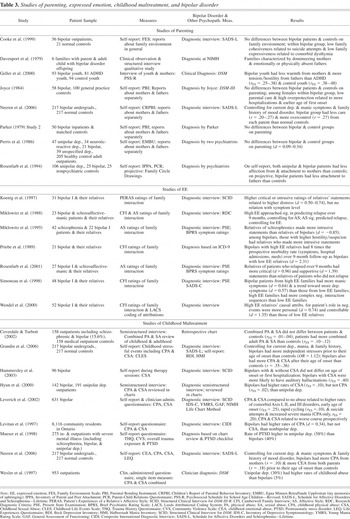
A small, but growing, research literature has begun to address the role of negative parenting practices and maltreatment histories in risk for and the course of bipolar disorders. Table 3 summarizes these studies. Also relevant to the role of parenting in bipolar disorder and reminiscent of the work on negative inferential feedback in promoting cognitive vulnerability to depression and depression itself discussed earlier (Alloy et al., 2001; Panzarella et al., 2006), is research indicating that high criticism and emotional overinvolvement (high “expressed emotion” or EE) from family members also predicts a worse course of bipolar disorder. Thus, we briefly review research on parenting, EE, and maltreatment histories in bipolar disorder.
Studies of parenting, expressed emotion, childhood maltreatment, and bipolar disorder

Both the parenting and maltreatment literatures have important methodological limitations that make it difficult to draw firm conclusions regarding the role of these developmental factors in the onset, expression, or course of bipolar disorder (Alloy, Abramson, Neeren, et al., 2006; Alloy, Abramson, Smith, Gibb, & Neeren, 2006; Alloy, Abramson, Urosevic, et al., 2005; Alloy, Abramson, Walshaw, et al., 2006; Alloy, Reilly-Harrington, et al., 2005). First, the vast majority of studies used retrospective designs, asking adult bipolar individuals to recall their childhood histories. Thus, such studies cannot determine whether these developmental factors were a causal contributor to or a consequence of the bipolarity. Second, and related, only three studies have attempted to examine whether these developmental factors preceded the onset of the bipolar disorder (and thus, whether they could have contributed to the bipolarity). Third, and also relevant to this issue, most studies do not control for bipolar participants' mood states at the time their childhood histories are assessed; consequently, reporting biases associated with current mood cannot be ruled out in most cases. Fourth, some studies do not include an appropriate control group and thus, cannot determine whether bipolar individuals' histories differ from those of normal controls. Fifth, the operationalizations of parenting and maltreatment histories differ widely across studies, with some studies using measures of questionable reliability and validity (e.g., only one- or two-item indicators of childhood history). Sixth and finally, with few exceptions, the studies in these areas do not attempt to rule out third variable explanations, such as shared genes, for the association between reported familial environment and bipolar disorder. Thus, with these caveats in mind, we briefly review evidence on the developmental histories of bipolar individuals.
Nine studies have examined the parenting and attachment histories of individuals with bipolar disorder (see Table 3, studies of parenting). Most of these studies examined whether bipolar individuals' parents were characterized by low care or warmth and high overprotection or psychological control, a pattern referred to as “affectionless control” by Parker (1983). Four retrospective studies of adults (Cooke, Young, Mohri, Blake, & Joffe, 1999; Joyce, 1984; Parker, 1979; Perris, Arrindell, Van der Ende, & Knorr, 1986) obtained no differences between the reported parenting of bipolar and comparison groups, although Joyce (1984) and Cooke et al. (1999) found that negative parenting practices were associated with greater severity and a worse course of bipolar disorder (e.g., more hospitalizations for both depression and mania and a greater history of suicide attempts). In contrast, three other methodologically stronger studies (Geller et al., 2000; Neeren, Alloy, & Abramson, 2006; Rosenfarb, Becker, & Khan, 1994) did obtain evidence of greater “affectionless control” in the parenting reportedly received by bipolar participants relative to controls. Moreover, in the one prospective study, Geller et al. (2004) reported that low maternal warmth predicted faster relapse after recovery from mania in a sample of bipolar youth followed for 4 years.
Related to the work on parenting are studies of family members' EE and bipolar disorder (see Table 3, studies of EE). The cross-sectional studies of EE found that compared to bipolar patients with low EE relatives, bipolar patients whose relatives made more critical or intrusive comments had higher hostility/suspicion (Miklowitz, Goldstein, & Nuechterlein, 1995), greater distress (Koenig, Sachs-Ericsson, & Miklowitz, 1997), and more manic symptoms and a trend toward more depressive symptoms (Simoneau, Miklowitz, & Saleem, 1998). Moreover, three prospective studies found that high EE among relatives is predictive of a worse course of bipolar disorder, specifically predicting relapse (Miklowitz, Goldstein, Nuechterlein, Snyder, & Mintz, 1988; Rosenfarb et al., 2001) and morbidity (hospital admissions, symptoms, additional medications; Priebe, Wildgrube, & Muller-Oerlinghausen, 1989).
Nine retrospective studies examined the maltreatment histories (and other childhood stressors) of bipolar individuals (see Table 3, studies of childhood maltreatment), six with no normal control group. Two of these compared unipolar and bipolar patients on overall trauma exposure and posttraumatic stress disorder (PTSD; Mueser et al., 1998) or on a single-item measure of combined abuse (Wexler, Lyons, Lyons, & Mazure, 1997), and found that unipolar patients had higher rates of PTSD or childhood abuse than bipolar patients. However, two other studies observed that bipolar patients did report higher rates of abuse than unipolar patients, either physical abuse (Levitan et al., 1997) or sexual abuse (Hyun, Friedman, & Dunner, 2000). Two additional studies without normal comparison groups obtained an association between childhood maltreatment history and the expression or course of bipolar disorder, including the presence of auditory hallucinations (Hammersley et al., 2003) and higher incidence of Axis I and II comorbidity, early (≤14) age of onset, faster cycling frequencies, increased suicide attempts, and increased severity of mania (Leverich et al., 2002).
Finally, three studies examined childhood stressors and did include normal controls. Coverdale and Turbott (2000) found that combined childhood physical and sexual abuse did not differ between patients and controls, but more patients reported combined adult (≥16 years of age) abuse than controls. Unfortunately, bipolar patients comprised only 15.6% of the patient sample. Controlling for current depressive and manic symptoms and family history of mood disorder, Neeren et al. (2006) found that bipolar spectrum individuals reported more childhood physical abuse from mothers and more childhood emotional abuse from both parents prior to the age of onset of their bipolar disorder than did demographically matched normal controls (prior to the same age). Similarly, also controlling for current depressive and manic symptoms and family history of mood disorder, Grandin, Alloy, and Abramson (in press) reported that only independent childhood stressors occurring prior to the age of onset were associated with bipolarity. Moreover, higher numbers of preonset childhood stressors actually predicted an earlier age of onset.
In summary, there is some suggestion of parenting characterized by low care and high overprotection, criticism, and childhood abuse in the histories of individuals with bipolar disorder, but the evidence is inconsistent (see reviews by Alloy, Abramson, Neeren, et al., 2006; Alloy, Abramson, Smith, et al., 2006; Alloy, Reilly-Harrington, et al., 2005, for more detail). There is better evidence that negative parenting and maltreatment histories may be associated with an earlier age of onset, rapid cycling, and a worse course of bipolar disorder, the type of phenomenology observed in adolescent onset bipolar disorder.
Application of the Cognitive Vulnerability–Stress Perspective to the Adolescent Onset, Gender Differences, and Phenomenology of Bipolar Spectrum Disorders
The five constructs in the cognitive vulnerability–transactional stress model are: life events, cognitive vulnerability, rumination/basking, cognitive vulnerability–stress interaction, and hopelessness/hope and self-efficacy. If the model explains adolescence as an HR period for onset of bipolar disorder, especially for girls, as well as the mixed presentation of adolescent bipolarity involving depression, irritability, and attention problems, then increases in the operation or “consolidation” of any of these variables should be associated with the occurrence of these developmental phenomena.
A developmental rise in the number of negative life events occurs after age 13 for both boys and girls (Garber, Keiley, & Martin, 2002; Gest, Reed, & Masten, 1999; but see Compas, Davis, & Forsyth, 1985), but especially for adolescent girls (Ge, Lorenz, Conger, Elder, & Simons, 1994), and could contribute to the initial onset of bipolar episodes in adolescence. In addition, depressed adolescent females generate interpersonal, negative events at a high rate (Hankin & Abramson, 2001; transactional–stress component). Moreover, adolescence is also a period that offers increased opportunities and greater expectations for individual achievement (Steinberg et al., 2005). Such goal striving and goal attainments could trigger initial onset of hypomania/mania in adolescents, as reviewed above (Johnson, Sandrow, et al., 2000; Nusslock et al., 2006), particularly in those with maladaptive BAS-relevant cognitive styles. Moreover, irrevocable failures to achieve desired goals could precipitate initial onsets of depression. To more fully understand the role of life events in contributing to the onset of bipolar disorder in adolescence, it is crucial that future studies remedy problems associated with prior life events research (e.g., poor sensitivity in dating event and symptom onset) and examine the same youth longitudinally, thereby permitting construction of individual trajectories of growth in stress across adolescence and comparison of such trajectories with those for bipolar symptoms and episodes. Because many vulnerability–stress theories feature life events, it is also important to see whether the cognitive factors unique to the cognitive vulnerability–stress model show relevant developmental changes that proximally precede the onset of bipolar disorder and emergence of gender differences in symptom course in adolescence.
Preliminary indications suggest that cognitive vulnerability may “consolidate” (relative stability over time and consistency across situations) by adolescence and thus be accessible for the Cognitive Vulnerability × Stress interaction (Abramson et al., 2002; Gibb & Alloy, 2006; Gibb et al., 2006). Longitudinal studies of third to eighth graders showed that attributional style became more stable in the later grades and interacted with stress to predict depression in older but not younger children (Gibb & Alloy, 2006; Nolen-Hoeksema, Girgus, & Seligman, 1992; Turner & Cole, 1994). In addition, because of achievement of formal operations and the ability to contemplate the future, beginning in adolescence children can experience hopelessness or hope, the mediating link in the chain culminating in depression or hypomania/mania. Moreover, work (Mezulis, Abramson, Hyde, & Hankin, 2004) demonstrating decreases in attributional positivity as children transition into adolescence suggests that cognitive vulnerability may increase during this transition and, in turn, contribute to the onset of depression or hypomania/mania in adolescence (see also Garber et al., 2002; Gibb et al., 2006).
Developmental changes in cognitive vulnerability may contribute to the greater predominance of depression in females' bipolar disorder beginning in adolescence. Girls show greater rumination than boys postpuberty, but not before (Broderick, 1998; Smith, Floyd, Alloy, Hughes, & Neeren, 2006). Hankin and Abramson (2002) recently developed a psychometrically superior measure of cognitive style for adolescents that revealed more maladaptive styles among adolescent females (Floyd, Alloy, Smith, Neeren, & Thorell, 2006; Hankin & Abramson, 2002). Moreover, in three cross-sectional studies, adolescent girls' more negative cognitive styles and rumination mediated the gender difference in depressive symptoms (Floyd et al., 2006; Hankin & Abramson, 2002; Smith et al., 2006). Thus, preliminary support exists for the hypothesis that adolescent girls may exhibit greater cognitive vulnerability than adolescent boys, which contributes to the gender difference in adolescent depression, and perhaps, the greater propensity for a depressive course in adolescent females' bipolar disorder.
The cognitive vulnerability–stress model suggests that a history of maladaptive IF about the causes and consequences of stressful events from family and friends should contribute to development of cognitive vulnerability. Accordingly, in an earlier section, we presented evidence that negative IF from parents during childhood (Alloy et al., 2001) and from current members of the support network (Panzarella et al., 2006) predicted negative cognitive styles and prospective depression onset in adolescence. Negative IF from others may represent the milder end of a continuum of negative emotional feedback with emotional abuse at the extreme end (Alloy et al., 2001, 2004). In a developmental extension of hopelessness theory, Rose and Abramson (1992) hypothesized that recurrent childhood abuse, particularly emotional abuse, would lead to the development of cognitive vulnerability. We found preliminary support for this hypothesis with both retrospective studies in late adolescents (Gibb et al., 2001a, 2001b, 2004; Spasojevic & Alloy, 2002) and a prospective study in youth (Gibb et al., 2006). In addition, among adult bipolar samples, high levels of criticism (high EE) and a negative affective communicative style from family members prospectively predicted a worse course and greater likelihood of relapse (Miklowitz et al., 1988; Priebe et al., 1989; Rosenfarb et al., 2001).
Negative inferential and emotional feedback from others may be especially likely to be internalized in adolescence and contribute to the formation of cognitive vulnerability. Peers become increasingly important beginning in early adolescence (Harris, 1995; Steinberg, 2002) and rates of negative emotional feedback from peers, including teasing, harassment, rejection, and derogation (i.e., “relational aggression”; Crick & Grotpeter, 1996), rise at this time, especially among adolescent girls (e.g., Crick & Grotpeter, 1996). Thus, negative emotional feedback from peers, in particular, may contribute to the adolescent onset of bipolar disorder, the emergence of gender differences in symptom course, and the dysphoric and irritable symptom presentation (see Liu & Kaplan, 1999).
Embedding the Cognitive Vulnerability–Stress Perspective in a Normative Adolescent Brain and Cognitive Development Context
Developmental psychopathologists (Cicchetti & Rogosch, 2002; Steinberg, 2002; Steinberg et al., 2005) and developmental neuroscientists (Casey, Tottenham, Liston, & Durston, 2005; Walker, Sabuwalla, & Huot, 2004) emphasize that it is critical to apply knowledge of normative adolescent cognitive and brain development to the study of psychopathology in adolescence. From this viewpoint, an understanding of bipolar disorder in adolescence from a cognitive vulnerability–transactional stress perspective must proceed with an explicit recognition of the brain maturation and concomitant cognitive capacities and attainments of the adolescent. Brain development and cognitive maturation occur concurrently in childhood and adolescence (Casey, Giedd, & Thomas, 2000; Sowell, Delis, Stiles, & Jernigan, 2001; Sowell, Thompson, & Toga, in press; Spear, 2000, in press). Whereas prior work has tracked clinical phenomena as a function of age, little, if any, work has tracked changes in clinical phenomena as a function of cognitive development during adolescence (Steinberg, 2002). An important goal of this article is to embed the cognitive vulnerability–stress model in a normative adolescent brain and cognitive development context. Placed in such a context, some of the key etiological factors in the model (e.g., cognitive vulnerability, rumination/basking, future expectations) have just become developmentally operative during adolescence due to normative brain maturation and concomitant cognitive development.
Contemporary neuroimaging methods have provided evidence of changes in structural architecture and functional organization of the developing brain in vivo, as well as linkages between brain maturation and increases in cognitive competencies (Casey, Galvan, & Hare, 2005; Casey, Tottenham, et al., 2005; Liston et al., 2003; Nagy, Westerberg, & Klingberg, 2004). Longitudinal magnetic resonance imaging (MRI) studies show that cognitive milestones in development parallel the sequence in which the cortex matures (Giedd, 2004; Gogtay et al., 2004; Sowell et al., 2003, 2004, in press). Regions subserving primary functions such as motor and sensory systems mature earliest and higher order association areas, such as the prefrontal cortex (PFC), that integrate sensorimotor processes and control “executive functions” such as self-regulation, attention, working memory, planning, and decision-making mature more slowly, and not completely, until early adulthood (Casey, Galvan, et al., 2005; Casey, Tottenham, et al., 2005; Gogtay et al., 2004; Sowell et al., 2004). During adolescence, frontal lobe gray matter volume decreases (Casey, Galvan, et al., 2005; Giedd, 2004; Gogtay et al., 2004; Sowell et al., 2003, 2004), involving synaptic pruning and the elimination of connections (Casey, Tottenham, et al., 2005; Giedd et al., 1996; Pfefferbaum et al., 1994), and PFC white matter volume increases, reflecting ongoing myelination of axons (Casey, Tottenham, et al., 2005; Giedd et al., 1999; Gogtay et al., 2004; Paus et al., 1999; Thompson et al., 2000), occur in parallel, suggesting that connections are being fine-tuned with the elimination of extra synapses and the strengthening of the relevant connections (Casey, Tottenham, et al., 2005).
Moreover, there are gender differences in PFC maturation. Males have been found to show greater loss of PFC grey matter volume and greater increase of PFC white matter volume compared with females as a function of age and pubertal status (De Bellis et al., 2001; Giedd et al., 1999). Normal pubertal development is associated with large increases in sex hormones and glucocorticoids (Walker et al., 2004), which influence brain maturation (De Bellis et al., 2001; Walker et al., 2004), in part through their effects on gene expression (Walker et al., 2004). Thus, the maturational changes in the adolescent brain may be linked to the high-risk period for onset of bipolar disorder that occurs in adolescence and the gender differences in adolescent brain development may be associated with the later age of onset of bipolar disorder for females and the greater depressive course among females.
The developmental changes in cortical development correlate with cognitive performance measures (Casey, Tottenham, et al., 2005; Casey, Trainor, Orendi, et al., 1997; Sowell et al., 2001). The fine tuning of PFC structural architecture during adolescence observed in MRI studies is associated functionally with a shift from diffuse recruitment of cortical regions by children performing cognitive tasks involving executive functions to more focal recruitment of PFC regions specifically implicated in cognitive control by adolescents (Brown et al., 2005; Casey, Galvan, et al., 2005; Durston et al., 2005; see Paus, 2005, for a review). In essence, adolescence involves a reorganization of frontally based neural executive systems involved in affect and self-regulation (Leibenluft et al., 2003). Specifically, we hypothesize that four cognitive competencies (attentional executive functions, working memory, hypothetical thinking/decision making, and future orientation) attained during adolescence and linked to maturation of the PFC are cognitive developmental “prerequisites” for the Cognitive Vulnerability × Stress interaction to “pack its punch” in contributing to onset of bipolar mood episodes. Ironically, adolescents' increased brain maturation, PFC structural and functional “fine-tuning,” and cognitive competence may come with a cost. It puts them at greater risk for mood disorder than they were in childhood.
Earlier, we showed how attention is a self-regulatory mechanism in the causal chain of the cognitive vulnerability–stress model (MacCoon et al., 2006). Cognitively vulnerable individuals can become stuck in the self-regulatory cycle with their attention focused on affectively laden cognitive content as they attempt to deal with life events that activate their maladaptive cognitive styles (i.e., ruminating on failures and losses; Abramson et al., 2002; MacCoon et al., 2006; or basking on goal attainments). An implication is that a cognitively vulnerable individual must have achieved greater attentional executive functions in order for the Cognitive Vulnerability × Stress interaction to lead to full-blown depression or hypomania/mania. For example, a cognitively vulnerable child who has not developed sufficient competence in selective and sustained attention may generate negative inferences when faced with a negative event, but will not remain focused on such inferences and thus will not be as likely to suffer their depressogenic effects. We suggest that emerging normative cognitive development of self-regulatory executive functions (i.e., sustained and selective attention and executive control over attentional switching) is a prerequisite for adolescents to engage in attempts to self-regulate affect and thus for full-blown rumination or basking to occur (Abramson et al., 2002; Steinberg et al., 2005). Attentional processes are known to become more efficient with age, and continue to develop through adolescence (Casey, Trainor, Giedd, et al., 1997). Adolescent developmental maturation of the medial PFC and anterior cingulate cortex (ACC) is centrally involved in improved selective attention performance (Botvinik, Braver, Barch, Carter, & Cohen, 2001; Casey, Trainor, Giedd, et al., 1997). Moreover, studies of normative development suggest that emotion regulation mechanisms are dependent on attentional regulation and control (Leibenluft et al., 2003). The maturation of attentional executive functions in adolescence and the link between attention regulation and affect regulation is relevant to adolescent onset bipolar disorder and may help explain the attentional difficulties observed in adolescent bipolar disorder and frequent comorbidity with ADHD (Leibenluft et al., 2003). Thus, as attentional executive control develops during adolescence, recursive thinking (rumination or basking) in an effort to regulate affect and the Cognitive Vulnerability × Stress interaction can fully “pack their punch” in contributing to the onset of mood episodes.
Similarly, normative development of working memory is essential for maintaining information and the present context in mind (Cohen & Servan-Schreiber, 1992; Kimberg & Farah, 1993) and thus is also an important cognitive capacity underlying self-regulation and affect regulation. Thus, increases in working memory skills should also be a prerequisite for adolescents to more fully engage in self-regulation and rumination or basking. Working memory is most reliably associated with activation of the dorsolateral PFC (Owen, 2000).
With the advent of formal operations in adolescence comes the ability to think about possibilities rather than only concrete realities, that is, abstract, hypothetical thinking. Adolescents develop greater competence in generating options, viewing situations from many perspectives, and anticipating potential consequences of decisions (Keating, 1990, 2005). Such increased competency in hypothetical thinking and decision making is also subserved by maturation of the PFC, and should be a prerequisite for generating implications of life events and for experiencing hopelessness or hope (Steinberg, 2002). In addition, to experience hopelessness or hope, the proximal cause of depressive or hypomanic/manic symptoms in the cognitive vulnerability–stress model (Abramson et al., 1989), children must develop the normative capacity to think about the future, also a likely outgrowth of PFC maturation in adolescence.
Prefrontal executive functioning in bipolar spectrum disorders
Is there evidence that abnormal functioning of the PFC and the executive control it subserves is implicated in bipolar disorder? In this subsection, we briefly review neuroimaging and neuropsychological studies of executive function (see Walshaw & Alloy, 2006, for a more complete review) involved in attentional control and working memory that suggest PFC and ACC abnormalities in bipolar disorder that may be relevant to the operation of maladaptive cognitive styles and self-regulatory processes featured in the cognitive vulnerability–stress model of bipolar disorder.
Overall, morphometric and histopathological studies of the cerebral lobes and subregions suggest structural abnormalities of the PFC (Cotter et al., 2002; Drevets et al., 1997; Haznedar et al., 2005; Lopez-Larson, DelBello, Zimmerman, Schwiers, & Strakowski, 2002; Ongur, Drevets, & Price, 1998; Rajkowska, Halaris, & Selemon, 2001) and ACC (Benes, Vincent, & Todtenkopf, 2001; Bouras, Kovari, Hof, Riederer, & Giannakopoulos, 2001) in bipolar disorder. Friedman et al. (1999) detected decreased frontal volumes in adolescents with bipolar disorder compared to normal controls (see also DelBello, Adler, et al., 2004; Lyoo, Lee, Jung, Noam, & Renshaw, 2002) and Chang, Gallelli, and Howe (in press) also observed a trend toward decreased cortical gray matter volume in adolescent bipolar offspring of bipolar parents. Smaller PFC volume also correlates with deficits on tasks of sustained attention and inhibition (Sax et al., 1999).
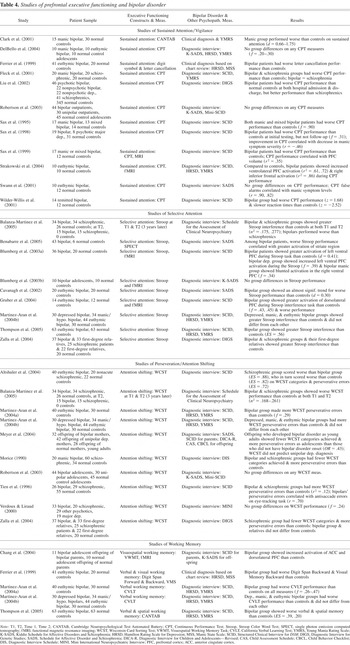
Above, we suggested that the normative development of attention and working memory executive functions in adolescence is a cognitive prerequisite for recursive thinking (rumination/basking) aimed at regulating affective reactions to life events, and thus, for the Cognitive Vulnerability × Stress interaction to “fully pack its punch” in contributing to onsets of mood episodes. Attention and working memory executive functions have been examined in bipolar individuals in neuropsychological studies. These studies are summarized in Table 4.2
Many of the studies in Table 4 included other measures of executive or cognitive functioning as well.
Studies of prefrontal executive functioning and bipolar disorder

The Continuous Performance Test (CPT; e.g., Connors, 1985; Garfinkel & Klee, 1983; Rosvold, Mirsky, Sarason, Bransome, & Beck, 1956) assesses sustained attention/vigilance (see Table 4, studies of sustained attention/vigilance). Adults with bipolar disorder consistently perform worse than normal controls on the CPT in both manic and euthymic states (Clark, Iversen, & Goodwin, 2001; Ferrier, Stanton, Kelly, & Scott, 1999; Fleck, Sax, & Strakowski, 2001; Liu et al., 2002; Sax et al., 1998, 1999; Sax, Strakowski, McElroy, Keck, & West, 1995; Wilder-Willis et al., 2001, but see Swann, Anderson, Dougherty, & Moeller, 2001, for negative findings). Moreover, Strakowski, Adler, Holland, Mills, and DelBello (2004) found decreased activation of medial PFC in bipolar adults during performance on a CPT. Two studies of youth (DelBello, Adler, et al., 2004; Robertson, Kutcher, & Lagace, 2003) did not find CPT differences between bipolar and normal youth; however, the CPT may not be able to differentiate developmentally normal errors from deficits found in bipolar disorder, given that attentional control is still developing throughout adolescence (Walshaw & Alloy, 2006).
The Stroop Color–Word Naming Task (Golden, 1978; Stroop, 1935) activates the ACC and right orbitofrontal cortex, known to be involved in selective attention and inhibition of interfering stimuli (Bench et al., 1993; Cabeza & Nyberg, 1997, 2000). The studies in Table 4 (studies of selective attention) indicate that bipolar individuals show impaired Stroop performance regardless of current mood state (Martinez-Aran, Vieta, Reinares, et al., 2004), including when they are euthymic (Cavanagh, van Beck, Muir, & Blackwood, 2002; Gruber, Rogowska, & Yurgelun-Todd, 2004; Thompson et al., 2005; Zalla et al., 2004), and these deficits are stable over a 3-year period (Balanza-Martinez et al., 2005). Bipolar patients' first-degree relatives also show Stroop impairment compared to nonpsychiatric controls (Zalla et al., 2004), suggesting a possible genetic component to the selective attention problems. The one study of bipolar adolescents found that they showed abnormalities in ventral PFC activation during the Stroop task (Blumberg, Martin, et al., 2003), similar to bipolar adults who display deficits on the task (Benabarre et al., 2005; Blumberg, Leung, et al., 2003).
The Wisconsin Card Sorting Test (WCST; Heaton, 1981) assesses the ability to shift attentional focus or cognitive flexibility, and is one of most widely used tests of PFC executive function (Berman et al., 1995; Nagahama et al., 1996; Rezai et al., 1993; Stuss et al., 2000; Weinberger, Berman, & Zec, 1986). In particular, the WCST perseverative errors score measures the extent to which an individual becomes fixated on a dominant rewarded response. Studies (see Table 4, studies of perseveration/attention shifting) have found greater WCST perseverative errors for bipolar individuals than normal controls (Altshuler et al., 2004; Martinez-Aran, Vieta, Colom, et al., 2004; Morice, 1990; Tien, Ross, Pearlson, & Strauss, 1996; but see Robertson et al., 2003; Verdoux & Liraud, 2000; Zalla et al., 2004, for negative findings) and these deficits occur across mood state (Martinez-Aran, Vieta, Reinares, et al., 2004), and are stable over 3 years (Balanza-Martinez et al., 2005). Moreover, in a prospective study, Meyer et al. (2004) found that WCST performance in adolescence predicted bipolar disorder onset, but not unipolar depression, in young adulthood.
Given that neuroimaging studies indicate that the ACC may be centrally involved in selective attention performance (Botvinik et al., 2001; Casey, Trainor, Giedd, et al., 1997; Miller & Cohen, 2001), the possibility that the attentional deficits observed in bipolar individuals are associated with differences in ACC activation is worth exploring. Leibenluft et al. (2003) reviewed several studies finding an association between mania and increased ACC activation (Blumberg et al., 2000; Drevets et al., 1997; Goodwin et al., 1997; Rubinsztein et al., 2001). These studies of attentional function and ACC activation may be important in understanding why adolescence is a high-risk period for onset of bipolar disorder, given that attentional executive control begins to mature in adolescence and that development of attention regulation, in turn, plays a role in the concurrent development of affect regulation (Leibenluft et al., 2003). Drevets (2001) proposed that the ventral ACC may be involved in mediating the abrupt switches of mood state and arousal seen in bipolar disorder, which may be relevant to understanding the greater prevalence of rapid cycling observed in adolescent bipolar disorder as the ACC is maturing.
As noted above, the normative development of working memory skills, subserved by the dorsolateral PFC (Owen, 2000), should also be an important cognitive capacity underlying efforts at self-regulation and rumination/basking (see Table 4, studies of working memory). Deficits in verbal working memory have been found consistently in bipolar adults relative to controls (Ferrier et al., 1999; Martinez-Aran, Vieta, Colom, et al., 2004; Thompson et al., 2005), across mood states (Martinez-Aran, Vieta, Reinares, et al., 2004). Moreover, Chang et al. (2004) found that relative to normal controls, euthymic adolescent bipolar offspring with bipolar disorder showed increased ACC and dorsolateral PFC activation during a visuospatial working memory task. More generally, Chang and colleagues (in press) have suggested that prefrontal overactivation may serve as a marker of risk for development of bipolar disorder.
Our hypotheses regarding the dependence of the adolescent onset of bipolar disorder on the normative cognitive development of executive functions subserved by PFC maturation in adolescence, combined with the evidence reviewed here that bipolar disorder may be associated with impairments in executive functioning and PFC and ACC activation, suggest important directions for future research. Specifically, prospective longitudinal studies are needed that track the trajectories of development of executive functions (attentional competence, working memory, hypothetical thinking/decision making, future orientation) and PFC/ACC activation during the transition to adolescence and relate these trajectories to the trajectories of development of maladaptive cognitive styles, self-regulatory attentional processes (e.g., rumination/basking), and hopelessness/hope, and, in turn, bipolar disorder.
Embedding the Cognitive Vulnerability–Stress Perspective in a Normative Adolescent Brain and Emotional Development Context
In the previous sections, we presented evidence that maladaptive cognitive styles and self-regulatory attentional processes (e.g., rumination/basking) are coming “on-line” and consolidating in adolescence (see Application of the Cognitive Vulnerability–Stress Perspective to the Adolescent Onset, Gender Differences, and Phenomenology of Bipolar Spectrum Disorders section), and argued that this may be a function of normative adolescent cognitive development of relevant executive functions and underlying PFC brain maturation. Just as cognitive vulnerability is maturing and consolidating in adolescence, the stress half of the cognitive vulnerability–stress model is also undergoing important developments in adolescence. Recall we noted that there is a developmentally normative increase in the number of stressful life events after age 13 for both males and females (Garber et al., 2002; Gest et al., 1999), but especially for adolescent females (Ge et al., 1994), as well as an increase in achievement opportunities and goal-striving (Steinberg et al., 2005). This developmentally normative adolescent increase in stress exposure occurs at the same time as developmental increases in the “stress sensitivity” of the adolescent brain (Spear, 2000; Walker, 2002, in press; Walker et al., 2004). Thus, at the same time maladaptive cognitive styles and the capacity for self-regulatory perseverative thinking is consolidating, adolescents' exposure and reactivity to stressors is also increasing. This two-hit normative augmentation of both vulnerability and stress may help to explain why adolescence is a high-risk period for onset of bipolar spectrum disorders.
Accumulating evidence suggests that the stress response is enhanced during adolescence both at the neural and behavioral levels (Spear, 2000; Walker, in press; Walker et al., 2004). One of the most important biological stress–response systems is the hypothalamic–pituitary–adrenal (HPA) axis. Acutely, in response to environmental challenges, central corticotropin-releasing hormone is released from the hypothalamus, stimulating the anterior pituitary to secrete adrenocorticotropin (ACTH). ACTH, in turn, stimulates the release of glucocorticoids (cortisol in humans) from the adrenal cortex. Normative adolescent development is characterized by a pubertal increase in activity of the HPA axis. Cross-sectional and longitudinal studies reveal a gradual rise in salivary and urinary cortisol during middle childhood, with a sharp increase beginning around age 13 and continuing throughout adolescence (Kenny, Gancayon, Heald, & Hung, 1966; Kenny, Preeyasombat, & Migeon, 1966; Kiess et al., 1995; Lupien et al., 2002; Wajs-Kuto, De Beeck, Rooman, & Caju, 1999; Walker, Bonsall, & Walder, 2002; Walker, Walder, & Reynolds, 2001; Wingo, 2002). Excessive exposure to cortisol through exaggerated or repeated responses to stressors and/or slow recovery following stressors can have serious adverse effects (Charney, 2004). Indeed, longitudinal and prospective studies suggest that cortisol hypersecretion is associated with the onset and persistence of depressive symptoms and MD (Goodyer, Herbert, & Altham, 1998; Goodyer, Herbert, & Tamplin, 2000, 2003; Goodyer, Herbert, Tamplin, & Altham, 2000; Susman, Dorn, Inoff-Germain, Nottelmann, & Chrousos, 1997).
The postpubertal increase in activity of the HPA axis is accompanied by other indicators of heightened biobehavioral sensitivity to stress in adolescence. There is a stronger association between stressful events and depression in adolescents compared to adults (Gould, Petrie, Kleinman, & Wallenstein, 1994; Pine, Cohen, Johnson, & Brook, 2002; Rice, Harold, & Thapar, 2003). During laboratory exposure to stressful stimuli, adolescents respond with increases in heart rate and cortisol secretion (Buske-Kirschbaum et al., 1997), greater β-adrenergic activation than younger children (Allen & Matthews, 1997), and more persistent skin conductance responding, requiring more exposure trials to habituate, than adults (Miller & Shields, 1980). In animal models, the stress responsiveness of cortical receptors for GABA, an inhibitory neurotransmitter, increase during adolescence (Kellogg, Awatramani, & Piekut, 1998). Similarly, dopaminergic function, important in mediating reward behavior, increases in the PFC during adolescence (Spear, 2000). Further, the amygdala, a limbic brain structure involved in emotional reactivity and coordinating responses to stressors with connections to the PFC and ACC, shows continuing maturation well into adolescence (Benes, 2003a, 2003b). The normative adolescent maturation of the amygdala may have particular relevance to bipolar disorder. Functional imaging studies of bipolar adults indicate activation abnormalities of the amygdala (Drevets et al., 2002; Yurgelun-Todd et al., 2000), and bipolar adolescents show decreased amygdalar volumes compared to normal controls (Blumberg, Martin, et al., 2003; Chang et al., 2005; DelBello, Zimmerman, Mills, Getz, & Strakowski, 2004). Thus, adolescence appears to be a developmental period in which behaviorally and biologically individuals are particularly responsive to stressors.
The augmented stress sensitivity of the adolescent brain may not only help to account for the greater likelihood of onset of bipolar disorder in adolescence, but it may also contribute to some of the other clinical phenomena associated with bipolar disorder in adolescence. For example, the kindling studies reviewed above finding that life events play a larger role in triggering earlier rather than later mood episodes in the course of bipolar disorder (see section on Life Events and Bipolar Spectrum Disorders) may be explained by the greater responsiveness of individuals to stressful events during adolescence. Further, an increased sensitivity to life events in adolescence could contribute to the rapid cycling often observed in adolescent bipolar disorder, as individuals overreact to minor events of different valences and motivational significance. Moreover, cortisol secretion has been found to be about 20% higher in postpubertal females than males (Goodyer, Park, Netherton, & Herbert, 2001). The adolescent gender differences in cortisol secretion may contribute to the relatively greater onset of bipolar disorder in females than males in adolescence. That is, prepubertal onset cases of bipolar disorder are overwhelmingly male, whereas there is a more even gender distribution in adolescent onset bipolar disorder (Biederman et al., 2005; Geller et al., 1995; Hendrick, Altshuler, Gitlin, Delrahim, & Hammen, 2000).
Individual differences in neural and behavioral stress sensitivity during adolescence may arise as a function of earlier childhood experiences. In a previous section (see the Developmental Factors and Bipolar Spectrum Disorders section), we reviewed evidence suggesting that negative parenting and abuse histories may be associated with an earlier age of onset, rapid cycling, and a worse course of bipolar disorder, the type of phenomenology observed in adolescent onset bipolar disorder. Further, we showed that maltreatment and parenting involving low care and warmth are associated with the development of maladaptive cognitive styles that promote vulnerability to major depressive episodes (see Evidence for the Cognitive Vulnerability–Transactional Stress Model of Depression section). Thus, Alloy and colleagues (Alloy, Abramson, Smith, et al., 2006; Alloy et al., 2004) suggested that childhood maltreatment and negative parenting may contribute risk to both unipolar and bipolar mood disorders through their contribution to the formation of cognitive vulnerability. However, recent evidence on the development of the stress–emotion system indicates that early experiences of maltreatment and poor parental care may also promote the development of a hyperreactive stress response system as well (Gunnar, in press). Thus, here too, childhood maltreatment and parenting experiences may set the stage for the typically observed adolescent onset and phenomenology of bipolar disorder by affecting both the vulnerability and stress components of the cognitive vulnerability–stress model.
Both animal and human studies indicate that early caregiving experiences can have long-term effects on the biobehavioral stress–response system. A series of elegant rodent studies by Meaney and colleagues (see Meaney, 2001, in press, for a review) indicate that neonatal rat pups separated from their mothers for 15 min/day are resistant to the development of stress-induced high levels of glucocorticoids as adults, whereas those who undergo maternal separation for 3 hr/day develop lifelong hypercortisolemia and increased anxiety behaviors. Further, these effects are mediated by maternal behavior. In the 15-min separated rats, maternal attention and licking increase upon return of the rat pup. However, mothers of 3-hr separated pups show little attention toward and licking of the returned pups. Moreover, the offspring of mothers who naturally show low levels of licking of their pups are more likely to be hypercortisolemic and anxious as adults than the offspring of naturally high-licking mothers. If the pups born to low-licking mothers are cross-fostered to high-licking mothers, they do not show hypercortisolemia and anxiety behaviors. Similar to these findings in rodents, Gunnar (in press) reviews evidence that human infants and children who are exposed to poor caregiving and early adversity are also more likely to show increased HPA axis stress-responsivity. Further, children with early severe or prolonged abuse have been found to exhibit elevated basal cortisol levels (Carrion et al., 2002; De Bellis et al., 1999). In sum, the developmentally normative rise in adolescent stress sensitivity may be further augmented in adolescents with a history of poor care or maltreatment.
Embedding the Cognitive Vulnerability–Stress Model in a Genetic Context
It is well established that bipolar disorder has a strong genetic predisposition. The risk of bipolar disorder in first-degree relatives of bipolar probands ranges from 7 to 22%, indicating a relative risk of 10.3 compared to controls (Merikangas et al., 2002). Recent twin studies obtain concordance rates of 40 to 43% for monozygotic (MZ) twins versus 5 to 6% for dizygotic (DZ) twins (Kieseppa, Partonen, Haukka, Kaprio, & Lonnqvis, 2004; McGuffin et al., 2003). However, much less is known about the processes by which genetic vulnerability culminates in bipolar spectrum disorders. We suggest that, among other mechanisms, genetic predisposition may contribute to bipolar disorder by increasing both stress sensitivity and cognitive vulnerability, particularly during the developmental period of adolescence.
Neurodevelopment and the genetic vulnerability–stress model
Work on developmental genetics and neurodevelopment suggests that some genetic effects may come on-line during adolescence. Researchers (e.g., Walker et al., 2004) have drawn on recent advances showing that hormones affect gene expression (e.g., Kawata, 1995) to suggest that pubertal hormonal changes may trigger the expression of genetic vulnerabilities for various disorders, including mood disorders. This is consistent with the findings that the heritability estimate for depression rises dramatically after puberty (Silberg et al., 1999), and that the risk of affective illness increases as offspring of bipolar parents move through adolescence (Egeland et al., 2003; Hillegers et al., 2005; Shaw, Egeland, Endicott, Allen, & Hostetter, 2005). The expression of such genetic vulnerabilities may contribute to adolescents' increased stress responsivity (e.g., Spear, 2000; Walker et al., 2004). Thus, genes may exert an increasingly stronger effect on responses to life events over the course of adolescence and thus may contribute to the adolescent onset of bipolar disorder.
Integrating cognitive vulnerability and genetic vulnerability
To date, cognitive and genetic approaches to mood disorders have proceeded in parallel with little “cross-talk.” It may be possible to integrate these two perspectives. Two independent studies found that cognitive vulnerability has a genetic component. In particular, Schulman, Keith, and Seligman (1993) reported higher concordances for attributional style among MZ than DZ twins. Similarly, in a study of over 1,300 adolescent twin and sibling pairs, Lau, Rijsdijk, and Eley (2006) revealed a genetic influence on attributional style. For several reasons, it is plausible that the serotonin transporter genotype (5-HTTLPR), in particular, is related to cognitive vulnerability. The 5-HTTLPR genotype has been related to both unipolar depression (e.g., Caspi et al., 2003) and bipolar disorder (e.g., Cho et al., 2005; Craddock & Jones, 2001), particularly in interaction with exposure to stressful life events (Caspi et al., 2003; Eley et al., 2004; Grabe et al., 2004; Kaufman et al., 2004; Kendler, Kuhn, Vittum, Prescott, & Riley, 2005; but see Gillespie, Whitfield, Williams, Heath, & Martin, 2005). Both cognitive vulnerability and 5-HTTLPR genotype vulnerability may participate in vulnerability–stress interactions that moderate the effects of stress on the development of mood episodes. More specifically, recent work (J.H. Meyer et al., 2003, 2004) suggests that serotonin modulates dysfunctional attitudes, one type of cognitive vulnerability for mood disorders. Finally, a link has been found between the 5-HTTLPR genotype and neuroticism (e.g., Lesch et al., 1996), which in turn, interacts with life events to predict the development of cognitive vulnerability among children making the transition to adolescence (Mezulis, Hyde, & Abramson, in press). This further suggests that the 5-HTTLPR genotype may be associated with cognitive vulnerability. Thus, it is possible that cognitive vulnerability mediates, in part, the effects of genetic predisposition on adolescent onset bipolar disorder in response to the rise in adolescent stressors.
Conclusions and Future Directions
Over the past decade, major advances have occurred in the understanding of adolescent neurodevelopment, as significant maturation of the PFC and concomitant executive functions as well as augmented activity of the HPA axis and increased stress sensitivity occur at this time. We suggested that these normative changes in adolescent brain, cognitive, and emotional development provide a context for understanding important clinical phenomena of bipolar spectrum disorders from a cognitive vulnerability–stress perspective. Consistent with the cognitive vulnerability–stress model, we reviewed studies indicating that life events may precipitate depressive and hypomanic/manic episodes, perhaps especially when they occur early in the course of disorder or at younger ages, and that individuals with bipolar disorders exhibit maladaptive cognitive styles characterized by BAS-relevant features of perfectionism, self-criticism, and excessive goal striving. Moreover, several prospective studies found that such cognitive styles combine with relevant life events to predict the depressive and hypomanic/manic symptoms and episodes of bipolar individuals. When considered in the context of the normative changes in adolescent brain, cognitive, and emotional development, as well as genetic predisposition, the cognitive vulnerability–stress model may provide important insights into some of the risk factors for the onset, gender differences, and symptom presentation of adolescent bipolar disorder.
In particular, adolescence is a high-risk period for the onset of bipolar spectrum disorders. We suggested that the increased risk for adolescent onset of bipolar disorder may be explained by the enhanced expression of genetic predispositions and the augmentation of both the cognitive vulnerability and stress components of the cognitive vulnerability–stress model during this developmental period. We presented evidence that maladaptive cognitive styles and self-regulatory attentional processes (rumination/basking) consolidate and come on-line to contribute to mood episodes during adolescence, as a function of normative adolescent PFC maturation and the concomitant development of executive functions (attentional competence, working memory, hypothetical thinking/decision making, future orientation) that provide “prerequisites” for these cognitive vulnerability processes. We also presented evidence that both exposure to stress and neural and behavioral responsiveness to stress increase during adolescence. Thus, this two-hit normative rise in both cognitive vulnerability and stress during adolescence may lead to the greater likelihood of bipolar disorder onset at this time. Moreover, a history of maltreatment and parenting involving low care is associated with an earlier age of onset, rapid cycling, and worse course of bipolar disorder that may arise, in part, because these early socialization experiences contribute to the development of both maladaptive cognitive styles and a hyperresponsive stress system.
Adolescent bipolar disorder is characterized by mixed states involving considerable depression and irritability, rapid cycling, and attention problems, and bipolar females show a predominantly depressive course beginning in adolescence. We suggested that in individuals with maladaptive, BAS-relevant cognitive styles that increase vulnerability to both depressive and hypomanic/manic symptoms, certain types of negative life events (e.g., failures that can be overcome, goal obstacles) might precipitate a mixture of hypomanic/manic, depressive, and irritable symptoms. In addition, within day or across day fluctuations in exposure to relevant life events could lead to rapid alternations between depression and hypomania/mania (rapid cycling), particularly during adolescence when individuals may both be exposed to higher levels of stressful events and be hypersensitive to these stressors. The attentional difficulties observed in adolescent bipolar disorder and high levels of comorbidity with ADHD may be related to the maturation of attentional executive functions during adolescence and the link between attention regulation and emotion regulation. Finally, we speculated that the greater propensity for a depressive course in females' bipolar disorder starting in adolescence may be related to the findings that females exhibit greater cognitive vulnerability and rumination than males, as well as increased HPA axis activation, beginning in adolescence.
Our hypotheses regarding the integration of a cognitive vulnerability–stress perspective with the normative changes in adolescent brain, cognitive, and emotional development as a basis for the adolescent onset and phenomenology of bipolar spectrum disorders are speculative at present. However, these hypotheses suggest important directions for future research that may ultimately increase knowledge of the development and characteristics of this understudied illness. First, the trajectories of development of prefrontal cortical maturation and activation and concomitant executive functioning need to be linked with the developmental trajectories of maladaptive cognitive styles, self-regulatory attentional processes, and hopelessness/hope in prospective, longitudinal studies of adolescents. All of these trajectories, in turn, must be related to the onset and course of bipolar symptoms. Second, longitudinal studies that relate the developmental trajectories of exposure to stressful events and neural and behavioral responsiveness to stressors during adolescence to the onset and course of bipolar disorder are also needed. We hope that the ideas proposed here will inspire researchers to conduct further tests of the cognitive vulnerability–stress model of bipolar disorders in an adolescent development context.