


Introduction
Apart from many mental illnesses, the prevalence of depression is increasing because of the recent economic crisis. Accordingly, many companies are facing the substantial challenge of addressing the absence of workers due to depression, and are attempting to facilitate a rapid return to work (RTW). Recently, although many interventions aimed at the reduction in mental health complaints have been developed and evaluated, little scientific evidence has been made available on methods that successfully enhance RTW for workers with common mental health disorders. A few controlled studies on the effects of psychotherapy [mostly cognitive behavioural therapy (CBT)] on RTW underline the need for more research in this field and for adapting existing psychotherapeutic interventions.
Regular CBT offered by mental health professionals often lacks a focus on work and RTW (Rebergen et al., Reference Rebergen, Bruinvels, van Tulder, van der Beek and van Mechelen2009). The effectiveness of psychotherapy on RTW may therefore be enhanced when work (or RTW) is more explicitly addressed during treatment, and if psychologists are trained in workplace issues. The central idea behind work-focused interventions is that any CBT technique may be applied to the work context, to achieve regular psychotherapeutic treatment goals and RTW. Recently, a large-scale, randomized controlled trial (RCT) found that CBT focusing on the workplace improved depression, anxiety, health-related quality of life, and workplace participation, and that more people who underwent work-focused CBT succeeded in RTW than those that received typical care (Reme et al., Reference Reme, Grasdal, Løvvik, Lie and Øverland2015).
Therefore, our pilot study investigated the initial efficacy of a work-focused intervention programme for Japanese workers who took leave due to depression. In Japan, RTW often means returning to the place where the worker was originally working, and the purpose of the ‘Rework Programme’ is to restore workers to work and to prevent recurrence. Although the Japanese Ministry of Health, Labour and Welfare has republished the guidelines on support for RTW and recommended their use in the workplace, Japanese companies are not fully utilizing it. Therefore, it is common to return to work after participating in the Rework Programme at a mental health clinic during a leave of absence. CBT has been introduced in the Rework Programme in Japan, but its impact on RTW has not been fully clarified. For example, Tanoue et al. (Reference Tanoue, Ito, Shimizu, Ohno, Shirai and Shimada2012) demonstrated that regular CBT programmes such as cognitive and problem-solving therapies are effective for improving depressive symptoms and social adaptation, but not necessarily for difficulties in RTW. The present study contributes substantially to the existing knowledge, because many workers on leave due to depression also contribute to social problems in Japan. Furthermore, the models and therapeutic components of CBT were mostly developed based on Western conceptualizations of depression, and most studies demonstrating the efficacy of CBT were conducted in Europe and North America. Empirical support for CBT in Japanese clinical settings is lacking. Especially, cultural differences pertaining to workplace problems tend to occur.
Method
Participants
The participants were introduced to the Rework Programme when they visited a mental clinic offering general medical services as an outpatient. Participants in the study included outpatients who could participate in the WF-CBGT, those currently diagnosed with major depressive disorder (MDD) by a psychiatrist, and outpatients who hoped to RTW. In other words, the participants were those that had MDD and hoped to RTW. Exclusion criteria were current or previous diagnosis of a psychotic spectrum disorder, evidence of an organic brain disorder, developmental delay, personality disorder, current high risk of suicide, substance abuse, and/or major somatic disease.
An a priori power analysis (effect size = 0.8, α error = .05, 1 – β = .80) revealed that a minimum of 15 participants were necessary. The programme was introduced to 27 outpatients; two refused to participate and two met the exclusion criteria. Therefore, we obtained written informed consent from 23 patients (14 males, 9 females, mean age = 40.96 ± 8.28 years).
Treatment procedures
A psychiatrist screened participants. WF-CBGT was conducted over eight weekly 150-minute sessions for groups with four or five patients each, by a clinical psychologist and a psychological staff member. The treatment programme was based on behavioural activation therapy, cognitive therapy, and problem-solving therapy. First, psycho-education about depression was imparted and behavioural activation and cognitive therapies, which are proven intervention methods for depressive disorders, were conducted to improve depression symptoms and social adaptation (sessions 1–5). Next, psycho-education focusing on problems after RTW in Japan was imparted and problem-solving therapy was conducted (sessions 6–8). Tanoue et al. (Reference Tanoue, Ito, Shimizu, Ohno, Shirai and Shimada2012) indicated three problems (pertaining to human relationships, physical fitness, and cognitive function) as difficulties in RTW in Japan. Therefore, problem-solving therapy was applied to concerns of workplace relationships, such as those with colleagues and bosses, to improve difficulty in RTW (e.g. human relationships). Furthermore, we encouraged them to perform exercises (e.g. walking and swimming) and cognitive tasks (e.g. reproduce and summarize long sentences using a personal computer) in daily life other than during intervention time using problem-solving therapy and behaviour analysis to improve difficulty in RTW (e.g. physical fitness and cognitive function). The treatment programme also used structured diaries and homework assignments.
Measures
The primary outcome was that participants succeeded in RTW. In other words, we asked the participants whether they worked regularly within 3 months after the intervention and judged the success of the intervention based on their answers. The secondary outcome was determined based on the following three questionnaires, assessed at baseline (pre-intervention) and post-intervention.
The Japanese version of the Kessler-6 (K6), developed by Furukawa et al. (Reference Furukawa, Kawakami, Saitoh, Ono, Nakane and Nakamura2008), consisting of six items, with scores for each item ranging from 0 (Never) to 4 (Always), and designed to assess non-specific psychological distress (depressive moods and anxiety) over the preceding 4 weeks, was used. MDD has a high comorbidity with anxiety disorder, and so we could evaluate anxiety symptoms and depression using K6; considering participants’ burden in responding to the questionnaires, we used K6 with fewer items. A previous study by Furukawa et al. (Reference Furukawa, Kawakami, Saitoh, Ono, Nakane and Nakamura2008) demonstrated the reliability and validity of this measure. A total score of 5 was decided as a cut-off point for ‘probable mood and anxiety disorders’.
The Japanese version of the Social Adaptation Self-evaluation Scale (SASS), developed by Goto et al. (Reference Goto, Ueda, Yoshimura, Kihara, Kaji and Yamada2005), consists of 20 items, with scores for each item ranging from 0 (Not at all) to 3 (Extremely good), and measures the social functioning of individuals. A previous study by Goto et al. (Reference Goto, Ueda, Yoshimura, Kihara, Kaji and Yamada2005) demonstrated its reliability and validity. The optimal cut-off point to divide the working group from the non-working group was a total score of 25.
The original Difficulty in Returning to Work Inventory (DRW), developed by Tanoue et al. (Reference Tanoue, Ito, Shimizu, Ohno, Shirai and Shimada2012), is a 10-item self-report scale with scores for each item ranging from 1 (Not at all) to 4 (Extremely difficult), and was designed to assess difficulty levels in RTW before participation in rework programmes. It has three subscales: Difficulty in RTW before rework programmes for physical fitness (e.g. ‘I'm worried whether I have the physical strength necessary when work time increases’), human relationships (e.g. ‘I appear fine from the outside, so I'm worried whether co-workers can understand my sickness’), and cognitive function (e.g. ‘I am worried whether I can concentrate efficiently on work’). Tanoue et al. (Reference Tanoue, Ito, Shimizu, Ohno, Shirai and Shimada2012) demonstrated high reliability and validity of this measure. The cut-off point was not established, but the average score before intervention of depressed patients of the previous study (Tanoue et al., Reference Tanoue, Ito, Shimizu, Ohno, Shirai and Shimada2012) was 26.68 (SD = 5.37).
Data analysis
Using IBM SPSS 22 statistics, we analysed data with a paired t-test, and effect size was estimated using Cohen's d.
Results
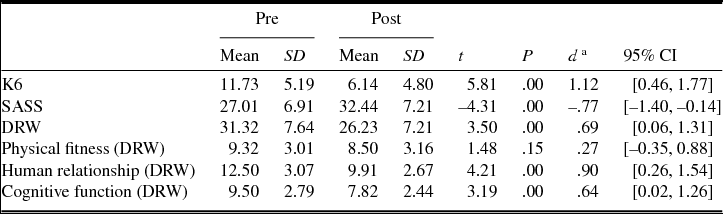
One participant dropped out, but 22 (13 males, 9 females; mean age = 40.68 years, SD = 8.37 years) successfully completed the intervention and RTW. K6, SASS and DRW scores were analysed with paired t-tests, and effect sizes were assessed (see Table 1). Although there was no significant improvement between pre-intervention and post-intervention in physical fitness (DRW), t (21) = 1.48, not significant, d = .27, 95% CI: [–.35, .88], there were significant improvements in most other areas.
Outcomes of work-focused cognitive behavioural group therapy

K6, Kessler-6; SASS, Social Adaptation Self-Evaluation Scale; DRW, Difficulty in Returning to Work Inventory. aCohen's d = .20 (small), .50 (medium), 0.80 (large).
Discussion
The results supported the hypothesis that our WF-CBGT programme is efficient for Japanese workers on leave due to depression. Particularly, depression symptoms and social adaptation improved, difficulty in RTW reduced, and all participants except the individual who dropped out were able to RTW. In Japan, approximately 45% of workers who took leave due to mental health problems used a system of leave at workplace whereby they could return to work; thus, it can be interpreted that the returning rate of workers participating in this programme was relatively high. The results were consistent with that of previous research, such as that on WF-CBT (Reme et al., Reference Reme, Grasdal, Løvvik, Lie and Øverland2015) validating the efficacy of CBT on RTW. Previous intervention studies in Japan (Tanoue et al., Reference Tanoue, Ito, Shimizu, Ohno, Shirai and Shimada2012) focused on improving depression symptoms, but they have not necessarily dealt positively with workplace problems. There is, however, no one-to-one relationship between disorder, symptom levels and work participation (Henderson et al., Reference Henderson, Harvey, Øverland, Mykletun and Hotopf2011), and focusing on workplace problems appears beneficial. Despite possibly being invasive in asking participants to report problems in previous workplaces and those that may arise after RTW, our programme may be effective because most participants successfully completed the intervention; however, additional research examining its effectiveness is essential.
Although the literature recommends evidence-based interventions such as CBT for workers on leave due to depression, empirical studies on its validity, especially in Japan, are lacking. Therefore, whether treatments for depression in the West can be effective in Japan is unclear. Thus our findings have important implications, suggesting that WF-CBT can valuably contribute to Japanese workers on leave due to depression, despite cross-cultural differences.
The research protocol of this study has several limitations. First, as there was no control group, the findings are inconclusive. For example, it took 367.09 days (SD = 305.90) to receive psychotherapy in the previous study (Tanoue et al., Reference Tanoue, Ito, Shimizu, Ohno, Shirai and Shimada2012), whereas the average duration of sick leave due to depression was 101.83 days (SD = 122.43) in this study. Since the score on K6 in the baseline period was higher than the cut-off score, although the severity was high, the relatively short leave duration may have influenced the positive effect. Second, we assessed symptoms using only self-report questionnaires rather than a structured clinical interview. Although we assessed symptoms and the possibility of RTW after intervention, its long-term effectiveness was not verified, because the symptoms and social adaptation after RTW were not evaluated. Third, because the first and second authors conducted the programme, its generalizability is unknown, as there may have been a therapist effect leading to over-estimation of the treatment benefit. Despite such limitations, our findings are encouraging because they indicate the effectiveness of a WF-CBGT programme in non-Western settings. Future research should examine the efficacy of this programme more systematically to continue developing evidence-based interventions.
Acknowledgement
We would like to thank Editage (www.editage.jp) for English language editing.
Conflicts of interest: The authors declare that they have no conflicts of interest.
Ethical statement: This research was conducted with the approval of the ethics committee of University of Ryukyus (approval number 373). The work complies with the ethical principles and code of conduct of psychologists stipulated by the APA.
Financial support: This work was supported by management expenses grants from University of Ryukyus.
Supplementary material
To view supplementary material for this article, please visit https://doi.org/10.1017/S1352465818000280




Comments
No Comments have been published for this article.