INTRODUCTION
Parasite-induced manipulation of host phenotype has become one of the most commonly cited examples of the ‘extended phenotype’, a concept introduced by Dawkins (Reference Dawkins1982) to identify the phenotype beyond an organism's own body. Extended phenotypes are an attempt to express the interacting genotypes of both the host and the parasite (Dawkins, Reference Dawkins1982, Reference Dawkins, Hughes, Brodeur and Thomas2012; Hughes et al. Reference Hughes, Kronauer and Boomsma2008; Lefèvre et al. Reference Lefèvre, Lebarbenchon, Gauthier-Clerc, Missé, Poulin and Thomas2009a ), even if the alterations in the host phenotypic traits can be at multiple levels and not always easily detectable. The result is a large range of phenotypic traits that can vary greatly in their magnitude, from simple changes in the host morpho-physiology and slight shifts in the percentage of time spent in performing a given activity to the production of complex, aberrant and sometimes spectacular phenotypes (Hurd, Reference Hurd1990; Poulin and Thomas, Reference Poulin and Thomas1999; Moore, Reference Moore2002; Thomas et al. Reference Thomas, Adamo and Moore2005; Hughes et al. Reference Hughes, Andersen, Hywel-Jones, Himaman, Billen and Boomsma2011).
Among the most extreme examples of parasitic manipulations of the host's phenotype are the changes induced by castrators (Baudin, Reference Baudin1975; Brown and Reed, Reference Brown, Reed and Beckage1997; Hechinger et al. Reference Hechinger, Lafferty, Mancini, Warner and Kuris2009; Lafferty and Kuris, Reference Lafferty and Kuris2009; Lefèvre et al. Reference Lefèvre, Adamo, Biron, Missé, Hughes and Thomas2009b ; Hartikainen and Okamura, Reference Hartikainen and Okamura2012). Parasitic castration is an adaptive strategy where the parasite usurps the host's reproductive physiology to complete its life cycle; the fitness of the host is reduced to zero. As a result, the castrated host is no longer a member of the host species but instead it is part of the parasite population: a ‘parasite in host disguise’ (Beckage, Reference Beckage and Beckage1997; Lafferty and Kuris, Reference Lafferty and Kuris2009).
Strepsiptera are an enigmatic group of parasitic castrators that ‘challenges the biological rule book’ due to several striking features: extreme sexual dimorphism, controversial phylogenetic position, and peculiar associations with a wide variety of insect hosts (Kathirithamby, Reference Kathirithamby1989, Reference Kathirithamby2009; Whiting et al. Reference Whiting, Carpenter, Wheeler and Wheeler1997; Huelsenbeck, Reference Huelsenbeck1998; Proffitt, Reference Proffitt2005; Pohl and Beutel, Reference Pohl and Beutel2008; McMahon et al. Reference McMahon, Hayward and Kathirithamby2011). Little experimental work has been carried out to study how Strepsiptera alter the phenotype of their hosts: one exception is the fascinating yet-not-fully investigated relationship between Xenos vesparum (Xenidae) and its primary host, the primitively eusocial wasp Polistes dominula (Hughes et al. Reference Hughes, Kathirithamby, Turillazzi and Beani2004a ). Infection begins with the entry of tiny triungulins (i.e. host-seeking first-instar larvae) into the immature stages of the wasp (Hughes et al. Reference Hughes, Beani, Turillazzi and Kathirithamby2003; Beani and Massolo, Reference Beani and Massolo2007; Manfredini et al. Reference Manfredini, Giusti, Beani and Dallai2007, Reference Manfredini, Massolo and Beani2010a ). At the conclusion of endoparasitic larval development, female and male X. vesparum differ remarkably: neotenic females are permanently associated with the host while males pupate within the host and then emerge from their puparia as winged insects, leaving the host's body in search of a receptive female (Beani et al. Reference Beani, Giusti, Mercati, Lupetti, Paccagnini, Turillazzi and Dallai2005). Different aspects of this peculiar parasite–host association have been studied over the years, spanning from the parasite strategies to overcome the immune defences of its host to the dramatic physiological and behavioural changes driven by the parasite in the female host to favour its own transmission (Strambi and Strambi, Reference Strambi and Strambi1973; Hughes et al. Reference Hughes, Kathirithamby, Turillazzi and Beani2004a ; Beani, Reference Beani2006; Manfredini et al. Reference Manfredini, Beani, Taormina and Vannini2010b , Reference Manfredini, Benati and Beani c , Reference Manfredini, Grozinger and Beani2013; Beani et al. Reference Beani, Dallai, Mercati, Cappa, Giusti and Manfredini2011).
Morpho-physiological changes induced by the parasite in the female wasp include smaller body size, higher fluctuating asymmetry, less broken facial pattern (Cervo et al. Reference Cervo, Dapporto, Beani, Strassmann and Turillazzi2008; Beani et al. Reference Beani, Dallai, Mercati, Cappa, Giusti and Manfredini2011; Tibbetts et al. Reference Tibbetts, Skaldina, Zhao, Toth, Skaldin, Beani and Dale2011) and, above all, castration. Regardless of the putative caste, parasitized females show undeveloped ovaries, reduced volume of corpora allata and lowered levels of juvenile hormone (Strambi and Strambi, Reference Strambi and Strambi1973; Strambi et al. Reference Strambi, Strambi and Augier1982; Beani et al. Reference Beani, Dallai, Mercati, Cappa, Giusti and Manfredini2011). However, very little attention has been given to the parasitic impact on the male phenotype of P. dominula, with the exception of a study that reports a different effect of the parasite on haemolymph protein levels in male wasps compared with females (Strambi et al. Reference Strambi, Strambi and Augier1982).
In the summer reproductive males of P. dominula gather in great numbers in lek-like aggregations in proximity to prominent landmarks where they try to acquire and defend a territory against their rivals: here they wait for weeks until females visit the aggregation (Beani and Turillazzi, Reference Beani and Turillazzi1988; Beani, Reference Beani, Turillazzi and West-Eberhard1996). Leks represent attractive sites for foraging workers and gynes (i.e. future queens), both healthy and parasitized by X. vesparum. Parasitized females leave their colonies before the emergence of the parasite and cluster in aberrant summer aggregations, usually at leks, where they stay inactive while the free-living winged X. vesparum males break their pupal cap and abandon their hosts to fertilize the permanently endoparasitic female (Hughes et al. Reference Hughes, Kathirithamby, Turillazzi and Beani2004a ; Beani et al. Reference Beani, Giusti, Mercati, Lupetti, Paccagnini, Turillazzi and Dallai2005). In a previous study we have shown that males are able to distinguish females of different putative caste, preferring gynes over workers; conversely, they are unable to recognize the presence of X. vesparum parasites in female partners and try to mate with them (Cappa et al. Reference Cappa, Bruschini, Cervo, Turillazzi and Beani2013). Preliminary field observations revealed that similarly to healthy individuals, male wasps parasitized by X. vesparum exhibit territorial behaviour, defending particular sites where they sexually interact with females (L. Beani personal communication). However, there is no information as to whether these males are somehow affected by the parasite in terms of their sexual behaviour and morpho-physiology. Here, we addressed this question by combining behavioural assays and morphological analyses. We used preference trials to investigate sexual behaviour in parasitized males and we characterized their reproductive apparatus to evaluate the effects of X. vesparum on the male phenotype. Since the parasite has dramatic effects on the physiology and behaviour of female hosts, our main goal was to investigate the impact of X. vesparum on P. dominula males to assess if male wasps were also affected by the parasite in terms of sexual behaviour or altered reproductive structures.
MATERIALS AND METHODS
Field collections and laboratory rearing
Polistes dominula males (N = 251) unparasitized (176) and parasitized (75) by X. vesparum were collected at the end of August in 2 consecutive years (2010 and 2011), from different natural lek systems located in the surroundings of Florence and housed in the laboratory (cubic glass cages of 15×15×15 cm) with water and sugar ad libitum.
Polistes dominula female wasps from different nests (N = 20) were collected in August 2010 at the end of the colony cycle, in the surroundings of Florence from four different populations. Nests were transferred to the laboratory, placed in nestboxes (cubic glass cages of 15×15×15 cm), and provided with water, sugar and fly maggots ad libitum. The wasps found on the nest at collection as well as newly eclosed individuals were marked with TESTOR's enamel paint (Strassmann, Reference Strassmann1981). All the newly emerged males were removed from each colony daily to prevent any sexual interaction with virgin females.
Female wasps were classified as (1) workers: females present on the nest at collection with evidence of wing wear as an index of foraging activity (Toth et al. Reference Toth, Bilof, Henshaw, Hunt and Robinson2009); (2) gynes: last generation female offspring pupated in the wild and eclosed in the laboratory at the end of August, either unparasitized or naturally infected by one X. vesparum parasite of either sex (N = 77, parasitized by one X. vesparum male = 42; parasitized by one X. vesparum female = 35). All female wasps used in our experiments were at least 2 weeks old.
Behavioural assays
To test male sexual preference, we selected two pools of males with similar body size, unparasitized (N = 40) and parasitized (N = 37, parasitized by one X. vesparum male = 21; parasitized by one X. vesparum female = 16). We sequentially presented each male with three females which differed for their reproductive potential: a worker (W), an unparasitized gyne (UG), and a parasite-castrated gyne (PG), coming from different nests. We chose to present these three categories of females since they represent the three options that a male can encounter on a lek. Furthermore, the occurrence of parasitized gynes represent a sort of natural experiment, because, despite belonging to the reproductive caste, their reproductive potential is compromised due to parasitic castration. Each session consisted of a set of three consecutive 5-min videotaped trials (Digital Video Camera Recorder, Sony DCR-SR35E), with a 2-min interval, during which every male was paired with one female in an observation arena (10 cm diameter Petri dish). In a previous study we showed that our experimental apparatus coupled with a short duration of each trial proved effective in evaluating male sexual preference (Cappa et al. Reference Cappa, Bruschini, Cervo, Turillazzi and Beani2013).
All trials were carried out in laboratory conditions between 11:00 a.m. and 3:00 p.m., which is the time window when males are more active in natural leks (Beani and Turillazzi, Reference Beani and Turillazzi1988; Beani, Reference Beani, Turillazzi and West-Eberhard1996). Male and female samples came from different populations to ensure no relatedness among test individuals.
All video-recordings were watched in slow-motion (0·25 s) by a viewer blind to the identity of the wasps. During trials males spent a consistent amount of time waving their antennae towards a female and following her or touching her body with their antennae (‘approaches’). These behaviours typically culminated with a copulatory attempt. Thus, we registered: (1) the duration of male approaches as a measure of male interest towards different females; (2) the number of ‘sexual interactions’, classified into grasps and attempted/successful copulations according to previous studies (Beani and Turillazzi, Reference Beani and Turillazzi1988; Liebert et al. Reference Liebert, Wilson-Rich, Johnson and Starks2010; Sen et al. Reference Sen, Samudre, Shilpa, Chitra Tarak and Gadagkar2010). We did not focus on the females’ behaviour since in our experimental set-up they were mainly inactive and scarcely interacting with males regardless of caste and state of parasitization (see Cappa et al. Reference Cappa, Bruschini, Cervo, Turillazzi and Beani2013).
Morphological analyses
To assess any possible effect of the parasite on male size, we measured the maximum head width of males with a stereo light microscope (Olympus SZX12) as a good proxy for body size (Eickwort, Reference Eickwort1969), in two random samples of unparasitized (N = 30) and parasitized males (N = 30, parasitized by one male X. vesparum, 17; parasitized by one female X. vesparum, 13). Body size represents a trait associated with the male ability to acquire and maintain a territory on a lek, and is therefore correlated with a male's reproductive success (Beani and Turillazzi, Reference Beani and Turillazzi1988).
Comparative morphological investigations were carried out in 30 mature males (i.e. active on leks) (N = 15 unparasitized, N = 15 parasitized, parasitized by one X. vesparum male = 9; parasitized by one X. vesparum female = 6). Specimens were dissected under an Olympus SZX12 stereo light microscope in a sodium phosphate buffer to which 3% sucrose was added (PB, 0·1 m, pH 7·2). Reproductive apparatuses were isolated and photographed in toto to observe the general morphology of testes, seminal vesicles and accessory glands. For histological preparations, the reproductive structures were transferred to 2·5% glutaraldehyde in PB overnight at 4 °C. After pre-fixation, the samples were rinsed in PB, post-fixed in 1% osmium tetroxide for 1 h at 4 °C, then washed in the same buffer as before, dehydrated in a graded series of ethanol, and embedded in Epon-Araldite resin. Semi-thin sections (1 μm) were cut with a Reichert Ultracut E ultramicrotome, mounted on glass slides, lightly stained with 1% toluidine blue, and viewed under a Leica DMRB interference contrast microscope. Images were taken with an Axiocam digital photocamera (Carl Zeiss).
Statistical analyses
Behavioural data on male preference towards females belonging to different groups were analysed with the non-parametric Friedman test for multiple comparisons of paired data. Post-hoc tests (Wilcoxon signed-rank tests) were used to assess if, and where, a significant difference existed between pairs of treatments with a P value of less than α/number of comparisons considered significant. Differences in males’ interest, sexual preference between unparasitized and parasitized males were analysed with a non-parametric Mann–Whitney U test for comparisons of unrelated data. Differences in body size between unparasitized and parasitized males were analysed with parametric T-test. All the statistical analyses were performed using SPSS® 16.00 for Windows (SPSS Inc., Chicago, IL).
RESULTS
Behavioural assays
In both years of collection, around 30% of sampled males were infected by X. vesparum (in 2010, 41 parasitized males out of 150, i.e. 27·3%; in 2011, 34 parasitized males out of 102, i.e. 33·3%).
Males spent significantly more time approaching gynes, regardless of their parasitization status, rather than workers (Table 1, Fig. 1a). Similarly, we observed a total of 218 sexual interactions for unparasitized males (34 sexually active males out of 40 tested, 85%) and 164 for parasitized males (30 sexually active males out of 37 tested, 81·1%) (Fig. 1b). The vast majority of them were directed towards gynes, regardless of the presence/absence of the parasite, rather than towards workers (Table 1, Fig. 1b). The sex of the parasite had no effect on the sexual behaviour of the parasitized male (Mann–Whitney test, N 1 = 21, N 2 = 16, Z = −0·456, P = 0·648).
Males’ behavioural responses towards the different groups of females per trial. There was no difference between unparasitized (N = 40) and parasitized males (N = 37) in terms of (a) time spent in approaches and (b) number of sexual interactions. White box plots = unparasitized males; grey box plots = parasitized males. Thick horizontal lines represent medians, boxes are upper and lower quartiles and whiskers indicate the highest and lowest values excluding outliers (asterisks).

Male sexual preference (Friedman test post-hocs: Wilcoxon signed rank test, α = 0·017)

G = gynes; W = workers; U = unparasitized; P = parasitized.
Overall, there were no differences in time spent approaching females (Fig. 1a) between unparasitized and parasitized males (Mann–Whitney U test, UG, Z = −0·827, N 1 = 40, N 2 = 37, P = 0·408; PG, Z = −0·999, N 1 = 40, N 2 = 37, P = 0·318; W, Z = −0·245, N 1 = 40, N 2 = 37, P = 0·807). Similarly the number of sexual interactions (Fig. 1b) did not differ between the two groups of males (Mann–Whitney U test, UG, Z = −0·426, N 1 = 40, N 2 = 37, P = 0·670; PG, Z = −0·277, N 1 = 40, N 2 = 37, P = 0·782; W, Z = −0·460, N 1 = 40, N 2 = 37, P = 0·645).
Morphological analyses
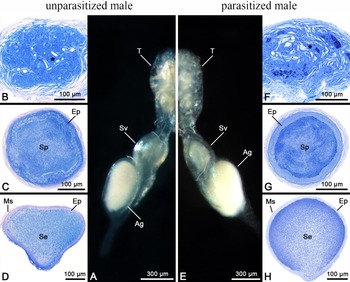
Unparasitized and parasitized males did not differ in their body size (t-test, F = 0·734, N 1 = 30, N 2 = 30, P = 0·395). The morphological comparison of the reproductive apparatus from unparasitized and parasitized males did not reveal notable differences regardless of parasite sex. In both conditions, stereomicroscope observations showed testes of moderate size (∼0·8×0·5 mm), well-developed seminal vesicles (∼0·7×0·4 mm) with a turgid appearance and a full lumen, and large ovoid accessory glands (∼0·6×0·3 mm) containing a secretion with a milkish white colour (Fig. 2A–E). In both unparasitized and parasitized males, histological preparations revealed that testes were strongly degenerated (M. Gottardo, R. Dallai, D. Marchini, F. Cappa, I. Petrocelli, F. Manfredini, L. Beani, unpublished results) and no longer contained germ and sperm cells (Fig. 2B–F). In cross-sections, seminal vesicles showed a wall consisting of a mono-layered epithelium, and a lumen completely filled with sperm cells (Fig. 2C–G). In semi-thin sections, accessory glands displayed very thin outer muscular layers surrounding a glandular epithelium. The wide lumen of the accessory glands is full of a secretion with granular appearance (Fig. 2D–H).
Morphological comparison of the reproductive apparatus from unparasitized (A–D) and parasitized (E–H) mature sexually active males of P. dominula. Stereomicrographs (A and E) show no significant difference in the general appearance of the reproductive organs of the two male types. Ag, accessory gland; Sv, seminal vesicle; T, testis. Cross-sections through testes (B and F) demonstrate the strong degenerative aspects (asterisk) typical of the mature male gonads. Semi-thin sections of seminal vesicles (C and G) show the well-developed epithelial layer (Ep) surrounding a vesicle lumen completely filled with sperm cells (Sp). Through cross sections of accessory glands (D and H), a thin outer layer of muscle fibres (Ms) and a glandular epithelium (Ep) are visible. The glandular lumen is full of granular secretions (Se).

DISCUSSION
In this study we characterize the impact of the parasitic insect X. vesparum on P. dominula male wasps. Our results show that males of P. dominula are not affected, in terms of morphology of the reproductive apparatus and sexual behaviour: they are found on leks and, once in the laboratory, retain their sexual behaviour and their preference for gynes over workers analogously to what is observed in non-parasitized males (Cappa et al. Reference Cappa, Bruschini, Cervo, Turillazzi and Beani2013).
The impact of Strepsipteran parasites on the male phenotype has probably been neglected in wasps for three main reasons. First of all, the vast majority of studies on social Hymenoptera focused on females, while males have always been considered small mating machines (Tsuji, Reference Tsuji1996), unworthy of deep investigation. Second, the focus of studies on this host-parasite interaction has been the curious gregarious behaviour of parasitized female wasps along the seasons: a crucial step in the life history of the parasite. Third, female wasps, especially the first generations of workers, were thought to be the main target of parasitic infection, since the release of the infective stage of the parasite was believed to happen only during spring (Hughes et al. Reference Hughes, Kathirithamby, Turillazzi and Beani2004a , Reference Hughes, Kathirithamby and Beani b ; Beani and Massolo, Reference Beani and Massolo2007): therefore males and gynes were believed to be marginally affected by X. vesparum. Recent field and laboratory evidence, however, support the presence of a bivoltine cycle of the parasite with a second release of infective triungulins during the summer hence targeting sexuals (i.e. reproductive individuals) (L. Beani and F. Cappa, unpublished data). In facts, the occurrence of parasitized males has been observed in different species of Polistes (Dunkle, Reference Dunkle1979; Hughes et al. Reference Hughes, Kathirithamby, Turillazzi and Beani2004a ).
The most intriguing aspect emerging from our study is that parasitized males exhibit a sexual behaviour typical of healthy individuals (Beani, Reference Beani, Turillazzi and West-Eberhard1996; Cappa et al. Reference Cappa, Bruschini, Cervo, Turillazzi and Beani2013), and that their reproductive apparatus is not irreversibly compromised by the parasite as in parasitized female wasps (Beani, Reference Beani2006; Beani et al. Reference Beani, Dallai, Mercati, Cappa, Giusti and Manfredini2011). This is totally different from what happens in females, where the presence of a single parasite is sufficient to drive abnormal behavioural changes (Beani et al. Reference Beani, Dallai, Mercati, Cappa, Giusti and Manfredini2011): as is the case with males, parasitized females are present in proximity of the nuptial arenas, but they are clustered in inactive aberrant aggregations (Beani and Turillazzi, Reference Beani and Turillazzi1988; Hughes et al. Reference Hughes, Kathirithamby and Beani2004b ; Beani, Reference Beani2006; Beani et al. Reference Beani, Dallai, Mercati, Cappa, Giusti and Manfredini2011). Parasitized females are transformed by the parasite into idle, gregarious ‘zombies’. They leave their colonies before the emergence of the parasite without performing any social task on the nest, and cluster in aberrant summer aggregations where the mating of the parasite occurs (Hughes et al. Reference Hughes, Kathirithamby, Turillazzi and Beani2004a ; Beani et al. Reference Beani, Giusti, Mercati, Lupetti, Paccagnini, Turillazzi and Dallai2005). Similarly to parasitized females, infected male wasps also gather at leks, but, unlike females, they do not form nor join the aberrant aggregations of parasitized wasps; instead, they try to defend territories and sexually interact with females as healthy males do (L. Beani, personal communication; Polak, Reference Polak1993). Once in the laboratory, during our trials, parasitized males showed no differences in the level of both sexual activity and mate choosiness when compared with unparasitized individuals.
From a morpho-physiological perspective, parasitized female wasps are smaller than unparasitized ones and have undeveloped ovaries, irrespective of parasite load and parasite sex (Beani et al. Reference Beani, Dallai, Mercati, Cappa, Giusti and Manfredini2011); in contrast, there was no difference either in body size or in the structure of the reproductive apparatus of our unparasitized and parasitized P. dominula males. Preliminary analyses also showed that there is no difference in sperm motility between parasitized and unparasitized individuals and that parasitized males are able to inseminate females (M. Gottardo, R. Dallai, D. Marchini, F. Cappa, I. Petrocelli, F. Manfredini, L. Beani, unpublished results). Based on our findings, we cannot exclude that the parasite might still have an impact on the reproductive success of male wasps, affecting, for example, survival, territory tenure ability or the probability of being chosen by lek-visiting females (Polak, Reference Polak1993). Since our parasitized males were collected on leks, there might be a bias towards those males capable of tolerating the infection; nonetheless, it is still remarkable that at least a segment of the male population is not affected either in behaviour or in morphology, whereas parasitized females are always dramatically affected by X. vesparum, regardless of parasite load and sex. Despite the controversy about the male as ‘the sicker sex’ (Zuk, Reference Zuk1990, Reference Zuk2009) and the current lack of physiological data about the pathological changes induced by parasites in male insects (for a review in invertebrates see Schmid-Hempel, Reference Schmid-Hempel and Schmid-Hempel2011; Retschnig et al. Reference Retschnig, Williams, Mehmann, Yañez, de Miranda and Neumann2014), we can hypothesize that neuroendocrine alterations are induced by X. vesparum in female but not male hosts (Strambi and Strambi, Reference Strambi and Strambi1973; Strambi et al. Reference Strambi, Strambi and Augier1982). Further investigations are necessary to assess the proximate mechanism responsible for the different phenotype alterations shown by P. dominula sexes. Moreover, the male reproductive apparatus might be altered by the parasite at the fine level of ultrastructure or biochemistry. Nonetheless, we can affirm that in terms of behavioural and morpho-physiological alterations, the male phenotype of P. dominula is much less affected by X. vesparum than the female phenotype.
The results that we obtained are even more remarkable if we take into account the fact that the order of Strepsiptera has always been regarded as an order of parasitic castrators and it is only more recently that an alternative view has been proposed to consider them at the boundary between parasites and parasitoids (McMahon et al. Reference McMahon, Hayward and Kathirithamby2011), due to the fact that castrated hosts are reproductively dead (Kathirithamby, Reference Kathirithamby2009). Our study indicates that neither of these definitions applies to P. dominula males parasitized by X. vesparum. They are not castrated nor is their sexual behaviour affected by the parasite; we also did not observe any modification of the host's lifespan, since all the males that we collected in the wild as well as the laboratory-eclosed individuals, both unparasitized and parasitized, died before the winter. Furthermore, parasitized males are not found in prehibernating and hibernating gatherings of female wasps (Beani, Reference Beani2006; Dapporto et al. Reference Dapporto, Cini, Palagi, Morelli, Simonti and Turillazzi2007). We think that our results provide a new perspective to discuss and maybe reconsider the traditional view of strepsipteran parasites.
A recent review by Duneau and Ebert (Reference Duneau and Ebert2012) underlines that differences in parasitic impact between host sexes may be explained in terms of parasite adaptations to the host sex more commonly encountered and with the longer lifespan. In Polistes colonies workers are numerically predominant and the main target of the first Xenos infection. Among sexuals, targets of the second Xenos infection, gynes live much longer than males, surviving the winter and representing the parasite vehicle in the following season. Thus, the intimate relationship between X. vesparum and P. dominula occurs mainly in the ‘female environment’ (Duneau and Ebert, Reference Duneau and Ebert2012; Duneau et al. Reference Duneau, Luijckx, Ruder and Ebert2012), and this could explain the dramatic differences in parasite-driven changes between sexes. In conclusion, our study offers new insights in the fascinating Xenos–Polistes coevolution, opening new scenarios of research.
ACKNOWLEDGEMENTS
The authors are grateful to Professor Mary Jane West-Eberhard and to an anonymous Reviewer for their helpful suggestions on an earlier version of the manuscript. We also thank Dr Rita Cervo, Professor Stefano Turillazzi and the members of the Florence Group for the Study of Social Wasps for their assistance during this study, both in the field and laboratory, and for fruitful discussions on the Xenos–Polistes system.
FINANCIAL SUPPORT
The study was funded by the University of Florence.