INTRODUCTION
Estrogen plays a key role in normal brain functioning, a finding that has led researchers to hypothesize that the increased risk of Alzheimer's disease (AD) in women may be related to the dearth of circulating estrogen in postmenopausal women. Although the results of research investigating the effects of ERT on AD have been disparate, studies have demonstrated that estrogen replacement therapy (ERT) may lower the risk of AD (Compton et al., 2001) and lessen the severity of AD after onset (Ohkura et al., 1995).
Along with memory loss, one of the earliest clinical signs of AD is olfactory dysfunction. The impairment in olfactory function is one of the earliest observable deficits in AD, likely due to the pattern of brain degeneration associated with AD. The research suggests that the development of the amyloid plaques and neurofibrillary tangles associated with AD occurs initially in brain regions responsible for olfactory functioning, such as the entorhinal cortex in the medial temporal lobe and the orbital frontal cortex (Price et al., 1991; Braak et al., 1996). The neurodegeneration has little effect on other sensory regions, which makes the sensory impairment in AD relatively specific to the olfactory system (Van Hoesen & Solodkin, 1994). Functional olfactory deficits in AD patients have been detected in a variety of olfactory tasks, including odor identification, odor sensitivity, and odor memory (Nordin & Murphy, 1998; Gilbert & Murphy, 2004b).
In recent studies, AD patients have demonstrated poor performance on recognition memory tasks for odor and visual stimuli relative to healthy, older adults. This memory impairment was more prominent for olfactory stimuli than for visual stimuli (Gilbert & Murphy, 2004b). These findings are most likely due to the combination of brain areas that are targeted early in the neural degeneration process in AD.
Estrogen has demonstrated several neuroprotective effects on the brain, including the stimulation of axon sprouting and connectivity as well as increasing dendritic spine density (Gould et al., 1990). Estrogen also stimulates cholinergic neuron growth and activity, neurons heavily involved in learning and memory. Estrogen also exerts neuroprotective effects by minimizing the formation of senile plaques and by the stimulation of nerve growth factor activity (Gibbs, 1998). Nerve growth factors are polypeptides that are expressed in the hippocampus and function in learning and memory (Gibbs, 1998). Lastly, studies have shown that estrogen may increase production of the Apolipoprotein ε, which contributes to the repair and growth of cell membranes (Srivastava et al., 1996).
Prior studies have provided some preliminary evidence that estrogen may mitigate in women (Deems et al., 1991) the olfactory loss associated with aging (Murphy et al., 2002). In light of the current findings on the associations between AD, olfactory dysfunction, and ERT, the present study chose to explore the effects of ERT on a higher-order olfactory functioning task, odor recognition memory, in women diagnosed with AD. Performance on an episodic recognition memory task for odors, faces, and unfamiliar symbols was compared between women with AD who took ERT for 1 year or more during or after menopause and women with AD who have never taken ERT but were comparable in age and demographic background. It was hypothesized that the AD patients who took ERT would perform significantly better on the recognition task for odors relative to the AD patients who have never taken ERT. It was further hypothesized that the difference in performance between the ERT users and non-users on the recognition memory task would be significantly greater for odor stimuli than for visual stimuli.
METHODS
Participants
Participants were volunteers in a longitudinal study at the Alzheimer's Disease Research Center (ADRC) at the University of California, San Diego (UCSD). The participants were recruited to the ADRC by means of the patient's spouses, referral from primary physicians, and from advertising within the community. Participants were diagnosed by two senior staff neurologists at the ADRC according to the criteria for primary degenerative dementia outlined in the DSM-IIIR and according to the criteria for probable AD developed by the NINCDS-ADRDA (McKhann et al., 1984).
Participants (n = 101) included women ranging in age from 53 to 90 years with an average age of approximately 74. All participants were given a diagnosis of probable or possible AD. Women were selected to participate by investigators who were blind to patient performance on cognitive or psychophysical tasks. The participants included in the estrogen group (n = 24) had used some form of ERT for at least 1 year, either during or after menopause or both. The method of self-report was used to determine information concerning history of ERT use. Information on duration and type of ERT use was available for some but not all of the participants. The remaining 77 participants had never used ERT and were labeled the no estrogen group.
Procedure
Odor threshold
Odor threshold was assessed for each nostril with a two-alternative, forced-choice, ascending method of limits design with the odorant butanol (Murphy et al., 1990). A series of 10 aqueous dilution steps was used, ranging from 349 ppb (dilution step 9) to 3055 ppm (dilution step 0). Each successive dilution was one-third the concentration of the preceding dilution. The stimuli, vapor phase from 60-ml solutions, were presented by means of 250-ml squeezable polyethylene bottles with pop-up spouts. The spout was inserted into the nostril of the participant for monorhinic testing. To avoid adaptation, the test began with the weakest concentration and progressed toward the higher concentrations, and trials were separated by 90 seconds. The order in which the odorant and blank were presented was randomized in each trial. In each trial, the participant was instructed to choose which of the two bottles contained the odorant. A correct choice led to presentation of the same concentration to a criterion of five consecutive correct choices. Threshold scores for the two nostrils were averaged together for analysis.
Recognition memory task
Recognition memory was assessed using a procedure developed by Murphy et al. (1991). The stimuli consisted of sets of (1) 15 household odors that were concealed in amber-colored jars, (2) 50 black and white oval bust pictures of American presidents and vice presidents printed on 9 × 8 cm cards (Clements, 1975), and (3) 50 abstract engineering symbols also printed on 9 × 8 cm cards. With the olfactory stimuli, participants were instructed to close their eyes while the odorant was presented directly under the nose. Before testing, 10 stimuli were randomly chosen from each of the three stimuli sets. Each of the stimuli was presented for 5 seconds, with a 10-second interval separating each of the stimulus presentations, which allowed for a 45-second interstimulus interval between each of the olfactory stimuli. Participants were not informed that a recognition memory test would follow the presentation of stimuli.
Immediately after the stimuli presentation session, participants were presented with 10 odors, 10 faces, and 10 symbols. Five stimuli from each set were randomly selected out of the pool of the 10 previously presented stimuli (old) and five were selected from the remaining pool of stimuli (new). Participants responded to whether each stimulus was old or new. The interval between the initial inspection of a stimulus and its presentation for recognition averaged 20 minutes.
To characterize task performance, the number of hits (responding “old” to an old stimulus), misses (response of ‘new’ to an old stimulus), correct rejections (response of “new” to a new stimulus), and false-positive errors (response of “old” to a new stimulus) were recorded for each participant. Because hits are inversely related to misses, and false-positive errors are inversely related to correct rejections, only hits and false-positive errors were entered into the analysis. The recognition memory data also were analyzed using standard signal detection theory procedures to measure discriminability (d′) and bias (Macmillan and Creelman, 1991). The raw number of hits and false-positive errors were transformed into conditionalized rates. A linear Z transformation was applied to the hit and false-positive error rates to convert the rates into a Z score. The d′ measure was then calculated using the formula d′ = [Z(HR) − Z(FR)]. The sensitivity measure characterizes the ability of a participant to discriminate old stimuli from new stimuli. The hit and false-positive error rates also were used to calculate the bias measure (c) defined as c = −0.05[Z(HR) + Z(FR)]. The c measure characterizes the tendency of a participant to favor one response over another.
RESULTS
Demographic Data and Level of Dementia
A multivariate analysis of variance (MANOVA) was used to analyze significant mean differences between the estrogen group and the no-estrogen group in demographic characteristics (age and years of education), odor threshold scores, as well as scores on the Dementia Rating Scale (DRS) and Mini-Mental State Examination (MMSE). Only the DRS scores significantly differed, with higher scores in the estrogen group.
Recognition memory
A group (estrogen group, no-estrogen group) by stimuli (odors, faces, symbols), multivariate analyses of covariance (MANCOVA; summarized in Table 1) was used to analyze mean differences in recognition memory between the estrogen group and the no-estrogen group.
Results from a group (estrogen group, no-estrogen group) by stimuli (odors, faces, symbols), multivariate analyses of covariance, with mean DRS scores entered as the covariate, analyzing mean differences in the hit and false-positive error (FPE) measures

Mean DRS scores were entered as a covariate into the MANCOVA to control for the significant difference in DRS scores between the estrogen and no-estrogen groups. The MANCOVA revealed no significant differences in hit rate for all task stimuli; however, the no-estrogen group committed a significantly greater number of false-positive errors for olfactory stimuli relative to the estrogen group (Figure 1). This significant difference for false-positive errors was not present for visual stimuli.

The mean number of false-positive errors for olfactory and visual stimuli in the estrogen group versus no-estrogen group. Error bars represent standard errors.
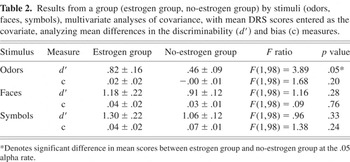
The mean d′ and c scores for the estrogen and no-estrogen groups on recognition memory for odors, faces, and symbols was assessed using a group (estrogen group, no-estrogen group) by measure (d′ odors, c odors, d′ faces, c faces, d′ symbols, c symbols) MANCOVA with mean DRS scores entered as a covariate. The results are presented in Table 2. The MANCOVA revealed a significantly higher mean d′ score in the estrogen group for olfactory stimuli relative to the no estrogen group. However, no significant differences existed in mean d′ scores between groups for visual stimuli.
Results from a group (estrogen group, no-estrogen group) by stimuli (odors, faces, symbols), multivariate analyses of covariance, with mean DRS scores entered as the covariate, analyzing mean differences in the discriminability (d′) and bias (c) measures.

DISCUSSION
The results demonstrate that performance of an episodic recognition task was indistinguishable between the estrogen and no-estrogen groups for the visual stimuli. However, the data support the hypothesis that the estrogen group would perform significantly better than the no-estrogen group on the recognition memory task for odor stimuli. The facilitated task performance observed in the estrogen group with the odor stimuli was not apparent in the hit rate; however, the estrogen group committed significantly fewer false-positive errors for olfactory stimuli relative to the no-estrogen group.
The significantly higher mean d′ score exhibited by the estrogen group for olfactory stimuli indicates that the estrogen group demonstrated a greater ability to discriminate between old and new olfactory stimuli than the no-estrogen group. The c measure showed no significant differences between the estrogen and no-estrogen groups, which suggests that response bias did not contribute to the difference in d′ scores between groups for odor stimuli.
The data suggest that ERT had a beneficial effect in AD patients on recognition memory that occurred specifically for olfactory stimuli. The hippocampus and entorhinal cortex are responsible for episodic memory formation of polymodal stimuli; however, olfactory memory may be particularly vulnerable to degeneration of the hippocampus and entorhinal cortex. This vulnerability is likely due to the significant inputs these brain regions receive from sensory olfactory domains. Therefore, the potential effect of estrogen on the hippocampus and entorhinal cortex is likely to be reflected in less early olfactory memory impairment in women with AD. The location of estrogen receptors also may contribute to the positive effect associated with ERT that occurred specifically for odor stimuli because they are located in brain regions responsible for olfaction and episodic memory formation (Osterlund & Hurd, 2001).
The tendency toward false-positive errors demonstrated by AD patients may be due to poor memory encoding and compromised semantic networks (Davis et al., 2002). The hippocampus is one of the primary brain regions responsible for encoding episodic memory. The entorhinal cortex also functions in the formation of episodic memory due to its role as the main afferent projection to the hippocampus. This damage to the hippocampus and entorhinal cortex in AD patients is likely to result in an insufficient ability to encode specific characteristics of olfactory stimuli. AD patients may poorly encode olfactory stimuli using only general properties of the stimuli that are shared by many of the distractor stimuli (Gilbert & Murphy, 2004a). The poor encoding makes distinguishing between target and distractor stimuli difficult and may lead to more false-positive errors. The possible neuroprotective effect that estrogen has shown on the hippocampus and entorhinal cortex may mitigate this deficit in odor encoding ability.
The estrogen and no-estrogen groups were matched on demographic variables and an analysis of covariance was used to adjust for differences in DRS scores. However, although an improvement was observed in odor recognition memory in the estrogen group, one cannot assume a cause and effect relationship. The possibility cannot be excluded that ERT use may be associated with lifestyle characteristics or health-related attributes that may be responsible for the performance differences exhibited in the recognition memory task between groups. Another possible limitation of the present study is the potential for faulty recall of drug histories in female AD patients. The current study was unable to investigate any possible differential effects of the various hormone combinations on recognition memory task performance due to small sample size and the unavailability of information concerning ERT type.
The results of research on the effects of ERT on AD have been disparate. For example, a recent clinical trial failed to demonstrate a positive effect of ERT on behavioral symptoms in AD (Thal et al., 2003) and another demonstrated other health risks associated with ERT (Shumaker et al., 2003). Additional research is needed to investigate the potential neuroprotective effect of ERT on other cognitive and behavioral abilities in both AD patients and nonsymptomatic older individuals. It is hoped that the results of the current study will contribute to the ongoing investigation of the complex relationship between AD and ERT and offer insight into the types of cognitive and sensory functions that may benefit from ERT use in female AD patients.
In conclusion, the current study indicates that female AD patients who reported a history of ERT demonstrated significantly fewer false-positive errors on a measure of odor recognition memory relative to female AD patients who never used ERT. The results of this study provide additional support for olfactory deficits in AD and suggest that ERT may be beneficial in mitigating these deficits. However, ERT has been found to convey some health risks; therefore, routine use of ERT is not justified at this time. Future studies examining the neuroprotective role of ERT in other cognitive abilities in both AD patients and nonsymptomatic individuals appear warranted.
ACKNOWLEDGMENTS
This research was supported by NIH grant numbers AG04085 (Claire Murphy) and P50 AG05131 (UCSD Alzheimer's Disease Research Center). We gratefully acknowledge Drs. Leon Thal, David Salmon, and the patients and staff at the UCSD ADRC.