Introduction
Every ballot is, from expressive and instrumental perspectives, the sum of the pleasures, benefits, frustrations, and damages the voter associates with it each time they reflect upon the performance of the voted party or policy outcomes (Brennan and Hamlin, Reference Brennan and Hamlin1998). If consequences and responsibilities can be assigned (Key, Reference Key1966), instrumentally rational voters update their party preferences and vote choices in line with the ‘running tally’ (Fiorina, Reference Fiorina1981). Furthermore, voters can assess new information without ideological bias and display an open-mindedness that matches their value orientations toward politics rather than partisan identification, that is, ‘value voting’ (Knutsen, Reference Knutsen1995). The explanatory potential of ‘evaluation-based’ partisanship seems fairly high outside the United States, especially in the multiparty systems of Western Europe where the Netherlands is the quintessential example (Rosema, Reference Rosema2006), providing substantial clues about voting behavior in the younger democracies from the post-communist region (Tóka, Reference Tóka1998).
Does this ‘evaluative-based’ choice apply when large segments of the electorate perceive political actors (i.e. parties and politicians) as highly incompetent and corrupt? Two theoretical answers are possible. On the one hand, irrespective of spread and generalized disappointment, the explanation should function as long as people consider protest to be a value in itself (Hirschman, Reference Hirschman1970). On the other hand, starting from the human quest for the lesser evil, only a reduced degree of party loyalty can magnify – through the selective use of information – insignificant differences, reinforcing previous antipathies and contributing to further polarization (Bartolini and Mair, Reference Bartolini and Mair1990; Kim, Reference Kim2009). In this respect, given the intrinsic subjective nature of perceptions, voters are more inclined to exaggerate the misdeeds of officials from opposing parties and underestimate those of their preferred politicians. Partisan allegiance has been shown to act as a filter for the perception of corruption (Anderson and Tverdova, Reference Anderson and Tverdova2003).
The ideal setting to identify the validity of these answers is the Central and Eastern European region where, despite visible successes at domestic (e.g. important economic growth, political stability) and international levels (e.g. North Atlantic Treaty Organization (NATO) and European Union (EU) accessions) parties continue to be negatively perceived by the population. Levels of public confidence rarely exceed 15% (Candidate Countries Eurobarometers, 2001, 2002, 2003; Standard Eurobarometers, 2004, 2005, 2006, 2007), making the political parties the least trusted political institutions in the region. Consequently, the electoral instability that characterizes the countries where these political parties compete may not come as a surprise. A quick look at the governments of these countries indicates that there are few cases when the same party is reelected. Moreover, of the few hundred political parties competing in elections for two decades, less than one fifth have seen continuous success in legislative elections (Gherghina, Reference Gherghina2008). Their high levels of electoral volatility, when compared with the Western European countries (Rose et al., Reference Rose, Munro and Mackie1998; Lewis, Reference Lewis2000; Birch, Reference Birch2001; van Biezen, Reference van Biezen2003; Sikk, Reference Sikk2005) substantiate the previous observation.
Building on these theoretical and empirical premises, we test whether corruption perceptions and evaluations of party performance increase gross electoral volatilityFootnote 1 (i.e. individual-level swings of votes in consecutive elections) in the most likely environment for the occurrence of such mechanisms. We select two post-communist democracies – Bulgaria and Romania – characterized by broadly shared doubts about politicians’ honesty. These two most recent members of the EU are generally perceived as the most corrupt member states; the media exposure of corruption scandals and the reports of the EU Commission have reinforced this widely held belief. Accordingly, the citizens of these two states share the same understanding of corruption as one of the most acute problems of their societies (Transparency International, 2000, 2004, 2009) to a great extent.Footnote 2 The research question this paper seeks to answer is: How do generalized perceptions of corruption and evaluations of party performance affect the party loyalty of voters in Bulgaria and Romania? In doing so, we use descriptive statistics and multivariate analysis (logistic regression) with individual-level data from the comparative study of electoral systems (CSES) Module 2. We distinguish between voters for parties in government (i.e. that govern or are included in the government coalitions) and in opposition since different logics of reward and punishment function for each.
The first section sets the theoretical framework of our analysis by summarizing the findings of previous studies and formulating testable hypotheses. The second section discusses the selection of the countries and the research design (data, operationalization, and method). This is followed by a brief overview of the political context in which the elections took place and of the general features observed in the two samples. The analysis per se contains an in-depth discussion of each dimension and its explanatory power for this study. Finally, the conclusion provides answers to the puzzle and points to further directions of study.
What drives volatility?
One key concept used in this paper is ‘voter loyalty’, referring strictly to electoral choice in two consecutive elections. Voters are loyal when in election t 1 they make the same electoral choice (i.e. cast their votes for the same political party) as in election t 0. Electoral volatility occurs when the voters change their preference (i.e. the dependent variable of our study). The interplay between voters, parties, representatives, and the political system is the appropriate ground to understand the causes of electoral volatility. There are two specific dimensions in which its relevance can be analyzed. First, whenever institutional political actors persuade citizens to vote for them in a series of elections (i.e. party loyalty), they integrate voters into the democratic project (Dalton and Weldon, Reference Dalton and Weldon2007: 180). Thus, accountability increases (Grzymala-Busse, Reference Grzymala-Busse2003) and the quality of representation is enhanced by diminishing the demagogic politicians’ room for maneuver (Converse and Dupeux, Reference Converse and Dupeux1962). A stable preference for a political actor is likely to imply a functioning representation linkage: voters reward the implementation of the actions they expected from parties. The latter are aware of such a cycle and in order to maximize benefits must show even greater responsiveness to societal needs and consistent policies (Andeweg and Thomassen, Reference Andeweg and Thomassen2005). Once these tasks are fulfilled, the political space closes to existing actors without allowing newcomers to exploit existing issues or promote new ones.
Second, volatility raises the stakes of the electoral game, and the likelihood of elite switching across competing parties is higher as office-holders target reelection (Birch, Reference Birch2003; Enyedi, Reference Enyedi2006; Heller and Mershon, Reference Heller and Mershon2009). In other words, elite and voter loyalty toward the party are mutually reinforcing (Millard, Reference Millard2004). In this sense, a long-term attachment usually favors party (system) stability (Mainwaring and Zoco, Reference Mainwaring and Zoco2007), where the patterns of competition are well established and the number of entries and exits is limited (Spirova, Reference Spirova2007). In the Central and Eastern European (CEE) political environment characterized by pronounced electoral vulnerability the relevance of such reasons is further augmented.
What explanations were provided for changes of voting preferences between elections? On the one hand, the traditional approach of party identification focuses on its origins, that is, parental socialization (Greenstein, Reference Greenstein1965; Easton and Dennis, Reference Easton and Dennis1969) and its stability over time (Campbell et al., Reference Campbell, Converse, Miller and Stokes1960). On the other hand, the revisionist approach explains change by looking at how performance evaluations and shifting policy preferences (Fiorina, Reference Fiorina1981; Franklin, Reference Franklin1984; Niemi and Jennings, Reference Niemi and Jennings1991; Tavits, Reference Tavits2007) modify party loyalties. Unlike most existing research, we suggest that the impact of corruption perceptions on electoral choice should also be adopted as a specific branch of the revisionist theory. The explanatory potential of both traditional and revisionist theories is empirically tested for Bulgaria and Romania. Following previous findings (Rose and Mishler, Reference Rose and Mishler1998), we expect the latter approach to be more appropriate to the fluid electorates in the investigated countries.
However, the first theory we test singles out party identification as the key determinant of vote choice. Two conceptual interpretations of party identification are possible: (a) an enduring psychological affinity between the individual and the party (Campbell et al., Reference Campbell, Converse, Miller and Stokes1960); (b) a specific orientation toward short-term policy preferences and evaluations which influence vote choice (Miller and Shanks, Reference Miller and Shanks1996). Irrespective of its conceptual nuances, the logical mechanism is the same: individuals who identify with a party tend to support it in elections. In the CEE context, party identification is unlikely to occur for a few inter-connected reasons: open and available electorates, lack of alignment patterns, the numerous entries and exits in the party system, and the absence of stable constituencies (Mair, Reference Mair1997; Rose and Mishler, Reference Rose and Mishler1998; van Biezen, Reference van Biezen2003; Spirova, Reference Spirova2007; Gherghina, Reference Gherghina2008). To avoid conceptual stretching, we use the term ‘party closeness’ to reflect the ideological attachment of voters to one party. This is a soft version of party identification in that we do not assume long-term attachments to the party. Instead, we focus on the ideological proximity between voters and parties at specific moments. Despite such conceptual nuances, we expect to reach a similar result where citizens perceiving themselves to be close to a certain party cast their votes for it. Changes in party attachments are quite possible in the future, but for the short-term investigated effect this lacks relevance:
H1: Citizens feeling closer to a party are likely to be loyal voters.
The revisionist theory should work better in the analyzed context because the parties that emerged in the atomized post-communist societies could not secure long-term attachment. This happened because they did not reflect significant structural (class, cultural, or ethnic) cleavages (Kitschelt et al., Reference Kitschelt, Mansfeldova, Markowski and Toka1999), at least nothing comparable to the ‘freezing thesis’ of Lipset and Rokkan (Reference Lipset and Rokkan1967). The only divide, which hardly approximated a cleavage, that is, ‘communist vs. anticommunist’, rapidly lost its importance, especially after the first economic hardships. Instead, voters developed pragmatic attitudes and updated their preferences in accordance with party performance.
The evaluations were thus also dependent on the voters’ expectations and the information available to them. As people generally have higher expectations from the government and because of increased media exposure, voters of an incumbent party are more likely to base their voting choice on performance evaluations (Przeworski et al., Reference Przeworski, Stokes and Manin1999). However, this does not imply that voters of opposition parties completely ignore the behavior of their representatives between elections. They could legitimately expect those parties to do their best to scrutinize the governing coalition and act as whistleblowers were the latter to abuse its power or implement detrimental policies. Thus we expect that:
H2a: Respondents satisfied with the performance of the previously voted party are more likely to maintain their electoral preferences.
Compared to other voters, citizens who have voted for parties participating in government will have more or fewer incentives to switch votes, depending on their assessment of the quality of governance, that is, governing outcomes as public goods delivered by the government.Footnote 3 These goods could target the entire population (e.g. national security) or only the constituents of the government parties, in which case one can speak of clientelism. The latter is another important reason for which we hypothesize that:
H2b: Satisfaction with the performance of the previously voted party is more likely to matter for the current electoral choice in the case of incumbent parties’ voters, rather than for opposition voters.
If evidence supports hypothesis 2b and retrospective voting in the context of political elites perceived as colonizing state resources has a greater impact on incumbents, then this should be a normatively desirable outcome as it favors electoral accountability. However, constantly switching votes and having an ‘anti-incumbency bias’ (Pop-Eleches, Reference Pop-Eleches2007: 12) creates disincentives for performing better (Roberts, Reference Roberts2009: 36–37) and encourages political elites to abandon sinking parties, and boost further the volatility of the system (Tavits, Reference Tavits2008). However, if opposition voters also critically assess the performance of their favorites, all these concerns would be considerably diminished.
As mentioned before, we treat corruption perceptions as an integral part of the revisionist theory of partisanship. Although citizens might not have sufficient information and the necessary skills to judge the success or failure of certain macroeconomic policies implemented by governments, they can certainly react more easily to corruption scandals and re-evaluate their partisanship accordingly.
Only a few studies have connected the broad topic of corruption perceptions with voting behavior and partisan loyalty. We do not include here the extensive literature on which electoral system is more susceptible to corruption (Kunicova and Rose-Ackerman, Reference Kunicova and Rose-Ackerman2005; Chang and Golden, Reference Chang and Golden2006). In the United States, scholars have focused more on effects at the level of individual politicians than on parties, that is, by analyzing how corruption charges influence voting for specific candidates in congressional elections (Peters and Welch, Reference Peters and Welch1980; Welch and Hibbing, Reference Welch and Hibbing1997) or presidential contests (Fackler and Lin, Reference Fackler and Lin1995). Using panel data from the Polish Panel survey, Slomczynski and Shabad (Reference Slomczynski and Shabad2009) illustrate how perceptions of specific party corruption (as opposed to general allegations directed toward the government or elected officials) influence vote choice. However, the gap in the literature remains broad while available findings are ambiguous and derived from single-case studies. Conversely, we know that widespread perceived corruption is a key determinant of decisions to refrain from voting and disengage from politics altogether (Sandholtz and Taagepera, Reference Sandholtz and Taagepera2005).
As corruption perceptions are usually directed differently toward governments and the parties participating in them, one would expect these perceptions to affect the loyalty of incumbent and opposition voters differently. There are two opposing views in the literature. The first maintains that membership in the political majority diminishes the importance attached to corruption of current governments significantly. This happens either because information is interpreted according to political predispositions, or because these voters are likely to receive clientele benefits (the most important work on this issue is the cross-national study by Anderson and Tverdova (Reference Anderson and Tverdova2003); see also Manzetti and Wilson (Reference Manzetti and Wilson2007). The second perspective argues that, on the contrary, corruption perceptions can be one of the several elements contributing to the mobilization of opposition voters, while for government supporters they are the key element in the decision to switch (Davis et al., Reference Davis, Camp and Coleman2004: 678–680). This approach appears to characterize the selected countries: there is a widespread inability of parties to secure the kind of political support that would ensure their presence in government for consecutive terms. There are only isolated examples – mostly actors representing ethnic minorities – of parties governing or participating in coalition governments twice in a row, indicating continuous loss of support by the parties in government irrespective of their label. In such a context, we expect corruption perceptions to be responsible for demobilizing incumbents’ supporters compared to the rest of voters:
H3: Perceptions of widespread corruption decrease the loyalty of incumbents’ voters.
Apart from the hypothesized effects presented above, we have also controlled for the effects of age (see Franklin and Jackson, Reference Franklin and Jackson1983), education, and household income on the probability of switching or sticking with vote choices.
Research design: data, cases, variables, and method
Our analysis is conducted at individual level as all variables in the hypotheses are either evaluations or perceptions of citizens. We use survey data from the CSES – Module 2 (2001–06). They refer to the Bulgarian national parliamentary elections in 2001 (and 1997 for the previous vote choice) and to those held in Romania in 2004 (and 2000, accordingly). The analysis considers only those respondents that also voted in the previous election. As we are interested in the odds of switching votes, that is, a dichotomous dependent variable, we use binary logistic regression.
As individual responses provide variation for all tested factors, the major task was to select the ideal setting in which the hypothesized effects occur. In this respect, we focus on Bulgaria and Romania as these countries share at least four general similarities, mostly derived from the fuzzy power transfer during regime change (Innes, Reference Innes2002: 86). First, they are perceived as suffering from chronic corruption, an issue that delayed their accession to the EU with the Eastern European wave of 2004, and their entrance into the Schengen area in 2010. Objective indicators (World Bank, 2010a, World Bank, 2010b, EU Commission Report, 2004, 2009, 2010) and opinions of citizens (Transparency International, 2000, 2004; Flash EuroBarometer 236, 2008) have been consistent on the issue over an extended period of time. Second, both countries used the same closed list proportional representation (PR) electoral system with similar thresholds: 4% for Bulgaria and 5% (for single parties with up to 10% for coalitions) in Romania. Thus, the institutional framework transforming votes into seats and its implications for the strategic calculations voters faced amounted to almost identical opportunity structures.Footnote 4 Third, the electoral cycle analyzed is an example of a ‘third generation election’, since it ‘occurred after at least two different ideological camps had governed in the post-communist era (and when) voters suddenly faced a shortage of untried mainstream alternatives’ (Pop-Eleches, Reference Pop-Eleches2007: 3). Fourth, both political systems are characterized by a weak level of voter identification with a party (Kitschelt et al., Reference Kitschelt, Mansfeldova, Markowski and Toka1999; Sum and Bădescu, Reference Sum and Bădescu2004). In line with all these aspects, we expect to observe similar causal mechanisms in the two countries examined.
The dependent variable of the study – party loyalty – is the similarity of the vote cast for a political party in consecutive elections. Its coding requires a few explanations. For example, if in the Bulgarian 1997 elections, voters chose the Union for National Salvation and in the 2001 elections, they cast a vote for the Movement for Rights and Freedoms (MRF), we considered their vote unchanged as MRF was the most important party in the 1997 coalition. The same applies to the Bulgarian Socialist Party (BSP) in 1997 and the Coalition for Bulgaria (2001; see the description of political actors in the following section). For Romania, we have a similar situation with Romanian Democratic Convention (CDR) 2000 and the Christian-Democratic National Peasant Party (PNTCD) in 2004. The loyalty ‘verdict’ also holds where, having voted for either the National Liberal Party (PNL) or the Democratic Party (PD) in 2000, the voter then chose the Truth and Justice Alliance (DA) in 2004. Several parties and coalitions kept their names for both electoral cycles and thus it was much easier to identify continuity in voting behavior. This is the case with the Union of Democratic Forces (UDF) and EUROLEFT coalitions in Bulgaria and the Alliance of Democratic Hungarians in Romania, the Greater Romania Party (PRM), and the alliance between the Social Democratic Party (PSD) and the Humanists/Conservatives in Romania.
The performance of the party previously voted for is assessed through a straightforward question asking for the respondent's evaluation according to a 4-point scale ranging from a ‘very good job’ to a ‘very bad job’ (see Appendix). The ‘closeness to a party’ variable is a dummy reflecting the answers of respondents about whether they felt close to a particular party. The corruption perception is measured on a 4-point scale ranging from ‘very widespread corruption’ to ‘no occurrence’. Education and household income are ordinal variables for which we used distinct categories (see Appendix).
The political context and general findings
All the Bulgarian governments in the first decade after the collapse of communism were formed of either left-wing coalitions dominated by the successor party, BSP, or by right-wing coalitions lead by the UDF. However, by 2001 both big actors lost most of their appeal. The corruption allegations against Kostov's UDF cabinet were supplemented in the electoral campaign by accusations of imposing high taxes while unable to fight rampant unemployment (Harper, Reference Harper2003: 335). In this volatile context, the appearance of the NSM (National Movement Simeon II), which was formed only 2 months before the elections – in April 2001 – was bound to make a difference. The former Czar's party cleverly adopted a discourse that emphasized national unity at the expense of partisan rivalries and advanced a program that promised considerable improvement of living standards in 800 days (Harper, Reference Harper2003: 336). As a result, NSM II won a landslide victory, whereas the ‘traditional’ left and right coalitions lead by the BSP and UDF together obtained only 35.4% of all votes.
The 2000–04 social-democratic (PSD) government in Romania, and the Prime Minister Adrian Năstase, in particular, were broadly perceived by the public and Western audiences as involved in highly corruptFootnote 5 acts and as taking steps to limit the freedom of the mass media. Not surprisingly, this was one of the major topics stressed by the opposition in the campaign (Downs and Miller, Reference Downs and Miller2006: 409, 415). However, the bad reputation was not limited to the government as 83% of respondents in May 2004 Public Opinion Barometer indicated that Romania faced ‘generalized corruption’ and that the politicians are ‘the most corrupt and untrustworthy social category’ (Pârvulescu, Reference Pârvulescu2004: 11). This can be interpreted as a sign of general dissatisfaction occurring after all mainstream variants had been tried and the large protest vote for the extremist PRM did not bring anything positive. The most important difference with the Bulgarian case resides, however, in the ‘political offer’ available to voters. Thus, no completely new party managed to match the popularity of the NSM. In fact, one alternative (in the sense of people not previously involved in politics, proposing reforms and a fight against corruption) did appear at the 2004 elections – URR (the Union for the Reconstruction of Romania), a party formed by a group of young Western-educated businessmen and professionals. However, despite receiving the support of some of the country's cultural elites they did not even manage to enter Parliament. It could even be said they had no chance to do so, precisely because of the successful manner in which the two older parties (PNL and PD) had governed Romania together with other parties between 1996 and 2004 and re-branded themselves as the ‘Alliance of Truth and Justice’ whose main rhetoric was one of anti-statist populism (Chiru, Reference Chiru2010). The concept is introduced by Kitschelt (Reference Kitschelt2002) as the discourse of demonizing governing elites for their incestuous relationship with the state, (i.e. clientelistic spoliation of resources and patronage politics) and presenting the market (i.e. minimal state, deregulation) as the only solution possible.
The turnout in the two electoral cycles was similar. In the 1997 Bulgarian elections, 58.87% of the voters went to the polls and five parties/coalitions won seats, while in 2001, the turnout was 66.8% and four parties passed the threshold. For Romania, the turnout figures were 65.3% in 2000 and 58.9% in 2004 (Popescu and Hannavy, Reference Popescu and Hannavy2001). The six parties that entered the 2000 Parliament secured representation in 2004 as well, while no other party managed to pass the threshold.
One further similarity is the weak level of voter identification with any one party: 43% of the Bulgarian respondents and 38% of the Romanians mentioned that they felt somehow close to a political party.Footnote 6 Similar percentages thought their views were represented by at least one party. It can be easily concluded from these figures that the level of partisanship as identification in the two electorates is relatively weak. This is an important condition for what is being tested – since the focus lies on the importance of evaluations of party performance on loyalty, which in turn necessitates electorates that are not structurally captive to any political grouping.
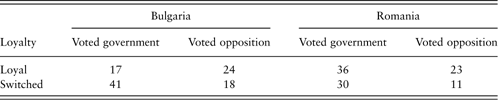
With respect to the dependent variable, aggregate figures indicate that party loyalty is much higher in the Romanian case. A total of 855 respondents in the Bulgarian sample declared that they voted in both 1997 and 2001, while 40% stuck to their first choice.Footnote 7 A total of 856 people in the Romanian sample voted in both elections – 60% of them being considered ‘loyal’. These differences are not canceled out at the aggregate level, that is, in terms of the scope of the change they produced. Hence, if in Bulgaria the former Czar, Simeon II's, newly created movement managed to win the elections, in Romania an alliance new only in name – composed of mainstream parties which had governed before in a wider coalition between 1996 and 2000 – managed to come second after the governing party. This shows once again that the ‘choice’ available to the voters and the credibility of new options are the crucial elements leading to different outcomes in the elections. Table 1 illustrates the distribution of respondents’ loyalty and their previous vote for the party that formed the government or the opposition. As can be seen, the proportion of those who switched after previously voting for the incumbent party is higher in Bulgaria.
Loyalty across government and opposition parties
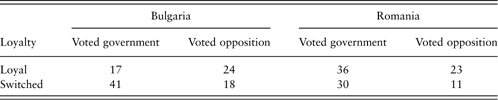
Table entries are percentages out of the total number of respondents voting in both elections.
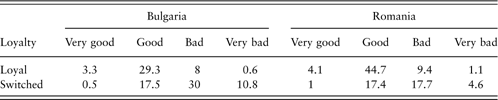
Table 2 presents the distribution of respondents according to their loyalty and their evaluations of the performance of the parties for which they voted previously. The first observation to note is that Bulgarian voters were much more critical than those from Romania: almost half of them judged the performance of their party as either bad or very bad, as opposed to only 33% of their Romanian counterparts. Second, one could wonder whether the almost 9% of Bulgarian respondents and more than 10% of Romanian respondents that did not switch despite negatively evaluating their party's performance remained loyal because of the lack of alternatives, or whether they are real die-hard supporters who would never consider switching an option.
Party performance evaluations and voters’ loyalty
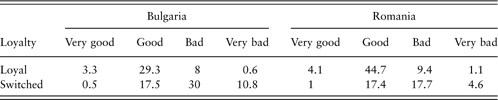
Table entries are percentages out of the total number of respondents voting in both elections.
Findings
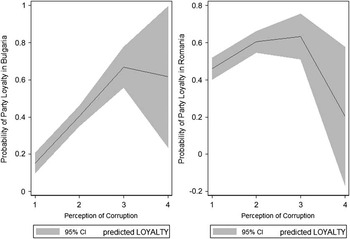
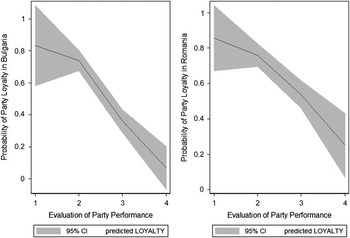
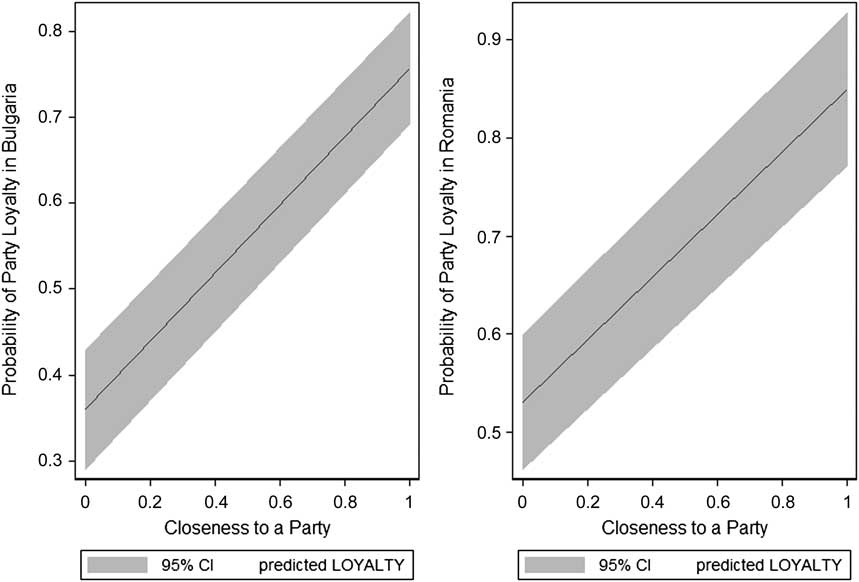
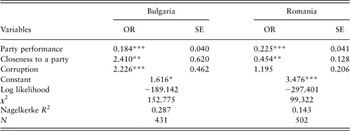
The logistic regression models include only those respondents who provided complete information on all variables.Footnote 8 As different logics of reward and punishment function for voters of the parties that governed as opposed to those of the parties that remained in opposition, we tested separately for the determinants of party loyalty in the two categories. In order to better understand the results, Figures 1–5 below present the impact that public perceptions of party performance, closeness to a party, and corruption have on vote loyalty in the two countries comparatively. The graphs are two-way fit plots – fractional polynomial with 95% confidence intervals. The first model (summarized in Table 3) tests for the variables’ effects on the party loyalty of voters that chose the party, which formed the government after the last elections. It is relatively impressive how high and significant the constant term is – just by showing up at the polls the Romanian citizens are already three times more likely to stick with the same party they chose 4 years earlier. In the Bulgarian case, this effect is smaller and less significant.
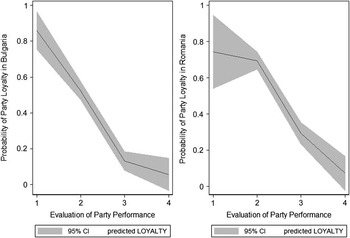
Performance of (government) party and loyalty.

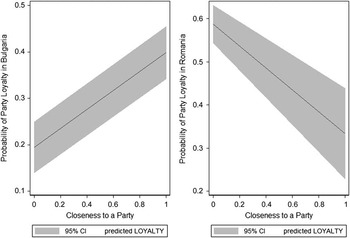
Identification with the incumbent party and loyalty.

Corruption perceptions and party loyalty.

Performance of opposition party and loyalty.

Identification with an opposition party and loyalty.
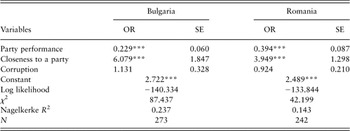
Logistic regression for the party loyalty of government voters

Significance at *P < 0.05, **P < 0.01, ***P < 0.001.
A large and strong effect in the model for the Bulgarian elections is provoked by evaluations of how well (or how badly) the government party performed since the last election in the eyes of its voters. Thus, switching one category – from a ‘good’ to a ‘bad job’ evaluation, for example, means the respondent is more than five times (5.43***) less likely to vote for the same party again.Footnote 9
The situation repeats itself to a larger degree in the Romanian test: the assessment of the party's performance is an excellent predictor of party (dis)loyalty for the government voters. Accordingly, a move downward on the scale of satisfaction more than quadruples the chances of switching to another party (4.44***). Figure 1 highlights the similarity of the variable's impact in the two national contexts, a similarity which was to be expected given the very bad image the UDF and PSD acquired throughout the legislative term and which cannot be separated from the records of the Kostov and Năstase governments.
The identification of a voter with a party, that is, whether the respondent's declared closest party was the same as the one he voted for in the election under examination, also proved to be an important predictor of loyalty in the two countries, although with an important distinction regarding the direction of the effect. A vote consistent with the self-reported party closeness more than doubles the chances the UDF voter will remain loyal (2.41**).
In Romania, the closeness effect did not run in the intuitive direction, that is, a lack of identification doubled the voter's chances of loyalty (2.2**) – see Figure 2 below. This is quite puzzling and suggests either a pragmatic vote or is a consequence of measurement errors, as only 15% of the PSD respondents satisfied the ‘closeness’ conditions.
Finally, perceptions of how widespread corruption is affect voting decisions in a manner which is not trivial for the Bulgarian test only, as shown by the values of the ORs in Table 1. Consequently, the likelihood of loyalty doubles (2.26***) when one switches, for example, from seeing corruption as ‘very widespread’ to perceiving it as ‘quite widespread’. Therefore, the direction of the effect corroborates the corresponding hypothesis. In the Romanian case, corruption is the only variable in the model, which does not acquire statistical significance, the OR being very close to 1 (1.19). Figure 3 presents the variable's impact in the two national contexts. Note that the extreme ‘broadening’ of the two confidence intervals between the values 3 and 4 is due to the fact that only a minority of the respondents sees corruption as ‘not at all widespread’.
The natural explanation for the difference in the two countries is that in 1997 many of the UDF voters voted for Europeanization/political and economic reforms and favored a divorce from the corrupt communist past (Crampton, Reference Crampton1997), but were extremely disappointed with what they received. Moreover, this Western-oriented public was captured by the appearance of the NMS II, which was considered as a credible, untainted alternative as opposed to the dishonest records of the previous self-proclaimed ‘reformist parties’.
On the other hand, the PSD voters’ lack of concern with corruption when casting their ballots can also be explained in terms of expectations. What mattered most for these voters at the time was social security issues and the charisma of the country's president, Ion Iliescu, who publicly endorsed the PSD and declared Adrian Năstase his legitimate successor.
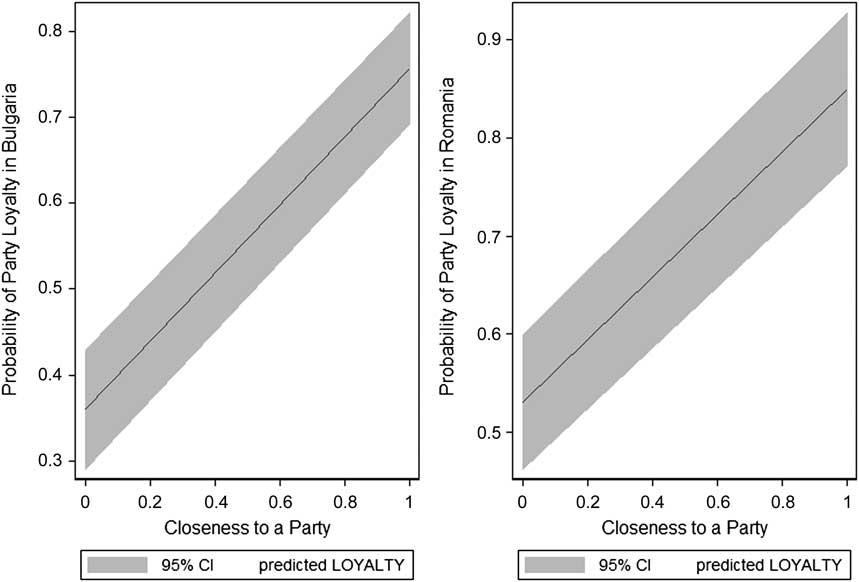
In the second model, we replaced the observations based on the answers of those respondents that previously voted for the ‘government’ with those of the opposition voters,Footnote 10 while keeping the same variables. The results confirm the assumption of the different impacts these factors have when controlling for the government/opposition status of the respective party (Table 4).
Logistic regression for the party loyalty of opposition voters

Significance at *P < 0.05, **P < 0.01, ***P < 0.001.
The effects of voter evaluations regarding how well the party voted for had performed since the last election are indeed smaller for the loyalty of ‘opposition’ voters than for the ‘government’ supporters, as hypothesized. Thus, switching one category – from a ‘good’ to a ‘bad job’ evaluation, for example, makes the Bulgarian respondent more than four times (4.36***) less likely to vote for the same party again. The same decrease in satisfaction reduces the chances of party loyalty for the ‘opposition’ voter in Romania by two and a half times (2.53***).
Despite being smaller than their equivalents in model 1 the ORs are still quite high and statistically significant. This finding shows that in both Bulgaria and Romania, voters are critically assessing their previous choices and acting accordingly irrespective of whether their party of choice was part of the governing coalition or not. From a normative point of view, this situation can be interpreted positively as it suggests that opposition parties too would be exposed to punishment were they to perform badly, and that the ‘anti-incumbency bias’ might be balanced out in the long run.
The most salient finding of the model is the degree in which identification/closeness can successfully predict party loyalty for opposition voters in both countries. A consistent vote with the self-reported party closeness makes the Bulgarian respondent more than six times (6.07***) less likely to switch to another party, while the loyalty chances of Romanian respondent quadruple (3.94***). It seems that being in opposition to governments perceived as corrupt and inefficient considerably reinforced voters’ identification with their parties and consequently boosted their loyalty.
Last but not least, corruption perceptions do not affect the party loyalty of opposition voters in either of the two countries, corroborating the corresponding hypothesis. The result indicates that corruption is still associated almost exclusively with the parties that govern – although one might legitimately think that all parliamentary parties dispose of a basis for patronage or clientelistic deals.
The control variables of age, gender, education, and household income did not have any significant effect on the chances of party loyalty in either of the models. These non-effects are in themselves important findings, since they support previous empirical results about the weakness of party loyalty or identification based on structural sociodemographic characteristics in the young post-communist democracies (Tóka, Reference Tóka1998). In addition, they matter indirectly by showing that the impact patronage politics and clientelism is believed to exert on the partisanship of certain social categories in these countries – pensioners, poorer and less educated citizens, which one would expect to be loyal or the natural constituencies of the successor communist parties (see e.g. Kitschelt, Reference Kitschelt2001: 304, 314–316) – is much more complex and subject to specific interactions. Therefore, it cannot be captured with survey data of this sort.
Conclusions
This article illustrates how evaluations of party performance and corruption perceptions have a major impact on the voting options of Romanian and Bulgarian electorates. We were inspired by the theoretical argument according to which corruption perceptions should be treated as an important part of the revisionist theory of partisanship.
The first key finding refers to the degree to which retrospective evaluations of party performance matter for party loyalty among both opposition and government voters, even in contexts where responsibilities are often blurred and the general dissatisfaction with parties and (rent-seeking) politicians is omnipresent. However, the party performance evaluations do not say much about the deeper roots of the types of party loyalty observed. They could very well be instrumental assessments based on satisfaction with policy outcomes, but could also be derived from sympathy-driven projections caused by certain politicians’ charisma/slip-ups and thus the fuel of expressive voting. Unfortunately, the data set did not offer a basis for testing such nuances. Nevertheless, the results presented by our article do argue convincingly in favor of the utilization of the ‘revisionist model’ of party identification as the prime theoretical choice in voting behavior studies in the region.
The article makes a second important contribution by testing for the first time in a European comparative setting for the impact corruption perceptions have on party loyalty. As the effect proved significant for the Bulgarian case, one might legitimately wonder if things are not similar in other new democracies, be they post-communist or Latin American. A further direction of study would be to look at how the corruption perceptions of individual parties (as opposed to general perceptions of the political system) shape partisanship, but in a cross-national context with a much larger number of cases where corruption is objectively more widespread. A third contribution of this paper is to reveal a certain salience for opposition voters’ loyalty of identification as closeness to a party, that is, very similar to the traditionalist perspective of party identification on grounds of psychological affinity. It would be extremely interesting to explore further the basis of this emotional attachment, since primary evidence shows that it is something independent of voters’ sociodemographic characteristics.
Whereas the recurrent tendency to change electoral preferences implies the existence of political alternatives – crucial for the two countries examined – in the medium and long run such attitudes generate side effects that harm the political system. Our results reveal how political stability can be achieved through increased performances of the political parties in government. Citizens react positively to the accomplishments of incumbents, being sensitive to changes in salient societal issues (i.e. the economy and corruption). Accordingly, the political elites who are responsive toward voters’ priorities are rewarded with electoral loyalty. The latter is highly valued in an environment characterized by high uncertainty on the political scene. In this respect, our analysis emphasizes one possible explanation for the numerous entries and exits from the Bulgarian party system.
The overall inherent limitations for generalizations from a two country analysis within an electoral cycle are acknowledged, but at the same time, we consider that they are compensated for by the exploratory potential and pioneering effort of this paper, which proposes a theoretically driven, easily replicable model. Another problem stems from the self-reporting aspect of the data analyzed. Four years is a long time, and a number of voters might have forgotten for whom they had voted previously, or might have ‘adjusted’/‘rationalized’ the choice in terms salient at the moment of the survey interview. Some of these worries were alleviated by consistency checks. A more important limitation is derived from the possibility that the assessments of the previously voted party's performance would be ad hoc self-serving justifications of a random decision to switch votes. This possibility can only be excluded through repeated observations, meaning a subsequent study using panel data. In this way, the above-mentioned uncertainty about the deeper bases of these assessments could also be resolved.
Acknowledgments
We are grateful to Gabor Toka and the four anonymous reviewers of the journal for their constructive criticism on earlier versions of our manuscript.
Appendix Variable codebook