


Introduction
Global trends in the misuse of prescription and over-the-counter (OTC) opioids are driven by prescribing trends, forms of patient self-medication and public availability (Collins and McAllister, Reference Collins and McAllister2006; Cooper, Reference Cooper2013a). Misuse definitions vary, but are broadly defined as ‘the use of a medicine, with or without a doctor's prescription, clearly outside of accepted medical practice or guidelines, for recreational purposes or in the framework of self-medication, in greater dosages or for longer periods than were prescribed, in which the risks and problems associated with use outweigh the benefits’ (Casati et al., Reference Casati, Sedefov and Pfeiffer-Gerschel2012, p. 230). Public misuse and potential for misuse of codeine-containing medicines in particular has received attention in recent times in Australia, the UK, Ireland, France and South Africa (McAvoy et al., Reference McAvoy, Dobbin and Tobin2011; Stannard, Reference Stannard2013; Tobin et al., Reference Tobin, Dobbin and McAvoy2013; Nielsen et al., Reference Nielsen, Roxburgh, Bruno, Lintzeris, Jefferson and Degenhardt2015c). Codeine, or 3-methylmorphine, is a short-acting, weak to mid-range opiate (Tremlett et al., Reference Tremlett, Anderson and Wolf2010). Codeine-containing medicines are available (at the time of writing) in OTC formulations for the symptomatic relief of mild to moderate pain or cough (Derry et al., Reference Derry, Karlin and Moore2013), and at varying strengths per country regulatory regime (Van Hout and Norman, Reference Van Hout and Norman2015c).
Typical side-effects of codeine include euphoria, altered perceptions and emotional responses to pain, and sedation, and development of tolerance within relatively short time-frames on repeated use (Romach et al., Reference Romach, Sproule, Sellers, Somer and Busto1999; Sproule et al., Reference Sproule, Busto, Somer, Romach and Sellers1999; Frei et al., Reference Frei, Nielsen, Dobbin and Tobin2010; Nielsen et al., Reference Nielsen, Cameron and Pahoki2010; Babalonis et al., Reference Babalonis, Lofwall, Nuzzo, Siegel and Walsh2013). Harms relating to excessive and/or long-term use of codeine-containing medicines are well documented (Robinson et al., Reference Robinson, Robinson, McCarthy and Cameron2010), and often occur in individuals with no history of substance use disorders or co-morbidity (Van Hout et al., Reference Van Hout, Bergin, Foley, Rich, Rapca, Harris and Norman2014). Clinical profiles vary and are distinct from other opiate dependents, but include all ages, genders, alcohol and poly-substance users, and patients with chronic pain and/or underlying psychiatric conditions (Myers et al., Reference Myers, Siegfried and Parry2003; Nielsen et al., Reference Nielsen, Bruno, Carruthers, Fischer, Lintzeris and Stoove2008; Otto et al., Reference Otto, Crackau, Lӧhrmann, Zahradnik, Bischof, John and Rumpf2009; Robinson et al., Reference Robinson, Robinson, McCarthy and Cameron2010; Thekiso and Farren, Reference Thekiso and Farren2010; Nielsen et al., Reference Nielsen, Cameron and Lee2011; Agyapong et al., Reference Agyapong, Singh, Savage, Thekiso, Finn, Farren and McLoughlin2013; Roussin et al., Reference Roussin, Bouyssi, Pouche, Pourcel and Lapeyre-Mestre2013; Nielsen et al., Reference Nielsen, Bruno, Murnion, Dunlop, Degenhardt and Demirkol2015a,Reference Nielsen, Murnion, Dunlop, Degenhardt, Demirkol and Muhleisenb). Problematic codeine users do not easily recognize problematic use or dependence, and view themselves as different to other substance abusers (Romach et al., Reference Romach, Sproule, Sellers, Somer and Busto1999; Pates et al., Reference Pates, McBride, Li and Ramadan2002; Nielsen et al., Reference Nielsen, Cameron and Pahoki2010; Cooper, Reference Cooper2013b; Marr and Hill, Reference Marr and Hill2015; Nielsen et al., Reference Nielsen, Bruno, Murnion, Dunlop, Degenhardt and Demirkol2015a).
Building on this ‘uniqueness’, we used concept mapping (Liese and Esterline, Reference Liese and Esterline2015) to apply Liese and Franz's (Reference Liese, Franz and Salkovskis1996) cognitive developmental model of substance abuse to the accounts of two groups of individuals from Ireland (Van Hout et al., Reference Van Hout, Horan, Santlal, Rich and Bergin2015b) and South Africa (Van Hout et al., Reference Van Hout, Rich, Dada and Bergin2015d) that experienced codeine use, misuse and dependence. Concept mapping according to Liese and Esterline (Reference Liese and Esterline2015) advocates case mapping which when shared with the patient, can function as an intervention to support behaviour change by presenting methodical generated graphic representations of the client's dynamic relations and pathways towards substance dependence. Ultimately this mapping exercise could be used to better integrate specific cognitive and behaviour change strategies for those experiencing codeine misuse and dependence, and for therapists to better understand the unique challenges of this OTC opiate drug as it relates to the role of feelings and emotions as influences for use, environmental influences on behaviour change, and limits of self-control (Borland, Reference Borland2014). We chose the model designed by Liese and Franz (Reference Liese, Franz and Salkovskis1996) as it is compatible within current opiate substitution treatment (OST) and harm reduction approaches to treatment (Liese, Reference Liese and Straussner2014).
Method
Aim
The aim of this study was to apply Liese and Franz's (Reference Liese, Franz and Salkovskis1996) cognitive developmental model of substance abuse to the in-depth narrative accounts of two samples of individuals from Ireland and South Africa experiencing codeine misuse and dependence. Ethical approval in South Africa was granted by the Ethics Committee of the South African Medical Research Council, and by the Waterford Institute of Technology and the National Drug Treatment Centre Board (NDTCB) in Ireland. Both studies were conducted in two very distinct regulatory regimes and aimed to garner unique individual and collective lived experiences of codeine misuse and dependence, from purposive samples of adult codeine misusers and individuals dependent on codeine (actively misusing and in recovery) in Ireland (n = 21) and South Africa (n = 25). Sampling for both the Irish and South African studies continued until saturation of the data occurred. We utilized extant narratives from these national studies and applied Liese and Franz's (Reference Liese, Franz and Salkovskis1996) cognitive developmental model of substance abuse to concept map a cognitive behavioural analysis of the experiences of codeine misusers – which ‘surfaces’ their specific beliefs, thoughts, emotions and behaviours.
Selection of participants
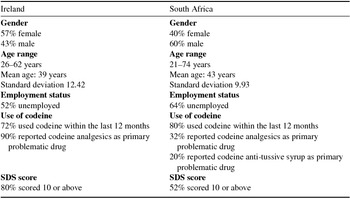
Recruitment of participants was facilitated by the National Head Office of the South African National Council on Alcoholism and Drug Dependence (SANCA) and the NDTCB in Ireland, which oversee national addiction treatment systems in the respective countries. Both national treatment organizations nominated key gatekeepers in each treatment centre to provide their patients with information on the research study, and to ask if they wished to partake in an interview. Informants were eligible for interview if they were: citizens of the country in which the research was conducted (Ireland or South Africa), 18 years of age or more, reported using codeine in excess of accepted medical guidelines, and scored five or more on the Severity of Dependence Scale (SDS) (Gossop et al., Reference Gossop, Darke, Griffiths, Hando, Powis, Hall and Strang1995), a measure of the psychological components of codeine dependence; a score of five or more on the SDS has been found to identify problematic codeine use with a high degree of accuracy (Nielsen et al., Reference Nielsen, Cameron and Pahoki2010). The demographic profile of the participants is reported in Table 1.
Participant profile

Interviews
Interviews lasted between 30 and 90 min, and were conducted in treatment and private settings. The interview guide was developed based on the literature contained in an extensive scoping review on codeine conducted by the team (Van Hout et al., Reference Van Hout, Bergin, Foley, Rich, Rapca, Harris and Norman2014). Questions centred on participant choices and decision making to use codeine (prescribed or over-the-counter), experience of sporadic and continued codeine use and misuse, reinforcers for use, misuse and dependence, sourcing, awareness of risk and abuse potential, adverse consequences and accessing of treatment services.
Analysis
Narratives were combined and analysed using the Empirical Phenomenological Psychological (EPP) five-step method (Karlsson, Reference Karlsson1995). This method was used to interpret the meaning structure of lived psychological phenomena relating to the subjective codeine misuse and dependence experience. A dialectic understanding of the whole picture and its part-components was used to create an incremental understanding of the relationship between the individual and the codeine-containing medicine. Above the thematic level, higher levels of abstraction were grounded in user lack of awareness of habit-forming use, self-legitimization of use and the pre-empting of physical pain, management of emotional distress, and the invisible and isolating nature of dependence.
Psychological model of codeine misuse and dependence
Shaffer, LaPlante and Nelson (Reference Shaffer, LaPlante and Nelson2012) and Shaffer et al. (Reference Shaffer, LaPlante, LaBrie, Kidman, Donato and Stanton2004) view addiction as a syndrome with common causes, multiple opportunistic expressions, and with shared neurobiological and psychosocial antecedents and experiences. This syndrome is cognisant of the role of individual characteristics, drug used, and environmental factors influencing transitions from use to misuse, and ultimately development of dependence. West (Reference West2005, Reference West2013), whilst recognizing the heterogeneous nature of mechanisms underlying addiction, underscores the effect of motivational dysfunction through the unstable presence of responses, reflexes, impulses/inhibitory forces, desires, evaluations (beliefs), and overarching plans that interact with the individual's internal and external environment. Addictive behaviours (such as misuse of codeine) are viewed by Beck et al. (Reference Beck, Wright, Newman and Liese1993) as emerging from interplay between layers and levels of substance-related (anticipatory, relief-oriented and permissive) and facilitative beliefs, and high-risk situations that activate automatic thoughts, and feelings of urges and cravings to use, within a cycle of addiction.
A complex interaction between cognitions (beliefs, thoughts, schemas), opinions, expectations, values, suppositions, behaviours, emotions, social relationships, cultural influences and physiological processes occurs (Alford and Nocross, Reference Alford and Nocross1991; Beck and Alford, Reference Beck and Alford2000). Beck's cognitive model of addiction underpins cognitive therapy for substance use, through behavioural strategies centring on avoiding high-risk situations, finding new coping mechanisms, and working with substance-related beliefs. In Beck's model, the expectancies of substances are a key difference between those using problematically and those not, and with dysfunctional beliefs playing a role in the generation of urges (Beck et al., Reference Beck, Wright, Newman and Liese1993; Liese and Franz, Reference Liese, Franz and Salkovskis1996), with beliefs and expectancies interacting with the emotional, environmental and physiological systems, and facilitating the development and maintenance of the disorder (Liese et al., Reference Liese, Beck, Seaton, Brook and Spitz1999).
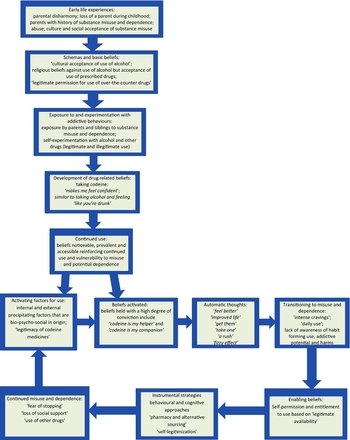
The model, presented in Fig. 1, applies Liese and Franz's (Reference Liese, Franz and Salkovskis1996) cognitive developmental model of substance abuse, to concept map the cognitive behavioural analysis of the distinct and unique experiences of codeine misusers – which ‘surfaces’ their specific beliefs, thoughts, emotions and behaviours around misuse and dependence on the legitimately used OTC opiate drug, codeine. Liese and Franz's (Reference Liese, Franz and Salkovskis1996) model includes a developmental component preceding the point of continued use activated by ‘activating stimuli’ (see Fig. 1). These earlier factors include early life experiences, development of schemas, basic and conditional beliefs, exposure to and experimentation with substances and the development of drug-related beliefs. This developmental process can influence potential vulnerability for codeine use, misuse and dependence. Seven stages are then depicted in the model of acute periods of codeine use, misuse and dependence with individuals not necessarily following a linear trajectory through the stages identified. The stages are: (1) activating stimuli for codeine use; (2) beliefs activated; (3) automatic thoughts; (4) transitioning to codeine misuse and dependence (urges and cravings); (5) enabling beliefs; (6) instrumental strategies; and (7) continued codeine misuse and dependence (see Fig. 1).
Cognitive developmental model depicting use, misuse and dependence of codeine containing medicines (adapted from: Liese and Franz, Reference Liese, Franz and Salkovskis1996)

Developmental stages of use and misuse
The developmental component before point of ‘continued use’ (see Fig. 1) explores early life experiences, development of schemas, basic beliefs, exposure to and experimentation with substances and the development of drug-related beliefs. Early life experiences reported by participants centred on the ‘loss of a parent’ as a child and the emotional isolation experienced (South African male, 45 years); ‘parental disharmony’ (South African female, 43 years; Irish male, 31 years) and its negative impact on children; history of parents with substance misuse and dependence (South African male, 47 years; Irish male, 31 years; Irish female, 42 years); parental physical and emotional abuse of children (South African male, 36 years; South African male, 47 years; Irish male, 31 years); history of childhood behavioural problems and the use of medications to manage such challenging behaviours (South African male, 42 years); ‘religion’ and associated beliefs formed and held that alcohol was forbidden but it was acceptable to use drugs that were legitimately available to purchase OTC (South African male, 45 years); to the ‘culture of sports’ and the social acceptance for some sports, for example, ‘rugby’ and its association with ‘alcohol use and misuse’ (South African male, 37 years).
Such early life experiences led some participants to develop beliefs that negatively impacted upon them, for example feeling ‘emotionally isolated’ resulted from parental loss, or having ‘low self-esteem’ and feelings of worthlessness as a consequence of physical and emotional abuse from parents who misused or were dependent on substances. Exposure to and experimentation with substances occurred with many individuals reporting exposure ranging from parental or sibling addictions to alcohol, nicotine and other substances to participants themselves experimenting in the past as teenagers and young adults with ‘ecstasy, . . . speed, (Irish female, 26 years) cannabis’ (Irish female, 26 years; Irish male, 38 years; Irish female, 42 years) and ‘cocaine’ (Irish male, 50 years) to their own legitimate use of OTC and prescribed medications for physical conditions related to pain symptomology.
Specific positive drug-related beliefs were developed and maintained in relation to initial codeine use. For example, some participants described how initial use of codeine-containing medicines would make them feel more socially ‘relaxed’ (South African male, 37 years; South African male, 41 years; South African male, 47 years; South African male, 74 years) similar to the effects of alcohol, and also would enhance their self-confidence. One 31-year-old male Irish participant describes how:
‘I was never confident enough. . . to just go out and talk to people. . .. And then when I was out, I used to take codeine and. . . I would be very chatty. It's almost like you're drunk. . .’
A 42-year-old male Irish participant highlights how over time he increased his use of codeine to sustain feelings of confidence as were previously experienced:
‘. . . three. . .just twenty four [codeine tablets] until they were gone but then I was getting to [the] sixties and I wasn't getting the effect anymore, well I was getting it a bit but I wasn't. . . as confident as I would be, . . .[then]. . . stretching up to eighty four [codeine tablets]. . .’
In sum, early life experiences, social norms and schemas about the cultural acceptability of drugs, combined with exposure to and experimentation with addictive behaviours appears to lead to positive beliefs about codeine, which reinforces continued use.
Activating factors
We distinguish between internal and external precipitating factors that predispose the person to risk for using codeine-containing medicines. Internal precipitating factors occur within the individual, while external factors are contextualized beyond the individual's psychobiography and are situated either within relational or social contexts, or both. Examples of internal factors are bio-psycho-social in origin and include individuals experiencing physical pain, emotional distress, depression, anxiety, stress-related conditions, low self-esteem and a sense of an ‘internalized loss’ of control resulting from adverse life events and the use of codeine for reducing the perceived impact of psychological trauma.
External precipitating factors could include adverse life events such as lone parenting, unemployment, marital and relationship disharmony and divorce. These experiences of ‘internalized loss’ lead to relational conflict within social networks, often resulting in social isolation and loss of support networks. Such internal and external precipitating factors are situated within a wider context of the ‘legitimacy’ status of codeine products, ‘advertising of products’, ‘pharmacy availability’ and ‘over the counter’ access to codeine-containing medicines.
Beliefs activated
Many codeine-dependent individuals do not realize they are dependent. Anticipatory and relief-oriented beliefs are formed as a consequence of internal and external activating factors. Anticipatory beliefs that are convincingly held focus on the efficacy and pleasures associated with use and misuse, whereby codeine is viewed as ‘my helper’ and ‘companion’. The presence of emotional pain and self-legitimization of use is a common belief.
‘Pain killers are not just for what is written on the back of the pack, they should add also pain relief from anxiety, depression and heartache.’ (Irish female, 26 years)
Automatic beliefs that codeine-containing medicines can ‘manage discrete episodes of physical pain’, ‘deny or suppress psychological symptoms’ and ‘lift up moods’ are held. Such beliefs range from relief-oriented beliefs, and involve the expectation of reprieve from physical and emotional symptoms, for example helping them to relax, to beliefs relating to mood elevation and regulation. Such automatic or involuntary thoughts sustain the convincingly held beliefs that ‘codeine is my helper’ and ‘codeine is my companion’.
‘I wasn't expecting the high I got but I was very happy with its effects, it felt like the missing piece to my life.’ (Irish female, 26 years)
Automatic thoughts
Involuntary or automatic thoughts are described as a consequence to deeply held beliefs, such as ‘codeine is my helper’ and ‘codeine is my companion’. Such beliefs contribute to the development of the role of codeine as ‘crutch’, ‘friend’ and ‘helper’ in correspondence with dependence and to the detriment of ‘real life social relations’. Automatic thoughts triggered that are brief and spontaneous in relation to such basic beliefs include ‘feel better’, ‘improved life’, ‘get them’ and ‘a rush’. As two Irish participants stated:
‘I always deep down knew I was abusing it but some of my thoughts were, so what? It's serving you a purpose, it's making life better, it's only an over the counter drug. I used it for just under a year’ (Irish male, 30 years)
‘I used to take it [codeine tablets] then just to make myself feel better. When I used to get up and feel crap, I'll take it and feel instantly better. That is what I used to do. That is what I still do; and now it's like it has become part of my daily routine in my daily life. . . . I'd get very uplifted when I was using that stuff [codeine tablets]’ (Irish male, 31 years)
Images as automatic thoughts were sometimes described, for example ‘fizzy effect’ following use of soluble codeine medications and its pleasurable effects. One male participant described how ‘soluble codeines in water with that fizzy effect. . . it gave me the hit and it gave me a rush’ (Irish male, 38 years). This association between drugs-related beliefs and thoughts lead the individual to desire codeine-containing medicines and ‘. . .to consume in order to function throughout the day’. This creates a context whereby certain convincingly held beliefs are maintained.
Transitioning to misuse and dependence
Many individuals described their use of codeine-containing medicines as appropriate and consumed for legitimate reasons, prescribed or OTC and were largely unaware of codeine's abuse and dependence potential and the possible harms. Some are totally unaware of their physical dependence to codeine, despite an increase in their use, desire to continue to misuse and not being able to stop.
‘It creeps up on you particularly if you've got an addictive personality.’ (South African male, 38 years)
Awareness of habit-forming use and related tolerance is a gradual and subtle process with often a sudden realization that they were consuming more than normal, sometimes recreationally, with their ‘bodies’ experiencing withdrawal and requiring more codeine-containing medicines. This pattern of use would ‘escalate’ especially as a result of on-going life events negatively impacting upon their lives reinforced by beliefs that ‘codeine is my helper’ and ‘codeine is my companion’. We failed to pinpoint any cultural or gender-related differences in the codeine use, misuse and dependence pathway, and speculate that this is due to the similarities in OTC availability, legitimization via prescriber and pharmacist routes of supply, and tolerance of alcohol and other drugs by wider societal forces.
Enabling beliefs
Enabling beliefs are held which facilitate self-permissiveness or reinforce a sense of entitlement to continue misusing codeine-containing medicines. Two specific enabling beliefs were identified. The first centred on the misuse of codeine as a coping mechanism to manage and pre-empt the occurrence of physical and psychological distress, in many cases relating to severe trauma and distress.
‘Eventually there was not any pain, but I was scared of the pain in my mind.’ (South African male, 47 years)
‘Very quickly it was not enough in the morning to have me floating, feeling euphoric, and care free really. I was numb and I liked that. Codeine filled a void.’ (Irish female, 32 years)
The second enabling belief highlights the importance of adverse social circumstances in underpinning codeine dependence pathways, so justifying codeine misuse as a novel adaptive coping mechanism for managing life stressors.
‘I actually abused the codeine to supress my depression and to give that euphoric effect. I felt a lot of isolation, guilt and grief.’ (South African male, 36 years)
Instrumental strategies
Once individuals grant themselves permission to use codeine-containing medicines, their focus moves to instrumental (behavioural and cognitive) strategies to secure the medicines either through legitimate sources (multiple pharmacy purchasing, ‘doctor hopping’) or via the ‘black market’. Participants explained:
‘. . ..it became a very ingrained thing for me [to do].’ (South African male, 21 years)
‘An addiction will find a way, there's always a way. When you want something you will always find a way to get it.’ (Irish female, 45 years)
Legitimate sourcing involves behaviours that are deceptive and manipulative, involving lying, faking illness or exaggerating symptoms to secure a script or supply of the medicine.
‘Exaggerating symptoms and manipulating the conversation. I always had an answer.’ (South African male, 38 years)
Habitual daily therapeutic and non-therapeutic use escalates with high dosages consumed within a short time frame. This often occurs as a result of failure to develop alternative coping strategies in relation to physical and emotional pain. Individuals recognize their problem with regard to their daily use and misuse which leads in turn to ‘self-legitimization’ based upon their need to use codeine inappropriately. This need to use inappropriately is reinforced by a somatic ‘recognition of liking the opiate effect’, ‘pleasurable effects’ and ‘codeine giving a buzz’ with increased tolerance to adverse effects such as withdrawals, medication overuse headache, nausea, constipation, tachycardia and palpitations.
Continued misuse and dependence
Adopting instrumental (behavioural and cognitive) strategies, individuals are likely to continue to source and use and misuse codeine leading to dependence.
‘Addiction teaches you master manipulation. No matter what barriers you build an addict's mind goes far beyond it.’ (Irish female, 26 years)
Beliefs held with conviction that ‘codeine is my helper’, ‘codeine is my companion’ and ‘self-legitimization’ reinforce their continued misuse and dependence. This process is further reinforced by pre-existing internal and external precipitating factors that predispose them to risk of using, misusing and dependence, and a ‘fear of stopping’.
‘My friends are gone and it's more a companion addiction. It feels like it has its arm around you. It gives me that sense of security and that's what I'm struggling with at the moment, it's to break that cycle.’ (Irish male, 31 years)
Discussion
Liese and Franz's (Reference Liese, Franz and Salkovskis1996) cognitive developmental model of substance abuse is applied to the in-depth narrative accounts of a sample of individuals experiencing codeine misuse and dependence. A cognitive behavioural mapping of the psychological processes involved in transitioning from codeine use, to misuse and towards dependence is presented. Illustrations of the unique nature of these individuals’ experiences and pathways by virtue of codeine as a legitimately sourced OTC opiate drug despite carrying risk of habitual and dependent use, the accidental nature of inadvertent dependence, and interplay with various forms of physical and emotional pain, which ultimately creates difficulties in successful recovery. Reinforcers, triggers and thoughts are influenced by the thought processes around use, the pharmacy retail environment, and to a lesser extent, prescribing patterns. Ultimately we sought to create greater understanding of codeine misuse and dependence in order to better inform the design of appropriate psychological treatment plans within existing OST management systems. The need to better understand and intervene with those requiring support for problematic codeine use is well evidenced in contemporary literature (Pates et al., Reference Pates, McBride, Li and Ramadan2002; Nielsen et al., Reference Nielsen, Cameron and Pahoki2010; Marr and Hill, Reference Marr and Hill2015; Nielsen et al., Reference Nielsen, Bruno, Murnion, Dunlop, Degenhardt and Demirkol2015a).
Reliability and validity of the qualitative research process and the application of findings to Liese and Franz's (Reference Liese, Franz and Salkovskis1996) cognitive developmental model of substance abuse are enhanced by the trustworthiness of the data used (Lincoln and Guba, Reference Lincoln and Guba1985), which contain extensive and consistent similarities in the misuse and dependence phenomenon across the lived experiences and social circumstances in both countries, one in the developed, and the other in the developing world (Van Hout, et al., Reference Van Hout, Horan, Santlal, Rich and Bergin2015b,Reference Van Hout, Rich, Dada and Bergind). Horizontal and vertical consistencies are visible in the interpretation of the codeine misuse and dependence phenomena, despite variance in cultural contexts, social circumstances and regulatory availability in each country. In terms of ‘generalizability’ both qualitative studies were underpinned by a constructivist approach that guided sampling, data collection and analysis and we do not claim that ‘generalizability’ was achieved. However, reliability of the data sources and validity of the model is further supported by triangulation of these qualitative studies, and the generated model itself against accounts of pathways to codeine misuse reported by other studies conducted in the UK (Cooper, Reference Cooper2011, Reference Cooper2013b), and Australia (Nielsen et al., Reference Nielsen, Cameron and Pahoki2010, Reference Nielsen, Cameron and Lee2011, Reference Nielsen, Cameron and Pahoki2013).
Borland (Reference Borland2014) advocates the need to consider how a ‘hard to maintain’ behaviour is maintained, whether by the skills required to perform it, reinforcement patterns, cognitive thought processes, environmental factors, or a multiplicity of these factors, and that such behaviour is often not available for conscious awareness. Codeine misuse and dependence pathways appear to be maintained by the interplay between physiological determinants relating to pain, withdrawal and tolerance, and psychological influences. These influences include therapeutic need and use pre-empting of anticipated physical pain, recognition of appreciation of the opiate sedative therapeutic effect both for legitimate therapeutic and non-therapeutic reasons. Iatrogenic dependence contributes to the blurring between therapeutic use and problematic use of codeine-containing medicines. Progression towards habitual use, dose escalation and medication of withdrawal and anxiety-related symptoms appears to be mediated by external environmental triggers pertaining to availability, and internal meta-cognitions around physical pain and emotional distress, and the significance of the role codeine assumes for the user.
Given codeine users’ unique experiences with a legitimately available opiate drug, lack of self-identification of habit-forming use and pathways towards dependence, those patients do require psychological treatment interventions particular to their needs and in order for recovery to occur (Kean, Reference Kean2015; Nielsen et al., Reference Nielsen, Cameron and Lee2011, Reference Nielsen, Roxburgh, Bruno, Lintzeris, Jefferson and Degenhardt2015c; Van Hout et al., Reference Van Hout, Delargy, Ryan, Flanagan and Gallagher2015a). The recognition of iatrogenic dependence in these patients warrants particular psycho-social interventions alongside the management of pain (Hard, Reference Hard2014; Marr and Hill, Reference Marr and Hill2015). Targeted psycho-social cognitive-based interventions are warranted for this distinct group of opiate dependents (Kean, Reference Kean2015; Van Hout et al., Reference Van Hout, Delargy, Ryan, Flanagan and Gallagher2015a,b,d) and particularly those that target client conscious awareness of transitioning of misuse towards dependence (Borland, Reference Borland2014; West, Reference West2005, Reference West2013). The model is intended to help therapists integrate cognitive and behaviour change strategies (for example mindfulness and acceptance), with an understanding of the distinct challenges for these patients in navigating pharmacies when in recovery, the role of trauma and distress in increasing their vulnerability, and coping mechanisms needed for successful rehabilitation. The role of codeine-containing medicines appears grounded in self-regulation vulnerabilities (Khantzian, Reference Khantzian1997; Nielsen et al., Reference Nielsen, Cameron and Pahoki2010). Cognitive conceptualization can thus be reformulated during therapy, whilst gathering additional client information, experiences and evidence. Physiological, behavioural and social triggers, along with the interplay of anticipatory, relief-oriented and permissive beliefs can contribute to relapse, even in the absence of physiological symptoms such as pain.
Conclusion
Psychological interventions for codeine dependence should take account of the reinforcing cycles of physical pain, emotional distress and codeine misuse. This model could provide psychological therapists working with individuals experiencing problems with codeine, misusing codeine and those with iatrogenic dependence with an enhanced understanding of the key concepts involved in these unique dependence and recovery pathways.
Acknowledgements
Financial support: The research leading to these results has received funding from the European Community's Seventh Framework Programme FP7/2007-2013 under grant agreement no. 611736.
Ethical standards: The authors assert that all procedures contributing to this work comply with the ethical standards of Waterford Institute of Technology, Ireland and the South African Medical Research Council and with the Helsinki Declaration of 1975, and its most recent revision.
Conflicts of interest: The authors declared no potential conflicts of interest with respect to the research, authorship and/or publication of this article.



Comments
No Comments have been published for this article.