INTRODUCTION
Fluctuating asymmetry (FA) describes the magnitude of random differences in size or shape between the two sides of a bilateral character in organisms (Møller & Shykoff Reference MØLLER and SHYKOFF1999, Palmer & Strobeck Reference PALMER and STROBECK1986). FA is considered an indicator of developmental instability resulting from environmental disturbances (Freeman et al. Reference FREEMAN, GRAHAM, TRACY, EMLEN and ALADOS1999, Palmer Reference PALMER1996, Palmer & Strobeck Reference PALMER and STROBECK1986). Since both sides of bilateral morphological traits are controlled by the same set of genes, the degree of FA reflects the inability of individuals to maintain homeostasis during development under stressful conditions (Møller & Swaddle Reference MØLLER and SWADDLE1997, Palmer Reference PALMER1996). Consequently, increased FA can be correlated with slower growth and reduced fecundity and survival in comparison with more symmetric individuals (Díaz et al. Reference DÍAZ, PULIDO and MØLLER2004). FA has already been evaluated as an indicator of environmental stress in different groups such as birds (Anciaes & Marini Reference ANCIAES and MARINI2000, Hansen et al. Reference HANSEN, AMUNDSEN and FORSGREN1999), mammals (Wauters et al. Reference WAUTERS, DHONDT, KNOTHE and PARKIN1996), fishes (Allenbach et al. Reference ALLENBACH, SULLIVAN and LYDY1999), amphibians (Söderman et al. Reference SÖDERMAN, VAN DONGEN, PAKKASMAA and MERILA2007), insects (Blackenhorn et al. Reference BLACKENHORN, REUSCH and MUEHLHAUSER1998), humans (Rikowski & Grammer Reference RIKOWSKI and GRAMMER1999) and plants (Møller Reference MØLLER1999, Roy & Stanton Reference ROY and STANTON1999).
Some studies have shown that abiotic factors, such as pollution, altitude, climate and deficiencies or excess of nutrients (>Kozlov et al. Reference KOZLOV, WILSEY, KORICHEVA and HAUKIOJA1996, Møller Reference MØLLER1997, Wilsey et al. Reference WILSEY, HAUKIOJA, KORICHEVA and SULKINOJA1998, Zvereva et al. Reference ZVEREVA, KOZLOV and HAUKIOJA1997), as well as biotic factors such as hybridization, competition, predation and parasitism can influence levels of leaf FA in plants (Albarrán-Lara et al. Reference ALBARRÁN-LARA, MENDOZA-CUENCA, VALENCIA-ÁVALOS, GONZÁLEZ-RODRÍGUEZ and OYAMA2010, Leamy & Klingenberg Reference LEAMY and KLINGENBERG2005, Møller Reference MØLLER1996, Møller & Swaddle Reference MØLLER and SWADDLE1997, Rettig et al. Reference RETTIG, FULLER, CORBETT and GETTY1997). For example, some studies have shown relationships between FA and herbivory suggesting that leaf FA serves as an indicator of plant susceptibility to herbivorous damage (Cornelissen & Stiling Reference CORNELISSEN and STILING2005, Díaz et al. Reference DÍAZ, PULIDO and MØLLER2004). However, the relationship between FA and herbivory is not clear. In some cases, leaf FA is positively related with the levels of herbivory (Cornelissen & Stiling Reference CORNELISSEN and STILING2005, Cornelissen et al. Reference CORNELISSEN, STILING and DRAKE2003, Lempa et al. Reference LEMPA, MARTEL, KORICHEVA, HAUKIOJA, OSSIPOV, OSSIPOVA and PIHLAJA2000, Martel et al. Reference MARTEL, LEMPA and HAUKIOJA1999, Møller Reference MØLLER1996, Møller & De Lope Reference MØLLER and DE LOPE1998), but in others no relationship has been found (Bañuelos et al. Reference BAÑUELOS, SIERRA and OBESO2004, Díaz et al. Reference DÍAZ, PULIDO and MØLLER2004). Differences in plant chemistry, age, environmental conditions and enemy-free space have been suggested as possible causes for these differences (Bañuelos et al. Reference BAÑUELOS, SIERRA and OBESO2004, Cornelissen & Stiling Reference CORNELISSEN and STILING2005, Cornelissen et al. Reference CORNELISSEN, STILING and DRAKE2003, Lempa et al. Reference LEMPA, MARTEL, KORICHEVA, HAUKIOJA, OSSIPOV, OSSIPOVA and PIHLAJA2000). In some of these studies (Cornelissen & Stiling Reference CORNELISSEN and STILING2005, Díaz et al. Reference DÍAZ, PULIDO and MØLLER2004), it has been found that individual plants with more asymmetric leaves experience increased levels of herbivory because these plants also have higher nutritional quality in comparison with more symmetric ones (Lempa et al. Reference LEMPA, AGRAWAL, SALMINEN, TURUNEN, OSSIPOV, OSSIPOVA, HAUKIOJA and PIHLAJA2004, Sakai & Shimamoto Reference SAKAI and SHIMAMOTO1965), suggesting that leaf morphology and FA can also be used as an indicator of plant quality (Cornelissen et al. Reference CORNELISSEN, STILING and DRAKE2003, Niinemets et al. Reference NIINEMETS, BILGER, KULL and TENHUEN1998). Environmental conditions such as incidence of light and humidity availability affect both leaf morphology and plant quality, which in turn might influence the incidence of herbivores (Cunningham et al. Reference CUNNINGHAM, SUMMERHAYES and WESTOBY1999, Givnish Reference GIVNISH, Medina, Mooney and Vázquez-Yañez1984). In addition, FA levels have been associated with biochemical and developmental factors. However, the relationship between developmental instability and biochemical variation in leaves is unknown (Lempa et al. Reference LEMPA, MARTEL, KORICHEVA, HAUKIOJA, OSSIPOV, OSSIPOVA and PIHLAJA2000).
In seasonal communities such as tropical dry forests, the impact of insects on host plants is poorly documented (Cuevas-Reyes et al. Reference CUEVAS-REYES, QUESADA and OYAMA2006, Filip et al. Reference FILIP, DIRZO, MAASS and SARUKHÁN1995, Janzen Reference JANZEN1981, Pascual-Alvarado et al. Reference PASCUAL-ALVARADO, CUEVAS-REYES, QUESADA and OYAMA2008). In these forests, the timing of insect herbivore damage is particularly important given the strong seasonality of precipitation within the year, and the abundance of most herbivorous insects during the dry season is relatively low and increases during the wet season (Lowman Reference LOWMAN1985, Murali & Sukumar Reference MURALI and SUKUMAR1993, Neves et al. Reference NEVES, ARAÚJO, ESPÍRITO-SANTO, FAGUNDES, FERNANDES, SÁNCHEZ-AZOFEIFA and QUESADA2010, Wolda Reference WOLDA1980, Reference WOLDA1988). Therefore, we expect strong herbivore pressure on plants during the wet season that could be reflected in foliar FA levels. Also, this effect might vary depending on micro-environmental conditions, particularly according to moisture availability.
In this study, we tested this hypothesis using an approach that makes use of geometric morphometric techniques. Leaf size and shape, herbivory levels and FA were quantified in Heliocarpus pallidus (Tiliaceae), that occurs within the tropical dry forest reserve of Chamela-Cuixmala in Mexico, in two adjacent and contrasting habitat types (i.e. deciduous and riparian) that differ in humidity, vegetation and leaf phenology (Lott et al. Reference LOTT, BULLOCK and SOLIS-MAGALLANES1987). In particular, our hypotheses were: (1) leaf morphology and size differ between the two habitats in H. pallidus, with larger leaves expected in riparian habitats, (2) higher herbivory levels should occur in riparian habitats due to the probably higher quality of H. pallidus individuals at these sites, as a result of more favourable micro-environmental conditions for plant development, and (3) foliar FA is positively associated with the levels of herbivory.
METHODS
Study area
This study was conducted at the Chamela-Cuixmala Biosphere Reserve on the Pacific coast of Jalisco, Mexico, which covers an area of 13 200 ha. The elevation of this site ranges between 50–500 m asl, the average annual precipitation is 748 mm and the rainy season ranges from June to October (Bullock Reference BULLOCK1985). The predominant vegetation is tropical deciduous forest, with some patches of tropical riparian forest (Rzedowski Reference RZEDOWSKI1978). Deciduous habitats are seasonal and xeric, while riparian habitats are aseasonal and mesic (Lott et al. Reference LOTT, BULLOCK and SOLIS-MAGALLANES1987). Plants that occur in these habitats differ in their phenology and moisture availability (Lott et al. Reference LOTT, BULLOCK and SOLIS-MAGALLANES1987). Deciduous and riparian habitats show differences in foliar phenological patterns as a response to temporal availability of rainfall and hydrological processes (Frankie et al. Reference FRANKIE, BAKER and OPLER1974, Opler et al. Reference OPLER, FRANKIE and BAKER1980). In deciduous habitats, species produce leaves before the initiation of the wet season and lose all leaves in the dry season. In contrast, in riparian habitats, species retain a full canopy all year round and only lose 10% of leaves in the dry season (Eamus Reference EAMUS1999). However, some species are common and ubiquitous in both habitats (Lott et al. Reference LOTT, BULLOCK and SOLIS-MAGALLANES1987). In addition, soil depth, pH, available phosphorus and total nitrogen contents, exchangeable base cations, particle size distribution, total organic carbon contents and the available water-holding capacity are different in deciduous and riparian habitats (Cotler et al. Reference COTLER, DURÁN, SIEBE, Noguera, Vega, García and Quesada2002, Cuevas-Reyes et al. Reference CUEVAS-REYES, QUESADA, SIEBE and OYAMA2004b).
Study plant
Heliocarpus pallidus Rose is a tree, growing up to 10 m and it is abundant in both deciduous and riparian habitats in the Chamela-Cuixmala Biosphere Reserve (Lott et al. Reference LOTT, BULLOCK and SOLIS-MAGALLANES1987). Leaf flushing occurs in July at the beginning of the rainy season and leaves are maintained until November in deciduous habitats (Bullock & Solís-Magallanes Reference BULLOCK and SOLÍS-MAGALLANES1990), whereas in riparian habitats H. pallidus is evergreen and produces new leaves throughout a more extended period during the wet season and a short period in the dry season (Bullock & Solís-Magallanes Reference BULLOCK and SOLÍS-MAGALLANES1990, Frankie et al. Reference FRANKIE, BAKER and OPLER1974, Opler et al. Reference OPLER, FRANKIE and BAKER1980). Herbivorous insect species attacking H. pallidus have not been previously documented in the literature, but during the study, we observed at least five species of Lepidoptera of different families responsible for most of the apparent damage of the plant.
Sample collection
Surveys were conducted at the end of the rainy season in 2008, after the peak of herbivore activity. We chose two independent sites, one deciduous and one riparian, at the Chamela-Cuixmala Biosphere Reserve to determine the patterns of leaf morphology, herbivory and FA in H. pallidus. Transects were positioned on a grid system distributed in space within each habitat, sampling across several low hills in deciduous forest, while in riparian forest transects were placed across different streams. We selected 10 individuals of H. pallidus in each habitat (i.e. 10 in deciduous and 10 in riparian habitats). From each individual, three branches were collected from the top, intermediate and bottom parts of the canopy, sampling approximately 300 fully developed leaves per tree and about 3000 leaves in the deciduous and 3000 in the riparian habitats. To control for plant size the stem diameter at breast height (dbh) was measured for each individual sampled (Cuevas-Reyes et al. Reference CUEVAS-REYES, QUESADA, HANSON, DIRZO and OYAMA2004a). Trees sampled from deciduous habitat ranged between 2.0 to 8.0 cm in dbh, while in riparian habitats trees ranged between 2.5 and 9 cm. We categorize all plants by size into smaller plants (≤3.0 cm dbh) and larger plants (≥3.1 cm dbh) (Lott et al. Reference LOTT, BULLOCK and SOLIS-MAGALLANES1987). Herbivory was estimated in a random sample of leaves from each individual, while morphometric and FA analyses were performed on intact leaves only.
Morphometric analysis of leaves
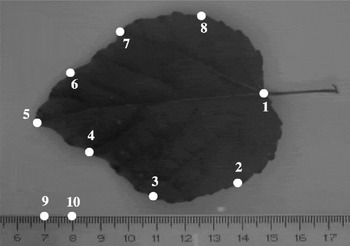
To determine if plants from the two habitat types differ in leaf morphology and size, we obtained digital images of approximately 100 intact leaves per tree, together with a size reference, to apply geometric morphometric techniques (Rohlf Reference ROHLF1998). On each leaf image, we placed eight morphological marks while two additional marks were placed on the size reference (Figure 1). All morphological marks corresponded to homologous loci (i.e. ‘landmarks’ sensu Bookstein Reference BOOKSTEIN1991), which are unambiguous and repeatable marks in all the leaves, and were chosen because they properly represented the morphology of the leaf contour. The program TpsDig (Rohlf Reference ROHLF1998) was used to register x, y coordinates of the eight anatomical marks on each leaf image. We performed a Procrustes superimposition analysis for the configuration of landmark coordinates using the CoordGen6 program in the Integrated Morphometrics Package (IMP series: http://www.canisius.edu/~sheets/morphsoft.html. As a reference, the average configuration of all leaves was used. Shape variables (Procrustes distances) without the effect of size were calculated from superimposition coordinates. We used these shape variables for the morphological analyses, which allowed us to evaluate the effect of habitat on the foliar morphology of H. pallidus. To visualize changes in leaf shape as landmark displacement in a deformation grill between habitats, we used interpolation by the thin plate spline technique (Bookstein Reference BOOKSTEIN1989, Zelditch et al. Reference ZELDITCH, SWIDERSKI, SHEETS and FINK2004).
Digital image of a leaf of Heliocarpus pallidus showing the eight morphological landmarks along the leaf margin. Two additional marks (9 and 10) were added on a reference ruler as a scale.

FA was assessed in approximately 100 fully expanded intact mature leaves for each of the ten trees in both habitats. A digital image was taken for each leaf and FA was calculated as the absolute value of the difference between the distances from the midvein to right and left leaf margin (|Ai – Bi|), divided by the average distance (Ai + Bi/2), to correct for the fact that asymmetry may be size-dependent (Cornelissen & Stiling Reference CORNELISSEN and STILING2005). An individual FA value was obtained for each tree from the average of the 100 leaves analysed. Finally, to control for measurement error in FA, a subsample of 30 leaves was re-measured without reference to previous measurements. In addition, we checked the significance of FA relative to measurement error using a two-way mixed-model ANOVA for each trait considering as factors individual, leaf (random) and side (left or right). Both measurements were considered as replicates (Palmer & Strobeck Reference PALMER, STROBECK and Polak2003). The significance of the interaction (individual × leaf × side) indicated that variation in FA among sides was greater than expected by measurements error (F 29,60 = 12.4; P < 0.001).
Three different types of asymmetry have been recognized in organismal morphology: fluctuating asymmetry (FA), directional asymmetry (DA) and antisymmetry (AS) (Albarrán-Lara et al. Reference ALBARRÁN-LARA, MENDOZA-CUENCA, VALENCIA-ÁVALOS, GONZÁLEZ-RODRÍGUEZ and OYAMA2010, Van Valen Reference VAN VALEN1962). FA measures the variance in small random departures from symmetry in bilaterally paired traits distributed with a mean value of zero, whereas in DA the differences among traits are distributed about a mean that is significantly greater or less than zero. Finally, AS is the lack of symmetry characterized by a platykurtic or bimodal distribution of deviations about a mean of zero (Albarrán-Lara et al. Reference ALBARRÁN-LARA, MENDOZA-CUENCA, VALENCIA-ÁVALOS, GONZÁLEZ-RODRÍGUEZ and OYAMA2010, Palmer & Strobeck Reference PALMER and STROBECK1992). Therefore, FA describes random variation from the optimal symmetrical phenotype, whereas DA and AS are developmentally controlled and are probably adaptive. Thus, the last two are considered inefficient descriptors of developmental stability. Since in our data left-right differences followed a normal distribution and the mean did not deviate significantly from zero, the values were considered to reflect FA exclusively.
Measurement of herbivory and statistical analysis
Herbivory was measured in approximately 100 leaves from each individual in each habitat. To estimate the leaf area removed by folivores, we first obtained a digital image of each leaf and then estimated the total area of the leaf and the area removed using Sigma Scan Pro software.
To determine differences in leaf size between habitats, we applied a t-test. A linear regression analysis was used to determine the relationship between leaf size and leaf area removed by folivorous insects in deciduous and riparian habitats.
We conducted a logistic regression analysis GENMOD (SAS 2000) to determine the effect of habitat (riparian vs. deciduous) on the leaf area removed by insects. Habitat and host plant size were considered as the independent variables and leaf area removed was used as the response variable. These same variables were used for all statistical analysis. The proportion of leaf area affected by herbivores was estimated for each leaf as the area removed divided by the total leaf area.
To determine if the leaf area removed varies among individuals or depends on host plant size, for each habitat we applied a two-way ANOVA and a posteriori LSMeans test for the comparison of means (SAS 2000). We used a logistic regression analysis GENMOD (SAS 2000) to test if FA differs between riparian and deciduous habitats. Habitat and host plant size were considered as the independent variables and FA was used as the response variable. Finally, a linear regression analysis was used to determine the relationship between leaf area removed by folivores and foliar FA in deciduous and riparian habitats.
RESULTS
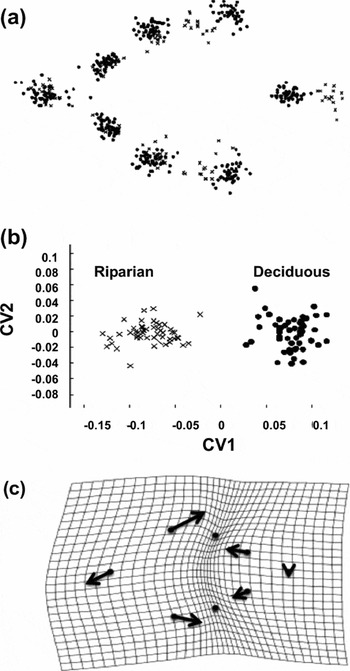
Canonical variate analysis, using Procrustes coordinates (Figure 2a), showed that leaf morphology of H. pallidus was significantly different between individuals that occurred in riparian and deciduous habitats (Lambda = 0.07; χ2 = 240; df = 19; P < 0.001; Figure 2b). A thin plate spline analysis based on mean configuration of superimposition coordinates, showed that leaves in riparian habitats were longer and wider than leaves in deciduous habitats (Figure 2c). In addition, we found that leaves of H. pallidus had a larger total area in riparian habitats than leaves in deciduous habitats (t = 10.3, df = 1, P < 0.0001). The mean leaf area in riparian habitats was 42.3 ± 1.2 cm2, while in deciduous it was 17.2 ± 3.5 cm2.
Leaf morphological variation in Heliocarpus pallidus: shape coordinates of landmark configuration of leaves of H. pallidus in riparian (black stars) and deciduous habitats (black dots) (a); differences in leaf shape morphology between riparian and deciduous habitats according to canonical variate analysis (b); deformation grid showing mean riparian leaf shape variation (arrows indicate the direction and intensity of deformation) relative to deciduous habitats (c).

In riparian habitats, the leaf area removed by folivorous insects was significantly greater than in deciduous habitats (χ2 = 12.5, df = 1, P < 0.0001). The mean leaf area removed in riparian habitats was 25.5% ± 1.8% (range = 1.7–77.7%) while in the deciduous habitat herbivores removed 9.6% ± 1.0% (range = 1.5–35.2%) of the leaf area. In riparian habitats, the percentage of leaf area removed by folivorous insects was significantly greater on smaller (29.6% ± 6.5%) than on larger plants (15.8% ± 3.8%) (host plant size: χ2 = 121, df = 1, P < 0.0001). Similarly, in deciduous habitats leaf area removed was significantly greater on smaller (14.5% ± 3.2%) than on larger plants (9.1% ± 1.5%) (χ2 = 101, df = 1, P < 0.0001).
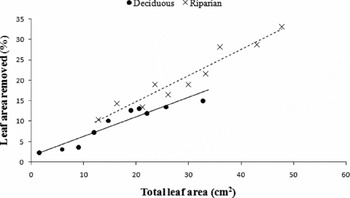
Leaf area removed by folivores differed among individuals and between size classes both in riparian (Individuals: χ2 = 8.2, df = 9, P < 0.0001; plant size: χ2 = 10.6, df = 1, P < 0.0001) and deciduous habitats (Individuals: χ2 = 11.8, df = 9, P < 0.0001; plant size: χ2 = 10.7, df = 1, P < 0.0001). The results of the linear regression analysis indicated that the percentage of leaf area removed by insects was positively related to total leaf area in riparian (R2 = 0.92, F = 169, P < 0.05) and in deciduous habitats (R2 = 0.9, F = 71.9, P < 0.05) (Figure 3).
Relationships between leaf size and leaf area removed by folivorous insects in riparian (R2 = 92.0%, F = 169, P < 0.05) and deciduous habitats (R2 = 90.0%, F = 71.9, P < 0.05).

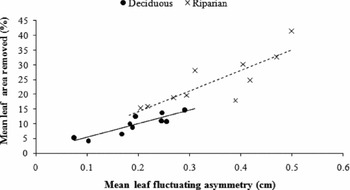
FA was significantly greater in leaves of trees that occur in riparian habitats (0.38 ± 0.04 cm) than in trees from the deciduous habitat (0.18 ± 0.03 cm) (t = 10.5, df = 1; P < 0.00001). In addition, we found a positive relationship between leaf area removed and FA values (in riparian habitats R2 = 0.70; F = 18.4; P < 0.001; in deciduous habitats (R2 = 0.79; F = 30.5; P < 0.0001; Figure 4).
Relationships between leaf area removed by folivorous insects and fluctuating asymmetry of leaves in riparian (R2 = 70.3%; F = 18.4; P < 0.001) and deciduous habitats (R2 = 79.2%; F = 30.5; P < 0.0001).

DISCUSSION
Size and shape of leaves depend on a variety of factors, including phylogeny, developmental constraints and physiological and biomechanical demands imposed by habitat conditions such as light regimen, temperature, humidity and nutrient and water availability (Brown & Lawton Reference BROWN and LAWTON1991, Givnish Reference GIVNISH1986, Horn Reference HORN1971). In our study, we found that leaf area and morphology of H. pallidus were significantly different between individuals that occur in riparian and deciduous habitats. In riparian habitats, leaves of H. pallidus were longer and wider than leaves in deciduous habitats. In seasonal communities such as tropical dry forests, soil type combined with different conditions in temperature, humidity, soil pH, nutrients and water availability, establish a patchy landscape that supports different vegetation types (Cotler et al. Reference COTLER, DURÁN, SIEBE, Noguera, Vega, García and Quesada2002, Lott et al. Reference LOTT, BULLOCK and SOLIS-MAGALLANES1987). Particularly, in our study system, phosphorus and nitrogen concentration are higher in riparian than in deciduous habitats (Cuevas-Reyes et al. Reference CUEVAS-REYES, QUESADA, SIEBE and OYAMA2004b). Nitrogen and phosphorus are the two primary limiting resources for plant growth in many terrestrial ecosystems (Bobbink et al. Reference BOBBINK, HICKS, GALLOWAY, SPRANGER, ALKEMADE, ASHMORE, BUSTAMANTE, CINDERBY, DAVIDSON, DENTENER, EMMETT, ERISMAN, FENN, GILLIAM, NORDIN, PARDO and DE VRIES2010, Perring et al. Reference PERRING, HEDING, LEVIN, MACGRODDY and DE MAZANCOURT2008). Therefore, an increment in nutrient availability may modify organ/module production such as leaves, roots and inflorescences (Abrahamson & McCrea Reference ABRAHAMSON and MCCREA1985, Aerts & Chapin Reference AERTS and CHAPIN2000), which in turn affects plant–herbivore interactions as a result of uptake and use efficiency of nutrients by plants (Crawley et al. Reference CRAWLEY, JOHNSTON, SILVERTOWN, DODD, DE MAZANCOURT, HEART, HENMAN and EDWARDS2005, Gough et al. Reference GOUGH, OSENBERG, GROSS and COLLINS2000). In addition, moisture availability is particularly variable, because while deciduous habitats are seasonal and xeric, riparian habitats are aseasonal and mesic (Frankie et al. Reference FRANKIE, BAKER and OPLER1974, García-Oliva et al. Reference GARCÍA-OLIVA, SVESHTAROVA and OLIVA2003, Lott et al. Reference LOTT, BULLOCK and SOLIS-MAGALLANES1987). These differences are reflected in the phenology of individual plants of the same species occurring in these contrasting habitats (Opler et al. Reference OPLER, FRANKIE and BAKER1980, van Schaik et al. Reference VAN SCHAIK, TERBORGH and WRIGHT1993). Variation in leaf area (and specific leaf area) according to moisture availability is a common morphophysiological adjustment in plants, that can involve plasticity, genetic differentiation or both (Calagari et al. Reference CALAGARI, MODIRRAHMATI and ASADI2006, Jonas & Geber Reference JONAS and GEBER1999, Li et al. Reference LI, ZHANG, LIU, LUUKKANEN and BERNINGER2006, Royer et al. Reference ROYER, WILF, JANESKO, KOWALSKI and DILCHER2005, Sokal et al. Reference SOKAL, CROVELLO and UNNASCH1986, Uribe-Salas et al. Reference URIBE-SALAS, SÁENZ-ROMERO, GONZÁLEZ-RODRÍGUEZ, TÉLLEZ-VALDÉZ and OYAMA2008).
The higher incidence of herbivory, in terms of percentage of leaf area removed, was observed in plants from the riparian habitats. Interestingly, this result is the opposite of the general pattern observed in Chamela, where most species are more heavily consumed in the deciduous habitats, in correlation with massive leaf flushing at the beginning of the rainy season (Cuevas-Reyes et al. Reference CUEVAS-REYES, QUESADA and OYAMA2006). In our case, we observed a strong correlation between the percentage of leaf area consumed and total leaf area, probably implying a response by insects to the amount of resource available. However, leaf size could also be correlated with chemical defence or nutritional quality (Coley et al. Reference COLEY, BRYANT and CHAPIN1985, Kursar & Coley Reference KURSAR and COLEY2003). In turn, the higher degree of consumption of smaller plants can be explained by a higher nutritional quality for insects resulting from more investment in growth than in defence mechanisms in comparison to adults (Coley & Barone Reference COLEY and BARONE1996, Fonseca et al. Reference FONSECA, FLECK and FERNANDES2006).
We found that FA was significantly greater in leaves of trees that occur in riparian habitats compared with those in the deciduous habitat. This result is the opposite of what would be expected if we hypothesize that the deciduous habitat should have more stressful conditions given the limited moisture availability during most of the year. However, FA might not be an unequivocal indicator of environmentally induced stress in plants, since other factors can be involved, such as genetic stress or growth rate (Fair & Breshears Reference FAIR and BRESHEARS2005, Milligan et al. Reference MILLIGAN, KREBS and MAL2008, Velickovic & Perisic Reference VELICKOVIC and PERISIC2006). In fact, in some cases higher FA has been found in what, a priori, would be considered the more favourable conditions, like higher nutrient availability (Milligan et al. Reference MILLIGAN, KREBS and MAL2008), less polluted soil (Velickovic & Perisic Reference VELICKOVIC and PERISIC2006), or water supplementation (Fair & Breshears Reference FAIR and BRESHEARS2005). To explain this observation, it has been hypothesized that favourable environments allow a faster growth of plants or plant organs, prompting higher developmental instability and FA levels (Hochwender & Fritz Reference HOCHWENDER and FRITZ1999, Lempa et al. Reference LEMPA, MARTEL, KORICHEVA, HAUKIOJA, OSSIPOV, OSSIPOVA and PIHLAJA2000, Martel et al. Reference MARTEL, LEMPA and HAUKIOJA1999). Also, asymmetry could increase with leaf size because larger leaves require more resources to be produced (Møller & Eriksson Reference MØLLER and ERIKSSON1994). However, another important result in this study is that herbivory levels were clearly higher in the riparian habitat, and in both environments there was a significant association between mean foliar area removed and individual FA levels. A similar correlation has been reported in other few studies (Cornelissen & Stiling Reference CORNELISSEN and STILING2005, Lempa et al. Reference LEMPA, MARTEL, KORICHEVA, HAUKIOJA, OSSIPOV, OSSIPOVA and PIHLAJA2000) and might be explained in two different ways. The first is that herbivory directly causes the stress level of the plants to increase, and thus results in higher FA levels. Alternatively, plants with higher FA might be more susceptible to herbivory, because of chemical or nutritional differences between symmetric and asymmetric leaves (Cornelissen & Stiling Reference CORNELISSEN and STILING2005). For example, the oaks Quercus laevis and Q. geminata showed, respectively, lower and higher concentrations of tannins and nitrogen in more asymmetric leaves, correlated with a higher incidence of leaf miners (Cornelissen & Stiling Reference CORNELISSEN and STILING2005). In the mountain birch Betula pubescens larvae of Epirrita autumnata had a higher consumption and growth rate on trees with higher FA. These trees also had enhanced leaf growth rates and higher concentration of gallotannins and sugars (Lempa et al. Reference LEMPA, MARTEL, KORICHEVA, HAUKIOJA, OSSIPOV, OSSIPOVA and PIHLAJA2000). However, other studies did not identify a relationship between herbivory and FA in B. pubescens (Hagen et al. Reference HAGEN, IMS, YOCCOZ and SORLIBRATEN2008, Kozlov Reference KOZLOV2004), as well as in other species (Bañuelos et al. Reference BAÑUELOS, SIERRA and OBESO2004).
Unfortunately, in this study the positive correlation between levels of FA and herbivory is not enough to distinguish between both hypotheses because FA measurements were made only after herbivory had occurred. Future studies are necessary that consider measurements of FA, nutritional quality and secondary compounds in undamaged leaves before herbivory, and then follow plants throughout the rainy season in tropical dry forests. In the case of H. pallidus, it is possible that individuals occurring in the riparian habitat are experiencing more favourable developmental conditions, which result in a higher growth rate and in larger leaves. Related to these morphological differences, we predict that in plants from the riparian habitat chemical defence and nutritional quality should be, respectively, lower and higher. As a consequence, herbivorous insects may respond with higher consumption rates in this habitat. Our results illustrate the complexities associated with understanding the relationships among FA and environmental stress, growth rate and herbivory, and highlight the necessity of future studies that take into account nutritional quality and chemical defence in this plant system.
ACKNOWLEDGEMENTS
We thank the authorities of Chamela and Cuixmala Biosphere reserve for their permission to conduct this study. Pablo Cuevas-Reyes thanks Dirección Adjunta de Desarrollo Científico y Académico del CONACyT for their generous support and GWF acknowledges the support provided by CNPq (30.9633/2007-9). We thank for the constructive comments by Ian Turner and two anonymous reviewers that greatly improved earlier versions of the manuscript.