A recent study in the United Kingdom reported that healthcare workers (HCWs) with serologic evidence of previous natural infection with severe acute respiratory coronavirus virus 2 (SARS-CoV-2) are at an ∼90% lower risk for coronavirus disease 2019 (COVID-19) over 6-months of follow-up. Reference Lumley, O’Donnell and Stoesser1 In fact, some observations suggest that natural infection may provide similar protection to vaccination in preventing future reinfection. Reference Lumley, Rodger and Constantinides2 However, studies reporting low rates of SARS-CoV-2 infection in seropositive individuals, including HCWs, may not be generalizable to other countries or regions because of different admixtures of SARS-CoV-2 clades, underlying population infection rates, and mitigation policies that may affect exposures related to primary infection and reinfection rates.
Understanding the risks for reinfection is particularly pertinent to US HCWs, who have been at very high risk for COVID-19, with 473,705 cases and 1,559 deaths as of April 22, 2021. 3 Not only do HCWs have significant risk due to repeated patient-facing exposures and performing high-risk procedures, they are also at significant risk for community exposure to SARS-CoV-2. Reference Wilkins, Gray and Wallia4,Reference Jacob, Baker and Fridkin5 In addition, although vaccination has been available to HCWs, intentions to get vaccinated vary due to concerns over adverse effects of the vaccine and perceived immunity following natural infection. In fact, reports of plans to obtain the vaccine range from 53% to 80%, Reference Meyer, Gjorgjieva and Rosica6 which suggests that a significant portion of HCWs will remain at risk for COVID-19 despite available vaccines. Therefore, predicting SARS-CoV-2 infection rates among unvaccinated HCWs with and without a history of SARS-CoV-2 infection is important as clinicians and public health officials develop strategies to contain COVID-19 while maintaining a sufficient healthcare work force.
Here, we describe the 6-month SARS-CoV-2 infection rates in HCWs with and without serologic evidence of prior infection and examine change in antibody status over time. We hypothesized the following: (1) antibody seroreversion (seropositive to seronegative during follow-up) would be common; (2) seropositivity at baseline would be associated with a lower rate of PCR positivity for SARS-CoV-2 than observed in baseline seronegative HCWs; and (3) rates of possible reinfection (ie, a PCR-positive result that occurs >90 days after a positive serology result at baseline) observed will be substantially higher than those recently reported in the United Kingdom over 6 months of follow-up. Reference Lumley, O’Donnell and Stoesser1
Methods
Study design and population
We conducted a prospective cohort study with HCWs recruited in May and June of 2020 from Northwestern Medicine. Northwestern Medicine is an academic healthcare system comprising 10 hospitals, 18 immediate-care centers, and 325 outpatient practices in the Chicago metropolitan area. The largest hospital in the health system is in downtown Chicago, whereas the other 9 regional centers are in the western, northwestern, and northern suburbs of Chicago. Affiliated outpatient practices and immediate-care centers are in downtown Chicago and the surrounding suburbs.
Details of the study and recruitment techniques have been reported previously. Reference Wilkins, Gray and Wallia4 Briefly, HCWs were invited to participate in a cohort study of SARS-CoV-2 serology and COVID-19 risk and after providing written consent, participants were invited to undergo serology testing between May 26 and July 10 (baseline) and then between November 9 and January 8, 2021 (follow-up). Participants completed a self-report survey at baseline that assessed demographic characteristics, occupational group, participation in specific occupational tasks, symptoms, and community exposure to COVID-19. After the baseline survey, participants were sent monthly surveys to ascertain new diagnoses, symptoms, or COVID-19 test results. Participant outcomes were also followed in the electronic health record (EHR), which allowed for identification of diagnoses and PCR results for COVID-19 and COVID-19–related outcomes. PCR test frequency was determined by EHR review and survey response including reasons for each test (as reported by the participant). Possible reinfection cases in participants who were seropositive at baseline were adjudicated by EHR review (J.T.W., L.H., and B.T.).
Laboratory analysis
Seropositivity for SARS-CoV-2 was evaluated using the SARS-CoV-2 IgG assay on the high-throughput ARCHITECT i2000SR Immunoassay System from Abbott Laboratories (Abbott Park, IL) for samples obtained between May 26 and July 10 and on the Abbott Alinity Immunoassay System for samples obtained between November 9 and January 8, 2021. Concordance across the two analyzers was verified following the College of American Pathologist (CAP) guidelines and by the study team using 20 positive and 20 banked negative serum samples from baseline with 100% concordance. The SARS-CoV-2 IgG ARCHITECT and Alinity assays are semiquantitative, chemiluminescent, microparticle immunoassays that identify whether human serum or plasma have IgG antibodies to SARS-CoV-2 nucleocapsid antigen. Samples tested were determined to be seropositive or seronegative based on these assays. Performance characteristics for this assay are reported to be 100% positive agreement at ≥14 days after symptom onset in those with confirmed COVID-19 and 99.6% negative agreement in those without COVID-19. Reference Bryan, Pepper and Wener7 The risks for incident COVID-19 by IgG as determined using this assay were roughly equivalent when compared to a noncommercially available anti-spike assay in a cohort from Oxford, England. Reference Lumley, O’Donnell and Stoesser1
Definitions
Antibody serostatus for SARS-CoV-2 at baseline was defined as being seropositive or seronegative based on laboratory results for IgG antibody response. Change in serologic status from baseline to follow-up was assigned to 1 of 4 mutually exclusive groups: seropositive to seropositive (persistently positive), seropositive to seronegative (seroreversion), seronegative to seronegative (persistently negative), and seronegative to seropositive (incident seropositive)
Incident SARS-CoV-2 infection was defined as a positive PCR in the EHR in participants who were seronegative at baseline. Participants who were seronegative at baseline were considered at risk for SARS-CoV-2 infection from baseline until the end of follow-up or until their first positive PCR test. 8–Reference Yahav, Yelin and Eckerle10 Stricter criteria for SARS-CoV-2 infection, heretofore referred to as “possible reinfection” in participants who were seropositive at baseline were used to minimize misclassification and to enhance exclusion of persistent viral shedders. Thus, participants who were seropositive at baseline were considered to be at risk for possible reinfection 90 days after their antibody test until the end of follow-up (January 8, 2021) or to the first positive PCR test plus 1 or more of the following characteristics: in-home exposure to someone infected with SARS-CoV-2, consistent symptoms, or a physician diagnosis of active infection. Reference Lumley, O’Donnell and Stoesser1,Reference Yahav, Yelin and Eckerle10 The 90-day window was used to minimize the identification of cases with persistent viral shedding and to remain consistent with the CDC time frame for definition of possible reinfection. 11
Statistical analysis
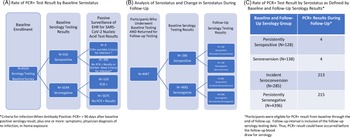
Baseline antibody serostatus (seropositive or seronegative) and change in serologic status from baseline to follow-up was used to describe participant characteristics, reasons for PCR testing and average number of PCR tests per participant, and outcomes of SARS-CoV-2 infection or reinfection risk. Only participants who completed both the baseline and follow-up exams were included in the change in serologic status analysis (Fig. 1).
Cohort design and analysis flow chart. (A) Analysis of PCR positivity rate by baseline serology status. (B) Analysis of serology status at baseline and by follow-up serology status. Of the 6,510 participants who enrolled at baseline, 4,947 returned for follow-up serology testing 6 months later. (C) PCR positivity rate by baseline and follow-up serology status groups.

Separate logistic regression analyses were used to assess the associations between change in serostatus between baseline and follow-up blood draws and demographics, occupation group, and community exposure to COVID-19. Odds ratios (ORs) and 95% confidence intervals (CIs) were calculated.
Rates of SARS-CoV-2 infection in previously seronegative individuals or possible reinfection in baseline seropositive individuals were calculated as the number of incident infections or possible reinfection divided by the total number of person days followed and reported per 10,000 person days at risk. Rates were calculated by baseline serostatus and the 4 serology status groups: incident seropositive, persistently seropositive, persistently seronegative, and seroreversion. Unadjusted incidence rate ratios (IRRs) and 95% CIs were calculated comparing serologic groups. Adjusted IRRs and 95% CIs were calculated using Poisson regression; IRRs were adjusted for covariates that predicted baseline serologic status within the cohort (age, sex, race, and occupation) to isolate the relative “effect” of baseline serostatus on SARS-CoV-2 infection risk in HCWs.
Sensitivity analyses
To assess the effect of different case definitions in seronegative and seropositive participants, a sensitivity analysis was conducted in which participants who were seronegative at baseline were considered at risk for COVID-19 infection starting 90 days after their baseline antibody test until end of follow-up (January 8, 2021) or until their first positive PCR.
Results
Participant characteristics and follow-up
In total, 6,510 participants enrolled in the cohort at baseline in the Spring of 2020, of whom 4,947 (76%) returned for follow-up serology testing (Fig. 1). In total, participants were followed for 1,285,395 person days (median, 216 days).
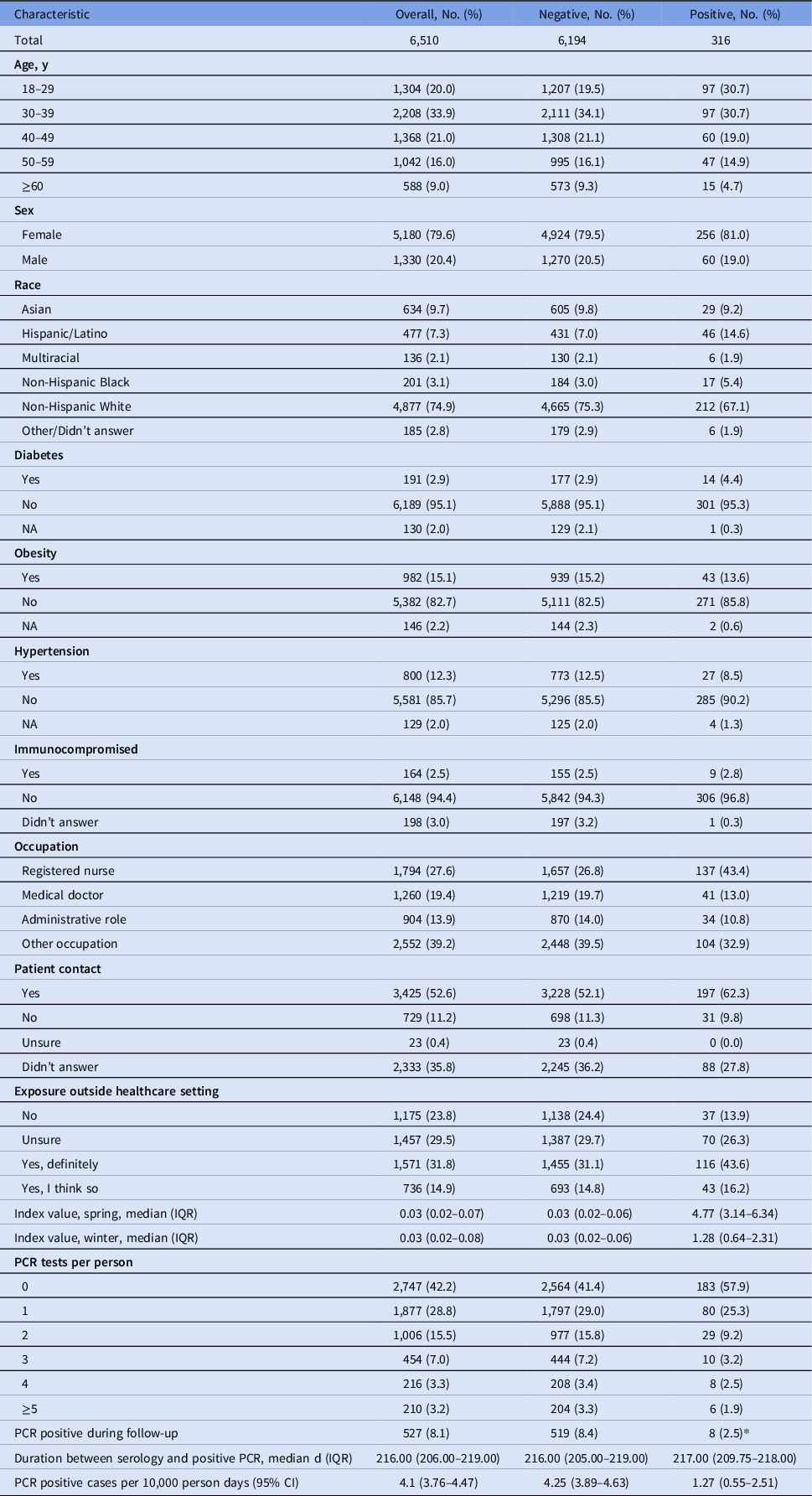
Participant characteristics overall and by baseline serology status are shown in Table 1. The sample mean age was 41 years (SD, 12). The cohort was 79.6% female, 74.9% White, 7.3% Latinx, and 3.1% non-Hispanic Black. Moreover, 15.1% of the cohort was obese, 12.3% had hypertension, and 2.9% had diabetes mellitus, 2.5% reported immunosuppression at baseline. Most participants were registered nurses, followed by physicians, administrators, and other occupation groups.
Participant Characteristics and Outcomes By Baseline Serologic Status for All Enrolled Individuals

Note. IQR, interquartile range; CI, confidence interval; PCR, polymerase chain reaction assay; NA, not available.
a Positive 90 days or more after baseline serology plus 1 or more of the following clinical criteria: consistent symptoms, in-home infected contact, physician diagnosis of reinfection.
The characteristics of participants who completed the baseline but not the follow-up serology testing are presented in Supplementary Table 1 (online). When compared to those who did not return for follow-up serology testing, the group that returned for follow-up testing was slightly older, had 5% more women, had ∼7% more non-Hispanic white individuals, had a 2% higher rate of hypertension, and had slightly more registered nurses and administrators and fewer physicians.
Change in serostatus from baseline to follow-up
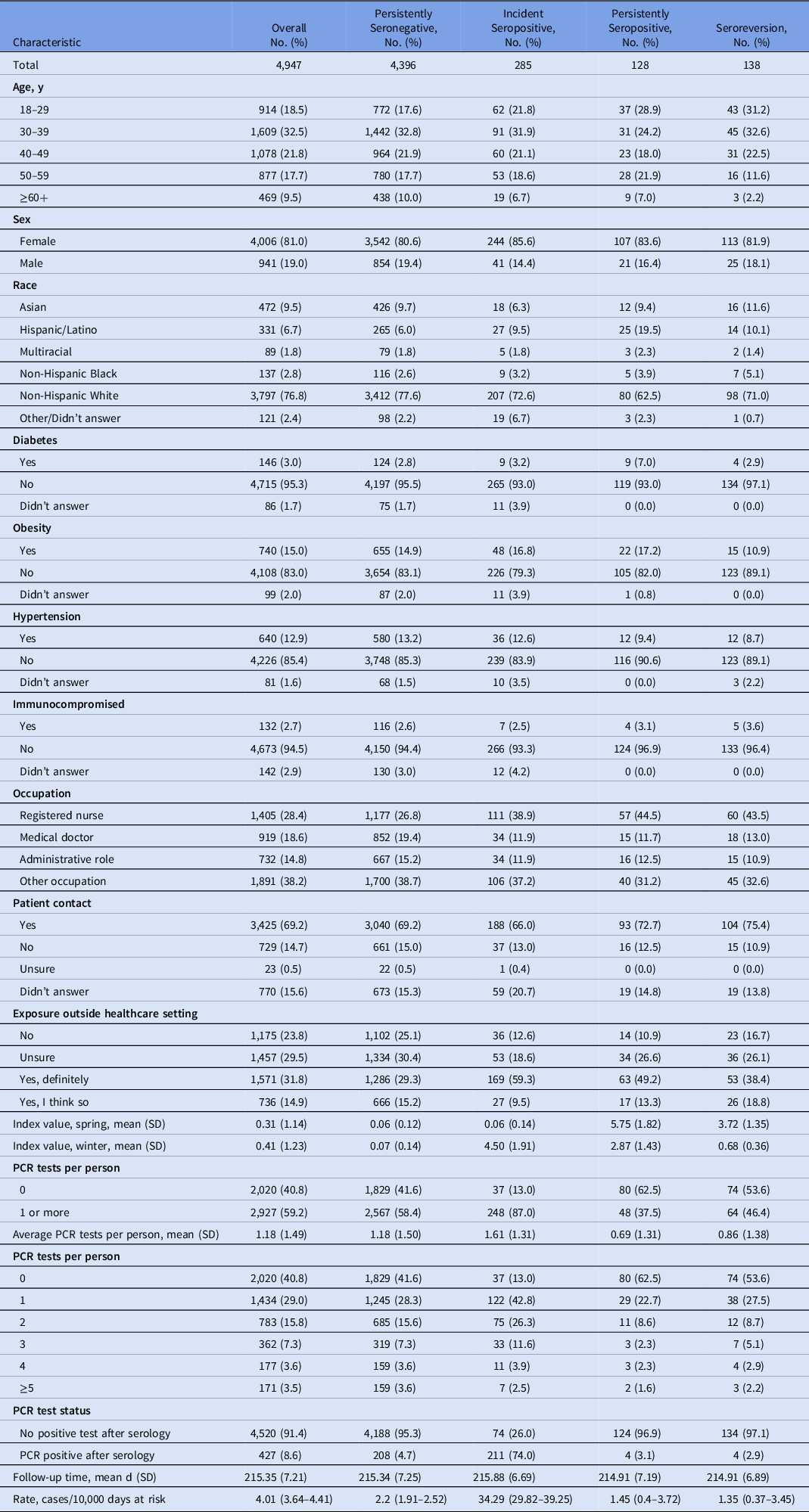
Of those who completed follow-up serology (n = 4,947), 88.9% remained persistently seronegative, 5.8% persistently seropositive, 2.6% had incident seropositivity (seronegative to seropositive), and 2.8% seroreverted from being seropositive to seronegative (Table 2). When compared to seronegative participants, seropositive participants were more likely to be younger, of non-Hispanic Black and Latinx race or ethnicity, to work as a nurse, to report a home exposure to COVID-19, to have symptoms consistent with COVID-19, and to have a history of a positive COVID-19 test (Table 2).
Characteristics and Outcomes of Participants with Repeated Testing by Baseline and Follow-Up Serology Status

Note. PCR, polymerase chain reaction assay; IQR, interquartile range; SD, standard deviation.
Among participants who were seronegative at baseline in the spring of 2020, 285 (6.1%) seroconverted to positive during the follow-up in the fall of 2020. Among the 266 who were seropositive at baseline, 138 (52%) seroreverted to negative in the follow-up fall blood draw (Fig. 1, panel B). In multivariable adjusted logistic regression models, no demographic, occupational, or exposure characteristics were associated with seroreversion during follow-up. However, lower semiquantitative antibody titer (index value) was significantly associated with seroreversion (OR, 2.14; 95% CI, 1.76–2.66) per 1-unit lower semiquantitative titer.
SARS-CoV-2 infection or possible reinfection by baseline antibody status
During the entire study period (May 26, 2020–January 8, 2021), 58.5% of the 6,510 participants at baseline reported or had evidence in their EHR of PCR testing during the study period at least once: 58.6% of seronegative participants and 42.1% of seropositive participants at baseline. Reasons for testing among HCWs reporting a PCR test included symptoms (32.7%), contact with an infected person (19.5%), provider recommendation (15.5%), work or school surveillance (14.2%), and “other” (18.1%). Among 6,510 HCWs, 550 (8.4%) in the study had a positive PCR result for SARS-COV-2.
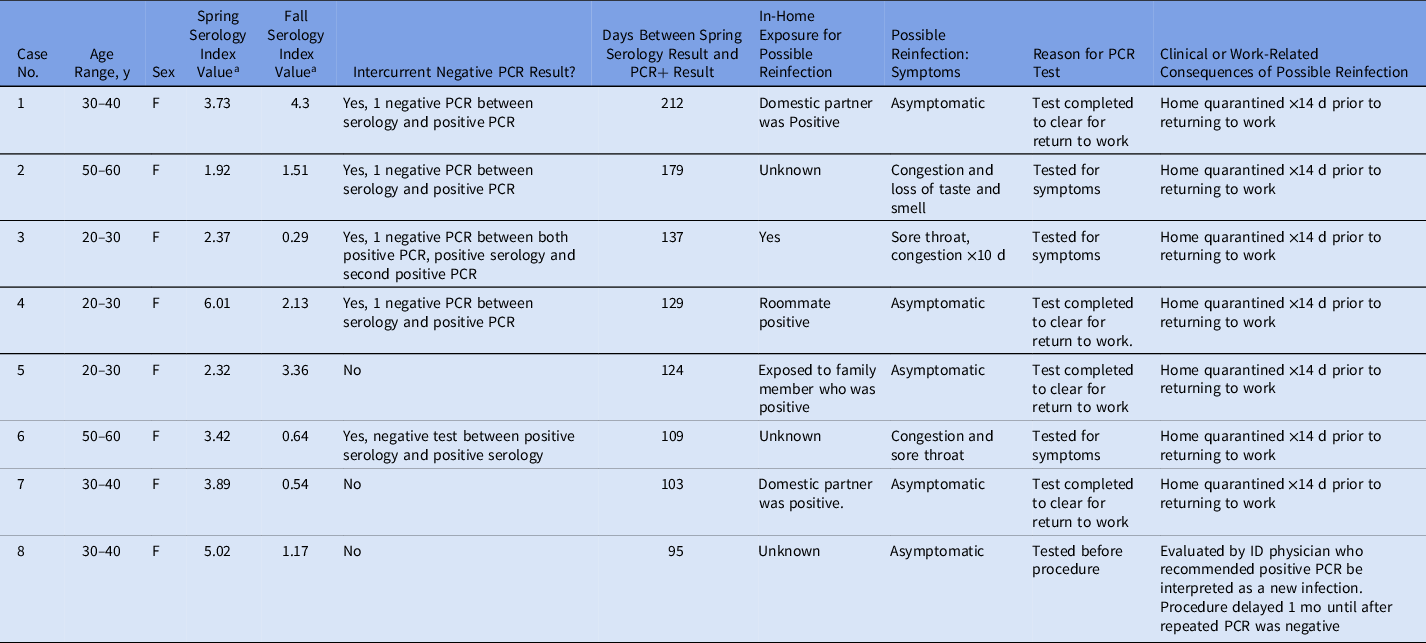
When analyzed by serostatus at baseline, 519 (8.4%) of 6,194 seronegative participants had a positive PCR after serology testing, representing a SARS-CoV-2 infection rate of 4.25 per 10,000 days at risk (95% CI, 3.89–4.63) (Fig. 1, panel A). Among the 316 participants who were seropositive at baseline, 20 participants had positive PCR results during follow-up. Among those, 8 (2.5%) met the study criteria for possible reinfection, representing a possible reinfection rate of 1.27 per 10,000 days at risk (95% CI, 0.55–2.51). Of these 8 baseline seropositive participants, 5 had a negative PCR between their baseline serology and the positive PCR result and none reported a history of immunosuppression. Among these 8 cases of possible reinfection during follow-up, 5 were asymptomatic and no cases were severe (Table 3). Overall, participants who were seropositive at baseline had a lower risk for possible reinfection than the rate for infection that was observed in participants who were seronegative at baseline. The unadjusted and adjusted incidence rate ratios were 0.30 (95% CI, 0.15–0.60) and 0.26 (95% CI, 0.13–0.53) for participants who were seropositive at baseline compared with those who were seronegative at baseline, respectively.
Characteristics of SARS-CoV-2 Infection Cases During Follow-Up Among Participants Who Were Seropositive at Baseline

Note. PCR, polymerase chain reaction assay; ID, infectious diseases.
a Index value represents semiquantitative titer. Values ≥ to 1.4 are considered positive.
In the sensitivity analyses, in which seronegative participants were not eligible for infection until 90 days or more following their serology result, the possible reinfection rate was 6.7%. The rate of infection per 10,000 days at risk (excluding the initial 90 days of follow-up) was 3.72 (95% CI, 3.39–4.08).
SARS-CoV-2 infection by baseline and follow-up antibody status
When analyzed by baseline and follow-up serology status (excluding the 2,114 who enrolled at baseline but did not attend follow-up serology testing) 208 of 4,396 participants (2.20 per 10,000 days at risk; 95% CI, 1.91–2.52) who were persistently seronegative developed SARS-CoV-2 infection during follow-up (Fig. 1). Of the 128 persistently seropositive participants, 4 had a possible reinfection during follow-up (1.45 per 10,000 days at risk; 95% CI, 0.40–3.72) and 4 of the 138 participants (1.35 per 10,000 days at risk; 95% CI, 0.37–3.45) who seroreverted had a possible SARS-CoV-2 reinfection during follow-up.
Discussion
In a cohort of HCWs in Chicago metropolitan area, participants with detectable antibodies against SARS-CoV-2 at baseline had rates of possible SARS-CoV-2 infection over 6 months of follow-up that were ∼26% of those observed in persistently seronegative participants, suggesting partial protection from COVID-19 infection for 6 months or more after initial infection. Loss of detectable antibody was common during the 6 months follow-up but was not associated with significantly higher rates of possible reinfection than those who were persistently seropositive. Similar to other reports of reinfection in HCWs, all cases of possible reinfection that we observed in seropositive HCWs were not severe. Reference Lumley, O’Donnell and Stoesser1
Rates of COVID-19 infection in HCWs are strongly driven by community exposure to SARS-CoV-2. Reference Wilkins, Gray and Wallia4 Unsurprisingly, we observed an increased rate of incident COVID-19 within the cohort during months in which COVID-19 rates were surging in the Chicago metropolitan area. 12 The rates for detected PCR positivity across antibody groups in seropositive and seronegative participants in our study were higher than those reported for HCWs in the United Kingdom. Reference Lumley, O’Donnell and Stoesser1,Reference Hall, Foulkes and Charlett13 However, the case–rate ratios (indicating the relative effect of antibody positive status) do not appear to be significantly different between our study and those reported in the UK study, but the power to detect differences in case–rate ratios between studies is limited due to the low overall event rate for possible reinfection reported in both studies (2 in the United Kingdom and 8 in our study). Reference Lumley, O’Donnell and Stoesser1 Differences observed in absolute PCR-positive rates between our study and others may be due to differences in the background rate of HCW exposure occurring in the community and while delivering care (due to local COVID-19 case rates, population density, and behavioral characteristics) and the uptake of PCR testing.
Our study represents, to our knowledge, the only report of infection rates, relative rates, and outcomes by serologic status of HCWs in the United States. The only other population-level estimates of reinfection risk in the United States come from an analysis of pooled data from central laboratory testing centers and claims data which reported very low occurrence of PCR positivity >90 days after a preceding positive PCR test (rates of positive tests to negative after 90 days = 0.1). Reference Harvey, Rassen and Kabelac14 However, unlike our study, the methodology employed in this study did not provide infection rates, nor as the authors point out, was it appropriate to infer relative risks from that analysis. Our study highlights data from a large midwestern metropolitan area, which was underrepresented in the previous study. Reference Harvey, Rassen and Kabelac14 Our analysis also included data through the second surge of COVID-19 (September through late December 2020) and information on clinical outcomes associated with reinfection. Reference Harvey, Rassen and Kabelac14
The only significant predictor of seroreversion was the semiquantitative antibody titer at baseline, suggesting that the baseline titer predicts the rate at which IgG levels are attenuated. However, we observed similar risks for infection in the seroreversion group as was seen in the persistently seropositive group. Further study of this relationship between antibody level and resistance to infection is needed as maintaining immunity in HCWs, ensuring high vaccination rates, and maintaining effective infection prevention activities in the workplace will be important for potential surges due to variants of SARS-CoV-2 and preservation of the healthcare workforce.
This study included the largest closed cohort of HCWs in the midwestern United States with >6 months of follow-up, allowing for estimates of SARS-CoV-2 infection incidence as well as the ability to assess the demographic, occupational, environmental, and behavioral factors associated with rates of infection. However, this study had some important limitations. First, PCR testing was not performed systematically on cohort participants. All PCR results included in this study are from passive surveillance of the electronic health record, which could result in a detection bias. Nonetheless, the estimates reported provide a real-world estimate of observed SARS-CoV-2 infection rates in a US-based healthcare system. Only 32.7% of those tested reported getting tested for COVID-19–related symptoms. Thus, a substantial degree of surveillance in asymptomatic cohort participants was present. The rates of testing were different across serology groups, with subsequent testing in seropositive participants lower than observed in seronegative participants at baseline. This factor could have resulted in a bias toward underdetection of SARS-CoV-2 in seropositive participants. Nevertheless, we report substantially higher rates than have been reported elsewhere, so this bias, if present, does not invalidate the central inference of this analysis that HCWs with serologic evidence of natural infection may have ongoing risks for infection within 6 months of the baseline serology. Second, not all COVID-19 serology assays have been vigorously evaluated in population-based samples, so suboptimal sensitivity or specificity could affect accuracy of results in determining serostatus at baseline and follow-up. However, in previous work, the case rate by serostatus was the same whether Abbott or an anti-spike assay was used. Reference Lumley, O’Donnell and Stoesser1 Third, we defined possible reinfection as a PCR test that occurred >90 days after a positive serology result. Some of the cases we report as a possible reinfection could be due to prolonged viral shedding. However, the mean follow-up time between serology test and PCR positive result was 116 days, much longer than has been reported in the literature as the expected duration for prolonged viral shedding. Reference Zhou, She, Wang and Ma9,Reference Recalde-Zamacona, Tomas-Velazquez and Campo15–Reference Nakajima, Ogai and Furukawa18 Furthermore, 5 of the 8 individuals who were positive had an intercurrent negative PCR test, suggesting that viral clearance had occurred.
In summary, in this cohort of HCWs in and around a major metropolitan center with substantial burden of COVID-19, serologic evidence of previous infection was associated with ∼74% lower rates of SARS-CoV-2 infection (new or possible reinfection) over 6 months of follow-up. Further study is needed to determine whether new infection with SARS-CoV-2 in seropositive individuals leads to severe disease, contagion, or long-term sequalae. Meanwhile, the risks for possible reinfection that we observed in seropositive participants support growing evidence against inferring that all individuals who are seropositive following infection have protective immunity. Policy makers and clinicians should expect continued infection risks in HCWs with a history of COVID-19, and these risks should be communicated to those who are unsure whether they want to proceed with vaccination.
Supplementary material
To view supplementary material for this article, please visit https://doi.org/10.1017/ice.2021.367
Acknowledgments
We thank our informatics colleagues Quan Mai, Daniel Schneider, and Firas Wehbe. We thank the Northwestern All of Us Research Program for providing staff, and Benjamin Singer, MD, and Ravi Patel, MD for their comments on this manuscript. We are grateful to the NM employees who volunteered to participate in this project.
Financial support
This project was funded by the Northwestern Memorial Foundation, The Northwestern University Clinical and Translational Sciences Institute, as well as the National Institutes of Health.
Conflicts of interest
A.W. has received research funding support from Novo Nordisk, Eli Lily, and United Healthcare Group. C.T.E. has received consulting fees from BioK+. All authors report no conflicts of interest related to this article.