Introduction
Dementia is defined by the World Health Organization as a syndrome, usually of a chronic or progressive nature, caused by a variety of brain illnesses that affect memory, thinking, behavior, and the ability to perform everyday activities (WHO, 2015). There are 47.5 million people with dementia in the world and this number is expected to triple by 2050 (WHO, 2015). In 2012, the prevalence of dementia in Germans aged 60 years and over was estimated at around 7% (OECD/European Union, 2014). Clearly, therefore, this disorder is very common in Germany, and also more generally in Europe.
A number of factors are associated with the risk of developing dementia. Although dementia is not a normal part of the aging process, the risk of developing this disease is higher in the elderly (Bachman, Reference Bachman1993). Furthermore, dementia has controversially been associated with gender, as several authors have found that women were at a higher risk of developing dementia, likely to be confounded by gender differences in longevity (Yoshitake et al., Reference Yoshitake1995; Kukull et al., Reference Kukull2002). Finally, using candidate gene approaches, further studies have shown that several genetic variants increase the risk of developing dementia, in particular one allele of the APOE gene (APOEε4) (Corder et al., Reference Corder1993). Although light to moderate alcohol intake is associated with a lower risk of dementia, the risk is increased in heavy drinkers (Gupta and Warner, Reference Gupta and Warner2008).
Interestingly, as dementia is a complex human disease with a physiopathology involving numerous areas of the body, it is associated with various metabolic, cardiovascular, and neuropsychiatric disorders, such as hypertension, diabetes, obesity, history of stroke, coronary heart disease, traumatic brain injury and PD (McCullagh et al., Reference McCullagh, Craig, McIlroy and Passmore2001). In addition, the risk of developing dementia is also controversially known to be modulated by the use of several medications, in particular the use of statins, PPI and antihypertensive drugs. Although a recent report of the Food and Drug Administration (FDA) based on observational studies and randomized clinical trials (Food and Drug Administration, 2012) stated that statins may have a short-term adverse effect on cognition, several authors have found the risk of Alzheimer's disease and dementia decreased in patients treated with statins (Jick et al., Reference Jick, Zornberg, Jick, Seshadri and Drachman2000; Wolozin et al., Reference Wolozin, Kellman, Ruosseau, Celesia and Siegel2000). In parallel to this important controversy, Haenisch et al. recently discovered that the use of PPI among primary care patients aged 75 years and over was associated with a significant increase in the risk of developing dementia (Haenisch et al., Reference Haenisch2015). By contrast, the use of antihypertensive drugs protects against the occurrence of dementia (Johnson et al., Reference Johnson2012).
As some of the previous works were controversial and focused on a low number of patients, our goal was to reanalyze the association of these potential risk factors with the risk of developing dementia in German primary care practices.
Methods
Database
The Disease Analyzer database (IMS Health) assembles drug prescriptions, diagnoses, and basic medical and demographic data obtained directly from the computer system of a representative sample of general practitioners throughout Germany. The data are generated directly from the computers in the physicians’ practices via standardized interfaces and provide daily routine information on patients’ diseases and therapies. A practice transmits patient data stored in the physician's computer to IMS on a monthly basis. Before transmission, the data are encrypted for data protection and contain, in similar scope and detail, the information in the files of patients in the doctor's practice.
The Disease Analyzer database provides a complete listing of all relevant patient details for each practice. The data obtained directly from the practice computers are checked for plausibility, linked to relevant additional information such as the price of a medicinal product, ATC (The Anatomical Therapeutic Chemical Classification) and ICD (International Classification of Diseases), coded, saved, and updated on a monthly basis. The database includes only anonymized data in compliance with the regulations of the applicable data protection laws.
In Germany, the sampling methods used for the selection of physicians’ practices were appropriate to obtain a representative database of primary care practices (Becher et al., Reference Becher, Kostev and Schröder-Bernhardi2009). Prescription statistics for several drugs were very similar to data available from pharmaceutical prescription reports (Becher et al., Reference Becher, Kostev and Schröder-Bernhardi2009). The age groups for given diagnoses in Disease Analyzer also agreed well with those in corresponding disease registries (Becher et al., Reference Becher, Kostev and Schröder-Bernhardi2009).
Study population
11,956 patients with initial diagnosis of dementia (all cause) were included in the study between January 2010 and December 2014. In this study, no differentiation of patients on the basis of dementia type or etiology was performed. The assessment of dementia diagnoses relied on ICD codes for vascular dementia (F01), unspecified dementia (F03), or Alzheimer's disease (G30). 11,956 controls without dementia were also included and were matched with cases on the basis of age, sex, type of health insurance, and physician. The practice visit records were used in both cases to verify that there had been 10 years of continuous follow-up prior to the index date. A total of 23,912 subjects were observed.
Study outcome
The main outcome of the study was the risk of dementia depending on predefined risk factors. The selection of risk factors was based on the literature (McCullagh et al., Reference McCullagh, Craig, McIlroy and Passmore2001). Several disorders potentially associated with dementia were determined based on primary care diagnoses (ICD-10 codes): diabetes (E10-E14), hypertension (I10), obesity (E66), hyperlipidemia (E78), stroke including transient ischemic attack (TIA) (I63, I64, G45), PD (G20, G21), intracranial injury (S06), coronary heart disease (I20-I25), MCI (F06), and mental and behavioral disorders due to alcohol use (F10). The presence of several medications, such as statins, PPI and antihypertensive drugs (including diuretics, Beta blockers, calcium channel blockers, ace inhibitors, and angiotensin II), was also assessed.
Statistical analyses
Descriptive analyses were obtained for all demographic variables and mean ± SDs were calculated for normally distributed variables. Multivariate logistic regression models were fitted with dementia as a dependent variable and the potential predictors. p values < 0.05 were considered statistically significant. The analyses were carried out using SAS version 9.3.
Results
Patient and control characteristics
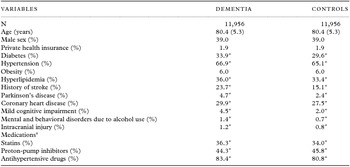
Socio-demographic data pertaining to the subjects are shown in Table 1. 11,956 dementia patients and 11,956 matched controls without dementia were included in this study. The mean age of subjects was 80.4 (SD: 5.3) and 39.0% of them were men. 1.9% of both patients and controls had private health insurance. 6% were obese. Several disorders occurred significantly more frequently in patients than in controls: diabetes (33.9% vs. 29.6%), hypertension (66.9% vs. 65.1%), hyperlipidemia (36.0% vs. 33.4%), history of stroke (23.7% vs. 15.1%), PD (4.7% vs. 2.4%), coronary heart disease (29.9% vs. 27.5%), MCI (4.5% vs. 2.0%), mental and behavioral disorders due to alcohol use (1.4% vs. 0.7%), and intracranial injury (1.2% vs. 0.8%). The use of statins and antihypertensive drugs was also significantly more common in dementia patients than in matched controls without dementia: 36.3% versus 34.0% and 83.4% versus 80.8%, respectively. By contrast, the use of PPI was less frequent in dementia patients than in controls: 44.3% versus 45.8%.
Characteristics of primary care patients with dementia and matched controls without dementia

Matching for age, sex, type of health insurance (private or statutory), and physician.
*p value < 0.05 (dementia vs. controls): Wilcoxon tests for paired samples, or McNemar's tests.
aTherapy within ten years prior to index date.
Associations with dementia
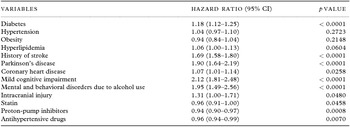
The results of the multivariate logistic regression model for the development of dementia in German primary care patients are displayed in Table 2. Dementia development was found to be associated with seven disorders: diabetes, history of stroke, Parkinson disease, coronary heart disease, MCI, mental and behavioral disorders due to alcohol use, and intracranial injury. Hazard ratios ranged from 1.07 (coronary heart disease, CI 95%, 1.01–1.14) to 2.12 (MCI, 1.81–2.48). Hypertension, obesity, and hyperlipidemia had no significant effect on the development of dementia (p value > 0.05). By contrast, statins, PPI, and antihypertensive drugs uses were associated with a decreased risk of developing dementia: HRs were equal to 0.96 (CI 95%, 0.91–1.00), 0.94 (CI 95%, 0.90–0.97), and 0.96 (CI 95%, 0.94–0.99), respectively.
Multivariate logistic regression model for development of dementia in primary care patients (11,956 dementia patients and 11,956 controls without dementia)

Discussion
Dementia is one of the most prevalent mental diseases (WHO, 2015), affecting millions of people globally each year. Although the pathophysiology of dementia is still not understood precisely, several factors have been associated with the disorder. The goal of this study was to reanalyze the impact of these potential risk factors on dementia in German primary care practices.
We used a multivariate regression model to demonstrate that the risk of dementia increased significantly in connection with the following variables: diabetes, lipid metabolism, stroke incl. TIA, PD, intracranial injury, coronary heart disease, MCI, and mental and behavioral disorders due to alcohol use. The last two variables had the strongest effect on the odds of developing dementia (HR of 2.12 and 1.95 respectively). Conversely, the risk of dementia decreased with the use of statins, PPI, and antihypertensive drugs (HR equal to 0.96, 0.94, and 0.96 respectively).
MCI is a mental disorder which is common in the elderly population (3% to 20%, depending on the definition used (Busse et al., Reference Busse, Bischkopf, Riedel-Heller and Angermeyer2003)) and is associated with a decline in cognitive abilities, particularly memory, attention, and thinking. It was first described in 1999 by Petersen et al. in subjects displaying poorer neuropsychiatric abilities than controls, notably in the Mini-Mental State Examination (MMSE), but better abilities than patients with Alzheimer's disease (Petersen et al., Reference Petersen, Smith, Waring, Ivnik, Tangalos and Kokmen1999). Therefore, MCI is now considered a transitional stage between normal aging and dementia. Although rates of dementia conversion in MCI patients vary between studies, the consensus is that all patients will develop dementia in the decade following MCI diagnosis (Morris et al., Reference Morris2001), underlining the close relationship between these two mental disorders (Ritchie and Touchon, Reference Ritchie and Touchon2000). Our data support this finding, as we showed an increased risk of dementia in elderly people already displaying symptoms of MCI.
The link between dementia and mental and behavioral disorders due to alcohol use is still understudied, although several works have analyzed the impact of alcohol on dementia. Indeed, it is known that alcohol intake protects older people against dementia in a J-shaped association (O’Keefe et al., Reference O’Keefe, Bybee and Lavie2007). Although low quantities of alcohol have positive effects on the development of dementia, heavy alcohol consumption increases the risk of dementia, particularly in patients carrying APOEε-4, an allele that predisposes carriers to this mental disorder (Mukamal et al., Reference Mukamal, Kuller, Fitzpatrick, Longstreth, Mittleman and Siscovick2003). Therefore, our data seem to be in line with these recent studies.
Interestingly, PD was also strongly associated with dementia. PD is defined as a progressive disorder of the nervous system that affects movement (Samii et al., Reference Samii, Nutt and Ransom2004). After Alzheimer's disease, it is the second most common neurodegenerative disorder in the world, with around 260,000 cases in Germany alone (European Brain Concil, 2012). In the late 1980s, Cummings analyzed 27 studies with a total of 4,336 PD patients and found that the prevalence of dementia was approximately equal to 40% in the population studied, suggesting that there was a close link between the two diseases (Cummings, Reference Cummings1988). Moreover, two separate studies completed during the same period demonstrated that the incidence of dementia over three or more years was four times higher in patients with PD, than in controls (Mindham et al., Reference Mindham, Ahmed and Clough1982; Rajput et al., Reference Rajput, Offord, Beard and Kurland1987). Our data and these convincing results clearly indicate that PD is a risk factor for the development of dementia.
Furthermore, we found in our study that diabetes patients had a higher risk of developing dementia. This result is particularly relevant, as several longitudinal studies have shown a link between dementia and diabetes (Leibson et al., Reference Leibson1997; Ott et al., Reference Ott, Stolk, van Harskamp, Pols, Hofman and Breteler1999). Indeed, Leibson and his colleagues discovered in 1997 that adults with this metabolic disease had a higher risk of developing dementia, than control adults without diabetes (RR = 1.66; CI 95%, 1.34–2.05) (Leibson et al., Reference Leibson1997). This important result was further corroborated by Ott et al. with 6,370 elderly subjects from the Rotterdam Study (Ott et al., Reference Ott, Stolk, van Harskamp, Pols, Hofman and Breteler1999). In line with these results, we discovered that the risk of dementia was also impacted by two diabetes-related disorders (stroke and coronary heart disease), corroborating the existing literature (Ivan et al., Reference Ivan2004; Newman et al., Reference Newman2005) and underlining the complex physiopathology of this mental condition.
Finally, the protective effects of the use of statins, PPI and antihypertensive drugs must be discussed, as there are several controversial studies in this area. Although several observational studies and randomized clinical trials have revealed adverse effects on cognition (Food and Drug Administration, 2012), such effects were reversible after medication discontinuation, and were not connected with “fixed or progressive dementias” such as Alzheimer's disease. Confirming FDA guidelines, a recent Cochrane Review on statin use in the primary prevention of cardiovascular disease also showed durable effects on cognition (Taylor et al., Reference Taylor2013) and several authors have recommended against use of this medication in healthy men (Redberg and Katz, Reference Redberg and Katz2012). By contrast, older studies published in the early 2000s found that the risk of Alzheimer's disease and dementia was lower in patients treated with statins (Jick et al., Reference Jick, Zornberg, Jick, Seshadri and Drachman2000; Wolozin et al., Reference Wolozin, Kellman, Ruosseau, Celesia and Siegel2000). These results were recently confirmed by two different meta-analyses (Song et al., Reference Song, Nie, Xu, Zhang and Wu2013; Wong et al., Reference Wong, Lin, Boudreau and Devine2013), although a third one found no association in 2007 (Zhou et al., Reference Zhou, Teramukai and Fukushima2007). To add further complexity, recent studies did not corroborate FDA results and showed that statins had no short- or long-term cognitive effects (Richardson et al., Reference Richardson2013; Swiger et al., Reference Swiger, Manalac, Blumenthal, Blaha and Martin2013). The main limitation of all these studies is that they included low numbers of patients, which may explain their controversial results. Therefore, the positive effect of statin use on the risk of dementia revealed in our study should be considered cautiously, although we observed 11,956 patients and 11,956 matched controls. In addition, the positive impact of PPI on dementia development will need further investigation, as a recent study gave rise to conflicting results (Haenisch et al., Reference Haenisch2015).
Our study includes several limitations. Firstly, the assessment of dementia diagnoses and co-morbidities was based solely on ICD codes entered by GPs. Unfortunately, many patients had different ICD codes of dementia diagnosed, showing that physicians were not sure what kind of dementia these patients had. Therefore, a breakdown of the risk factors associated with different types of dementia was not possible. No data from neuropsychiatric practices were analyzed as the documentation of co-morbidities such as diabetes, obesity or coronary heart disease by neuropsychiatrists is often missing. A further limitation of our study was the unavailability of precise data on patient compliance. This means that we only could include information about the therapy with defined medications and not details on the compliance of treated patients. In addition, data on socioeconomic status and physical activity were not available.
In conclusion, dementia is a mental disorder that is associated with various risk factors. These numerous associations need to be analyzed carefully by physicians in order to prevent the occurrence of dementia, particularly in elderly patients.
Conflict of interest
None.
Description of authors’ roles
AW contributed to the analysis and interpretation of the data, drafted the manuscript and gave the final approval of the version to be published. LJ, MR, and JB contributed substantially to the design, analysis and interpretation of the data, drafted the manuscript, and gave the final approval of the version to be published. KK contributed substantially to the conception, design, and interpretation of the data, revised the manuscript critically for important content and gave the final approval of the version to be published.
Acknowledgments
Professional English language editing services were provided by Claudia Jones, MA, Radford, Virginia, United States.