How do courts review the exercise of executive powers in a nonliberal, single-party-dominated state? In which types of cases do they rule against the state and on what grounds? In this article, we provide the first statistical profile of judicial review of executive power in Singapore, or judicial review for short, to analyze administrative law in a state whose executive is known to pursue expediency often at the expense of civil-political liberties (Lin Reference Lin2008).
According to a growing body of research on law and courts in nonliberal regimes (see, e.g., Solomon Reference Solomon2004; Pereira Reference Pereira2005; Hilbink Reference Hilbink2007; Moustafa Reference Moustafa2007; Stern Reference Stern2013), single-party-dominated states typically desire to consolidate power and dislike judicial intervention. However, they do turn to courts as independent arbiters. Judicial restraint on executive power in nonliberal states is not necessarily weak but varies depending on the nature of the disputes and the state’s interests in maintaining judicial autonomy (Moustafa Reference Moustafa2003; Moustafa and Ginsburg Reference Moustafa2008).
Singapore represents an important case study in this regard. After it gained independence from the British and became a sovereign nation in 1965, the ruling party, the People’s Action Party (PAP), employed legal instrumentalism to achieve economic progress in a span of 50 years, turning Singapore into a country with one of the world’s highest gross domestic product per capita and the world’s second-freest economy (Economic Freedom Index 2015). PAP leaders tout the country as driven by the rule of law, fiercely defend the independence of its judiciary (Chua Reference Chua2014), and take pride in the judiciary’s reputation for efficiency (see, e.g., Tan Reference Tan2009). But critics argue that the state’s “authoritarian” use of law has severely curtailed civil-political liberties, stifled political opposition, and entrenched the ruling party (Rajah Reference Rajah2012). Yet, it is for this very combination of features that Singapore is emulated and studied by other nonliberal states, such as China, whose ruling party desires to promote the rule of law for economic development while maintaining its hegemony (Silverstein Reference Silverstein2008).
Scholars thus point out that Singapore’s judiciary protects economic interests but takes a conservative approach toward civil-political rights (Silverstein Reference Silverstein2008). Indeed, Singaporean courts have not found any legislation to be unconstitutional.Footnote 1 Because Singaporean courts lack a record of ruling against the constitutionality of legislation, therefore curbing the exercise of legislative powers, recourse to judicial review of executive powers, in the hands of the same political party, is even more critical. It is the only other judicial avenue through which one could challenge the actions of a single-party-dominated government. In a rare extrajudicial speech to counter “Chinese whispers about the allegedly poor state of judicial review in Singapore” (Chan Reference Chan2010, 474), Singapore’s then–chief justice announced that about a quarter of judicial review challenges succeeded against the executive. However, we have no empirical study to confirm Chan’s claims.
How often do challenges against executive power in Singapore succeed? What do their wins and losses tell us about the effects of judicial review in Singapore? To address these questions, we conduct an empirical study of the Singaporean High Court and Court of Appeal decisions on judicial review from the first 48 years of its independence. We find judicial review, while an uncommon avenue, to be a much more viable recourse against single-party governance than constitutional challenges, succeeding 38% of the time in the High Court and 39% in the Court of Appeal.
Our findings contribute to law and courts literature on nonliberal regimes. When conducting judicial review, Singaporean courts simultaneously retain autonomy and exercise deference depending on whether the nature of the issue at stake or the scope of the ruling affects the political or economic imperatives of the state. Hence, we do not merely confirm existing arguments on Singaporean judicial review that economic issues are much more successful than those relating to civil-political liberties. More specifically, we find that issues with the highest success rate are the ones that have strong personal economic impact on the applicant but lack detrimental effect on the government’s developmental and political agenda. Although the PAP’s rule has been criticized as authoritarian, the party relies on an electoral system that returns it to power by way of popular mandate. Wins against the government in judicial review demonstrate to citizens that they can count on the PAP to respect rule of law and thus to care for their livelihoods, one of the PAP’s vital political platforms. Moreover, even though challenges against the executive curtailment of civil-political liberties usually fail, applicants occasionally win on procedural errors, which are grounds that avoid questioning the scope of executive power. Taken together, these findings suggest that Singaporean judicial review could have the consequence of reinforcing the political status quo by buttressing the ruling party’s domestic legitimacy, as scholars have argued generally in the literature (Shapiro Reference Shapiro1981) and in recent work on other nonliberal contexts (Haynie Reference Haynie1993, Reference Haynie1994; Stern Reference Stern2013), and by maintaining executive power to check dissent and restrict civil-political rights.
Background: Administrative Law and the Study of Judicial Review in Singapore
Singapore’s constitution provides for separation of powers among the legislature, executive, and judiciary and vests judicial power in the High Court and Court of Appeal—endowing these two courts with supervisory jurisdiction over executive powers and administrative decisions.Footnote 2 Judicial review cases are first heard in the High Court before a single judge and may be appealed to the Court of Appeal, the apex court, which usually convenes as a three-judge panel.Footnote 3 Judges of both the Court of Appeal and the High Court have security of tenure until 65 years old and are appointed by the head of state in concurrence with the advice of the prime minister, the political executive.Footnote 4
By and large, Singaporean courts apply English principles of administrative law when undertaking judicial review of executive powers. The scope of judicial review in this tradition is narrower than American administrative law, where courts even develop, oversee, and implement structural reform to administrative practices (Hertogh and Halliday Reference Hertogh2004). To have his or her case for judicial review heard, the applicant must first fulfill the prerequisite or separate procedural requirement of seeking and obtaining leave from the High Court; in other words, recourse to judicial review, except where it pertains to the release of a detained person (remedy of habeas corpus), is not a matter of right.Footnote 5 If leave is granted, the High Court convenes the hearing for judicial review and issues its decision, which may be appealed to the Court of Appeal.
Like other courts that follow the English tradition, Singaporean courts only inquire into whether the executive acted in excess of its authority, committed “illegality,” behaved “irrationally,” abused its power, acted in bad faith, unduly fettered its discretion, or violated procedural rules of justice in the decision-making process. In contrast to the broad range of remedies available to American courts (Sunkin Reference Sunkin1996), they can grant only remedies narrowly specified in the court rules: prohibit the implementation of the original decision, quash the decision (without substituting it with their own), order the executive to issue a fresh decision or act in a manner consistent with the law, order the release of persons, or declare the state of the law. Nevertheless, within this limited ambit, Singaporean courts have constitutionally vested powers to restrain the executive, for example, by inquiring into whether it had acted “irrationally” or taken into account “irrelevant considerations” in making its decision.
In practice, Singaporean courts are conservative and usually defer to the executive’s discretion as well as the bureaucratic concerns of efficiency and public order (Thio Reference Thio1999; Lin Reference Lin2008). This position is consistent with the political leadership’s view that Singaporeans trust their government and political leaders as “honorable men” (Shared Values White Paper, Singapore Parliament, Cmd. 1 of 1991; Thio Reference Thio2011). Former chief justice Chan Sek Keong (Reference Chan2010), who also served as attorney general for 6 years, went as far as to endorse extrajudicially the “green light” theory for Singaporean judicial review. According to this theory, the administration’s internal mechanisms, such as administrative tribunals and guidelines, and the political process should be the first line of defense against executive abuse of power, whereas courts should play a supporting role in ensuring the state implements “sound policies in a lawful manner” (481). However, unlike Chan, green light theorists correspondingly emphasize the existence of other accountability measures, such as the right to information and an ombudsman, as well as political turnover (Taggart Reference Taggart1999; Harlow and Rawlings Reference Harlow2009), which are features lacking in Singapore.
Law and courts scholars agree that courts in nonliberal, single-party-dominated states exhibit deference toward the executive in cases of judicial review but also highlight diversity and range in their decisions to restrain its powers (Haynie Reference Haynie2003; Moustafa and Ginsburg Reference Moustafa2008). They argue that these courts tend to have more autonomy where their decisions help to remove low-level corruption, implement controversial policies, protect foreign and domestic investment, control political opponents, furnish legal cover for the state’s extralegal activities (Moustafa Reference Moustafa2007), or provide better government services or solutions to citizens in a manner that accumulates domestic support and legitimizes the regime’s authority (Stern Reference Stern2013). Therefore, courts in single-party states are less inclined to rule against the government in matters that are perceived to threaten its political control or key agenda (Moustafa Reference Moustafa2007; Magaloni Reference Magaloni2008; but see Ghias Reference Ghias2010). In Asian “developmental” states, courts thus restrain executive action related to economic issues with less threat of state retaliation. The ruling parties use such court decisions to assure economic actors, especially foreigners, of accountability and “good governance” and keep low-level bureaucrats in check; hence, they promote rule of law and courts as a credible and independent arena for dispute resolution (Ginsburg Reference Ginsburg2008b; Jayasuriya Reference Jayasuriya2008). Some of these courts are also more likely to favor the less interventionist grounds of procedural violation (Ginsburg Reference Ginsburg2008a), an argument that resonates with studies in democracies in which scholars find judicial ruling on procedural rules to be better internalized and received by agencies (Sunkin Reference Sunkin2004).
While research on law and courts in nonliberal regimes is growing, there is a paucity of empirical analyses of judicial review in Singapore or similar regimes. Law and courts literature so far focuses on politically controversial or selective cases to illustrate the nature of judicial power and constraints in Singapore (see, e.g., Silverstein Reference Silverstein2003, Reference Silverstein2008; Lin Reference Lin2008). Although Chan (Reference Chan2010) attempted to quantify the percentage of judicial review applications granted against the government, he did not go beyond the overall number of applications and percentage of success.Footnote 6
In contrast, we construct and analyze a data set of Singaporean judicial review decisions. Our analysis spans the universe of such decisions and includes mundane ones that attract little public or academic attention. We empirically analyze the success rate, the issues, and the legal grounds to understand judicial review outcomes and its possible effects on the Singaporean legal system.
Methodology
Our study evaluates the reported High Court and Court of Appeal judgments on judicial review. These judgments are decisions on legal action seeking judicial review of executive power from August 9, 1965—the day Singapore became a sovereign nation—to November 6, 2012, the last day of the third chief justice’s term. Altogether, the 48-year period covers three chief justices, two former prime ministers, and the current prime minister.
Data Set
We focus on reported decisions found in the Singapore Law Reports (SLR).Footnote 7 Since the SLR is the authoritative, comprehensive source for reported Singaporean judgments,Footnote 8 we avoid bias in our analysis within the universe of reported decisions and ensure the analysis can be replicated. Although including unreported decisions could further inform our findings on the success rate and the types of cases that involve judicial review, we do not do so for a combination of reasons: Neither the Singapore Academy of Law (“the Academy”), SLR’s publisher, nor the courts have kept any systematic record of unreported decisions since the time of independence.Footnote 9 The Academy can confirm and provide complete sets of unreported High Court and Court of Appeal decisions only since 1991. While a comprehensive analysis of unreported decisions is beyond the objectives of this analysis, we did evaluate unreported decisions in 5-year intervals. We found only a single instance across the 5 years surveyed (1991, 1996, 2001, 2006, and 2011) in which a judgment on judicial review was not reported, confirming the general consensus that such decisions are rarely unreported and furthering our own confidence in the results.
In addition, we do not include decisions that merely ruled on whether to grant leave for judicial review (“leave application”), as the courts and the Academy also do not maintain any systematic record of them and cannot provide any estimate. Knowing the number of successful and unsuccessful leave applications would have contributed to our analysis. If a considerable number of would-be challenges had no leave to proceed to judicial review, then gatekeeping by the courts could have substantially shaped the outcomes of judicial review. In England, for instance, some figures show that only 50% of leave applications for judicial review were granted, and only half of those challenges succeeded, meaning that the government overall prevailed two-thirds of the time (Kritzer Reference Kritzer2003). Because such an analysis is impossible in the Singaporean context given the lack of systematic official government records, we are left only to speculation.
Unit of Analysis
Our primary unit of analysis is the court decision. Across the years of analysis, Singaporean courts issued 120 published decisions involving review of executive actions.Footnote 10 Out of the 120 decisions, 87 are decisions of the High Court, the court that first hears a judicial review case, and 31 are Court of Appeal decisions.Footnote 11 To ensure the comprehensive nature of the data, we include decisions of a predecessor court known as the Federal Court of Malaysia, Singapore, in the analyses of the decisions of the Court of Appeal.Footnote 12 The remaining two decisions were issued by the Privy Council in the United Kingdom before the Singaporean government abolished it as a venue of final appeal (see fn. 3).
In contrast to many law and courts studies, we do not concentrate on the decision making of individual members of the judiciary because of conditions particular to Singapore. Its Court of Appeal usually has three-judge benches, but they seldom issue plural or dissenting opinions, making it difficult to analyze for variation in attitude across judges. Moreover, High Court and Court of Appeal judges are appointed by the head of state on the advice of the prime minister, who is traditionally the leader of the ruling party. To date, therefore, they have all been appointed during the PAP’s administration. Other than rare exceptions such as Chan’s Reference Chan2010 speech, they also rarely make extrajudicial statements. Hence, we find little traction in examining for variations in judicial ruling based on differing attitudes.Footnote 13
Analysis of Judicial Review of Executive Power in Singapore
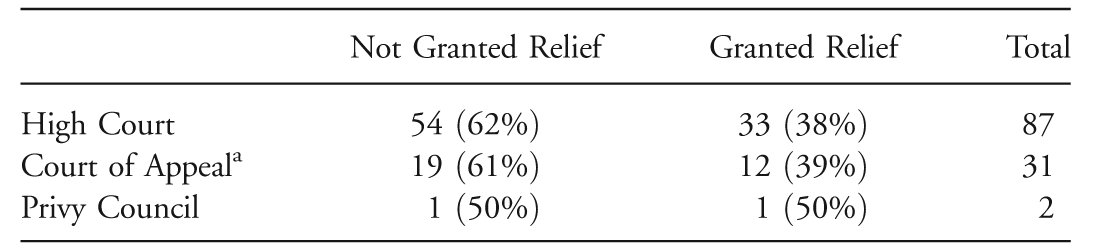
On the basis of our analysis, the success rate of judicial review is much higher than what was previously known.Footnote 14 Out of the 87 decisions in the High Court, 33 (38%) succeeded against the government, meaning that the court ruled at least partially in favor of the applicant, whereas 12 out of the 31 decisions (39%) in the Court of Appeal succeeded (see table 1).Footnote 15 These are substantial figures in the Singaporean context given the dearth of successful constitutional challenges and the criticisms in law and courts literature.
Judicial Review Applications Granted, 1965–2012
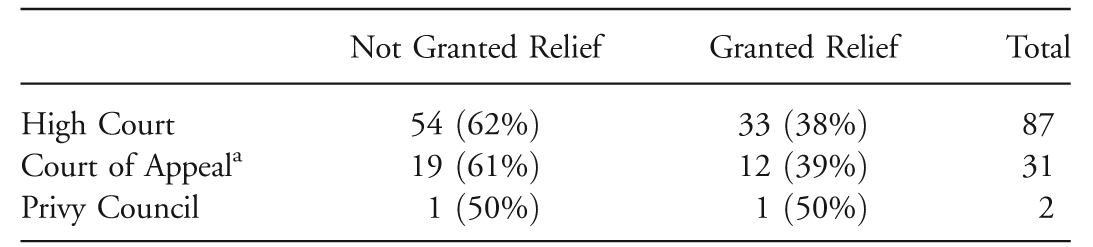
a Includes four decisions by the Federal Court.
What, then, do the data tell us about the outcomes of judicial review and how they shape its effects in Singapore? If the executive prevails in most of the challenges, judicial review may not adequately serve the purpose of checking its power. If applicants record a reasonable percentage of success, as shown in table 1, perhaps the converse is true. However, the implications of judicial review outcomes are more nuanced than merely indicating the degree of robustness. As discussed in the previous section, the types of judicial review decisions that succeed for applicants in nonliberal regimes could have the consequence of reinforcing or boosting state interests. The scope of the decisions’ rulings could also limit their impact on the state interests at stake.
Hence, in the analysis below, we go beyond the overall success rates to examine which types of issues are involved in the decisions that succeed or fail against the executive and which legal grounds are provided by courts when they rule in the challengers’ favor. We examine these features to discern if there are particular types of judicial review decisions that tend to succeed and succeed in a particular way, findings that will help us understand their implications. On the basis of what we know about Singapore, we examine whether the successful decisions involve issues that do not threaten key state interests. Therefore, we pay attention to whether they concern economic issues rather than civil-political rights. In addition, informed by the broader literature on judicial review in nonliberal regimes, we analyze whether the successful economic issues are the ones that have high personal impact for applicants but lack a detrimental effect on the state developmental or political agenda. Such results would suggest that judicial review has the potential consequence of bolstering the legitimacy of the current regime while insulating it from political dissent. Furthermore, we consider the scope of the rulings of successful decisions. If challenges succeed on procedure-oriented grounds even when the issues are politically controversial, judicial review could reinforce the impression of a publicly accountable regime and arguably legitimize its authority as well; at the same time, such narrow grounds would avoid judicial incursions into executive power.Footnote 16
Issue Type
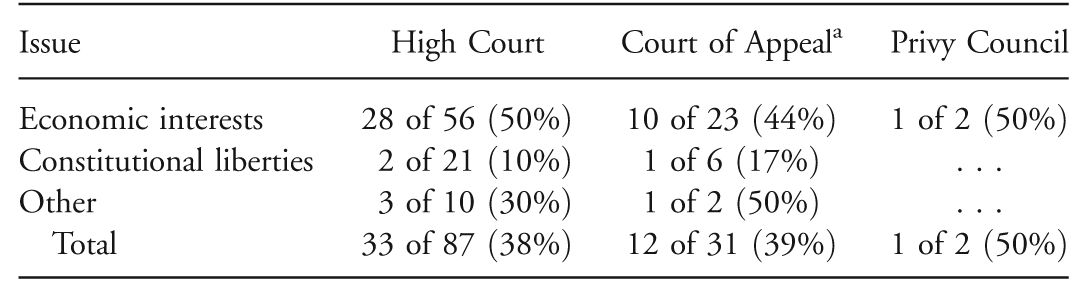
As evident in table 2, economic issues make up the majority of decisions and record the highest success rate. Fifty-six out of the 87 High Court decisions (64%) and 23 out of the 31 Court of Appeal decisions (74%) are economic related. Among those granted in the applicant’s favor, 85% in the High Court (28 out of 33) and 83% in the Court of Appeal (10 out of 12) deal with economic issues. In comparison, decisions concerned with constitutional liberties are by far the least successful, failing 90% of the time in the High Court and 83% in the Court of Appeal.
Judicial Review Applications Granted by Aggregated Issue, 1965–2012
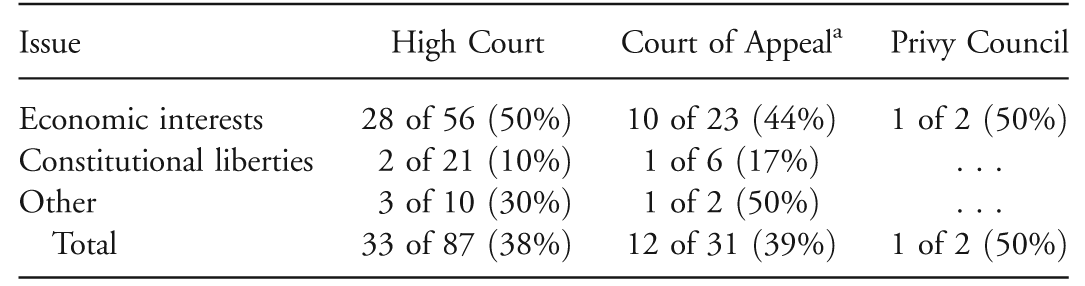
a Includes four decisions by the Federal Court.
The aggregate categories in table 2 consist of various issues types that we coded for each decision and then grouped together to confirm the clear divide between economic issues and constitutional liberties.Footnote 17 Under the economic category, we placed “livelihood,” “individual finances or business interests,” “taxation,” and “land rights.” Under constitutional liberties, we included “illegal detention” and “other constitutional liberties.”Footnote 18
In the next step of our analysis, we break down the aggregate categories into the specific issue types and qualitatively analyze the successful decisions to discern if there are further nuances, such as being high on personal impact. We assigned the code of “individual finances or business interest” to issues relating to one’s personal or business finances and salary or wages (excluding employment dismissal and taxation); “livelihood” to situations in which applicants face dismissal or disciplinary measures while under the employment of a state authority; “taxation” to the computation of personal income tax, customs duty, and land revenue; and “land rights” to contestations over compulsory land acquisition and land sale or use orders and policies (but excluding property tax issues). Where applicants challenged executive detention without trial or “preventive” detention, we coded with “illegal detention.” For other decisions related to civil-political rights, we designated them as “other constitutional liberties.”
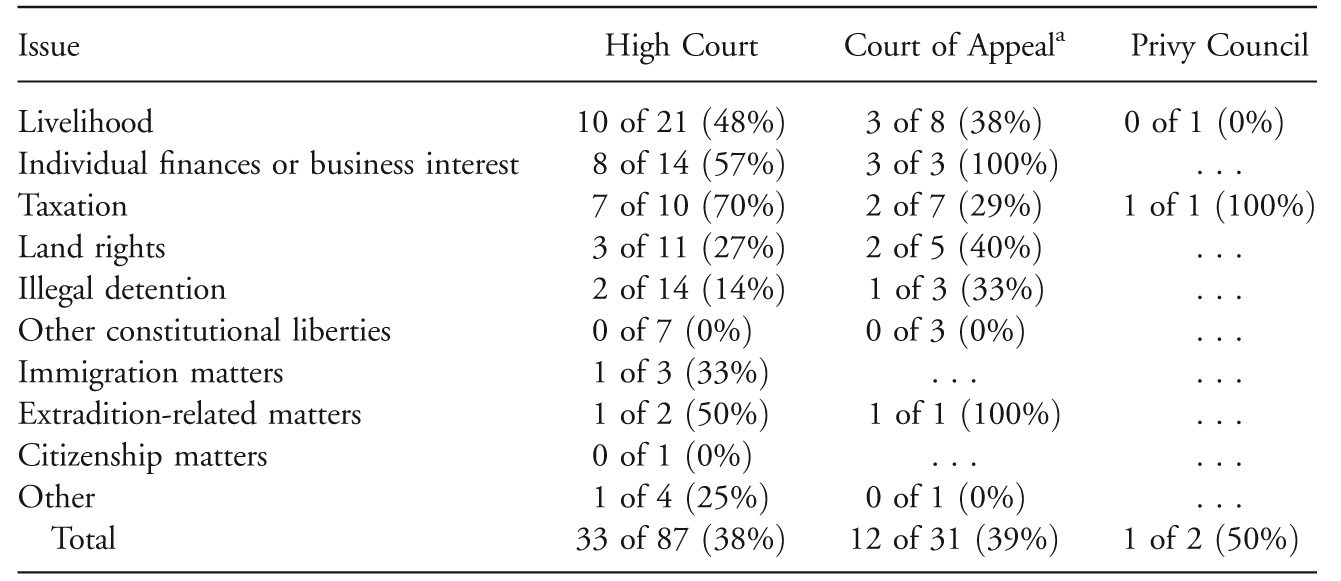
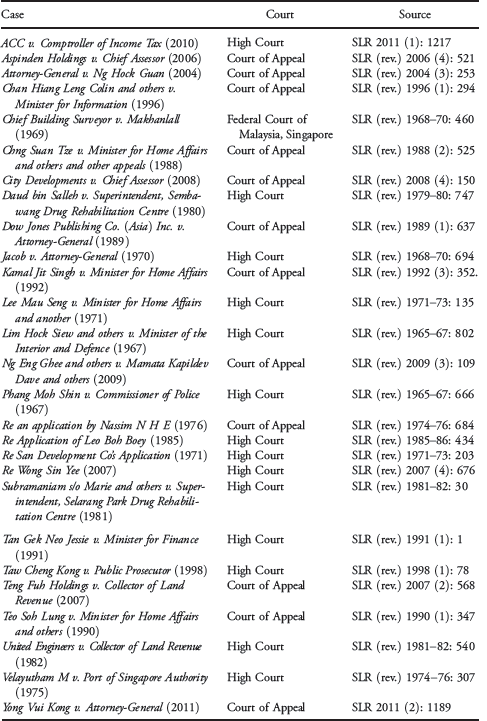
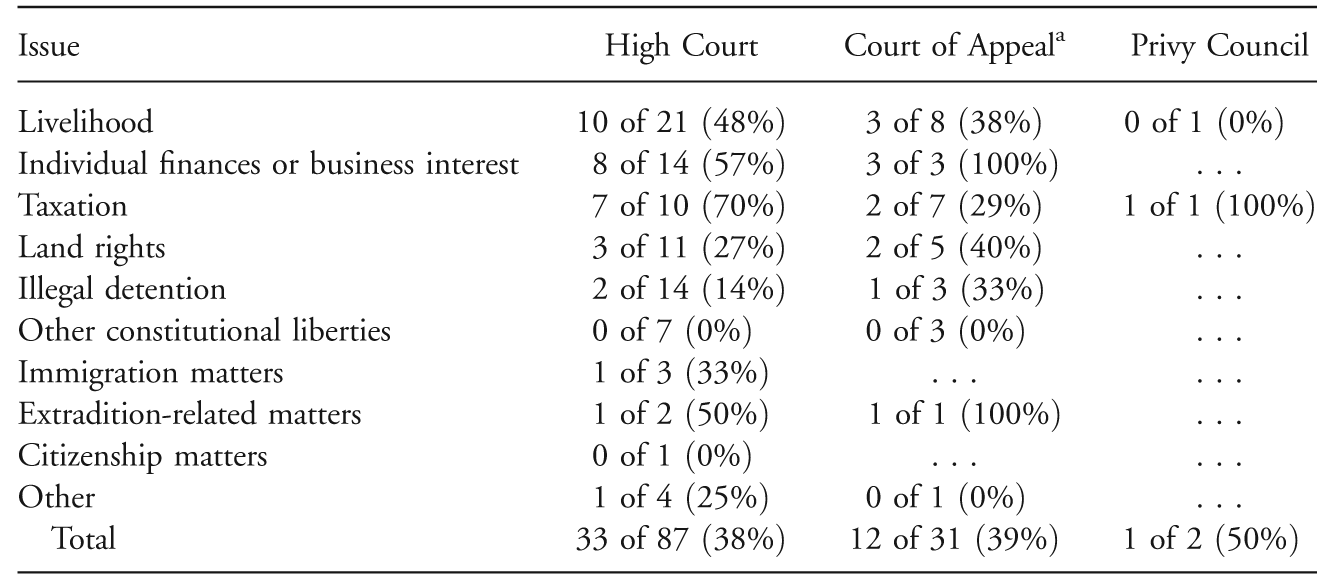
According to our closer analysis of issue types, successful economic decisions typically have strong personal, economic impact for the applicants but do not purport to alter or interfere with broader policies and practices.Footnote 19 As shown in table 3, “individual finances or business interest” is the most successful issue with a winning rate of 57% and 100%, respectively, in the High Court and Court of Appeal. For instance, in Re Application of Leo Boh Boey (High Court, 1985), the applicant successfully challenged the Commission for Labour’s refusal to consider her claim under the Workmen’s Compensation Act for the death of her husband, who was killed at his place of employment; in Tan Gek Neo Jessie v. Minister for Finance (High Court, 1991), the applicant disputed and won against an order from the Registrar of Business to change the name of her business because it contained the same words found in a foreign company’s trademarks that were not in use in Singapore.
Judicial Review Applications Granted by Issue, 1965–2012
a Includes four decisions by the Federal Court.
Similarly, successful economic issues related to livelihood contain fact patterns specific to the individual applicant’s circumstances. For example, they involve the question of whether the applicant should have been dismissed from the police force (see, e.g., Phang Moh Shin v. Commissioner of Police, High Court, 1967; Attorney-General v. Ng Hock Guan, Court of Appeal, 2004). Or they deal with dismissal by the Public Service Commission (see, e.g., Jacob v. Attorney-General, High Court, 1970) and other government agencies, such as the Port of Singapore Authority (Velayutham M v. Port of Singapore Authority, High Court, 1975).
For “taxation” issues, decisions granted in the applicant’s favor typically involve erroneous calculations or interpretation and implementation of the tax provision in question. In ACC v. Comptroller of Income Tax (2010), the High Court ruled against the government respondent for wrongly determining that the applicant, a Singapore-incorporated company, owed withholding taxes. Where taxation issues fail, the applicants dispute policies or practices that the government defendant is empowered to use on a whole class of taxpayers, such as the assessment method for taxes payable on combined property lots (Aspinden Holdings v. Chief Assessor, Court of Appeal, 2006). In City Developments v. Chief Assessor (2008), the Court of Appeal dismissed the challenge against property tax calculations that took into account the policy of discouraging “land hoarding” by developers.
Generally, among economic-related issues, “land rights” has a comparatively lower success rate, especially in the High Court, where it recorded only 27%. The Singaporean constitution does not provide for the right to property. On the basis of the justification that the island state has scarce land resources, it heavily regulates land development and the real estate market and enacts laws with wide compulsory acquisition powers. Unsurprisingly, judicial review brought against orders of compulsory acquisition (see, e.g., Teng Fuh Holdings v. Collector of Land Revenue, Court of Appeal, 2007; United Engineers v. Collector of Land Revenue, High Court, 1982) or the determination of compensation sum for compulsorily acquired land (Re an application by Nassim N H E, Court of Appeal, 1976) fail in both the High Court and Court of Appeal.Footnote 20 Other types of land rights issues heard by either court, such as an administrative tribunal’s (dis)approval of the sale of certain properties (see, e.g., Ng Eng Ghee and others v. Mamata Kapildev Dave and others, Court of Appeal, 2009) and a building demolition order (Chief Building Surveyor v. Makhanlall, Federal Court, 1969), have a mixture of successes and failures.
Moreover, the success rates of issues under the constitutional liberties category stand in sharp contrast to those in the economic category as a whole and to the ones with strong personal, economic impact in particular. Out of the 17 “illegal detention” decisions, only three were granted in their favor (the grounds of those decisions are discussed in the next subsection). Applicants who challenged under “illegal detention” were held under the Internal Security Act for their alleged subversive politics (see, e.g., Lee Mau Seng v. Minister for Home Affairs, High Court, 1971; Teo Soh Lung v. Minister for Home Affairs, Court of Appeal, 1990), the Criminal Law (Temporary Provisions) Act for suspected criminal activities (see, e.g., Kamal Jit Singh v. Minister for Home Affairs, Court of Appeal, 1992; Re Wong Sin Yee, High Court, 2007), or the Misuse of Drugs Act for the purposes of undergoing drug rehabilitation (Daud bin Salleh v. Superintendent, Sembawang Drug Rehabilitation Centre, High Court, 1980; Subramaniam s/o Marie and others v. Superintendent, Selarang Park Drug Rehabilitation Centre, High Court, 1981). All of the 10 decisions related to “other constitutional liberties” also failed; they include challenges against the ban of publications (Chan Hiang Leng Colin and others v. Minister for Information, Court of Appeal, 1996), restrictions on circulation of materials (Dow Jones Publishing Co. [Asia] Inc. v. Attorney-General, Court of Appeal, 1989), and the denial of clemency (Yong Vui Kong v. Attorney-General, Court of Appeal, 2011).
Grounds Granted
In addition to our analysis of issue type, we consider the grounds on which successful decisions were based to find out if the scope of these rulings has any implications for judicial power and its check on the executive. We coded these granted grounds on the basis of specific “heads of review” in Singaporean (and English) administrative law that allow judges to rule against the executive (also see the background section). “Procedural” grounds are violations of statutorily provided procedures or breaches of the common law rules of natural justice that require “fair hearing” and prohibit “bias” on the part of the decision maker; they indicate that the executive committed procedural impropriety in the decision-making process but do not interfere with the substance of its decision. “Substantive” grounds refer to acts of “illegality,” “irrationality,” ultra vires (exceeding legal authority), Wednesbury unreasonableness, and “bad faith” committed by the executive in making its decision, and arguably encroach on its merits or substance, though the extent varies from one head of review to the next.Footnote 21
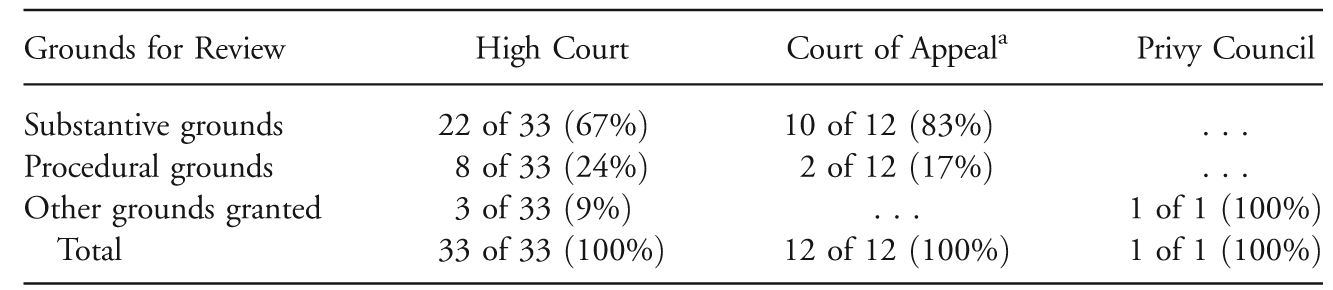
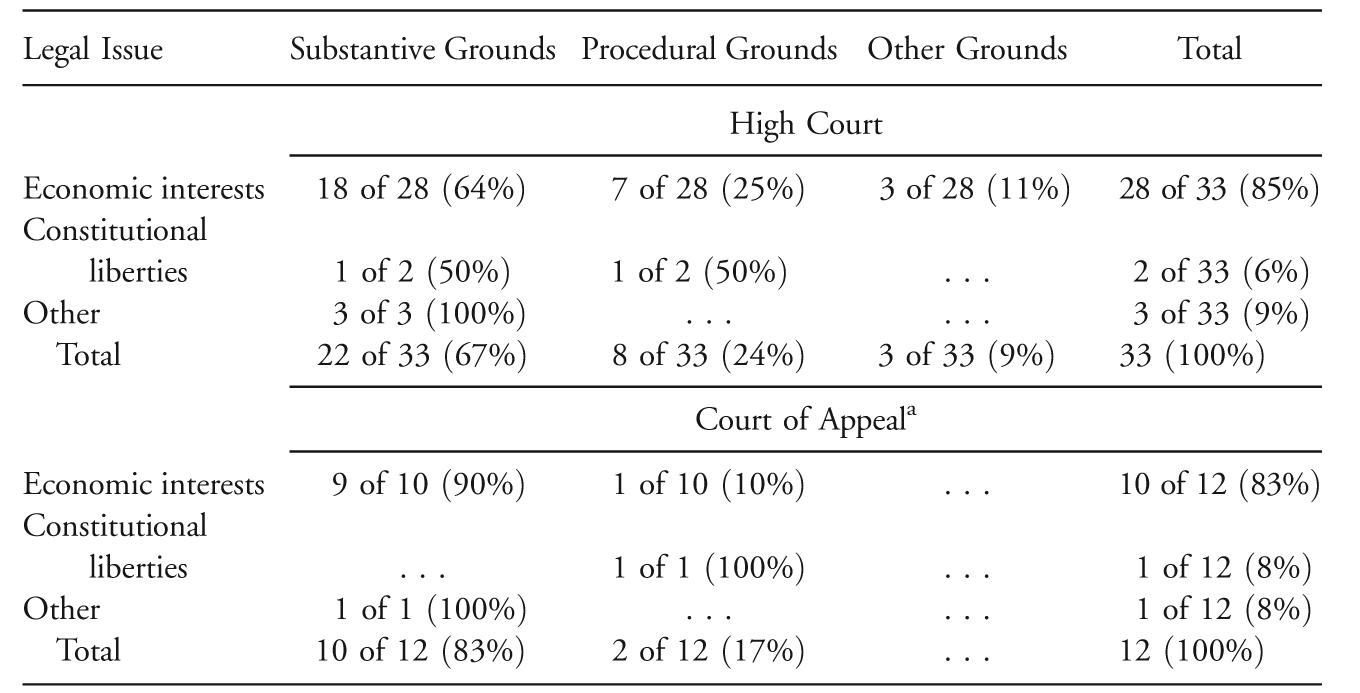
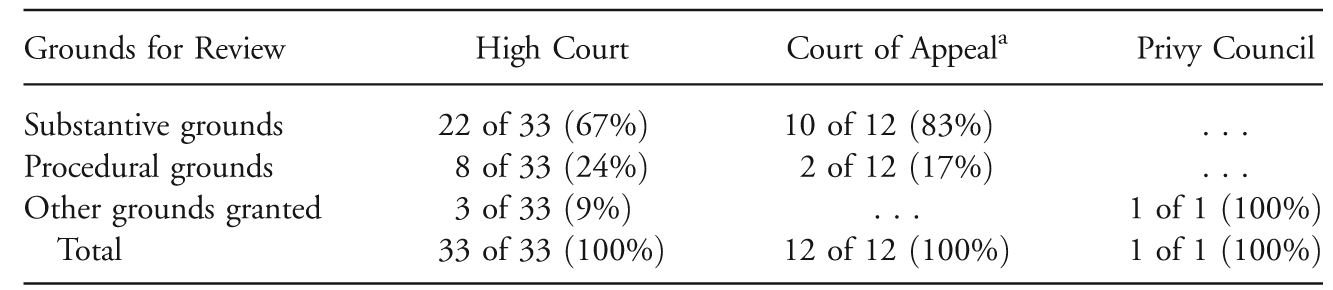
At first glance, the data on granted grounds cast doubt on claims that judiciaries in nonliberal regimes with entrenched dominant parties usually rely on procedural violations when ruling against the executive. As shown in table 4, 24% and 17% of successful decisions in the High Court and Court of Appeal, respectively, are based on procedural grounds. Most of the remaining successful decisions, 67% in the High Court and 83% in the Court of Appeal, are based on “substantive” grounds in administrative law.
Judicial Review Applications by Grounds Granted, 1965–2012
a Includes three decisions granted by the Federal Court.
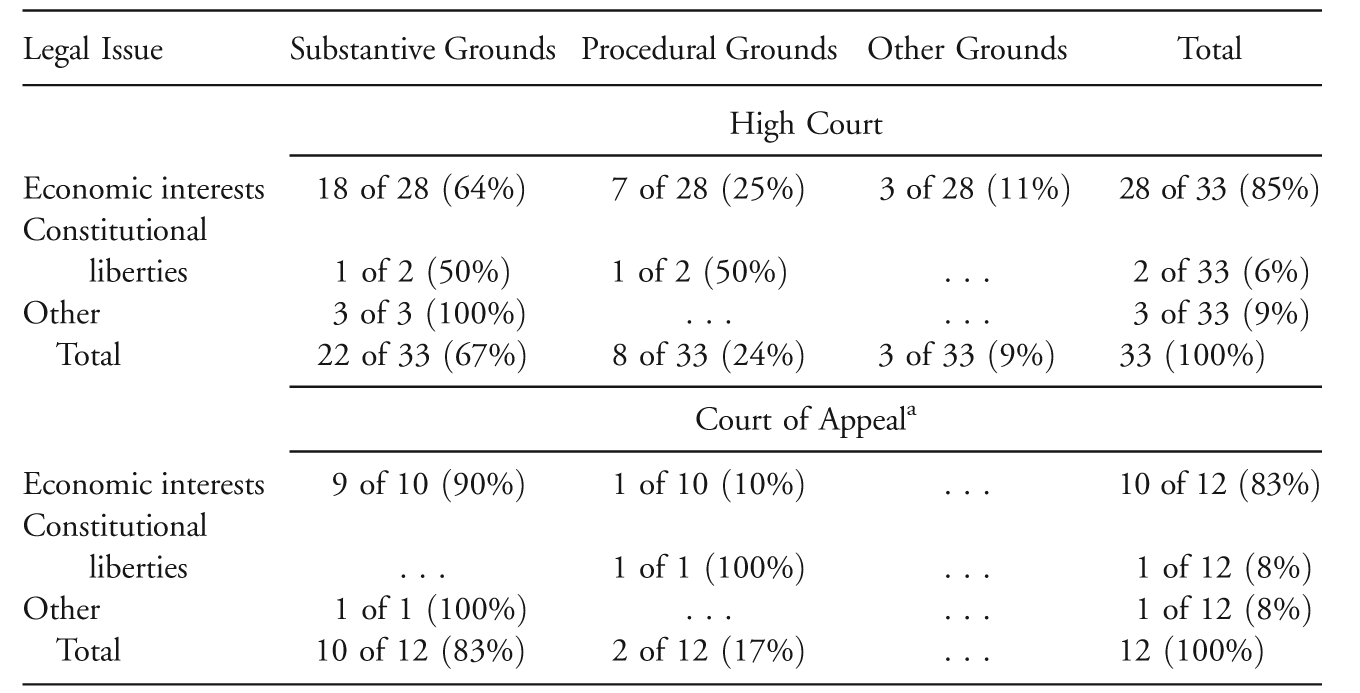
Upon closer examination, however, the data do not indicate an interventionist bench but point back to the divide between economic interests and civil-political rights. As evident in table 5, substantive grounds are granted overwhelmingly to economic issues, 18 out of the 33 (55%) successful decisions in the High Court and nine of 12 (75%) in the Court of Appeal. To illustrate using two aforementioned decisions, in ACC v. Comptroller of Income Tax (2010), the High Court found that the Comptroller had interpreted the relevant tax provision wrongly; in Re Application of Leo Boh Boey (1985), the High Court ruled that the Commission for Labour, by refusing to assess the compensation payable to the applicant, had failed to comply with its statutory duty.
Judicial Review Applications Granted by Aggregated Issue and Grounds Granted, 1965–2012
Note.—The table does not include one Privy Council decision, a case involving an economic issue that was granted relief on “other” grounds.
a Includes three decisions granted by the Federal Court.
In the rare decisions that find for individuals’ constitutional liberties, applicants win on extremely narrow procedural grounds, which constrain the decisions’ political impact, or under circumstances that have limited repercussions for the existing political order. Among the two decisions in the High Court and the single decision in the Court of Appeal that favor the applicant, only one (Daud bin Salleh, High Court, 1980) was granted on the “substantive” ground of illegality. In that case, the drug enforcement agency detained the applicant to compel him to undergo drug rehabilitation. The applicant successfully argued that the agency’s order was made without sufficient factual evidence. The other two decisions, Lim Hock Siew and others v. Minister of the Interior and Defence (High Court, 1967) and Chng Suan Tze v. Minister for Home Affairs (Court of Appeal, 1988), involve the preventive detention of individuals suspected of threatening “national security.” They succeeded because of procedural errors: the detention order or supporting documentation was not signed by the statutorily designated person. In contrast to drug rehabilitation, the two cases were highly politically charged, and in the eyes of the ruling party, the applicants had openly espoused antagonistic political views.Footnote 22 By ruling on procedural grounds, the court granted relief to the applicants but avoided setting judicial precedent for wider scrutiny into the executive’s control of political dissenters.
Implications
Our empirical analysis by no means suggests that the Singaporean judiciary makes decisions according to the executive’s direction or preferences, but it does reveal some nuanced implications, particularly based on the key finding that judicial review is most successful where it does not intrude on a key political or economic agenda of the state. First, our analysis suggests that Singaporean judicial review could have the important effect of domestic legitimation, demonstrating that courts can be trusted to protect day-to-day livelihood interests and the PAP to abide by those court rulings.Footnote 23 According to law and courts literature, the judiciary, perceived to be a third-party arbiter, helps to legitimize the political regime (Shapiro Reference Shapiro1981). More specifically, in nonliberal states, court rulings that protect economic interests signal the government’s commitment to foreign investors and trade partners (Ginsburg Reference Ginsburg2008b) and thus have an outward legitimation effect. Recent work on China, though not exclusively on cases involving government defendants, argues that where courts provide efficient dispute resolution (Michelson and Li Reference Michelson2012; Stern Reference Stern2013) or resolve livelihood concerns (Su and He Reference Su2010), they build up the one-party state’s domestic support and authority. In our study, the most successful judicial review decisions are those that have high personal, economic impact but bring little detriment to the key agenda of the state (and thus the ruling party). Overall, applicants suing on economic-related issues win one-third of the time at either court level. These phenomena affirm the state’s promise of accountability and the judiciary as an independent restraint of its power. They also comport with the PAP’s platform that they are the only party capable of addressing citizens’ bread-and-butter concerns and bolster support for the party, which nevertheless relies on electoral mandate to stay in power.
Second, our analysis echoes concerns that procedure-based justice could elicit satisfaction with existing legal institutions (Lind and Tyler Reference Lind1988; Tyler Reference Tyler1990; but see Berrey, Hoffman, and Nielsen Reference Berrey2012) in spite of the administrative curtailment of civil-political liberties. On the one hand, the high failure rate for the few challenges brought by applicants in this area demonstrates strong judicial deference (Lee Reference Lee2015) toward the executive, according it with wide discretionary latitude to impose social control. On the other hand, aggrieved individuals can vindicate violations of their civil-political liberties if they are able to point to procedural error, symbolizing some adherence to rule of law even in politically charged cases.
Third, the above implications together suggest that judicial review could have the consequence of reinforcing the incumbent regime. Within Singapore’s established scope of judicial review, courts can rule against the executive only on certain types of grounds and therefore already have limited authority to question the substance of state policies and actions. The approach is traceable to English administrative law inherited from the colonial era and accumulated in the jurisprudence over time as legal precedent. Such limitations are subsequently exacerbated by postindependence political realities in Singapore. The PAP-dominated legislature endows the executive with wide powers to implement its national policies, especially for land and economic development. It also enacts “ouster clauses” to exclude judicial review or restrict it to checks on procedural propriety, further narrowing its limited scope in certain areas of governance. Therefore, the rules that help to determine the parameters for judicial review are already heavily stacked in the executive’s favor. Although Chan (Reference Chan2010) is right that Singaporean courts grant judicial review applications that have “merit,” legal rules from the outset determine the available scope for judicial review and limit what counts as meritorious. The effect of these constraints may be one reason why only a small number of judicial review applications are heard in the High Court or reach the Court of Appeal.
The situation is further entrenched by judicial deference, which we find in our study and in the green light approach as propounded by Chan (also see Lee Reference Lee2015). In Chng Suan Tze (1988), the Court of Appeal pronounced in obiter dicta that courts possess inherent judicial power to check the executive’s exercise of discretion, including its decision-making process in the issuance of orders for preventive detention. Despite not being the actual ruling of the case—since the court found that the executive had committed procedural error (see the section on grounds granted)—the pronouncement was enough to come across as judicial activism to the PAP-dominated legislature. With the required two-thirds of parliamentarian votes, the legislature swiftly amended the constitution to enact an ouster clause that excludes judicial review of preventive detention for national security reasons except for the violation of legislatively prescribed rules of procedure (also see Silverstein Reference Silverstein2003, Reference Silverstein2008). Such ouster clauses have never been successfully challenged in the courts. Although the bench since 2006 has repeatedly affirmed the famous obiter dicta of Chng Suan Tze, its pronouncements have pertained to circumstances outside preventive detention based on national security reasons. Even in those cases, executive action is upheld, and judicial deference continues to prevail.
Future Research Directions
Our study demonstrates the need for further empirical research. Although it offers important insights, it raises questions that cannot be fully answered by analysis based on court decisions. Building on our study, we propose future research that explores the relationship between judicial review and the governed and the government, respectively. These suggestions would further verify or enrich our findings that suggest judicial review of executive power in Singapore may have the effects of legitimating and reinforcing a PAP-dominated government.
Scholars should investigate how people in a nonliberal regime such as Singapore make decisions about filing for judicial review. In our analysis, we noted the small number of judicial review decisions on civil-political liberties. Overall, judicial review decisions make up at most 8% of all reported decisions per year and average just 2% across our period of analysis. Chan (Reference Chan2010) surmises that the infrequency of judicial review in Singapore signifies popular satisfaction with the government. It may well be that Singaporeans do not have much cause for complaint. However, empirical research is simply lacking in this regard. The multitude of rules and regulations and prior decisions, especially those curbing civil-political liberties, could subtly shape the way people think about what is permissible (Fernandez Reference Fernandez2009; Earl Reference Earl2011) or what is likely to succeed in court. Most grievances do not end up in litigation because they are not even perceived as injurious experiences in the first place (Felstiner, Abel, and Sarat Reference Felstiner1980). People may be so conditioned by their sociopolitical context that they could not imagine they could bring judicial review or even realize they have suffered a grievance. They may also be deterred by a perception that applicants are unlikely to succeed.
Therefore, future research should ask how people responded to their encounters with executive power—what they did during and after their encounters—and whether, if, and how they decided to bring judicial review action. Do Singaporean lawyers discourage judicial review, especially where civil-political liberties are concerned? Is there a support structure (Epp Reference Epp1998) that facilitates and encourages judicial review and other legal actions against the state? What are the perceptions of the chances of success and why? Do people tend to sue certain government respondents more than others, and, if so, why? Do they opt for bureaucratic mechanisms that resolve their disputes with the government administratively, thus filtering out potential judicial review actions that could have been granted in their favor? “Settlements” may save complainants the time and cost of litigation, but they also reduce the opportunity for courts to develop case law (Albiston Reference Albiston1999), especially in situations in which the state has committed wrongdoing. For people who pursued judicial review, future research should seek to understand their experiences: what they thought of the outcomes, and whether judicial review and the outcomes changed their perceptions of not only the courts but also the government and ruling party.
Additionally, research should examine whether and how Singaporean judicial review changed over time. We notice a slight increase in the number of judicial review decisions across the 48-year span. Singapore’s first prime minister, the late Lee Kuan Yew, was well known for clamping down on political dissent. It is possible that people were reluctant to bring challenges during Lee’s office, compared to his successors’ administrations, which publicly indicated their openness to political differences. However, other factors may be at work. Studies that include analysis of judgments as well as interviews with scholars and (former) judges could provide a fuller explanation.
Scholars should also determine if alternatives to judicial review have increased, so that certain cases are “settled” and preempted from judicial review. We notice that the success rate of judicial review during Lee’s office (41%), despite his tough reputation, is higher than that of the current administration led by his son, Lee Hsien Loong (23%). One possible explanation could be the increasing use of bureaucratic mechanisms to address complaints (also see Chan Reference Chan2010), thus filtering out cases that would otherwise have been granted by the courts. Or, governmental departments and agencies may have become more aware of judicial review and put in additional safeguards in their decision-making processes. Hence, only the most difficult cases that fall outside or cannot be satisfactorily handled by the bureaucratic mechanisms end up in the courts. Addressing these questions is particularly important if Singaporean courts lean toward a green light approach, as any serious adoption of this approach means that other accountability measures ought to be in place. It could also reveal whether and how Singaporean views have shifted, if any, toward the administration and their governing politicians.
At the other end of judicial review, future research should examine its relationship to the conduct of a powerful executive, which has the backing of a single-party-dominated legislature. Are bureaucratic politics such that certain government respondents are more frequently sued and more frequently lose? If indeed judicial review has a domestic legitimating effect, how do government respondents react to their losses in court? Scholars should assess whether successful applicants could enforce the court-ordered remedies and whether government respondents remain defiant (and if so, which ones).
They should also study whether and how leaders of the executive branch and bureaucrats alter their conduct after judicial review decisions. To which types of rulings did they react and in what ways? In other words, do court decisions on judicial review have any impact beyond the immediate applicants, and if so, to what extent? In the United Kingdom, for instance, scholars find that judicial review rulings on procedure are likelier than other grounds to exact compliance (Sunkin Reference Sunkin2004; but see Machin and Richardson Reference Machin2000). Although a strong degree of judicial deference, or green light judicial approach (Chan Reference Chan2010), does exist in Singapore, judicial review could still shape executive compliance in the long run. Judicial review and the threat of it could induce government agencies and officers to change their conduct to avoid litigation, but it could also undermine administrative functions and statutory objectives (see, e.g., Kagan Reference Kagan2001; Platt, Sunkin, and Calvo Reference Platt2009; Meazell Reference Meazell2011). More systematic empirical studies will further illuminate the degree to which courts play a role in restraining executive power in nonliberal regimes.
Conclusion
In this article, we provided the first comprehensive analysis of almost 50 years of Singaporean judicial review. Singaporean courts exercise deference to the executive to varying degrees, depending on the extent to which the nature of the issue at stake or the scope of the ruling encroaches on key state interests. Our findings, therefore, provided empirical support for existing views—that judicial review involving economic issues tends to have a higher success rate than those related to civil-political liberties in Singapore. Furthermore, by showing that the most successful type of judicial review is related to economic issues with high personal impact but limited political ramifications, our study contributed to recent research on the ways in which judicial decision making in nonliberal regimes could produce inward legitimating effects for the political status quo. In addition, although judicial review on civil-political liberty issues usually defers to the executive’s discretionary powers, the fact that some cases have succeeded on narrow procedural grounds could also evoke a sense of legal legitimacy toward the government. Combined, these findings indicate that judicial review outcomes could generate perceptions that help to sustain the incumbent regime.
Of course, the empirical analysis in this article is only a starting point. The political and legal contexts of nonliberal regimes—or liberal states, for that matter—restrict the scope of judicial review from the outset, influencing both the outcomes and the sort of grievances that are litigated. Therefore, we proposed empirical research that goes beyond court decisions to investigate other ways in which legal and political power could influence the ability of judicial review to restrain the executive and to further examine the effects of judicial review on regime legitimacy. With this article, we took a substantial step toward informing the relationship between courts and executive power in Singapore and enriching the study of administrative law and courts in nonliberal, single-party-dominated regimes.
Appendix
Cases Cited