Examining the psychosis high-risk (HR) paradigm
Over the past two decades, the paradigm of help-seeking people presenting with potentially prodromal symptoms for psychosis has been the focus of much clinical and research activity. Operationalized diagnostic criteria, giving rise to ultra-high-risk (UHR; Yung et al. Reference Yung, Phillips, Yuen, Francey, McFarlane, Hallgren and McGorry2003), clinical high-risk (Cornblatt et al. Reference Cornblatt, Lencz, Smith, Correll, Auther and Nakayama2003) or at-risk mental state (ARMS; Yung et al. Reference Yung, McGorry, McFarlane, Jackson, Patton and Rakkar1996) status, have been developed to identify the syndrome and applied to young individuals seeking help for their problems at specialized services (Fusar-Poli et al. Reference Fusar-Poli, Borgwardt, Bechdolf, Addington, Riecher-Rossler, Schultze-Lutter, Keshavan, Wood, Ruhrmann, Seidman, Valmaggia, Cannon, Velthorst, De Haan, Cornblatt, Bonoldi, Birchwood, McGlashan, Carpenter, McGorry, Klosterkotter, McGuire and Yung2012c ). These criteria require one of three presentations: ‘attenuated’ psychotic symptoms (identifying the Attenuated Positive Symptom syndrome, APS), full-blown psychotic symptoms that are brief and self-limiting (Brief Intermittent Psychotic Symptom syndrome, BLIPS), or a significant decrease in functioning in the context of a genetic risk for schizophrenia (Genetic Risk and Deterioration syndrome, GRD). Belonging to one of these ‘putative prodromal’ groups [hereafter: clinical high-risk (HR) state] is associated with an enhanced risk to develop psychotic disorders (Fusar-Poli et al. Reference Fusar-Poli, Bechdolf, Taylor, Bonoldi, Carpenter, Yung and McGuire2012a , Reference Fusar-Poli, Bonoldi, Yung, Borgwardt, Kempton, Valmaggia, Barale, Caverzasi and McGuire b ). There is an ongoing debate about the usefulness of the HR state as a possible diagnostic class within psychotic syndromes (Carpenter & van Os, Reference Carpenter and van Os2011; Fusar-Poli & Yung, Reference Fusar-Poli and Yung2012). In the present article we discuss epidemiological validity and efficacy of the HR criteria, which, to date, have not been discussed in detail and therefore have not fully informed the debate, and examine whether changes could be implemented so that HR criteria might be more useful in intervention.
‘High risk’ from the population perspective
Independently from the study of HR criteria in clinical samples, population-based studies have been examining subthreshold psychotic experiences (PEs). These studies have shown that the dichotomous disease model of psychosis can be complemented with a model of psychosis as an extended phenotype across clinical and non-clinical expressions. At one end of the continuum lies schizophrenia, in the middle are non-psychotic mental disorders with PEs, and at the other extreme lie PEs in healthy, non-help-seeking individuals (Kaymaz et al. Reference Kaymaz, Drukker, Lieb, Wittchen, Werbeloff, Weiser, Lataster and van Os2012; van Os & Linscott, Reference van Os and Linscott2012). Thus, psychotic symptoms are experienced not only by patients with psychotic disorders but also by (i) patients with non-psychotic disorders and (ii) a substantial part of the general population (van Os et al. Reference van Os, Hanssen, Bijl and Vollebergh2001). The extended psychosis PE phenotype has the important advantage, from a research perspective, of (i) being much more prevalent than schizophrenia and (ii) not being dependent on help-seeking, thus allowing for true population-based epidemiological enquiry. These two advantages mean PEs are suitable for epidemiological research into the pathophysiology, course and treatment of psychotic symptoms in representative population-based contexts. PEs in the general population are generally transient and only a small proportion (8–10%) evolve into psychotic and non-psychotic disorders each year (Kaymaz et al. Reference Kaymaz, Drukker, Lieb, Wittchen, Werbeloff, Weiser, Lataster and van Os2012). Although the proportion of HR state that develops into psychotic disorder is much higher (36% after 3 years) (Fusar-Poli et al. Reference Fusar-Poli, Bonoldi, Yung, Borgwardt, Kempton, Valmaggia, Barale, Caverzasi and McGuire2012b ), clearly the clinical HR and the population PE extended psychosis phenotype perspective cannot be seen in isolation from each other. In the following sections, therefore, the two perspectives are brought together.
Risk of transition: a function of specific HR criteria or sampling strategy?
A key concept to emerge from work in the area of early psychosis is that the HR criteria have been developed and tested in highly selected help-seeking subjects, sampled in specialized research settings. The underlying implicit assumption is that the process of selection of samples is consistent across prodromal centres and that the associated risk of psychosis is independent from the sampling method adopted. However, there is no evidence supporting these assumptions, as the sampling methods are rarely described in detail. It follows that each HR sample is invariably opportunistic, each study using a different, unique strategy that cannot be replicated. For example, the sampling strategy of the Personal Assessment and Crisis Evaluation (PACE) Clinic in Melbourne was described as ‘referral sources included general practitioners, psychiatric services, school and university counselling services and other support agencies working with young people, such as drug and alcohol services’ (Yung et al. Reference Yung, Phillips, Yuen and McGorry2004). The North American Prodrome Longitudinal Study (NAPLS), involving 377 individuals meeting HR criteria as assessed by the Structured Interview for Prodromal Syndromes (SIPS), described their sampling strategy as: ‘each site recruited potential subjects through clinical referrals as stimulated by talks to school counsellors and mental health professionals in community settings’ (Cannon et al. Reference Cannon, Cadenhead, Cornblatt, Woods, Addington, Walker, Seidman, Perkins, Tsuang, McGlashan and Heinssen2008). In the European Prediction of Psychosis Study (EPOS), where criteria were assessed with the SIPS and the Bonn Scale for the Assessment of Basic Symptoms – Prediction List (BSABS-P, n = 245), sampling was similarly described as: ‘Knowledge about early warning signs (e.g. concentration and attention disturbances, unexplained functional decline) and inclusion criteria was disseminated (through local workshops, articles in professional journals and newsletters, informational flyers, and websites) to mental health professionals as well as institutions and persons who might be contacted by at-risk persons seeking help’ (Ruhrmann et al. Reference Ruhrmann, Schultze-Lutter, Salokangas, Heinimaa, Linszen, Dingemans, Birchwood, Patterson, Juckel, Heinz, Morrison, Lewis, von Reventlow and Klosterkotter2010).
Given that various sampling selection procedures and help-seeking behaviours enrich the HR transition probability, it is likely that not only the criteria themselves that determine the probability of transition but also the process of specialized selection of samples presenting to services, which creates substantial enrichment in risk (Yung, Reference Yung2003). As the great majority of individuals in HR research have attenuated psychotic symptoms (other HR criteria being rare), longitudinal research on attenuated psychotic symptoms (PEs) conducted in non-selected, non-help-seeking samples in the general population can serve as the population reference for HR research. A recent epidemiological study of 4587 subjects, sampled from a 10-year birth cohort of young adults and followed up for 24 years, found that 14.3% of the subjects reported at least one strong attenuated psychotic symptom (PE) at baseline, but only 0.5% were hospitalized and clinically diagnosed as having a non-affective psychotic disorder at follow-up (Werbeloff et al. Reference Werbeloff, Drukker, Dohrenwend, Levav, Yoffe, van Os, Davidson and Weiser2012). This study demonstrated that, in the general population, the base risk of transition from PE to non-affective psychotic disorder represents only a tiny proportion of the estimates in the prodromal HR literature. A recent meta-analysis identified six cohorts of unselected non-help-seeking population-based samples with 3–24-year follow-up of baseline subthreshold self-reported PEs (Kaymaz et al. Reference Kaymaz, Drukker, Lieb, Wittchen, Werbeloff, Weiser, Lataster and van Os2012). The yearly risk of conversion to a clinical psychotic outcome in exposed individuals (0.6%) was three times higher than for individuals without PEs (0.2%) and there was additional meta-analytic evidence of dose–response with severity/persistence of PEs. Individual studies also found a range of psychopathological, personal and environmental factors influencing transition (Kaymaz et al. Reference Kaymaz, Drukker, Lieb, Wittchen, Werbeloff, Weiser, Lataster and van Os2012). In addition, many individuals with PEs (2.8%) also made a transition to non-psychotic disorders. The conclusion therefore is, that for PEs, the yearly risk of transition to psychotic disorder is around 0.6% (Kaymaz et al. Reference Kaymaz, Drukker, Lieb, Wittchen, Werbeloff, Weiser, Lataster and van Os2012), representing only a fraction of the 22% (Fusar-Poli et al. Reference Fusar-Poli, Bonoldi, Yung, Borgwardt, Kempton, Valmaggia, Barale, Caverzasi and McGuire2012b ) observed in HR samples at 1-year follow-up. Therefore, the difference between the epidemiological PE studies and the HR literature can be attributed, at least in part, to the selective sampling strategies used when collecting putative prodromal samples rather than the specific HR criteria to which they are attributed. The risk enrichment associated with sampling procedures of HR criteria poses crucial questions to the current research paradigms. For example, it may not be useful to introduce a new diagnostic category of ‘attenuated psychosis syndrome (APS)’ in DSM-5, if the criteria will only work in the context of the requirement of distress and help-seeking, as is currently proposed (Carpenter & van Os, 2011); that is, a criterion of a non-replicable elusive sampling strategy occasioning enrichment in risk, compared to representative general population samples. Therefore, the question is whether the APS diagnostic criteria should also stipulate how clinicians should go about collecting a sample with attenuated psychotic symptoms in such a way that the result is an enriched group yielding 22% conversion at 1-year follow-up, instead of the much lower 0.6% proportion that they can expect from individuals with similar symptoms (PEs) in the general population.
PE and HR states are not ‘schizophrenia light’
In addition to attenuated psychotic symptoms, people who meet criteria for HR usually present with a mixed bag of psychopathology, in particular anxiety, depression and substance use (Yung et al. Reference Yung, Nelson, Stanford, Simmons, Cosgrave, Killackey, Phillips, Bechdolf, Buckby and McGorry2008; Woods et al. Reference Woods, Addington, Cadenhead, Cannon, Cornblatt, Heinssen, Perkins, Seidman, Tsuang, Walker and McGlashan2009). One of the largest multicentre studies in the HR population confirmed that DSM-IV diagnostic co-morbidity with the prodrome at baseline was common (Woods et al. Reference Woods, Addington, Cadenhead, Cannon, Cornblatt, Heinssen, Perkins, Seidman, Tsuang, Walker and McGlashan2009). About 69% of HR had one or more mood/anxiety diagnoses, 25% had one or more substance abuse or dependence diagnoses, and 44% had one or more Axis II diagnoses (Woods et al. Reference Woods, Addington, Cadenhead, Cannon, Cornblatt, Heinssen, Perkins, Seidman, Tsuang, Walker and McGlashan2009). Lifetime major depression and dysthymia rates were much higher among HR patients than among controls (Woods et al. Reference Woods, Addington, Cadenhead, Cannon, Cornblatt, Heinssen, Perkins, Seidman, Tsuang, Walker and McGlashan2009). A recent study in 509 HR individuals found that about 73% of HR subjects had a co-morbid Axis I diagnosis in addition to the ‘at-risk’ signs and symptoms, with 40% of HR subjects having a co-morbid depressive disorder (Fusar-Poli et al. Reference Fusar-Poli, Nelson, Valmaggia, Yung and McGuire2012d ). The study was complemented by a meta-analysis in 1683 HR subjects, which confirmed that baseline prevalence of co-morbid depressive and anxiety disorders is 41% and 15% respectively. Co-morbid diagnoses of anxiety or depression were associated with more severe psychopathology and with impaired global functioning (Fusar-Poli et al. Reference Fusar-Poli, Nelson, Valmaggia, Yung and McGuire2012d ).
The fact that most individuals defined as HR in fact have a diagnosis of anxiety disorder or depression at baseline (Velthorst et al. Reference Velthorst, Nieman, Becker, van de Fliert, Dingemans, Klaassen, de Haan, van Amelsvoort and Linszen2009; Addington et al. Reference Addington, Cornblatt, Cadenhead, Cannon, McGlashan, Perkins, Seidman, Tsuang, Walker, Woods and Heinssen2011) may be fundamental in explaining the risk function of HR samples. Research on PEs in the general population indicates that, similar to HR states, most PEs occur in the context of at least a degree of affective dysregulation (van Rossum et al. Reference van Rossum, Dominguez, Lieb, Wittchen and van Os2011). Indeed, the co-presence of psychotic symptomatology in disorders of anxiety and depression, and in subthreshold mania, is common, and may represent a functionally and aetiologically highly relevant feature (Kaymaz et al. Reference Kaymaz, van Os, de Graaf, Ten Have, Nolen and Krabbendam2007; Yung et al. Reference Yung, Buckby, Cosgrave, Killackey, Baker, Cotton and McGorry2007; van Rossum et al. Reference van Rossum, Dominguez, Lieb, Wittchen and van Os2011; Wigman et al. Reference Wigman, van Nierop, Vollebergh, Lieb, Beesdo-Baum, Wittchen and van Os2012). Common mental disorders and subthreshold mania have a high prevalence of PEs (Hanssen et al. Reference Hanssen, Peeters, Krabbendam, Radstake, Verdoux and van Os2003; Tijssen, Reference Tijssen2008; van Rossum et al. Reference van Rossum, Dominguez, Lieb, Wittchen and van Os2011; Varghese et al. Reference Varghese, Scott, Welham, Bor, Najman, O'Callaghan, Williams and McGrath2011), significantly impacting on prognosis (Kaymaz et al. Reference Kaymaz, van Os, de Graaf, Ten Have, Nolen and Krabbendam2007; Kelleher & Cannon, Reference Kelleher and Cannon2011; Perlis et al. Reference Perlis, Uher, Ostacher, Goldberg, Trivedi, Rush and Fava2011; van Rossum et al. Reference van Rossum, Dominguez, Lieb, Wittchen and van Os2011; Merikangas et al. Reference Merikangas, Cui, Kattan, Carlson, Youngstrom and Angst2012; Wigman et al. Reference Wigman, van Nierop, Vollebergh, Lieb, Beesdo-Baum, Wittchen and van Os2012).
Thus, a proportion of individuals meeting criteria for the HR state could be those from the general population with affective psychopathology and (poor outcome) the co-presence of PEs, as has been hypothesized previously (Yung et al. Reference Yung, Nelson, Baker, Buckby, Baksheev and Cosgrave2009). In other words, some ‘transitions’ to psychotic disorder in HR studies may represent the poor outcome of the general population subgroup of individuals with affective disorder and the co-presence of psychotic symptoms. Depending at which point along the extended psychosis phenotype help-seeking individuals are selected (e.g. from individuals with mild PEs but without co-morbid affective disorder, to individuals with PEs and co-morbid affective disorder to individuals with severe and multiple persistent PEs), subsequent transition risks may be higher or lower (van Os & Linscott, Reference van Os and Linscott2012).
The HR state therefore should not be considered exclusively as the prodromal phase of schizophrenia. Instead, it should be seen as heterogeneous, capturing some individuals with an admixture of affective and psychotic symptoms and some with a true vulnerability to schizophrenia (Nelson et al., in press). Not all transitions represent the onset of psychotic; instead, some may be mood disorders or mixed psychopathology.
Is ‘transition’ a useful concept?
Several important issues suggest themselves regarding the dichotomous definition of transition. The intensity, frequency and duration of PEs in HR subjects varies, as shown by Strauss (Reference Strauss1969), along continua. Defining transition, however, involves making a quantitative distinction between levels of severity of a symptom that corresponds to one of two categories (psychosis and non-psychosis) (Yung et al. Reference Yung, Nelson, Thompson and Wood2010). This, of course, is an arbitrary choice, particularly as it concerns individuals who are help-seeking in the context of affective dysregulation and other co-morbidities that to date remain understudied, notably cognitive alterations, motivational impairments, drug use and social dysfunctions. The standard criteria based on the DSM-III/IV or ICD-10 define brief psychotic disorder as an illness occurring for at least 1 day (Fusar-Poli & van Os, Reference Fusar-Poli and van Os2012). Paradoxically, this threshold is generally lower than those of the Comprehensive Assessment of At-Risk Mental States (CAARMS) and the SIPS, which have longer duration criteria. The CAARMS criteria require the occurrence of at least one fully developed positive psychotic symptom several times a week for more than 1 week (Yung et al. Reference Yung, Yuen, McGorry, Phillips, Kelly, Dell'Olio, Francey, Cosgrave, Killackey, Stanford, Godfrey and Buckby2005). The SIPS criteria require the presence of at least one fully developed positive psychotic symptom several times a week for at least 1 month, or at least one fully developed psychotic symptom for at least 1 day, if this symptom is seriously disorganizing or dangerous (Miller et al. Reference Miller, McGlashan, Rosen, Somjee, Markovich, Stein and Woods2002). Both the CAARMS and the SIPS transition criteria are weighted towards positive psychotic symptoms (Fusar-Poli & van Os, Reference Fusar-Poli and van Os2012). This was originally done to link the transition point to when antipsychotic treatment was thought to be indicated. However, under this scenario the concern is that many individuals meeting HR criteria in fact meet diagnostic criteria for anxiety disorder and depression (Fusar-Poli et al. Reference Fusar-Poli, Nelson, Valmaggia, Yung and McGuire2012d ), conditions in which the presence of PEs predicts poor outcome (Kelleher & Cannon, Reference Kelleher and Cannon2011; Perlis et al. Reference Perlis, Uher, Ostacher, Goldberg, Trivedi, Rush and Fava2011; Wigman et al. Reference Wigman, van Nierop, Vollebergh, Lieb, Beesdo-Baum, Wittchen and van Os2012). Thus, the question arises as to what degree an arbitrary definition of ‘transition’ (Yung et al. Reference Yung, Nelson, Thompson and Wood2010), which in fact represents variation of a single symptom (psychosis) on a continuous scale, in the context of a multidimensional syndrome for which help-seeking and need for care has developed, can represent a relevant outcome, or the only relevant outcome (Yung et al. Reference Yung, Nelson, Thompson and Wood2010).
The outcome of subjects who do not convert to psychosis is not well defined or studied. A systematic review by Simon et al. (Reference Simon, Velthorst, Nieman, Linszen, Umbricht and de Haan2011) showed that nearly half of the HR studies provided no characteristics of those subjects who did not develop clinical psychosis. Some studies have demonstrated evidence of continuing attenuated positive symptoms in some individuals who did not transition (Miller et al. Reference Miller, McGlashan, Rosen, Somjee, Markovich, Stein and Woods2002; Velthorst et al. Reference Velthorst, Nieman, Klaassen, Becker, Dingemans, Linszen and De Haan2011). However, it was unclear whether these participants improved or whether the baseline presentation of the non-converting group was predictive of another disorder. Indeed, a recent study confirmed that higher PE ratings significantly increased the risk of later hospitalization for psychiatric disorders other than schizophrenia spectrum disorders (Werbeloff et al. Reference Werbeloff, Drukker, Dohrenwend, Levav, Yoffe, van Os, Davidson and Weiser2012), whereas other studies indicated that PEs increase the risk of suicide attempts (Kelleher et al. Reference Kelleher, Lynch, Harley, Molloy, Roddy, Fitzpatrick and Cannon2012). One large study showed that the non-converting group had significant improvement in attenuated positive symptoms, negative symptoms and social and role functioning, and more than 50% no longer presenting with what at baseline were considered possible prodromal symptoms. However, the group on average remained at a lower level of functioning than non-psychiatric comparison subjects, suggesting that, for a significant proportion, initial ‘prodromal’ categorization is associated with persistent disability for a period of at least for 2 years (Addington et al. Reference Addington, Cornblatt, Cadenhead, Cannon, McGlashan, Perkins, Seidman, Tsuang, Walker, Woods and Heinssen2011). Additional research is needed to explore the causes of persistent disability among those who do not transition, and to what degree, from a clinical and health economic perspective, persistent disability represents a more relevant health state than arbitrary transition defined along a single symptom dimension. To address these caveats, future studies are needed to better focus on long-term outcomes other than conversion to psychosis, such as functional and psychosocial outcomes. Existing studies suggest that many non-converters have poor outcome, including non-psychotic morbidity (Lin et al. Reference Lin, Wood, Nelson, Brewer, Spiliotacopoulos, Bruxner, Broussard, Pantelis and Yung2011; Velthorst et al. Reference Velthorst, Nieman, Klaassen, Becker, Dingemans, Linszen and De Haan2011).
False transitions
The issue of ‘false transitions’ has more recently come to the fore. It is known that HR samples may in part consist of patients with concealed first episodes of psychosis (Nelson & Yung, Reference Nelson and Yung2007). Previous studies have found that almost 12% of subjects presenting to a first assessment for HR symptoms were already psychotic, indicating that a substantial minority of individuals thought to be prodromal are in fact suffering a first episode of psychosis (Lemos-Giraldez et al. Reference Lemos-Giraldez, Vallina-Fernandez, Fernandez-Iglesias, Vallejo-Seco, Fonseca-Pedrero, Paino-Pineiro, Sierra-Baigrie, Garcia-Pelayo, Pedrejon-Molino, Alonso-Bada, Gutierrez-Perez and Ortega-Ferrandez2009). This suggests that some individuals enrolled in HR services who transition early may have already been psychotic. Indeed, recent trials excluding those patients who made an apparent early transition from their analysis found very low transition risks (Morrison et al. Reference Morrison, French, Stewart, Birchwood, Fowler, Gumley, Jones, Bentall, Lewis, Murray, Patterson, Brunet, Conroy, Parker, Reilly, Byrne, Davies and Dunn2012), suggesting that a proportion of apparent transitions from HR to clinical psychotic disorder may represent a dimensional fluctuation in severity of existing psychotic disorder. On the contrary, some HR individuals who meet criteria for transition may in fact be functioning well and have never met criteria for a distressing or disabling mental disorder. These have been referred to as ‘trivial transitions’ (Yung et al. Reference Yung, Nelson, Thompson and Wood2010). However one explanation for their good outcome may be that they received intensive interventions in the HR services.
Misclassification: false positives and false negatives
False positives have been defined as individuals who were diagnosed as having an HR state for psychosis but who did not develop any psychotic disorder over time. According to recent meta-analytical estimates, the proportion of false positives is about 82% at 6 months of follow-up, 78% at 1 year, 71% at 2 years and 64% after 3 years (Fusar-Poli et al. Reference Fusar-Poli, Bonoldi, Yung, Borgwardt, Kempton, Valmaggia, Barale, Caverzasi and McGuire2012b ) and, according to a long-term follow-up study, 65.1% after 10 years (Nelson et al., in press). Thus, follow-up may need to continue for many years to detect high numbers of people with psychotic disorder, which may not be feasible. The issue of false negatives remains understudied. Some apparent false negatives may in fact be ‘false false positives’. That is, they may have been going to develop psychosis but were prevented from doing so because of formal or informal treatment or some change in circumstance, such as reduction in stress or substance use (Yung et al. Reference Yung, Phillips, Yuen, Francey, McFarlane, Hallgren and McGorry2003). These individuals may remain at risk of psychotic disorder in the future. Other false negatives may never have been at risk of psychotic disorder but were clearly help-seeking and symptomatic at the time of initial presentation and may have been, or may be, at risk of non-psychotic disorder. The importance of this issue is discussed in the following section, in relation to a new model of mental health care that sees these people not just as ‘false negatives’ but as requiring monitoring and follow-up for a range of outcomes, not just psychosis.
Discussion
Summary of findings
Importantly, HR studies have shown proof of concept, and individual cases may continue to benefit from specialized HR services. Nevertheless, it is becoming increasingly clear that the specific focus on psychosis may be too narrow, and epidemiologically too incomplete, to merit specific operational criteria in diagnostic manuals and to allow broad and cost-effective implementation in mental health care. A broader focus beyond psychosis, from a public health perspective, means a higher preventable fraction and therefore a more successful strategy. Similar staging approaches have been adopted successfully in other risk states in medicine such as mild cognitive impairments (Petersen et al. Reference Petersen, Roberts, Knopman, Boeve, Geda, Ivnik, Smith and Jack2009) and pre-diabetes (Tabak et al. Reference Tabak, Herder, Rathmann, Brunner and Kivimaki2012).
Three significant issues were identified. First, the notion of a binary outcome of ‘transition’ does not adequately describe the course and outcome of early states of mixed psychopathology with some co-presence of psychotic symptoms. Second, the notion of ‘risk’ predicting a future outcome in the HR literature includes an artefact of sampling. That is, the degree of risk depends on the base rate of the sample from which it is derived. This caveat could be addressed by using a two-stage design to systematically standardize sampling and enrichment (Rietdijk et al. Reference Rietdijk, Klaassen, Ising, Dragt, Nieman, van de Kamp, Cuijpers, Linszen and van der Gaag2012). Third, the notion of an HR ‘schizophrenia light’ state specifically predicting schizophrenia is much too narrow to capture the multidimensional and dynamic nature of early mixed affective and non-affective psychopathology in the general population and how it may progress, in some, to more severe psychopathology in a slow and non-linear fashion over periods of up to 25 years (Werbeloff et al. Reference Werbeloff, Drukker, Dohrenwend, Levav, Yoffe, van Os, Davidson and Weiser2012).
From specific HR syndromes to general staging
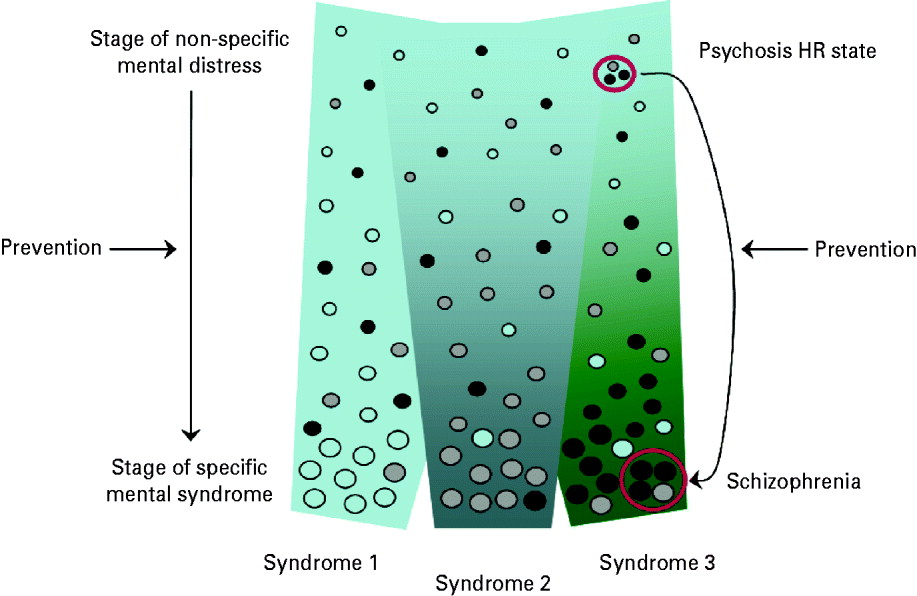
The data suggest that ‘risk’ states in the context of the psychosis HR paradigm do not produce a dramatic shift from one state to another, but rather index the possibility of a slow progression across stages of psychopathology (McGorry et al. Reference McGorry, Hickie, Yung, Pantelis and Jackson2006; McGorry, Reference McGorry2007) under the influence of many factors, starting with early states of mixed, diagnostically non-specific, subthreshold psychopathology in the general population (e.g. stage 1), that are usually transitory but in some cases become associated with distress and help-seeking behaviour, giving rise to early mixed psychopathology (e.g. stage 2) that in some cases may progress to more severe psychopathological outcomes that are characterized by some degree of diagnostic specificity and a degree of treatment resistance (e.g. stage 3) (Fig. 1) (McGorry & van Os, in press). Psychosis is an important dimension, but only one of several, dynamically interacting psychopathological domains (Kendler et al. Reference Kendler, Zachar and Craver2011). Both population-based PE research and care-based HR research have shown that early expression of psychosis is not ‘schizophrenia light’ but rather forms part of a multidimensional early syndrome predicting a range of outcomes both at the level of the syndrome and at the level of functional outcome. Therefore, instead of defining a specific risk syndrome for each mental disorder, it may be more profitable to pay heed to advances in psychiatric epidemiology, which has demonstrated widespread subdiagnostic and relatively non-specific expression of mental ill-health in populations with important public health impact and significant variation in diagnostic outcome over time. One way to use this information in the context of early intervention is to introduce a general diagnostic staging model of psychopathology (McGorry & van Os, in press).
Staging model of prodromal prevention, showing how mental disorders arise from non-specific states of mental distress that gradually develop into recognizable syndromes of, for example, anxiety (syndrome 1), depression (syndrome 2) and psychotic disorder (syndrome 3). Treatment of early mental distress therefore may efficiently prevent transition to mental disorder in general (on the left). In comparison, the exclusive focus on high-risk (HR) state and prevention of schizophrenia (on the right) benefits a much narrower population.

Advantages of a general diagnostic staging model of psychopathology
The HR state seems to predict a much broader outcome than schizophrenia/psychotic disorder alone, suggesting that there is much more to be ‘prevented’, increasing the public health relevance of the strategy. The population-based PE literature is informative in this regard, as meta-analytic work reveals that although the relative risk for transition to mental disorder is highest for (rare) psychosis outcomes, the absolute number of preventable cases is much higher for (more common) non-psychotic outcomes, including disorders of anxiety and depression (Kaymaz et al. Reference Kaymaz, Drukker, Lieb, Wittchen, Werbeloff, Weiser, Lataster and van Os2012). In other words, the public health ‘yield’ of the HR paradigm may be enhanced considerably if it is not used narrowly in the context of subthreshold psychosis predicting psychosis outcomes, but broadly in the context of relatively non-specific subdiagnostic mental distress predicting both psychotic and non-psychotic outcomes. Thus, an alternative way to proceed along the lines of early intervention and prevention is to introduce a broad model of staging in psychiatry, focusing on a general syndrome of early mental distress requiring non-specific interventions to prevent more severe stages of psychopathology that may develop in more specific, and relatively treatment-resistant, syndromes later on (Fig. 1) (McGorry & van Os, in press). In this way, stage-specific treatments can be introduced, varying from non-specific non-pharmacological self-management approaches in the early stages to more active treatments in the advanced stages.
Declaration of Interest
None.