Introduction
Mixed states present particular challenges to the treating clinician, and even the prevalence rate changes significantly among studies and in relation to the diagnostic criteria used. In the DSM–IV, a diagnosis of a mixed episode required simultaneously all criteria for a manic or a major depressive episode for a period of one week. Individuals infrequently meet these full criteria in clinical practice. The new DSM–5 “specifier” arguably adopts a broader approach toward mixed states. In the case of depressive episodes, there is a requirement for the presence of at least three manic/hypomanic symptoms (including elevated mood, inflated self-esteem, decreased need for sleep, an increase in energy or goal-directed activities, etc.) occurring nearly every day during a major depressive episode; notably, overlap with symptoms of major depression is restricted. In the case of mania or hypomania, the specifier requires the presence of at least three symptoms of depression (including depressed mood, diminished interest or pleasure, slowed physical and emotional reaction, fatigue or loss of energy, and recurrent thoughts of death, etc.) occurring nearly everyday throughout the manic or hypomanic episode.
Mixed states are generally held to be less responsive to pharmacological treatment, and the response to mood stabilizers and other pharmacotherapies is poor.Reference Swann, Lafer and Perugi 1 , Reference Vieta and Valenti 2 Antidepressants are generally avoided because of exacerbation of manic symptoms and a feared increased risk of suicidality, which is already high.Reference Castle 3 However, the use of an atypical antipsychotic/antimanic agent in some bipolar disorder patients may decrease suicidal ideation.Reference Houston, Ahl, Meyers, Kaiser, Tohen and Baldessarini 4 As a result, the choice of medication is usually based on individual factors and short-/long-term harms, safety, and tolerability parameters. The aim of this review is to summarize the pharmacological treatment of “mixed states/episodes” as defined by the DSM–III and the DSM–IV, and manic episodes “with mixed features” as defined in the DSM–5.
Methods
Searches
PubMed, MEDLINE, and The Cochrane Library were searched from January of 1980 to October of 2016 for all publications regarding treatment of mixed features as defined by the DSM–III and DSM–IV, and manic or depressive episodes “with mixed features” as defined in the DSM–5. The clinical trials registries in clinicaltrials.gov and controlled-trials.com were scrutinized for trials. The search was done using different combinations of the following keywords: “mixed states/features,” “bipolar disorder,” “depressive symptoms/bipolar depression,” “manic symptoms,” “treatment,” “DSM–5.” Related publications were hand-searched from the reference lists of every identified primary study.
Study selection
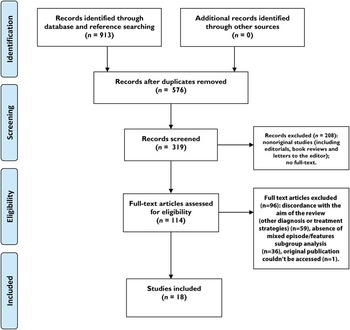
We followed the Preferred Reporting Items for Systematic Reviews and Meta-Analyses (PRISMA)Reference Liberati, Altman and Tetzlaff 5 guidelines (see Figure 1). Articles were selected for inclusion in this review if they met the following criteria: (1) inclusion of a mixed-episode sample (or subgroup) was clearly stated; and (2) research findings for the mixed-episode sample (or subgroup) were presented. Nonoriginal studies (including editorials, book reviews, and letters to the editor) and studies without available full-text versions were excluded.
PRISMA flow diagram.

Quality assessment
First-degree studies included double-blind, placebo-controlled randomized controlled trials (RCTs) of pharmacological interventions used as monotherapy. Second-degree studies had a similar design without a placebo or combination therapy as a comparative group, while third-degree studies referred to any other type of published research.
Results
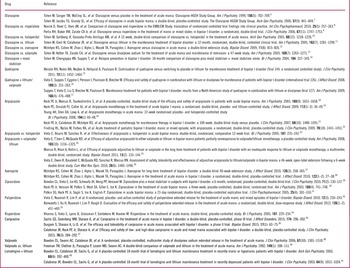
114 articles were assessed for eligibility, of which 54 investigated mixed states in bipolar disorder. However, while 36 of these studies included some number of patients experiencing a mixed episode at baseline, their focus was on pure mania, and the data from both groups were pooled and analyzed together. Several of these studies briefly reported some exploratory subgroup analysis or no significant effect of episode on treatment outcome when baseline episode (manic vs. mixed) was added as a covariate. These studies were excluded from the present review as the data reported are not sufficient to provide reliable estimates of treatment efficacy in patients with mixed states. Table 1 presents all the studies that were excluded at this final stage, organized by treatment. In addition, one article examining the effects of gabapentin as adjunctive treatment in mixed states was also excluded from this review as the full text of the publication could not be accessed.Reference Perugi, Toni, Ruffolo, Sartini, Simonini and Akiskal 42
List of publications that included mixed patients in the total sample, but did not report results for the mixed-only subgroup

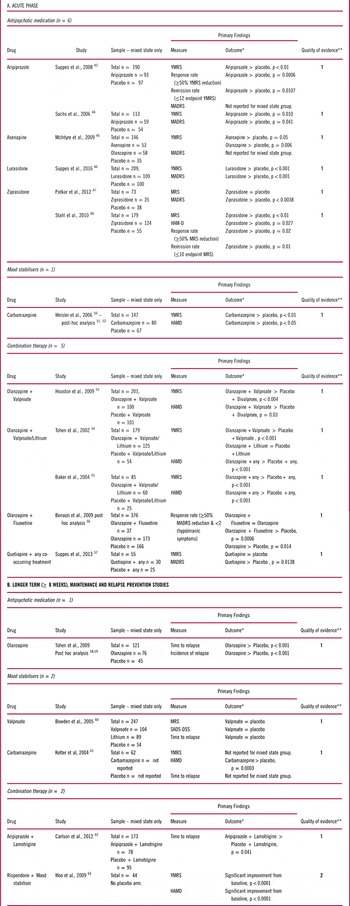
Following the exclusion of these articles, there were 18 studies that met the inclusion criteria and investigated mixed states in bipolar disorder as a separate group. Of these, only 7 studies specifically examined pharmacotherapy for mixed states and the remaining 11 included both manic and mixed episode patients but reported treatment effect separately for each subgroup. These studies evaluated antipsychotics, mood stabilizers, and combination therapies for acute (n=12), maintenance treatment (n=5), or both (n=1) in patients with DSM–III and DSM–IV mixed episodes or DSM–5 mixed features. Pharmacological evidence for each class of medication is presented in Table 2, and the sections below are organized according to aim of treatment (acute vs. maintenance) and drug. The primary findings, degree of evidence, and sample size are also presented in Table 2.
Studies evaluating pharmacological treatments for mixed states in bipolar disorder during the acute or long-term/maintenance phase.

* > indicates ‘significantly superior’;=indicates ‘no significant difference’; ** 1- first-degree evidence: randomised placebo controlled studies of pharmacological interventions used in monotherapy; 2- second-degree evidence: absence of a placebo group or of combination therapy; 3- third degree evidence: case reports, case series or reviews of published studies; HAMD- Hamilton Depression Rating Scale, MADRAS- Montgomery-Asberg Depression Rating Scale, MRS- Mania Rating Scale, SADS-DSS- Schedule for Affective Disorders and Schizophrenia-Depressive Syndrome Scale, YMRS- Young Mania Rating Scale.
Acute Phase Studies
Antipsychotic medication
We identified six studies that evaluated the efficacy of antipsychotic medication in patients with mixed states.
Two first-degree studies compared aripiprazole with placebo and found that aripiprazole significantly decreased manic symptoms.Reference Suppes, Eudicone, McQuade, Pikalov and Carlson 43 , Reference Sachs, Sanchez and Marcus 44 Further, Sachs et al.Reference Sachs, Sanchez and Marcus 44 reported a significant reduction in depressive symptoms among patients taking aripiprazole compared to placebo. Suppes et al.Reference Suppes, Eudicone, McQuade, Pikalov and Carlson 43 also reported significantly higher response and remission rates (based on YMRS scores) among those treated with aripiprazole.
We identified two studies that examined the efficacy of ziprasidone.Reference Patkar, Gilmer and Pae 47 , Reference Stahl, Lombardo, Loebel and Mandel 48 One first-degree evidence trial comparing ziprasidone with placebo in major depressive episodes with 2 or 3 concomitant manic symptoms found ziprasidone to be superior to placebo in improving depressive, but not manic symptoms.Reference Patkar, Gilmer and Pae 47 One studyReference Stahl, Lombardo, Loebel and Mandel 48 is also available from a pooled analysis of mixed patients with dysphoric mania previously enrolled in two similar placebo-controlled trials.Reference Keck, Versiani, Potkin, West, Giller and Ice 30 , Reference Potkin, Keck, Segal, Ice and English 31 This study found ziprasidone to be significantly superior to placebo in improving both manic and depressive symptoms. Response and remission rates were also significantly higher in the ziprasidone group.
In a first-degree placebo-controlled trial, McIntyre et al.Reference McIntyre, Cohen, Zhao, Alphs, Macek and Panagides 45 found that the effect of treatment with sublingual asenapine (compared to placebo) on manic symptoms only approached significance, while the effect was significantly greater in the group treated with olanzapine (compared to placebo).
In a recent first-degree trial, Suppes et al.Reference Suppes, Silva and Cucchiaro 46 evaluated the efficacy of lurasidone in major depression with mixed features and found that lurasidone significantly improved both depressive and manic symptoms, and a significantly higher proportion of patients in the lurasidone group met a-priori response and remission criteria (number needed to treat [NNT] of 3 and 4, respectively).
Finally, in a case series by Suppes et al.Reference Suppes, McElroy, Gilbert, Dessain and Cole 49 (not included in the table), patients were treated with clozapine in both the acute and maintenance phases. Seven subjects had treatment-resistant bipolar disorder and manic episodes associated with significant depressive symptoms. All patients displayed significant reductions in affective and psychotic symptoms when treated with clozapine alone or in combination with lithium, an antidepressant, or valproate.
Mood stabilizers
We found only one study that satisfied our inclusion criteria. This was a post-hoc analysis by Weisler et al.Reference Weisler, Hirschfeld and Cutler 50 of data from two studiesReference Weisler, Kalali and Ketter 51 , Reference Weisler, Keck, Swann, Cutler, Ketter and Kalali 52 that evaluated the efficacy of carbamazepine (extended-release capsules) versus placebo in patients with manic or mixed episodes. Carbamazepine significantly improved both manic and depressive symptoms in the subsample of mixed patients.
Combination therapy
We identified five first-degree trials that met our inclusion criteria. Three trials compared the efficacy of olanzapine in combination with a mood stabilizer (lithium or valproate) versus placebo and presented data for the mixed-patients group.Reference Houston, Tohen, Degenhardt, Jamal, Liu and Ketter 53 – Reference Baker, Brown and Akiskal 55 Overall, the results from all three studies indicated that adjunctive olanzapine treatment is superior to mood stabilizer monotherapy in improving both depressive and manic symptoms. Conversely, one trial examining the efficacy of a olanzapine/fluoxetine combination for the treatment of mixed depression reported no statistically significant difference in depressive symptoms between patients who received both olanzapine and fluoxetine and those who received olanzapine alone.Reference Benazzi, Berk, Frye, Wang, Barraco and Tohen 56
Finally, Suppes et al.Reference Suppes, Ketter and Gwizdowski 57 assessed adjunctive quetiapine treatment (to any stable cooccurring treatment) in hypomanic patients experiencing mixed symptoms. Quetiapine adjunctive treatment was significantly more effective in improving depressive, but not hypomanic symptoms.
Long-Term (≥8 Weeks), Maintenance and Relapse Prevention Studies
Antipsychotic medication
We found one post-hoc analysis of a randomized placebo-controlled trial that compared olanzapine with placebo in mixed-episode patients for 6 to 12 weeks. The results indicated that olanzapine-treated patients had significantly lower rates of symptomatic relapse of any kind compared with placebo, with a reported NNT of 4 to prevent one episode of symptomatic relapse.Reference Tohen, Calabrese and Sachs 58 , Reference Tohen, Sutton, Calabrese, Sachs and Bowden 59
Mood stabilizers
Two first-degree trials met our inclusion criteria: one of valproate and one of carbamazepine. Bowden et al.Reference Bowden, Collins and McElroy 60 provided randomized maintenance treatment with valproate, lithium, or placebo to euphoric and dysphoric patients. Among the dysphoric patients, there were no statistically significant treatment-related differences on time to relapse nor on manic and depressive scores.
Ketter et al.Reference Ketter, Kalali and Weisler 61 examined the efficacy of carbamazepine extended-release capsules as maintenance therapy in bipolar patients with manic and mixed episodes in an open-label extension study of two double-blind placebo-controlled trials. Separate data analysis of the mixed subgroup was only reported for depressive symptoms, where carbamazepine treatment maintained the significant decrease of depressive symptoms observed at the end of the double-blind studies.
Combination therapy
One first-degree study of aripiprazole+lamotrigine combination therapy was found.Reference Carlson, Ketter and Sun 62 Time to relapse in the mixed-state group was significantly longer in the aripiprazole+lamotrigine group compared to the placebo+lamotrigine group in this study.
Finally, in a 24-week open-label (second-degree) combination trial, Woo et al.Reference Woo, Bahk and Jon 63 investigated the efficacy of risperidone in combination with mood stabilizers. A significant improvement from mean baseline was reported for both manic and depressive symptoms among mixed-episode patients.
Discussion
We found that the vast majority of published RCTs initially recruited both pure manic and mixed patients as defined by the DSM–IV classification system and that additional analyses were performed to identify effects in the subgroup of mixed patients only in a small proportion of these studies. This subgroup approach has several shortcomings. First, the resulting sample sizes are usually small, and thus “negative” trials could have been underpowered to detect existing differences between treatment groups. Second, the enrollment criteria in many of these studies were based on manic symptom severity alone, and there was no minimum depressive score cut-off, suggesting that the mixed patients enrolled could be less severely ill than those seen in clinical practice or that they may not be representative of the full spectrum. Third, the categorical definition in the DSM–IV limits the number of patients identified, since it requires the co-occurrence of a full manic and a full depressive episode. The new DSM–5 specifier, however, has the potential to address this latter issue, as it is likely that it will increase the detection and reporting of mixed states from both ends of the spectrum. A further major shortfall of the literature is that mixed depressive cases are not usually reported in depression RCTs. Additionally, there were only seven studies identified in the literature that exclusively examined pharmacotherapy for the mixed manic or depressive state. Due to the low number of studies, the variety of pharmacological interventions tested, the differences in methodology and in the aim of treatment (acute vs. maintenance), it is not possible to draw informative conclusions for clinical practice at the present point in time.
Some limitations of our work must be acknowledged. Although our search strategy was comprehensive, there is still the chance that relevant papers or studies have been missed. This review did not include books or clinical trials that looked at the effects of other nonpharmacological treatment modalities, such as psychosocial interventions or electroconvulsive therapy. We reported results distinguishing between manic and depressive outcomes when available, which may be more in line with the clinical need to understand to what extent the chosen medication is able to resolve both manic and depressive symptoms in mixed states or, conversely, to independently treat one or the other. Moreover, this is in line with the new “mixed-features” categorization of mood episodes in the DSM–5, as the distinction in efficacy based on the polarity of concomitant symptoms may be more applicable to the clinical setting.
In summary, the currently available evidence does not meet clinicians’ demands. Therefore, there is a clear need to conduct well-powered clinical trials specifically designed to enroll the full range of mixed features using current criteria.
Disclosures
Alessandro Cuomo, Viktoriya Nikolova, Nefize Yalin, and Danilo Arnone hereby declare that they do not have anything to disclose.
Andrea Fagiolini reports grants and personal fees from Allergan, Angelini, Astra Zeneca, Bristol-Myers Squibb, Boehringer Ingelheim, Pfizer, Eli Lilly, Janssen, Lundbeck, Novartis, Otsuka, and Roche, outside the submitted work.
Allan Young has the following disclosures. Employed by King’s College London. Honorary consultant SLaM (NHS UK). Paid lectures and advisory boards for all major pharmaceutical companies with drugs used in affective and related disorders. No shareholdings in pharmaceutical companies. Lead Investigator for the Embolden Study (AZ), the BCI Neuroplasticity Study, and the Aripiprazole Mania Study. Investigator-initiated studies from AZ, Eli Lilly, Lundbeck, and Wyeth. Grant funding (past and present): NIMH (USA), CIHR (Canada), NARSAD (USA), Stanley Medical Research Institute (USA), MRC (UK), Wellcome Trust (UK). the Royal College of Physicians (Edin), BMA (UK), UBC–VGH Foundation (Canada), WEDC (Canada), CCS Depression Research Fund (Canada), MSFHR (Canada), and NIHR (UK).