A controversy exists over whether direct democracy enhances the political efficacy of citizens. Earlier theorists of participatory democracy have suggested that direct democracy serves as a school of democracy and, therefore, has educative effects on citizens, such as promoting political efficacy (Macpherson, Reference Macpherson1977; Pateman, Reference Pateman1970). Numerous empirical studies have investigated whether the popular vote, one of the representative forms of direct democracy, has an educative effect. Their results are, however, inconsistent. While many studies have found that popular vote procedures, such as initiative and referendum, increase political efficacy, interest, knowledge, and electoral turnout (Bowler and Donovan, Reference Bowler and Donovan2002; Smith and Tolbert, Reference Smith and Tolbert2004; Mendelsohn and Cutler, Reference Mendelsohn and Cutler2000; Stadelmann-Steffen and Vatter, Reference Stadelmann-Steffen and Vatter2012; Smith, Reference Smith2002; Bowler and Donovan, Reference Bowler and Donovan2000), some recent investigations have claimed that neither the causal mechanisms nor the empirical findings are convincing (Dyck and Lascher, Reference Dyck and Lascher2009; Dyck, Reference Dyck2012; Seabrook et al., Reference Seabrook, Dyck and Lascher2014; Schlozman and Yohai, Reference Schlozman and Yohai2008).
What is behind the inconsistency of empirical findings? The inconsistent results can be attributed to at least two problems: employing cross-sectional data and the heterogeneity of the issues of the popular vote. First, the existing research ignores the heterogeneity of the substantive topic on which popular votes were held. If the effect of the substantive topic is not independent from that of direct democracy, its uncontrolled heterogeneity should lead at least to inefficient estimates of the interested causal effects. Second, most previous studies have utilized cross-sectional data rather than panel data. Consequently, one can never be sure about the causal direction of the effect, even in the case of a positive correlation.
This study closes this gap by examining the effect of direct democracy on political efficacy in a more systematic and controlled way. More concretely, it utilizes the Japanese case. In the first decade of this century, more than 400 Japanese municipalities held a popular vote for the first time since the Japanese national government promoted municipal merger. Therefore, the Japanese case provides multiple popular votes on comparable substantive topics that can be conceived of as an homogeneous treatment. To examine the causal effect, this study further employs panel data covering the corresponding period before and after the votes at stake.
The remainder of this article proceeds as follows. The next section outlines previous research on the relationship between direct democracy and political efficacy and carves out the problems of the research design. The subsequent section suggests an alternative research design and data that promise more rigid causal inference. The forth section first provides empirical evidence that our data fulfill the important assumptions of the research design, including as-if randomness. Subsequently, the main empirical results concerning the hypotheses are presented. In the final section, the article discusses the relevance of the empirical findings and possible future research directions.
Previous studies and hypotheses of this study
Political efficacy is defined as ‘the feeling that individual political action does have, or can have, an impact on the political process’ (Campbell et al., Reference Campbell, Gurin and Miller1954: 187). Many researchers have considered it one of the most important citizen perceptions that sustain and develop successful democratic systems (Macpherson, Reference Macpherson1977; Pateman, Reference Pateman1970; Almond and Verba, Reference Almond and Verba1963). It is generally acknowledged that political efficacy consists of two dimensions: (1) internal efficacy refers to those feelings of personal competence that permit one ‘to understand and to participate effectively in politics’ (Craig et al., Reference Craig, Niemi and Silver1990: 290); (2) external efficacy refers to a belief in the responsiveness of political bodies and actors to citizen demands so that citizens may feel influential (Balch, Reference Balch1974; Converse, Reference Converse, Campbell and Converse1972).Footnote 1
Normative theorists have stressed that the process of direct participation in the decision-making process has educative effects that promote civic engagement, such as political efficacy. It has been argued that direct participation can increase an individual's self-confidence, cultivate the citizen skills and resources required to participate more effectively in politics, and give citizens a more positive regard for the political process (Pateman, Reference Pateman1970; Barber, Reference Barber2003).
Further, scholars have suggested that direct democracy can increase internal efficacy by promoting the confidence of citizens in their ability to participate in the democratic process (e.g., Cronin, Reference Cronin1989; Bohnet and Frey, Reference Bohnet and Frey1997; Bowler and Donovan, Reference Bowler and Donovan2002). Bowler and Donovan (Reference Bowler and Donovan2002) have pointed out several concrete reasons. They have argued that exposure to direct democracy enhances internal efficacy, since it gives citizens a chance to decide on public policy without mediating representatives. Having the opportunity to participate in the policy-making process can promote more positive feelings about the efficacy of individual political activity. In addition, prior to a popular vote, active campaigns and media coverage are directed toward the policy issue at stake. Exposures to such an information environment make citizens feel more politically informed and efficacious. Moreover, the popular vote provides citizens with a chance to learn the skills needed for political participation, such as deliberating public affairs (Bowler and Donovan, Reference Bowler and Donovan2002: 375).
While the studies discussed above refer to internal efficacy, other scholars have claimed that direct democracy can promote citizen external efficacy, as well (Smith and Tolbert, Reference Smith and Tolbert2004; Bowler and Donovan, Reference Bowler and Donovan2002; Hero and Tolbert, Reference Hero and Tolbert2004). Participating in a ballot can make citizens more positive about government and the processes of the political system (Barber, Reference Barber2003). Additionally, under direct democracy, voters can compel a local government to be more responsive to the needs of citizens (Smith and Tolbert, Reference Smith and Tolbert2004: 74−5). Moreover, citizens can think that government will listen to their demands when they vote directly on issues (Bowler and Donovan, Reference Bowler and Donovan2002). In addition, some scholars have maintained that these educational effects are valid, regardless of whether citizens actually participate (Bowler and Donovan, Reference Bowler and Donovan2002; Smith and Tolbert, Reference Smith and Tolbert2004). This means that even watching the processes of direct democracy in action will enhance citizen political efficacy.
However, some research has challenged the reasoning behind the hypothesis. For example, Dyck and Lascher (Reference Dyck and Lascher2009) have claimed that winning or losing an initiative may affect efficacy, since previous findings have suggested that efficacy is more sensitive to winning than to participating (Clarke and Acock, Reference Clarke and Acock1989). In addition to these arguments, some scholars have pointed out that the use of direct democracy instruments does not always have the same effect on all citizens because direct democracy can result in a one-sided game. Members of constantly losing groups can forfeit their political efficacy. This is, for example, the case of minorities in a society (e.g., Gamble, Reference Gamble1997; Bell, Reference Bell1978; Wenzel et al., Reference Wenzel, Donovan, Bowler, Bowler, Donovan and Tolbert1998).Footnote 2 Moreover, unlike ordinary citizens, well-funded interest groups can more frequently initiate direct democratic measures (Smith, Reference Smith1998), which can lead to feelings of injustice and unfairness among citizens, thus resulting in a lower level of efficacy.
Methodological problems have also been suggested. Dyck and Lascher (Reference Dyck and Lascher2009) have focused on the problem of survey responses. According to them, it is hard to think that respondents recall their experiences of direct democracy when responding to a survey. In particular, when questions of political efficacy simply ask about ‘government’, without specifying whether the term refers to national or local government, most of the respondents will think of national government. This is more problematic for external efficacy items, since these items focus on measuring the responsiveness of government and not on citizen ability.
A number of studies have examined the hypothesis that direct participation via the popular vote (i.e. initiatives and referendums) increases the level of political efficacy; however, their empirical findings are not clear-cut. Some studies have found empirical evidence in favor of the hypothesis in terms of both dimensions of efficacy (Bowler and Donovan, Reference Bowler and Donovan2002; Mendelsohn and Cutler, Reference Mendelsohn and Cutler2000) and external efficacy (Smith and Tolbert, Reference Smith and Tolbert2004; Hero and Tolbert, Reference Hero and Tolbert2004). Among them, Bowler and Donovan (Reference Bowler and Donovan2002), who have analyzed US data, have concluded that ‘the effects of exposure to direct democracy on political efficacy rival the effects of formal education’ (p. 371). However, some researchers have reported empirical results that reject the hypothesis (Dyck and Lascher, Reference Dyck and Lascher2009; Schlozman and Yohai, Reference Schlozman and Yohai2008; Mendelsohn and Cutler, Reference Mendelsohn and Cutler2000). Among others, Dyck and Lascher (Reference Dyck and Lascher2009) have reported that extensive empirical tests, based on multiple surveys in the US, have failed to find the general effects of ballot initiative on both types of political efficacy.
As described above, the relationships between direct democracy and political efficacy remain controversial. Their contentious nature stems, in particular, from conflicting empirical findings that fail to provide firm evidence in favor of one of the mechanisms discussed above. In this regard, I argue that the research designs of previous studies contain several problems: the use of cross-sectional data and the substantive heterogeneity of the direct democracy at stake. First, most studies have used cross-sectional survey mainly due to data availability. However, cross-sectional data cannot capture the attitudinal ‘changes’ of individuals.Footnote 3 Therefore, we can never answer the criticisms of some scholars that the causal direction could possibly be reversed (Bowler and Donovan, Reference Bowler and Donovan2002; Tolbert et al., Reference Tolbert, Bowen and Donovan2009; Smith et al., Reference Smith, Tolbert and Keller2010). Second, individual popular votes can be held on different topics, issues, and constellations of political actors. Depending on the substantive issues at stake, they can have different effects on political efficacy (Biggers, Reference Biggers2011). As discussed above, when stable majority−minority relationships and/or well-funded interest groups are involved in the issues at stake, the effect on citizen political efficacy could be reversed. However, most previous studies have ignored the heterogeneity of issues, which may have led to the inconsistent findings of past research.
Given this situation, this article suggests a research design that overcomes the problems discussed above. In the next section, I will present the alternative research design and also the Japanese case that is suited to it.
Research design
In the last section, we identified two drawbacks in the research designs of previous studies that could result in contradictory empirical results. This article suggests an alternative design that overcomes the discussed problems. First, the design collects the popular votes on the same or similar issues to control for the effect of substantive heterogeneity on political efficacy. By controlling such heterogeneity, I expect to improve the efficiency of the estimated causal effect. Second, the design utilizes panel data with at least two waves, before and after the popular votes at stake. Furthermore, the panel survey's respondents can be divided into those who experienced a popular vote and those who did not. By comparing the two group's at the level of political efficacy, we can calculate the causal effect of the popular votes on political efficacy. Thus, this design employs a case that can be conceived as a natural experiment with popular votes as a treatment.
To apply the design, one should make several important assumptions. Among them, the assignment of respondents to the treatment and control group should be as-if random. Most importantly, both treatment and control groups must not significantly differ, on average, at the level of political efficacy before treatment (before popular votes). If this is not the case, the crucial variable is correlated with group assignment. In other words, disturbing factors exist. Further, Dunning (Reference Dunning2012) has cautioned researchers to be careful about units’ self-selection into treatment conditions. To be exact, the as-if random could be violated when units have information that they will be exposed to a treatment and have incentives or capacities to self-select into treatment.Footnote 4
As a case that conforms to the suggested design, this article utilizes data from Japan. More specifically, residents in many (but not all) municipalities have experienced popular votes on the merger of municipalities for a short time period. For the same time period, a panel survey was conducted; its dataset includes the measurement of political efficacy. In the following, I give details about the popular votes in Japan and the utilized panel data.
Until the 1990s, only a small number of Japanese municipalities had direct democratic institutions, except for recall. As a consequence, very small numbers of popular votes had been held.Footnote 5 However, the Japanese government's promotion of municipal mergers resulted in substantial change in the mode of participation in local politics. In the late 1990s, the Japanese government promoted the policy that encouraged municipal merger; it revised special merger laws that allowed residents to initiate popular votes on whether local governments should set up committees for mergers.Footnote 6 In addition, many local governments held local referendums in the process of municipal mergers. Thereafter, the number of municipalities drastically decreased from 3,299 to 1,730, and, during the process, more than 400 local governments held a popular vote for the first time.Footnote 7 Most of the popular votes occurred in the period from 2001 to 2005.Footnote 8
In the course of municipality reform, some of the citizens experienced a popular vote for the first time, while others did not. This unique Japanese circumstance can be considered a natural experiment by regarding that popular vote as an as-if random assignment, as discussed above.
It should be noted that all of the popular votes were held over a substantively identical issue: municipal mergers. Therefore, this study can control the diverse issue problem that has plagued previous research. Moreover, the issue (municipal mergers) concerned most of the inhabitants. Consequently, it is less likely that there were strong and active interest groups on this issue that mobilized citizens and that can result in the other causal effect of the popular vote.
Moreover, concerning the existence of fixed minority groups, it is reasonable to assume that this problem has little relevance to the present case, since it is unlikely that proponents or opponents of mergers fell into the majority and minority groups of municipalities.Footnote 9 In addition, most municipalities participated in popular votes for the first time; therefore, fixed minority groups could not have existed at the times of the popular vote.
This study examines the effect of the popular vote on political efficacy, using the combined data of the municipal aggregate data and individual panel survey data from the Japanese Election Study III (JES III).Footnote 10 The JES III data comprises ten survey panels that were conducted from 2001 to 2005, a period during which most of the municipal mergers and their referendums took place. Therefore, the JES III data are highly suitable for investigating the effects of popular votes.Footnote 11 As a result, this study, utilizing a panel design, is able to examine whether popular votes positively affect actual attitudinal change. Unfortunately, external efficacy items do not constantly appear, whereas internal efficacy items exist in four panels. In addition, Dyck and Lascher (Reference Dyck and Lascher2009) have pointed out that current external efficacy items, which do not refer to the exact government level in the survey questions, are not suitable for investigating the relationship between local-level direct participation.Footnote 12 External efficacy items in the JES III have the same limitation. For these reasons, this research focuses on the relationship between direct democracy and internal efficacy.Footnote 13
Data and statistical models
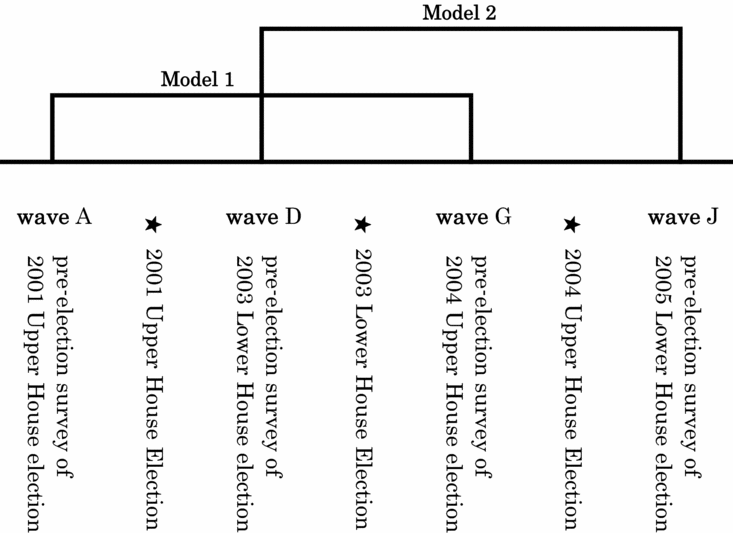
As discussed above, this study employs a panel survey dataset from the JES III project. While the survey was conducted in ten waves, four waves contain internal efficacy items: Wave A, Wave D, Wave G, and Wave J. All four waves were conducted prior to the national elections. Wave A and Wave G were conducted prior to the Upper House elections (July 2001 and July 2004). Wave D and Wave J were conducted prior to the Lower House elections (November 2003 and August 2005). The different types of national elections can interact with the popular vote's effect on political efficacy; to minimize this uncontrolled influence, this study matches the waves that were based on the same types of elections: The first set of waves consist of Wave A and Wave G prior to the Upper House elections. The second set of waves consists of Wave D and Wave J prior to the Lower House elections (see Figure 1). By investigating both sets of waves, the hypothesis is, therefore, tested in a stricter way.
Data structure and the model

The dependent variable is the changes in the respondents’ internal efficacy level between two waves, before and after popular votes. The internal efficacy variable, constructed by summing the two classical efficacy items, has been suggested by Campbell et al. (Reference Campbell, Gurin and Miller1954): (1) ‘People like me don't have any say about what the government does’ and (2) ‘Sometimes politics and government seem so complicated that a person like me can't really understand what is going on’.Footnote 14 Both items are measured by using a 5-point Likert scale; hence, the measure of internal efficacy ranges from 2 to 10, with higher values indicating a higher level of efficacy. Since the dependent variable is the change of the efficacy level, the differences in responses to internal efficacy between two waves ranges from −8 to 8.
As discussed above, the main independent variable is the usage of the popular vote in the municipality where respondents lived. This dummy-variable is measured at the municipality level, which indicates whether the respondent experienced a popular vote between the waves. The variable of popular vote is based on the sampling points (195 municipalities).Footnote 15 In total, 27 respondents in six municipalities experienced a popular vote in the period of Wave AG, and 59 respondents in nine municipalities experienced a popular vote in the period of Wave DJ. The number of observations in the treatment group is relatively small. However, this is not problematic, since it should result in a larger standard error, which, in turn, makes the significance test more conservative. Moreover, the hypothesis will be examined by two models covering different sets of waves, which should lead to more credible results.Footnote 16
It should be noted that the dependent variable of this study is not the level of political efficacy, but the changes in individual respondents. Therefore, demographic variables, such as age, gender, and socio-economic variables, are not included in the model, since they seldom change over time or change in an equal way for individual subjects (in case of age).
In contrast, national-level elections between the two waves in each set are considered, since they may influence the attitudinal change between waves. The rationale is based on the argument of previous studies that voting for victorious candidates could increase the level of efficacy (Clarke and Acock, Reference Clarke and Acock1989). Correspondingly, the statistical models include the dummy variables of whether individual respondents voted for a winning or losing candidate in a national election between the corresponding waves.Footnote 17 Between Wave A and Wave G, there were two elections: the 2001 Upper House election and the 2003 Lower House election. Therefore, the corresponding two dummy variables are included. In the same way, Model 2 for the set of waves (Wave D to Wave J) includes the dummy variable for the 2003 Lower House election and the 2004 Upper House election (see Figure 1).
The dependent variable is regressed on the independent variables by using a multilevel model. This is due to the multilevel structure of data, in which a unit of analysis (individuals) is nested within the other (municipalities). Both models’ data include 195 municipalities at the group level. At the individual level, the data for Wave AG include 866 individuals and Model Wave DJ 1,126 individuals. By employing a multilevel model, potential unconsidered factors within each municipality can be better dealt with.
Results
Assumption tests
This study mimics an experimental research design, since the respondents are divided into treatment and control groups: the subjects in the treatment group are exposed to the popular vote and the other subjects are not. It is, however, not a genuine experimental design, since the respondents are not randomly assigned to the groups. If the assignment of respondents correlated with the dependent variable, the causal effect cannot be attributed to the treatment (popular vote) because of endogeneity. Therefore, the assumption tests must examine whether there is any systematic differences in the dependent variable (internal efficacy) among groups before treatment (popular vote).
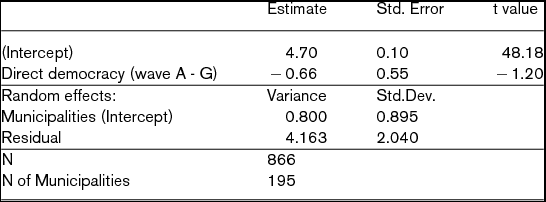
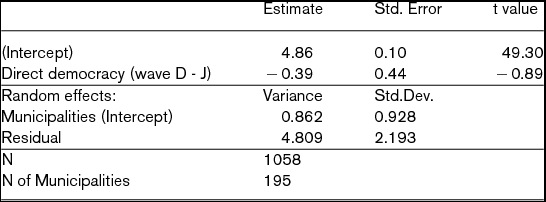
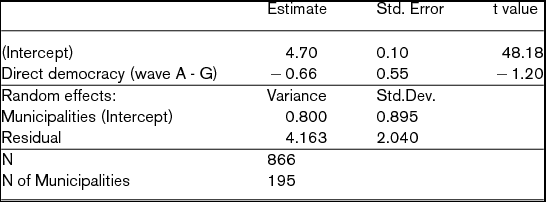
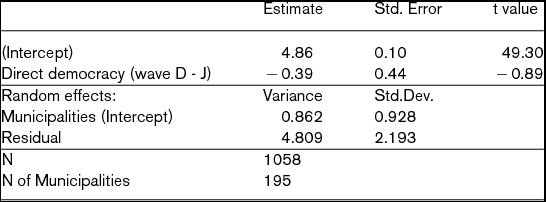
More concretely, for each set of waves, we set up a linear model. The dependent variable is the level of internal efficacy in the first wave of each model (Wave A in Model 1 and Wave D in Model 2). The independent variable is the dummy variable for the existence of the popular vote during the period covered by each model. Since the respondents are clustered in municipalities, and the independent variable is measured at this level, we employ a multilevel model with random intercepts for municipalities.Footnote 18
Tables 1 and 2 show the estimation results. Neither of the popular votes in both sets of waves shows significant effects on the level of internal efficacy in the first wave. Thus, the inhabitants of municipalities who later experienced a popular vote and those who did not experience one have the same level of internal efficacy.Footnote 19 That is to say, one of the important as-if random assumption holds for the dataset. If significant difference exists in the attitudinal change between the treatment and control group, it can be attributed to the treatment.Footnote 20
Assumption test (Model 1)
Assumption test (Model 2)
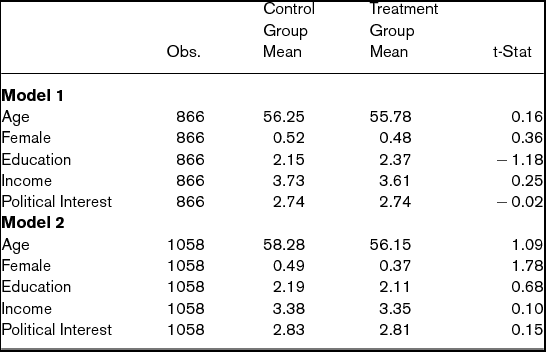
Additionally, this study also conducted a balance test of whether there are any systematic differences in basic demographic variables and political interest between treatment and control groups. Accordingly, there were no significant differences in age, gender, education, income, and political interest between both groups in both sets of waves (Table 3).
Balance test

Direct democracy and internal efficacy
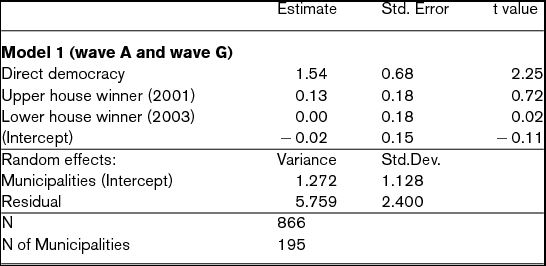
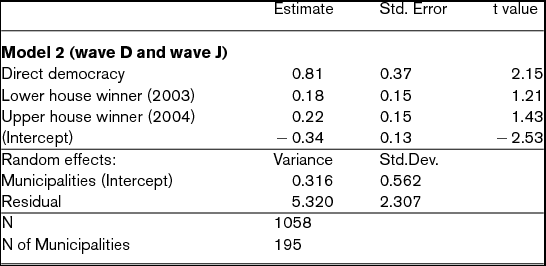
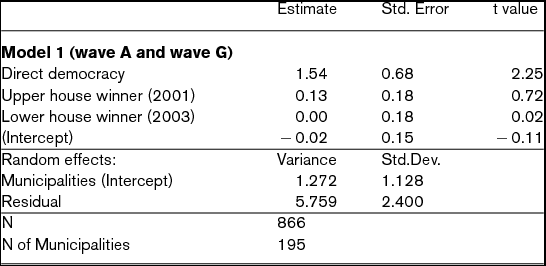
Having seen that the important assumption is fulfilled by data, we now evaluate the main hypothesis. The analysis of this study comprises two models, each dealing with different sets of waves. All the results are presented in Table 4 and 5.
The effect of direct democracy on internal efficacy (Model 1)
The effect of direct democracy on internal efficacy (Model 2)
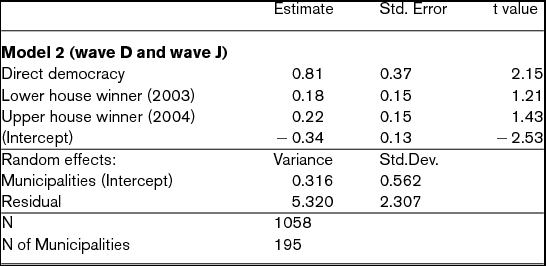
Tables 4 and 5 reveal that the existence of a popular vote increases the level of internal efficacy in both sets of waves. Thus, when people experienced a popular vote, they were less likely to think ‘people like me don't have any say about what the government does’ or ‘politics and government seem so complicated that a person like me can't really understand what is going on’. The effect of a popular vote seems to be robust, since both sets of periods have expected significant results.
However, the estimated size of effects has to be interpreted with caution, since the differences in size of both sets of waves are considerable. The estimated size of the effect is 1.54 in Wave AG and 0.81 in Wave DJ, respectively. Here, the effect in Wave AG is almost twice as high as that in Wave DJ. What is behind the difference of the effect size? Several explanations are possible. First, the length of time after popular votes could change the effect size. It is reasonable to assume that the effect of experiencing direct participation decays in time because of the limited capacity of human memory. The average length between the popular vote and the second survey is 253 days (Wave AG) and 384 days (Wave DJ), respectively. These lengths are in line with the differences of estimates.
Further, the turnout rate at popular votes can be another reason. It can be an indicator for the level of the residents’ interest in the popular vote. However, the average turnout rates in the two models are very similar: the average turnout rate of Wave AG is 57.47 and that of Wave DJ is 58.64. Thus, there is no empirical evidence that the turnout rate causes the differences of estimate size.
Finally, the size of the municipality could also influence the effect size. It is reasonable to assume that in a larger municipality it is more difficult for individual citizens to influence outcomes (Dahl and Tufte, Reference Dahl and Tufte1973). The average population of a municipality with the popular vote is 78,045 for Wave AG and 93,010 for Wave DJ. This is in line with the expectation.
A further interesting result is that national election victories do not show any significant effects on the level of political efficacy. Some previous studies have suggested that the results of an election − winning or losing − are more likely to affect efficacy than the participatory activity itself (Clarke and Acock, Reference Clarke and Acock1989). The results of this study clearly contradict this seemingly reasonable argument. Furthermore, the results also show that it is irrelevant for political efficacy whether citizens participated in a popular vote. The possibility of participating in popular votes is enough to increase the level of political efficacy, as Smith and Tolbert (Reference Smith and Tolbert2004) have suggested.
Conclusion
This research contributes to the academic debate on the hypothesis that direct democracy enhances citizen political efficacy by overcoming the methodological deficits of existing empirical studies. In particular, it used the panel data collected during a number of popular votes to make inferences about the causal relationship between direct democracy and political efficacy. This design keeps the issues of popular votes (municipal mergers) constant over referenda. In addition, panel data enable it to investigate the attitudinal changes at the individual level.
The results of this study confirm the effects of the popular vote on internal efficacy. The finding can be considered as robust not only because of its research design but also because the effects of the popular vote were consistently confirmed in two models with different time periods.
However, this does not necessarily mean that the study's results can be generalized to all cases of direct democracy in the same way. In this research, the issues of the popular vote are controlled, and it is assumed that neither fixed minority problems nor active interest groups representing partial public interests existed. As previous studies have pointed out, direct democracy can lead not only to an inequality problem but also enlarge gaps between citizens. Its success depends on how it is utilized. The positive effect on internal efficacy identified by this inquiry is based on the condition that there are no fixed minority or interest group problems. It is possible that if these problems are salient in the process of direct democracy, the positive effect of a direct democracy could be lost. Furthermore, municipal mergers were an important issue for most residents, since such mergers can affect all their everyday lives. When issues of the popular vote are not relatively important for many residents, it is possible that their effect would be small. Thus, future studies need to compare the effect of different issues in a systematic way.
Even with certain limitations, this study clearly identifies the positive effect of direct democracy on the internal efficacy of citizens. It has been said that Japan suffers from a relatively low level of political efficacy, especially in comparison to other established democracies. In addition, the direct democracy instruments in local politics have been quite limited. The results suggest that institutional change, particularly the introduction of direct democracy in local politics, can promote internal efficacy among citizens.
About the author
Taehee Kim is a Ph.D. Candidate at the Graduate School of Law at Keio University, Japan. Her research interests include diverse topics in comparative political psychology and political sociology, including public opinion, political attitudes, and political behavior.