Prosody plays an important part in the production and comprehension of the organization of speech, manifested by patterns of intonation, rhythm, prominence, and chunking of the speech continuum. Several form–meaning relations are established or contributed to by prosody, namely, sentence type distinctions, the highlighting of important information, the demarcation of speech units (also known as phrasing), and different kinds of affective meanings (Halliday, Reference Halliday1967; Ladd, Reference Ladd2008). Many prosodic form–meaning relations convey linguistic meanings, that is, meanings related to the message, such as interrogativity, finality, or focus, which may (or not) be grammaticalized in different languages and in different ways (Gussenhoven, Reference Gussenhoven, Bel and Marlien2002, Reference Gussenhoven2016). For example, interrogativity tends to be signaled by high or rising pitch, and finality by low pitch (as in English or Portuguese), but in Swedish a final low tone is used both in statements and questions; focus in West Germanic languages is typically achieved by the presence of a pitch contour in the prominent element (accentuation) and absence of accentuation on words that follow the prominent element, whereas other languages may use different types of accents to contrast focused and unfocused words (such as Portuguese; Frota, Reference Frota and Sun-Ah2014). Other prosodic form–meaning relations express meanings related to the state of the speaker, such as the affective meanings of (un)happy or (un)cooperative, which tend to be less arbitrary and thus less language specific (Gussenhoven, Reference Gussenhoven2016).
Given the broad role played by prosody, it is not surprising that it has taken a leading role in spoken communication and language development. Prosodic skills have been shown to be essential for language acquisition, and it is known that children have the ability to understand differences conveyed by prosodic features from birth and to use prosody to extract relevant information for lexical and syntactic analysis early in development (e.g., Gervain & Mehler, Reference Gervain and Mehler2010; Höhle, Reference Höhle2009; Morgan & Demuth Reference Morgan, Demuth, Morgan and Demuth1996). At the same time, however, certain domains/functions of prosody do not seem to be mastered in an adultlike fashion before puberty, such as prosodic comprehension skills involved in chunking, or the prosodic abilities required to understand or produce final focus in English and Dutch (e.g., Chen, Reference Chen2011; Wells, Peppé, & Goulandris, Reference Wells, Peppé and Goulandris2004). Furthermore, prosody can be impaired in a large number of clinical populations with language or communication problems, such as specific language disorders (e.g., Wells & Peppé, Reference Wells and Peppé2003), deafness (e.g., Parker & Rose, Reference Parker, Rose and Pamela1990), Down syndrome (e.g., Heselwood, Bray, & Crookston, Reference Heselwood, Bray and Crookston1995), Williams syndrome (e.g., Catterall, Howard, Stojanovik, Szczerbinski, & Wells, Reference Catterall, Howard, Stojanovik, Szczerbinski and Wells2006), aphasia (e.g., Seddoh, Reference Seddoh2004), schizophrenia (e.g., Pascual, Solé, Castillón, Abadía, & Tejedor, Reference Pascual, Solé, Castillón, Abadia and Tejedor2005), epilepsy (e.g., Sanz-Martín, Guevara, Corsi-Cabrera, Ondarza-Rovira, & Ramos-Loyo, Reference Sanz-Martín, Guevara, Corsi-Cabrera, Ondarza-Rovira and Ramos- Loyo2006), and autism spectrum disorders (e.g., Baltaxe & Simmons, Reference Baltaxe, Simmons, Schopler and Mesibov1985; Filipe, Frota, Castro, & Vicente, Reference Filipe, Frota, Castro and Vicente2014; Filipe, Frota, Villagomez, & Vicente, Reference Filipe, Frota, Villagomez, Vicente, Armstrong, Enricksen and Vanrell2016). It is important to note that although the functions of prosody tend to be quite general across languages, prosodic systems are known to vary considerably, and prosodic cues are strikingly language specific (Frota & Prieto, Reference Frota and Prieto2015a; Jun, Reference Jun2005, Reference Jun2014; Ladd, Reference Ladd2008). Therefore, studies focusing on different languages are critical for cross-linguistic comparisons, which in turn are necessary for a better understanding of prosodic development and prosodic impairments. These are strong reasons for prosodic skills to be more widely studied in typical and impaired language development.
European Portuguese (EP) poses challenging questions for the study of language development, due to the atypical prosodic profile of the language. EP includes properties of both Romance and Germanic languages in its phonology and prosody. EP prosody combines typical Romance properties with Germanic-like properties. Unlike Spanish, the rhythm of EP is characterized by a mix of syllable-timed and stress-timed features, thus combining Romance-like syllable timing with Germanic-like stress timing (Frota & Vigário, Reference Frota and Vigário2001). EP displays a clear cluster of cues to signal the beginnings and ends of words, like English and other Germanic languages, but at the same time allows for final word consonants to take the initial position of the following word (resyllabification) as in Romance languages (Vigário, Reference Vigário2003). The intonation contours of EP are characterized by sparse accentuation; that is, they show fewer tonal events than in Spanish or other Romance languages, approximating the hat pattern contour characteristic of Dutch (Frota, Reference Frota and Sun-Ah2014). However, like Spanish, there is no deaccenting of the sort found in West Germanic languages when the prominence is not final in the utterance (Frota, Reference Frota and Sun-Ah2014; Frota & Prieto, Reference Frota, Prieto, Frota and Prieto2015b). In addition, unlike in English, pitch accent placement is not the critical means to express focus. In Romance languages several strategies may apply to convey narrow/contrastive focus depending on the language/variety, namely, the use of a particular type of pitch accent, sometimes with the presence of postnuclear accents, or changes in word order (Frota, Reference Frota and Sun-Ah2014; Ladd, Reference Ladd2008). In the case of EP, all the Romance-like strategies have been reported to apply, with the prosodic focus strategy signaled by a particular type of accentuation being the most frequently used by Standard EP speakers (Fernandes, Reference Fernandes2007; Frota, Reference Frota2000, Reference Frota and Sun-Ah2014). In short, EP stands as an interesting case for the study of prosodic development, with cross-linguistic implications for the understanding of developmental paths for form–meaning relations in different languages, as well as for the understanding of prosodic impairments.
Research on prosodic skills requires the development of tools to assess prosody in a systematic and comprehensive way adapted to the specificities of the language observed. The use of diverse methodologies of prosodic assessment may lead to contradictory findings and/or to findings that cannot be compared (McCann & Peppé, Reference McCann and Peppé2003; Peppé et al., Reference Peppé, Martínez-Castilla, Coene, Hesling, Moen and Gibbon2010). There are presently few procedures available to assess prosodic abilities. For instance, in the United Kingdom, there is the Prosody Profile (Crystal, Reference Crystal1982), which depends on the transcription of the intonation of spontaneous speech samples. In the United States, the Prosody-Voice Screening Profile is used, also requiring transcription, for the assessment of spoken language in seven domains, three of which are prosodic domains: phrasing, speech rate, and stress (Shriberg, Kwiatkowski, & Rasmussen, Reference Shriberg, Kwiatkowski and Rasmussen1990). In Sweden, the Swedish procedure is used to evaluate prosody at the word, phrase, and discourse levels (Samuelsson, Scocco, & Nettelbladt, Reference Samuelsson, Scocco and Nettelbladt2003). However, none of these instruments assesses prosodic discrimination and comprehension of meaning differences conveyed by prosodic features. The only test available to examine both receptive and expressive prosodic abilities in children over 4 years of age is the Profiling Elements of Prosody in Speech-Communication (PEPS-C; Peppé & McCann, Reference Peppé and McCann2003) developed in the United Kingdom. The PEPS-C has the following advantages: (a) transcription skills of both lexical and prosodic elements are not needed; (b) samples of speech are elicited in a homogeneous way across subjects and types of populations; (c) the content of responses is the same for all participants; (d) instructions are suitable for individuals who may have low cognitive level; and (e) it may provide a systematic and comparable way to assess prosodic abilities in different languages. Originally, the PEPS-C only assessed prosody in adults (Peppé, Maxim, & Wells, Reference Peppé, Maxim and Wells2000), but it was revised in 2004 and norms for typically developing children were collected (Wells et al., Reference Wells, Peppé and Goulandris2004). Subsequently, it has been adapted to different languages, such as Spanish, Flemish, French, and Norwegian (Peppé et al., Reference Peppé, Martínez-Castilla, Coene, Hesling, Moen and Gibbon2010).
Given the absence of a procedure for the assessment of Portuguese prosody throughout the school years, and the lack of studies on EP prosodic development covering this age range, we adapted an English test (the PEPS-C) for use with EP speakers. With the Portuguese version of the PEPS-C, we analyzed the developmental changes of several components of prosody between 5 years of age and adulthood.
The PEPS-C includes tasks at two levels: formal and functional. The formal level assesses auditory discrimination and production abilities (related to perceptual and motor skills) required to perform the tasks. The functional level takes into account four prosodic functions (related to cognitive understanding and expression) organized in the four subtests affect, turn-end, chunking, and focus.
The affect subtest is associated with the expression of feelings or emotions, that is, with affective meanings in the sense of Gussenhoven (Reference Gussenhoven2016; for instance, a more prolonged and high intonation suggests positive affects, as shown in Banse & Scherer, Reference Banse and Scherer1996). Specifically, it uses the difference between like and dislike intonation. As the intonation patterns used in the expression of liking and disliking in EP were largely unknown, a study was performed to provide a systematic account of these prosodic patterns (Filipe, Branco, Frota, Castro, & Vicente, Reference Filipe, Branco, Frota, Castro and Vicente2015). The results showed that, as in English, in EP the meaning of liking is expressed by rise–fall pitch movements. However, for disliking, the EP results showed a more flat melodic pattern with a fall in the stressed syllable. These findings have shown that the intonation patterns for liking and disliking exhibit differences across languages (namely, in English, Spanish, and EP), highlighting the language specificity of prosodic contours even in the expression of affective meanings.
The other three subtests examine linguistic meanings. The turn-end subtest uses the differences between interrogative and declarative intonation. In EP, as in English, interrogatives are expressed by rising intonation, whereas declaratives are marked by falling intonation (e.g., Frota, Reference Frota2002). However, unlike in English, which uses word order together with prosody to differentiate interrogatives from declaratives, in EP the interrogative/declarative distinction is crucially marked by prosody only (Frota, Reference Frota2002; Frota, Butler, & Vigário, Reference Frota, Butler and Vigário2014; Mateus et al., Reference Mateus, Brito, Duarte, Faria, Frota, Oliveira and Villalva2003).
The chunking subtest relates to the prosodic cues that disambiguate the syntactic structure of what is being said (e.g., the segmentation of utterances marked by prosodic features, such as pauses). The chunking function is expressed through similar prosodic correlates in English and EP, as EP resorts to final lengthening, pitch movement, and pauses (e.g., Falé, Reference Falé2005; Frota, Reference Frota2000; Vigário, Reference Vigário2003). However, languages may weigh the various prosodic cues for chunking differently (Seidl & Cristia, Reference Seidl and Cristia2008; Wellmann, Holzgrefe, Truckenbrodt, Wartenburger, & Höhle, Reference Wellmann, Holzgrefe, Truckenbrodt, Wartenburger and Höhle2012), and there are no studies on cue weighting for EP.
The focus subtest uses prominence to signal the element that carries more informative load, that is, the element that is highlighted in the utterance. Previous work on prosodic focus in EP had shown that the prosodic strategy (i.e., placement of main prominence and use of a particular pitch accent) is frequently used by Standard EP speakers (Fernandes, Reference Fernandes2007; Frota, Reference Frota2000, Reference Frota and Sun-Ah2014). As in English, contrastive focus in EP is generally expressed by means of prominence and intonation, although in important different ways. In English, pitch accent placement, together with deaccenting of given (i.e., nonfocused elements) are the main strategies used; in EP, focus is expressed by choice of pitch accent type and there is no systematic deaccenting of nonprominent material (e.g., Frota, Reference Frota2000).
The description of the prosodic system of EP has advanced during the last few years (see Frota, Reference Frota and Sun-Ah2014, for a review), and there has been recent work in the field of prosodic acquisition both in early perception and in production (Butler, Vigário, & Frota, Reference Butler, Vigário and Frota2016; Frota et al., Reference Frota, Butler and Vigário2014; Frota, Matos, Cruz, & Vigário, Reference Frota, Matos, Cruz, Vigário, Armstrong, Vanrell and Henriksen2016). The adaptation of a test such as the PEPS-C to assess EP prosodic development from preschool through adulthood will allow new studies covering prosodic development. Therefore, the current study intends to (a) describe the adaptation of the PEPS-C to EP, (b) examine the typical developmental trajectory of several aspects of EP prosody after the age of 5, and (c) compare the results obtained with findings reported by other studies using comparable methodologies for other languages. Thus, this paper aims to address the following two research questions:
-
1. How do receptive and expressive prosodic abilities of EP speakers change from childhood to adulthood? Specifically, we analyzed prosodic abilities assessed by the PEPS-C: to discriminate and produce short and long prosodic utterances, as well as the use of prosody to signal affect patterns (i.e., the expression of liking and disliking), to indicate sentence-type distinctions (i.e., interrogative vs. declarative), to mark speech chunks (i.e., the distinction between simple and compound nouns, or different groupings of properties that qualify nouns), and to highlight (focus on) a particular word. The typical developmental data obtained may serve as a basis for comparison with specific clinical populations.
-
2. Are developmental trajectories in EP between 5 and 20 years of age similar to those that have been described for English and Spanish speakers; in other words, do we find similar milestones? Using the PEPS-C, Wells et al. (Reference Wells, Peppé and Goulandris2004) found that for English some prosodic skills are present by the age of 5, while other abilities continue to develop until the age of 11. Results for the Spanish PEPS-C (Martínez-Castilla & Peppé, Reference Martínez-Castilla and Peppé2008) showed that after the age of 7, every age group performed above chance level being near or reaching ceiling scores, except for the expression of focus, and that scores continued to rise with age especially for the chunking and focus subtests. A comparison of the results from the English PEPS-C and the Spanish PEPS-C showed that the developmental paths and the degree of differences across age groups was not similar for all tasks, in particular for the chunking and the focus tasks, with Spanish speakers reaching above chance performance later than English speakers. As EP includes properties of both Romance and Germanic languages in its prosody, the question arises as to whether developmental paths for Portuguese speakers will approximate those of Spanish or of English speakers, or will show a mix pattern depending on the form–meaning relation and task.
METHOD
Participants
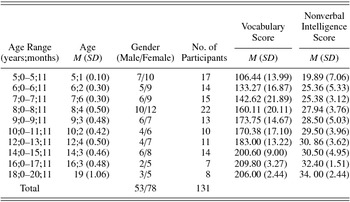
A total of 131 typically developing participants (ages 5 to 20 years; 78 females) were recruited. The sample included 10 age groups (see Table 1): 5-year-olds, 6-year-olds, 7-year-olds, 8-year-olds, 9-year-olds, 10- to 11-year-olds, 12- to 13-year-olds, 14- to 15-year-olds, 16- to 17-year-olds, and 18- to 20-year-olds. All participants met our inclusion criteria: (a) they were native speakers of EP, born and raised in monolingual homes in the north of Portugal; (b) they had no significant visual or hearing problems; (c) they had no history of language and/or learning difficulties according to educators’ and/or parent reports; and (d) they scored within the typical range in a vocabulary test (the Peabody Picture Vocabulary Test; Dunn & Dunn, Reference Dunn and Dunn2007; Portuguese adaptation and norms by Vicente, Sousa, & Silva, Reference Vicente, Sousa and Silva2011) and in a nonverbal intelligence test (the Raven's Coloured Progressive Matrices; Raven, Reference Raven1995; Portuguese adaptation and norms by Simões, Reference Simões2000). The recruitment of participants was in accordance with the ethical principles that originated in the Declaration of Helsinki (developed by the World Medical Association). Participants or caregivers of participants were selected via notices in schools. All procedures described in this study were approved by the schools’ boards. Informed consent was obtained from caregivers of participants under 18 years of age, and from the participants themselves if 18 or older, following Portuguese regulations.
Distribution of participants by age, gender, vocabulary score, and nonverbal intelligence score

Note: Vocabulary was assessed by the Peabody Picture Vocabulary Test (Dunn & Dunn, Reference Dunn and Dunn2007). Nonverbal intelligence was assessed by the Raven's Coloured Progressive Matrices (Raven, Reference Raven1995).
Material
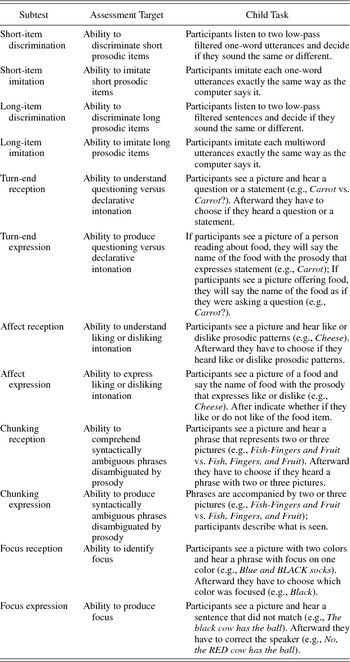
The PEPS-C was used to evaluate the participants’ prosodic abilities. This instrument includes tasks at two levels: formal and functional. The formal level assesses auditory discrimination and production abilities required to perform the tasks, whereas the functional level evaluates receptive (comprehension) and expressive (production) prosodic skills in four domains where prosody usually plays an important role: (a) affect (liking vs. disliking), (b) turn-end (questions vs. statements), (c) chunking (prosodic phrasing), and (d) focus (contrastive stress conveyed by accent placement, i.e., nuclear prominence on a particular word). The distinction between formal and functional levels is also relevant as they can be differently affected. Whereas some individuals have difficulties in mimicking and discriminating prosodic patterns (formal level), others have problems with understanding the meanings and producing the intended social or interactional meanings (functional level).
The PEPS-C runs though pictures that are presented successively on a laptop screen. The instrument has 12 subtests, with a preliminary vocabulary check to confirm that the vocabulary items used in the test are familiar to the participant. Six of the subtests address receptive ability, and the other 6 expressive ability. Each subtest begins with 2 examples and 2 training items, followed by 16 experimental items (the maximum score for each subtest is 16). The receptive tasks present binary choices with low working-memory requirements, resulting in two possible responses, whereas the expressive tasks require the production of speech and are open to more response possibilities. All the stimuli were selected on the basis of appropriateness of cultural meaning, a high degree of familiarity, and ease of pronunciation. The EP version of the PEPS-C generally follows the structure of the original English battery, as all the communicative functions evaluated are found in both languages. Furthermore, it is essential to build similar versions when one of the goals is cross-linguistic comparison. However, the adaptation also included some modifications in order to address different uses of prosody in EP. The following paragraphs present a short description of the adaptation process, including the modifications introduced. Detailed information about the original and the Portuguese version of the PEPS-C can be found in Appendix A, and a full description of the original version can be found at http://www.peps-c.com/.
As mentioned, the first test in the PEPS-C is a vocabulary check. In addition, the Portuguese version includes a routine to check the understanding of facial expressions, to avoid any bias on the performance in the affect subtest, which resorts to the interpretation of facial expressions of like and dislike.
Prosodic skills at the formal level (that correspond to the acoustic and auditory-perceptual characteristics of the signal, such as the F0 features of the melodic pattern) are assessed in two subtests:
-
1. Short-item, receptive, and expressive tasks:
Aim: To assess the ability to perceive and imitate intonation differences in items with one, two, or three syllables (e.g., “PÊRA” “pear”). The receptive stimuli have no lexical information.
Receptive task: The task consists of same/different trials, in which two sounds are presented, and the participant indicates whether the sounds are the same or different, by clicking on a symbol for “same” (two red circles) or one for “different” (a red circle and green square). The original version uses laryngeal recordings (i.e., signals made by recording sounds from the larynx only, having no lexical information) as stimuli. However, in the Portuguese version short-items from the turn-end and affect receptive tasks underwent low-pass filtering (upper limit 500 Hz) using PRAAT software (Boersma & Weenink, Reference Boersma and Weenink2011), and thus resulting in a different form of delexicalization that preserved the prosodic features.
Expressive task: A sound stimulus is presented, and the participant imitates types of intonation from the turn-end and affect receptive tasks.
-
2. Long-item, receptive and expressive tasks:
Aim: To assess the ability to perceive and imitate prosodic differences in long-items, that is, items with six or seven syllables (e.g., “PORTA, CHAVES E LEITE” “door, keys, and milk”).
Receptive and expressive tasks: Same procedure as for short items; however, the stimuli are from the chunking and focus receptive tasks.
The assessment of prosodic functions aimed to evaluate the pragmatic and linguistic meanings of prosody in communication. As prosodic patterns can facilitate perceptual judgments by providing added meanings, a functional analysis is extremely important to understand the development of prosodic abilities. Prosodic skills at the functional level are captured in four subtests, each with a receptive and an expressive dimension. One of the subtests assesses form–meaning relations that express meanings related to the state of the speaker, namely, affective meanings: the affect subtest. The other three assess form–meaning relations at the linguistic level, that is, meanings related to the message conveyed: turn-end, chunking, and focus.
-
1. Affect, receptive and expressive tasks:
Aim: To assess the ability to understand and produce the affective meanings of liking and disliking through intonation.
Receptive task: A sound stimulus with a “liking” or a “disliking” intonation is presented simultaneously with the image representing the object mentioned. Then two images appear, a happy and a sad face, and the participant has to select the image corresponding to the intonation pattern heard (smiley face for “liking” intonation or sad face for “disliking” intonation). High-frequency stimuli are used with an acquisition age equal to or less than 5 selected through the written lexical databases PORLEX (Gomes & Castro, Reference Gomes and Castro2003) and CORLEX (Nascimento, Casteleiro, Marques, Barreto, & Amaro, Reference Nascimento, Casteleiro, Marques, Barreto and Amaro2009), as well as a study of age of acquisition of Portuguese words (Cameirão & Vicente, Reference Cameirão and Vicente2010). For the recording of the audio stimuli, and given that the intonation patterns used in the expression of liking and disliking in EP were largely unknown, a study was performed to provide a systematic account of these prosodic patterns (Filipe et al., Reference Filipe, Branco, Frota, Castro and Vicente2015). The results show that, as in English, in EP liking has a pattern expressed by rise–fall pitch movements. However, for disliking, the EP results show a more flat melodic pattern with a fall in the stressed syllable.
Expressive task: One picture of food appears on the screen, the participant is asked to produce “liking” or “disliking” intonation according to his/her own preference. To show what they want to convey with the utterance produced, the participants point to a sad or happy face. The stimuli follow the same criteria used for the receptive task.
-
2. Turn-end, receptive and expressive tasks:
Aim: To assess the ability to understand and produce the intonation cues indicating interrogative versus declarative intonation.
Receptive task: A declarative or interrogative pattern is presented, and the participant identifies which is the pattern heard by selecting one of two pictures (i.e., the participant chooses the picture of a child offering a food item when hearing an interrogative; or the image of a child reading a book that contains the object mentioned when hearing a declarative). The selected stimuli have one to three syllables in length, were within the semantic field of food, and are high-frequency words with an acquisition age of 5 years or less (we used the lexical bases mentioned above). The audio stimuli contain typical cues of questions and declaratives in the language. In EP, as in English, questions are expressed by rising intonation, while declaratives are marked by falling intonation (e.g., Frota, Reference Frota2002).
Expressive task: One picture of food being offered or read out from a book page appears on the screen, and the participant says the item with suitable intonation (i.e., interrogative or declarative pattern, respectively). The stimuli follow the same criteria applied in the receptive task.
-
3. Chunking, receptive, and expressive tasks:
Aim: To assess the ability to understand and produce the delimitation of discourse into linguistic chunks, a process that reflects syntactic parsing and semantic processing (Wagner & Watson Reference Wagner and Watson2010).
Receptive task: As in the original version, stimuli in combinations of three to six words are used. The first type of stimuli is related to the distinction between simple words and compound words. The participant hears an auditory stimulus and has to select the correct picture from two possible pictures (each one representing two or three items, for instance: fish-fingers and fruit vs. fish, fingers, and fruit). Unlike in English, many of the compound words used in the original version are formed using the particle “de” in Portuguese. For example, the word “chocolate-cake” in Portuguese is “bolo de chocolate.” However, there are Portuguese examples where prosody has a similar demarcative function differentiating compounds from lists of words. Excluding all words not related to concrete objects, we select the following: COUVE-FLOR, BOLO-REI, SACO-CAMA, PEIXE-ESPADA, and PORTA-CHAVES “cauliflower, special Portuguese cake, sleeping bag, swordfish, and key holder.” The second type of stimuli consists of sentences with adjectives that differ in prosodic chunking, namely, the difference between pairs of socks with one or two colors. The participant hears an auditory stimulus and has to select the correct picture from two possible pictures. For example, the utterance MEIAS PRETAS E VERDES] E BRANCAS “black and green] and white socks,” with an internal boundary (]) after VERDES “green” but not after PRETAS “black,” denotes a pair of socks with two colors (black and green) and another pair of socks with one color (white). Whereas MEIAS PRETAS] E VERDES E BRANCAS “black] and green and white socks,” with an internal boundary after PRETAS “black,” represents a pair of socks which are black, and another pair of socks with two colors (green and white). Items included in the task are direct translations from English.
For the audiorecordings, the chunking function is expressed through similar prosodic correlates in English and EP, as EP resorts to final lengthening, pitch movement, and pauses (e.g., Falé, Reference Falé2005; Frota, Reference Frota2000; Vigário, Reference Vigário2003), but these prosodic cues may have different weights in different languages (Seidl & Cristia, Reference Seidl and Cristia2008; Wellmann et al., Reference Wellmann, Holzgrefe, Truckenbrodt, Wartenburger and Höhle2012).
Expressive task: The participant sees one picture and has to produce the sentence that prosodically matches the visual representation. The stimuli follow the same criteria applied in the receptive task.
-
4. Focus, receptive and expressive tasks:
Aim: To assess the ability to understand and produce prominence to signal the element that carries more informative load.
Receptive task: The following instruction is given “Earlier on today, the person on the computer bought some socks. But when she got home, she realized she had forgotten to buy socks of one particular color. Please point to the color of socks that the person has forgotten to buy.” Then, two different colors appear on the screen, and the participant hears a sentence that varies in placement of main stress (e.g., AZUIS e PRETAS “ blue and black” with the word AZUIS “ blue ” carrying the main prominence). The correct answer is the color they just heard with the main prominence, or focus. Items included in the task are direct translations from English.
Expressive task: A football game between cows and sheep was presented to the participants, and they see a picture and hear a sentence that do not match (e.g., The black cow has the ball). After, they have to correct the speaker (e.g., No, the RED cow has the ball). In the Portuguese version, some changes are introduced in the expressive task instructions. Specifically, we remove the “no” from the participant's answer (i.e., NÃO, A VACA VERDE TEM A BOLA “no, the green cow has the ball” is replaced by A VACA VERDE TEM A BOLA “the green cow has the ball”), because the initial “no ” often gets the main prominence of the sentence. An example of an item of the expressive task is the following: if the participant hears A OVELHA VERDE TEM A BOLA “the green sheep has the ball,” and is seeing a green cow with the ball, the task is to correct the error saying A VACA VERDE TEM A BOLA “the green COW has the ball” emphasizing the word VACA COW , that is, placing the main prominence on this word. Because Martínez-Castilla and Peppé (Reference Martínez-Castilla and Peppé2008) found some problems in the Spanish version of the PEPS-C with respect to this task (i.e., even adult participants did not show mastery of this function), we tested this version in a sample of 10 adult Portuguese speakers, and the results showed no difficulties in carrying out the task. Furthermore, previous work on prosodic focus in EP had shown that the prosodic strategy (i.e., placement of main prominence and use of a particular pitch accent) is frequently used by Standard EP speakers (Fernandes Reference Fernandes2007; Frota Reference Frota2000, Reference Frota and Sun-Ah2014). The stimuli are direct translations of the English utterances.
The stimuli were recorded with a high-quality microphone (Audio-Technica ATM89) in a soundproof room in the Speech Laboratory at the University of Porto by a female speaker. The software used was Pro Tools LE version 5.1.1 with 48-kHz sampling rate and 16-bit resolution. The stimuli with the best recording quality, most unambiguous prosody, and clear articulation were selected according to the judgment of two of the authors. The stimuli were considered unambiguous by 20 adult judges and were not rated as exaggerated or unnatural.
A Portable Digital Audio Recorder (Marantz PMD661) and a wireless microphone system (Sennheiser EW 152 G3-A-model 503102) were used to record participants’ performance on the PEPS-C expressive tasks. We used SPSS version 20.0 for the statistical analyses.
Procedure
The administration of the PEPS-C was performed in one session lasting approximately 45 min. Participants were assessed in school or at home in a quiet room with adequate lighting conditions. The PEPS-C administration was conducted in PowerPoint on a computer screen, and the subtests order was the same for all the participants: short-item, long item, turn-end, affect, chunking, and focus. Half of the participants started with the receptive tasks and the other half with the expressive tasks.
RESULTS
For the PEPS-C receptive tasks, the experimenter coded each participant's answer online as correct (1 point) or incorrect (0 points). For the PEPS-C expressive tasks, three raters judged each participant's answers. Raters (ages between 26 and 29 years; 2 females) had in common the fact that they speak EP as their mother tongue and the absence of any auditory or visual problems. One had expertise in the field of linguistics and was phonetically trained; the others had expertise in the field of the psychology of language. For the affect and turn-end subtests, the raters had to categorize the answers within two possible alternatives: liking versus disliking and statement versus question, respectively. For the chunking subtest, the raters had two tasks: (a) for the stimuli related to socks, they had to discriminate the socks of one color versus bicolor; and (b) for the stimulus related to compound versus simple words, they had to decide if they heard a sentence formed by a compound word or a sentence formed only by single words. For the focus subtest, they had to recognize where the focus was in a set of five possible alternatives. Each participant's answer was scored as correct (with 1 point) only when the three raters agreed in the classification. There was 91% overall agreement between the raters’ classification.
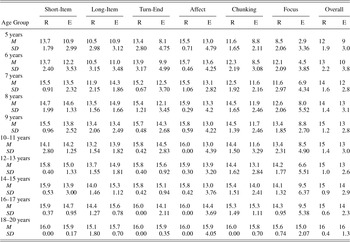
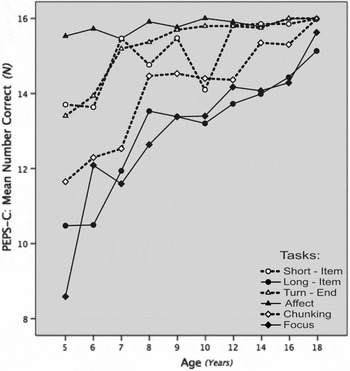
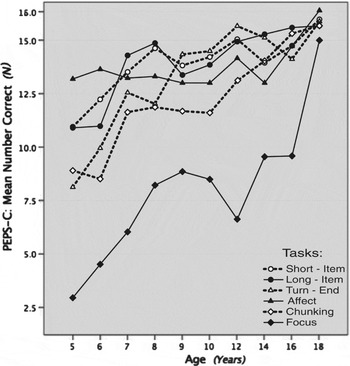
Means and standard deviations for all the PEPS-C subtests (short-item, long-item, affect, turn-end, chunking, and focus) separately for receptive and expressive tasks and for age group are presented in Table 2, as well as the developmental trajectories for the PEPS-C receptive and expressive tasks in Figures 1 and 2, respectively. No effects of presentation order were found. We conducted an analysis of variance using difference and Helmert contrasts for each dependent variable to examine the degree of change in all the PEPS-C tasks with age (from 5 years to adulthood). Particularly, the difference contrast compares each age group, except the first, to the mean of the previous groups (i.e., adult vs. all children, 16- to 17-year-olds to all younger participants, 14- to 15-year-olds to all younger participants, etc.). The Helmert contrast compares each age group, except the last, to the mean of the subsequent groups (i.e., 5-year-olds to all older participants, 6-year-olds to all older participants, and so on). In addition, due to the high risk of chance performances (i.e., score obtained if the participant performed at random) in the receptive tasks, we considered that participants reached above chance performance in a specific task if their score was at least 12 (75%). Within the psycholinguistics approach adopted by the PEPS-C, ceiling effects or no differences between adult and children performances were understood as mastery of the skill assessed.
Mean and standard deviation of PEPS-C results by age group

Note: PEPS-C, Profiling Elements of Prosody in Speech-Communication (Peppé & McCann, Reference Peppé and McCann2003); R, reception; E, expression. Maximum score = 16.
Mean score for the Profiling Elements of Prosody in Speech-Communication (PEPS-C; Peppé & McCann, Reference Peppé and McCann2003) receptive tasks (short-item, long-item, turn-end, affect, chunking, and focus). Maximum score = 16; chance score = 12.

Mean score for the Profiling Elements of Prosody in Speech-Communication (PEPS-C; Peppé & McCann, Reference Peppé and McCann2003) expressive tasks (short-item, long-item, turn-end, affect, chunking, and focus). Maximum score = 16.

Receptive tasks
The main effect of age group was significant for all receptive tasks except for affect: short-item, F (9, 121) = 4.325, p < .001, partial η² = 0.243; long-item, F (9, 121) = 7.064, p < .001, partial η² = 0.344; affect, F (1, 9) = 1.61, p = .117; turn-end, F (9, 121) = 4.53, p < .001, partial η² = 0.252; chunking, F (9, 121) = 10.44, p < .001, partial η² = 0.437; and focus, F (9, 121) = 12.53, p < .001, partial η² = 0.482. Detailed scores are presented in Table 2, and developmental trajectories are visible in Figure 1. In all tasks, except for long-item and focus, every group performed above chance level. Detailed significant contrasts found for each task are presented below.
For the short-item receptive task, contrasts showed significant differences between the performance of 5- to 6-year-olds and all older participants, p < .001, 95% confidence interval (CI) [–2.34, –6.83]; p < .001, 95% CI [–2.69, –8.62], respectively.
For the long-item receptive task, significant differences were found between the performance of 5- to 7-year-olds and all older participants, p ≤ .001, 95% CI [–3.94, –1.74]; p ≤ .001, 95% CI [–4.37, –1.95]; p ≤ .001, 95% CI [–3.17, –0.79], respectively.
For the affect receptive task, age group means were near ceiling, and no differences were found.
For the turn-end receptive task, significant differences were visible between the performance of 5- to 6-year-olds and all older participants, p ≤ .001, 95% CI [–2.91, –1.27]; p ≤ .001, 95% CI [–2.68, –0.87], respectively.
For the chunking receptive task, contrasts showed significant differences between the performance of 5- to 7-year-olds and all older participants, p ≤ .001, 95% CI [–3.54, –1.67]; p ≤ .001, 95% CI [–3.25, –1.41]; p ≤ .001, 95% CI [–3.26, –1.47], respectively. In addition, a contrast was found between 12/13-year-olds and all older participants, p = .043, 95% CI [–2.33, –0.35].
For the focus receptive task, significant differences were observed between the performance of 5- to 8-year-olds and all older participants, p < .001, 95% CI [–5.92, –3.84]; p = .007, 95% CI [–2.72, –0.43]; p < .001, 95% CI [–3.47, –1.21]; p = .003, 95% CI [–2.51, –0.53], respectively.
Expressive tasks
The main effect of age group was significant for all expressive tasks except for affect: short-item, F (9, 121) = 5.13, p < .001, partial η² = 0.276; long-item, F (9, 121) = 8.85, p < .001, partial η² = 0.397; affect, F < 1; turn-end, F (9, 121) = 8.19, p < .001, partial η² = 0.378; chunking, F (9, 121) = 11.08, p < .001, partial η² = 0.454; and focus, F (9, 121) = 5.62, p < .001, partial η² = 0.295. Detailed scores are presented in Table 2, and developmental trajectories are visible in Figure 2. Exhaustive significant contrasts found for each task are presented below.
For the short-item expressive task, contrasts showed significant differences between the performance of 5- to 6-year-olds and all older participants, p < .001, 95% CI [–4.47, –2.07]; p ≤ .001, 95% CI [–3.57, –0.93], respectively.
For the long-item expressive task, significant differences were observed between the performance of 5- to 6-year-olds and all older participants, p < .001, 95% CI [–4.57, –2.29]; p < .001, 95% CI [–4.98, –2.48], respectively. In addition, a contrast was found between 9-year-olds and all older participants, p = .014, 95% CI [–3.08, –0.35].
For the affect expressive task, there was no difference between groups.
For the turn-end expressive task, significant differences were detected between the performance of 5- to 8-year-olds and all older participants, p < .001, 95% CI [–7.41, –3.96]; p < .001, 95% CI [–6.28, –2.46]; p = .035, 95% CI [–3.86, –0.140]; p ≤ .001, 95% CI [–4.44, –1.16], respectively.
For the chunking expressive task, contrasts showed significant differences between the performance of 5- to 13-year-olds and all older participants (p < .001, 95% CI [–4.98, –2.45]; p < .001, 95% CI [–6.01, –3.23]; p = .014; 95% CI [–3.10, –0.36]; p = .008, 95% CI [–2.89, –0.44]; p = .004, 95% CI [–3.77, –0.74]; p ≤ .001, 95% CI [–4.65, –1.21]; p = .03; 95% CI [–3.66, –0.19], respectively).
For the focus expressive task, significant differences were detected between the performance of 5- to 7-year-olds and all older participants, p < .001, 95% CI [–7.98, –3.15]; p ≤ .001, 95% CI [–7.16, –1.86]; p = .010, 95% CI [–6.04, –0.83], respectively. In addition, a contrast was found between 12/13-year-olds and all older participants, p = .005, 95% CI [–8.03, –1.42]; as well as a contrast between the 16/17- and 18- to 20-year-olds, p = .026, 95% CI [–10.19, –0.66].
DISCUSSION
The aim of this study was to analyze the developmental trajectories of a set of prosodic abilities in a group of Portuguese typically developing participants (providing typical data useful for comparison with the performance of atypical populations), and to investigate whether the developmental path of prosodic abilities in EP differed from that described for other languages, namely, English and Spanish, on the basis of comparable methodologies. Two research questions were addressed.
Research question 1: How do receptive and expressive prosodic abilities of EP speakers change from childhood to adulthood?
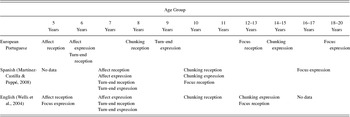
Overall, results confirmed findings from other studies that prosody continues to develop throughout the school years (e.g., Chen, Reference Chen2011; Wells et al., Reference Wells, Peppé and Goulandris2004). Specifically, results showed that some prosodic skills are already acquired by the age of 5, while others continue to develop with age until adulthood, a pattern that was especially found for chunking and focus. Milestones for the mastering of the different prosodic skills assessed were identified: 5-year-olds reached ceiling effects in the affective prosodic tasks, and the pattern of performance was globally similar across age groups; 7-year-olds mastered the ability to discriminate and produce short prosodic items, as well as the ability to understand question versus declarative intonation; 8-year-olds mastered the ability to discriminate long prosodic items; 9-year-olds mastered the ability to produce question versus declarative intonation, as well as the ability to identify focus; 10- to 11-year-olds mastered the ability to produce long prosodic items; 14- to 15-year-olds mastered the ability to comprehend and produce syntactically ambiguous utterances disambiguated by prosody; and 18- to 20-year-olds mastered the ability to produce focus. These developmental trends (summarized in Table 2) may serve as a basis for comparison with specific clinical populations.
Our results show that prosodic form–meaning relations that express affective meanings (the affect subtest) seem to be acquired earlier than form–meaning relations that convey linguistic meanings. This finding might be explained by the overall less arbitrary nature of affective meanings, which are more deeply rooted in anatomical and physiological effects on prosody and are thus more biologically grounded (Gussenhoven, Reference Gussenhoven, Bel and Marlien2002; Ohala, Reference Ohala1996).
Different milestones were also found for formal (globally acquired earlier) and functional levels. The distinction between formal and functional levels, used by the PEPS-C, is particularly relevant for atypical populations, where prosodic abilities can be affected differently. For instance, impairments at the functional level are possible, without difficulties at the formal level (Peppé & McCann, Reference Peppé and McCann2003)
Research question 2: Are developmental milestones in EP similar to those that have been described for English- and Spanish-speaking children?
In previous studies, English-speaking children performed above chance level on the PEPS-C in most groups tasks (Wells et al., Reference Wells, Peppé and Goulandris2004), and the same general pattern was found for the majority of the PEPS-C tasks for Spanish (Martínez-Castilla & Peppé, Reference Martínez-Castilla and Peppé2008), as well as for Portuguese-speaking children. This overall similar pattern indicates that prosodic skills develop with age. However, previous studies have also shown that different form–meaning relations do not necessarily develop at the same pace across languages. For English, both in receptive and expressive tasks, affect and chunking reach above chance scores (around or above 75%) earlier (i.e., already at age 5) than turn-end. Moreover, more refined skills for using and understanding prosodic features continue to develop for English: both in receptive and expressive tasks, affect and turn-end reach higher scores (above 85%) earlier than chunking. The ability to produce focus is achieved earlier at age 5, but the ability to understand focus shows a later development reaching higher scores (above 85%) around age 13 (Peppé et al., Reference Peppé, Martínez-Castilla, Coene, Hesling, Moen and Gibbon2010; Wells et al., Reference Wells, Peppé and Goulandris2004). For Spanish, focus was found to develop even slower than for English (Martínez-Castilla & Peppé, Reference Martínez-Castilla and Peppé2008). In the case of EP, a clear pattern emerged with affect acquired first, then turn-end, then chunking, and finally focus. Thus, if for all languages there are aspects of prosody that are acquired early (e.g., affect) and other aspects that continue to develop after the age of 5, the developmental paths followed may differ. The cross-linguistic comparison between ages of achievement of the higher scores (85% correct answers) are presented in Table 3.
85% correct answers in the PEPS-C by age for European Portuguese, Spanish, and English

Note: PEPS-C, Profiling Elements of Prosody in Speech-Communication (Peppé & McCann, Reference Peppé and McCann2003).
Some prosodic contrasts are easier to perceive for younger Portuguese-speaking children relative to English-speaking children (and Spanish-speaking children as well), namely, the contrast between the intonation cues indicating interrogative versus declarative (turn-end). This is an interesting result that is in line with recent infant speech perception findings showing that EP infants, but not English infants, are able to discriminate the prosody of declaratives and interrogatives as early as from 5 months (Frota et al., Reference Frota, Butler and Vigário2014; Sundara, Molnar, & Frota, Reference Sundara, Molnar and Frota2015). In EP the interrogative/declarative distinction is crucially marked by prosodic means only (viz., falling versus falling-rising pitch), whereas English uses word order together with prosody to differentiate interrogatives from declaratives. It has been shown that English infants are able to distinguish the two sentence types on the sole basis of word order cues by 12 months of age (Geffen & Mintz, Reference Geffen and Mintz2014). Spanish also uses word order cues for the sentence type distinction to a certain extent, although in different ways (and lower frequency) than English (Hualde & Prieto Reference Hualde, Prieto, Frota and Prieto2015). The differences in the grammar of these languages with respect to the declarative/interrogative difference may thus impact prosodic development. Furthermore, the fact that intonation contours in EP are characterized by sparse accentuation, unlike in Spanish (where almost every content word is pitch accented, Hualde & Prieto, Reference Hualde, Prieto, Frota and Prieto2015) and also unlike in English (Dainora, Reference Dainora, Goldstein, Whalen and Best2006), may render pitch changes perceptually more prominent and thus easier to perceive.
Some prosodic contrasts are hard to achieve for younger Portuguese-speaking children, namely, the production of chunking, mastered by 14/15 years of age, and focus expression, which is only mastered by 18/20 years of age. It is known that although languages can use similar prosodic cues for chunking, they can nevertheless assign different weights to such cues (Seidl & Cristia, Reference Seidl and Cristia2008). Two types of stimuli were used in the chunking subtest: (a) compound words, which are clearly lexical words in the language, were contrasted with phrases; and (b) lists of adjectives with different chunking ([A and B] and C vs. A and [B and C]). The latter type was adapted directly from English, for comparison reasons. Listing in EP usually tends to be marked by prosodic boundaries, independent of the combined structures listed. There is ongoing work suggesting that the first type of stimuli is very strongly marked by a cluster of contrasting prosodic cues in EP (Severino, Reference Severino2016), unlike for listing-type structures, and that these prosodic cues are enough to disambiguate compound words from phrases already at the age of 5. The prosodic cues of final lengthening and pitch movement, found in the compound word/phrases chunking contrast, are similar in type to those that signal the difference between declarative and interrogative, although the prosodic structure involved is more complex given the comparison between different numbers of prosodic phrases. Future work needs to look at the specific prosodic cues used in the two sets of stimuli, and examine whether the adjective type can be considered a typical case of chunking contrast in EP.
However, the most frequent errors were in the focus subtest, with the placement of prominence in the final word of the sentence instead of the early prominence targeted in the subtest item. This result is similar to findings for Spanish-speaking children (Martínez-Castilla & Peppé, Reference Martínez-Castilla and Peppé2010), but is different from English, a language where the focus expressive ability is reported to be acquired by age 5 (Wells et al., Reference Wells, Peppé and Goulandris2004; although this is also the skill with the higher incidence of ambiguous responses in the particular case of final narrow focus). These results suggest that the abilities to produce focus follow a slower developmental trajectory in Romance languages (such as Spanish and Portuguese) than in Germanic languages (such as English).
Martínez-Castilla and Peppé (Reference Martínez-Castilla and Peppé2010) highlight that the PEPS-C focus subtest structure that assesses prefinal contrastive focus may not be measuring the most common strategy for expressing focus in Spanish, which is based on word order. However, this reasoning may not apply to EP, since in EP, as in English or Dutch, placement of main prominence to express contrastive focus is used as a common strategy (Chen, Reference Chen2011; Fernandes, Reference Fernandes2007; Frota, Reference Frota2000, Reference Frota, Elordieta and Prieto2012). Although in these languages focus is generally expressed by means of prominence and intonation, there are crucial differences between English and Dutch and EP. In English and Dutch, accentuation of focused material and deaccenting of nonfocused material is the common strategy, so a prefinal focused word is followed by no other pitch accent. In EP, a particular type of pitch accent is used for focus, and a prefinal focused word is usually followed by a postfocal accent (Frota, Reference Frota and Sun-Ah2014; Frota & Prieto, Reference Frota and Prieto2015a). In short, EP is both different from Spanish and from English with respect to focus marking.
It has been shown, on the basis of spontaneous production data, that EP children produce prosodic focus early in development (chronological age between 1 year, 9 months and 1 year, 10 months; Frota, Butler, et al., Reference Frota, Butler, Correia, Severino, Vicente and Vigário2016; Frota & Vigário, Reference Frota and Vigário2008). Results from a parental report about early prosodic development in EP (Proso-Quest) showed that EP children already perceived focus at around 13 months and produced focus at around 18 months (Vigário, Correia, & Butler, Reference Vigário, Correia and Butler2013). Moreover, in a speech discrimination task using visual habituation, EP infants were found to differentiate the prosodic cues of focused items from those of nonfocused items (Butler et al., Reference Butler, Vigário and Frota2016). In addition, adult Portuguese speakers showed no difficulties in carrying out the focus subtest in the PEPS-C. Therefore, we may conclude that the focus subtest is assessing a strategy that is available and is common in the language. It may, nevertheless, be the case that the specific subtest in the PEPS-C could be a more cognitively demanding task for EP children. Unlike in English, in EP deaccenting is not common after focus. In other words, in English there are typically no pitch accents after a contrastive focus, and thus the contrastive focus corresponds to the final prominence in the utterance. In EP pitch accents are common after a nonfinal focus, and thus the prefinal focused word is not simply marked by the last pitch accent in the utterance. This difference across languages could be a factor contributing to the later development of the focus ability, as it is assessed by the PEPS-C. Even though it might be necessary to further adjust this subtest to the prosodic specificities of the target language, in the case of EP, we can assume that the mastery of focus ability and the use of this skill in an explicit way is developed later than the affect, turn-end, and chunking prosodic abilities.
In sum, by the age of 5, some prosodic skills are already acquired by Portuguese-speaking children, while others continued to develop with age until adulthood, especially in the case of the chunking and focus abilities. Cross-linguistic data suggests that form–meaning relations that express affective meanings are acquired earlier than form–meaning relations that convey linguistic meanings, in line with the more general nature of the former and the more language-specific nature of the latter. Furthermore, linguistic form–meaning relations do not necessarily develop at the same pace across languages, a fact that seems to find explanation in the language-particular features of the prosodic system. These findings highlight the need to study languages with different prosodic profiles, such as EP, using comparable methods and tools. The results from typically developing Portuguese speakers should be useful for educators, teachers, therapists, and other professionals, providing information guidelines about the development and mastery of prosodic skills between ages 5 and 20.
We can conclude that the prosodic functions evaluated with the PEPS-C are age sensitive for EP, since the children understood the tasks and their performance improved with age. However, further research should address the validity and reliability of this test. Furthermore, although the PEPS-C stands as an improvement in terms of prosodic assessment (as transcription skills, of both lexical and prosodic elements, are not needed; samples of speech are elicited in a homogeneous way across subjects and types of populations; and instructions are suitable for individuals who may have low cognitive levels), this instrument still raises some concerns. The full assessment is time consuming, and ecological validity still needs to be tested (i.e., measures need to be feasible for real-world settings).
Description of the PEPS-C subtests

ACKNOWLEDGMENTS
This research was supported by the Portuguese Foundation for Science and Technology (SFRH/BD/64166/2009, SFRH/BPD/100696/2014, PEst-C/PSI/IU0050/2011, UID/PSI/000050/2013, PEst-OE/LIN/UI0214/2014, EXCL/MHC-LIN/0688/2012, and UID/LIN/00214/2013). We thank Joseph Butler for a final revision of the manuscript.