INTRODUCTION
One of the long-lasting puzzles in international finance is the forward premium anomaly in currency markets. This refers to the well-documented empirical phenomenon (e.g., Hodrick, 1987) that the domestic currency tends to appreciate when domestic nominal interest rates exceed foreign interest rates, a clear violation of uncovered interest parity (henceforth UIP). A deviation from UIP often is interpreted as the risk premium from investing in foreign currency by rational and risk-averse investors in the standard international monetary asset pricing models (e.g., Lucas, 1982).1
Other explanations of the failure of UIP include irrational expectations, “peso problems,” learning, statistical artifact, monetary policy impact, etc. See papers discussed in Lewis (1995). In this work, we take the perspective that the deviations from UIP reflect the presence of rational, time-varying risk premia.
This is similar to the failure of consumption-based asset pricing models in the equity premium puzzle literature.
This failure prompts alternative theoretical structural models that attempt to reconcile with the contradicting stylized facts, but so far there has been little apparent breakthrough in those models. To address the issue in this paper, we take an intermediate approach between a fully structural model and pure data summarization. We focus on understanding the sources of the volatility of the foreign exchange risk premia empirically. Are the volatilities of the currency risk premia mostly due to the fundamental macroeconomic shocks that are standard inputs to the international asset pricing models? Or are they rather some exogenous shocks to the foreign exchange market? Understanding the impact of these different shocks is important when constructing a structural model that would be consistent with the stylized facts.
More specifically, we start with the structural relation betwen the exchange rate change and the interest rate differential derived from the no arbitrage condition in international financial markets. We then connect the deviation from UIP in this relation to the standard macroeconomic shocks identified on the basis of the structural VAR models frequently used in emrical work (e.g., Christiano, Eichenbaum, and Evans, 1999). The resulting system is a nonlinear structural VAR model. The dynamic effects of those exogenous shocks on the risk premia are then examined. We find that most of the volatility (more than 80% on average) of the foreign exchange risk premia are explained by the standard macroeconomic shocks that drive output and inflation. The exogenous shock to the exchange rate, by contrast, which has little impact on macroeconomic fundamentals, only accounts for a small fraction of the volatilities of the currency risk premia. This result may provide some discipline on the channels through which economic shocks can effect currency risk premia. It is not an external exchange rate shock but the standard macroeconomic shocks in the two countries that drive the risk premia on returns from currency speculation.
Hollifield and Yaron (2000) use a similar no-arbitrage based approach to decompose the foreign exchange risk premia into real and nominal components. They found that most of variations in the risk premia are driven by the real factor. The difference between the current paper and Hollifield and Yaron (2000) is that we incorporate the no-arbitrage based asset-pricing relation into a structural VAR model driven by various fundamental macroeconomic shocks.
The current paper is also closely related to the empirical literature of VAR analysis of the monetary policy effect on the exchange rate. The main focus of these studies is on the overshooting phenomenon (Dornbush, 1976) of the exchange rate in response to a monetary policy shock. Clarida and Gali (1994), Eichenbaum and Evans (1995), and Grilli and Roubini (1996) find strong evidence of the “delayed overshooting” of the exchange rate. Cushman and Zha (1997) and Faust and Rogers (2003), however, obtain the results showing no delayed overshooting.
Our approach differs from these VAR studies in that we explicitly model the time-varying foreign exchange risk premia and, by so doing, introduce a nonlinear structure into the VAR system. Because the risk premium is very volatile, a large fraction of the exchange rate movement must be attributed to the changes in the risk premium.3
The critical component of the exchange rate overshooting mechanism is uncovered interest rate parity. If a time-varying risk premium is also present, we then have
, where ϕt is the risk premium. Fama (1984) argues that ϕt is extremely volatile. Therefore, the movement in the exchange rate Δ ln St+1 is affected as much by ϕt as by the short-term interest rates it and
.
We find that the risk premium increases significantly in response to an expansionary monetary policy shock, which is consistent with the previous VAR studies that find large UIP deviations following monetary innovations. Because our VAR is nonlinear, the model can capture the state-dependent effects of the monetary innovations. We find large variations in the magnitude of the dynamic response of the currency risk premium across different states of the economy. The “delayed overshooting” of the exchange rate, which often is reported in the literature, would occur if the increase in the risk premium outweighs the decrease in the interest rate under such shocks. If the response of the risk premium is smaller than that of the interest rate, however, the exchange rate exhibits the standard overshooting behavior without any delay. This finding, therefore, offers a potential reconciliation for the seemingly contradicting observations from the previous VAR analysis of the monetary policy effect on the exchange rate.
The rest of the paper is organized as follows. Section 2 lays out the empirical model we use to examine the relation between the foreign exchange risk premia and macroeconomic shocks. Section 3 discusses the main results, and Section 4 contains some concluding remarks.
THE MODEL
In this section, we first outline a general relationship between the exchange rate movements, currency risk premia and the short term interest rate differential, based on the no-arbitrage condition widely used in the finance literature. We next incorporate this relation into a structural VAR system that links key economic aggregates and the exchange rate to the fundamental macroeconomic shocks. The resulting nonlinear structural VAR system is then used for analyzing the effects of macroeconomic shocks, including monetary policy shocks, on the foreign exchange risk premia.
The Foreign Exchange Risk Premia
Absence of arbitrage in asset markets (e.g., Harrison and Kreps 1979) implies that there exists a positive stochastic discount factor Mt+1 such that for any asset denominated in domestic currency,

where Rt+1 is the gross rate of return on a domestic asset between time t and t+1, and expectation is taken with respect to investors' information set at time t. In various versions of consumption-and-money based asset pricing model developed since Lucas (1982), Mt+1 is simply given by
where MUt is the marginal utility of consumption and Pt is the price level. In this case, ln Mt+1 becomes the (inflation adjusted) growth rate of marginal utility.
Now let St be the home currency price of one unit of a foreign currency. Then for any asset denominated in the foreign currency that can be purchased by domestic investors, (1) implies:

where
is the gross rate of return in terms of the foreign currency. But for foreign investors, absence of arbitrage implies that there also must exist a foreign stochastic discount factor satisfying:

Therefore, (2) and (3) imply that there exist Mt+1 and
such that:4
Note that if markets are complete, there will be unique Mt+1 and
. Otherwise, we can interpret
and Mt+1 as the minimum variance discount factors and hence are unique (Cochrane 2001). In either case, we can define
to be
.

or, in terms of logarithms,

This relation is an implication of the general no-arbitrage condition and summarizes the connection between the stochastic discount factors and currency prices. See Backus et al. (2001) and Brandt et al. (2006) for a formal statement of the relation and more detailed derivations.
To get a useful expression for foreign exchange risk premia, we assume that Mt+1 and
both follow the log-normal distribution. More specifically, it is assumed that:


where μt and
are scalars, and λt and λt* are two vectors to be specified below. The term εt stands for a vector of fundamental economic shocks distributed as
, including shocks to domestic and foreign monetary policies. And λt and λt* are usually referred to in the literature as the market prices of risk, which we will discuss in detail later.
To see how the exchange rate is related to the interest rates and the market price of risk, let it and
be the continuously compounded short-term interest rates in the home and foreign country, respectively. Then (1) and (3) implies that:5
Consider a one-period risk-free bond, (1) and (3) imply, respectively, that
and
.


Using the log-normal assumptions (6) and (7), we can express μt and
as:


which together with (5) implies:

Note that if Mt+1 and
are not distributed as log-normal, this result still hold as the second-order approximation to (5), as shown in Backus et al. (2001).
It is easy to see from (12) that the conventional uncovered interest parity (UIP) does not hold in general, or:

where the UIP deviation ϕt can be expressed as a quadratic function of the home and foreign country's market prices of risks:

We may decompose ϕt as:

where


Note that, using equation (6) and (12), ut can be expressed as:

that is, ut is the conditional covariance between the excess return on the foreign exchange and the log of the stochastic discount factor and hence, is equal to the risk premium from investing in the foreign currency. By (6), we can write ut as:

which explains why λt or λt* is called the market price of risk. The ith component of λt prices the covariance between the excess return and the ith fundamental economic shock. For example, if εi,t+1 is an exogenous shock to monetary policy in the home country, then the risk associated with the policy when investing in the foreign exchange is characterized by the conditional covariance between the excess return and the policy shock, and λi,t is the expected excess rate of return per unit of such covariance.6
Note that similar results hold for the foreign country as well. The currency risk premium for foreign investors can be expressed as
, and the similar interpretation applies to
.
The second term vt in (15) is simply Jensen's inequality term resulting from taking logarithm of the foreign exchange return, or:

This term does not have any economic significance and disappears in a continuous time setting. However, it is interesting to note that both the conditional volatility of the exchange rate and the risk premium are determined by the home and foreign country's market prices of risks. Because in the finance literature the market price of risk is routinely treated as time-varying, it is not surprising that movements of the exchange rate are characterized by stochastic volatilities and time-varying risk premia.
Finally, note that equation (12) provides a link between the foreign exchange risk premia and macroeconomic shocks. In the finance literature, the market price of risk is commonly parameterized as a function of a vector of latent state variables of low dimension without clear economic interpretations. Instead, in what follows, we will model λt and λt* as functions of observable macroeconomic variables, which are in turn driven by identified fundamental macroeconomic shocks.
A Nonlinear VAR Model
We postulate two types of shocks in our analysis. One includes exogenous innovations to output, inflation, and monetary policies in the home and foreign countries. The other is an exogenous exchange rate innovation orthogonal to those macroeconomic shocks.
More specifically, we assume that the εt in equation (12) has seven components:7
We can easily generalize the model to include more economic shocks.

where
and
can be thought of as the home and foreign country's aggregate supply and demand shocks, respectively, whereas
represents exogenous shocks to the monetary policies in the two countries. The last element, εs,t, is constructed to be the exogenous innovation to the exchange rate orthogonal to other macroeconomic shocks.
Let zt be a 7×1 vector of macroeconomic variables that summarizes the current state of the economy. We include in zt the home and foreign output growth rates
, as well as the inflation rates
in the two countries. Also included in zt are the home and foreign country's monetary policy instruments, or the short term interest rates,
. The last component of zt is the change of the exchange rate (Δln St).
We assume that the market prices of risks are linear functions of zt:


where Γ and Γ* are 7×7 matrices.8
Similar parameterizations of the market price of risk have been widely used in the literature where zt is treated as a set of latent state variables, including Constantinides (1992), Ahn et al. (2002), and Dai and Singleton (2002), among many others.
) can be described by the following reduced-form equation:

where
,
are 6×7 matrices and μ are a 6×1 vector of constants. The
stands for a vector of one-step-ahead forecast errors and it is assumed that
, where Σ is a symmetric positive definite matrix. The error term
is related to the structural shocks according to:

where C is a 6×7 matrix. Using (12) together with (22) and (23), the last component of zt may be written as:

It is then easily seen that (24) and (26) constitute a constrained nonlinear VAR, on which our empirical analysis will be based. More specifically,

where

with
and b=(0, 0, 0, 0, 1, −1, 0)′.
Notice that the last equation in the above system is nonlinear in zt−1 [see also equation (26)] and the lagged values of the last element of zt feed back into the other equations. Therefore, how Δln St responds dynamically to the shock εt depends on the initial value of zt−1. And through the feedback effect, the dynamic responses of the other variables in the system are also dependent on the initial value of zt−1. This implies that the impulse response functions as well as the results of variance decompositions from the VAR system will all depend on zt−1.
Identification
We impose the following restrictions to identify the macroeconomic shocks. First, we assume that output and price do not respond contemporaneously to shocks on monetary policies in both countries, nor are they affected by the current exogenous shocks to the exchange rate. This assumption is widely used in the monetary VAR literature (e.g., Christiano et al., 1999) and does not appear to be unreasonable when monthly data are used in the study. Second, we assume that the monetary authority in each country does not respond contemporaneously to the other country's aggregate supply and demand shocks as well as the monetary policy shocks when setting its policy instrument. However, we allow monetary authorities to respond contemporaneously to exogenous innovations to the exchange rate, relaxing the restriction imposed in Eichenbaum and Evans (1995).
These identifying assumptions imply that the matrix C takes the following form:

where C11 is a 4×4 matrix, 0 is a 4×3 matrix of zeroes, “0” indicates the zero restriction and “×” indicates a free parameter. In the following estimation we will further normalize C11 to be lower triangular.
The matrices Γ and
are not identified without further restrictions. Hence we make the following additional identifying assumptions. First, we assume that home investors and foreign investors price the currency risk in a symmetrical fashion in the sense described in the Appendix. Under this assumption, we have Γ*=AΓA, where:

With this restriction, the last equation in (27) can be expressed as:

where BS and CS are, respectively, 4×3 and 7×7 matrices whose elements are to be estimated, b=(0, 0, 0, 0, 1, −1, 0)′ as defined in (27), and the matrices A1 and A2 are given in the Appendix. See the Appendix for derivation of (28).
Second, to simplify the expression of matrix CS, another type of symmetric restrictions are imposed. We assume, for example, the contribution of
to the market price of home output risk is equal in size to the contribution of yt to the market price of foreign output risk. Under this assumption, matrix CS takes the form as:

See the Appendix for more details.
RESULTS
The data used in this study are monthly observations on industrial production, consumer price index (CPI), the short-term interest rate, and the foreign exchange rate in Germany, Britain, Japan, and the United States over the period between January 1980 and December 2000. The data on industrial production and consumer price index are extracted from OECD publications. The short-term interest rate is one-month Euro rate. The exchange rates are expressed as the U.S. dollar price of the foreign currencies. The data on the Euro rates and the exchange rates are obtained from Datastream.
Using the maximum likelihood method, we estimate the seven-variable VAR (27) separately for three pairs of countries: U.S./Germany, U.S./U.K., and U.S./Japan.9
Our empirical exercises that follow are based on the point estimates of the parameters in the model. An important extension might be to take into account parameter uncertainties, including the problem of choosing the lag length.
, the U.S. and foreign rates of inflation
, the U.S. and foreign one-month Euro rates
, and the change in the exchange rate (Δln St).
The Estimated Monetary Policy Behavior
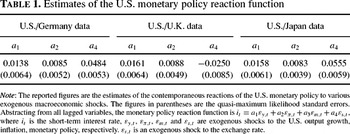
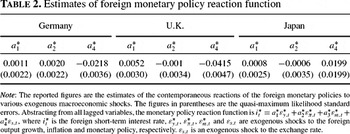
The identification restrictions imposed on matrix C in section 2.3 imply that the U.S. and the foreign monetary authorities react contemporaneously to various economic shocks according to (abstracting from all lagged variables)


where εy,t, επ,t and εm,t are exogenous shocks to the U.S. output growth, inflation and monetary policy, respectively, while
,
and
are exogenous shocks to the corresponding foreign variables. Shock εs,t is an exogenous innovation to the exchange rate.10
We identify the policy response to the exchange rate shock by assuming that the U.S. (foreign) monetary authority only responds to the U.S. (foreign) output and inflation shocks. See the zero restrictions imposed on the last two rows of matrix C in Section 2.3.
(i=1, 2, 4) are presented in Tables 1 and 2.


We can see from Table 1 that across all country pairs, the estimates of a1 and a2 are positive and highly significant, indicating that the Fed raises the short-term interest rate in response to positive innovations in output growth and inflation, which is consistent with the conventional view of the counter-cyclical monetary policy pursued by the Fed during that period. Also note that although the model is estimated for three different pairs of countries separately, the estimates are very close to each other.
Table 2 reports the corresponding policy reactions to the exogenous output and inflation shocks in the foreign countries. Although most coefficients are still positive, they are not significant, suggesting that the policy reactions in those countries are not as strong as in the United States.
It is interesting to note from Tables 1 and 2 that the estimate of a4 and
are highly significant in all cases, suggesting that there appear to be strong contemporaneous monetary policy responses in all countries to the exchange rate movements.11
Interpretation of the sign of the estimates of a4 and
needs some caution. A negative estimate of the U.S. monetary policy response to an exogenous exchange rate shock does not necessary mean that the Fed seeks to cut the short term interest rate when the U.S. dollar is depreciating, because the direction of movement of the exchange rate Δln St depends on Cszt−1 [see equation (28)].
The unconditional correlation coefficient between the one-month Euro rates, it and
, ranges from 0.52 for U.S./Germany to 0.70 for U.S./U.K.
The Exchange Rate Volatility
The Appendix shows that the exchange rate is determined by the following equation:

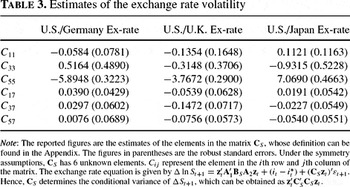
where BS and CS are, respectively, 4×4 and 7×7 matrices, and A1 and A2 are defined in Appendix. Under the symmetry assumption, the matrix CS has a simple structure with only six unknown coefficients. This equation implies that the conditional variance of Δln St+1 is given by
, where the estimates of the elements in CS are reported in Table 3.

Consistent with many previous studies (e.g., Baillie and Bollerslev, 2000), we find that stochastic volatility is an important character of the foreign exchange rate movements, given the significant estimates of some of the elements in CS. In particular, we can see from Table 3 that, among all the estimates, C55 seems to be the statistically most significant and economically important element. Because C55 is the coefficient on
in the expression of (CSzt)′εt+1, this implies that the most important component of the conditional variance of the exchange rate movement, Δlog St+1, is
, where
and
are the variance of the exogenous interest rate shocks, εm,t+1 and
, respectively. The higher the level of the interest rates or the larger the variance of the interest rate shocks, the more volatile is the exchange rate.
Time-Varying Currency Risk Premia
Equation (31) also reveals that the UIP deviation ϕt as defined in (13) is given by
. Therefore, following the discussion in Section 2.1, the currency risk premium ut defined in (15) can be expressed as:13
Note that the foreign exchange risk premium defined in this paper has the opposite sign as that in Fama (1984), which defines the risk premium as
.

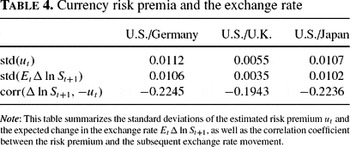
As pointed out by Fama (1984), the negative slope coefficient from the linear regression of the change in the exchange rate on the interest rate differential implies that the risk premium must be negatively correlated with the exchange rate movement, and must be more volatile than the expected changes in the exchange rate, that is:


Table 4 summarizes the corresponding standard deviations and the correlation coefficients. We find that our parameterization of the market price of risk indeed produces foreign exchange risk premia with the requisite properties. The risk premia from investing in the German Mark, British Pound, and Japanese Yen are found to be negatively correlated with the subsequent change in the exchange rates and are more volatile than the expected changes in the exchange rates.

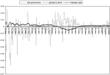
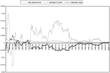
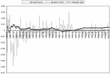
We also plot the estimated risk premia ut together with the interest rate differential
and Jensen's inequality term vt for the U.S./Germany, U.S./U.K., and U.S./Japan, respectively in Figures 1, 2, and 3. Consistent with previous results (e.g., Bekaert and Hodrick, 1992), the graphs confirm that, compared to the risk premia, Jensen's inequality term is not an important factor affecting the exchange rate movements. Moreover, the graphs also clearly show that the risk premia are more volatile than the interest rate differential, implying that a large fraction of the exchange rate movements must be attributable to the changes in risk premia. Knowing how macroeconomic shocks affect the risk premia, therefore, may be critical for understanding the dynamics of exchange rate movements.

U.S./German currency risk premia 1980–2000.

U.S./U.K. currency risk premia 1980–2000.

U.S./Japan currency risk premia 1980–2000.
Variance Decomposition
One key aspect of the exchange rate movements that dynamic international asset pricing models fail to match is the volatility of the currency risk premia. Most reasonably parameterized models are found unable to produce the risk premia that are volatile enough to explain the UIP deviations when subject to usual macroeconomic shocks. Such failure could either reflect mis-specifications of the models (such as investor's preference) or some other exogenous shocks to the exchange rate not appropriately taken into account by economists. The VAR system discussed in the last section allows us to examine the sources of the volatility of the risk premia by imposing little restrictions on the structure of the economy.
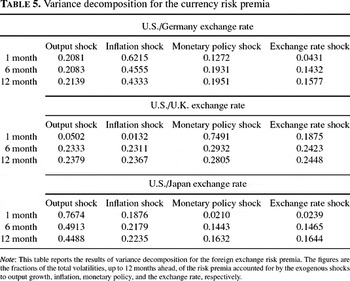
Specifically, we calculate a variance decomposition for the foreign exchange risk premia analogous to those in linear VAR models based on Monte Carlo simulations. Random shocks (εt+j, j=1, …, 12) to the VAR system (27) are drawn from a multivariate normal distribution and the 12-month forecasting errors for the foreign exchange risk premia ut are computed using (32). This process is repeated 500 times and the sample variances of the forecast errors at each time horizon (j=1, …, 12) are computed. In order to obtain a variance decomposition, each element of εt+j [see equation (21)] is drawn separately while holding all other elements fixed at zero during the simulations. The ratios of the variance due to each component of εt+j over the total variance then gives the variance decomposition. However, unlike linear VAR models, the sample variances from the Monte Carlo simulations are dependent on the past history zt−1 due to the nonlinear restrictions imposed on the exchange rate movement. Therefore, we first calculate the variance decomposition conditional on each observation of zt−1 in our sample over 1980 to 2000, and then take the average across zt−1. The results are reported in Table 5.

In contrast to the results from the previous literature, we find that most of the volatilities of the currency risk premia can be accounted for by the identified standard macroeconomic shocks. In the case of the U.S./Germany exchange rate, output shocks and inflation shocks account for about 64% of the risk premium's volatilities, and shocks to the monetary policies in the two countries account for another 20% of the volatilities. Similar results are found for the U.S./Japan exchange rate, in which the shocks to output, inflation, and monetary policies together account for nearly 85% of the risk premium's volatilities, whereas the exogenous shocks to the exchange rate account for about 16% of the volatilities. In the case of the U.S./U.K. exchange rate, the exogenous exchange rate shocks account for a little larger fraction of the volatilities of the currency risk premium but still less than 25% of its total standard deviation. Moreover, among those standard macroeconomic shocks, the output and inflation shocks seem to be the most important ones, accounting for 64% (U.S./Germany), 46% (U.S./U.K.) and 67% (U.S./Japan) of the risk premium's volatilities.
Moreover, our results suggest that the exogenous shocks to the monetary policies are an important force driving the foreign exchange risk premia, accounting for 16% (U.S./Japan) to 28% (U.S./U.K.) of the risk premium's volatilities. To fully understand the dynamics of the exchange rate movement, therefore, it is crucial to explicitly model the policy behavior in the asset pricing models and investigate the mechanisms through which monetary policies affect the exchange rate.
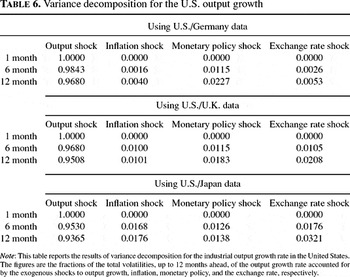
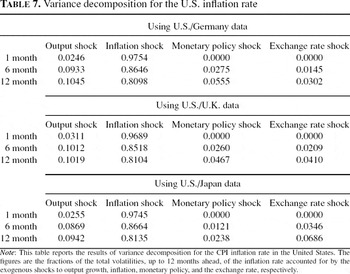
We also compute the variance decompositions for output and inflation using the U.S./German, U.S./U.K., and U.S./Japan data, respectively. The results are reported in Tables 6 and 7. In all three cases, we find that almost all of the volatilities in output are accounted for by the output shocks (more than 95% on average). The inflation shocks and the monetary policy shocks account for another 2 to 3% of its volatilities. The shocks to the exchange rate only account for less than 2% of the volatilities of output. Similar results are found for inflation as well. All standard macroeconomic shocks together account for nearly 95% of its volatilities with the inflation shocks being the most important ones. The exchange rate shocks only account for about 5% of the volatilities of inflation. These results confirm that the foreign exchange risk premia are driven mostly by the same macroeconomic shocks that affect output and inflation.14
As a simple measure for the amount of nonlinearity, we estimated a standard linear VAR by ignoring the restrictions in the last equation of the system, and compare the resulting variance decompositions to the figures reported in Tables 5–7. The sharp contrasts we observed in our nonlinear VAR models tend to lessen when the linear VAR models are used. For example, the output and monetary policy shocks account for 93% and 1.4%, respectively, of the volatility of the U.S. output based on U.S./Japan data in our nonlinear model. The ratios become 86% and 7.7%, respectively, in the linar model. Even bigger differences are found for the foreign exchange risk premia. The exogenous exchange rate shock accounts for less than 24.5% of the volatility of the U.S./U.K. currency risk premia in our nonlinear model, whereas the ratio becomes to 38% in the linear model.


The standard representative agent models fail to account for the forward premium anomaly in currency market mainly because they impose a very close link between the real exchange rate and aggregate consumption. Introducing frictions in the goods market such as sticky prices (e.g., Chari, Kehoe, and McGrattan, 2003) or in the asset market such as transaction costs (e.g. Alvarez, Atkeson, and Kehoe, 2002), international business cycle models can break such a tight link. When subject to the standard macroeconomic shocks, they are able to generate volatile and persistent real exchange rates, eliminating some discrepancies between the theoretical models and the data. The empirical results obtained in our paper complement these theoretical studies, and suggest that a promising approach to understand the anomaly in currency markets is to extend the standard international asset pricing models to include various imperfections in the goods and/or asset markets.
Exchange Rate Overshooting
Economists have long recognized the importance of monetary policy shocks for the movement of exchange rates. The well-known Dornbush (1976) overshooting model predicts that the exchange rate will initially overshoot its long-run level in response to an exogenous monetary shock that alters the domestic and foreign interest rate differential. However, as seen in Figures 1–3, the difference between the volatilities of risk premia and interest rate differentials is wide enough to suggest that a large fraction of exchange rate movements must be attributable to the changes in risk premia. Knowing how monetary policy shocks affect risk premia, therefore, may be critical for understanding the dynamics of exchange rate movements under such shocks.
In this section, we revisit the issue of exchange rate overshooting. In particular, we examine the following two questions: (i) how does an exogenous monetary policy shock affect the currency risk premium? and (ii) How does the response of the risk premium to the policy shock affect exchange rate movements?
In particular, we follow the literature on nonlinear impulse response functions (IRF) and calculate the dynamic responses of zt under the macroeconomic shock εt as the difference between a pair of conditional expectations:15

where Ωt−1 stands for the information set (or the state) at t−1 (including zt−1), and h=0, 1, 2, … is time horizon.
In this paper, we consider an exogenous shock to the U.S. monetary policy that pushes down the U.S. short-term interest rate relative to the foreign rate.16
Only an expansionary monetary policy shock is considered here.
, denoted by ωt−1, between January 1980 and December 2000. Assuming stationarity, these IRFs conditional on ωt−1 are realizations of the random variables defined by these conditional expectations. To calculate the expectations conditional on ωt−1, we simulate the model in the following manner. First, we fix ωt−1 and randomly draw εt+j from
for j=1, 2, …, h and then simulate the model conditional on ωt−1 and monetary policy shock εt. This process is repeated 500 times and the estimated conditional expectation is obtained as the average of the outcomes.
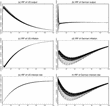
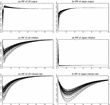
Figures 4–6 display the estimated IRFs of output growth, inflation, and the short-term interest rate in the home and foreign country using the U.S./Germany, U.S./U.K., and U.S./Japan data, respectively. The IRFs are computed conditional on each realization of
between January 1980 and December 2000 under an exogenous expansionary shock to U.S. monetary policy. Each line in the graphs corresponds to a particular realization of the random impulse response function defined earlier. We can see that although there are some variations in the effects of the policy shock on these variables due to nonlinearity in the VAR model, the IRFs are very similar to those frequently reported in the standard monetary VAR literature. In particular, under the expansionary monetary policy shock, the U.S. short-term interest rate falls, which in turn leads to a mild decline in the foreign interest rate as the foreign monetary authority reacts to the U.S. monetary actions. These declines in interest rates eventually lead to increases in output in both the United States and the foreign country through the usual monetary transmission mechanisms. By contrast, the inflation rates in the United States and the foreign country appear to fall in response to the expansionary monetary shock, similar to the widely observed phenomenon dubbed as the “price puzzle” in the standard monetary VAR literature.

IRFs of macroeconomic variables. (This figure plots the impulse-response functions of macroeconomic variables under an exogenous monetary policy shock of the size of 1 standard deviation using U.S./German data.)

IRFs of macroeconomic variables. (This figure plots the impulse-response functions of macroeconomic variables under an exogenous monetary policy shock of the size of 1 standard deviation using U.S./U.K. data.)

IRFs of macroeconomic variables. (This figure plots the impulse-response functions of macroeconomic variables under an exogenous monetary policy shock of the size of 1 standard deviation using U.S./JAPAN data.)
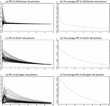
Figure 7 reports the responses of risk premia from investing in three currencies to the U.S. monetary policy shock. The left side panels display the IRFs conditional on different zt−1 all together, whereas the right side panels show their averages. It is easy to see that the shocks to U.S. monetary policy have a significant impact on risk premia. On average, an expansionary shock to U.S. monetary policy generates a large increase in the currency risk premium. In the case of the German Mark, the risk premium increases by 20 basis points on average, whereas the risk premia on the British Pound and Japanese Yen increase on average by 11 and 5 basis points, respectively, in response to a monetary policy shock of one standard deviation.

IRFs of the foreign exchange risk premia. (This figure plots the impulse-response functions of the foreign exchange risk premia under an exogenous monetary policy shock of the size of 1 standard deviation. The left panel plots the IRFs across different states and the tight panel includes the average IRFs over those states.)
Such a positive response of the foreign exchange risk premium to an expansionary monetary shock is consistent with the standard economic models. The foreign exchange risk premium is, by definition, the expected excess return from investing in a foreign currency under risk aversion. An expansionary monetary shock not only lowers the U.S. interest rate relative to the foreign rate but also leads to an expected depreciation of the U.S. dollar or an expected appreciation of the foreign currency as most economic models predict.
More important, the responses of the currency risk premium to the monetary policy shock vary substantially across different states of the economy (or different initial values of zt−1). The responses range from a slightly negative number to positive 1.6% in the case of the German Mark, and from less than 5 to nearly 35 basis points in the case of the British Pound. These large variations have important implications for exchange rate movements in response to the monetary shocks.
According to Dornbush's (1976) overshooting mechanism, the exchange rate initially overshoots its long-run level in response to an expansionary monetary shock. In this mechanism, interest rates play a central role in affecting the dynamics of exchange rate movements. However, in the presence of time-varying risk premia, the exchange rate movement is determined by the risk premia (ut) as much as by the interest rate differential
, as is observed in (15). Indeed, many empirical studies find that, instead of immediate overshooting, we often observe persistent dollar depreciations before it starts to move to its long run level in response to the U.S. expansionary monetary policy shocks (e.g., Eichenbaum and Evans, 1995). Although many economists try to rationalize such delayed overshooting based on the dynamics of interest rate movements,17
For example, Gourichas and Tornell (1996) argue that as the market cannot distinguish between the persistent component and the transitory component of interest rate shocks, the delayed overshooting results from the interaction of learning by the market and the dynamic response of interest rates to monetary shocks.
More specifically, although an expansionary shock to U.S. monetary policy lowers the U.S. interest rate relative to the foreign rate (see Figures 4–6), it also raises the risk premium. The lower U.S. interest rate makes the foreign currency more attractive and leads to a depreciation of the U.S. dollar. If there were no risk premia or the risk premia were constant, equation (13) (ignoring Jensen's inequality term) would imply that there should be a subsequent appreciation of the U.S. dollar relative to the foreign currency following the initial reaction of the exchange rate due to international arbitrage. Hence, in such a case, the exchange rate must initially overshoot its long run level. However, in the presence of time-varying risk premium, the movement in the exchange rate depends on both the risk premium and the interest rates, and, in particular, on the magnitude of the response of the risk premium. If ut increases more than a decline in
in response to the monetary shock, the dollar would continue to depreciate as dictated by the risk-premium-adjusted UIP given in (13) and, therefore, exhibits the “delayed overshooting.” By contrast, if ut increases less than a decline in
in response to the monetary shock, then the exchange rate will behave according to the standard overshooting mechanism.
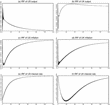
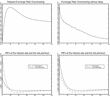
In Figure 8, we plot two typical cases of the responses of the exchange rate following an expansionary shock to the U.S. monetary policy. The upper-left panel of the figure presents the IRF of the exchange rate when the response of the risk premium is larger than that of the interest rate differential (shown in the lower-left panel) under the monetary shock. The upper-right panel of the figure displays the IRF of the exchange rate when the response of the risk premium is smaller than that of the interest rate differential (shown in the lower-right panel). Both IRFs are drawn conditional on particular actual historical dates. We can clearly see how the dynamics of exchange rate movements depend on the size of the response of risk premia to the monetary shock.

Exchange rate overshooting. (The upper panel of this figure plots the impulse-response functions of the exchange rate under an exogenous expansionary shock to the U.S. monetary policy of the size of 1 standard deviation. The lower panel plots the corresponding IRFs of the risk premium andthe interest rate differential.)
CONCLUDING REMARKS
In this paper we empirically examine the sources of volatilities of the foreign exchange risk premia. The study is motivated by the observation that reasonably parameterized international asset pricing models fail to generate the currency risk premia volatile enough to match the empirical evidence. Using a nonlinear structural VAR based on the no-arbitrage condition to identify various fundamental shocks and the foreign exchange risk premia, we find that most of the volatilities of the foreign exchange risk premia can be accounted for by the standard macroeconomic shocks that drive output and inflation. Exogenous shocks to the foreign exchange markets have a small, although not negligible, impact on the foreign exchange risk premia.
If the foreign exchange risk premia are time-varying and volatile, then a large fraction of the movement in the exchange rate must be attributed to the fluctuations in the risk premium. Therefore, knowing the behavior of the risk premia may be crucial to understand the dynamics of the exchange rate movements in response to exogenous macroeconomic shocks. Our findings help reconcile the seemingly contradicting observations from previous VAR analysis of the exchange rate movement under exogenous monetary innovations.
One important question that is left unanswered in this work is that why the currency risk premium or the exchange rate is so volatile. Many studies have proposed various explanations based on structural models. The empirical results of the current paper provide some insight into the dynamic effects of different macroeconomic shocks as an intermediate step toward bridging the gap between economic theories and the empirical evidence.
APPENDIX
The first identifying restriction is based on the assumption that home and foreign investors price the currency risk in a symmetrical fashion in the sense described as follows. For example, let us consider the first two elements of εt: the shocks to the home and foreign country's output (εy,t and
). To investors in the home country, the currency risk associated with the shock to home output is Covt−1[Δln St, εy,t],18
We have ignored the term
here, as it does not affect the conditional covariance.
We assume that if the market price for the risk (or the expected excess rate of return per unit of the covariance) in the home country is given by:

then the foreign counterpart is given by:

where Γij refers to the element on the ith row and jth column of matrix Γ. And similar parameterizations apply to λi,t and
for i=2, …, 6. For λ7,t and
, notice that if the currency risk due to the exogenous exchange rate shock εS,t is Covt−1[Δln St, ~εS,t] for home investors, its foreign analogy is Covt−1[−Δln St, −εS,t]. Hence, the symmetric assumption implies that if εS,t has a market price of risk in the home country given by:

then in the foreign country its market price of risk will be:

In summary, the symmetric treatment of the market price of risk across countries implies that
where:

Pre- and postmultiplication of matrix A has an effect on matrix Γ in the following manner: First, it changes the position of the first and second rows, the third and fourth rows, and the fifth and sixth rows of matrix Γ and then changes the sign of the last row. Second, it changes the position of the first and second columns, the third and fourth columns, and the fifth and sixth columns of matrix Γ and then changes the sign of the last column.
With this restriction, the last equation in (27) can be expressed as:

or:

where BS and CS are, respectively, 4×3 and 7×7 matrices whose elements are to be estimated, b=(0, 0, 0, 0, 1, −1, 0)′ as defined in (27), and the matrices A1 and A2 are given by:

To see this, note that
, where
. Now:

Note also that:

Therefore, if there is no restriction on Γ, we can express the original quadratic form as z′(Γ′Γ -Γ*′Γ*)z,=z′ A1′BSA2z as claimed.
The second set of restrictions is based on another type of symmetric assumption to simplify the expression of matrix CS. We assume, for example, the contribution of y* to the market price of home output risk is assumed to be equal in size to the contribution of y to the market price of foreign output risk. This type of symmetric assumption implies restrictions on matrix Γ in the form of Γ1+2i,1+2j=Γ2+2i,2+2j and Γ1+2k,2+2l=Γ2+2k,1+2l for i, j, k, l=0, 1, 2 and i≠j. It makes all off-diagonal elements of CS except the last row and the last column equal to zero. The resulting matrix CS becomes:

We would like to thank an associate editor and an anonymous referee for helpful comments and constructive suggestions. All remaining errors are ours.