Introduction
Symptoms of psychosis (Hanssen et al. Reference Hanssen, Peeters, Krabbendam, Radstake, Verdoux and van Os2003; Varghese et al. Reference Varghese, Scott, Welham, Bor, Najman, O'Callaghan, Williams and McGrath2011; Kelleher et al. 2012b; Wigman et al. Reference Wigman, van Nierop, Vollebergh, Lieb, Beesdo-Baum, Wittchen and van Os2012) and bipolar disorder (Angst et al. Reference Angst, Cui, Swendsen, Rothen, Cravchik, Kessler and Merikangas2010; Nusslock & Frank, Reference Nusslock and Frank2011), at clinical and subclincal levels of expression, commonly occur in the context of major depressive disorder (MDD). This reflects overlap between affective and psychotic disorders in genetic (Craddock et al. Reference Craddock, O'Donovan and Owen2009) and environmental risk factors (Weiser et al. Reference Weiser, van Os and Davidson2005), as well as in underlying endophenotypes, for example (neuro)cognitive, social and emotional dysfunctions (Weiser et al. Reference Weiser, van Os and Davidson2005; Hill et al. Reference Hill, Reilly, Harris, Rosen, Marvin, DeLeon and Sweeny2009; Simonsen et al. Reference Simonsen, Sundet, Vaskinn, Birkenaes, Engh, Færden, Jónsdóttir, Ringen, Opjordsmoen and Melle2011). The overlap in diagnostic constructs has important implications for both research and clinical practice. Theoretically, dimensional clustering of psychopathology challenges the validity of current diagnostic systems that aim to categorize essentially continuous psychopathological phenomena (McGorry & van Os, Reference McGorry and van Os2013). Clinically, disregard of subclinical co-expression of psychotic and bipolar symptoms may contribute to treatment resistance in MDD, as suggested by a number of lines of evidence. First, some but not all studies suggest poorer response to antidepressants in individuals screening positive for subclinical bipolar illness features (Sharma et al. Reference Sharma, Khan and Smith2005; Smith et al. Reference Smith, Forty, Russell, Caesar, Walters, Cooper, Jones, Jones and Craddock2009; Dudek et al. Reference Dudek, Rybakowski, Siwek, Pawłowski, Lojko, Roczeń and Kiejna2010; Perlis et al. Reference Perlis, Uher, Ostacher, Goldberg, Trivedi, Rush and Fava2011). Second, the presence of subclinical psychotic features during an episode of MDD (not fulfilling criteria for a formal diagnosis of psychotic depression) predicts poor response to multiple antidepressants (Perlis et al. Reference Perlis, Uher, Ostacher, Goldberg, Trivedi, Rush and Fava2011). To our knowledge, no study has examined whether the presence of subclinical bipolar and psychotic symptoms in MDD moderates response to evidence-based psychotherapies like cognitive behavioural therapy (CBT; Beck & Rush, Reference Beck and Rush1979) or interpersonal psychotherapy (IPT; Klerman et al. Reference Klerman, Weissman, Rounsaville and Chevron1984).
The aims of the current study were to investigate the impact of (i) subclinical psychotic experiences and (ii) subclinical bipolar symptoms on the course and outcome of MDD when treated with short-term psychotherapy, either alone or in combination with antidepressants. More specifically, outcome variables of interest cover clinical outcome (severity of depression, remission, time to remission and relapse of depression) and functional outcome.
Method
Sample
The study sample consisted of depressed, treatment-seeking patients presenting at the mood disorders treatment programme of an out-patient mental health care centre in Maastricht, The Netherlands. After initial screening, patients are referred to specialized treatment programmes for diagnostic work-up and treatment. During the acute treatment phase, the mood disorders programme offers most depressed patients CBT or IPT, either alone or in combination with pharmacotherapy. The current data came from an observational study designed to examine the effectiveness of evidence-based treatments for depression in routine clinical practice. Thus, treatment allocation was based on participants’ preference and not on randomization (Peeters et al. Reference Peeters, Huibers, Roelofs, van Breukelen, Hollon, Markowitz, van Os and Arntz2013). Peeters et al. (Reference Peeters, Huibers, Roelofs, van Breukelen, Hollon, Markowitz, van Os and Arntz2013) previously showed that psychotherapy interventions, alone or in combination with pharmacotherapy, are effective in a routine clinical setting. CBT was provided by experienced therapists who received appropriate training and followed the procedures outlined in standard texts of cognitive therapy for depression (Beck & Rush, Reference Beck and Rush1979). IPT, based on the manual by Klerman et al. (Reference Klerman, Weissman, Rounsaville and Chevron1984), was also provided by trained and experienced therapists (psychologists, psychotherapists and psychiatrists).
For the current study, the inclusion criteria were a primary diagnosis of MDD as assessed with the Structured Clinical Interview for DSM-IV Axis I (SCID-I; First et al. Reference First, Spitzer, Gibbon and Williams1997) and completion of the Community Assessment of Psychic Experiences (CAPE) and/or the Mood Disorder Questionnaire (MDQ). Trained mental health care professionals conducted the SCID-I assessments. Exclusion criteria were a primary diagnosis other than MDD, elevated acute suicide risk and insufficient command of the Dutch language. Patients who met Diagnostic and Statistical Manual of Mental Disorders, 4th Edition (DSM-IV) criteria for psychotic depression or bipolar disorder were thus excluded. Co-morbid Axis I diagnoses were allowed. The study was approved by the Ethics Committee of Maastricht University. All participants provided written informed consent.
Procedure
After the diagnostic work-up, participants were allocated to treatment. Licensed psychologists and psychotherapists, who received appropriate training and followed the procedures outlined in standard texts, provided CBT and IPT (Beck & Rush, Reference Beck and Rush1979; Klerman et al. Reference Klerman, Weissman, Rounsaville and Chevron1984). Pharmacotherapy typically consisted of treatment with a serotonin reuptake inhibitor (SSRI), following national and international guidelines. In cases of SSRI non-response in the current episode, participants were prescribed another SSRI, venlafaxine or a tricyclic agent augmented with lithium in case of subsequent non-response. Prior to the start of treatment, baseline measurements were carried out; follow-up assessments took place after 8, 16, 26, 52 and 104 weeks. A total of 44 (38%) patients received CBT and 40 (34%) patients IPT; 17 (15%) patients received CBT in combination with pharmacotherapy and 15 (13%) received IPT in combination with pharmacotherapy.
Instruments
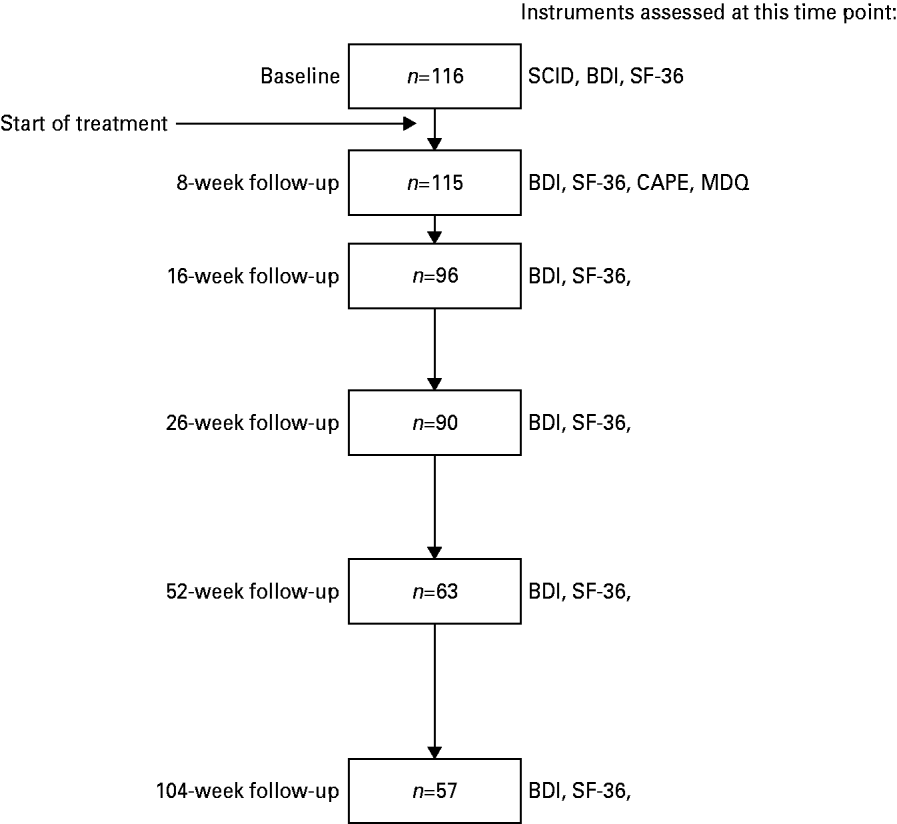
At different time points, different instruments were used (see Fig. 1). The main outcome variable was the Beck Depression Inventory, second edition (BDI; Beck & Steer, Reference Beck and Steer1996). The BDI measures depression severity using 21 items, with higher scores indicating more severe depression (range 0–63). Its construct validity and reliability have consistent support from varied samples (Beck & Steer, Reference Beck and Steer1996). Using the guidelines of Jacobson & Truax (Reference Jacobson and Truax1991), response was defined a priori as a decrease of at least 10 points from baseline BDI score, whereas remission was conservatively defined as an absolute BDI score of 10 points or less.
Flowchart of the study design. SCID, Structured Clinical Interview for DSM-IV; BDI, Beck Depression Inventory; SF-36, Short Form-36; CAPE, Community Assessment of Psychic Experiences; MDQ, Mood Disorder Questionnaire.

The positive dimension of the CAPE (18 self-report items), based on the Peters et al. Delusions Inventory (Peters et al. Reference Peters, Joseph and Garety1999) and modified to also include hallucinatory experiences, was used to assess lifetime subclinical positive psychotic experiences (Stefanis et al. Reference Stefanis, Hanssen, Smirnis, Avramopoulos, Evdokimidis, Stefanis, Verdoux and van Os2002; Konings et al. Reference Konings, Bak, Hanssen, van Os and Krabbendam2006). Each CAPE item rates the frequency of subclinical psychotic experiences on a four-point scale; scores can thus range from 18 to 72, and higher scores indicate more subclinical psychotic experiences.
The MDQ (Hirschfeld et al. Reference Hirschfeld, Williams, Spitzer, Calabrese, Flynn, Keck, Lewis, McElroy, Post and Rapport2000), a screening instrument for bipolar disorder, was used to assess symptoms of subthreshold bipolar (spectrum) disorder. The MDQ consists of three sections: part A addresses 13 yes/no questions addressing occurrence of (hypo)manic symptoms; part B rates co-occurrence of multiple symptoms (yes/no) and part C addresses the level of impact of these symptoms on the individual's daily life (none, mild, moderate, severe). The MDQ also assesses lifetime prevalence of symptoms. For the purpose of the current study, part A was used in the analyses. Part A scores can range from 0 to 13, and higher scores indicate more symptoms.
Level of functioning was assessed with the Short Form-36 (SF-36; Ware & Sherbourne, Reference Ware and Sherbourne1992), which includes 36 items. The SF-36 rates functional health and well-being on eight dimensions. The mean score of the eight dimensions was used as an indicator of a generic, mental health summary measure, and higher scores indicate better overall functioning.
Analyses
Analyses were carried out in STATA version 12.0 (StataCorp LP, USA). Comparisons of baseline characteristics and differences between treatment groups were done with χ 2 tests for categorical data and with analysis of variance or Pearson correlations for continuous data. Data were analysed in the long format, modelling the dependent variable assessed at time points 2, 3, 4, 5 and 6 while correcting for the baseline value of the dependent variable, taking into account hierarchical clustering of observations within persons using the xtreg command.
First, the prevalences of (i) subclinical psychotic experiences, as assessed with the CAPE, and (ii) subclinical bipolar symptoms, as assessed with the MDQ, were investigated. Pearson's correlations were calculated for BDI, CAPE and MDQ scores in order to address the degree of association between the three instruments.
Second, multilevel linear regression was used to predict BDI scores over time (T2–T6), using (i) CAPE score, (ii) MDQ score and, when main effects were found, (iii) interactions between these two respective measures and time. Third, logistic regression was used to predict non-remission using (i) CAPE score and (ii) MDQ score. Fourth, logistic regression was used to predict relapse (i.e. a BDI score of 10 points or higher at time point t after having been in remission at time point t –1) using (i) CAPE score and (ii) MDQ score. Fifth, time to remission was predicted using Cox regression with (i) CAPE score and (ii) MDQ score as predictors. For this analysis, variables of CAPE and MDQ were dichotomized (split around the mean). All these analyses were controlled for depression severity (BDI score) at baseline. Finally, multilevel linear regression was used to predict T2–T6 level of functioning, expressed as mean SF-36 score and controlling for baseline functioning, using (i) CAPE score and (ii) MDQ score.
BDI or functioning scores, CAPE score and MDQ score did not differ between men and women (all p > 0.05). Age was not correlated with BDI score or functioning, nor with CAPE or MDQ score (all p > 0.05); age and sex were therefore not controlled for in the analyses. There were no differences in BDI baseline score, CAPE or MDQ score between individuals who received monotherapy or combined therapy; nor did these scores differ between individuals who received CBT or IPT (all p > 0.05). Functioning scores did not differ when comparing monotherapy with combined therapy. However, comparing these therapy groups on the type of psychotherapy received revealed that patients receiving IPT had higher levels of functioning at baseline compared with patients receiving CBT (p < 0.02; not at other time points). Given these differences, analyses on functioning were additionally controlled for receipt of CBT or IPT (hereafter: treatment group).
Since patients reporting subclinical psychotic or bipolar phenomena may be those that present with more severe symptoms, expressed as ‘co-morbidity’, we performed post hoc analyses to see whether patients with more psychotic experiences (using the dichotomized variable representing the mean split of the CAPE score) reported more co-morbidity (i.e. the co-presence of one or more disorders) compared with patients with fewer psychotic experiences. In addition, all analyses were repeated controlling for the presence of co-morbidity.
Results
Sample
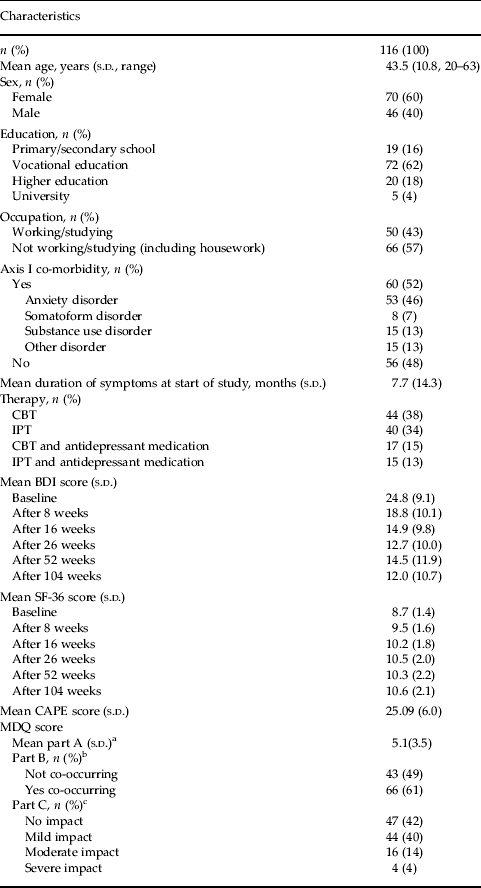
The sample consisted of 116 patients who at the second time point completed the CAPE; MDQ data were available for 113 patients. Demographic characteristics of the sample can be found in Table 1. At baseline assessment, eight patients (7%) scored below the clinical cut-off on the BDI (i.e. a score of 10 or less), increasing to 23 patients (20% of the assessed sample) at the 8-week follow-up, 35 patients (36%) at the 16-week follow-up, 43 patients (48%) at the 26-week follow-up, 30 patients (48%) at the 52-week follow-up and 29 patients (51%) at the 104-week follow-up. Of the total sample, 66 patients (57%) reached remission at least once during the study. Relapse of depression occurred in 20 patients (17%). More than one disorder (co-morbidity) was present in 60 patients. Of these 60 patients, 38 (63%) had one additional disorder, 14 (23%) had two additional disorders, seven (12%) had three additional disorders and one patient (2%) had four additional disorders.
Demographic characteristics of participants at baseline

s.d., Standard deviation; CBT, cognitive behavioural theory; IPT, interpersonal therapy; BDI, Beck Depression Inventory; SF, Short Form-36; CAPE, Community Assessment of Psychic Experiences; MDQ, Mood Disorder Questionnaire.
a Part A addresses 13 yes/no questions addressing the occurrence of (hypo)manic symptoms.
b Part B rates the co-occurrence of multiple symptoms (yes/no).
c Part C addresses the level of impact of these symptoms on the individual's daily life (none, mild, moderate, severe).
Attrition analyses
There were no large or significant differences between individuals who dropped out of the study (i.e. only 59 individuals did not complete the last measurement) compared with the individuals who completed the study regarding level of depression, functioning at baseline, CAPE score and MDQ score. Also, individuals who dropped out were no more likely to receive monotherapy or combined therapy or to have chosen IPT or CBT (all p > 0.05). Patients who dropped out showed no sex differences (p > 0.05); however, patients who dropped out at the final measurement were younger than patients who completed the study [39.6 (s.d. = 10.9) v. 47.5 (s.d. = 9.4) years, respectively] (F 1,114 = 17.33, p < 0.001). However, since it is unlikely that young patients for whom subclinical psychosis would be associated with good outcome were more likely to drop out of the study compared with older patients for whom psychosis would be associated with poor outcome, it is unlikely that this age difference may have biased the results.
Sublinical psychotic experiences and bipolar symptoms in the context of depression
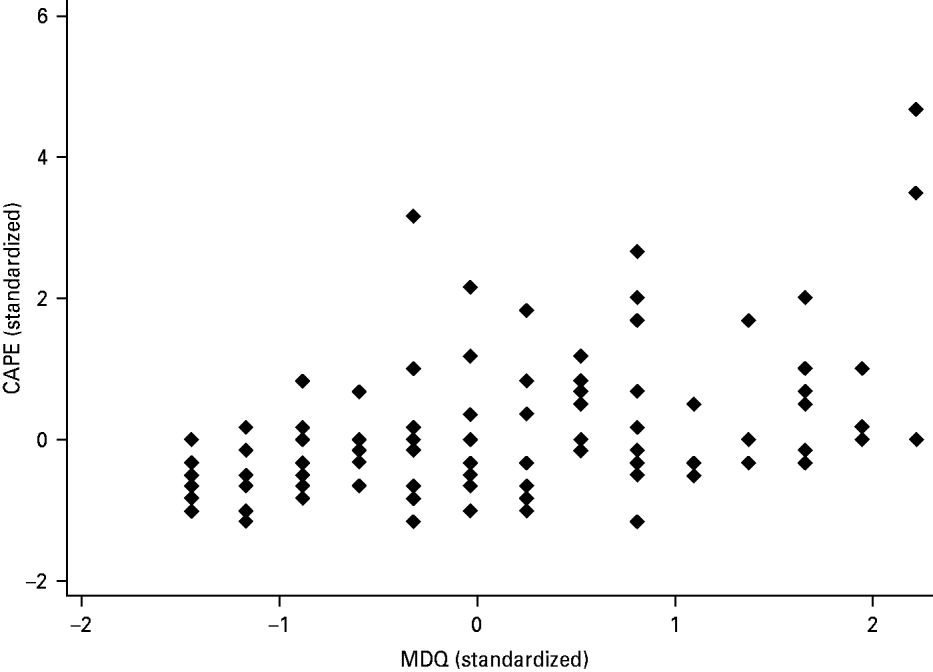
Both subclinical psychotic experiences and subclinical bipolar symptoms were prevalent in depressed patients and often co-occurred. Of the participants, 96% reported at least one subclinical psychotic experience; 93% reported at least one bipolar symptom. Also, 89% reported at least one instance of psychosis and bipolarity together. Fig. 2 shows the distribution of the co-occurrence of bipolar symptoms and subclinical psychotic experiences.
Bivariate plot of subclinical psychotic experiences (Community Assessment of Psychic Experiences; CAPE) and bipolar symptoms (Mood Disorder Questionnaire; MDQ).

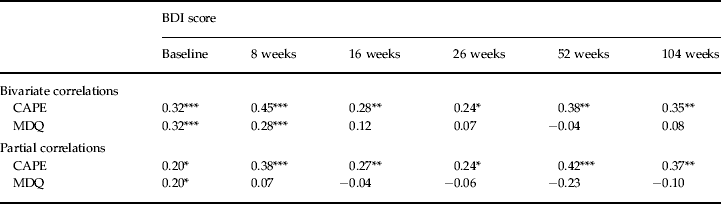
Zero-order bivariate correlations of measures of the BDI, CAPE and MDQ were significant at baseline and at the 8-week follow-up (Table 2). However, when calculating partial correlations, it was shown that at the 8-week follow-up, CAPE and BDI were still significantly correlated when controlling for MDQ, whereas the MDQ was no longer significantly correlated with the BDI when controlling for CAPE. At subsequent assessments, only CAPE was significantly correlated with BDI score as indicated by both bivariate and partial correlation coefficients.
Pearson's bivariate and partial correlations of BDI with, respectively, CAPE and MDQ score at all time points

BDI, Beck Depression Inventory; SF, Short Form-36; CAPE, Community Assessment of Psychic Experiences; MDQ, Mood Disorder Questionnaire.
*** p < 0.0.001, ** p < 0.01, * p < 0.05.
CAPE and MDQ were also significantly correlated at the 8-week assessment (ρ = 0.49, p < 0.0001), and after controlling for depression at that time point (ρ = 0.43, p < 0.0001).
No interactions were found for either CAPE score or MDQ score with treatment groups predicting either depression or functioning over time, nor was there an interaction between CAPE score and MDQ score predicting depression or functioning over time (all p > 0.05).
Subclinical psychotic experiences and bipolar symptoms predicting depression and functioning over time
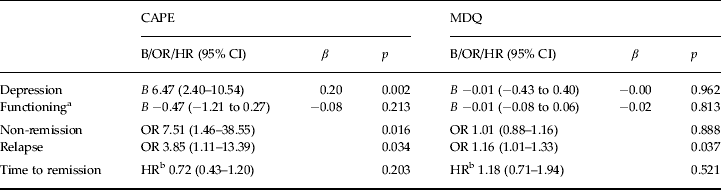
Controlling for baseline depression (Table 3), CAPE score significantly predicted (i) depression score over time (i.e. more subclinical psychotic experiences predicted more severe depression over time), (ii) non-remission (i.e. more subclinical psychotic experiences increased a patient's probability of not reaching remission) and (iii) relapse. CAPE score did not predict time to remission or level of functioning. No interaction was found between CAPE score with time in predicting BDI score (p = 0.69). Controlling for baseline depression, MDQ scores predicted an increased risk of relapse, but MDQ did not significantly predict any of the other outcomes (depression or functioning).
CAPE and MDQ predicting depression and functioning over time while controlling for baseline depression/functioning

CAPE, Community Assessment of Psychic Experiences; MDQ, Mood Disorder Questionnaire; B, unstandardized regression coefficient; OR, odds ratio; HR, hazard ratio; CI, confidence interval; β, standardized regression coefficient.
a Analysis on functioning was additionally controlled for treatment group.
b HR = increase in odds for remission over time with the increase of one point of the CAPE/MDQ score.
Co-morbidity
Patients with more psychotic experiences reported more co-morbidity compared with patients with fewer psychotic experiences [χ 2(1) = 9.21, p = 0.002]. However, repeating all analyses while controlling for co-morbidity showed that the results did not change (in effect size or in significance), indicating that co-morbidity was not a confounder in the association between depression and subclinical psychosis.
Discussion
The present study showed that co-presence of subclinical psychotic experiences and subclinical bipolar spectrum features is common in out-patients presenting for treatment of MDD. It should be emphasized that these individuals did not meet DSM-IV criteria for psychotic depression or bipolar disorder. Nevertheless, subclinical co-presence was clinically relevant, as psychotic experiences were shown to have an impact on both treatment outcome and course of MDD. Controlling for baseline level of depression, co-presence of subclinical psychotic experiences was associated with higher levels of depression over time. Furthermore, individuals who more often reported subclinical psychotic experiences were more than seven times more likely to not reach remission of their depressive symptoms, and had an almost four-fold higher probability of relapse. Thus, subclinical psychotic experiences predicted poorer response to psychotherapeutic treatment of depression. As reported earlier, no differences emerged between the different therapies (CBT and IPT), either alone or in combination with pharmacotherapy (Peeters et al. Reference Peeters, Huibers, Roelofs, van Breukelen, Hollon, Markowitz, van Os and Arntz2013). With the exception of the finding that subclinical bipolar spectrum features predicted relapse, no effects on course or outcome of MDD were found for bipolar spectrum symptoms.
The elevated number of depressed subjects that endorsed both subclinical psychotic experiences and bipolar spectrum features in this sample as well as the significant correlation between these symptoms dimensions are in line with earlier suggestions of considerable overlap between these three constructs (van Os & Kapur, Reference van Os and Kapur2009; Perlis et al. Reference Perlis, Uher, Ostacher, Goldberg, Trivedi, Rush and Fava2011). It was also shown that the association between depressive and bipolar symptoms was mediated by subclinical psychotic experiences, as the partial correlation between depression and bipolar symptoms was no longer significant after controlling for subclinical psychotic experiences.
Our finding that subclinical psychotic experiences have a negative impact on the clinical manifestation of depression, both in terms of severity and of development over time, concurs with earlier work in the general population (Olfson et al. Reference Olfson, Lewis-Fernández, Weissman, Feder, Gameroff, Pilowsky and Fuentes2002; van Rossum et al. Reference van Rossum, Dominguez, Lieb, Wittchen and van Os2011; Wigman et al. Reference Wigman, van Nierop, Vollebergh, Lieb, Beesdo-Baum, Wittchen and van Os2012) as well as in a clinical sample (Perlis et al. Reference Perlis, Uher, Ostacher, Goldberg, Trivedi, Rush and Fava2011). In the latter, it was shown that depressed individuals with psychotic experiences responded less well to four consecutive pharmacological interventions. Our results indicate that the same applies to depressed patients when treated with state-of-the-art evidence-based psychotherapy (CBT or IPT), either alone or combined with pharmacotherapy. These results are also consistent with data from earlier studies into the outcomes of syndromal psychotic depression showing more chronicity, higher risk of recurrence, and lower levels of psychosocial functioning in comparison with non-psychotic depression (Johnson et al. Reference Johnson, Horwath and Weissman1991; Coryell et al. Reference Coryell, Leon, Winokur, Endicott, Keller, Akiskal and Solomon1996).
Several possible explanations for the negative impact of psychotic experiences on treatment response in MDD can be suggested. First, psychotic symptoms have been shown to be indicators of psychopathological severity (van Os et al. Reference van Os, Verdoux, Maurice-Tison, Gay, Liraud, Salamon and Bourgeois1999; Hanssen et al. Reference Hanssen, Peeters, Krabbendam, Radstake, Verdoux and van Os2003; van Rossum et al. Reference van Rossum, Dominguez, Lieb, Wittchen and van Os2011; Kelleher et al. 2012b). Therefore, patients with psychotic experiences may be those that present with more severe symptoms, expressed as ‘co-morbidity’, since this was not an exclusion criterion. Post hoc analyses showed that this was indeed the case: patients with more psychotic experiences reported more co-morbidity compared with patients with fewer psychotic experiences [χ 2(1) = 9.21, p = 0.002]. However, repeating the analyses while controlling for co-morbidity showed that the results did not change (in effect sizes or in significance), indicating that co-morbidity was not a confounder in the association between depression and subclinical psychosis. Another mechanistic explanation to consider is that individuals with psychotic experiences may have higher levels of neurocognitive alterations and negative symptoms (Simons et al. Reference Simons, Jacobs, Jolles, van Os and Krabbendam2007; Blanchard et al. Reference Blanchard, Jacobson, Clarke, Connor, Kelleher, Garavan, Harley and Cannon2010; Kelleher et al. 2012a). Alterations in these domains may reduce the ability to engage in or to benefit from psychological therapies. It may be argued that, along a dimensional scale, neurobiological, cognitive and emotional processes may show progressively more alterations with increasing vulnerability to or presence of psychotic symptoms (Kaymaz & Van Os, Reference Kaymaz and van Os2009; Stetler & Miller, Reference Stetler and Miller2011). For example, low self-esteem and higher levels of depression are linked to paranoid delusions that, through cognitive performance difficulties, may impede daily functioning, adequate problem solving and, possibly, effectiveness of psychotherapy (Chadwick et al. Reference Chadwick, Trower, Juusti-Butler and Maguire2005; Bentall et al. Reference Bentall, Rowse, Shryane, Kinderman, Howard, Blackwood, Moore and Corcoran2009).
Subclinical bipolar spectrum features were more weakly associated with treatment response in the analyses. This finding is similar to the results reported by Perlis et al. (Reference Perlis, Uher, Ostacher, Goldberg, Trivedi, Rush and Fava2011), who also found that psychotic rather than bipolar symptoms have a negative impact on treatment response in MDD. Taken together, these findings contradict the results from some other reports and question the hypothesis that many individuals with treatment-resistant MDD in fact have unrecognized bipolar (spectrum) disorder (Manning, Reference Manning2003; Parker et al. Reference Parker, Malhi, Crawford and Thase2005; Sharma et al. Reference Sharma, Khan and Smith2005; Smith et al. Reference Smith, Forty, Russell, Caesar, Walters, Cooper, Jones, Jones and Craddock2009; Dudek et al. Reference Dudek, Rybakowski, Siwek, Pawłowski, Lojko, Roczeń and Kiejna2010). One of the explanations of these diverging results, as suggested by Perlis et al. (Reference Perlis, Uher, Ostacher, Goldberg, Trivedi, Rush and Fava2011), may be differences in the operationalization of bipolar spectrum disorder, which sometimes includes psychotic symptoms (Smith et al. Reference Smith, Forty, Russell, Caesar, Walters, Cooper, Jones, Jones and Craddock2009). However, this does not apply to the comparison of results between our and some earlier studies; elevated MDQ scores were in all these studies used as proxy for the presence of bipolar spectrum disorder. Second, differences in diagnostics between studies may explain divergent results. In our study, SCID-I interviews were used in the diagnostic procedure, which is a more reliable diagnostic tool for the detection of bipolar disorder than a screening instrument such as the MDQ (Zimmerman, Reference Zimmerman2012). Thus, patients meeting criteria for bipolar disorder were excluded on the basis of SCID-I-derived classification before filling out the MDQ. Third, the use of the MDQ, which was originally developed as a screening instrument, as a diagnostic tool to assess bipolar spectrum features, as some studies have done, is questionable and probably will result in many false-positive cases (Zimmerman, Reference Zimmerman2012). Patients screening false positive on the MDQ appear to present with a broad variety of co-morbid Axis I and II disorders, more severe depressive symptoms and suicidality, which are known to impede the effectiveness of standard treatments for MDD (van den Berg et al. Reference van den Berg, Penninx, Zitman and Nolen2010; Zimmerman et al. Reference Zimmerman, Galione, Ruggero, Chelminski, Young, Dalrymple and McGlinchey2010a ,Reference Zimmerman, Ruggero, Chelminski and Young b ). Although many patients in the treatment programme present with co-morbid disorders, the diagnostic procedure excluded subjects whose co-morbid symptomatology, such as borderline personality disorder, dominated the clinical presentation. This type of undetected co-morbidity in other studies may explain the proposed association between ‘subclinical bipolar spectrum features’ and worse treatment outcome.
Taken together, the findings that (i) the correlation between MDD and bipolar symptoms is reducible in part to subclinical psychotic experiences and (ii) subclinical psychotic experiences but not bipolar symptoms make an impact on the course and outcome of MDD suggest that subclinical psychosis is of greater importance with regard to MDD than bipolar spectrum features. Although the association between MDD and psychosis was shown to be more prominent, subclinical psychotic experiences and bipolar spectrum features were still correlated, even when controlling for depressive symptoms. Thus, overlap exists between these different domains.
The results are in line with earlier work that has hypothesized that depression, psychosis, and, perhaps to a lesser extent, mania share underlying vulnerabilities (van Os & Kapur, Reference van Os and Kapur2009). Assuming that affective and psychotic disorders are on an aetiological and phenomenological continuum (van Rossum et al. Reference van Rossum, Dominguez, Lieb, Wittchen and van Os2011), this would suggest that individuals who are vulnerable with respect to one dimension are also more prone to express the other (Hanssen et al. Reference Hanssen, Peeters, Krabbendam, Radstake, Verdoux and van Os2003). This is supported by high levels of affective dysregulation in clinical psychosis (e.g. Buckley et al. Reference Buckley, Miller, Lehrer and Castle2009) and, vice versa, frequent reports of psychotic symptoms in affective disorders (Hanssen, et al. Reference Hanssen, Peeters, Krabbendam, Radstake, Verdoux and van Os2003; Varghese et al. Reference Varghese, Scott, Welham, Bor, Najman, O'Callaghan, Williams and McGrath2011; Wigman et al. Reference Wigman, van Nierop, Vollebergh, Lieb, Beesdo-Baum, Wittchen and van Os2012). Considerable overlap in symptom expression is one of the most important arguments that categorical models may not adequately describe psychopathology as it exists in nature (Kendell & Jablensky, Reference Kendell and Jablensky2003). A dimensional model, delineating psychopathology not as a binary phenomenon, but along a continuous scale of severity, may complement the traditional categorical approach (Allardyce et al. Reference Allardyce, Suppes and van Os2007; Kendler et al. Reference Kendler, Zachar and Craver2011).
The current results have clinical implications, as it is suggested that treatment of psychosis in non-psychotic disorders is essential (van Os & Murray, Reference van Os and Murray2013). Clinicians should be aware of, and routinely enquire about, psychotic experiences, even when below the clinical severity threshold. In addition, patients should be informed that these phenomena are commonly present in the context of depression and may have a negative impact on course and outcome. Research has shown that psycho-education or simply discussing psychotic experiences reduces their stressful effects (van der Gaag et al. Reference van der Gaag, Nieman, Rietdijk, Dragt, Ising, Klaassen, Koeter, Cuijpers, Wunderink and Linszen2012), which in turn may be beneficial for recovery. Electroconvulsive therapy or antipsychotic medication may need to be considered or, alternatively, cognitive behavioural therapy or other psychotherapeutic approaches may be indicated. Future work is required to formally assess the effects of these.
The results of the current study should be interpreted in the light of its strengths and limitations. First, the CAPE refers to lifetime experiences and results do not necessarily reflect current symptomatology. Therefore, it could be argued that the effect of subclinical psychotic symptoms may not be caused by current co-presence of such symptoms. Nevertheless, work in this area has shown that even when assessing lifetime experience of psychotic symptoms, a positive response most often refers to a recent experience (Kelleher et al. 2012). Psychotic experiences as listed in the CAPE have a low reporting threshold in general as well as in clinical populations. We therefore analysed the sum score in order to assess linear effects across the entire distribution of severity. In addition, dichotomized CAPE scores, indexing a threshold measure of psychosis, were used in the survival analysis, yielding identical results. A second limitation that is inherent to longitudinal studies, especially involving clinical samples, is attrition. This may have led to an underestimation of effects and especially of the prevalence of relapse. However, the use of a data set in long format partly offsets this problem by preventing list-wise deletion of participants and thus ensuring inclusion of the maximum amount of data. Also, patients who dropped out only differed in age from patients who completed the study. The fact that patients were not randomly assigned to a treatment condition could be seen as a drawback in the study design. However, this is in fact an important strength of the study, examining the effectiveness of empirically supported treatments for MDD as it is delivered in daily practice to patients who actively seek help and choose their preferred treatment, which has been hypothesized to enhance outcome (Peeters et al. 2012). Furthermore, individuals who choose different treatment options did not differ on baseline BDI score, CAPE score or MDQ scores, suggesting that there was no possibility of bias related to treatment choice based on level of psychotic of bipolar subclinical symptoms. Another important strength of the current study is that a structured diagnostic interview ensured accurate classification of patients’ symptoms, and well-defined, well-administered therapeutic approaches were assessed with a psychometrically robust outcome measure. Therefore, the results can be interpreted as truly reflecting the effect of subclinical psychotic experiences on the effectiveness of psychotherapy, alone or in combination with antidepressants, in routine clinical practice.
However, no formal assessment of Axis II diagnoses were carried out in the current study, with the exception of a small group of patients where a strong clinical impression existed of personality problems requiring further assessment. Patients so diagnosed with significant Axis II pathology were referred to a specialized treatment setting and would not have been included in the current analyses. Thus, for most patients, psychopathology ratings were made as required for SCID-I diagnoses only.
A final limitation is that the current study did not investigate the potential impact of other factors associated with the course of both psychosis and depression, such as trauma (Kessler et al. Reference Kessler, McLaughlin, Green, Gruber, Sampson, Zaslavsky, Aguilar-Gaxiola, Alhamzawi, Alonso and Angermeyer2010; Varese et al. Reference Varese, Smeets, Drukker, Lieverse, Lataster, Viechtbauer, Read, van Os and Bentall2012) or cannabis use (Degenhardt et al. Reference Degenhardt, Hall and Lynskey2003; Semple et al. Reference Semple, McIntosh and Lawrie2005). Environmental risks associated with psychosis may mediate the observed associations and should be addressed in future research. Dimensional approaches to psychopathology and the use of a categorical system of discrete clinical diagnoses are not necessarily mutually exclusive: both can be used to construct a threshold mode of disease (Kendell & Jablensky, Reference Kendell and Jablensky2003), and help building staging and profiling models that can guide clinical decision making (Hetrick et al. Reference Hetrick, Parker, Hickie, Purcell, Yung and McGorry2008; McGorry & van Os, Reference McGorry and van Os2013). Future studies will have to show whether the presence of lifetime or current psychotic experiences warrant modification of standard antidepressant treatments such as the addition of cognitive skills training or metacognitive training to psychotherapeutic approaches (Singer & Dobson, Reference Singer and Dobson2007; Barahmand et al. Reference Barahmand, Abolghasemi and Jahanmohammadi2008; Moritz et al. Reference Moritz, Kerstan, Veckenstedt, Randjbar, Vitzthum, Schmidt, Heise and Woodward2011) and the addition of antipsychotics to antidepressants (Farahani & Correll, Reference Farahani and Correll2012).
Declaration of Interest
None.