

Introduction
Urbanisation represents a threat to wildlife and natural areas, often resulting in a loss of biological diversity (Rudd et al. Reference Rudd, Vala and Schaefer2002, Goddard et al. Reference Goddard, Dougill and Benton2010). However, urbanisation unintentionally benefits certain species, as urban environments can provide enhanced anthropogenically associated resources, such as food, water and cover (Lim and Sodhi Reference Lim and Sodhi2004, Palma et al. Reference Palma, Beja, Pias and Cansela da Fanseca2006, Palomino and Carrascal Reference Palomino and Carrascal2007, Ogada and Kibuthu Reference Ogada and Kibuthu2009). Apart from plants, these urban-adaptable predators are usually birds and smaller mammals (Contesse et al. Reference Contesse, Hegglin, Gloor, Bontadina and Deplazes2004, Chace and Walsh Reference Chace and Walsh2006, Palomino and Carrascal Reference Palomino and Carrascal2007). Once human-commensal prey species establish populations in urban areas due to habitat modifications and mesopredator removal, it is likely that other adapter species will be attracted (Niemelä Reference Niemelä1999, Fuller and Sievert Reference Fuller, Sievert, Gittleman, Funk, Macdonald and Wayne2001, Ditchkoff et al. Reference Ditchkoff, Saalfeld and Gibson2006, McPherson Reference McPherson, Brown and Downs2015). Raptors have been noted to successfully utilise urban environments globally (Chace and Walsh Reference Chace and Walsh2006, Ellis et al. Reference Ellis, Craig, Craig, Postupalsky, LaRue, Nelson, Anderson, Henny, Watson, Millsap, Dawson, Cole, Martin, Margalida and Kung2009, Hager Reference Hager2009).
Raptor species that succeed in urban environments usually prefer, or are able to benefit from, the abundance of urban-exploiting prey, such as rodents and other birds (Palomino and Carrascal Reference Palomino and Carrascal2007, Bateman and Fleming Reference Bateman and Fleming2012). The prey species utilised by raptors in urban areas are probably directly related to different human activities, such as urban developments, habitat fragmentation, agricultural practises, and the persecution of other carnivores. We hypothesise that predators will target anthropogenically-associated prey species in urban areas to benefit from their often stable biomass and higher numbers, consequently maintaining sufficient heterogeneity of distinct energy channels to promote the population resilience of peri-urban dwelling raptors.
Verreaux’s Eagles Aquila verreauxii prefer rocky, mountainous habitats with high, inaccessible nesting cliffs (Gargett Reference Gargett1990). The distribution of Verreaux’s Eagles generally corresponds with that of their preferred prey, the rock hyrax Procavia capensis, but they also hunt other primary consumers that incorporate a range of smaller mammals, birds and reptiles (Gargett Reference Gargett1990, Boshoff et al. Reference Boshoff, Palmer, Avery, Davies and Jarvis1991, Kruger Reference Kruger2010, Symes and Kruger Reference Symes and Kruger2012, Baker Reference Baker2013, Murgatroyd et al. Reference Murgatroyd, Underhill, Rodrigues and Amar2016a, Reference Murgatroyd, Avery, Underhill and Amar2016b). In southern Africa, Verreaux’s Eagles can be found exclusively in most mountainous areas (Taylor et al. Reference Taylor, Nengovhela, Linden and Baxter2015), and a small number of eagles have also been recorded nesting and hunting in peri-urban environments (Symes and Kruger Reference Symes and Kruger2012, Whittington-Jones et al. Reference Whittington-Jones, West, Neser, Davidson, Saunders and Saunders2012, Baker Reference Baker2013).
Although dietary differences, such as the reduction of preferred prey, are speculated to be the reason for the population decline of the Magaliesberg Verreaux’s Eagles, this supposition contradicts the prediction that urbanised predators can exploit higher prey biomass in peri-urban areas to sustain their population density. An investigation of the dietary preferences of raptor populations is imperative for their conservation (Iezekiel et al. Reference Iezekiel, Bakaloudis, Vlachos, Chancellor and Meyburg2004, Krahn et al. Reference Krahn, Herman and Matkin2007). The Verreaux’s Eagles of the Magaliesberg hunt atypical prey that includes proportionally more birds (Symes and Kruger Reference Symes and Kruger2012, Baker Reference Baker2013).
Human activities have been found to alter the richness, distribution, abundance, and composition of available prey species (McKinney Reference McKinney2008). Rooney et al. (Reference Rooney, McCann, Gellner and Moore2006) hypothesise that at increasing trophic levels, predators tend to incorporate energy from a broader range of prey to couple multiple energetic pathways; this dietary heterogeneity is hypothesised to provide stability to complex ecosystems (Rooney et al. Reference Rooney, McCann, Gellner and Moore2006). At a population level, predator species may incorporate prey taxa from multiple food webs into their diets (Rooney et al. Reference Rooney, McCann, Gellner and Moore2006). To unravel these food webs, the carbon isotope values (δ 13C) measured in the tissue of a predator can be utilised to determine the source of the primary production on which their prey fed (Tieszen et al. Reference Tieszen, Boutton, Ottichilo, Nelson and Brandt1989, Cerling and Harris Reference Cerling and Harris1999). The majority of tree, forb and shrub species follow the C3 photosynthetic pathway, whereas most subtropical grass species in Africa follow the C4 pathway (Vogel Reference Vogel1978, Codron et al. Reference Codron, Codron, Sponheimer, Lee-Thorp, Robinson, Grant and De Ruiter2005). C3 and C4 plants are distinguishable from each other based on their δ 13C values, and this distinction is maintained with each trophic level increment, after accounting for the small increase in δ 13C values that occurs during metabolism (Δ13C ca. 1.0‰ per trophic level) (Post Reference Post2002).
Nitrogen stable isotope values (δ 15N), represents a proxy for ecological function and reflect the consumption of prey at different trophic levels or habitat niches (Newsome et al. Reference Newsome, Collins and Sharpe2015a, Reference Newsome, Garbe, Wilson and Gehrt2015b). Primary consumers will have lower δ 15N values than secondary and tertiary consumers that are further up the food web (Post Reference Post2002, Faeth et al. Reference Faeth, Warren, Shochat and Marussich2005). The inclusion of prey species that are supported by distinct resource-bases by higher trophic level predators (prey heterogeneity) is essential for their resilience in complex ecosystems (Rooney et al. Reference Rooney, McCann, Gellner and Moore2006). Stable popualtions of lower trophic prey species are often readily available and abundant in peri-urban areas. Therefore, the finding that Verreaux’s Eagles are hunting more birds in peri-urban areas may suggest that land-use changes near active Verreaux’s Eagle nests alter their prey selection and merits further investigation.
The aim of this study was to describe the diet of the peri-urban Magaliesberg Verreaux’s Eagles using camera trap and stable isotopic data. We examined the hypothesis that Verreaux’s Eagles are capable of exploiting human-commensal prey species to succeed in their peri-urban environments. We then combined the dietary information with the isotopic values measured in their feathers to relate the isotopic niche of this population to their diet. The known diet (camera trap data) of the Magaliesberg Verreaux’s Eagles, expressed in isotopic space, was then compared to the isotopic niche utilised by the Soutpansberg Verreaux’s Eagles (considered a stable, rural population for which camera trap data were unavailable). The aim of the comparison between the peri-urban Magaliesberg population and the stable, rural Soutpansberg population was to determine whether the cause of the decline in the Magaliesberg Verreaux’s Eagles is associated with their diet. The shift of a species from rural to urban habitats can force individuals to exert adaptive foraging strategies, but this effect might be beneficial, depending on the dietary phenotypic plasticity of the species.
Study area and methods
Nest survey
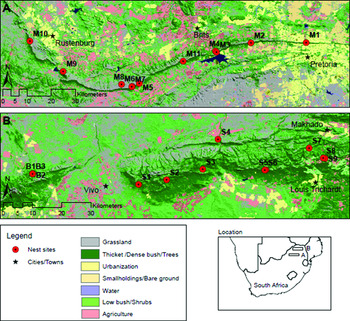
The Magaliesberg Mountain Range is 120 km long and extends from Rustenburg in the west (25.6842°S; 27.1542°E) to Wonderboom in the east (25.6909°S; 28.1900°E) and has been proclaimed as a UNESCO Biosphere Reserve (Department of Environmental Affairs 2015). The mountains dip gently to the north with steep south and west facing cliffs. The cliffs are predominantly located in the Gold Reef Mountain Bushveld, which comprises a woody layer with an underlying grass stratum (Mucina and Rutherford Reference Mucina and Rutherford2010). Land-use flanking the mountains includes urban development, intensive agriculture and road networks (Figure 1), characterising the Magaliesberg as peri-urban. These developments are characterised by habitat destruction and modification that can be described by the habitat-loss gradient (McKinney Reference McKinney2002) which suggests that physical changes in the natural habitat produce a decline of loss from rural to urban habitats, with peri-urban habitats providing the interface between the two (Medley et al. Reference Medley, McDonnell and Pickett1995, McKinney Reference McKinney2002, McDonnell and Hahs Reference McDonnell and Hahs2008).
Map of the Magaliesberg (above) and Blouberg and western Soutpansberg (below) study areas displaying all the nest sites identified during the nest surveys. M = Magaliesberg nests, B = Blouberg nests, S = Soutpansberg nests. On the lower map, Blouberg is in the west and the western Soutpansberg in the east. In the Magaliesberg, cameras were placed on nest M1, M3, and M6. B = Blouberg nests, S = Soutpansberg nests.

On this mountain range, all but one of the Verreaux’s Eagle nests are located on the southern cliffs (Allan Reference Allan1984, Allan Reference Allan1988, Whittington-Jones et al. Reference Whittington-Jones, West, Neser, Davidson, Saunders and Saunders2012). To study the layout of the cliff range, an aerial search of the Magaliesberg study area was conducted in March 2013. This survey was followed by vehicle and foot searches in which two observers spent a minimum of two hours searching for evidence of eagle activity at each potential nest site using a spotting scope and binoculars. A nest was recorded as active if: 1) adult eagles were observed in close proximity of the nest; 2) eggs or a nestling was present on the nest; 3) if fresh green lining was present on the nest structure; and 4) if fresh white wash was evident below and on the back wall of the nest structure (Jenkins Reference Jenkins and Malan2009).
The western Soutpansberg study area extended from Vivo (23.051° S; 29.2818° E) in the west for 70 km to Makhado in the east (22.9735° S; 29.9372° E). The 26-km long Blouberg Mountain (23.0206°S; 29.0374°E) is situated 23 km to the west of the Soutpansberg. These mountains are 320 km north-east of the Magaliesberg (Figure 1). This mountain range also dips to the north with steep south-facing cliffs and occurs in the Soutpansberg Arid Mountain Bushveld (Mucina and Rutherford Reference Mucina and Rutherford2010). It is characterised by highly variable vegetation including aspects from three biomes, the grassland, savanna and forest biomes, with moist mountain thickets occurring on the steeper southern slopes and more arid bushveld on the more gradual, drier northern slopes (Mostert Reference Mostert2006, Mostert et al. Reference Mostert, Bredenkamp, Klopper, Verwey, Mostert and Hahn2008, Willems and Hill Reference Willems, Barton and Hill2009). The areas surrounding the western Soutpansberg are subject to intensive agriculture with little urban infrastructure (Figure 1). The western Soutpansberg is part of the UNESCO Vhembe Biosphere Reserve (Taylor et al. Reference Taylor, Sowler, Schoeman and Monadjem2013). Nests in the western Soutpansberg were located based on historic nest records of surveys conducted during 1988, 1989, 1992, and 1995 (W. Tarboton in litt. A. R. Jenkins in litt.). Nests were again predominantly located on the south-facing cliffs.
Prey provisioning and diet of Magaliesberg Verreaux’s Eagles
This study employed photography to capture prey provisioning during the breeding season, used as a proxy for the diet of raptors (Rogers et al. Reference Rogers, Destefano and Ingraldi2005, López-López and Urios Reference López-López and Urios2010). Camera traps were placed at four nests that became active between 31 May and 24 July 2013. Prey items were captured using Bushnell Trophy Cam HD Max Brown Trail Cameras (8 megapixels). Movement on the nests triggered the camera traps and image capture was continuous for the duration of the nesting season. Three of the nests were successful (a nestling fledged; nests M1, M3, M6), while one nest (M9) failed due to possible nest disturbance by chacma baboons Papio ursinus. The camera trap on nest M3 was only placed after the nestling hatched, and the prey provision rate for this nest was only recorded for the nestling period.
Prey items were identified to the lowest possible taxon by comparing images to reference specimens from the Ditsong Natural History Museum in Pretoria, South Africa. The contribution of each prey category was tabled after identification. Prey items were then grouped into species to represent total diet composition as a percentage.
Stable isotopes analysis
Isotopic analysis was conducted on feathers collected from the base of active and alternative nests surveyed to define the isotopic niches of Verreaux’s Eagles in the Magaliesberg, western Soutpansberg, and Blouberg mountain ranges. Feathers were collected from three nest sites (M1, M6, and M9) along the Magaliesberg (n = 10 feathers). The isotopic niche used by the Magaliesberg Verreaux’s Eagles was compared to the other Verreaux’s Eagle populations collected from three nest sites along the western Soutpansberg (n = 6 feathers) and one nest site along the Blouberg (n = 2 feathers). The feathers were collected from specific nesting sites but may have come from more than one individual. We therefore, treated each feather independently, assuming only that the feather collected came from one of the eagles frequenting the nest site. All feathers collected were stored in clear polypropylene bags at room temperature, labeled, and compared to reference specimens from the Ditsong National Museum of Natural History to ensure authenticity.
We used 10 equally spaced subsamples collected from the vane material of each feather (tip–base) to characterize the niche utilized by the individual during the period of feather growth, irrespective of the length of the feather. Verreaux’s Eagles take six to nine months to moult (Gargett Reference Gargett1990) and, although no temporal resolution was assigned to the isotopic data because of the unknown growth history of the feathers, sampling sequentially along of the length of the feather ensured that we accounted for the temporal variation in the foraging strategy of the bird during the months it took the sampled feathers to grow (Grecian et al. Reference Grecian, McGill, Phillips, Ryan and Furness2015).
Homogenization of the vane material of the sub-samples was performed using stainless steel scissors (Grecian et al. Reference Grecian, McGill, Phillips, Ryan and Furness2015, Newsome et al. Reference Newsome, Collins and Sharpe2015a). The samples were cleaned with a chloroform and ethanol solution (1:2 ratio) and then exposed to the chloroform: ethanol solution for 20 min in an ultrasonic cleaner to remove dirt and oils. The samples were subsequently rinsed in distilled water and subjected to 20 min exposure to distilled water in an ultrasonic cleaner. Samples were then oven-dried for 24 h at 70 °C (Lowther et al. Reference Lowther, Harcourt, Page and Goldsworthy2013), homogenized, and weighed (c.0.5 mg) into tin capsules (pre-cleaned in Toluene) for stable isotope analysis.
Sample aliquots were combusted at 1,020 °C in an elemental analyser (Flash EA, 1112 Series, Thermo™, Thermo Fisher Scientific, Bremen, Germany) and the δ 13C and δ 15N isotope values were determined using a continuous-flow isotope ratio mass spectrometer (CFIRMS; Delta V Plus) at the Stable Isotope Laboratory of the Mammal Research Institute, University of Pretoria, South Africa. Results are presented using standard delta (δ) notation in parts per thousand (‰) relative to an international standard: Vienna Pee Dee Belemnite (VPDB) for δ 13C and atmospheric N2 (Air) for δ 15N (Coplen Reference Coplen1994) (Equation 1):
 $$ \updelta \mathrm{X}\left(0/00\right)=\left(\frac{{\mathrm{R}}_{\mathrm{Sample}}}{{\mathrm{R}}_{\mathrm{Standard}}}-1\right) $$
where X is the heavy isotope of an element (e.g., 13C or 15N) and R is the ratio of heavy to light isotopes (13C/12C or 15N/14N). Duplicate aliquots (n = 30 samples) were interspersed with an in-house standard (Merck gel: δ 13C = -20.57 ‰, δ 15N = 6.8 ‰, C% = 43.8%, N% = 14.6%) and blanks after every 10 samples to ensure reproducibility. The instrumental precision of δ 13C and δ 15N values was < 0.13 ‰ based on the standards, while the inhomogeneity of samples determined from the reproducibility of duplicate sample aliquots was ± 0.12 ‰ for δ 15N and ± 0.19 ‰ for δ 13C.
Best practice in stable light isotope analysis involves the use of two standards (Schimmelmann et al. Reference Schimmelmann, Qi, Coplen, Brand, Fong, Meier-Augenstein, Kemp, Toman, Ackermann, Assonov, Aerts-Bijma, Brejcha, Chikaraishi, Darwish, Elsner, Gehre, Geilmann, Gröning, Hélie, Herrero-Martín, Meijer, Sauer, Sessions and Werner2016), which was not followed in this case. However bias caused by using a single standard will mainly affect the unknown values that deviate from the standard by a large amount. The failure to use a two-standard protocol means that the absolute values (especially those that deviate from the value of our standard) should be compared with other data with caution. Our analysis compares datasets that were generated at the same time using the same protocol, and the biases between the datasets are presumed to be systematic and negligible to the findings of this study. Yet, comparison to other datasets should be done with caution.
Statistical analyses
In all cases, normality was assessed using a Shapiro-Walks normality test, while an F-test was used to compare the variances between variables, before applying an appropriate parametric (Analyses of Variance; ANOVA) or equivalent non-parametric test (Kruskal-Wallis). Values are presented as means ± standard deviation (1 SD) where applicable, and significance was set at P < 0.05. Statistical tests were performed in the R environment (R Core Team, 2013) (Table 1).
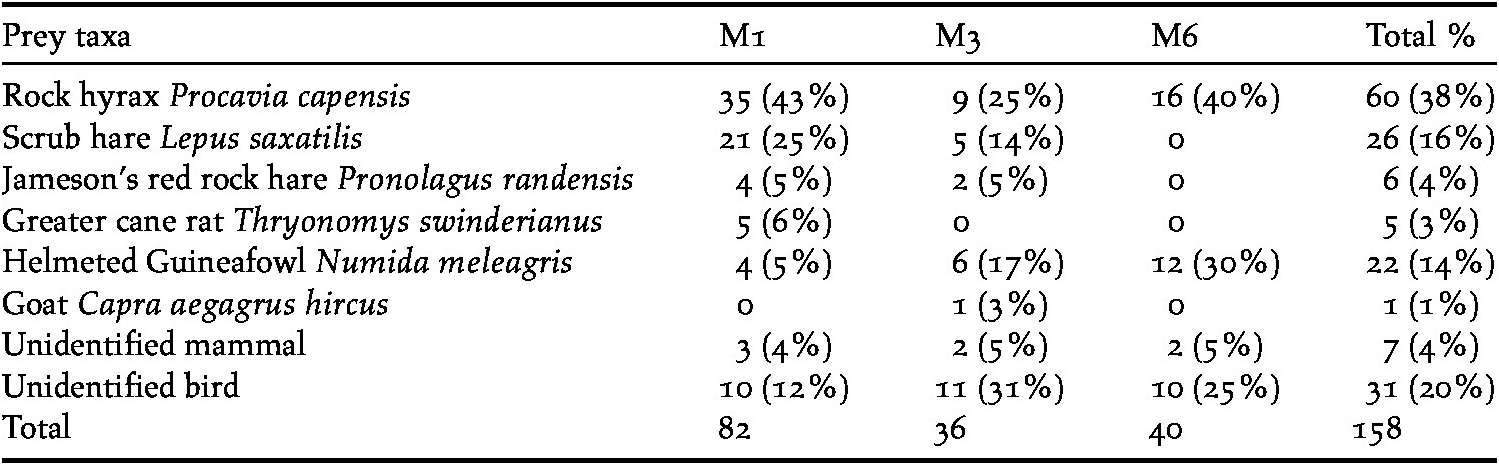
Taxa and total number of individuals recorded from camera trap images of prey remains at three Verreaux’s Eagle nests (M1, M3, M6) in the Magaliesberg during the 2013 breeding season.

A δ 15N and for δ 13C biplot was used to portray the isotopic niche utilized by each individual (each feather) at the various nests, and between the different mountain ranges. We used the Stable Isotope Bayesian Ellipses (SIBER) package (Jackson et al. Reference Jackson, Inger, Parnell and Bearhop2011, contained in the Stable Isotope Analysis in R; SIAR v. 4.2; Parnell et al. Reference Parnell, Inger, Bearhop and Jackson2010) to characterise and compare the isotopic niche breadths of the Verreaux’s Eagles sampled from different nests and mountain ranges. A Standard Ellipse Area (SEAc) was constructed around 40% of the data of each feather and population, thereby representing the core isotopic niche of each feather from the different populations (Layman et al. Reference Layman, Arrington, Montaña and Post2007, Jackson et al. Reference Jackson, Inger, Parnell and Bearhop2011). The isotopic niche overlap between species was calculated from the SEAc output after 16,000 iterations, and > 60% overlap was considered biologically significant (Guzzo et al. Reference Guzzo, Haffner, Legler, Rush and Fisk2013). The SEAc provides a relative, continuous measure of the isotopic niche width utilized by individual species within the specific community, constrained by the variation in the stable isotope values of the available prey (baseline). Specialist predators generally have small isotopic niche widths (SEAc), while generalists tend to have larger SEAc values (Jackson et al. Reference Jackson, Inger, Parnell and Bearhop2011). Isotopic data can only be related to dietary data after correcting for the isotopic discrimination occurring during digestion. Trophic enrichment factors (TEF; Post Reference Post2002) are both tissue- and species-specific, and a diet to feather specific TEFs obtained from captive adult Bald Eagles Haliaeetus leucocephalus (Δ15N = 3.0 ± 0.5‰; Δ13C = -1.0 ± 0.5‰) (Newsome et al. Reference Newsome, Collins and Sharpe2015a) were used to infer the diet of the Verreaux’s Eagles. Feathers were used in the stable isotope analysis and lipid correction was unnecessary.
Results
Diet of Magaliesberg Verreaux’s Eagles
The three camera traps captured 9,541 images over a period of 320 days: 1,821 photographs from nest M3, 2,101 photographs from nest M6, and 5,619 photographs from nest M1. We were able to identify 158 prey individuals from the images, of which 120 were identifiable to species level (Table 1).
We found that mammalian prey dominated the diet of the Magaliesberg Verreaux’s Eagles (Table 1). The most commonly represented prey families selected were Procaviidae, Leporidae, and Numididae. Avian prey was equally as important to eagles at nests M3 and M6 as mammalian prey. The dominant identified prey of the M1 Verreaux’s Eagles was rock hyrax (43%) and scrub hare Lepus saxatilis (25%), and at M3 it was rock hyrax (25%) and helmeted guineafowl (17%). At M6, the dominant prey was rock hyrax (40%), but more Helmeted Guineafowl Numida meleagris were hunted (30%) than at the two other sites. When combined, the dominant prey species were rock hyrax (60%), scrub hare (26%) and Helmeted Guineafowl (22%).
Stable isotope analysis
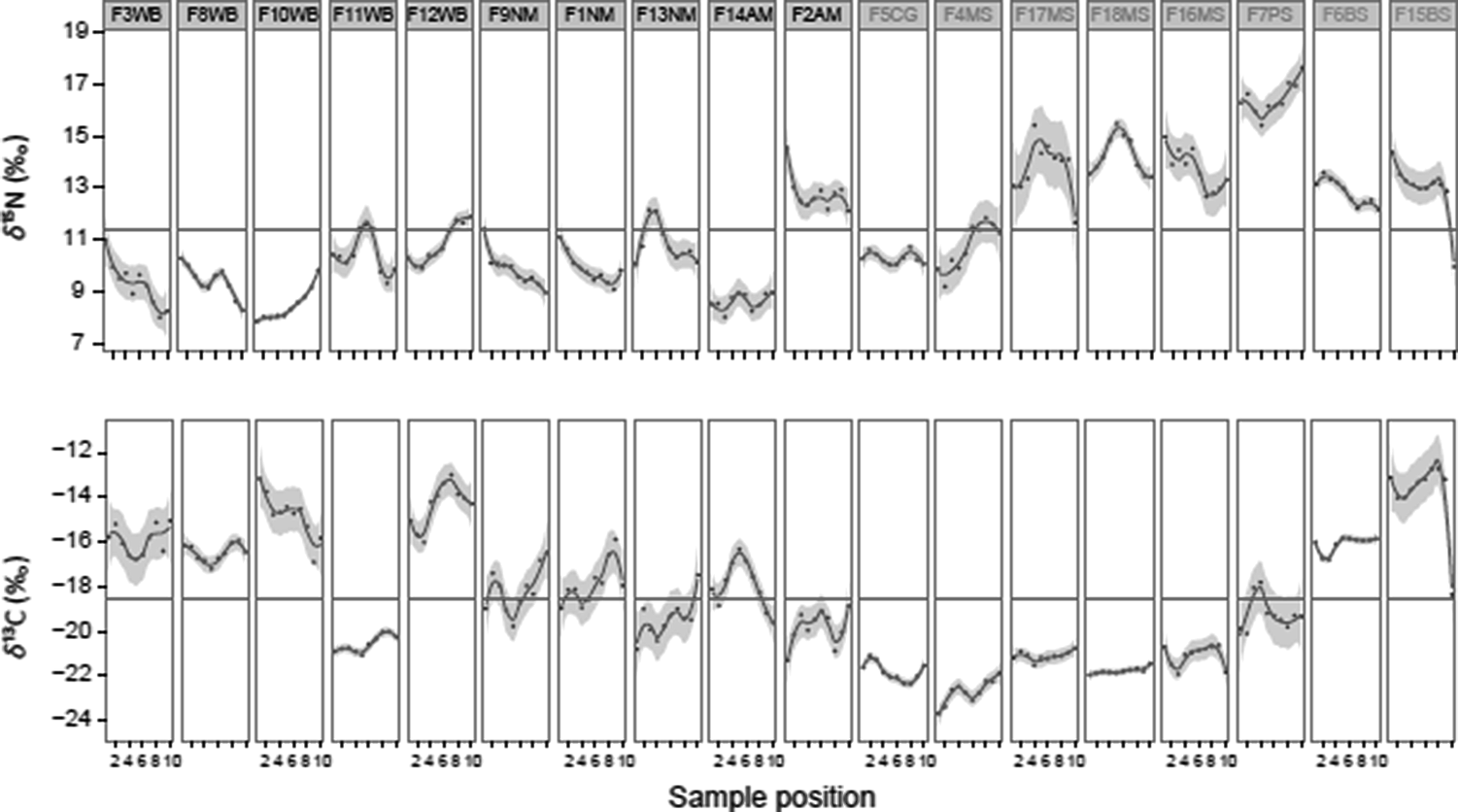
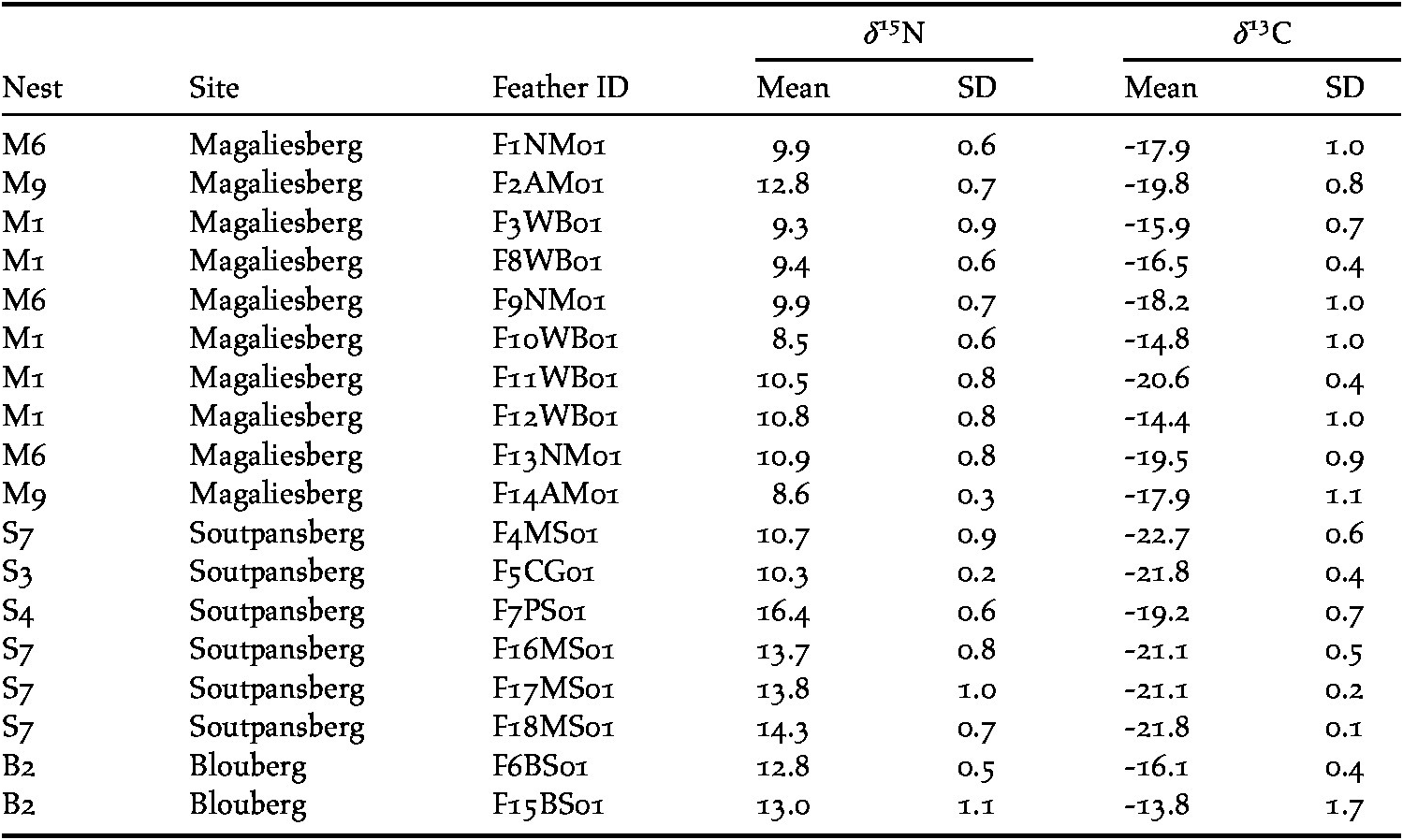
The stable isotope results show a substantial amount of intra-individual variation in δ 15N and δ 13C values along the length of the feathers (Table 2). The δ 15N in some of the feathers change by up to 4.4‰ (more than one trophic level), while the δ 13C ranged up to 5.7‰, which indicates changes in range use or prey selected. The mean variation in the δ 15N (differences between the min and max) was +2.3 ± 0.9‰ and +2.3 ± 1.3‰ for δ 13C of all 18 feathers analysed (Figure 2).
Time series of the data captured along the length of the feathers. It is clear that intra-individual variation in the dietary niche use/shifts in baseline values occur during the period of feather growth. The intra-variation (within the feather) is quite small, compared to the inter-variation (between mountain ranges). Importantly, taking a single sample from a feather to assess the dietary niche usage between individuals/populations is not sufficient, as previously demonstrated by Grecian et al. (Reference Grecian, McGill, Phillips, Ryan and Furness2015).

Variation in δ 15N and δ 13C (mean ± SD) between feathers from the Magaliesberg, western Soutpansberg and Blouberg.

The mean δ 13C and δ 15N values differed significantly between the three nest sites in the Magaliesberg (N = 10 feathers), as well as between the Soutpansberg, and Blouberg nest sites (N = 8 feathers, δ 13C; Kruskal-Wallis χ 2 = 131.5, df = 6, P < 0.001; δ 15N: Kruskal-Wallis χ 2 = 105.8, df = 6, P < 0.001). The stable isotope values of feathers sampled from M1 were all similar, except for the δ 13C of feather F11WB that were significantly more depleted than all the other feathers (Kruskal-Wallis χ 2 = 167.3, df = 17, P < 0.01) (Figure 2). The three feathers sampled from nest M6 were all isotopically similar (Figure 2). The stable isotope values of the M9 feathers were significantly different from each other (δ 13C: P < 0.05; δ 15N: P < 0.01).
Comparison between Magaliesberg and Soutpansberg Verreaux’s Eagles
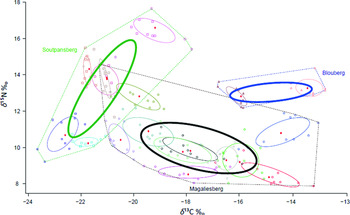
There was no overlap between the SEAc ellipse areas generated by the Bayesian model for the three Verreaux’s Eagle mountain ranges (Figure 3). The niche size (SEAc) differ significantly (P < 0.05) between all three ranges (Figure 3).
Niche size (SEAc) and variability in the total convex hull area (dotted line) between the Magaliesberg (bold black line), western Soutpansberg (bold green line), and Blouberg (bold blue line) constructed around the centroid of each individual feather (red squares). The SEAc (regular solid lines) and stable isotope values of individual feathers (n = 10 samples per feather) collected from the Magaliesberg (circles), Soutpansberg (squares), and Blouberg (triangles) Mountain Ranges indicates the intra- and interindividual variability of the n = 18 feathers analysed.

The extensive δ 13C range, from -21.8‰ to -13.0‰ (-17.5 ± 2.2‰), and large SEAc (SEAc = 8.4) of the Magaliesberg Verreaux’s Eagles, corroborated the assorted mammalian and avian food-niche (Figure 3). The δ 13C of the Soutpansberg individuals ranged from -23.7‰ to -17.8‰ (-21.3 ± 1.2‰). The δ 13C of the Magaliesberg eagles was 3.1‰ less enriched than the Soutpansberg eagles.
The δ 15N of the Magaliesberg Verreaux’s Eagles ranged from 7.9‰ to 14.5‰ (+10.1 ± 1.4‰). The δ 15N of the Soutpansberg eagles was 3.1‰ more enriched than the Magaliesberg eagles. The large δ 15N range, from +9.2‰ to +17.6‰ (+13.2 ± 2.3‰) of the Soutpansberg Verreaux’s Eagles, and large SEAc (5.8) suggest that they consumed prey species from multiple trophic levels. The Blouberg nest was also distinct from the nests sampled in the western Soutpansberg (δ 13C; Kruskal-Wallis χ 2 = 109.2, df = 2, P < 0.001; δ 15N: Kruskal-Wallis χ 2 = 83.8, df = 2, P < 0.001).
Discussion
Diet of Magaliesberg Verreaux’s Eagles
During the 2013 breeding season, the Magaliesberg Verreaux’s Eagles primarily hunted rock hyrax, followed by scrub hare and thirdly, helmeted guineafowl. Hyraxes are browsers that feed on leaves of woody C3 vegetation, preferring trees such as Vachellia karoo, Olea europea, and Grewia accidentalis (Skinner and Chimimba Reference Skinner and Chimimba2005, Mucina and Rutherford Reference Mucina and Rutherford2010, while scrub hare represents an obligate grazer, with a preference for C4 grasses (Skinner and Chimimba Reference Skinner and Chimimba2005). Helmeted Guineafowl feeds primarily on seeds of C4 grasses and agricultural crops (Grafton Reference Grafton1971, Mentis et al. Reference Mentis, Poggenpoel, Maguire, Hockey, Dean and Ryan1975). The observed mixed mammalian and avian food-niche is supported by the concurrent stable isotope analysis and camera trapping performed on the nests in the peri-urban environment. The three dominant prey species are all human-commensal and occur at high abundance throughout the year in the area utilised by the peri-urban Verreaux’s Eagles population (Symes and Kruger Reference Symes and Kruger2012). Hyraxes, for example, persist in high densities in areas were mesopredators have been excluded, such as the botanical gardens.
Verreaux’s Eagles from nests M1 and M6 had a similar diet (Table 1), but the enriched δ 13C of nest M1 (-16.43 ± 2.3‰) is likely due to the inclusion of more scrub hare in their diet, which is associated with C4 grasses (Vogel Reference Vogel1978, Codron et al. Reference Codron, Codron, Sponheimer, Lee-Thorp, Robinson, Grant and De Ruiter2005). The higher numbers of Helmeted Guineafowl caught by eagles from nest M6 probably further enriched their diet. Nevertheless, on the whole, the δ 13C spread that dominates the isotopic niche (SEAc) of the Magaliesberg Verreaux’s Eagles correlated to the mixed mammalian and avian food niche that is supported first by the camera trapping, and second, data based on the C3 (hyrax), and C4 (guineafowl and hare) primary consumers. Since the differences in the isotopic niche used between the two nest sites can be related to the prey consumed, it enabled us to link the isotopic niche to the actual ecological food-niche utilized.
Isotopic niche comparison between Magaliesberg and Soutpansberg Verreaux’s Eagles
The isotopic niche (SEAc) indicated that there is negligible overlap between the isotopic niches of the Verreaux’s Eagles from different mountain ranges. Differences are most likely associated with the vegetation type, prey species composition, and the associated differences in the isotopic values of the primary production supporting the base of the food web in the contrasting habitats. Despite the lack of an isotopic baseline, comparing the isotopic niche utilized by the Magaliesberg Verreaux’s Eagles with a defined food-niche (camera trap data) with the isotopic niche utilized by the Soutpansberg and Blouberg Verreaux’s Eagles, enabled us to infer broad-scale dietary differences between Verreaux’s Eagles under peri-urban and semi-natural environments. In contrast to the mixed C3 and C4 primary consumers consumed by the Magaliesberg Verreaux’s Eagles (δ 13C = -21.8‰ to -13.0‰), Verreaux’s Eagles in the Soutpansberg fed on prey with restricted and C3-dominated δ 13C values (-23.7‰ to -17.8‰), associated with the dominant C3 Soutpansberg Mountain Bushveld (Mucina and Rutherford Reference Mucina and Rutherford2010). The Soutpansberg vegetation is characterised by a dense tree layer and a poorly developed grass layer (Mucina and Rutherford Reference Mucina and Rutherford2010). The diet of the Soutpansberg eagles is, therefore, likely dominated by their prefered prey, hyrax, with less inclusion of avian prey supported by C4 grass-based δ 13C values. In addition, the large δ 15N range (+9.2‰ to +17.6‰) of the Soutpansberg Verreaux’s Eagles, and large SEAc (5.8) dominated by δ 15N variability suggest that they consumed prey species from multiple trophic levels (i.e. broad dietary niche).
Given the feather-specific Δ 15N of 3.0 ± 0.5‰ (Newsome et al. Reference Newsome, Collins and Sharpe2015a), the δ 15N of the prey utilized in the western Soutpansberg should range from +6‰ to +14‰. The approximate cut-off for apex predators is > +11‰ (Newsome et al. Reference Newsome, Ralls, Job, Fogel and Cypher2010), and so the prey of these Verreaux’s Eagles not only spanned numerous trophic levels, but Verreaux’s Eagles could be classified as apex predators. The Soutpansberg Verreaux’s Eagles likely preyed on the available, resident secondary consumers, e.g. small-spotted genet Genetta genetta, southern African wildcat Felis silvestris cafra, bat-eared fox Otocyon megalotis, striped polecat Ictonyx striatus, mongoose spp. (Herpestidae), and even tertiary consumers, e.g. black-backed jackal Canis mesomelas, known prey of Verreaux’s Eagles (Gargett Reference Gargett1990, Boshoff et al. Reference Boshoff, Palmer, Avery, Davies and Jarvis1991, Baker Reference Baker2013). In contrast to the Soutpansberg Verreaux’s Eagles, individuals sampled in the Magaliesberg consumed prey from lower trophic levels, including more human-commensal species supported by different resources bases, representative of the higher habitat heterogeneity associated with transformed urban environments and a more substantial grass base. Raptors, including Verreaux’s Eagles, have the ability to switch their prey base from traditional prey to dissimilar, commonly occurring prey species (Yalden Reference Yalden1980, Village Reference Village1982, Murgatroyd et al. Reference Murgatroyd, Underhill, Rodrigues and Amar2016a, 2016b).
The neighbouring Blouberg Verreaux’s Eagle pair was entirely distinguishable from the western Soutpansberg individuals and had a diet associated with more grazers than the Magaliesberg, but with trophic levels as high as the western Soutpansberg. The supposition that these birds were feeding on secondary consumers that, in turn were feeding almost exclusively on C4 plants (e.g. a mongoose feeding on a granivorous columbid) should be examined through camera trapping.
Peri-urban living
One of the aims of this study was to assess if the cause of the decline in the Magaliesberg Verreaux’s Eagles can be associated with their dietary preferences in areas with residential developments and flanking agricultural activities. In the last two decades, the Verreaux’s Eagle numbers in the Magaliesberg were perceived to have decreased (Whittington-Jones et al. 2010, Reference Whittington-Jones, West, Neser, Davidson, Saunders and Saunders2012). Yet, here we suggest that the availability of their preferred prey is unlikely to have caused their recent population decline. Their dominant prey, rock hyrax, have been found to adapt well and even thrive in peri-urban anthropogenic refugia, such as storm-water drains, culverts and building holes (McPherson et al. 2015, Naylor Reference Naylor2016). Helmeted Guineafowl are also well known urban adapters which benefit from human-modified environments, particularly those ecosystems that increase the agricultural and savannah edge habitat (Malan and Benn Reference Malan and Benn1999). The savannah vegetation and agricultural development in the Magaliesberg are also conducive to the habitat frequented by scrub hare (Skinner and Chimimba Reference Skinner and Chimimba2005). During this study, scrub hare were recorded using suburban gardens, agricultural and derelict land, and public parks within the vicinity of peri-urban Verreaux’s Eagle nests (K. Padaychee pers. obs.).
Peri-urban matrices are often considered more productive than adjacent natural areas due to microhabitats and resources available (e.g. increased water and fertilizer), enhancing habitat heterogeneity (the intermediate disturbance hypothesis; Schwilk et al. Reference Schwilk, Keeley and Bond1997). The habitat heterogeneity of the peri-urban environment sustains a stable prey base, maintained by different energy channels based in both C3 and C4 photosynthetic pathways supported by irrigation and fertilising practices of crops, gardens, and parks (Rooney et al. Reference Rooney, McCann, Gellner and Moore2006), which affectively affords the population resilience of urban adaptable predators. The isotopic values of the Soutpansberg Verreaux’s Eagles similarly suggested that they couple multiple energetic pathways, and although the Verreaux’s Eagles in the Magaliesberg hunted prey from lower trophic levels, their breeding success was comparable to the natural Soutpansberg Verreaux’s Eagle population. The dietary differences were directly associated with the physical environment, land use type, and vegetative composition. Raptors can further benefit from human-mediated persecution of other competing predators. Therefore, although the frequency of human activities has negatively influenced breeding success in Spanish Imperial Eagle Aquila adalberti in the northern hemisphere (González et al. Reference González, Arroyo, Margalida, Sánchez and Oria2006), urbanization seems to benefit other eagle species (Palma et al. Reference Palma, Beja, Pias and Cansela da Fanseca2006). Verreaux’s Eagles in the Magaliesberg are a prime example of species that benefit from urbanisation, predominantly hunting three species that are all narrowly associated with human habitat modifications and well- documented urban adapters (Malan and Benn Reference Malan and Benn1999, Skinner and Chimimba Reference Skinner and Chimimba2005, McPherson et al. 2015, Naylor Reference Naylor2016). Therefore, the hypothesis that eagles can adapt their diet to include abundant, lower trophic level human-commensal prey species to succeed in peri-urban environments, is supported by the dietary data of the Magaliesberg Verreaux’s Eagle population.
The decline in the Magaliesberg Verreaux’s Eagle population is not necessarily associated with a decline in prey abundance but more likely associated with other anthropogenic factors, such as poisoning, persecution, and nest disturbances facilitated by the placement of recreational climbing routes on cliff faces adjacent to their nests (Richardson and Miller Reference Richardson and Miller1997, Camp and Knight Reference Camp and Knight1998, Whitfield et al. Reference Whitfield, Fielding, McLeod and Haworth2004). The increased development pressure in their habitats suggest that increased conservation efforts are warranted, specifically aimed at informing the public and land developers about the important contribution of Verreaux’s Eagles to the management of urban-adapted species, often considered a nuisance (e.g. feral pigeons). Other misperceptions about the number of domesticated anmals hunted by the Magaliesberg Verreaux’s Eagles should also be addressed, given the limted nest provisioning of domisticated species (goats) observed during the study peroid.
Acknowledgements
We would like to thank all the landowners who provided us with access to the eagle nests on their properties and to Pieter and Natasja Saunders from the Wonderboom Urban Black Eagle Project as well as Walter Nesser from Vulpro for assisting with setting up of the nest cameras along the Magaliesberg. Thanks to Faansie Peacock who kindly assisted in the identification of specimens at the Ditsong National Museum of Natural History, Craig Whittington-Jones and Sean West from Gauteng Conservation, as well as Andrew Jenkins and David Allan for access to historical data from the Magaliesberg. I thank NRF iThemba Labs and the Isotope Lab at the University of Pretoria for all the isotopic analysis and guidance during this research. Kailen Padayachee would like to thank his parents Nalen and Mogani Padayachee, as well as Sasha Fullerton for all their support and encouragement, but most importantly his brother Navelan Padayachee, for all his assistance and support in the field without whom this study would never have been possible. Kailen Padayachee and Gerard Malan would like to thank the Nature Conservation Department of the Tshwane University of Technology for supporting this research. A word of thanks to all the organisations that provided funding during the study period: National Research Foundation, E. Oppenheimer and Son, Birdlife Northern Gauteng, The Sean Williams Living Creatures Trust, and the KaiNav Conservation Foundation.