1 Introduction
The North and South Kyungsang dialects of Korean (spoken by approximately thirteen million people in southeast Korea) differ from the standard Seoul dialect in their preservation of lexical pitch accents from Middle Korean (15th–16th centuries) (see e.g. Ramsey Reference Ramsey1975, Lee & Ramsey Reference Lee and Ramsey2000, Reference Lee and Ramsey2011, Kenstowicz et al. Reference Kenstowicz, Cho and Kim2008).Footnote 1 However, two aspects of the sociolinguistic setting of the Kyungsang dialect cast doubt on whether this tonal system is the same for younger or innovative Kyungsang speakers as it is for older or conservative speakers. First, Kyungsang speakers have been increasingly influenced by the standard Seoul dialect, through contact with Seoul speakers as well as sources such as television, movies and education (Lee Reference Lee2008). Second, Korean ideology has emphasised linguistic homogeneity in favour of the standard Seoul dialect (Silva Reference Silva, Yoon, Kang, Han and Shi2011). Given that language contact and ideology are important factors in explaining language change (e.g. Labov Reference Labov and Silverstein1974, Trudgill Reference Trudgill1986, Munro et al. Reference Munro, Derwing and Flege1999, Auer et al. Reference Auer, Hinskens and Kerswill2005, Evans & Iverson Reference Evans and Iverson2007, Heffernan et al. Reference Heffernan, Borden, Erath and Yang2010, Armstrong Reference Armstrong2012), it is reasonable to suspect that the prosody of Kyungsang Korean is undergoing change.
With respect to the sociolinguistic setting, a number of studies have investigated age-related differences in the prosody of Kyungsang Korean, and have provided evidence for sound change in sentence intonation (Lee Reference Lee2008) and lexical pitch accent (Lee & Jongman Reference Lee and Jongman2015). Lee (Reference Lee2008) found age differences in the realisation of sentence intonation in North Kyungsang Korean, and showed that, in contrast to older speakers, who marked interrogative sentences with a final-falling declarative intonation, younger speakers used a final-rising intonation, similar to Seoul Korean. Lee & Jongman (Reference Lee and Jongman2015) document a sound change in progress for the nominal pitch accents, showing generational differences in the surface phonetic properties across contrastive accents. They also show that, in comparison to older speakers, younger Kyungsang speakers have less distinct spectral and temporal F0 differences across contrastive accents, and a substantial F0 peak delay, resulting in a final rising accent pattern similar to Seoul Korean (Jun Reference Jun1993, Reference Jun1998). Based on similar phonetic properties in the speech of Seoul and younger Kyungsang speakers, Lee (Reference Lee2008) and Lee & Jongman (Reference Lee and Jongman2015) suggest that the sound change can be attributed to the increased influence of the prestigious Seoul Korean.
The purpose of this paper is to explore whether the sound change observed by Lee & Jongman (Reference Lee and Jongman2015) in surface forms is related to a change in the underlying forms of the lexical pitch accents of Kyungsang Korean, based on the analysis of a larger set of phonetic data, including noun stems followed by various suffixes. We specifically tested whether Lee & Jongman's observation is replicated in a full range of nominal accents under suffixation, and whether suffixal tones are affected by changes in the pitch accents of the noun stems. In addition, by closely observing how individual speakers maintain the accent distinction, this paper aims to determine the direction of the change.
The organisation of this paper is as follows. §2 outlines the descriptive accent patterns of Kyungsang Korean, and discusses a previous phonological analysis of the nominal accents. §3 describes the methodology used in the production experiment. §4 and §5 present and discuss the results of the acoustic study, and §6 offers concluding remarks. To avoid geographical effects on lexical pitch accent, this paper focuses on South Kyungsang Korean, spoken near the city of Pusan.
2 Background
2.1 Lexical pitch accent of South Kyungsang Korean
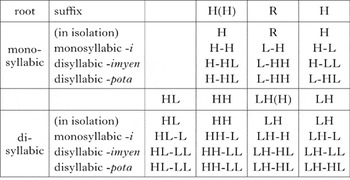
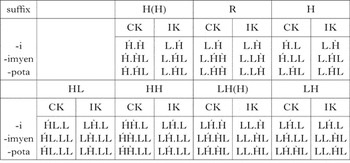
Both the phonetic and phonological properties of the lexical pitch accent of South Kyungsang Korean have been explored in previous work (e.g. Ramsey Reference Ramsey1975, Kenstowicz & Park Reference Kenstowicz and Park2006, Kim & Schuh Reference Kim and Schuh2006, Chang Reference Chang2007, Schuh & Kim Reference Schuh and Kim2007, Kenstowicz et al. Reference Kenstowicz, Cho and Kim2008, Lee & Davis Reference Lee and Davis2009, Lee & Zhang Reference Lee and Zhang2014). Although the phonological analyses differ, there is general agreement on the descriptive accent patterns presented in Table I. Notably, although we only see one H monosyllabic and one LH disyllabic accent in isolation, tonal behaviour under suffixation indicates that there are two different underlying H and LH accents – one that spreads its high tone to the next available syllable and one that does not. We use distinct notations to mark the two Hs and LHs, H(H) vs. H and LH(H) vs. LH, reflecting their tonal patterns under suffixation. Therefore, monosyllabic and disyllabic nouns in South Kyungsang Korean underlyingly belong to three (H(H), H and R) and four (HL, HH, LH(H) and LH) accent classes respectively. Lee & Zhang (Reference Lee and Zhang2014) provide phonetic data that confirm the reported descriptive accent patterns, and suggest a formal analysis within an Optimality Theory framework (Prince & Smolensky Reference Prince and Smolensky1993). Lee & Zhang (Reference Lee and Zhang2014) propose four underlying pitch accent classes, corresponding to four parallel prosodic patterns for monosyllabic and disyllabic nouns affixed with -i (nominative case marker), -imyen ‘if’ and -pota ‘than’. Table I shows the four cases identified by Lee & Zhang: (i) HL, a peak on the penultimate syllable of the root for HL, (ii) H(H)/HH, peaks across the first syllable and the second syllable, if present, (iii) R/LH(H), peaks across the second syllable and the third syllable, if present, and (iv) H/LH, different prosodic patterns depending on suffix type.
Parallels between pitch-accent patterns in monosyllabic and disyllabic nouns under suffixation. R represents a rising tone.

Lee & Zhang (Reference Lee and Zhang2014) divide the four underlying accent classes proposed into two groups. The accent classes in the first group, HL, H(H)/HH and R/LH(H), have consistent prosodic patterns regardless of suffix type, and are thus analysed as having an underlyingly pre-linked H. Lee & Zhang suggest that the underlying accent class is determined by where the pre-linked H is located, and whether or not the H tone spreads to the next available syllable. The second group, H/LH, shows different tonal patterns across suffixes, and is analysed as a toneless class. Lee & Zhang propose that the prosodic patterns of toneless words are revealed by constraint interactions and suffixal accent types. They suggest that the difference between the prosodic patterns of toneless words with -pota and those with -imyen or -i is due to the fact that -pota bears an underlying accent, whereas -i and -imyen do not. The underlying accent on -pota surfaces when it is added to a toneless word, resulting in a peak on its first syllable, whereas the H on the last syllable of the root with -imyen or -i is a default H derived by constraints. When -pota is attached to a root belonging to an underlying accent class, however, only the prosodic pattern of the root surfaces, due to culminativity; -pota therefore triggers the same tonal pattern as the toneless suffixes -imyen and -i. In summary, expanding a word with a suffix plays a crucial role in determining underlying prosodic categories, and the underlying classes of suffixal tones are determined by the way in which they are realised after toneless (i.e. H/LH) nouns (see Lee & Zhang Reference Lee and Zhang2014 for more details of the descriptive accent patterns and the formal analysis).
2.2 Sound change in the lexical pitch accent
A recent production study, Lee & Jongman (Reference Lee and Jongman2015), hypothesises that the increased influence of the non-tonal Seoul dialect may affect the realisation of accents by younger Kyungsang speakers, and investigates whether these speakers produce accent words in the same way as older speakers. It compares the F0 scaling and timing properties of accent words produced by ten older female speakers (mean age 66) and ten younger female speakers (mean age 21). Lee & Jongman found significant age-related differences in the acoustic properties; while the speech of older speakers was consistent with the observations of Kenstowicz & Park (Reference Kenstowicz and Park2006), Chang (Reference Chang2007) and Lee (Reference Lee2008), for example, the speech of younger speakers was not.
Lee & Jongman (Reference Lee and Jongman2015) found two major pieces of acoustic evidence for the sound change. First, acoustic differences in the F0 scaling and timing properties were significantly reduced across contrastive accent words in the speech of younger speakers. For example, for F0 scaling properties Lee & Jongman (Reference Lee and Jongman2015) measured the F0 maximum and minimum values across accent words. They found that older speakers showed greatest F0 maximum and minimum values for HL, intermediate for HH and lowest for LH(H)/LH, while for younger speakers the differences between HL, HH and LH(H)/LH were non-significant. For the F0 timing properties, they measured the duration from F0 onset to peak (i.e. F0 maximum duration) and that from F0 onset to the lowest F0 point (i.e. F0 minimum duration); for older speakers the maximum and minimum duration for LH(H)/LH were longest, for HH intermediate and for HL shortest, while for younger speakers there was a significant difference only between HL and HH/LH(H)/LH. Second, there were substantial peak delays for younger speakers: as compared to older speakers, the location of F0 peaks was placed further to the right in all four accent classes. The peak delay made the contrastive accents more similar to each other by consistently placing a peak on the second syllable for all disyllabic accents and on the right edge for monosyllabic accents. The peak delay was also observed for words suffixed with -i; both HL and HH disyllabic accents with -i were realised as LH.L, and LH(H) was realised as LL.H. Overall, the phonetic realisations of younger Kyungsang speakers' lexical pitch accents were less distinct than those of older speakers. Based on this generational difference, Lee & Jongman suggest that the phonetic forms of the lexical pitch accent of South Kyungsang Korean are undergoing a sound change.
2.3 Current study
The primary goal of the current study is to investigate how the underlying accent classes are realised by innovative Kyungsang speakers as well as conservative speakers. To this end, we conducted an acoustic study comparing the full range of nominal pitch accent patterns in two cohorts of speakers, grouped by age. The nominal pitch system of Kyungsang Korean can be accurately observed only in words longer than three syllables (e.g. Schuh & Kim Reference Schuh and Kim2007). Therefore, although Lee & Jongman (Reference Lee and Jongman2015) provided phonetic details about the generational change, they were not in a position to determine the underlying change, because they considered only unsuffixed monosyllables and disyllables. Given that the location of an underlying accent type is important in distinguishing accent classes in Kyungsang Korean, Lee & Jongman's findings motivated us to examine potential generational differences in the underlying accents, and to test whether the F0 peak delay observed in younger speakers is related to the change in the underlying accent classes. Importantly, the current phonetic examination, based on nouns with various types of suffixes, allows us to establish whether the suffixal accent, as well as that in noun stems, is affected by the change.
In addition, the current study uses a new tone-assignment method, which we adopted for classifying the tonal patterns alongside the traditional acoustic measurements for pitch accent (e.g. F0 scaling, F0 timing). One advantage of this method is that it captures representative pitch properties for each syllable, and allows a clearer understanding of variability in the data. Accordingly, we can see the general tendency of the sound change more clearly, as well as individual differences.
Finally, we examine whether the tonal properties of Kyungsang Korean have become similar to those of standard Seoul Korean, a variety with no lexical pitch accent. The use of a consistent methodology enables a direct comparison with Seoul Korean. The results of the current study substantially improve upon earlier empirical observations on the prosody of Kyungsang Korean, and allow us to revisit previous phonological analyses. We hope that the findings of this paper will contribute to a comprehensive understanding of the pitch-accent system of Kyungsang Korean, as well as of the mechanism of contact-induced sound change.
3 Methodology
3.1 Speakers
Thirty-nine Korean speakers participated in the study (19 Kyungsang speakers and 20 Seoul speakers). To avoid any potential variation due to gender differences, only female speakers were recorded. All participants were born and educated in the target dialect region, with parents who spoke the same target dialect. With the exception of two older Kyungsang speakers, who were born in Japan and had lived there for ten years, no participants had any experience living in other dialect regions for more than one year.
Participants born before 1952 were grouped as conservative Kyungsang (henceforth CK) speakers; the age of the nine CK speakers ranged from 59 to 75 (mean age 65.4; SD 5.5), and that of the ten conservative Seoul speakers from 61 to 71 (mean age 65.8; SD 3.8). Participants born after 1985 were grouped as innovative Kyungsang (henceforth IK) speakers; the age of the ten IK speakers ranged from 20 to 23 (mean age 21; SD 1.2), and that of their Seoul counterparts from 18 to 26 (mean age 20.7; SD 2.6).Footnote 2 None of the participants reported any speech or hearing disorders, and all of the speakers were literate in Korean.
3.2 Speech materials
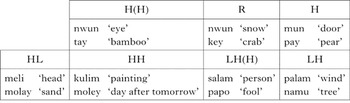
Fourteen noun stems differing in their number of syllables (monosyllabic vs. disyllabic) and in their underlying accent classes were recorded. Two words from each of the four classes were selected, providing six monosyllabic and eight disyllabic nouns. The recorded noun stems are listed in Table II. They were expanded with three suffixes, which differed in the number of syllables (monosyllabic vs. disyllabic) and underlying accent classes (toneless vs. penult H). The three suffixes, introduced in §2.1, are -i (toneless), -imyen (toneless) and -pota (penult H). The monosyllabic suffix -i and disyllabic suffix -imyen have allomorphs that are either vowel- or consonant-initial, and the allomorphy is determined by the last segment of the noun root: a consonant-final noun takes the vowel-initial suffix allomorph (i.e. -i, -imyen); a vowel-final noun takes the consonant-initial suffix allomorph (i.e. -ka, -lamyen).Footnote 3
Monosyllabic and disyllabic test words.

3.3 Procedure
Speakers produced each test word twice, embedded in a sentential frame i cey __ -cohkeyssta ‘Now, (I) like_’. The speech materials were written in Korean orthography, provided on index cards in a pseudo-randomised order; successive occurrences of words from the same accent class were avoided. In order to help subjects distinguish segmental homonyms such as nwún ‘eye’ (H tone) and nwǔn ‘snow’ (R tone), a corresponding picture was provided next to each stimulus. In total, 3276 tokens were obtained: 1404 tokens for the monosyllabic words (2 noun stems ú 3 underlying accent classes ú 3 suffixes ú 2 repetitions ú 39 speakers) and 1872 tokens for the disyllabic words (2 noun stems ú 4 underlying accent classes ú 3 suffixes ú 2 repetitions ú 39 speakers).
Subjects were instructed to read each word as naturally as possible at a normal speaking rate, and they practised before the actual recording. Since the first author of the current study is a speaker of Seoul Korean, a female Kyungsang language consultant (aged 30) assisted in the Kyungsang recording session, to prevent any phonetic accommodation between the two dialects of Korean. Subjects were recorded in various quiet locations in South Korea, such as the subject's campus, home or village community centre, using a Marantz Digital Recorder (PMD 671) and a SHURE head-mounted microphone. The test words were recorded at a sampling rate of 22,050 Hz and analysed using Praat (Boersma & Weenink Reference Boersma and Weenink2010).
3.4 Acoustic measurements
3.4.1 Tonal movement within syllables
To observe phonetic details within a syllable, we examined pitch movement by measuring scaling and timing properties of F0. We measured F0 minimum and maximum values, i.e. the lowest and the highest F0 within a syllable, as well as F0 minimum and maximum duration, measured from the syllable onset to the points of the F0 minimum and maximum values respectively. We used Praat's ‘Move cursor to minimum (and maximum) pitch’ function to find the lowest and highest F0 values and their locations. The duration was first measured in milliseconds, and then converted to a ratio, to control for differences in syllable duration. The ratio therefore expresses the point where F0 minimum (F0min) or F0 maximum (F0max) occurs as a percentage of the syllable duration. Normalised pitch tracings are provided below, along with scaling and timing measurements. F0 was measured every 10% within each syllable (i.e. rhyme) of a test word, using a Praat script across speech materials, repetitions and speakers within the same accent class.
3.4.2 Tone assignment
To obtain the full range of nominal accent patterns in Kyungsang Korean, H or L was assigned to every syllable for all test words in an objective manner. This tone assignment proceeded as follows. First, each word was segmented into syllables. A segmented syllable includes a vowel only, or a vowel with a coda nasal (i.e. rhyme). Excluding the initial consonant helps minimise segmental effects caused by onset consonants, and also allows consistent syllabification throughout the test words. The onset and offset of a vowel were determined by the onset of F1 and offset of F2 respectively. The boundary between nasal and vowel or between nasal and oral consonant was determined on the basis of the amplitude change in both the waveform and the spectrogram.
Second, after segmentation, the mean F0 value of each syllable was measured, as a way of establishing representative pitch values for the syllables. For instance, if a test word consisted of two syllables (e.g. monosyllabic stem + monosyllabic suffix), the mean F0 values for each of the two syllables were measured; if a test word has four syllables (e.g. disyllabic stem + disyllabic suffix), the mean F0 values for each of the four syllables were measured.
Third, either an H or an L was assigned to each syllable, according to the mean F0 value obtained. For this tone assignment, the syllable with the highest mean F0 was first selected, and an H was assigned to it. Then, if there was another syllable whose mean F0 differed by less than 5% from the highest mean F0, that syllable was also assigned an H.Footnote 4 In other words, any syllable with less than a 5% F0 difference from the syllable with the highest pitch was also considered to be an H syllable. All other syllables were assigned an L. Using the percentage criterion (i.e. less than 5%) instead of a fixed criterion (e.g. less than 10 Hz) is advantageous, as it compensates for inter- and intra-speaker variations in F0.
This tone-assignment procedure was applied across all test words obtained from the Kyungsang speakers. For non-tonal Seoul Korean, which is not expected to have distinct tonal patterns across test words, we examined the prosodic structure of the words through F0 tracings and mean F0 for each syllable.
3.5 Analysis
For the statistical analysis of the F0 scaling and timing measures, we conducted ANOVAs on the four dependent variables, F0min and F0max values and the duration ratios of F0min and F0max. Data were averaged across repetitions and speech materials. The ANOVAs were conducted for each accent class to test the effects of Group and Syllable for most cases, and Group, Syllable and Suffix for the H/LH accent class.Footnote 5 We used R (R Development Core Team 2011) to perform ANOVAs and post hoc comparisons with the Bonferroni correction. For non-tonal Seoul Korean, we observed the mean F0 for each syllable for (i) two-syllable (monosyllabic stem + -i), (ii) three-syllable (monosyllabic stem + -pota) and (iii) four-syllable (disyllabic stem + -pota) words. We then analysed the frequency of occurrence of the observed accent patterns for CK and IK speaker groups. 52 glottalised tokens (3.3%) were excluded from the analysis.
4 Results
4.1 Tonal movement within syllables
This section presents the results of the tonal movement measures. Figures 1–4 display F0 tracings for each accent class, to provide a visual sense of how the tonal movements are realised for phonological words. In what follows, we discuss the results of ANOVAs separately for the four accent classes, focusing on group differences across syllables.Footnote 6 The ANOVA results can be found in the online supplementary materials, as well as figures containing boxplots giving the distribution of the measured F0 scaling and timing values.
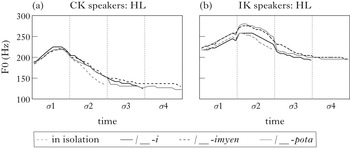
F0 tracks of HL test words in isolation and followed by -i, -imyen and -pota for (a) conservative and (b) innovative Kyungsang speakers.

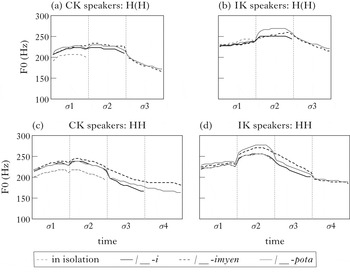
F0 tracks of H(H) and HH test words in isolation and followed by -i, -imyen and -pota for (a) and (c) conservative and (b) and (d) innovative Kyungsang speakers.

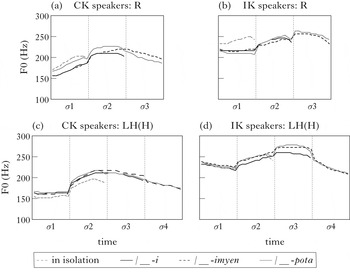
F0 tracks of R and LH(H) test words in isolation and followed by -i, -imyen and -pota for (a) and (c) conservative and (b) and (d) innovative Kyungsang speakers.

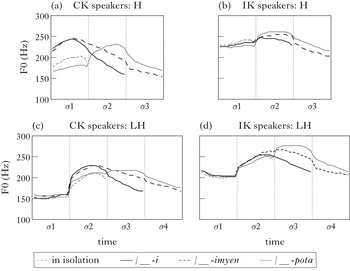
F0 tracks of H and LH test words in isolation and followed by -i, -imyen and -pota for (a) and (c) conservative and (b) and (d) innovative Kyungsang speakers.

4.1.1 HL
Figure 1 shows a F0 peak on the first syllable for CK speakers, but on the second syllable for IK speakers. Inspection of the tonal contours in Fig. 1 shows the peak at the right edge of the first syllable for CK speakers, but at the left edge of the second syllable for IK speakers. As can be seen in the supplementary materials, the ANOVA results reveal a significant Group ú Syllable interaction, indicating group differences for F0min and F0max values and the duration ratio of F0max. That is, the two generations differ in the syllable with the lowest and highest F0 and the pitch-contour shape within syllables. As can be seen in the boxplots in the supplementary materials, pairwise comparisons for each group showed that while the minimum and maximum values of the first syllable are greater than that of the second syllable for CK speakers (p<0.01 for both F0min and F0max), minimum and maximum values of the second syllable are greater than that of the first syllable for IK speakers (p<0.01 for both F0min and F0max). For F0 timing, although the two groups of Kyungsang speakers produced the HL words under suffixation as a rising-falling-falling-falling contour, the F0 peak within syllables starts earlier for CK speakers than IK speakers. Taken together, the results of the F0 scaling and timing properties suggest that for CK speakers the highest F0 peak across syllables occurs and starts falling on the first syllable for the HL words with suffixes, whereas for IK speakers it does so on the second syllable.
4.1.2 H(H) and HH
Figure 2 shows comparable F0 peaks across the first and second syllables for CK speakers, but a peak only on the second syllable for IK speakers. The pitch contours display a long peak plateau across the two initial syllables for CK speakers, but the peak plateau is seen only on the second syllable for IK speakers. The ANOVA results are similar for H(H) monosyllabic and HH disyllabic words; both H(H) and HH display a significant interaction of Group ú Syllable in F0min and F0max values and duration ratios, confirming that the two groups of Kyungsang speakers differ in the pitch pattern across syllables, and in pitch-contour shape within syllables. Boxplots in the supplementary materials show that, while the F0 minimum and maximum values for the first two syllables are comparable for CK speakers (p>0.05 for all comparisons in both H(H) and HH), they are greater for the second syllable than the first syllable for IK speakers (p<0.05 for all comparisons in both H(H) and HH). The F0min and F0max duration ratios suggest a rising-falling-falling-(falling) contour for CK speakers, but a rising-rising-falling-(falling) one for IK speakers. F0 scaling and timing measures confirm that, while comparable F0 peaks occur on the right and left edge of the first and second syllables respectively for CK speakers, a single F0 peak occurring on the second syllable is more towards the end of the syllable for IK speakers. Overall, consistent with the earlier observation for HL words, innovative speakers show a peak delay in H(H)/HH words.
4.1.3 R and LH(H)
Figure 3 shows F0 peaks on the second and third syllables for CK speakers, but only on the third syllable for IK speakers. For the monosyllabic rising and disyllabic LH(H) accent words, the group difference was confirmed by the significant interaction of Group ú Syllable for F0min and F0max values and duration ratios. While both F0min and F0max for the second and third syllables are comparable for CK speakers (p > 0.05 for all comparisons for both R and LH(H)), they are generally greater for the third syllable than the second syllable in the innovative group (R: F0max, p = 0.04, F0min, p=0.18; LH(H): F0max, p=0.28, F0min, p < 0.01). As can be seen in the boxplots in the supplementary materials, the duration ratios of F0min and F0max for each syllable suggest rising-rising-falling-(falling) and falling-rising-falling-(falling) contours for CK and IK speakers respectively. Combining the observation of the F0min and F0max values with that of the duration measures indicates similar F0 peaks at the right and left edges of the second and third syllables respectively for CK speakers, but for IK speakers the single F0 peak occurs at the left edge of the third syllable.
4.1.4 H and LH
Along with the peak delay observed in the other accent classes, another noticeable group difference for H/LH words is the less variable tonal patterns per suffix for IK speakers in comparison to CK speakers.Footnote 7 The visual inspection of the pitch contours in Fig. 4 was confirmed by the results of ANOVAs for monosyllabic H words, but not for disyllabic LH words.
For H words, a significant three-way interaction of Group ú Syllable ú Suffix was found for the F0 scaling and timing properties, indicating that the group difference associated with syllables also differs by suffix types. Pairwise comparisons tested the effect of Syllable for each suffix and group. For CK speakers, while the F0min and F0max values of the first syllable were generally greater than that of the other syllables for -i (s1>s2, p<0.01) and -imyen (s1=s2>s3, p<0.01), for -pota the F0min and F0max values of the second syllable were always higher than those of the first syllable (s2>s1, p<0.01), but were similar for the second and third syllables and for the first and third syllables. For IK speakers, on the other hand, the F0min value of the second syllable was greater than that of the first and third syllables with -imyen and -pota (s1=s3<s2, p<0.05) but not with -i (s1=s2, p=0.064). The F0max value is comparable across all syllables for the three suffixes, except for the first and second syllables for -pota (s1<s2, p=0.023). Regarding the F0 contour shape, there is substantial variability in the F0 timing properties, seen as levelled contours in Fig. 4. Based on the median in the boxplot in the supplementary materials, the CK speakers generally have a rising-falling-falling contour for -i and -imyen and rising-rising-falling for -pota. The IK speakers have rising-falling for -i and rising-rising-falling for -imyen and -pota.
For LH in disyllabic words, there was a significant interaction of Group ú Syllable for the F0 scaling and timing properties, but no interaction of Group ú Syllable ú Suffix. The absence of a three-way interaction indicates that the two groups of speakers have tonal variation across syllables, which is not affected by the three suffixes. Given this, we carried out pairwise comparisons to test the effect of Syllable, averaged across the suffix types for each group.Footnote 8 The F0min and F0max values of the second and third syllables were greater than that of the other two syllables for CK speakers (p<0.05); for IK speakers, while the F0min of the third syllable was greater than that of the other syllables (p<0.05), the F0max value was comparable between the second and third syllables. The F0 contours in Fig. 4 and the median of the boxplots in the supplementary materials suggest a rising-rising-falling-falling contour for CK speakers for all three suffixes, but a falling-rising-falling-falling contour for -i and -imyen and a falling-rising-rising-falling contour for -pota.
4.1.5 Comparison between HL and HH
The fact for IK speakers the highest F0 peak in both HL and HH starts and falls on the second syllable might mean that the innovative speakers have lost the underlying distinction between HL and H(H)/HH. Accordingly, we further examined whether the IK speakers exhibited reliable acoustic differences between the two accent classes. A series of t-tests compared the F0 scaling and timing properties of the second syllable between HL and HH words produced by IK speakers. The results showed that the two accent classes differ significantly in the F0min value (HL<HH, p=0.013) and the F0min and F0max duration (HL<HH, p<0.01 for both), but not in the F0max value (p=0.27).Footnote 9 The t-test comparisons suggest that, despite the similar tonal pattern for IK speakers, with the peak on the second syllable for both HL and HH accent words, the two accent classes are still distinct.
4.1.6 Comparison of -imyen and -pota
Consistent with previous research, the F0 scaling and timing properties within syllables of H words differ for -imyen and -pota for CK speakers. For IK speakers, however, the acoustic properties and contour shape are similar, showing the highest F0 peak on the second syllable for both suffixes, with a rising-rising-falling contour. LH-imyen and LH-pota words also pattern differently for the two speaker groups. This suggests a change in suffixal tones as well as in noun stem accents. In particular, the lack of a distinction between H-imyen and H-pota words for IK speakers suggests that they are losing the tonal contrast. A series of t-tests was carried out in order to compare the F0 scaling and timing properties of the two suffixes, i.e. between both H-imyen and H-pota words and LH-imyen and LH-pota words. The comparison was made separately for each syllable and speaker group.
The results of t-tests revealed that H-imyen and H-pota words produced by IK speakers do not differ from each other for any of the syllables on any of the four acoustic measures. But for CK speakers H-imyen and H-pota are significantly different on several comparisons; the significant differences were for the F0min and F0max values (-imyen > -pota, p<0.05) and F0min duration of the first syllable (-imyen < -pota, p<0.05), the F0min duration (-imyen > -pota, p<0.05) and F0max duration of the second syllable (-imyen < -pota, p<0.05), and the F0max value of the third syllable (-imyen < -pota, p<0.05). Combined with the finding in §4.1.4, these results indicate that for monosyllabic H words affixed with either -imyen or -pota, only the CK speakers produce the suffixed words differently; the IK speakers do not make a distinction.
For the comparison between LH-imyen and LH-pota, a significant difference was observed only for the F0 timing properties for both speaker groups. For the two groups of speakers the significant difference was in the F0min (-imyen > -pota, p<0.05) and F0max (-imyen < -pota, p<0.05) duration of the third syllable, suggesting a third-syllable peak located further to the right for -pota than for -imyen. The t-test results for disyllabic stems with suffixes differ from those for monosyllabic stems with suffixes, in the sense that the innovative speakers showed some differences in the F0 timing properties of the disyllabic stem with suffixes. Overall, the results indicate that the suffixal tone in the speech of the innovative speakers is not maintained in the same way as for the conservative speakers, suggesting that the change in the lexical pitch accent found in noun stems is also occurring in suffixes. Given that innovative speakers have a tonal distinction between LH-imyen and LH-pota, it is premature to conclude that suffixal tones have been lost. However, the absence of the suffixal tone distinction between H-imyen and H-pota might suggest that IK speakers are moving toward losing the suffix tone distinction, with shorter noun phrases being affected first.
4.2 Tone assignment
This section presents the results of tone assignment based on the analytic method described in §3.4.2. The tone-assignment results, which provide a summary of the detailed tonal movement analysis in §4.1, allow us to focus on representative pitch properties for each syllable and provide a clearer understanding of the variability in the data. Consequently, it also facilitates the detection of sound change and individual variations. The frequency of the observed accent patterns is illustrated in Figs 5 and 6; the data are presented for CK and IK speakers for the three suffixes and for each of the monosyllabic and disyllabic accent classes.
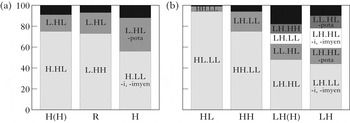
Observed accent patterns for (a) monosyllabic H(H), R and H accent classes and (b) disyllabic HL, HH, LH(H) and LH accent classes for CK speakers. The H/LH accent patterns are observed with the suffixes -i, -imyen and -pota. Black cells indicate exceptional accent patterns (HHHL, HLLH, LHLH, HLHL and HHLH); morpheme boundaries are indicated by full stops.

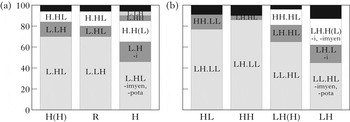
Observed accent patterns for (a) monosyllabic and (b) disyllabic accent classes for IK speakers. The H/LH patterns are observed with the suffixes -i, -imyen and -pota.

4.2.1 Dominant tonal patterns
The dominant accent patterns confirmed the observations in §4.1. Specifically, the majority of HL, H(H)/HH and R/LH(H) words produced by conservative speakers had HL.L(L), HH.L(L) and LH.H(L) patterns respectively; on the other hand, for the same words innovative speakers predominantly produced LH.L(L), LH.L(L) and LL.H(L) patterns. The predominant tonal patterns reveal that the highest mean F0 is realised on a later syllable for IK speakers than CK speakers, and confirms that innovative speakers do not have F0 values across two syllables in H(H)/HH and R/LH(H) similar to those exhibited by CK speakers. The other generational difference is in the tonal variation of the monosyllabic H and disyllabic LH words by suffix type, which was observed only for CK speakers (see §4.1.4 and §4.1.6). Figure 5 shows that conservative speakers predominantly produced the LH words as LH.L(L) with -i and -imyen (44%), and LH.HL with -pota (15%), though there was considerable variation. On the other hand, as shown in Fig. 6, innovative speakers mostly produced the LH words as LH.L with -i (18%), and as LL.HL with -imyen and -pota (45%). In other words, CK speakers realised the H on the stem with -i and -imyen, but on a suffix with -pota for H/LH. But IK speakers did not show the same kind of tonal variations; for H words with suffixes, innovative speakers consistently realised an H on the second syllable, regardless of suffix type; for LH with suffixes, they realised an H on the second syllable with the monosyllabic suffix -i, but on the third syllable with the disyllabic suffixes -imyen and -pota.
4.2.2 Variable tonal patterns and their implications for sound change
We now turn to the secondary accent patterns. The results displayed in Figs 5 and 6 show that these patterns fall into one of four classes: (i) a secondary accent pattern for one age group is comparable to a dominant pattern for the other group (H(H), HH, LH(H), R, LH-pota); (ii) the two age groups share a secondary pattern (HL, R, LH-imyen); (iii) a secondary accent pattern is shared with a dominant or secondary pattern across accent categories within an age group and between age groups (R/H, LH(H)/LH); (iv) a secondary pattern does not have anything in common with other tonal patterns (LH(H), H).
First, CK speakers' secondary patterns for H(H), HH, LH(H) and LH-pota are consistent with IK speakers' dominant accent patterns. That is, the variations produced by CK speakers are not entirely random, but parallel the sound change in the speech of IK speakers. Specifically, some CK speakers' secondary patterns for H(H) and HH are identical to IK speakers' dominant patterns – a peak occurs on the second syllable (i.e. LHLL); likewise, CK speakers' secondary patterns for LH(H) and LH-pota are consistent with IK speakers' dominant patterns for LL.HL, though there are some other variations. These analogues between CK speakers' tonal variations and IK speakers' primary prosodic patterns suggest that the change has some effect in the speech of at least some conservative speakers. The opposite case, where IK speakers' secondary pattern is similar to CK speakers' dominant patterns, is observed for H(H), R and LH(H). For example, among IK speakers, some tonal patterns for H(H) and R showed H.HL and L.HH respectively, consistent with CK speakers' primary patterns. This suggests that some innovative speakers maintain the original property of the accent class, and that the change in innovative Kyungsang's pitch accents has not been completed.
Second, conservative and innovative Kyungsang speakers have the same secondary accent pattern for HL, R and LH-imyen. Importantly, the fact that CK speakers' secondary pattern is the same as IK speakers' primary pattern for H(H)/HH and LH-pota and that the two generations share the same secondary pattern for the HL and LH-imyen class implies a possible direction for the generational change in progress for HL and H(H)/HH and for LH-imyen and LH-pota suffixes. The proportion of observed tonal patterns for each of the nine conservative and ten innovative Kyungsang speakers for HL and H(H) and for LH-imyen and LH-pota respectively can be found in the individual data in the supplementary materials.
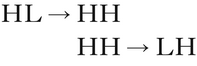
Some utterances of the HL class words were produced as HH by both CK and IK speakers. The secondary LH.HL pattern was also shared by the two groups of speakers, analogous to the HL class words. The secondary HH.LL and LH.HL patterns may be understood as a transitional stage in the peak delay, which later results in surface LH and LL.HL form for HL and LH-imyen respectively (i.e. HL£HH£LH; LH.LL£LH.HL£LL.HL). This hypothesis is supported by the data for individual speakers: the secondary tonal patterns for CK speakers' H(H) and LH-pota are the IK speakers' surface forms for L.HL and LL.HL. In other words, since the H(H) and LH-pota words, whose tonal patterns are originally H.HL and LH.HL respectively, do not require the intermediate stage, they would readily form L.HL and LL.HL, and some of the older speakers have already started to produce L.HL and LL.HL. This proposal suggests a diachronic chain shift as in (1): first, the H(H)/HH class loses the initial peak, resulting in LH (HH£LH); second, the HL class spreads the initial peak by equalising F0 prominence across two syllables, resulting in HH (HL£HH); third, the HH form, which is an intermediate stage of the rightward peak shift, loses the initial peak, resulting in LH (HH£LH). This chain shift explains why HL and H(H)/HH have different time scales in their merger process; the HL accent, requiring two steps to form LH (i.e. peak spreading and peak loss), would occur later than the H(H)/HH class, which requires only one step to form LH (i.e. peak loss). That is, the HL class, which needs two steps, would take more time than HH to form LH.
-
(1)

The third case involves a secondary pattern being shared with the dominant or secondary pattern across accent categories within a group and between groups. Specifically, for the monosyllabic rising class, the secondary pattern of L.HL in both speaker groups is the same as IK speakers' dominant L.HL pattern for the H class; for the LH(H) class, the secondary pattern of LL.HL in the conservative group is shared with the IK speakers' dominant LL.HL pattern for the LH class. This implies a weakened accent contrast between the R/LH(H) and H/LH classes; alternatively, the two accent classes might be in the process of merging. Note that the merger of these accent classes has already been completed for the corresponding trisyllabic accent classes (Utsugi Reference Utsugi2009), and LH has been merged with LHH.
Fourth, there are some random variations such as HH.HL ~ LH.HH for LH(H) and H.HL ~ L.HH for H that do not have anything in common with other dominant and secondary patterns across the two groups. Differences in segment types across test words may be one possible reason; i.e. pitch-raising consonants may play a role these random variations. For example, the IK speakers' HH.HL secondary pattern for the LH(H) class tends to occur more frequently for the word salam ‘person’ than papo ‘fool’; the former begins with the fricative /s/, and the latter with the lenis stop /p/. The word-initial fricative /s/ in salam may raise the pitch of the first and second syllables, forming HH.HL rather than the dominant LL.HL pattern. This is comparable to Jun's (Reference Jun1993) observation that initial aspirated /s/ raises the pitch of the first syllable in an accentual phrase in Seoul Korean. One thing to note here is that the HH.HL pattern is only observed for the IK speakers, not for the CK speakers, suggesting that IK speakers are more influenced by the segment types than CK speakers.
The discussion of the variable tonal patterns suggests three important aspects of the generational change, showing how the change possibly occurs and what stage it has reached. First, the parallels between CK speakers' secondary patterns and IK speakers' primary patterns indicate that a similar sound change has occurred for some CK speakers. Second, the shared secondary HH pattern HH for the HL accent suggests that HH is a transitional stage in the process of the accent change between HL and HH, implying a diachronic chain shift of the form HL √ HH √ LH. Finally, the shared accent patterns across R/LH(H) and H/LH indicate an accent merger between the two classes.
5 Discussion
5.1 Age-based group differences and implications for sound change
The purpose of this study was to examine whether the underlying distinction in the lexical pitch accent of Kyungsang Korean is maintained by innovative speakers as well as by conservative speakers. The investigation, based on a substantial data set and the two different analytic methods (tonal movement and tone assignment), allowed us to address the issue for pitch accents in both noun stems and suffixes. In addition, variable tonal patterns and individual differences allowed us to hypothesise the direction of the change and how far the change has evolved. In general, the two different methods of analysing tonal properties revealed comparable results, showing similar systematic generational differences. Table III presents the combined results from the two types of analysis in §4.1 and §4.2. In order to assess the primary findings objectively, we adopted the following criteria. First, H-toned syllables were established on the basis of the dominant tonal pattern from the tone-assignment analysis and the post hoc comparisons of the F0 scaling measure. That is, a syllable was only treated as H-toned if it had F0 peaks in both the tonal movement and tone-assignment analyses. We then marked the contour shape within the H-toned syllable based on the F0 timing measure and t-test comparisons across accent classes. In Table III, an acute accent indicates that the high peak is on the right edge of the syllable (i.e. the syllable has a rising pitch) and a grave accent to indicate that the high peak is on the left edge of the syllable (i.e. the syllable has a falling pitch). Significant findings are listed below.
Combination of the results from tonal movement (§4.1) and tone assignment (§4.2) for CK and IK speakers for (a) monosyllabic and (b) disyllabic nouns with suffixation.

(a) Both CK and IK speakers have the four underlying classes of the nominal lexical pitch accent. But the accent classes are maintained with less distinctive acoustic properties for innovative speakers compared to conservative speakers.
(b) Compared to CK speakers, IK speakers locate the peak one syllable later across all accent classes. For example, the first-syllable pitch prominence for conservative speakers occurs on the second syllable (e.g. HL.LL£LH.LL), and the second-syllable peak occurs on the third syllable (e.g. LH.LL£LL.HL).
(c) While CK speakers have Hs across two consecutive syllables, IK speakers do not (e.g. HH.LL£LH.LL, LH.HL£LL.HL).
(d) The changes in (a) and (b) mentioned above result in similar accent patterns for HL and HH for IK speakers, and made us suspect an accent merger. But further t-test comparisons on the second syllable of HL and HH in §4.1.5 indicated a difference in F0 scaling and timing properties between the two accent classes, suggesting that IK speakers maintain the underlying accent distinction in a different way from CK speakers.
(e) For H/LH, while CK speakers have tonal variation depending on the suffix involved, such a distinction in suffixes is less clear for IK speakers, which led us to test the suffixal tone distinction between H/LH-imyen and H/LH-pota in particular. Further t-test comparisons indicated no difference between H-imyen and H-pota, but a significant difference in F0 timing properties between LH-imyen and LH-pota, suggesting a weakened suffixal tone distinction.
The phonetic observations in this paper clearly showed age-based group differences in the lexical pitch accent system of Kyungsang Korean, suggesting a sound change in its prosodic properties. Overall, the acoustic distinction across contrastive accent classes is substantially weakened for IK speakers. However, despite the weakened acoustic properties, innovative speakers maintain four underlying accent classes, consistent with the conservative group. Two major generational changes are worth discussing: peak delay and the loss of peaks occurring across two consecutive syllables. These changes are the major source of the weakened acoustic distinction across accent contrasts, which potentially induce an accent merger, changes in accent restrictions and a loss of suffixal accents.
First, for IK speakers, the phonetic distinction between HL and H(H)/HH is less clear than that for CK speakers. The F0 peak (§4.1) and the highest mean F0 (§4.2) in phonological words are realised on the second syllable for both accent classes for the innovative speakers (i.e. LHLL), although the two classes differ only in the contour shape of the second syllable. This is different from the conservative speakers, who make the accent contrast by locating peaks across two syllables. The reduced phonetic distinction between HL and HH may suggest that an accent merger is in progress in the innovative variety. In other words, the subtle phonetic differences across underlying accents for the innovative group cast doubt on whether the sound change involves weakening of the underlying distinction, which would ultimately be lost, at least in speech production. In fact, this speculation seems to be in line with what we have seen with -imyen and -pota, in which the distinction has already disappeared when they are affixed to monosyllabic nouns. For the potential merger in progress, peak delay and peak loss on one of the syllables are related. Given the peak delay, the peak of the HL accent on the second syllable is delayed, resulting in LH; likewise, due to the peak loss, H(H)/HH has its peak only on the second syllable, resulting in LH as well.
Second, peak delay and peak loss are also observed for the R/LH(H) accent (i.e. LHHL and LLHL for CK and IK speakers respectively), indicating that these two processes are not limited to the HL and H(H)/HH classes. As a consequence of these two changes, some accent restrictions have changed. Specifically, among CK speakers we do not find two initial Ls, and a peak occurs either on the first or second syllable (i.e. *#LL), but they do occur for IK speakers; in addition, while CK speakers have a peak on the first syllable (i.e. #H), innovative speakers do not (i.e. *#H). Overall, the two major group differences, peak delay and peak loss, play a role in reshaping the nominal accent system for innovative Kyungsang speakers.
Third, another major age effect is that for CK speakers H/LH showed tonal variation by suffix type, while the variation was less clear for IK speakers: for CK speakers H/LH with -i and -imyen is different from H/LH with -pota, but IK speakers showed a consistent pattern for -imyen and -pota. Recall that Lee & Zhang (Reference Lee and Jongman2014) propose that while the suffix -pota has an underlyingly pre-linked H, -i and -imyen do not. Thus the consistency in the tonal patterns of -imyen and -pota for IK speakers suggests that suffixes have lost their underlying distinction. Notably, as result of the loss of the tonal distinction in suffixes, the accent patterns between LH(H) and LH classes under suffixation become similar for innovative speakers; these two disyllabic accents are distinct only when suffixed with -i. In other words, the loss of suffixal tone plays a role not only in the lack of suffix-induced tonal differences for H/LH words, but also in weakening the tonal contrast between LH(H) and LH words.
5.3 General discussion
The two crucial generational changes in the accent system are that younger or innovative Kyungsang speakers both delay and lose a pitch peak. In addition, the changes tend to parallel secondary patterns for some conservative or older speakers, suggesting that the sound change is not limited to the younger generation, but also affects some speakers of the older generation.
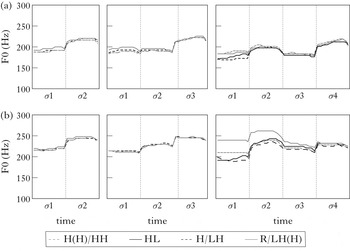
The question then arises as to what brings about these changes. One possible answer is external motivation; that is, standard Seoul Korean is affecting the restructuring of Kyungsang's lexical accent system, making it similar to the prosody of Seoul Korean. For Seoul Korean, Jun (Reference Jun1993, Reference Jun1998) proposes that while an underlying LHLH pattern is realised on each syllable for four-syllable words, some of the tones in the LHLH pattern are undershot for words with two or three syllables, resulting in LH and LLH (or LHH). Proposing the ‘Alignment-Duration’ model, Cho (Reference Cho2011) suggests that the tonal timing of the phrase-initial rise in Seoul Korean is determined by alignment of relevant F0 to a particular segment, as well as by target durations. In other words, the initial syllable generally has low pitch, comparable to what we have seen for IK speakers. As illustrated in Fig. 7, the prosodic patterns reported in the literature were confirmed with twenty female Seoul speakers, using the same method as for the Kyungsang data in terms of speech materials and two cohorts of speakers grouped by age. We examined the tonal patterns of Seoul Korean for words with a varying number of syllables (see §3 in this paper for details of methodology). Table IV summarises the measured mean F0 for syllables.
F0 tracks of the Kyungsang accent classes in two-, three- and four-syllable words for (a) older and (b) younger Seoul speakers.

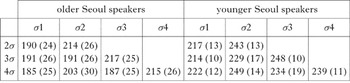
Mean F0 (Hz) in each syllable for two-, three- and four-syllable words for older and younger Seoul speakers. Standard deviation is given in parentheses.

The results in Table IV are generally compatible with previously reported prosodic patterns for Seoul Korean. For two-syllable words, the F0 of the second syllable is 24 Hz and 26 Hz higher than that of the first syllable for older and younger Seoul speakers respectively; the higher F0 for the second syllable indicates an LH pattern for both generations of speakers. For three-syllable words, the higher F0 in the third syllable than in the first syllable suggests that both older and younger Seoul speakers have the final-rising accent pattern.Footnote 10 Finally, for four-syllable words, the second and the fourth syllables have a higher F0 than the first and the third syllables for both older and younger Seoul speakers, forming LHLH. In addition to these findings, which replicate Jun's (Reference Jun1993, Reference Jun1998) results, we also observed that when the phrase-initial segment had a [+stiff vocal cords] feature (e.g. /s/ in salam), the initial syllable showed a high F0 and, accordingly, the tonal pattern of a phrase was HHLH (or HHH). This is also in line with the proposal in Jun (Reference Jun1993, Reference Jun1998) regarding the role of the initial segment in determining the tonal pattern of an accentual phrase in Seoul Korean. In summary, the prosodic patterns of Seoul Korean are LH, LLH, and LHLH, where initial syllables always have low pitch, except in the case of phrase-initial [s].
The peak on the initial syllable in a phonological word is a unique feature of tonal Kyungsang Korean. Our observation also shows a lexically determined initial peak in Kyungsang Korean (e.g. mélì (HL) ‘head’ and kúlím (HH) ‘painting’), limited to conservative speakers; an initial peak does not occur in the production of the innovative speakers for any accent classes. In particular, the absence of the initial peak or initial H is comparable to the prosody pattern in Seoul Korean. This suggests that IK speakers, who are more under the influence of Seoul Korean (e.g. through mass media, higher education) and are more likely to accommodate to Seoul than the older generations, might adjust their prosody structure towards that of Seoul Korean, especially following the non-initial peak. On the other hand, older generations, with less exposure to Seoul Korean, are more likely to maintain distinct phonetic properties. In addition, under prevailing Korean ideology, younger Kyungsang speakers would feel more stigmatised by their speech, which might make them avoid any distinctive properties (e.g. initial peak). Therefore, we argue that external factors, i.e. increased exposure to Seoul Korean as well as ideological pressure to conform to Seoul Korean, might be the cause of the change in the accent system of Kyungsang Korean.
The observation and claim here are compatible with those of Lee (Reference Lee2008) and Lee & Jongman (Reference Lee and Jongman2015). Lee found that younger Kyungsang speakers use sentence intonation in a similar way to Seoul speakers, and attributes the generational change to the increased exposure to prestigious Seoul Korean among younger Kyungsang generations. Lee & Jongman also propose that the later occurring F0 peak within a monosyllabic or a disyllabic word is due to the influence of Seoul, which has a phrase-final rising tonal pattern. The current study therefore provides converging evidence that the sound change in the prosody of Kyungsang Korean is induced by the influence of Seoul Korean. In addition to replicating these findings, the current paper has addressed (i) how innovative speakers maintain the underlying accents, (ii) how the peak delay makes contrastive accents more similar to each other, (iii) the individual variability of the tonal patterns and how it sheds light on the nature of the sound change and (iv) whether the suffixal tones are affected by the sound change.
Overall, the tonal pattern of Kyungsang Korean is undergoing a sound change involving assimilation to that of Seoul Korean. But despite the resulting similarity, we noted that Kyungsang Korean is still distinct from non-tonal Seoul Korean in maintaining lexical accent contrasts. Therefore, we conclude that the sound change in the lexical pitch accent of Kyungsang Korean is progressing by adopting the phrase-initial low tone from Seoul Korean, but preserving its lexical accent properties.
6 Conclusions
This study has investigated whether the underlying properties of the lexical pitch accent of Kyungsang Korean are retained by both conservative and innovative speakers. Given the increased influence of standard Seoul Korean, we hypothesised that the lexical pitch accent of Kyungsang Korean is undergoing change. We provided phonetic evidence for diachronic sound change in the pitch-accent system of Kyungsang Korean by establishing age-based group differences. The data observed for IK speakers are similar to those for non-tonal Seoul Korean speakers, particularly in having low pitch in the initial syllable. This similarity suggests that the influence of Seoul Korean on IK speakers plays a role in the sound change. However, despite the substantial generational differences and the potential influence of Seoul Korean, IK speakers' phonology of the lexical pitch accent of Kyungsang Korean has been maintained. The sound change in the prosody of Kyungsang Korean is therefore in progress, but is still subphonemic.
There are several remaining issues that should be investigated in future research. First, it would be worthwhile to test the observed generational difference in longer words. The change in progress for HL and H(H)/HH invites the question whether the potential merger is taking place for the trisyllabic LHL and HHL accents. Testing the issue in longer words would provide a more comprehensive picture regarding the sound change in the lexical pitch accent of South Kyungsang Korean. Second, a perception study would provide crucial evidence for whether the potential accent merger is indeed a merger, near merger or false merger, thus linking the acoustics to perception.