Introduction
A key premise identified for organizational success is the unique combination of resources and capabilities that creates long-term sustainability (Foss, Husted, & Michailova, Reference Foss, Husted and Michailova2010; Liu & Hart, Reference Liu and Hart2011). This includes the capacity for the organization’s workers to generate and share the knowledge required to meet its purposes, confront new challenges and goals and develop innovations in practices, processes and products (Wang & Wang, Reference Wang and Wang2012). Knowledge in organizations has been described as emergent, distributed, embedded in the connections between individuals and groups, in rules, divisions of labor and roles, and artifacts that determine patterned interaction and behavioral regularities (Nicolini, Reference Nicolini2011; Jensen, Reference Jensen2012).
Research on knowledge sharing is now well advanced (see, e.g., reviews by Foss, Husted, & Michailova, Reference Foss, Husted and Michailova2010; Wang & Noe, Reference Wang and Noe2010). Network theory has been extensively used to analyze knowledge sharing (e.g., Chinowsky, Diekmann, & O’Brien, Reference Chinowsky, Diekmann and O’Brien2010). Lyons, Duxbury, and Higgins (Reference Lyons, Duxbury and Higgins2006) noted that work values provide the framework for individual workers’ decision making about goals and practices. Østerlund, Carlile, Huysman, and Wulf (Reference Østerlund, Carlile, Huysman and Wulf2003) highlighted the links between relational thinking and knowledge sharing; Hotho, Saka-Helmhout, and Becker-Ritterspach (Reference Hotho, Saka-Helmhout and Becker-Ritterspach2014), Gherardi and Perrotta (Reference Gherardi and Perrotta2011) and Rashman, Withers, and Hartley (Reference Rashman, Withers and Hartley2009) identified the influence of the contextual and multi-level interlinking factors. Aalbers, Dolfsma, and Koppius (Reference Aalbers, Dolfsma and Koppius2013) explored the influence of formal and informal ties on innovative knowledge transfer and Connelly, Ford, Turel, Gallupe, and Zweig (Reference Connelly, Ford, Turel, Gallupe and Zweig2014) explored the impact of ‘busyness’ on knowledge sharing, finding that people under pressure are less likely to share knowledge willingly or comprehensively.
However although Gardiner’s (Reference Gardiner2008) review of knowledge sharing influences addressed macro, local, and individual factors, Foss, Husted, and Michailova (Reference Foss, Husted and Michailova2010) identified a research preoccupation with organizational and collective levels and insufficient attention to individual level factors. This is important because in most fields of work, employees expect to learn through ongoing knowledge sharing by colleagues, and employers expect workers to access and contribute to the collective expertise and organizational memory through formal and informal knowledge exchanges in order to achieve organization objectives (Feldman & Feldman, Reference Feldman and Feldman2006; Cordeiro-Nilsson & Hawamdeh, Reference Cordeiro-Nilsson and Hawamdeh2011). Yet, individual knowledge sharing is dependent on individual workers’ understanding of their relations with the organization, its representatives and their co-workers.
Knowledge sharing orientations and practices develop within the frameworks established by individuals’ values as practitioners of their profession and as collaborators with the values and norms of their organization and sector or industry (Gardiner, Reference Gardiner2008). Therefore, knowledge sharing can be a complex, negotiated and fragile process occurring within the social relations of the micro and locally situated patterns of daily practice (Nerland, Reference Nerland2010; Nicolini, Reference Nicolini2011), especially where the knowledge is practice-based and specialized (Gherardi, Reference Gherardi2012).
Further, Javernick-Will (Reference Javernick-Will2012) recommends more attention to the positive influences and facilitators for individual knowledge sharing, and Rennstam and Ashcraft (Reference Rennstam and Ashcraft2014) recommend more focus on ‘knowing as a situated, collaborative accomplishment, inherent and anchored in an infinite variety of social practices’ (p. 4). It appears that insufficient work to date illustrates the interconnectedness of resistances, facilitators and influences on individual-level knowledge sharing arising from professional identity and values, individual relational history and knowledge culture.
The case study here addresses these concerns by exploring influences on individual decision making for knowledge sharing among professionals and paraprofessionals – specifically railways civil engineers and design drafters – directly employed in a public sector organization. The selected research site ‘RailServices’ is a mature knowledge sharing environment, with extensive data capture, project reporting, management support and other mechanisms to facilitate and encourage knowledge sharing. The engineering department in which respondents work is characterized by professional and service values. The nature of knowledge about railways and rail operations (e.g., design of rail networks, turnouts, and level crossings) is highly specialized (i.e., little required in other engineering applications), contextually constructed and acquired through practice of the profession, in addition to successful completion of civil engineering and design drafting initial qualifications. Limited training is available for railways-specific knowledge in either engineering or design drafting courses. Railways engineering and design drafting practitioners are therefore dependent on the knowledge sharing orientation of more advanced colleagues for conceptual and practical progression in the knowledge and techniques of the field.
These circumstances provide a facilitative organizational and professional environment and culture for individual knowledge sharing, even of hard-won deeply personal expertise, and therefore an ideal site in which to explore the individual-level influences on workers’ knowledge sharing behaviors. A favorable knowledge sharing environment should enhance individual knowledge sharing orientations and practices even where overlapping sets of individual values and behavioral drivers exist.
In addition, the respondents were selected because they simultaneously enact multiple perspectives and embeddedness as: (i) members of their profession who have undergone extensive formal training in their field, its purpose, history, values, and practices; (ii) public servants who have been or are being inculcated in the values, purposes, and practices of the public sector; (iii) employees of a large and complex formally structured organization; (iv) members of multidisciplinary project teams of extended duration and varying membership dependent upon the project’s tasks; (v) practitioners of a contextually developed and situated, specialized railways engineering knowledge not otherwise accessible; and (vi) individuals with their own personal values, practices, frameworks, and relationships. The positive knowledge sharing environment, nature of the work and the organization, and the department and profession-based values should create an ideal setting for individual level knowledge sharing decision making among experienced and novice co-workers.
The findings here make a broad, useful contribution to understanding knowledge sharing resistances and success. Not all employment fields can be accessed through formal qualifications and training and instead learning must occur through practice: successful capability-building and progression will be reliant on the individual knowledge sharing orientation and decision making of more expert co-workers.
To illustrate the influences for knowledge sharing success and resistance at the individual level this work will explore the extent to which: (i) knowledge sharing will be positively influenced by the professional identity, values and knowledge culture to achieve organizational and project goals; and (ii) sharing of deep personal expertise will be influenced by the quality of relational capital among individuals and individual perspectives. The paper first presents influences on knowledge sharing arising from professional identity, values, knowledge culture, and relational capital; the methodology is then established, findings and implications for practice are discussed followed by the limitations and conclusion.
Knowledge Culture and Professional Identity
The knowledge culture framing the work of members of a profession is important for knowledge sharing orientations and behaviors (Jensen, Reference Jensen2012). A profession-based knowledge culture shapes professionals’ understanding of ‘how to be’ in their profession and establishes awareness of existing related knowledge, norms and values for individuals’ enactment of the profession’s practices (Gardiner, Reference Gardiner2008), exercising individual agency (Raudsepp, Reference Raudsepp2005) and to ‘draw distinctions in the processes of carrying out their work, in particular concrete contexts, by enacting sets of generalizations whose application depends on historically evolved collective understandings and experiences’ (Tsoukas & Vladimirou, Reference Tsoukas and Vladimirou2001: 973).
Knorr Cetina (Reference Knorr Cetina2006) described knowledge culture as a set ‘of particular beliefs about, for example, the particular ways knowledge should be handled and inserted into personal and organisational life’ (p. 37). An important component of the knowledge culture is social capital, comprising social structures, their elements and resources which enable and support actions of agents within the structures, that is ‘structural capital, cognitive capital, and relationship capital’ (Yu, Hao, Dong, & Khalifa, Reference Yu, Hao, Dong and Khalifa2013: 781). In essence, social capital is based on relationships – the combined resources in, through and accessible via relationships which an individual worker has developed and maintains in the organization or site of practice – thus providing invaluable resources (Inkpen & Tsang, Reference Inkpen and Tsang2005). Crocker and Eckardt (Reference Crocker and Eckardt2014) suggest professional and social capital are influential at multiple levels, that is work group, project team, occupational group and department. In the work carried out collaboratively by railways engineers and design drafters, the knowledge needed is inextricably linked to context and situation (Hotho, Saka-Helmhout, & Becker-Ritterspach, Reference Hotho, Saka-Helmhout and Becker-Ritterspach2014). In the case of trainees or newcomers, active membership of a work or social practice setting may provide access to the larger network of relationships of the group, even when the individual has not yet contributed to those relationships (Kostova & Roth, Reference Kostova and Roth2003).
The nature and practices associated with an industry or profession are reinforced by professional values, training and networks (Gherardi, Reference Gherardi2012) which provide a framework for professional identity and disposition for knowledge sharing. Identity has been described as a process (Pullen & Linstead, Reference Pullen and Linstead2008). This process includes social, physical, psychological, role, temporal, reflective, behavioral, contextual, and performance factors (Pullen & Linstead, Reference Pullen and Linstead2008; Fenwick, Nerland, & Jensen, Reference Fenwick, Nerland and Jensen2012). In professional identity, the practice and performance factors are prioritized because an individual’s professional identity is constructed, evidenced, maintained, and enhanced through their profession-based knowledge, practices and task enactment (Ghirardi, Reference Gherardi2012; Brown, Reference Brown2014).
The development of a strong sense of professional identity and a sense of being an ‘insider’ contribute to the construction of a work identity and values (Alvesson, Reference Alvesson2004). Values are ideas and beliefs generally held by an individual about desirable outcomes or behaviors – beyond specific situations – that guide their judgment and selection of behaviors and events, and are prioritized by judgments of importance and context (Schwartz et al., Reference Schwartz, Caprara, Vecchione, Paul Bain, Bianchi, Caprara, Jan Cieciuch, Kirmanoglu, Baslevent, Lönnqvist, Mamali, Manzi, Pavlopoulos, Posnova, Schoen, Silvester, Tabernero, Torres, Verkasalo, Vondrakova, Welzel and Zaleski2014). In railways design engineering, for instance, safety and excellence are paramount values to be internalized by practitioners (Steenhuisen & van Eeten, Reference Steenhuisen and Van Eeten2010). High levels of shared values facilitate reciprocal interactions, trust and knowledge sharing (Bock, Zmud, Kim, & Lee, Reference Bock, Zmud, Kim and Lee2005).
Influences on Knowledge Sharing
Knowledge sharing will be influenced by organizational mechanisms prescribing roles and relationships (Hotho, Saka-Helmhout, & Becker-Ritterspach, Reference Hotho, Saka-Helmhout and Becker-Ritterspach2014), the daily experience of organizational life the individual’s perceptions of their own role and the roles of others, and their perceptions of their relationships with their co-workers and the organization (Østerlund et al., Reference Østerlund, Carlile, Huysman and Wulf2003). Supervisors and co-workers are strong influences on individual workers’ attitudes and practices. Perceptions of support for knowledge sharing are interpreted by workers as approval and encouragement for individual level knowledge sharing behavior (Bock et al., Reference Bock, Zmud, Kim and Lee2005).
Factors that indicate or predispose towards knowledge sharing include altruism, peacemaking (Spitzmuller & Van Dyne, Reference Spitzmuller and Van Dyne2013), interpersonal helping (Wang, Howell, Hinrichs, & Prieto, Reference Wang, Howell, Hinrichs and Prieto2011), and actively minimizing difficulties for co-workers (Zhao, Peng, & Chen, Reference Zhao, Peng and Chen2014). Previous work on the public sector (e.g., review by Perry, Hondeghem & Wise, Reference Perry, Hondeghem and Wise2010) notes the interaction of professional identity and institutional context with individual other-orientation and pro-social motivation. Rashman, Withers and Hartley (Reference Rashman, Withers and Hartley2009) highlighted the socio-historical context as a key, specific variable for knowledge generation and sharing in public sector organizations. Many public sector employees are highly motivated by notions of public service, involvement in projects of public worth, personal task identification and individual level perceptions of the worthwhile, communitarian nature of their work (Georgellis, Iossa, & Tabvuma, Reference Georgellis, Iossa and Tabvuma2011; Kjeldsen, Reference Kjeldsen2014). Public service motivation has been usually associated with altruism. However, quasi-privatization and other pressures for change can diminish factors fostering commitment and collaboration, negatively affecting workers’ relations with the organization, knowledge sharing and intellectual capital (OECD, 2005). Increased understanding of facilitators and resistances for knowledge sharing in public sector organizations is important because of the public sector’s scope, social and economic purposes and public expectations of its effectiveness, and because it has values, practices and a knowledge culture of its own (Currie & Suhomlinova, Reference Currie and Suhomlinova2006).
Silos (e.g., discrete projects) (Bundred, Reference Bundred2006), organizing structures (Hotho et al., 2014) and professional boundaries (Wanberg & Javernick-Will, Reference Wanberg and Javernick-Will2012) can create barriers and resistance to knowledge sharing in public sector organizations (Martin, Currie, & Finn, Reference Martin, Currie and Finn2009). Withholding or hoarding knowledge (Noe, Clarke, & Klein, Reference Noe, Clarke and Klein2014) has been associated with lower levels of organizational commitment or political behavior designed to create leverage. Special challenges can arise for knowledge sharing where work is primarily undertaken on a project basis, especially where project teams are engaged in long term, discrete projects and overlaps in project membership may not occur. Discontinuities can occur in the maintenance of relational capital (Fincham & Roslender, Reference Fincham and Roslender2004) and knowledge sharing arising from strong interpersonal relations (Leana & Rousseau, Reference Leana and Rousseau2000). Relational capital develops overtime and through repeated interactions at the micro-level and creates a basis of understanding for negotiation (Smith, Reference Smith2014) and reciprocal contributions (Thompson & Heron, Reference Thompson and Heron2006).
In project-based organizations, barriers to knowledge sharing caused by organizational, professional (e.g., between professionals and paraprofessionals) and task-based boundaries have been identified (Ivory, Alderman, Thwaites, McLoughlin, & Vaughan, Reference Ivory, Alderman, Thwaites, McLoughlin and Vaughan2007). The most reported form of knowledge management is the post-project evaluation but that dissemination can be ad hoc or unsystematic (Orange, Burke, & Boam, Reference Orange, Burke and Boam2000). Carillo and Chinowsky (Reference Carrillo and Chinowsky2006) suggested these evaluations add to the organizational knowledge but shortcomings include incompleteness of information and stakeholder perspectives, outcomes and learning, and assumed knowledge sharing.
Use of virtual communication media can create technology-based knowledge repositories, especially where common processes and terminology are consistently adopted. However, individual communications may flow along personal network channels rather than being dispersed across the overall group, and such personal communications may contain a richness of detail and accuracy that is censored or ‘sanitised’ in more formal reporting, reducing the potential value of the formal reports and for learning from errors (Catino & Patriotta, Reference Catino and Patriotta2013).
As established above, knowledge sharing can be a complex, negotiated and fragile process dependent on workers’ understanding of their relations with the organization, its representatives and their co-workers. This work makes an important integrative contribution to our understanding of individual level factors influencing knowledge sharing success and why resistances can still occur, even where the organizational environment provides supportive mechanisms and workers already possess characteristics and values conducive to knowledge sharing.
Method
The purpose of this work was to explore how: (i) knowledge sharing will be positively influenced by the professional identity, values and knowledge culture to achieve organizational and project goals; and (ii) sharing of deep personal expertise will be influenced by the quality of relational capital among individuals and individual perspectives.
Respondents were directly employed in a large (12,000 employees) 150-year-old public sector organization, the dominant provider of railway infrastructure and other rail services across vast, geographically diverse regions with widely dispersed populations and key economic sites (e.g., coal mines) in its country of origin. RailServices operates under ongoing scrutiny of its value contribution amidst government and market pressure for its sale, privatization or asset disposal. The engineering department (400 engineers and design drafters) was selected (Silverman, Reference Silverman2013) as an ideal setting to explore the impacts of the intersections of overlapping values frameworks, professional practices, individual behaviors and knowledge culture for sharing specialized, contextualized, practice-based knowledge.
The investigation adopted a single case qualitative method (Yin, Reference Yin2009). A case study approach supported the goals to explore multiple realities, socially constructed meanings, generate understanding of ambiguity and context (Tsang, Reference Tsang2014) and explore interactions, that is ‘the space between’ (Bradbury & Bergmann Lichtenstein, Reference Bradbury and Bergmann Lichtenstein2000: 551).
Procedure
Semi-structured interviews were adopted to facilitate the collection of stories illustrating abstractions and the ways individual workers’ meaning was constructed from experience (Czarniawska, Reference Czarniawska2011), capture unexpected or unusual nuances, surface the most salient data (Tracy, Reference Tracy2012) and provide flexibility (Crouch & McKenzie, Reference Crouch and McKenzie2006). Thorough prior theoretical interrogation (Denzin & Lincoln, Reference Denzin and Lincoln2005) assisted recognition and investigation of any associated topics that spontaneously emerged (Yin, Reference Yin2009).
A replication strategy ensured that for each occupational group, level and type, multiple respondents provided comparable case data (Miles, Huberman, & Saldaña, Reference Miles, Huberman and Saldaña2014). Depth of contact facilitated increasing familiarity, honesty and openness, deep reflections upon practices and the development of a rich vein of narratives and episodes (Czarniawska, Reference Czarniawska2011).
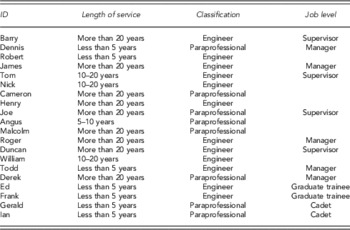
Data were collected in 46 individual interviews, meeting recommendations for semi-structured interviews in qualitative studies (see Crouch & McKenzie, Reference Crouch and McKenzie2006). A series of three recorded interviews (each 60–90 min duration) was conducted with 14 professional and paraprofessional managers and staff, and a single 1 hr individual interview with each of four novices (two graduate engineers and two design drafter trainees) who are participants in structured development programs. One additional respondent retired before the second interview and is excluded, no other exits occurred. The sample, shown in Table 1, represented a vertical slice of the all-male engineering department.
Participants

The first round of interviews established the respondents’ personal histories, knowledge sharing orientations, examples and anecdotes, and gathered information about workplace values, organization and practices. The second round of interviews was carried out a year later and gathered data about the respondents’ information-gathering practices, key knowledge relationships, the knowledge and knowledge sharing practices of acknowledged experts and the knowledge sharing practices of other colleagues. The final round of interviews occurred a further year later and explored knowledge construction and generation in the local setting, respondents’ personal knowledge sharing orientations and practices and their reflections upon these.
The extended time interval between interviews allowed for completion of some team projects and commencement of new projects, with the respondents forming new teams composed of both study participants and other employees. It was designed to capture more complete observations about ongoing, authentic knowledge sharing practices by the same group of participants in varying contexts and workgroups (Fernie, Green, Weller, & Newcombe, Reference Fernie, Green, Weller and Newcombe2003). The low-impact spacing of the interview rounds was desirable to the organization.
Following Czarniawska (Reference Czarniawska2011), questions for the three interview rounds were carefully designed to capture the interviewees’ own experiences and reduce interviewer influence on those reflections, for example, Tell me about your work here; Tell me about a situation where knowledge sharing worked well; In your opinion, why did it work well; Who are you most likely to share your new ideas with, why is that; What are the most important influences on how knowledge is shared around here; To what extent would you say your own knowledge sharing is sometimes influenced by how you view the other person. Additional questions in the graduate and trainee interviews explored their relations with colleagues, access to the collective knowledge and experienced knowledge sharing. Negative knowledge sharing experiences were explored.
Attention was paid to preserving contrary and unique renderings about issues/events (Rubin & Rubin, Reference Rubin and Rubin2005), for instance where individuals held some beliefs in common with fellow professionals or team members but alternative views about other issues/events. Respondents’ accounts were examined for biases and group level distortions. Threats to validity, researcher or respondent bias were further reduced by member checking (Robson, Reference Robson2011) at the start of each subsequent interview, a detailed documentation audit trail, peer review throughout the data collection and analysis processes, and review of relevant archival documents, procedures and artifacts (Yin, Reference Yin2009). In all, the methodology supported a reasonably systematic investigation of knowledge sharing practices across occupational groups, levels, teams, and multiple individuals.
Data analysis
Following transcription, the interview data were read several times: as whole, complete stories by individual respondents across the series of interviews, read again as episodes relating to a specific issue, and read again in relation to the previously identified theoretical constructs. Interview transcripts were analyzed using NVivo software to achieve management and interrogation of qualitative data, and cyclical, iterative analysis through three levels of thematic coding based upon themes identified in an extensive prior literature review (Denzin & Lincoln, Reference Denzin and Lincoln2005).
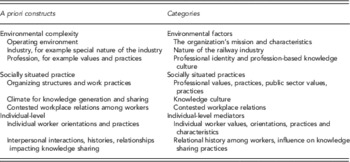
As depicted in Table 2, at Level One, codes were allocated to identify passages of text dealing with specific issues or topics. At Level Two, the codes were grouped into sub-categories which provided logical clusters. At Level Three, the sub-categories were then organized into categories that reflected sense making and cognate issues which the sub-categories naturally informed (Tsang, Reference Tsang2014): environmental factors, socially situated practice factors, and individual-level mediators.
A priori constructs from the literature and categories established through data analyses

Results and Discussion
This investigation addressed the apparent gap in existing research regarding the interconnectedness of resistances, facilitators and influences on individual-level knowledge sharing arising from professional identity and values, individual relational history and knowledge culture. It specifically explores the extent to which: (i) knowledge sharing will be positively influenced by the professional identity, values and knowledge culture to achieve organizational and project goals; and (ii) sharing of deep personal expertise will be influenced by the quality of relational capital among individuals and individual perspectives.
Influence of professional identity, knowledge culture and values
A highly developed sense of professional mission and identity was evident among these civil engineers and design drafters. The complex, focused nature of rail design work carried out at RailServices occurs in an extremely strong knowledge culture, for instance, the most senior and most junior respondents respectively describe the department’s role and identity: ‘We are the custodians of the discipline’ (James, departmental head) and ‘We are the intellectual division producing intellectual information’ (Ed, graduate engineer). Role content, status and organizational commitment were emphasized:
RailServices has deep specialised and extensive knowledge about everything to do with rail…the knowledge in this area is unique and closely held…the knowledge has been developed and built up by RailServices people in RailServices time and paid for by RailServices…we are the leading national rail operator.
Joe, design drafter
Respondents described themselves as ‘professionals’ and ‘insiders,’ and their work as ‘knowledge intensive.’ The local knowledge culture comprises professional knowledge and practices, shaped by the histories and outcomes of previous projects, that is the collective organizational memory, long standing personal and professional relationships, and the influential practices of key individuals regarded as experts, innovators and thought leaders (Knorr Cetina, Reference Knorr Cetina2006). Certain expertise (such as design of rail networks, turnouts, level crossings) is not required by other industry applications and reinforces the sense of profession-based knowledge culture:
Railways are a fairly specific profession … railways structures, for example, is pretty much just for railways… you can’t really transfer that sort of thing anywhere else.
Nick, engineer
Emotional engagement with the work, associated with higher levels of motivation, job involvement and work performance and convergence between workers’ interests and organizational goals, all antecedents for knowledge sharing, were evident: ‘…a lot of people who work in this department are very dedicated to the train cause as a professional issue…a special bond…they love to be associated with trains’ (Todd, engineer), and Nick (engineer) noted ‘… they take pride in what they do because they are railway men.’
In response to the question ‘what parts of your work do you find most fulfilling?’ intrinsic values (Schwartz, Reference Schwartz, Caprara, Vecchione, Paul Bain, Bianchi, Caprara, Jan Cieciuch, Kirmanoglu, Baslevent, Lönnqvist, Mamali, Manzi, Pavlopoulos, Posnova, Schoen, Silvester, Tabernero, Torres, Verkasalo, Vondrakova, Welzel and Zaleski2014) were repeatedly highlighted, including intellectual stimulation (‘I’m always learning something new,’ Tom, engineer, 10–20 years’ experience), opportunities for creativity (‘it’s the ability to develop a few different ideas,’ Nick, engineer, 10–20 years), a sense of achievement, and rewarding relationships with colleagues. Other-oriented values (Wang et al., Reference Wang, Howell, Hinrichs and Prieto2011) of contribution to the public good, and the usefulness, correctness, longevity and safety of the structures that respondents design, demonstrate professional and public service value-actualization, for example: ‘You get the opportunity to contribute something that benefits a lot of people…to participate in long projects or plans to improve the city or environment’ (Todd, engineer, manager); ‘The fulfilling part of your job is when you see things are built, projects that you’ve worked on and suddenly the result is there’ (Angus, design drafter); ‘Seeing something that you’ve taken from concept through to actual operation and in ten years down the track it’s still … functioning perfectly’ (Barry, engineer). One engineer described taking his family to see each completed construction he designed, and his feelings of achievement, contribution to the community and professional validation.
Influence of relational capital and individual perspectives
Willingness to share and learn from co-workers is discretionary, occurring within social relations and work history realities. Ongoing demonstrations of shared professional and personal values provide a basis for individual judgments for knowledge sharing in RailServices engineering department: ‘If you like their methodology, their work, ethics, you are more willing to give more information’ (Nick, engineer). The need for personal relationships with a range of co-workers with different types of expertise and organizational/historical knowledge was highlighted by one new manager/engineer: ‘If I’ve got the right contacts, I’ll advance my case.’ Respondents noted differential knowledge sharing based upon past interactions:
Our group is all fairly good friends…I guess you get the different personalities and if people have done the right thing by you, you will do the right thing by them. So if you don’t get on particularly well with somebody you will perhaps not tell them everything. But that is probably the way that you have been treated yourself.
Duncan, engineer
Instrumental knowledge sharing occurs, for instance, proactive knowledge sharing based on future reciprocation aspirations. Failure to share individual expertise sometimes arises from personal animosity:
Depending on who you talk to. Some people are reluctant to release that, ‘oh well if it’s helping’…if you are helpful to them you usually get information…I tend to help people thinking that I might need their help in the future.
William, engineer
Participants’ reflections about their own and their colleagues’ knowledge sharing practices demonstrate awareness of the influence of relational history on those practices. One participant, for instance, was separately identified by several respondents as commonly refusing to share his expertise, attributed to his personal beliefs that his career progression in the organization has been negatively affected by others, for instance:
Some don’t, due to past history of their relationships with other people and how they feel about their career or their colleagues.
Joe, design drafter
Another engineer noted: ‘I might just give them what they need but no extra.’ Political behaviors arising from dysfunctional interpersonal relationships and uneven organizational commitment arising from individual workers’ organizational histories negatively impact on knowledge sharing and collective effectiveness. Several participants observed that yet another engineer’s knowledge sharing was ‘like getting blood out of a stone.’ Interestingly, this engineer noted in the final interview: ‘during this process I’ve realised that I’m probably not a very good knowledge sharer.’ These reflections demonstrate new awareness of his own behavior and its impact on his relations with others and the work of the collective.
However, efforts by workers with specific expertise to share what they believe is valuable knowledge may be rebuffed. Roger, a senior engineer and manager, explained: ‘Providing information doesn’t work unless the individual has the need and motivation to use it.’ Henry (engineer) observed ‘some are persistent in their ideas regardless…that (it) will compromise the work.’ Angus (design drafter) noted: ‘I would say that I would restrain myself…because you tell them, you might tell them ten times and they are not listening and basically when you see what they’ve done…It’s just a waste of effort to tell them.’ So, knowledge sharing was practised and experienced as sensitive to relations and individual agency by both the initiator of the knowledge sharing exchange and the potential recipient. The rejection may be influenced by unfavorable interpersonal relations, temporal mismatch (i.e., the proferred knowledge is not seen as relevant or useful at this time by the target) or by the failure of a less experienced recipient to recognize the value of the knowledge being shared by a more expert colleague.
The project-based nature of the department’s work reduces professional boundaries between the civil engineers and design drafters as they work in multi-function teams on high visibility projects over extended periods and develop close understandings. Longevity of service and high quality project outcomes contribute to the development of affective commitment which overcomes discipline boundaries that can inhibit knowledge sharing: ‘we are a team environment and…you’re not looking for a thanks’ (Cameron, design drafter). Professional respect and relational capital develop under these conditions facilitating knowledge sharing: ‘Knowing that we work for RailServices, the more you share the information the more efficient the work will be and less cost for RailServices for other people to do the work’ (William, engineer). Personal relations overcome workgroup boundaries:
When I used to work in the … section, I used to have a lot of contact with the people there and also with their designs. I still have them coming to see me: ‘I don’t know how to do this’ or ‘what’s the best way to do that’ … How is it shared? Only by the social interaction.
Tom, engineer, supervisor
Within the project teams, official organizational communication methods including a secure departmental repository (150 years of design and project work, organization and discipline rules and current requirements), meetings, reports and emails function effectively to create project histories and trails of experimentation, supplemented by ‘unofficial’ contemporary communication methods such as social media, to which the rich but ‘messy’ narratives and records of learning through errors are transferred.
Novices’ knowledge sharing experiences
The importance of developing the required level of skills and knowledge in novices is highlighted by experienced respondents. Safety is a primary concern due to the impact of risks to public safety and emphasis is placed upon training novices in safety design principles that must become an internalized value: ‘Number one and foremost is a safety perspective’ (Cameron, design drafter). The specialized, contextualized nature of railways knowledge and work is the overarching feature of the up-skilling and development of novice engineers and design drafters, reflected in the department’s commitment to structured training and supervision:
The sort of skills we’re looking for here, particularly in our … design area … are not really available outside of the industry… we have to grow them ourselves … So they add value to us, and we put a big investment in them.
Dennis, design drafter, manager
The novice group experiences situated, contextualized learning that requires proactivity in accessing the deep personal knowledge underpinning their supervisors’ expertise:
I think they are pretty generous with how they share their knowledge. They actually encourage us cadets to learn as much as we can … I’ve gone on site … and they take advantage of that a lot – every opportunity – explain what this post means, or what is this symbol … sometimes because they have been working in that field for so long they just sort of expect it to be sort of common knowledge … so there is a lot of times where you have to speak up and ask. But they are pretty free with their knowledge, pretty happy to share it.
Ian, trainee
Another novice commented: ‘There is so much to learn and they know so much.’ The graduate engineer experience is similar:
Being new you have to do a lot of searching for information, talking to the right people and asking the right questions. Sometimes you don’t know what question to ask because you have never done all these things before… a lot of times we are thrown in the deep end and we have to be on our toes.
Ed, graduate engineer
It is evident that the novices must also be proactive in in their own learning and participation in the work to further their knowledge. In addition, they are given opportunities to make their mark through using their initiative to complete tasks independently and experience powerful reinforcement from success as well as learning through their errors. The senior people create opportunities for social interaction, knowledge sharing and self-reflection, supporting the formation of the technical railways expertise of the graduate engineers and trainees and their internalization of the professional, organizational and sector values. Their motivation was described: ‘Bringing through young engineers, developing and passing on my knowledge is the most fulfilling aspect’ (Roger, engineer); ‘… seeing people gain extra skills and becoming … more mature’ (Derek, design drafter). In this way, the novices receive access to the knowledge and informational relationships within the department. They begin to develop their own embeddedness in the collective knowledge and make their own knowledge connections for future task success. Although the novices’ contributions in this phase may be limited, they are valued as future co-contributors.
Reflecting the public sector nature of RailServices, some participants noted the broader considerations of contribution to the community and economy achieved through employing and developing novices in the department, for example: ‘government organisations … have a social obligation to take on trainees’ (Cameron, design drafter). This obligation was seen to be another aspect of RailServices’ operations in contributing to the pool of essential railways expertise available to the industry, creating employment opportunities for newly graduated engineers and trainees, and at the same time, instrumentally, in gaining access to the most recent and up to date formal knowledge of the field brought to the department by the new recruits.
Knowledge sharing environment
The professional and social capital at multiple levels, that is work group, project team, occupational group and department, is enacted on a daily basis in RailServices Engineering department through knowledge sharing practices. This is reinforced through local celebrations of achievements, innovations and an organizational recognition and reward process of awards: ‘This morning we received an email for doing a job well’ (Henry, engineer). These professionals appreciate the organization’s attention to reinforcing their expertise and efforts: ‘it is satisfaction, recognition’ (William, engineer). Additionally, recognition and reward activities help to reinforce and develop the interconnectedness, respect and relational capital among workers in the department: ‘We are encouraged to nominate people for awards’ (Robert, engineer).
Notably, the workers themselves appreciate the importance of recognizing the broader, formal and informal contributions of support workers as well as the focal group who may have contributed specialized expertise. Several respondents identified an example that demonstrated their awareness of and attention to collegial relations: ‘Our group won a $1,000 award for improvements. We used the money to put on drinks for everyone on this floor’ (Joe, design drafter). This event was seen to be an important signal for department members that although numbering around 400, they are a united and connected group. Mechanisms such as these recognize, validate, and reinforce the intellectual, professional and social capital at organization and co-worker levels and facilitate the relations that underpin knowledge sharing behaviors.
External knowledge sharing influences: Changing macrolevel environment
Pervasive change and crisis are contextual dimensions that influence knowledge sharing at work. A government organization, RailServices is subject to the vagaries of political ideologies, changes to legislation and to policy that can transform its macrolevel environment and thereby, its internal environment. As previously mentioned, political and media debate is ongoing for privatization of this organization’s most profitable elements or for complete privatization. As the study progressed, respondents began to use the language of the marketplace, for example: ‘when we are privatised….’ In particular, some engineer respondents reflected on the potential likelihood of increased use of contractors and external consultants, for example:
But the consequences of sourcing people outside … is that you would lose a lot of history. And often you will just get a body, a civil engineer, a project manager to fill a role. You don’t have a knowledge of RailServices, of RailServices systems, of people involved, the history, any parallel projects, any proposed parallel projects, consequences of decisions.
Robert, engineer
The depth and scope of knowledge within the professional and paraprofessional groups was identified by members as a valuable resource which contributes to current and future success. Within that extensive knowledge base exists a record of not only the projects and designs, but their relationship with other projects and events and the consequential impacts of parallel projects. In short, the organizational meaning of the events lies in the importance of the locally constructed nature of the organization’s knowledge. RailServices possesses expertise, databases and practices which constitute a rich history, contextualized knowledge resource and a deep memory of events, success and failures to access for its operational needs. The concerns of respondents in this study for possible outsourcing of their work were summed up: ‘They don’t, I guess, appreciate how valuable that knowledge is’ (Duncan, engineer).
Implications for Practice
The case illustrates the mediation of organizational capacities for sharing knowledge by organizing structures (e.g., profession-based workgroups, project teams, trainee-supervisor assignment) that frame the coordination and communication of individual and functional expertise, through which individuals cooperate to complete their work. Where the environment supports knowledge sharing, workers’ practices should generally reflect that positive value, facilitating knowledge sharing. The need for effective knowledge sharing is accentuated within a work environment such as RailServices where pressure is increasing from expanding government and industry demands and growing external contracting is a reality. Organizational mechanisms exist to support knowledge sharing, including extensive design databases, capture of project histories and technological systems. The participants’ profession-based and public service values and the project-based environment create a supportive knowledge culture for developing and sharing expertise.
Even so, this study demonstrates that individual knowledge sharing actions will be mediated by factors that color workers’ perceptions of their context and experienced workplace relations. Individual decision making for knowledge sharing is both constrained and facilitated by personal values and practices, professional sense of self, perceptions of current interpersonal relationships, the individual’s beliefs about their ongoing and future relational history with the organization, their supervisor and co-workers, anticipated future interactions and the continuing personal assessments made of each other’s expertise and conduct. Knowledgeable workers function as critical conduits to the organizational memory, discipline expertise, values, norms and identity for novice and developing professionals. Individual and team level resistances arise from relational histories and personal biases.
Sharing of deep personally constructed expertise in contemporary engineering organizations occurs in a marketplace environment, where individual expert reputations must be constructed to create and maintain professional positioning for potential work of greater intellectual challenge and community significance. In organizations with dynamic external environments, changing pronouncements by senior sources regarding future governance arrangements and structures create anxiety about job tenure and security. Strategic poaching of highly respected engineers by external consulting firms is ongoing in this organization, with many of the participants in the study reporting approaches from consulting firms with salary offers that the public sector’s prescribed rates cannot match. Previous colleagues who have transitioned to the private sector provide unflattering remuneration comparisons.
Knowledge leakage is exacerbated under conditions of organizational instability. Knowledge hoarding may increase as individuals focus on reputation building. Public recognition and affirmation of individual contributions must accompany team recognition and reward programs, incorporating industry-competitive practices of value to key workers, for instance, sponsored international fact-finding and study opportunities, cross-sector secondments, access to higher level re-classification processes and other sponsored professional development opportunities.
Knowledge sharing absorbs operational time, an established disincentive to knowledge sharing. Helpful reframing by management of this perceived loss as an organizational gain requires consistency in informal as well as formal practices and conversations to provide evidence to workers that the time spent is valued. The role of supervisors and managers in facilitating a supportive work environment for knowledge sharing must also include upward management to promote public endorsement of time consuming but essential knowledge sharing activities in the form of day to day coaching, guidance, socialization, idea generation and socially connecting work practices. While position descriptions commonly indicate expectations of collaborative knowledge support to newcomers and other colleagues, public recognition and examples of these practices evidence and validate time spent in such activities to workers who are sensitive to organizational nuances.
Research on public service motivation has commonly associated knowledge sharing with altruism, organizational commitment and other organizational behavior concepts. This study shows that additionally, the day to day organizational experience includes micro and organization level contested workplace relations that can exert a powerful influence. Knowledge management initiatives therefore need to reinforce the organization’s mission and goal alignment, and adopt a range of consistently applied multi-level approaches to support knowledge sharing and account for individual agency.
Limitations
The case study does not attempt to fully address knowledge sharing causality. The primary purpose of this work is an explanation of occurrences among a group of railways civil engineers and design drafters. The power of using narratives for organizational research to collect stories to examine and compare individual accounts about the same occurrences, lies in the revelation of not only the individuals’ beliefs and perceptions about pertinent events, but also the organizational politics, values and culture in action. Limitations may include the use of a single case, use of semi-structured interviews, threats to validity, researcher bias and respondent bias. Use of a single case rather than multiple cases prevents cross case replication and analysis within this study.
However, this research site was selected due to its capability to meet the desired characteristics for the research questions rather than for convenience, and the opportunity to develop a prolonged interaction with civil engineers and design drafters (who commonly work closely throughout the construction industry) and their multiple contexts. To build trustworthiness, attention to triangulation was achieved through multiple interviews with multiple respondents about the same issues based upon thorough theoretical preparation. Member checking of data and data analysis, and ongoing debriefings with colleagues and other peers were undertaken. Access to observe a range of group meetings and examine archival and public documents was provided.
The respondents’ experiences, information and beliefs were influenced by their ongoing experience as is typical in studies of this kind. Due to the use of semi-structured interviews, a resource intensive research method, numbers of respondents and hence data are limited. Future studies could adopt a less resource intensive approach and increase the number of respondents if the goal is verification rather than the capture of rich narratives and episodes. Comparative studies could include civil engineers and design drafters across multiple settings or engineering specializations, or comparative investigations with other professional occupational groups in other industry settings for the same issues.
Conclusion
Although a considerable body of work exists exploring knowledge sharing, especially at organizational, network and group levels, inadequate attention has been directed to individual level factors. An apparent gap in existing research was identified regarding the interconnectedness of resistances, facilitators and influences for individual-level knowledge sharing arising from professional identity and values, individual relational history and knowledge culture. This is important because knowledge sharing orientations and practices develop within the frameworks established by individuals’ values as practitioners of their profession, as collaborators with the values, norms and members of their organization, sector and industry, and as actors within the work arrangements of their organization. This work therefore specifically contributes to our knowledge about the extent to which: (i) knowledge sharing will be positively influenced by the professional identity, values and knowledge culture to achieve organizational and project goals; and (ii) sharing of deep personal expertise will be influenced by the quality of relational capital among individuals and individual perspectives.
In RailServices, a knowledge culture was found to exist that integrates public service, organizational and professional values and identities. Respondents’ knowledge sharing emerges from a sense of alignment of their professional, public service and personal values. Organizational processes exist to gather and make accessible ongoing learning and innovation. Managers and other leaders encourage knowledge sharing. Structured developmental activities (e.g., assignment of novices and less experienced engineers and design drafters to work with more senior workers and task rotations) create formal knowledge sharing conduits to departmental, organizational and personal expertise. The project structures reinforced the knowledge culture, increasing knowledge sharing more broadly through a ‘ripple’ effect of ongoing and varying project team participation throughout the large department, creating strong identification with the organization and its mission and with professional colleagues. Reward and recognition activities are in place. Together, these create a mature knowledge sharing environment and strongly positive factors for knowledge sharing.
Overall, individual perspectives, contested workplace relations and attendant relational quality were found to influence, enhance and even diminish the extent to which individuals exercised their individual agency to share their most personally constructed and held expertise. All respondents described the importance of knowledge sharing, together with numerous instances of value-adding outcomes from collaborative and effective practices.
Yet, individual knowledge sharing could be diminished by unfavorable interpersonal histories, judgments about others’ work practices and values, and by individuals’ relations with the larger organization and its agents. In addition, episodes existed where targets of knowledge sharing exercised their individual agency to reject knowledge sharing exchanges. These instances of unhelpful knowledge sharing practice created a separation of the individual from the group-level practices and collaboration. So, while commitment to professional values and identity, organizational goals and values and project outcomes were the overarching drivers for generous knowledge sharing, individual knowledge sharing practice in regard to deep, personally constructed expertise was most strongly influenced by the presence and quality of relational capital and individual perspectives.
In all, this work makes a strong integrative contribution illustrating that even in a facilitative knowledge sharing environment, with extensive data capture, project reporting, management support and other mechanisms to facilitate and encourage knowledge sharing, sharing of deep individual personal expertise will be influenced by the quality of relational capital among individuals and individual perspectives. The findings here have general application to all fields. In addition, these influences for knowledge sharing orientation and practices have not previously been illustrated for railways civil engineers and design drafters in a public sector setting.