Implications
This manuscript was designed to extend information on the nutritional needs of different sex classes of hair lambs. The sex class influences the growth characteristics of the animals and can promote differences in body composition and nutritional requirements. A better understanding of the nutrient requirements of growing hair sheep has global importance: it would allow the development of better food strategies and reduce costs in the formulation of diets.
Introduction
Improving animal yield through biodiversity enhancement may be a sustainable pathway toward greater food supplies (Pereira et al., Reference Pereira, Fontenele, Silva, Oliveira, Ferreira, Mizubuti, Carneiro and Campos2016). Hair sheep are important to world agriculture and natural resource management in the tropics. The advancement of ruminant nutrition in tropical environments requires a greater understanding of the nutritional requirements (Galvani et al., Reference Galvani, Pires, Kozloski and Sanchez2008; Regadas Filho et al., Reference Regadas Filho, Pereira, Pimentel, Villarroel, Medeiros and Fontenele2013),taking into account the several factors that have been shown to affect net energy and protein demands and use efficiency (Salah et al., Reference Salah, Sauvant and Archimède2014).
Studies involving male hair sheep growth have been developed with the goal of obtaining accurate estimates for weight gain (Costa et al., Reference Costa, Pereira, Silva, Paulino, Mizubuti, Pimentel, Pinto and Rocha Junior2013; Galvani et al., Reference Galvani, Pires, Susin, Gouvea, Berndt, Chagas, Dorea, Abdalla and Tedeschi2014). However, it is also necessary to know how nutrients are utilized in males subjected to castration and subsequent body composition changes. The comparison of castrated and non-castrated animals is important because physiologically, non-castrated animals can accumulate protein more efficiently, whereas castrated animals deposit more fat (Chizzotti et al., Reference Chizzotti, Tedeschi and Valadares Filho2008) due to differences in the metabolic synthesis of these components and differences in body composition.
Successful exploitation of ruminant animals in tropical regions depends largely on the animals’ production potential and their ability to adapt to the environment. In this context, one can cite as an example the predominance of the Santa Ines breed in the national herd of Brazil, due to its resistance and adaptation to adverse environmental conditions. It comes from the semiarid regions of the Brazilian northeast and has become scattered through the southeast regions, where it is raised for meat production, drawing attention to its high productivity even though it is a wool-less breed. Due to the importance of hair sheep to the production systems of tropical regions, it is important to carry out targeted studies and thus establish sheep feeding procedures under tropical conditions.
We hypothesized that the energy and protein requirements for maintenance and weight gain differ between sex classes. In this context, this study was carried out to determine the body composition and the net energy and protein requirements for maintenance and weight gain in castrated and non-castrated Santa Ines lambs, a breed of hair sheep.
Material and methods
The experiment was carried out in the Department of Animal Science at the Federal University of Ceara in Fortaleza. The city of Fortaleza is located on the east coast of the State of Ceara, Brazil, at latitude 3°43'2''S and longitude 38°32'35'' W. According to the Köppen classification system, this area has a tropical humid climate, with an average ambient temperature of 26 °C and relative humidity of ~78%. The animals were identified, dewormed using ivermectin (Ivomec; Merial, Duluth, GA, USA), and placed in individual stalls (2.0 m2) with feeding troughs to supply the diets and water. Individual stalls were in a shed with a height of 4 m and a partially open side. The shed was built in an east-west orientation, and the roof was made of adobe.
Animals and experimental design
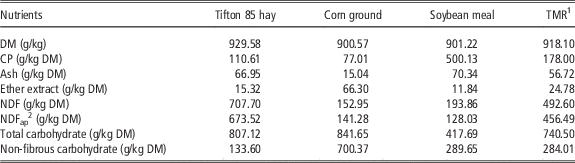
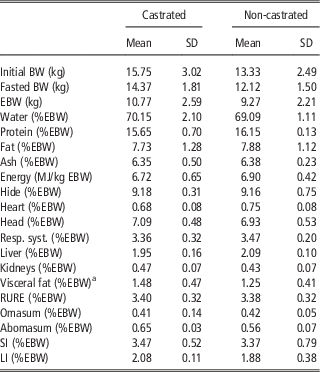
This study used 38 60-day-old hair lambs, comprising 19 castrated and 19 non-castrated Santa Ines lambs averaging 13.0±1.49 kg of BW. We used a factorial design with diet restriction levels (ad libitum, 30% and 60% feed restriction) and two sex classes (castrated and non-castrated males). The ration was formulated to supply the nutritional requirements of late maturity lambs with a gain of 200 g/day as recommended by the National Research Council (NRC) (2007). The total mixed ration was composed of Tifton 85 hay ground in an agricultural chopper and an added concentrate ration composed of ground corn grain, soybean meal and minerals as a loose mixture of single components (Table 1). Total mixed ration was provided twice a day (0800 and 1600 h), allowing for up to 10% orts only for animals fed ad libitum, and the intake was registered based on the daily feed supply. The proportional supply of feed for animals in 30% and 60% feed restriction was calculated daily in relation to the average intake of animals of respective sex classes subjected to ad libitum intake. The lambs had free access to drinking water. At the beginning of the experimental period, four animals from each group were randomly selected and slaughtered as reference animals (Table 2). Fasted BW (FBW) was determined as the BW after 18 h of no access to feed or water.
Chemical composition of the experimental diet (g/kg dry matter (DM))

TMR=total mixed ration.
1 TMR with ingredients proportions of the total ration (g/kg as fed): Tifton 85 hay (60%); corn ground (20.07%); soybean meal (19.23%); limestone (0.19%); dicalcium phosphate (0.41%); sodium chloride (0.07%) and mineral premix (0.03%).
2 NDF corrected for ash and protein.
Body composition and internal organs of reference animals

EBW=empty BW; Resp. syst.=respiratory system; RURE=rumen-reticulum; SI=small intestine; LI=large intestine.
a Visceral fat=renal, mesenteric, omental and cardiac fat.
Sampling, determination of diet digestibility and slaughter
To determine the diet digestibility, indigestible NDF (iNDF) was used as an internal marker to estimate the apparent nutrient digestibility and fecal output (Costa et al., Reference Costa, Pereira, Silva, Paulino, Mizubuti, Pimentel, Pinto and Rocha Junior2013). The feces were sampled for 3 consecutive days at 15-day intervals during the experimental period: at 0800 h on the 1st day, noon on the 2nd day and 1600 h on the 3rd day. The amounts of iNDF in the fecal samples, orts, concentrates and Tifton 85 hay were obtained through in situ waste incubations over a period of 240 h in the rumen of a cow receiving a diet of Tifton 85 hay and concentrates based on corn grain, soybean meal, urea, limestone, dicalcium phosphate, sodium chloride and mineral premix. After incubation, the bags were washed in water until they became clear. Then, following the protocol of Van Soest et al. (Reference Van Soest, Robertson and Lewis1991), the residue was weighed and considered as the iNDF. The level of total digestible nutrients (TDN) was calculated according to Weiss (Reference Weiss1993): TDN=CPd+NFCd+aNDFomd+EEd×2.25 (subscript d means digestible). The digestible energy (DE) was estimated at 18.4 MJ/kg of TDN, and the DE was converted to metabolizable energy (ME) at an 82% efficiency rate (National Research Council (NRC), 2000). The rumen-degradable protein (RDP) was estimated using microbial synthesis efficiencies (MCP) of 76.5, 67.1 and 57.8 g of MCP/kg TDN for the restriction treatments of ad libitum, 30% restriction and 60% restriction, respectively, multiplying by the factor 0.64 for conversion to true microbial digestible protein. The metabolizable protein (MP) intake was calculated as the sum of the microbial protein intake and the digestible rumen-undegradable protein (RUP). The RUP intake was calculated as the difference between the CP intake and the RDP, and the RDP was calculated as microbial protein×1.11.
The animals were weighed weekly to calculate BW gain (BWG). The duration of the study was determined by the time required for the animals fed ad libitum to reach an average BW of 30 kg; using that criterion, the experimental trial lasted 100 days. The FBW was obtained as described for the reference animals. Slaughter was performed by stunning the animals, causing a concussion and sectioning the jugular vein, allowing the animals to completely bleed out. The blood was collected, weighed and sampled. The components of the gastrointestinal tract were separated and weighed with digesta. Subsequently, they were washed and weighed again together with the organs and other body parts (carcass, hide, head and hooves) of each animal. The bodies of the lambs were separated into individual components, namely, the combined lung+trachea and tongue+esophagus, the heart, the bladder, the liver, the kidneys, the reproductive tract, thespleen, the cleaned digestive tract (rumen, reticulum, omasum, abomasum and the small and large intestines) and the fats (heart, omental, mesenteric and perirenal), which were weighed separately. Empty BW (EBW) was defined as FBW at slaughter minus digestive tract contents. The carcass was chilled at 4 °C for ~24 h. After chilling, it was divided into two halves lengthwise. All of the right half-carcasses, non-carcass components (blood, head, hooves, internal organs and the cleaned gastrointestinal tract) and hides were ground separately in an industrial meat grinder. The combined mass of the non-carcass components was sampled. The same protocol was used for right half of the carcass and hide. The samples were placed in a forced-ventilation oven at 55 °C for 72 h and then ground in a ball mill and stored in closed containers for subsequent chemical analysis. The composition of the EBW was calculated as the proportional sum of results for the carcass, non-carcass components and hide.
Laboratory analysis
Concentrate, forage and ort samples were dried in a forced-air oven at 55 °C for 72 h and then ground in a knife mill with a 1-mm screen. The samples were analyzed according to the methods of the Association of Official Analytical Chemists (AOAC, 1990) to determine levels of dry matter (DM) (method 967.03), ash (method 942.05), CP (method 981.10), ether extract (method 920.29) and ADF (method 913.18) (Table 1). The content of the NDF was determined according to Van Soest et al. (Reference Van Soest, Robertson and Lewis1991). The residue from boiling the neutral detergent solution was incinerated in an oven at 600 °C for 4 h, and the correction for protein content was applied by subtracting the neutral detergent-insoluble nitrogen content (Licitra et al., Reference Licitra, Hernandez and Van Soest1996). The constituent animal body parts were defatted by extraction with ether in a Soxhlet apparatus (AOAC, 1990) for 12 h, and the samples were then ground in a ball mill for subsequent chemical analyses.
The mass of the ground organs, blood, hooves, head and right half of the carcass and hide was homogenized, sampled and placed in a forced-ventilation oven at 55 °C for 72 h (Costa et al., Reference Costa, Pereira, Silva, Paulino, Mizubuti, Pimentel, Pinto and Rocha Junior2013). Subsequently, the samples were defatted by extraction with ether in a Soxhlet apparatus (AOAC, 1990; method number 920.39). The samples were ground in a ball mill and stored in closed containers (Regadas Filho et al., Reference Regadas Filho, Pereira, Pimentel, Villarroel, Medeiros and Fontenele2013). The DM contents were determined by placing samples in an oven at 105 °C until constant weight was reached. The ash and CP levels were determined in fat-free samples, following the method described above for experimental diet ingredients. The body water content was determined as 100% minus the DM. Body content of protein (nitrogen content×6.25), fat and ash were determined following the AOAC (1990) methodology. Body energy content (BEC) (MJ) was calculated as the protein content (kg)×23.599 along with the fat content (kg)×39.299.
Models and calculations
The initial EBW of the slaughtered animals in the final experimental period was estimated using the EBW-to-FBW ratio of the reference animals. The empty body fat (EBF) and protein (EBP) contents were determined according to their empty body percentages, and the BEC was obtained according to the following equation: BEC (MJ)=23.599 (EBP, kg)+39.299 (EBF, kg). Body protein, fat and energy contents were predicted from the EBW using an allometric equation according to the Agricultural Research Council (1980), from which we obtained an ordinary least squares linear regression of the logarithm of the body fat (g), protein (g) and energy contents (MJ) v. the logarithm of the EBW (kg): Y=a+b×log EBW, where Y is the body fat, protein or energy content, a the intercept, and b the regression coefficient.
To estimate the net energy requirements for weight gain (NEg), we used the model proposed by Chizzotti et al. (Reference Chizzotti, Tedeschi and Valadares Filho2008): NEg (MJ/day)=a×EBW0.75×EBWG b , where a and b are the coefficients obtained from the non-linear regression of the RE on the empty BW gain (EBWG). The net protein requirement for gain (NPg, g/day) was estimated using the following equation: NPg=β 0+β 1×EBWG+β 2×RE, where EBWG is measured in kg/day, RE the retained energy (MJ/day) and β 0 and β 1 the coefficients of the linear regression equation.
The net energy required for maintenance (NEm) was estimated as the intercept (a) of the regression between the heat production (HP, MJ/kg EBW0.75 per day) and the metabolizable energy intake (MEI, MJ/kg EBW0.75 per day), using the following non-linear exponential model (Ferrell and Jenkins, Reference Ferrell, Garrett, Hinman and Grichting1998): HP=a×e (b×MEI), where a is the estimate of the net energy required for maintenance, b the regression coefficient and e the Euler number.
By the iterative method, the point where MEI equals HP can be determined, and this point can be considered the metabolizable energy requirement for maintenance (MEm). The efficiency of metabolizable energy use for maintenance (k m) was calculated as NEm/MEm, and the efficiency of metabolizable energy use for gain (k g) was considered to be the slope of the regression between the RE and the MEI.
To estimate the net protein requirements for maintenance, the retained protein was plotted as a function of metabolizable protein intake (MPI; g/EBW0.75 per day): PR=β 0+β 1×MPI, wherein PR is the retained protein (g/EBW0.75 per day), and β 0 and β 1 the coefficients. The net protein requirement for maintenance (NPm, g/kg EBW0.75 per day) was assumed to be β0, and the MP efficiency for gain (k pg) was estimated as β 1 (Marcondes et al., Reference Marcondes, Valadares Filho, Oliveira, Paulino, Paulino, Detmann and Silva2011).
The requirements for metabolizable protein for maintenance (MPm; g/kg EBW0.75 per day) were estimated by dividing the intercept of the regression equation for the MPI (g/day), as a function of the EBWG (g/day), by the mean metabolic EBW of the animals, according to Wilkerson et al. (Reference Wilkerson, Klopfenstein, Britton, Stock and Miller1993): MPI=β 0+β 1×EBWG. The estimated requirements based on the EBW were converted to the FBW using the factor (1.18) derived from the relationship between FBW0.75/EBW0.75.
Statistical analyses
The effects of feed restriction and sex class on the intake, performance and body composition parameters were measured using PROC GLM in SAS® software (SAS Institute Inc., Cary, NC, USA), at a significance level equal to 0.05, using the following statistical model:
 $$Y_{{ij}} \,{\equals}\,\mu {\plus}S_{i} {\plus}R_{j} {\plus}\left( {SR} \right)_{{ij}} {\plus}e_{{ij}} {\rm ,}$$
where μ is the general mean, S i the effect of sex classes (castrated or non-castrated), R j the effect of feed restriction (ad libitum, 30% or 60% feed restriction), (SR) ij the interaction between feed restriction and sex classes and e ij the random error.
For linear regression, we used the regression procedure from SAS. Model identity was tested using dummy variables for sex classes as proposed by Regazzi and Silva (Reference Regazzi and Silva1996). The nonlinear procedure was used for non-linear regression analysis. The regression coefficients for the different sex classes were calculated and compared at a 95% confidence interval for significant non-linear regression results.
Results
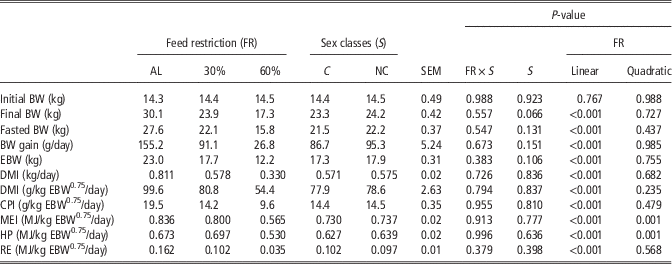
Regarding dry matter intake (DMI), there was no effect of sex classes or interaction of sex classes with feed restriction. The feed restrictions of 30% and 60% imposed on the animals were based on the daily intake of animals fed ad libitum. Dry matter intakes reduced 19 and 45 g/kg BW075 per day respectively for the restriction levels of 30% and 60%. The BWG and final BW were affected by feed restriction (Table 3), but no effects (P>0.05) of sex class were observed. The MEI and retained energy were not affected by sex class, instead declining as feed restriction increased, whereas the HP showed a quadratic response. The coefficients obtained from the linear regressions of the EBW against the BW and the empty EBWG against the BWG did not differ between sex classes (P>0.05). Therefore, equations were generated to estimate the EBW and EBWG for all the animals combined:
 $$\eqalignno{ &{\rm EBW}\left( {{\rm kg}} \right) \,{\equals}\, -{\!}1.0887{\plus}0.9575 {\times}{\rm BW} \cr & \quad\quad\quad\quad\quad\,\,\left( {R^{2} {\equals}\,0.98\,;\, {\rm root}\,{\rm mean}\,{\rm square}\;{\rm error}\left( {{\rm RMSE}} \right)\,{\equals}\,0.228} \right). \cr & {\rm EBWG}\left( {{\rm kg\,/\,day}} \right)\,{\equals}\,-{\!}0.0014{\plus}0.8199\cr &\quad\quad\quad\quad\quad\quad\quad\quad\quad\quad\quad{\times}{\rm BWG}\left( {R^{2} \,{\equals}\,0.98\,;\,{\rm RMSE}\,{\equals}\,0.007} \right){\rm .} $$
Body parameters, intake and energy retention in castrated (C) and non-castrated (NC) Santa Ines lambs

AL=ad libitum intake; 30%=30% of FR; 60%=60% of FR; SEM=standard error of the mean; EBW=empty BW; DMI=dry matter intake; CPI=CP intake; MEI=metabolizable energy intake; HP=heat production; RE=retained energy.
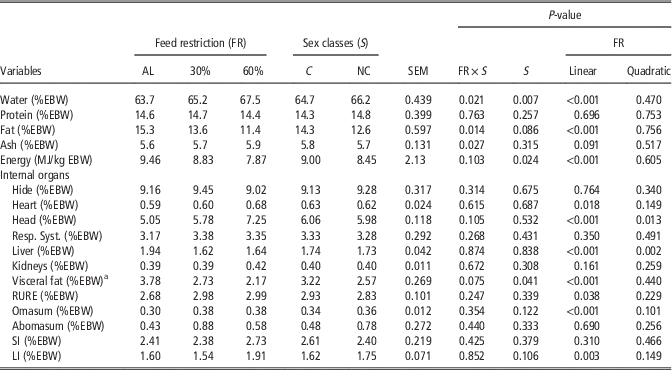
The body fat and BECs decreased linearly with increased feed restriction (Table 4). The BEC was significantly higher in castrated lambs, whereas the body fat content (BFC) tended to be higher but did not reach significance (P=0.086). The body water content increased linearly with increased feed restriction and was higher in non-castrated lambs. The body protein content was not affected by feed restriction or sex class.
Body composition and internal organs of castrated (C) and non-castrated (NC) Santa Ines lambs

AL=ad libitum intake; 30%=30% of FR; 60%=60% of FR; SEM=standard error of the mean; EBW=empty BW; resp. syst.=respiratory system; RURE=rumen-reticulum; SI=small intestine; LI=large intestine.
a Visceral fat=renal, mesenteric, omental and cardiac fat.
The castrated animals presented higher visceral fat content. The proportions of organs and viscera were not influenced by the sex class. The feed restriction promoted an increase in the proportional weight of the heart, head, visceral fat, rumen-reticulum and omasum. On the other hand, a reduction in the proportional weight of the liver was observed as a function of the feed restriction (Table 4).
The identity test indicated an effect of sex class using the following equations for the BFC (RMSE=0.926; P=0.019) and BEC (RMSE=0.970; P=0.024), whereas there was no effect on the body protein content (RMSE=0.938; P=0.387):
 $$\eqalignno{ & {\rm Log}\;{\rm BFC}\;{\rm for}\;{\rm castrated}\;{\rm lambs}\,\colon\,\;1.344\left( {0.165} \right){\plus}1.655\left( {0.136} \right) \cr & \quad {\times}{\rm log}\;{\rm EBW}{\rm .} \cr & {\rm Log}\;{\rm BFC}\;{\rm for}\;{\rm non{\minus}castrated}\;{\rm lambs}\,\colon\,\;1.793\left( {0.119} \right) \cr & \quad {\plus}1.244\left( {0.096} \right){\times}{\rm log}\;{\rm EBW}{\rm .} \cr & {\rm Log}\;{\rm BEC}\;{\rm for}\;{\rm castrated}\;{\rm lambs}\,\colon\,\;0.081\left( {0.056} \right) \cr & \quad {\plus}1.179\left( {0.045} \right){\times}{\rm log}\;{\rm EBW}{\rm .} \cr & {\rm Log}\;{\rm BEC}\;{\rm for}\;{\rm non{\minus}castrated}\;{\rm lambs}\,\colon\,\;-0.152\left( {0.098} \right) \cr & \quad {\plus}1.394\left( {0.080} \right){\times}{\rm log}\;{\rm EBW}{\rm .} \cr & {\rm Log}\;{\rm BPC}\;{\rm for}\;{\rm all}\;{\rm lambs}\,\colon\,\;2.116\left( {0.065} \right){\plus}1.037\left( {0.053} \right) \cr & \quad {\times}{\rm log}\;{\rm EBW}{\rm .} $$
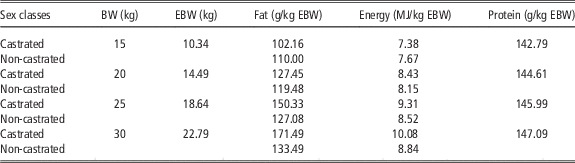
The body fat, energy and protein content (g/kg EBW) increased with increasing BW; however, the increase in BFC and energy was higher for castrated lambs (Table 5).
Fat, energy and protein contents of castrated and non-castrated Santa Ines lambs at various BWs

EBW=empty BW.
The equations generated to estimate NEg from the retained energy (RE) (MJ/EBW0.75/day) and the EBWG did not differ between the castrated and non-castrated lambs; therefore, a general equation was generated:
 $${\rm RE}\left( {{\rm MJ/day}} \right)\,{\equals}\,0.8494{\times}{\rm EBW}^{{0.75}} {\times}{\rm EBWG}^{{0.8154}} {\rm .}$$
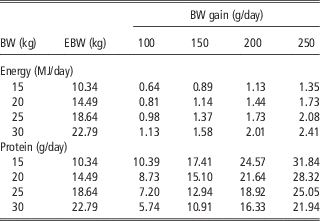
The NEg estimated for the castrated and non-castrated lambs was 1.44 MJ/day for 20 kg BW and 200 g average daily gain (ADG) (Table 6), and the k g was 0.37, based on the following equation:
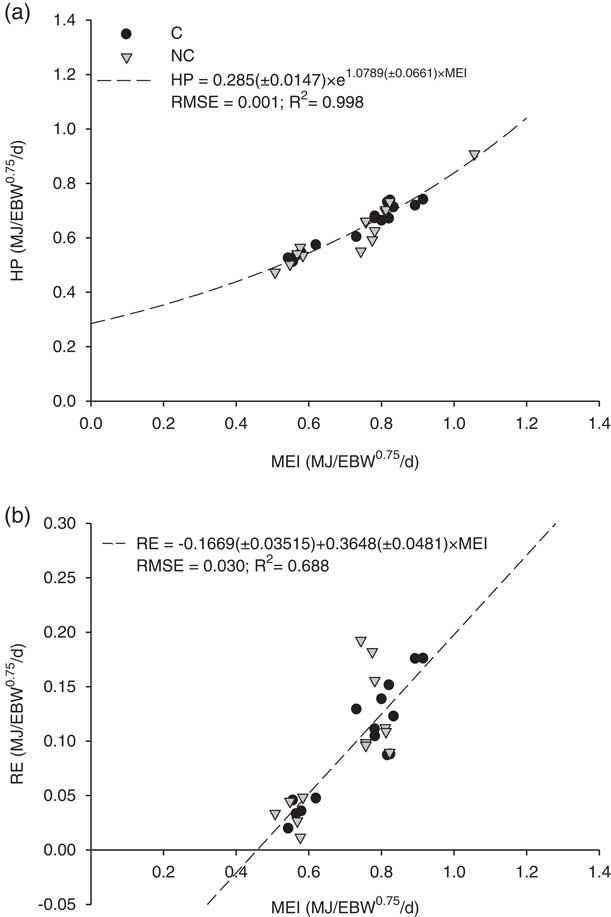
 $$\eqalignno{ {\rm RE}\,{\equals} & \,-{\!}0.1669\left( {0.0351} \right){\plus}0.3648\left( {0.0481} \right) \cr & {\times}{\rm MEI}\left( {{\rm RMSE}\,{\equals}\,0.030\,;R^{2} \,{\equals}\,0.69} \right){\rm .} $$
Net energy and protein requirements for BW gain of castrated and non-castrated Santa Ines lambs at different BW intervals

EBW=empty BW.
There was no effect of sex class on the k g (Figure 1).
Relationships between the heat production (HP) and the metabolizable energy intake (MEI) (a) and between the retained energy (RE) and the MEI (b) of Santa Ines castrated (C) and non-castrated (NC) lambs. EBW=empty BW; RMSE=root mean square error.

The equations generated to estimate the NPg did not differ between classes; therefore, a single equation was generated:
 $${\rm RP}\left( {{\rm g/day}} \right)\,{\equals}\,-{\!}2.1125{\plus}229.170{\times}{\rm EBWG}\,{\minus}\,39.2011{\times}{\rm RE}{\rm .}$$
The NPg for the animals with 20 kg BW and ADG of 200 g/day was 21.64 g/day, and the k pg was 0.28. The decrease in the NPg with increasing BW (Table 5) is due to a reduction in muscle growth and an increase in adipose tissue development. Consequently, the energy requirement increases, with a concomitant decrease in the protein requirement.
The net energy for maintenance (NEm) did not differ between classes; therefore, a single equation was generated to estimate the NEm as the HP, as follows: (Figure 1).
 $$\eqalignno{ & {\rm HP} ( {{\rm MJ/EBW}^{{0.75}} \,{\rm per}\;{\rm day}} \right)\,{\equals}\,0.285\left( {0.0147} \right){\times}{\rm e}^{{1.0789\left( {0.0661}\right) {\times}{\rm MEI} }} \,\cr & \quad\quad\quad\quad\quad\quad\quad\quad\quad\;\; \left( {{\rm RMSE}{\equals}0.001; R^{2} \,{\equals}\,0.998} \right) $$
Using this equation, the NEm was estimated at 0.241MJ/kgFBW0.75 per day. The MEm was 0.403 MJ/kg FBW0.75 per day, and the k m was 0.60.
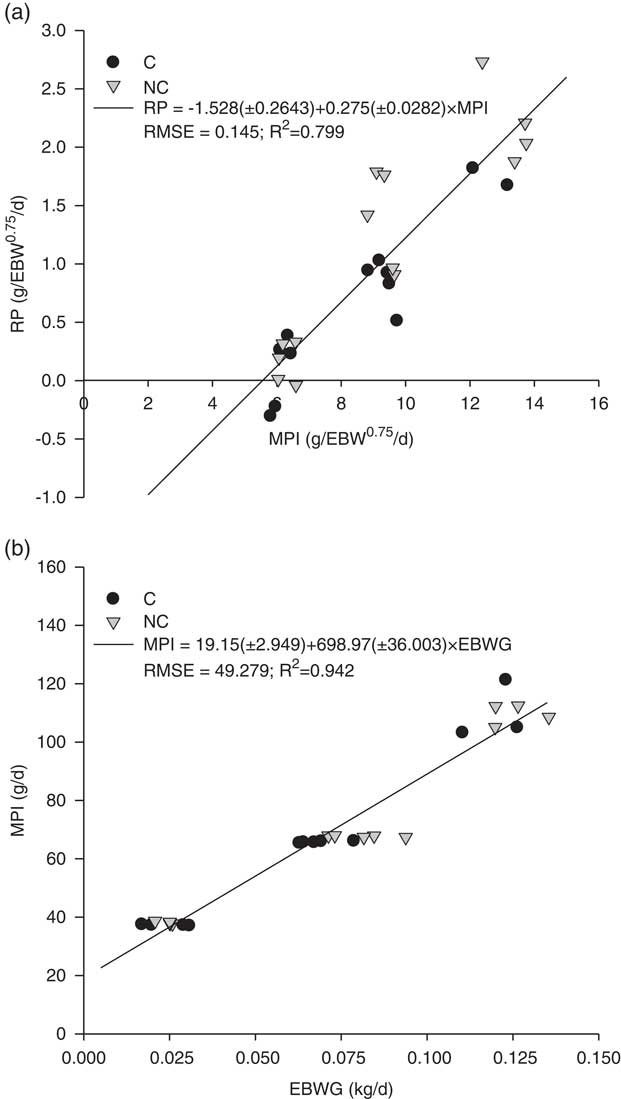
There was no effect of sex class on the NPm, thus an equation was generated for both sex classes (Figure 2):
 $${\rm RP}\,{\equals}\,0.2752{\times}{\rm MPI}{\minus}1.528\,\left( {{\rm RMSE}\,{\equals}\,0.06; R^{2} \,{\equals}\,0.80} \right)$$
Relationships between the retained protein (RP) and the metabolizable protein intake (MPI) (a) and between the empty BW gain (EBWG) and the MPI (b) of Santa Ines castrated (C) and non-castrated (NC) lambs. EBW=empty BW; RMSE=root mean square error.

The NPm was 1.30 g/kg FBW0.75 per day. The relationship between the MPI and the EBWG was modeled using the following equation (Figure 2):
 $${\rm MPI}\,{\equals}\,19.148{\plus}698.97{\times}{\rm EBWG}\,\left( {{\rm RMSE}\,{\equals}\,0.001;R^{2} {\equals}\,0.942} \right)$$
The requirement of MPm was 2.28 g/kg of FBW0.75 per day, and the efficiency of MP use for maintenance (k pm) was 0.57.
Discussion
Accurate predictions of DMI are highly dependent on knowledge of the net energy value that accurately represents the food offered (Pereira et al., Reference Pereira, Fontenele, Medeiros, Lopes, Campos, Heinzen and Bezerra2014), as this defines the quantity of ingested nutrients and therefore determines the animal’s response (Pereira et al., Reference Pereira, Fontenele, Silva, Oliveira, Ferreira, Mizubuti, Carneiro and Campos2016). According to the NRC (2000), sex class has a limited effect on animal feed intake, and the differences are generally attributed to different stages of body maturity reached by the sexes. In our study, the MEI declined with increasing feed restriction. This occurred because lambs fed ad libitum are selective with full diets, preferring the concentrate portion, which results in higher MEI. Sheep are able to differentiate foods based on features such as particle size, smell, shape, texture and other sensory characteristics (Domingue et al., Reference Domingue, Dellow and Barry1991).
Some factors may influence the composition of the animal’s body and consequently its nutrient requirements. Body composition is not constant during growth and is influenced by factors such as breed, age and sex class (Commonwealth Scientific and Industrial Research Organization (CSIRO), 2007; NRC, 2007). It is known that body fat concentration increases as an animal reaches its mature weight (NRC, 2007), and the increase in body fat promotes increased energy requirements (Chizzotti et al., Reference Chizzotti, Tedeschi and Valadares Filho2008). Feed restriction is a factor that influences body composition by inducing a reduction of the BFC and a consequent reduction of the BEC. In our study, the lambs subjected to feed restriction directed most of their nutrients to maintenance requirements, as this becomes the priority in animals subjected to dietary restrictions, resulting in fewer nutrients directed to weight gain and reducing the accumulation of fat.
Another important aspect to consider is the internal organs. The organs with the highest metabolic activity and representing the largest energy expenditure for maintenance are the liver, heart and gastrointestinal tract (Baldwin et al., Reference Baldwin, Smith, Taylor and Sharp1980). The lack of effect for the net requirements of energy for maintenance can be attributed to similarities in the weights of internal organs. The lower relative weight of the liver is related to lower intake of nutrients, especially energy and protein, as it participates actively in the metabolism of these nutrients (Ferrell et al., Reference Ferrell and Jenkins1976). Energy is primarily directed to essential functions when the animals are on feed restriction.
The lower BFC in non-castrated animals is associated with the action of androgens, which are steroid substances with anabolic action that promote higher muscle deposition and less fat deposition (Guiroy et al., Reference Guiroy, Tedeschi, Fox and Hutcheson2002), consequently inducing a lower BEC. The increase in the body protein content (Table 5) indicates that the lambs had not decreased muscle deposition during weight gain and that they were still growing. However, protein deposition increased only 0.7% when the animals increased in BW from 25 to 30 kg, indicating the stabilization of protein deposition.
The energy requirement for weight gain (NEg) is directly related to the gain composition, increasing according to the increase in the energy content of the gain (NRC, 2007). Although the castrated lambs presented a higher BFC, there was no difference in their energy requirement for growth compared with non-castrated lambs. The composition of the weight gain and the efficiency of energy utilization for weight gain (k g) may vary depending on the composition of the diet, weight gain composition, genetic group, rate of gain, physiological state and environmental factors (Garrett, Reference Garrett1980). The difference between the NEg and k g estimated in this study and the values presented by international committees (Agricultural and Food Research Council (AFRC), 1993; CSIRO, 2007; NRC, 2007) may be due to the type of genotype considered by committees for sheep. The k g represents the amount of energy contained in food that is retained in the animal body.
The protein requirement for growth is dependent on the content of fat-free DM in weight gain and varies with BW, weight gain rate, sex class, genetic and nutritional factors (NRC, 2007). Intact males deposit more fat-free body tissue than castrated males, and they therefore have higher protein requirements for gain. However, in this study, there was no difference between sex classes. This observation can be attributed to the young age of the lambs used in this study because greater differences in body composition generally occur after weight maturity. Other studies with sheep in the tropics also found no effect of sex class (Rodrigues et al., Reference Rodrigues, Chizzotti, Martins, Silva, Queiroz, Silva, Busato and Silva2015).
The k pg estimated in this study was lower than 0.59 (AFRC, 1993) and 0.70 (CSIRO, 2007; NRC, 2007). The biological value of the protein source and the ideal mixture of amino acids, among other factors, influence this efficiency (Oldham, Reference Oldham1987).
The NEm is equivalent to the heat produced by the fasting animal, that is, without any feed support to attend any other energetic need, measuring the animal HP that represents the amount of energy dispensed for strictly basal activities, such as breathing, circulation, homeothermy, organ function and enzymatic systems (Valadares Filho et al., Reference Valadares Filho, Marcondes, Chizzotti and Paulino2010). NEm requirements were similar for castrated and non-castrated lambs with no effect of imposed feed restriction. The values obtained for NEm are lower than those established by CSIRO (2007) and NRC (2007). The differences are due to the genotype, the methodologies used and the nature of the experimental data. Differences in NEm estimates may be expected when different energy systems are used, principally because of variations in the nature of the experimental data (Cannas et al., Reference Cannas, Tedeschi, Fox, Pell and Van Soest2004). It should be considered that the differences may be because these animals did not reach maturity during the experimental trial; thus, the estimated energy requirements in these conditions are impaired by the colinearity and interdependence of maintenance and growth and by variations in the partial efficiency values k m and k g (Pereira et al., Reference Pereira, Fontenele, Medeiros, Lopes, Campos, Heinzen and Bezerra2014). The value of NEm obtained in this study was similar to the basal metabolic rate suggested by Poczopko (Reference Poczopko1971), at 0.289 MJ/EBW0.75 per day for adult homeothermic mammals, indicating that the estimation methods were consistent. The NRC (2000) estimates a 15% higher NEm for intact males than for castrated males and females, and this difference is partly due to the higher body protein content in non-castrated males because this component is more metabolically active, requiring greater energy. According to Baldwin et al. (Reference Baldwin, Smith, Taylor and Sharp1980), 50% of the energy requirement for maintenance is consumed by protein recycling and the transport of ions across membranes. However, because the animals in this study were still growing, the effects of naturally produced steroid hormones did not result in differences in the NEm.
To estimate the NEm in sheep, the NRC (2007) adopted the comparative slaughter approach and reported a NEm of 0.259 MJ/kg FBW0.75 per day, which is 7.5% higher than the 0.241 MJ/kg FBW0.75 per day estimated in this study. In contrast, the AFRC (1993) and the CSIRO (2007) adopted the calorimetric method, in which the heat produced by an animal’s body is measured in chambers or obtained using the respiratory quotient, and recommended NEm values of 0.272 and 0.276 MJ/kg FBW0.75 per day, respectively. The NEm estimated in this study was 12.9% and 14.8% lower than the values recommended by these committees. In Brazil, the net energy requirements for maintenance have been calculated using the comparative slaughter method. In the comparative slaughter method, the MEI and retained energy variables are measured directly and the HP is obtained by difference, whereas in the calorimetric method, the MEI and HP variables are measured directly and the energy retained is obtained by difference (NRC, 2000). Thus, the calorimetric method is more precise in determining the requirement of NEm, as the HP is measured directly and not estimated. On the other hand, the comparative slaughter method has the advantage of being conducted under conditions similar to those of the production systems, whereas not presenting the limitations that the long-term experiments have for the use of animals in the growth, gestation or lactation phase.
The demand for maintenance protein is equivalent to the fecal and urinary metabolic N losses, in addition to the protein lost by scurf. Reduction in feed intake may result in a decreased protein degradation rate in some tissues (Attaix et al., Reference Attaix, Rémond and Savary-Auzeloux2005). Feed restriction might reduce lambs’ protein requirements for maintenance. In addition, body composition can influence the protein requirements for maintenance. The NPm corresponds to 1.30 g/kg FBW0.75 per day, a lower value than that recommended by the AFRC (1993), the NRC (2007) and the CSIRO (2007). The variations in the protein requirements for maintenance in the literature may be related to different estimation methodologies used, as well as factors such as breed, sex class and physiological status. The AFRC (1993) estimates the NPm via N-free diets and intragastric N infusion, which can overestimate N excretion (CSIRO, 2007). On the other hand, the NRC (2007) and cornell net carbohydrate and protein system - sheep (Cannas et al., Reference Cannas, Tedeschi, Fox, Pell and Van Soest2004) use empirical equations to estimate the N excreted in feces and urine and retained in the hair, and the sum of these values corresponds to the NPm. The methodology used in this study does not account for N losses in hair and scurf; thus, the NPm estimated via this method is generally lower than that recommended by the international committees. The conditions of low feed intake and protein mobilization can induce a lower k pm than that found in normal feeding conditions. In addition, this reduction is dependent on the mobilized amino acid profile required for maintenance (NRC, 2007). Thus, these factors may have contributed to the lower NPm estimated in this study because the animals were fed restricted diets.
The requirement for the MPm was estimated at 2.28 g/kg FBW0.75 per day, and the efficiency of k pm at 0.57. The MPm was similar to that reported by Galvani et al. (Reference Galvani, Pires, Kozloski and Wommer2009) at 2.31 g/kg FBW0.75 per day. The NRC (2007) and CSIRO (2007) estimated k pm at 0.67, a value 11% higher than that reported in this study. Some of the assumptions employed to estimate the MP intake may contribute to this variability (Galvani et al., Reference Galvani, Pires, Kozloski and Sanchez2008). Another factor that may contribute to this difference is the inaccuracy associated with the mathematical models (Cannas et al., Reference Cannas, Tedeschi, Fox, Pell and Van Soest2004) used to estimate RUP intake and the constant values used to calculate the digestible fractions of microbial true protein intake and RUP.
The net energy and protein requirements for gain did not differ between sex classes. The NEg varied from 1.13 to 2.01 MJ/day for lambs with BW of 15 and 30 kg and BWG of 200 g. The NPg varied from 24.57 to 16.33 g/day for lambs with BW of 15 and 30 kg and BWG of 200 g. The net energy and protein maintenance requirements, estimated at 0.241 MJ/FBW0.75 per day and 1.30 g/kg FBW0.75 per day, respectively, were also unaffected by sex class. The present study emphasize the importance of updating the tables of the international committees and of including data obtained from studies with sheep breeds raised in tropical conditions, with the purpose of improving the productive efficiency of the animals.
Acknowledgments
The authors thank the National Council for Scientific and Technological Development (CNPq – Brazil).