INTRODUCTION
Eight of the 12 new cetacean species described in the last century belong to the family Ziphiidae, mostly to the genus Mesoplodon Gervais, 1850 (Mead, Reference Mead, Ridgeway and Harrison1989; Dalebout et al., Reference Dalebout, Mead, Baker, Baker and Van Helden2002; Perrin, Reference Perrin2015). At the surface, the beaked whales' morpho-traits do not allow equally easy identification and require a close observation of the head (Barlow et al., Reference Barlow, Ferguson, Perrin, Ballance, Gerrodette, Joyce, MacLeod, Mullin, Palka and Waring2006; Jefferson et al., Reference Jefferson, Webber and Pitman2015). Little is known of most of the Ziphiidae, due to their cryptic, shy and elusive behaviour. Their prolonged dives, small group size, and inconspicuous surface activity showing only small body portions for very short durations, increase the poor detectability. The lack of beaked whales abundance estimates, together with the geographic variation of sighting rates could be related to difficulties in their visual detection and identification at sea, mainly due to the need for very good sea state and wind (Douglas and Beaufort scales = 0–1), to observers’ experience in detecting beaked whales at sea, and to a scant research effort in large pelagic areas (Barlow et al., Reference Barlow, Ferguson, Perrin, Ballance, Gerrodette, Joyce, MacLeod, Mullin, Palka and Waring2006). In particular, the genus Mesoplodon is also frequently misidentified at sea for its anatomical similarities, especially for juveniles and females (Pitman, Reference Pitman, Perrin, Würsig and Thewissen2009).
Four Mesoplodon species inhabit the North Atlantic, i.e. Gervais’ beaked whale Mesoplodon europaeus (Gervais, 1855), Blainville's beaked whale Mesoplodon densirostris (Blainville, 1817), True's beaked whale Mesoplodon mirus True, 1913, and the endemic Sowerby's beaked whale Mesoplodon bidens (Sowerby, 1804) (Mead, Reference Mead, Ridgeway and Harrison1989; MacLeod, Reference MacLeod2000; MacLeod et al., Reference MacLeod, Perrin, Pitman, Barlow, Balance, D'Amico, Gerrodette, Joyce, Mullin, Palka and Waring2006). They are sympatric, at a large scale, in the North Atlantic warm-temperate zone (MacLeod, Reference MacLeod2000).
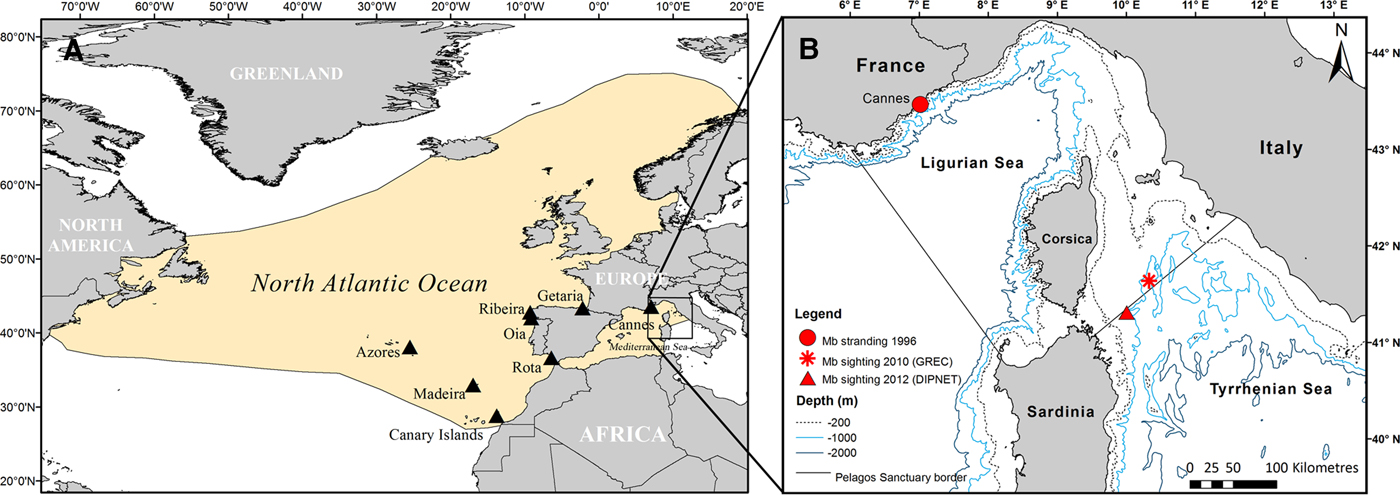
Mesoplodon bidens is characterized by the northernmost distribution (Figure 1A), whereas M. densirostris, M. mirus and M. europaeus generally occur further south with an almost certainly cross-equatorial geographic range (MacLeod, Reference MacLeod2000). The northernmost live sighting of M. bidens occurred in the polar Norwegian Sea (Carlström et al., Reference Carlström, Denkinger, Feddersen and Øien1997) while the majority of stranding records occurred in the European Atlantic Coast (MacLeod et al., Reference MacLeod, Perrin, Pitman, Barlow, Balance, D'Amico, Gerrodette, Joyce, Mullin, Palka and Waring2006) (Figure 1A), where it is also the most commonly stranded species among mesoplodonts (Bachara et al., Reference Bachara, Cermeño and Norman2014). Regular sightings of M. bidens off the Azores (MacLeod & Mitchell, Reference MacLeod and Mitchell2000; Visser, Reference Visser2012; Villa, personal communication) along with many strandings (Reiner, Reference Reiner1986; Reiner et al., Reference Reiner, Gonçalves and Santos1993; Pereira et al., Reference Pereira, Neves, Prieto, Silva, Cascão, Oliveira, Cruz, Medeiros, Barreiros, Porteiro and Clarke2011; Bachara et al., Reference Bachara, Cermeño and Norman2014) and sightings off the Madeira Archipelago (Maul & Sergeant, Reference Maul and Sergeant1977; Freitas et al., Reference Freitas, Dinis, Nicolau, Ribeiro and Alves2012) highlight that these areas may represent the south-eastern parts of its geographic range, with the latter recent live sightings probably related to the increase in local cetological research. Stranding records of M. bidens were also reported as extralimital in the Canary Archipelago (Lanzarote) by Martín et al. (Reference Martín, Tejedor, Pérez-Gil, Dalebout, Arbelo and Fernández2011), and from the southern Spanish Atlantic coast, near Cádiz (Bellido et al., Reference Bellido, Cabot, Farfán, Castillo, Martín, Mons, Muñoz, Vázquez and Real2008) ~100 km away from the Gibraltar Strait (Figure 1A). However, the south-westernmost stranding, maybe extralimital, occurred in Brazil in 1983 and was only recently identified as M. bidens (Bachara et al., Reference Bachara, Cermeño and Norman2014).
(A) Mesoplodon bidens. North Atlantic geographic range (shaded area) (modified from MacLeod et al., Reference MacLeod, Perrin, Pitman, Barlow, Balance, D'Amico, Gerrodette, Joyce, Mullin, Palka and Waring2006; IUCN, 2008) with the area of potential occurrence in the Mediterranean Sea. Stranding records (black triangles) in the southernmost North-eastern Atlantic Ocean and western Mediterranean Sea, during 1941–2012 (N = ind. num.). Getaria, Spain, 2006, N = 1 (Bachara et al., Reference Bachara, Cermeño and Norman2014); Ribeira, Spain, 2012, N = 1 (Covelo et al., Reference Covelo, Martínez-Cedeira, Llavona, Díaz and López2016); Oia, Spain, 2013, N = 1 (Covelo et al., Reference Covelo, Martínez-Cedeira, Llavona, Díaz and López2016); Rota, Spain, 2007, N = 2 (Bellido et al., Reference Bellido, Cabot, Farfán, Castillo, Martín, Mons, Muñoz, Vázquez and Real2008); Lanzarote, Canary Archipelago, Spain, 2007, N = 1 (Martín et al., Reference Martín, Tejedor, Pérez-Gil, Dalebout, Arbelo and Fernández2011); Madeira Archipelago, Portugal, 1941–2012, N = 4 (Maul & Sergeant, Reference Maul and Sergeant1977; Freitas et al., Reference Freitas, Dinis, Nicolau, Ribeiro and Alves2012); Azores Archipelago, Portugal, 1981–2009, N = 23 (Reiner, Reference Reiner1986; Reiner et al., Reference Reiner, Gonçalves and Santos1993; Bachara et al., Reference Bachara, Cermeño and Norman2014). (B) Sighting positions recorded in the Mediterranean Sea by GREC (asterisk) in 2010 and by DIPNET (triangle) in 2012 and stranding site (circle) in Lérins Islands (see Table 1). The International Pelagos Sanctuary is indicated by black lines.

There is no evidence of the regular occurrence of mesoplodonts in the Mediterranean (MacLeod et al., Reference MacLeod, Perrin, Pitman, Barlow, Balance, D'Amico, Gerrodette, Joyce, Mullin, Palka and Waring2006), while Cuvier's beaked whale Ziphius cavirostris Cuvier, 1823 is thought to be the only regularly occurring ziphiid (Notarbartolo di Sciara, Reference Notarbartolo di Sciara2002; Notarbartolo di Sciara & Demma, Reference Notarbartolo Di Sciara and Demma2004). Only five mesoplodont specimens in four reliable strandings are known in the Mediterranean Sea, with just one referred to a live stranding event (Table 1). A specimen reported as female M. bidens stranded in 1927 on the western coast of Italy (Brunelli & Fasella, Reference Brunelli and Fasella1928) but samples were neither preserved, nor any clear morphological description was given to provide a less doubtful identification (Podestà et al., Reference Podestà, D'Amico, Pavan, Drougas, Komnenou and Portunato2006). The ascription to the genus Mesoplodon by the authors was based on the teeth position (‘not on the tip of the lower jaw, but significantly distant’, Brunelli & Fasella, Reference Brunelli and Fasella1928). Although the description is detailed enough to conclude that it was not a Cuvier's beaked whale, it is insufficient for a reliable identification at species level. The Gervais’ beaked whale (M. europaeus) stranded in Italy in 2001 represents the first Mediterranean record of this species (Podestà et al., Reference Podestà, Cagnolaro and Cozzi2005).
Genus Mesoplodon. Records of stranded beaked whales in the Mediterranean Sea.

Only a single Mediterranean record (live stranding) may be clearly referred to M. bidens on the basis of photographic data (Van Canneyt et al., Reference Van Canneyt, Dabin and Collet1998; Bompar, Reference Bompar2000; Notarbartolo di Sciara, Reference Notarbartolo di Sciara2002; Dhermain, Reference Dhermain2004; Reeves & Notarbartolo di Sciara, Reference Reeves and Notarbartolo di Sciara2006), when two subadults M. bidens were rescued and refloated in the Lérins Islands (Cannes, Ligurian Sea), without collecting any tissue samples to confirm, on a genetic basis, the species identity (Bompar, Reference Bompar2000). Podestà et al. (Reference Podestà, D'Amico, Pavan, Dolman, McLeod and Evans2009) stated that all these strandings indicate the presence of the genus Mesoplodon in the Mediterranean Sea, but until then no live sighting data were available. Although stranding records actually provided much of the available information on the beaked whales, geographic range can be better assessed when regular sightings occur.
The debate as to whether the Sowerby's beaked whale inhabits the Mediterranean Sea is still open. Here we report two live sightings of M. bidens from the western Mediterranean Sea, along the south-eastern border of the International Pelagos Sanctuary for the protection of Mediterranean marine mammals.
MATERIALS AND METHODS
Sighting No. 1 was part of a GREC dedicated programme on Z. cavirostris during visual and acoustic boat surveys, carried out in sea state Douglas 0–1 (i.e. Beaufort wind force scale 0–1) by three experienced observers. The survey focused on natural behaviour, therefore groups were not approached and the sail boat was stopped at a distance of 100–200 m away from the whales. Photographs were taken using digital cameras. For all GPS positions, depth was then determined using GEBCO Atlas (IOC–IHO–BODC, 2003); see Gannier (Reference Gannier2011) for full description of field protocol.
Sighting No. 2 was part of a DIPNET–University of Sassari research programme focused on pelagic cetaceans (Bittau & Manconi, Reference Bittau and Manconi2011; Bittau, Reference Bittau2014). Visual observation and photo-identification were carried out during an opportunistic boat survey (whale watching) by means of a power catamaran in sea state Douglas scale 0–2 (i.e. Beaufort wind force scale 0–3). Photographs of the animals were collected using digital cameras. For all GPS positions, depth was then determined by ISMAR–CNR depth data using Geographic Information System (GIS) ESRI ArcGIS 9.3. SST was recorded during all tracking by a Garmin transducer (GPS nav 540s) positioned on the boat's hull. See Bittau & Manconi (Reference Bittau and Manconi2016) for a full description of the field protocol.
Species identification was based on the photographic and behavioural data analysis of diagnostic traits of the two animals vs the other species of Mesoplodon expected to occur in the North Atlantic (Leatherwood & Reeves, Reference Leatherwood and Reeves1983; Heyning, Reference Heyning, Ridgeway and Harrison1989; Mead, Reference Mead, Ridgeway and Harrison1989; MacLeod, Reference MacLeod2000; Jefferson et al., Reference Jefferson, Webber and Pitman2015).
RESULTS
Sighting offshore the Corsica Island
Sighting No. 1 is the northernmost of the two records (Figure 1B), and occurred on 9 August 2010, 72.2 km offshore eastern Corsica, in the Montecristo Trough area (41°42.467′N 10°16.550′E; time 17:47 UTC+1) at a depth of 1280 m on sighting position, with Douglas and Beaufort 0–1, calm sea and cloudy weather. At first, a beaked whale group was visually detected, at a distance of ~0.93 km while cruising at 5 knots.
A group size of eight beaked whales was initially estimated, but later it appeared to be structured in two subgroups of three and five individuals. A single individual was initially observed repeatedly breaching, up to four times in a row, displaying belly flop leaps and showing flippers, hence not showing its full body length (Figure 2A) and staying not less than 100 m away. The subgroup of three, apparently including all juveniles, approached the boat at less than 10 m, were photographed at close distance and identified with certainty as Cuvier's beaked whales, due to their head shape (Figure 2B). The general behaviour was initially social and mobile, with the two subgroups that joined and split, thus showing a variable size, at times performing short dives, but with always at least two individuals at the surface. This uncoordinated behaviour finished when all eight animals dived. Some clicks were recorded after this dive and thereafter. After a 29 min dive, one whale was spotted at the surface and 3 min later three individuals, presumably juveniles, were visible, but they were never approached. The sighting was concluded when clicks were no longer recorded and beaked whales were not visible anymore. The total sighting duration was 96 min, including 31 min during which the entire group was generally visible, and 65 min when most individuals performed a deep dive. This sighting was immediately qualified as unusual, because of both group size and surface activity.
Mesoplodon bidens in the western Mediterranean Sea. (A) The M. bidens associated with Ziphius cavirostris sighted offshore E Corsica (August 2010), during the breaching series, showing long pointed beak and prominent bulge. (B) Head of Z. cavirostris recorded during the same sighting of (A). (C and D) The M. bidens sighted offshore NE Sardinia (June 2012). (C) Head details of the animal showing dark colour, long beak, prominent bulge and concave shape between the forehead and the beak; (D) the same animal as in (C) showing its long beak, pale blaze and closely spaced parallel scars on body side. Photo credits: (A and B), Adrien Gannier; (C and D), Paolo Curto.
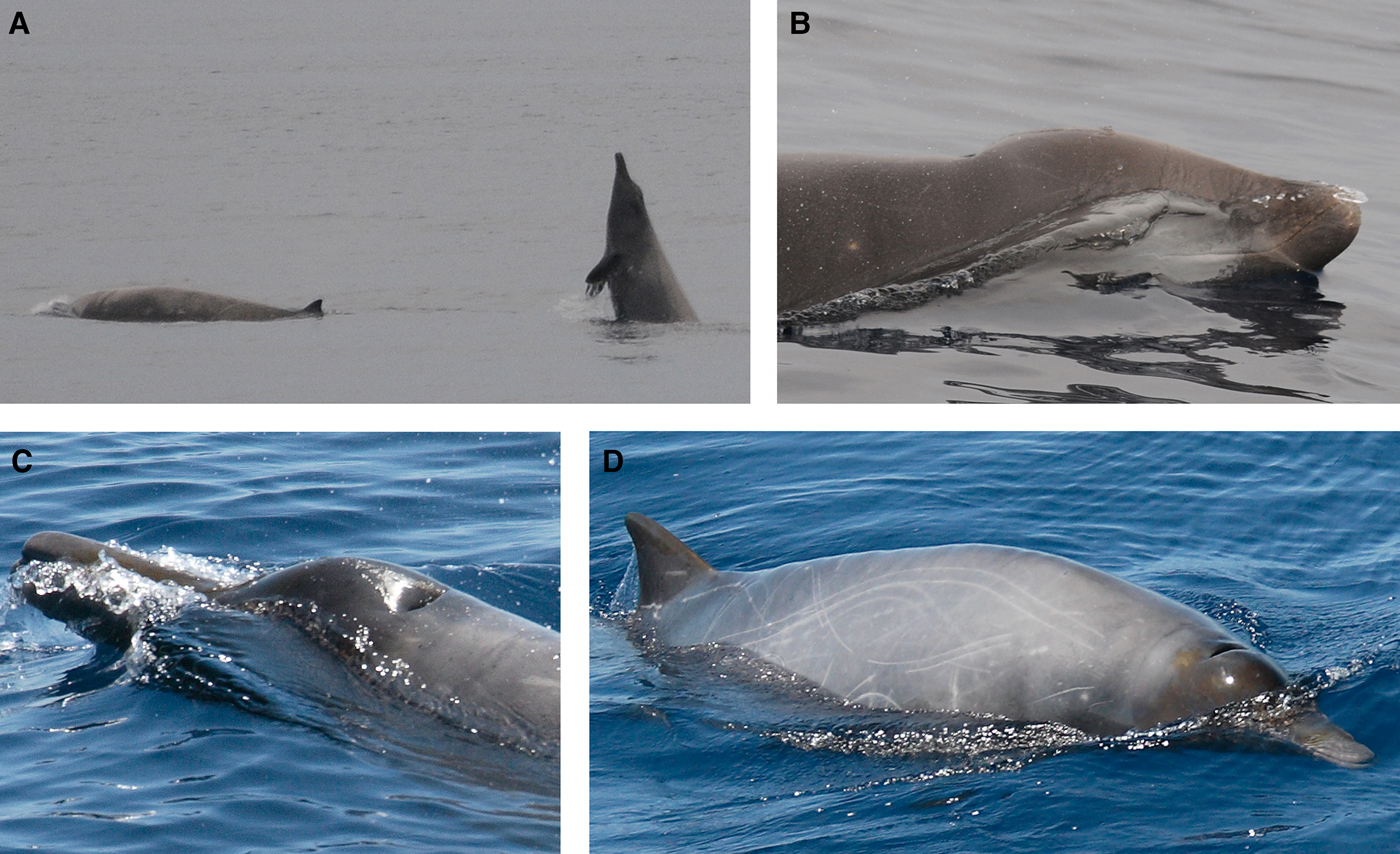
All whales sighted in 2010 offshore eastern Corsica were initially recorded as Z. cavirostris. However, one individual in the subgroup of five, showing its forebody during the breaching series, was distinguished by a highly distinctive long and thin beak compared with the rest of the group (Figure 2A and B). At that time this unusual head shape was associated with its lean body, perhaps characteristic of an emaciated individual. Two years later, despite the long distance observation and poor quality photographs, the final identification of this individual as a Cuvier's beaked whale was reviewed after the sighting of a mesoplodont, carried out offshore Sardinia by DIPNET. The more detailed photographic analysis allowed us to also identify the 2010 animal as a mesoplodont. Six sightings of Z. cavirostris were recorded by GREC in the study area, offshore eastern Corsica from 2010–2012, in 787 km of effective effort (0.76 group per 100 km). Gannier & Epinat (Reference Gannier and Epinat2008) reported a sighting rate of 0.1 group per 100 km for Cuvier's beaked whale in the northern Tyrrhenian Sea, and Gannier (2011) obtained 19 primary sightings with an effective effort of 907 km in 2007–2008, giving a mean sighting rate of 1.88 group per 100 km.
Sighting offshore Sardinia Island
Sighting No. 2, the southernmost of the two records, is located to the east of the Bonifacio Strait (Figure 1B). It occurred on 17 June 2012, 44.5 km offshore north-eastern Sardinia, in the Caprera Canyon area (41°23.075′N 9°57.672′E; time 12:50 UTC+1; Figure 1B) at a depth of 950 m and sea surface temperature of 21.8 °C on sighting position. Sea and weather conditions were wind Beaufort 1, good sea state (Douglas 1) and visibility >10 km. Total time with the animals was 9 min.
A group of four individuals was first identified as Cuvier's beaked whales, when observed from a distance. During the approach, an animal was identified as an adult male Z. cavirostris showing a white, odd-shaped head with a deformed beak, which seemed to have suffered a previous fracture. The colour pattern showed ochre–yellowish patchiness, presumably because of diatoms and distinct body scarring, with some fresh rake marks on the head, consistent with a mature male (according to Rosso et al., Reference Rosso, Ballardini, Moulins and Würtz2011). The second animal was identified as an adult female Z. cavirostris, with greyish colour and poor body scarring, showing only some white patches. The third animal was a juvenile Z. cavirostris, due to its typical, totally brownish head and poor scarring pattern.
Field identification of the fourth, 4–5 m long, animal was not so clear. This beaked whale approached the boat to less than 100 m and displayed morphological and behavioural traits typical of some Mesoplodon species such as a long and thin beak, and a prominent bulge on the forehead. Early in the observation, the beaked whale performed one breach, where the whole body, except the flukes, left the water. Then it surfaced to breathe at a steep angle, displaying its long beak way out of the water. Observations of the head in close-up photos seem to show that there were no teeth in the lower jaw (Figure 2C and D). Also, it was a very lean animal, as seen from frontal observation. Moreover, the colour pattern of this animal showed a dark head and a pale blaze across the back, in front of the dorsal fin.
Fifteen parallel, double linear scars ~1–2 m in length on both sides of the animal, mostly located on the right flank, were highlighted by photographs (Figure 2D). Scars were mainly closely parallel, and ranging from fine- to medium-scrape, with estimated size ranging from a thickness ≤1 cm (fine scrape) to 1–3 cm (medium scrape), following Cuvier's beaked whale mark description (Rosso et al., Reference Rosso, Ballardini, Moulins and Würtz2011). Almost all pairs of linear marks on both sides showed a narrow width and a lighter grey colour, compared with the colour of the surrounding skin. Few single fine and medium scrapes (not paired) were observed on both sides of the animal, below and behind the dorsal fin. Three small, not recent, oval scars were observed on the left side of the body, below the dorsal fin, and several more on the right, behind the eye. These may be ‘attachments’ similar to Z. cavirostris natural marking (Rosso et al., Reference Rosso, Ballardini, Moulins and Würtz2011) and related to sea lampreys (Petromyzon sp.) or scars from cookie cutter shark bites (Isistius sp.), a pelagic squaloid never recorded in the Mediterranean Sea (Di Natale et al., Reference Di Natale, Idrissi and Rubio2013). During a DIPNET survey in 2011, a sea lamprey (Petromyzon sp.) was sighted by the authors at the surface in the Caprera Canyon area, attached to a live pelagic stingray Pteroplatytrygon violacea (Bonaparte, 1832). Other smaller white dots may be due to previous settlement of epizoic copepods as the single probable Pennella sp., settled behind the dorsal fin, on the left side back of the observed mesoplodont. Total effort offshore Sardinia in 2011–2013 made by DIPNET–University of Sassari was 11,700 km, 3537 km of which were run on-effort, searching for cetaceans. A total number of 64 Cuvier's beaked whale groups were sighted in this time, with a mean sighting rate of 1.89 group per 100 km (Bittau & Manconi, Reference Bittau and Manconi2016).
DISCUSSION
The animals described here clearly matched morphological and behavioural traits of the genus Mesoplodon (Mead, Reference Mead, Ridgeway and Harrison1989). Photographs of both animals highlighted the Sowerby's beaked whale Mesoplodon bidens diagnostic traits (Leatherwood & Reeves, Reference Leatherwood and Reeves1983; Jefferson et al., Reference Jefferson, Webber and Pitman2015) as a beak longer and thinner than other mesoplodonts occurring in the North Atlantic, a melon with prominent bulge on the forehead, a concave shape between the forehead and the beak, a small triangular dorsal fin and laterally compressed body shape.
The comparative analysis (see Leatherwood & Reeves, Reference Leatherwood and Reeves1983; Mead, Reference Mead, Ridgeway and Harrison1989; Jefferson et al., Reference Jefferson, Webber and Pitman2015) highlighted that the beak observed in each of the two sightings was too long to belong to Gervais’, Blainville's or True's beaked whales. The long beak observed in 2012, projected at a 45° angle from the water before the rest of the head (Figure 2C) is a typical Sowerby's beaked whale surfacing behaviour (Hooker & Baird, Reference Hooker and Baird1999; Jefferson et al., Reference Jefferson, Webber and Pitman2015). The later photographic analysis of the individual sighted in 2010 showed the typical long beaked-head profile, displayed during the breaching series and definitely identified it as M. bidens.
Although M. bidens colouration is not well known, and does not appear to be distinctive, the colour pattern evident in the 2012 sighting (Figure 2D) seems quite usual in M. bidens and consistent with the dark head, lighter grey blaze on the sides, and pale back extended just behind the dorsal fin, as described by Jefferson et al. (Reference Jefferson, Webber and Pitman2015).
Adult male M. bidens have two teeth on the lower jaw, about two-thirds from the beak tip (Mead, Reference Mead, Perrin, Wursig and Thewissen2002), generally producing single scars, not paired (Jefferson et al., Reference Jefferson, Webber and Pitman2015). Scarring tends to be numerous on adult males (Heyning, Reference Heyning1984; Mead, Reference Mead, Ridgeway and Harrison1989). However, the long, close-spaced parallel scars along both flanks of the M. bidens sighted in 2012 (Figure 2D) seem left by an adult male of a different beaked whale species bearing terminal teeth at the tip of the lower jaw, according to McCann (Reference McCann1974); Heyning (Reference Heyning1984) and J. Mead (personal communication). The close-spaced parallel scars are typically related to males Z. cavirostris or M. mirus, both with apical teeth on the lower jaw (McCann, Reference McCann1974; Heyning, Reference Heyning1984), the former rather common in the Caprera Canyon area (Bittau et al., Reference Bittau, Gilioli and Manconi2013b, Reference Bittau, Gilioli, Leone, Costa and Manconia; Bittau & Manconi, Reference Bittau and Manconi2016).
The apparent lack of teeth in this individual could mean that they had not erupted yet, or they were not yet clearly visible, as in subadult males. However, this animal may have already fought with different males, as clearly shown by the extensive linear scars of different thickness. Both present sightings of M. bidens in the Mediterranean Sea occurred in association with groups of Z. cavirostris, whose males may have inflicted these wounds, due to inter-species interactions. There are few data on inter-species interactions among beaked whales (Allen et al., Reference Allen, Mead and Brownell2011). The extensive scars on the mesoplodont sighted in 2012 raise further questions on how long it had been wandering in the Mediterranean and whether both records involved the same individual. These new records confirm that M. bidens may occur occasionally in the Mediterranean Sea.
Photographic matching between the two mesoplodonts did not allow us to conclude that both the M. bidens were the same individual, due to the poor quality photographs of the 2010 animal, although the mutual distance (44.4 km), and the occurrence of both Sowerby's in mixed groups with Cuvier's beaked whales, might suggest this hypothesis. A further photographic comparison of the 2012 Tyrrhenian mesoplodont vs North East Atlantic Sowerby's beaked whale catalogues should be made.
Both present sightings occurred in the central–western Tyrrhenian (western Mediterranean Sea) in an area previously identified as a favourable habitat for Z. cavirostris (Gannier & Epinat, Reference Gannier and Epinat2008; Gannier, Reference Gannier2011). The two single mesoplodonts encountered offshore Corsica and Sardinia were in both cases associated with a Z. cavirostris group and represent very unusual sightings, even in areas where members of both genera co-occur. Finally, a matching was attempted between the Z. cavirostris individuals associated with M. bidens in 2010 vs those in 2012, but the poor quality of the first sighting photographs did not allow us to determine whether the two groups of Cuvier's beaked whales shared some individuals. Mesoplodon bidens and Z. cavirostris seem to have a different diet and probably occupy a separate ecological niche (MacLeod et al., Reference MacLeod, Santos and Pierce2003). The dietary plasticity of M. bidens argued by Pereira et al. (Reference Pereira, Neves, Prieto, Silva, Cascão, Oliveira, Cruz, Medeiros, Barreiros, Porteiro and Clarke2011) may partly explain its association, in the medium term, with Z. cavirostris. However it is unclear how the two beaked whale species may share different foraging habits and relative dive depths, in the case of a prolonged association (years) in a mixed species group. Stomach contents of M. bidens stranded in the Azores revealed a diet composed primarily of small, midwater fish inhabiting depths of 0–750 m, confirming that this species is mainly a fish eater (Pereira et al., Reference Pereira, Neves, Prieto, Silva, Cascão, Oliveira, Cruz, Medeiros, Barreiros, Porteiro and Clarke2011) as in MacLeod et al. (Reference MacLeod, Santos and Pierce2003), Pitman (Reference Pitman, Perrin, Würsig and Thewissen2009) and Spitz et al. (Reference Spitz, Cherel, Bertin, Kiszka, Dewez and Ridoux2011). On the other hand Cuvier's beaked whale has a highly specialized diet, feeding mainly on larger prey, as oceanic (meso- to bathy-pelagic) cephalopods, although some authors also found remains of oceanic fish and crustaceans (Blanco & Raga, Reference Blanco and Raga2000; Santos et al., Reference Santos, Pierce, Herman, Lopez, Guerra, Mente and Clarke2001).
The current literature data (e.g. MacLeod et al., Reference MacLeod, Perrin, Pitman, Barlow, Balance, D'Amico, Gerrodette, Joyce, Mullin, Palka and Waring2006) indicate that Sowerby's beaked whale in the Mediterranean Sea could be considered as a stray. In the past, Cuvier's beaked whale Z. cavirostris was also regarded as an accidental species (Tortonese, Reference Tortonese1957). It was only after mass strandings since the 1960s (Tortonese, Reference Tortonese1963; Podestà et al., Reference Podestà, D'Amico, Pavan, Drougas, Komnenou and Portunato2006) and along with the increase of sightings since the 1980s that this species has been considered common in the western and eastern Mediterranean basins.
Based on the initial misidentification of the M. bidens sighting in 2010, it cannot be excluded that some mesoplodonts encountered in the past may have been misidentified as Cuvier's beaked whales and missed because of the underlying assumptions that all individuals in a group, or distant sightings, belong to a single species. However their occurrence may be more common than we currently know. We suggest that species identification of some previous beaked whale sightings should be carefully dealt with or revisited by photographic analysis of datasets, in order to investigate the possible co-occurrence of mixed species groups. Present records might confirm the M. bidens occasional occurrence in the Mediterranean Sea.
The sightings described here are until now the only records, supported by photographic documentation, of free-ranging Sowerby's beaked whales in the Mediterranean Sea. The present data contribute to increase information on M. bidens presently categorized as ‘Data Deficient’ at a global level in the IUCN Red List of Threatened Species (Taylor et al., Reference Taylor, Baird, Barlow, Dawson, Ford, Mead, Notarbartolo di Sciara, Wade and Pitman2008).
The co-occurrence with Z. cavirostris could indicate the need to be associated with another deep-feeder beaked whale to forage efficiently and/or the need of protection against predators.
If both sightings involved the same individual it would mean that one M. bidens has survived for at least two years and the scars may have been inflicted during the time spent in the Mediterranean basin. On the basis of the present sightings and previous live stranding, we hypothesize that the western Mediterranean Sea is a marginal area of the M. bidens North Atlantic geographic range. More likely, M. bidens in the Mediterranean could still be considered strays from the nearby North Atlantic cetacean community.
Further research effort focused on beaked whales might help to confirm the M. bidens occasional occurrence in other Mediterranean areas as well, or even lead to investigations with regard to the presence of a potential small population in this enclosed basin.
ACKNOWLEDGEMENTS
Fieldwork would not have been possible without the collaboration and support of Corrado Azzali and Whale Watching Sardinia team. We thank Marco Frenquellucci for the kind support. We are grateful to Natacha Aguilar de Soto, Wojtek Bachara, Jean Michel Bompar, Leigh Hickmott, James Mead, Colin McLeod, Giuseppe Notarbartolo di Sciara, Robert Pitman, Massimiliano Rosso and Dylan Walker for the useful discussions and expert opinion on species identification. We are also grateful to Marzia Rovere and Fabiano Gamberi, ISMAR–CNR Bologna, for providing depth data. Special thanks to all the students and volunteers who contributed with their work to this research. We are also grateful to Paolo Curto for providing his photos and to Mario de Luca and Paolo Pan for the collaboration. We also thank the referees for helpful suggestions about how to improve the manuscript.
FINANCIAL SUPPORT
This work was supported by the La Maddalena National Park, Fondazione Banco di Sardegna, CAR/ASP–UNEP, DELL Company, and in part by the Regione Autonoma della Sardegna (RAS/L.7/2007), INTERREG–EU, and Italian Ministero dell'Università e della Ricerca Scientifica e Tecnologica (MIUR−PRIN).