Introduction
Aging of the population is an irreversible phenomenon all over the world, bringing many demands and challenges to which our societies have to respond. This demographic evolution is established as a dominant tendency in population dynamics, particularly in the context of the European Union. Portugal presents one of the greatest aging indexes, and dependency rates, increasing in less than 15 years to 26% (INE, 2012).
Moreover, elderly Portuguese people are characterized with great levels of isolation, loneliness, illness, poverty, and even social exclusion (Oliveira et al., Reference Oliveira, Rosa, Pinto, Botelho, Morais and Veríssimo2008). These conditions exacerbate a set of problems related to physical and mental illness, which need to be considered in the global care of older people.
In this framework, mental disorder gains particular emphasis, with the majority of the studies suggesting a significant occurrence of depressive symptoms in the elderly, as an incapacitating disease, with consequences for the overall functioning of the patient and for those who care and meet their needs (Benedetti et al., Reference Benedetti, Borges, Petroski and Gonçalves2008; Ayis et al., Reference Ayis, Paúl and Ebrahim2010). In the same way, dementia is a clinical condition whose prevalence increases significantly with aging, being also associated with cognitive, psychological, and behavioral symptoms that make it one of the most common causes of disability (Paúl, Reference Paúl and Fernandez-Ballesteros2007; Passos et al., Reference Passos, Sequeira and Fernandes2012).
The frequent co-existence of disability, physical and mental illness, and social problems means that older people often have complex needs, some of which may be long-term and require comprehensive and systematic assessment. In this sense, somatic, psychological, and social factors cannot be looked at separately, so that its consideration as a whole is critical to maintain independence, to determine the need for care and to achieve maximum quality of life (Orrell and Hancock, Reference Orrell and Hancock2004).
In spite of the Portuguese National Mental Health Plan 2007/2016 (DGS, 2013), which recommends that an accurate assessment of patients' social functioning should include a full needs assessment, little is known about the needs of older people with mental health problems in Portugal (Fernandes et al., Reference Fernandes2009). This identification of needs in older people with mental health problems requires the use of adequate instruments, such as the Camberwell Assessment of Need for the Elderly (CANE) a widely-used multi-dimensional evaluation tool (Reynolds et al., Reference Reynolds2000; Orrell and Hancock, Reference Orrell and Hancock2004). Also, this instrument is suitable for use as an outcome measure and includes the perspectives of the patient, carer, and staff, subjectively considering needs from different points of views. Ratings based on all of this information gathered throughout the assessment allow difficulties associated with elderly people with mental health problems to be overcome, giving greater credibility to the assessment process (Deck and Machleidt, Reference Deck, Machleidt, Orrell and Hancock2004; Mateos et al., Reference Mateos, Ybarzábal, García, Amboage, Fraguela, Orrell and Hancock2004; Orrell and Hancock, Reference Orrell and Hancock2004).
In this context, need is considered met when there is a moderate or serious problem for which the individual is receiving appropriate and effective intervention. In the same way, an unmet need is a significant and serious problem requiring intervention or assessment, which is currently receiving either no assistance or assistance that is inadequate or insufficient (Orrell and Hancock, Reference Orrell and Hancock2004). Bearing this concept in mind, different views of elderly needs can be found. This is not underestimated because usually the factors for allocating health and social resources in services are determined only from staff and carer perspectives. Little is known, especially in Portugal, about the elderly's own perspectives of their needs.
In this way, the present study aims to identify the met and unmet needs of elderly people with mental health problems from different perspectives (patient, carer, and staff) and to analyze the relationships between those needs and socio-demographic and clinical psychiatric diagnosis. Considering the literature review the study addresses the question concerning the different perspectives on elderly needs and aims to identify whether elderly patients report different needs from the carer or the staff member, as well as whether some factors could be associated with more needs in some target populations.
Methods
Sample and procedures
From January to September 2012, a convenience sample of 306 elderly patients was recruited from inpatient and outpatient settings in the Department of Psychiatry and Mental Health (DPSM) of the Local Health Unit of the Alto Minho (ULSAM, EPE) in northern Portugal.
The DPSM provides assistance to the Alto Minho population (resident population: 244,836 inhabitants) and it is integrated in a larger structure (ULSAM, EPE) that also includes two hospitals and primary care units that cover the entire region. The DPSM includes an inpatient unit, a day hospital, and in order to facilitate the population accessibility the DPSM provides outpatient services by multidisciplinary teams in two other locations other than the core department.
Of its target population, 23.1% are elderly (aged 65 years or more years) and they are almost homogeneously characterized by great levels of isolation and low levels of education and incomes.
Inclusion criteria were: aged 65 years and over, both sexes and a psychiatric diagnosis according to the International Classification of Diseases/ICD-10 (WHO, 2010). The exclusion criteria were blindness/deafness, severe impaired communication, and inability to speak Portuguese.
Participants were recruited by the researcher through a list of clinical appointments scheduled for patients attending outpatient settings, and from the elderly inpatients that were admitted to the mental health service.
Also, a suitable member of staff (psychiatrist, psychologist, nurse, and social worker) and a primary caregiver were identified to give information about patients, using the CANE assessment. In the sample of elderly inpatients, the evaluation of needs was conducted at admission to the inpatient unit.
In the development of this study, all procedures concerning ethical approval were obtained from the ethics committee and from the board of the institution, where the study was held. The participants’ anonymity and confidentiality of information were also thoroughly followed. The researcher gave information about the study and obtained informed consent from all patients and/or carers.
Measures
The socio-demographic (Graffar, Reference Graffar1956) and clinical characterization was obtained from a semi-structured interview and corroborated by nursing and medical records.
For needs assessment the CANE (Orrell and Hancock, Reference Orrell and Hancock2004; Fernandes et al., Reference Fernandes2009) was used, that covers 24 areas of need for the patient/user and two areas for the carer, and includes ratings from staff, patient/user, and carer views of needs. The CANE also assesses the informal/formal support that the user receives. A further advantage is that it appears relatively simple to use, with an easy scoring system and a clear layout. The CANE was given as a structured interview separately to the patients, their informal carer and to a staff member from items 1 to 24. Sections A and B were only applied to caregivers and professional staff members.
All patients included were also assessed with: Mini-Mental State Examination/MMSE (Folstein et al., Reference Folstein, Folstein and McHugh1975) and the Clock Draw Test/CDT (Shulman et al., Reference Shulman, Shedletsky and Silver1986) for cognitive impairment, the Geriatric Depression Scale/GDS-15 (Yesavage et al., Reference Yesavage1983) for depression, and the Barthel Index/BI (Mahoney and Barthel, Reference Mahoney and Barthel1965) and the Lawton & Brody Index/LI (Lawton and Brody, Reference Lawton and Brody1969) for daily-living activities.
Data analysis
Patient and carer characteristics are described using raw frequencies and percentages for categorical variables, mean, and standard deviation (SD) for continuous variables, when normal distributions could be assumed, and median, range and percentiles 25 and 75, when normality could not be assumed. Needs assessments using the CANE were analyzed using numbers and percentages for each category and for each item. Inferential statistical analyses were conducted using the non-parametric Mann–Whitney test, when comparing two independent groups, and the Kruskall–Wallis test, when three or more independent groups were being compared. The significance level of α = 5% was considered for all hypothesis tests. The statistical analyses were performed using the IBM Statistical Package for the Social Sciences (SPSS), version 20.0.
Results
A total of 315 patients were considered eligible during the period of the study. From these, nine patients were not assessed (five did not meet all the inclusion criteria, two refused to participate, and two dropped out due to emotional instability). Also, 212 informal carers were interviewed and 306 reports from staff members were obtained.
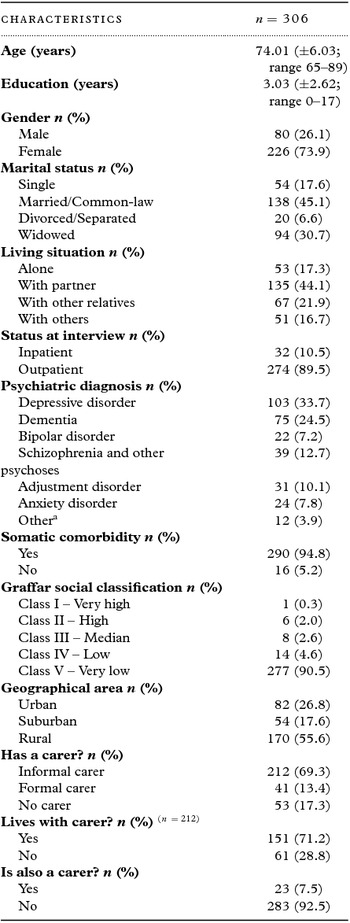
In this study, 306 patients (32 inpatients and 274 outpatients) were included, with ages ranging between 65 and 89 (mean= 74.01, ±6.03). The majority were female (73.9%), married or cohabiting (45.1%), and living with their partner (44.1%) in rural areas (55.6%), with 24.5% illiterate and the majority (67.6%) with a basic level of education (4 years). Also, the majority (90.5%) of the participants were of low socio-economic status. About 70.0% of the elderly had an informal carer and 71.2% of those lived with them. Only 7.5% of the elderly were also carers.
Considering the group of outpatients (n = 274), 225 lived at home, 40 in a nursing home, and 9 lived in an unrelated host family.
Concerning the clinical characterization of the sample, the most common diagnosis was depression (33.7%), followed by dementia (24.5%). In 94.8% of the cases somatic comorbidity was presented. More detailed socio-demographic characterization is presented in Table 1.
Socio-demographic and clinical characteristics of patients

a Other includes alcohol dependence, mental retardation, personality disorder, sleep disorder, and delirium.
Of the 212 informal carers assessed, the majority (64.2%) were females, married or cohabiting (75.4%) and whose ages ranged between 21 and 83 years (mean = 57.84, ±15.03). They were mainly husband/wife (38.2%) and adult children (33.0%). The majority were primary carers (99.5%).
Concerning the cognitive and functional assessment of the elderly sample, 47.4% of the patients presented cognitive deficit, according to the MMSE. In the CDT, most of them (68.4%) also presented with cognitive deficit. The GDS scores suggested that the majority (64.7%) presented with depression. In relation to functionality, most of the patients (51.3%) presented with some level of dependency (moderate, severe, or total dependence) in basic activities of daily living (BADLs). The majority of the sample (83.3%) was also dependent on the instrumental activities of daily living (IADLs).
Considering the inpatient and outpatient groups separately, both presented similar results in relation to socio-demographic characteristics (Tables S1 and S2, available as supplementary material attached to the electronic version of this paper at https://doi.org/10.1017/S1041610217000072).
Needs assessment
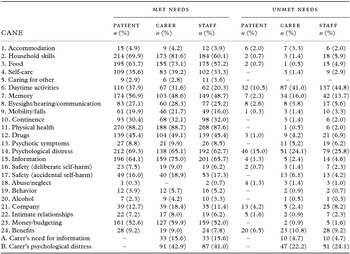
Comparing the needs of older people with mental health problems by themselves, and their carers and staff individually, great differences can be found (Table 2). The most common unmet needs for patients were psychological distress (15.0%), daytime activities (10.5%), and benefits (6.5%). For carers and staff, the most common unmet needs were daytime activities (41.0%, 44.8%), psychological distress (24.1%, 25.8%), and memory (16.0%, 13.7%). Psychological distress was recorded in 22.2% of carers and in 24.1% of staff as an unmet need.
Number of needs rated by the patient, carer, and staff

Considering the inpatients and outpatients groups separately, the most frequently unmet needs for the first group were: daytime activities (62.5%), psychological distress (40.6%), and drugs (21.9%). In the second group, daytime activities (44.9%), psychological distress (24.1%), and memory (12.8%) were the most common. Detailed information is presented in Tables S3 and S4.
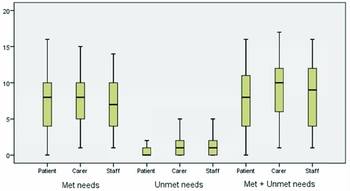
Comparison of the number of needs rated by patients, carers, and staff
Patients reported significantly lower unmet needs than carers and staff (Z = −8.58, p < 0.001; Z = −11.07, p < 0.001, respectively). Also, carers identified lower unmet needs than the staff (Z = −7.20, p < 0.001). Patients identified lower global needs than carers and staff (Z = −7.57, p < 0.001; Z = −4.97, p < 0.001, respectively), and carers identified more global needs than staff (Z = −3.92, p < 0.001) (Figure 1).
Box plots of total scores of needs (median, interquartile range, minimum, and maximum).

Needs, socio-demographic, and clinical characteristics
Significant positive associations were found between patients’ age and the CANE reports of met, unmet, and global needs (r s = 0.33, p < 0.001, r s = 0.14, p = 0.014 and r s = 0.34, p < 0.001, respectively). Also, significant differences were found when comparing patients who were between 65 and 79 years, with those over 80 years, with the former presenting more met (median 9.0 vs. 6.0, p < 0.001) and global needs (median 11.5 vs. 8.0, p < 0.001).
No gender or geographical differences were found regarding patients’ met unmet and global needs.
On the other hand, significant negative associations were found between patients’ education and met, unmet, and global needs (r s = −0.27, p < 0.001, r s = −0.22, p < 0.001 and r s = −0.31, p < 0.001, respectively).
Independent of their marital status in each category, the majority of the elderly lived with someone else, so this is not considered as a clarifying variable.
Patients living alone reported fewer met and global needs, when compared to patients living with someone else (median 4.0 vs. 8.0, p < 0.001; 7.0 vs. 10.0, respectively). No differences were found regarding the ratings of unmet needs.
Positive correlations were found between patients’ Graffar scores and the CANE reports of met, unmet, and global needs (r s = 0.19; p = 0.001, r s = 0.17; p = 0.003 and r s = 0.23, p < 0.001, respectively).
In this sample, significant negative correlations between the MMSE (rs = −0.69, p < 0.001), CDT (rs = −0.52, p < 0.001), BI (rs = −0.76, p < 0.001), and LI (rs = −0.86, p < 0.001); and the CANE global needs (met and unmet needs) were also found. The GDS correlated positively with these global needs (rs = 0.39 p < 0.001).
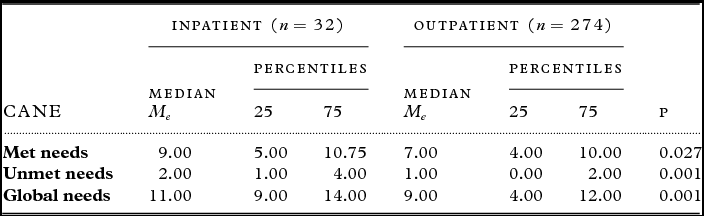
Related to the clinical-care setting considered, the results suggest that inpatients presented more met (p = 0.027), unmet (p < 0.001), and global needs (p < 0.001) than outpatients (Table 3).
Differences of patients’ needs between inpatient and outpatient groups

Mann–Whitney tests.
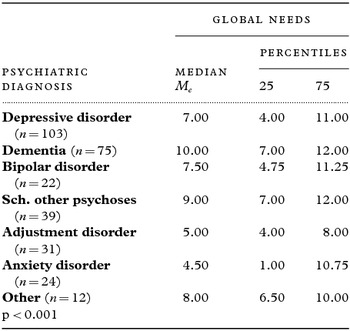
Regarding the relationship between psychiatric diagnosis and global needs of the patients, the data analysis shows a higher number of these needs in patients with dementia, followed by patients with schizophrenia, bipolar, and depressive disorder (Table 4).
Relation between patients’ needs and psychiatric diagnosis

Kruskall–Wallis tests.
Discussion
This is in line with the first study in Portugal, with the CANE validation (Fernandes et al., Reference Fernandes2009), assessing the needs of elderly patients in a psychiatric context. This process involves the view of their own needs, as well as the views of both the staff involved in their care and their informal carers, contributing to the understanding of the importance of such different perspectives.
Depressive disorder and dementia were the most common diagnoses in this sample, which is in line with other studies (Reynolds et al., Reference Reynolds2000; Ashaye et al., Reference Ashaye, Livingston and Orrell2003; Greaves et al., Reference Greaves, Bhat, Regan, Qazi, Miranda-Castillo and Orrell2006; Fernandes et al., Reference Fernandes2009). A larger number of global needs were associated with the diagnosis of dementia, followed by schizophrenia, bipolar, and depressive disorder, a result also corroborated by other authors (Field et al., Reference Field, Walker, Orrell, Orrell and Hancock2004; Greaves et al., Reference Greaves, Bhat, Regan, Qazi, Miranda-Castillo and Orrell2006; Passos et al., Reference Passos, Sequeira and Fernandes2012).
The main met needs found in this sample were physical health, household skills, information, psychological distress, and food; and the most common unmet needs were psychological distress, daytime activities, benefits, and company, which is similar to other studies (Ashaye et al., 2003; Hancock et al., Reference Hancock, Reynolds, Woods, Thornicroft and Orrell2003; Hoe et al., Reference Hoe, Orrell, Lambert, Prettyman, Orrell and Hancock2004; Greaves et al., Reference Greaves, Bhat, Regan, Qazi, Miranda-Castillo and Orrell2006; Fernandes et al., Reference Fernandes2009).
Regarding the carers’ sections, the majority presented global needs in terms of psychological distress, and those were unmet for 24.1% of staff and 22.2% of carers, with needs for information in just a few (4.7%). The majority of the research (Reynolds et al., Reference Reynolds2000; Walters et al., Reference Walters, Iliffe, Tai and Orrell2000; Hoe et al., Reference Hoe, Orrell, Lambert, Prettyman, Orrell and Hancock2004; Fernandes et al., Reference Fernandes2009; Passos et al., Reference Passos, Sequeira and Fernandes2012) does not identify a significant number of needs for information, which is consistent with the findings of the present research. However, regarding psychological distress, despite some authors not presenting significant results in this domain, others have verified the existence of a great number of these global needs (Reynolds et al., Reference Reynolds2000; Fernandes et al., Reference Fernandes2009; Sousa et al., Reference Sousa, Scazufca, Menezes, Crepaldi and Prince2009), which can be explained by different staff/carer knowledge and training. Another explanation can be attributed to the overloading of dementia cases.
Regarding the needs identified by patients, informal carers, and staff, significant differences were found in the number of reported needs. Patients identified fewer unmet and global needs than their carers and staff, a result previously reported by other authors (Reynolds et al., Reference Reynolds2000; Hancock et al., Reference Hancock, Reynolds, Woods, Thornicroft and Orrell2003; Orrell et al., Reference Orrell, Hancock, Liyanage, Woods, Challis and Hoe2008; Fernandes et al., Reference Fernandes2009; Miranda-Castilho et al., Reference Miranda-Castillo, Woods and Orrell2013). The possible lack of information about elderly service users was outlined in a National Audit England, which found that only a few areas had comprehensive information available for older persons (Audit Commission, 2000).
On the other hand, carers identified fewer unmet needs, when compared to staff, a fact which has also been referred to in previous research (Hancock et al., Reference Hancock, Reynolds, Woods, Thornicroft and Orrell2003; Miranda-Castillo et al., Reference Miranda-Castillo, Woods and Orrell2013). Staff may have rated higher unmet needs for “objective” services because they were more aware than carers and patients about the services that were available (Hancock et al., Reference Hancock, Reynolds, Woods, Thornicroft and Orrell2003). Carers also identified more global needs than staff, consistent with results from previous studies (Hancock et al., Reference Hancock, Reynolds, Woods, Thornicroft and Orrell2003; Fernandes et al., Reference Fernandes2009; Miranda-Castillo et al., Reference Miranda-Castillo, Woods and Orrell2013). Despite the fact that these differences have also been found by other authors, in the present research the number of unmet needs identified by the elderly is significantly lower, which could be explained by cognitive deficits and mental disorders that characterize the present sample.
Significant correlations were also found between the age and needs of the patients, with older patients presenting a higher number of unmet and global needs. Also Meaney et al. (Reference Meaney, Croke and Kirby2005) found similar results, mostly concerning unmet needs. However, some studies (e.g. Field et al., Reference Field, Walker, Orrell, Orrell and Hancock2004) have not analyzed this variable and others have not found an association between age and the number of needs.
Concerning gender, no significant differences were found in terms of needs, a result consistent with previous studies (Field et al., Reference Field, Walker, Orrell, Orrell and Hancock2004; Meaney et al. Reference Meaney, Croke and Kirby2005), in spite of Greaves et al. (Reference Greaves, Bhat, Regan, Qazi, Miranda-Castillo and Orrell2006) reporting a higher number of unmet needs in men, which can be attributed to different sample characteristics.
When analyzing needs according to education levels, the patients with higher education had lower met, unmet, and global needs, which suggests that education has a positive effect regarding the elderly's needs. This is corroborated by the analyses concerning the four education levels, with fewer needs recorded for better-educated patients.
In Graffar's social classification, the highest scores (class V, very low socio-economic status) were correlated with a higher number of met, unmet, and global needs (Crane-Ross et al., Reference Crane-Ross, Roth and Lauber2000).
In the present study, it was found that the participants who lived alone had lower met and global needs than those who lived with other people. This result is related to the fact that these were younger elderly, who had fewer cognitive deficits, lower levels of depression and better functionality. This is not corroborated by the study of Miranda-Castillo et al. (Reference Miranda-Castillo, Woods and Orrell2010), regarding opposite characteristics of the sample. In that study, patients who lived alone presented a higher number of needs, mainly because they had dementia, were older, more dependent, and had more problems.
On the other hand, there were no significant differences in needs according to the geographical areas where the patients lived, and they were homogeneously characterized by great levels of isolation and low levels of education and incomes.
Beyond the association between psychiatric diagnoses and more needs already mentioned, also considering the clinical-care setting of patients, significant differences were found between inpatients and outpatients. Inpatients presented more met, unmet, and global needs when compared to outpatients. This result can be explained by the fact that the elderly were inpatients in an acute psychiatric ward, and the patients were assessed at admission, demonstrating the burden of mental diseases (Houtjes et al., Reference Houtjes, Van Meijel, Deeg and Beekman2011). However, the limited number of inpatient participants deserves some caution in the interpretation and generalization of the present results.
This work contributes to the identification of the problems and needs of older people with mental health problems and to the understanding of some of the associated socio-demographic characteristics. It also allows for contextualizing the psychopathology, which in turn could result in improved interventions, and more acceptable use of mental health services.
The limitations of this study are related to the transversal design of the research, which was also carried out in a sample from a single health unit population, thus limiting the generalization of the present findings. The low number of participants in the inpatient group is also considered as a limit to the generalization of the conducted comparisons.
Further longitudinal and multi-center studies are needed to highlight and clarify the relationships between some patients’ needs and the clinical findings.
The main findings of this study, presenting the different views of needs in dementia and other mental health disorders, are a starting point for a basic needs assessment in the Portuguese National Health System. Particularly, in the inpatient context, where a great amount of unmet needs are found, it is crucial to conduct an early, precise, and brief assessment, allowing a prompt diagnosis for targeted tailored interventions.
An integrated perspective of needs is fundamental and required in order to plan any structured care intervention based on the bio-psychosocial model.
Conflict of interest
None.
Description of authors’ roles
LF participated in the definition and design of the study and JP in the data collection. CD, LF, and JP contributed to the analyses and interpretation of the results and writing the article. All authors (JP, AF, CD, and LF) made critical revisions to the article and have approved the final manuscript.
Acknowledgments
The authors wish to thank the Alto Minho Local Health Unit (Hospital de Santa Luzia), in northern Portugal, for permission to carry out this study, and also acknowledge the collaboration of all health professionals in the Department of Psychiatry and Mental Health. They also thank all the patients and carers who agreed to participate in the study.
Supplementary material
To view supplementary material for this paper, please visit https://doi.org/10.1017/S1041610217000072.