As defined by Olweus (Reference Olweus1993), bullying is a special kind of aggression that includes three main characteristics: intentionality, repetition, and imbalance of power. Bullying usually appears in cyberbullying and in three traditional forms: physical bullying (e.g., kicking, beating, and biting); verbal bullying (e.g., threats, name calling); and relational bullying (e.g., excluding, spreading rumours).
Bullying in school is a common problem across the world. A cross-national survey of 25 countries showed that 9–54% of children have been bullies or victims of bullying (Nansel, Craig, Overpeck, Saluja, & Ruan, Reference Nansel, Craig, Overpeck, Saluja and Ruan2004). In the United States, Nansel et al. (Reference Nansel, Overpeck, Pilla, Ruan, Simons-Morton and Scheidt2001) reported that 29.9% of students in Grades 6 through 10 were involved in bullying behaviour: 13.0% were bullies, 10.6% were victims, and 6.3% were both bullies and victims. In Korea, Kim, Koh, and Leventhal (Reference Kim, Koh and Leventhal2004) reported that 40% of middle school students participated in school bullying: 17% were bullies, 14% were victims, and 9% were both bullies and victims. In China, Zhang (Reference Zhang2002) reported that nearly one fifth (19%) of primary and middle school students were involved in bullying behaviour: 2.5% were bullies, 14.9% were victims, and 1.6% were both bullies and victims.
Many cross-sectional and longitudinal studies have shown that victimisation is significantly associated with increases in a variety of externalising (Reijntjes et al., Reference Reijntjes, Kamphuis, Prinzie, Boelen, Van der Schoot and Telch2011), academic (Nakamoto & Schwartz, Reference Nakamoto and Schwartz2010), psychosomatic (Gini & Pozzoli, Reference Gini and Pozzoli2009), and internalising problems (Hawker & Boulton, Reference Hawker and Boulton2000; Reijntjes, Kamphuis, Prinzie, & Telch, Reference Reijntjes, Kamphuis, Prinzie and Telch2010; Shi, Liu, & Zhang, Reference Shi, Liu and Zhang2011). The most serious internalising problem correlated with victimisation is suicide. Research shows that victims report more suicidal ideation than non-victims (Liu, Lu, Zhou, & Su, Reference Liu, Lu, Zhou and Su2013a). Moreover, Klomek et al. (Reference Klomek, Sourander, Niemelä, Kumpulainen, Piha, Tamminen and Gould2009) found that frequent victimisation at age 8 was a risk factor for suicide attempts and death by suicide at age 25. In cross-sectional studies, the increased risk (odds ratios) of suicidal ideation and (or) suicide attempts that were associated with bullying behaviour ranged from 1.4 to 10.0 (Brunstein, Sourander, & Gould, Reference Brunstein, Sourander and Gould2010). In these longitudinal studies, the odds ratios ranged from 1.7 to 11.8 (Brunstein et al., Reference Brunstein, Sourander and Gould2010). In general, being bullied has short-term and long-term negative consequences, including suicide. Therefore, it is important to intervene in bullying situations and address its adverse outcomes.
Despite the well-documented relationship between victimisation and mental health problems, there are two questions that are related to this relationship and need to be clarified. First, it is obvious that not all of the children who are victimised will develop mental heath problems, so it is important to determine which factors will buffer the negative effects of being bullied. Second, children who experience bullying rarely suffer from mental health problems immediately, so it is important to determine which factors mediate the pathway from victimisation to mental health problems. Examining these questions will help us determine how the relationship between victimisation and mental health problems develops, identify those victims who are at the most risk of developing mental health problems or committing suicide, and develop more effective intervention for children who are victimised. Fortunately, in recent years, researchers have begun to identify risk and protective factors that influence victims’ risk of experiencing negative consequences; these factors include gender, age, coping styles, self-esteem, forgiveness, warm family relationships, positive home environments, academic self-efficacy, peer sociability, and a positive relationship with parents (Baldry, Reference Baldry2004; Bond, Carlin, Thomas, Rubin, & Patton, Reference Bond, Carlin, Thomas, Rubin and Patton2001; Kochenderfer-Ladd, & Skinner, Reference Kochenderfer-Ladd and Skinner2002; Liu, Lu, Zhou, & Su, Reference Liu, Lu, Zhou and Su2013b; Paul & Cillessen, Reference Paul and Cillessen2003; Salmivalli, Lagerspetz, Björkqvist, Österman, & Kaukiainen, Reference Salmivalli, Lagerspetz, Björkqvist, Österman and Kaukiainen1996; Turner, Finkelhor, & Ormrod, 2009; Yen et al., Reference Yen, Huang, Kim, Wang, Tang, Yeh and Yang2013).
Social support has been established as an important protective factor for the health of the students. This factor may affect the outcomes of the children and adolescents in several ways. Stress-buffering theory has shown that social support is a buffering, or moderating, factor in students’ lives; if students who experience stress have high levels of social support, this support may provide a buffer for them from negative outcomes (Cohen, Gottlieb, & Underwood, Reference Cohen, Gottlieb and Underwood2000). Social support deterioration theory has shown that perceived social support is a mediating variable; stress erodes the perceived availability or effectiveness of social support, which then leads the students to experience psychological distress, impairment and/or maladjustment (Barrera Jr., Reference Barrera1986). When applying both theories to the stressful context of peer victimisation, social support may be seen as a contributing factor that helps explain the adverse outcomes of victims and plays different moderating and mediating roles in the relationships between victimisation and different negative outcomes. Research has found that social support buffered against mental health problems, internalising distress, and suicidal ideation for victims (Bonanno & Hymel, Reference Bonanno and Hymel2010; Davidson & Demaray, Reference Davidson and Demaray2007; Stadler, Feifel, Rohrmann, Vermeiren, & Poustka, Reference Stadler, Feifel, Rohrmann, Vermeiren and Poustka2010). However, other research failed to find evidence that social support moderated the relationship between victimisation and different negative outcomes, including suicidal ideation, poor mental health, and depression (Pouwelse, Bolman, Lodewijkx, & Spaa, Reference Pouwelse, Bolman, Lodewijkx and Spaa2011; Rigby, Reference Rigby2000; Rigby & Slee, Reference Rigby and Slee1999). Holt and Espelage (Reference Holt and Espelage2007) found that victims who reported moderate peer social support experienced the least amount of anxiety/depression. Rothon, Head, Klineberg, and Stansfeld (Reference Rothon, Head, Klineberg and Stansfeld2011) reported that friend support and family support were able to protect bullied adolescents from poor academic achievement but not depressive symptoms. Although these findings are mixed, the stress-buffering theory seems to be a plausible explanation. Given the well-known difficulty that exists in detecting interactions, more research in different sample groups is needed. To our knowledge, studies about the mediation of social support are relatively few; only two studies have found the partial mediation of peer support in the relationship between victimisation and negative outcomes (maladjustment and depression; Malecki, Demaray, & Davidson, Reference Malecki, Demaray and Davidson2008; Pouwelse et al., Reference Pouwelse, Bolman, Lodewijkx and Spaa2011), and no studies have yet examined the mediating effect of perceived social support on the relationship between victimisation and suicidal ideation. Regarding the above-mentioned research, social support could serve as a mediator, as well as a moderator, in the relationship between victimisation and suicidal ideation. Studies that assess both of the roles of social support with regard to victims who are vulnerable to suicide have been lacking, until now.
Most of the existing research about bullying has been conducted in Western cultures. With regard to the few studies concerning bullying in China, studies of the relationship between victimisation, suicidal ideation, and perceived social support are still scarce. Therefore, this study aimed to examine whether perceived social support moderated or mediated the association between victimisation and suicidal ideation among Chinese adolescents. Three specific hypotheses were evaluated. First, we hypothesised that the experience of victimisation would be associated with higher levels of suicidal ideation. Second, we hypothesised that perceived social support would serve as a protective factor that moderated the relationship between victimisation and suicidal ideation. Finally, we expected that perceived social support would mediate the association between victimisation and suicidal ideation.
Methods
Participants
Participants included middle school students in Grades 7 and 8 who were recruited from Shaoyang city in Hunan province, which is located in central and southern China. Shaoyang city represents the culture of western Hunan and had a population of 707 million in 2010, of which the rural population accounts for 84%. The schools in Shaoyang city were divided in three categories based on the geographic region: urban middle school, county middle school, and town middle school. A stratified cluster random sampling method was used to select participants in the three different types of middle schools. First, one urban middle school, one county middle school, and two town middle schools were selected as the sampled schools. Then, three classes were randomly selected from Grades 7 and 8 in each sampled school. All of the students (1,016) in the selected classes were invited, and 978 agreed to participate in this study (the response rate was 96.3%).
Measures
Victimisation
The victim subscale of the Chinese version of the Olweus Bully/Victim Questionnaire (OBVQ-C) was used to assess the participants’ peer victimisation. This subscale consists of six items that assess the frequency of the three kinds of victimisation: verbal victimisation (e.g., being satirised, scolded, made fun of, and called nasty names), physical victimisation (e.g., being physically harmed and having one's belongings taken away) and indirect victimisation (e.g., rumours being spread, being rejected). A 5-point Likert scale (never = 0, once or twice = 1, sometimes = 2, about once a week = 3, several times a week = 4) was used to record how often they had experienced different types of victimisation during the current term, with higher scores indicating greater overall victimisation. This subscale has a good internal consistency (α = 0.82) and test–retest reliability (γ = .78; Zhang, Wu, & Jones, Reference Zhang, Wu and Jones1999). In the present study, Cronbach's alpha was 0.80.
Suicidal ideation
The Chinese version of the Positive and Negative Suicidal Ideation (PANSI) Questionnaire (Osman et al., Reference Osman, Barrios, Gutierrez, Wrangham, Kopper, Truelove and Linden2002; Wang et al., Reference Wang, Gong, Kang, Liu, Dong and Ma2011) was used to assess the participants’ suicidal ideation. This scale contains 14 items and two dimensions: positive suicidal ideation and negative suicidal ideation. A 5-point Likert scale was used to record the frequency for each item, with higher scores indicating greater suicidal ideation. The scale has a good internal consistency reliability (α = 0.92) and content validity (Wang et al., Reference Wang, Gong, Kang, Liu, Dong and Ma2011). In the present study, Cronbach's alpha was 0.92.
Perceived social support
The Chinese version of the Zimet Multidimensional Scale of Perceived Social Support (MPSSS; Wang, Wang, & Ma, Reference Wang, Wang and Ma1999; Zimet, Dahlem, Zimet, & Farley, Reference Zimet, Dahlem, Zimet and Farley1988) was used to assess the individuals’ perceived support from different social sources (family, friends, and important others). This scale consists of three subscales (family support, friend support, and other support) and 12 items that were measured on a 7-point Likert scale from extremely–disagree (coded as 1) to extremely–agree (coded as 7). The scale has good internal consistency reliability (α = 0.88; Gao, Reference Gao2011). In the present study, Cronbach's alpha was 0.86.
Ethical Statement
The study received the approval of the ethical committee of Central South University. Participants were assured of the anonymity and confidentiality of the answers that they provided. Informed consent was obtained from the school, the students, and the students’ parents. Because of the anonymity of the investigation, we cannot confirm which students had serious suicidal ideation. But all the students were told that if they felt they are being bullied, or had a strong sense of suicidal thoughts, they could ask for help from their school psychology centre or the local psychiatric hospital. All of the methods and contact information for help were provided in the questionnaire instructions.
Data Collection
Six graduates who had received professional training directed the students to complete a series of anonymous questionnaires in the classroom during a school session (45 minutes). In order to avoid a potential information bias, students were required to complete the questionnaires independently, and all of the teachers were required to be absent while the surveys were being completed. All data were collected in April 2012.
Statistical Analysis
A descriptive analysis estimated in SPSS 17.0 was used to describe the prevalence of bullying and the demographic characteristics of the sample. Next, a series analysis was conducted that followed three steps. The first step was to test the factor structure of the items using a confirmatory factor analysis (CFA). The second step was to examine the association between victimisation and suicidal ideation using a structural equation model (SEM). The third step was to test the moderating and mediating role of perceived social support using a SEM. For both SEM models, grade and gender were included as covariates, with suicidal ideation as the dependent variable. The theoretical moderation and mediation model on the relationship between victimisation, perceived social support, and suicidal ideation is shown in Figure 1.
Full model estimated to examine mediation and moderation hypotheses. Control variables (not shown) include age and gender.

The CFA and SEM were conducted with the software package, Mplus 7.0. Values for missing data were handled using full information maximum-likelihood (FIML) as the method of estimation. Four statistics reflecting fit were reported: the ratio of chi-square statistic to degrees of freedom; the Comparative Fit Index (CFI), the Tucker Lewis Index (TLI), and the root mean square error of approximation (RMSEA).
Results
The demographic information of the sample is presented in Table 1. After excluding the invalid questionnaires, the final participants included 946 middle school students (544 boys, 402 girls). The participants’ ages ranged from 11 to 16 years, and the mean age was 13.18 ± 0.9 years. Students who reported at least one special victimisation experience with a frequency of at least 2 were classified as victims. Overall, 48.1% of the total students reported being bullied, with more boys reporting being bullied than girls (51.5% vs. 43.5&, χ2 = 5.84, df = 1, p = .001), and more students in Grade 7 reporting being bullied than the students in Grade 8 (53.8% vs. 41.1%, χ2 = 15.28, df = 1, p = .000). Verbal forms of victimisation were the most prevalent. Regarding all of the students, 40.3% were victims of verbal bullying, 17.5% were victims of physical bullying, and 23.5% were victims of relational bullying.
Demographic Characteristics of the Participants and Prevalence of Different Victims

Step 1: Confirmatory Factor Analysis
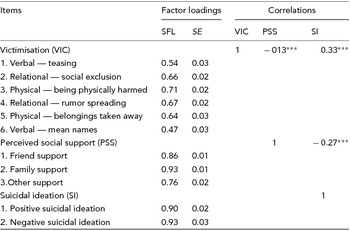
A CFA on the items measuring victimisation, perceived social support, and suicidal ideation was done to test the factor structure of the items. No error terms were allowed to be free or to correlate with one another in the CFA. The results showed that measurement model for the three latent variables fit the data well (χ2/df = 126/41, CFI = 0.98, TLI = 0.97 and RMSEA = 0.047). The standardised factor loading for the models are reported in Table 2. As all factor loadings were moderate to high, ranging from .47 to .93, each item was considered a good indicator for the latent variable it represented.
Standardised Factor Loading (SFL), Correlations and Model Fit Indices of the CFA Model

Note: SFL = standardised factor loading, SE = standard error; *p < .05, **p < .01, ***p < .001; N = 946, χ2/df = 126/41, CFI = 0.98, TLI = 0.97, RMSEA = 0.047.
The correlations for victimisation, perceived social support, and suicidal ideation (see Table 2) showed that victimisation was positively correlated with suicidal ideation (r = .33, p < .00) and negatively correlated with perceived social support (r = -.13, p < .001). Perceived social support was negatively correlated with suicidal ideation (r = -.27, p < .000).
Step 2: Association Between Victimization and Suicidal Ideation
The SEM provided desirable indices of goodness-of-fit, χ2/df = 302/98, CFI = 0.97, TLI = 0.96 and RMSEA = 0.06. Results showed that after adjusting gender and grade, victimisation had a positive significant influence on suicidal ideation (β = 0.33, p < .001).
Step 3: The Moderating and Mediating Role of Perceived Social Support
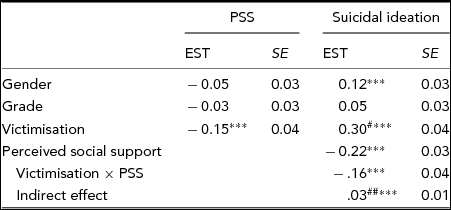
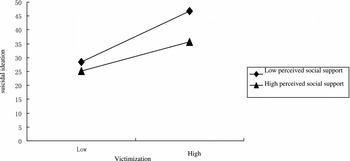
As indicated by indices of goodness-of-fit, this moderation and mediation model had a desirable fit with the data, χ2/df = 302/98, CFI = 0.94, TLI = 0.93 and RMSEA = 0.047. The estimated standardised path coefficient for the full model is presented in Table 3. As seen in Table 3, the interaction effect of victimisation and perceived social support was significant (β = -0.16, p < .001), which indicates that perceived social support significantly moderated the relationship between victimisation and suicidal ideation. To examine how perceived social support influences the relationship between victimisation and suicidal ideation, simple slopes were plotted for the values of high perceived social support (1 SD above the mean) and low perceived social support (1 SD below the mean), as shown in Figure 2. Post hoc analyses showed that the simple slopes for high and low perceived social support were both significantly different than zero (high perceived social support: β = 0.175, t(138) = 2.09, p = .04; low perceived social support: β = 0.305, t(238) = 4.94, p = .000). The relationship between victimisation and suicidal ideation was substantially weaker under low perceived social support than high perceived social support. In other words, these results provide some evidence that perceived high social support helped victims from thoughts of suicide.
Results of Final Model

Note: EST = estimated standardised path coefficient, SE = standard error, PSS = perceived social support; *p < .05, **p < .01, ***p < .001; N = 946, χ2/df = 302/98, CFI = 0.94, TLI = 0.93 and RMSEA = 0.047; #direct effect of victimisation on suicidal ideation, ##the indirect effect through perceived social support.
Perceived social support as a moderator between the relationship of victimisation and suicidal ideation.

At the same time, we found evidence for a mediating role of perceived social support. Adjusting for controls, victimisation was associated significantly with perceived social support (β = -0.15, p < .001, i.e., ‘a’ effect) and perceived social support was significantly associated with suicidal ideation (β = -0.22, p < .001, i.e., ‘b’ effect). We tested the significance of the indirect effect using the product of coefficients method (i.e., the ‘a’ effect multiplied by the ‘b’ effect). Given that the direct relationship between victimisation and suicidal ideation remained statistically significant (β = 0.30, p < .001), the mediation was considered partial. According to the result of the path coefficient (see Table 3), the direct effect of victimisation on suicidal ideation was 0.30, the indirect effect through perceived social support was 0.033 (-0.15 × -0.22), the total effect of victimisation on suicidal ideation was 0.33 (0.03 + 0.30), and perceived social support accounted for about 10% (i.e., 0.03/0.33) of the association between victimisation and suicidal ideation.
Discussion
The Prevalence of Victimisation and Its Association With Suicidal Ideation
In this study, 48.1% of adolescents reported being bullied in school. Similar studies have been implemented in China. Zhang's (Reference Zhang2002) study, which used a sample of 9,205 primary and junior middle school children from both urban and rural areas, found that one out of five (19%) of the children who were investigated were involved in bullying. However, Qiao, Xing, Ji, and Zhang's (Reference Qiao, Xing, Ji and Zhang2009) study, which used a sample of 177,578 urban middle school students, reported that 57.5% of the participants experienced at least one kind of bullying. The diversity of the results can be attributed to the conflict over the definition and determination standards; the differences in the samples and the geographical location also play a role. All of these results did, however, show that bullying is not rare in China.
Consistent with our first hypothesis, a significant inverse association between victimisation and suicidal ideation was found. This is consistent with a wealth of research that shows that victims of bullying experience an increased risk of suicidal ideation, suicidal attempts, and self-injurious behaviours (Baldry & Winkel, Reference Baldry and Winkel2003; Kaltiala-Heino, Rimpelä, Marttunen, Rimpelä, & Rantanen, Reference Kaltiala-Heino, Rimpelä, Marttunen, Rimpelä and Rantanen1999; Kim, Koh, & Leventhal, Reference Kim, Koh and Leventhal2005; Klomek et al., Reference Klomek, Sourander, Kumpulainen, Piha, Tamminen, Moilanen and Gould2008). The identification of victimisation as a risk factor for suicidal ideation highlights the importance of intervention in victimisation in school.
The Moderating Role of Perceived Social Support in the Relationship Between Victimisation and Suicidal Ideation
Regarding our second hypothesis, we found an interaction effect of perceived social support and victimisation on suicidal ideation; particularly the strength of association between victimisation and suicidal ideation was stronger under low perceived social support than high perceived social support. Our result was similar to the findings by Bonanno and Hymel (Reference Bonanno and Hymel2010), which showed that perceived family support (but not perceived friend support) buffered the relationship between victimisation and suicidal ideation after controlling for the effects of sex and age. However, in another study, Rigby and Slee (Reference Rigby and Slee1999) failed to demonstrate that perceived social support acted as a buffer in the relationship between victimisation and suicidal ideation after controlling for the effect of sex. In addition to the different locations of sample collection, one possible explanation for the mixed findings could be related to the differences in the measurement indicators of social support (Bonanno & Hymel, Reference Bonanno and Hymel2010). Controlling for the covariate variables may have contributed to the variance in the findings. Uncontrolled risk factors may have confounded the moderating effect of perceived social support on the relationship between bullying and suicide. In the current study, we controlled for the effect of gender and grade on suicidal ideation. The results have extended the previous research and added additional evidence of the buffering role in social support in the field of school bullying among Chinese adolescents.
The Mediational Role of Perceived Social Support in the Relationship Between Victimisation and Suicidal Ideation
Consistent with our third hypothesis, perceived social support partially mediated the relationship between victimisation and suicidal ideation: severe victimisation was associated with lower perceived social support, which in turn was associated with higher levels of suicidal ideation. This finding was consistent with that of previous studies (Malecki et al., Reference Malecki, Demaray and Davidson2008; Pouwelse et al., Reference Pouwelse, Bolman, Lodewijkx and Spaa2011) and indicates that perceived social support is a significant mediating factor between peer victimisation and psychological distress. The possible mediator of perceived social support may be explained by several mechanisms. For example, when bullying occurs within friendship or acquaintanceship groups, it will directly lead to the termination of normal relationships, the loss of close friendships, and decreases in interpersonal trust; those who are bullied will begin to view others as unpredictable and unresponsive. In these circumstances, victims may have little confidence in their ability to elicit support from their peers. In addition, when an individual is bullied, the negative reactions (such as ignoring, laughing, and having a cold attitude) of their friends and parents may cause the victims to experience loneliness, helplessness, and declines in perceived social support (Salmivalli et al., Reference Salmivalli, Lagerspetz, Björkqvist, Österman and Kaukiainen1996).
Implications for Education
The results of the study contribute to the existing literature by further proving that being bullied is significantly correlated with suicidal ideation and by shedding light on the mechanism of perceived social support on the relationship between victimisation and suicide ideation. Perceived social support can act as a partial mediating, as well as a moderating, factor between victimisation and suicidal ideation. On the one hand, good social support can effectively help the victims overcome the negative effects of being bullied. On the other hand, the bullying experience may also cause more serious psychological distress by reducing victims’ perceived social support. Based on these findings, several important implications can be drawn for the field of school education and bullying intervention.
First of all, the school should attach great importance to the intervention of bullying. The aim of school education is to promote students’ overall development. Bullying has been confirmed to be closely related to students’ psychosomatic health. School education should focus on the change of school environment, set reasonable regulations, and build a good atmosphere to prevent the occurrence of bullying. In addition, we need to treat perceived social support as a protective factor and build supportive friendships and parent-child relationships for the children in their daily lives in order to enhance their mental ability to cope with bullying. More specifically, parents need to pay more attention to their children's physical and emotional needs and give more understanding and encouragement, which will eventually enable them to feel that support can be obtained when they meet with bullying and other troubles. The teachers need to build a supportive classroom atmosphere in which students help each other and give more support to disadvantaged students, such as the introverted, disabled, obese and transfer students, and students whose parents are divorced or who lack friends. Finally, we need to treat perceived social support as an intermediary factor. When a child is bullied, we must give them timely support, rather than ignoring or deriding the child. At the same time, the effectiveness of the support that we provide should be given more attention. Simple help or just sympathy is certainly not enough to comfort a victim's injured heart. Guiding children in how to correctly handle peer conflict, make more good friends, and become more confident in overcoming difficulties may be more effective in contributing to their growth and may help them to stay away from bullying.
In summary, the findings of the study suggest that perceived social support is very important for the victims. More encouragement, deep understanding, and positive guidance are needed to help victims perceive the support from parents and peers and eventually minimise the negative effects of being bullied. However, the result of the study should be read cautiously because of several limitations. First, although the results showed a statistically significant partial mediation effect, the proportion of indirect effect was not large, with perceived social support accounting for only about 10% of the association between victimisation and suicidal ideation. This suggests that other mediators (e.g., depression and loneliness) may also contribute to explaining the covariation of victimisation and suicidal ideation. In addition, the different measurement of social support may contribute to the size of the intermediary effect. Researchers have highlighted that social support dimensions may have differential effects on outcomes (Kessler, Price, & Wortman Reference Kessler, Price and Wortman1985). So, future studies could further examine the diversity of intermediary factors between victimisation and suicidal ideation, and could also examine the multidimensional nature of the social support (e.g., its functional domain) beyond the global perceptions of support. Second, this study has some methodological limitations. For example, its corelational and cross-sectional design prevents us from making any definitive cause–effect conclusions. In addition, this study used self-report scales to assess victimisation, perceived social support and suicidal ideation. It is possible that the association between these variables will be minimised due to shared method variance. Future studies with a longitudinal design and a multitrait-multimethod measurement approach (e.g., peer nomination for victimisation, and clinical assessment for suicidal ideation) are needed to replicate the results of this study. Future students could also consider whether different types of bullying (e.g., cyber, social) have a different impact on suicidal ideation.