INTRODUCTION
In about a quarter of the languages of the world, the source of information a speaker has for her proposition is morphologically encoded by so-called ‘evidentials’ (Aikhenvald, Reference Aikhenvald2004). These evidentials occur very frequently in languages such as Quechua, Tariana, Tibetan, and Turkish (Aikhenvald, Reference Aikhenvald2004). The use of evidential morphemes in these languages is sometimes called obligatory by virtue of the evidential morphemes being obligatorily present in a subset of the sentences of the particular language (Matsui & Fitneva, Reference Matsui, Fitneva, Fitneva and Matsui2009). For instance, in Turkish, the evidential morphemes -dI and -mIş are obligatory in their function as past tense markers. A decision between -dI (indicating that the speaker has direct evidence for the proposition) and -mIş (indicating that the speaker has indirect evidence for the proposition) is made on the basis of aspectual and evidential properties of the proposition, rendering the evidential morpheme semantically complex (cf. Rett & Hyams, Reference Rett and Hyams2014).
Recently, a number of studies have addressed the acquisition of evidentiality (Aksu-Koç, Reference Aksu-Koç1988; Aksu-Koç, Ögel-Balaban & Alp, Reference Aksu-Koç, Ögel-Balaban, Alp, Fitneva and Matsui2009; Fitneva, Reference Fitneva2008; Matsui & Miura, Reference Matsui, Miura, Fitneva and Matsui2009; Matsui, Yamamoto & McCagg, Reference Matsui, Yamamoto and McCagg2006a; Ozturk & Papafragou, Reference Ozturk, Papafragou, Caunt-Nulton, Kulatilake and Woo2007, Reference Ozturk, Papafragou, Chan, Jacob and Kapia2008; Papafragou, Li, Choi & Han, Reference Papafragou, Li, Choi and Han2007; Rett & Hyams, Reference Rett and Hyams2014; de Villiers, Garfield, Gernet-Girard, Roeper & Speas, Reference de Villiers, Garfield, Gernet-Girard, Roeper, Speas, Fitneva and Matsui2009). These studies have shown that children acquiring languages with evidentials spontaneously produce these morphemes at a very early age (the earliest forms are already present around the age of two; cf. Aksu-Koç, Reference Aksu-Koç1988; Aksu-Koç et al., Reference Aksu-Koç, Ögel-Balaban, Alp, Fitneva and Matsui2009; Papafragou et al., Reference Papafragou, Li, Choi and Han2007). However, at the same time that children are capable of producing evidential morphemes, they still fail at tasks assessing their comprehension. Various studies have found that an adult-like comprehension of evidentials is not present until relatively late in development (Aksu-Koç, Reference Aksu-Koç1988; Aksu-Koç et al., Reference Aksu-Koç, Ögel-Balaban, Alp, Fitneva and Matsui2009; Matsui et al., Reference Matsui, Yamamoto and McCagg2006a; Matsui & Miura, Reference Matsui, Miura, Fitneva and Matsui2009; Ozturk & Papafragou, Reference Ozturk, Papafragou, Caunt-Nulton, Kulatilake and Woo2007, Reference Ozturk, Papafragou, Chan, Jacob and Kapia2008; Papafragou et al., Reference Papafragou, Li, Choi and Han2007; de Villiers et al., Reference de Villiers, Garfield, Gernet-Girard, Roeper, Speas, Fitneva and Matsui2009). It is still disputed at which age exactly children develop an adult-like understanding of evidential systems. Depending on the language and the particular type of evidential under investigation, age of acquisition ranges from six years old or even younger for Korean and some aspects of Turkish (Aksu-Koç, Reference Aksu-Koç1988; Aksu-Koç et al., Reference Aksu-Koç, Ögel-Balaban, Alp, Fitneva and Matsui2009; Papafragou et al., Reference Papafragou, Li, Choi and Han2007) to as late as nine or ten for Tibetan (de Villiers et al., Reference de Villiers, Garfield, Gernet-Girard, Roeper, Speas, Fitneva and Matsui2009). Interestingly, there seems to be a hierarchy in the acquisition of the different evidentials such that direct evidentials are acquired earlier than indirect evidentials (Aksu-Koç, Reference Aksu-Koç1988; Aksu-Koç et al., Reference Aksu-Koç, Ögel-Balaban, Alp, Fitneva and Matsui2009; Papafragou et al., Reference Papafragou, Li, Choi and Han2007; Ozturk & Papafragou, Reference Ozturk, Papafragou, Caunt-Nulton, Kulatilake and Woo2007).
Although the number of studies investigating the acquisition of evidentiality is growing, there are several issues that remain understudied or unclear at this stage. First of all, the acquisition of evidentiality has only been studied in languages with so-called grammaticalized evidentiality (cf. Aikhenvald, Reference Aikhenvald2004) (with the exception of English copy-raising constructions, e.g. John looks like he's wearing a hat; cf. Jeschull & Roeper, Reference Jeschull, Roeper and Crawford2009; Rett & Hyams, Reference Rett and Hyams2014). Languages with grammaticalized evidentiality differ from languages without grammaticalized evidentiality in that in the latter set of languages it is not obligatory to mark source of information, even though these languages do contain elements for which source of information is the primary meaning. In order to understand the nature of the developmental trajectory of the acquisition of evidentials more completely, we should also consider languages without grammaticalized evidentiality (cf. Robinson, Reference Robinson, Fitneva and Matsui2009).
Another issue that has not received much attention in previous studies regards the semantic complexity of evidential morphemes (Rett & Hyams, Reference Rett and Hyams2014). Many evidentials encode an additional semantic property such as tense, aspect, or speaker certainty as well as their evidential meaning. For instance, the Cuzco Quechua direct evidential does not only encode that the speaker has direct evidence for the proposition, but also that the speaker is very certain of the proposition (Faller, Reference Faller2002, Reference Faller, Li and Lutz2011). (Direct) Evidentials are thus often semantically complex in the sense that they mark high speaker certainty in addition to evidentiality. This semantic complexity makes it particularly difficult to test the age of acquisition of evidentiality, as it is difficult to differentiate between, for instance, children's understanding of an evidential as requiring a particular type of source and children's understanding of the evidential as requiring high speaker certainty (Robinson, Reference Robinson, Fitneva and Matsui2009; de Villiers et al., Reference de Villiers, Garfield, Gernet-Girard, Roeper, Speas, Fitneva and Matsui2009). As mentioned above, a general finding in the literature is that direct evidentials are acquired earlier than indirect evidentials. This could follow from the additional cognitive complexity of indirect evidentials compared to direct ones (Aksu-Koç, Reference Aksu-Koç1988; Ozturk & Papafragou, Reference Ozturk, Papafragou, Caunt-Nulton, Kulatilake and Woo2007; de Villiers et al., Reference de Villiers, Garfield, Gernet-Girard, Roeper, Speas, Fitneva and Matsui2009). That is, it might be cognitively more complex to use a linguistic event as evidence in comparison to a physical event (Aksu-Koç, Reference Aksu-Koç1988). On the other hand, this might also mean that children interpret these direct evidentials as certainty markers instead of as markers for a particular source of information. It is thus possible that studies that claim to show an early comprehension of direct evidentials are in fact demonstrating children's early understanding of the direct evidential as a certainty marker (cf. Robinson, Reference Robinson, Fitneva and Matsui2009; de Villiers et al., Reference de Villiers, Garfield, Gernet-Girard, Roeper, Speas, Fitneva and Matsui2009).
A related difficulty in investigating the acquisition of evidentiality is that evidentials typically do not contribute the main content of the utterance; that is, they do not contribute at-issue content (Faller, Reference Faller2006; Murray, Reference Murray2010). This entails that children's performance can be easily over- or underestimated. Overestimation can result from the fact that ignoring the evidential term does not influence the main content of the sentence. It is a plausible hypothesis that children ignore or delete a(n) (evidential) term that creates a difficulty in interpretation and interpret the remainder of the sentence, as has been found for English seem (cf. Becker, Reference Becker2006; Hirsch, Orfitelli & Wexler, Reference Hirsch, Orfitelli, Wexler, Gavarró and Freitas2008; Orfitelli, Reference Orfitelli2012). As a result, performance (the child's understanding of the marker as carrying a specific source requirement) might be overestimated (cf. Robinson, Reference Robinson, Fitneva and Matsui2009). At the same time, designs that do not allow the evidential element to be ignored run the risk of measuring the child's meta-cognitive reflection capacities, leading to an underestimation of the child's actual ability (Matsui, Miura & McCagg, Reference Matsui, Miura, McCagg and Sun2006b; Papafragou et al., Reference Papafragou, Li, Choi and Han2007; Robinson, Reference Robinson, Fitneva and Matsui2009). To give an example, some studies assess children's comprehension of evidentials by having the participant infer from an utterance that includes a particular evidential morpheme who the speaker of this utterance is (Aksu-Koç, Reference Aksu-Koç1988; Ozturk & Papafragou, Reference Ozturk, Papafragou, Caunt-Nulton, Kulatilake and Woo2007; Papafragou et al., Reference Papafragou, Li, Choi and Han2007). This requires meta-cognitive capacities that natural language comprehension does not involve. In short, both the fact that evidentials are not the main part of the message and that they are semantically complex make it particularly hard to give definitive answers regarding the exact age of acquisition of the evidential semantics.
The main goal of the present study is to contribute to a more complete overview of the acquisition of evidentiality by studying the acquisition of evidentiality in Dutch, a language without grammaticalized evidentiality. The issues discussed will be addressed in the following way. First of all, Dutch does not encode evidentiality with bound morphemes that are obligatorily present. Instead, certain copulas encode source of information (de Haan, Reference De Haan, Chang, Liaw and Ruppenhofer1999, Reference De Haan2007; Koring, Reference Koring2012; Vliegen, Reference Vliegen, Nouwen and Elenbaas2011). Second, Dutch is informative regarding the issue of semantic complexity, as Dutch allows us to disentangle speaker certainty and evidentiality. The Dutch direct evidential does not encode speaker certainty (nor is it a tense or aspectual marker; Koring, Reference Koring2013), thereby allowing us to disambiguate between the child's understanding of direct evidentials as indicating high speaker certainty vs. requiring a specific evidential source. Finally, results on children's understanding of evidentials will be compared to their non-linguistic source-monitoring skills in two tasks that are minimally different (the only difference being that in one task (the ‘linguistic’ task), the test question contains an evidential, whereas this is absent in the other task (the ‘non-linguistic’ task)). This enables us to consider whether it is possible to force the child to use a particular source of information if an evidential verb is added to the test question. That is, whether the child explicitly understands the semantics of the evidential verb and, as such, whether there is an additional positive (or potentially negative) value of adding an evidential verb.
More specifically, in the present study we investigate what happens if six- to nine-year-old children are asked to judge a certain course of events in the presence of conflicting sources of information in situations in which the outcome is not known to any participant. Specifically, we want to know which source of information will be decisive in the child's judgment if, for instance, we provide the child with a situation in which visual information is in conflict with reported information (cf. Jeschull & Roeper, Reference Jeschull, Roeper and Crawford2009, for a similar set-up investigating understanding of look like vs. probably). The child's score on this task will then serve as a baseline for the linguistic task in which an evidential term necessitates the use of a particular source of information to provide an answer.
Before sketching the hypotheses and predictions that are at the core of our experiment, it is necessary to explicate the properties of the Dutch evidential system. In Dutch, source of information is encoded through the verbs lijken and schijnen that are often translated into English seem, although this does not cover their meaning exactly (Koring, Reference Koring2012). Lijken is used in contexts in which the speaker has some kind of direct perceptual evidence for a proposition, but the evidence is unclear (van Bruggen, Reference van Bruggen1980). To give an example: sentence (1) could be uttered in a context in which the speaker does see the queen himself, but cannot make out exactly what it is that she is wearing (it may be a hat, but it could also be a scarf). Hence, lijken is like direct evidentials in that the speaker directly perceives the event, but differs from them in that the speaker does not consider the perceptual information to be necessarily true. As such, lijken encodes source of information, but not speaker certainty (Koring, Reference Koring2013; cf. Kratzer, Reference Kratzer2010, for the distinction between realistic and informational conversational backgrounds).
-
(1) De koningin lijkt een hoed te dragen
The queen seems<L> a hat to wear
Proposition (p): The queen is wearing a hat
Evidential contribution: the speaker has direct perceptual (potentially fallible) evidence for p
The verb schijnen is used in contexts in which the speaker has obtained information via the report of some other person (Vliegen, Reference Vliegen, Nouwen and Elenbaas2011). An example of schijnen is given in (2). This sentence could be uttered in a context in which the speaker has not seen the queen directly, but has heard from another source that the queen is wearing a hat.
-
(2) De koningin schijnt een hoed te dragen
The queen seems<S> a hat to wear
Proposition (p): the queen is wearing a hat
Evidential contribution: the speaker has heard p
The last verb under investigation is lijkt me (lijken combined with an overt experiencer pronoun (me ‘to-me’)). This form is used when the speaker draws an inference (see (3) for an example). Hence, although in form it is very similar to lijken, the addition of the pronoun changes its meaning significantly. As lijkt me is only felicitous in contexts in which the speaker does not see the event directly, but has another source of evidence for the proposition expressed, it is generally used for future or past events. Sentence (3), for instance, can be uttered in a context in which the speaker infers that the queen will be wearing a hat from the fact that she always wears a hat. Table 1 summarizes the contexts in which the various evidentials can be used felicitously.
-
(3) De koningin lijkt me een hoed te zullen dragen
The queen seems to-me a hat to will wear
Proposition (p): the queen will be wearing a hat
Evidential contribution: the speaker infers that p
Use of Dutch evidential terms

The current study compares the direct evidential lijken to the indirect evidentials schijnen (encoding hearsay evidence) and lijkt me (encoding inferential evidence), as the distinction between direct and indirect evidence counts as the most basic one (Davis, Potts & Speas, Reference Davis, Potts, Speas, Gibson and Friedman2007; Faller, Reference Faller2002). These are also the evidentials that have been studied most extensively and as such allow for the most optimal comparison to languages with grammaticalized evidentiality. (It should be noted that all evidential verbs have other uses in addition to their use as an evidential verb. The direct evidential lijken appears as a lexical verb in the construction lijken op ‘look like’ (Vliegen, Reference Vliegen, Nouwen and Elenbaas2011); schijnen appears as a lexical verb with the meaning ‘to shine’, and the inferential evidential lijkt me can also appear with an adjectival complement, for instance in lijkt me leuk ‘seems fun to me’, which differs from its occurrence with an infinitival complement (cf. Matushansky, Reference Matushansky2002).)
At this point we can turn to the hypotheses that guide our experiment on the basis of findings in the previous literature and the properties of the Dutch evidential system. Our experiment investigates whether the acquisition of Dutch evidential verbs is similar to the acquisition of evidential systems in better-studied languages. If children acquiring Dutch follow the general developmental pattern found for languages with grammaticalized evidentiality, we thus expect them to be able to understand the direct evidential lijken prior to the indirect evidentials schijnen (hearsay) and lijkt me (inferential). This issue is especially interesting for Dutch because it enables a cross-linguistic comparison of languages with and without grammaticalized evidentiality, and also because the term that denotes direct evidence (lijken) does not encode speaker certainty, which entails that the effects of evidentiality and speaker certainty can be teased apart.
METHOD
Participants
One hundred and twenty six- to nine-year-old Dutch-speaking children (52 boys) divided over four age groups (six-, seven-, eight- and nine-year-olds) participated in the experiment. Each of the four age groups consisted of thirty children (six-year-olds: range = 6;0 – 6;11, mean = 6;6; seven-year-olds: range = 7;0 – 7;11, mean = 7;6; eight-year-olds: range = 8;0 – 8;11, mean = 8;4; nine-year-olds: range = 9;0 – 9;11, mean = 9;4). None of the children had a noticeable language delay according to teachers' reports. The children were recruited from two schools around Utrecht, the Netherlands, and were tested individually in a quiet room in their school. Additionally, a control group of forty-three native adult speakers of Dutch was recruited from the participant database of the Utrecht Linguistics Institute.
Materials
The experiment consisted of two tasks that were minimally different: a non-linguistic task and a linguistic task. The two tasks made use of different materials, but as they use the same procedure, we will discuss the procedure for both tasks at the same time. The example items that will be used are therefore not necessarily part of the actual test items. For a list of example items we refer the reader to the ‘Appendix’ (the full list of items can be found in the supplementary materials). The points at which the two tasks differ will be indicated.
Participants were presented with various scenarios consisting of a picture that was shown on a laptop computer screen and an accompanying story that was recorded by a female Dutch native speaker. For each scenario, participants had to judge which of two possible characters would perform a particular action following a test question. The participant was provided with different sources of information to be used to make a judgment. Importantly, the different sources of information were always in conflict and so there was no ‘fact of the matter’ regarding which possible character would perform a particular action. The important difference between the non-linguistic task and the linguistic task was in the test question. In the linguistic task, the test question involved an evidential verb that guides the participant in her judgment of the scenario. That is, the participant is asked to judge the scenario on the basis of a particular source of information, i.e. the source of information that the evidential verb encodes. In the non-linguistic task, however, the evidential was absent and, as such, participants were free in their judgment of the scenario. They could use their preferred source of information to provide an answer. For both tasks, there were three different conditions (direct visual, hearsay, or inferential) that would emphasize a different source of information in the scenario (by directing the participants' attention to direct visual, hearsay, or inferential information, respectively). In the non-linguistic task, participants' answers to the test questions depend on which information source the participant considers to be the most salient, i.e. there were no clearly right or wrong answers to the questions in this task. In the linguistic task, on the other hand, the use of evidential verbs in the test questions necessitated the use of one particular source of information (namely the source of information indicated by the evidential verb) and thus an answer could be considered either right or wrong. If the direct evidential was used in the test question, the participant had to consult direct visual information; if the hearsay evidential was used, the answer should be based on hearsay information; and if the inferential evidential was used, inferential information had to be consulted. This task thus required explicit awareness of the meaning of the evidential verbs. If an answer was not based on the source of information that the evidential verb asks the participant to rely on, it is not a correct answer to the question. In contrast to the non-linguistic task, answers in the linguistic task can thus be considered to be right or wrong.
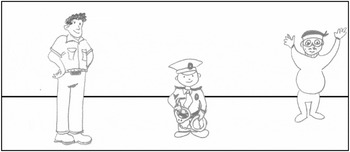
To make the procedure more concrete, consider Figure 1 and the accompanying story in (4) as an example (note that this figure has been adapted for the printed version somewhat: in the experiment colored pictures were used and Minnie Mouse (whose function will be explained later) was also included in the actual items as an observer).
-
(4) Here you see father and his son Bart. Father is a police officer and today he has taken Bart to the police station. Bart is even wearing a real policeman outfit. At the police station there is a thief that has to be handcuffed. Look, Bart is already holding the handcuffs.
Example item.

In the non-linguistic task, following this story, participants would be asked the question “Who is going to handcuff the thief, do you think?”, followed by an explanation question: “Why him?” This example serves as a direct visual trial, as both the picture and the story focus the participant's attention on the fact that the child is dressed as a policeman and is holding the handcuffs. This item thus emphasizes the use of direct visual information in the judgment of the scenario (i.e. that the child will handcuff the thief, not the father), although the participant may choose to ignore the direct visual evidence and make an inference based on world knowledge (i.e. that children do not normally handcuff thieves) instead. Direct visual items thus lay the focus of attention on what can be seen in the picture, but they do not preclude inferential information being used. After the participants indicated which character they thought would perform a particular action, the explanation question required them to make a verbally explicit report of the source of information that was used. This question thus forced the participants not only to monitor the source of information, but also to report on it. In the linguistic task, on the other hand, following the story in (4), participants would be asked the question “Who lijkt [direct evidence] to be going to handcuff the thief?” The correct answer to this question would be ‘the boy’ as the direct evidential forces you to consult direct evidence as your source of information. Given the fact that the boy is the one wearing the required outfit for performing police officer duties, and he is actually already holding the handcuffs in the picture, the boy is the only one who looks like he is going to handcuff the thief and thus is the correct answer to the question containing the direct visual evidential. Of course, the participant may not consider the child to be a likely candidate for handcuffing a thief (given world knowledge regarding the likelihood of children vs. adults catching thieves), but the direct evidential requires one to ignore this source of information and only focus on the visual information.
The structure of the inferential item stories is the same as in the direct visual condition, but crucial information is added at the end of the story that suggests that the information provided by the picture should be ignored and an inference should be made instead:
-
(5) [see story in 4)] … but Bart doesn't know how to handcuff the thief! Dad, who is a police officer, does know how to handcuff the thief.
This story would be followed by the question “Who is going to handcuff the thief, do you think?” and the explanation question “Why him?” in the non-linguistic task. Again, the participant is free to choose which source of information she thinks weighs heaviest in her judgment of the scenario (direct visual or inferential). In the linguistic task, the question following this story would be “Who lijkt je [inferential] to be going to handcuff the thief?” Note that the pronoun changes from first person (me) to second person (je) as the question is addressed to the hearer. As such it is a request for the hearer to give an answer based on inferential evidence. In contrast to the direct evidential condition, in this case the correct answer should be ‘dad’, as use of the inferential evidential forces one to base the answer on a likely inference (i.e. that the character who knows how to handcuff thieves is more likely to do it than the one who does not). The answer ‘Bart’ would be incorrect in this case, because this answer is not based on a likely inference.
In the final condition, the hearsay condition, the use of a verbal report as a source of information was emphasized. To this end, a third character, Minnie Mouse, played a role in the stories in this condition. At the beginning of the experiment, participants were introduced to Minnie Mouse, who told the child that she would be listening to the stories and would be looking at the pictures as well and that sometimes she would give her report of events. As in the direct visual condition, the story would thus introduce two characters and note that only one of the two characters was dressed appropriately for performing a particular act. At this point, Minnie Mouse would inform the participant that Mickey Mouse had already told her how this story would end. In her report of events, the character that was dressed appropriately would not be the one to eventually perform the act, but the other character would take over instead. For instance, in a scenario in which dad is dressed as a clown and carrying juggling balls and the participant is asked to decide who will do a juggling act, Minnie claims that in the end the person dressed as a juggler (dad) will tell his son Martin how to juggle, so that Martin will perform the juggling act. The participant would then be asked the question “Who is going to perform in the juggling act, do you think?”, followed by the explanation question “Why him?” Again, in the non-linguistic task, the participant is free to choose which source weighs heaviest in her judgment. The participant may go with the report of Minnie Mouse or decide to ignore it and focus on the information provided by the picture instead. In the linguistic task, the story was followed by the question “Who schijnt [hearsay] to be going to perform in the juggling act?” As the hearsay evidential requires an answer based on hearsay evidence, the correct answer here is ‘Martin’, because he is the one who will juggle according to the report. Even though visual evidence suggests that dad is the one who will juggle (as he is the one holding the balls and wearing a clown outfit) and world knowledge also entails that a dad is more likely to perform a juggling act than a child, the evidential verb requires one to ignore this and focus on the information provided in the report instead.
Design
All children took part in both the linguistic and the non-linguistic task. The order of the tasks was counterbalanced across participants. That is, half of the participants received the non-linguistic task first and the other half of the participants received the linguistic task first. The minimum amount of time between the two tasks was three weeks. Adults took part in only one of the two tasks (13 participants in the non-linguistic task, 30 participants in the linguistic task). Both tasks took about 15 minutes, and after completion of each task the children were rewarded with a sticker (one school did not want children to receive a material reward, so these children were not given a sticker); the adults received a monetary reward for their participation.
For the non-linguistic task, a total of nine different test items were created. Each participant received the same set of items with three items in each condition (a within-subjects design) with the same order for each participant. The reason to keep the order the same for each participant was to make sure that participants received an item in all three conditions in the first three items. As such, the participant's attention would be drawn to the differences between the items. Furthermore, the first item always had to be an item in the hearsay condition, as this is the condition in which Minnie Mouse gives her report of events. It was therefore clear to the child that whenever Minnie Mouse would speak, she would hear a different voice. Given that the children did not respond with “because Minnie Mouse said so” or any version of this in the other conditions, it is not the case that the first item conditioned the child to answer in a particular way for the remainder of the items.
For the linguistic task, a different set of items was created. A total of eight test items was created for each of the three conditions (24 test items in total) and eight filler items. The total of sixteen items was presented in a pseudo-randomized order. Each participant was randomly assigned to either the lijken (direct visual), schijnen (hearsay), or lijkt me (inferential) condition (i.e. a between-subjects design).
The reason a within-subjects design was chosen for the non-linguistic task whereas a between-subjects design was employed in the linguistic task is that being exposed to different conditions might help the child become aware of the differences between the conditions in the non-linguistic task. In the linguistic task, however, the difference between the evidential verbs (given that they are so similar in form) might obscure the difference between conditions instead of aid the child in appreciating their differences.
The pictures for the direct evidential and inferential evidential condition were the same; the items differed only in the accompanying story (i.e., there was an additional sentence for the inferential items). The hearsay evidential condition made use of different pictures, as these items required a source for the hearsay information (Minnie Mouse) and because in the hearsay condition direct visual evidence and inferential evidence should not be in conflict (in contrast to the direct visual and inferential condition).
RESULTS
Coding responses
The non-linguistic task provides us with answers to two questions: the who-question and the explanation, or the why-question. The answer to the who-question is a categorical response (one of two characters) and the answer to the why-question is an explicit report of the source used. As a first step, we compared the answers to the who- and why-questions. Note that neither of the questions clearly has a right or a wrong answer. The participants can use the source of information that seems most reliable to them in their response. We counted answers to the who-question as being ‘correct’ if the answer given was the character who would perform the action based on the source of information that was emphasized in that condition. That is, the character who looked like he was going to perform the action in the direct visual condition, the character who Minnie Mouse reported to be going to perform the action in the hearsay condition, and the character who was most likely to be going to perform the action in the inferential condition. Answers to the why-questions were coded per condition as falling in either one of two categories: answers based on the source of information that the condition emphasized or answers based on other information (i.e. categories were direct visual vs. non-direct visual, hearsay vs. non-hearsay, and inferential vs. non-inferential). Answers were considered to fall in the ‘direct visual’ category if they referred to an element in the picture (e.g. “I can see in the picture”, “because he's holding the handcuffs”, or “because he is wearing a policeman outfit” in the policeman scenario described in the ‘Method’ section). ‘Hearsay’ answers, on the other hand, were those responses that referred to hearsay evidence (e.g. “I heard from Minnie Mouse” or “because Minnie Mouse told me so” or “that's what she [Minnie Mouse] said”). (This answer category was only available for items in the hearsay condition as this is the only condition in which Minnie Mouse intervenes in the story.) Those responses that referred to an inference based on world knowledge or information in the story were considered inferential answers (e.g. “because the one in the policeman outfit cannot do it”, or “because that one knows how to handcuff a thief”). As it was not always entirely obvious how an answer should be classified, all data were coded by two separate coders, one of whom was blind to the experimental condition. Inter-coder reliability was calculated for each condition separately using Cohen's kappa. Inter-coder reliability was high overall with a kappa of ·87 for the direct visual condition, ·94 for the hearsay condition and ·96 for the inferential condition.
In the vast majority of cases (95·6% of the data), the answers to the who-question and the why-question were congruent. That is, the source of information that the children had relied on (as became apparent from their answer to the why-question) focused on the same character as the children had said would perform the action in their answer to the who-question.
A descriptive analysis of the answers to the why-questions (i.e. the answers that require an explicit report of the source of information) shows that children are more inclined to use direct visual evidence and hearsay evidence as their source of information than they are to use inferential evidence as a source of information. That is, children use direct visual and hearsay information in the vast majority of cases (82% and 81%, respectively) but inferential evidence is relied upon to a much smaller extent (58%). In contrast to the children's performance, the adults tested in this experiment seemed to be more inclined to use inferential (82%) and hearsay (82%) evidence as opposed to direct visual (64%) evidence to provide a judgment of the scenario.
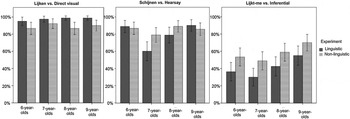
Coding responses for the linguistic task is more straightforward. As the evidential verb forces the participant to consult a particular source of information to give an answer, responses in this experiment can be considered right or wrong, depending on whether the participant bases her answer on the source of information indicated by the evidential verb or not. The data showed that adults scored 97% on lijken, 91% on schijnen, and 95% correct on lijkt me. These scores are not significantly different from a 95% performance level, as shown by a one-sample t-test (lijken: t(9) = 1·00; schijnen: t(9) = −0·63; lijkt me: t(9) = −0·40). This shows that the method used to test children's comprehension of the evidential verbs is suitable. For the children, the data show at-ceiling scores on lijken. But not all children scored at-ceiling on schijnen or lijkt-me (see Figure 2).
Mean percentage of correct answers for the children on the linguistic task compared to the mean percentage of ‘correct’ answers on the non-linguistic task (i.e. answers pointing to the character who is going to do it according to the emphasized source). Error bars indicate 95% confidence intervals.

Analysis
The test question is whether the child can be made to use a specific source of information in her judgment of the scenario by adding an evidential verb to the question. If the child can be made to do so, this is evidence for the child's explicit understanding of the evidential term in question. However, if the addition of the evidential term does not alter the child's initial predispositions regarding the source of information she focuses on, there is no evidence for the child's explicit awareness of the evidential semantics. Children's answers in response to the who-questions served as a baseline for the child's inclination to answer in a particular way in a situation in which she is not guided by an evidential term. Figure 2 graphically shows children's answers to the who-questions on both the linguistic and the non-linguistic tasks for the different age groups in the different conditions.
In order to find out whether children score differently on the linguistic vs. the non-linguistic task, we used a crossed random effects multilevel analysis (Quené & van den Bergh, Reference Quené and van den Bergh2008). The dependent variable is the child's score (right or wrong for the linguistic task, and the character based on emphasized source vs. different source for the non-linguistic task). Both participant and item were included as random effects, and age, task, and the interaction between them were included as predictors. There was no significant effect of age (F(3,2) = 1·68, p = ·170), nor a significant interaction effect (F(15,2) = 0·99, p = ·460), and thus results from the model that includes only task as a predictor are reported.
The model shows that there is a significant effect of task (F(5,2) = 24·22, p < ·001). This effect results from the children scoring significantly higher on lijken (direct visual) than on the direct visual condition (t = −2·078 (0·013), p = ·038, Cohen's d = 0·02). In contrast, children scored significantly lower on lijkt me (inferential) than on the (non- linguistic) inferential condition (t = 3·502 (0·061), p < ·001, Cohen's d = 0·14). There is no evidence that task has an effect on score if schijnen (hearsay) is compared to (non-linguistic) hearsay (t = 1·135 (0·026), p = ·256, Cohen's d = 0·009).
In conclusion, the results show that children have an explicit awareness of the evidential term lijken (direct evidence). Their performance increases as compared to a baseline score (when they are free to choose which source of information they use in their judgment) once the evidential term lijken (direct evidence) is added. They thus understand that lijken (direct evidence) requires the use of direct evidence to provide a judgment of a scenario irrespective of their own judgment of the scenario. There is no evidence to suggest that the evidential verbs schijnen (hearsay) and lijkt me (inferential) have a similar effect, as the addition of the evidential verb does not give a more positive value as compared to the baseline. In fact, there is a negative effect of lijkt me (inferential) indicating that children make fewer inferences when answering a question that includes lijkt me than when they were not guided by an evidential term in the question.
DISCUSSION
The aim of this study was to shed light on a number of issues regarding the acquisition of evidentiality. The main question that this study addressed was whether the acquisition of Dutch evidential verbs is similar to the acquisition of evidentials in languages with grammaticalized evidentiality. That is, whether we find the same pattern in development with direct evidentials being acquired earlier than indirect evidentials. Importantly, in Dutch, the evidential that encodes direct evidence does not encode speaker certainty. As such, it allows us to differentiate between children's understanding of direct evidentials as certainty markers vs. as requiring a particular source of information. In this study, we thus compared children's scores on a task involving evidential verbs to their score on a minimally different non-linguistic task so that their comprehension of the evidential verbs would not be overestimated. Only when performance changes as a result of the addition of an evidential verb can we conclude that there is evidence for the child's explicit awareness of the evidential verb (as opposed to the child simply ignoring the evidential verb in the test question).
Regarding the hierarchy in the acquisition of evidentials, the results of the experiment showed that even the youngest age group tested in this study (consisting of six-year-olds) already demonstrated an explicit understanding of the direct visual evidential (lijken). That is, children can be made to use direct visual evidence as their source of information by adding lijken to the test question. However, no such effect was found for the indirect hearsay and inferential evidential verbs, not even in the oldest age group tested (consisting of nine-year-olds). On the contrary, children were less likely to make an inference once lijkt me (inferential) was added to the question. Potentially, then, some of the children understood lijkt me (inferential) as lijken (direct visual), and as such relied on direct visual information instead of inferential information. Future research is required to find out whether this is indeed the case. Overall, though, it seems that acquiring a system of non-obligatory evidential verbs as opposed to grammaticalized evidentiality does not make a great difference to the pattern of development (cf. Rett & Hyams, Reference Rett and Hyams2014, for a similar conclusion on the basis of English production data). The pattern of acquisition for children acquiring Dutch is the same as that of children acquiring languages with grammaticalized evidentiality: the direct evidential is acquired before the indirect evidentials.
Given the fact that the Dutch direct evidential term lijken does not encode speaker certainty (the direct evidential (lijken) only requires that the speaker has direct evidence for her proposition, not that the speaker is highly certain of it), these findings also demonstrate that the earlier acquisition of the direct evidential as compared to indirect evidentials cannot be attributed to the child's earlier acquisition of certainty (as has been proposed for languages in which direct evidentials conflate evidentiality and high speaker certainty; cf. Robinson, Reference Robinson, Fitneva and Matsui2009; de Villiers et al., Reference de Villiers, Garfield, Gernet-Girard, Roeper, Speas, Fitneva and Matsui2009). This strengthens the idea that, indeed, the direct evidential semantics is acquired before indirect evidentiality.
An open question that remains is to what extent the ages at which children acquire evidentials cross-linguistically are related. Given that children acquiring Turkish start producing direct evidential morphemes around age two (Aksu-Koç, Reference Aksu-Koç1988; Aksu-Koç et al., Reference Aksu-Koç, Ögel-Balaban, Alp, Fitneva and Matsui2009; Papafragou et al., Reference Papafragou, Li, Choi and Han2007), the participants that we included in this experiment (i.e. six- to nine-year-olds) might seem relatively old. However, it should be noted that it is unclear at what age an explicit understanding of the source requirement of the evidentials is acquired for reasons discussed in the ‘Introduction’ to this paper. Different tasks that consider at which age evidentials are acquired require differential capacities of the child, and it is often difficult to tease apart the evidential contribution from other aspects of the semantics of the particular element. Comparing age of acquisition cross-linguistically is thus not particularly informative at this point. Having said that, it is a reasonable hypothesis that Dutch children's understanding of the Dutch evidential verbs lags behind the comprehension of evidentials of children acquiring languages with obligatory evidential morphemes, as these obligatory morphemes occur much more frequently in the input. Moreover, the (subject-to-subject raising) syntax underlying Dutch evidential constructions might induce an additional complexity for the child that might also contribute to a more extended period of acquisition for the Dutch evidential system. Crucially though, the developmental pattern that is observed is the same cross-linguistically.
An interesting additional result from a descriptive analysis of the data from the non-linguistic task is that children were less likely than adults to use and report inferential evidence as their source of information. This finding is in accordance with studies that report late ages of acquisition of inferential evidence as a source of information (Matsui & Fitneva, Reference Matsui, Fitneva, Fitneva and Matsui2009; de Villiers et al., Reference de Villiers, Garfield, Gernet-Girard, Roeper, Speas, Fitneva and Matsui2009). It should be noted that the inference the child was required to make in the current study was an inference on the basis of knowledge and not on the basis of perceptual evidence. As such, the data presented here are compatible with the hypothesis that inferences on the basis of perceptual evidence might be understood earlier than inferences based on knowledge (as it might be cognitively more complex to use a linguistic event as evidence as compared to a physical event; cf. Aksu-Koç, Reference Aksu-Koç1988). Besides the cognitive complexity, there are various other factors that could also contribute to this observed difference. One factor might be that children are simply more prepared than adults to engage in fantasy play and accept that an unlikely situation might happen if visual evidence suggests this possibility (Jeschull & Roeper, Reference Jeschull, Roeper and Crawford2009). Alternatively, the child might not yet possess a knowledge database (consisting of knowledge such as the fact that, typically, adults are more likely to handcuff thieves than children) that is required to make the inference. Future research should investigate whether the results from the descriptive analysis can be replicated and to what extent different factors contribute to the development of source preference.
At this point, we should address some methodological issues concerning this study. A potential worry might be that the effect we find, namely, that indirect evidentials are acquired later than direct ones, results from a difference in complexity of the test items. That is, the indirect evidential items look more complex than the direct ones. The child is asked to ignore the visual evidence that is right in front of her and to either report what someone else said, or to draw a (mental) inference. This thus requires a memory component for the indirect evidential conditions that is absent in the direct evidential condition. Still, it is unlikely that this has a significant effect on the outcome for several reasons. First of all, the data show that children are perfectly capable of ignoring visual information and basing their answer on a report from someone else (as even six-year-old children rely on hearsay information in 76% of the cases in the non-linguistic task). Second, it should be noted that it is inherent to mental reasoning and hearsay evidence that they require a memory component, the memory of a linguistic event. The items are thus necessarily more complex, as they require the use of an indirect (mental) source of information. Yet, from children's scores on hearsay items in both tasks, it seems that this level of complexity can be handled by the children in the age groups that were tested. As such, this complexity cannot by itself account for the delay in the acquisition of indirect evidentials. It seems more likely then that the difficulty lies in mapping the right concept to the right word (cf. Papafragou et al., Reference Papafragou, Li, Choi and Han2007).
Another point of concern might be that Minnie Mouse, as the reporter of the information in the hearsay condition, might be judged to be unreliable. If so, participants might prefer to rely on a different source of information even though they might know that schijnen requires them to use hearsay information. However, we believe that it is unlikely that this has influenced the pattern found in any significant way. In the first place, children have a basic trust in testimony, unless they have particular reasons to disbelieve the source (cf. Harris & Koenig, Reference Harris and Koenig2006). In this set-up, there was no reason for the child to believe that Minnie Mouse would not provide a veridical report of events, so the basic trust in her testimony should have been upheld. Second, it was clear that the children (and adults) often relied on Minnie Mouse and gave an answer based on hearsay information in a relatively large proportion of cases in both the linguistic and the non-linguistic task, again suggesting that there was no general notion of her unreliability as a source.
In conclusion, the present study has shown that the Dutch direct evidential verb is acquired prior to the indirect evidential verbs. This is an interesting result for two reasons: first of all, Dutch encodes evidentiality through verbs instead of bound morphemes, yet the developmental pattern we observe is the same across languages. Second, the present results do not conflate speaker certainty and evidentiality, as the Dutch direct evidential only encodes the source requirement and not (high) speaker certainty. This study is thus specifically informative regarding the child's understanding of evidentiality in and of itself.
SUPPLEMENTARY MATERIAL
The supplementary material referred to in this paper can be found online at <journals.cambridge.org/JCL>.
APPENDIX
EXAMPLE TEST STORIES NON-LINGUISTIC TASK
Example item direct visual condition
Hier zie je vader en zijn zoontje Bart. Vader is politieagent en vandaag heeft hij Bart meegenomen naar het politiebureau. Bart heeft zelfs een echt politiepak aangetrokken. Op het politiebureau is ook een dief die handboeien om moet. Kijk, Bart heeft de handboeien al vast. Wie gaat de handboeien bij de dief omdoen, denk je?
‘Here you see father and his son Bart. Father is a police officer and today he has taken Bart to the police station. Bart is even wearing a real policeman's uniform. At the police station there is a thief who has to be handcuffed. Look, Bart is already holding the handcuffs. Who is going to handcuff the thief, do you think?’
Example item inferential condition
Hier zie je Stijn en zijn opa. Stijn zit op judo en vandaag heeft hij opa meegenomen naar een judowedstrijd. Opa heeft zelfs een echt judopak aangetrokken. Kijk, opa staat al op de judomat. Maar ja, opa kent de judoworpen helemaal niet. Stijn zit op judo en kent de judoworpen heel goed. Wie gaat er aan de judowedstrijd meedoen denk je?
‘Here you see Stijn and his grandpa. Stijn does judo and today he has taken grandpa to a judo competition. Grandpa is even wearing a real judogi. Look, grandpa is already standing on the tatami. But then, grandpa doesn't know the judo moves. Stijn, who does judo, does knows the judo moves. Who is going to play in the judo match, do you think?’
Example item hearsay condition
Hier zie je vader en zijn zoontje Martin. Vader is clown en vandaag heeft hij Martin meegenomen naar het circus. Er is zelfs een jongleeroptreden in het circus. Minnie Mouse: “Mickey heeft me weleens verteld hoe dit verhaaltje afloopt. Vader gaat aan Martin uitleggen hoe je moet jongleren. En dan gaat Martin jongleren tijdens het optreden.” Wie gaat er jongleren tijdens het optreden denk je?
‘Here you see father and his son Martin. Father is a clown and today he has taken Martin to the circus. There is a juggling act in the circus. Minnie Mouse: “Mickey once told me how this story ends. Father will explain to Martin how to juggle and then Martin will do the juggling act.” Who is going to juggle during the act, do you think?’
EXAMPLE TEST STORIES LINGUISTIC TASK
Example item lijken (direct visual)
Hier zie je vader en zijn zoontje Sam. Vader werkt bij de brandweer. Vandaag is het open dag bij de brandweer en vader heeft Sam daar mee naartoe genomen. Sam heeft zelfs een echt brandweermannenpak aan. De brandweer heeft ook een brand gemaakt. Kijk, Sam heeft de brandweerslang al vast. Wie lijkt de brand te gaan blussen?
‘Here you see father and his son Sam. Father is a firefighter. Today is an open day at the fire station and Sam joined father there. Sam is even wearing a real fireman's uniform. The fire fighters have even made a real fire. Look, Sam is already holding the fire hose. Who lijkt to be going to put out the fire?’
Example item lijkt-me (inferential)
Hier zie je vader en zijn zoontje Sam. Vader werkt bij de brandweer. Vandaag is het open dag bij de brandweer en vader heeft Sam daar mee naartoe genomen. Sam heeft zelfs een echt brandweermannenpak aan. De brandweer heeft ook een brand gemaakt. Kijk, Sam heeft de brandweerslang al vast. Maar ja, Sam weet helemaal niet hoe je de slang aan moet doen. Papa is brandweerman en weet heel goed hoe je de slang aan moet doen. Wie lijkt je de brand te gaan blussen?
‘Here you see father and his son Sam. Father is a firefighter. Today is an open day at the fire station and Sam joined father there. Sam is even wearing a real fireman's uniform. The fire fighters have even made a real fire. Look, Sam is already holding the fire hose. But then, Sam doesn't know how to turn on the fire hose. Dad, who is a firefighter, does know how to turn on the fire hose. Who lijkt je to be going to put out the fire?’
Example item schijnen (hearsay)
Hier zie je vader en zijn zoontje Sam. Vader werkt bij de brandweer. Vandaag is het open dag bij de brandweer en vader heeft Sam daar mee naartoe genomen. Ze hebben er zelfs een echte brand gemaakt. Minnie: “Mickey heeft me weleens verteld hoe dit verhaaltje afloopt. Vader gaat aan Sam vertellen hoe de brandweerslang werkt, en dan gaat Sam de brand blussen.” Wie schijnt de brand te gaan blussen?
‘Here you see father and his son Sam. Father is a firefighter. Today is an open day at the fire station and Sam has joined father there. They even made a real fire. Minnie: “Mickey once told me how this story ends. Father will explain how the fire hose works and then Sam will put out the fire.” Who schijnt to be going to put out the fire?’