INTRODUCTION
The Andaman and Nicobar Islands are known for their rich diversity of molluscan fauna occurring in the mangroves, coral reefs, rocky coasts, sandy beaches, seagrass beds and greater depths in the sea. These islands have been subjects of intense study by scientists specializing in a wide range of disciplines for over a century. Molluscs of these islands have in general received more attention than other invertebrates. Subba Rao & Dey (Reference Subba Rao and Dey2000) collated inventories of marine molluscs from the Andaman and Nicobar Islands based on the literature, museum collections and their own work (Rajagopal & Subba Rao, Reference Rajagopal and Subba Rao1974; Subba Rao, Reference Subba Rao1980a, Reference Subba Raob, Reference Subba Rao1989; Subba Rao & Dey, Reference Subba Rao and Dey1984, Reference Subba Rao and Dey1986, Reference Subba Rao and Dey1991; Tikadar et al., Reference Tikadar, Daniel and Subba Rao1986). They reported 1282 species belonging to 372 genera of 145 families. In the past two decades published records and unpublished museum repositories of gastropods from this region have increased considerably. Even so, the present state of knowledge about marine gastropods from these islands is limited. While attempting to prepare a manual on the marine gastropods of the Andaman and Nicobar Islands with a view to understand their present status and diversity, we encountered two species belonging to the families Naticidae and Strombidae that are new to this region. After examining the associated specimens at National Zoological Collections of the Zoological Survey of India, Port Blair, we determined the species Natica arachnoidea (Gmelin, Reference Gmelin1791) and Ministrombus minimus (Linnaeus, Reference Linnaeus1771) as new records to the Andaman and Nicobar Islands. The occurrence of living specimens of both the species in the intertidal area was also confirmed.
MATERIALS AND METHODS
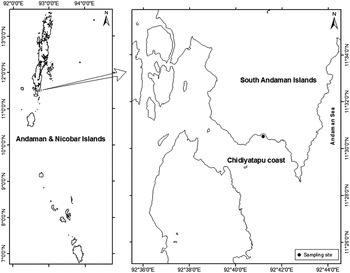
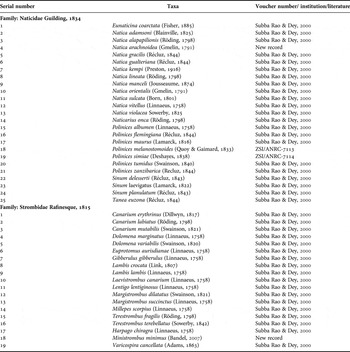
Opportunistic collections of gastropods were carried out during April 2011 in the inter-tidal region during a survey conducted by the Andaman and Nicobar Centre for Ocean Science and Technology at Chidiyatapu (Figure 1) situated at the southern tip of South Andaman, Port Blair. Figure 1 shows the exact location of the study area. Map of the study area was generated using Arc GIS software 9.3.1 version. One specimen of each species has been deposited in the holdings of National Zoological Collections of the Zoological Survey of India, Andaman and Nicobar Regional Centre (ZSI/ANRC), Haddo, Port Blair 744102, India (Registration Numbers: ZSI/ANRC6593 and ZSI/ANRC6594). Systematic classification is based on descriptions given in Kabat (Reference Kabat1996, Reference Kabat2000) and Bandel (Reference Bandel2007). An updated checklist of species under the families Naticidae and Strombidae from the Andaman and Nicobar Islands was compiled based on the published reports (Subba Rao, Reference Subba Rao1989; Subba Rao & Dey, Reference Subba Rao and Dey2000) and from holdings at the Zoological Survey of India, Andaman and Nicobar Regional Centre (see Table 1).
Map showing the study area.

List of species of families Naticidae and Strombidae reported from the Andaman and Nicobar Islands. ZSI/ANRC, Zoological Survey of India/Andaman Nicobar Regional Centre.

RESULTS
The present study records the occurrence of two marine gastropods belonging to the families Naticidae; Natica arachnoidea (Gmelin, Reference Gmelin1791) and Strombidae; Ministrombus minimus (Linnaeus, Reference Linnaeus1771) in the Andaman and Nicobar Islands for the first time.
SYSTEMATICS
Class GASTROPODA Cuvier, 1795
Sub-class CAENOGASTROPODA Cox, 1960
Order LITTORINIMORPHA Golikov & Starobogatov, 1975
Super family NATICOIDEA Guilding, 1834
Family NATICIDAE Guilding, 1834
Genus Natica Scopoli, 1777
Natica arachnoidea Gmelin, Reference Gmelin1791
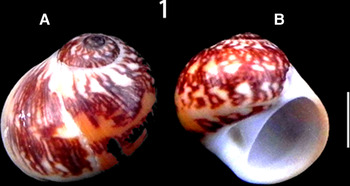
(Figure 2A, B)
Natica arachnoidea: (A) dorsal view; (B) ventral view. Scale bar: 0.5 cm.

MATERIAL EXAMINED
Chidiyatapu (11°30′42.33″N 92°40′42.64″E), South Andaman: 12 April 2011; 1 living individual 15 mm in length and 17 mm in width, collected at 1.5 m depth from the intertidal sand by N.V. Vinithkumar, Registration Number ZSI/ANRC6593; 1 empty shell, 14 mm in length and 16 mm in width collected at 1 m depth.
DESCRIPTION
Shell thick, spire low with a large body whorl. Columnar callus enters the umbilicus; aperture semicircular. Shell base orange with irregular strong reddish brown maculations that run diagonally from the spire towards base; protoconch reddish brown. Callus and interior of aperture white.
DISTRIBUTION
Indo-Pacific region, from the western Indian Ocean to Fiji and the Marshall Islands (Cernohorsky, Reference Cernohorsky1971; Kilburn, Reference Kilburn1976; Springsteen & Leobrera, Reference Springsteen and Leobrera1986; Wilson, Reference Wilson1993; Kabat, Reference Kabat1996, Reference Kabat2000; Hylleberg & Kilburn Reference Hylleberg and Kilburn2002). No previous record of this species from the Andaman and Nicobar Islands is extant.
REMARKS
New record to Andaman and Nicobar Islands. Found only on intertidal sand. Natica arachnoidea is also reported from regions in close proximity to these islands such as Malaysia, Singapore, Borneo and Sabah of Indonesia, Ambon of Molucca Islands, Irian Jaya, Papua New Guinea (Kabat, Reference Kabat2000) and from the Philippines (Springsteen & Leobrera, Reference Springsteen and Leobrera1986). From mainland India, this species has been reported from the Gulf of Mannar (Hylleberg & Kilburn, Reference Hylleberg and Kilburn2002).
Class GASTROPODA Cuvier, 1795
Sub class CAENOGASTROPODA Cox, 1960
Order LITTORINIMORPHA Golikov & Starobogatov, 1975
Super family STROMBOIDEA Rafinesque, 1815
Family STROMBIDAE Rafinesque, 1815
Genus Ministrombus Bandel, Reference Bandel2007
Ministrombus minimus Linnaeus, Reference Linnaeus1771
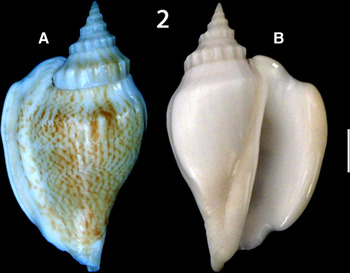
(Figure 3A, B)
Ministrombus minimus: (A) dorsal view; (B) ventral view. Scale bar: 1 cm.

MATERIAL EXAMINED
Chidiyatapu (11°30′36.59″N 92°40′34.44″E), South Andaman: 12 April 2011, 1 living individual; 61 mm in length and 32 mm in width, collected at 2 m depth from a complete sandy substratum by N.V. Vinithkumar, Registration Number ZSI/ANRC6594; 1 living individual, 52 mm in length and 26 mm in width, collected at 1.5 m depth from sand by J.B. Franklin; 1 empty shell, 57 mm in length and 27 mm in width, collected from nearshore region on coral rubbles and sand.
DESCRIPTION
Shell thick, strong with smooth nodulous plaits at the shoulder. Spire conical, whorls with fine plaits; protoconch sharp. Inner lip thickened, reflected and obtusely pointed above. Outer lip smooth within, deeply lobed above attached to the second spiral volution from below upwards. Two small and smooth stromboid notches. Shell white; spire and last whorl with zigzag irregular brown striations. Protoconch and aperture white; columella and lip yellowish brown.
DISTRIBUTION
West Pacific to Japan and Queensland, Australia (Abbott, Reference Abbott1960; Walls, Reference Walls1980).
REMARKS
This species is common but generally overlooked. It is primarily found in the sandy bottom of the intertidal region of the Andaman Islands. Linnaeus (Reference Linnaeus1771) has given the type locality of this species as ‘Habitat in India orientali’ without precise locality data. However, there is no report of its occurrence from the Andaman and Nicobar Islands.
Intense taxonomic and phylogenetic studies of the family Strombidae in the past two decades have created a multigeneric re-arrangement that classifies species more accurately within this group. Recent revision of the family Strombidae by Bandel (Reference Bandel2007) has placed this species under the genus Ministrombus from the parent genus Strombus Linnaeus, Reference Linnaeus1771.
DISCUSSION
Scientific teams from the Zoological Survey of India have surveyed these islands and collected several molluscs beginning from 1957. These type specimens are now in the holdings of the National Zoological Collections of India. The number of species in known collections of gastropods from the Andaman and Nicobar Islands are about 880 (Subba Rao & Dey, Reference Subba Rao and Dey2000). However, of the 24 species known from the family Strombidae that include the present new record, nineteen are valid now and five have been removed from the checklist based on classification updates proposed by Bandel (Reference Bandel2007). Nomenclature has been updated and authors and dates are corrected for the members of both families given in the checklist. Although we have collected many specimens of both species, we have included and mentioned only a few that could be referred from the National Zoological Collections. Even a cursory search has yielded us two unreported species. Hence, focused studies on marine gastropods and systematic surveys are likely to reveal many more additional species from the Andaman and Nicobar Islands.
ACKNOWLEDGEMENTS
The authors gratefully acknowledge the financial support given by the Earth System Science Organization, Ministry of Earth Sciences, Government of India, to conduct this research. We are thankful to Dr M.A. Atmanand, Director, National Institute of Ocean Technology for constant encouragement to conduct this work. We thank Professor K.S. Krishnan, National Centre for Biological Sciences (TIFR), Bangalore, India and Dr M. Nithyanandan, Environmental Department, La Ala Al Kuwait Real Estate Co. K.S.C., Kuwait for valuable editorial comments and review of an earlier draft of this manuscript. We also thank Professor Thomas F. Duda Jr and the anonymous referees for their inputs that helped to improve the manuscript. We thank Dr C. Raghunathan, Officer-In-Charge, ZSI/ANRC, Port Blair, Andaman, for his encouragement and repository of specimens in the National Zoological Collections.