Introduction
Elephant grass (Cenchrus purpureus) is an important forage grass commonly cultivated in tropical and subtropical climate regions, with high potential for biomass production, adaptation to diverse ecosystems, and good acceptance by animals (Amaral et al., Reference Amaral, Carvalho, Costa, Morenz, Schwan and Ávila2020; Shah et al., Reference Shah, Xianjun, Zhihao, Junfeng and Sao2018). In tropical regions, elephant grass silage serves as an alternative feed resource within livestock production systems (Bernardes and Rego, Reference Bernardes and Rêgo2014).
Efficient fermentation of ensiled mass is characterized by rapid reduction in pH due to the metabolism, mainly, of lactic acid bacteria (LAB), which results in an increase in the concentration of lactic acid (Kung et al., Reference Kung, Shaver, Grant and Schmidt2018). Such conditions make the silage environment unsuitable for the development of undesirable microorganisms belonging to the genera Listeria, Clostridium, and Bacillus (Pahlow et al., Reference Pahlow, Muck, Driehuis, Elfrink, Oude Elferink, Spoelstra, Buxton, Muck and Harrison2003).
Tropical grasses generally present high moisture content and low concentrations of water-soluble carbohydrates (WSC) at the time of harvest (Amaral et al., Reference Amaral, Carvalho, Costa, Morenz, Schwan and Ávila2020; Santos et al., Reference Santos, Pereira, Garcia, Ferreira, Oliveira and Silva2014). These characteristics contribute to a slower decline in pH during the ensiling process (Dong et al., Reference Dong, Shao, Li, Yang and Yuan2020; Shah et al., Reference Shah, Xianjun, Zhihao, Junfeng and Sao2018; Shah et al., Reference Shah, Qian, Liu, Wu, Sultana, Mobashar, Wanapat and Zhong2021), which can compromise fermentation efficiency and increase the risk of nutrient losses during storage. In this context, the inoculation of tropical grasses with obligate homofermentative and/or facultative heterofermentative LAB at the time of ensiling can improve the fermentation profile. The addition of these microorganisms typically results in faster acidification, leading to lower final pH values, higher concentrations of lactic acid, and reduced levels of acetic acid (AA), butyric acid (BA), and ammonia. Consequently, silages treated with LAB tend to exhibit greater dry matter (DM) recovery compared with untreated silages (Amaral et al., Reference Amaral, Carvalho, Costa, Morenz, Schwan and Ávila2020; Irawan et al., Reference Irawan, Sofyan, Ridwan, Hassim, Respati, Wardani, Sadarma and Jayanegara2021; Oliveira et al., Reference Oliveira, Weinberg, Ogunade, Cervantes, Arriola, Jiang, Kim, Li, Gonçalves, Vyas and Adesogan2017; Santos et al., Reference Santos, Pereira, Garcia, Ferreira, Oliveira and Silva2014; Shah et al., Reference Shah, Xianjun, Zhihao, Junfeng and Sao2018).
The compatibility between the forage and the inoculated bacterial strain is a determining factor for the success of a microbial additive (Yang et al., Reference Yang, Cao, Cai and Terada2010). Several studies have reported improved fermentation quality when silages were inoculated with strains originally isolated from the same crop (Agarussi et al., Reference Agarussi, Pereira, da Silva, da Silva, de Paula, Silva and Ribeiro2022; Amaral et al., Reference Amaral, Carvalho, Costa, Morenz, Schwan and Ávila2020; Cardoso et al., Reference Cardoso, Silva, Sousa, Silva, Silva, Soares and Ávila2025; Carvalho et al., Reference Carvalho, Ávila, Pinto, Neri and Schwan2014; Silva et al., Reference Silva, Pereira, Silva, Leandro, Paula, Santos, Ribeiro and Valadares Filho2018). This response is likely associated with the specific nutrient composition and physicochemical characteristics of the plant exudates from which the microorganisms were isolated (Hill, Reference Hill1989; Muck, Reference Muck and Muck1993). Based on this evidence, we hypothesized that the use of wild lactobacilli strains isolated from elephant grass grown under tropical conditions, when reintroduced into their respective silages, can enhance the fermentation process and improve overall silage quality.
However, producing well-preserved elephant grass silage remains a challenge due to the high moisture content commonly observed at harvest. Under such conditions, it can be difficult to demonstrate the effectiveness of microbial inoculants, as excessive moisture reduces the availability of fermentable substrates and may limit bacterial activity. Therefore, testing crop-adapted strains under these challenging tropical conditions may help identify microorganisms capable of improving fermentation efficiency and enabling earlier harvests, reducing field losses and improving silage management. Thus, our objective was to isolate, identify, and select LAB strains that can be used as inoculants in elephant grass silage, as well as to evaluate their effects on the fermentation quality of these silages under tropical conditions.
Materials and methods
Experimental area and climatic conditions
The experiment was carried out at the Animal Science Department of the Federal University of Viçosa, Viçosa, MG, Brazil. Viçosa is located at 20°45′ S, 42°51′ W, 657 m above sea level, and has a mean annual rainfall of 1,341 mm.
Experiment 1: Isolation and identification of LAB from elephant grass
Elephant grass (Cenchrus purpureus cv. Napier), established in an area approximately five years before the experiment, was harvested manually at 150 days of regrowth and chopped in a stationary forage machine (model PN Plus 2000, Nogueira S.A., São João da Boa Vista, Brazil) to an average particle size of 1.5 cm. For maintenance fertilization, after each cut, 200 kg/ha of the formula NPK 20-05-20 was applied. Five hundred grams of chopped forage was ensiled in bags (25 cm x 35 cm, Doug Care Equipment, Springville, CA, USA), and anaerobic conditions inside the mini-silo were obtained using a vacuum sealer (Eco vacum 1040, Orved, Venice, Italy). The bags were stored at room temperature (25 ± 2°C), and triplicate bags were opened at 1, 3, 7, 14, 28 and 56 d after fermentation. The samples were destined for chemical analysis, and the water extract was prepared for fermentation profile analysis, microbial count, and identification of LAB.
Water extracts from the silages and fresh forage samples were prepared by homogenizing 25 g of sample in 225 ml of Ringers solution (Oxoid, Basingstoke, UK) in an industrial blender for 1 min and divided into two portions. In one portion, the pH was measured using a potentiometer (model W3B, Tecnal, Piracicaba, SP, Brazil). Subsequently, 15 ml of each extract were filtered through Whatman 54 filter paper (Whatman, Florham, NJ, USA), acidified with 100 µL of sulphuric acid (50% v/v), and frozen (−20°C) for further analyses of water-soluble carbohydrates (WSC) by a colorimetric procedure (Nelson, Reference Nelson1944), lactic acid (LA), AA, and butyric acid by high-performance liquid chromatography (HPLC, Shimadzu, OR, USA) (Siegfried et al., Reference Siegfried, Ruckemann and Stumpf1984). The HPLC apparatus was equipped with a refractive index detector and used an Aminex HPX-87H column (BIO-RAD, Hercules, CA, USA) with the mobile phase containing 0.005 M sulphuric acid with a flow rate of 0.6 ml/min at 50°C.
The other portion was subjected to serial dilutions (10−2 to 10−8) for microorganism enumeration by pour plate method. Enterobacteria were enumerated on Violet Red Bile (Difco, Sao Paulo, SP, Brazil), and the plates were incubated at 37°C for 24 h. Moulds and yeasts were cultivated on potato dextrose agar (Difco, Detroit, MI, USA) acidified with 1.5% tartaric acid solution (10% w/v). The plates were incubated at 25°C, and yeasts and moulds were counted after 72 and 120 h of incubation, respectively. The LAB count was performed on De Man Rogosa Sharpe (MRS) agar (Oxoid, Basingstoke, UK) after incubation in anaerobic jars (Permution, Curitiba, PR, Brazil) at 37°C for 48 h. Colonies were counted on plates containing a minimum of 25 and a maximum of 250 colony-forming units (cfu). Data from microbial counts were transformed into the logarithmic base (log10 cfu).
For the isolation of LAB, several colonies corresponding to the square root of the total colonies contained on the MRS agar plates were isolated at random (Holt et al., Reference Holt, Krieg, Sneath and Williams1994). The isolates were further purified by streaking individual colonies onto MRS agar containing 0.04 g/l of bromocresol purple and 5 g/l of CaCO3 (Holt et al., 1944). All potential LAB were detected by a yellowish colony and a clear zone caused by the dissolution of CaCO3. Pure stock cultures were maintained at −80°C in MRS broth supplemented with 20% glycerol for further analysis.
For DNA extraction and further identification by 16S rRNA gene sequencing, pure cultures of LAB were grown for 16 h in MRS broth at 37°C. Extraction of the DNA was performed with Wizard® Genomic DNA Purification kit (Promega, Madison, WI, USA). The concentration of extracted DNA was evaluated in a NanoDrop spectrophotometer (Thermo Fisher Scientific, Waltham, MA, USA) and stored at -20°C. The 16S rRNA gene sequences were amplified by polymerase chain reaction (PCR) using P027F primers (5’-GAGAGTTTGATCCTGGCTCAG-3’) and 1492R (5’-TACGG(C/T)TACCTTGTTACGACTT-3’) (Heuer et al., Reference Heuer, Krsek, Baker, Smalla and Wellington1997). The PCR was performed in microtubes containing 50 µL of the mixture of 4 µL of genomic DNA (20 ng/µL), 10 µL of GoTaq reaction buffer (5X), 3 µL of MgCl2 (25 mmol/L), 1 µL dNTP (10 mmol/l) (Promega, Madison, WI, USA), 0.4 µL of Taq DNA polymerase (5 U/µL) (Promega, Madison, WI, USA), and 0.6 µL of each primer (10 µmol/L). Autoclaved ultrapure water was added to reach the final volume. Amplification took place in a thermocycler Prime Techne (Cole-Parmer, Staffordshire, UK) under the following conditions: initial denaturation 94°C for 5 min, followed by 30 cycles of denaturation at 94°C for 30 s each cycle; primer annealing at 60°C for 30 s; elongation at 72°C for 2 min; and final extension at 72°C for 5 min. The PCR product was analysed by agarose gel electrophoresis (12 g/l) in Tris borate EDTA buffer (0.5X TBE). The gel was stained with 0.5 μg/mL of ethidium bromide, and the bands were visualized under UV illumination (UVB Transilluminator, model LTB-20X20 HE, Loccus Biotecnologia, Cotia, SP, Brazil). One fragment of approximately 1500 pb of the PCR product was sent to Macrogen© (Seoul, South Korea) for purification and sequencing.
The sequences of rRNA fragments of each isolate, ranging from 1000 to 1350 bp, were analysed using the BLASTn software (Basic Local Alignment Search Tool – 2215 BLAST, version 2.0) available at the National Centre for Biotechnology Information (NCBI) (https://www.ncbi.nlm.nih.gov/BLAST/). Isolates with a sequence identity equal to or greater than 97% of the sequences deposited in the GenBank were considered as the same species (Altschul et al., Reference Altschul, Gish, Miller, Myers and Lipman1990).
The gene sequences of the 16S rRNA region of the LAB isolated in this study were deposited in the GenBank database at NCBI with access numbers from MH899226 to MH899382.
Characterization and selection of LAB strains
Physiological and biochemical tests were utilized for LAB characterization and screening. The strains were evaluated for growth capacity by using MRS broth at 15 and 45°C, as well as pH values 3.5, 4.0, 4.5, and 8.0. After 24 h of incubation, the absorbance at 630 nm was measured by using a plate spectrophotometer (Thermo Fisher Scientific, Waltham, MA, USA). Gas production from glucose in MRS broth in Durham tubes at 37°C for 48 h was also estimated.
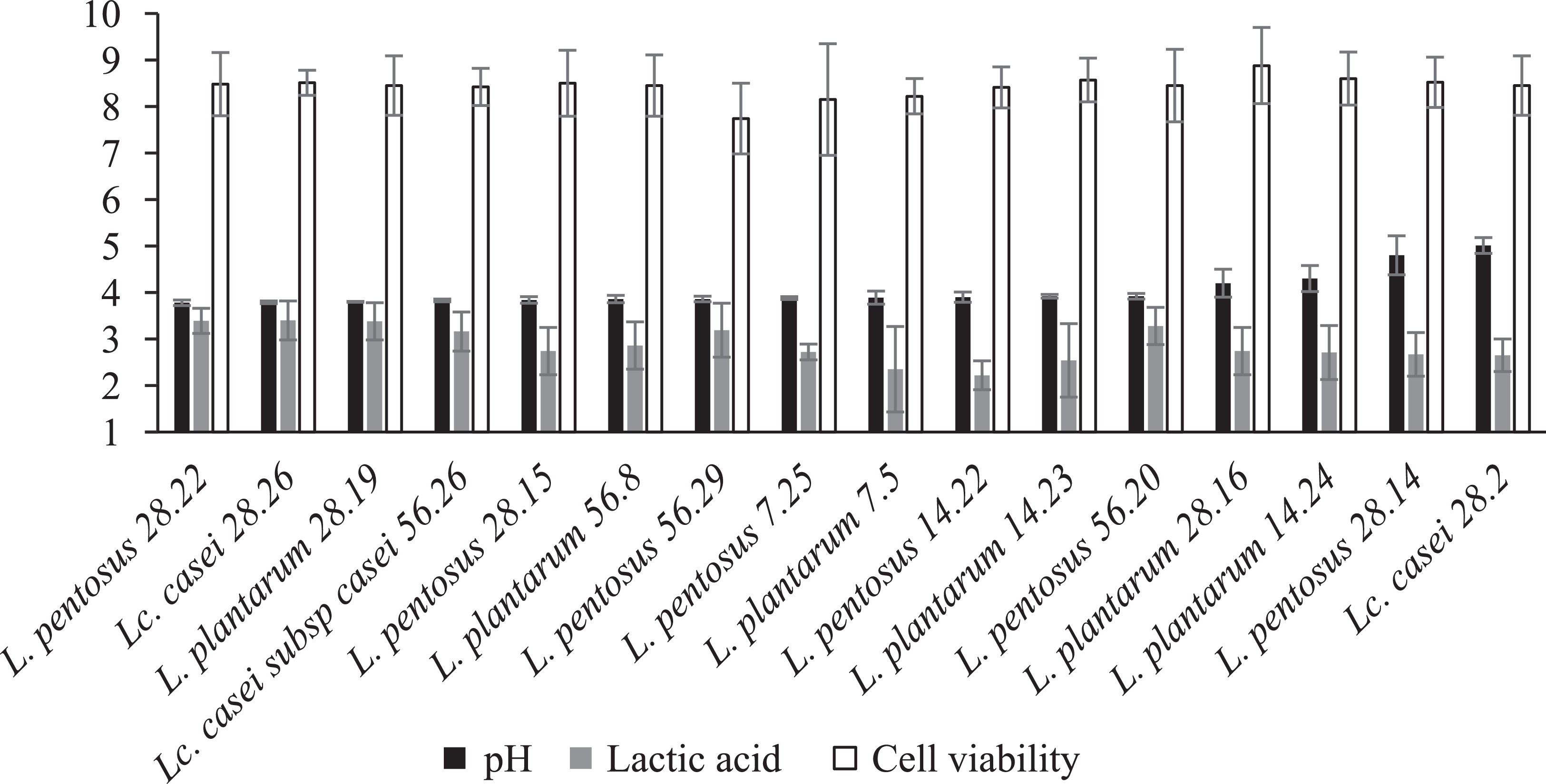
The homofermentative LAB strains (n = 16) that showed the best growth at 45°C and pH ≤ 4.0 were selected for cultivation in an aqueous extract of elephant grass (Figure 1). The extract was prepared by blending fresh elephant grass with distilled water in the proportion of 1:5 in an industrial blender for 5 min. The extract was filtered through layers of cheesecloth and sterilized at 121°C for 15 min. The selected strains were inoculated into elephant grass extract at a concentration of 103 cfu/ml and incubated at 37°C. Samples were collected after 12 h of cultivation to measure pH value, LA, and counts of viable cells (cfu/ml) according to methods described previously. Based on the final pH (< 4.0) and LA production (>3.0 mg/l), three strains of LAB (L. plantarum CE 28.19, L. pentosus CE 28.22, and Lc. casei CE 28.26) were selected to be inoculated into elephant grass for ensiling.
Lactic acid concentration (mg/l), pH values, and cell viability (log cfu/ml) obtained from different LAB strains (n = 16) cultivated in an aqueous extract of elephant grass at 37°C for 12 hours (Experiment 1). The bars indicate the standard deviation.

Figure 1. Long description
Panel A: A bar graph comparing pH, lactic acid concentration, and cell viability for different LAB strains. The horizontal axis lists the LAB strains, including L pentosus 28.22, Lc casei 28.26, Lc casei subsp casei 28.19, L pentosus 56.26, L plantarum 28.15, L pentosus 56.8, L pentosus 56.29, L plantarum 7.25, L plantarum 7.5, L pentosus 14.22, L pentosus 14.23, L plantarum 56.20, L plantarum 28.16, L pentosus 14.24, L pentosus 28.14, and Lc casei 28.2. The vertical axis measures values from 1 to 10. The graph uses three colors: black for pH, gray for lactic acid, and white for cell viability. Each LAB strain has three bars representing these measurements. The bars indicate the standard deviation. Notable trends include variations in pH, lactic acid concentration, and cell viability across different LAB strains.
Experiment 2: Evaluation of LAB strains on silage fermentation and chemical composition
Elephant grass cv. Napier was harvested manually at 70 d of regrowth and chopped into 1.5 cm particle size in a stationary forage chopper (model PN Plus 2000, Nogueira S.A., Sao Joao da Boa Vista, SP, Brazil). Three piles (replicates) containing approximately 3 kg of fresh forage were prepared for each inoculant (for a total of 18 piles). Each pile received one of the following six inoculants: (1) distilled water without inoculant (CTRL); (2) L. plantarum CE 28.19 (LPL); (3) L. pentosus CE 28.22 (LPE); (4) Lc. casei CE 28.26 (LCA); (5) L. plantarum CE 28.19 + L. pentosus CE 28.22 + Lc. casei CE 28.26 (COMBO); and (6) a commercial inoculant (CI). The CI was Sil-All 4 × 4 W.S. (Lallemand, Aparecida de Goiânia, GO, Brazil), which contains sucrose, L. plantarum, Pediococcus acidilactici, Enterococcus faecium, Ligilactobacillus salivarius ssp. salivarius, silicon dioxide, amylase, cellulase, hemicellulose, and xylanase. The inoculants were diluted in 100 mL of water and sprayed onto the forage at an application rate of 106 cfu/g of forage. A total of 500 g of each pile was packed into nylon-polyethylene bags (25 × 35 cm; Doug Care Equipment Inc., Springville, CA, USA), and the air was evacuated from the bags using a vacuum sealer (Eco vacuum 1040, Orved, Venice, Italy). Six bags were prepared from each pile, one bag for each fermentation period, and stored in the laboratory at room temperature.
The experiment was conducted in a completely randomized design based on a 6 × 6 factorial assay with six inoculants (I) and six fermentation periods (P) (1, 3, 7, 14, 21, and 56 days) and three replications, for a total of 108 experimental units.
The ammonia-N concentrations were determined according to the method proposed by Okuda et al. (Reference Okuda, Fuju and Kawashima1965), whereas the measurement of microbial counts, pH, WSC, LA, AA, and BA were performed as previously described. For chemical analyses, fresh and ensiled elephant grass samples were dried in a forced-air oven at 55°C for 72 h. After drying, all samples were ground in a Willey mill with a 1-mm sieve. Samples were analysed after each fermentation period for DM (method 934.01) and, after 56 d of fermentation for crude protein (CP) (method 984.13), ash (method 942.05), and acid detergent fibre (ADF) content according to the AOAC23 (1990), and the neutral detergent fibre (NDF) content according to Mertens (Reference Mertens2002).
Statistical analyses
Data were analysed in a factorial scheme in a completely randomized design. Inoculant (I), fermentation period (P), and the interaction between I and P were considered fixed effects in the following model:
 ${\rm Y}_{ijk} = {\rm\mu} + {\rm I}_{i} + {\rm P}_{j} + {(\rm IP)}_{ij} + {\rm e}_{ijk}$
where Y ijk = response variable, µ = general constant, I i = effect of inoculant i, P j = effect of fermentation period j, (IP) ij = interaction of inoculant i and fermentation period j, and e ijk = random error assuming an independent normal distribution, NID (0, σ2). The normality of residuals was assessed using the Shapiro–Wilk test, and the homogeneity of variances was verified using Levene’s test. After analysis of variance, the significant interactions among the factors were unfolded and compared using the Tukey test. The critical level of probability for type I error of 0.05 was adopted using the PROC MIXED of SAS version 9.4 (SAS, 2013).
Results
Experiment 1: Isolation and identification of LAB from elephant grass
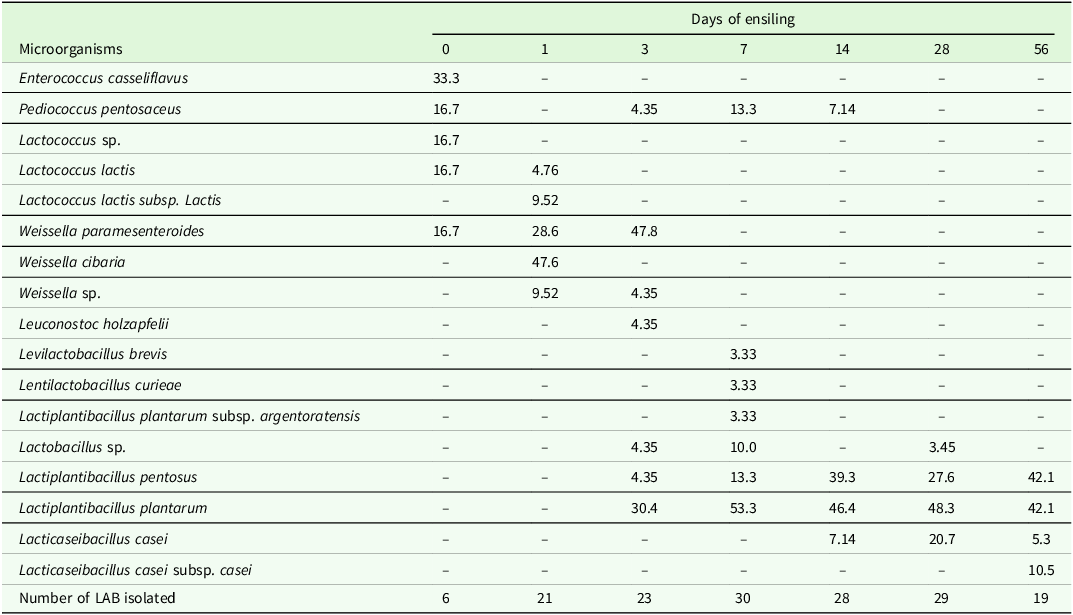
The sequencing of the 16S rRNA gene identified of 156 isolates belonging to the genera Lactiplantibacillus (58.33%), Lacticaseibacillus (7.05%), Lactobacillus sp. (3.21%), Levilactobacillus (0.64%), and Lentilactobacillus (0.64%), all belonging to the group previously classified as lactobacilli (69.87%). In addition, isolates from the genera Weissella (19.87%), Pediococcus (5.14%), Lactococcus (3.21%), Enterococcus (1.28%), and Leuconostoc (0.64%). The microbial succession of elephant grass silage on different days of fermentation showed that the genus Weissella predominated on days 1 and 3, represented mainly by the species W. cibaria (47.62%) and W. paramesenteroides (47.82%), respectively. Subsequently, the L. plantarum and L. pentosus dominated as the fermentation progressed (Table 1).
Epiphytic lactic acid bacteria succession (%) of tropical elephant grass forage and its silages (Experiment 1)

Table 1. Long description
The table presents the percentage succession of various microorganisms over different days of ensiling in tropical elephant grass forage and silages. It includes data for 12 microorganisms across 7 days of ensiling (0, 1, 3, 7, 14, 28, 56). The microorganisms listed are Enterococcus casseliflavus, Pediococcus pentosaceus, Lactococcus sp., Lactococcus lactis, Lactococcus lactis subsp. Lactis, Weissella paramesenteroides, Weissella cibaria, Weissella sp., Leuconostoc holzapfelii, Levilactobacillus brevis, Lentilactobacillus curieae, Lactiplantibacillus plantarum subsp. argentoratensis, Lactobacillus sp., Lactiplantibacillus pentosus, Lactiplantibacillus plantarum, Lacticaseibacillus casei, and Lacticaseibacillus casei subsp. casei. The table also includes the total number of lactic acid bacteria (LAB) isolated each day. Each row lists the percentage of each microorganism present on specific days of ensiling. Notable trends include the predominance of Weissella species on days 1 and 3, and the increasing presence of Lactiplantibacillus species as fermentation progresses.
Characterization and selection of LAB strains
The isolated LAB strains showed lower growth at pH 3.5 and 15°C, and higher growth at pH 8.0 and 45°C. Based on glucose fermentation, approximately 73% of the strains were characterized as homofermentative and 27% as heterofermentative (see Supplementary Table 1).
The 16 homofermentative LAB strains with the best growth at 45°C and pH ≤ 4.0 in grass broth showed exponential growth, with an approximate increase of five log cycles in 12 h, while the initial pH of the medium (5.80) was reduced to final values ranging from 3.78 to 5.01 (Figure 1). The highest LA concentrations (>3.0 mg/l) were obtained from the isolates Lc. casei CE 28.26, L. pentosus CE 28.22, L. plantarum CE 28.19, L. pentosus CE 56.20, L. pentosus CE 56.29, and Lc. casei sp. casei CE 56.26, respectively (Figure 1). Therefore, based on higher LA production associated with lower pH, the strains L. pentosus 28.22, Lc. casei 28.26, and L. plantarum 28.19 were selected as inoculants in elephant grass silage in Experiment 2.
Experiment 2: evaluation of LAB strains on silage fermentation and chemical composition
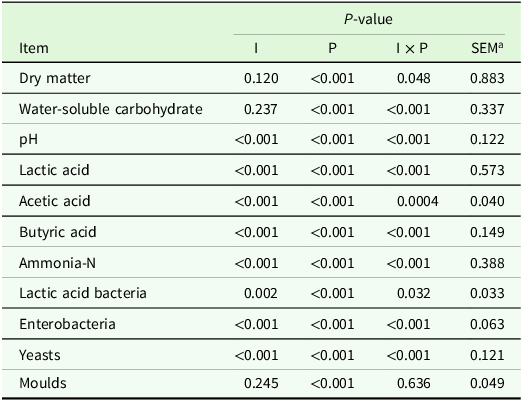
There was an I × P interaction effect (P < 0.050) on all the variables analysed in the silages, except for the mould population, which was affected only by P (Table 2).
Effect of inoculant (I), period (P) and interaction (I × P) factors on the evaluated variables of elephant grass silages (Experiment 2)

Table 2. Long description
A table with 11 rows and 5 columns. The columns are labeled Item, P-value I, P-value P, P-value I x P, and SEM. The rows are labeled with different items: Dry matter, Water-soluble carbohydrate, pH, Lactic acid, Acetic acid, Butyric acid, Ammonia-N, Lactic acid bacteria, Enterobacteria, Yeasts, and Moulds. Each row contains P-values for the items under the columns P-value I, P-value P, and P-value I x P, along with SEM values. The table shows the statistical significance of the effects of inoculant (I), period (P), and their interaction (I x P) on each item.
a SEM = mean standard error.
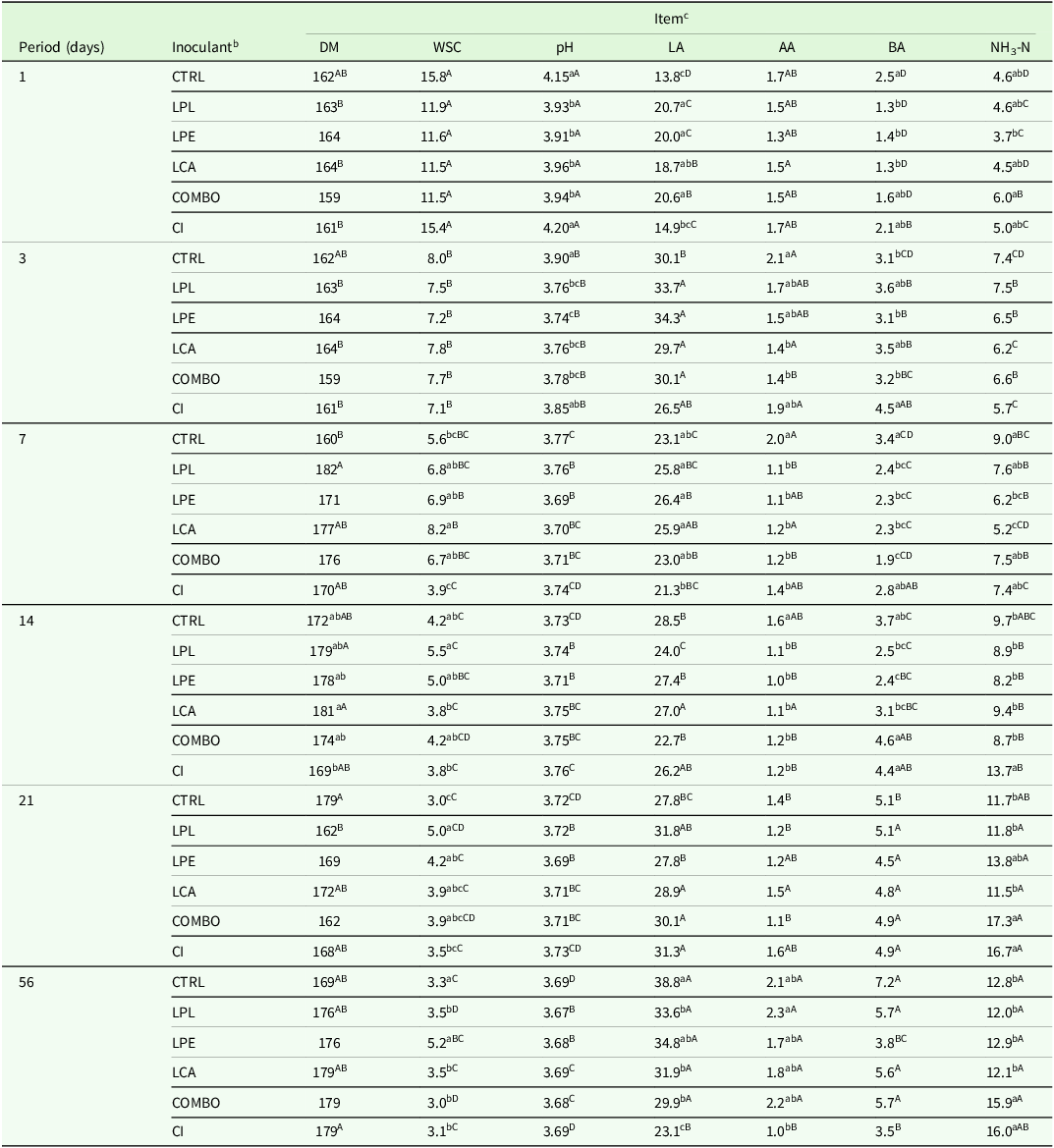
The pH values differed only at the beginning of fermentation (Table 3). On the first day, silages inoculated with the selected strains had a significantly (P < 0.001) lower pH compared to the CTRL and CI silages (Table 3). On the third day, the significantly (P = 0.008) lowest pH was recorded in the silage inoculated with LPE strain compared to CTRL and CI silages (Table 3). Throughout fermentation, silages inoculated with LPL (P = 0.002) and LPE (P < 0.001) presented a significantly shorter time for pH stabilization compared to CTRL silage (3 vs. 14 d of fermentation) (Table 3).
Average dry matter content (g/kg FM a ), water-soluble carbohydrates (g/kg DM) and fermentative profile of elephant grass silages with or without inoculant in different fermentation periods (Experiment 2)

Table 3. Long description
A table comparing the dry matter content, water-soluble carbohydrates, and fermentative profile of elephant grass silages with different inoculants over various fermentation periods. The table has 7 rows and 10 columns. Column headers are Period (days), Inoculant, DM, WSC, pH, LA, AA, BA, and NH3-N. Row labels include different inoculants (CTRL, LPL, LPE, LCA, COMBO, CI) and fermentation periods (1, 3, 7, 14, 21, 56 days). Each row provides specific values for DM, WSC, pH, LA, AA, BA, and NH3-N. Notable trends include variations in pH and NH3-N levels across different inoculants and fermentation periods.
a FM = fresh material.
b CTRL = without inoculant; LPL = Lactiplantibacillus plantarum CE 28.19; LPE = Lactiplantibacillus pentosus CE 28.22; LCA = Lacticaseibacillus casei CE 28.26; COMBO = L. plantarum CE 28.19 + L. pentosus CE 28.22 + L. casei CE 28.26; CI = commercial inoculant (Sil-All 4 × 4 W.S.).
c DM = dry matter; WSC = water-soluble carbohydrates; LA = lactic acid (g/kg DM); AA = acetic acid (g/kg DM); BA = butyric acid (g/kg DM); NH3-N = ammonia nitrogen (% Total Nitrogen). Means followed by the same lowercase lettera–c, inoculant split in each period, and uppercaseA–D, period split in each inoculant, in the column do not differ (P > 0.05) from each other using the Tukey test.
On the first day of fermentation, CTRL silage had a significantly (P = 0.002) lower LA concentration compared to the silages inoculated with LPL, LPE, LCA and COMBO (Table 3). However, at 56 d of fermentation, the LA concentrations in the CTRL and LPE silages were similar but significantly (P < 0.001) higher compared to the LA concentration in the CI silage (Table 3).
The inoculated silages had significantly (P < 0.050) lower AA contents compared to the CTRL silage at 7 and 14 d of fermentation. At 56 d of fermentation, the highest AA content, 2.27 g/kg DM in the silage inoculated with LPL was significantly (P = 0.031) greater than that in the CI silage. No significant differences (P > 0.050) were observed among the AA concentrations of silages on days 1 and 21 of fermentation (Table 3). Silage inoculated with LCA maintained similar (P > 0.050) AA concentrations throughout fermentation (Table 3).
The lowest BA concentrations were in the silages inoculated with LPL, LPE, and LCA on days 1 and 7 compared to CTRL silage. However, in the final fermentation periods (days 21 and 56), there were no significant (P > 0.050) differences difference in the concentration of BA among the silages (Table 3).
Significantly (P = 0.009) higher ammonia-N concentrations were recorded at 21 d of fermentation in silages treated with COMBO and CI compared to the CTRL, LPL, and LCA silages, as well as at 56 d of fermentation (P = 0.001). Significantly (P < 0.050) higher ammonia-N concentrations were observed in all silages at 56 d of fermentation compared to 1, 3, and 7 d (Table 3).
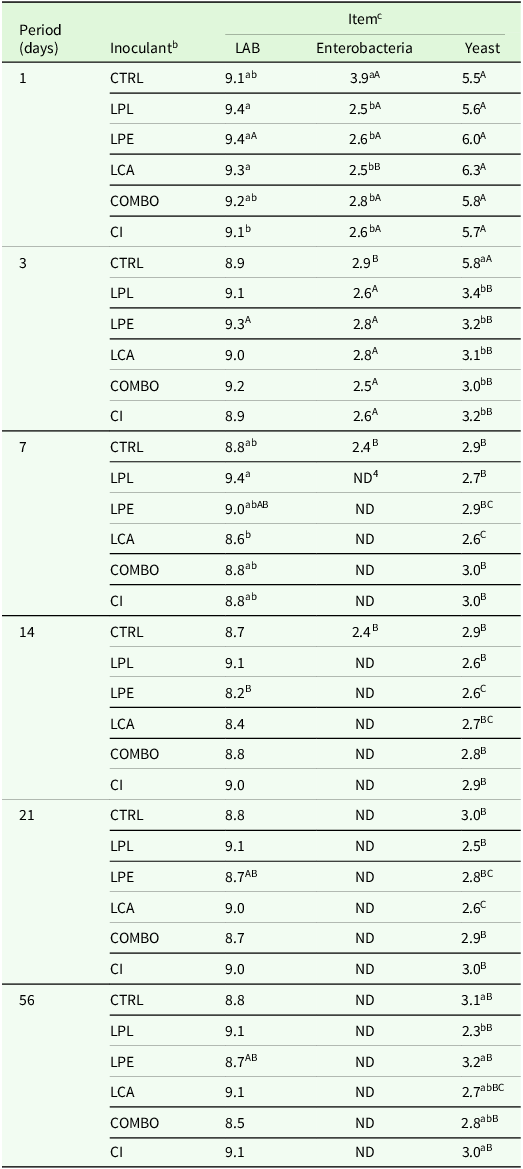
The LAB population in the silages differed significantly (P < 0.050) only on days 1 and 7 of fermentation (Table 4). The silages inoculated with LPL, LPE, and LCA had significantly (P = 0.007) higher LAB populations on the first day of fermentation compared to the silage treated with CI. At 7 d of fermentation, the silage treated with LPE had a significantly (P = 0.040) higher LAB population compared to the silage treated with LCA (Table 4). Throughout fermentation, the LAB population within each treatment silage did not differ significantly (P > 0.050) except in the silage treated with LPE (Table 4).
Microbial populations (log cfu/g FM a ) of elephant grass silages with or without inoculant in different fermentation periods (Experiment 2)

Table 4. Long description
The table presents microbial populations in elephant grass silages with or without inoculant over different fermentation periods. It has 7 rows and 5 columns. The columns are labeled Period (days), Inoculant, LAB, Enterobacteria, and Yeast. The rows are labeled with different periods (1, 3, 7, 14, 21, 56 days) and inoculant types (CTRL, LPL, LPE, LCA, COMBO, CI). Row 1: Period 1, Inoculant CTRL, LAB 9.1ab, Enterobacteria 3.9BA, Yeast 5.5A. Row 2: Period 1, Inoculant LPL, LAB 9.4a, Enterobacteria 2.5BA, Yeast 5.6A. Row 3: Period 1, Inoculant LPE, LAB 9.4AA, Enterobacteria 2.6BA, Yeast 6.0A. Row 4: Period 1, Inoculant LCA, LAB 9.3a, Enterobacteria 2.5BB, Yeast 6.3A. Row 5: Period 1, Inoculant COMBO, LAB 9.2ab, Enterobacteria 2.8BA, Yeast 5.8A. Row 6: Period 1, Inoculant CI, LAB 9.1b, Enterobacteria 2.6BA, Yeast 5.7A. Row 7: Period 3, Inoculant CTRL, LAB 8.9, Enterobacteria 2.9B, Yeast 5.8AA. Row 8: Period 3, Inoculant LPL, LAB 9.1, Enterobacteria 2.6A, Yeast 3.4BB. Row 9: Period 3, Inoculant LPE, LAB 9.3A, Enterobacteria 2.8A, Yeast 3.2BB. Row 10: Period 3, Inoculant LCA, LAB 9.0, Enterobacteria 2.8A, Yeast 3.1BB. Row 11: Period 3, Inoculant COMBO, LAB 9.2, Enterobacteria 2.5A, Yeast 3.0BB. Row 12: Period 3, Inoculant CI, LAB 8.9, Enterobacteria 2.6A, Yeast 3.2BB. Row 13: Period 7, Inoculant CTRL, LAB 8.8ab, Enterobacteria 2.4B, Yeast 2.9B. Row 14: Period 7, Inoculant LPL, LAB 9.4a, Enterobacteria ND, Yeast 2.7B. Row 15: Period 7, Inoculant LPE, LAB 9.0abAB, Enterobacteria ND, Yeast 2.9BC. Row 16: Period 7, Inoculant LCA, LAB 8.6b, Enterobacteria ND, Yeast 2.6C. Row 17: Period 7, Inoculant COMBO, LAB 8.8ab, Enterobacteria ND, Yeast 3.0B. Row 18: Period 7, Inoculant CI, LAB 8.8ab, Enterobacteria ND, Yeast 3.0B. Row 19: Period 14, Inoculant CTRL, LAB 8.7, Enterobacteria 2.4B, Yeast 2.9B. Row 20: Period 14, Inoculant LPL, LAB 9.1, Enterobacteria ND, Yeast 2.6B. Row 21: Period 14, Inoculant LPE, LAB 8.2B, Enterobacteria ND, Yeast 2.6C. Row 22: Period 14, Inoculant LCA, LAB 8.4, Enterobacteria ND, Yeast 2.7BC. Row 23: Period 14, Inoculant COMBO, LAB 8.8, Enterobacteria ND, Yeast 2.8B. Row 24: Period 14, Inoculant CI, LAB 9.0, Enterobacteria ND, Yeast 2.9B. Row 25: Period 21, Inoculant CTRL, LAB 8.8, Enterobacteria ND, Yeast 3.0B. Row 26: Period 21, Inoculant LPL, LAB 9.1, Enterobacteria ND, Yeast 2.5B. Row 27: Period 21, Inoculant LPE, LAB 8.7AB, Enterobacteria ND, Yeast 2.8BC. Row 28: Period 21, Inoculant LCA, LAB 9.0, Enterobacteria ND, Yeast 2.6C. Row 29: Period 21, Inoculant COMBO, LAB 8.7, Enterobacteria ND, Yeast 2.9B. Row 30: Period 21, Inoculant CI, LAB 9.0, Enterobacteria ND, Yeast 3.0B. Row 31: Period 56, Inoculant CTRL, LAB 8.8, Enterobacteria ND, Yeast 3.1aB. Row 32: Period 56, Inoculant LPL, LAB 9.1, Enterobacteria ND, Yeast 2.3BB. Row 33: Period 56, Inoculant LPE, LAB 8.7AB, Enterobacteria ND, Yeast 3.2aB. Row 34: Period 56, Inoculant LCA, LAB 9.1, Enterobacteria ND, Yeast 2.7abBC. Row 35: Period 56, Inoculant COMBO, LAB 8.5, Enterobacteria ND, Yeast 2.8abB. Row 36: Period 56, Inoculant CI, LAB 9.1, Enterobacteria ND, Yeast 3.0aB.
a FM = fresh material.
b CTRL = without inoculant; LPL = Lactiplantibacillus plantarum CE 28.19; LPE = Lactiplantibacillus pentosus CE 28.22; LCA = Lacticaseibacillus casei CE 28.26; COMBO = L. plantarum CE 28.19 + L. pentosus CE 28.22 + L. casei CE 28.26; CI = commercial inoculant (Sil-All 4 × 4 W.S.).
c LAB = lactic acid bacteria; 4ND = not detected at the lowest dilution performed (10−2). Means followed by the same lowercase lettera–c, inoculant split in each period, and uppercaseA–D, period split in each inoculant, in the column do not differ (P > 0.05) from each other using the Tukey test.
The significantly (P < 0.050) greatest population of enterobacteria was observed in the CTRL silage on days 1, 7, and 14 of fermentation compared to the other inoculated silages. However, no enterobacteria were detected in the final fermentation periods (21 and 56 d) in all treatments (Table 4).
The yeast population was affected on day 3, with a significantly (P < 0.001) higher population recorded in the CTRL silage compared to the inoculated silages. On day 56, a significantly (P = 0.007) lower yeast population was observed in silage inoculated with LPL compared to CTRL and CI silages (Table 4). During fermentation, the significantly (P < 0.050) lowest yeast populations were recorded in the CTRL, LPE, and LCA silages on from day 7 of fermentation. In the silages inoculated with LPL, COMBO, and CI, the lowest yeast population occurred from day 3 of fermentation (Table 4).
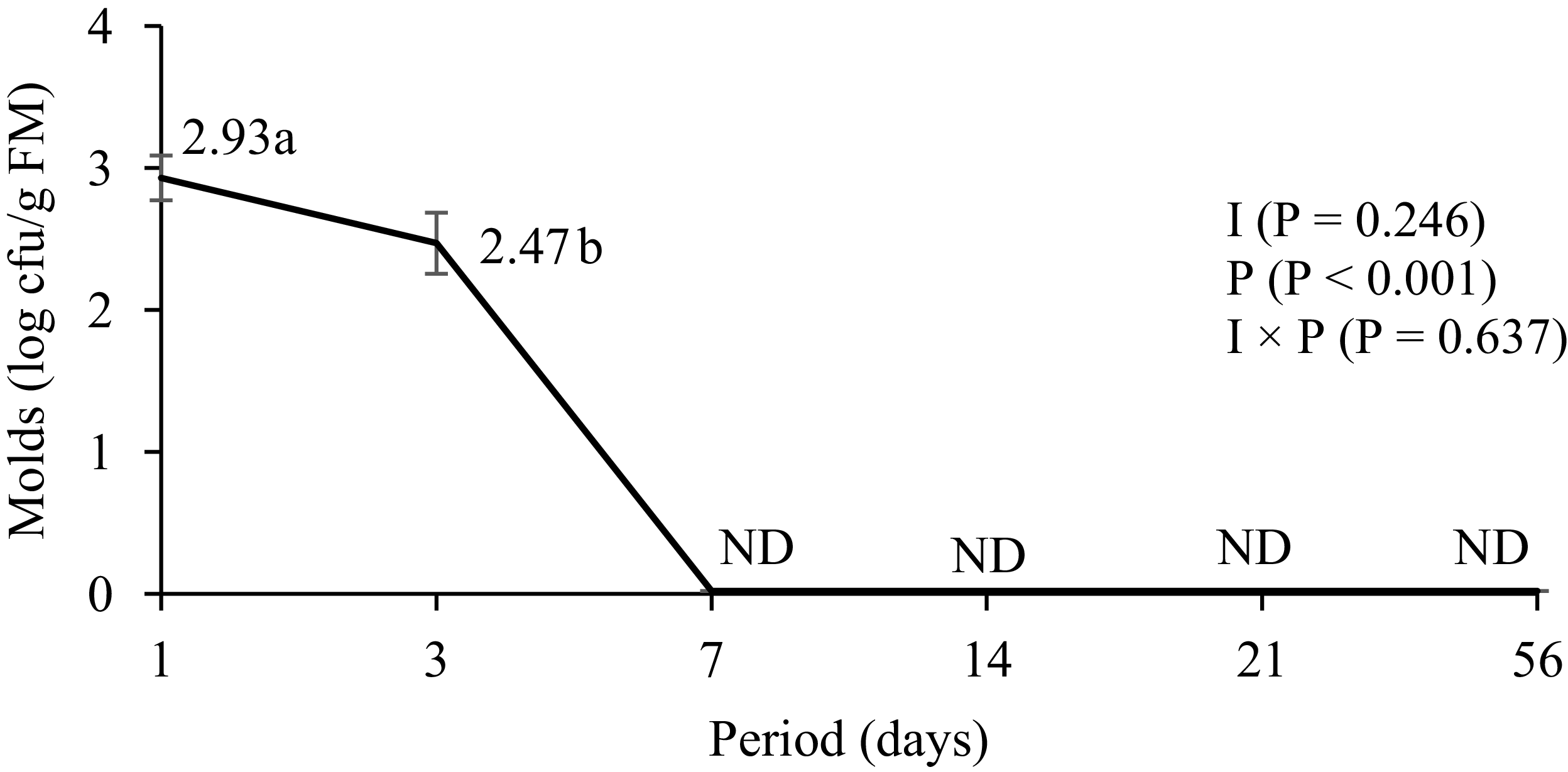
The presence of moulds in the treatment silages was only verified at the beginning of fermentation, with a significantly (P < 0.001) higher presence recorded on day 1 of fermentation compared to day 3. Subsequently, no moulds were detected in the treatment silages (Figure 2).
Average mould population in elephant grass silages at different fermentation periods. ND = not detected at the lowest dilution performed (10−2). cfu = colony-forming units, FM = fresh material, I = inoculant, P = period. The bars indicate the standard deviation at periods 1 (SD = 0.158) and 7 (SD = 0.215).

The DM and WSC contents were affected by the I × P interaction (Table 2). The DM contents of the silages were not significantly different (P > 0.050) in the different fermentation periods, except at 14 d (P = 0.039), in which the silage inoculated with LCA had a higher DM content compared to the silage treated with CI (Table 3). The DM concentrations of the silages treated with LPE and COMBO did not vary significantly (P > 0.050) throughout the fermentation (Table 3). The significantly (P < 0.050) lowest concentrations of residual WSC were recorded at day 56 of fermentation compared to days 1 and 3, except for the silage treated with LPE (Table 3).
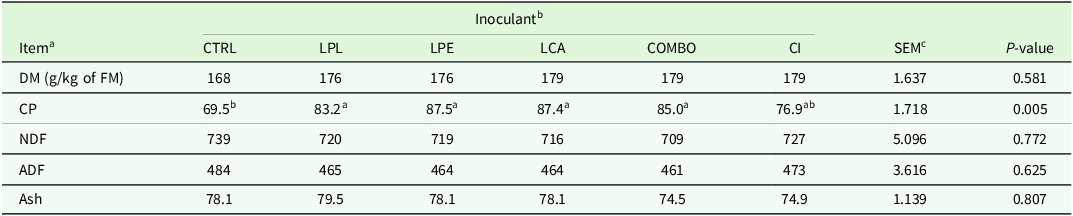
Of the variables analysed in the chemical composition at 56 days of fermentation, only CP was significantly (P = 0.005) affected by I. Silages inoculated with the selected strains had higher CP contents when compared to the CTRL silage (Table 5).
Chemical composition (g/kg DM) of elephant grass silage treated with inoculant at 56 days of fermentation (Experiment 2)

Table 5. Long description
A table comparing the chemical composition of elephant grass silage treated with different inoculants. The table has 6 rows and 8 columns. The columns are labeled as Item, CTRL, LPL, LPE, LCA, COMBO, CI, SEM, and P-value. The rows are labeled as DM (g/kg of FM), CP, NDF, ADF, and Ash. The values in the table are as follows: Row 1: DM (g/kg of FM), 168, 176, 176, 179, 179, 179, 1.637, 0.581. Row 2: CP, 69.5, 83.2, 87.5, 87.4, 85.0, 76.9, 1.718, 0.005. Row 3: NDF, 739, 720, 719, 716, 709, 727, 5.096, 0.772. Row 4: ADF, 484, 465, 464, 464, 461, 473, 3.616, 0.625. Row 5: Ash, 78.1, 79.5, 78.1, 78.1, 74.5, 74.9, 1.139, 0.807.
a DM = dry matter; FM = fresh material; CP = crude protein; NDF = neutral detergent fibre; ADF = acid detergent fibre.
b CTRL = without inoculant; LPL = Lactiplantibacillus plantarum CE 28.19; LPE = Lactiplantibacillus pentosus CE 28.22; LCA = Lacticaseibacillus casei CE 28.26; COMBO = L. plantarum CE 28.19 + L. pentosus CE 28.22 + L. casei CE 28.26; CI = commercial inoculant (Sil-All 4 × 4 W.S.).
c SEM = mean standard error. Means followed by the same letter in a row do not differ (P > 0.05) from each other by Tukey test.
Discussion
The elephant grass used in the production of silage for the isolation of LAB (experiment 1, see Supplementary Table 2), despite having low WSC levels (31.2 g/kg DM), allowed the epiphytic LAB to dominate the fermentation, providing an increase in the concentration of LA, reduction of pH, and control of the populations of fungi and enterobacteria in the ensiled mass throughout the fermentation. The dominant species L. plantarum and L. pentosus beginning on day 7 of fermentation are commonly isolated during the fermentation of various forages, as reported by Agarussi et al. (Reference Agarussi, Pereira, da Silva, Leandro, Ribeiro and Santos2018); Amaral et al. (Reference Amaral, Carvalho, Costa, Morenz, Schwan and Ávila2020); Puntillo et al. (Reference Puntillo, Gaggiotti, Oteiza, Binetti, Massera and Vinderola2020) and Santos et al. (Reference Santos, Pereira, Garcia, Ferreira, Oliveira and Silva2014) in silages of mombasa grass (Megathyrsus maximus), alfalfa (Medicago sativa), elephant grass (Cenchrus purpureus) and corn (Zea mays), respectively. These bacterial species are characterized as facultative heterofermentative, as they can metabolize hexoses and pentoses, producing almost exclusively LA during fermentation (Muck et al., Reference Muck, Nadeau, McAllister, Contreras-Govea, Santos and Kung2018; Wischral et al., Reference Wischral, Arias, Modesto, de França Passos and Pereira2019), which contributes to the production of better-quality silage (Irawan et al., Reference Irawan, Sofyan, Ridwan, Hassim, Respati, Wardani, Sadarma and Jayanegara2021; Oliveira et al., Reference Oliveira, Weinberg, Ogunade, Cervantes, Arriola, Jiang, Kim, Li, Gonçalves, Vyas and Adesogan2017).
Genetically, L. plantarum and L. pentosus are quite similar in their 16S rRNA gene sequences, differing by only 2 base pairs, which can make it difficult to accurately differentiate the species in phylogenetic studies (Collins et al., Reference Collins, Rodrigues, Ash, Aguirre, Farrow, Martinez-Murcia, Phillips, Williams and Wallbanks1991; Sifeeldein et al., Reference Sifeeldein, Xianjun, Zhihao, Junfeng, Youns and Tao2018; Torriani et al., Reference Torriani, Clementi, Vancanneyt, Hoste, Dellaglio and Kersters2001).
The similarity of 16S rRNA genes is used in bacterial taxonomy, allowing the identification, classification, and naming of different microorganisms (Schleifer and Stackebrandt, Reference Schleifer and Stackebrandt1983). Analysis of the 16S rRNA gene fragment demonstrated changes in the LAB population throughout fermentation. A similar phenomenon has been reported in previous studies (Agarussi et al., Reference Agarussi, Pereira, da Silva, Leandro, Ribeiro and Santos2018; Amaral et al., Reference Amaral, Carvalho, Costa, Morenz, Schwan and Ávila2020; Chen et al., Reference Chen, Xin, Li, Ni, Zeng, Du, Guan, Wu, Yang, Cai and Yan2022; Silva et al., Reference Silva, Pereira, Silva, Leandro, Paula, Santos, Ribeiro and Valadares Filho2018). These changes in the population are mainly associated with lower pH in the ensiled mass during fermentation, with bacteria that are more tolerant to acidity, such as Lactobacilli, becoming predominant (Ogunade et al., Reference Ogunade, Jiang, Pech Cervantes, Kim, Oliveira, Vyas, Weinberg, Jeong and Adesogan2018; Woolford, Reference Woolford1984). As in our study, reductions in the populations of Weissella (Chen et al., Reference Chen, Xin, Li, Ni, Zeng, Du, Guan, Wu, Yang, Cai and Yan2022; Dong et al., Reference Dong, Shao, Li, Yang and Yuan2020) and Pediococcus pentosaceus (Amaral et al., 2020) were observed throughout fermentation in elephant grass silage, with dominance of Lactobacilli in the final periods of fermentation. Pediococcus species are commonly found in commercial silage inoculants due to their tolerance to high DM and pH conditions, allowing them to act in the early stages of fermentation when lactobacilli growth is slow (Kung et al., Reference Kung, Stokes, Lin, Buxton, Muck and Harrison2003).
Recent methodological advances highlight the importance of combining cultivation-dependent and cultivation-independent approaches to better characterize silage microbiota, because some epiphytic and silage-associated bacteria may occur in a viable but non-cultivable state. In this state, they cannot be recovered by standard plating methods, which may lead to an underestimation of microbial diversity in culture-based studies (Flegler et al., Reference Flegler, Behrens, Sturmhöfel, Sonntag, Schmitt, Rang, Deeken, Sun, Maack, Büscher and Baer2025; Wei et al., Reference Wei, Wang, Zhang, Tan, Yang, Li, Liu, Zhong and Sun2026; Yan et al., Reference Yan, Zhu, Bao, Zhao, Sun, Yan, Wang, Wang, Jia and Ge2026).
The screening of the isolates in our study was carried out in an attempt to identify potential strains to be used as inoculants in silage, as there may be metabolic differences between species and strains belonging to the same species (Fitzsimons et al., Reference Fitzsimons, Duffner, Curtin, Brophy, O.’Kiely and O’Connell1992; Tanizawa et al., Reference Tanizawa, Kobayashi, Nomura, Sakamoto, Arita, Nakamura, Ohkuma and Tohno2020).
Strain selection was mainly based on growth performance, pH and temperature resistance, and LA production. The ability of LAB to tolerate and grow at low pH is considered an advantage in silage production, as they can remain viable for longer time, contributing to greater production of organic acids (Carvalho et al., Reference Carvalho, Sales, Schwan and Ávila2021). The rapid acidification of forage, due to the increased concentration of LA, mainly in elephant grass and legume silages, results in the control of undesirable microorganisms during fermentation, contributing to the production of better-quality silage (Amaral et al., Reference Amaral, Carvalho, Costa, Morenz, Schwan and Ávila2020; Oliveira et al., Reference Oliveira, Weinberg, Ogunade, Cervantes, Arriola, Jiang, Kim, Li, Gonçalves, Vyas and Adesogan2017; Shah et al., Reference Shah, Qian, Liu, Wu, Sultana, Mobashar, Wanapat and Zhong2021; Zhao et al., Reference Zhao, Wang, Yang, Wang and Zhang2020). Therefore, the culture and bacteria selected must be compatible to achieve the inoculation objective, since an inadequate use of the inoculant can compromise the quality of the silage produced (Rabelo et al., Reference Rabelo, Härter, Ávila and Reis2019).
The temperature range for LAB growth is 5 to 50°C, with an optimum around 30°C (McDonald et al., Reference McDonald, Henderson and Heron1991). The greater growth of LAB at 45°C compared to 15°C observed in our study agrees with results from previous studies with LAB isolated from different silages (Amaral et al., Reference Amaral, Carvalho, Costa, Morenz, Schwan and Ávila2020; Sifeeldein et al., Reference Sifeeldein, Xianjun, Zhihao, Junfeng, Youns and Tao2018; Silva et al., Reference Silva, Pereira, Silva, Leandro, Paula, Santos, Ribeiro and Valadares Filho2018). However, Costa et al. (Reference Costa, Carvalho, Bernardes, Schwan and da Silva Ávila2021) observed that only one strain of L. plantarum and one of P. acidilactici grew at 45°C, while the obligate heterofermentative bacteria (Lentilactobacillus buchneri and L. hilgardii) did not grow at this temperature. Tolerance to different temperatures may be associated with the species or the substrate (silage) from which the strains were isolated (Amaral et al., Reference Amaral, Carvalho, Costa, Morenz, Schwan and Ávila2020). There is a natural increase in temperature during fermentation (Kung et al., Reference Kung, Shaver, Grant and Schmidt2018), and the ambient temperature can have an effect on the microbial population and quality of the silage produced (Bernardes et al., Reference Bernardes, Daniel, Adesogan, McAllister, Drouin, Nussio, Huhtanen, Tremblay, Bélanger and Cai2018; Chen et al., Reference Chen, Xin, Li, Ni, Zeng, Du, Guan, Wu, Yang, Cai and Yan2022; Ferrero et al., Reference Ferrero, Tabacco, Piano, Casale and Borreani2021; Liu et al., Reference Liu, Zhao, Hao, Yan, Fu, Zhu, Jia, Wang and Ge2024). Therefore, the ability of LAB to grow at higher temperatures is an important characteristic for silage production in tropical countries, where high temperatures occur throughout the year. The use of inoculants containing more resistant LAB will ensure greater survival of the strains during the preparation and application of the inoculant, as well as in the fermentation process (Windle et al., Reference Windle and Kung2016).
The WSC concentration (62.6 g/kg DM) of elephant grass before ensiling (experiment 2, see Supplementary Table 3) was adequate to ensure good fermentation, despite the low DM content of the forage (160.6 g/kg of fresh matter).
The pH, ranging 3.67–3.69 at the end of fermentation, was considered adequate for the silages produced, as tropical grass silages typically stabilize at pH levels higher than those found in our study (Amaral et al., Reference Amaral, Carvalho, Costa, Morenz, Schwan and Ávila2020; Dong et al., Reference Dong, Shao, Li, Yang and Yuan2020; Kung et al., Reference Kung, Shaver, Grant and Schmidt2018). The pH reflects the concentrations of organic acids produced during fermentation, with LA being the most effective in reducing pH, as it is approximately 10–12 times stronger compared to acetic acid and propionic acid (Kung et al., Reference Kung, Shaver, Grant and Schmidt2018). Therefore, in our study, the lowest pH at the beginning of fermentation occurred in response to the higher concentrations of LA in silages inoculated with LPL, LPE, LCA and COMBO compared to the CTRL and CI treatments (Table 3). A rapid decline in the pH of the ensiled mass contributes to the control of secondary fermentations inside the silo (McDonald et al., Reference McDonald, Henderson and Heron1991). An interesting finding in our study is that the LPL and LPE strains required less time to stabilize the pH of the ensiled mass compared to CTRL treatment (3 vs. 14 d of fermentation), which may contribute to the better control of undesirable fermentations, resulting in higher quality silage.
The AA concentrations recorded in the silages, with levels ranging from 1.0 to 2.3 g/kg DM throughout fermentation, were below the levels reported in the literature with elephant grass silages (Amaral et al., Reference Amaral, Carvalho, Costa, Morenz, Schwan and Ávila2020; Chen et al., Reference Chen, Xin, Li, Ni, Zeng, Du, Guan, Wu, Yang, Cai and Yan2022; Dong et al., Reference Dong, Shao, Li, Yang and Yuan2020; Tran et al., Reference Tran, Nguyen, Nguyen and Nishino2018). AA is produced mainly by obligate heterofermentative LAB present in the epiphytic population or inoculated into the forage (Amaral et al., Reference Amaral, Carvalho, Costa, Morenz, Schwan and Ávila2020; Schmidt et al., Reference Schmidt, Hu, Mills and Kung2009). Moderate AA concentrations in silage are desirable, as they inhibit yeast growth, resulting in silages with greater aerobic stability (Amaral et al., Reference Amaral, Carvalho, Costa, Morenz, Schwan and Ávila2020; Guan et al., Reference Guan, Shuai, Ran, Yan, Wang, Li, Cai and Zhang2020; Tran et al., Reference Tran, Nguyen, Nguyen and Nishino2018).
The BA concentrations observed in the silages were higher than the levels recommended by Kung et al., (2018). The elevated levels may be explained by the low DM content (160 g/kg of fresh matter) of the grass at ensiling, which provides favourable conditions for clostridial activity. The high moisture content of the forage is associated with elevated water activity (aw), which probably contributed to the occurrence of clostridial activity even at relatively low pH values. Under such conditions, part of the lactic acid produced can be used as a substrate for secondary fermentation, contributing to BA formation and increased ammonia-N. Nevertheless, the consistently low pH values indicate that the fermentation process was effectively driven by LA bacteria, particularly in the inoculated silages, contributing to reduced populations of enterobacteria and yeasts throughout the fermentation (Tables 3 and 4).
Tropical grasses are known to exhibit high buffering capacity and generally low concentrations of WSC, resulting in a low WSC:BC ratio (< 0.5) (Carvalho et al., Reference Carvalho, Bragatto, Buttow, Silva, Silva, Silva, Auerbach, Nussio and Daniel2024). These conditions may limit the efficiency of pH decline during ensiling, even when lactic acid is produced in considerable amounts (Alves et al., Reference Alves, Cruz, Freitas, Silveira, Coutinho, Roseira, Teixeira, Rigueira, Pereira and Ribeiro2025). Under such circumstances, particularly when associated with low dry matter content, the high moisture of the forage may favour the occurrence of clostridial activity, even in environments where pH values are relatively low. Forages with high buffering capacity combined with low DM favour butyric fermentation (Steinbrenner et al., Reference Steinbrenner, Nägele, Buschmann, Hülsemann and Oechsner2019), and under such conditions, part of the LA produced can be metabolized by clostridia and converted into butyric and acetic acids (McDonald et al., Reference McDonald, Henderson and Heron1991; Pahlow et al., Reference Pahlow, Muck, Driehuis, Elfrink, Oude Elferink, Spoelstra, Buxton, Muck and Harrison2003). This mechanism helps explain why the accumulation of lactic acid alone does not necessarily suppress butyric fermentation in certain silages.
Although the development of clostridia can negatively affect hygienic quality due to the production of undesirable compounds and potential risks associated with contamination (Pahlow et al., Reference Pahlow, Muck, Driehuis, Elfrink, Oude Elferink, Spoelstra, Buxton, Muck and Harrison2003), the extent of these effects depends on the balance between fermentation pathways. Clostridial silages are also associated with higher fibre concentrations and reduced dry matter digestibility, as soluble nutrients are degraded during fermentation (Scherer et al., Reference Scherer, Gerlach and Südekum2015). For tropical grasses, DM contents above 35% are generally associated with the absence of butyric acid, likely due to osmotic effects and/or more favourable fermentation conditions resulting from higher availability of soluble carbohydrates and lower buffering effects (Carvalho et al., Reference Carvalho, Bragatto, Buttow, Silva, Silva, Silva, Auerbach, Nussio and Daniel2024; Woolford, Reference Woolford1984). However, increasing dry matter content through forage maturation may compromise nutritional value and overall silage quality (Lelis et al., Reference Lelis, Paciullo, Morenz, Gomide, Roseira, Lopes, Oliveira, Pereira, Silva and Chizzotti2025). Therefore, the identification of bacterial strains with high fermentative efficiency capable of acting effectively under high-moisture conditions remains essential for improving silage quality in tropical systems.
The considerable increase in the LAB population throughout fermentation indicates that the initial concentration of WSC was sufficient to ensure adequate fermentation since it is the main substrate used by LAB during fermentation (Pahlow et al., Reference Pahlow, Muck, Driehuis, Elfrink, Oude Elferink, Spoelstra, Buxton, Muck and Harrison2003). It is interesting to highlight that inoculation of forage with the selected strains of LPL, LPE, and LCA resulted in silages with higher LAB populations compared to CI silage (day 1), indicating that the strains isolated from elephant grass dominated fermentation prior to the commercial inoculant. This is probably due to a specific nutrient composition found in the exudates of the plants from which the strains were isolated (Hill, Reference Hill1989; Muck, Reference Muck and Muck1993), which positively contributes to compatibility between forage and the inoculated strain, a determining factor for the success of a microbial additive (Amaral et al., Reference Amaral, Carvalho, Costa, Morenz, Schwan and Ávila2020; Yang et al., Reference Yang, Cao, Cai and Terada2010).
The populations of enterobacteria and yeasts recorded in our elephant grass before ensiling were higher than those reported in other studies (Amaral et al., Reference Amaral, Carvalho, Costa, Morenz, Schwan and Ávila2020; Dong et al., Reference Dong, Shao, Li, Yang and Yuan2020; Shah et al., Reference Shah, Xianjun, Zhihao, Junfeng and Sao2018; Shah et al., Reference Shah, Qian, Liu, Wu, Sultana, Mobashar, Wanapat and Zhong2021). However, there was a reduction in the population of these microorganisms during fermentation due to the metabolites produced by LAB. Enterobacteria compete directly for substrates with LAB. However, enterobacteria are sensitive to lower pH in the ensiled mass (Pahlow et al., Reference Pahlow, Muck, Driehuis, Elfrink, Oude Elferink, Spoelstra, Buxton, Muck and Harrison2003), which explains the reduction in their population throughout fermentation. The decline in enterobacterial activity in silages can be considered a potential indicator of good ensilage conditions (Pahlow et al., Reference Pahlow, Muck, Driehuis, Elfrink, Oude Elferink, Spoelstra, Buxton, Muck and Harrison2003). Therefore, the use of inoculant constitutes a fundamental strategy in the production of higher quality silage since there was a more rapid reduction in the enterobacteria population in the inoculated silages compared to the CTRL silage (7 vs. 21 d of fermentation).
The lower population of yeasts in silage inoculated with LPL compared to CI silage at 56 days of fermentation can be explained by the higher AA production in LPL silage compared to CI silage (2.3 vs. 1.0 g/kg DM). Possibly, obligate heterofermentative epiphytic bacteria present in the medium, due to the reduction in WSC, metabolized part of the LA, resulting in an increase in the AA concentration in the ensiled mass (Oude Elferink et al., Reference Oude Elferink, Krooneman, Gottschal, Spoelstra, Faber and Driehuis2001), which may contribute to more aerobically stable silages.
The presence of moulds in silage compromises the silage’s nutritional value, and many fungal species in the genera Aspergillus, Fusarium, and Penicillium produce mycotoxins that are harmful to animals and humans (Ogunade et al., Reference Ogunade, Martinez-Tuppia, Queiroz, Jiang, Drouin, Wu, Vyas and Adesogan2018a). In the anaerobic conditions in the silo, moulds generally experience restricted growth, occurring mainly at the beginning of the fermentation process when there is still oxygen in the ensiled mass (McDonald et al., Reference McDonald, Henderson and Heron1991; Pahlow et al., Reference Pahlow, Muck, Driehuis, Elfrink, Oude Elferink, Spoelstra, Buxton, Muck and Harrison2003). This may explain the detection of moulds in silage only in the initial periods of fermentation (days 1 and 3).
Forage ensiled with low DM levels, such as in our study, is prone to secondary fermentations, mainly by bacteria of the genus Clostridium, which are mainly responsible for the proteolytic activity during fermentation. However, the rapid production of LA from the beginning of fermentation, resulting in a rapid drop in pH, is one of the most important factors that inhibit the activity of Clostridium (McDonald et al., Reference McDonald, Henderson and Heron1991; Pahlow et al., Reference Pahlow, Muck, Driehuis, Elfrink, Oude Elferink, Spoelstra, Buxton, Muck and Harrison2003), which may explain the higher CP levels in silages inoculated with LPL, LPE, and LCA compared to the CTRL silage at 56 days of fermentation. The levels of NDF and ADF in our study are similar to those reported by Irawan et al. (Reference Irawan, Sofyan, Ridwan, Hassim, Respati, Wardani, Sadarma and Jayanegara2021) and Oliveira et al. (Reference Oliveira, Weinberg, Ogunade, Cervantes, Arriola, Jiang, Kim, Li, Gonçalves, Vyas and Adesogan2017) in a meta-analysis study. The latter two studies did not observe any effect of the inoculation of homofermentative and facultative heterofermentative LAB on these variables in different silages, including tropical grasses.
Conclusion
In conclusion, Lactiplantibacillus plantarum and L. pentosus were the dominant cultivable epiphytic species in the final fermentation stages of elephant grass silages. The strains isolated from elephant grass were able to dominate the fermentation from the first day onwards, resulting in silages with lower yeast and enterobacterial populations and higher CP contents. Therefore, the strains LPA, LPE, and LCA are promising in the production of higher quality elephant grass silage. Further studies should be conducted to evaluate these strains in large-scale silos.
Supplementary material
The supplementary material for this article can be found at https://doi.org/10.1017/S0021859626100768.
Acknowledgements
The authors express their gratitude to the Conselho Nacional de Desenvolvimento Científico e Tecnológico (CNPq), Coordenação de Aperfeiçoamento de Pessoal de Nível Superior, Fundação de Amparo à Pesquisa do Estado de Minas Gerais, and Instituto Nacional de Ciência e Tecnologia em Ciência Animal for their invaluable financial support and assistance.
Author contributions
RAP performed the experiment, analyses and prepared the manuscript. LKJr designed the experiment. JPSR performed the statistical analyses and contributed to the writing of the manuscript. HCM designed the experiment and performed the microbiology analyses. FXA performed the chemical composition analyses. MCNA performed the microbiology analyses and contributed to the writing of the manuscript. TCS designed the experiment and performed the chemical composition analyses. KGR contributed to the writing of the manuscript. OGP performed the experiment, the acquisition and contributed to the writing of the manuscript.
Funding statement
This research received no specific grant from any funding agency, commercial or not-for-profit sectors.
Competing interests
The authors declare there are no conflicts of interest.
Ethical standards
Not applicable.