It is generally accepted that depression is an etiologically heterogeneous disorder that arises from interplay among multiple forms of risk across levels of analysis (e.g., Beck, Reference Beck2008; Davey, Yucel, & Allen, Reference Davey, Yucel and Allen2008; Hankin, Reference Hankin2012). Consistent with this notion, multiple risk markers and vulnerability processes for the disorder have been identified. In particular, a family history of depression is one of the most robust markers of an individual's own depression risk, with those with a first-degree relative with depression at approximately 3 to 10 times greater risk for developing depression (Goodwin & Jamison, Reference Goodwin and Jamison2007; Sullivan, Neale, & Kendler, Reference Sullivan, Neale and Kendler2000; Wallace, Schnieder, & McGuffin, Reference Wallace, Schnieder, McGuffin, Gotlib and Hammen2002). The mechanisms by which this risk is transmitted are complex (Goodman & Gotlib, Reference Goodman and Gotlib1999) and likely include genetic influences (Levinson, Reference Levinson, Gotlib and Hammen2009), poor parenting (Lovejoy, Graczyk, O'Hare, & Neuman, Reference Lovejoy, Graczyk, O'Hare and Neuman2000; Wilson & Durbin, Reference Wilson and Durbin2010), behavioral and learning processes (Ashman & Dawson, Reference Ashman, Dawson, Goodman and Gotlib2002), and exposure to adverse pre- and postnatal environments (Essex, Klein, Cho, & Kalin, Reference Essex, Klein, Cho and Kalin2002; Hammen, Reference Hammen1991), among other pathways.
However, it is important to note that familial depression is associated with an array of negative psychiatric outcomes in offspring other than depression (e.g., Barker, Copeland, Maughan, Jaffee, & Uher, Reference Barker, Copeland, Maughan, Jaffee and Uher2012; Hammen, Reference Hammen2009) and that many with familial depression maintain adaptive psychological functioning despite this risk. Examining the risk associated with familial depression in conjunction with other established depression risks may lead to more refined models that account for why some children of depressed parents proceed to develop depression themselves as opposed to other disorders, such as externalizing psychopathology, and why some offspring do not develop significant depressive symptoms despite a positive family history of the disorder. It is surprising that, in light of its fundamental importance to developmental psychopathology perspectives (Cicchetti & Toth, Reference Cicchetti and Toth2009), very few studies have examined the interactions between multiple markers of depression risk in predicting early vulnerability. The present study seeks to address this gap by examining whether cross-sectional and longitudinal associations between a parental history of depression and an important marker of offspring depression risk, heightened cortisol reactivity to stress, are moderated by children's cognitive vulnerability to depression (CVD).
Cognitive theories of depression risk have generated a vast body of research over the past five decades, with work on this topic shifting in recent years toward the exploration of the utility of these models in adolescents and children (Abela & Hankin, Reference Abela and Hankin2008). Reviews of this literature support the claim that cognitive vulnerability in youth is an important prospective predictor of depressive symptoms (e.g., Hankin et al., Reference Hankin, Oppenheimer, Jenness, Barrocas, Shapero and Goldband2009; Hankin, Snyder, & Gulley, Reference Hankin, Snyder, Gulley and Cicchetti2013; Jacobs, Reinecke, Gollan, & Kand, Reference Jacobs, Reinecke, Gollan and Kane2008), usually when examined in conjunction with stressful life events. More specifically, most studies have focused on testing whether the interaction between cognitive vulnerability and stress predicts elevations in children and adolescents' depressive symptoms, showing that stressful life events show stronger associations with depression when youth possess negative cognition, such as maladaptive attributional styles, information processing biases favoring enhanced processing of negative stimuli, and other aspects of depressive cognition (Abela & Hankin, Reference Abela and Hankin2008; Lakdawalla, Hankin, & Mermelstein, Reference Lakdawalla, Hankin and Mermelstein2007).
However, other than stressful life events, the moderating effects of cognitive risk on other depression risk markers, such as family history of depression, have rarely been examined. This is a potentially important omission if multiple vulnerabilities have dynamic effects on risk, showing greater predictive power when considered in conjunction than individual risks examined in isolation. Interactions between cognitive risk and familial depression are to be expected, given that familial depression itself may be a marker of early childhood stress (Hammen, Reference Hammen1991; Lovejoy et al., Reference Lovejoy, Graczyk, O'Hare and Neuman2000; Wilson & Durbin, Reference Wilson and Durbin2010); if so, familial depression may simply represent an index of environmental stress that is moderated by children's cognitive vulnerability to predict emerging depression and related outcomes. Conversely, familial depression is also frequently interpreted as a marker of genetic aspects of depression risk, given the evidence for the heritability of the disorder (e.g., Sullivan et al., Reference Sullivan, Neale and Kendler2000). If so, such genetic influences on biological processes, such as psychophysiological aspects of stress reactivity, might be potentiated by information processing biases that favor negative or threatening information, thus strengthening links between familial depression and depression-relevant outcomes. Despite these possible relationships, to our knowledge, no published research has examined whether these two established markers of depression risk interact.
Understanding the relationship between markers of depression risk and negative outcomes across time, prior to the age of risk for disorder, is crucial for developing comprehensive models of the developmental psychopathology of depression. Given that the condition is rare prior to adolescence (Garber, Gallerani, & Frankel, Reference Garber, Gallerani, Frankel, Gotlib and Hammen2009), predicting depression per se in young children may be difficult due to its low prevalence; thus, research that predicts the emergence of other forms of risk may prove useful. With this in mind, we tested models predicting children's hypothalamic–pituitary–adrenal (HPA) axis reactivity to social-evaluative stress, measured via cortisol, the glucocorticoid end product of the HPA system. Abnormal cortisol function and reactivity to stress are established markers of depression in adults and youth (Burke, Davis, Otte, & Mohr, Reference Burke, Davis, Otte and Mohr2005; Lopez-Duran, Kovacs, & George, Reference Lopez-Duran, Kovacs and George2009); further, cortisol reactivity appears to play a causal role in the development of the disorder (Azar, Paquette, Zoccolillo, Baltzer, & Tremblay, Reference Azar, Paquette, Zoccolillo, Baltzer and Tremblay2007; Feldman et al., Reference Feldman, Granat, Pariente, Kanety, Kuint and Gilboa-Schechtman2009; Hasler, Drevets, Manji, & Charney, Reference Hasler, Drevets, Manji and Charney2004; Oswald et al., Reference Oswald, Zandi, Nestadt, Potash, Kalaydjian and Wand2006). It has been proposed that it may mediate associations between familial history and depression in offspring (Dougherty, Klein, Rose, & Laptook, Reference Dougherty, Klein, Rose and Laptook2011). If so, abnormal cortisol reactivity should emerge prior to significant depressive symptoms and thus potentially be more readily detectable in younger samples, making this a more tractable outcome variable for investigations of depression risk in childhood. Supporting this notion are numerous studies identifying deviant patterns of cortisol reactivity in the infant and child offspring of depressed mothers (Ashman, Dawson, Panagiotides, Yamada, & Wilkinson, Reference Ashman, Dawson, Panagiotides, Yamada and Wilkinson2002; Brennan, Pargas, Walker, Mewport, & Stowe, Reference Brennan, Pargas, Walker, Mewport and Stowe2008; Diego et al., Reference Diego, Field, Hernandez-Reif, Cullen, Schanberg and Khun2004; Essex et al., Reference Essex, Klein, Cho and Kalin2002). A small but supportive literature in adults also implicates cognitive factors, such as rumination and self-esteem, in cortisol function (Kuehner, Holzhauer, & Huffziger, Reference Kuehner, Holzhauer and Huffziger2007; Kuehner, Huffziger, & Liebsch, Reference Kuehner, Huffziger and Liebsch2009; van Santen et al., Reference van Santen, Vreeburg, Van der Does, Spinhoven, Zitman and Penninx2011; Zoccola & Dickerson, Reference Zoccola and Dickerson2012), although less attention has been directed toward identifying such associations in childhood. We know of no study investigating relationships between established indices of cognitive risk for depression and cortisol reactivity to stress in childhood, even though it has been posited that cognitive biases may confer risk for maladaptive HPA activation (Beck, Reference Beck2008; Hankin, Reference Hankin2012). Exploring interactions between theoretically relevant predictors of children's cortisol reactivity to stress may help shed light on early processes that eventuate in depressive disorder in adolescence and adulthood.
We therefore examined whether two known markers of depression risk, a familial history of depression and cognitive vulnerability, predicted children's cortisol reactivity to a standardized laboratory stressor. We used laboratory measures of attention and memory processing, as well as self-reported measures of cognitive risk, to assess multiple facets of cognitive vulnerability as a core risk to depression. Both laboratory measures of information processing (Garber et al., Reference Garber, Gallerani, Frankel, Gotlib and Hammen2009; Hayden et al., Reference Hayden, Olino, Bufferd, Miller, Dougherty and Sheikh2013) and self-report measures are useful in studies of CVD among youth. Alongside the finding that biased memory favoring negative information is perhaps the strongest cognitive marker of depression (Joormann, Reference Joormann, Gotlib and Hammen2009; Matt, Vasquez, & Campbell, Reference Matt, Vazquez and Campbell1992), the use of information-processing tasks in studies of CVD is strongly indicated as an adjunct to self-reported negative cognition. Furthermore, while ample previous work has found that children with a maternal history of depression are at heightened risk for the development of CVD (Garber & Flynn, Reference Garber and Flynn2001; Garber & Martin, Reference Garber, Martin, Goodman and Gotlib2002), associations between fathers' depression history and child risk are poorly understood and understudied in the field, despite their implications for child outcomes (e.g., Connell & Goodman, Reference Connell and Goodman2002). We therefore expanded previous work by including measures of both maternal and paternal depression in one of our samples. We examined these questions in two studies, one of which used cross-sectional methods (Study 1) and the other a longitudinal sample (Study 2), to test the hypothesis that the association between parental depression history and children's cortisol reactivity to stress would be stronger among children with heightened cognitive vulnerability to depression.
Study 1
Participants
Children and adolescents were recruited by letters sent home to families with a child in third, sixth, or ninth grades of public schools. Interested parents called the laboratory and responded to a brief phone screen that established that both the parent and child were fluent in English and the child did not carry an autism spectrum or psychotic disorder and had an IQ of more than 70. Participants were 244 youth ranging in age from 9 to 15 years (M = 11.4, SD = 2.27). The sample was approximately evenly divided by sex (44% boys, 56% girls) and grade (32% third grade, 32% sixth grade, 36% ninth grade). Ethnicity was as follows: 64% Caucasian, 8% African American, 7% Latino, 5% Asian/Pacific Islander, and 16% other/mixed race. Of the caretakers who participated in the study, 83% were mothers, the rest were fathers. Across all caretakers, 70% were married, 9% single, 20% divorced or separated, and 1% widowed. Median annual parental income was $75,000 (range = $10,000–$900,000), and 22% of the youth received free/reduced lunch at school.
The primary caretaker and the child participant visited the laboratory for the assessment. This consisted of a battery of questionnaires completed by youth and parents about the child, diagnostic interviewing, and collection of youth cortisol via saliva. Parents provided informed written consent for their own and their child's participation; youth provided written assent. To allow for a decrease in any cortisol reactivity that may have occurred in response to arriving at the laboratory, each pair completed the stress paradigm after 1 hr in the laboratory. During this time, youth were asked to complete questionnaires and interviews. For 45 min after the challenge, youth completed additional questionnaires so that cortisol recovery could be assessed. On average, baseline cortisol samples were collected at 17:00 (range = 16:00–18:30). Samples were then taken at 15-min intervals until 60 min had passed since the onset of the stress paradigm. Diagnostic interviewing occurred in person during the laboratory visit but after the laboratory stressor and saliva collection had been complete in case participants found this interview to be stressful.
Method
Depressive symptoms
The Children's Depression Inventory (CDI; Kovacs, Reference Kovacs1985) was used to assess youths' depressive symptoms. The CDI has good reliability and validity (Klein, Dougherty, & Olino, Reference Klein, Dougherty and Olino2005). Internal consistency (α) was 0.89. The range of CDI scores from this sample (mean CDI = 6.25, SD = 5.4, range = 0–35) was comparable to published norms (Kovacs, Reference Kovacs1985) and prior research with community samples (Petersen et al., Reference Petersen, Compas, Brooks-Gunn, Stemmler, Ey and Grant1993).
Negative cognitive style
The Children's Cognitive Style Questionnaire self-implications subscale (Abela, Reference Abela2001) was used to measure youths' level of negative inferences about their self-concept based on the hopelessness theory of depression (Abramson, Metalsky, & Alloy, Reference Abramson, Metalsky and Alloy1989). Youth are presented with hypothetical scenarios (e.g., “some kids that you know say they don't like you”; “you get a bad grade in school”) in which they are asked to imagine negative events happening to them and then use a 3-point Likert scale to choose the response that best describes the way they would think (e.g., 0 = This does not make me feel bad about myself; 1 = This makes me feel a little bad about myself; 2 = This makes me feel very bad about myself). The Children's Cognitive Style Questionnaire self-implications subscale has demonstrated good reliability and validity in prior research with children and adolescents (Abela, Reference Abela2001). Internal consistency was 0.82.
Parental mood and anxiety disorder
The Structured Clinical Interview for DSM-IV Axis I Disorders (SCID; First et al., Reference First, Spitzer, Gibbon and Williams1996) was used to assess caretakers' lifetime history and current level of depressive and anxiety disorders at baseline. Diagnostic interviewers, all of whom all had a minimum of a bachelor's degree and most were advanced graduate students in clinical psychology, completed an intensive training program for assigning DSM-IV diagnoses. To assess interrater reliability, an independent, trained rater who was blind to parent diagnostic status randomly evaluated 15% of the SCID interviews (N = 37). Reliability was excellent (κ = 0.91), and presence/absence of diagnoses was confirmed. Considering the high level of familial aggregation between major depressive disorder (MDD) and dysthymic disorder (DD; Klein et al., Reference Klein, Riso, Donaldson, Schwartz, Anderson and Ouimette1995; Klein, Shankman, Lewinsohn, Rhode, & Seeley, Reference Klein, Shankman, Lewinsohn, Rohde and Seeley2004), and the evidence that individuals with DD almost invariably develop MDD (Klein, Shankman, & Rose, Reference Klein, Shankman and Rose2006), MDD and DD were collapsed into a single category reflecting either depressive disorder. We also included cases of minor depressive disorder, as these were associated with clinically significant impairment/distress. In our sample, half of the caretakers had a history of clinical depression (28.9% definite MDD, 10.5% probable MDD, 18.2% definite minor depressive disorder, and 5.2% DD; 53% of the primary caregivers who were mothers, N = 202, and 42, or 37%, of the caregivers who were fathers). While these rates may appear high, considering only the rates of definite MDD and DD in the sample shows that these were consistent with those found in epidemiological studies (e.g., Kessler et al., Reference Kessler, Berglund, Demler, Jin, Merikangas and Walters2005). Because depression is highly comorbid with anxiety disorders, and because anxiety disorders are also linked to cortisol reactivity (e.g., Yoon & Joormann, Reference Yoon and Joormann2012), we included parental history of anxiety disorder in analyses; 31.3% of caretakers met DSM-IV criteria for a history of any DSM-IV anxiety disorder, except simple phobia, over the lifetime. Of those caregivers with a depressive disorder, 53% also met criteria for an anxiety disorder.
Stress paradigm and cortisol assessment
The stress paradigm (see Badanes, Watamura, & Hankin, Reference Badanes, Watamura and Hankin2011) included a 5- to 10-min parent–child conflict discussion in which the parent and child were asked to talk about a recent fight or argument. Then, youth auditioned for a “reality TV show” by giving a speech directly into a video camera while their parent watched; youth were instructed that judges would evaluate their performance. Given the lack of consensus on stress/challenge paradigms that elicit cortisol reactivity across different ages (Gunnar, Talge, & Herrera, Reference Gunnar, Talge and Herrera2009), this laboratory challenge task was selected because it was expected to be developmentally appropriate across third, sixth, and ninth graders, and it involved the essential elements (e.g., threat of social rejection and social evaluation, anticipatory and processive stress) known to activate the HPA axis in youths and adults (Lupien, McEwen, Gunnar, & Heim, Reference Lupien, McEwen, Gunnar and Heim2009). Prior research (e.g., Badanes et al., Reference Badanes, Watamura and Hankin2011; Hankin, Badanes, Abela, & Watamura, Reference Hankin, Badanes, Abela and Watamura2010) using this stress elicitation paradigm has demonstrated its predictive validity for theoretically relevant outcomes.
Saliva samples were obtained via synthetic Salivette collection devices (Sarstedt, Nuembrecht, Germany). Saliva was extracted by centrifuging for 4 min at 2500 revolutions per minute. Vials and Salivettes were frozen at –20 °C until data collection was complete. Samples were then defrosted and batched for assay in groups of 36 and were assigned to batches; all samples from the same child were analyzed in the same batch. Samples were sent to the Biochemical Laboratory, Psychobiology, University of Trier, Germany, to be assayed. Cortisol levels were determined by employing a competitive, solid-phase time-resolved fluorescence immunoassay with fluorometric end point detection (Hoferl, Krist, & Buchbauer, Reference Hoferl, Krist and Buchbauer2005). For samples retained in the analyses described next, the mean interassay coefficients of variation (CV) for controls were 6.6% to 8.5%. For duplicates of the samples used in this study, the intraassay CV was 5%.
It is often the case that cortisol distributions are positively skewed (Gunnar & Talge, Reference Gunnar, Talge, Schmidt and Segalowitz2005), and this was true for the data obtained in this study. To address this, as is standard in this literature, a log10 transformation of the raw cortisol values produced unskewed cortisol values that were used in all analyses. As measures of cortisol reactivity to stress, we calculated the area under the curve with respect to ground (AUCg) and increase (AUCi) in cortisol (Pruessner, Kirschbaum, Meinlschmid, & Hellhammer, Reference Pruessner, Kirschbaum, Meinlschmid and Hellhammer2003). For endocrinological data, AUCg is the total area under the curve of all measurements; it takes into account sensitivity and intensity differences in cortisol, whereas AUCi is calculated with respect to baseline cortisol levels and emphasizes change over time (Fekedulegn et al., Reference Fekedulegn, Andrew, Burchfiel, Violanti, Hartley and Charles2007).
Results
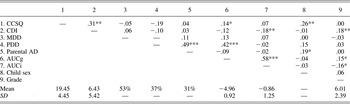
Correlations among main variables for Study 1, as indicated in Table 1, show that negative cognitive style about the self was positively associated with children's depressive symptoms and inversely related to AUCg. There were also some significant gender differences; girls reported higher levels of negative cognitive style and were more likely than boys to have a parent with a lifetime anxiety disorder. Also, older youth reported more depressive symptoms and higher AUCg.
Correlations between Study 1 variables

Note: CCSQ-S, Children's Cognitive Style Questionnaire—Self Implications; CDI, Children's Depression Inventory; MDD, maternal depressive disorder; PDD, paternal depressive disorder; Parental AD, parental history of any anxiety disorder; AUCg, area under the curve with respect to ground; AUCi, AUC with respect to increase; Grade, child's grade at baseline.
*p < .05. **p < .01. ***p < .001.
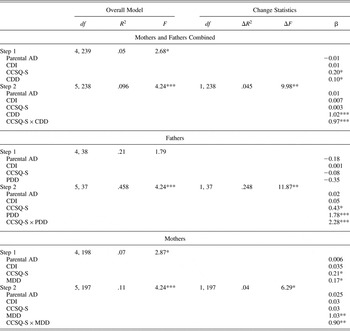
We next used multiple regression to test interactions between caregiver depression history and children's cognitive risk in predicting indices of cortisol. In particular, we were interested in testing whether children's cognitive risk moderated associations between caregiver depression history and offspring cortisol reactivity indexed via AUCg and AUCi. Children's self-reported depressive symptoms and caregiver history of any anxiety disorder at baseline were treated as covariates. All variables were mean-centered as needed (Aiken & West, Reference Aiken and West1991).
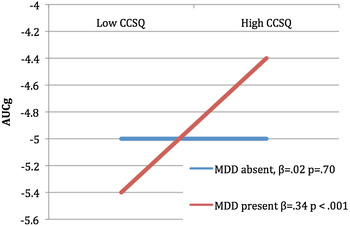
Results of this analysis, presented in Table 2 (top panel), show that caregiver history of mood disorder significantly interacted with youths' negative cognitions about themselves in relation to youths' cortisol reactivity. This significant interaction was decomposed by analyzing the strength of the relationship between youths' negative cognitions about themselves and AUCg among those offspring of caregivers with and without a depression history. As hypothesized, there was a significant association between cognitive vulnerability and AUCg among offspring of caregivers with a depression history, whereas this relation was not significant among offspring whose caregivers did not have a depression history. Figure 1 graphically displays this interaction. The interaction between caregiver history of mood disorders and youths' negative cognitive style did not predict AUCi.
(Color online) The interaction between caregiver depression history and child Child Cognitive Style Questionnaire (CCSQ) predicting the area under the curve with respect to ground (AUCg). MDD, Major depressive disorder for child's caregiver (mother or father).

Regression testing the interaction between parental depression history and child CCSQ-S predicting AUCg in Study 1

Note: Parental AD, Parental history of any anxiety disorder; CDI, Children's Depression Inventory; CCSQ-S, Children's Cognitive Style Questionnaire—Self Implications; CDD, overall combined caregiver depressive disorder; MDD, maternal depressive disorder; PDD, paternal depressive disorder; AUCg, area under the curve with respect to ground.
*p < .05. **p < .01. ***p < .001.
In exploratory analyses examining the possibility that maternal or paternal depression history might be differentially important to the effect of caregiver in the model, we next separated caregivers into two groups based on whether they were mothers or fathers and examined whether parental depression was differentially moderated by child cognitive vulnerability in predicting AUCg. Results are shown in Table 2. These show that the interaction was significant in the model with paternal depression; the analogous model with maternal depression was significant, but the effect was considerably smaller compared to that for fathers.
Study 2
Participants
A community sample of 205 7-year-olds (96 boys; 46.83%) and their parents were recruited from Southwestern Ontario, Canada. Participants were recruited through a psychology department database and advertisements placed in local newspapers and online. Children with serious psychological or medical conditions, as ascertained by a telephone screening process administered by a trained research assistant, were not eligible to participate. The mean age of children at baseline was 7.41 months (SD = 0.30). The Peabody Picture Vocabulary Test, Fourth Edition (Dunn & Dunn, Reference Dunn and Dunn2007), was administered as a general measure of cognitive functioning. Children performed within the normal range (M = 111.92, SD = 12.15). Parents identified their child's race as Caucasian (n = 180; 87.80%), Asian (n = 4; 1.95%) or other (n = 16; 7.80%). The vast majority of the children (n = 187; 91.22%) came from two-parent homes. Approximately half of the families participating (n = 103; 50.24%) reported a family income ranging from $40,000 to $100,000 CAD; 26.83% (n = 55) of families reported a family income greater than $100,000, and 15.12% (n = 31) of families reported a family income of less than $40,000. Based on 2006 census data for this area (Statistics Canada, 2007), the sample was representative of the region from which it was recruited. Approximately 2 years after the collection of baseline data, a follow-up laboratory visit occurred when children were an average of 9.63 years old (SD = 0.38); 167 children (81% of the original sample) participated. Participants who completed follow-up procedures did not differ significantly on any study variables from those who completed the baseline assessment only (all ps > .09).
Method
Baseline assessment
Parent mood and anxiety disorder
The SCID was used to assess parents' lifetime history of depressive disorder at baseline. In instances in which one of the biological parents was unavailable to complete a SCID (e.g., the participating parent did not know how to contact them), the Family History—Research Diagnostic Criteria (Andreasen, Endicott, Spitzer, & Winokur, Reference Andreasen, Endicott, Spitzer and Winokur1997) was used to obtain an assessment of history of psychopathology. Interviews, which were administered and scored by graduate students in clinical psychology who were blind to other study data, occurred during a home visit assessment that took place approximately 40 days (SD = 29.65) after children's CVD was assessed as described in the next section.
We had clinical history information on 203 mothers and 196 fathers. The majority of mothers (n = 202; 99.51%) and most fathers (n = 183; 93.37%) completed the SCID. (Clinical interview data was obtained via the Family History—Research Diagnostic Criteria for 1 mother and 13 fathers.) Interrater reliability was assessed by having each interviewer video record a subset of interviews, which were then rescored by one of the other interviewers. Agreement between raters was high (Cohen κ = 1.00, p < .001) for a diagnosis of any depressive disorder (N = 14). In our sample, 68 (33%) mothers and 34 (17%) fathers had a history of either MDD or DD; only 7 mothers and 7 fathers were currently experiencing an episode of depression or dysthymia. Interview data were not collected for minor depressive disorder in this study, in contrast to Study 1. In our sample, 70 (35%) mothers and 34 (17%) fathers had a history of a DSM-IV anxiety disorder. Agreement between raters was high (Cohen κ = 0.83, p < .001) for a diagnosis of any anxiety disorder (N = 14).
Child cognitive vulnerability
Two aspects of CVD were assessed in Study 2: Self-Referent Encoding Task (SRET) performance and attention bias toward affective pictures. In order to produce mild negative affect and activate latent cognitive vulnerability (Taylor & Ingram, Reference Taylor and Ingram1999; Teasdale & Dent, Reference Teasdale and Dent1987), a mood induction procedure was administered prior to the SRET, in which children were shown a sad movie clip (e.g., Zieff, Reference Zieff1991; Columbus, Reference Columbus1998). Film clips have been shown to be successful in producing sad affect in children (e.g., Brenner, Reference Brenner2000), and the specific clips and procedures used here have been shown in two independent samples to increase children's facial expressions of negative affect when coded by independent raters (Hayden, Klein, Durbin, & Olino, Reference Hayden, Klein, Durbin and Olino2006) and to lead to decreases in children's self-reported mood quality (Hayden et al., Reference Hayden, Olino, Bufferd, Miller, Dougherty and Sheikh2013).
The SRET (Kuiper & Derry, Reference Kuiper and Derry1982) is a widely used information-processing task used to assess memory biases for positive and negative self-referent information, as well as the extent to which individuals hold positive and negative self-views. In this task, participants are presented with a series of positive and negative adjectives and are asked to indicate whether each adjective is self-descriptive. This is followed by an unexpected free recall period in which participants are asked to recall as many of the presented adjectives as possible. Immediately following the mood induction procedure, children were presented with 26 words (13 positive, 13 negative) taken from previous research using this task with young children (Hayden et al., Reference Hayden, Klein, Durbin and Olino2006). Words were presented on flash cards and spoken aloud by the experimenter. Following each word, children were asked “Is this like you?” Words were presented in a different random order for each participant with two neutral buffer words presented at both the beginning and the end of the list to address primacy and recency effects. This portion of the task was followed by an unexpected incidental recall period in which children were asked to recall as many of the words as possible from the list. As is typically done in research using this task (Gencoz, Voels, Gencoz, Pettit, & Joiner, Reference Gencoz, Voels, Gencoz, Pettit and Joiner2000; Hammen & Zupan, Reference Hammen and Zupan1984; Johnson, Joorman, & Gotlib, Reference Johnson, Joorman and Gotlib2007; Taylor & Ingram, Reference Taylor and Ingram1999), two indices of memory processing relevant to depression were calculated: a positive schematic processing score (the proportion of positive words rated as self-descriptive and recalled relative to all words rated as self-descriptive) and a negative schematic processing score (derived in the same manner using negative words).
The dot-probe task is a widely used computerized measure of information processing designed to identify attentional biases in the processing of emotional information (e.g., MacLeod, Mathews, & Tata, Reference MacLeod, Mathews and Tata1986). In this task, participants are presented with a series of picture pairs typically consisting of one emotionally neutral image and one emotionally valenced image. At stimulus offset, one of the images is replaced with a probe stimulus and participants are required to identify, as quickly as possible, the location of the probe. Quicker responses to identify the location of probes replacing emotional images than probes replacing neutral images are thought to reflect attentional biases for information of this emotional valence (MacLeod et al., Reference MacLeod, Mathews and Tata1986). Children completed a computerized version of this task programmed using E-Prime software (Schneider, Eschman, & Zuccolotto, Reference Schneider, Eschman and Zuccolotto2002). Four types of picture pairs (neutral–neutral, positive–neutral, sad–neutral, and threat–neutral) were created using images taken from the International Affective Picture System (Lang, Bradley, & Cuthbert, Reference Lang, Bradley and Cuthbert1997). The International Affective Picture System provides normative data for both the valence (i.e., pleasant vs. unpleasant) and intensity of emotional arousal evoked by each image. Only stimuli for which norms existed for children this age were used. Pleasant images rated as low to moderate in arousal were chosen as positive stimuli. Sad and threat stimuli were similar in that they were both rated as unpleasant but differed with respect to ratings of arousal: Low arousal–unpleasant images were chosen for sad stimuli and high arousal–unpleasant stimuli were chosen for threat stimuli. To reduce the number of analyses conducted, and as most research on depression risk has focused on reactivity to threat-related stimuli (e.g., Peckham, McHugh, & Otto, Reference Peckham, McHugh and Otto2010), we used the dot-probe index capturing reactivity to threat in this study.
On each trial, picture pairs were presented on the left- and right-hand sides of the screen against a black backdrop for 1200 ms, after which both images disappeared and one was replaced with a probe stimulus (a small, white dot). Children indicated the location of the probe via button press. The task consisted of three blocks of 60 trials (15 of each pairing type). New picture pairings were created for each of the three blocks so that no two images were paired on more than one trial. The probe location (left or right) was counterbalanced, and half of the neutral-valence trials were congruent (i.e., the probe was located at the same location as the emotional image) and half were incongruent (i.e., the probe was located at the same location as the neutral image). Trials within each block were presented in a different random order for each participant. Blocks were separated by a 1-min break. Consistent with established procedures in studies using the dot-probe paradigm with children (e.g., Dalgleish et al., Reference Dalgleish, Taghavi, Neshat-Doost, Moradi, Canterbury and Yule2003; Hankin et al., Reference Hankin, Badanes, Abela and Watamura2010; Heim-Dreger, Kohlmann, Eschenbeck, & Burkhardt, Reference Heim-Dreger, Kohlmann, Eschenbeck and Burkhardt2006; Hunt, Keogh, & French, Reference Hunt, Keogh and French2007; Joormann, Talbot, & Gotlib, Reference Joormann, Talbot and Gotlib2007; Kimonis, Frick, Fazekas, & Loney, Reference Kimonis, Frick, Fazekas and Loney2006), data were cleaned by removing reaction time data for trials in which children committed errors (2.89% of trials) and for correct trials in which children responded faster than 100 ms or slower than 2000 ms (1.27% of correct trials).
Traditional bias scores (MacLeod & Mathews, Reference MacLeod and Mathews1988) were calculated, reflecting response time differences between congruent and incongruent trials, controlling for probe location (e.g., threat bias score = 1/2 [(TrPl – TlPl) + (TlPr – TrPr)], where TrPl refers to the response time on trials in which the threat-related stimulus is located on the right and the subsequent probe is located on the left). Using this method, positive scores reflect attentional biases towards threat, while negative scores reflect attentional biases away from threat.
Child depressive symptoms
The Depression Self-Rating Scale (DSRS; Birleson, Reference Birleson1981) is a 24-item self-report measure of depression in children, with items tapping affective, cognitive, behavioral, and somatic symptomatology (Asarnow & Carlson, Reference Asarnow and Carlson1985). The DSRS was read aloud to children by a research assistant at baseline assessment to address potential issues with reading comprehension. The DSRS demonstrates good psychometric properties (e.g., Asarnow & Carlson, Reference Asarnow and Carlson1985) and scores are related to symptoms of depression as assessed by other measures (e.g., Asarnow & Carlson, Reference Asarnow and Carlson1985; Birleson, Reference Birleson1981; Ivarsson, Gillberg, Arvidsson, & Broberg, Reference Ivarsson, Gillberg, Arvidsson and Broberg2002; Kashani, Reid, & Rosenberg, Reference Kashani, Reid and Rosenberg1989). DSRS scores demonstrated good internal consistency (Cronbach α = 0.73). The average score in the current sample was 12.45 (SD = 5.30), which is comparable to that observed in other nonclinical samples (e.g., Asarnow & Carlson, Reference Asarnow and Carlson1985; Hayden et al., Reference Hayden, Klein, Durbin and Olino2006).
Follow-up assessment
Trier Social Stress Test for Children (TSST-C)
Children participated in a modified version of the TSST-C (Buske-Kirschbaum et al., Reference Buske-Kirschbaum, Jobst, Wustmans, Kirschbaum, Rauh and Hellhammer1997). Upon arrival at the laboratory, children engaged in quiet activities (e.g., coloring, reading; watching a family-friendly movie) for 30 min to allow any potential increase in cortisol due to the arrival at the laboratory to return to baseline levels before sampling began (Tottenham, Parker, & Liu, Reference Tottenham, Parker and Liu2001). Children were encouraged to stay seated and engage in minimal activity to avoid a cortisol increase related to physical activity (Jansen et al., Reference Jansen, Gispen-de Wied, Jansen, van der Gaag, Matthys and van Engeland1999). After 30 min, a baseline salivary cortisol sample was collected, followed by the TSST-C. All visits began between 12:00 p.m. and 3:30 p.m. to minimize diurnal variation in cortisol levels.
After collecting the baseline sample, the children was brought to the testing room where they were told that they were being asked to complete a story for two “story judges,” actually two student research assistants. The main experimenter provided the beginning of the story to each child who was told that he or she would have 3 min to prepare a middle section and ending for the story. To increase the extent to which the task elicited anxiety, each child was told that his or her story should be as exciting as possible and better than the stories of other children in the study. After the preparation period, the two research assistants entered the room. To increase the anxiety-provoking nature of the task, children were given a microphone to speak into, and a video camera was held by one of the research assistants.
A research assistant directed the child through the TSST-C, prompting him or her to begin the story and to continue as necessary for a total duration of 5 min. After this, the research assistant instructed the child to complete a subtraction task by counting backwards from the number 758 by the number 7 as fast and as accurately as possible. The research assistant stopped the child and asked him/her to start again following all mistakes. The subtraction task also lasted 5 min. Following this, the child was asked to tell the research assistants about themselves and their personality in response to a series of prompts from the research assistant. Children were prompted to continue for 5 min or until all of the prompts had been repeated twice. Finally, the child was praised, thanked for participating, and given a prize by the research assistants.
Cortisol sampling procedure
In addition to the baseline sample previously described, cortisol samples were obtained at 10-min intervals following completion of the task (i.e., at 0, 10, 20, and 30 min following the end of TSST-C) for a total of four samples poststressor. Three children provided a baseline sample only, as their participation in the TSST was ended early due to the children becoming distressed; these participants are excluded from analyses. Cortisol can be readily indexed noninvasively through salivary assays, and such methods have been found to yield cortisol levels comparable to serum cortisol levels collected from blood samples (Dorn, Lucke, Loucks, & Berga, Reference Dorn, Lucke, Loucks and Berga2007); hence, this approach is more feasible and appropriate in research aimed at characterizing stress responsivity in childhood (Kryski, Smith, Sheikh, Singh, & Hayden, Reference Kryski, Smith, Sheikh, Singh and Hayden2011). To collect saliva, the children were asked to chew on an absorbent cotton dental roll until it was wet with saliva; saliva was subsequently expunged from the rolls for analysis. All samples were frozen immediately following the laboratory visit. Samples were later taken to a laboratory at the University of Western Ontario to be assayed in duplicate using an expanded range, high sensitivity, salivary cortisol enzyme immunoassay kit (Salimetrics, State College, PA). The mean interassay CVs for controls were 4.1% to 6.8%. For duplicates of the samples used in this study, the intraassay CV was 3.6%. It is often the case that cortisol distributions are positively skewed (Gunnar & Talge, Reference Gunnar, Talge, Schmidt and Segalowitz2005) and this was true for the data obtained in this study. To address this, as is standard in this literature, a log10 transformation of the raw cortisol values produced unskewed cortisol values, which were used in all analyses. As in Study 1, we calculated the AUCg and AUCi (Pruessner et al., Reference Pruessner, Kirschbaum, Meinlschmid and Hellhammer2003).
Results
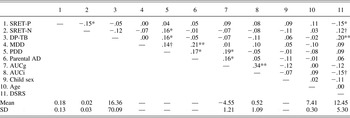
Correlations between all major study variables are shown in Table 3. Measures of children's cognitive vulnerability at age 7 tended to be only modestly intercorrelated. A lifetime history of depressive disorder in mothers was unrelated to children's CVD and cortisol indices at age 9; however, paternal depression was associated with SRET negative processing scores, threat bias scores from the dot-probe task, and AUCg, indicating that children with a paternal history of depression had more negative memory biases for self-referent information, a greater attentional bias for threat-related information, and excreted more cortisol over the course of the TSST at age 9. The parental anxiety disorder composite was positively related to both parents' depression histories as well as children's AUCg scores. Child age at baseline and sex were not significantly related to any other study variables. Child depressive symptoms were negatively related to SRET positive processing scores, positively related to threat bias scores on the dot probe task, and positively related to SRET negative processing scores (at trend level).
Correlations between Study 2 variables

Note: SRET-P, Self-referent encoding task positive processing; SRET-N, Self-referent encoding task negative processing; DP-TB, dot-probe threat bias; MDD, maternal depressive disorder; PDD, paternal depressive disorder; Parental AD, parental history of any anxiety disorder; AUCg, area under the curve with respect to ground; AUCi, area under the curve with respect to increase; Age, child age at baseline; DSRS, Depression Self-Rating Scale.
†p < .10. *p < .05. **p < .01.
We next used multiple regression to examine interactions between maternal and paternal depression history and children's cognitive risk at age 7 in predicting indices of cortisol reactivity at age 9. In particular, we were interested in testing whether children's cognitive risk moderated associations between parental depression and offspring cortisol reactivity indexed via AUCg and AUCi. Children's self-reported depressive symptoms at baseline were treated as a covariate as was parental history of any anxiety disorder (to reduce the number of model terms, this variable was a composite reflecting whether either parent had ever met criteria for an anxiety disorder; results were virtually identical when maternal and paternal anxiety history were included as separate variables). Initial models examined interactions between maternal and paternal depression with each measure of child cognitive risk predicting AUCg and AUCi; when an interaction term was not significant, it was dropped from the final model to increase model parsimony and statistical power. All variables were mean-centered as needed (Aiken & West, Reference Aiken and West1991).
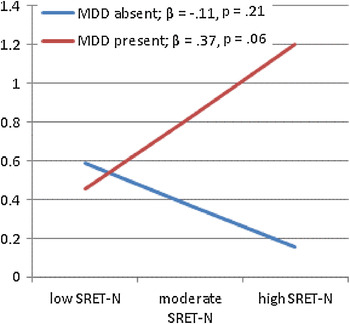
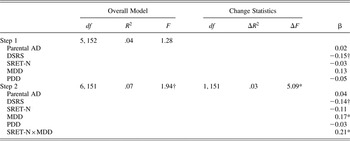
As we had four measures of cognitive risk and two indices of cortisol activity, we ran eight models in total for each measure of cognitive risk, testing whether it moderated associations between maternal and paternal depression and AUCg and AUCi. To conserve space, models with nonsignificant interactions are not presented here; these include three of the four models predicting AUCi. The regression testing the interaction between maternal depression history and child SRET-N predicting AUCi did yield a significant interaction term (Table 4), by which the significant main effect of maternal depression history on children's cortisol indexed by AUCi was qualified by its interaction with SRET negative processing. Figure 2 depicts this interaction, which shows the significant, positive association between SRET negative processing scores and children's AUCi in the context of a positive maternal depression history; the small, negative association between these scores and AUCi was not significant for children whose mothers had no history of depression.
(Color online) The interaction between maternal depression history and child self-referent encoding task negative processing (SRET-N) predicting the area under the curve with respect to increase (AUCi). MDD, Major depressive disorder (maternal).

Regression testing the interaction between maternal depression history and child SRET-N predicting AUCi

Note: SRET-N, Self-referent encoding task negative processing; AUCi, area under the curve with respect to increase; Parental AD, parental history of any anxiety disorder; DSRS, Depression Self-Rating Scale; MDD, maternal depressive disorder; PDD, paternal depressive disorder.
†p < .10. *p < .05.
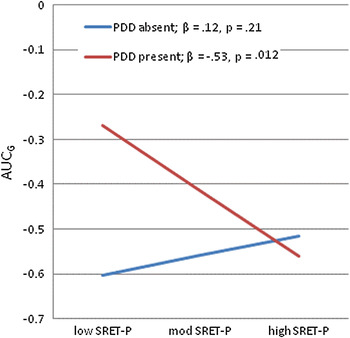
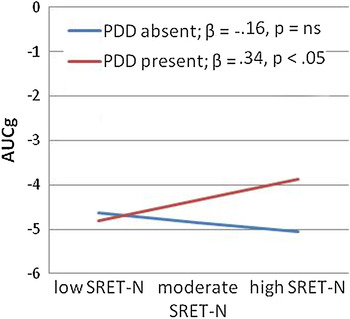
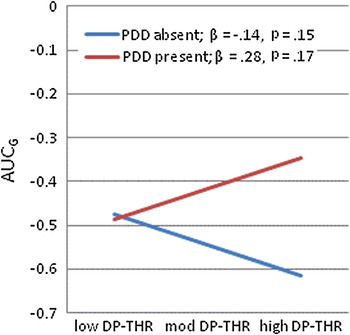
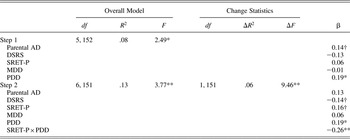
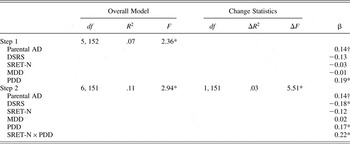
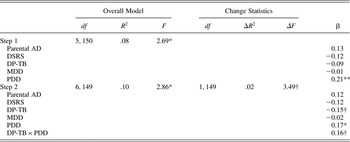
Regarding interactions between children's cognitive risk and parental depression predicting AUCg, two of the four interaction terms tested were significant, both with respect to the moderation of paternal depression history by indices of children's cognitive risk. An additional interaction between paternal depression and children's dot-probe threat bias scores was a trend in predicting AUCg scores; because of the novelty of our study and analyses, we explore this trend here, acknowledging the importance of future attempts at replication. Full models are shown in Tables 5–7 and interactions depicted in Figures 3–5. As the pattern of effects was quite consistent across these three analyses, they will be discussed as a group. In each case, the association between cognitive risk and AUCg scores was not significant for children without a paternal history of depression. For SRET positive and negative information processing, greater cognitive risk was significantly related to greater cortisol production when children's fathers' had a history of depression; although the pattern was the same for threat bias indexed using the dot probe task, the slope did not reach significance.
(Color online) The interaction between paternal depression history and child self-referent encoding task positive processing (SRET-P) predicting the area under the curve with respect to ground (AUCg). PDD, Paternal depressive disorder.

(Color online) Interaction between paternal depression history and child self-referent encoding task negative processing (SRET-N) predicting the area under the curve with respect to ground (AUCg). PDD, Paternal depressive disorder.

(Color online) The interaction between paternal depression history and child dot-probe threat bias (DP-TB) predicting the area under the curve with respect to ground (AUCg). PDD, Paternal depressive disorder.

Regression testing the interaction between paternal depression history and child SRET-P predicting AUCg

Note: SRET-N, Self-referent encoding task positive processing; AUCg, area under the curve with respect to ground; Parental AD, parental history of any anxiety disorder; DSRS, Depression Self-Rating Scale; MDD, maternal depressive disorder; PDD, paternal depressive disorder.
†p < .10. *p < .05. **p < .01.
Regression testing the interaction between paternal depression history and child SRET-N predicting AUCg

Note: SRET-N, Self-referent encoding task negative processing; AUCg, area under the curve with respect to ground; Parental AD, parental history of any anxiety disorder; DSRS, Depression Self-Rating Scale; MDD, maternal depressive disorder; PDD, paternal depressive disorder.
†p < .10. *p < .05.
Regression testing the interaction between paternal depression history and child DP-TB predicting AUCg

Note: DP-TB, Dot-probe threat bias; AUCg, area under the curve with respect to ground; Parental AD, parental history of any anxiety disorder; DSRS, Depression Self-Rating Scale; MDD, maternal depressive disorder; PDD, paternal depressive disorder.
†p < .10. *p < .05. **p < .01.
Discussion
Very little is known about the interplay across multiple levels of analysis among established markers of depression risk in predicting emerging vulnerability to depressive disorders. We examined whether associations between parental depression and children's cortisol reactivity were moderated by another well-known marker of depression risk: children's cognitive vulnerability to depression. The findings generally supported the notion that parental depression and cortisol reactivity are more strongly associated in the context of elevated levels of child cognitive vulnerability; a fairly consistent pattern did emerge across two independent samples and multiple measures of cognitive risk for depression.
We were somewhat surprised to find greater evidence for main effects and interactions involving fathers' depression, rather than mothers' depression, in shaping children's cortisol reactivity. The finding of stronger effects observed for fathers' depression, relative to mothers, was obtained in both studies, strengthening the confidence in this unanticipated pattern. In light of the scarcity of research on the role of fathers' depression in children's cortisol reactivity to stress, it is difficult to relate our work to a larger, relevant literature. To our knowledge, only one study has examined the role of paternal depression in child HPA axis function; in this study, Laurent and colleagues (Reference Laurent, Leve, Neiderhiser, Natsuaki, Shaw and Fisher2013) found that paternal depressive symptoms interacted with maternal depressive symptoms to predict lower daytime cortisol in adopted offspring. Considered as a whole, these findings suggest that the impact of paternal depression on aspects of children's cortisol function may be important and that future studies of this vulnerability pathway should include assessments of fathers as well as measures of mediators of this risk (e.g., paternal caregiving, paternal genetic risk for depression). The lack of knowledge on this topic is an important omission in the literature, given that research indicates that paternal depression is associated with youth psychopathology (Brennan et al., Reference Brennan, Pargas, Walker, Mewport and Stowe2008; Kane & Garber, Reference Kane and Garber2009), including internalizing symptoms. Cortisol reactivity may play a role in mediating these associations. In light of the trend for fathers to be increasingly involved in child rearing (National Institute of Child Health and Human Development, 2000), additional work on the role on paternal depression in children's early emerging depression is clearly needed.
It is important to note that a family history of depression is a marker of a diverse array of processes that can increase children's depression risk, including both intrinsic (e.g., genetic) and extrinsic (e.g., environmental) factors, including negative parenting practices (Lovejoy et al., Reference Lovejoy, Graczyk, O'Hare and Neuman2000). In Study 2, observational ratings of negative parenting behavior were collected at baseline; as these ratings were almost entirely based on maternal behavior, we examined whether the same pattern of interaction was obtained for the single analysis in which maternal depression interacted with children's cognitive risk (i.e., the analysis presented in Table 4) when substituting hostile and intrusive parenting for maternal depression in models. These interaction terms were not significant; thus, we cannot say that the effect of maternal depression on children's cortisol reactivity can be better understood as a marker of poor parenting. However, as we did not collect data on fathers' interactions with their children, we cannot rule out the possibility that the effect of paternal depression we found is a proxy for the negative impact of paternal depression on fathers' caregiving (Wilson & Durbin, Reference Wilson and Durbin2010). Certainly, it would stand to reason that children with heightened negative cognition (e.g., self-blaming attributions, attention and memory biases favoring negative stimuli) would be particularly susceptible to poor caregiving in terms of its impact on cortisol reactivity. Along similar lines, given the associations between depression and relationship discord, it is also possible that parental depression is a marker of parental relationship discord, which may also influence children's cortisol reactivity (Davies, Sturge-Apple, & Cicchetti, Reference Davies, Sturge-Apple and Cicchetti2011). Future work should aim to more clearly delineate specific processes that interact with children's cognitive risk to produce increased depression vulnerability.
It would be premature to apply our findings to preventative efforts. However, should future studies replicate the pattern of findings we obtained, fine-grain preventions might be developed targeting children with parental depression who also evince elevated cognitive risk, with the focus of increasing these children's coping skills and stress reduction. Prevention studies using family-based cognitive interventions in the context of parental depression that have focused on enhancing youth coping (Compas et al., Reference Compas, Champion, Forehand, Cole, Reeslund and Fear2010) are broadly complementary to this suggestion. Furthermore, previous work has shown that disengagement from negative emotional information may decrease cortisol reactivity (Ellenbogen, Hodgins, Walker, Couture, & Adam, Reference Ellenbogen, Hodgins, Couture and Adam2006). This may suggest that some of the risk associated with the presence of both familial depression and heightened cognitive vulnerability can be attenuated by training children in strategies that reduce the tendency to preferentially process negative information in their environments or by targeting children's coping strategies for dealing with stress.
We have framed heightened cortisol reactivity to stress as a marker of depression risk. While there is evidence to support this assertion, it is also important to note that cortisol reactivity may not be a marker of risk but of contextual sensitivity more broadly speaking (Belsky & Pluess, Reference Belsky and Pluess2009). According to the notion of differential susceptibility, heightened cortisol reactivity is an index of how likely an individual is to react to both positive and negative environmental circumstances; if so, the long-term implications of heightened cortisol reactivity for children's adaptation and maladaptation can only be understood in terms of the broader environmental context. Previous work also implicates certain genetic variants as markers of differential susceptibility (Hankin et al., Reference Badanes, Watamura and Hankin2011; Hayden et al., Reference Hayden, Klein, Dougherty, Olino, Dyson and Durbin2010; Reference Hayden, Olino, Bufferd, Miller, Dougherty and Sheikh2013); given the heritable basis of cortisol reactivity (e.g., Miller, Wankerl, Stalder, Kirschbaum, & Alexander, Reference Miller, Wankerl, Stalder, Kirschbaum and Alexander2013), genetic markers could be yet another important level of analyses in models of cortisol function. Further, both hyper- and hyporeactivity of the cortisol response have been linked to psychopathology risk (e.g., see Hankin et al., Reference Hankin, Badanes, Abela and Watamura2010, for evidence in depression). Further longitudinal work is therefore needed to examine the long-term outcomes related to different patterns of children's cortisol reactivity to stress.
Our study had a number of strengths. We examined interactions between cognitive risk and parental depression in two independent samples. We used multiple, diverse measures of children's cognitive risk and structured clinical interviews to assess parental depression. We collected a large number of cortisol samples for research of this kind, permitting a fuller characterization of children's HPA axis reactivity to stress, and took steps to ensure that an accurate baseline sample was obtained. We examined the interactive effects of two well-established markers of depression risk across theoretically relevant levels of analysis, an underinvestigated topic in the developmental psychopathology of depression (see Hankin, Reference Hankin2012, for a theoretical model emphasizing this approach). For Study 2, the interval between our follow-ups was lengthy for research of this kind, providing a stringent test of the relationship between children's cognitive risk, parental psychiatric history, and cortisol reactivity in middle childhood, and our attrition rates were relatively low.
However, our study also had some weaknesses. Because of funding constraints, and to reduce the burden on participants, clinical interview data were collected only on primary caregivers in Study 1; in Study 2, we collected measures of parental psychopathology at baseline only. Thus, it is possible that we missed new cases of parental depression that occurred during the 2-year follow-up period. In addition, our outcome variable was cortisol reactivity, not depression per se. Hence, further longitudinal work is needed to demonstrate that the multilevel model of risk to internalizing distress we have proposed, by which interaction between risks lead to heightened cortisol reactivity, in turn eventuates in depression or other emotional distress disorders. While we have framed our study in terms of predicting children's depression risk, heightened cortisol reactivity is also relevant to anxiety disorders (e.g., Roelofs et al., Reference Roelofs, van Peer, Berretty, de Jong, Spinhoven and Elzinga2009). While this does not negate the significance of our findings, it will be important for future research to investigate the specificity of these effects to youth depression relative to anxiety to further evaluate the applicability to the pathogenesis of anxiety as well as depression. We did not collect measures of children's stressful life events at baseline, which may also interact with cognitive risk and familial depression to predict cortisol reactivity, and we were unable to control for children's baseline cortisol reactivity because of the lack of tasks that are known to elicit comparable patterns of cortisol reactivity across different child ages. We ran multiple analyses without correction, increasing the likelihood that some associations found were due to chance and will not be replicated in future tests of interplay between parent depression and child cognitive risk. However, as so little is known in the current literature about interactions between aspects of children's depression risk, we felt a more exploratory approach to data analysis was warranted to lay the groundwork for subsequent investigations of this important topic.
In conclusion, we found in two separate samples of children that aspects of cognitive risk for depression interacted with parental depression, especially paternal depression, to predict increased cortisol reactivity to stress in middle childhood. Our findings indicate that future attempts to model children's emerging depression risk may benefit from the examination of interactions between multiple sources of vulnerability. Further, including measures of paternal depression also appears an important step toward generating a fuller picture of the dynamic nature of children's emerging stress reactivity and depression risk.