Empathy has been studied for many years now, using different theoretical approaches. This conceptual divergence in itself serves to underline how difficult it is to reach one common definition of the construct, and that it comprises many different factors or dimensions (Hogan, Reference Hogan1969; Mehrabian & Epstein, Reference Mehrabian and Epstein1972). For the same reason, multiple ways to measure the construct have been developed. As a general rule, authors have opted to focus on one of empathy’s dimensions. For instance, the Hogan Empathy Scale (EM; Hogan, Reference Hogan1969) hones in on its cognitive dimension; the Questionnaire Measure of Emotional Empathy (QMEE; Mehrabian & Epstein, Reference Mehrabian and Epstein1972) concentrates on its emotional dimension. Other scales such as the Empathy Quotient (EQ; Baron-Cohen & Wheelwright, 2004) or the Cognitive and Affective Empathy Test (Test de Empatía Cognitiva y Afectiva or TECA; López-Pérez, Fernández-Pinto & Abad, Reference López-Pérez, Fernández-Pinto and Abad2008) reflect both. Davis (Reference Davis, Stets and Turner2006) proposed a unifying definition of empathy with the Interpersonal Reactivity Index (IRI): a “set of constructs that connects the responses of one individual to the experiences of another. These constructs specifically include both the processes taking place within the observer and the affective and non-affective outcomes that result from these processes” (p. 443).
Neurobiology explains emotional contagion as an increase in autonomic arousal, so as to emulate the inner state of the other person. Physiological adjustment of arousal states are a key to being able to offer a regulated empathic response (Appelhans & Luecken, Reference Appelhans and Luecken2006).
However, none of these theories take into account the misconceptions which are in fact common amongst healthcare professionals.
Empathy from a counseling viewpoint and misconceptions
In counseling theory, empathy is defined as a tool, a skill, an attitude and a process. The success of the aid relationship depends on the counselor’s ability to empathize with the client’s inner world and convey that comprehension to the client. This empathy process consists of three phases (Casera, 1983, quoted in Bermejo, Reference Bermejo2012). In the initial, identification phase the person is listened to from an emotional and cognitive standpoint; in the second phase, which focuses on assimilation and repercussion, the counselor places the emphasis on his or her own emotional universe and detects how the other’s experience affects their own self (thus beginning their own emotional self-regulation). In the third and final phase, which focuses on separation, the counselor regains the necessary emotional and cognitive distance to provide an appropriate response.
There can be no doubt that the conceptual divergence and multiple theories used to address the empathy construct have meant that popular understanding of the term ‘empathy’ is shrouded in erroneous and confusing misconceptions. For example, empathy is not the same thing as friendliness; it is not a means to experience how others feel, nor is it based on good interpersonal understanding, nor does it mean that a person must live the same experiences or identify with the person they have in front of them (Bermejo, Reference Bermejo2012). Equally, it is not an innate, fixed quality of a person, but rather something that can be learnt and brought into play (Coutinho, Silva, & Decety, Reference Coutinho, Silva and Decety2014; Teding van Berkhout, & Malouff, 2016). In fact, it has been proved that empathic response is neither automatic nor spontaneous (Bermejo Villacieros, & Carabias, 2013), although researchers disagree on this point; some authors such as Hojat et al. (Reference Hojat, Louis, Markham, Wender, Rabinowitz and Gonnella2011) perceive empathy as a stable, unchangeable personality trait. Another common misconception is to think that empathy involves participating in, becoming infected by or letting yourself be swayed by someone else’s emotion.
Authors such as Bermejo et al. (Reference Bermejo, Villacieros and Carabias2013) have studied this kind of error amongst healthcare professionals in depth, addressing the premise that this professional collective may be more vulnerable to popular misconceptions of the empathy construct. Using the Popularization of the Term ‘Empathy’ (Popularización del Término Empatía or henceforth, PTE) scale, which reflects misconceptions such as interpreting empathy as feeling like another or friendliness (positive feeling), they found that healthcare professionals fell into this kind of error significantly more often than other groups of professionals.
From a counseling point of view, being aware of one’s own emotional state to differentiate it from that of the client enables counselors to avoid emotional spillover; separation is a key element in the empathic process, because without separation there is never empathy, only friendliness (positive feeling) or emotional and/or cognitive identification with the client (rapport or agreeing with them).
In this sense, Bermejo (Reference Bermejo2012) argues that assertiveness is a vital part of the empathic process. Assertive people can sustain balanced or anxiety-free behavior whilst expressing their emotions in a pleasant and honest way; they can exercise their rights without submitting to or ignoring the rights of others (Alberti & Emmons, Reference Alberti and Emmons1998). Whilst empathy allows a speaker to display understanding, assertiveness allows them to articulate an appropriate response.
In a similar vein, but not belonging to the core of the empathy construct, due self-esteem facilitates the empathic process. Without it, people are more emotionally vulnerable and interact less with others; they establish less effective interpersonal relationships; they experience a sense of ineptitude and have less resources to deal with this (Gil-Monte, García-Juesas & Caro-Hernández, Reference Gil-Monte, García-Juesas and Caro Hernández2008); they tend to be dependent on external validation and are particularly vulnerable in emotionally intense scenarios. However, people with high self-esteem are less affected by job stress and its effects (Hobfoll & Freedy, Reference Hobfoll, Freedy, Schaufeli, Maslach and Marek1993).
Burnout and healthcare scenarios
Burnout syndrome is present in between 30 and 70% of healthcare professionals (Lamothe, Boujut, Zenasni, & Sultan, Reference Lamothe, Boujut, Zenasni and Sultan2014). This prevalence is often blamed on the inherent difficulties of the relational world itself and the better or worse use of empathy by healthcare professionals (Bermejo, Reference Bermejo2012; Hojat et al., Reference Hojat, Louis, Markham, Wender, Rabinowitz and Gonnella2011). For instance, it has been linked to the question of Empathic Concern, with feelings of guilt (Blasco, Reference Blasco2002). On a positive note, it is considered that factors such as self-esteem (González, Souto, Fernández & González, 2016), communication skills (Gil-Monte et al., Reference Gil-Monte, García-Juesas and Caro Hernández2008) and assertiveness (Suzuki et al., Reference Suzuki, Saito, Tagaya, Mihara, Maruyama, Azuma and Sato2009) protect against burnout.
Healthcare professionals try to be empathic, given that it is linked to improved patient progress (Hojat et al., Reference Hojat, Louis, Markham, Wender, Rabinowitz and Gonnella2011) and that lack of empathy results in a lack of implication with patients (Yu, Wang, & Liu, Reference Yu, Wang and Liu2012).
However, healthcare professionals often have to face disproportionate demands (from unsatisfied clients who are going through difficult times) or demands that are impossible to meet (for instance, in cases involving terminal illness). If they put the empathic process into practice, giving emotional self-regulation its due importance and gaining the necessary separation or emotional distance, professionals would be aware of the risk of overburdening themselves when faced with situations of this kind; they could justify their dissociation and assertive response. Otherwise, the lack of ability to self-regulate their affective arousal can mean that being empathic has a personal cost (Coutinho et al., Reference Coutinho, Silva and Decety2014).
For this reason and many more, a lot of authors call for empathy training to enable healthcare professionals to protect against burnout (Coutinho et al., Reference Coutinho, Silva and Decety2014). If such training is not given, burnout can have serious repercussions on both the professional and society; the quality of personal and working lives is compromised to the extent that professionals can lose their vocation, seek to be declared unfit, use psychotropic drugs or even entertain suicidal thoughts (Cathébras, Begon, Laporte, Bois, & Truchot, Reference Cathébras, Begon, Laporte, Bois and Truchot2004). Obviously, this has a direct effect on the quality of care and eventually dehumanizes the patient-doctor relationship (Bermejo, Reference Bermejo2012).
The aim of the present research was to study to what extent common misconceptions of the concept of empathy, the use of empathy and empathic capacity affect burnout levels in healthcare professionals. To this end, one of the research’s secondary objectives was to validate the Exercise of Process of Empathy (Ejecución del Proceso de Empatía or EPE) questionnaire used to measure empathic capacity (it involves a set of subscales already validated in Spanish and described in the Method) and the Common Misconceptions scale (Errores Habituales de concepto or EH) based on the Popularization of the Term ‘Empathy’ (Popularización del Término Empatía or PTE) scale (Bermejo et al., Reference Bermejo, Villacieros and Carabias2013). Research was carried out in two phases comprising exploratory and confirmatory analyses, each using an independent sample.
Hypothesis and control variables. Expected findings.
The hypothesis of the present work is that the empathic process, as described in the counseling function and including assertiveness factor as the phase 3 dimension, is one factor that protects against burnout in healthcare professionals. Conversely, misconceptions surrounding empathy, or commonly-held errors caused by the popularization of empathy, constitute a risk factor for burnout. Finally, self-esteem (at least in some degree) is required to put the empathic capacity into practice.
As stated above, two questionnaires had to be validated in order to put this work’s hypotheses to the test: namely, the EPE questionnaire to measure empathic capacity and the questionnaire on Common Misconceptions of empathy (EH). The following control variables were measured during the data collection process, as factors required to provoke burnout: Professional Collective (Healthcare or Non-healthcare), Public-facing Care Provision (Yes or No) and Time of Direct Care Dedication (None, Occasional, Part-time or Full-time). Prior Counseling Training (Yes or No) and Prior Training in Humanist Psychotherapies (Yes or No) were also considered, as variables that in principle protect against burnout. Burnout is considered to be a work-related illness that affects professionals who provide public-facing care, with certain emotional implication in users (Álvarez & Fernández, Reference Álvarez and Fernández1991); according to the approach adopted in this research, it is more common in healthcare professionals who receive no prior training in empathy, as opposed to the kind of training that can be found in counseling and/or humanist psychotherapies.
Method
Participants
Two different participant samples were used. The first was used to analyze the factorial structure of the EPE and EH scales (described below), given their exploratory nature. All 377 attendee who took part in the Palliative Care and Family Workshops Footnote 1 organized by the Center for Health Humanization (which belongs to the ‘San Camilo’ Heathcare Center) in the Autonomous Community of Madrid, were invited to SD take part in the research. Finally, the participants were 252 (being 66.8% the response rate). Of them, 80% were women, with an average age of 40 years old, (SD = 15).
Half of this first sample had a University profile (53.4%, n = 132), and the other half belonged to the studies and occupational health field (50%, n = 118). There were few participants that marked psychology studies (12.7%, n = 30) or workplace of psychology (9.6%, n = 22).
Once the questionnaires had been validated, the second sample was then used to test the structural equation model object of research. During this second phase the sample comprised 275 participants (78% women, M = 43 years old, SD = 13.41); most of them again were attendees in the Grieving Workshops Footnote 2 (n = 218) organized by the aforementioned center, and the other part (n = 57) were students of an online Master in Counseling Footnote 3 at the same center, in collaboration with the Universidad Católica de Valencia Footnote 4 . This sample was used to validate the factorial structure identified in the first phase and to research the structural equation model.
They had University studies 70.1% (190) and were working 64.6% (170). We divided this sample into 4 groups: health 30% (77), and social 27.2% (57) professionals, psychologists 18.7% (48) and others 24.1% (62). Most were professionals who provide public-facing care 84.4% (216), with an average experience of 11.5 years (SD = 10.3), of whom part-time and full-time were 72.3% (180). With respect to prior training in empathy, they had prior counseling training 39.1% (101), and prior humanist psychotherapies 11.6% (30). Finally, 49.2% (127) had none.
Materials
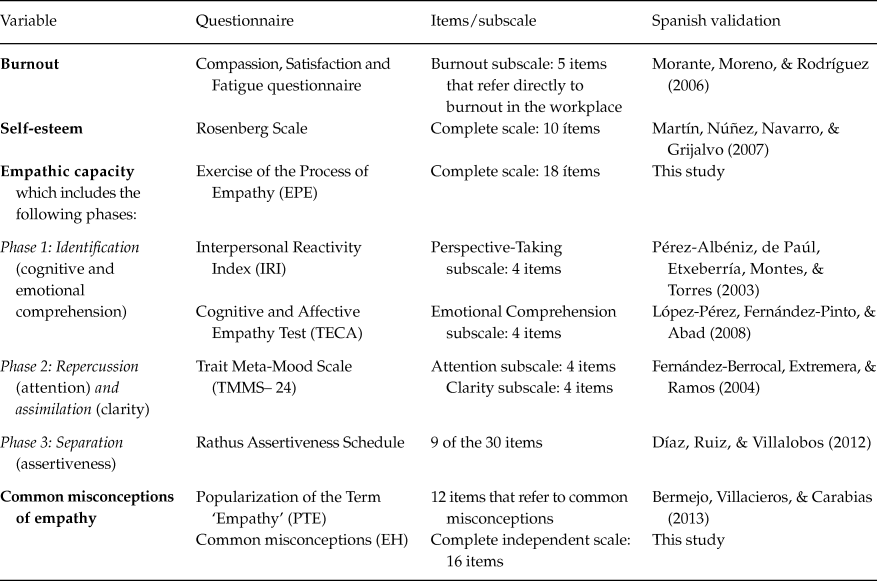
Burnout: the burnout subscale from the Compassion, Satisfaction and Fatigue questionnaire translated and adapted to Spanish by Morante, Moreno & Rodríguez (Cuestionario de Fatiga de Compasión y Satisfacción ProQOL-vIV, 2006) was used to measure the dependent variable. This scale includes ten items, although the present research concentrated on five that refer directly to burnout in the workplace. This items are measured using a six-point Likert scale (0 = Never to 5 = Very Often) (see Table 1).
Summary Table of Variables (and Questionnaires) Used to Establish SEM Model

Self-esteem: ten items adapted to Spanish from the Rosenberg Scale (Martín, Núñez, Navarro & Grijalvo, 2007) were used to measure levels of self-esteem. The items on this scale are scored using a four-point Likert scale.
Exercise of the Process of Empathy (EPE): a scale of initially 25 items gathered from different subscales validated in Spanish were used to measure empathic capacity. These covered the different phases of the empathic process, as defined in counseling (see Table 1). All the items were adapted to an identical five-point response scale (1 = Strongly Disagree to 5 = Strongly Agree). The empathic components measured in this scale included cognitive comprehension in phase 1, to collect data covering four of the seven items in Perspective-Taking subscale from the Interpersonal Reactivity Index (IRI) (Pérez-Albéniz, de Paúl, Etxeberría, Montes, & Torres, Reference Pérez-Albéniz, de Paúl, Etxeberría, Montes and Torres2003, items 8, 21, 25 and 28). Secondly, emotional comprehension was also measured in phase 1, with data covering four of the nine items in the Emotional Comprehension subscale of the Cognitive and Affective Empathy Test (TECA) questionnaire (López-Pérez et al., Reference López-Pérez, Fernández-Pinto and Abad2008, items 14, 27, 31, y 33). In third place, repercussion and assimilation or phase 2 of the empathic process was also measured, using on the one hand four of the eight of Attention subscale of the Trait Meta-Mood Scale (TMMS– 24) (Fernández-Berrocal, Extremera, & Ramos, Reference Fernández-Berrocal, Extremera and Ramos2004, items 3, 4, 7, and 8): these items define to what extent people observe and think about their feelings, emotions and mood changes. On the other hand, four of the eight items from the Clarity subscale of TMMS– 24 (Fernández-Berrocal et al, Reference Fernández-Berrocal, Extremera and Ramos2004, items 9, 12, 13 and 14) were also analyzed, to collect data relating to people’s understanding and identification of their emotional state or moods. Finally, in phase 3 the concept of separation as used in counseling was analyzed, namely establishing the emotional distance required to make an objective response to the other person. For this purpose, 9 of the 30 items in the Rathus Assertiveness Schedule adapted to Spanish (Díaz, Ruiz, & Villalobos, Reference Díaz, Ruiz, Villalobos, Ruiz, Díaz and Villalobos2012, items 2, 3, 4, 5, 6, 7, 8, 9 and 10) were used. After analysis, only 3 items of the scale remained valid.
Popularization of the Term ‘Empathy’ (PTE): Twelve items of the PTE scale (Bermejo et al., Reference Bermejo, Villacieros and Carabias2013) were used to measure popularized misconceptions of empathy. A further 4 items were added in order to complete and validate an independent Common Misconceptions (Errores Habituales or EH) scale (response scale from 1 = Strongly Disagree to 5 = Strongly Agree).
Procedure
Both studies used the same procedure: the questionnaire was handed to all workshop participants (Palliative Care and Grieving) inside the documentation pack given out at registration. Participants were asked for their collaboration and to post the completed questionnaires in boxes provided at the registration desk when the workshops finished.
Prior to this, the Healthcare Ethics Committee at the San Camilo Healthcare Center reviewed the questionnaire content and the Center’s management authorized its use during the workshops. In the instructions provided, the anonymity, confidentiality and voluntary nature of the questionnaire were emphasized, together with its objective: to investigate certain concepts such as empathy in greater depth.
Data analysis
Two exploratory factorial analyses (EFA) were carried out with the first study sample (N = 252), given the lack of a contrasted validation of the factorial structure used in the EPE scale and EH subcale. Also a CFA was carried out to validate these questionnaires studied previously and the structural equation model (SEM) was tested with the second sample (N = 275). Mplus 7.0 software was used to conduct the EFA and SEM analyses (Muthén & Muthén, 1998 – 2014) and the R statistic package was used to perform parallel analysis on the polychoric correlation matrix (psych library). The robust weighted least squares means and variance adjusted (WLSMV) estimation method was used due to the categorical nature of the variables (Abad, Olea, Ponsoda & García, Reference Abad, Olea, Ponsoda and García2011; Brown, Reference Brown2006). Polychoric correlation matrix was then used as the imputation matrix. Geomin rotation method was used in the EFA. In addition, parallel analysis and χ2, RMSEA, CFI and TLI goodness-of-fit indices were used in factor selection. The same goodness-of-fit indices were also used to assess the quality of the SEM model. A RMSEA of less than .08 (Brown, Reference Brown2006) was used as an acceptable modelling criteria, together with a standardized root of mean square residual (SRMR) of less than .08 to indicate good data fit (Hu & Bentler, Reference Hu and Bentler1998). Indicators from the Comparative Fit Index (CFI) (Bentler, Reference Bentler1989) and the non-normed fit index or Tucker-Lewis Index (TLI) were also used, where the model is considered to fit if values over .90 are obtained (Abad et al., Reference Abad, Olea, Ponsoda and García2011).
The reliability was addressed with the Cronbach’s alpha (95% CI) and Omega coefficients.
Results
Exploratory factor analysis of the EPE and PTE scales
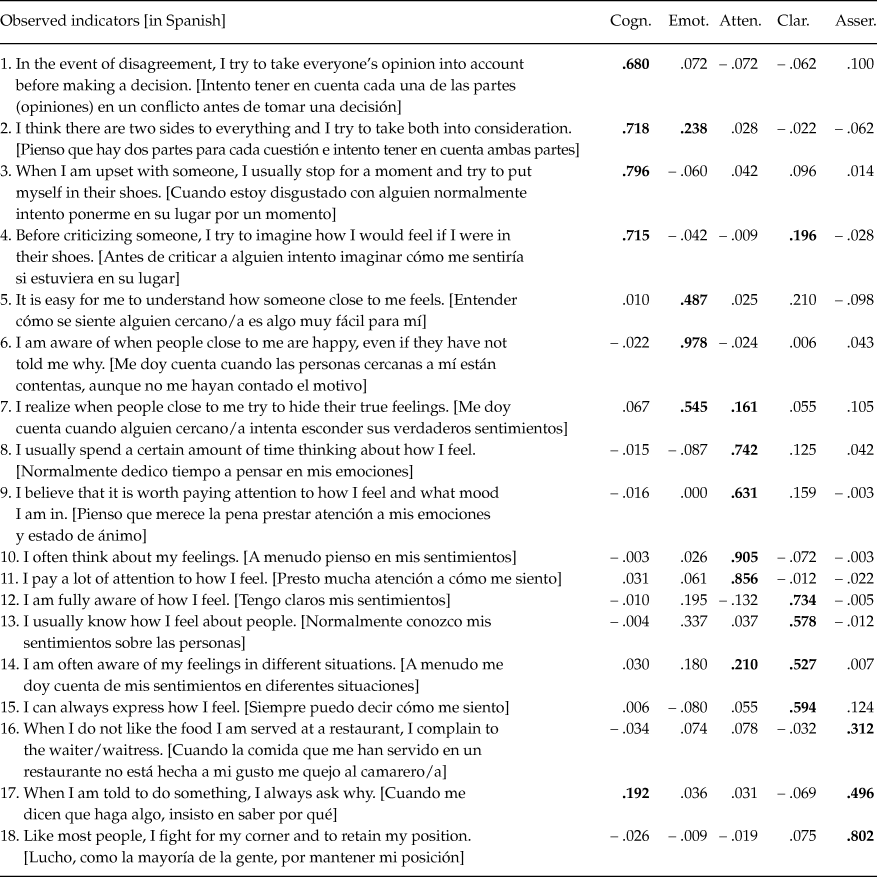
The EPE scale, as mentioned above, took 25 items from five subscales into account, all adapted to one Likert five-point response format. These scales were: cognitive comprehension, emotional comprehension, attention, clarity and assertiveness. Five items stood out for returning null or negative homogeneity indices. A further two items were ruled out in the exploratory factor analysis because up to six factor solutions were not able to reproduce the correlations observed properly. As a result, the final, fitted exploratory factor analysis contained 18 items (geomin rotation and WLSMV estimation method). The one- to three-factor solutions returned inadmissible goodness-of-fit indices (RMSEA > .08; CFI and TLI < .950). The four and five-factor solutions returned reasonably good fits (although the four-factor solution returned TLI = .922 and RMSEA = .08). Parallel analysis on the polychoric correlation matrix suggested four factors. However, the factorial weights of the five-factor solution complied with the expected structure and moreover returned all goodness-of-fit indices within the admissible range; for that reason, this solution was finally selected χ2(73) = 146.20, p < .001; RMSEA = .063 90% CI [0.048 – 0.078]; CFI = .977; TLI = .952]. Table 2 shows the fully-standardized factor loadings. All the factors positively and significantly correlated except for the cognitive and assertiveness factors (r = .02).
Factor Loadings for Exploratory Factor Analysis of Exercise of Process of Empathy scale (five-factor solution)
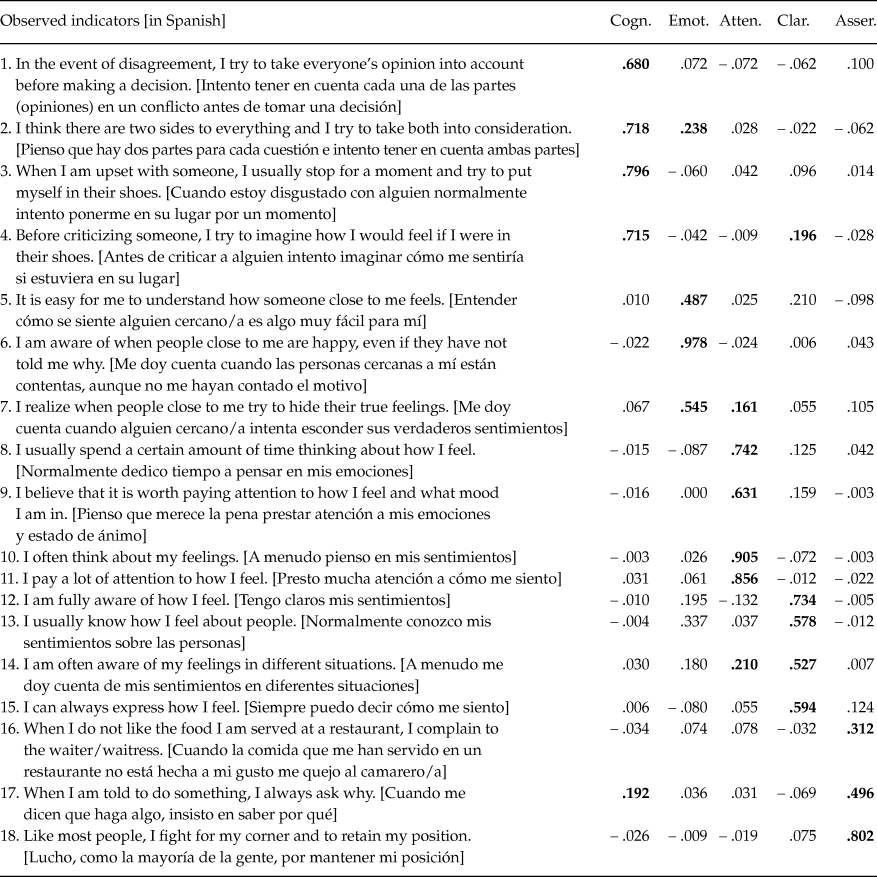
Note: Factor loadings p < .05 are in boldface. Cogn = Cognitive comprehension, Emot = Emotional comprehension, Atten = Attention, Clar = Clarity, Asser= Assertiveness.
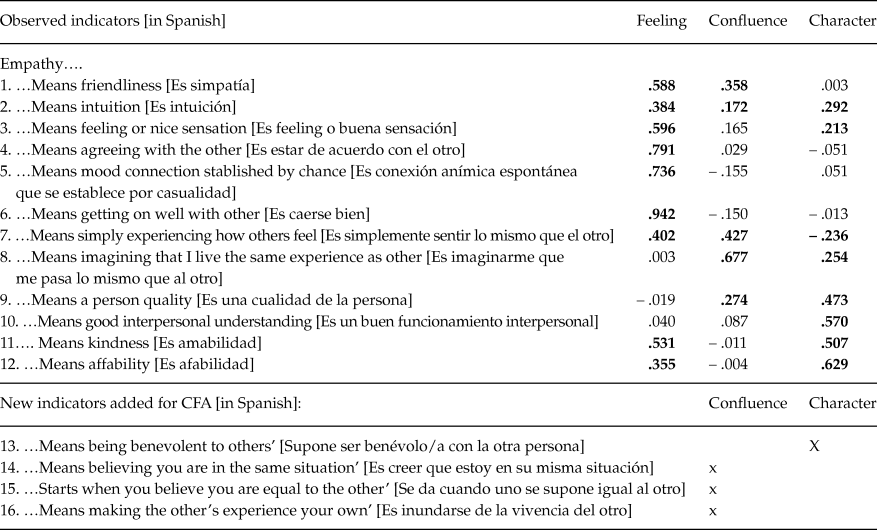
The EH scale was also put through an EFA, using the 12 items of PTE scale that reflect common misconceptions of the empathy construct. The first solution to return admissible goodness-of-fit indices was the three-factor solution χ Footnote 2 (33) = 74.940, p < .001; RMSEA = .071 90% CI [0.050 – 0.093]; CFI = .978; TLI = .957; SRMR = .039. Parallel analysis also suggested three factors. Three factors also made sense from a theoretical perspective, given that six indicators addressed the misconception that empathy is equal to Feeling (the first six indicators of Table 3). A further four indicators reflected the misconception that empathy is equal to temperament, character or a personality trait (the last four items, or the factor labeled Character). Finally, two items (7 and 8) addressed a factor labeled Confluence: these indicators reflected the misconception that empathy means feeling the same as the other.
Factor Loadings for Exploratory Factor Analysis (EFA) of Common Misconceptions Scale (Three Factor Solution) and New Items Added to Reinforce the Measurement of the Character and Confluence Factors to Be Tested in Confirmatory Factor Analysis (CFA)

Note: Factor loadings p < .05 are in boldface.
To reinforce the measurement of the Character and Confluence factors, four indicators were added to these dimensions in the second sample (confirmatory study). In particular, the item ‘Empathy … means being benevolent to others’ [Empatía… supone ser benévolo/a con la otra persona] was added to the Character dimension and the items, ‘Empathy …means believing you are in the same situation’ [Empatía…es creer que estoy en su misma situación], ‘starts when you believe you are equal to the other’ [se da cuando uno se supone igual al otro] and ‘means making the other’s experience your own’ [es inundarse de la vivencia del otro] were added to the Confluence dimension.
Confirmatory factor analysis and structural equation model
In the second, entirely independent sample, a CFA was carried out to validate the questionnaires studied previously, using the first sample. Moreover, the second sample was used to carry out the structural equation model object of research.
A three-factor structure was tested in relation to the EH scale (Feeling, Confluence and Character), through six, five and five measurable items respectively. The goodness-of-fit indices proved the model was a reasonably good fit χ2(101) = 250.59, p <.001; RMSEA = .075 90% CI [0.063 – 0.087]; CFI = .952; TLI = .943. All the standardized factor loadings were above 0.600, except for two items from the Character factor (0.363 and 0.372) and one from the Confluence factor (0.517). Alpha (95% CI) and Omega coefficients were calculated for the three subscales (factors): for Character (5 items); Alpha = .733 (.681 – .785) and Omega = .794, for Confluence (5 items); Alpha = .764 (.719 – .809) and Omega = .810 and for Feeling (6 items); Alpha = .828 (.795 – .860) and Omega = .871.
The factors in turn returned positive, high correlations (Character correlated to Feeling .824, Confluence to Feeling .662 and Confluence to Character .587), which shows that the SEM model had a second-order factor that reflected misconceptions of empathy (the second-order standardized loadings for Character, Confluence and Feeling were .855, .687 and .964 respectively).
In terms of the EPE scale, a CFA model was carried out using the five factors obtained in the EFA analysis (see Table 2). The goodness-of-fit indices showed the model fitted the data reasonably well χ Footnote 2 (130) = 307.98, p < .001; RMSEA = .073 90% CI [0.063 – 0.084]; CFI = .962; TLI = .954.
As the correlations between the factors were all positive, significant and similar in magnitude (see Table 4), a second-order model was carried out in which the second-order factor was labeled Empathy. The goodness-of-fit indices showed an improvement in the overall fit of the model χ Footnote 2 (130) = 269.63, p < .001; RMSEA = .069 90% CI [0.058 – 0.079]; CFI = .965; TLI = .959. The improvement was obtained in the RMSEA and TLI indices particularly, as indices that favor more parsimonious models and penalize more complex ones. Alpha (95% CI) and Omega coefficients of the second order factor resulted of Alpha = .848 (.819 – .874) and Omega = .906.
Correlation between the Primary Factor and Second Order Factor Loadings of the Exercise of Process of Empathy Scale

Note: a = correlations, b = second order factor loadings. All correlations and factor loadings were significant (p < .001).
The second-order factor loadings are presented in Table 4.
The Spanish-adapted Rosenberg self-esteem scale (10 items) also displayed a reasonably good fit χ2(130) = 76.53, p < .001; RMSEA = .078 90% CI [0.057 – 0.0100]; CFI = .978; TLI = .965. Our CFA solution proposed a one-dimensional factor and a method factor for inverse items, following validation studies of this scale (Tomas & Oliver, Reference Tomas and Oliver1999). A residual covariance between indicators four and five was freed. Alpha (95% CI) and Omega coefficients of the Rosenberg self-esteem scale was Alpha = .801 (.762 – .836) and Omega = .798.
Finally, our dependent variable, the latent burnout factor (five items), was also validated through a unidimensional CFA (a residual covariance between the first two items was freed). The data fitted the model well χ2(4) = 8.54, p = .06; RMSEA = .066 90% CI [0.000 – 0.0126]; CFI = .997; TLI = .992. Alpha (95% CI) and Omega coefficients of burnout scale was Alpha =.758 (.708 – .802) and Omega = .798.
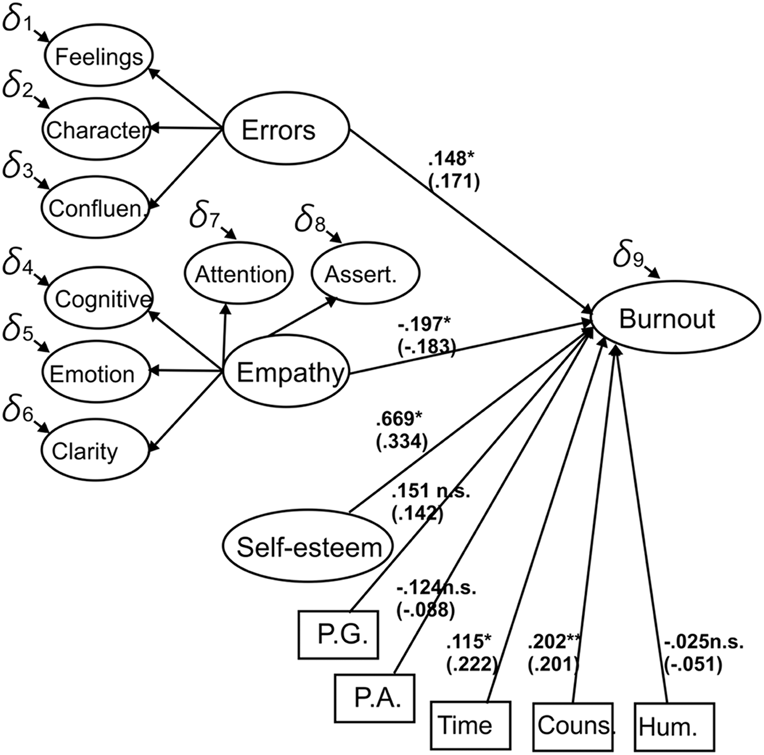
As a next step, the structural equation model was carried out. Given the model’s complexity, a schema of the constructs used can be seen in Figure 1, together with the control variables and the regression coefficients.
Measurement and structural equation model. Ovals denote involved constructs and rectangles denote control variables: P.G = Professional groups; P.A. = Public-facing care provision; Time = Time of direct care dedication; Couns = Prior counseling training; Hum. = Prior humanist training. Beta regression coefficients unstandarized (standarized) are shown; * = p < .05; ** = p < .01; n.s.= non-significant. Predictors of the model are correlated; however these correlations are omitted due to simplicity.

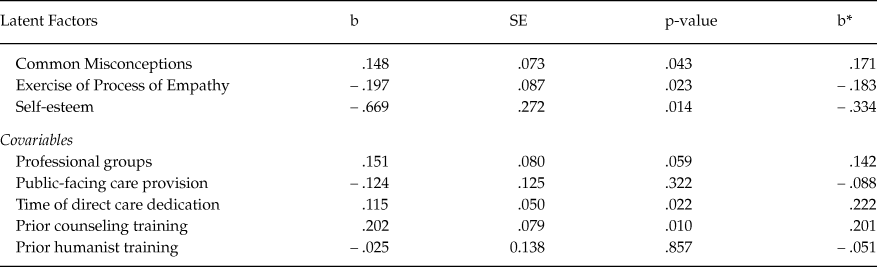
The three latent variables had significant statistical regression weights, in the expected direction (see Table 5). Looking at the standardized weight of common misconceptions (.171) and controlling other indicators, an increased standard deviation can be seen in misconceptions that predict an average .171 increase in the standard deviation of burnout, which acts as a risk factor. Equally, the standard deviation of burnout is predicted to decrease by an average of .183 for every increase in the standard deviation of the empathy factor, which acts as a protective factor. Self-esteem was the indicator that had the most significant influence on this: for each increase in the standard deviation of the factor, a predicted – .334 decrease could be seen in the standard deviation of burnout. Only two covariables were 5% significant: Time of Direct Care Dedication (None = 0, Occasional = 1, Part-time = 3 or Full-time = 4) and Prior Counseling Training (No = 0 and Yes = 1). The more exposure to the public, the higher predicted burnout. More counseling training also derives in an increase in burnout. This was the only unexpected result obtained. One possible explanation for this is that many people who sign up for counseling training do so precisely because they are suffering from burnout, so there is a masked variable that could explain the results found. It is worth mentioning that the Professional Group indicator (Non-healthcare=0 and Healthcare=1) had a marginal effect on burnout. As expected, the healthcare professional collective suffered marginally more burnout that the non-healthcare collective. Finally, the model’s R 2 was .303, in line with previous studies that have sought to explain this construct. This result reflects the extent of its average impact.
Predictors of Burnout after Structural Equation Model

Discussion
The main aim of this research was to provide an explanation for the burnout construct in healthcare professionals with minimum working experience in public-facing roles, using variables recognized in existing documentation; however, for the first time burnout was predicted in terms of the empathic process and misconception of the empathy construct. As secondary objectives, two scales were validated. In the first study (N = 252), exploratory factor analyses were conducted on scales of empathic capacity (EPE) and common misconceptions (EH). The second study (N = 252) served to confirm the models detected previously. Once the scales were validated, the structural model proved that self-esteem, the empathic capacity and misconceptions of empathy have a significant impact on burnout in healthcare professionals. The percent variance explained by these constructs is in line with the results published in other studies, which returned R 2 = .30 (Gil-Monte et al., Reference Gil-Monte, García-Juesas and Caro Hernández2008).
As the present research has explained, whilst definitions of burnout (whether it is serious, a syndrome, slight or compassion fatigue), self-esteem and assertiveness (Hobfoll & Freedy, Reference Hobfoll, Freedy, Schaufeli, Maslach and Marek1993; Martín et al., 2007) have generated a certain consensus in the body of existing documentation, the same cannot be said of empathy. This construct can be explained from a cognitive or emotional point of view, as an exercisable skill, an attitude, a process or as a stable personality trait (Bermejo, Reference Bermejo2012). Concepts associated with the construct abound, and these range from emotional contagion (Singer, Critchley, & Preuschoff, Reference Singer, Critchley and Preuschoff2009) to dimensions such as personal angst or affliction (Davis, Reference Davis1983), emotional reactivity (Baron-Cohen & Wheelwright, Reference Baron-Cohen and Wheelwright2004), the tendency to experience compassion, the tendency to be affected by the negative moods of others (Mehrabian & Epstein, Reference Mehrabian and Epstein1972), empathic distress (Batson, Reference Batson1991) and empathic happiness (López-Pérez et al., Reference López-Pérez, Fernández-Pinto and Abad2008). The wide spectrum of concepts used to define empathy has led to contradictory findings about how empathy affects burnout.
Some authors maintain that having too much empathy can lead to an increase in burnout (Rosen, Gimotty, Shea, & Bellini, Reference Rosen, Gimotty, Shea and Bellini2006). Other authors point to the iatrogenic effects of empathy, and how they can lead to burnout (Borrell, Reference Borrell2011). However, in other studies empathy was found to act as a protective factor against burnout (Coutinho et al., Reference Coutinho, Silva and Decety2014).
During care communication, a lack of training can cause a healthcare professional to be friendly towards a friendly patient and unfriendly towards an unfriendly patient. It can also cause him or her to try to be empathic without really knowing how. Borrell (Reference Borrell2011) is of the opinion that empathy is contraindicated in aggressive or blame-placing patients, because it can lead patients to believe that their reproaches or judgments of blame have been accepted. For that author, empathic behavior is a double-edged sword that should only be brought into play with certain kinds of patients, the understanding or pleasant ones; if on the contrary it is brought into play with an aggressive patient, it will undoubtedly lead to burnout.
In the present research it is sustained that this only happens when empathy is misunderstood, when it is labored with common misconceptions, when it is understood as feeling, a character trait or confluence with the other. The results obtained in this research serve to partially clarify contradictory opinion and research.
The starting hypothesis was that empathy is shrouded in a series of misconceptions; when there is a need to be empathic, for instance in the case of healthcare professionals who have received no specific prior training, there is therefore an increased risk of burnout. In this sense, the most relevant result of this research is to have established a significant link between misconceptions (b* = .171) and burnout; laboring under the misconception that empathy means being pleasant, friendly or good (the Character factor), having good rapport with the patient (Feeling) or letting yourself be affected by the emotional state of the patient as a means of getting closer to him or her (Confluence) leads to greater vulnerability to burnout, possibly due to emotional contagion (personal angst, personal affliction, tendency to experience compassion, tendency to be affected by the negative moods of others, empathic distress or, in the best scenario, empathic happiness).
Moreover, empathy returned a significant, negative weight (b* = –.183). Specifically, the second-order factor or Exercise of the Process of Empathy (EPE) scale showed an average reduction in burnout, which means that empathic capacity (or putting the five components required to provoke the three phases of empathy into play) protects against burnout in healthcare professionals. When faced with aggressive or blame-placing patients, or disproportionate demands, the empathic process helps healthcare professionals to articulate an assertive, guilt-free response. Separation or emotional rebalance frees them from any previous conditioning or prior commitment to the patient, blocks the possibility of emotional contagion or confluence and justifies their right to formulate an assertive response (Bermejo, Reference Bermejo2012; Bermejo et al., Reference Bermejo, Villacieros and Carabias2013). This would mean explaining to an aggressive or blame-placing patient that his or her reproachful behavior, judgments or threats cannot be accepted.
However, given prevalent misconceptions surrounding empathy and the lack of prior training or practice, professionals are constantly exposed to situations where they cannot attend to their own emotional universe or self-regulate their emotional state, at the consequent risk of emotional overload. This could, over time, result directly in burnout.
As far as the control variables are concerned, it was seen that the healthcare collective suffered marginally more burnout (b* = –.088) than non-healthcare groups. The time dedicated to direct care provision is another variable that has a positive and significant effect on burnout (b* = .222). The unexpected results seen with the control variable relating to prior training in counseling (β = .201), with explanatory weight in burnout syndrome, are in line with those found in other studies in the field of professional counseling. Lee, Cho, Kissinger & Ogle (Reference Lee, Cho, Kissinger and Ogle2010) classify counselors into three categories depending on their professional activities; two of these evidence medium-to-high levels of burnout.
The consequences that can be drawn from this research are above all practical, because they offer an alternative approach to avoid and/or prevent burnout. As healthcare professionals understand the theoretical definition of the term ‘empathy’ and are given strategies to put empathic responses underway in the same way they are in the counseling field, it is to be expected that common misconceptions will decrease; professionals will be able to formulate assertive responses to their clients (patients, their family members and professional colleagues), to avoid assuming responsibilities and burdens that should not fall on their shoulders, and thus provide a better quality of care.
This research does not of course substantiate a cause-effect relationship (misconceptions-burnout), but it nevertheless opens the door to a new approach from a training standpoint: to compare burnout in professionals who have undergone counseling training, with particular emphasis on the last phase of the empathy process, and those who have not.
We can therefore draw this research to a close indicating that whilst empathy tends to protect healthcare professionals against burnout, a lack of training and misconceptions about empathy make them more vulnerable and predisposed to burnout. The present research has served to validate a scale that addresses three misconceptions regarding empathy (confusing it with feeling, believing it is a character trait and emotional confluence or contagion). This scale, together with the factors of Self-esteem and Exercise of the Process of Empathy, provide a model that partially explains and clarifies how these relate to burnout syndrome in healthcare professionals; what is more, it heralds a potential means to prevent and to avoid it.