In today's pluralistic societies, constitutional courts are inevitably confronted with divisive religious disputes. Controversies over religion are among the hardest cases constitutional judges face, given the (un)reasonable disagreement that often envelops them. This difficulty translates to a shift in constitutional discourse. When adjudicating religious disputes, constitutional courts tend to reach beyond general constitutional language to open up a particular discursive register, composed of notions such as neutrality, accommodation and separation. The philosophical notions of tolerance and respect are also an integral part of this religion-specific constitutional register. Constitutional courts frequently invoke the values of tolerance and respect to indicate how society, and citizens within it, should engage with religious diversity.
Consider, by way of illustration, two recent examples from United States constitutional law: Masterpiece Cakeshop v Colorado Civil Rights Commission and American Legion v American Humanist Association. In Masterpiece Cakeshop, a Christian baker who refused to make a wedding cake for a same-sex couple was found in breach of anti-discrimination legislation by the Colorado Civil Rights Commission. The United States Supreme Court, reviewing the case under the First Amendment to the US Constitution, found that the Commission's treatment of the case disclosed constitutionally impermissible hostility towards religion.Footnote 1 How the baker was treated, the Court held, ‘was neither tolerant nor respectful of [his] religious beliefs’.Footnote 2 In future, the Supreme Court concluded in obiter,
these [kinds of] disputes must be resolved with tolerance, without undue disrespect to sincere religious beliefs, and without subjecting gay persons to indignities when they seek goods and services in an open market.Footnote 3
In American Legion the Supreme Court also repeatedly invoked the notions of tolerance and respect. In upholding the constitutionality of a 32-foot Latin cross on public grounds, the Court held that ‘destroying or defacing [a] Cross that has stood undisturbed for nearly a century would not … further the ideals of respect and tolerance embodied in the First Amendment’.Footnote 4 Earlier in its judgment, the Court emphasised that
[t]he practice begun by the First Congress [by enacting the First Amendment] stands out as an example of respect and tolerance for differing views … and a recognition of the important role that religion plays in the lives of many Americans.Footnote 5
Both examples indicate that tolerance and respect play an important part in constitutional discourse on religious freedom. The US Supreme Court is, moreover, not the only constitutional court to deploy the language of tolerance and respect in adjudicating religious disputes. The Supreme Courts of India and Israel, among others,Footnote 6 also do so.Footnote 7 But what do constitutional judges mean when they use the language of tolerance and respect? Are constitutional understandings of tolerance and respect antagonistic, as they are in political philosophy? Or do both concepts have distinct meanings in constitutional law? Apart from these conceptual questions, we should also ask substantive questions. What role do tolerance and respect play in constitutional adjudication? Do constitutional courts merely deploy them for rhetorical effect? Or does judicial reliance on tolerance and respect have an impact on constitutional interpretation of religious freedom and, concomitantly, the resolution of religious disputes?
These important questions have received less attention from constitutional scholars than they deserve. This article aims to provide answers by comparing constitutional case law on religious freedom in three liberal democracies marked by reasonable disagreement on the place of religion in public life: India, Israel and the United States. The aims of the article are twofold. First, the article seeks to identify the conceptualisation of tolerance and respect favoured by the Supreme Courts of these three jurisdictions. Second, the article aims to analyse the substantive impact of these diverging conceptualisations on the constitutional interpretation of religious freedom. The main conclusions of the comparative analysis are foreshadowed here and unpacked throughout the article.
With regard to the conceptual aim, the comparative analysis—based on a dataset of 117 Supreme Court judgments—indicates both convergence and divergence. At a more superficial level of analysis, the comparative study shows convergence in that the Supreme Courts of India, Israel and the United States frequently deploy tolerance and respect in adjudicating religious disputes. At a deeper level of analysis, however, salient divergences begin to emerge. The comparative study reveals that the three courts resort to notions of tolerance and respect to varying degrees and, more importantly, rely on different conceptions of both concepts (see Sections II and III).
With regard to its substantive aim, the article's main claim is that, although the three Supreme Courts favour diverging conceptions of tolerance and respect, a striking convergence unfolds when it comes to the actual impact that these distinct understandings have on the constitutional interpretation of religious freedom. The comparative analysis discloses that each Supreme Court relies on its distinctive understanding of tolerance in particular to circumscribe the constitutional right to freedom of religion (see Section IV).
The structure of the article is as follows. Section I provides a conceptual sounding board by outlining the multiple meanings of tolerance and respect in political philosophy. This section also explains why constitutional choices between tolerance and respect matter (in theory). Section II introduces the three jurisdictions and offers a broad overview of the relevant case law. Section III identifies the conceptualisation of tolerance and respect favoured by each Supreme Court. Section IV goes on to analyse the substantive impact of the distinctive understanding of tolerance in particular on the constitutional interpretation of religious freedom across the three jurisdictions. This section also provides linkages to ongoing processes of (alleged) democratic erosion and constitutional retrogression in all three jurisdictions.Footnote 8 The conclusion, finally, ties the comparative analysis back to the debate about tolerance and respect in political philosophy.
I. The Meanings of Tolerance and Respect in Political philosophy
Throughout this article, the primary aims are to (i) identify constitutional understandings of tolerance and respect across jurisdictions; and (ii) analyse the impact this has on constitutional interpretation of religious freedom. But to fully appreciate the ambivalence in comparative understandings of the philosophical notions of tolerance and respect, we first need to get our bearings straight. We must begin by grasping (the essentials of) the meaning of tolerance and respect in political philosophy.
In political philosophy, tolerance and respect are usually pitted against each other as antagonistic idea(l)s. Arguments for tolerance date back to at least the seventeenth century, when John Locke and Pierre Bayle advocated for the toleration of (most)Footnote 9 religious difference.Footnote 10 Tolerance has remained a core building block of liberalism ever since.Footnote 11 Yet some contemporary political philosophers argue that ‘mere’ tolerance of religious difference is not enough. Martha Nussbaum and Emanuela Ceva, for instance, posit that we should move beyond tolerance towards (equal) respect.Footnote 12 In historical perspective, this is not a novel or radical position to defend. The contemporary argument not only recalls the thoughts of Kant (who equated tolerance to arrogance) and Goethe (who found tolerance insulting).Footnote 13 It also echoes the thoughts of several founding figures of the US Constitution. James Madison, in particular, objected to the language of tolerance, because it suggested legislative grace,Footnote 14 ‘as if it were by the blessing of the majority that the minority was not persecuted’.Footnote 15 Among contemporary political philosophers, however, John Horton has countered that the alternative project of respect may well be too ambitious. Horton claims that mutual tolerance is the best we can hope for in contemporary pluralistic societies marked by ‘mutually antagonistic and hostile’ ways of life.Footnote 16 In political philosophy, in short, the role of tolerance and respect in shaping liberal responses to religious diversity remains contested.
This ongoing debate has important implications, at least in theory, for constitutional law. In theory, it matters whether constitutional courts view religious claims through the lens of tolerance or the lens of respect, since both lenses operate differently and thus generate different outcomes. Tolerance, at least as understood in political philosophy, operates as a negative lens.Footnote 17 It relies on disapproval by those with power (usually a majority) of those without power (generally a minority).Footnote 18 In its most pernicious mode, tolerance involves drawing boundaries of societal belonging, of in-groups and out-groups. Tolerance's negativity has led Nussbaum, among others, to reject it as ‘too grudging and weak’ an attitude towards religion.Footnote 19 Nussbaum prefers the rival notion of (equal) respect.Footnote 20 Unlike tolerance, respect does not have a ‘condescending and superior air’ about it.Footnote 21 In its strongest form, respect instead equates to esteem or positive regard for difference. In other words, respect operates as a positive lens.Footnote 22 But Brian Leiter and others categorically reject this positive lens as unsuited to resolve religious disputes. Leiter argues that religion is not the sort of thing that warrants respect, at least not in the strong sense intended by Nussbaum.Footnote 23 Instead, he submits, tolerance is all that is required in the face of religious difference.Footnote 24 This disagreement on the competing roles of tolerance and respect is not merely philosophical. It has practical consequences for constitutional law as well. On Nussbaum's respect framework, at least some religious exemptions from facially neutral laws that burden religious exercise are constitutionally required.Footnote 25 On Leiter's tolerance framework, by contrast, the State is under no obligation to grant such religious exemptions.Footnote 26
It thus matters, in theory, how constitutional courts view religion: through the lens of tolerance or of respect. Yet to fully understand the role of tolerance and respect in comparative constitutional law, we must dig deeper into the content of both notions. Although tolerance has a broadly accepted core meaning—of forbearance from coercively interfering with disapproved of beliefs, practices and opinionsFootnote 27—the concept is usually broken down into multiple modes and conceptions. In terms of modes, tolerance can be either a moral virtue displayed by individuals in interpersonal relations or a political practice adopted by the State towards its subjects.Footnote 28 When the Israeli Supreme Court notes that ‘[m]utual tolerance among persons of different … faiths is a fundamental precondition for the existence of a free, democratic society’, it refers to tolerance as an interpersonal moral virtue.Footnote 29 Conversely, when the United States Supreme Court rules that ‘[t]he Free Exercise Clause commits government itself to religious tolerance’, it speaks of tolerance as a State practice.Footnote 30
Importantly, philosophical objections to tolerance tend to target State tolerance, not interpersonal tolerance.Footnote 31 These objections moreover take aim at a specific conception of State tolerance, at what Rainer Forst terms the ‘permission conception’ of tolerance.Footnote 32 On this conception, ‘the authority [gave] qualified permission to the members of [a] minority to live according to their beliefs on the condition that the minority accept[ed] the dominant position of the authority’.Footnote 33 This is the understanding of tolerance deployed in early modern political acts of toleration,Footnote 34 which struck Goethe as insulting and Kant as arrogant.Footnote 35 It is also against this specific conception of State tolerance that contemporary arguments for respect instead of tolerance are generally made.Footnote 36
But tolerance and respect are not necessarily incompatible. Ian Carter argues that respect for persons is compatible with tolerance of their practices, under certain conditions.Footnote 37 Compatibility of tolerance and respect depends, Carter posits, on a specific conception of the latter as ‘recognition respect’, a notion coined by Stephen Darwall.Footnote 38 ‘To have recognition respect for someone as a person’, Darwall states, ‘is to give appropriate weight to the fact that he or she is a person by being willing to constrain one's behavior in ways required by that fact.’Footnote 39 Recognition respect is thus due to all persons.Footnote 40 As long as tolerance is reserved for responses to beliefs, opinions and practices, it is compatible with recognition respect for persons. Yet Darwall also identifies a different understanding of respect, as ‘consist[ing] in an attitude of positive appraisal of [a] person’ and her projects.Footnote 41 Such ‘appraisal respect’, he explains, is synonymous with esteem or high regard.Footnote 42 Because appraisal respect entails positive evaluation, it is logically incompatible with tolerance, which necessarily implies disapproval.Footnote 43 Appraisal respect is, in other words, inherently incompatible with tolerance.Footnote 44
The above conceptual puzzle may be unfamiliar to most (constitutional) lawyers. But the salient takeaway for constitutional law is that the meanings of tolerance and respect are multiple and nuanced. While some of these understandings are incompatible, others are not. There is, in other words, nothing inherently contradictory in the Indian Supreme Court ruling that ‘religious tolerance [is] an essential part of secularism enshrined in our Constitution’ in one judgment,Footnote 45 only to state in the next that ‘[o]ur concept of secularism is that the State … shall treat all religions … with equal respect’.Footnote 46 It all depends on how constitutional judges understand tolerance and respect, which is where we must look next.
II. Tolerance and Respect in Constitutional Law
To analyse the role of tolerance and respect in constitutional law, this article compares constitutional case law from India, Israel and the United States. The Supreme Courts of India, Israel and the United States operate in secular constitutional democracies marked by reasonable disagreement on the place of religion in public life.Footnote 47 This reasonable disagreement moreover runs along similar cleavages. Although India and Israel are characterised by a majority–minority religion relationship in which Islam is the minority religion, the central constitutional cleavage in both countries is between the religious and the secular.Footnote 48 A similar religious–secular chasm is at the heart of most contemporary religious disputes in the United States.
All three countries are also home to a majority religion—Judaism, Hinduism and Christianity—that is itself fragmented. Yet, the State's response to this fragmentation differs across the three jurisdictions. In the United States, the great diversity of Protestant sects was seen at the time of the founding, and continues to be perceived today, as a positive guarantee against religious domination by one sect over the others.Footnote 49 In other words, the social fact of religious pluralism sustains constitutional protection of religious liberty in the United States. I will argue that the notions of tolerance and respect have played an important role in shaping this constitutional framework.
In India, by contrast, fragmentation of the majority Hindu religion—through caste-based segregation—was considered a threat to national unity in the aftermath of independence and Partition.Footnote 50 The ideal of tolerance held the key to dissolving this threat. As CS Adcock explains, ‘Gandhi's deployment of Tolerance’ was instrumental in ‘disengaging Indian secularism from the politics of caste’.Footnote 51 This, in turn, ‘helped to secure a Hindu majority in India’ by bringing the Untouchables or Dalit into the Hindu fold.Footnote 52 Tolerance was not only central to ensuring Hindu unity in post-independence India, but also—as a necessary concomitant—to the creation of a Muslim minority.Footnote 53 More recently, however, constitutional emphasis on Hindu unity has taken a pernicious turn in the resurgence of the nationalist Hindutva ideology.Footnote 54 Hindutva ideologues draw on a narrative that depicts Hinduism as a uniquely tolerant religion, and the only religion truly compatible with the constitutional commitment to secularism.Footnote 55 Islam, conversely, is constructed as inherently intolerant and, therefore, a threat to the secular constitutional order.Footnote 56 In section IV, I trace how these pernicious Hindutva views have gradually burrowed their way into the doctrines of the Indian Supreme Court. I will argue that, ironically, this evolution has been facilitated by the Indian Court's positive conception of tolerance.
In Israel, finally, the legal presence of religion in public life is shaped by Orthodox Judaism. Public protection of Orthodox Judaism is the legal norm. Other streams of Judaism, conversely, are the object of varying degrees of accommodation. These religious accommodations, of Ultra-Orthodox Jews in particular, have caused increased tension with the secular majority.Footnote 57 This is evident in the opening sentence of the Israeli Supreme Court's judgment in Horev, on the closing of a central street in Jerusalem on the Sabbath. ‘[I]n Israeli public discourse’, the Court explains, ‘Bar-Ilan Street is no longer simply a street. It has become a social concept reflecting a deep-seated political dispute between the Ultra-Orthodox and the secular populations.’Footnote 58 Throughout the article, it is explained how the Israeli Supreme Court has attempted to defuse these tensions by adopting a compromise approach to religious disputes. Insistence on the value of tolerance has been instrumental in legitimating the Court's search for compromise solutions.
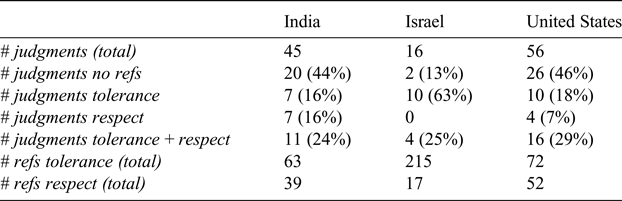
Although this article has comparative ambitions, it does not purport to explain the above-described and other convergences and divergences across the three studied jurisdictions.Footnote 59 Instead, it aims at a more profound understanding of the disparate meanings and impacts of tolerance and respect in the three jurisdictions.Footnote 60 To gain this deeper understanding, linkages will be made to other legal tools, doctrines and interpretive devices, used by the three Supreme Court to resolve religious disputes. To this end, a dataset of 117 constitutional judgments was composed: 45 judgments of the Supreme Court of India, 16 of the Supreme Court of Israel, and 56 of the Supreme Court of the United States.Footnote 61 The dataset is representative of the constitutional case law on religious freedom across the three jurisdictions.Footnote 62 It contains the landmark judgments, along with less dominant judgments, across time.Footnote 63 Initial screening of all 117 judgments for references to tolerance and respect discloses the rate at which both notions are deployed in constitutional discourse, as shown in the table below.Footnote 64
Table 1 depicts the frequency of explicitFootnote 65 references to tolerance and respect in the dataset. The table's first row reflects the distribution of the dataset across the three jurisdictions. Rows 2–5 give, per jurisdiction, the number of judgments that contain (i) no relevantFootnote 66 references to either tolerance or respect; (ii) only references to tolerance; (iii) only references to respect; and (iv) references to both tolerance and respect. Rows 6–7, finally, give the total number of references to tolerance and respect across the entire dataset, disaggregated per jurisdiction.
Explicit references to tolerance and respect in dataset

A few immediate observations stand out from the data. Perhaps most strikingly, the data indicate that the notion of tolerance dominates constitutional law and religion in Israel. Not only do most judgments of the Israeli Supreme Court only reference tolerance (63 per cent), the total number of references to tolerance also dwarfs the number of references to respect in the Israeli dataset (at 215 to 17). The data for India and the United States are comparatively more balanced, indicating at best a slight preference for tolerance over respect. But, as we will see, this minor statistical difference is inconsequential. A more significant finding is that, compared to the data for Israel, the total number of references to tolerance and respect is markedly lower in Indian and United States constitutional law and religion, at 232 for Israel, 102 for India and 124 for the United States.Footnote 67
It may seem, then, as if tolerance and respect play a less central role in Indian and US constitutional law. Chronological analysis of the data, however, reveals a different picture. In India, the 1994 judgment in SR Bommai is an undisputable defining moment for constitutional law and religion. In SR Bommai, the Indian Supreme Court entrenched secularism in the basic structure of the Indian Constitution. As discussed below, notions of tolerance and respect played an important justificatory role in support of this entrenchment. This (r)evolution in the case law has resulted in a notable increase in references to tolerance and respect in the Indian case law post-SR Bommai. Of all references in the Indian dataset, 88 per cent occur in SR Bommai and onwards.Footnote 68 In the United States, the number of references to tolerance and respect also rises noticeably after the pivotal 1984 case of Lynch. Of all references in the US dataset, 77 per cent occur in Lynch and onwards.Footnote 69
Overall, the data suggest that constitutional discourse on tolerance and respect emerged gradually in all three jurisdictions. This is not surprising in relation to respect, which is—also in political philosophy—a more recent concept.Footnote 70 But the finding is more striking in relation to tolerance, which has been a core building block of liberalism since the seventeenth century. Some of the early freedom of religion cases in all three jurisdictions were furthermore open to examination through the lens of tolerance (and its inverse: intolerance). Consider the religious practice of polygamy, for instance. Polygamy was the subject of early constitutional judgments in post-independence India, Israel and the United States. Polygamy moreover elicited profound disapproval among powerful segments of society in all three jurisdictions. In theory, we could thus expect notions of (in)tolerance to play a central role in early constitutional responses to polygamy. In reality, (in)tolerance only makes a fleeting appearance in the leading IsraeliFootnote 71 and United StatesFootnote 72 judgments (from 1951 and 1878, respectively). It does not feature at all in India's landmark polygamy ruling (from 1951).Footnote 73 Tolerance was, in other words, not yet embedded in the constitutional repertoire at the time of the polygamy cases. Instead, the notion of tolerance—and later that of respect—only gradually gained prominence in constitutional discourse on religious freedom in India, Israel and the United States.
III. Diverging Conceptualisations of Tolerance and Respect in Constitutional Law
As stated earlier, this article pursues two aims: the conceptual aim of identifying understandings of tolerance and respect in constitutional discourse in India, Israel and the United States; and the substantive aim of analysing the impact of these diverging conceptualisations on constitutional interpretation of religious freedom in the same jurisdictions. Both aims require detailed analysis of the case law. To this end, a more limited number of judgments was selected for study in a second phase of analysis. The selection was based on three parameters: (i) the extent to which a judgment is (or was) considered controlling;Footnote 74 (ii) the number of textual references to tolerance and/or respect in a judgment;Footnote 75 and (iii) representativeness of the entire dataset (that is, reflecting a wide range of religious freedom issues).Footnote 76 On the basis of these parameters, 47 judgments were selected for in-depth analysis: 18 judgments of the Supreme Court of India, 10 of the Supreme Court of Israel, and 19 of the Supreme Court of the United States. The results of the second phase of analysis—supplemented with references from the entire dataset and from the scholarly literature—are presented here, in section III, and in section IV.
This section pursues the conceptual aim of determining which conceptions of tolerance and respect the three constitutional courts rely on. The main claim is that the three courts rely on diverging conceptions of tolerance and respect, only some of which align with their understanding in political philosophy. The Supreme Court of the United States tracks the understanding of tolerance and respect in political philosophy most closely. At the same time, however, it interprets both Religion Clauses of the First Amendment differently. The Court has especially undergone a marked evolution—from tolerance to respect and back to tolerance—in its interpretation of the Free Exercise Clause. The Supreme Court of Israel, for its part, seems convinced that tolerance is more suitable than respect to tackle religious difference in a divided society. Tolerance dominates the analysed cases from Israel, whereas the rival value of respect only plays a marginal role. The Supreme Court of India, finally, does not conceive of respect and tolerance as incompatible values, but as two sides of the same coin. In Indian constitutional law, tolerance and respect align to support a positive conception of ‘ameliorative’ secularism. These claims will be unpacked in reverse order.
A. The Indian Supreme Court: Wavering between Tolerance and Respect?
The Supreme Court of India operates in a constitutional setting marked by two antagonistic claims on constitutional identity: the secular and the Hindutva.Footnote 77 Advocates from both camps have drawn on the notion of tolerance to support their aspirational claims. Initially, this ideological battle was fought outside the courts. As a result, tolerance does not feature prominently in the early case law of the Indian Supreme Court.Footnote 78 This changed, however, with the 1994 landmark case of SR Bommai. In this landmark judgment, the Supreme Court identified ‘religious tolerance’ as ‘an essential part of secularism enshrined in [the Indian] Constitution’.Footnote 79
SR Bommai would have a profound influence on the Supreme Court's religious freedom case law. One immediate consequence was a marked increase in references to tolerance and respect in subsequent judgments.Footnote 80 This change suggests that Indian Supreme Court justices have found, in the aftermath of SR Bommai, value in casting their religious freedom judgments in the language of tolerance and respect. A recurring passage on the links between tolerance and respect, India's religious diversity, and the secular nature of the Indian Constitution is indicative:
Since India is a country of great diversity, it is absolutely essential if we wish to keep our country united to have tolerance and equal respect for all communities and sects. It was due to the wisdom of our founding fathers that we have a Constitution which is secular in character, and which caters to the tremendous diversity in our country.Footnote 81
The Supreme Court's attitude towards religion, then, seems to be driven by both tolerance and respect. The Supreme Court can note in one judgment that ‘[a]rticles 25 and 26 [of the Constitution] embody a tolerance for all religions’,Footnote 82 to find in the next that ‘the Constitution gives equal respect to all … sects’.Footnote 83 It is tempting to construe this as wavering between incompatible values. But, as mentioned earlier, both statements are not inherently contradictory. Much depends on the conceptions of respect and tolerance employed.
In examining which conceptions of tolerance and respect find favour in the Indian Supreme Court, we should however remain mindful of the ‘polyvocality’ of the Indian Court.Footnote 84 Unlike the US Supreme Court, which sits en banc, the multi-bench Indian Court speaks with many voices in a wide array and immense number of cases.Footnote 85 Different benches of the Court can, and do, interpret the Indian Constitution differently.Footnote 86 Conflicting preferences of individual justices further add, especially on smaller benches,Footnote 87 to interpretive inconsistencies between judgments.Footnote 88 Nick Robinson has nevertheless argued that the Court's polyvocality does not automatically cause incoherence in its case law.Footnote 89 Robinson also posits that polyvocality can be valuable, in that it generates opportunities for justices to innovate by strategically pushing precedents in a new direction.Footnote 90 This last point is key to understanding the evolving role of tolerance in the Indian court's case law (see Section IV).
The image to emerge from the case law is, in any event, not one in which the Indian Constitution treats religion with indifference.Footnote 91 Instead, the Supreme Court reads the Constitution as extending appraisal respect to religion, against objections and disapproval in society: ‘our Constitution is benign and sympathetic of all religious creeds however unacceptable they may be in the eyes of the non-believers’.Footnote 92 Yet, herewith the spectre of incompatibility between tolerance and respect re-emerges. Following Carter, the kind of appraisal respect extended to religion by the Indian Constitution is logically incompatible with tolerance. Crucially, however, this conclusion only follows if tolerance is understood in its usual philosophical terms, as implying inherent disapproval. But the Indian Supreme Court seems to conceptualise tolerance differently. In Indian constitutional law, the disapproval inherent in tolerance is pushed to the background, allowing it to be recast as a positive value that aligns with appraisal respect.
This distinct conceptualisation is borne out most clearly in how the Supreme Court correlates tolerance—and respect—directly to India's positive conception of secularism. In SR Bommai, the Court characterises ‘religious tolerance’ as ‘an essential part of secularism enshrined in our Constitution’.Footnote 93 Importantly, the Court has said the same about respect: ‘[o]ur concept of secularism … is that … [t]he State shall treat all religions … with equal respect’.Footnote 94 At the same time, the Court has been fairly consistent in rejecting what it perceives to be the American conception of secularism, based on neutrality and a ‘wall of separation’.Footnote 95 Instead, the Court accords secularism ‘a positive meaning’.Footnote 96 Rajeev Bhargava calls this approach one of ‘principled distance’:
a value-based strategy that presupposes disestablishment and that enjoins the State to intervene in or abstain from such interventions depending upon whether specific values integral to the secular ideal are advanced.Footnote 97
All this suggests that the Indian Supreme Court relies on a distinctly positive conception of tolerance, which aligns with the idea of equal respect to inform the Constitution's positive secular stance towards religion. Ironically, however, this distinct notion of tolerance has enabled interpretive moves that ultimately undermine the Constitution's ‘benign’ stance towards religion. As will be explained in Section IV, tolerance has become a powerful tool in the Indian Supreme Court's efforts to (re)shape religion through the essential practices doctrine.
B. The Israeli Supreme Court: Committed to Tolerance
Whereas India is a secular State, the same can hardly be said of Israel. The constitutional identity of Israel is, instead, that of both a democratic and a Jewish State.Footnote 98 A central feature of Israeli constitutionalism is persistent debate on how to interpret and reconcile its ‘dual normative commitment’ to Jewish and democratic values.Footnote 99 Some constitutional scholars emphasise the ‘tension which arises from the definition of Israel as both a Jewish and a democratic state, two principles that apparently contradict one another’.Footnote 100 Gideon Sapir and Daniel Statman, for instance, highlight the clash between both values when they point out that ‘promoting the Jewish nature of the state … necessarily includes the promotion of the Jewish religion … over other religions’.Footnote 101 This, however, appears to rely on a particular understanding of ‘a Jewish state’ as equivalent with a theological State (ie. a halakhic State). Ruth Gavison, by contrast, has argued that ‘the idea(l) of a state both Jewish and democratic, is – under some conceptions – both coherent and feasible’.Footnote 102 On Gavison's argument, understanding ‘a Jewish state’ as the State in which the Jewish people exercise their right to self-determination (that is, a nation State) is compatible with a thin conception of democracy that includes some political rights (such as the right to vote and freedom of expression) but not all human rights.Footnote 103 A constitutional commitment to liberal democracy is, on Gavison's argument, ill-advised in Israel, since uniting all segments of the divided society ‘will be made much more difficult if we add to the definition of democracy notions such as liberalism’.Footnote 104
Nevertheless, as Suzie Navot explains, the Supreme Court insists ‘that “Jewish” and “democratic” are compatible as constitutional characteristics’,Footnote 105 even under a thicker understanding of liberal democracy that encompasses a full register of human rights. Indeed, in United Mizrahi Bank, the case in which the Supreme Court established its powers of strong judicial review of legislation, Justice Shamgar emphasised the integration of Jewish and democratic values,Footnote 106 while Justice Barak anticipated that solving the clash between both values would occupy the Court greatly in the future.Footnote 107 Navot argues that the Supreme Court ‘has been particularly cautious’ in adjudicating cases in which the Jewish and democratic nature of Israel appear to be in tension.Footnote 108 In such cases, many of which pertain to issues of law and religion, the Court has ‘attempt[ed] to bridge the gap and find compromises between’ the Jewish and democratic values of Israeli constitutionalism.Footnote 109 Thus, in Shavit, Justice Barak stated that ‘[o]nly the attempt to find a synthesis between the conflicting values will allow society to function [since] a rigid ruling that leaves no room for compromise … is a recipe for societal division and disintegration’.Footnote 110 As we will see shortly, the value of tolerance plays an important role in legitimating this constitutional search for compromise solutions.
Theoretically, we might expect the majority status of Jews in Israeli society, which translates into their ‘dominance in all fields of public life’, to obstruct compromise solutions in the name of tolerance.Footnote 111 We might be tempted to assume that the permission conception of tolerance—in which the Jewish majority would extend tolerance to subordinated minorities by way of grace—garners particular traction in Israel. But contrary to the broader political context—in which ethnicity plays a central roleFootnote 112—Israeli constitutional law appears to live up to the promise of moving beyond the permission conception of tolerance in responding to religious diversity. One manifestation is that the deepest religious cleavage in Israeli society is not between the Jewish majority and the Muslim and Christian minorities, but between Ultra-Orthodox Jews and secular Jews.Footnote 113 This cleavage was once subdued by a particular approach to reasonable disagreement on the place of Judaism in public life: the ‘status quo model’.Footnote 114 On this model, Daphne Barak-Erez explains, the aim was to preserve ‘an existing status quo that acknowledges the priority of religious demands in some areas in a way that reflects a social-political compromise rather than a principled decision-making’.Footnote 115
Although the status quo model itself has been steadily eroding,Footnote 116 a search for compromise solutions continues to undergird the Israeli Supreme Court's approach to religious controversies. Rather than immediately truncate religious disputes, the Court tends to nudge parties to find an amicable solution.Footnote 117 ‘Social consensus, based on compromise, is by far preferable to an imposed judicial decision’, the Court has repeatedly held.Footnote 118 The ‘hope’Footnote 119 of the Court is that parties will find a ‘social solution’, ‘based on mutual tolerance’,Footnote 120 thereby avoiding the need for a ‘legal solution’.Footnote 121 The idea, in other words, is that the moral virtue of tolerance will propel parties to a religious dispute towards a compromise, thereby avoiding the need for (constitutional) litigation.
Even when the Court sees no option but to truncate the religious dispute itself, it often settles on a compromise solution in the name of tolerance.Footnote 122 As Justice Barak held in Shavit, a case on the use of non-Hebrew characters and dates on gravestones in a Jewish cemetery, ‘[i]t is appropriate that the legal ruling should reflect, as much as possible, the spirit of compromise and tolerance, since only through these principles can the unity of society be preserved’.Footnote 123 Justice Barak, and Justice Shamgar before him, have been key figures in Israel's constitutional tolerance-narrative. Horev is arguably the defining judgment.Footnote 124 In Horev, building on what Shamgar had said earlier in Universal City Studios,Footnote 125 Barak notes that ‘the principle of tolerance [is] a basic tenet of democratic theory, vital to a pluralistic democracy’.Footnote 126 Barak further builds on his own concurring opinion in Universal City Studios to perfect the Israeli Supreme Court's ‘threshold of tolerance’ doctrine.Footnote 127 This doctrine provides the answer, says Barak in Horev, to the following question: ‘How do we resolve the complications flowing from the fact that tolerance … simultaneously justifies both protecting rights and infringing them?’Footnote 128 The answer: by searching for compromise solutions to religious disputes. Section IV unpacks the implications of this intertwining of tolerance and compromises for the constitutional interpretation of religious freedom in Israel.
C. The US Supreme Court: Contrasting Attitudes under Both Religion Clauses
Compared to Israel and India, the conceptualisation of tolerance and respect in US constitutional law is more difficult to identify. Another register of language—that of neutrality, coercion, separation, endorsement and accommodation—has partly displaced the language of tolerance and respect in US constitutional discourse on religion. The latter notions, however, arguably remain foundational to a proper understanding of the First Amendment to the US Constitution. The Supreme Court has for instance noted that ‘[a]lmost 200 years after the First Amendment was drafted, tolerance and respect for all religions still set us apart from most other countries’,Footnote 129 clarified that ‘[t]he whole theory of viewpoint neutrality is that minority views are treated with the same respect as are majority views’,Footnote 130 and indicated that ‘[m]anifesting a purpose to favor one faith over another … clashes with … a religious tolerance that respects the religious views of all citizens’.Footnote 131
The historical record also supports the claim that tolerance and respect are key to understanding the Religion Clauses of the First Amendment.Footnote 132 The converse of one of these notions—intolerance—was of course central to the emergence of what is now the United States. Many of the early settlers were escaping religious persecution in pre-toleration Europe.Footnote 133 But ironically, most of the newly founded colonies continued to engage in practices of establishment and treat adherents to other faiths with intolerance.Footnote 134 Gradually, however, practices of toleration began to emerge.Footnote 135 These practices culminated in the adoption of the Religion Clauses, which brought about the ‘tolerance and respect for all religions’ that is said to mark the present-day United States.Footnote 136
Because the American trajectory included first-hand experience with the persecution that attended establishment in England,Footnote 137 its constitutional history of tolerance diverges from the Lockean path towards the permission conception of tolerance.Footnote 138 Some of the founding figures of the US Constitution, most notably Thomas Jefferson, did adopt the Lockean argument for religious toleration.Footnote 139 But others followed a different route. As David Richards argues,
The American conception is radical in that it calls for more than toleration in Locke's sense, requiring, as Madison early insisted, a respect for the rights of conscience … [that is] motivated … by an ethics of equal respect.Footnote 140
Appreciating the ways in which some of the founding figures departed from Locke is thus key to understanding the distinct American approach to religious liberty.Footnote 141 Madison—‘the primary architect of [the] First Amendment’Footnote 142—was the central counter-figure to the Lockean-inspired Jefferson. When George Mason drafted the Virginia Declaration of Rights to read that ‘all men should enjoy the fullest toleration in the exercise of religion’,Footnote 143 Madison objected, insisting that the term ‘toleration’ be removed.Footnote 144 He objected, because to him the notion of toleration suggested legislative grace,Footnote 145 ‘as if it were by the blessing of the majority that the minority was not persecuted’.Footnote 146 A similar rejection of tolerance is evident in George Washington's letter to the Jewish congregation at Newport, in which he famously noted that ‘[i]t is now no more that toleration is spoken of, as if it was by the indulgence of one class of people, that another enjoyed the exercise of their inherent natural rights’.Footnote 147 The historical record, in short, shows that a distinctive debate on the role of tolerance surrounded the adoption of the Religion Clauses of the First Amendment.Footnote 148 Moving across time towards the present day, however, a complication emerges: the possibility of diverging tracks of constitutional interpretation under both Religion Clauses. In what follows, it is shown that the Supreme Court's interpretation of the Establishment Clause is respect-based, whereas its understanding of the Free Exercise Clause is (or remains) tolerance-based.
1. A tolerance-based understanding of the Free Exercise Clause
The Supreme Court's understanding of the Free Exercise Clause has undergone an evolution that is best appreciated by evaluating the Court's stance on religious exemptions. One should look there, because—as we saw earlier—exemptions are precluded on the Lockean understanding of tolerance,Footnote 149 while they are required under respect-based interpretations of religious freedom.Footnote 150
Initially, the Supreme Court favoured the Jeffersonian/Lockean toleration track. This is evident in the Court's categorical rejection of religious exemptions from criminal law in the free exercise cases of Reynolds and Davis. In these early cases, the Supreme Court expressed strong disapproval of the Mormons’ religious practice of polygamy. In Reynolds, the Court held that ‘[p]olygamy has always been odious among the northern and western nations of Europe’.Footnote 151 Twelve years later, in Davis, it added that not ‘everything which may be … called [religion] can be tolerated. Crime is not the less odious because sanctioned by what any particular sect may designate as “religion”.’Footnote 152
In Reynolds and Davis, disapproval of the Mormons’ religious practice was moreover attended by the power dynamics that characterise tolerance. Nussbaum argues that the growing power of the Mormon sect played a central role in the Supreme Court's polygamy judgments.Footnote 153Reynolds was decided in a societal context in which a Protestant majority refused to tolerate an ‘odious’ religious practice of a rival religious minority. The Reynolds Court did note that ‘[a]n exceptional colony of polygamists under an exceptional leadership may sometimes exist for a time without appearing to disturb the social condition of the people who surround it’.Footnote 154 But the Mormon Church, having established a strong regional power in Utah, did not fit the pattern of an ‘exceptional colony’.Footnote 155 In the face of their growing power, instead a constitutional message needed to be sent: Mormons were as much subject to the laws of the land as any other person.Footnote 156 Their religious practice of polygamy could, therefore, not be tolerated.
The Supreme Court's tolerance-based understanding of minority religious practices continued at least until Minersville.Footnote 157 In a judgment it would overrule a few years later,Footnote 158 the Court refused to grant Jehovah's Witnesses an exemption from reciting the pledge of allegiance to the American flag in school. In rejecting the exemption claim, the Minersville Court explicitly relied on the Lockean understanding of tolerance: ‘[c]onscientious scruples have not, in the course of the long struggle for religious toleration, relieved the individual from obedience to a general law not aimed at the promotion or restriction of religious beliefs’.Footnote 159
Gradually, however, the constitutional pendulum would swing away from a tolerance-based understanding of free exercise towards respect. The Supreme Court, one could say, moved from a Jeffersonian to a Madisonian interpretation of the Free Exercise Clause. This process culminated in a couple of landmark cases, spread about a decade apart: Sherbert and Yoder. These are the judgments on which Nussbaum relies when she claims that the American constitutional tradition of religious liberty is founded on equal respect.Footnote 160 In both cases, the Court carved out a constitutional exception from general, neutral laws for adherents to minority religions. Seventh Day Adventist Mrs Sherbert, who refused to work on Saturdays for religious reasons, no longer saw her access to unemployment benefits conditioned on a willingness to work on her religion's day of rest.Footnote 161 And the Yoder family could take their children out of school at the age of 14, although state law required children to attend school until the age of 16.Footnote 162
Crucially, the constitutional exemptions mandated in Sherbert and Yoder are precluded by the Lockean understanding of tolerance. The Supreme Court finding them constitutionally required thus signalled a shift towards a (more) respect-based understanding of the Free Exercise Clause. This hypothesis is supported by the constitutional discourse used in both judgments. In Sherbert, Justice Stewart held that ‘the guarantee of religious liberty embodied in the Free Exercise Clause affirmatively requires government to create an atmosphere of hospitality and accommodation to individual belief or disbelief’.Footnote 163 A similar respect-based view is borne out by the Court's description of the Old Order Amish in Yoder. Through Reynolds’ lens of tolerance, the Court had viewed the Mormons as a dangerous minority rife with ‘odious’ practices. But through Yoder's lens of respect, it described the Amish as a benevolent, ‘highly successful social unit’.Footnote 164 The Yoder Court even noted that ‘their idiosyncratic separateness exemplifies the diversity we profess to admire and encourage’.Footnote 165
Yet, the respect-based understanding of the Free Exercise Clause foreshadowed in Sherbert and Yoder never gained a firm foothold in the Supreme Court's case law. The Court rejected most claims for religious exemptions.Footnote 166 Ultimately, the Court would shift back towards a Lockean understanding of tolerance, in Smith.Footnote 167 The dissent in Smith marked the majority judgment as effectuating ‘a wholesale overturning of settled law concerning the Religion Clauses’.Footnote 168 This is hardly an overstatement. Smith allowed the earlier rulings in Sherbert and Yoder to stand.Footnote 169 But the Supreme Court was adamant that the Sherbert framework should be replaced by a ‘sounder approach’ to the Free Exercise Clause, one that precludes exemptions from generally applicable criminal law.Footnote 170 To achieve this end, the majority reverted back to the permission conception of tolerance favoured in Reynolds and Minersville. The majority cited the ‘conscientious scruples’ passage from Minersville and borrowed from Reynolds the idea that a general system of exemptions would make ‘each conscience … a law unto itself’, before concluding that religious tolerance under the Free Exercise Clause does not require exemptions from general, facially neutral laws.Footnote 171
2. A respect-based understanding of the Establishment Clause
Since Smith remains controlling today, the Free Exercise Clause is best understood in terms of the permission conception of tolerance. The Supreme Court's conceptualisation of the Establishment Clause, conversely, is arguably more respect-based. The Court has even rejected a tolerance-based understanding of the Establishment Clause, finding that it ‘affirmatively mandates accommodation, not merely tolerance, of all religions’.Footnote 172 ‘Anything less’, the Court has noted, ‘would require the “callous indifference” we have said was never intended by the Establishment Clause’.Footnote 173
If the Establishment Clause mandates more than tolerance and was never intended to display indifference towards religion, appraisal respect for religion looms large to displace these attitudes. To appreciate why the US Supreme Court treats religion with respect under the Establishment Clause, we need to examine the distinct American constitutional view of religion as special. The Supreme Court insists that ‘[t]he First Amendment's Religion Clauses mean that religious beliefs and religious expression are too precious to be either proscribed or prescribed by the State’.Footnote 174 Underlying the Court's interpretation of the Religion Clauses is, in part, a ‘conviction that religious beliefs worthy of respect are the product of free and voluntary choice by the faithful’.Footnote 175 Ironically, this engrained Protestant emphasis of belief over practice has led the Court to revert to tolerance under the Free Exercise Clause in Smith.Footnote 176 Religious beliefs remain unaffected by the Smith ruling. But the Court has acknowledged that religious practices—especially those of minority religious groups—suffer from its ruling.Footnote 177
Under the Establishment Clause, by contrast, the special respect due to religious beliefs retains its force: ‘respect for religious pluralism [is] commanded by the Constitution’.Footnote 178 As a result, ‘the Establishment Clause permits government some latitude in recognizing and accommodating the central role religion plays in our society’.Footnote 179 Most recently, this respect-based understanding of the Establishment Clause led a plurality to rule in American Legion that ‘destroying or defacing [a] Cross that has stood undisturbed for nearly a century would not … further the ideals of respect and tolerance embodied in the [Establishment Clause of the] First Amendment’.Footnote 180
This does not mean, however, that all public acts and displays of religion are constitutionally accepted. Indeed, respect for religious beliefs cuts both ways. It is not only due to those who support religious displays, but also to those with opposing views.Footnote 181 Under the Establishment Clause, then, the Court continuously walks a tightrope, attempting to be respectful of the religious beliefs of competing groups. Or, as Justice O'Connor put it three decades ago in County of Allegheny:
[e]ndorsement [of religion] sends a message to nonadherents that they are outsiders, not full members of the political community, and an accompanying message to adherents that they are insiders, favored members of the political community. … [But] [d]isapproval of religion conveys the opposite message.Footnote 182
IV. The Impact: Tolerance Circumscribes the Interpretation of Religious Freedom
The preceding section discussed the diverging conceptions of tolerance and respect that inform constitutional discourse on religion in India, Israel and the United States. The comparative analysis revealed that the Supreme Court of the three jurisdictions resorts to diverging understandings of tolerance and respect. But why and how does this matter? This section aims to show that the conceptual discourse has a substantive impact on constitutional interpretation of religious freedom in the three jurisdictions.
The principal claim in this section is that, although the three Supreme Courts favour diverging conceptions of tolerance and respect, a striking convergence unfolds in terms of the actual impact that these distinct understandings have on the constitutional interpretation of religious freedom. The comparative analysis discloses, in particular, that each Supreme Court relies on its distinctive understanding of tolerance to circumscribe freedom of religion. The US Supreme Court has resorted to an antiquated notion of tolerance to virtually eliminate religious exemptions under the Free Exercise Clause. This, however, has prompted a legislative response to bring respect back in. The Israeli Supreme Court, for its part, insists on compromise solutions in the name of mutual tolerance, but in doing so excludes religious feelings from the scope of religious freedom. In Indian constitutional law and religion, finally, tolerance has been instrumental in enabling the exclusionary workings of the Indian Supreme Court's essential practices doctrine, under which minority religious practices are increasingly deprived of constitutional protection.
A. The United States: Legislative Efforts to Bring Respect Back In
In its interpretation of the Free Exercise Clause, we saw, the US Supreme Court has shifted from a permission conception of tolerance to appraisal respect, and back again. Along with this shifting position, the scope of the constitutional right to religious freedom broadened and narrowed until Smith closed the constitutional door on religious exemptions. Yet, in Smith the Supreme Court did not consider exemptions to be wholly unwarranted. Rather, it did not find them to be constitutionally required. In other words, the Supreme Court left the decision to grant exemptions to the legislature, while anticipating that minority religions would struggle to find favour in this political arena.Footnote 183
In a sense, the Smith ruling knowingly surrendered minority religious practices to the kind of legislative grace that was so vigorously opposed by James Madison. But Congress and state legislatures have disagreed with the Court. Various US legislatures have sought to legislatively restore the respect-based, pre-Smith case law of the Supreme Court.Footnote 184 They have done so by enacting the Religious Freedom Restoration Act (RFRA) and, following RFRA's being partially struck down in Flores,Footnote 185 State-level RFRAs and the Religious Land Use and Institutionalized Persons Act (RLUIPA).
RFRA prohibits the federal government from ‘substantially burden[ing] a person's exercise of religion even if the burden results from a rule of general applicability’, unless a Sherbert-style compelling interest test is met.Footnote 186 RLUIPA does the same for ‘the religious exercise of a person [such as a prisoner] residing in or confined to an institution’, both at federal and state level.Footnote 187 Both pieces of legislation have reinstated religious exemptions, albeit at the sub-constitutional level.Footnote 188
Although Smith's tolerance-based rejection of exemptions under the Free Exercise Clause still stands, there are some indications that RFRA and RLUIPA have nudged the Supreme Court back to a more respect-based understanding of the free exercise of religion. This was already evident in Cutter and Hobby Lobby and has been confirmed more recently in Masterpiece Cakeshop. In upholding the constitutionality of RLUIPA in Cutter, the Court noted in obiter that ‘the Free Exercise Clause … requires government respect for … the religious beliefs and practices of our Nation's people’.Footnote 189 In Hobby Lobby, the Supreme Court applied RFRA to ‘closely held’Footnote 190 religious corporations who claimed to be burdened by the Affordable Care Act's contraception mandate. In finding for the claimants, the Court ruled that a less restrictive alternative was available that ‘achieves all of the Government's aims while providing greater respect for religious liberty’.Footnote 191 In Masterpiece Cakeshop, finally, the Court held that religious beliefs should be treated with tolerance and respect.Footnote 192 Under the influence of legislative efforts, then, it seems that the notion of respect might be regaining a foothold in the Supreme Court's understanding of the Free Exercise Clause.Footnote 193
Yet, the impact of a respect-based understanding of the Religion Clauses is not necessarily positive. According to certain political philosophers, appraisal respect for religious difference is to be preferred over bare tolerance thereof.Footnote 194 But this is arguably only true if respect is meted out equally. Hence Martha Nussbaum's insistence on equal respect. Based on the recent docket of the US Supreme Court, however, there are indications that majoritarian Christian denominations are benefitting disproportionately from the Supreme Court's reliance on respect for religion.Footnote 195Hobby Lobby notoriously upheld the claims of Christian ‘closely held’ corporations and Masterpiece Cakeshop did the same (even if ‘only’ on procedural grounds) for a Christian baker who refused to serve a same-sex couple.Footnote 196 Similarly, in American Legion and earlier Establishment Clause cases (including Lynch and Van Orden v Perry), the Court upheld the constitutionality of Christian symbols by secularising their religious meaning and/or emphasising their ‘passive’ nature.Footnote 197
A pro-Christian bias thus seems to have crept into the Court's case law, along with the notion of respect. Justices Ginsburg and Sotomayor have a point when they argue in dissent in American Legion that displaying a Latin cross on public land ‘elevates Christianity over other faiths’ and ‘conveys a message of exclusion’.Footnote 198 Richard Schragger and Micah Schwartzman have similarly posited that American Legion entails an ‘inversion of the Establishment Clause’ under which ‘the Court has … opened the way toward Christian preferentialism’.Footnote 199 Even before American Legion, Christian Joppke claimed that a majority of Supreme Court Justices are pandering to the conservative ‘Christian Right’ by reinterpreting the Establishment Clause to be more accommodating of religious (predominantly Christian) displays in public.Footnote 200 It is tempting to relate these pro-Christian elements in the Supreme Court's case law to the ongoing process of (alleged) democratic erosion in the United States, as pursued—or instigated—by Donald Trump's brand of right-wing and ethno-nationalist populism (as evident in, among others, his ‘Muslim travel ban’, at least the first and second iteration of which overtly targeted Muslims). Yet, even in the wake of Trump v Hawaii,Footnote 201 such conclusions would disregard the fact that the (seeming) pro-Christian bias in the Court's case law is part of a constitutional interpretive process that predates Trump's election.Footnote 202
B. Israel: The Delineating Effect of the Threshold of Tolerance Doctrine
Shlomo Fischer has argued that Israel utilises a model of tolerance that differs dramatically from the Protestant, American conceptualisation of tolerance.Footnote 203 The divergence rests chiefly, Fischer posits, in an inversion of the public–private divide.Footnote 204 On the American Protestant model, tolerance aims to protect religious liberty by relegating it to the private realm, as evidenced by the tolerance-based Smith ruling. On the Israeli model, conversely, tolerance is used as a tool to navigate the tensions that accompany the public presence of Judaism. This is espoused in Justice Joubran's holding in Ragen that ‘the value of tolerance’ should guide the Supreme Court on ‘fraught issues’ of religious diversity.Footnote 205 Justice Joubran refers, here, to horizontal tolerance, which ‘requires [an] individual to come to terms with opinions and cultural customs … even if he perceives [them] to be outrageous, abhorrent and negative’.Footnote 206
In other words, whereas the US Supreme Court resorted to the most pernicious mode of tolerance—the permission conception—in Smith, its Israeli counterpart relies on a more constructive view of tolerance. By emphasising the importance of mutual tolerance in Israel's pluralistic society, the Israeli Supreme Court aims to secure compromise solutions to divisive religious disputes.Footnote 207 ‘Tolerance is essentially the rejection of the “all or nothing” approach’, Justice Barak has noted, ‘and [supports] the promotion of mutual compromise’ instead.Footnote 208 Barak moreover considered it the Supreme Court's constitutional task to reach for tolerance-based compromises: ‘[i]t is appropriate that the legal ruling should reflect … the spirit of compromise and tolerance’.Footnote 209
The constitutional link between tolerance and compromise is evident in the Supreme Court's proposed solution to the (in)famous case on coerced gender segregation on mehadrin (‘meticulous’) bus lines. In Ragen, the Court ruled that coercive segregation could not be tolerated.Footnote 210 At the same time, however, the Court indicated that there was ‘no legal impediment to allowing’ voluntary gender segregation on buses.Footnote 211 ‘[I]t is even possible’, the Court continued, ‘that we must try to help’ those who wish to voluntarily practise gender segregation, out of ‘consideration [for their] religious needs and beliefs’.Footnote 212 In Ragen, the Supreme Court thus hinted at the need for pragmatic compromises in the face of the divisive presence of religion in Israeli public life.Footnote 213
As indicated in Section III, the importance of compromises in Israeli constitutional law and religion is predicated on the idea that ‘compromise is required by the values of the State of Israel as a Jewish and democratic state’.Footnote 214 ‘Tolerance’, in turn, ‘is among Israel's values as a democratic state [and] as a Jewish state’.Footnote 215 A primary function of tolerance in Israeli constitutional law, then, is to enable compromise solutions: ‘tolerance serves as a measure for striking the proper balance between various clashing values’.Footnote 216 But concrete balancing exercises also reveal the limits of tolerance, which ‘delineate the multicultural “playing field”’.Footnote 217 Coercive gender segregation on buses is ‘outside the multicultural playing field’,Footnote 218 but voluntary segregation may remain within it. Voluntary segregation can, in other words, be constitutionally tolerated.
In linking tolerance to a constitutional search for pragmatic compromises, the Israeli Supreme Court diverges from the US Supreme Court. The latter principallyFootnote 219 excludes religious exemptions from the scope of the Free Exercise Clause, in pursuit of the permission conception of tolerance. An analogous interpretation of religious freedom appears inconceivable under the Israeli Court's compromise-based approach.Footnote 220 Yet in other ways, the Israeli Court has also circumscribed the scope of the constitutional right to freedom of religion, in pursuit of its own conception of tolerance.Footnote 221
The Israeli Supreme Court has specifically limited the scope of religious freedom in its case law on religious feelings, which spans a wide range of issues, including broadcasting of films,Footnote 222 car traffic on the Sabbath,Footnote 223 use of non-Hebrew in Jewish cemeteries,Footnote 224 and the sale of pig meat.Footnote 225 In this specific area of its case law, the Supreme Court has translated the constitutional concern for compromise solutions into a doctrinal tool: the ‘threshold of tolerance’ test. The Court has held that ‘a society whose values are Jewish and democratic protects … religious feelings’.Footnote 226 This protection of religious feelings, however, raises the spectre of conflict with other rights. ‘[T]olerance’, the Court has acknowledged, ‘simultaneously justifies both protecting rights and infringing them.’Footnote 227 To reconcile the competing demands of tolerance, the Court has formulated a threshold of tolerance test. This test is predicated on the idea that citizens must ‘absorb’ a certain level of offensiveness ‘as part of the social contract’.Footnote 228 Only if the threshold of tolerance is exceeded, does protection of religious feelings justify interference with human rights.Footnote 229
But the threshold of tolerance doctrine is—by design—skewed against religious feelings. Under the doctrine, the Israeli Supreme Court does not engage in ‘horizontal balancing’, in which two clashing rights or two competing public interests enter a balancing exercise on equal footing.Footnote 230 Instead, the Court resorts to ‘vertical balancing’, in which the competing right (for instance freedom of expression) prevails ‘unless the violation of religious feelings is nearly certain and their violation is real and severe’.Footnote 231 That is, religious feelings only ‘trump’ human rights when offence goes ‘beyond the tolerable threshold of Israeli society’.Footnote 232 The bar is thus set very high.
The Court's reason for setting it so high relates to the constitutional status of religious feelings. The Court principally excludes such feelings from the scope of the constitutional right to freedom of religion. Instead, it equates them to a public interest.Footnote 233 And as a public interest, religious feelings are principally subordinated to constitutional rights.Footnote 234 Like any other public interest, they can overcome this principled subordination, but only when a high threshold has been exceeded. The constitutional threshold of tolerance doctrine is thus, for better or worse, stacked against religious feelings.Footnote 235
Solodkin illustrates how all of this plays out in practice. In Solodkin, the Supreme Court was confronted with deeply divisive bans on the sale of pig meat in Israeli cities.Footnote 236 As the judgment explains, consumption of pig meat traditionally elicits profound disgust in many Jews, both for religious and national-identity reasons.Footnote 237 Yet bans on the sale of pig meat have become increasingly controversial since the 1990s, when a large number of Jewish immigrants from former Soviet Union republics arrived in Israel.Footnote 238 These immigrants—and a growing number of secular Jews—were habituated to eating pig meat, whereas many other Jews (both religious and secular) continued to find consumption of pigs disgusting.Footnote 239 This constellation made Solodkin a particularly hard case for tolerance to emerge from. The Supreme Court nevertheless ruled that municipal authorities should aim for compromise solutions in regulating the sale of pig meat.Footnote 240
The judgment's famous scenario of the three villages (A, B and C) is particularly instructive. Running through the scenario, the Supreme Court applies its threshold of tolerance doctrine to three hypothetical settings: a village composed entirely of residents who oppose the sale of pig meat (village A), a village composed entirely of residents who wish to eat pig meat (village B), and a village of mixed inhabitants (village C).Footnote 241 The Court finds that tolerance is not at issue in village A, since all its inhabitants agree on banning the sale of pig meat. Municipal authorities in A-like villages can thus prohibit the sale of pig meat without violating the constitutional framework. But in village B, the Court holds, the sale of pig meat should be allowed. Here, an issue of tolerance does arise, in that inhabitants of nearby villages of the A variety might object to the sale of pig meat in an adjacent village of the B variety. But the Court argues that this ‘injury does not exceed the “tolerance level”’, because the harm is geographically removed from the objectors.Footnote 242
The most interesting of the three scenarios in Solodkin is, of course, that of Village C. Here, the challenges of mutual tolerance play out in full force. Under the threshold of tolerance doctrine, the Supreme Court nevertheless settles on a pragmatic compromise. It rules that it is open to municipal authorities in C-like villages to consider the sale of pig meat in their village to exceed ‘the “level of tolerance” that every resident ought to tolerate as a part of his living in that place’.Footnote 243 Acknowledging the harm to the religious feelings of those disgusted by the consumption of pig meat thus justifies banning its sale in C-like villages. But the Court also finds that inhabitants of C-like villages who wish to eat pig meat should have access to it. The Court specifically notes that they should be able to purchase products in the outskirts of their own village or in a neighbouring B-like village.Footnote 244 In the final analysis, then, Solodkin suggests that exclusion of religious feelings from the scope of religious freedom need not preclude the kinds of pragmatic compromises that otherwise mark the Israeli constitutional conception of tolerance.
Not everyone agrees, however, that the Supreme Court has succeeded in finding pragmatic compromises that secure an adequate balance between Israel's constitutional values as a Jewish State and a (liberal-)democratic State.Footnote 245 In the political realm, conservatives have perceived the ‘activist’ Supreme Court as paying lip service to both values, while in fact giving primacy to liberal values over Jewish values.Footnote 246 Under subsequent Benjamin Netanyahu-led governments, this has resulted in a series of counterbalancing measures, which Yaniv Roznai describes as a ‘counterrevolution’ to the constitutional revolution initiated by the Supreme Court in United Mizrahi Bank.Footnote 247 These countermeasures include the recent appointment of conservative justices to the Supreme Court,Footnote 248 adoption of Basic Law: Israel—The Nation State of the Jewish People (to shift the constitutional balance (back) in the direction of the Jewish nature of the State in the sense intended by Ruth Gavison,Footnote 249 that is as the nation State of the Jewish People),Footnote 250 and the tabling of a Bill for Basic Law: Legislation (which would, among others, introduce an override clause and a non-justiciability clause to prevent the Supreme Court from reviewing Basic Laws).Footnote 251
These developments have prompted debate on whether Israel is affected by democratic erosion and constitutional retrogression. Some Israeli scholars argue that the above measures signal ‘incremental erosion of Israel's strong democratic institutions’,Footnote 252 indicate that Israel is ‘in the developing stages of constitutional capture’,Footnote 253 or even that ‘Israel is already in a constitutional crisis’.Footnote 254 Other scholars, however, dispute the claim ‘that Israel has already slid into a process of “constitutional capture”’,Footnote 255 or even argue that the recent countermeasures ‘constitute a generally legitimate democratic response by one side of the political map in Israel—the Right—to its relative weakness in several public spheres’.Footnote 256
Since the primary concern here is with constitutional interpretation of religious freedom in this article, it is not my intention to take a stand on either side of the ‘constitutional capture’ debate. Rather, it is interesting to note how (alleged and variable) processes of democratic erosion and constitutional retrogression link the three studied jurisdictions together. As in the United States, the Israeli ‘constitutional capture’ debate responds to the implications of (religiously) conservative populism in the executive branch of government. And similarly to India, as we will see shortly, the Israeli debate centres around an ethno-religious nationalist State-formation project. But in India, contrary to in Israel, the nationalist executive has found a powerful (if possibly unwitting) ally in the Supreme Court to further their ethno-religious agenda. In the next sub-section, it is argued that a distortion of the Supreme Court's positive conception of tolerance into an instrument of power has been instrumental in facilitating this synergy between both branches of government.
C. India: The Power of Tolerance to Constitutionally Redefine Religion
Both the US and Israeli Supreme Court have, as we have seen, restricted the scope of religious freedom in pursuit of their respective conceptions of tolerance. Neither court, however, has gone so far as to limit the scope of religion itself. Quite the opposite, the US Supreme Court is adamant that it is not a constitutional court's business to define or interpret religion.Footnote 257 Its Indian counterpart, however, does not share that position. Through its essential practices doctrine, the Indian Supreme Court is more than willing to (re)interpret and (re)define religion. This distinctive approach results in a more drastic delineation of the constitutional right to religious freedom in India than in Israel or the United States. Ironically, a distorted version of the Indian Court's positive conception of tolerance has been instrumental in facilitating this interpretive move.
The Supreme Court's conception of tolerance is devoid of the element of disapproval inherent in the prevailing conceptions in American and Israeli constitutional law. Instead, in Indian constitutional law tolerance aligns with the positive lens of respect to generate a benign constitutional environment for religious freedom.Footnote 258 But this benign stance comes with a catch. To preserve its understanding of the secular constitutional framework, the Indian Supreme Court has—unlike its Israeli and American counterparts—become heavily invested in (re)defining religion. Whenever religious practices contradict secular values, they cannot—on the Indian Court's understanding of the secular constitutional framework—be part of religion. The alternative would jeopardise the Court's conception of religion as an unambiguously good thing that aligns entirely with the Constitution's secular values.Footnote 259 In its drive to preserve the (romantic) moral goodness of religion and its (fictional) constitutional alignment with secularism, the Court regularly casts out pernicious religious practices from the scope of religious freedom.Footnote 260 It does this by applying the ‘essential practices doctrine’.Footnote 261 On this doctrine, only practices that are essential to a religion, as ultimately defined by the Court itself, are worthy of constitutional protection.Footnote 262
Initially, the essential practices doctrine aimed to ‘ameliorate’ Hinduism, especially in relation to abolition of the caste system and opening up access to temples.Footnote 263 But more recently, the doctrine appears to have become a tool to curb Muslim minority religious practices, in particular. In its early freedom of religion case law, the Indian Supreme Court already restricted constitutional protection to the ‘essential part’ of religion.Footnote 264 But importantly, the Court initially left the definition of ‘essential practices’ to religious denominations, because ‘no outside authority has any jurisdiction to interfere with their decision in such matters’.Footnote 265 The Court construed its judicial role as limited to assessing the reasonableness of government intrusions on religious freedom by conducting limitation-style analysis.Footnote 266 Under the influence of Justice Gajendragadkar's views, however, the Court gradually reserved for itself the power to define the essential practices of religion.
Justice Gajendragadkar initially struck a famous ‘note of caution’, which would revolutionise the Supreme Court's essential practices doctrine, in Durgah Committee.Footnote 267 There, he warned that ‘purely secular practices … clothed with a religious form’ may well make invalid claims for constitutional protection.Footnote 268 He also noted that nominally religious practices ‘may have sprung from merely superstitious beliefs’ and are in that sense ‘unessential accretions to religion itself’.Footnote 269 Genuine religious practices thus needed to be distinguished from secular practices and superstitious beliefs.Footnote 270 Whereas the delineation was originally left to religious authorities, in Tilkayat Shri Govindlalji Justice Gajendragadkar insisted that the Supreme Court should bear the burden of deciding what counts as an essential practice of religion.Footnote 271 ‘The question will always have to be decided by the Court’, he held, ‘because the community might speak with more than one voice’ and would thus fail to come up with an unequivocal answer.Footnote 272
This shift in the Indian Supreme Court's understanding of the essential practices doctrine should be read in the context of a ‘transformative’Footnote 273 Indian Constitution. Article 25(2) of the Constitution grants the Indian State the power to regulate ‘secular activity which may be associated with religious practice’ and to provide for social welfare and reform (including by removing caste-based limitations on entry to Hindu temples).Footnote 274 Although nothing precludes the Supreme Court from incorporating these powers in limitation-style analysis under Article 25(1),Footnote 275 the Court has opted to pursue a different path under the revised essential practices doctrine.Footnote 276 To achieve the social reform ambitions of the secular Constitution, in Sastri Yagnapurushadji the Supreme Court for instance rejected a Hindu sect's claim for separate status as a religious denomination distinct from Hinduism as ‘entirely misconceived’, to prevent the sect from acting upon its ‘apprehension … founded on superstition, ignorance and complete misunderstanding of the true teachings of Hindu religion’ to let other Hindus access its temple.Footnote 277 More recently, in the Sabarimala Footnote 278 case on access of women to the Lord Ayyappa Temple at Sabarimala, the Court held that the practice of excluding women aged 10 to 50 from accessing the temple was not an essential practice of Hindu religion and therefore did not merit constitutional protection.Footnote 279
Under the essential practices doctrine, the Supreme Court thus tends to reinterpret religious practices as non-essential to religion whenever the spectre of incompatibility with the secular values of the Constitution arises.Footnote 280 By so circumscribing the scope of religious freedom, the Court has ‘tried to sustain the happy illusion that a deep pluralism of comprehensive doctrines is compatible with the public purposes of a liberal state’.Footnote 281 Although a search for perfect alignment of religion with the secular Constitution's aim of social reform explains the Court's interpretive move,Footnote 282 it is important to recognise that tolerance has facilitated this interpretive move. In what follows, I will argue that India's distinctly positive conception of tolerance has gradually been distorted into an instrument of power, thereby enabling circumscription of religious freedom through the essential practices doctrine. The primary ‘victims’ of this distortion have been minority Hindu sects and, especially, Muslims.
Two contextual factors are relevant to the distortion. The first is a constitutional vision of the majority religion of Hinduism as distinctly tolerant. The Supreme Court has described Hinduism as a religion that ‘bred a spirit of tolerance’ and as ‘a tolerant faith [whose] tolerance … has enabled [other religions] to find shelter and support upon this land’.Footnote 283 Ronojoy Sen has explained that the Court's views on this point correspond, in historical perspective, to the inclusivist strand of reformist Hinduism, which ‘argued for Hinduism as a universal and tolerant religion’.Footnote 284 But, Sen has added, proponents of inclusivist Hinduism also ‘believed in the superiority of Hinduism’.Footnote 285
Here enters the second factor: the benevolent majoritarianism that underlies majority–minority religious relations in India. In SR Bommai, Justices Jeevan Reddy and Agrawal noted that ‘the Indian tradition of tolerance and fraternity’ inspired the creation of a secular State that would not stand minorities being treated as second-class citizens.Footnote 286 At the same time, however, they also found that ‘the dominant thinking appears to be that the majority community, Hindus, must be secular and thereby help the minorities to become secular’.Footnote 287 Rochana Bajpai has remarked, in this context, that the tolerance of the Hindu majority towards religious minorities is that of a
responsible, easygoing, benevolent, and self-sacrificing older brother – indulgent, protective, and accommodating of even the excessive and unreasonable demands of his younger and weaker brothers, the minorities.Footnote 288
This ‘benevolent’ tolerance is positive, in the sense that it is devoid of disapproval. But it remains marked by the second component of tolerance: power. In this case the power of the older brother (Hinduism) to help his younger siblings (chiefly Islam) to become secular. Such exercise of power in the absence of disapproval has arguably enabled tolerance to justify the Supreme Court's interpretive moves in the (re)calibration of the essential practices doctrine.
We know, for instance, that Justice Gajendragadkar was part of the ‘progressive elites who desire[d] to use the power of the State to “bring about enormous changes” [in Indian society]’.Footnote 289 In this judicial project, he was ‘profoundly influenced by the Nehruvian vision of an “all-embracing and all-powerful Leviathan of state power and bureaucracy” radically transforming Indian society’.Footnote 290 By taking up the ‘Hobbesian mandate’,Footnote 291 Justice Gajendragadkar and the Supreme Court with him have drawn on the power element inherent in tolerance to reshape the contours of the constitutional right to religious freedom.
Once the leviathan had been unleashed, however, it proved impossible to control. Later Justices seized upon Gajendragadkar's description of Hinduism as ‘a way of life’Footnote 292 to (unwittingly) further the Hindutva conception of a homogenous Hinduism on which ‘Christians and Muslims [are constructed] as a threat to the Hindu nation’.Footnote 293 In a second major recalibration of the essential practices doctrine, the Indian Supreme Court has, Ratna Kapur explains, ‘construct[ed] a singular and unitary religion that has inadvertently aligned with the agenda of the Hindu Right and reinforced Hindu majoritarianism’.Footnote 294
In Ramesh Yeshwant Prabhoo, a bench of the Indian Supreme Court not only described the nationalist Hindutva belief as ‘a synonym of “Indianisation”, i.e., development of uniform culture by obliterating the differences between all the cultures co-existing in the country’.Footnote 295 The bench also legitimated the Hindutva belief by describing it as ‘indicative … of a way of life of the Indian people’ rather than a religion.Footnote 296 As it was held not to be a religion, promoting Hindutva beliefs could not contravene electoral legislation, which bars candidates from appealing to religion during election campaigns.Footnote 297 Instead, the Court held, use of the words Hindutva and Hinduism should be understood to ‘promote secularism’ or ‘criticize the policy of any political party as discriminatory or intolerant’.Footnote 298 The Hindutva movement was thereby cast in the role of the tolerant party promoting secularism against ‘intolerant’ political parties.
Here, the interplay between the Supreme Court's role as an (unwitting) enabler of Hindu-nationalist discourse, on the one hand, and the ongoing process of democratic retrogression in India, on the other, becomes particularly salient. Several commentators have pointed out that the Court's equating of the nationalist Hindutva ideology with a ‘way of life’ in the ‘Hindutva’ cases has ultimately contributed to electoral victories of Narendra Modi's Hindu-nationalist Bharatiya Janata Party (BJP), since the BJP could now openly advocate its Hindu-nationalist ideology in electoral campaigns without falling foul of the ban on appeals to religion for electoral purposes.Footnote 299
Following Modi's rise to power in 2014 (confirmed and strengthened during the 2019 elections), India has been described as being on a trajectory towards an ‘illiberal democracy’,Footnote 300 marked by ‘national-populism’Footnote 301 and ‘executive aggrandizement’.Footnote 302 The Modi government is pursuing a Hindu-nationalist State-formation project attended by exclusion of minorities, especially of Muslims.Footnote 303 To cite just one recent example,Footnote 304 in December 2019 the BJP-controlled Parliament passed the Citizenship (Amendment) Act 2019, which enables migrants ‘belonging to Hindu, Sikh, Buddhist, Jain, Parsi or Christian community from Afghanistan, Bangladesh or Pakistan’ who initially entered India without a valid permit to regularise their stay and apply for citizenship. The Act, however, does not cover Muslim migrants, who remain designated as ‘illegal migrants’ and can thus not claim citizenship.
Importantly, the Modi government's exclusionary project can draw on (potentially unwitting) historical support by the Supreme Court. As Kapur argues, in ‘a series of decisions … the Indian Supreme Court has endorsed the Hindu Right's majoritarian and homogenising understanding of religion’.Footnote 305 By contrast, minority religious practices that could have been the object of ‘benign’ and ‘benevolent’ tolerance, have instead been excluded from the scope of religious freedom as non-essential. Muslim minority practices, in particular, have suffered from this pernicious turn in the essential practices doctrine. The relevant cases often centre on divisive issues on which Hindu-nationalist interests are diametrically opposed to the interests of the Muslim minority (or segments thereof). Two such issues are discussed here.Footnote 306
One of the most divisive religious issues in India concerns the destruction of the Babri mosque in Ayodhya by Hindu nationalists in 1992. With the express support of the BJP, Hindu nationalists have claimed the disputed site as the birthplace of Lord Ram and aim to (re)construct a temple to this deity at the site.Footnote 307 In a series of cases, the Supreme Court has effectively ruled in favour of the Hindu-nationalist majority, thereby paving the way for the (re)building of the temple. In Ismail Faruqui, the Court rejected the claim that government acquisition of the site of the destroyed mosque had violated Muslims’ religious freedom. Although the Court could have dispensed with the case on other grounds, it did so by excluding prayer at a mosque from the very scope of religious freedom. In the name of tolerance and secularism,Footnote 308 the Court ruled that ‘[a] mosque is not an essential part of the practice of the religion of Islam and namaz (prayer) by Muslims can be offered anywhere’.Footnote 309 Once prayer at a mosque had been labelled a non-essential practice of Islam, the conclusion swiftly followed that acquisition of the mosque in exercise of the ‘sovereign or prerogative power of the State’ did not contravene the Constitution.Footnote 310
In its 2019 ruling on the Ayodhya case, the Supreme Court definitively settled the religious dispute in favour of the Hindu-nationalists by upholding a petition submitted in the name of the Lord Ram himself.Footnote 311 The Court paid lip service to the values of tolerance and respect in its judgment, noting that ‘[t]olerance, respect for and acceptance of the equality of all religious faiths is a fundamental precept of fraternity [in the Indian constitutional framework]’.Footnote 312 In principle, this translates to a ‘solemn duty which was cast upon the State to preserve and protect the equality of all faiths as an essential constitutional value’.Footnote 313 In practice, however, the 2019 ruling supports the Hindutva agenda by paving the way for (re)construction of a Hindu temple on the site.
A similarly divisive issue concerns the slaughter of cows. The sacred nature of the cow to (most) Hindus is reflected in the Indian Constitution. A non-justiciable Directive Principle in Article 48 of the Constitution enjoins the State to ‘take steps for … prohibiting the slaughter, of cows and calves’. As Arun Thiruvengadam explains, this Directive Principle ‘was originally inserted [in the Constitution] to appease Constituent Assembly members of a Hindu nationalist persuasion who had a specific commitment to cow protection’.Footnote 314 Several Indian states, among which the state of Gujarat, have adopted an absolute ban on cow slaughter over the past couple of decades. The Supreme Court reviewed—and upheld—the Gujarat ban in Mirzapur Moti Kureshi.Footnote 315 This ruling allows us to draw insightful contrasts to the Israeli tolerance-based approach. Whereas the Israeli Solodkin case deals with an animal—the pig—that provokes disgust among Jews, the Indian Mirzapur Moti Kureshi case focuses on another animal—the cow—that enjoys great reverence among Hindus.Footnote 316 Yet both cases are also analogous in the sense that what is done to the animal—selling its meat in Israel, slaughtering it in India—elicits strong disapproval in powerful segments of society. This makes cow slaughter in India, much like the sale of pig meat in Israel, a difficult case for tolerance.Footnote 317
Under the tolerance-based compromise solution favoured in the Israeli Solodkin judgment, an absolute ban such as the one in place in Gujarat would arguably not stand. The Israeli Supreme Court would likely consider it to impede the compromise required by the Israeli conception of tolerance. The Indian Supreme Court, however, upheld the absolute ban in Gujarat. In an obiter passage, the Court applied its essential practices doctrine to confirm that ‘[s]laughtering of cows on [the Muslim holy day of] BakrI'd is neither essential to nor necessarily required as part of the religious ceremony’.Footnote 318 Immediately afterwards, the Court noted that ‘it is common knowledge that the cow and its progeny, i.e., bull, bullocks and calves are worshipped by Hindus’.Footnote 319 It further held, in line with the Hindu-majoritarian argument, that it would be ‘an act of reprehensible ingratitude to condemn a cattle in its old age as useless and send it to a slaughter house taking away the little time from its natural life that it would have lived’.Footnote 320 In sharp contrast to the Israeli approach, the Indian Court thereby rejected the possibility of a compromise solution. Instead, as in other cases, the Court sided with the Hindu-majoritarian argument by finding a minority religious practice ‘optional’ and ‘not covered’ by the constitutional right to religious freedom.Footnote 321 This has emboldened the Hindu-nationalist BJP to enact absolute bans on cattle slaughter in several other states.Footnote 322 It is in these kinds of cases, then, that the pernicious distortion of India's conception of tolerance—benevolent in principle, but a majoritarian instrument of power in practice—bears its teeth.
V. Conclusion
Tolerance and respect are powerful notions in political arguments about how liberal democracies should respond to religious diversity. An ongoing debate in political philosophy pits both concepts against each other. Political philosophers like Nussbaum favour appraisal respect over tolerance, because the former grants greater protection to religious minorities. In part, Nussbaum's argument is borne out by the comparative analysis presented in this article. This is unsurprising in relation to US constitutional law and religion, since the case law of the US Supreme Court provided the backdrop against which Nussbaum proposed her argument for equal respect.
The Supreme Court's interpretation of the Free Exercise Clause can, we saw, be likened to a pendulum swinging from tolerance to respect and back again. In resorting to the permission conception of tolerance to interpret the Free Exercise Clause, in particular, the Supreme Court tracked a common (if outdated) understanding of tolerance that is particularly detrimental to the rights of religious minorities (who are more likely to demand exemptions from facially neutral laws). At the same time, however, there are indications that constitutional reliance on respect can also go hand in hand with pro-majoritarian biases. This is especially the case when respect is not meted out equally but ends up privileging (adherents to) the majority religion. In that sense, the constitutional analysis in this article underscores the importance of arguments for equal respect in political philosophy.
We have seen that the other Supreme Courts studied in this article conceive of tolerance and respect in ways that do not mirror their understanding in political philosophy. In relation to tolerance in particular, diverging conceptions can be found in Indian and Israeli constitutional law. The Israeli Supreme Court, for its part, has secured a constructive role for tolerance as a pragmatic tool in the search for compromise solutions to divisive religious disputes. The Indian Supreme Court has moved even further away from the philosophical understanding of tolerance by deploying tolerance as a distinctively positive concept, devoid of the disapproval that attends the notion in political philosophy.
But the Indian case also indicates that the political philosophy debate might have overlooked—or, rather, underestimated—the salience of power differentials in the workings of tolerance.Footnote 323 In philosophical debates, disapproval is often taken as the core problem with tolerance in liberal democracies.Footnote 324 When political philosophers argue against tolerance, they tend to focus on the disapproval inherent in tolerance.Footnote 325 Yet in Indian constitutional law, a disapproval-free conception of tolerance has gradually morphed into a majoritarian instrument of power. The Indian example thereby indicates that power differentials may irrevocably separate tolerance from respect, ultimately rendering both notions incompatible regardless of which conceptions one favours.
Constitutional choices therefore have to be made. Nussbaum and others may well be right to insist that we ought to view religious diversity through the lens of equal respect, since doing so precludes the kind of subordination and domination that attends tolerance. But this does not mean we should abandon tolerance altogether. For one thing, among citizens of pluralistic societies the disapproval-laden notion of tolerance may be the only viable response to divisive beliefs and practices.Footnote 326 In its distinctive understanding in Israeli constitutional law, tolerance also seems to be working rather well. Finally, as has been argued elsewhere, tolerance continues to play an important role in how the law responds to controversial moral issues.Footnote 327 Nevertheless, both political philosophy and constitutional law would do well to further unpack the relationship between tolerance and respect, on the one hand, and power and subordination, on the other.